EP1457318A1 - Polyesterfolie mit verbesserter Sauerstoffbarriere, enthaltend Poly(m-xylol-adipinamid) und eine Barrierebeschichtung, Verfahren zu ihrer Herstellung und ihre Verwendung - Google Patents
Polyesterfolie mit verbesserter Sauerstoffbarriere, enthaltend Poly(m-xylol-adipinamid) und eine Barrierebeschichtung, Verfahren zu ihrer Herstellung und ihre Verwendung Download PDFInfo
- Publication number
- EP1457318A1 EP1457318A1 EP20040000706 EP04000706A EP1457318A1 EP 1457318 A1 EP1457318 A1 EP 1457318A1 EP 20040000706 EP20040000706 EP 20040000706 EP 04000706 A EP04000706 A EP 04000706A EP 1457318 A1 EP1457318 A1 EP 1457318A1
- Authority
- EP
- European Patent Office
- Prior art keywords
- film
- polyester film
- film according
- polyester
- base layer
- Prior art date
- Legal status (The legal status is an assumption and is not a legal conclusion. Google has not performed a legal analysis and makes no representation as to the accuracy of the status listed.)
- Granted
Links
- 230000004888 barrier function Effects 0.000 title claims abstract description 42
- 229920006267 polyester film Polymers 0.000 title claims abstract description 33
- 238000000576 coating method Methods 0.000 title claims abstract description 28
- 239000011248 coating agent Substances 0.000 title claims abstract description 26
- -1 polymetaxylylene Polymers 0.000 title claims abstract description 23
- 238000000034 method Methods 0.000 title description 18
- GVNWZKBFMFUVNX-UHFFFAOYSA-N Adipamide Chemical compound NC(=O)CCCCC(N)=O GVNWZKBFMFUVNX-UHFFFAOYSA-N 0.000 title description 2
- 239000000203 mixture Substances 0.000 claims abstract description 23
- 238000004519 manufacturing process Methods 0.000 claims abstract description 16
- 238000001125 extrusion Methods 0.000 claims abstract description 10
- OFOBLEOULBTSOW-UHFFFAOYSA-N Propanedioic acid Natural products OC(=O)CC(O)=O OFOBLEOULBTSOW-UHFFFAOYSA-N 0.000 claims abstract description 6
- VZCYOOQTPOCHFL-UPHRSURJSA-N maleic acid Chemical compound OC(=O)\C=C/C(O)=O VZCYOOQTPOCHFL-UPHRSURJSA-N 0.000 claims abstract description 6
- 239000011976 maleic acid Substances 0.000 claims abstract description 6
- VZCYOOQTPOCHFL-UHFFFAOYSA-N trans-butenedioic acid Natural products OC(=O)C=CC(O)=O VZCYOOQTPOCHFL-UHFFFAOYSA-N 0.000 claims abstract description 6
- 229920000728 polyester Polymers 0.000 claims description 29
- LYCAIKOWRPUZTN-UHFFFAOYSA-N Ethylene glycol Chemical compound OCCO LYCAIKOWRPUZTN-UHFFFAOYSA-N 0.000 claims description 26
- KKEYFWRCBNTPAC-UHFFFAOYSA-N Terephthalic acid Chemical compound OC(=O)C1=CC=C(C(O)=O)C=C1 KKEYFWRCBNTPAC-UHFFFAOYSA-N 0.000 claims description 19
- BEWAXVGXILNLGM-UHFFFAOYSA-N 2-(2,6-dimethylphenyl)hexanediamide Chemical compound CC1=CC=CC(C)=C1C(CCCC(N)=O)C(N)=O BEWAXVGXILNLGM-UHFFFAOYSA-N 0.000 claims description 17
- 229910052760 oxygen Inorganic materials 0.000 claims description 16
- 239000001301 oxygen Substances 0.000 claims description 16
- 239000000126 substance Substances 0.000 claims description 16
- QVGXLLKOCUKJST-UHFFFAOYSA-N atomic oxygen Chemical compound [O] QVGXLLKOCUKJST-UHFFFAOYSA-N 0.000 claims description 15
- 229920001577 copolymer Polymers 0.000 claims description 15
- 239000004372 Polyvinyl alcohol Substances 0.000 claims description 12
- QQVIHTHCMHWDBS-UHFFFAOYSA-N isophthalic acid Chemical compound OC(=O)C1=CC=CC(C(O)=O)=C1 QQVIHTHCMHWDBS-UHFFFAOYSA-N 0.000 claims description 12
- 229920002451 polyvinyl alcohol Polymers 0.000 claims description 12
- 229920000139 polyethylene terephthalate Polymers 0.000 claims description 10
- 239000005020 polyethylene terephthalate Substances 0.000 claims description 10
- 239000000155 melt Substances 0.000 claims description 9
- RXOHFPCZGPKIRD-UHFFFAOYSA-N naphthalene-2,6-dicarboxylic acid Chemical group C1=C(C(O)=O)C=CC2=CC(C(=O)O)=CC=C21 RXOHFPCZGPKIRD-UHFFFAOYSA-N 0.000 claims description 6
- SMZOUWXMTYCWNB-UHFFFAOYSA-N 2-(2-methoxy-5-methylphenyl)ethanamine Chemical compound COC1=CC=C(C)C=C1CCN SMZOUWXMTYCWNB-UHFFFAOYSA-N 0.000 claims description 5
- NIXOWILDQLNWCW-UHFFFAOYSA-N 2-Propenoic acid Natural products OC(=O)C=C NIXOWILDQLNWCW-UHFFFAOYSA-N 0.000 claims description 5
- 235000013305 food Nutrition 0.000 claims description 4
- 230000035699 permeability Effects 0.000 claims description 4
- 229920001169 thermoplastic Polymers 0.000 claims description 4
- 239000004416 thermosoftening plastic Substances 0.000 claims description 4
- 238000009998 heat setting Methods 0.000 claims description 2
- 235000013361 beverage Nutrition 0.000 claims 1
- 239000005022 packaging material Substances 0.000 claims 1
- 239000000463 material Substances 0.000 abstract description 6
- 229920002126 Acrylic acid copolymer Polymers 0.000 abstract description 3
- 239000010410 layer Substances 0.000 description 99
- 229920000642 polymer Polymers 0.000 description 13
- 230000008569 process Effects 0.000 description 11
- XLYOFNOQVPJJNP-UHFFFAOYSA-N water Substances O XLYOFNOQVPJJNP-UHFFFAOYSA-N 0.000 description 9
- LZFNKJKBRGFWDU-UHFFFAOYSA-N 3,6-dioxabicyclo[6.3.1]dodeca-1(12),8,10-triene-2,7-dione Chemical compound O=C1OCCOC(=O)C2=CC=CC1=C2 LZFNKJKBRGFWDU-UHFFFAOYSA-N 0.000 description 7
- 230000003287 optical effect Effects 0.000 description 7
- 238000012545 processing Methods 0.000 description 7
- LLLVZDVNHNWSDS-UHFFFAOYSA-N 4-methylidene-3,5-dioxabicyclo[5.2.2]undeca-1(9),7,10-triene-2,6-dione Chemical compound C1(C2=CC=C(C(=O)OC(=C)O1)C=C2)=O LLLVZDVNHNWSDS-UHFFFAOYSA-N 0.000 description 6
- 229920001634 Copolyester Polymers 0.000 description 6
- 238000012360 testing method Methods 0.000 description 6
- IVSZLXZYQVIEFR-UHFFFAOYSA-N 1,3-Dimethylbenzene Natural products CC1=CC=CC(C)=C1 IVSZLXZYQVIEFR-UHFFFAOYSA-N 0.000 description 5
- 239000000853 adhesive Substances 0.000 description 5
- 230000001070 adhesive effect Effects 0.000 description 5
- 239000003795 chemical substances by application Substances 0.000 description 5
- 239000002131 composite material Substances 0.000 description 5
- 150000001991 dicarboxylic acids Chemical class 0.000 description 5
- 150000002009 diols Chemical class 0.000 description 5
- 239000006185 dispersion Substances 0.000 description 5
- 239000000945 filler Substances 0.000 description 5
- 239000011888 foil Substances 0.000 description 5
- 239000000543 intermediate Substances 0.000 description 5
- 238000002844 melting Methods 0.000 description 5
- 230000008018 melting Effects 0.000 description 5
- 238000006068 polycondensation reaction Methods 0.000 description 5
- 101000623895 Bos taurus Mucin-15 Proteins 0.000 description 4
- 239000003054 catalyst Substances 0.000 description 4
- 238000004806 packaging method and process Methods 0.000 description 4
- 230000000704 physical effect Effects 0.000 description 4
- 239000002994 raw material Substances 0.000 description 4
- 239000007787 solid Substances 0.000 description 4
- 239000002904 solvent Substances 0.000 description 4
- 238000005809 transesterification reaction Methods 0.000 description 4
- XEKOWRVHYACXOJ-UHFFFAOYSA-N Ethyl acetate Chemical compound CCOC(C)=O XEKOWRVHYACXOJ-UHFFFAOYSA-N 0.000 description 3
- 239000004594 Masterbatch (MB) Substances 0.000 description 3
- 239000000654 additive Substances 0.000 description 3
- 239000000919 ceramic Substances 0.000 description 3
- MTHSVFCYNBDYFN-UHFFFAOYSA-N diethylene glycol Chemical compound OCCOCCO MTHSVFCYNBDYFN-UHFFFAOYSA-N 0.000 description 3
- 238000009826 distribution Methods 0.000 description 3
- 239000008187 granular material Substances 0.000 description 3
- 229910052751 metal Inorganic materials 0.000 description 3
- 239000002184 metal Substances 0.000 description 3
- 238000002156 mixing Methods 0.000 description 3
- 239000000178 monomer Substances 0.000 description 3
- 239000002245 particle Substances 0.000 description 3
- KKEYFWRCBNTPAC-UHFFFAOYSA-L terephthalate(2-) Chemical compound [O-]C(=O)C1=CC=C(C([O-])=O)C=C1 KKEYFWRCBNTPAC-UHFFFAOYSA-L 0.000 description 3
- NEQFBGHQPUXOFH-UHFFFAOYSA-N 4-(4-carboxyphenyl)benzoic acid Chemical compound C1=CC(C(=O)O)=CC=C1C1=CC=C(C(O)=O)C=C1 NEQFBGHQPUXOFH-UHFFFAOYSA-N 0.000 description 2
- OYPRJOBELJOOCE-UHFFFAOYSA-N Calcium Chemical compound [Ca] OYPRJOBELJOOCE-UHFFFAOYSA-N 0.000 description 2
- VTYYLEPIZMXCLO-UHFFFAOYSA-L Calcium carbonate Chemical compound [Ca+2].[O-]C([O-])=O VTYYLEPIZMXCLO-UHFFFAOYSA-L 0.000 description 2
- 229920000219 Ethylene vinyl alcohol Polymers 0.000 description 2
- NBIIXXVUZAFLBC-UHFFFAOYSA-N Phosphoric acid Chemical compound OP(O)(O)=O NBIIXXVUZAFLBC-UHFFFAOYSA-N 0.000 description 2
- VYPSYNLAJGMNEJ-UHFFFAOYSA-N Silicium dioxide Chemical compound O=[Si]=O VYPSYNLAJGMNEJ-UHFFFAOYSA-N 0.000 description 2
- GWEVSGVZZGPLCZ-UHFFFAOYSA-N Titan oxide Chemical compound O=[Ti]=O GWEVSGVZZGPLCZ-UHFFFAOYSA-N 0.000 description 2
- HCHKCACWOHOZIP-UHFFFAOYSA-N Zinc Chemical compound [Zn] HCHKCACWOHOZIP-UHFFFAOYSA-N 0.000 description 2
- 239000002390 adhesive tape Substances 0.000 description 2
- WNLRTRBMVRJNCN-UHFFFAOYSA-N adipic acid Chemical compound OC(=O)CCCCC(O)=O WNLRTRBMVRJNCN-UHFFFAOYSA-N 0.000 description 2
- ADCOVFLJGNWWNZ-UHFFFAOYSA-N antimony trioxide Chemical compound O=[Sb]O[Sb]=O ADCOVFLJGNWWNZ-UHFFFAOYSA-N 0.000 description 2
- TZCXTZWJZNENPQ-UHFFFAOYSA-L barium sulfate Chemical compound [Ba+2].[O-]S([O-])(=O)=O TZCXTZWJZNENPQ-UHFFFAOYSA-L 0.000 description 2
- 230000008901 benefit Effects 0.000 description 2
- 230000005540 biological transmission Effects 0.000 description 2
- WERYXYBDKMZEQL-UHFFFAOYSA-N butane-1,4-diol Chemical compound OCCCCO WERYXYBDKMZEQL-UHFFFAOYSA-N 0.000 description 2
- 229910052791 calcium Inorganic materials 0.000 description 2
- 239000011575 calcium Substances 0.000 description 2
- OSGAYBCDTDRGGQ-UHFFFAOYSA-L calcium sulfate Chemical compound [Ca+2].[O-]S([O-])(=O)=O OSGAYBCDTDRGGQ-UHFFFAOYSA-L 0.000 description 2
- 229910010293 ceramic material Inorganic materials 0.000 description 2
- 230000000052 comparative effect Effects 0.000 description 2
- 239000000470 constituent Substances 0.000 description 2
- JXTHNDFMNIQAHM-UHFFFAOYSA-N dichloroacetic acid Chemical compound OC(=O)C(Cl)Cl JXTHNDFMNIQAHM-UHFFFAOYSA-N 0.000 description 2
- 230000000694 effects Effects 0.000 description 2
- 239000004715 ethylene vinyl alcohol Substances 0.000 description 2
- 239000007789 gas Substances 0.000 description 2
- 239000011521 glass Substances 0.000 description 2
- 238000003475 lamination Methods 0.000 description 2
- 239000002346 layers by function Substances 0.000 description 2
- PQXKHYXIUOZZFA-UHFFFAOYSA-M lithium fluoride Chemical compound [Li+].[F-] PQXKHYXIUOZZFA-UHFFFAOYSA-M 0.000 description 2
- 150000002696 manganese Chemical class 0.000 description 2
- 239000011572 manganese Substances 0.000 description 2
- 150000002739 metals Chemical class 0.000 description 2
- LXCFILQKKLGQFO-UHFFFAOYSA-N methylparaben Chemical compound COC(=O)C1=CC=C(O)C=C1 LXCFILQKKLGQFO-UHFFFAOYSA-N 0.000 description 2
- 239000000049 pigment Substances 0.000 description 2
- 238000006116 polymerization reaction Methods 0.000 description 2
- 238000007639 printing Methods 0.000 description 2
- YPFDHNVEDLHUCE-UHFFFAOYSA-N propane-1,3-diol Chemical compound OCCCO YPFDHNVEDLHUCE-UHFFFAOYSA-N 0.000 description 2
- 239000003381 stabilizer Substances 0.000 description 2
- 238000009864 tensile test Methods 0.000 description 2
- 238000001771 vacuum deposition Methods 0.000 description 2
- 239000011701 zinc Substances 0.000 description 2
- 229910052725 zinc Inorganic materials 0.000 description 2
- PXGZQGDTEZPERC-UHFFFAOYSA-N 1,4-cyclohexanedicarboxylic acid Chemical compound OC(=O)C1CCC(C(O)=O)CC1 PXGZQGDTEZPERC-UHFFFAOYSA-N 0.000 description 1
- MMINFSMURORWKH-UHFFFAOYSA-N 3,6-dioxabicyclo[6.2.2]dodeca-1(10),8,11-triene-2,7-dione Chemical group O=C1OCCOC(=O)C2=CC=C1C=C2 MMINFSMURORWKH-UHFFFAOYSA-N 0.000 description 1
- VPWNQTHUCYMVMZ-UHFFFAOYSA-N 4,4'-sulfonyldiphenol Chemical class C1=CC(O)=CC=C1S(=O)(=O)C1=CC=C(O)C=C1 VPWNQTHUCYMVMZ-UHFFFAOYSA-N 0.000 description 1
- NIXOWILDQLNWCW-UHFFFAOYSA-M Acrylate Chemical compound [O-]C(=O)C=C NIXOWILDQLNWCW-UHFFFAOYSA-M 0.000 description 1
- 239000005995 Aluminium silicate Substances 0.000 description 1
- 229930185605 Bisphenol Natural products 0.000 description 1
- 229920002835 CELVOL ® 305 Polymers 0.000 description 1
- 229920013683 Celanese Polymers 0.000 description 1
- MYMOFIZGZYHOMD-UHFFFAOYSA-N Dioxygen Chemical compound O=O MYMOFIZGZYHOMD-UHFFFAOYSA-N 0.000 description 1
- VGGSQFUCUMXWEO-UHFFFAOYSA-N Ethene Chemical compound C=C VGGSQFUCUMXWEO-UHFFFAOYSA-N 0.000 description 1
- 239000005977 Ethylene Substances 0.000 description 1
- WHXSMMKQMYFTQS-UHFFFAOYSA-N Lithium Chemical compound [Li] WHXSMMKQMYFTQS-UHFFFAOYSA-N 0.000 description 1
- 229920000007 Nylon MXD6 Polymers 0.000 description 1
- ALQSHHUCVQOPAS-UHFFFAOYSA-N Pentane-1,5-diol Chemical compound OCCCCCO ALQSHHUCVQOPAS-UHFFFAOYSA-N 0.000 description 1
- 241000170793 Phalaris canariensis Species 0.000 description 1
- 239000004793 Polystyrene Substances 0.000 description 1
- 229920006121 Polyxylylene adipamide Polymers 0.000 description 1
- 229910004298 SiO 2 Inorganic materials 0.000 description 1
- 229920002472 Starch Polymers 0.000 description 1
- XEFQLINVKFYRCS-UHFFFAOYSA-N Triclosan Chemical compound OC1=CC(Cl)=CC=C1OC1=CC=C(Cl)C=C1Cl XEFQLINVKFYRCS-UHFFFAOYSA-N 0.000 description 1
- 235000010724 Wisteria floribunda Nutrition 0.000 description 1
- FDLQZKYLHJJBHD-UHFFFAOYSA-N [3-(aminomethyl)phenyl]methanamine Chemical compound NCC1=CC=CC(CN)=C1 FDLQZKYLHJJBHD-UHFFFAOYSA-N 0.000 description 1
- YIMQCDZDWXUDCA-UHFFFAOYSA-N [4-(hydroxymethyl)cyclohexyl]methanol Chemical compound OCC1CCC(CO)CC1 YIMQCDZDWXUDCA-UHFFFAOYSA-N 0.000 description 1
- 239000002253 acid Substances 0.000 description 1
- 150000007513 acids Chemical class 0.000 description 1
- 238000004026 adhesive bonding Methods 0.000 description 1
- 239000001361 adipic acid Substances 0.000 description 1
- 235000011037 adipic acid Nutrition 0.000 description 1
- 150000001298 alcohols Chemical class 0.000 description 1
- 150000001335 aliphatic alkanes Chemical class 0.000 description 1
- 125000001931 aliphatic group Chemical group 0.000 description 1
- 229910000147 aluminium phosphate Inorganic materials 0.000 description 1
- 235000012211 aluminium silicate Nutrition 0.000 description 1
- 230000001998 anti-microbiological effect Effects 0.000 description 1
- 238000013459 approach Methods 0.000 description 1
- 239000012298 atmosphere Substances 0.000 description 1
- 229910052788 barium Inorganic materials 0.000 description 1
- DSAJWYNOEDNPEQ-UHFFFAOYSA-N barium atom Chemical compound [Ba] DSAJWYNOEDNPEQ-UHFFFAOYSA-N 0.000 description 1
- AYJRCSIUFZENHW-DEQYMQKBSA-L barium(2+);oxomethanediolate Chemical compound [Ba+2].[O-][14C]([O-])=O AYJRCSIUFZENHW-DEQYMQKBSA-L 0.000 description 1
- 229920001400 block copolymer Polymers 0.000 description 1
- 229910000019 calcium carbonate Inorganic materials 0.000 description 1
- 239000001506 calcium phosphate Substances 0.000 description 1
- 229910000389 calcium phosphate Inorganic materials 0.000 description 1
- 235000011010 calcium phosphates Nutrition 0.000 description 1
- 125000004432 carbon atom Chemical group C* 0.000 description 1
- 239000006229 carbon black Substances 0.000 description 1
- 239000012141 concentrate Substances 0.000 description 1
- 238000001816 cooling Methods 0.000 description 1
- QYQADNCHXSEGJT-UHFFFAOYSA-N cyclohexane-1,1-dicarboxylate;hydron Chemical class OC(=O)C1(C(O)=O)CCCCC1 QYQADNCHXSEGJT-UHFFFAOYSA-N 0.000 description 1
- PDXRQENMIVHKPI-UHFFFAOYSA-N cyclohexane-1,1-diol Chemical class OC1(O)CCCCC1 PDXRQENMIVHKPI-UHFFFAOYSA-N 0.000 description 1
- VKONPUDBRVKQLM-UHFFFAOYSA-N cyclohexane-1,4-diol Chemical compound OC1CCC(O)CC1 VKONPUDBRVKQLM-UHFFFAOYSA-N 0.000 description 1
- 238000007872 degassing Methods 0.000 description 1
- 150000001990 dicarboxylic acid derivatives Chemical class 0.000 description 1
- 229960005215 dichloroacetic acid Drugs 0.000 description 1
- 238000004090 dissolution Methods 0.000 description 1
- 230000032050 esterification Effects 0.000 description 1
- 238000005886 esterification reaction Methods 0.000 description 1
- UFRKOOWSQGXVKV-UHFFFAOYSA-N ethene;ethenol Chemical compound C=C.OC=C UFRKOOWSQGXVKV-UHFFFAOYSA-N 0.000 description 1
- 238000002474 experimental method Methods 0.000 description 1
- 238000000605 extraction Methods 0.000 description 1
- 238000007765 extrusion coating Methods 0.000 description 1
- 239000003292 glue Substances 0.000 description 1
- 238000010438 heat treatment Methods 0.000 description 1
- 125000005842 heteroatom Chemical group 0.000 description 1
- RZXDTJIXPSCHCI-UHFFFAOYSA-N hexa-1,5-diene-2,5-diol Chemical compound OC(=C)CCC(O)=C RZXDTJIXPSCHCI-UHFFFAOYSA-N 0.000 description 1
- XXMIOPMDWAUFGU-UHFFFAOYSA-N hexane-1,6-diol Chemical compound OCCCCCCO XXMIOPMDWAUFGU-UHFFFAOYSA-N 0.000 description 1
- 229920001519 homopolymer Polymers 0.000 description 1
- 230000001771 impaired effect Effects 0.000 description 1
- 239000000976 ink Substances 0.000 description 1
- 239000010954 inorganic particle Substances 0.000 description 1
- NLYAJNPCOHFWQQ-UHFFFAOYSA-N kaolin Chemical compound O.O.O=[Al]O[Si](=O)O[Si](=O)O[Al]=O NLYAJNPCOHFWQQ-UHFFFAOYSA-N 0.000 description 1
- 239000004922 lacquer Substances 0.000 description 1
- 238000010030 laminating Methods 0.000 description 1
- 229910052744 lithium Inorganic materials 0.000 description 1
- 229910001386 lithium phosphate Inorganic materials 0.000 description 1
- ZLNQQNXFFQJAID-UHFFFAOYSA-L magnesium carbonate Chemical compound [Mg+2].[O-]C([O-])=O ZLNQQNXFFQJAID-UHFFFAOYSA-L 0.000 description 1
- 239000001095 magnesium carbonate Substances 0.000 description 1
- 229910000021 magnesium carbonate Inorganic materials 0.000 description 1
- GVALZJMUIHGIMD-UHFFFAOYSA-H magnesium phosphate Chemical compound [Mg+2].[Mg+2].[Mg+2].[O-]P([O-])([O-])=O.[O-]P([O-])([O-])=O GVALZJMUIHGIMD-UHFFFAOYSA-H 0.000 description 1
- 239000004137 magnesium phosphate Substances 0.000 description 1
- 229910000157 magnesium phosphate Inorganic materials 0.000 description 1
- 229960002261 magnesium phosphate Drugs 0.000 description 1
- 235000010994 magnesium phosphates Nutrition 0.000 description 1
- 238000005259 measurement Methods 0.000 description 1
- 238000000691 measurement method Methods 0.000 description 1
- 238000010327 methods by industry Methods 0.000 description 1
- 235000010270 methyl p-hydroxybenzoate Nutrition 0.000 description 1
- 239000004292 methyl p-hydroxybenzoate Substances 0.000 description 1
- 229960002216 methylparaben Drugs 0.000 description 1
- KYTZHLUVELPASH-UHFFFAOYSA-N naphthalene-1,2-dicarboxylic acid Chemical class C1=CC=CC2=C(C(O)=O)C(C(=O)O)=CC=C21 KYTZHLUVELPASH-UHFFFAOYSA-N 0.000 description 1
- 239000011146 organic particle Substances 0.000 description 1
- TWNQGVIAIRXVLR-UHFFFAOYSA-N oxo(oxoalumanyloxy)alumane Chemical compound O=[Al]O[Al]=O TWNQGVIAIRXVLR-UHFFFAOYSA-N 0.000 description 1
- 150000003014 phosphoric acid esters Chemical class 0.000 description 1
- 150000003018 phosphorus compounds Chemical class 0.000 description 1
- XNGIFLGASWRNHJ-UHFFFAOYSA-N phthalic acid Chemical class OC(=O)C1=CC=CC=C1C(O)=O XNGIFLGASWRNHJ-UHFFFAOYSA-N 0.000 description 1
- 229920002959 polymer blend Polymers 0.000 description 1
- 229920002223 polystyrene Polymers 0.000 description 1
- 230000036316 preload Effects 0.000 description 1
- 230000009467 reduction Effects 0.000 description 1
- 230000035945 sensitivity Effects 0.000 description 1
- 239000002356 single layer Substances 0.000 description 1
- 239000008107 starch Substances 0.000 description 1
- 235000019698 starch Nutrition 0.000 description 1
- 239000000454 talc Substances 0.000 description 1
- 229910052623 talc Inorganic materials 0.000 description 1
- 150000003608 titanium Chemical class 0.000 description 1
- 239000004408 titanium dioxide Substances 0.000 description 1
- QORWJWZARLRLPR-UHFFFAOYSA-H tricalcium bis(phosphate) Chemical compound [Ca+2].[Ca+2].[Ca+2].[O-]P([O-])([O-])=O.[O-]P([O-])([O-])=O QORWJWZARLRLPR-UHFFFAOYSA-H 0.000 description 1
- 229960003500 triclosan Drugs 0.000 description 1
- TWQULNDIKKJZPH-UHFFFAOYSA-K trilithium;phosphate Chemical compound [Li+].[Li+].[Li+].[O-]P([O-])([O-])=O TWQULNDIKKJZPH-UHFFFAOYSA-K 0.000 description 1
- 239000002699 waste material Substances 0.000 description 1
- 239000000080 wetting agent Substances 0.000 description 1
- 238000004804 winding Methods 0.000 description 1
Images
Classifications
-
- B—PERFORMING OPERATIONS; TRANSPORTING
- B32—LAYERED PRODUCTS
- B32B—LAYERED PRODUCTS, i.e. PRODUCTS BUILT-UP OF STRATA OF FLAT OR NON-FLAT, e.g. CELLULAR OR HONEYCOMB, FORM
- B32B27/00—Layered products comprising a layer of synthetic resin
- B32B27/34—Layered products comprising a layer of synthetic resin comprising polyamides
-
- B—PERFORMING OPERATIONS; TRANSPORTING
- B32—LAYERED PRODUCTS
- B32B—LAYERED PRODUCTS, i.e. PRODUCTS BUILT-UP OF STRATA OF FLAT OR NON-FLAT, e.g. CELLULAR OR HONEYCOMB, FORM
- B32B27/00—Layered products comprising a layer of synthetic resin
- B32B27/06—Layered products comprising a layer of synthetic resin as the main or only constituent of a layer, which is next to another layer of the same or of a different material
- B32B27/08—Layered products comprising a layer of synthetic resin as the main or only constituent of a layer, which is next to another layer of the same or of a different material of synthetic resin
-
- B—PERFORMING OPERATIONS; TRANSPORTING
- B32—LAYERED PRODUCTS
- B32B—LAYERED PRODUCTS, i.e. PRODUCTS BUILT-UP OF STRATA OF FLAT OR NON-FLAT, e.g. CELLULAR OR HONEYCOMB, FORM
- B32B27/00—Layered products comprising a layer of synthetic resin
- B32B27/30—Layered products comprising a layer of synthetic resin comprising vinyl (co)polymers; comprising acrylic (co)polymers
-
- B—PERFORMING OPERATIONS; TRANSPORTING
- B32—LAYERED PRODUCTS
- B32B—LAYERED PRODUCTS, i.e. PRODUCTS BUILT-UP OF STRATA OF FLAT OR NON-FLAT, e.g. CELLULAR OR HONEYCOMB, FORM
- B32B27/00—Layered products comprising a layer of synthetic resin
- B32B27/36—Layered products comprising a layer of synthetic resin comprising polyesters
-
- B—PERFORMING OPERATIONS; TRANSPORTING
- B29—WORKING OF PLASTICS; WORKING OF SUBSTANCES IN A PLASTIC STATE IN GENERAL
- B29K—INDEXING SCHEME ASSOCIATED WITH SUBCLASSES B29B, B29C OR B29D, RELATING TO MOULDING MATERIALS OR TO MATERIALS FOR MOULDS, REINFORCEMENTS, FILLERS OR PREFORMED PARTS, e.g. INSERTS
- B29K2995/00—Properties of moulding materials, reinforcements, fillers, preformed parts or moulds
- B29K2995/0037—Other properties
- B29K2995/0072—Roughness, e.g. anti-slip
-
- B—PERFORMING OPERATIONS; TRANSPORTING
- B32—LAYERED PRODUCTS
- B32B—LAYERED PRODUCTS, i.e. PRODUCTS BUILT-UP OF STRATA OF FLAT OR NON-FLAT, e.g. CELLULAR OR HONEYCOMB, FORM
- B32B2255/00—Coating on the layer surface
- B32B2255/10—Coating on the layer surface on synthetic resin layer or on natural or synthetic rubber layer
-
- B—PERFORMING OPERATIONS; TRANSPORTING
- B32—LAYERED PRODUCTS
- B32B—LAYERED PRODUCTS, i.e. PRODUCTS BUILT-UP OF STRATA OF FLAT OR NON-FLAT, e.g. CELLULAR OR HONEYCOMB, FORM
- B32B2255/00—Coating on the layer surface
- B32B2255/26—Polymeric coating
-
- B—PERFORMING OPERATIONS; TRANSPORTING
- B32—LAYERED PRODUCTS
- B32B—LAYERED PRODUCTS, i.e. PRODUCTS BUILT-UP OF STRATA OF FLAT OR NON-FLAT, e.g. CELLULAR OR HONEYCOMB, FORM
- B32B2270/00—Resin or rubber layer containing a blend of at least two different polymers
-
- Y—GENERAL TAGGING OF NEW TECHNOLOGICAL DEVELOPMENTS; GENERAL TAGGING OF CROSS-SECTIONAL TECHNOLOGIES SPANNING OVER SEVERAL SECTIONS OF THE IPC; TECHNICAL SUBJECTS COVERED BY FORMER USPC CROSS-REFERENCE ART COLLECTIONS [XRACs] AND DIGESTS
- Y10—TECHNICAL SUBJECTS COVERED BY FORMER USPC
- Y10S—TECHNICAL SUBJECTS COVERED BY FORMER USPC CROSS-REFERENCE ART COLLECTIONS [XRACs] AND DIGESTS
- Y10S428/00—Stock material or miscellaneous articles
- Y10S428/91—Product with molecular orientation
-
- Y—GENERAL TAGGING OF NEW TECHNOLOGICAL DEVELOPMENTS; GENERAL TAGGING OF CROSS-SECTIONAL TECHNOLOGIES SPANNING OVER SEVERAL SECTIONS OF THE IPC; TECHNICAL SUBJECTS COVERED BY FORMER USPC CROSS-REFERENCE ART COLLECTIONS [XRACs] AND DIGESTS
- Y10—TECHNICAL SUBJECTS COVERED BY FORMER USPC
- Y10T—TECHNICAL SUBJECTS COVERED BY FORMER US CLASSIFICATION
- Y10T428/00—Stock material or miscellaneous articles
- Y10T428/13—Hollow or container type article [e.g., tube, vase, etc.]
- Y10T428/1352—Polymer or resin containing [i.e., natural or synthetic]
- Y10T428/1379—Contains vapor or gas barrier, polymer derived from vinyl chloride or vinylidene chloride, or polymer containing a vinyl alcohol unit
-
- Y—GENERAL TAGGING OF NEW TECHNOLOGICAL DEVELOPMENTS; GENERAL TAGGING OF CROSS-SECTIONAL TECHNOLOGIES SPANNING OVER SEVERAL SECTIONS OF THE IPC; TECHNICAL SUBJECTS COVERED BY FORMER USPC CROSS-REFERENCE ART COLLECTIONS [XRACs] AND DIGESTS
- Y10—TECHNICAL SUBJECTS COVERED BY FORMER USPC
- Y10T—TECHNICAL SUBJECTS COVERED BY FORMER US CLASSIFICATION
- Y10T428/00—Stock material or miscellaneous articles
- Y10T428/24—Structurally defined web or sheet [e.g., overall dimension, etc.]
- Y10T428/24355—Continuous and nonuniform or irregular surface on layer or component [e.g., roofing, etc.]
-
- Y—GENERAL TAGGING OF NEW TECHNOLOGICAL DEVELOPMENTS; GENERAL TAGGING OF CROSS-SECTIONAL TECHNOLOGIES SPANNING OVER SEVERAL SECTIONS OF THE IPC; TECHNICAL SUBJECTS COVERED BY FORMER USPC CROSS-REFERENCE ART COLLECTIONS [XRACs] AND DIGESTS
- Y10—TECHNICAL SUBJECTS COVERED BY FORMER USPC
- Y10T—TECHNICAL SUBJECTS COVERED BY FORMER US CLASSIFICATION
- Y10T428/00—Stock material or miscellaneous articles
- Y10T428/31504—Composite [nonstructural laminate]
- Y10T428/31725—Of polyamide
-
- Y—GENERAL TAGGING OF NEW TECHNOLOGICAL DEVELOPMENTS; GENERAL TAGGING OF CROSS-SECTIONAL TECHNOLOGIES SPANNING OVER SEVERAL SECTIONS OF THE IPC; TECHNICAL SUBJECTS COVERED BY FORMER USPC CROSS-REFERENCE ART COLLECTIONS [XRACs] AND DIGESTS
- Y10—TECHNICAL SUBJECTS COVERED BY FORMER USPC
- Y10T—TECHNICAL SUBJECTS COVERED BY FORMER US CLASSIFICATION
- Y10T428/00—Stock material or miscellaneous articles
- Y10T428/31504—Composite [nonstructural laminate]
- Y10T428/31725—Of polyamide
- Y10T428/31736—Next to polyester
-
- Y—GENERAL TAGGING OF NEW TECHNOLOGICAL DEVELOPMENTS; GENERAL TAGGING OF CROSS-SECTIONAL TECHNOLOGIES SPANNING OVER SEVERAL SECTIONS OF THE IPC; TECHNICAL SUBJECTS COVERED BY FORMER USPC CROSS-REFERENCE ART COLLECTIONS [XRACs] AND DIGESTS
- Y10—TECHNICAL SUBJECTS COVERED BY FORMER USPC
- Y10T—TECHNICAL SUBJECTS COVERED BY FORMER US CLASSIFICATION
- Y10T428/00—Stock material or miscellaneous articles
- Y10T428/31504—Composite [nonstructural laminate]
- Y10T428/31725—Of polyamide
- Y10T428/31739—Nylon type
-
- Y—GENERAL TAGGING OF NEW TECHNOLOGICAL DEVELOPMENTS; GENERAL TAGGING OF CROSS-SECTIONAL TECHNOLOGIES SPANNING OVER SEVERAL SECTIONS OF THE IPC; TECHNICAL SUBJECTS COVERED BY FORMER USPC CROSS-REFERENCE ART COLLECTIONS [XRACs] AND DIGESTS
- Y10—TECHNICAL SUBJECTS COVERED BY FORMER USPC
- Y10T—TECHNICAL SUBJECTS COVERED BY FORMER US CLASSIFICATION
- Y10T428/00—Stock material or miscellaneous articles
- Y10T428/31504—Composite [nonstructural laminate]
- Y10T428/31725—Of polyamide
- Y10T428/31739—Nylon type
- Y10T428/31743—Next to addition polymer from unsaturated monomer[s]
-
- Y—GENERAL TAGGING OF NEW TECHNOLOGICAL DEVELOPMENTS; GENERAL TAGGING OF CROSS-SECTIONAL TECHNOLOGIES SPANNING OVER SEVERAL SECTIONS OF THE IPC; TECHNICAL SUBJECTS COVERED BY FORMER USPC CROSS-REFERENCE ART COLLECTIONS [XRACs] AND DIGESTS
- Y10—TECHNICAL SUBJECTS COVERED BY FORMER USPC
- Y10T—TECHNICAL SUBJECTS COVERED BY FORMER US CLASSIFICATION
- Y10T428/00—Stock material or miscellaneous articles
- Y10T428/31504—Composite [nonstructural laminate]
- Y10T428/31725—Of polyamide
- Y10T428/3175—Next to addition polymer from unsaturated monomer[s]
-
- Y—GENERAL TAGGING OF NEW TECHNOLOGICAL DEVELOPMENTS; GENERAL TAGGING OF CROSS-SECTIONAL TECHNOLOGIES SPANNING OVER SEVERAL SECTIONS OF THE IPC; TECHNICAL SUBJECTS COVERED BY FORMER USPC CROSS-REFERENCE ART COLLECTIONS [XRACs] AND DIGESTS
- Y10—TECHNICAL SUBJECTS COVERED BY FORMER USPC
- Y10T—TECHNICAL SUBJECTS COVERED BY FORMER US CLASSIFICATION
- Y10T428/00—Stock material or miscellaneous articles
- Y10T428/31504—Composite [nonstructural laminate]
- Y10T428/31786—Of polyester [e.g., alkyd, etc.]
-
- Y—GENERAL TAGGING OF NEW TECHNOLOGICAL DEVELOPMENTS; GENERAL TAGGING OF CROSS-SECTIONAL TECHNOLOGIES SPANNING OVER SEVERAL SECTIONS OF THE IPC; TECHNICAL SUBJECTS COVERED BY FORMER USPC CROSS-REFERENCE ART COLLECTIONS [XRACs] AND DIGESTS
- Y10—TECHNICAL SUBJECTS COVERED BY FORMER USPC
- Y10T—TECHNICAL SUBJECTS COVERED BY FORMER US CLASSIFICATION
- Y10T428/00—Stock material or miscellaneous articles
- Y10T428/31504—Composite [nonstructural laminate]
- Y10T428/31786—Of polyester [e.g., alkyd, etc.]
- Y10T428/31797—Next to addition polymer from unsaturated monomers
Definitions
- the invention relates to a transparent, biaxially oriented polyester film with a Base layer (B).
- the base layer (B) contains polyester as an additional Polymer poly (m-xylene-adipinamide) (MXD6). It is on at least one side with a Barrier layer (D) coated, which consists of a blend, the polyvinyl alcohol and contains a copolymer of maleic acid and acrylic acid.
- the invention further relates to a method of making the film and its use.
- Transparent, biaxially oriented polyester films which are characterized by improved barrier properties are known in the prior art. In the In most cases, the films receive their improved barrier properties off-line after production through a further processing step. Examples for this are extrusion coating, coating or lamination with barrier materials, coating in a vacuum with metals or with ceramic substances or the plasma polymerization in connection with the vacuum coating.
- biaxially oriented film described in JP 2001-347592, which consists of a mixture of polyethylene terephthalate and poly (m-xylene adipamide) (MXD6).
- the proportion of poly (m-xylene-adipinamide) (MXD6) in the film is between 10 and 40% by weight and the corresponding proportion of polyethylene terephthalate is between 60 and 90% by weight.
- the film is simultaneously biaxially stretched. It is characterized by good mechanical properties, by high thermal stability, but in particular by a good barrier with regard to the permeation of oxygen. An oxygen permeability OTR which is less than 30 cm 3 / (m 2 ⁇ bar ⁇ d) is achieved with the film.
- the film is characterized by a low haze.
- a value is given in the script for the turbidity which is below 15%.
- a disadvantage of the film is its two rough surfaces, which are caused by the incompatibility of the two raw materials and the simultaneous biaxial stretching. As a result, the film loses its gloss and has a matt appearance, which is undesirable for many applications in the packaging industry.
- a further disadvantage is that the film cannot be printed, metallized or coated as well as films which, for example, consist only of polyethylene terephthalate. Due to the high roughness of the two film surfaces, the thickness distribution of additionally applied layers (printing inks, metals, lacquer, ceramic materials) is inadequate. As a result, the physical properties of these layers also deteriorate.
- the film according to EP-A-0 675 158 B1 which is an stretched composite film based on polyester with improved barrier properties against gases.
- the film is covered at least on one of the two sides with a 0.3 ⁇ m or less thick layer of polyvinyl alcohol, which has a numerical average degree of polymerization of 350 and more, the average roughness R z of the side of the base film to be coated being 0.30 ⁇ m or less and this side is characterized by a certain distribution of the elevations on the film surface.
- the composite film has an oxygen permeability which is less than 3 cm 3 / (m 2 ⁇ bar ⁇ d).
- a disadvantage of this composite film is its low resistance to moisture, for example. Upon contact with water or steam, the adhesion of the barrier coating made of polyvinyl alcohol to the polyester film is lost with the effect that the barrier coating can be washed off the polyester film.
- the other polyester films should also be distinguished Do not deteriorate properties. These include, for example, the mechanical ones and the thermal properties, the winding behavior and the processability of the Foil, especially when printing, laminating or coating with metallic or ceramic materials.
- a biaxially oriented polyester film that has a base layer (B), which has a barrier layer (D) on at least one side is coated, characterized in that the base layer (B) poly (m-xyloladipinamide) (MXD6) contains and the barrier layer (D) consists of a blend that a film-forming substance and a copolymer of maleic acid and acrylic acid contains.
- the base layer (B) further contains thermoplastic polyester, preferably at least 60% by weight, based on the weight of layer (B).
- the proportion of poly (m-xylene adipamide) in the base layer is preferably 5 to 30% by weight, based on the Weight of the layer (B).
- the film-forming substance is preferably Polyvinyl alcohol.
- Poly (m-xylene-adipinamide) (MXD6) also as poly-m-xylylene-adipinamide or PA-MXD6 is a polycondensation product (polyarylamide) from m-xylylenediamine and Adipic acid and is offered in various types on the market, which are basically all are suitable for the purpose according to the invention. To be favoured Types with a melt viscosity of less than 2000 poise.
- the biaxially oriented, transparent polyester film according to the present invention has improved optical properties compared to prior art films, especially an increased gloss.
- the Film with excellent barrier properties especially compared to Passage of oxygen.
- the film has an oxygen barrier of preferably less than 30 cm 3 / (m 2 ⁇ d ⁇ bar), preferably less than 25 cm 3 / (m 2 ⁇ d ⁇ bar) and particularly preferably less than 20 cm 3 / (m 2 ⁇ dbar).
- the film according to the present invention preferably consists of the inventive Base layer (B) and the coating (D) according to the invention.
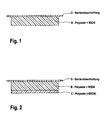
- the film is constructed in two layers (cf. FIG. 1).
- the film is constructed in three layers (cf. FIG. 2).
- she then consists of the base layer (B) according to the invention, which on one side of the Base layer (B) applied barrier layer (D) and one on the other side of the base layer (B) applied top layer (C).
- the Layers D and C can be the same or different.
- component I thermoplastic Polyester
- polyester Ethylene glycol and terephthalic acid polyethylene terephthalate, PET
- ethylene glycol and naphthalene-2,6-dicarboxylic acid polyethylene-2,6-naphthalate, PEN
- PCDT 1,4-bishydroxymethyl-cyclohexane and terephthalic acid
- PCDT 1,4-bishydroxymethyl-cyclohexane and terephthalic acid
- PCDT 1,4-bishydroxymethyl-cyclohexane and terephthalic acid
- PCDT 1,4-bishydroxymethyl-cyclohexane and terephthalic acid
- PCDT poly-1,4-cycl
- polyesters which are at least 90 mol%, particularly preferred at least 95 mol%, from ethylene glycol and terephthalic acid units or from Ethylene glycol and naphthalene-2,6-dicarboxylic acid units exist.
- the remaining Monomer units come from other diols or other dicarboxylic acids.
- Copolymers can also advantageously be used for component I of the base layer (B) or mixtures or blends of the homo- and / or copolymers mentioned be used.
- the base layer (B) as component I a polyester copolymer based on isophthalic acid and Terephthalic acid or based on terephthalic acid and naphthalene-2,6-dicarboxylic acid is used.
- the manufacturability of the film is good and that optical properties of the film and the achieved barrier properties of the film particularly good.
- the base layer (B) essentially contains as component I.
- Polyester copolymer consisting mainly of isophthalic and terephthalic acid units and / or terephthalic acid and naphthalene-2,6-dicarboxylic acid units and is composed of ethylene glycol units, and as component II that previously said poly (m-xylene-adipinamide) according to the invention (MXD6).
- the preferred copolyesters that provide the desired properties of the film are those that are made of Terephthalate and isophthalate units and built up from ethylene glycol units are.
- the proportion of ethylene terephthalate in these copolymers is preferably 40 to 97 mol% and the corresponding proportion of ethylene isophthalate 60 to 3 mol%.
- Copolyesters in which the proportion of ethylene terephthalate is 50 to 95 are preferred Mol% and the corresponding proportion of ethylene isophthalate is 50 to 5 mol%, and very preferred are copolyesters in which the proportion of ethylene terephthalate is 60 up to 90 mol% and the corresponding proportion of ethylene isophthalate 40 to 10 mol% is.
- Suitable other aliphatic diols which can be constituents of the polyesters according to the invention are, for example, diethylene glycol, triethylene glycol, aliphatic glycols of the general formula HO- (CH 2 ) n -OH, where n represents an integer from 2 to 6 (in particular propane-1 , 3-diol, butane-1,4-diol, pentane-1,5-diol and hexane-1,6-diol) or branched aliphatic glycols with up to 6 carbon atoms, cycloaliphatic, optionally heteroatom-containing diols with one or more rings.
- diethylene glycol triethylene glycol
- cyclohexanediols (in particular cyclohexane-1,4-diol) may be mentioned.
- Suitable other aromatic diols correspond, for example, to the formula HO-C 6 H 4 -XC 6 H 4 -OH, where X is -CH 2 -, -C (CH 3 ) 2 -, - C (CF 3 ) 2 -, -O -, -S- or -SO 2 - stands.
- bisphenols of the formula HO-C 6 H 4 -C 6 H 4 -OH are also very suitable.
- Suitable other aromatic dicarboxylic acids which can be constituents of the polyesters according to the invention are preferably benzenedicarboxylic acids, naphthalenedicarboxylic acids (for example naphthalene-1,4- or -1,6-dicarboxylic acid), biphenylx, x'-dicarboxylic acids (in particular biphenyl-4,4'- dicarboxylic acid), diphenylacetylenx, x'-dicarboxylic acids (in particular diphenylacetylene-4,4'-dicarboxylic acid) or stilbenx, x'-dicarboxylic acids.
- benzenedicarboxylic acids for example naphthalene-1,4- or -1,6-dicarboxylic acid
- biphenylx, x'-dicarboxylic acids in particular biphenyl-4,4'- dicarboxylic acid
- diphenylacetylenx x'-dicar
- cyclohexanedicarboxylic acids (in particular cyclohexane-1,4-dicarboxylic acid) should be mentioned.
- aliphatic dicarboxylic acids the (C 3 -C 19 ) alkanedioic acids are particularly suitable, it being possible for the alkane portion to be straight-chain or branched.
- the polyester can be produced by the known transesterification process. It is based on dicarboxylic acid esters and diols, which with the usual Transesterification catalysts such as zinc, calcium, lithium and manganese salts be implemented. The intermediates then become general in the presence Polycondensation of conventional polycondensation catalysts such as antimony trioxide or titanium salts. Production can also be carried out using the direct esterification process take place in the presence of polycondensation catalysts. You go directly from the dicarboxylic acids and the diols.
- the poly (m-xylene-adipinamide) (MXD6) is selected such that the viscosities of the respective polymer melts do not differ too much. In the other case, additional bumps / protrusions, flow disturbances or streaking on the finished film may be expected. In addition, the polymers then tend to separate. According to the experiments carried out here, the melt viscosity of the poly (m-xylene-adipinamide) (MXD6) should preferably be below certain values.
- melt viscosity for the MXD6 is less than 2000 poise (measured in a capillary rheometer of 0.1 mm diameter, a length of 10 mm and a load of 10 kg / cm 2 , melting temperature 280) ° C), preferably less than 1800 poise and particularly preferably less than 1600 poise.
- melt viscosity for the polyester is less than 2000 poise (measured in a capillary rheometer of 0.1 mm diameter, a length of 10 mm and a load of 10 kg / cm 2 , melting temperature 280 ° C), preferably less than 1800 poise and particularly preferably less than 1600 poise.
- the poly (m-xylene-adipinamide) (MXD6) is expediently incorporated into the film either as pure granules or as granulated concentrate (masterbatch).
- the polyester granulate is premixed with the poly (m-xylene-adipinamide) (MXD6) or the poly (m-xylene-adipinamide) (MXD6) masterbatch and then fed to the extruder.
- the components are mixed further in the extruder and heated to processing temperature.
- the extrusion temperature is above the melting temperature T s of the poly (m-xylene adipamide) (MXD6), generally at least 5 ° C., preferably 10 to 50 ° C., but in particular 20 to 40 ° C above the melting temperature of the poly (m-xylene-adipinamide) (MXD6).
- the twin-screw extruder is a preferred extrusion unit for processing the mixture and also for producing the masterbatch from components I and II.
- the film according to the present invention has at least two layers. she then consists of the base layer (B) according to the invention and the one arranged thereon barrier coating according to the invention (D).
- the slide have additional layers, e.g. B. one on the other side of the base layer (B) arranged top layer (C) or intermediate layers such as between the base layer (B) and the cover layer (C).
- Typical film structures are then z. B. DB or DBC or DBZC, where (Z) an intermediate layer and (C) a cover layer represents.
- a film structure DBD is also of the present invention comprises, the layers D with respect to the composition being the same or different could be.
- the same can be used for the cover layer and for the intermediate layers (Polyester) polymers can be used as for the base layer B.
- the intermediate layers (Polyester) polymers can be used as for the base layer B.
- other materials may also be contained in these further layers, in which case these layers preferably from a mixture of polymers, copolymers or Homopolymers consist of ethylene isophthalate units and / or ethylene 2,6-naphthalate units and / or contains ethylene terephthalate units. Up to 10 Mol% of the polymers can consist of further comonomers.
- additional layers can advantageously be used as further components also (polyester) copolymers or (polyester) mixtures or blends of homound / or Copolymers can be used.
- top layer (C) Base of isophthalic acid and terephthalic acid is used. In this case they are optical properties of the film are particularly good.
- the outer layer (C) of the film essentially contains a polyester copolymer, that mainly consists of isophthalic acid and terephthalic acid units and is composed of ethylene glycol units.
- the remaining monomer units are derived from other aliphatic, cycloaliphatic or aromatic Diols or other dicarboxylic acids as they also occur in the base layer can.
- the preferred copolyester that has the desired properties of the film provide are those that are made of terephthalate and Isophthalate units and are built up from ethylene glycol units.
- the share of Ethylene terephthalate is preferably 40 to 97 mol% and the corresponding proportion 60 to 3 mol% of ethylene isophthalate.
- copolyesters in which the Proportion of ethylene terephthalate 50 to 90 mol% and the corresponding proportion Ethylene isophthalate is 50 to 10 mol%, and copolyesters are very preferred which the proportion of ethylene terephthalate 60 to 85 mol% and the corresponding proportion of ethylene isophthalate is 40 to 15 mol%.
- MXD6 Component poly (m-xylene-adipinamide)
- the thickness of the cover layer (C) is preferably greater than 0.5 ⁇ m and is preferably in the Range from 1.0 to 20 ⁇ m and particularly preferably in the range from 1.5 to 10 ⁇ m.
- the base layer (B) as well as existing top and intermediate layers (C) and (F, G, ...) can also conventional additives such.
- B. contain stabilizers and antiblocking agents. They are expediently already before the polymer or the polymer mixture added to the melting. Phosphorus compounds, for example, are used as stabilizers such as phosphoric acid or phosphoric acid esters used.
- Typical antiblocking agents are inorganic and / or organic particles, for example calcium carbonate, amorphous silica, talc, magnesium carbonate, barium carbonate, calcium sulfate, Barium sulfate, lithium phosphate, calcium phosphate, magnesium phosphate, aluminum oxide, Lithium fluoride, calcium, barium, zinc or manganese salts of the used Dicarboxylic acids, carbon black, titanium dioxide, kaolin or cross-linked polystyrene or Acrylate particles.
- Dicarboxylic acids carbon black, titanium dioxide, kaolin or cross-linked polystyrene or Acrylate particles.
- the particles can be the individual Layers in the usual concentrations e.g. as a glycolic dispersion during the Polycondensation or masterbatches can be added during extrusion. As pigment concentrations of 0.0001 to 5% by weight have proven advantageous, based on the weight of the layer equipped with it.
- a detailed A description of the antiblocking agents can be found, for example, in EP-A-0 602 964.
- the filler content in the Cover layer (C) less than 0.6% by weight, preferably less than 0.5% by weight and particularly preferably less than 0.4% by weight, based on the weight of the Top layer (C).
- the top layer (C) contains no poly (m-xylene adipinamide) (MXD6), furthermore not more than 0.5% by weight of a certain filler, e.g. B. SiO 2 , and has an average roughness R a , which is in the range of 10 to 100 nm.
- the average diameter d 50 of the fillers used should be in a range from preferably 2.0 to 5.0 ⁇ m.
- Such a top layer (C) is then particularly suitable for the application of further layers and coatings which, for. B. in-line (in the manufacture of the film) or z. B. can be applied off-line (in the further processing of the film) by suitable methods (eg reverse gravure, melt coating).
- the base layer (B) has a barrier layer on at least one side (D) coated, which consists of a blend containing a film-forming substance, preferably polyvinyl alcohol, and contains a copolymer of maleic acid and acrylic acid.
- the preferred poly (maleic acid-co-acrylic acid) copolymer (PMA-co-PA) has one average molecular weight of 1500 to 15000, contains the individual monomer units in a ratio of approx. 50:50 and has an alternating structure.
- conventional Block copolymers are not preferred.
- the solids content of the invention Copolymers in the coating is preferably 50 to 95% by weight, in particular 55 to 90% by weight and particularly preferably 60 to 85% by weight on the sum of the copolymer and the film-forming substance.
- the blend of the coating according to the invention contains, in addition to the copolymer a film-forming substance which is preferably water-soluble. This substance minimized essentially the brittleness of the coating.
- a preferred film-forming Substance is polyvinyl alcohol.
- the solids content of the polyvinyl alcohol or the film-forming Substance in the coating is preferably 5 to 50 wt .-%, in particular 10 to 45 wt .-% and particularly preferably 15 to 40 wt .-%, based on the sum of copolymer and film-forming substance.
- the molecular weight of the Polyvinyl alcohol is preferably greater than 15,000, in particular greater than 20,000 and particularly preferably greater than 30,000.
- the coating or blend still contains a wetting agent and / or a starch, the latter preferably being water-soluble.
- the coating or the blend can have antimicrobiological substances such as B. triclosan or methyl paraben can be added.
- the percentage of water in this Solution is 50 to 99% by weight, preferably 80 to 95% by weight.
- % By weight is here each based on the finished dispersion / solution.
- the solids content in the finished dispersion / solution is generally up to 50 wt .-%, preferably 0.01 to 30 wt .-% and particularly preferably 5 to 15% by weight.
- a film that has been coated with the barrier layer according to the invention is excellent for packaging food, including a contact coating with the food is possible.
- the coated film has one excellent resistance to solvents as well as water. It was e.g. B. found that in a two-hour extraction of the coated according to the invention Foil in 121 ° C water vapor atmosphere no measurable amounts of Coatings were extracted.
- the coating thickness (D) is 0.01 to 1 ⁇ m, preferably 0.04 to 0.2 ⁇ m and particularly preferably 0.06 to 0.15 ⁇ m.
- the total thickness of the polyester film according to the invention can vary further Limits vary and depend on the intended use. She is usually 6 to 300 microns, preferably 8 to 200 microns, particularly preferred 10 to 100 ⁇ m, the base layer (B) preferably having a proportion of 40 to 99% of the total thickness.
- the present invention also relates to a method for producing the Foil.
- component I polyester homo- or polyester copolymer or Mixtures thereof
- component II poly (m-xylene-adipinamide) (MXD6) granules) fed directly to the extruder.
- the materials can be at around 270 to 300 ° C extrude. From a process engineering point of view (mixing of the different polymers) it has proven to be particularly advantageous if the extrusion of the Polymers for the base layer (B) on a twin-screw extruder with the possibility of degassing is carried out.
- the polymers for a possible top layer (C) are expediently used another extruder fed to the (coextrusion) system; here too is in principle the twin-screw extruder is preferable to the single-screw extruder.
- the melts are formed into flat melt films in a multi-layer nozzle and one above the other layered.
- the multilayer film is then removed using a cooling roller and, if appropriate, further rollers are drawn off and solidified.
- the biaxial stretching is carried out sequentially. It is preferably only in Longitudinal direction (i.e. in the machine direction) and then in the transverse direction (i.e. stretched perpendicular to the machine direction). Stretching in the longitudinal direction can be done with the help of two different speeds according to the desired stretching ratio perform rotating rollers.
- the temperature at which the stretching is carried out can be in a relatively large Range vary and depends on the desired properties of the film.
- the longitudinal stretching is in a temperature range of 80 (Heating temperatures 80 to 130 ° C) to 130 ° C (stretching temperatures 80-130 ° C, depending on the stretch ratio) and the transverse stretch in a temperature range from 90 (start of stretching) to 140 ° C (end of stretching).
- the longitudinal stretching ratio is preferably in the range from 2.0: 1 to 5.0: 1, in particular from 2.3: 1 to 4.8: 1.
- the transverse stretching ratio is preferably in the range from 2.5: 1 to 5.0: 1, in particular from 2.7: 1 to 4.5: 1.
- At least one surface of the base layer (B) of the film coated with the barrier coating (D) according to the invention preferably in-line.
- the process parameters in the longitudinal stretching and in the transverse stretching have a significant influence on the planar orientation ⁇ p of the finished film.
- the most important process parameters influencing the planar orientation include the stretching ratios in the longitudinal and transverse directions ( ⁇ MD and ⁇ TD ) and the stretching temperatures in the longitudinal and transverse directions (T MD and T TD ).
- the temperatures given relate to the respective roll temperatures for the longitudinal stretching and to the film temperatures for the transverse stretching, which were measured by means of IR.
- the film is over a period of about Maintained for 0.1 to 10 s at a temperature of approx. 150 to 250 ° C. Then will the film is wound up in the usual way.
- the gloss of the film surface (B) is preferably greater than 100 at an angle of incidence of 20 °. In a preferred embodiment, the gloss of this side is more than 110 and in a particularly preferred embodiment more than 120. Due to the high gloss of this layer (B) the functional layer (D) is not or only slightly disturbed. It is e.g. B. a uniform thickness distribution of the coating (D) achieved, which ultimately results in particularly good physical properties set this shift.
- the haze of the film is preferably less than 20%. In a preferred embodiment the haze of the film is less than 15% and especially in one preferred embodiment less than 10%. Suitable due to the low turbidity the film is particularly suitable for packaging applications.
- Another advantage of the invention is that the manufacturing costs of the invention Film not significantly above that of a film made from standard polyester raw materials lie.
- the manufacture of the film ensures that Waste material that is inherent in the production of films in the company as Regenerate in an amount of up to approx. 60% by weight, preferably 10 to 50% by weight, each based on the total weight of the film, again for film production can be used without affecting the physical properties of the film noticeably affected.
- the film according to the invention is also outstandingly suitable for metallizing or Vacuum coating with ceramic substances.
- the film is preferably on the side that has been coated with the coating according to the invention, metallized or coated with ceramic substances. Then she excels especially because of its excellent barrier properties, not just opposite Oxygen but also against water vapor.
- the film according to the invention is therefore particularly suitable for packaging Food and luxury goods.
- the film is characterized by excellent barrier properties, especially towards oxygen. Beyond that it is resistant to contact with moisture.
- the barrier layer (D) can be Comparison to barrier layers according to the prior art, for. B. do not wash off.
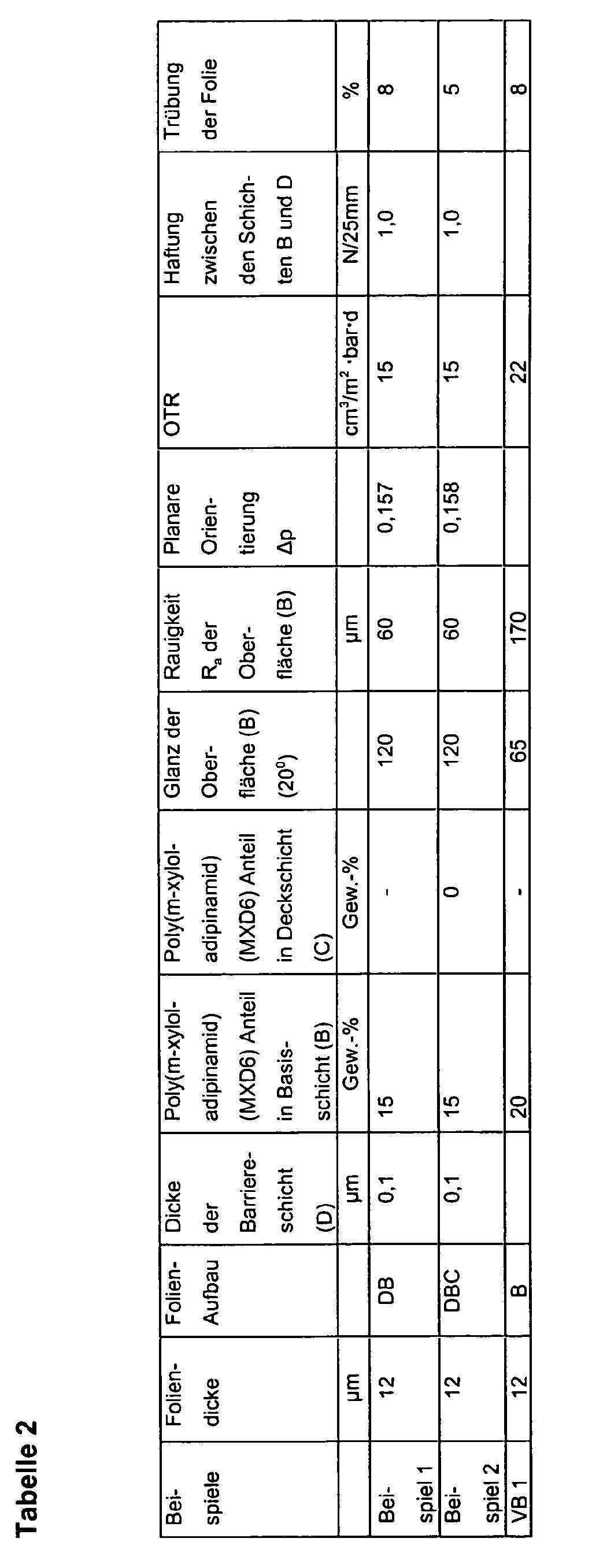
- Table 1 summarizes the most important and preferred film properties according to the invention, "invention" already being understood as a preferred embodiment.
- Oxygen transmission rate (OTR)
- the oxygen barrier was measured using an OXTRAN® 100 from Mocon Modern Controls (USA) according to DIN 53 380, part 3 (23 ° C, 50% relative air humidity on both sides of the film). The OTR was measured in each case on 12 ⁇ m thick film.
- the haze of the film was determined based on ASTM-D 1003-52.
- the standard viscosity SV (DCE) is measured based on DIN 53726 in dichloroacetic acid.
- the gloss was determined in accordance with DIN 67530.
- the reflector value was measured as optical parameter for the surface of a film. Based on the standards ASTM-D 523-78 and ISO 2813 the angle of incidence was set at 20 ° or 60 °. A ray of light strikes the flat test surface at the set angle of incidence and is reflected or scattered by this. The on the photoelectronic receiver striking light rays are displayed as a proportional electrical quantity. The The measured value is dimensionless and must be specified with the angle of incidence. The Measured values for the gloss given in the examples were at an angle of incidence measured from 20 °.
- the roughness R a of the film was determined according to DIN 4768 with a cut-off of 0.25 mm. It was not measured on a glass plate, but in the ring. In the ring method, the film is clamped in a ring so that neither surface touches a third surface (e.g. glass).
- the planar orientation is determined by measuring the refractive indices with an Abbe refractometer (Kruss Optronic, Germany). The planar orientation is always measured on the higher gloss side of the film. The determination of the refractive indices is already detailed e.g. B. in EP-A-0 952 176, page 10. It is therefore expressly referred to this document here.
- the film sample (300 mm along 180 mm across) according to the present invention is placed on a smooth cardboard (200 mm along 180 mm across; approx. 400 g / m 2 , bleached, outer layers coated) before gluing, the protruding ends of the film are on turn the back over and fix it with adhesive tape.
- the film according to the present invention is bonded with a standard polyester film 12 ⁇ m thick (for example Melinex® 800) using a doctor device and doctor rod No. 3 from Erichsen (Germany), about 1.5 ml of adhesive (Novacote® NC 275 + CA 12; mixing ratio: 4/1 + 7 parts of ethyl acetate) can be applied to the barrier layer (D) of the film according to the present invention.
- the standard polyester film is laminated onto the barrier layer (D) of the film according to the present invention using a metal roller (width 200 mm, diameter 90 mm, mass 10 kg, according to DIN EN 20 535).
- the parameters of the lamination are: amount of adhesive 5 +/- 1 g / m 2 Ventilate after applying the adhesive 4 min +/- 15 s Squeegee strength (Erichsen) 3 Squeegee speed level approx. 133 mm / s Hardening time of the bond 2 h at 70 ° C in a convection oven
- test specimens are to be affixed to the entire surface of a carrier sheet using double-sided adhesive tape with the back of the film according to the present invention (base layer B or cover layer C).
- base layer B or cover layer C The plate with the bonded composite is to be clamped in the lower jaw of the tensile testing machine.
- the clamping distance is 100 mm.
- the non-laminated end of the standard polyester film is to be clamped in the upper jaw of the tensile testing machine (e.g. Instron®, Zwick) so that a peeling angle of 180 ° results.
- the average peeling force is given in N / 25 mm, rounded to one decimal place.
- sample width 25 mm
- Pre-load 0.1 N measuring length 25 mm
- Test movement 40 mm sensitivity 0.01 N off speed 100 mm / min
- the measurement result for the peeling force is equivalent to the minimum adhesive force between the layers of the film according to the invention, since the adhesive force between the Glue and the standard film is significantly larger.
- Chips made of polyethylene terephthalate produced via the transesterification process with Mn as the transesterification catalyst, Mn concentration in the polymer: 100 ppm; dried at a temperature of 150 ° C to a residual moisture of below 100 ppm) and poly (m-xylene adipinamide) (MXD6) , also dried at a temperature of 150 ° C.) were fed to the extruder (single-screw extruder) for the base layer (B) in a mixing ratio of 85:15. Then a single-layer film was first produced by extrusion. The film was stretched in the longitudinal direction and then coated with the barrier layer (D) according to the invention (by means of reverse gravure).
- Mn concentration in the polymer 100 ppm; dried at a temperature of 150 ° C to a residual moisture of below 100 ppm
- MXD6 poly (m-xylene adipinamide)
- the two-layer film was then stretched in the transverse direction, and a transparent, two-layer film with a DB structure and a total thickness of 12 ⁇ m was obtained.
- Barrier coating (D) applied to the base layer (B): 7% by weight PMA-co-PA with an average molecular weight of 3000 from Sigma-Aldrich, Milwaukee, Wisconsin, USA (product name: 41605-3) 3% by weight Polyvinyl alcohol from Celanese Ltd., USA (product name: Celvol® 305, M w 31000 to 50000)
- the surface of the base layer (B) had the required high gloss, the film the required low turbidity and the required low OTR. Furthermore, the Foil very good, i.e. tear-free, be produced and also showed the desired Processing performance.
- Example 2 In comparison to Example 1, an initially two-layer film with a BC structure is now produced by coextrusion.
- the composition of the base layer (B) was not changed compared to Example 1.
- chips made of polyethylene terephthalate and a filler were fed to the extruder (twin-screw extruder) for the top layer (C).
- the film was stretched in the longitudinal direction and then coated with the barrier layer (D) according to the invention.
- the three-layer film was then stretched in the transverse direction, and a transparent, three-layer film with a DBC structure and a total thickness of 12 ⁇ m was obtained.
- the thickness of the cover layer (C) was 1.0 ⁇ m.
- Top layer (C) 100% by weight Polyester raw material 4023 from KoSa with an SV value of 800, consisting of 99% by weight of polyethylene terephthalate 4023 from KoSa and 1.0% by weight of silica particles (Sylysia® 320 from Fuji / Japan) with a d 50 value of 2.5 ⁇ m
- the manufacturing conditions in the individual process steps were similar to as in Example 1.
- the film had the required low haze and required low OTR. Furthermore, the film was very good, i.e. tear-free, manufactured and also showed the desired processing behavior.
- a film was produced in accordance with Example 1 of JP 2001-347592.
- the roughness values of this film are much too high and the gloss of the film is not in the area according to the invention.
Landscapes
- Laminated Bodies (AREA)
- Wrappers (AREA)
Abstract
Description
- sie gut bedruckbar, gut zu metallisieren und gut zu beschichten ist, ohne dass diese zusätzliche Funktionsschicht in ihrer Wirkung beeinträchtigt wird;
- sie einen hohen Glanz aufweist;
- sie sich wirtschaftlich herstellen lässt, dies bedeutet beispielsweise auch, dass zur Herstellung der Folie in der Industrie übliche (in der Regel sequenzielle) Streckverfahren eingesetzt werden können, ohne sich dabei auf das teure simultane Streckverfahren einschränken zu müssen:
- bei der Herstellung der Folie gewährleistet ist, dass das Regenerat in einer Menge von bis zu 60 Gew.-% wieder der Extrusion zugeführt werden kann, ohne dass dabei die physikalischen und optischen Eigenschaften der Folie, insbesondere aber die Barriere gegenüber Sauerstoff, nennenswert negativ beeinflusst werden.

| Klebstoffmenge | 5 +/- 1 g/m2 |
| Lüften nach Auftrag des Klebers | 4 min +/- 15 s |
| Rakelstärke (Erichsen) | 3 |
| Geschwindigkeitsstufe des Rakels | ca. 133 mm/s |
| Aushärtzeit des Verbundes | 2 h bei 70 °C in einem Umluftofen |
| Probenbreite | 25 mm |
| Vorkraft | 0,1 N |
| Messlänge | 25 mm |
| Abzugsgeschwindigkeit bis Vorkraft | 25 mm/min |
| Vorweg | 5 mm |
| Prüfweg | 40 mm |
| Empfindlichkeit | 0,01 N |
| Abzugsgeschwindigkeit | 100 mm/min |
| Barrierebeschichtung (D) aufgebracht auf Basisschicht (B): | |
| 7 Gew.-% | PMA-co-PA mit einem mittleren Molekulargewicht von 3000 der Fa. Sigma-Aldrich, Milwaukee, Wisconsin, USA (Produktname: 41605-3) |
| 3 Gew.-% | Polyvinylalkohol der Fa. Celanese Ltd., USA (Produktname: Celvol® 305, Mw = 31000 bis 50000) |
| Basisschicht (B): | |
| 85,0 Gew.-% | Polyethylenterephthalat 4023 der Fa. KoSa, Deutschland, mit einem SV-Wert von 800 |
| 15 Gew.-% | Poly(m-xylol-adipinamid) (MXD6) der Fa. Mitsubishi Gas Chemical Co., Produktname Nylon MXD6 6001 mit einer Schmelzviskosität von 1400 Poise |
| Extrusion | Temperaturen | B-Schicht: | 290 °C |
| Temperatur der Abzugswalze | 25 °C | ||
| Längsstreckung: | Strecktemperatur: | 125 °C | |
| Längsstreckverhältnis: | 4,0 | ||
| Querstreckung: | Strecktemperatur: | 130 °C | |
| Querstreckverhältnis | 3,9 | ||
| Fixierung: | Temperatur: | 230 °C | |
| Dauer: | 3 s |
| Deckschicht (C): | |
| 100 Gew.-% | Polyesterrohstoff 4023 von Fa. KoSa mit einem SV-Wert von 800, bestehend aus 99 Gew.-% Polyethylenterephthalat 4023 der Fa. KoSa und 1,0 Gew.-% Kieselsäurepartikel (Sylysia® 320 von der Fa. Fuji/Japan) mit einem d50-Wert von 2,5 µm |
Claims (18)
- Polyesterfolie, die eine Basisschicht (B) aufweist, die auf mindestens einer Seite mit einer Barriereschicht (D) beschichtet ist, dadurch gekennzeichnet, dass die Basisschicht (B) Poly(m-xylol-adipinamid) enthält und die Barriereschicht (D) aus einem Blend besteht, der eine filmbildende Substanz und ein Copolymer aus Maleinsäure und Acrylsäure enthält.
- Polyesterfolie nach Anspruch 1, dadurch gekennzeichnet, dass die Basisschicht (B) 5 bis 30 Gew.-% Poly(m-xylol-adipinamid) enthält, bezogen auf das Gewicht der Basisschicht (B).
- Polyesterfolie nach Anspruche 1 oder 2, dadurch gekennzeichnet, dass die Schmelzviskosität des Poly(m-xylol-adipinamid) kleiner als 2000 Poise ist.
- Polyesterfolie nach einem oder mehreren der Ansprüche 1 bis 3, dadurch gekennzeichnet, dass die Basisschicht (B) thermoplastischen Polyester, bevorzugt zu mindestens 60 Gew.-%, enthält.
- Polyesterfolie nach einem oder mehreren der Ansprüche 1 bis 4, dadurch gekennzeichnet, dass der thermoplastische Polyester der Basisschicht (B) Ethylenglykol- und Terephthalsäure- und/oder Ethylenglykol- und Naphthalin-2,6-dicarbonsäure-Einheiten aufweist.
- Polyesterfolie nach einem oder mehreren der Ansprüche 1 bis 5, dadurch gekennzeichnet, dass der Polyester der Basisschicht (B) Isophthalsäure-, Terephthalsäure- und Ethylenglykol-Einheiten aufweist.
- Polyesterfolie nach einem oder mehreren der Ansprüche 1 bis 6, dadurch gekennzeichnet, dass als Polyester der Basisschicht (B) Polyethylenterephthalat verwendet wird.
- Polyesterfolie nach einem oder mehreren der Ansprüche 1 bis 7, dadurch gekennzeichnet, dass als filmbildende Substanz für die Barriereschicht (D) Polyvinylalkohol verwendet wird.
- Polyesterfolie nach einem oder mehreren der Ansprüche 1 bis 8, dadurch gekennzeichnet, dass der Polyvinylalkohol ein Molekulargewicht von größer als 15000 aufweist.
- Polyesterfolie nach einem oder mehreren der Ansprüche 1 bis 9, dadurch gekennzeichnet, dass das Copolymer aus Maleinsäure und Acrylsäure der Barriereschicht (D) ein mittleres Molekulargewicht von 1500 bis 15000 aufweist.
- Polyesterfolie nach einem oder mehreren der Ansprüche 1 bis 10, dadurch gekennzeichnet, dass die Folie einen D-B-C Schichtaufbau aufweist, wobei C eine Deckschicht ist, die gleich oder verschieden von (D) sein kann.
- Polyesterfolie nach einem oder mehreren der Ansprüche 1 bis 11, dadurch gekennzeichnet, dass die Deckschicht (C) den für die Basisschicht (B) verwendeten Polyester enthält.
- Polyesterfolie nach einem oder mehreren der Ansprüche 1 bis 12, dadurch gekennzeichnet, dass die Basisschicht (B) einen Glanz von größer als 100 aufweist.
- Polyesterfolie nach einem oder mehreren der Ansprüche 1 bis 13, dadurch gekennzeichnet, dass die Folie eine Sauerstoffdurchlässigkeit (OTR) von kleiner als 30 cm3· m-2 · d-1 · bar-1 aufweist.
- Polyesterfolie nach einem oder mehreren der Ansprüche 1 bis 14, dadurch gekennzeichnet, dass die Folie eine Trübung von kleiner als 20 % aufweist.
- Polyesterfolie nach einem oder mehreren der Ansprüche 1 bis 15, dadurch gekennzeichnet, dass die Haftung zwischen der Basisschicht (B) und der Barriereschicht (D) größer als 0,5 N/25 mm ist.
- Verfahren zur Herstellung einer Polyesterfolie nach einem oder mehreren der Ansprüche 1 bis 16 umfassend die Schrittea) Herstellen einer Folie durch Extrusion oder Koextrusion ,b) Längsstrecken der Folie,c) Beschichten der Folie mit der Barriereschicht (D),d) Querstrecken der beschichteten Folie unde) Thermofixieren der gestreckten Folie
- Verwendung einer Polyesterfolie nach einem oder mehreren der Ansprüche 1 bis 16 als Verpackungsmaterial, insbesondere für Nahrungs- und Genussmittel.
Applications Claiming Priority (2)
| Application Number | Priority Date | Filing Date | Title |
|---|---|---|---|
| DE2003102036 DE10302036A1 (de) | 2003-01-21 | 2003-01-21 | Polyesterfolie mit verbesserter Sauerstoffbarriere, enthaltend Poly(m-xylol-adipinamid) und eine Barrierebeschichtung, Verfahren zu ihrer Herstellung und ihre Verwendung |
| DE10302036 | 2003-01-21 |
Publications (2)
| Publication Number | Publication Date |
|---|---|
| EP1457318A1 true EP1457318A1 (de) | 2004-09-15 |
| EP1457318B1 EP1457318B1 (de) | 2007-06-13 |
Family
ID=32602792
Family Applications (1)
| Application Number | Title | Priority Date | Filing Date |
|---|---|---|---|
| EP20040000706 Expired - Lifetime EP1457318B1 (de) | 2003-01-21 | 2004-01-15 | Polyesterfolie mit verbesserter Sauerstoffbarriere, enthaltend Poly(m-xylol-adipinamid) und eine Barrierebeschichtung, Verfahren zu ihrer Herstellung und ihre Verwendung |
Country Status (5)
| Country | Link |
|---|---|
| US (1) | US6991837B2 (de) |
| EP (1) | EP1457318B1 (de) |
| JP (1) | JP2004224051A (de) |
| KR (1) | KR20040067972A (de) |
| DE (2) | DE10302036A1 (de) |
Cited By (1)
| Publication number | Priority date | Publication date | Assignee | Title |
|---|---|---|---|---|
| EP3613592A1 (de) * | 2018-08-22 | 2020-02-26 | Mitsubishi Polyester Film GmbH | Polyesterfolie mit beschichtung |
Families Citing this family (34)
| Publication number | Priority date | Publication date | Assignee | Title |
|---|---|---|---|---|
| DE10302035A1 (de) * | 2003-01-21 | 2004-07-29 | Mitsubishi Polyester Film Gmbh | Polyesterfolie mit verbesserter Sauerstoffbarriere, enthaltend Poly(m-xylol-adipinamid) sowie eine Deckschicht und eine Barrierebeschichtung, Verfahren zu ihrer Herstellung und ihre Verwendung |
| DE10302034A1 (de) * | 2003-01-21 | 2004-07-29 | Mitsubishi Polyester Film Gmbh | Polyesterfolie mit verbesserter Sauerstoffbarriere und Poly(m-xylol-adipinamid)-haltiger Basisschicht, Verfahren zu ihrer Herstellung und ihre Verwendung |
| DE10352444A1 (de) * | 2003-11-10 | 2005-06-09 | Mitsubishi Polyester Film Gmbh | Haftvermittelte, heißsiegelbare und peelfähige Polyesterfolie, Verfahren zu ihrer Herstellung und ihre Verwendung |
| DE10352431A1 (de) | 2003-11-10 | 2005-06-09 | Mitsubishi Polyester Film Gmbh | Peelfähige Polyesterfolie mit selbsttätiger Entlüftung, Verfahren zu ihrer Herstellung und ihre Verwendung |
| DE10352432A1 (de) | 2003-11-10 | 2005-06-09 | Mitsubishi Polyester Film Gmbh | Weiße, heißsiegelbare, peelfähige Polyesterfolie, Verfahren zu ihrer Herstellung und ihre Verwendung |
| DE10352440A1 (de) * | 2003-11-10 | 2005-06-09 | Mitsubishi Polyester Film Gmbh | Verfahren zur Herstellung einer coextrudierten, peelfähigen Polyesterfolie |
| DE10352430A1 (de) | 2003-11-10 | 2005-06-09 | Mitsubishi Polyester Film Gmbh | Peelfähige Polyesterfolie mit verbesserter Sauerstoffbarriere, Verfahren zu ihrer Herstellung und ihre Verwendung |
| DE102004030978A1 (de) * | 2004-06-26 | 2006-01-19 | Mitsubishi Polyester Film Gmbh | Haftvermittelnde Polyesterfolie enthaltend Poly(m-xylol-adipinamid) |
| DE102004030977A1 (de) * | 2004-06-26 | 2006-01-19 | Mitsubishi Polyester Film Gmbh | Metallisierte oder keramisch beschichtete Polyesterfolie enthaltend Poly(mxyloladipinamid) |
| DE102004030980A1 (de) * | 2004-06-26 | 2006-01-19 | Mitsubishi Polyester Film Gmbh | Polyesterfolie enthaltend Poly(m-xylol-adipinamid) |
| DE102004030979A1 (de) * | 2004-06-26 | 2006-01-19 | Mitsubishi Polyester Film Gmbh | Extrusionsbeschichtbare Polyesterfolie enthaltend Poly(m-xylol-adipinamid) |
| DE102004061390A1 (de) * | 2004-12-21 | 2006-07-06 | Mitsubishi Polyester Film Gmbh | Matte, biaxial orientierte Polyesterfolie |
| US7786252B2 (en) * | 2005-03-02 | 2010-08-31 | Eastman Chemical Company | Preparation of transparent multilayered articles |
| US20060199871A1 (en) * | 2005-03-02 | 2006-09-07 | Hale Wesley R | Multilayered, transparent articles and a process for their preparation |
| US7462684B2 (en) | 2005-03-02 | 2008-12-09 | Eastman Chemical Company | Preparation of transparent, multilayered articles containing polyesters comprising a cyclobutanediol and homogeneous polyamide blends |
| US7955533B2 (en) * | 2005-03-02 | 2011-06-07 | Eastman Chemical Company | Process for the preparation of transparent shaped articles |
| US7964258B2 (en) * | 2005-03-02 | 2011-06-21 | Eastman Chemical Company | Transparent, oxygen-scavenging compositions and articles prepared therefrom |
| US7959836B2 (en) | 2005-03-02 | 2011-06-14 | Eastman Chemical Company | Process for the preparation of transparent, shaped articles containing polyesters comprising a cyclobutanediol |
| US7959998B2 (en) | 2005-03-02 | 2011-06-14 | Eastman Chemical Company | Transparent, oxygen-scavenging compositions containing polyesters comprising a cyclobutanediol and articles prepared therefrom |
| US7968164B2 (en) * | 2005-03-02 | 2011-06-28 | Eastman Chemical Company | Transparent polymer blends and articles prepared therefrom |
| US7955674B2 (en) | 2005-03-02 | 2011-06-07 | Eastman Chemical Company | Transparent polymer blends containing polyesters comprising a cyclobutanediol and articles prepared therefrom |
| DE102005011470A1 (de) * | 2005-03-12 | 2006-09-14 | Mitsubishi Polyester Film Gmbh | Biaxial orientierte Polyesterfolie mit hoher Sauerstoffbarriere |
| DE102005011469A1 (de) * | 2005-03-12 | 2006-09-14 | Mitsubishi Polyester Film Gmbh | Mehrschichtige, transparente Polyesterfolie mit hoher Sauerstoffbarriere |
| DE102005027657A1 (de) * | 2005-06-15 | 2006-12-21 | Mitsubishi Polyester Film Gmbh | Mehrschichtige, transparente Polyesterfolie mit hoher Sauerstoffbarriere |
| US20070031546A1 (en) * | 2005-08-05 | 2007-02-08 | Curwood, Inc. | Polyester and polyamide blend containing article for packaging a CO2 respiring foodstuff |
| JP2009024159A (ja) | 2007-04-09 | 2009-02-05 | Futura Polyesters Ltd | ポリエステル系ガスバリア樹脂およびそのプロセス |
| DE102007019994A1 (de) * | 2007-04-27 | 2008-10-30 | Fraunhofer-Gesellschaft zur Förderung der angewandten Forschung e.V. | Transparente Barrierefolie und Verfahren zum Herstellen derselben |
| DE102008046780A1 (de) * | 2008-09-11 | 2010-03-18 | Mitsubishi Polyester Film Gmbh | Siegelfähige Polyesterfolie |
| KR20110110265A (ko) | 2008-12-29 | 2011-10-06 | 신세스 게엠바하 | 수술 부위의 보존을 위한 막 조성물의 형성 방법 및 결과적으로 얻어진 막조성물 |
| CN102648253A (zh) | 2009-11-20 | 2012-08-22 | 太阳化学有限公司 | 阻气涂料 |
| US20120067842A1 (en) * | 2010-03-19 | 2012-03-22 | Keller Timothy P | Oxygen regulation mechanism for a beverage gasket |
| US9663677B2 (en) | 2010-09-07 | 2017-05-30 | Sun Chemical B.V. | Carbon dioxide barrier coating |
| US20180057241A1 (en) * | 2016-08-30 | 2018-03-01 | Mead Johnson Nutrition Company | Container with absorptive patch |
| EP3651987A1 (de) | 2017-07-14 | 2020-05-20 | Flex Films (USA) Inc. | Orientierte hochgradige sperrschichtfolien |
Citations (4)
| Publication number | Priority date | Publication date | Assignee | Title |
|---|---|---|---|---|
| JPS58197050A (ja) * | 1982-05-12 | 1983-11-16 | 東洋紡績株式会社 | 多層容器 |
| JPH0664098A (ja) * | 1992-08-24 | 1994-03-08 | Denki Kagaku Kogyo Kk | 積層体及びその成型体 |
| WO2001092011A1 (en) * | 2000-05-31 | 2001-12-06 | Cryovac, Inc. | High modulus, multilayer film |
| WO2002038673A2 (en) * | 2000-11-08 | 2002-05-16 | Valspar Sourcing, Inc. | Multilayered package with barrier properties |
Family Cites Families (25)
| Publication number | Priority date | Publication date | Assignee | Title |
|---|---|---|---|---|
| US3154461A (en) | 1960-03-07 | 1964-10-27 | Minnesota Mining & Mfg | Matte-finish polymeric film and method of forming the same |
| GB1415686A (en) | 1972-10-24 | 1975-11-26 | Ici Ltd | Voided films |
| JPS57123050A (en) | 1980-12-01 | 1982-07-31 | Toray Industries | Polyester composite film |
| DE301719T1 (de) * | 1987-07-27 | 1990-12-20 | MB Group plc, Reading, Berkshire | Verpackungsmittel. |
| EP0679508B1 (de) | 1988-06-08 | 1999-12-29 | Toray Industries, Inc. | Biaxial orientierte Verbundfolie |
| US6288161B1 (en) * | 1990-01-31 | 2001-09-11 | Pechiney Emballage Flexible Europe | Barrier compositions and articles made therefrom |
| JP2989080B2 (ja) | 1992-12-17 | 1999-12-13 | 帝人株式会社 | 磁気記録媒体用積層ポリエステルフイルム |
| JP3340780B2 (ja) * | 1993-01-27 | 2002-11-05 | 呉羽化学工業株式会社 | ガスバリヤー性フィルム及びその製造方法 |
| JP2736600B2 (ja) * | 1993-09-27 | 1998-04-02 | 呉羽化学工業株式会社 | ガスバリヤー性フィルム及びその製造方法 |
| JP3203287B2 (ja) * | 1994-01-26 | 2001-08-27 | 呉羽化学工業株式会社 | ガスバリヤー性積層体及びその製造方法 |
| FR2718078B1 (fr) | 1994-03-31 | 1996-05-03 | Rhone Poulenc Films | Films polyesters composites à propriétés barrière. |
| WO1995034425A1 (en) * | 1994-06-13 | 1995-12-21 | Alliedsignal Inc. | Retortable, high oxygen barrier polymeric films |
| US6177159B1 (en) * | 1996-06-10 | 2001-01-23 | Sumitomo Bakelite Company Limited | Composite sheet for food container |
| US6083585A (en) * | 1996-09-23 | 2000-07-04 | Bp Amoco Corporation | Oxygen scavenging condensation copolymers for bottles and packaging articles |
| EP0962300A1 (de) | 1998-06-03 | 1999-12-08 | E.I. Du Pont De Nemours And Company | Verfahren zur Herstellung einer biaxial gestreckten Folie aus EVOH und Polyester und durch das Verfahren hergestellte Folie |
| US6562276B1 (en) * | 1998-08-20 | 2003-05-13 | Eastman Chemical Company | Process for forming a multilayer, coinjected article |
| EP1253000B2 (de) * | 1999-02-12 | 2008-08-27 | Toyo Seikan Kaisya, Ltd. | Polyesterbehälter und Verfahren zu seiner Herstellung |
| JP2001347592A (ja) | 2000-06-07 | 2001-12-18 | Unitika Ltd | ガスバリヤ性ポリエステルフィルム |
| DE10051082A1 (de) | 2000-10-14 | 2002-04-25 | Mitsubishi Polyester Film Gmbh | Matte, koextrudierte, biaxial orientierte Polyesterfolie |
| US6933055B2 (en) * | 2000-11-08 | 2005-08-23 | Valspar Sourcing, Inc. | Multilayered package with barrier properties |
| DE10109217A1 (de) | 2001-02-26 | 2002-09-05 | Mitsubishi Polyester Film Gmbh | Transparente, biaxial orientierte Polyesterfolie |
| US6709735B2 (en) * | 2001-11-14 | 2004-03-23 | Mitsubishi Polyester Film, Llc | Oxygen barrier coating and coated film |
| DE10302033A1 (de) * | 2003-01-21 | 2004-07-29 | Mitsubishi Polyester Film Gmbh | Polyesterfolie mit verbesserter Sauerstoffbarriere und Poly(m-xylol-adipinamid)-haltiger Deckschicht, Verfahren zu ihrer Herstellung und ihre Verwendung |
| DE10302034A1 (de) * | 2003-01-21 | 2004-07-29 | Mitsubishi Polyester Film Gmbh | Polyesterfolie mit verbesserter Sauerstoffbarriere und Poly(m-xylol-adipinamid)-haltiger Basisschicht, Verfahren zu ihrer Herstellung und ihre Verwendung |
| DE10302035A1 (de) * | 2003-01-21 | 2004-07-29 | Mitsubishi Polyester Film Gmbh | Polyesterfolie mit verbesserter Sauerstoffbarriere, enthaltend Poly(m-xylol-adipinamid) sowie eine Deckschicht und eine Barrierebeschichtung, Verfahren zu ihrer Herstellung und ihre Verwendung |
-
2003
- 2003-01-21 DE DE2003102036 patent/DE10302036A1/de not_active Withdrawn
-
2004
- 2004-01-15 DE DE200450004062 patent/DE502004004062D1/de not_active Expired - Fee Related
- 2004-01-15 EP EP20040000706 patent/EP1457318B1/de not_active Expired - Lifetime
- 2004-01-19 JP JP2004010881A patent/JP2004224051A/ja not_active Withdrawn
- 2004-01-19 KR KR1020040003955A patent/KR20040067972A/ko not_active Withdrawn
- 2004-01-20 US US10/760,987 patent/US6991837B2/en not_active Expired - Fee Related
Patent Citations (4)
| Publication number | Priority date | Publication date | Assignee | Title |
|---|---|---|---|---|
| JPS58197050A (ja) * | 1982-05-12 | 1983-11-16 | 東洋紡績株式会社 | 多層容器 |
| JPH0664098A (ja) * | 1992-08-24 | 1994-03-08 | Denki Kagaku Kogyo Kk | 積層体及びその成型体 |
| WO2001092011A1 (en) * | 2000-05-31 | 2001-12-06 | Cryovac, Inc. | High modulus, multilayer film |
| WO2002038673A2 (en) * | 2000-11-08 | 2002-05-16 | Valspar Sourcing, Inc. | Multilayered package with barrier properties |
Non-Patent Citations (2)
| Title |
|---|
| DATABASE WPI Section Ch Week 198401, Derwent World Patents Index; Class A23, AN 1984-002155, XP002276539 * |
| DATABASE WPI Section Ch Week 199414, Derwent World Patents Index; Class A14, AN 1994-114850, XP002276645 * |
Cited By (2)
| Publication number | Priority date | Publication date | Assignee | Title |
|---|---|---|---|---|
| EP3613592A1 (de) * | 2018-08-22 | 2020-02-26 | Mitsubishi Polyester Film GmbH | Polyesterfolie mit beschichtung |
| US11752678B2 (en) | 2018-08-22 | 2023-09-12 | Mitsubishi Polyester Film Gmbh | Polyester film with coating |
Also Published As
| Publication number | Publication date |
|---|---|
| US6991837B2 (en) | 2006-01-31 |
| EP1457318B1 (de) | 2007-06-13 |
| US20040146727A1 (en) | 2004-07-29 |
| DE10302036A1 (de) | 2004-07-29 |
| DE502004004062D1 (de) | 2007-07-26 |
| KR20040067972A (ko) | 2004-07-30 |
| JP2004224051A (ja) | 2004-08-12 |
Similar Documents
| Publication | Publication Date | Title |
|---|---|---|
| EP1457318B1 (de) | Polyesterfolie mit verbesserter Sauerstoffbarriere, enthaltend Poly(m-xylol-adipinamid) und eine Barrierebeschichtung, Verfahren zu ihrer Herstellung und ihre Verwendung | |
| EP1457317B1 (de) | Polyesterfolie mit verbesserter Sauerstoffbarriere, enthaltend Poly(m-xylol-adipinamid) sowie eine Deckschicht und eine Barrierebeschichtung, Verfahren zu ihrer Herstellung und ihre Verwendung | |
| EP1274575B1 (de) | Matte, flammhemmend ausgerüstete koextrudierte polyesterfolie, verfahren zu ihrer herstellung und ihre verwendung | |
| EP1475229A2 (de) | Coextrudierte, heisssiegelbare und peelfähige Polyesterfolie mit leichter Peelbarkeit, Verfahren zu ihrer Herstellung und ihre Verwendung | |
| EP1529635A1 (de) | Peelfähige Polyesterfolie mit verbesserter Sauerstoffbarriere, Verfahren zu ihrer Herstellung und ihre Verwendung | |
| DE10051083A1 (de) | Koextrudierte, zumindest einseitig matte, biaxial orientierte Polyesterfolie | |
| EP1471098A1 (de) | Coextrudierte, heisssiegelbare und peelfähige Polyesterfolie, Verfahren zu ihrer Herstellung und ihre Verwendung | |
| EP0976548A2 (de) | Matte, koextrudierte Polyesterfolie, Verfahren zu ihrer Herstellung und ihre Verwendung | |
| DE10051082A1 (de) | Matte, koextrudierte, biaxial orientierte Polyesterfolie | |
| EP1186405B1 (de) | Koextrudierte, biaxial orientierte Polyesterfolie mit guter Metallhaftung, Verfahren zu ihrer Herstellung und ihre Verwendung | |
| EP1471094B1 (de) | Coextrudierte, heisssiegelbare und peelfähige Polyesterfolie, Verfahren zu ihrer Herstellung und ihre Verwendung | |
| DE102018214185A1 (de) | Polyesterfolie mit Beschichtung | |
| EP1440793A1 (de) | Polyesterfolie mit verbesserter Sauerstoffbarriere und Poly(m-xylol-adipinamid)-haltiger Deckschicht, Verfahren zu ihrer Herstellung und ihre Verwendung | |
| EP1457316A1 (de) | Polyesterfolie mit verbesserter Sauerstoffbarriere und Poly(m-xylol-adipinamid)-haltiger Basisschicht, Verfahren zu ihrer Herstellung und ihre Verwendung | |
| DE10039366A1 (de) | Mindestens dreischichtige transparente Polyesterfolie, Verfahren zu ihrer Herstellung und ihre Verwendung | |
| EP1609812A1 (de) | Extrusionsbeschichtbare Polyesterfolie enthaltend Poly(m-xylol-adipinamid) | |
| DE10063590A1 (de) | Einseitig matte, siegelfähige,biaxial orientierte Polyesterfolie | |
| DE102004030980A1 (de) | Polyesterfolie enthaltend Poly(m-xylol-adipinamid) | |
| EP1609813A1 (de) | Haftvermittelnde Polyesterfolie enthaltend Poly(m-xylol-adipinamid) | |
| EP1366896A1 (de) | Transparente Polyesterfolie mit verbesserter Wasserdampfbarriere, Verfahren zu ihrer Herstellung und ihre Verwendung | |
| EP1179418A2 (de) | Transparente Polyesterfolie mit hoher Sauerstoffbarriere, Verfahren zu ihrer Herstellung und ihre Verwendung | |
| DE10119023A1 (de) | Mehrschichtige transparente biaxial orientierte Polywsterfolie, Verfahren zu ihrer Herstellung und ihre Verwendung | |
| EP1733875A1 (de) | Mehrschichtige, transparente Polyesterfolie mit hoher Sauerstoffbarriere | |
| EP1609814A1 (de) | Metallisierte oder keramisch beschichtete Polyesterfolie enthaltend Poly(mxyloladipinamid) | |
| EP1291168B1 (de) | Biaxial orientierte Polyesterfolie mit guter Metallhaftung, Verfahren zu ihrer Herstellung und ihre Verwendung |
Legal Events
| Date | Code | Title | Description |
|---|---|---|---|
| PUAI | Public reference made under article 153(3) epc to a published international application that has entered the european phase |
Free format text: ORIGINAL CODE: 0009012 |
|
| AK | Designated contracting states |
Kind code of ref document: A1 Designated state(s): AT BE BG CH CY CZ DE DK EE ES FI FR GB GR HU IE IT LI LU MC NL PT RO SE SI SK TR |
|
| AX | Request for extension of the european patent |
Extension state: AL LT LV MK |
|
| 17P | Request for examination filed |
Effective date: 20050315 |
|
| AKX | Designation fees paid |
Designated state(s): DE FR GB IT LU NL |
|
| GRAP | Despatch of communication of intention to grant a patent |
Free format text: ORIGINAL CODE: EPIDOSNIGR1 |
|
| RBV | Designated contracting states (corrected) |
Designated state(s): DE GB |
|
| GRAS | Grant fee paid |
Free format text: ORIGINAL CODE: EPIDOSNIGR3 |
|
| GRAA | (expected) grant |
Free format text: ORIGINAL CODE: 0009210 |
|
| AK | Designated contracting states |
Kind code of ref document: B1 Designated state(s): DE GB |
|
| REG | Reference to a national code |
Ref country code: GB Ref legal event code: FG4D Free format text: NOT ENGLISH |
|
| REF | Corresponds to: |
Ref document number: 502004004062 Country of ref document: DE Date of ref document: 20070726 Kind code of ref document: P |
|
| GBT | Gb: translation of ep patent filed (gb section 77(6)(a)/1977) |
Effective date: 20070821 |
|
| PLBE | No opposition filed within time limit |
Free format text: ORIGINAL CODE: 0009261 |
|
| STAA | Information on the status of an ep patent application or granted ep patent |
Free format text: STATUS: NO OPPOSITION FILED WITHIN TIME LIMIT |
|
| 26N | No opposition filed |
Effective date: 20080314 |
|
| GBPC | Gb: european patent ceased through non-payment of renewal fee |
Effective date: 20080115 |
|
| PG25 | Lapsed in a contracting state [announced via postgrant information from national office to epo] |
Ref country code: DE Free format text: LAPSE BECAUSE OF NON-PAYMENT OF DUE FEES Effective date: 20080801 |
|
| PG25 | Lapsed in a contracting state [announced via postgrant information from national office to epo] |
Ref country code: GB Free format text: LAPSE BECAUSE OF NON-PAYMENT OF DUE FEES Effective date: 20080115 |