EP1457159A1 - Canon de perçage pour le positionnement d'un implant glénoidien - Google Patents
Canon de perçage pour le positionnement d'un implant glénoidien Download PDFInfo
- Publication number
- EP1457159A1 EP1457159A1 EP04356033A EP04356033A EP1457159A1 EP 1457159 A1 EP1457159 A1 EP 1457159A1 EP 04356033 A EP04356033 A EP 04356033A EP 04356033 A EP04356033 A EP 04356033A EP 1457159 A1 EP1457159 A1 EP 1457159A1
- Authority
- EP
- European Patent Office
- Prior art keywords
- plate
- ancillary
- holes
- guide
- barrel
- Prior art date
- Legal status (The legal status is an assumption and is not a legal conclusion. Google has not performed a legal analysis and makes no representation as to the accuracy of the status listed.)
- Granted
Links
- 241001653121 Glenoides Species 0.000 title claims description 32
- 239000007943 implant Substances 0.000 title claims description 26
- 210000001991 scapula Anatomy 0.000 claims abstract description 29
- 238000007493 shaping process Methods 0.000 claims description 10
- 230000003100 immobilizing effect Effects 0.000 claims description 7
- BASFCYQUMIYNBI-UHFFFAOYSA-N platinum Chemical compound [Pt] BASFCYQUMIYNBI-UHFFFAOYSA-N 0.000 description 25
- 238000005553 drilling Methods 0.000 description 9
- 208000031968 Cadaver Diseases 0.000 description 4
- 210000000988 bone and bone Anatomy 0.000 description 4
- 230000000295 complement effect Effects 0.000 description 4
- 210000000056 organ Anatomy 0.000 description 4
- 238000006073 displacement reaction Methods 0.000 description 3
- 238000002591 computed tomography Methods 0.000 description 2
- 238000000034 method Methods 0.000 description 2
- 241000920340 Pion Species 0.000 description 1
- 238000004458 analytical method Methods 0.000 description 1
- 230000006866 deterioration Effects 0.000 description 1
- 230000000694 effects Effects 0.000 description 1
- 230000002349 favourable effect Effects 0.000 description 1
- 210000002758 humerus Anatomy 0.000 description 1
- 230000000977 initiatory effect Effects 0.000 description 1
- 238000009434 installation Methods 0.000 description 1
- 238000002955 isolation Methods 0.000 description 1
- 230000014759 maintenance of location Effects 0.000 description 1
- 239000000463 material Substances 0.000 description 1
- 229910052751 metal Inorganic materials 0.000 description 1
- 239000002184 metal Substances 0.000 description 1
- 238000003801 milling Methods 0.000 description 1
- 230000007170 pathology Effects 0.000 description 1
- 229910052697 platinum Inorganic materials 0.000 description 1
- 238000002271 resection Methods 0.000 description 1
- 230000000717 retained effect Effects 0.000 description 1
- 238000001356 surgical procedure Methods 0.000 description 1
Images


Classifications
-
- A—HUMAN NECESSITIES
- A61—MEDICAL OR VETERINARY SCIENCE; HYGIENE
- A61B—DIAGNOSIS; SURGERY; IDENTIFICATION
- A61B17/00—Surgical instruments, devices or methods
- A61B17/16—Instruments for performing osteoclasis; Drills or chisels for bones; Trepans
- A61B17/17—Guides or aligning means for drills, mills, pins or wires
- A61B17/1739—Guides or aligning means for drills, mills, pins or wires specially adapted for particular parts of the body
- A61B17/1778—Guides or aligning means for drills, mills, pins or wires specially adapted for particular parts of the body for the shoulder
Definitions
- the present invention relates to a fitting aid of a glenoid implant.
- a glenoid implant that, from a side, rigidly anchored in the scapula and which, on the other side, delimits a joint surface for cooperation with the head of a humeral implant attached to the end corresponding to the patient's humerus.
- this implant usually has a protruding keel from the rest of the implant and intended to be received and immobilized in a canal dug inside the scapula using a suitable body, in particular the forest of a drill for use medical.
- a suitable body in particular the forest of a drill for use medical.
- the longitudinal direction of the reception of the implant keel is different.
- the surgeon usually has an interest in digging a canal in the direction where the patient's shoulder blade is most resistant, especially in a thick area where the bone is abundant and healthy.
- the direction to dig this channel is spotted on the scapula either empirically by the surgeon, that is, when the latter uses an ancillary such as that described in document US-6,379,386 mentioned above, arbitrarily imposed by the turntable of the ancillary used. If the surgeon tries to apply the piercing member in a chosen direction without use a guide, it runs the risk of see the piercing member slip and / or dig a channel in a different direction from the one he was aiming for, minus favorable for placement and subsequent holding of the implant glenoid.
- the purpose of the present invention is to provide a ancillary of simple structure and which allows to impose on the piercing, shaping or similar member used during the placement of a glenoid implant, for example in the drill a drill for medical use, an application direction chosen by the surgeon, if necessary preoperatively, across a range of directions possible, even for any direction anatomically possible.
- the invention relates to an ancillary of placement of a glenoid implant, of the type comprising a plate which delimits a bearing surface intended to come lean against the glenoid of a patient's shoulder blade and which forms a directional guide for a piercing member, shaping or the like, characterized in that it comprises means for adjusting the direction of the guide by compared to the stage.
- the surgeon is able to have an adjusted guide depending on the direction he has previously chosen, by example following the analysis of scanned sections of the scapula performed before surgery.
- these adjustment means are adapted to be connected so removable to the plate, the surgeon can just before the operation, or if necessary intraoperatively, adjust the guide direction imposed on the piercing member used.
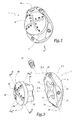
- Figure 1 an ancillary 1 of installation a glenoid implant, adapted to guide directionally the drill of a drill for medical use not shown.
- a glenoid implant When placing a glenoid implant on a patient's shoulder blade to form a prosthesis shoulder, the surgeon must dig into the glenoid the scapula a receiving channel for a keel the glenoid implant.
- the management that this channel is to be formed is different.
- Optimal here means “preferential” considering all the medical parameters brought to the attention of the surgeon, the latter for example has a series of scanned sections of the scapula on which it is intended to place the implant and determine this direction preferred.
- the exact location of the point of application of the piercing member is secondary to the preferred direction, it being understood that this point of application is located in a central area of the cavity glenoid.
- Figure 2 shows a dotted line shoulder blade 2 of a patient as it appears at surgeon using a CT scan.
- the C-C axis indicates the preferred direction chosen by the surgeon as the direction in which the piercing member should to be applied.
- the ancillary 1 essentially comprises a plate 4 on which are reported means 6 adjusting the direction of a drilling guide by compared to the stage.
- the plate 4 is formed of a metal body 10 having, in a direction denoted Z-Z a dimension smaller than on the two orthogonal directions remaining, indicated by axes X-X and Y-Y. Subsequently, the lower and upper terms will be oriented by relation to the X-X axis so that for example next to Figure 3, the upper term corresponds to the part high of this figure, while the lower term corresponds to the lower part.
- the body 10 of the plate 4 defines a surface convex 12 intended to come into surface support against scapula 2, as shown in figure 2.
- the surface 12 is provided with pins projections 16 intended to facilitate the retention of the plate relative to the scapula as will be explained later.
- the body 10 delimits a surface 18 opposite the surface 12, substantially planar and from which are provided, at the four corners of the body 10, surfaces bevelled 20.
- surfaces 20 are formed threaded recesses 21, adapted to receive means (not shown) removable fixing for a handle manipulation of the plate known per se.
- the body 10 internally defines an opening through 22, central axis Z-Z and cross-shaped in cross section.
- the opening 22 has two pairs of diametrically opposite lobes, the lobes of the same pair being aligned respectively according to the directions X-X and Y-Y.
- the adjustment means 6 are formed by a barrel 30 shown in more detail in Figures 3 to 5.
- This cannon comprises a tubular body 32 of axis Z-Z and of profile exterior substantially complementary to the profile of the through opening 22 of the body 10.
- the body 32 is closed at one end by a bottom overall hemispherical 34 which forms, with the outer surface of the body 32, a planar shoulder 35 radially projecting from relative to the Z-Z axis.
- holes straight through 36 whose respective axes are substantially concurrent at a point denoted P belonging to the Z-Z axis.
- These holes 36 are distributed in a first 38 series of holes that extend in the foreground containing the axes X-X and Z-Z and corresponding substantially in the section plane of FIG. 4, and a second series 40 of holes which extend in a second plane containing the axes Y-Y and Z-Z and corresponding to the section plane of the figure 5.
- each series 38, 40 of holes 36 the spacing angular between two adjacent holes on the same side of the Z-Z axis is approximately 10 °.
- Angular spacing between the Z-Z axis and one of the two holes 36 in the 38 series located most in the center of the cover 34 is approximately 5 °, while the same angular deviation for the two holes more in the center of series 40 is about 10 °
- a screw 42 is housed in an additional hole extending along the X-X direction and leading on one side to the edge of the body 10 and on the other side in the opening 22.
- This screw makes it possible to retain along the axis Z-Z the barrel 30 in opening 22.
- the surgeon When the surgeon has determined, for example at means of CT scans of a patient's shoulder, the privileged direction C-C in which he wishes anchor the glenoid implant in the scapula and therefore apply a drill bit, it supports the ancillary 1 against the scapula. More specifically, the surface 12 of the platinum 4 is pressed against the bony glenoid of the scapula 2, as shown in FIG. 2.
- ancillary 1 is advantageously handled by a handle connected to the plate 10 at the beveled surfaces 20.
- the pins 16 facilitate the fixing of the plate by compared to the scapula.
- the surgeon While the barrel 30 is received and immobilized in the opening 22 of the plate, the surgeon selects, among the set of holes 36 in the barrel, the only hole of which the longitudinal axis is closest to the direction preferential C-C he chose. If necessary, the surgeon disengages the barrel 30 from the stage, the fact turn it a quarter turn then put it back in the cruciform opening 22, which allows to have adjustable drilling directions with a step of 5 ° in the two planes containing respectively the axes X-X and Z-Z and the Y-Y and Z-Z axes.
- the chosen direction C-C forms, in a plane containing the axes Y-Y and Z-Z, an angular deviation about 15 ° from the central axis of the cavity glenoid, so the surgeon will use a only holes from the 38 series of the barrel.
- the drill of a drill in order to drill or at least one initiation of drilling in the direction imposed by the hole.
- the surgeon can widen the hole drilled in the scapula by a larger diameter drill or other shaping. It can also use a pin milling which, wedged in the drilled hole, allows to spare a glenoid resection plane orthogonal to the direction CC.
- Ancillary 1 is thus easy to use and puts quickly available to the surgeon a guide application of an organ, in particular a drilling guide, whose direction is adjusted according to the direction preferential that the surgeon chose.
- Figures 6 and 7 is shown a variant of the ancillary 1 which differs from the ancillary of the figures previous by the number and the arrangement of the holes of guide 36 provided by the barrel 30.
- series of holes 42, 44, 46 and 48 are located respectively in the four bounded quadrants by the series of holes 38 and 40, forming a grid from the bottom 34 of the barrel. This variant makes available to the surgeon more guidance directions than ancillary Figures 1 to 5.
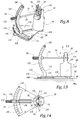
- FIGS 8 to 14 show a second instrument 50 according to the invention.
- This ancillary is intended to be used in the same context as the ancillary 1 of the previous figures, that is to say to guide the rod an organ, in particular the drill of a drill for use medical, when placing a glenoid implant of a shoulder prosthesis.
- this ancillary 50 comprises a plate 52 formed of a body metallic 54 of substantially the same shape as the body 10 of plate 4 and oriented with respect to axes X-X, Y-Y and Z-Z defined in the same way as in Figure 3.
- the body 54 defines a convex surface 56 intended to come to rest against a patient's bone glenoid, advantageously provided with mooring pins 58 substantially similar to the pins 16 of the plate 10, as well as a planar opposite surface 59.
- the body 54 is also suitable to be removably attached to a manipulation handle not shown.
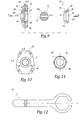
- a through opening 60 of axis of revolution Z-Z In the body 54 of the plate 52 is formed a through opening 60 of axis of revolution Z-Z. As shown in FIG. 9, this opening comprises, successively from the face 56 of the body 54, a part frustoconical 62 which diverges towards the face 56, part 64 in trunk of sphere of center O and a cylindrical part 66 threaded.
- the ancillary 50 also includes means 70 adjusting the direction of a drilling guide by relative to the plate 52, comprising on the one hand, a sphere 72 drilled right through one of its diameters in forming a single cylindrical bore 74 of axis Z'-Z ', and on the other hand, a nut 76.
- the sphere 72 has an outer surface 72 a substantially complementary to the hemispherical part 64 of the opening 60.
- the nut 76 is formed of a tubular body 78, of axis ZZ and threaded in a manner substantially complementary to the tapped cylindrical part 66 of the opening 60, and of a hexagonal head 80 which forms with the tubular body 78 a shoulder 82 radially projecting with respect to the axis of the body 78.
- the nut 76 internally provides a bore 84 formed, on the side of the tubular body 78, of a part 81 substantially in the form of a trunk of a sphere complementary to the external surface of the sphere 72, and, on the side of the head 80, of a flared part 83.
- the sphere 72 By cooperation of the outer surface 72 a of the sphere 72 with the surface 64 of the opening 60, the sphere 72 is movable relative to the platen 52 in the manner of a ball joint center O.
- the nut is able to immobilize the sphere 72 relative to the plate.
- the flat face 59 of the plate forms a stop surface for the shoulder 82, thus avoiding excessive tightening, or even deterioration of the sphere by the tight nut.
- ancillary 50 comprises advantageously a key 86, shown in FIG. 12, provided with a hollow head drive head hexagonal nut.
- the sphere 72 being movable relative to the plate 52 when nut 76 is not tightened, this sphere is adapted to be moved so that the axis Z'-Z 'of its bore 74 is adjusted according to the direction privileged C-C chosen beforehand by the surgeon.
- the ancillary 50 further comprises means 88 for displacement and positioning of the sphere 72 by relative to plate 52, shown in FIGS. 8, 13 and 14.
- These means comprise a rigid support 90 of a part and a rod 92 for driving the sphere 72 on the other hand, connected to support 88.
- the rod 92 is adapted to one of its ends, to be threaded inside the hole 74 of the sphere 72, and has at its other end a knurled handle 94 for handling the rod, added from removably on this rod like a nut.
- Bar 114 is pivotally mounted relative to the rest of the support 90, around a pivot axis 118 perpendicular to the surface 98 and formed for example by a cylindrical pin guided in rotation in a recess correspondent formed in the horizontal protractor plate 106 and the base 100.
- Each arm 116 has a profile along its length essentially semicircular with center O and bears corresponding angle graduations, referenced 120 on Figures 8 and 13.
- the zero scale corresponds to the position of the rod 92 perpendicular to the plane Q.
- the arms 116 are received in a groove 122 of the protractor horizontal 106, semicircular centered on the axis of pivoting 118.
- the periphery of the groove 122 carries angular graduations referenced 124.
- the zero graduation corresponds to the position of the rod 92 perpendicular to the plane Q.
- the arms 116 are connected by a jumper 126.
- the surgeon determines the preferred direction C-C that he wants to dig the canal receiving a keel from the glenoid implant.
- the entire vertical protractor 112 pivots around the axis 118 and the angular orientation of the rod in a plane perpendicular to the X-X axis of the stage is set.
- the surgeon ensures the correct positioning rod angle by direct reading on the references corresponding angles 120 and 124.
- the surgeon uses the key 86 to tighten firmly the nut 76 and thus immobilize the sphere 72 by relative to the plate 52.
- the head of the key 86 is at this effect with a slot wide enough to allow to engage the key on the head 80 of the nut without be bothered by the rod 92.
- the second embodiment of the ancillary 50 has the advantage, compared to the ancillary 1 of Figures 1 to 5, to allow the surgeon to adjust continuously the direction of the drilling guide following all anatomically conceivable directions, and not only following a discrete series of these directions.
- the bearing face 12 or 56 is flat.
- the positions of points P and O above may deviate somewhat from those described upper.
- the adjustment means 70 are replaced by a sliding system allowing directional adjustment in a single plane.
- the ancillary device according to the invention is able to directionally guide any piercing member, shaping or the like other than a drilling forest, for example example an impact pin or a marking nail.
Landscapes
- Health & Medical Sciences (AREA)
- Surgery (AREA)
- Life Sciences & Earth Sciences (AREA)
- Medical Informatics (AREA)
- Animal Behavior & Ethology (AREA)
- Orthopedic Medicine & Surgery (AREA)
- Oral & Maxillofacial Surgery (AREA)
- Engineering & Computer Science (AREA)
- Biomedical Technology (AREA)
- Heart & Thoracic Surgery (AREA)
- Dentistry (AREA)
- Molecular Biology (AREA)
- Nuclear Medicine, Radiotherapy & Molecular Imaging (AREA)
- General Health & Medical Sciences (AREA)
- Public Health (AREA)
- Veterinary Medicine (AREA)
- Prostheses (AREA)
- Surgical Instruments (AREA)
- Dental Prosthetics (AREA)
- Perforating, Stamping-Out Or Severing By Means Other Than Cutting (AREA)
- Drilling And Boring (AREA)
- Electrotherapy Devices (AREA)
Abstract
Description
- les moyens d'ajustement de la direction du guide sont adaptés pour être reçus et immobilisés dans une ouverture traversante formée dans la platine et débouchant sur la surface d'appui de la platine ;
- les moyens d'ajustement permettent d'ajuster la direction du guide par rapport à la platine au moins dans deux plans sensiblement perpendiculaires l'un à l'autre ;
- les moyens d'ajustement de la direction du guide comportent un canon pourvu de plusieurs trous traversants rectilignes, l'un desdits trous formant le guide directionnel pour l'organe de perçage, de façonnage ou analogue ;
- le canon comporte un corps tubulaire fermé à une de ses extrémités par un fond, les trous traversants étant formés dans le fond et débouchant à l'intérieur du corps tubulaire, lequel corps tubulaire présente en coupe transversale un profil extérieur adapté pour coopérer avec une ouverture traversante de la platine de façon à immobiliser le canon dans cette ouverture ;
- les axes des trous sont sensiblement concourants en un point situé sensiblement dans le prolongement géométrique de la face convexe de la platine ;
- une première série de trous du canon est alignée selon un premier plan et une seconde série d'autres trous du canon est alignée suivant un second plan sensiblement orthogonal au premier plan ;
- dans chacune des première et seconde séries de trous, les axes des trous situés d'un même côté de l'axe central du canon sont décalés angulairement les uns par rapport aux autres d'une valeur sensiblement constante ;
- d'autres séries de trous sont prévus dans les quadrants définis par les première et seconde séries de trous ;
- les moyens d'ajustement de la direction du guide comportent d'une part, un élément mobile par rapport à la platine et d'autre part, un élément d'immobilisation de l'élément mobile par rapport à la platine, l'élément mobile étant pourvu d'un perçage traversant rectiligne adapté pour former le guide directionnel pour l'organe de perçage, de façonnage ou analogue ;
- la direction du perçage de l'élément mobile est continûment ajustable ;
- l'élément mobile présente une surface adaptée pour coopérer avec une surface associée de la platine ;
- la surface de l'élément mobile adaptée pour coopérer avec la surface associée de la platine est sensiblement sphérique ;
- il comporte en outre un outil de commande de l'élément d'immobilisation ;
- il comprend en outre des moyens de déplacement et de positionnement de l'élément mobile par rapport à la platine adaptés pour amener le perçage de l'élément mobile sensiblement suivant une direction choisie ;
- les moyens de déplacement et de positionnement de l'élément mobile comportent un support rigide de retenue pour la platine et une tige d'entraínement de l'élément mobile, déplaçable par rapport au support rigide, ledit support étant pourvu de deux rapporteurs adaptés pour rapporter la position angulaire de la tige dans deux plans sensiblement perpendiculaires l'un à l'autre.
- on dispose d'au moins une coupe scanner ou analogue de l'omoplate d'un patient,
- on détermine une direction préférentielle d'application sur l'omoplate d'un organe de perçage, de façonnage ou analogue,
- on utilise un ancillaire de guidage qui comporte une platine formant un guide directionnel pour ledit organe de perçage et des moyens d'ajustement de la direction du guide par rapport à la platine,
- on plaque une surface de la platine sur la glène de l'omoplate,
- on introduit l'organe de perçage dans le guide dont la direction est ajustée suivant la direction préférentielle, et
- on actionne l'organe de perçage de façon à agir sur l'omoplate suivant la direction préférentielle.
- les moyens d'ajustement de l'ancillaire de guidage comportent un canon pourvu de plusieurs trous traversants rectilignes, et dans laquelle, après avoir plaqué la platine sur la glène de l'omoplate, on introduit l'organe de perçage dans le trou qui, parmi les trous traversants du canon, s'étend suivant une direction proche ou la direction la plus proche de la direction préférentielle ; ou
- les moyens d'ajustement de l'ancillaire de guidage comportent un élément mobile par rapport à la platine et un élément d'immobilisation de l'élément mobile par rapport à la platine, ledit élément mobile étant pourvu d'un perçage traversant rectiligne, et dans laquelle, avant d'avoir plaqué la platine sur la glène de l'omoplate, on positionne l'élément mobile par rapport à la platine de façon à amener le perçage de l'élément mobile sensiblement suivant la direction préférentielle puis on immobilise l'élément mobile par rapport à la platine par l'intermédiaire de l'élément d'immobilisation.
- la figure 1 est une vue en perspective d'un premier mode de réalisation d'un ancillaire selon l'invention ;
- la figure 2 est une vue en élévation, prise selon la flèche II indiquée sur la figure 1, de l'ancillaire appliqué sur une omoplate d'un être humain ;
- la figure 3 est une vue en perspective en éclaté de l'ancillaire de la figure 1 ;
- les figures 4 et 5 sont des coupes selon les plans indiqués IV et V sur la figure 3 ;
- la figure 6 est une vue analogue à la figure 3 d'une variante de l'ancillaire de la figure 1 ;
- la figure 7 est une vue en élévation prise selon la flèche VII indiquée sur la figure 6 ;
- la figure 8 est une vue en perspective d'un second mode de réalisation d'un ancillaire selon l'invention ;
- la figure 9 est une vue en coupe longitudinale de certains éléments de l'ancillaire de la figure 8, représentés à plus grande échelle ;
- la figure 10 est une vue en élévation, prise selon la flèche X indiquée sur la figure 9, de l'éléments sur lequel pointe cette flèche X ;
- la figure 11 est une vue en élévation, prise selon la flèche XI indiquée sur la figure 9, de l'élément sur lequel pointe cette flèche XI ;
- la figure 12 est une vue en élévation d'un outil utilisé lors de la manipulation de l'ancillaire de la figure 8 ;
- la figure 13 est une vue en élévation de côté de l'ancillaire de la figure 8 ; et
- la figure 14 est une vue de dessus de l'ancillaire de la figure 8.
- une base d'appui sur une surface sensiblement plane, référencée 98 uniquement sur la figure 13, formée par exemple par une table ou tout plan de travail analogue ; cette base est constituée par exemple d'un pied 96A et d'un talon 96B ;
- une embase 100 de réception et d'immobilisation de la platine 52, pourvue d'un U dont les branches parallèles portent chacune une nervure longitudinale 102 adaptée pour être reçue dans une rainure correspondante 104 formée dans les chants latéraux du corps 54 de la platine, comme représenté sur la figure 14, de façon à positionner le plan Q de la platine, contenant le point O et les axes X-X et Y-Y, sensiblement perpendiculairement à la surface plane 98 ;
- un rapporteur 106 dit horizontal, sous forme d'une plaque sensiblement parallèle à la surface plane 98 ; ce rapporteur horizontal 106 est d'une part solidarisé à l'embase 100 et d'autre part relié fixement au talon 96B de la base d'appui par des pions de fixation 110 ;
- un rapporteur 112 dit vertical, constitué d'une barre plate 114 interposée entre le talon 96B et la plaque du rapporteur horizontal 106, et d'une paire de bras 116 parallèles l'un à l'autre, qui s'étendent transversalement depuis la barre 114 et entre lesquels est retenue la tige 92.
Claims (16)
- Ancillaire de pose d'un implant glénoïdien, du type comportant une platine (4 ; 52) qui délimite une surface d'appui (12 ; 56) destinée à venir s'appuyer contre la glène d'une omoplate (2) d'un patient et qui forme un guide directionnel pour un organe de perçage, de façonnage ou analogue, caractérisé en ce qu'il comporte des moyens (6 ; 70) d'ajustement de la direction du guide par rapport à la platine (4 ; 52).
- Ancillaire suivant la revendication 1, caractérisé en ce que les moyens (6 ; 70) d'ajustement de la direction du guide sont adaptés pour être reçus et immobilisés dans une ouverture traversante (22 ; 60) formée dans la platine (4 ; 52) et débouchant sur la surface d'appui (12 ; 56) de la platine.
- Ancillaire suivant l'une des revendications 1 ou 2, caractérisé en ce que les moyens d'ajustement (6 ; 70) permettent d'ajuster la direction du guide par rapport à la platine (4 ; 52) au moins dans deux plans ((X-X, Z-Z), (Y-Y, Z-Z)) sensiblement perpendiculaires l'un à l'autre.
- Ancillaire suivant l'une quelconque des revendications précédentes, caractérisé en ce que les moyens (6 ; 70) d'ajustement de la direction du guide comportent un canon (30) pourvu de plusieurs trous traversants (36) rectilignes, l'un desdits trous formant le guide directionnel pour l'organe de perçage, de façonnage ou analogue.
- Ancillaire suivant la revendication 4, caractérisé en ce que le canon (30) comporte un corps tubulaire (32) fermé à une de ses extrémités par un fond (34), les trous traversants (36) étant formés dans le fond et débouchant à l'intérieur du corps tubulaire, lequel corps tubulaire (32) présente en coupe transversale un profil extérieur adapté pour coopérer avec une ouverture traversante (22) de la platine (4) de façon à immobiliser le canon (30) dans cette ouverture.
- Ancillaire suivant la revendication 4 ou 5, caractérisé en ce que les axes des trous (36) sont sensiblement concourants en un point (P) situé sensiblement dans le prolongement géométrique de la face convexe (12) de la platine (4).
- Ancillaire suivant l'une quelconque des revendications 4 à 6, caractérisé en ce qu'une première série (38) de trous (36) du canon (30) est alignée selon un premier plan (X-X, Z-Z) et une seconde série (40) d'autres trous du canon est alignée suivant un second plan (Y-Y, Z-Z) sensiblement orthogonal au premier plan.
- Ancillaire suivant la revendication 7, caractérisé en ce que, dans chacune des première et seconde séries de trous, les axes des trous (36) situés d'un même côté de l'axe central (Z-Z) du canon (30) sont décalés angulairement les uns par rapport aux autres d'une valeur sensiblement constante.
- Ancillaire suivant l'une des revendications 7 ou 8, caractérisé en ce que d'autres séries (42, 44, 46, 48) de trous (36) sont prévus dans les quadrants définis par les première (38) et seconde (40) séries de trous.
- Ancillaire suivant l'une quelconque des revendications 1 à 3, caractérisé en ce que les moyens (6 ; 70) d'ajustement de la direction du guide comportent d'une part, un élément (72) mobile par rapport à la platine (52) et d'autre part, un élément (76) d'immobilisation de l'élément mobile (72) par rapport à la platine, l'élément mobile étant pourvu d'un perçage traversant (74) rectiligne adapté pour former le guide directionnel pour l'organe de perçage, de façonnage ou analogue.
- Ancillaire suivant la revendication 10, caractérisé en ce que la direction (Z'Z') du perçage (74) de l'élément mobile (72) est continûment ajustable.
- Ancillaire suivant la revendication 10 ou 11, caractérisé en ce que l'élément mobile (72) présente une surface (72a) adaptée pour coopérer avec une surface associée (64) de la platine (52).
- Ancillaire suivant la revendication 12, caractérisé en ce que ladite surface (72a) de l'élément mobile (72) adaptée pour coopérer avec la surface associée (64) de la platine (52) est sensiblement sphérique.
- Ancillaire suivant l'une quelconque des revendications 10 à 13, caractérisé en ce qu'il comporte en outre un outil (86) de commande de l'élément d'immobilisation (76).
- Ancillaire suivant l'une quelconque des revendications 10 à 14, caractérisé en ce qu'il comprend en outre des moyens (88) de déplacement et de positionnement de l'élément mobile (72) par rapport à la platine (52), adaptés pour amener le perçage (74) de l'élément mobile sensiblement suivant une direction choisie (C-C).
- Ancillaire suivant la revendication 15, caractérisé en ce que les moyens (88) de déplacement et de positionnement de l'élément mobile (72) comportent un support rigide (90) de retenue pour la platine (52) et une tige (92) d'entraínement de l'élément mobile, déplaçable par rapport au support rigide, ledit support étant pourvu de deux rapporteurs (106, 112) adaptés pour rapporter la position angulaire de la tige (92) dans deux plans sensiblement perpendiculaires l'un à l'autre.
Priority Applications (1)
| Application Number | Priority Date | Filing Date | Title |
|---|---|---|---|
| EP09179648A EP2160985B1 (fr) | 2003-03-10 | 2004-03-09 | Canon de perçage pour le positionnement d'un implant glénoidien |
Applications Claiming Priority (2)
| Application Number | Priority Date | Filing Date | Title |
|---|---|---|---|
| FR0302936 | 2003-03-10 | ||
| FR0302936A FR2852224B1 (fr) | 2003-03-10 | 2003-03-10 | Ancillaire de pose d'un implant glenoidien |
Related Child Applications (1)
| Application Number | Title | Priority Date | Filing Date |
|---|---|---|---|
| EP09179648.2 Division-Into | 2009-12-17 |
Publications (2)
| Publication Number | Publication Date |
|---|---|
| EP1457159A1 true EP1457159A1 (fr) | 2004-09-15 |
| EP1457159B1 EP1457159B1 (fr) | 2010-07-21 |
Family
ID=32749774
Family Applications (2)
| Application Number | Title | Priority Date | Filing Date |
|---|---|---|---|
| EP09179648A Expired - Lifetime EP2160985B1 (fr) | 2003-03-10 | 2004-03-09 | Canon de perçage pour le positionnement d'un implant glénoidien |
| EP04356033A Expired - Lifetime EP1457159B1 (fr) | 2003-03-10 | 2004-03-09 | Canon de perçage pour le positionnement d'un implant glénoidien |
Family Applications Before (1)
| Application Number | Title | Priority Date | Filing Date |
|---|---|---|---|
| EP09179648A Expired - Lifetime EP2160985B1 (fr) | 2003-03-10 | 2004-03-09 | Canon de perçage pour le positionnement d'un implant glénoidien |
Country Status (4)
| Country | Link |
|---|---|
| EP (2) | EP2160985B1 (fr) |
| AT (2) | ATE543448T1 (fr) |
| DE (1) | DE602004028186D1 (fr) |
| FR (1) | FR2852224B1 (fr) |
Cited By (6)
| Publication number | Priority date | Publication date | Assignee | Title |
|---|---|---|---|---|
| EP2324780A1 (fr) | 2009-11-24 | 2011-05-25 | Tornier | Ensemble chirurgical d'assistance à l'implantation d'un composant glénoïdien de prothèse d'épaule |
| WO2011110374A1 (fr) * | 2010-03-10 | 2011-09-15 | Depuy Orthopadie Gmbh | Instrument orthopédique |
| US20130018378A1 (en) * | 2011-07-12 | 2013-01-17 | Takehito Hananouchi | Surgical instrument for the positioning of an alignment element |
| CN104271053A (zh) * | 2012-04-10 | 2015-01-07 | 克利夫兰临床基金会 | 定向构件放置导引装置 |
| EP3222250A1 (fr) * | 2016-03-22 | 2017-09-27 | Tornier | Instrumentation pour implanter un composant prothetic glenoide sur une glene d'un patient , et kit dr trsitement chirurgical d'une glene d'un patient comportant une telle instrumentation |
| US10052114B2 (en) | 2011-07-12 | 2018-08-21 | Materialise, Nv | Shoulder base plate coverage and stability |
Families Citing this family (1)
| Publication number | Priority date | Publication date | Assignee | Title |
|---|---|---|---|---|
| KR102440539B1 (ko) * | 2020-12-15 | 2022-09-06 | 연세대학교 원주산학협력단 | 골전도 임플란트 수직 드릴링 가이드 장치 |
Citations (4)
| Publication number | Priority date | Publication date | Assignee | Title |
|---|---|---|---|---|
| US5030219A (en) * | 1990-01-22 | 1991-07-09 | Boehringer Mannheim Corporation | Glenoid component installation tools |
| US5769856A (en) * | 1996-06-24 | 1998-06-23 | Osteonics Corp. | Drill guide and implant method |
| US5800551A (en) * | 1997-03-10 | 1998-09-01 | Biomet, Inc. | Apparatus and method for shoulder arthroplasty |
| US6379386B1 (en) * | 1997-09-09 | 2002-04-30 | Stryker Technologies Corporation | Anatomic glenoid shoulder prosthesis together with methods and tools for implanting same |
-
2003
- 2003-03-10 FR FR0302936A patent/FR2852224B1/fr not_active Expired - Fee Related
-
2004
- 2004-03-09 EP EP09179648A patent/EP2160985B1/fr not_active Expired - Lifetime
- 2004-03-09 DE DE602004028186T patent/DE602004028186D1/de not_active Expired - Lifetime
- 2004-03-09 AT AT09179648T patent/ATE543448T1/de active
- 2004-03-09 EP EP04356033A patent/EP1457159B1/fr not_active Expired - Lifetime
- 2004-03-09 AT AT04356033T patent/ATE474510T1/de not_active IP Right Cessation
Patent Citations (4)
| Publication number | Priority date | Publication date | Assignee | Title |
|---|---|---|---|---|
| US5030219A (en) * | 1990-01-22 | 1991-07-09 | Boehringer Mannheim Corporation | Glenoid component installation tools |
| US5769856A (en) * | 1996-06-24 | 1998-06-23 | Osteonics Corp. | Drill guide and implant method |
| US5800551A (en) * | 1997-03-10 | 1998-09-01 | Biomet, Inc. | Apparatus and method for shoulder arthroplasty |
| US6379386B1 (en) * | 1997-09-09 | 2002-04-30 | Stryker Technologies Corporation | Anatomic glenoid shoulder prosthesis together with methods and tools for implanting same |
Cited By (12)
| Publication number | Priority date | Publication date | Assignee | Title |
|---|---|---|---|---|
| EP2324780A1 (fr) | 2009-11-24 | 2011-05-25 | Tornier | Ensemble chirurgical d'assistance à l'implantation d'un composant glénoïdien de prothèse d'épaule |
| US8535319B2 (en) | 2009-11-24 | 2013-09-17 | Tornier | Surgical guide systems and methods for prosthetic joints |
| FR2955250A1 (fr) * | 2010-01-15 | 2011-07-22 | Tornier Sa | Ensemble chirurgical d'assistance a l'implantation d'un composant glenoidien de prothese d'epaule |
| WO2011110374A1 (fr) * | 2010-03-10 | 2011-09-15 | Depuy Orthopadie Gmbh | Instrument orthopédique |
| CN103002820A (zh) * | 2010-03-10 | 2013-03-27 | 德普伊矫形外科有限责任公司 | 骨科器械 |
| CN103002820B (zh) * | 2010-03-10 | 2015-07-22 | 德普伊矫形外科有限责任公司 | 骨科器械 |
| US20130018378A1 (en) * | 2011-07-12 | 2013-01-17 | Takehito Hananouchi | Surgical instrument for the positioning of an alignment element |
| US10052114B2 (en) | 2011-07-12 | 2018-08-21 | Materialise, Nv | Shoulder base plate coverage and stability |
| US10092419B2 (en) * | 2011-07-12 | 2018-10-09 | Materialise, Nv | Surgical instrument for the positioning of an alignment element |
| CN104271053A (zh) * | 2012-04-10 | 2015-01-07 | 克利夫兰临床基金会 | 定向构件放置导引装置 |
| EP3222250A1 (fr) * | 2016-03-22 | 2017-09-27 | Tornier | Instrumentation pour implanter un composant prothetic glenoide sur une glene d'un patient , et kit dr trsitement chirurgical d'une glene d'un patient comportant une telle instrumentation |
| US11013619B2 (en) | 2016-03-22 | 2021-05-25 | Tornier | Instrumentation and method for implanting a glenoidal prosthetic component on a glenoid |
Also Published As
| Publication number | Publication date |
|---|---|
| ATE474510T1 (de) | 2010-08-15 |
| FR2852224B1 (fr) | 2005-12-09 |
| DE602004028186D1 (de) | 2010-09-02 |
| EP2160985B1 (fr) | 2012-02-01 |
| ATE543448T1 (de) | 2012-02-15 |
| EP2160985A1 (fr) | 2010-03-10 |
| FR2852224A1 (fr) | 2004-09-17 |
| EP1457159B1 (fr) | 2010-07-21 |
Similar Documents
| Publication | Publication Date | Title |
|---|---|---|
| EP1508316B1 (fr) | Prothèse totale métatarso-phalangienne, et ancillaires pour la mise en place de cette prothèse | |
| EP2405837B1 (fr) | Implant rachidien à liaison rotule verrouillable | |
| EP1200006B1 (fr) | Dispositif pour la mise en place d'implant dentaire | |
| FR2867962A1 (fr) | Plaque d'osteosynthese et spherique | |
| EP0880950A1 (fr) | Cage intervertébrale cervicale | |
| EP2020938B1 (fr) | Dispositif de fixation osseuse | |
| EP0704191A1 (fr) | Ensemble porte-fraise et fraise pour la chirurgie | |
| FR2857576A1 (fr) | Dispositif d'aide pour l'implantation de protheses totales du genou | |
| EP1275346A2 (fr) | Ancillaire de pose d'un composant huméral de prothèse de coude | |
| FR2831048A1 (fr) | Dispositif d'osteosynthese a approche progressive et procede de premontage | |
| EP0414633A1 (fr) | Fixateur externe dynamique pour poignet | |
| FR2831049A1 (fr) | Plaque pour dispositif d'osteosynthese et procede de premontage | |
| FR2848413A1 (fr) | Plaque d'osteosynthese pour l'osteosynthese de petits os voisins les uns des autres | |
| EP0578807A1 (fr) | Ensemble d'implants d'osteosynthese et son dispositif de pose | |
| WO2012080637A1 (fr) | Instrument chirurgical pour une technique de fixation de fragments d'os au moyen d'une vis canulee | |
| EP1876974A1 (fr) | Instrument de visée pour la détermination de l'axe mécanique du fémur | |
| FR2487711A1 (fr) | Dispositif de fixation d'un foret a un outil mecanique et adaptateur utilise dans ce dispositif | |
| WO2010061124A1 (fr) | Dispositif d'aide a la pose d'implants dentaires | |
| EP1457159B1 (fr) | Canon de perçage pour le positionnement d'un implant glénoidien | |
| WO2021028636A2 (fr) | Implant intramédullaire pour ostéotomie transversale | |
| FR2647006A1 (fr) | Dispositifs pour le montage d'un clou de renforcement et procede mettant en oeuvre ces dispositifs | |
| FR3022137A1 (fr) | Ensemble forme par une prothese d'articulation metatarso-phalangienne et par les instruments de mise en place de cette prothese | |
| EP3852652A1 (fr) | Guide de positionnement d'une broche de guidage orthopédique sur une structure osseuse | |
| FR2930424A1 (fr) | Dispositif de reduction d'une fracture entre la tete epiphysaire et la diaphyse d'un os long, notamment d'une fracture humerale proximale. | |
| EP4478994B1 (fr) | Dispositif d'implant pour la realisation d'une arthrodese rachidienne par voie posterieure au niveau d'une articulation facettaire, et systeme comprenant ledit implant et son outil de pose |
Legal Events
| Date | Code | Title | Description |
|---|---|---|---|
| PUAI | Public reference made under article 153(3) epc to a published international application that has entered the european phase |
Free format text: ORIGINAL CODE: 0009012 |
|
| AK | Designated contracting states |
Kind code of ref document: A1 Designated state(s): AT BE BG CH CY CZ DE DK EE ES FI FR GB GR HU IE IT LI LU MC NL PL PT RO SE SI SK TR |
|
| AX | Request for extension of the european patent |
Extension state: AL HR LT LV MK |
|
| 17P | Request for examination filed |
Effective date: 20041009 |
|
| AKX | Designation fees paid |
Designated state(s): AT BE BG CH CY CZ DE DK EE ES FI FR GB GR HU IE IT LI LU MC NL PL PT RO SE SI SK TR |
|
| RIN1 | Information on inventor provided before grant (corrected) |
Inventor name: EKELUND, ANDERS Inventor name: COMTAT, LAURENT Inventor name: TORNIER, ALAIN |
|
| 17Q | First examination report despatched |
Effective date: 20090819 |
|
| GRAP | Despatch of communication of intention to grant a patent |
Free format text: ORIGINAL CODE: EPIDOSNIGR1 |
|
| GRAS | Grant fee paid |
Free format text: ORIGINAL CODE: EPIDOSNIGR3 |
|
| GRAA | (expected) grant |
Free format text: ORIGINAL CODE: 0009210 |
|
| AK | Designated contracting states |
Kind code of ref document: B1 Designated state(s): AT BE BG CH CY CZ DE DK EE ES FI FR GB GR HU IE IT LI LU MC NL PL PT RO SE SI SK TR |
|
| REG | Reference to a national code |
Ref country code: GB Ref legal event code: FG4D Free format text: NOT ENGLISH |
|
| REG | Reference to a national code |
Ref country code: CH Ref legal event code: EP |
|
| REG | Reference to a national code |
Ref country code: IE Ref legal event code: FG4D |
|
| REF | Corresponds to: |
Ref document number: 602004028186 Country of ref document: DE Date of ref document: 20100902 Kind code of ref document: P |
|
| REG | Reference to a national code |
Ref country code: NL Ref legal event code: VDEP Effective date: 20100721 |
|
| PG25 | Lapsed in a contracting state [announced via postgrant information from national office to epo] |
Ref country code: AT Free format text: LAPSE BECAUSE OF FAILURE TO SUBMIT A TRANSLATION OF THE DESCRIPTION OR TO PAY THE FEE WITHIN THE PRESCRIBED TIME-LIMIT Effective date: 20100721 Ref country code: NL Free format text: LAPSE BECAUSE OF FAILURE TO SUBMIT A TRANSLATION OF THE DESCRIPTION OR TO PAY THE FEE WITHIN THE PRESCRIBED TIME-LIMIT Effective date: 20100721 Ref country code: FI Free format text: LAPSE BECAUSE OF FAILURE TO SUBMIT A TRANSLATION OF THE DESCRIPTION OR TO PAY THE FEE WITHIN THE PRESCRIBED TIME-LIMIT Effective date: 20100721 |
|
| PG25 | Lapsed in a contracting state [announced via postgrant information from national office to epo] |
Ref country code: PT Free format text: LAPSE BECAUSE OF FAILURE TO SUBMIT A TRANSLATION OF THE DESCRIPTION OR TO PAY THE FEE WITHIN THE PRESCRIBED TIME-LIMIT Effective date: 20101122 Ref country code: SI Free format text: LAPSE BECAUSE OF FAILURE TO SUBMIT A TRANSLATION OF THE DESCRIPTION OR TO PAY THE FEE WITHIN THE PRESCRIBED TIME-LIMIT Effective date: 20100721 Ref country code: PL Free format text: LAPSE BECAUSE OF FAILURE TO SUBMIT A TRANSLATION OF THE DESCRIPTION OR TO PAY THE FEE WITHIN THE PRESCRIBED TIME-LIMIT Effective date: 20100721 Ref country code: CY Free format text: LAPSE BECAUSE OF FAILURE TO SUBMIT A TRANSLATION OF THE DESCRIPTION OR TO PAY THE FEE WITHIN THE PRESCRIBED TIME-LIMIT Effective date: 20100721 Ref country code: BG Free format text: LAPSE BECAUSE OF FAILURE TO SUBMIT A TRANSLATION OF THE DESCRIPTION OR TO PAY THE FEE WITHIN THE PRESCRIBED TIME-LIMIT Effective date: 20101021 |
|
| PG25 | Lapsed in a contracting state [announced via postgrant information from national office to epo] |
Ref country code: SE Free format text: LAPSE BECAUSE OF FAILURE TO SUBMIT A TRANSLATION OF THE DESCRIPTION OR TO PAY THE FEE WITHIN THE PRESCRIBED TIME-LIMIT Effective date: 20100721 Ref country code: GR Free format text: LAPSE BECAUSE OF FAILURE TO SUBMIT A TRANSLATION OF THE DESCRIPTION OR TO PAY THE FEE WITHIN THE PRESCRIBED TIME-LIMIT Effective date: 20101022 |
|
| PG25 | Lapsed in a contracting state [announced via postgrant information from national office to epo] |
Ref country code: DK Free format text: LAPSE BECAUSE OF FAILURE TO SUBMIT A TRANSLATION OF THE DESCRIPTION OR TO PAY THE FEE WITHIN THE PRESCRIBED TIME-LIMIT Effective date: 20100721 |
|
| PLBE | No opposition filed within time limit |
Free format text: ORIGINAL CODE: 0009261 |
|
| STAA | Information on the status of an ep patent application or granted ep patent |
Free format text: STATUS: NO OPPOSITION FILED WITHIN TIME LIMIT |
|
| PG25 | Lapsed in a contracting state [announced via postgrant information from national office to epo] |
Ref country code: CZ Free format text: LAPSE BECAUSE OF FAILURE TO SUBMIT A TRANSLATION OF THE DESCRIPTION OR TO PAY THE FEE WITHIN THE PRESCRIBED TIME-LIMIT Effective date: 20100721 Ref country code: IT Free format text: LAPSE BECAUSE OF FAILURE TO SUBMIT A TRANSLATION OF THE DESCRIPTION OR TO PAY THE FEE WITHIN THE PRESCRIBED TIME-LIMIT Effective date: 20100721 Ref country code: RO Free format text: LAPSE BECAUSE OF FAILURE TO SUBMIT A TRANSLATION OF THE DESCRIPTION OR TO PAY THE FEE WITHIN THE PRESCRIBED TIME-LIMIT Effective date: 20100721 Ref country code: EE Free format text: LAPSE BECAUSE OF FAILURE TO SUBMIT A TRANSLATION OF THE DESCRIPTION OR TO PAY THE FEE WITHIN THE PRESCRIBED TIME-LIMIT Effective date: 20100721 Ref country code: SK Free format text: LAPSE BECAUSE OF FAILURE TO SUBMIT A TRANSLATION OF THE DESCRIPTION OR TO PAY THE FEE WITHIN THE PRESCRIBED TIME-LIMIT Effective date: 20100721 |
|
| 26N | No opposition filed |
Effective date: 20110426 |
|
| PG25 | Lapsed in a contracting state [announced via postgrant information from national office to epo] |
Ref country code: ES Free format text: LAPSE BECAUSE OF FAILURE TO SUBMIT A TRANSLATION OF THE DESCRIPTION OR TO PAY THE FEE WITHIN THE PRESCRIBED TIME-LIMIT Effective date: 20101101 |
|
| REG | Reference to a national code |
Ref country code: DE Ref legal event code: R097 Ref document number: 602004028186 Country of ref document: DE Effective date: 20110426 |
|
| BERE | Be: lapsed |
Owner name: TORNIER Effective date: 20110331 |
|
| PG25 | Lapsed in a contracting state [announced via postgrant information from national office to epo] |
Ref country code: MC Free format text: LAPSE BECAUSE OF NON-PAYMENT OF DUE FEES Effective date: 20110331 |
|
| PG25 | Lapsed in a contracting state [announced via postgrant information from national office to epo] |
Ref country code: BE Free format text: LAPSE BECAUSE OF NON-PAYMENT OF DUE FEES Effective date: 20110331 |
|
| REG | Reference to a national code |
Ref country code: DE Ref legal event code: R082 Ref document number: 602004028186 Country of ref document: DE Representative=s name: DREISS PATENTANWAELTE PARTNERSCHAFT, DE |
|
| REG | Reference to a national code |
Ref country code: CH Ref legal event code: PCOW Free format text: NEW ADDRESS: 161 RUE LAVOISIER, 38330 MONTBONNOT-SAINT-MARTIN (FR) |
|
| REG | Reference to a national code |
Ref country code: FR Ref legal event code: CA Effective date: 20121213 |
|
| REG | Reference to a national code |
Ref country code: DE Ref legal event code: R082 Ref document number: 602004028186 Country of ref document: DE Representative=s name: DREISS PATENTANWAELTE PARTNERSCHAFT, DE Effective date: 20121126 Ref country code: DE Ref legal event code: R081 Ref document number: 602004028186 Country of ref document: DE Owner name: TORNIER, FR Free format text: FORMER OWNER: TORNIER, SAINT-ISMIER, FR Effective date: 20121126 Ref country code: DE Ref legal event code: R082 Ref document number: 602004028186 Country of ref document: DE Representative=s name: DREISS PATENTANWAELTE PARTG MBB, DE Effective date: 20121126 |
|
| PG25 | Lapsed in a contracting state [announced via postgrant information from national office to epo] |
Ref country code: LU Free format text: LAPSE BECAUSE OF NON-PAYMENT OF DUE FEES Effective date: 20110309 |
|
| REG | Reference to a national code |
Ref country code: FR Ref legal event code: GC Effective date: 20130515 |
|
| PG25 | Lapsed in a contracting state [announced via postgrant information from national office to epo] |
Ref country code: TR Free format text: LAPSE BECAUSE OF FAILURE TO SUBMIT A TRANSLATION OF THE DESCRIPTION OR TO PAY THE FEE WITHIN THE PRESCRIBED TIME-LIMIT Effective date: 20100721 |
|
| PG25 | Lapsed in a contracting state [announced via postgrant information from national office to epo] |
Ref country code: HU Free format text: LAPSE BECAUSE OF FAILURE TO SUBMIT A TRANSLATION OF THE DESCRIPTION OR TO PAY THE FEE WITHIN THE PRESCRIBED TIME-LIMIT Effective date: 20100721 |
|
| PGFP | Annual fee paid to national office [announced via postgrant information from national office to epo] |
Ref country code: CH Payment date: 20140313 Year of fee payment: 11 |
|
| REG | Reference to a national code |
Ref country code: FR Ref legal event code: PLFP Year of fee payment: 12 |
|
| REG | Reference to a national code |
Ref country code: CH Ref legal event code: PL |
|
| PG25 | Lapsed in a contracting state [announced via postgrant information from national office to epo] |
Ref country code: LI Free format text: LAPSE BECAUSE OF NON-PAYMENT OF DUE FEES Effective date: 20150331 Ref country code: CH Free format text: LAPSE BECAUSE OF NON-PAYMENT OF DUE FEES Effective date: 20150331 |
|
| REG | Reference to a national code |
Ref country code: FR Ref legal event code: RG Effective date: 20160128 |
|
| REG | Reference to a national code |
Ref country code: FR Ref legal event code: PLFP Year of fee payment: 13 |
|
| REG | Reference to a national code |
Ref country code: FR Ref legal event code: PLFP Year of fee payment: 14 |
|
| REG | Reference to a national code |
Ref country code: FR Ref legal event code: PLFP Year of fee payment: 15 |
|
| PGFP | Annual fee paid to national office [announced via postgrant information from national office to epo] |
Ref country code: DE Payment date: 20190312 Year of fee payment: 16 Ref country code: IE Payment date: 20190214 Year of fee payment: 16 Ref country code: GB Payment date: 20190320 Year of fee payment: 16 |
|
| PGFP | Annual fee paid to national office [announced via postgrant information from national office to epo] |
Ref country code: FR Payment date: 20190221 Year of fee payment: 16 |
|
| REG | Reference to a national code |
Ref country code: DE Ref legal event code: R119 Ref document number: 602004028186 Country of ref document: DE |
|
| PG25 | Lapsed in a contracting state [announced via postgrant information from national office to epo] |
Ref country code: DE Free format text: LAPSE BECAUSE OF NON-PAYMENT OF DUE FEES Effective date: 20201001 Ref country code: FR Free format text: LAPSE BECAUSE OF NON-PAYMENT OF DUE FEES Effective date: 20200331 Ref country code: IE Free format text: LAPSE BECAUSE OF NON-PAYMENT OF DUE FEES Effective date: 20200309 |
|
| GBPC | Gb: european patent ceased through non-payment of renewal fee |
Effective date: 20200309 |
|
| PG25 | Lapsed in a contracting state [announced via postgrant information from national office to epo] |
Ref country code: GB Free format text: LAPSE BECAUSE OF NON-PAYMENT OF DUE FEES Effective date: 20200309 |
|
| P01 | Opt-out of the competence of the unified patent court (upc) registered |
Effective date: 20230515 |