EP1448799B2 - Verfahren zur selektiven Nukleinsäureisolierung - Google Patents
Verfahren zur selektiven Nukleinsäureisolierung Download PDFInfo
- Publication number
- EP1448799B2 EP1448799B2 EP02794065.9A EP02794065A EP1448799B2 EP 1448799 B2 EP1448799 B2 EP 1448799B2 EP 02794065 A EP02794065 A EP 02794065A EP 1448799 B2 EP1448799 B2 EP 1448799B2
- Authority
- EP
- European Patent Office
- Prior art keywords
- solid phase
- dna
- rna
- binding
- nucleic acid
- Prior art date
- Legal status (The legal status is an assumption and is not a legal conclusion. Google has not performed a legal analysis and makes no representation as to the accuracy of the status listed.)
- Expired - Lifetime
Links
- 238000000034 method Methods 0.000 title claims abstract description 48
- 150000007523 nucleic acids Chemical class 0.000 title abstract description 157
- 108020004707 nucleic acids Proteins 0.000 title abstract description 156
- 102000039446 nucleic acids Human genes 0.000 title abstract description 156
- 238000002955 isolation Methods 0.000 title description 7
- 239000007790 solid phase Substances 0.000 claims description 206
- VYPSYNLAJGMNEJ-UHFFFAOYSA-N Silicium dioxide Chemical compound O=[Si]=O VYPSYNLAJGMNEJ-UHFFFAOYSA-N 0.000 claims description 167
- 238000009739 binding Methods 0.000 claims description 108
- 230000027455 binding Effects 0.000 claims description 107
- 239000002245 particle Substances 0.000 claims description 79
- 239000012472 biological sample Substances 0.000 claims description 66
- 239000000377 silicon dioxide Substances 0.000 claims description 64
- 150000001450 anions Chemical class 0.000 claims description 44
- 239000000463 material Substances 0.000 claims description 26
- 235000012239 silicon dioxide Nutrition 0.000 claims description 22
- 239000012148 binding buffer Substances 0.000 claims description 20
- 239000005909 Kieselgur Substances 0.000 claims description 13
- CPELXLSAUQHCOX-UHFFFAOYSA-M Bromide Chemical compound [Br-] CPELXLSAUQHCOX-UHFFFAOYSA-M 0.000 claims description 11
- 229910002027 silica gel Inorganic materials 0.000 claims description 10
- 239000000741 silica gel Substances 0.000 claims description 10
- XMBWDFGMSWQBCA-UHFFFAOYSA-N hydrogen iodide Chemical compound I XMBWDFGMSWQBCA-UHFFFAOYSA-N 0.000 claims description 9
- 229940006460 bromide ion Drugs 0.000 claims description 8
- 239000011521 glass Substances 0.000 claims description 8
- 230000007935 neutral effect Effects 0.000 claims description 8
- 239000011324 bead Substances 0.000 claims description 6
- 230000002378 acidificating effect Effects 0.000 claims description 3
- 239000012528 membrane Substances 0.000 claims description 3
- 108020004414 DNA Proteins 0.000 description 216
- 108091032973 (ribonucleotides)n+m Proteins 0.000 description 148
- LFQSCWFLJHTTHZ-UHFFFAOYSA-N Ethanol Chemical compound CCO LFQSCWFLJHTTHZ-UHFFFAOYSA-N 0.000 description 100
- FVAUCKIRQBBSSJ-UHFFFAOYSA-M sodium iodide Chemical compound [Na+].[I-] FVAUCKIRQBBSSJ-UHFFFAOYSA-M 0.000 description 71
- 239000000872 buffer Substances 0.000 description 66
- 235000002639 sodium chloride Nutrition 0.000 description 59
- 238000002156 mixing Methods 0.000 description 48
- HEMHJVSKTPXQMS-UHFFFAOYSA-M Sodium hydroxide Chemical compound [OH-].[Na+] HEMHJVSKTPXQMS-UHFFFAOYSA-M 0.000 description 45
- FAPWRFPIFSIZLT-UHFFFAOYSA-M Sodium chloride Chemical compound [Na+].[Cl-] FAPWRFPIFSIZLT-UHFFFAOYSA-M 0.000 description 43
- 230000000694 effects Effects 0.000 description 37
- 150000003839 salts Chemical class 0.000 description 37
- 235000019441 ethanol Nutrition 0.000 description 33
- 239000000203 mixture Substances 0.000 description 33
- LENZDBCJOHFCAS-UHFFFAOYSA-N tris Chemical compound OCC(N)(CO)CO LENZDBCJOHFCAS-UHFFFAOYSA-N 0.000 description 33
- 230000004568 DNA-binding Effects 0.000 description 32
- 239000007983 Tris buffer Substances 0.000 description 29
- 238000011084 recovery Methods 0.000 description 27
- 239000000243 solution Substances 0.000 description 27
- QKNYBSVHEMOAJP-UHFFFAOYSA-N 2-amino-2-(hydroxymethyl)propane-1,3-diol;hydron;chloride Chemical compound Cl.OCC(N)(CO)CO QKNYBSVHEMOAJP-UHFFFAOYSA-N 0.000 description 25
- 238000011534 incubation Methods 0.000 description 25
- 239000000047 product Substances 0.000 description 25
- 210000004185 liver Anatomy 0.000 description 23
- 235000009518 sodium iodide Nutrition 0.000 description 23
- 244000309466 calf Species 0.000 description 22
- 239000011780 sodium chloride Substances 0.000 description 22
- 210000001541 thymus gland Anatomy 0.000 description 22
- JHJLBTNAGRQEKS-UHFFFAOYSA-M sodium bromide Chemical compound [Na+].[Br-] JHJLBTNAGRQEKS-UHFFFAOYSA-M 0.000 description 21
- XLYOFNOQVPJJNP-UHFFFAOYSA-N water Substances O XLYOFNOQVPJJNP-UHFFFAOYSA-N 0.000 description 21
- 230000004570 RNA-binding Effects 0.000 description 19
- ZJYYHGLJYGJLLN-UHFFFAOYSA-N guanidinium thiocyanate Chemical compound SC#N.NC(N)=N ZJYYHGLJYGJLLN-UHFFFAOYSA-N 0.000 description 15
- 150000001768 cations Chemical class 0.000 description 14
- 108090000623 proteins and genes Proteins 0.000 description 12
- 102000004169 proteins and genes Human genes 0.000 description 12
- 239000011159 matrix material Substances 0.000 description 11
- 238000002798 spectrophotometry method Methods 0.000 description 10
- 210000004369 blood Anatomy 0.000 description 9
- 239000008280 blood Substances 0.000 description 9
- CSCPPACGZOOCGX-UHFFFAOYSA-N Acetone Chemical compound CC(C)=O CSCPPACGZOOCGX-UHFFFAOYSA-N 0.000 description 8
- 239000008366 buffered solution Substances 0.000 description 8
- 230000003139 buffering effect Effects 0.000 description 7
- ZMMJGEGLRURXTF-UHFFFAOYSA-N ethidium bromide Chemical compound [Br-].C12=CC(N)=CC=C2C2=CC=C(N)C=C2[N+](CC)=C1C1=CC=CC=C1 ZMMJGEGLRURXTF-UHFFFAOYSA-N 0.000 description 7
- 229960005542 ethidium bromide Drugs 0.000 description 7
- 239000000523 sample Substances 0.000 description 7
- 239000006228 supernatant Substances 0.000 description 7
- JKMHFZQWWAIEOD-UHFFFAOYSA-N 2-[4-(2-hydroxyethyl)piperazin-1-yl]ethanesulfonic acid Chemical compound OCC[NH+]1CCN(CCS([O-])(=O)=O)CC1 JKMHFZQWWAIEOD-UHFFFAOYSA-N 0.000 description 6
- 238000010828 elution Methods 0.000 description 6
- 239000006166 lysate Substances 0.000 description 6
- QTANTQQOYSUMLC-UHFFFAOYSA-O Ethidium cation Chemical compound C12=CC(N)=CC=C2C2=CC=C(N)C=C2[N+](CC)=C1C1=CC=CC=C1 QTANTQQOYSUMLC-UHFFFAOYSA-O 0.000 description 5
- 238000000246 agarose gel electrophoresis Methods 0.000 description 5
- PJJJBBJSCAKJQF-UHFFFAOYSA-N guanidinium chloride Chemical compound [Cl-].NC(N)=[NH2+] PJJJBBJSCAKJQF-UHFFFAOYSA-N 0.000 description 5
- -1 hnRNA Proteins 0.000 description 5
- NKDFYOWSKOHCCO-YPVLXUMRSA-N 20-hydroxyecdysone Chemical compound C1[C@@H](O)[C@@H](O)C[C@]2(C)[C@@H](CC[C@@]3([C@@H]([C@@](C)(O)[C@H](O)CCC(C)(O)C)CC[C@]33O)C)C3=CC(=O)[C@@H]21 NKDFYOWSKOHCCO-YPVLXUMRSA-N 0.000 description 4
- VEXZGXHMUGYJMC-UHFFFAOYSA-M Chloride anion Chemical compound [Cl-] VEXZGXHMUGYJMC-UHFFFAOYSA-M 0.000 description 4
- 239000011543 agarose gel Substances 0.000 description 4
- 239000013592 cell lysate Substances 0.000 description 4
- 238000002474 experimental method Methods 0.000 description 4
- 229960000789 guanidine hydrochloride Drugs 0.000 description 4
- AMXOYNBUYSYVKV-UHFFFAOYSA-M lithium bromide Chemical compound [Li+].[Br-] AMXOYNBUYSYVKV-UHFFFAOYSA-M 0.000 description 4
- HSZCZNFXUDYRKD-UHFFFAOYSA-M lithium iodide Chemical compound [Li+].[I-] HSZCZNFXUDYRKD-UHFFFAOYSA-M 0.000 description 4
- 230000008569 process Effects 0.000 description 4
- 239000002002 slurry Substances 0.000 description 4
- 241000894007 species Species 0.000 description 4
- 210000001519 tissue Anatomy 0.000 description 4
- VHUUQVKOLVNVRT-UHFFFAOYSA-N Ammonium hydroxide Chemical compound [NH4+].[OH-] VHUUQVKOLVNVRT-UHFFFAOYSA-N 0.000 description 3
- 239000007995 HEPES buffer Substances 0.000 description 3
- ZMZDMBWJUHKJPS-UHFFFAOYSA-M Thiocyanate anion Chemical compound [S-]C#N ZMZDMBWJUHKJPS-UHFFFAOYSA-M 0.000 description 3
- 239000000908 ammonium hydroxide Substances 0.000 description 3
- 238000006243 chemical reaction Methods 0.000 description 3
- 230000007423 decrease Effects 0.000 description 3
- 238000001514 detection method Methods 0.000 description 3
- 238000001962 electrophoresis Methods 0.000 description 3
- 239000000499 gel Substances 0.000 description 3
- ZMZDMBWJUHKJPS-UHFFFAOYSA-N hydrogen thiocyanate Natural products SC#N ZMZDMBWJUHKJPS-UHFFFAOYSA-N 0.000 description 3
- NLKNQRATVPKPDG-UHFFFAOYSA-M potassium iodide Chemical compound [K+].[I-] NLKNQRATVPKPDG-UHFFFAOYSA-M 0.000 description 3
- 239000000126 substance Substances 0.000 description 3
- MIMUSZHMZBJBPO-UHFFFAOYSA-N 6-methoxy-8-nitroquinoline Chemical compound N1=CC=CC2=CC(OC)=CC([N+]([O-])=O)=C21 MIMUSZHMZBJBPO-UHFFFAOYSA-N 0.000 description 2
- 229920000936 Agarose Polymers 0.000 description 2
- 108091003079 Bovine Serum Albumin Proteins 0.000 description 2
- VEXZGXHMUGYJMC-UHFFFAOYSA-N Hydrochloric acid Chemical compound Cl VEXZGXHMUGYJMC-UHFFFAOYSA-N 0.000 description 2
- GRYLNZFGIOXLOG-UHFFFAOYSA-N Nitric acid Chemical compound O[N+]([O-])=O GRYLNZFGIOXLOG-UHFFFAOYSA-N 0.000 description 2
- WCUXLLCKKVVCTQ-UHFFFAOYSA-M Potassium chloride Chemical compound [Cl-].[K+] WCUXLLCKKVVCTQ-UHFFFAOYSA-M 0.000 description 2
- FKNQFGJONOIPTF-UHFFFAOYSA-N Sodium cation Chemical compound [Na+] FKNQFGJONOIPTF-UHFFFAOYSA-N 0.000 description 2
- 241000700605 Viruses Species 0.000 description 2
- MCMNRKCIXSYSNV-UHFFFAOYSA-N Zirconium dioxide Chemical compound O=[Zr]=O MCMNRKCIXSYSNV-UHFFFAOYSA-N 0.000 description 2
- 239000002253 acid Substances 0.000 description 2
- 239000007864 aqueous solution Substances 0.000 description 2
- 229940098773 bovine serum albumin Drugs 0.000 description 2
- 230000015556 catabolic process Effects 0.000 description 2
- 210000004027 cell Anatomy 0.000 description 2
- 239000003153 chemical reaction reagent Substances 0.000 description 2
- 238000006731 degradation reaction Methods 0.000 description 2
- 238000000105 evaporative light scattering detection Methods 0.000 description 2
- 238000000605 extraction Methods 0.000 description 2
- 238000009396 hybridization Methods 0.000 description 2
- IXCSERBJSXMMFS-UHFFFAOYSA-N hydrogen chloride Substances Cl.Cl IXCSERBJSXMMFS-UHFFFAOYSA-N 0.000 description 2
- KWGKDLIKAYFUFQ-UHFFFAOYSA-M lithium chloride Chemical compound [Li+].[Cl-] KWGKDLIKAYFUFQ-UHFFFAOYSA-M 0.000 description 2
- 238000004949 mass spectrometry Methods 0.000 description 2
- 244000005700 microbiome Species 0.000 description 2
- 229910017604 nitric acid Inorganic materials 0.000 description 2
- VLTRZXGMWDSKGL-UHFFFAOYSA-M perchlorate Inorganic materials [O-]Cl(=O)(=O)=O VLTRZXGMWDSKGL-UHFFFAOYSA-M 0.000 description 2
- VLTRZXGMWDSKGL-UHFFFAOYSA-N perchloric acid Chemical compound OCl(=O)(=O)=O VLTRZXGMWDSKGL-UHFFFAOYSA-N 0.000 description 2
- IOLCXVTUBQKXJR-UHFFFAOYSA-M potassium bromide Chemical compound [K+].[Br-] IOLCXVTUBQKXJR-UHFFFAOYSA-M 0.000 description 2
- 238000002360 preparation method Methods 0.000 description 2
- 238000010839 reverse transcription Methods 0.000 description 2
- 230000035945 sensitivity Effects 0.000 description 2
- BAZAXWOYCMUHIX-UHFFFAOYSA-M sodium perchlorate Chemical compound [Na+].[O-]Cl(=O)(=O)=O BAZAXWOYCMUHIX-UHFFFAOYSA-M 0.000 description 2
- 229910001488 sodium perchlorate Inorganic materials 0.000 description 2
- 238000001179 sorption measurement Methods 0.000 description 2
- 238000001228 spectrum Methods 0.000 description 2
- 239000000758 substrate Substances 0.000 description 2
- 238000012360 testing method Methods 0.000 description 2
- LWIHDJKSTIGBAC-UHFFFAOYSA-K tripotassium phosphate Chemical compound [K+].[K+].[K+].[O-]P([O-])([O-])=O LWIHDJKSTIGBAC-UHFFFAOYSA-K 0.000 description 2
- IHPYMWDTONKSCO-UHFFFAOYSA-N 2,2'-piperazine-1,4-diylbisethanesulfonic acid Chemical compound OS(=O)(=O)CCN1CCN(CCS(O)(=O)=O)CC1 IHPYMWDTONKSCO-UHFFFAOYSA-N 0.000 description 1
- PKAUICCNAWQPAU-UHFFFAOYSA-N 2-(4-chloro-2-methylphenoxy)acetic acid;n-methylmethanamine Chemical compound CNC.CC1=CC(Cl)=CC=C1OCC(O)=O PKAUICCNAWQPAU-UHFFFAOYSA-N 0.000 description 1
- SXGZJKUKBWWHRA-UHFFFAOYSA-N 2-(N-morpholiniumyl)ethanesulfonate Chemical compound [O-]S(=O)(=O)CC[NH+]1CCOCC1 SXGZJKUKBWWHRA-UHFFFAOYSA-N 0.000 description 1
- 229940058020 2-amino-2-methyl-1-propanol Drugs 0.000 description 1
- GUPXYSSGJWIURR-UHFFFAOYSA-N 3-octoxypropane-1,2-diol Chemical compound CCCCCCCCOCC(O)CO GUPXYSSGJWIURR-UHFFFAOYSA-N 0.000 description 1
- 239000007991 ACES buffer Substances 0.000 description 1
- 241000203069 Archaea Species 0.000 description 1
- 241000894006 Bacteria Species 0.000 description 1
- 229920002271 DEAE-Sepharose Polymers 0.000 description 1
- 102000053602 DNA Human genes 0.000 description 1
- 238000007400 DNA extraction Methods 0.000 description 1
- 241000450599 DNA viruses Species 0.000 description 1
- KCXVZYZYPLLWCC-UHFFFAOYSA-N EDTA Chemical compound OC(=O)CN(CC(O)=O)CCN(CC(O)=O)CC(O)=O KCXVZYZYPLLWCC-UHFFFAOYSA-N 0.000 description 1
- 241000206602 Eukaryota Species 0.000 description 1
- DGAQECJNVWCQMB-PUAWFVPOSA-M Ilexoside XXIX Chemical compound C[C@@H]1CC[C@@]2(CC[C@@]3(C(=CC[C@H]4[C@]3(CC[C@@H]5[C@@]4(CC[C@@H](C5(C)C)OS(=O)(=O)[O-])C)C)[C@@H]2[C@]1(C)O)C)C(=O)O[C@H]6[C@@H]([C@H]([C@@H]([C@H](O6)CO)O)O)O.[Na+] DGAQECJNVWCQMB-PUAWFVPOSA-M 0.000 description 1
- 239000007993 MOPS buffer Substances 0.000 description 1
- 239000000020 Nitrocellulose Substances 0.000 description 1
- 239000004677 Nylon Substances 0.000 description 1
- 239000007990 PIPES buffer Substances 0.000 description 1
- 206010036790 Productive cough Diseases 0.000 description 1
- 229920002684 Sepharose Polymers 0.000 description 1
- UIIMBOGNXHQVGW-DEQYMQKBSA-M Sodium bicarbonate-14C Chemical compound [Na+].O[14C]([O-])=O UIIMBOGNXHQVGW-DEQYMQKBSA-M 0.000 description 1
- YKTSYUJCYHOUJP-UHFFFAOYSA-N [O--].[Al+3].[Al+3].[O-][Si]([O-])([O-])[O-] Chemical compound [O--].[Al+3].[Al+3].[O-][Si]([O-])([O-])[O-] YKTSYUJCYHOUJP-UHFFFAOYSA-N 0.000 description 1
- 206010000269 abscess Diseases 0.000 description 1
- 150000007513 acids Chemical class 0.000 description 1
- 230000023445 activated T cell autonomous cell death Effects 0.000 description 1
- PNEYBMLMFCGWSK-UHFFFAOYSA-N aluminium oxide Inorganic materials [O-2].[O-2].[O-2].[Al+3].[Al+3] PNEYBMLMFCGWSK-UHFFFAOYSA-N 0.000 description 1
- CBTVGIZVANVGBH-UHFFFAOYSA-N aminomethyl propanol Chemical compound CC(C)(N)CO CBTVGIZVANVGBH-UHFFFAOYSA-N 0.000 description 1
- 230000003321 amplification Effects 0.000 description 1
- 238000004458 analytical method Methods 0.000 description 1
- LDDQLRUQCUTJBB-UHFFFAOYSA-O azanium;hydrofluoride Chemical compound [NH4+].F LDDQLRUQCUTJBB-UHFFFAOYSA-O 0.000 description 1
- 238000001574 biopsy Methods 0.000 description 1
- OWMVSZAMULFTJU-UHFFFAOYSA-N bis-tris Chemical compound OCCN(CCO)C(CO)(CO)CO OWMVSZAMULFTJU-UHFFFAOYSA-N 0.000 description 1
- 210000001124 body fluid Anatomy 0.000 description 1
- 239000010839 body fluid Substances 0.000 description 1
- KGBXLFKZBHKPEV-UHFFFAOYSA-N boric acid Chemical compound OB(O)O KGBXLFKZBHKPEV-UHFFFAOYSA-N 0.000 description 1
- 239000004327 boric acid Substances 0.000 description 1
- 239000007853 buffer solution Substances 0.000 description 1
- 230000001413 cellular effect Effects 0.000 description 1
- 210000001175 cerebrospinal fluid Anatomy 0.000 description 1
- 230000008859 change Effects 0.000 description 1
- 230000003196 chaotropic effect Effects 0.000 description 1
- 239000003795 chemical substances by application Substances 0.000 description 1
- 210000003763 chloroplast Anatomy 0.000 description 1
- 239000012539 chromatography resin Substances 0.000 description 1
- 239000000084 colloidal system Substances 0.000 description 1
- 239000002299 complementary DNA Substances 0.000 description 1
- 150000001875 compounds Chemical class 0.000 description 1
- 238000011109 contamination Methods 0.000 description 1
- 210000004748 cultured cell Anatomy 0.000 description 1
- 230000003247 decreasing effect Effects 0.000 description 1
- 239000005549 deoxyribonucleoside Substances 0.000 description 1
- 238000010586 diagram Methods 0.000 description 1
- 125000002147 dimethylamino group Chemical group [H]C([H])([H])N(*)C([H])([H])[H] 0.000 description 1
- 241001493065 dsRNA viruses Species 0.000 description 1
- 230000007515 enzymatic degradation Effects 0.000 description 1
- 210000003743 erythrocyte Anatomy 0.000 description 1
- CCIVGXIOQKPBKL-UHFFFAOYSA-M ethanesulfonate Chemical compound CCS([O-])(=O)=O CCIVGXIOQKPBKL-UHFFFAOYSA-M 0.000 description 1
- 230000001747 exhibiting effect Effects 0.000 description 1
- 239000000284 extract Substances 0.000 description 1
- 239000012530 fluid Substances 0.000 description 1
- 230000002538 fungal effect Effects 0.000 description 1
- 238000001502 gel electrophoresis Methods 0.000 description 1
- 230000002209 hydrophobic effect Effects 0.000 description 1
- 229910052588 hydroxylapatite Inorganic materials 0.000 description 1
- 239000012535 impurity Substances 0.000 description 1
- 238000000338 in vitro Methods 0.000 description 1
- 230000003993 interaction Effects 0.000 description 1
- 210000000265 leukocyte Anatomy 0.000 description 1
- 210000004072 lung Anatomy 0.000 description 1
- 210000002751 lymph Anatomy 0.000 description 1
- 239000003550 marker Substances 0.000 description 1
- 108020004999 messenger RNA Proteins 0.000 description 1
- 229910044991 metal oxide Inorganic materials 0.000 description 1
- 150000004706 metal oxides Chemical class 0.000 description 1
- YACKEPLHDIMKIO-UHFFFAOYSA-N methylphosphonic acid Chemical compound CP(O)(O)=O YACKEPLHDIMKIO-UHFFFAOYSA-N 0.000 description 1
- 239000008267 milk Substances 0.000 description 1
- 210000004080 milk Anatomy 0.000 description 1
- 235000013336 milk Nutrition 0.000 description 1
- 210000003470 mitochondria Anatomy 0.000 description 1
- 229920001220 nitrocellulos Polymers 0.000 description 1
- 238000003199 nucleic acid amplification method Methods 0.000 description 1
- 229920001778 nylon Polymers 0.000 description 1
- 210000003463 organelle Anatomy 0.000 description 1
- 239000006174 pH buffer Substances 0.000 description 1
- 239000008188 pellet Substances 0.000 description 1
- XYJRXVWERLGGKC-UHFFFAOYSA-D pentacalcium;hydroxide;triphosphate Chemical compound [OH-].[Ca+2].[Ca+2].[Ca+2].[Ca+2].[Ca+2].[O-]P([O-])([O-])=O.[O-]P([O-])([O-])=O.[O-]P([O-])([O-])=O XYJRXVWERLGGKC-UHFFFAOYSA-D 0.000 description 1
- 150000004713 phosphodiesters Chemical class 0.000 description 1
- 239000013612 plasmid Substances 0.000 description 1
- 229920000642 polymer Polymers 0.000 description 1
- 239000001103 potassium chloride Substances 0.000 description 1
- 235000011164 potassium chloride Nutrition 0.000 description 1
- 229910000160 potassium phosphate Inorganic materials 0.000 description 1
- 235000011009 potassium phosphates Nutrition 0.000 description 1
- 239000000843 powder Substances 0.000 description 1
- 108090000765 processed proteins & peptides Proteins 0.000 description 1
- 239000012460 protein solution Substances 0.000 description 1
- 238000000746 purification Methods 0.000 description 1
- 230000009467 reduction Effects 0.000 description 1
- 238000011160 research Methods 0.000 description 1
- 239000002342 ribonucleoside Substances 0.000 description 1
- 230000028327 secretion Effects 0.000 description 1
- 210000000582 semen Anatomy 0.000 description 1
- 239000011734 sodium Substances 0.000 description 1
- 229910052708 sodium Inorganic materials 0.000 description 1
- 239000007787 solid Substances 0.000 description 1
- 210000003802 sputum Anatomy 0.000 description 1
- 208000024794 sputum Diseases 0.000 description 1
- 239000000725 suspension Substances 0.000 description 1
- RYYWUUFWQRZTIU-UHFFFAOYSA-K thiophosphate Chemical compound [O-]P([O-])([O-])=S RYYWUUFWQRZTIU-UHFFFAOYSA-K 0.000 description 1
- 210000002700 urine Anatomy 0.000 description 1
Images










Classifications
-
- C—CHEMISTRY; METALLURGY
- C12—BIOCHEMISTRY; BEER; SPIRITS; WINE; VINEGAR; MICROBIOLOGY; ENZYMOLOGY; MUTATION OR GENETIC ENGINEERING
- C12Q—MEASURING OR TESTING PROCESSES INVOLVING ENZYMES, NUCLEIC ACIDS OR MICROORGANISMS; COMPOSITIONS OR TEST PAPERS THEREFOR; PROCESSES OF PREPARING SUCH COMPOSITIONS; CONDITION-RESPONSIVE CONTROL IN MICROBIOLOGICAL OR ENZYMOLOGICAL PROCESSES
- C12Q1/00—Measuring or testing processes involving enzymes, nucleic acids or microorganisms; Compositions therefor; Processes of preparing such compositions
- C12Q1/68—Measuring or testing processes involving enzymes, nucleic acids or microorganisms; Compositions therefor; Processes of preparing such compositions involving nucleic acids
- C12Q1/6806—Preparing nucleic acids for analysis, e.g. for polymerase chain reaction [PCR] assay
-
- C—CHEMISTRY; METALLURGY
- C12—BIOCHEMISTRY; BEER; SPIRITS; WINE; VINEGAR; MICROBIOLOGY; ENZYMOLOGY; MUTATION OR GENETIC ENGINEERING
- C12N—MICROORGANISMS OR ENZYMES; COMPOSITIONS THEREOF; PROPAGATING, PRESERVING, OR MAINTAINING MICROORGANISMS; MUTATION OR GENETIC ENGINEERING; CULTURE MEDIA
- C12N15/00—Mutation or genetic engineering; DNA or RNA concerning genetic engineering, vectors, e.g. plasmids, or their isolation, preparation or purification; Use of hosts therefor
- C12N15/09—Recombinant DNA-technology
- C12N15/10—Processes for the isolation, preparation or purification of DNA or RNA
- C12N15/1003—Extracting or separating nucleic acids from biological samples, e.g. pure separation or isolation methods; Conditions, buffers or apparatuses therefor
- C12N15/1006—Extracting or separating nucleic acids from biological samples, e.g. pure separation or isolation methods; Conditions, buffers or apparatuses therefor by means of a solid support carrier, e.g. particles, polymers
-
- C—CHEMISTRY; METALLURGY
- C12—BIOCHEMISTRY; BEER; SPIRITS; WINE; VINEGAR; MICROBIOLOGY; ENZYMOLOGY; MUTATION OR GENETIC ENGINEERING
- C12N—MICROORGANISMS OR ENZYMES; COMPOSITIONS THEREOF; PROPAGATING, PRESERVING, OR MAINTAINING MICROORGANISMS; MUTATION OR GENETIC ENGINEERING; CULTURE MEDIA
- C12N15/00—Mutation or genetic engineering; DNA or RNA concerning genetic engineering, vectors, e.g. plasmids, or their isolation, preparation or purification; Use of hosts therefor
- C12N15/09—Recombinant DNA-technology
- C12N15/10—Processes for the isolation, preparation or purification of DNA or RNA
- C12N15/1003—Extracting or separating nucleic acids from biological samples, e.g. pure separation or isolation methods; Conditions, buffers or apparatuses therefor
- C12N15/1006—Extracting or separating nucleic acids from biological samples, e.g. pure separation or isolation methods; Conditions, buffers or apparatuses therefor by means of a solid support carrier, e.g. particles, polymers
- C12N15/101—Extracting or separating nucleic acids from biological samples, e.g. pure separation or isolation methods; Conditions, buffers or apparatuses therefor by means of a solid support carrier, e.g. particles, polymers by chromatography, e.g. electrophoresis, ion-exchange, reverse phase
Definitions
- the invention relates to methods for isolating nucleic acids.
- RNA or DNA may be desirable to isolate nucleic acids from a biological sample. In certain instances, It would be useful to selectively isolate DNA from such a biological sample. In certain instances it would be useful to selectively isolate DNA and to selectively isolate RNA from a biological sample. Typical protocols for isolating either RNA or DNA have used selective enzymatic degradation to remove the undesired nucleic acid.
- MARKO ET AL. (ANALYTICAL BIOCHEMISTRY vol. 121, 1982, pages 382 - 387 ) describe a procedure for the large-scale isolation of highly purified plasmid DNA using alkaline extraction and binding to glass powder.
- EP 0 969 090 is directed to a rapid and simple process for isolation of circular nucleic acids.
- EP 1 146 049 disclose a method for separating double and single strand nucleic acid structures.
- VOGELSTEIN ET AL. PROC. NATL. ACAD. SCI. USA vol. 76, no. 2, February 1979, pages 618 - 619 ) describe the preparative and analytical purification of DNA from agarose.
- WO 00/63362 relates to a magnetic DNA extraction kit for plants.
- WO 97/05248 disclose a solution containing a chaotropic agent and process using it for the isolation of DNA, RNA and proteins.
- WO 02/090539 describes compositions and methods for releasing and isolating nucleic acids from biological samples.
- WO 97/30062 relates to methods for easily separating nucleic acid material from double stranded nucleic acid material in a sample containing both.
- Methods of isolating DNA from a biological sample comprise: selectively binding DNA to a solid phase by contacting the biological sample with the solid phase under conditions which selectively bind DNA; separating the solid phase with the bound DNA from an unbound portion of the biological sample; and isolating the DNA from the solid phase.
- the conditions which selectively bind DNA comprise using a binding buffer comprising: an alkaline pH; and a large anion, wherein the large anion is at least as large as a bromide ion, wherein the large anion is iodide.
- methods of isolating DNA and RNA from a biological sample comprising: selectively binding DNA to a first solid phase by contacting the biological sample with the first solid phase under conditions which selectively bind DNA; separating the first solid phase with the bound DNA from a first unbound portion of the biological sample; isolating the DNA from the first solid phase; and isolating RNA from the first unbound portion of the biological sample.
- the isolating of the RNA from the first unbound portion of the biological sample comprises: exposing the first unbound portion of the biological sample to a second solid phase under conditions which bind RNA to the second solid phase; separating the second solid phase with bound RNA from the second portion of the biological sample; and isolating the RNA from the second solid phase.
- methods of isolating nucleic acid from a biological sample comprising: binding nucleic acid to a first solid phase by contacting the biological sample with the first solid phase under conditions which bind both DNA and RNA; separating the first solid phase with bound nucleic acid from a first unbound portion of the biological sample; eluting RNA from the first solid phase with bound nucleic acid under conditions which selectively bind DNA; removing the first solid phase with bound DNA from a first eluate; and isolating the DNA from the first solid phase.
- the conditions which selectively bind DNA comprise using a binding buffer comprising: an alkaline pH; and a large anion, wherein the large anion is at least as large as a bromide ion, wherein the large anion is iodide.
- the method of isolating nucleic acid from a biological sample further comprises: exposing the first eluate to a second solid phase under conditions which bind RNA to the second solid phase; separating the second solid phase with the bound RNA from a second eluate; and isolating the RNA from the second solid phase.
- isolating nucleic acid from a solid phase comprises eluting the nucleic acid from the solid phase.
- methods of identifying DNA in a biological sample comprise: selectively binding DNA to a solid phase by contacting the biological sample with the solid phase under conditions which selectively bind DNA; separating the solid phase with the bound DNA from an unbound portion of the biological sample; and identifying the DNA bound to the solid phase.
- the identifying the nucleic acid on a solid phase comprises amplifying the nucleic acid bound to the solid phase.
- biological sample is used in a broad sense and is intended to include a variety of biological sources that contain nucleic acids.
- biological sources include, without limitation, whole tissues, including biopsy materials and aspirates; in vitro cultured cells, including primary and secondary cells, transformed cell lines, and tissue and cellular explants; whole blood, red blood cells, white blood cells, and lymph; body fluids such as urine, sputum, semen, secretions, eye washes and aspirates, lung washes, cerebrospinal fluid, abscess fluid, and aspirates.
- biological sample include samples processed from biological sources, including but not limited to cell lysates and nucleic acid-containing extracts.
- Any organism containing nucleic acid may be a source of a biological sample, including, but not limited to, any eukaryotes, eubacteria, archaebacteria, or virus. Fungal and plant tissues, such as leaves, roots, stems, and caps, are also within the scope of the present invention. Microorganisms and viruses that may be present on or in a biological sample are within the scope of the invention.
- buffer refers to aqueous solutions or compositions that resist changes in pH when acids or bases are added to the solution. This resistance to pH change is due to the solution's buffering action. Solutions exhibiting buffering activity are referred to as buffers or buffer solutions. Buffers typically do not have an unlimited ability to maintain the pH of a solution or composition. Rather, typically they are able to maintain the pH within certain ranges, for example between pH 5 and pH 7. See, generally, C. Mohan, Buffers, A guide for the preparation and use of buffers in biological systems, Calbiochem, 1999.
- Exemplary buffers include, but are not limited to, MES ([2-(N-Morphilino)ethanesulfonic acid]), ADA (N-2-Acetamido-2-iminodiacetic acid), and Tris ([ tris (Hydroxymethyl)aminomethane]; also known as Trizma); Bis-Tris; ACES; PIPES; and MOPS.
- Buffers that maintain the pH within a certain pH range are intended to encompass any buffer that exhibits buffering action at some point within the stated pH range. Thus, that term encompasses buffers that do not exhibit buffering capacity within the entire stated range, and buffers with buffering capacity that extend beyond the stated range.
- solution A may exhibit buffering capacity between pH 5.2 and 6.7
- solution B may exhibit buffering capacity between 6.0 and 8.0.
- both of those solutions would be considered buffers that maintain the pH within the range of pH 5.0 to pH 7.0.
- Buffer tables can be found in, among other places, the Calbiochem 2000-2001 General Catalog at pages 81-82, and the Sigma 2000-2001 Biochemicals and Reagents for Life Science Research Catalog at page 1873,
- isolated nucleic acid refers to the recovery of nucleic acid molecules from a source. While it is not always optimal, the process of recovering nucleic acid may also include recovering some impurities such as protein. It includes, but is not limited to, the physical enrichment of nucleic acid molecules from a source. The term “isolating” may also refer to the duplication or amplification of nucleic acid molecules, without necessarily removing the nucleic acid molecules from the source.
- salt refers to a compound produced by the interaction of an acid and a base.
- exemplary salts include, but are not limited to, sodium chloride (table salt), sodium iodide, sodium bromide, lithium bromide, lithium iodide, potassium phosphate, sodium bicarbonate, and the like.
- salts typically dissociate into an "anion” or negatively charged subcomponent, and a "cation” or positively charge subcomponent.
- sodium chloride (NaCl) when sodium chloride (NaCl) is dissolved in water, it dissociates into a sodium cation (Na + ) and a chloride anion (Cl - ).
- Examplary salts are discussed, e.g., in Waser, Jurg, Quantitative Chemistry, A Laboratory Text, W.A. Benjamin, Inc., New York, page 160, (1966 ).
- nucleic acid refers to a polymer of ribonucleosides or deoxyribonucleosides typically comprising phosphodiester linkages between subunits. Other linkages between subunits include, but are not limited to, methylphosphonate, phosphorothioate, and peptide linkages.
- nucleic acids include, but are not limited to, genomic DNA, cDNA, hnRNA, mRNA, rRNA, tRNA, fragmented nucleic acid, nucleic acid obtained from subcellular organelles such as mitochondria or chloroplasts, and nucleic acid obtained from microorganisms or DNA or RNA viruses that may be present on or in a biological sample.
- Solid phase components that are capable of binding to nucleic acids released from a biological sample include a variety of materials that are capable of binding nucleic acids under suitable conditions.
- Exemplary solid phase components include, but are not limited to, silica particles, silicon dioxide, diatomaceous earth, glass, alkylsilica, aluminum silicate, borosilicate, nitrocellulose, diazotized paper, hydroxyapatite, nylon, metal oxides, zirconia, alumina, diethylaminoethyl- and triethylaminoethyl-derivatized supports (Chromegabond SAX, LiChrosorb-AN, Nucleosil SB, Partisil SAX, RSL Anion, Vydac TP Anion, Zorbax SAX, Nucleosil NMe 2 , Aminex A-series, Chromex, and Hamilton HA lonex SB, DEAE sepharose, QAE sepharose), hydrophobic chromatography resin
- nucleic acid refers to binding of a type or species of nucleic acid (e.g., DNA) to a solid phase under conditions in which other types or species of nucleic acid (e.g., RNA) bind less efficiently.
- conditions for binding may be said to be selective for DNA when the amount of DNA bound to a solid phase is greater than the amount of RNA, when the DNA and RNA are in equimolar ratios in solution.
- conditions for the binding of DNA to a solid phase may be said to be selective when the efficiency of binding of DNA to a solid phase is unaffected by the amount of RNA in solution with the DNA.
- methods of isolating DNA from a biological sample comprise: selectively binding DNA to a solid phase by contacting the biological sample with the solid phase under conditions which selectively bind DNA; separating the solid phase with the bound DNA from an unbound portion of the biological sample; and isolating the DNA from the solid phase.
- methods of identifying DNA in a biological sample comprise: selectively binding DNA to a solid phase by contacting the biological sample with the solid phase under conditions which selectively bind DNA; separating the solid phase with the bound DNA from an unbound portion of the biological sample; and identifying the DNA bound to the solid phase.
- the identifying the DNA bound to the solid phase comprises amplifying the DNA bound to the solid phase.
- the solid phase is a siliceous material.
- the siliceous material is selected from a group comprising silica, silica dioxide, diatomaceous earth, glass, Celite, and silica gel.
- the solid phase is in a form selected from a group comprising a particle, a bead, a membrane, a frit, and a side of a container. Exemplary, but nonlimiting, examples of solid phases are discussed in U.S. Pat. Nos.
- the conditions which selectively bind DNA comprise using a binding buffer comprising: an alkaline pH; and a large anion, wherein the large anion is at least as large as a bromide ion, wherein the large anion is iodide.
- the alkaline pH is equal to, 10.0 between 10 and 11.
- the isolating the DNA from the solid phase comprises eluting the DNA.
- methods of isolating DNA and RNA from a biological sample comprise: selectively binding DNA to a first solid phase by contacting the biological sample with the first solid phase under conditions which selectively bind DNA; separating the first solid phase with the bound DNA from a first unbound portion of the biological sample; isolating the DNA from the first solid phase; and isolating RNA from the first unbound portion of the biological sample.
- the isolating the DNA from the first solid phase comprises eluting the DNA.
- methods of identifying DNA and RNA in a biological sample comprise: selectively binding DNA to a first solid phase by contacting the biological sample with the first solid phase under conditions which selectively bind DNA; separating the first solid phase with the bound DNA from a first unbound portion of the biological sample; identifying the DNA bound to the first solid phase; and identifying the RNA from the first unbound portion of the biological sample.
- the isolating the DNA from the first solid phase comprises eluting the DNA.
- the identifying the DNA bound to the first solid phase comprises amplifying the DNA bound to the first solid phase.
- nucleic acid both DNA and RNA bound to a solid phase.
- methods include, but are not limited to, hybridization to labeled probes, reverse transcription, mass spectrometry, and detection by a reaction of the bound DNA with a label, e.g., detection of fluorescence following the addition of a DNA-binding fluorophore.
- the isolating of the RNA from the first unbound portion of the biological sample comprises: exposing the first unbound portion of the biological sample to a second solid phase under conditions which bind RNA to the second solid phase; separating the second solid phase with bound RNA from the second portion of the biological sample; and isolating the RNA from the second solid phase by eluting the RNA.
- the conditions which bind RNA to the second solid phase comprise a neutral or acidic pH.
- the conditions which bind RNA to the second solid phase comprise reducing the pH to 8.0 or below.
- the conditions which bind RNA to the second solid phase comprise use of a salt with an anion smaller than bromide.
- the second solid phase is selected from any of the materials discussed above to the first solid phase in A above.
- the second solid phase may be the same material as the first solid phase or it may be different material.
- Conditions which selectively bind DNA comprise using a binding buffer comprising: an alkaline pH; and a large anion, wherein the large anion is at least as large as a bromide ion, wherein the large anion is iodide.
- Conditions which selectively bind DNA for these methods may comprise the conditions discussed above for selectively binding DNA in section A.
- a buffer or salt to a cell lysate, making the cell lysate very alkaline.
- a solid phase such a silica bead, would then be exposed to the alkaline lysate. DNA selectively binds to the bead, which is then removed.
- Another buffer or salt is added to the alkaline lysate to make the lysate neutral in pH.
- a second solid phase is added to the neutral lysate, and the RNA in the lysate binds to the second solid phase.
- the DNA bound to the first solid phase is then eluted with a neutral or alkaline, low salt buffer.
- the second solid phase is removed from the neutral lysate, and the RNA is eluted from the second solid phase with a neutral or alkaline, low salt buffer.
- methods of isolating nucleic acid from a biological sample comprise: binding nucleic acid to a first solid phase by contacting the biological sample with the first solid phase under conditions which bind both RNA and DNA; separating the first solid phase with bound nucleic acid from a first unbound portion of the biological sample; eluting RNA from the first solid phase with bound nucleic acid under conditions which selectively bind DNA; removing the first solid phase with bound DNA from a first eluate; and isolating the DNA from the first solid phase.
- the isolating the DNA from the first solid phase comprises eluting the DNA from the first solid phase.
- methods of identifying nucleic acid in a biological sample comprise: binding nucleic acid to a first solid phase by contacting the biological sample with the first solid phase under conditions which bind both RNA and DNA; separating the first solid phase with bound nucleic acid from a first unbound portion of the biological sample; eluting RNA from the first solid phase with bound nucleic acid under conditions which selectively bind DNA; removing the first solid phase with bound DNA from a first eluate of the biological sample; and identifying the DNA bound to the first solid phase.
- the identifying the DNA bound to the first solid phase comprises amplifying the DNA bound to the first solid phase.
- nucleic acid both DNA and RNA bound to a solid phase
- methods include, but are not limited to, hybridization to labeled probes, reverse transcription, mass spectrometry, and detection by a reaction of the bound DNA with a label, such as detection of fluorescence following the addition of a DNA-binding fluorophore.
- the first solid phase is selected from any of the materials discussed above to the first solid phase in A above.
- Conditions which selectively bind DNA comprise using a binding buffer comprising: a buffer with an alkaline pH; and a large anion, wherein the large anion is at least as large as a bromide ion wherein the large anion is iodide.
- Conditions which selectively bind DNA for these methods may comprise the conditions discussed above for selectively binding DNA in section A.
- the method of isolating nucleic acid from a biological sample further comprises: exposing the first eluate to a second solid phase under conditions which bind RNA to the second solid phase; separating the second solid phase with the bound RNA from a second eluate of the biological sample; and isolating the RNA from the second solid phase.
- the isolating the RNA from the second solid phase comprises eluting the RNA.
- the isolating the RNA from the second solid phase comprises amplifying the RNA bound to the second solid phase.
- the second solid phase is selected from any of the materials discussed above to the first solid phase in A above.
- the second solid phase may be the same material as the first solid phase or it may be different material..
- the conditions which selectively bind DNA comprise using a binding buffer comprising: an alkaline pH; and a large anion, wherein the large anion is at least as large as a bromide ion, wherein the large anion is iodide.
- Conditions which selectively bind DNA for these methods may comprise the conditions discussed above for selectively binding DNA in section A.
- the conditions which bind RNA to the second solid phase comprise a neutral or acidic pH.
- the conditions which bind RNA to the second solid phase comprise reducing the pH to 8.0 or below.
- the conditions which bind RNA to the second solid phase comprise use of a salt with an anion smaller than bromide.
- a solid phase such as a silica bead
- a cell lysate Nucleic acid, both DNA and RNA, then binds to the solid phase, which is then removed.
- the solid phase is then placed in a high pH buffer, which allows the RNA to elute from the solid phase, but keeps the DNA bound to the solid phase.
- the solid phase is then removed, and placed in a low salt buffer, which elutes the DNA.
- guanidine hydrochloride (Sigma, Lot 38H5432), guanidine thiocyanate (Sigma, Product Number G-9277), sodium iodide (Aldrich Chemical Company, Product Number 38,311-2, Lot Number 07004TS), sodium perchlorate (Aldrich Chemical Company, Product Number 41,024-1, Lot KU 06910HU), sodium bromide (Aldrich, Product Number 31050-6, Lot 11805KR), sodium chloride (Aldrich Chemical Company, Product Number 33,251-4, Lot Number 16524CS), Tris (Trizma base, Tris[Hydroxymethyl]aminomethane, Sigma, Product Number T-6791, Lot Number 1261-15738) - pH 8, MES (2-[N-Morpholino]ethanesulfonic acid, Sigma, product number M-5287, lot number 58H5411) - pH 6.0
- Nucleic acids and tissue samples and sources for them are as follows: calf thymus genomic DNA (deoxyribonucleic acid, type 1, highly polymerized from calf thymus, Sigma, Product Number D-1501, Lot 87H7840); rat liver total RNA (Biochain Institute, lot numbers A304057, A305062, or A306073); and whole blood (Blood Centers of the Pacific).
- calf thymus genomic DNA deoxyribonucleic acid, type 1, highly polymerized from calf thymus, Sigma, Product Number D-1501, Lot 87H7840
- rat liver total RNA Biochain Institute, lot numbers A304057, A305062, or A306073
- whole blood Boood Centers of the Pacific
- the spectrophotometry was performed with a Hewlett-Packard Model 8453 Spectrophotometer.
- Gel electrophoresis of nucleic acid samples in Examples 12 to 14 was carried out using SeaKem® agarose (Teknova); 1 X TBE (89 mM Tris, 89 mM Boric Acid, 2 mM EDTA, Teknova, catalog number 0278-1 L, lot number 17F801); and 0.5 ⁇ g/ml ethidium bromide buffer (BIO-RAD).
- Molecular weight markers used in electrophoresis were an AmpliSize DNA molecular weight standard (BIO-RAD), a High Molecular Weight DNA Marker (Gibco BRL), and an RNA ladder (GIBCO BRL).
- Silica and glass matrices from a variety of suppliers were evaluated for their ability to bind genomic DNA using different salts at pH 8.
- Silica (Organon Teknika), Diatomaceous Earth, Empore Filter Aid 400, J.T. Baker Silica Gel, Silicon dioxide, Binding Matrix, and Glassmilk Spin Buffer #4 were used for the following example.
- All particles were prepared as follows: the particles were washed once with 4-8 volumes of 1 N HCl, twice with 4-8 volumes of water, once with 4-8 volumes of 1 N NaOH, twice with 4-8 volumes of water, once with 4-8 volumes of ethanol, and four times with 4-8 volumes of water.
- one "volume" of water or ethanol referes to an amount of water or ethanol equal in mass to the mass of the particles being washed.
- the Binding Matrix and Glassmilk from BIO-101 were washed 4 times with at least 4 volumes of water before being treated with HCl, NaOH, and ethanol (as described above).
- the Silica particles were used as supplied.
- Diatomaceous Earth, Empore Filter Aid 400, Silica Gel, and Silicon dioxide were stored as a 200 mg/ml (20%) slurry in water.
- the Binding Matrix particles were stored as a 580 mg/ml (58%) slurry in water and the Glassmilk particles were stored as a 373 mg/ml (37%) slurry in water.
- Calf thymus DNA was used as the source of the genomic DNA. Sheared genomic DNA used in the following examples was prepared as follows. The DNA was resuspended at approximately 10 mg/ml in water. The DNA was then sheared by passing the material four times through a 20 G 1 1 ⁇ 2 needle, three times through a 21 G 1 1 ⁇ 2 gauge needle, 22 G 1 1 ⁇ 2 gauge needle, and once through a 26 G 1 1 ⁇ 2 gauge needle.
- the nucleic acid was incubated for up to 10 minutes at ambient temperature in the buffered solution, with occasional mixing. Those mixtures were incubated for 10 minutes at ambient temperature with occasional mixing. Following the binding incubation, the particles were centrifuged (15,800 x g, 1 minute) and washed twice with 0.5 ml of the binding buffer that had been used for the binding incubation. Subsequently, the particles were washed three to four times with 0.5 ml of 70% ethanol.
- the particles were allowed to air dry at ambient temperature or at 56°C for 5-10 minutes.
- the bound nucleic acid was first eluted with 0.25 ml of 10 mM Tris, pH 9 for 5 minutes at 56°C with constant mixing and the eluted nucleic acid was collected. Any residual nucleic acid bound to the particles was subsequently eluted with 0.25 ml of 0.1 N NaOH at 56°C for 5 minutes with constant mixing and the eluted nucleic acid was collected.
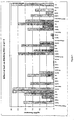
- the amount of nucleic acid was quantified by spectrophotometry. The results are shown in Figure 1 .
- Example 1 The solid phases used in the present example were prepared as described in Example 1. Sheared genomic DNA from calf thymus was prepared as described in Example 1.
- Sheared calf thymus DNA (25 ⁇ g of DNA, 50 ⁇ l of a 0.5 mg/ml concentration) was added to a 1.5 ml microcentrifuge tube containing 0.45 ml of either (1) 50 mM Tris-HCl, pH 8 and 4.75 M guanidine thiocyanate; or (2) 50 mM Tris-HCl, pH 8 and 4.75 M guanidine hydrochloride. Nucleic acid was incubated up to 10 minutes at ambient temperature in the buffered solution, with occasional mixing.
- Each of the seven solid phases (10-187 mg) was added separately to each of the two buffered nucleic acid solutions so that there were 14 containers with each combination of the individual solid phases and buffers. Those mixtures were incubated for 10 minutes at ambient temperature with occasional mixing. Following the binding incubation, the particles were centrifuged (15,800 x g, 1 minute) and washed twice with 0.5 ml of the binding buffer that had been used for the binding incubation. Subsequently, the particles were washed three to four times with 0.5 ml of 70% ethanol.
- the particles were allowed to air dry at ambient temperature or at 56°C for 5-10 minutes.
- the bound nucleic acid was first eluted with 0.25 ml of 10 mM Tris, pH 9 for 5 minutes at 56°C with constant mixing and the eluted nucleic acid was collected. Any residual nucleic acid bound to the particles was subsequently eluted with 0.25 ml of 0.1 N NaOH at 56°C for 5 minutes with constant mixing and the eluted nucleic acid was collected.
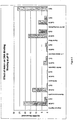
- the amount of nucleic acid was quantified by spectrophotometry. The results are shown in Figure 2 . In general, recovery in the presence of thiocyanate appeared superior to recovery in the presence of chloride ions.
- RNA to silica and glass solid phases from a variety of suppliers were evaluated using different salts at pH 8.
- Silica, Diatomaceous Earth, Binding Matrix, and Glassmilk Spin Buffer #4 were used for the following studies.
- the solid phase particles were prepared as described in Example 1.
- Rat liver total RNA (15 ⁇ g of RNA, 6 ⁇ l of a 2.5 mg/ml concentration in water) was added to a 1.5 ml microcentrifuge tube containing 0.45 ml of one of the following buffers: (1) 50 mM Tris-HCl, pH 8,4.75 M guanidine thiocyanate; (2) 50 mM Tris HCl, pH 8; 4.75 M guanidine hydrochloride; (3) 50 mM Tris HCl, pH 8; 4.75 M sodium chloride; or (4) 50 mM Tris HCl, pH 8; 4.75 M sodium iodide. Nucleic acid was incubated up to 5 minutes at ambient temperature in the buffered solution, with occasional mixing. Those mixtures were incubated 10 minutes at ambient temperature with occasional mixing.
- the particles were centrifuged (15,800 x g, 1 minute) and washed twice with 0.5 ml of the binding buffer that had been used for the binding incubation. Subsequently, the particles were washed two or four times with 0.5 ml of 70% ethanol. The particles which were washed twice with ethanol were then washed once with 0.5 ml of acetone and were allowed to dry for 5 minutes at 56°C.
- the bound nucleic acid was first eluted with 0.25 or 0.275 ml of 50 mM Tris, pH 9 for 5 minutes at 56°C with constant mixing and the eluted nucleic acid was collected.
- Example 1 Silica, Diatomaceous Earth, and Glassmilk Spin Buffer #4.
- sheared calf thymus DNA prepared as described in Example 1 was used as the source of genomic DNA.
- Sheared calf thymus DNA (25 ⁇ g - 50 ⁇ l at 0.5 mg/ml) was added to different 1.5 ml microcentrifuge tubes containing 0.45 ml of one of the following buffers: (1) 50 mM MES, pH 6, 4.75 M guanidine thiocyanate; (2) 50 mM MES, pH 6.0, 4.75 M sodium chloride; (3) 50 mM MES, pH 6.0, 4.75 M sodium bromide; (4) 50 mM MES, pH 6.0, 4.75 M sodium iodide; (5) 50 mM Tris-HCl, pH 8, 4.75 M guanidine thiocyanate; (6) 50 mM Tris-HCl, pH 8, 4.75 M sodium chloride; (7) 50 mM Tris-HCl, pH 8, 4.75M sodium bromide; (8) 50 mM Tris-HCl, pH 8, 4.75 M sodium iodide; (9) 50 mM MES, pH 6, 4.75 M gu
- Nucleic acid was incubated for 5 to 10 minutes at ambient temperature in the buffered solution, sometimes with occasional mixing. Each of the three solid phases (10 mg) was added separately to each of the buffered nucleic acid solutions. Those mixtures were incubated for 10 minutes at ambient temperature with occasional mixing. Following the binding incubation, the particles were centrifuged (4000 x g, 1 minute) and washed twice with 0.5 ml of the binding buffer that had been used for the binding incubation. The particles were then washed three times with 0.5 ml of 70% ethanol.
- the particles were allowed to air dry at ambient temperature for 5-10 minutes.
- the bound nucleic acid was first eluted with 0.25 ml of 50 mM Tris, pH 9 for 5 minutes at 56°C with constant mixing, and the eluted nucleic acid was collected. Any residual nucleic acid bound to the particles was eluted with 0.25 ml of 0.1 N NaOH at 56°C for 5 minutes with constant mixing and the eluted nucleic acid was collected.
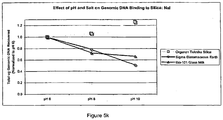
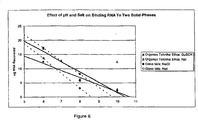
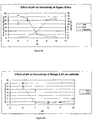
- the amount of nucleic acid was quantified by spectrophotometry. Results for each set of experiments are shown in Figures 5(a)-(k) .
- RNA binding was also evaluated.
- the solid phases Binding Matrix and Glassmilk particles were prepared as described in Example 1. Rat liver total RNA was the source of RNA.
- Rat liver total RNA (15 ⁇ g of RNA, 6 ⁇ l of a 2.5 mg/ml concentration) was added to 1.5 ml microcentrifuge tubes containing 0.45 ml of one of the following buffers: (1) 50 mM Tris-HCl, pH 8, 4.75 M guanidine thiocyanate; (2) 50 mM Tris-HCl, pH 8, 4.75 M sodium chloride; (3) 50 mM Tris-HCl, pH 8, 4.75 M sodium iodide; (4) 50 mM MES, pH 6, 4.75 M guanidine thiocyanate; (5) 50 mM MES, pH 6,4.75 M sodium iodide; (6) 50 mM MES, pH 6, 4.75 M sodium chloride; (7) 50 mM AMP, pH 10, 4.75 M guanidine thiocyanate; (8) 50 mM AMP, pH 10, 4.75 M sodium iodide; or (9) 50 mM AMP,
- Nucleic acid was incubated up to 5 minutes at ambient temperature in the buffered solution, with occasional mixing. Each of the two solid phases (10-187 mg) was added separately to the buffered nucleic acid solutions. Those mixtures were incubated 10 minutes at ambient temperature with occasional mixing. Following the binding incubation, the particles were centrifuged (15,800 x g, 1 minute) and washed twice with 0.5 ml of the binding buffer that had been used for the binding incubation. Subsequently, the particles were washed two or tour times with 0.5 ml of 70% ethanol. The particles which were washed twice with ethanol were then washed once with 0.5 ml of acetone and were allowed to dry for 5 minutes at 56°C.
- the bound nucleic acid was first eluted with 0.25 ml or 0.275 ml of 10 mM Tris, pH 9 for 5 minutes at 56°C with constant mixing, and the eluted nucleic acid was collected. Any residual nucleic acid bound to the particles was subsequently eluted with 0.25 or 0.275 ml of 0.1 N NaOH for 5 minutes with constant mixing and the eluted nucleic acid was collected. The amount of nucleic acid was quantified by spectrophotometry.
- RNA binding to the two solid-phases evaluated showed a large dependency on pH. There was a significant reduction in RNA binding with all salts when the pH of the buffer was increased.
- Glassmilk Spin Buffer #4 was prepared as described in Example 1.
- Sheared calf thymus DNA was prepared as described in Example 1.
- Rat liver total RNA was the source of RNA.
- Each nucleic acid and buffer combination was assayed once. Either 25 ⁇ g (50 ⁇ l of a 0.5 mg/ml solution in water) of sheared calf thymus DNA or 15 ⁇ g (6 ⁇ l of a 2.5 mg/ml solution in water) of rat liver total RNA was added separately to separate 1.5 ml microcentrifuge tubes containing 0.45 ml of one of the following buffers: (1) 50 mM MES, pH 6.0, 4.75 M sodium chloride; (2) 50 mM MES, pH 6.0, 4.75 M sodium iodide; (3) 50 mM Tris-HCl, pH 8, 4.75 M sodium chloride; (4) 50 mM Tris-HCl, pH 8, 4.75 M sodium iodide; (5) 50 mM AMP, pH 10, 4.75 M sodium iodide; or (6) 50 mM AMP, pH 10, 4.75 M sodium chloride.
- buffers (1) 50 mM MES, pH 6.0, 4.75 M sodium
- the particles were washed once with water, once with 500 mM ammonium bifluoride, once with 100 mM nitric acid, twice with 100 mM ammonium hydroxide, twice with 300 mM ammonium hydroxide, once with ethanol, and nine times with water. All particles of the three solid phases were prepared and stored as a 200 mg/ml (20%) slurry in water.
- Total rat liver RNA was the source of RNA.
- genomic DNA sheared calf thymus DNA was prepared as described in Example 1.
- Each solid phase, nucleic acid, and buffer combination was performed in triplicate. Either sheared calf thymus DNA (30 ⁇ g, addition of 50 ⁇ L of a 590 ⁇ g/mL stock) or total rat liver RNA (30 ⁇ g, addition of 50 ⁇ L of a 600 ⁇ g/mL stock) was added separately to separate 1.5 ml microcentrifuge tubes containing 50 ⁇ L of silica particles (10 mg) along with 0.45 ml of one of the following buffers: (1) 50 mM MES, pH 6.0, 4.8 M Nal; (2) 50 mM Hepes, pH 7.0, 4.8 M Nal; (3) 50 mM Tris, pH 8, 4.8 M Nal; (4) 50 mM Tris, pH 9, 4.8 M Nal; or (5) 50 mM AMP, pH 10, 4.8 M Nal.
- the particles were centrifuged 14,000 rpm for 1 minute and the supernatant removed. The particles were subsequently washed four times with 1 mL of 70% ethanol. Following addition of 250 ⁇ L of 50 mM Tris, pH 9.0, the particles were incubated for 5 - 6 minutes at 56°C with continuous shaking (1400 rpm) on an Eppendorf Thermomixer R. The particles were centrifuged at 14,000 rpm for 1 minute and the supernatant containing eluted nucleic acid was collected.
- nucleic acid In order to detect the presence of residual bound nucleic acid, 250 ⁇ L of 100 mM NaOH was added, the particles were incubated for 5 - 70 minutes at 56°C with continuous shaking (1400 rpm) on an Eppendorf Thermomixer R, and the eluted nucleic acid was collected. The amount of nucleic acid in each fraction was quantified spectrophotometrically.
- binding salt Silica (Organon Teknika), Diatomaceous Earth, silicon dioxide (Sigma Silica), Binding Matrix, and Glassmilk were prepared as described in Example 1. Binding was carried out in the presence of sheared calf thymus DNA (as described in Example 1) or rat liver total RNA. Binding was performed in the following binding buffers: (1) 50 mM Tris-HCl, pH 8, 4.75 M Nal; or (2) 50 mM AMP, pH 10, 4.75 M Nal.
- Each solid phase, nucleic acid, and buffer combination was assayed one to three times. Either sheared calf thymus DNA (25 ⁇ g) or total rat liver RNA (15-25 ⁇ g) was added to separate 1.5 ml microcentrifuge tubes containing 4.5 ml of one of the following buffers: (1) 50 mM Tris-HCl, pH 8, 4.75 M Nal; or (2) 50 mM AMP, pH 10, 4.75 M Nal.
- RNA and DNA experiments were added separately to the combinations of RNA or DNA and the individual buffers.
- the data in Figure 9 reflects for each of the RNA and DNA experiments: (1) three separate containers with Glassmilk at pH 8 and 2 containers with Glassmilk at pH 10; (2) two separate containers with Binding Matrix at pH 8 and 1 container with Binding Matrix at pH 10; (3) one separate container with Sigma Silica at pH 8 and 1 container with Sigma Silica at pH 10; (4) one separate container with Silica (Organon Teknika) at pH 8; and (5) two separate containers with Diatomaceous Earth at pH 8 and 1 container with Diatomaceous Earth at pH 10.
- nucleic acid was quantified by spectrophotometry.
- the solid phase examined was silicon dioxide, which was prepared as described in Example 1.
- the nucleic acids studied were sheared calf thymus DNA (prepared as described in Example 1) and total rat liver RNA.
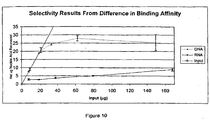
- Sheared calf thymus DNA (126 ⁇ g, 60 ⁇ g, 30 ⁇ g, 15 ⁇ g, or 5 ⁇ g) or total rat liver RNA (125 ⁇ g, 60 ⁇ g, 30 ⁇ g, 15 ⁇ g, or 5 ⁇ g was added in 50 ⁇ L to separate Eppendorf tubes (1.5 ml) containing 450 ⁇ l of binding buffer (50 mM Tris, pH 8, 4.8 M sodium iodide), and 10 mg of Sigma silicon dioxide particles (Sigma, prepared as described in Example 7). The work was performed in triplicate, so there were 15 containers for the five different amounts of DNA and 15 containers for the five different amounts of RNA. The samples were incubated at ambient temperature for 5-10 minutes on a Vortex Genie-2 mixer at setting 7 (Scientific Industries).
- the particles were centrifuged 14,000 rpm for 1 minute and the supernatant was removed. The particles were subsequently washed four times with 1 ml of 70% ethanol. Following addition of 250 ⁇ L of 50 mM Tris, pH 9.0, the particles were incubated for 5 - 10 minutes at 56°C with continuous shaking (1400 rpm) on an Eppendorf Thermomixer R. The particles were centrifuged at 14,000 rpm for 1 minute and the supernatant containing eluted nucleic acid was collected.
- nucleic acid In order to detect the presence of residual bound nucleic acid, 250 ⁇ L of 100 mM NaOH was added, the particles were incubated for 5 -10 minutes at 56°C with continuous shaking (1400 rpm) on an Eppendorf Thermomixer R, and the eluted nucleic acid was collected. The amount of nucleic acid in each fraction was quantitated spectrophotometrically.
- RNA was incubated either at pH 6 or pH 10 prior to binding to silica under conditions compatible with RNA binding as follows.
- Total rat liver RNA (25 ⁇ g in a total volume of 10 ⁇ L) was incubated, in duplicate, in 100 ⁇ L of either 50 mM AMP containing pH 10, 4.8 M Nal, or 50 mM MES, pH 6 containing 4.8 M Nal at ambient temperature for 5, 10, 15 30 or 60 minutes.
- 1 mL of 50 mM MES, pH 6 containing 4.8 M Nal was added to each tube in order to render conditions compatible with RNA binding to silica.
- the reactions were mixed and 10 mg of Sigma silicon dioxide (prepared as described in Example 1) in a total volume of 50 ⁇ L was added.
- the samples were incubated at ambient temperature for 10 minutes on a Vortex Genie-2 mixer at setting 7 (Scientific Industries).
- the particles were centrifuged 14,000 rpm for 1 minute and the supernatant was removed. The particles were subsequently washed twice with 1 ml of 50 mM MES, pH 6 containing 4.8 M Nal followed by four times with 1 mL of 70% ethanol. Following addition of 250 ⁇ L of 50 mM Tris, pH 9.0, the particles were incubated for 5 - 10 minutes at 56°C with continuous shaking (1400 rpm) on an Eppendorf Thermomixer R. The particles were centrifuged at 14,000 rpm for 1 minute and the supernatant containing eluted nucleic acid was collected.
- nucleic acid In order to detect the presence of residual bound nucleic acid, 250 ⁇ L of 100 mM NaOH was added, the particles were incubated for 5 - 10 minutes at 56°C with continuous shaking (1400 rpm) on an Eppendorf Thermomixer R, and the eluted nucleic acid was collected. The amount of nucleic acid in each fraction was quantified spectrophotometrically.
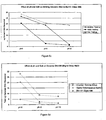
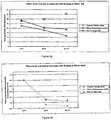
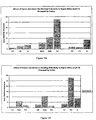
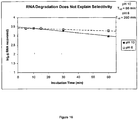
- RNA As shown in Figure 16 , the half-life of RNA is 86 minutes and 260 minutes at pH 10 and 6, respectively. Based on these half-lives, only 7.7% and 2.6% of the added RNA would be expected to degrade during a 10 minute binding incubation at pH 10 and 6, respectively.
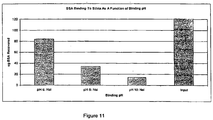
- the particles were centrifuged (15,800 x g, 1 minute), and then washed four times with 0.5 ml of 70% ethanol. Following the last ethanol wash, the particles were allowed to air dry at ambient temperature for 10 minutes. The bound protein was first eluted with 0.25 ml of 50 mM Tris, pH 9 for 5 minutes at 56°C with constant mixing and the eluted protein was collected. Any residual protein bound to the particles was eluted with 0.25 ml of 0.1 N NaOH at 56°C for 5 minutes with constant mixing and the eluted protein was collected. The recovery of protein was quantified by spectrophotometry.
- RNA binding to silica was examined at alkaline pH.
- Silicon dioxide (which is also called Sigma silica) was prepared as described in Example 1.
- Sheared calf thymus DNA was prepared according to Example 1.
- Rat liver total RNA was the source of RNA.
- rat liver total RNA was added separately to separate 1.5 ml microcentrifuge tubes containing 0.5 ml of one of the following buffers: (1) 50 mM AMP, pH 10, 3.65 M lithium chloride; (2) 50 mM AMP, pH 10, 3.65 M lithium bromide; (3) 50 mM AMP, pH 10, 3.65 M lithium iodide; (4) 50 mM AMP, pH 10, 3.65 M sodium chloride; (5) 50 mM AMP, pH 10, 3.65 M sodium bromide; (6) 50 mM AMP, pH 10, 3.65 M sodium iodide; (7) 50 mM AMP, pH 10, 3.65 M potassium chloride; (8) 50 mM AMP, pH 10, 3.65 M potassium bromid
- the solid phase (10 mg) was added to each of the 18 buffered nucleic acid solutions and the mixtures were incubated for 10 minutes at ambient temperature with occasional mixing. Following the binding incubation, the particles were centrifuged (15,800 x g, 1 minute) and washed four times with 0.5 ml of 70% ethanol.
- the bound nucleic acid was first eluted with 0.25 ml of 10 mM Tris , pH 9, for 5 minutes at 56°C with constant mixing and the eluted nucleic acid was collected. Any residual nucleic acid bound to the particles was eluted with 0.25 ml of 0.1 N NaOH at 56°c for 5 minutes with constant mixing and the eluted nucleic acid was collected. The recovery of nucleic acid was quantified by spectrophotometry.
- binding of DNA was influenced by the composition of the anion.
- DNA binding to silicon dioxide Sigma silica
- the radius of the monovalent cation influenced the magnitude of that effect.
- the binding of RNA to silica showed a tendency to decrease as the anion radius was increased.
- Decreasing the size of the cation increased the capacity of the silicon dioxide for both nucleic acid species.
- selectivity for DNA binding could be improved with certain selections of salt composition.
- RNA was prepared as described in Example 1. Rat liver total RNA was the source of RNA.
- the particles were centrifuged (15,800 x g, 1 minute) and washed four times with 0.5 ml of 70% ethanol. Following the last ethanol wash, the particles were washed once with 0.5 ml of acetone. Once the acetone was removed, the pellets were dried for 5 minutes at 56°C. The bound nucleic acid was eluted with 50 ⁇ l of 10 mM Tris , pH 9, for 5 minutes at 56°C with constant mixing and the eluted nucleic acid was collected.
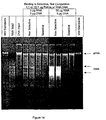
- nucleic acid was visualized by agarose gel electrophoresis (see Figure 13 ). Electrophoresis was performed on 2 ⁇ l of the nucleic acid stock mixes or 5 ⁇ l of the isolated eluate. Samples were electrophoresed through a 1% SeaKem® (Teknova), 0.5 ⁇ g/ml ethidium bromide gel using 1X TBE, 0.5 ⁇ g/ml ethidium bromide buffer (BIO-RAD), at 8V/cm for 30 minutes to 1 hour. Ethidium-stained material was visualized and photographed under short wave ultra-violet light. Molecular weight markers consisted of an AmpliSize DNA molecular weight standard (BIO-RAD) and an RNA ladder (GIBCO BRL).
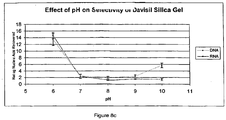
- silica was at least 40-fold more selective for DNA than RNA.
- pH 6 there was nearly complete capture of the added RNA.
- no detectable RNA was recovered at pH 10.
- pH 10 in the presence of sodium iodide, silica showed greater that 40-fold greater selectivity for DNA than RNA.
- RNA was mixed with genomic DNA and bound under both nonselective and selective conditions.
- Sigma silicon dioxide and sheared genomic DNA was prepared as described in Example 1.
- Rat liver total RNA (Biochain Institute, lot numbers A304057, A305062, or A306073) was the source of RNA.
- Each nucleic acid and buffer combination was assayed twice. Either (a) 5 ⁇ g sheared calf thymus DNA (10 ⁇ l of 0.5 mg/ml) and 5 ⁇ g (2 ⁇ l of 2.5 mg/ml) of rat liver total RNA, or (b) 5 ⁇ g sheared calf thymus DNA (10 ⁇ l of 0.5 mg/ml) and 50 ⁇ g (20 ⁇ l of 2.5 mg/ml) of rat liver total RNA was added separately and mixed in separate 1.5 ml microcentrifuge tubes containing 0.45 ml of one of the following buffers: (1) 50 mM AMP, pH 10, 3.5 M Nal; or (2) 50 mM MES, pH 6.0, 3.5 M Nal. The solutions were incubated at ambient temperature for 5 minutes.
- the solid phase (10 mg) was added to each of the four buffered nucleic acid solution combinations and the mixtures were incubated for 10 minutes at ambient temperature with occasional mixing. Following the binding incubation, the particles were centrifuged (15,800 x g, 1 minute), and washed three times with 0.5ml of 70% ethanol. The bound nucleic acid was eluted with 100 ⁇ l of 10 mM Tris, pH 9 for 5 minutes at 56°C with constant mixing and the eluted nucleic acid was collected.
- nucleic acid was visualized by agarose gel electrophoresis (see Figure 14 ). Of the isolation eluate, 10 ⁇ l was electrophoresed through a 0.8% SeaKem agarose gel as described in Example 13. Ethidium-stained material was visualized and photographed under a short wave ultra-violet light.
- Genomic DNA was isolated from whole human blood as follows. Silicon dioxide was prepared as described in Example 1.
- Each condition was assayed once. Either 25 ⁇ l or 100 ⁇ l of whole blood (Blood Centers of the Pacific) was added separately to separate 1.5 ml microcentrifuge tubes containing either 0.25 ml or 0.9 ml (respectively) of one of the following buffers: (1) 50 mM MES, pH 6.0, 4.75 M Nal, or (2) 50 mM AMP, pH 10, 4.75 M Nal. Nucleic acid was incubated 10 minutes at ambient temperature in the buffered solution, with occasional mixing.
- the solid phase (10 mg) was added to the four buffered nucleic acid solution combinations, and the mixtures were incubated 10 minutes at ambient temperature with occasional mixing. Following the binding incubation, the particles were centrifuged (15,800 x g, 1 minute), and washed twice with 0.5 ml of the binding buffer that had been used for the binding incubation. Subsequently, the particles were washed four times with 70% ethanol. The bound nucleic acid was eluted with 50 ⁇ l of 10 mM Tris, pH 9 for 5 minutes at 56°C with constant mixing and the eluted nucleic acid was collected.
- nucleic acid was visualized by agarose gel electrophoresis (see Figure 15 ). Either 2 ⁇ l or 10 ⁇ l of the isolation eluate was electrophoresed through 1.0% SeaKem agarose gel as described in Example 13. Ethidium-stained material was visualized and photographed under short wave ultra-violet light.
- silica When silica was added to whole blood in Nal-containing buffer at pH 6, the particles clump, suggesting that protein also adsorbed to the particles. As a result, DNA recovery was poor. In contrast, the silica particles remained in suspension when added to blood at pH 10. In the absence of protein adsorption to the particles, DNA recovery was high.
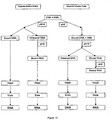
- both DNA and RNA can be isolated from a sample mixture by sequential selective binding (sequential selective binding).
- An exemplary sequential selective binding is shown in Figure 17 .
- sequential selective binding the sample is contacted with the solid phase under conditions compatible with selective DNA binding.
- the solid phase containing the bound DNA is separated from the unbound material, and the conditions in the unbound fraction are adjusted to those compatible with RNA binding to the solid phase.
- a second solid phase is added to this second fraction to adsorb the RNA. DNA and RNA are then isolated from the respective solid phases.
- RNA was processed under sequential selective binding conditions.
- the DNA was bound to the solid phase under DNA selective conditions and then the unbound RNA fraction was removed and bound to the same solid phase using nonselective binding conditions.
- Sigma silicon dioxide and sheared genomic DNA was prepared as described in Example 1.
- Rat liver total RNA (Biochain Institute) was the source of RNA.
- Each nucleic acid and buffer combination was assayed twice. 5 ⁇ g DNA, 5 ⁇ g RNA and a mixture of 5 ⁇ g DNA and 5 ⁇ g RNA were added to separate 1.5 ml microcentrifuge tubes containing 50 mM AMP, pH 10, 3.5 M Nal; 50 mM MES, pH 6, 3.5 M Nal; and 50 mM AMP, pH 10, 3.5 M Nal respectively. The buffered solutions were incubated for 5 minutes at ambient temperature. 10 mg of the solid phase was added to each of the 6 buffered nucleic acid solution combinations and the mixtures were incubated for 10 minutes at ambient temperature with occasional mixing.
- the particles were centrifuged (15,800 x g, 1 minute) and washed 3 times with 0.5 ml of 70% ethanol. Once the ethanol was removed, the particles were allowed to dry at ambient temperature at least 10 minutes.
- the supernatants from the binding reactions of the mixture of DNA and RNA were taken and added to separate 1.5 ml microcentrifuge tubes containing 1 mL of 50 mM MES, pH 6, 3.5 M Nal. To these tubes was added 10 mg of the solid phase and the mixtures were incubated for 10 minutes at ambient temperature with occasional mixing.
- the particles were centrifuged (15,800 x g, 1 minute) and washed 3 times with 0.5 mL of 70% ethanol. Once the ethanol was removed, the particles were allowed to dry at ambient temperature at least 10 minutes.
- the bound nucleic acid was eluted from all particles with 0.1 mL of 10 mM Tris-HCl, pH 9, for 5 minutes at 56°C wiith constant mixing and the eluted nucleic acid collected.
- nucleic acid was visualized by agarose gel electrophoresis. Electrophoresis was performed on 10 ⁇ L of the isolated eluate. Samples were electrophoresed through a 0.8% SeaKem®, 0.5 ⁇ g/mL ethidium bromide gel using 1X TBE, 0.5 ⁇ g/mL ethidium bromide buffer (BIO-RAD), at 7V/cm for 30 minutes to 1 hour. Ethidium-stained material was visualized and photographed under short wave ultra-violet light. Molecular weight markers consisted of High Molecular Weight DNA Markers (GIBCO BRL). The results are shown in Figure 18 .
- both DNA and RNA can be isolated from a sample mixture by first binding both species to a solid phase and sequentially releasing each nucleic acid type under the appropriate conditions (sequential specific elution).
- An exemplary sequential selective elution is shown in Figure 17 .
- sequential selective elution the sample is contacted with the solid phase under conditions that bind both DNA and RNA. Following washes, the RNA is released under conditions that bind only DNA. The solid phase is removed and the DNA and RNA are subsequently purified from both fractions.
- RNA is eluted under conditions which bind only DNA, and the DNA is subsequently eluted using a low ionic strength buffer.
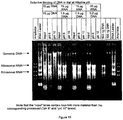
- Sigma silicon dioxide and sheared genomic DNA was prepared as described in Example 1. Rat liver total RNA (Biochain Institute) was the source of RNA.
- Each nucleic acid and buffer combination was assayed twice, and the DNA and RNA was processed as follows. Either (1) 10 ⁇ g sheared calf thymus DNA, or (2) 10 ⁇ g rat liver total RNA, or (3) 10 ⁇ g sheared calf thymus DNA and 10 ⁇ g rat liver total RNA was added to separate 1.5 ml microcentrifuge tubes containing 0.2 ml 50 mM MES, pH 6, 3.5 M sodium iodide, and incubated five minutes at ambient temperature with occassional mixing. The solid phase (10 mg) was added to each of the buffered nucleic acid solutions and the mixtures were incubated for 10 minutes at ambient temperature with mixing.
- the particles -with the exception of one replicate set of particles with both DNA and RNA bound - were centrifuged (15,800 x g, 1 minute) and the bound nucleic acid was eluted with 0.2 mL 10 mM Tris, pH 9 for 5 minutes at 56°C with constant mixing, and the eluted nucleic acid was collected.
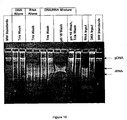
- nucleic acid was visualized by agarose gel electrophoresis.
- 10 ⁇ L was electrophoresed through a 1% SeaKem®, 0.5 ⁇ g/mL ethidium bromide gel using 1X TBE, 0.5 ⁇ g/mL ethidium bromide buffer (BIO-RAD), at 7V/cm for 30 minutes to 1 hour.
- Ethidium-stained material was visualized and photographed under short wave ultra-violet light.
- Molecular weight markers consisted of High Molecular Weight DNA Markers (GIBCO BRL). The results are shown in Figure 19 .
Landscapes
- Chemical & Material Sciences (AREA)
- Engineering & Computer Science (AREA)
- Health & Medical Sciences (AREA)
- Life Sciences & Earth Sciences (AREA)
- Genetics & Genomics (AREA)
- Biomedical Technology (AREA)
- Organic Chemistry (AREA)
- Zoology (AREA)
- Wood Science & Technology (AREA)
- Bioinformatics & Cheminformatics (AREA)
- General Engineering & Computer Science (AREA)
- Biotechnology (AREA)
- Analytical Chemistry (AREA)
- Biochemistry (AREA)
- General Health & Medical Sciences (AREA)
- Microbiology (AREA)
- Physics & Mathematics (AREA)
- Biophysics (AREA)
- Molecular Biology (AREA)
- Crystallography & Structural Chemistry (AREA)
- Plant Pathology (AREA)
- Proteomics, Peptides & Aminoacids (AREA)
- Chemical Kinetics & Catalysis (AREA)
- Immunology (AREA)
- Measuring Or Testing Involving Enzymes Or Micro-Organisms (AREA)
- Saccharide Compounds (AREA)
- Pharmaceuticals Containing Other Organic And Inorganic Compounds (AREA)
- Preparation Of Compounds By Using Micro-Organisms (AREA)
Claims (11)
- Verfahren zum Isolieren genomischer DNA aus einer biologischen Probe umfassend:Selektives Binden genomischer DNA an eine feste Phase mittels Kontaktieren der biologischen Probe mit der festen Phase unter Bedingungen, die selektiv genomische DNA binden;Trennen der festen Phase mit der gebundenen genomischen DNA von einem ungebundenen Teil der biologischen Probe; undIsolieren der genomischen DNA von der festen Phase, wobei die Bedingungen, die selektiv genomische DNA binden, das Verwenden eines Bindungspuffers umfassen, umfassend:einen alkalischen pH-Wert; undein großes Anion, wobei das große Anion mindestens so groß wie ein BromidIon ist, wobei der alkalische pH-Wert gleich 10,0 ist oder zwischen 10,0 und 11 liegt, und wobei die feste Phase ein silikatisches Material ist, und wobei das große Anion Iodid ist.
- Verfahren von Anspruch 1, wobei das Isolieren der genomischen DNA von der festen Phase das Eluieren der genomischen DNA umfasst.
- Verfahren von Anspruch 1, wobei das silikatische Material ausgewählt ist aus mindestens einem von Kieselsäure, Siliciumdioxid, Kieselerde, Glas, Kieselgur und Kieselgel.
- Verfahren von Anspruch 3, wobei die feste Phase in einer Form vorliegt, die ausgewählt ist aus mindestens einer von einem Partikel, einem Bead, einer Membran, einer Fritte, einer Oberfläche in einer Kammer und einer Seite eines Behälters.
- Verfahren zum Isolieren genomischer DNA und RNA aus einer biologischen Probe umfassend:selektives Binden genomischer DNA an eine erste feste Phase mittels Kontaktieren der biologischen Probe mit der ersten festen Phase unter Bedingungen, die selektiv genomische DNA binden;wobei die Bedingungen, die selektiv genomische DNA binden, das Verwenden eines Bindungspuffers umfassen, umfassend:einen alkalischen pH-Wert, undein großes Anion, wobei das große Anion mindestens so groß wie ein BromidIon ist und wobei der alkalische pH-Wert gleich 10,0 ist oder zwischen 10,0 und 11 liegt,Trennen der ersten festen Phase mit der gebundenen genomischen DNA von einem ersten ungebundenen Teil der biologischen Probe;Isolieren der genomischen DNA von der ersten festen Phase; undIsolieren von RNA aus dem ersten ungebundenen Teil der biologischen Probe, wobei die erste feste Phase ein silikatisches Material ist, und wobei das große Anion Iodid ist.
- Verfahren von Anspruch 5, wobei das Isolieren der genomischen DNA von der ersten festen Phase das Eluieren der genomischen DNA umfasst.
- Verfahren von Anspruch 5, wobei das Isolieren der RNA aus dem ersten ungebundenen Teil der biologischen Probe Folgendes umfasst:den ersten ungebundenen Teil der biologischen Probe einer zweiten festen Phase Aussetzen, unter Bedingungen, die RNA an die zweite feste Phase binden;Trennen der zweiten festen Phase mit gebundener RNA von einem zweiten ungebundenen Teil der biologischen Probe; undIsolieren der RNA von einer zweiten festen Phase durch Eluieren der RNA.
- Verfahren von Anspruch 7, wobei die Bedingungen, die RNA an die zweite feste Phase binden, einen neutralen oder sauren pH-Wert umfassen.
- Verfahren von Anspruch 7, wobei die zweite feste Phase ein silikatisches Material ist.
- Verfahren von Anspruch 9, wobei das silikatische Material ausgewählt ist aus mindestens einem von Kieselsäure, Siliciumdioxid, Kieselerde, Glas, Kieselgur und Kieselgel.
- Verfahren von Anspruch 7, wobei die zweite feste Phase in einer Form vorliegt, die ausgewählt ist aus mindestens einer von einem Partikel, einem Bead, einer Membran, einer Fritte, einer Oberflache mit einer Kammer und einer Seite eines Behälters.
Applications Claiming Priority (3)
| Application Number | Priority Date | Filing Date | Title |
|---|---|---|---|
| US33402901P | 2001-11-28 | 2001-11-28 | |
| US334029P | 2001-11-28 | ||
| PCT/US2002/038123 WO2003046146A2 (en) | 2001-11-28 | 2002-11-27 | Compositions and methods of selective nucleic acid isolation |
Publications (4)
| Publication Number | Publication Date |
|---|---|
| EP1448799A2 EP1448799A2 (de) | 2004-08-25 |
| EP1448799A4 EP1448799A4 (de) | 2006-03-08 |
| EP1448799B1 EP1448799B1 (de) | 2009-11-18 |
| EP1448799B2 true EP1448799B2 (de) | 2018-05-16 |
Family
ID=23305266
Family Applications (1)
| Application Number | Title | Priority Date | Filing Date |
|---|---|---|---|
| EP02794065.9A Expired - Lifetime EP1448799B2 (de) | 2001-11-28 | 2002-11-27 | Verfahren zur selektiven Nukleinsäureisolierung |
Country Status (7)
| Country | Link |
|---|---|
| US (5) | US7208271B2 (de) |
| EP (1) | EP1448799B2 (de) |
| JP (3) | JP4106026B2 (de) |
| AT (1) | ATE449186T1 (de) |
| AU (1) | AU2002359522A1 (de) |
| DE (1) | DE60234464D1 (de) |
| WO (1) | WO2003046146A2 (de) |
Families Citing this family (136)
| Publication number | Priority date | Publication date | Assignee | Title |
|---|---|---|---|---|
| US7078224B1 (en) * | 1999-05-14 | 2006-07-18 | Promega Corporation | Cell concentration and lysate clearance using paramagnetic particles |
| US7198924B2 (en) | 2000-12-11 | 2007-04-03 | Invitrogen Corporation | Methods and compositions for synthesis of nucleic acid molecules using multiple recognition sites |
| EP1448799B2 (de) | 2001-11-28 | 2018-05-16 | Life Technologies Corporation | Verfahren zur selektiven Nukleinsäureisolierung |
| JP3644641B2 (ja) * | 2003-03-07 | 2005-05-11 | 株式会社日立ハイテクノロジーズ | 核酸回収方法 |
| JP4241183B2 (ja) * | 2003-05-19 | 2009-03-18 | 株式会社日立ハイテクノロジーズ | 核酸回収方法及び核酸回収キット |
| US20050009036A1 (en) * | 2003-07-11 | 2005-01-13 | Applera Corporation | Methods and kits for obtaining nucleic acid from biological samples |
| US20050059024A1 (en) * | 2003-07-25 | 2005-03-17 | Ambion, Inc. | Methods and compositions for isolating small RNA molecules |
| JP4871722B2 (ja) * | 2003-07-25 | 2012-02-08 | アプライド バイオシステムズ リミテッド ライアビリティー カンパニー | 固定試料からrnaを調製するための方法および組成物 |
| EP2216415B2 (de) * | 2003-08-01 | 2017-01-04 | Life Technologies Corporation | Zusammensetzungen und Verfahren zur Aufreinigung kurzer RNA-Moleküle und anderer Nukleinsäuren |
| JP2005270049A (ja) * | 2004-03-26 | 2005-10-06 | Jfe Steel Kk | 核酸分子の切断方法 |
| JP2005295869A (ja) * | 2004-04-09 | 2005-10-27 | Jfe Steel Kk | 核酸分子の切断方法およびその装置 |
| KR100714988B1 (ko) * | 2005-08-09 | 2007-05-09 | 삼성전자주식회사 | 산화막이 표면에 형성된 실리콘 구조물 표면을 이용한dna 정제 방법 및 정제장치 |
| US8030034B2 (en) * | 2005-12-09 | 2011-10-04 | Promega Corporation | Nucleic acid purification with a binding matrix |
| WO2007133495A1 (en) * | 2006-05-10 | 2007-11-22 | Human Genome Sciences, Inc. | Mixture for decreasing protein interference |
| US20100216657A1 (en) * | 2006-05-16 | 2010-08-26 | Arcxis Biotechnologies, Inc. | Pcr-free sample preparation and detection systems for high speed biologic analysis and identification |
| EP2602321B1 (de) * | 2006-05-31 | 2017-08-23 | Sequenom, Inc. | Verfahren und Zusammensetzungen zur Nukleinsäureextraktion und -verstärkung aus einer Probe |
| DE102006031764B4 (de) * | 2006-07-06 | 2009-10-01 | Aj Innuscreen Gmbh | Verfahren zur parallelen Isolierung doppel- und einzelsträngiger Nukleinsäuren sowie zur selektiven Entfernung doppelsträngiger Nukleinsäuren aus einem Gemisch von doppel- und einzelsträngigen Nukleinsäuren |
| JP4297148B2 (ja) * | 2006-09-22 | 2009-07-15 | ソニー株式会社 | 核酸回収装置及び核酸回収方法 |
| GB0719022D0 (en) * | 2007-09-28 | 2007-11-07 | Mole Genetics As | Isolation method |
| US7871764B1 (en) * | 2008-03-18 | 2011-01-18 | The United States Of America As Represented By The United States Department Of Energy | Universal nucleic acids sample preparation method for cells, spores and their mixture |
| EP2414545B1 (de) | 2009-04-03 | 2017-01-11 | Sequenom, Inc. | Zusammensetzungen und verfahren für die herstellung von nukleinsäuren |
| US8039613B2 (en) | 2009-08-28 | 2011-10-18 | Promega Corporation | Methods of purifying a nucleic acid and formulation and kit for use in performing such methods |
| US8222397B2 (en) * | 2009-08-28 | 2012-07-17 | Promega Corporation | Methods of optimal purification of nucleic acids and kit for use in performing such methods |
| PT2588609T (pt) * | 2010-06-29 | 2018-04-02 | Exscale Biospecimen Solutions Ab | Método e conjunto para o isolamento sequencial de espécies nucleotidias de uma amostra |
| RU2567809C2 (ru) | 2010-07-07 | 2015-11-10 | ДИАГОН Кфт. | Способ специфического выделения полного днк-содержимого бактериальных возбудителей инфекции |
| WO2013024072A1 (en) | 2011-08-12 | 2013-02-21 | Qiagen Gmbh | Method for isolating nucleic acids |
| FR2994184B1 (fr) | 2012-08-02 | 2017-12-08 | Biomerieux Sa | Procedes de fonctionalisation et reactifs utilises dans de tels procedes utilisant un anhydride aza-isatoique ou un de ses derives, molecules biologiques ainsi traitees et kits |
| US20140322706A1 (en) | 2012-10-24 | 2014-10-30 | Jon Faiz Kayyem | Integrated multipelx target analysis |
| JP1628115S (de) | 2012-10-24 | 2019-04-01 | ||
| EP3520895A1 (de) | 2013-03-15 | 2019-08-07 | Genmark Diagnostics Inc. | Flüssigkeitsbehälter mit freitragender lanze |
| USD881409S1 (en) | 2013-10-24 | 2020-04-14 | Genmark Diagnostics, Inc. | Biochip cartridge |
| US9498778B2 (en) | 2014-11-11 | 2016-11-22 | Genmark Diagnostics, Inc. | Instrument for processing cartridge for performing assays in a closed sample preparation and reaction system |
| US10319502B2 (en) | 2014-10-23 | 2019-06-11 | Corning Incorporated | Polymer-encapsulated magnetic nanoparticles |
| US10005080B2 (en) | 2014-11-11 | 2018-06-26 | Genmark Diagnostics, Inc. | Instrument and cartridge for performing assays in a closed sample preparation and reaction system employing electrowetting fluid manipulation |
| US9598722B2 (en) | 2014-11-11 | 2017-03-21 | Genmark Diagnostics, Inc. | Cartridge for performing assays in a closed sample preparation and reaction system |
| CN107257857B (zh) | 2014-11-14 | 2021-12-14 | 康宁股份有限公司 | 用于ivt后rna纯化的方法和试剂盒 |
| US11242518B2 (en) | 2015-09-04 | 2022-02-08 | QIAGEN Sciences, LLP | Methods for co-isolation of nucleic acids and proteins |
| JP7300989B2 (ja) | 2016-12-22 | 2023-06-30 | ガーダント ヘルス, インコーポレイテッド | 核酸分子を解析するための方法およびシステム |
| WO2018191702A2 (en) | 2017-04-14 | 2018-10-18 | Guardant Health, Inc. | Methods of attaching adapters to sample nucleic acids |
| EP3685386A1 (de) | 2017-09-20 | 2020-07-29 | Guardant Health, Inc. | Verfahren und systeme zur differenzierung von somatischen und keimbahnvarianten |
| JP7304852B2 (ja) | 2017-11-03 | 2023-07-07 | ガーダント ヘルス, インコーポレイテッド | 脱アミノ化に誘導される配列エラーの補正 |
| EP3704268B1 (de) | 2017-11-03 | 2025-01-22 | Guardant Health, Inc. | Normalisierung einer tumormutationslast |
| GB201718803D0 (en) * | 2017-11-14 | 2017-12-27 | Phoenix Molecular Pte Ltd | Method for isolation of nucleic acids |
| CN108456675A (zh) * | 2018-03-27 | 2018-08-28 | 爱默基因(厦门)生物科技有限公司 | 一种用于凝胶DNA回收的溶胶buffer、回收凝胶DNA的试剂盒及其使用方法 |
| CN112334983A (zh) | 2018-04-13 | 2021-02-05 | 夸登特健康公司 | 用于检测和抑制由融合事件引起的比对错误的方法 |
| EP4410977A3 (de) | 2018-04-24 | 2024-10-30 | QIAGEN Sciences, LLC | Nukleinsäureisolierung und entfernung von inhibitoren aus komplexen proben |
| EP3802878A1 (de) | 2018-06-04 | 2021-04-14 | Guardant Health, Inc. | Verfahren und systeme zur bestimmung des zellulären ursprungs zellfreier nukleinsäuren |
| WO2020023420A2 (en) | 2018-07-23 | 2020-01-30 | Guardant Health, Inc. | Methods and systems for adjusting tumor mutational burden by tumor fraction and coverage |
| CN112970068B (zh) | 2018-08-30 | 2025-03-18 | 夸登特健康公司 | 用于检测样品之间的污染的方法和系统 |
| US20200075123A1 (en) | 2018-08-31 | 2020-03-05 | Guardant Health, Inc. | Genetic variant detection based on merged and unmerged reads |
| JP7539367B2 (ja) | 2018-08-31 | 2024-08-23 | ガーダント ヘルス, インコーポレイテッド | 無細胞dnaにおけるマイクロサテライト不安定性の検出 |
| US20200075124A1 (en) | 2018-09-04 | 2020-03-05 | Guardant Health, Inc. | Methods and systems for detecting allelic imbalance in cell-free nucleic acid samples |
| EP4524263A3 (de) | 2018-10-31 | 2025-05-28 | Guardant Health, Inc. | Verfahren, zusammensetzungen und systeme zur kalibrierung epigenetischer partitionierungstests |
| WO2020132628A1 (en) | 2018-12-20 | 2020-06-25 | Guardant Health, Inc. | Methods, compositions, and systems for improving recovery of nucleic acid molecules |
| ES3013495T3 (en) | 2019-01-31 | 2025-04-14 | Guardant Health Inc | Method for isolating and sequencing cell-free dna |
| KR20210132139A (ko) | 2019-02-27 | 2021-11-03 | 가던트 헬쓰, 인크. | 대립유전자 빈도에 기초한 기능 손실의 컴퓨터 모델링 |
| WO2020176659A1 (en) | 2019-02-27 | 2020-09-03 | Guardant Health, Inc. | Methods and systems for determining the cellular origin of cell-free dna |
| EP3976822A1 (de) | 2019-05-31 | 2022-04-06 | Guardant Health, Inc. | Verfahren und systeme zur verbesserung der patientenüberwachung nach der operation |
| US11891653B2 (en) | 2019-09-30 | 2024-02-06 | Guardant Health, Inc. | Compositions and methods for analyzing cell-free DNA in methylation partitioning assays |
| EP4041888A4 (de) | 2019-10-11 | 2023-11-01 | Guardant Health, Inc. | Verwendung von zellfreien bakteriellen nukleinsäuren zur krebserkennung |
| US11447819B2 (en) | 2019-10-25 | 2022-09-20 | Guardant Health, Inc. | Methods for 3′ overhang repair |
| CN114746560A (zh) | 2019-11-26 | 2022-07-12 | 夸登特健康公司 | 改进甲基化多核苷酸结合的方法、组合物和系统 |
| CN115428087A (zh) | 2020-01-31 | 2022-12-02 | 夸登特健康公司 | 克隆水平缺乏靶变体的显著性建模 |
| ES2988182T3 (es) | 2020-03-11 | 2024-11-19 | Guardant Health Inc | Métodos para clasificar las mutaciones genéticas detectadas en ácidos nucleicos libres de células como los de origen tumoral o no tumoral |
| EP4143338A1 (de) | 2020-04-30 | 2023-03-08 | Guardant Health, Inc. | Verfahren zur sequenzbestimmung unter verwendung partitionierter nukleinsäuren |
| JP2023526252A (ja) | 2020-05-14 | 2023-06-21 | ガーダント ヘルス, インコーポレイテッド | 相同組換え修復欠損の検出 |
| WO2023282916A1 (en) | 2021-07-09 | 2023-01-12 | Guardant Health, Inc. | Methods of detecting genomic rearrangements using cell free nucleic acids |
| EP4179111B1 (de) | 2020-07-10 | 2024-04-03 | Guardant Health, Inc. | Verfahren zum nachweis von genomischen neuanordnungen unter verwendung zellfreier nukleinsäuren |
| US11946044B2 (en) | 2020-07-30 | 2024-04-02 | Guardant Health, Inc. | Methods for isolating cell-free DNA |
| JP7588815B2 (ja) | 2020-08-17 | 2024-11-25 | 株式会社ミズホメディー | Rnaろ過器及びrnaろ過方法 |
| WO2022046947A1 (en) | 2020-08-25 | 2022-03-03 | Guardant Health, Inc. | Methods and systems for predicting an origin of a variant |
| WO2022047213A2 (en) | 2020-08-27 | 2022-03-03 | Guardant Health, Inc. | Computational detection of copy number variation at a locus in the absence of direct measurement of the locus |
| US20220162670A1 (en) | 2020-09-30 | 2022-05-26 | Guardant Health, Inc. | Methods and systems to improve the signal to noise ratio of dna methylation partitioning assays |
| EP4232599A1 (de) | 2020-10-23 | 2023-08-30 | Guardant Health, Inc. | Zusammensetzungen und verfahren zur analyse von dna mittels partitionierung und basenumwandlung |
| EP4251765A1 (de) | 2020-11-30 | 2023-10-04 | Guardant Health, Inc. | Zusammensetzungen und verfahren zur anreicherung methylierter polynukleotide |
| WO2022140629A1 (en) | 2020-12-23 | 2022-06-30 | Guardant Health, Inc. | Methods and systems for analyzing methylated polynucleotides |
| WO2022174109A1 (en) | 2021-02-12 | 2022-08-18 | Guardant Health, Inc. | Methods and compositions for detecting nucleic acid variants |
| KR20230156364A (ko) | 2021-03-05 | 2023-11-14 | 가던트 헬쓰, 인크. | 분자 반응을 분석하기 위한 방법 및 관련 측면 |
| WO2022192889A1 (en) | 2021-03-09 | 2022-09-15 | Guardant Health, Inc. | Detecting the presence of a tumor based on off-target polynucleotide sequencing data |
| WO2022204730A1 (en) | 2021-03-25 | 2022-09-29 | Guardant Health, Inc. | Methods and compositions for quantifying immune cell dna |
| JP2024520422A (ja) | 2021-05-28 | 2024-05-24 | ガーダント ヘルス, インコーポレイテッド | 循環分子をアッセイするための組成物および方法 |
| JP2024523401A (ja) | 2021-06-21 | 2024-06-28 | ガーダント ヘルス, インコーポレイテッド | コピー数情報に基づく組織起源分析のための方法および組成物 |
| EP4388091A2 (de) | 2021-08-20 | 2024-06-26 | Guardant Health, Inc. | Verfahren zur gleichzeitigen molekularen und probenbarcodierung |
| WO2023056065A1 (en) | 2021-09-30 | 2023-04-06 | Guardant Health, Inc. | Compositions and methods for synthesis and use of probes targeting nucleic acid rearrangements |
| WO2023081722A2 (en) | 2021-11-02 | 2023-05-11 | Guardant Health, Inc. | Quality control method |
| WO2023122623A1 (en) | 2021-12-21 | 2023-06-29 | Guardant Health, Inc. | Methods and systems for combinatorial chromatin-ip sequencing |
| EP4453240A1 (de) | 2021-12-23 | 2024-10-30 | Guardant Health, Inc. | Zusammensetzungen und verfahren zum nachweis von metastasen |
| WO2023150633A2 (en) | 2022-02-02 | 2023-08-10 | Guardant Health, Inc. | Multifunctional primers for paired sequencing reads |
| WO2023197004A1 (en) | 2022-04-07 | 2023-10-12 | Guardant Health, Inc. | Detecting the presence of a tumor based on methylation status of cell-free nucleic acid molecules |
| US20230360725A1 (en) | 2022-05-09 | 2023-11-09 | Guardant Health, Inc. | Detecting degradation based on strand bias |
| JP2025522763A (ja) | 2022-06-30 | 2025-07-17 | ガーダント ヘルス, インコーポレイテッド | 異常にメチル化されたdnaの富化 |
| US20240191290A1 (en) | 2022-07-21 | 2024-06-13 | Guardant Health, Inc. | Methods for detection and reduction of sample preparation-induced methylation artifacts |
| EP4587843A1 (de) | 2022-09-16 | 2025-07-23 | Guardant Health, Inc. | Zusammensetzungen und verfahren zur analyse löslicher proteine |
| WO2024073508A2 (en) | 2022-09-27 | 2024-04-04 | Guardant Health, Inc. | Methods and compositions for quantifying immune cell dna |
| JP2025538871A (ja) | 2022-11-15 | 2025-12-02 | ガーダント ヘルス, インコーポレイテッド | 非小細胞肺がん(NSCLC)患者の薬物応答または死亡もしくはがん進行までの時間を、循環腫瘍DNA(ctDNA)から、ベースラインctDNAレベルおよびctDNAレベルの経時的な縦断的変化の両方からのシグナルを利用して予測する方法 |
| AU2023379633A1 (en) | 2022-11-17 | 2025-05-15 | Guardant Health, Inc. | Validation of a bioinformatic model for classifying non-tumor variants in a cell-free dna liquid biopsy assay |
| AU2023409008A1 (en) | 2022-12-21 | 2025-06-26 | Guardant Health, Inc. | Detecting homologous recombination deficiences based on methylation status of cell-free nucleic acid molecules |
| WO2024138180A2 (en) | 2022-12-22 | 2024-06-27 | Guardant Health, Inc. | Integrated targeted and whole genome somatic and dna methylation sequencing workflows |
| EP4638781A2 (de) | 2022-12-22 | 2025-10-29 | Guardant Health, Inc. | Verfahren mit methylierungsbewahrender amplifikation mit fehlerkorrektur |
| EP4655416A1 (de) | 2023-01-25 | 2025-12-03 | Guardant Health, Inc. | Verfahren zur erstellung von nukleinsäuremethylierungprofilen |
| EP4677113A1 (de) | 2023-03-07 | 2026-01-14 | Guardant Health, Inc. | Verfahren zur herstellung einer hybriden ssdna- und dsdna-ngs-bibliothek |
| EP4690210A1 (de) | 2023-04-07 | 2026-02-11 | Guardant Health, Inc. | Nachweis des vorhandenseins eines tumors auf grundlage des methylierungsstatus von zellfreien nukleinsäuremolekülen |
| WO2024229143A1 (en) | 2023-05-01 | 2024-11-07 | Guardant Health, Inc. | Quality control method for enzymatic conversion procedures |
| WO2024229433A1 (en) | 2023-05-03 | 2024-11-07 | Guardant Health, Inc. | Methods for analysis of dna methylation |
| EP4705522A1 (de) | 2023-05-05 | 2026-03-11 | Guardant Health, Inc. | Zellfreier dna-blutbasierter test für krebsscreening |
| US20240420800A1 (en) | 2023-06-15 | 2024-12-19 | Guardant Health, Inc. | METHOD FOR HRD DETECTION IN TARGETED cfDNA SAMPLES USING DE NOVO MUTATIONAL SIGNATURES |
| WO2024264065A1 (en) | 2023-06-23 | 2024-12-26 | Guardant Health, Inc. | Methods and compositions for quantifying immune cell nucleic acids |
| WO2025029475A1 (en) | 2023-07-28 | 2025-02-06 | Guardant Health, Inc. | Methods to enrich nucleotide variants by negative selection |
| WO2025038399A1 (en) | 2023-08-11 | 2025-02-20 | Guardant Health, Inc. | Methylated enrichment methods for single-molecule genetic and epigenetic sequencing |
| WO2025059338A1 (en) | 2023-09-12 | 2025-03-20 | Guardant Health, Inc. | Methods for analyzing nucleic acids using sequence read family size distribution |
| WO2025064706A1 (en) | 2023-09-19 | 2025-03-27 | Guardant Health, Inc. | Detecting the presence of a tumor based on methylation status of cell-free nucleic acid molecules |
| WO2025072467A1 (en) | 2023-09-29 | 2025-04-03 | Guardant Health, Inc. | Genotyping cyp2d6 |
| WO2025076452A1 (en) | 2023-10-06 | 2025-04-10 | Guardant Health, Inc. | Detecting tumor-related information based on methylation status of cell-free nucleic acid molecules |
| WO2025090954A1 (en) | 2023-10-26 | 2025-05-01 | Guardant Health, Inc. | Methods for detecting nucleic acid variants |
| WO2025090956A1 (en) | 2023-10-26 | 2025-05-01 | Guardant Health, Inc. | Methods for detecting nucleic acid variants using capture probes |
| WO2025090646A1 (en) | 2023-10-27 | 2025-05-01 | Guardant Health, Inc. | Monitoring molecular response by allelic imbalance |
| WO2025137620A1 (en) | 2023-12-21 | 2025-06-26 | Guardant Health, Inc. | Methods for high quality and high accuracy methylation sequencing |
| WO2025137389A2 (en) | 2023-12-22 | 2025-06-26 | Guardant Health, Inc. | Methods for targeted single-molecule genetic and epigenetic sequencing |
| WO2025160433A1 (en) | 2024-01-24 | 2025-07-31 | Guardant Health, Inc. | Methods for analyzing sequencing reads |
| WO2025207817A1 (en) | 2024-03-26 | 2025-10-02 | Guardant Health, Inc. | Method of determining the likelihood of a disease by combining biomarkers and imaging |
| WO2025207788A1 (en) | 2024-03-27 | 2025-10-02 | Guardant Health, Inc. | Inferring cnvs from the distribution of molecules in hyper partition |
| WO2025208044A1 (en) | 2024-03-28 | 2025-10-02 | Guardant Health, Inc. | Methods for cancer detection using molecular patterns |
| WO2025207941A1 (en) | 2024-03-28 | 2025-10-02 | Guardant Health, Inc. | Methods for separating cpg-dense dna by binding of cpg-binding proteins and methyl-sensitive deamination |
| US20250308629A1 (en) | 2024-04-01 | 2025-10-02 | Guardant Health, Inc. | Small variant calling with error-rate based model |
| WO2025235889A1 (en) | 2024-05-10 | 2025-11-13 | Guardant Health, Inc. | Methods involving multiplexed pooled pcr |
| WO2025250544A1 (en) | 2024-05-31 | 2025-12-04 | Guardant Health, Inc. | Methods for analyzing chromatin architecture in tissue to boost detection of cancer associated signals in cell-free dna |
| WO2026015607A1 (en) | 2024-07-09 | 2026-01-15 | Guardant Health, Inc. | Methods for partitioning hyper-, hypo-, and non-methylated dna |
| WO2026015794A1 (en) | 2024-07-12 | 2026-01-15 | Guardant Health, Inc. | Methods for modifying dna using cpg-specific deamination and uracil base excision |
| WO2026024956A1 (en) | 2024-07-24 | 2026-01-29 | Guardant Health, Inc. | Selecting low technical noise biomarkers for sensitive molecular diagnostics |
| WO2026024692A1 (en) | 2024-07-24 | 2026-01-29 | Guardant Health, Inc. | Direct methylation single-base resolution sequencing of enriched unmethylated dna |
| WO2026024817A1 (en) | 2024-07-24 | 2026-01-29 | Guardant Health, Inc. | Methods and compositions for anchored multiplex ngs workflows |
| WO2026043702A1 (en) | 2024-08-21 | 2026-02-26 | Guardant Health, Inc. | Methods and approaches for personalized identification and monitoring of extrachromosomal circular dna |
| WO2026043718A1 (en) | 2024-08-21 | 2026-02-26 | Guardant Health, Inc. | Methods to monitor patients treated with a cancer vaccine |
| WO2026050179A1 (en) | 2024-08-26 | 2026-03-05 | Guardant Health, Inc. | Tumor fraction (tf) is associated with real-world progression-free survival (rwpfs) in non-small-cell lung cancer (nsclc) patients treated with platinum-based chemotherapy (chemo) |
| WO2026050287A1 (en) | 2024-08-27 | 2026-03-05 | Guardant Health, Inc. | Methylation biomarkers for osimertinib treatment management |
| WO2026060266A1 (en) | 2024-09-13 | 2026-03-19 | Guardant Health, Inc. | Use of copy number variants for the identification of false positive tumor calls |
Citations (1)
| Publication number | Priority date | Publication date | Assignee | Title |
|---|---|---|---|---|
| WO2002090539A2 (en) † | 2000-11-28 | 2002-11-14 | Applera Corporation | Compositions, methods, and kits for isolating nucleic acids using surfactants and proteases |
Family Cites Families (67)
| Publication number | Priority date | Publication date | Assignee | Title |
|---|---|---|---|---|
| US4340674A (en) * | 1980-05-05 | 1982-07-20 | The Upjohn Company | Cointegrate plasmids and their construction from plasmids of Escherichia and Streptomyces |
| US4420517A (en) | 1982-05-06 | 1983-12-13 | Becton Dickinson And Company | Methods for improving uniformity of silica films on substrates |
| US4483920A (en) | 1982-05-17 | 1984-11-20 | Hahnemann University | Immobilization of message RNA directly from cells onto filter material |
| DE3308932A1 (de) | 1983-03-12 | 1984-09-13 | Hoechst Ag, 6230 Frankfurt | Verfahren zur abtrennung von ribonukleinsaeuren aus einer loesung, die desoxyribonukleinsaeuren enthaelt |
| US5137816A (en) * | 1983-06-22 | 1992-08-11 | The Lubrizol Corporation | Rhizobial diagnostic probes and rhizobium trifolii nifH promoters |
| US4648975A (en) | 1983-08-17 | 1987-03-10 | Pedro B. Macedo | Process of using improved silica-based chromatographic supports containing additives |
| GB8519457D0 (en) * | 1985-08-02 | 1985-09-11 | Faulk Ward Page | Tumour imaging agents |
| CA1301606C (en) | 1986-05-02 | 1992-05-26 | David H. Gillespie | Chaotropic method for evaluating nucleic acids in a biological sample |
| US4900677A (en) * | 1986-09-26 | 1990-02-13 | E. I. Du Pont De Nemours And Company | Process for rapid isolation of high molecular weight DNA |
| US4843155A (en) | 1987-11-19 | 1989-06-27 | Piotr Chomczynski | Product and process for isolating RNA |
| US4923978A (en) | 1987-12-28 | 1990-05-08 | E. I. Du Pont De Nemours & Company | Process for purifying nucleic acids |
| US5075430A (en) * | 1988-12-12 | 1991-12-24 | Bio-Rad Laboratories, Inc. | Process for the purification of DNA on diatomaceous earth |
| NL8900725A (nl) | 1989-03-23 | 1990-10-16 | Az Univ Amsterdam | Werkwijze en combinatie van middelen voor het isoleren van nucleinezuur. |
| US5234809A (en) | 1989-03-23 | 1993-08-10 | Akzo N.V. | Process for isolating nucleic acid |
| AU5126890A (en) | 1989-04-03 | 1990-10-04 | Minnesota Mining And Manufacturing Company | Metal oxide supports for nucleic acids |
| US5106966A (en) | 1989-07-10 | 1992-04-21 | University Of Kansas | Use of gel polymer for dna extraction with organic solvents |
| US5175271A (en) | 1989-07-10 | 1992-12-29 | University Of Kansas | Use of silica gel for DNA extraction with organic solvents |
| US5533888A (en) * | 1990-08-21 | 1996-07-09 | Belarde; John F. | Apparatus for forming concrete barriers |
| WO1992018514A1 (en) | 1991-04-12 | 1992-10-29 | Minnesota Mining And Manufacturing Company | Purification of nucleic acids using metal oxide supports |
| CA2067711C (en) | 1991-05-03 | 2000-08-08 | Daniel Lee Woodard | Solid phase extraction purification of dna |
| US5155018A (en) | 1991-07-10 | 1992-10-13 | Hahnemann University | Process and kit for isolating and purifying RNA from biological sources |
| US5329000A (en) | 1991-10-31 | 1994-07-12 | Becton, Dickinson And Company | Purification of DNA with silicon tetrahydrazide |
| DE4143639C2 (de) * | 1991-12-02 | 2002-10-24 | Qiagen Gmbh | Verfahren zur Isolierung und Reinigung von Nukleinsäuren |
| US5346994A (en) | 1992-01-28 | 1994-09-13 | Piotr Chomczynski | Shelf-stable product and process for isolating RNA, DNA and proteins |
| EP0555798B1 (de) | 1992-02-13 | 1999-05-06 | Becton, Dickinson and Company | Celithydrat und Reinigung von DNS |
| AU669398B2 (en) | 1992-11-13 | 1996-06-06 | Becton Dickinson & Company | Boron silicates aluminum silicates phosphosilicates and purification of DNA |
| DE4321904B4 (de) | 1993-07-01 | 2013-05-16 | Qiagen Gmbh | Verfahren zur chromatographischen Reinigung und Trennung von Nucleinsäuregemischen |
| WO1995004140A1 (en) | 1993-07-28 | 1995-02-09 | Akzo Nobel N.V. | Process for isolating nucleic acid from gram positive microorganisms |
| EP0723549B1 (de) | 1993-08-30 | 2003-12-17 | Promega Corporation | Zusammensetzungen und verfahren zur reinigung von nukleinsäuren |
| US5637687A (en) | 1993-08-31 | 1997-06-10 | Wiggins; James C. | Methods and compositions for isolating nucleic acids |
| US5503816A (en) | 1993-09-27 | 1996-04-02 | Becton Dickinson And Company | Silicate compounds for DNA purification |
| US5438129A (en) | 1993-09-27 | 1995-08-01 | Becton Dickinson And Company | DNA purification by solid phase extraction using partially fluorinated aluminum hydroxide adsorbant |
| US5438127A (en) | 1993-09-27 | 1995-08-01 | Becton Dickinson And Company | DNA purification by solid phase extraction using a PCl3 modified glass fiber membrane |
| ATE210671T1 (de) | 1994-02-11 | 2001-12-15 | Qiagen Gmbh | Verfahren zur trennung von doppelstrang/einzelstrangnukleinsäurestrukturen |
| US5705628A (en) * | 1994-09-20 | 1998-01-06 | Whitehead Institute For Biomedical Research | DNA purification and isolation using magnetic particles |
| US5641665A (en) * | 1994-11-28 | 1997-06-24 | Vical Incorporated | Plasmids suitable for IL-2 expression |
| GB9425138D0 (en) * | 1994-12-12 | 1995-02-08 | Dynal As | Isolation of nucleic acid |
| US5576196A (en) | 1995-01-13 | 1996-11-19 | Vical Incorporated | Process for reducing RNA concentration in a mixture of biological material using diatomaceous earth |
| US5777099A (en) | 1995-02-24 | 1998-07-07 | Biotecx Laboratories, Inc. | RNA separation |
| JP2965131B2 (ja) | 1995-07-07 | 1999-10-18 | 東洋紡績株式会社 | 核酸結合用磁性担体およびそれを用いる核酸単離方法 |
| US5945515A (en) | 1995-07-31 | 1999-08-31 | Chomczynski; Piotr | Product and process for isolating DNA, RNA and proteins |
| US5804684A (en) | 1995-08-24 | 1998-09-08 | The Theobald Smith Research Institute, Inc. | Method for isolating nucleic acids |
| US5783686A (en) | 1995-09-15 | 1998-07-21 | Beckman Instruments, Inc. | Method for purifying nucleic acids from heterogenous mixtures |
| DE29601618U1 (de) | 1996-01-31 | 1996-07-04 | InViTek GmbH, 13125 Berlin | Vorrichtung zur gleichzeitigen multiplen Isolierung |
| GB9602825D0 (en) | 1996-02-12 | 1996-04-10 | Therexsys Ltd | Method of plasmid dna production and purification |
| US5973137A (en) | 1996-02-13 | 1999-10-26 | Gentra Systems, Inc. | Low pH RNA isolation reagents, method, and kit |
| KR100483498B1 (ko) | 1996-02-14 | 2005-07-18 | 악조 노벨 엔.브이. | 핵산물질의분리및증폭방법 |
| ZA973642B (en) * | 1996-04-26 | 1997-11-25 | Merck & Co Inc | DNA vaccine formulations. |
| EP0814156B1 (de) | 1996-06-18 | 2003-03-05 | The Institute Of Physical & Chemical Research | Verfahren zur Reinigung von DNS |
| EP0818461B1 (de) | 1996-07-12 | 2005-09-28 | Toyo Boseki Kabushiki Kaisha | Verfahren zur Isolierung von Ribonucleinsäuren. |
| US5981235A (en) | 1996-07-29 | 1999-11-09 | Promega Corporation | Methods for isolating nucleic acids using alkaline protease |
| CA2214495C (en) | 1996-09-25 | 2002-02-05 | Daniel L. Woodard | Hydrated zirconium silicate composition for purification of nucleic acids |
| WO1998026284A1 (en) | 1996-12-11 | 1998-06-18 | Nycomed Amersham Plc | Selective lysis of cells |
| AU6959998A (en) | 1997-04-10 | 1998-10-30 | Life Technologies, Inc. | Rna isolation reagent and methods |
| CA2286573C (en) * | 1997-04-16 | 2004-10-26 | Immunological Associates Of Denver | Nucleic acid archiving |
| EP1023460A4 (de) | 1997-06-25 | 2003-09-10 | Promega Corp | Verfahren zur isolierung von rna |
| US5972613A (en) | 1997-12-09 | 1999-10-26 | The Perkin-Elmer Corporation | Methods of nucleic acid isolation |
| DE19801730A1 (de) | 1998-01-19 | 1999-07-22 | Fraunhofer Ges Forschung | Verfahren zur kombinierten Analyse von Zellinhalten, insbesondere den in biologischen Zellen enthaltenen Nukleinsäuren sowie Vorrichtung zur Durchführung des Verfahrens |
| AU2654899A (en) | 1998-02-02 | 1999-08-16 | Gentra Systems, Inc. | Processes for isolating, amplifying and characterizing dna |
| DE59912604D1 (de) | 1998-02-04 | 2005-11-03 | Merck Patent Gmbh | Verfahren zur isolierung und aufreinigung von nucleinsäuren |
| AU3057399A (en) | 1998-04-02 | 1999-10-25 | Kyung Il Lee | Glass microfiber column and method for the preparation and purification of plasmid dna using the same |
| EP0969090A1 (de) | 1998-05-27 | 2000-01-05 | QIAGEN GmbH | Schnelles und einfaches Verfahren zur Isolierung von zirkulären Nucleinsäuren |
| AU4367500A (en) | 1999-04-21 | 2000-11-02 | Annovis, Inc. | Magnetic dna extraction kit for plants |
| US6270970B1 (en) | 1999-05-14 | 2001-08-07 | Promega Corporation | Mixed-bed solid phase and its use in the isolation of nucleic acids |
| ATE280225T1 (de) | 1999-08-20 | 2004-11-15 | Promega Corp | Simultane isolierung und quantifizierung von dna |
| AU2002211719B2 (en) | 2001-10-12 | 2007-06-14 | Qiagen North American Holdings, Inc. | Compositions and methods for using a solid support to purify RNA |
| EP1448799B2 (de) | 2001-11-28 | 2018-05-16 | Life Technologies Corporation | Verfahren zur selektiven Nukleinsäureisolierung |
-
2002
- 2002-11-27 EP EP02794065.9A patent/EP1448799B2/de not_active Expired - Lifetime
- 2002-11-27 AU AU2002359522A patent/AU2002359522A1/en not_active Abandoned
- 2002-11-27 WO PCT/US2002/038123 patent/WO2003046146A2/en not_active Ceased
- 2002-11-27 JP JP2003547581A patent/JP4106026B2/ja not_active Expired - Lifetime
- 2002-11-27 AT AT02794065T patent/ATE449186T1/de not_active IP Right Cessation
- 2002-11-27 DE DE60234464T patent/DE60234464D1/de not_active Expired - Lifetime
- 2002-11-27 US US10/306,347 patent/US7208271B2/en not_active Expired - Lifetime
-
2007
- 2007-04-23 US US11/789,352 patent/US7537898B2/en not_active Expired - Lifetime
- 2007-09-21 JP JP2007246299A patent/JP2008000146A/ja active Pending
-
2008
- 2008-10-31 JP JP2008282297A patent/JP2009039137A/ja active Pending
-
2009
- 2009-05-22 US US12/471,292 patent/US8507198B2/en not_active Expired - Fee Related
-
2013
- 2013-08-05 US US13/959,725 patent/US8865405B2/en not_active Expired - Lifetime
-
2014
- 2014-10-02 US US14/504,581 patent/US20150086988A1/en not_active Abandoned
Patent Citations (1)
| Publication number | Priority date | Publication date | Assignee | Title |
|---|---|---|---|---|
| WO2002090539A2 (en) † | 2000-11-28 | 2002-11-14 | Applera Corporation | Compositions, methods, and kits for isolating nucleic acids using surfactants and proteases |
Also Published As
| Publication number | Publication date |
|---|---|
| US20070224630A1 (en) | 2007-09-27 |
| US20100021905A1 (en) | 2010-01-28 |
| WO2003046146A2 (en) | 2003-06-05 |
| JP4106026B2 (ja) | 2008-06-25 |
| DE60234464D1 (de) | 2009-12-31 |
| AU2002359522A8 (en) | 2003-06-10 |
| US20140065626A1 (en) | 2014-03-06 |
| US7537898B2 (en) | 2009-05-26 |
| EP1448799A4 (de) | 2006-03-08 |
| JP2005510233A (ja) | 2005-04-21 |
| AU2002359522A1 (en) | 2003-06-10 |
| JP2009039137A (ja) | 2009-02-26 |
| JP2008000146A (ja) | 2008-01-10 |
| US8865405B2 (en) | 2014-10-21 |
| US20150086988A1 (en) | 2015-03-26 |
| WO2003046146A3 (en) | 2004-02-26 |
| US20030138828A1 (en) | 2003-07-24 |
| US8507198B2 (en) | 2013-08-13 |
| ATE449186T1 (de) | 2009-12-15 |
| EP1448799A2 (de) | 2004-08-25 |
| US7208271B2 (en) | 2007-04-24 |
| EP1448799B1 (de) | 2009-11-18 |
Similar Documents
| Publication | Publication Date | Title |
|---|---|---|
| EP1448799B2 (de) | Verfahren zur selektiven Nukleinsäureisolierung | |
| US8536322B2 (en) | Method for nucleic acid isolation by solid phase reversible binding of nucleic acids | |
| US6355792B1 (en) | Method for isolating and purifying nucleic acids | |
| EP1179056B1 (de) | Mischbett-festphase und dessen verwendung zur isolation von nukleinsäuren | |
| EP2258845B1 (de) | Isolierung und Reinigung von Nucleinsäuren | |
| DE4321904B4 (de) | Verfahren zur chromatographischen Reinigung und Trennung von Nucleinsäuregemischen | |
| US6787307B1 (en) | Lysate clearance and nucleic acid isolation using silanized silica matrices | |
| US6194562B1 (en) | Endotoxin reduction in nucleic acid purification | |
| CA2352472A1 (en) | Formulations and methods for isolating nucleic acids from any complex starting material and subsequent complex genetic analysis | |
| EP1641944A2 (de) | Raumtemperatur-eluierung der nukleinsäuren | |
| JPH10501246A (ja) | 極度に少量でかつ非常に強く汚染された非常に種々の出発物質から核酸を単離および精製する一般的方法 | |
| US20080166703A1 (en) | Rapid and Low Cost Method for Isolating Nucleic Acid | |
| WO2002044414A2 (en) | Purification of dna sequencing reactions using silica magnetic particles | |
| EP0580305B1 (de) | Verfahren und Material für Reinigung von Nukleinsäuren | |
| US20060160085A1 (en) | Novel buffer formulations for isolating purifying and recovering long-chain and short-chain nucleic acids | |
| US20090306359A1 (en) | Non-alcoholic buffer formulations for isolating, purifying and recovering long-chain and short-chain nucleic acids | |
| US20090130687A1 (en) | Formulations and method isolating nucleic acids from arbitrary complex starting materials and subsequent complex genetic materials | |
| EP1341910B1 (de) | Lysat-klärung und nukleinsäureisolierung mit silanisierten silicamatrizes | |
| CN114480370B (zh) | 核酸提取或纯化试剂和方法 | |
| EP4163371A1 (de) | Nukleinsäureextraktionsverfahren und anwendung | |
| US20110166338A1 (en) | Reagent, chaotropic agent, and reagent kit for and applications of isolating nucleic acid by use of magnetic cellulose material | |
| US20040121336A1 (en) | Method for generating multiple samples containing a predetermined amount of nucleic acid | |
| US20090088560A1 (en) | Process for Nucleic Acid Purification | |
| CN111996189A (zh) | 一种磁珠法核酸提取试剂盒及其使用方法 | |
| Bitner et al. | Use of MagneSil (TM) paramagnetic particles for plasmid purification, PCR cleanup, and purification of dideoxy and big dye DNA sequencing reactions |
Legal Events
| Date | Code | Title | Description |
|---|---|---|---|
| PUAI | Public reference made under article 153(3) epc to a published international application that has entered the european phase |
Free format text: ORIGINAL CODE: 0009012 |
|
| 17P | Request for examination filed |
Effective date: 20040517 |
|
| AK | Designated contracting states |
Kind code of ref document: A2 Designated state(s): AT BE BG CH CY CZ DE DK EE ES FI FR GB GR IE IT LI LU MC NL PT SE SK TR |
|
| AX | Request for extension of the european patent |
Extension state: AL LT LV MK RO SI |
|
| RIC1 | Information provided on ipc code assigned before grant |
Ipc: 7C 12N 15/10 B Ipc: 7C 12Q 1/68 A |
|
| A4 | Supplementary search report drawn up and despatched |
Effective date: 20060120 |
|
| 17Q | First examination report despatched |
Effective date: 20060509 |
|
| GRAP | Despatch of communication of intention to grant a patent |
Free format text: ORIGINAL CODE: EPIDOSNIGR1 |
|
| RTI1 | Title (correction) |
Free format text: KITS AND METHODS OF SELECTIVE NUCLEIC ACID ISOLATION |
|
| GRAS | Grant fee paid |
Free format text: ORIGINAL CODE: EPIDOSNIGR3 |
|
| GRAA | (expected) grant |
Free format text: ORIGINAL CODE: 0009210 |
|
| RIN1 | Information on inventor provided before grant (corrected) |
Inventor name: BOST, DOUGLAS, A. Inventor name: GREENFIELD, LAWRENCE, I. |
|
| RAP1 | Party data changed (applicant data changed or rights of an application transferred) |
Owner name: APPLIED BIOSYSTEMS, LLC |
|
| AK | Designated contracting states |
Kind code of ref document: B1 Designated state(s): AT BE BG CH CY CZ DE DK EE ES FI FR GB GR IE IT LI LU MC NL PT SE SK TR |
|
| REG | Reference to a national code |
Ref country code: GB Ref legal event code: FG4D |
|
| REG | Reference to a national code |
Ref country code: CH Ref legal event code: EP |
|
| REG | Reference to a national code |
Ref country code: IE Ref legal event code: FG4D |
|
| REF | Corresponds to: |
Ref document number: 60234464 Country of ref document: DE Date of ref document: 20091231 Kind code of ref document: P |
|
| REG | Reference to a national code |
Ref country code: NL Ref legal event code: VDEP Effective date: 20091118 |
|
| PG25 | Lapsed in a contracting state [announced via postgrant information from national office to epo] |
Ref country code: FI Free format text: LAPSE BECAUSE OF FAILURE TO SUBMIT A TRANSLATION OF THE DESCRIPTION OR TO PAY THE FEE WITHIN THE PRESCRIBED TIME-LIMIT Effective date: 20091118 Ref country code: SE Free format text: LAPSE BECAUSE OF FAILURE TO SUBMIT A TRANSLATION OF THE DESCRIPTION OR TO PAY THE FEE WITHIN THE PRESCRIBED TIME-LIMIT Effective date: 20091118 Ref country code: PT Free format text: LAPSE BECAUSE OF FAILURE TO SUBMIT A TRANSLATION OF THE DESCRIPTION OR TO PAY THE FEE WITHIN THE PRESCRIBED TIME-LIMIT Effective date: 20100318 Ref country code: ES Free format text: LAPSE BECAUSE OF FAILURE TO SUBMIT A TRANSLATION OF THE DESCRIPTION OR TO PAY THE FEE WITHIN THE PRESCRIBED TIME-LIMIT Effective date: 20100228 |
|
| RAP2 | Party data changed (patent owner data changed or rights of a patent transferred) |
Owner name: LIFE TECHNOLOGIES CORPORATION |
|
| RAP2 | Party data changed (patent owner data changed or rights of a patent transferred) |
Owner name: LIFE TECHNOLOGIES CORPORATION |
|
| PG25 | Lapsed in a contracting state [announced via postgrant information from national office to epo] |
Ref country code: CY Free format text: LAPSE BECAUSE OF FAILURE TO SUBMIT A TRANSLATION OF THE DESCRIPTION OR TO PAY THE FEE WITHIN THE PRESCRIBED TIME-LIMIT Effective date: 20091118 |
|
| PG25 | Lapsed in a contracting state [announced via postgrant information from national office to epo] |
Ref country code: AT Free format text: LAPSE BECAUSE OF FAILURE TO SUBMIT A TRANSLATION OF THE DESCRIPTION OR TO PAY THE FEE WITHIN THE PRESCRIBED TIME-LIMIT Effective date: 20091118 Ref country code: MC Free format text: LAPSE BECAUSE OF NON-PAYMENT OF DUE FEES Effective date: 20091130 Ref country code: BE Free format text: LAPSE BECAUSE OF FAILURE TO SUBMIT A TRANSLATION OF THE DESCRIPTION OR TO PAY THE FEE WITHIN THE PRESCRIBED TIME-LIMIT Effective date: 20091118 |
|
| REG | Reference to a national code |
Ref country code: CH Ref legal event code: PL |
|
| PG25 | Lapsed in a contracting state [announced via postgrant information from national office to epo] |
Ref country code: BG Free format text: LAPSE BECAUSE OF FAILURE TO SUBMIT A TRANSLATION OF THE DESCRIPTION OR TO PAY THE FEE WITHIN THE PRESCRIBED TIME-LIMIT Effective date: 20100218 Ref country code: DK Free format text: LAPSE BECAUSE OF FAILURE TO SUBMIT A TRANSLATION OF THE DESCRIPTION OR TO PAY THE FEE WITHIN THE PRESCRIBED TIME-LIMIT Effective date: 20091118 Ref country code: NL Free format text: LAPSE BECAUSE OF FAILURE TO SUBMIT A TRANSLATION OF THE DESCRIPTION OR TO PAY THE FEE WITHIN THE PRESCRIBED TIME-LIMIT Effective date: 20091118 Ref country code: EE Free format text: LAPSE BECAUSE OF FAILURE TO SUBMIT A TRANSLATION OF THE DESCRIPTION OR TO PAY THE FEE WITHIN THE PRESCRIBED TIME-LIMIT Effective date: 20091118 |
|
| PLBI | Opposition filed |
Free format text: ORIGINAL CODE: 0009260 |
|
| PG25 | Lapsed in a contracting state [announced via postgrant information from national office to epo] |
Ref country code: SK Free format text: LAPSE BECAUSE OF FAILURE TO SUBMIT A TRANSLATION OF THE DESCRIPTION OR TO PAY THE FEE WITHIN THE PRESCRIBED TIME-LIMIT Effective date: 20091118 Ref country code: CZ Free format text: LAPSE BECAUSE OF FAILURE TO SUBMIT A TRANSLATION OF THE DESCRIPTION OR TO PAY THE FEE WITHIN THE PRESCRIBED TIME-LIMIT Effective date: 20091118 |
|
| PLAX | Notice of opposition and request to file observation + time limit sent |
Free format text: ORIGINAL CODE: EPIDOSNOBS2 |
|
| 26 | Opposition filed |
Opponent name: KOENIG, SZYNKA, VON RENESSE & TILLMANN Effective date: 20100818 |
|
| PG25 | Lapsed in a contracting state [announced via postgrant information from national office to epo] |
Ref country code: IE Free format text: LAPSE BECAUSE OF NON-PAYMENT OF DUE FEES Effective date: 20091127 Ref country code: LI Free format text: LAPSE BECAUSE OF NON-PAYMENT OF DUE FEES Effective date: 20091130 Ref country code: GR Free format text: LAPSE BECAUSE OF FAILURE TO SUBMIT A TRANSLATION OF THE DESCRIPTION OR TO PAY THE FEE WITHIN THE PRESCRIBED TIME-LIMIT Effective date: 20100219 Ref country code: CH Free format text: LAPSE BECAUSE OF NON-PAYMENT OF DUE FEES Effective date: 20091130 |
|
| PLAF | Information modified related to communication of a notice of opposition and request to file observations + time limit |
Free format text: ORIGINAL CODE: EPIDOSCOBS2 |
|
| PG25 | Lapsed in a contracting state [announced via postgrant information from national office to epo] |
Ref country code: IT Free format text: LAPSE BECAUSE OF FAILURE TO SUBMIT A TRANSLATION OF THE DESCRIPTION OR TO PAY THE FEE WITHIN THE PRESCRIBED TIME-LIMIT Effective date: 20091118 |
|
| PLBB | Reply of patent proprietor to notice(s) of opposition received |
Free format text: ORIGINAL CODE: EPIDOSNOBS3 |
|
| PG25 | Lapsed in a contracting state [announced via postgrant information from national office to epo] |
Ref country code: LU Free format text: LAPSE BECAUSE OF NON-PAYMENT OF DUE FEES Effective date: 20091127 |
|
| REG | Reference to a national code |
Ref country code: FR Ref legal event code: ST Effective date: 20110331 |
|
| PG25 | Lapsed in a contracting state [announced via postgrant information from national office to epo] |
Ref country code: FR Free format text: LAPSE BECAUSE OF NON-PAYMENT OF DUE FEES Effective date: 20100118 |
|
| PG25 | Lapsed in a contracting state [announced via postgrant information from national office to epo] |
Ref country code: TR Free format text: LAPSE BECAUSE OF FAILURE TO SUBMIT A TRANSLATION OF THE DESCRIPTION OR TO PAY THE FEE WITHIN THE PRESCRIBED TIME-LIMIT Effective date: 20091118 |
|
| PLAB | Opposition data, opponent's data or that of the opponent's representative modified |
Free format text: ORIGINAL CODE: 0009299OPPO |
|
| R26 | Opposition filed (corrected) |
Opponent name: KOENIG SZYNKA TILMANN VON RENESSE Effective date: 20100818 |
|
| APBM | Appeal reference recorded |
Free format text: ORIGINAL CODE: EPIDOSNREFNO |
|
| APBP | Date of receipt of notice of appeal recorded |
Free format text: ORIGINAL CODE: EPIDOSNNOA2O |
|
| APAH | Appeal reference modified |
Free format text: ORIGINAL CODE: EPIDOSCREFNO |
|
| APBQ | Date of receipt of statement of grounds of appeal recorded |
Free format text: ORIGINAL CODE: EPIDOSNNOA3O |
|
| RAP2 | Party data changed (patent owner data changed or rights of a patent transferred) |
Owner name: LIFE TECHNOLOGIES CORPORATION |
|
| APBU | Appeal procedure closed |
Free format text: ORIGINAL CODE: EPIDOSNNOA9O |
|
| APAN | Information on closure of appeal procedure modified |
Free format text: ORIGINAL CODE: EPIDOSCNOA9O |
|
| RIC2 | Information provided on ipc code assigned after grant |
Ipc: C12N 15/10 20060101ALI20180209BHEP Ipc: C12Q 1/6806 20180101AFI20180209BHEP |
|
| PUAH | Patent maintained in amended form |
Free format text: ORIGINAL CODE: 0009272 |
|
| STAA | Information on the status of an ep patent application or granted ep patent |
Free format text: STATUS: PATENT MAINTAINED AS AMENDED |
|
| 27A | Patent maintained in amended form |
Effective date: 20180516 |
|
| AK | Designated contracting states |
Kind code of ref document: B2 Designated state(s): AT BE BG CH CY CZ DE DK EE ES FI FR GB GR IE IT LI LU MC NL PT SE SK TR |
|
| REG | Reference to a national code |
Ref country code: DE Ref legal event code: R102 Ref document number: 60234464 Country of ref document: DE |
|
| PGFP | Annual fee paid to national office [announced via postgrant information from national office to epo] |
Ref country code: GB Payment date: 20211007 Year of fee payment: 20 Ref country code: DE Payment date: 20211005 Year of fee payment: 20 |
|
| REG | Reference to a national code |
Ref country code: DE Ref legal event code: R071 Ref document number: 60234464 Country of ref document: DE |
|
| REG | Reference to a national code |
Ref country code: GB Ref legal event code: PE20 Expiry date: 20221126 |
|
| PG25 | Lapsed in a contracting state [announced via postgrant information from national office to epo] |
Ref country code: GB Free format text: LAPSE BECAUSE OF EXPIRATION OF PROTECTION Effective date: 20221126 |