EP1447465A2 - Verfahren und Vorrichtung zum Antrieb einer Abfallkantenschneidvorrichtung für eine schützenloze Webmaschine - Google Patents
Verfahren und Vorrichtung zum Antrieb einer Abfallkantenschneidvorrichtung für eine schützenloze Webmaschine Download PDFInfo
- Publication number
- EP1447465A2 EP1447465A2 EP04002678A EP04002678A EP1447465A2 EP 1447465 A2 EP1447465 A2 EP 1447465A2 EP 04002678 A EP04002678 A EP 04002678A EP 04002678 A EP04002678 A EP 04002678A EP 1447465 A2 EP1447465 A2 EP 1447465A2
- Authority
- EP
- European Patent Office
- Prior art keywords
- cutting
- waste selvage
- drive motor
- pick
- shuttleless loom
- Prior art date
- Legal status (The legal status is an assumption and is not a legal conclusion. Google has not performed a legal analysis and makes no representation as to the accuracy of the status listed.)
- Withdrawn
Links
Images



Classifications
-
- D—TEXTILES; PAPER
- D03—WEAVING
- D03D—WOVEN FABRICS; METHODS OF WEAVING; LOOMS
- D03D49/00—Details or constructional features not specially adapted for looms of a particular type
- D03D49/70—Devices for cutting weft threads
-
- G—PHYSICS
- G01—MEASURING; TESTING
- G01B—MEASURING LENGTH, THICKNESS OR SIMILAR LINEAR DIMENSIONS; MEASURING ANGLES; MEASURING AREAS; MEASURING IRREGULARITIES OF SURFACES OR CONTOURS
- G01B5/00—Measuring arrangements characterised by the use of mechanical techniques
- G01B5/30—Measuring arrangements characterised by the use of mechanical techniques for measuring the deformation in a solid, e.g. mechanical strain gauge
-
- D—TEXTILES; PAPER
- D03—WEAVING
- D03D—WOVEN FABRICS; METHODS OF WEAVING; LOOMS
- D03D47/00—Looms in which bulk supply of weft does not pass through shed, e.g. shuttleless looms, gripper shuttle looms, dummy shuttle looms
- D03D47/40—Forming selvedges
-
- G—PHYSICS
- G01—MEASURING; TESTING
- G01M—TESTING STATIC OR DYNAMIC BALANCE OF MACHINES OR STRUCTURES; TESTING OF STRUCTURES OR APPARATUS, NOT OTHERWISE PROVIDED FOR
- G01M5/00—Investigating the elasticity of structures, e.g. deflection of bridges or air-craft wings
- G01M5/0008—Investigating the elasticity of structures, e.g. deflection of bridges or air-craft wings of bridges
Definitions
- the present invention relates to a waste selvage cutter for a shuttleless loom, and a method of driving the waste selvage cutter, capable of changing the cutting period at which the waste selvage cutter performs a cutting cycle on the basis of to at least the rotating speed of the main shaft of the shuttleless loom, pick spacing in a fabric on the shuttleless loom or the type of filling yarns.
- a prior art waste selvage cutter for a shuttleless loom, disclosed in JP-A55-90650 is driven through a speed-change gear by the main shaft of the shuttleless loom.
- the cutting period at which the waste selvage cutter is driven is determined according to weaving conditions including the type of filling yarns and the pick spacing in the fabric by properly setting the gear ratio of the speed-change gear.
- This known waste selvage cutter performs one cutting cycle every several picks instead of performing one cutting cycle every pick to lessen the rate of frictional wear of the cutting blades of the waste selvage cutter and to extend the life of the waste selvage cutter.
- This prior art waste selvage cutter requires changing the gear ratio of the speed-change gear to change the cutting period at which the cutting cycle is repeated every time weaving conditions are changed to weave different fabrics. Problems arise in the waste selvage cutter if the cutting period is determined improperly; the waste selvage cutter is driven for the cutting cycle excessively frequently in weaving a fabric having a large pick spacing, so that power is consumed uselessly, and the life of the waste selvage cutter is shortened uselessly or the waste selvage cutter is driven for the cutting cycle at an excessively long cutting period in weaving a fabric having a small pick spacing, so that the waste selvage cutter is unable to cut the waste selvage satisfactorily and the waste selvage remains uncut because the waste selvage moves fast past the waste selvage cutter.
- the cutting period of the prior art waste selvage cutter cannot be changed while the loom is in operation.
- the waste selvage cutter is unable to cope with change in the type of filling yarns or pick spacing.
- Parts of the waste selvage including thick filling yarns or parts of the fabric having a small pick spacing moves fast past the waste selvage cutter and, consequently, the waste selvage cutter is unable to cut off the waste selvage satisfactorily and the waste selvage remains uncut on the fabric.
- a waste selvage cutter for a shuttleless loom and a method of driving the same, capable of changing the cutting period of the waste selvage cutter according to at least the rotating speed of the main shaft of the shuttleless loom, the pick spacing in a fabric on the shuttleless loom or the type of filling yarns, and of properly controlling the cutting period of the waste selvage cutter for an efficient cutting operation.
- a waste selvage cutter riving method of driving a waste selvage cutter for a shuttleless loom including a waste selvage cutting unit disposed near a selvage, on a pick arriving side opposite a picking side, of a fabric on the shuttleless loom and driven by the main shaft of the shuttleless loom comprises changing cutting period at which the waste selvage cutting unit performs a cutting cycle, according to at least rotating speed of the main shaft, pick spacing in the fabric or type of filling yarns.
- a plurality of cutting periods are set for at least rotating speed of the main shaft, pick spacing in the fabric or type of filling yarns, and stored in a storage device included in a drive motor controller for controlling a drive motor that drives the waste selvage cutting unit for a cutting operation, a cutting period suitable for a weaving condition is read from the storage device of the drive motor controller, and the waste selvage cutter is driven for a cutting operation at the selected cutting period.
- a cutting period suitable for a weaving condition corresponding to a rotating speed signal, a pick spacing signal and a filling yarn signal provided by the shuttleless loom among the cutting periods stored in the storage device of the drive motor controller is selected and read from the storage device of the drive motor controller, and the selected cutting period is set automatically while the shuttleless loom is in a weaving operation, and a cutting period may be represented by the frequency of cutting cycles for one pick.
- a waste selvage cutter comprises: a waste selvage cutting unit disposed near a selvage, on a pick arriving side opposite a picking side, of a fabric on the shuttleless loom; an actuator for driving the waste selvage cutting unit independently of the rotation of the main shaft of the shuttleless loom; and a drive motor controller for controlling the actuator; wherein the drive motor controller is provided with a storage device storing a plurality of cutting periods for at least rotating speed of the main shaft, pick spacing in the fabric or type of filling yarns, and the drive motor controller controls the actuator so as to drive the waste selvage cutting unit for a cutting operation at a cutting period suitable for a weaving condition and read from the storage device of the drive motor controller.
- a cutting period suitable for a weaving condition corresponding to a rotating speed signal, a pick spacing signal and a filling yarn signal provided by the shuttleless loom among the cutting periods stored in the storage device of the drive motor controller is selected and read from the storage device of the drive motor controller, and the selected cutting period is set automatically while the shuttleless loom is in a weaving operation, and the actuator may be controlled for driving the waste selvage cutting unit for a cutting operation at the selected cutting period.
- the cutting period at which the waste selvage cutting unit disposed near a selvage of the fabric on the arriving side opposite the picking side and driven independently of the main shaft performs a cutting cycle is controlled according to at least the rotating speed of the main shaft, the pick spacing in the fabric on the shuttleless loom or the type of filling yams, the cutting period is extended to avoid uselessly performing the cutting cycle excessively frequently. Consequently, the life of the waste selvage cutter is extended, and the power consumption of the waste selvage cutter can be reduced. When the pick spacing is small and the fabric advances fast, the cutting period is shortened so that the waste selvage can be satisfactorily cut off.
- the plurality of cutting periods are set for at least the rotating speed of the main shaft, the pick spacing in a fabric on the shuttleless loom or the type of filling yarns and stored in the storage device of the drive motor controller, a cutting period suitable for a weaving condition is read from the storage device of the drive motor controller, and the waste selvage cutting unit of the waste selvage cutter is driven for a cutting cycle at the selected cutting period, the waste selvage cutting unit performs a cutting cycle at the optimum cutting period suitable for the weaving condition and hence the waste selvage can be cut without failure.
- the waste selvage cutting unit can operate at a suitable cutting period even if the shuttleless loom is a multiple-color loom capable of using filling yarns of different yarn counts or when the shuttleless loom weaves a fabric having parts respectively having different pick spacings.
- the cutting period at which the waste selvage cutting unit performs a cutting cycle is defined by the number of cutting cycles per pick, the cutting operation of the waste selvage cutting unit can be synchronized with the rotation of the main shaft of the shuttleless loom.
- the waste selvage cutter 1 has a waste selvage cutting unit 5 disposed in a cutting region on an arriving side of a shuttleless loom 2 opposite a picking side of the shuttleless loom 2.
- the waste selvage cutting unit 5 cuts a leading end of a picked filling yarn 7 in the cutting region after the picked filling yarn 7 has been beaten up.
- the waste selvage cutting unit 5 is disposed at a distance corresponding to several filling yarns 7 picked and woven into a fabric 4 on the front side from the cloth fell 8 of the fabric 4.
- a drive motor 3, i.e., an actuator, drives the waste selvage cutting unit 5 for a cutting operation to cut several picked filling yarns 7 at a time.
- a main picking nozzle 17 picks a filling yarn 7 into a shed formed by warp yarns 6, and catch cords 18 extended on the arriving side catch the leading end of the picked filling yarn 7.
- the picked filling yarn 7 is beaten up into the cloth fell 8 of the fabric 4.
- the catch cords 18 are twisted to form a waste selvage by holding the leading end of the picked filling yarn 7.
- the catch cords 18 advances together with the fabric 4 in the direction of the arrow and thereby the waste selvage formed by holding the leading ends of the picked filling yarns 7 with the catch cords 18 is carried into the cutting region.
- the drive motor 3 drives the waste selvage cutting unit 5 at a predetermined cutting period to cut off the waste selvage, i.e., the leading ends of the picked filling yarns 7 and the catch cords 18, from the selvage of the fabric 4.
- the waste selvage thus separated from the selvage of the fabric 4 is advanced into a waste box or the like.
- a drive motor controller 20 controls the drive motor 3 so as to change the cutting period at which the waste selvage cutting unit 5 operates according to at least the rotating speed of the main shaft of the shuttleless loom, the pick spacing in the fabric 4 or the type of filling yarns.
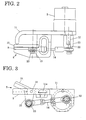
- the false selvedge cutting unit 5 is of a scissors type including a stationary cutting blade 9, a movable cutting blade 10, a bracket 11, the drive motor 3, a connecting shaft 13 and a connecting rod 14.
- the bracket 11 is fastened to a part, on the arriving side, of the frame of the shuttleless loom 2 with a bolt 11a.
- the stationary cutting blade 9 is attached to the bracket 11 with its cutting edge facing up.
- the movable cutting blade 10 is supported for turning by a pin 15 on the stationary cutting blade 9.
- a lever 16 is formed integrally with the movable cutting blade 10.
- the drive motor 3 combined with a reduction gear is mounted on the bracket 11.
- the connecting shaft 13 is connected fixedly to the drive shaft 12 of the reduction gear.
- An eccentric shaft 22, i.e., a bolt, is fixed to the connecting shaft 13 in parallel to the drive shaft 12.
- the connecting rod 14 has one end supported by a bearing on the eccentric shaft 22 so as to be turnable relative to the eccentric shaft 22, and the other end supported by a bearing on a connecting pin 23 attached to the lever 16 so as to be turnable on the connecting pin 23.
- the bracket 11, the drive shaft 12, the connecting shaft 13, the eccentric shaft 22, the connecting rod 14, the connecting pin 23, the pin 15 and the lever 16 constitute a crank mechanism.
- the waste selvage cutting unit 5 performs one cutting cycle every time the drive shaft 12 makes one full turn.
- the drive motor controller 20 controls the drive motor 3 to change the cutting period at which the waste selvage cutting unit 5 performs a cutting cycle according to at least the rotating speed of the main shaft of the shuttleless loom 2, the pick spacing in the fabric 4 or the type of filling yarns.
- the drive motor controller 20 is provided with a storage device storing a plurality of cutting periods (rotating speeds of the drive motor) for at least the rotating speed of the main shaft of the shuttleless loom 2, the pick spacing in the fabric 4 or the type of filling yarns.
- a rotating speed signal, a pick spacing signal and a filling yarn selection signal provided by the shuttleless loom 2 are given to the drive motor controller 20 while the shuttleless loom 2 is in weaving operation.
- the rotating speed signal is a command signal given to a drive unit, not shown, for driving a main motor for driving the main shaft and specifying a rotating speed for the main shaft.
- the rotating speed signal may be a signal representing a measured operating speed of the main motor for driving the main shaft.
- the pick spacing signal specifying a pick spacing is given to controllers for controlling a take-up motor, not shown, and a let-off motor, not shown.
- the filling yarn selection signal is a signal specifying one of picking devices of the shuttleless loom 2 (multiple-color shuttleless loom) and given to a multiple-color picking controller, not shown. These signals correspond to pick count, respectively
- the operator operates a weaving condition setting device 21 before starting the shuttleless loom for a weaving operation to store weaving conditions, a cutting period at which the waste selvage cutting unit 5 performs a cutting cycle (operating speed of the drive motor) in the storage device of the drive motor controller 20.
- a first control mode determines a cutting period (operating speed of the drive motor) at which the waste selvage cutting unit 5 performs a cutting cycle on the basis of at least the rotating speed of the main shaft, the pick spacing in the fabric 4 or the type of filling yarns.
- a second control mode determines a cutting period (operating speed of the drive motor) at which the waste selvage cutting unit 5 performs a cutting cycle on the basis of rotating speed signal, a pick spacing signal and a filling yarn signal provided by the shuttleless loom 2.
- a third control mode is the combination of the first and the second control mode.
- the drive motor controller 20 selects a cutting period (operating speed of the drive motor) at which the waste selvage cutting unit 5 performs a cutting cycle on the basis of at least the rotating speed of the main shaft, the pick spacing in the fabric 4 or the type of filling yarns, and controls the operating speed of the drive motor 3 so that the waste selvage control unit 5 performs a cutting cycle at the selected cutting period.
- the drive motor controller 20 selects a cutting period (operating speed of the drive motor) at which the waste selvage cutting unit 5 performs a cutting cycle on the basis of a rotating speed signal, a pick spacing signal and a filling yarn signal provided by the shuttleless loom 2, and controls the operating speed of the drive motor 3 so that the waste selvage control unit 5 performs a cutting cycle at the selected cutting period.
- the drive motor controller 20 selects a cutting period (operating speed of the drive motor) at which the waste selvage cutting unit 5 performs a cutting cycle on the basis of at least the rotating speed of the main shaft, the pick spacing in the fabric 4 or the type of filling yarns or on the basis of a rotating speed signal, a pick spacing signal and a filling yarn signal provided by the shuttleless loom 2, and controls the operating speed of the drive motor 3 so that the waste selvage control unit 5 performs a cutting cycle at the selected cutting period.
- a cutting period operating speed of the drive motor
- Tables 1(a), 1(b) and 1(c) show cutting periods T for rotating speeds N of the main shaft, pick spacings D and filling yarn types Y by way of example.
- Cutting periods T1 to T6 for rotating speeds N1 and N2, pick spacings D1 and D2 and filling yarn types Y1 and Y2 are optimum cutting periods empirically determined for weaving conditions.
- the cutting periods T1 to T6 are stored in the storage device of the drive motor controller 20.
- the operator operates the weaving condition setting device 21 to give a signal representing the pick spacing D1 to the drive motor controller 20. Then, the drive motor controller 20 selects the cutting period T3 and controls drive motor 3 so that the waste selvage cutting unit 5 is drive to perform a cutting cycle at the cutting period T3.
- the drive motor controller 20 may be constructed so that the drive motor controller 20 is capable of automatically changing the cutting period T
- the drive motor controller 20 changes a signal representing the cutting period T3 automatically for a signal representing the cutting period T4.
- the drive motor controller 20 operates similarly when the rotating speed of the main shaft and the type of filling yarns are changed intentionally.
- Table 2 shows combinations of rotating speeds N1 and N2, pick spacings D1 and D2 and filling yarn types Y1 and Y2, and cutting periods T1 to T8 for those combinations.
- the cutting periods T1 to T8 are optimum cutting periods empirically determined for weaving conditions.
- the cutting periods T1 to T8 are stored in the storage device of the drive motor controller 20.
- the operator operates the weaving condition setting device 21 before starting weaving the fabric 4 to enter values of parameters including rotating speed N, pick spacing D and filling yarn type Y.
- the drive motor controller 20 selects a value of cutting period T at which the waste selvage cutting unit 5 performs a cutting cycle for the values of the parameters. For example, when the operator specifies the rotating speed N1, the pick spacing D1 and the filling yarn type Y1 shown in Table 2, the drive motor controller 20 selects the cutting period T1.
- the drive motor controller 20 may automatically select a suitable cutting period on the basis of a rotating speed signal, a pick spacing signal and a filling yarn signal provided by the shuttleless loom 2, and the cutting period may be automatically changed while the shuttleless loom is in operation.
- Table 3 shows cutting periods T for combinations of rotating speeds N, pick spacings D and filling yarn types Y.
- Two basic cutting periods T1 and T2 are set respectively for two rotating speeds N1 and N2 and stored in the storage device of the drive motor controller 20. Effective cutting periods are calculated by multiplying the basic cutting periods T1 and T2 by correction factors set for pick spacings D and filling yarn types Y. For example, when the rotating speed N1, the pick spacing D1 and the filling yarn type Y1 are selected as weaving conditions, the effective cutting period is T1xd1xy1.
- the drive motor controller 20 changes the cutting period at which the waste selvage cutting unit 5 performs a cutting cycle on the basis of the rotating speed signal, the pick spacing signal and the filling yarn signal provided by the shuttleless loom 2, the cutting period may be changed according to the number of picks.
- Pick count corresponds univocally to weaving conditions including rotating speed, pick spacing and filling yarn type. Therefore, pick count (Fig. 8) represents to weaving conditions including rotating speed, pick spacing and filling yarn type.
- a loom controller not shown, receives a pick count signal and provides signals on the basis of pick count.
- Table 4 shows cutting periods for combinations of weaving conditions, i.e., pick counts, pick spacings and filling yarn types.
- the pick spacings D1, D2, filling yarn types Y1 and Y2, and cutting periods T1, T2, T3 and T4 for pick counts shown in Table 4 are stored beforehand in the storage device of the drive motor controller 20.
- the drive motor controller 20 counts the number of picks, reads a pick spacing D, a filling yarn type Y and a cutting period T for a pick count upon the coincidence of the pick count with a predetermined pick count, and changes the cutting period.
- the pick count is reset to zero every 1000 picks.
- Fig. 4 shows the variation of the position of the reed with the angular position of the main shaft and a drive signal for driving the drive motor 3 when the main shaft of the shuttleless loom 2 rotates at 600 rpm, i.e., at a period of 100 ms, and the waste selvage cutting unit 5 performs a cutting cycle at a cutting cycle of 80 ms. While the reed performs one beat-up cycle every one full turn of the main shaft, the waste selvage cutting unit 5 performs one cutting cycle every 80 ms independently of the rotation of the main shaft.
- the waste selvage cutting unit 5 operates in an operating mode shown in Fig. 4 when weaving conditions are those requiring the frequent operation of the waste selvage cutting unit 5, such as a small pick spacing (the fabric 4 advances fast) or filling yarns are thick.
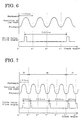
- Fig. 5 shows the variation of the position of the reed with the angular position of the main shaft and a drive signal for driving the drive motor 3 when the main shaft of the shuttleless loom 2 rotates at 600 rpm, i.e., at a period of 100 ms, and the waste selvage cutting unit 5 performs a cutting cycle at a cutting cycle of 200 ms. While the reed performs one beat-up cycle every one full turn of the main shaft, the waste selvage cutting unit 5 performs one cutting cycle every 200 ms independently of the rotation of the main shaft.
- the waste selvage cutting unit 5 Since the cutting period of 200 ms at which the waste selvage cutting unit 5 performs one cutting cycle is twice the period of rotation of the main shaft, namely, 100 ms, the waste selvage cutting unit 5 performs a cutting cycle every two beat-up cycles.
- the waste selvage cutting unit 5 operates in an operating mode shown in Fig. 5 when weaving conditions are those requiring the infrequent operation of the waste selvage cutting unit 5, such as a large pick spacing (the fabric 4 advances slow) or filling yarns are thin.
- Fig. 6 shows the variation of the position of the reed with the angular position of the main shaft and a drive signal for driving the drive motor 3 when the main shaft of the shuttleless loom 2 rotates at 600 rpm, i.e., at a period of 100 ms, and the waste selvage cutting unit 5 performs a cutting cycle at a cutting cycle of 300 ms. While the reed performs one beat-up cycle every one full turn of the main shaft, the waste selvage cutting unit 5 performs one cutting cycle every 300 ms independently of the rotation of the main shaft.
- the waste selvage cutting unit 5 Since the cutting period of 300 ms at which the waste selvage cutting unit 5 performs one cutting cycle is three times the period of rotation of the main shaft, namely, 100 ms, the waste selvage cutting unit 5 performs a cutting cycle every three beat-up cycles.
- the waste selvage cutting unit 5 operates in an operating mode shown in Fig. 6 when weaving conditions are those requiring the infrequent operation of the waste selvage cutting unit 5, such as a large pick spacing (the fabric 4 advances slow) or filling yarns are thin.
- Fig. 7 shows the variation of the position of the reed with the angular position of the main shaft and a drive signal for driving the drive motor 3 when the main shaft of the shuttleless loom 2 rotates at 600 rpm, i.e., at a period of 100 ms, and the cutting period at which the waste selvage cutting unit 5 performs a cutting cycle is variable. While the reed performs one beat-up cycle every one full turn of the main shaft, the waste selvage cutting unit 5 performs one cutting cycle every 80 ms independently of the rotation of the main shaft when the pick spacing D1 is selected, and the waste selvage cutting unit 5 performs one cutting cycle every 200 ms independently of the rotation of the main shaft when the pick spacing D2 is selected.
- the waste selvage cutting unit 5 operates in an operating mode shown in Fig. 7 when weaving conditions changes during the weaving of the fabric 4, i.e., when the pick spacings D1 and D2 (D1 ⁇ D2) are used alternately.
- the operating frequency of the waste selvage cutting unit 5 is expressed by cutting period (ms) in the foregoing description, the same may be expressed by cutting cycles per pick.
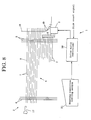
- Fig. 8 is a view of assistance in explaining the frequency of operation of the waste selvage cutting unit 5 of the waste selvage cutter 1 expressed by the number of cutting cycles performed for one picking cycle.
- the drive motor controller 20 receives a pick count signal, i.e., a signal representing the number of full rotations of the main shaft of the shuttleless loom 2, and the drive motor controller 20 drives the drive motor 3 in synchronism with the rotation of the main shaft of the shuttleless loom 2.
- Fig. 9 shows the variation of the position of the reed with the angular position of the main shaft and a drive signal for driving the drive motor 3 when the main shaft of the shuttleless loom 2 rotates at 600 rpm, i.e., at a period of 100 ms, and the waste selvage cutting unit 5 performs two cutting cycles for each pick (2 cutting cycles/pick).
- the number of picking cycles per pick may be changed according to weaving conditions and may be, for example, 0.5 cutting cycles per pick (1 cutting cycle/2 picks).
- the waste selvage cutting unit 5 starts a cutting cycle at angular positions of 0° and 180° of the main shaft.
- the cutting cycles may be started at any angular positions of the main shaft, such as 10° and 190°, provided that two cutting cycles are performed every one picking cycle.
- the waste selvage cutting unit 5 operates in the operating mode shown in Fig. 9 when weaving conditions are those requiring the frequent operation of the waste selvage cutting unit 5, such as a small pick spacing (the fabric 4 advances fast) or filling yarns are thick.
- the number of cutting cycles is set in this embodiment, the number of picking cycles per one cutting cycle may be set.
Landscapes
- Engineering & Computer Science (AREA)
- Textile Engineering (AREA)
- Physics & Mathematics (AREA)
- General Physics & Mathematics (AREA)
- Aviation & Aerospace Engineering (AREA)
- Looms (AREA)
- Auxiliary Weaving Apparatuses, Weavers' Tools, And Shuttles (AREA)
Applications Claiming Priority (2)
| Application Number | Priority Date | Filing Date | Title |
|---|---|---|---|
| JP2003037030A JP2004244764A (ja) | 2003-02-14 | 2003-02-14 | 断片織機の捨耳カッター駆動方法 |
| JP2003037030 | 2003-02-14 |
Publications (2)
| Publication Number | Publication Date |
|---|---|
| EP1447465A2 true EP1447465A2 (de) | 2004-08-18 |
| EP1447465A3 EP1447465A3 (de) | 2005-01-19 |
Family
ID=32677640
Family Applications (1)
| Application Number | Title | Priority Date | Filing Date |
|---|---|---|---|
| EP04002678A Withdrawn EP1447465A3 (de) | 2003-02-14 | 2004-02-06 | Verfahren und Vorrichtung zum Antrieb einer Abfallkantenschneidvorrichtung für eine schützenloze Webmaschine |
Country Status (4)
| Country | Link |
|---|---|
| EP (1) | EP1447465A3 (de) |
| JP (1) | JP2004244764A (de) |
| KR (1) | KR20040073967A (de) |
| CN (1) | CN1520977A (de) |
Families Citing this family (1)
| Publication number | Priority date | Publication date | Assignee | Title |
|---|---|---|---|---|
| CN105648738A (zh) * | 2016-02-24 | 2016-06-08 | 张家港市华益纺织有限公司 | 一种用于纺织面料加工的切刀装置 |
Family Cites Families (4)
| Publication number | Priority date | Publication date | Assignee | Title |
|---|---|---|---|---|
| CH579165A5 (de) * | 1974-06-28 | 1976-08-31 | Rueti Ag Maschf | |
| CH651331A5 (de) * | 1981-07-06 | 1985-09-13 | Saurer Ag Adolph | Kantenschneidvorrichtung fuer eine webmaschine. |
| BE1000369A4 (nl) * | 1987-03-09 | 1988-11-08 | Picanol Nv | Werkwijze voor het bevelen van een snijinrichting voor inslagdraden bij weefmachines en snijinrichting hiertoe aangewend. |
| DE19713089C2 (de) * | 1997-03-27 | 2000-07-27 | Dornier Gmbh Lindauer | Verfahren und Vorrichtung zur Steuerung und Überwachung der Schneidfunktion einer elektromotorisch angetriebenen Fadenschere in Webmaschinen |
-
2003
- 2003-02-14 JP JP2003037030A patent/JP2004244764A/ja active Pending
-
2004
- 2004-01-06 KR KR1020040000530A patent/KR20040073967A/ko not_active Abandoned
- 2004-02-06 EP EP04002678A patent/EP1447465A3/de not_active Withdrawn
- 2004-02-12 CN CNA2004100050045A patent/CN1520977A/zh active Pending
Also Published As
| Publication number | Publication date |
|---|---|
| JP2004244764A (ja) | 2004-09-02 |
| KR20040073967A (ko) | 2004-08-21 |
| CN1520977A (zh) | 2004-08-18 |
| EP1447465A3 (de) | 2005-01-19 |
Similar Documents
| Publication | Publication Date | Title |
|---|---|---|
| US4559976A (en) | Method of preventing a defective weft yarn from being woven in a fabric in a shuttleless loom | |
| US20040031533A1 (en) | Method for operating a weaving and shedding machine | |
| EP1447465A2 (de) | Verfahren und Vorrichtung zum Antrieb einer Abfallkantenschneidvorrichtung für eine schützenloze Webmaschine | |
| US5499662A (en) | Method for preventing the formation of fabric blemishes by controlling beat-up in a loom | |
| EP1247886B1 (de) | Vorrichtung und Verfahren zum Antrieb einer Webmaschine | |
| JP3316536B2 (ja) | 多色緯入れ織機の緯入れ方法およびその装置 | |
| US7231943B2 (en) | Device for a weaving machine | |
| US6029715A (en) | Method of controlling pile warp tension on pile fabric loom | |
| US5335698A (en) | Method of restarting a loom after stoppage | |
| EP1130145B1 (de) | Verfahren und Gerät zur Steuerung der Vorrichtung zum Bilden einer Webkante in eine Webmaschine | |
| JPH06346345A (ja) | 空気噴射式織機における運転再開方法 | |
| EP1862573B1 (de) | Vorrichtung zum Vermeiden von Operativfehlern für eine Webmaschine | |
| EP1541731B1 (de) | Verfahren zum Vermeiden von Schussstreifen in einer Webmaschine | |
| CN211848311U (zh) | 一种用于纬纱束编织的剑杆织机 | |
| EP1669483B1 (de) | Verfahren zum Anpassen der Spannung von Florkettfäden | |
| EP1424415B1 (de) | Webmaschine mit moduliertem Antrieb und Verfahren zur Webkontrolle mit Veränderung der Antriebsgeschwindigkeit | |
| JPH02169749A (ja) | 織機の運転方法 | |
| US5285820A (en) | Power loom lay or baton drive | |
| EP1826302A2 (de) | Fachbildungsvorrichtung einer Webmaschine und Wechselverfahren für den Kettbaum einer Webmaschine mit Fachbildungsvorrichtung | |
| JPH0329904B2 (de) | ||
| JP5137302B2 (ja) | 織機の運転装置 | |
| JP4098166B2 (ja) | パイル用無杼織機の捨て耳カッターの駆動方法 | |
| CN121443787A (zh) | 用于运行喷气织机的方法和喷气织机 | |
| CN101228304A (zh) | 片梭织机的工作方法 | |
| CN2890112Y (zh) | 一种剑杆织机防止纬档的装置 |
Legal Events
| Date | Code | Title | Description |
|---|---|---|---|
| PUAI | Public reference made under article 153(3) epc to a published international application that has entered the european phase |
Free format text: ORIGINAL CODE: 0009012 |
|
| AK | Designated contracting states |
Kind code of ref document: A2 Designated state(s): AT BE BG CH CY CZ DE DK EE ES FI FR GB GR HU IE IT LI LU MC NL PT RO SE SI SK TR |
|
| AX | Request for extension of the european patent |
Extension state: AL LT LV MK |
|
| PUAL | Search report despatched |
Free format text: ORIGINAL CODE: 0009013 |
|
| AK | Designated contracting states |
Kind code of ref document: A3 Designated state(s): AT BE BG CH CY CZ DE DK EE ES FI FR GB GR HU IE IT LI LU MC NL PT RO SE SI SK TR |
|
| AX | Request for extension of the european patent |
Extension state: AL LT LV MK |
|
| AKX | Designation fees paid | ||
| REG | Reference to a national code |
Ref country code: DE Ref legal event code: 8566 |
|
| STAA | Information on the status of an ep patent application or granted ep patent |
Free format text: STATUS: THE APPLICATION IS DEEMED TO BE WITHDRAWN |
|
| 18D | Application deemed to be withdrawn |
Effective date: 20050720 |