EP1447007B1 - A method and a plant for preparing shrimps - Google Patents
A method and a plant for preparing shrimps Download PDFInfo
- Publication number
- EP1447007B1 EP1447007B1 EP03388011A EP03388011A EP1447007B1 EP 1447007 B1 EP1447007 B1 EP 1447007B1 EP 03388011 A EP03388011 A EP 03388011A EP 03388011 A EP03388011 A EP 03388011A EP 1447007 B1 EP1447007 B1 EP 1447007B1
- Authority
- EP
- European Patent Office
- Prior art keywords
- shrimps
- meat
- sec
- separation
- bar
- Prior art date
- Legal status (The legal status is an assumption and is not a legal conclusion. Google has not performed a legal analysis and makes no representation as to the accuracy of the status listed.)
- Expired - Lifetime
Links
- 241000143060 Americamysis bahia Species 0.000 title claims abstract description 190
- 238000000034 method Methods 0.000 title claims abstract description 52
- 235000013372 meat Nutrition 0.000 claims abstract description 130
- 238000000926 separation method Methods 0.000 claims abstract description 106
- 241000238557 Decapoda Species 0.000 claims abstract description 71
- 235000013601 eggs Nutrition 0.000 claims abstract description 55
- 238000009835 boiling Methods 0.000 claims abstract description 47
- 239000007788 liquid Substances 0.000 claims abstract description 27
- HPALAKNZSZLMCH-UHFFFAOYSA-M sodium;chloride;hydrate Chemical compound O.[Na+].[Cl-] HPALAKNZSZLMCH-UHFFFAOYSA-M 0.000 claims abstract description 24
- FAPWRFPIFSIZLT-UHFFFAOYSA-M Sodium chloride Chemical compound [Na+].[Cl-] FAPWRFPIFSIZLT-UHFFFAOYSA-M 0.000 claims abstract description 22
- 239000012267 brine Substances 0.000 claims abstract description 22
- XLYOFNOQVPJJNP-UHFFFAOYSA-N water Substances O XLYOFNOQVPJJNP-UHFFFAOYSA-N 0.000 claims abstract description 18
- 239000011780 sodium chloride Substances 0.000 claims abstract description 11
- 239000000243 solution Substances 0.000 claims abstract description 9
- 238000010438 heat treatment Methods 0.000 claims abstract description 6
- 238000001816 cooling Methods 0.000 claims description 38
- 238000005188 flotation Methods 0.000 claims description 12
- 239000000498 cooling water Substances 0.000 claims description 11
- 238000012546 transfer Methods 0.000 claims description 8
- 238000010923 batch production Methods 0.000 claims description 2
- 238000003756 stirring Methods 0.000 claims description 2
- -1 6-14% NaCl by weight Chemical compound 0.000 claims 1
- 239000007864 aqueous solution Substances 0.000 claims 1
- 238000005336 cracking Methods 0.000 claims 1
- 241001131688 Coracias garrulus Species 0.000 description 13
- 230000008569 process Effects 0.000 description 11
- 239000000463 material Substances 0.000 description 6
- MBLBDJOUHNCFQT-LXGUWJNJSA-N aldehydo-N-acetyl-D-glucosamine Chemical group CC(=O)N[C@@H](C=O)[C@@H](O)[C@H](O)[C@H](O)CO MBLBDJOUHNCFQT-LXGUWJNJSA-N 0.000 description 5
- 239000002699 waste material Substances 0.000 description 5
- 238000010924 continuous production Methods 0.000 description 3
- 230000007704 transition Effects 0.000 description 3
- 230000000694 effects Effects 0.000 description 2
- 238000005265 energy consumption Methods 0.000 description 2
- 238000007710 freezing Methods 0.000 description 2
- 230000008014 freezing Effects 0.000 description 2
- 238000004806 packaging method and process Methods 0.000 description 2
- 230000009467 reduction Effects 0.000 description 2
- 210000003813 thumb Anatomy 0.000 description 2
- 238000013022 venting Methods 0.000 description 2
- 206010013911 Dysgeusia Diseases 0.000 description 1
- 241000237852 Mollusca Species 0.000 description 1
- 238000013019 agitation Methods 0.000 description 1
- 230000004075 alteration Effects 0.000 description 1
- 230000006835 compression Effects 0.000 description 1
- 238000007906 compression Methods 0.000 description 1
- 239000000470 constituent Substances 0.000 description 1
- 230000008602 contraction Effects 0.000 description 1
- 238000007796 conventional method Methods 0.000 description 1
- 238000010411 cooking Methods 0.000 description 1
- 238000007599 discharging Methods 0.000 description 1
- 238000001914 filtration Methods 0.000 description 1
- 239000012467 final product Substances 0.000 description 1
- 235000013305 food Nutrition 0.000 description 1
- 238000012986 modification Methods 0.000 description 1
- 230000004048 modification Effects 0.000 description 1
- 238000002360 preparation method Methods 0.000 description 1
- 238000012545 processing Methods 0.000 description 1
- 239000000047 product Substances 0.000 description 1
- 230000001737 promoting effect Effects 0.000 description 1
- 239000002994 raw material Substances 0.000 description 1
- 230000003134 recirculating effect Effects 0.000 description 1
- 239000007787 solid Substances 0.000 description 1
- 229910001220 stainless steel Inorganic materials 0.000 description 1
- 239000010935 stainless steel Substances 0.000 description 1
- 230000004580 weight loss Effects 0.000 description 1
Images

Classifications
-
- A—HUMAN NECESSITIES
- A22—BUTCHERING; MEAT TREATMENT; PROCESSING POULTRY OR FISH
- A22C—PROCESSING MEAT, POULTRY, OR FISH
- A22C29/00—Processing shellfish or bivalves, e.g. oysters, lobsters; Devices therefor, e.g. claw locks, claw crushers, grading devices; Processing lines
- A22C29/02—Processing shrimps, lobsters or the like ; Methods or machines for the shelling of shellfish
- A22C29/021—Cleaning operations on shellfish, e.g. evisceration, brushing
-
- A—HUMAN NECESSITIES
- A22—BUTCHERING; MEAT TREATMENT; PROCESSING POULTRY OR FISH
- A22C—PROCESSING MEAT, POULTRY, OR FISH
- A22C29/00—Processing shellfish or bivalves, e.g. oysters, lobsters; Devices therefor, e.g. claw locks, claw crushers, grading devices; Processing lines
- A22C29/02—Processing shrimps, lobsters or the like ; Methods or machines for the shelling of shellfish
-
- A—HUMAN NECESSITIES
- A22—BUTCHERING; MEAT TREATMENT; PROCESSING POULTRY OR FISH
- A22C—PROCESSING MEAT, POULTRY, OR FISH
- A22C29/00—Processing shellfish or bivalves, e.g. oysters, lobsters; Devices therefor, e.g. claw locks, claw crushers, grading devices; Processing lines
- A22C29/02—Processing shrimps, lobsters or the like ; Methods or machines for the shelling of shellfish
- A22C29/024—Opening, shelling or peeling shellfish
- A22C29/026—Mechanically peeling and shelling shrimps, prawns or other soft-shelled crustaceans
-
- A—HUMAN NECESSITIES
- A23—FOODS OR FOODSTUFFS; TREATMENT THEREOF, NOT COVERED BY OTHER CLASSES
- A23L—FOODS, FOODSTUFFS OR NON-ALCOHOLIC BEVERAGES, NOT OTHERWISE PROVIDED FOR; PREPARATION OR TREATMENT THEREOF
- A23L17/00—Food-from-the-sea products; Fish products; Fish meal; Fish-egg substitutes; Preparation or treatment thereof
- A23L17/40—Shell-fish
Definitions
- the present invention relates to a technique of preparing shrimps and in more details a method of boiling and peeling shrimps and of separating the meat of the shrimps from the remainings of the shrimps which remainings include shell parts and eggs.
- shrimps such as shrimps from cold water or from hot water i.e. shrimps from the arctic ocean or alternatively the oceans in areas with a tropical, a subtropical or a temperate climate are conventionally prepared by boiling the shrimps and separating the boiled meat from the shell part of the shrimps and optionally from any eggs carried by the living shrimps.
- US 3,501,317 describes a simple and inexpensive way of cooking shrimps having a minimum weight loss.
- US 3,722,035 describes a method of separating bivalve mollusc meat by subjecting partially opened shells to air bubbles under water.
- the method according to the present invention is characterised by two main features, namely on the one hand the steam boiling combined with the rapid cooling and the flotation separation.
- the steam boiling and rapid cooling feature it has been realised that the steam boiling of the shrimps allows on the one hand a high efficient and low energy consuming boiling and on the other hand contributes to a more easy peeling and separation of the meat from the remainings of the shrimps.
- the high pressure steam boiling provides a slight compacting of the meat during the boiling process, thereby providing a loosening of the meat from the surrounding shell which loosening of the meat from the shell is further accelerated through the high temperature of the steam causing a high temperature increase generating due to the differences in heat expansion coefficients of the shell and the meat a delimitation of the meat from the shell.
- the loosening of the meat from the shell is further promoted through the rapid cooling as the steam boiled shrimps having a temperature of 150°C or more from the high pressurised steam boiling process are rapidly cooled to a temperature below the atmospheric temperature such as a temperature of 3°C-5°C which rapid cooling causes a contraction of the shrimp meat and also of the shell, thereby promoting the loosening and separation of the meat from the shell circumferentially encircling the meat.
- the loosening or separation of the meat from the circumferentially encircling shells of the boiled shrimps makes the peeling of the shrimps more easy allowing the usage of simple peeling technique such as mechanical compression of the shells for simply causing the shells to crack and allowing the previously boiled and rapidly cooled meat to be easily removed from the interior of the cracked shells by simply allowing the meat to fall out from the cracked or opened shells.
- the separation of the meat from the remainings of the boiled shrimps including the shell or shell parts and any eggs is accomplished in a flotation separation process as it has surprisingly been realised that a flotation separation process provided a specific separation liquid be chosen having a specific density allows the meat to be floating on the separation liquid whereas the remainings of the shrimps including the shrimp shells and any eggs are allowed to sink.
- a flotation separation process provided a specific separation liquid be chosen having a specific density allows the meat to be floating on the separation liquid whereas the remainings of the shrimps including the shrimp shells and any eggs are allowed to sink.
- the eggs which are carried by the living shrimps during those periods of time when the shrimps are most tasty due to the presence of enough food may also be separated from the meat as the eggs have a slightly higher density as compared to the boiled meat of the shrimps.
- brine is used having a content of NaCl of the order of 6-14%, preferably 9.5% by weight which separation liquid is biologically acceptable for the reason that the shrimp meat after the completion of the boiling, cooling, the peeling and separation processes are usually salted for improving the taste of the shrimp meat. Therefore, the use of the brine solution for the flotation separation process gives no after-taste to the shrimp meat or deteriorates the taste of the shrimp meat.
- the pressure of the steam boiling process has to exceed the atmospheric pressure for providing the loosening of the meat from the circumferentially encircling shell. Therefore, the pressure in step b) is preferably of the order of 4-20 bar e.g. 6-16 bar, preferably 8-14 bar, further preferably approximately 12 bar, or of the order of 4-6 bar, 6-8 bar, 8-10 bar, 10-12 bar, 12-14 bar, 14-16 bar, 16-18 bar or 18-20 bar.
- the steam boiling temperature should, as discussed above, provide the separation of the meat from the shell and therefore, the temperature in step a) is preferably of the order of 150°C-250°C, such as 160°C-210°C, preferably 180°C-200°C, further preferably approximately 190°C, or 150°C-170°C, 170°C-190°C, 210°C- 230°C or 230°C-250°C.
- the steam boiling process is carried out within a very short period of time such as a time of less than 20 sec., such as 1-15 sec., preferably 2-10 sec., further preferably 4-6 sec., or 1-2 sec., 2-3 sec., 3-4 sec., 4-5 sec., 5-6 sec., 6-8 sec., 8-10 sec., 10-12 sec., 12-14 sec., 14-16 sec. or 16-20 sec.
- a very short period of time such as a time of less than 20 sec., such as 1-15 sec., preferably 2-10 sec., further preferably 4-6 sec., or 1-2 sec., 2-3 sec., 3-4 sec., 4-5 sec., 5-6 sec., 6-8 sec., 8-10 sec., 10-12 sec., 12-14 sec., 14-16 sec. or 16-20 sec.
- the loosening of the meat from the circumferentially encircling shells of the shrimps is as discussed above further promoted through the rapid cooling of the shrimps from the high boiling temperature preferably being higher than 150°C to a low temperature such as a temperature of approximately 0°C-20°C, e.g. 2°C-10°C, preferably 5°C-8°C, or 1°C-3°C, 3°C -5°C, 5°C -7°C, 7°C -10°C, 10°C -15°C, 15°C-20°C.
- a low temperature such as a temperature of approximately 0°C-20°C, e.g. 2°C-10°C, preferably 5°C-8°C, or 1°C-3°C, 3°C -5°C, 5°C -7°C, 7°C -10°C, 10°C -15°C, 15°C-20°C.
- the combined method according to the present invention including the steps a) - e) may be carried out as a continuous process or alternatively as a batch or intermittent process or further alternatively be combined as one or more of the steps may be performed as batch process steps whereas the remaining steps may be carried out as continuous process steps.
- the boiling may be performed in a pressurised boiler in a continuous operation as the shrimps are continuously introduced into the steam boiler, and after the above short period of time removed as a continuous flow of boiled shrimps from the steam container and introduced to the rapid cooling step.
- the boiling is performed in a set of pressurised boilers as a semi-continuous process involving the intermittent and sequential operation of the steam boilers of the set of boilers.
- the boiling is performed in a pressurised boiler in an intermittent batch operation.
- the rapid cooling of the high temperature steam boiled shrimps is preferably performed by simply sinking the boiled shrimps into a cooling bath having the above discussed temperature below the atmospheric temperature.
- the method preferably further includes a step prior to step d) of forcedly emerging the peeled shrimps into the separation liquid or alternatively stirring the peeled shrimps in the separation liquid for causing a physical separation of the meat from the remainings of the shrimps including the shell parts and any eggs for preventing that any meat is stuck between shell parts or concealed within eggs and due to a compacting of the material including the meat, the shell parts and any eggs be prevented from being rinsed before the completion of the flotation separation step.
- the present invention according to further aspects includes the separate steps a) in combination with b) and d) of the method according to the first aspect of the present invention.
- a method of boiling shrimps comprising:
- a method of separating meat from remainings of boiled shrimps which remainings include shell parts and any eggs which method comprises:
- the plant according to the present invention preferably includes any of the features discussed above with reference to the above described method according to the first aspect of the present invention.
- a first and presently preferred embodiment of a plant according to the present invention for boiling, peeling, rinsing and separating shrimps according to the method according to the present invention is shown, composed of a plurality of sections.
- the plant is in its entirety designated the reference numeral 10 and comprises a two-part batch boiler section 12, a peeling section 14, a rinsing and separation section 16 and finally the transfer section 18.
- the individual sections 12, 14, 16 and 18 are to be described in greater details below, however at this point an overall description of the plant 10 and the sections thereof is presented.
- the steam boiler section 12 two steam boilers are operated intermittently for providing a substantially continuous output of boiled and rapidly cooled shrimps to the peeling section 14.
- the peeling section the boiled and cooled shrimps are peeled by breaking the shells of the shrimps for allowing the meat of the shrimps to be separated from the shell of the shrimps.
- the meat of the shrimps is rinsed and the remainings, i.e. the shrimps shells and also the eggs of the shrimps are separated from the meat.
- the transfer section the peeled and rinsed shrimps are transferred to a further processing section such as a packaging and freezing section, which section is not part of the present invention.
- the boiler section having two intermittently operated steam boilers are first to be described.
- the one boiler is designated the reference numeral 20, and the other boiler is designated the reference numeral 22.
- the boilers receive high temperature and high pressure steam such as 12 bar 190°C steam from a steam supply tube 24 as the steam is input to the one boiler 20 through a closure valve 26 and similarly, the steam input to the second boiler 22 is input through a closure valve 28.
- the closure valves 26 and 28 are mounted on steam inlet tubes 30 and 32, respectively.
- the boilers 20 and 22 and vented through venting tubes 34 and 36, respectively, as the venting of the boiler chambers within the boilers 20 and 22 is controlled by means of additional closure valves 38 and 40, respectively.
- Each of the boilers 20 and 22 have a high pressure enclosure 42 and 44, respectively, having a bottom outlet 46 and 48, respectively.
- two closure caps 50 and 52, respectively are provided, constituting openable caps or lids through which a container including a specific amount of shrimps, such as a batch of 5-25 kg is introduced into the interior of the enclosures 42 and 44, respectively.
- the bottom outlet 46 and 48 communicate with upwardly open cooling containers 54 and 56, respectively, containing cooling water as indicated by the reference numerals 58 and 60, respectively.
- the cooling water is input to the cooling containers 54 and 56 by means of a water supply including a water supply tube 62 and a water supply reservoir 64 from which the cooling water is poured into the cooling containers 54 and 56, respectively, through additional valves 66 and 68, respectively.
- the containers 54 and 56 include thermostating elements for controlling the valves 66 and 68 as the valves 66 and 68 are opened for the entry of water provided the temperature of the cooling water 58 and 60 or one of the container 54 and 56 raise beyond a specific level necessitating the additional cooling by the supply of additional cooling water.
- the process time for the boiling of one batch of shrimps by the supply of 12 bar, 190°C steam is of the order of 4 sec. allowing one batch of shrimps to be boiled within a period of approximately 6-8 sec. including the time for the introduction of the batch into the boiler and the time for discharging the steam boiled shrimps to the cooling containers 54 and 56, respectively.
- the steam boiled and cooled shrimps delivered from the outlet ducts 70 and 72 are received in the peeling section 14 including two parallel side bars 80 and 82 in which a plurality of parallelly extending stainless rollers 84 are journalled and operated by means of a motor 86 causing the rollers 84 to rotate in opposite directions as is illustrated in Fig. 8.
- the rollers 84 cause the shrimps to be slightly compressed between the two oppositely rotating rollers causing the shell of the shrimp to break as the shell of the individual shrimp has due to the rapid boiling and rapid cooling loosened its grip to the meat of the shrimp.
- a shrimp 90 is shown having a head part 92, a body part 94 and a tail 96.
- the transition between the head part and the body part is indicated by an arrow 93 and similarly, an arrow 95 indicates the transition from the body part 94 to the tail 96.
- the shells Due to the rapid boiling and rapid cooling of the shrimps, the shells constitute fairly loose encasings relative to the meat of the individual shrimps, the shells of the shrimp break at the above transitions indicated by the arrows 93 and 95 generally allowing an almost 100% utilisation of the meat of the individual shrimp as compared to conventional techniques in which the shrimps are boiled at the atmospheric pressure and at a temperature of approximately 100°C.
- rollers 84 of the peeling section 14 are shown illustrating the peeling function of the rollers.
- the rollers 84 constitute revolving rollers, i.e. rollers which in the orientation shown in Fig. 1 rotate for an extended period of time in the clockwise direction and which are periodically reversed for rotating synchronically in the anti-clockwise direction.
- the unpeeled shrimps are in the clockwise direction performed by the rollers 84 caused to be brought into the gap between any two adjacent rollers causing a crushing of the shrimps and slightly compressing the boiled shrimps thereby causing the shells to be separated from the meat.
- the distance between the rollers prevents the meat from falling between the rollers whereas the shells, the shell parts and the eggs separated from the meat of the shrimps fall between the rollers 84 unto the conveyor belt shown in Fig. 1, from which conveyor belt the separated shell parts and any eggs attached to the shell parts are disposed.
- the shrimp meat and shrimp meat having attached shell parts and any eggs attached to the shell parts are carried along by the rollers 84 and delivered from the peeling section 14 to the rinsing and separation section 16. It is to be realised that the material delivered from the peeling section 14 to the separation section 16 includes any remaining shell parts having eggs attached thereto and loose meat and further shrimp meat having shell parts attached thereto.
- the rinsing and separation section 16 is physically mounted below the conveyor belt 88, however, in Fig. 1, as indicated by an arrow 98, the rinsing and separation section 16 is for illustrative purposes positioned above the conveyor belt 88.
- the shrimp meat is rinsed from any shell parts or eggs adhering to the meat and further separated from the shells and the eggs.
- the material including the shrimp meat, the shell or shell parts and the shrimp eggs are delivered from the output end of the conveyor belt 88 to a set of rotating agitators 100 which are journalled in two parallel side bars one of which is shown in Fig. 1 and designated the reference numeral 102 and which are rotated in opposite directions by means of a motor 104.
- the agitators 100 are operated similar to the rollers 84 of the peeling section 14, however, the agitators 100 are positioned in spaced apart relationship allowing the material after the mechanical agitation to be delivered into a separation bath of a separation container 106.
- the container 106 is composed of two opposite side walls 108 and 110, a front wall 112 and an end wall 114.
- the container also has a bottom wall 116 in which an outlet funnel 118 is provided which funnel communicates with a bottom pump assembly 120 from which the shell parts and the shrimp eggs are delivered to an outlet tube 122.
- a chute wall 124 extends from below two downwardly protruding V-defining walls 126 and 128 to the funnel 118 for guiding the shell parts and the shrimp eggs to the bottom outlet funnel 118.
- brine 130 is contained including approximately 9.5% NaCl by weight for providing a flotation separation of the shrimp meat from the remainings of the shrimps including the shell parts and the shrimp eggs. It has surprisingly been realised that a specific separation threshold exist allowing the shrimp meat to be separated from the remainings of the shrimps, namely the shrimp shells and the shrimp eggs.
- the brine is input to the separation container through two brine inlet tubes 132 and 134 and the brine is allowed to float out from the separation chamber 106 at an outlet opening in the rear wall 114 as the brine carrying the shrimp meat is allowed to fall down into the transportation section 18.
- a vertical sectional view of the separation container 106 is shown, in which the shrimps including the shrimp meat, the shrimp shells and the shrimp eggs are introduced into the separation container through a delivery funnel 136 rather than by means of the agitators 100 shown in Fig. 1.
- the water is forced upwardly along a vertical wall part of the chute wall 124 carrying along the material input through the funnel 136 and including the shrimp meat, the shrimp eggs and the shrimp shells.
- the material carried along with the brine is forced downwardly below the two V-defining walls 126 and 128 providing a steering effect for separating the constituents from one another and allowing the rinsed and cleaned shrimp meat parts 138 to float on top of the brine whereas the shell parts 140 and the eggs 142 sink to the bottom of the separation container 106, allowing the shrimp shell parts 140 and the shrimp eggs 142 to deposit in the outlet funnel 118 of the separation container from which outlet funnel shown in Fig. 1, the waste material, i.e. the shrimp shell parts 140 and the shrimp eggs 142 is output through the outlet 122 shown in Fig. 1.
- the brine carrying the shrimp meat parts 138 is output from the rear end of the separation container, i.e. opposite to the inlet end at which the brine inlet 132 and the funnel 136 are positioned, and transferred to the transport section 18.
- a conveyor belt 144 which constitutes a filtering conveyor belt carries the shrimp meat parts to the packaging and freezing section not shown in the drawings, whereas the brine is expelled to a bottom funnel 146, from which the brine may be wasted or alternatively, as shown in Fig. 2, be recirculated to the inlet end of the separation container by means of a pump 148 delivering the recirculating brine to the inlet end of the separation container 106.
- the technique of removing the waste, i.e. the shell parts 140 and the eggs 142, from the flotation separation container 106 may be accomplished in numerous ways as an intermittent operation or a continuous operation.
- a modified embodiment of the separation container is shown, differing from the above described first and presently preferred embodiment shown in Fig. 1 and 2, in that the side walls 108 and 110 constituting vertical side walls in Fig. 1 are substituted by sloping side walls 108' and 110'.
- a belt 144 extends, which belt is driven by a motor 145.
- the belt is forced down into contact with the inner surface of the separation container 106 by means of two pressure arms 148 and 150 carrying pressure rollers 152 and 154, respectively.
- the pressure rollers are in their lowermost operational position shown in full line in Fig. 3, the bottom part of the belt 144 is raised as illustrated in full line in fig. 3.
- the belt 144 passes round a drive roller 156 connected to the drive motor 145 and round an idler roller 158 positioned symmetrical relative to the drive roller 156 as the drive roller 156 is positioned above the sloping side wall 110' whereas the idler roller 158 is positioned above the sloping side wall 108'.
- the bottom part of the belt 144 is guided round two rollers 160 and 162 which are interconnected by means of a distance bar 164.
- a sloping rinsing wall 170 is positioned which rinsing wall 170 is fixated to supporting legs 172 and 174 of the rinsing and separation section 16.
- the amount of shrimp shells and shrimp eggs needs after a period of time to be removed.
- the removal of the shrimp shells and shrimp eggs in the modified embodiment shown in Fig. 3 is accomplished by simply raising the pressure arms 148 and 150 from the full line positions shown in Fig.
- a further modified embodiment of the separation container 106 is shown in which a transversal conveyor is used for the removal of shrimp shells and shrimp eggs from the bottom of the separation container 106.
- two guide rails 180 and 182 are provided in which a transversal conveyor belt 184 is guided transversally relative to the longitudinal direction of transportation of brine through the separation container 106.
- the conveyor belt 184 is provided with outwardly protruding carrier plates 186 by means of which the shrimp shells and shrimp eggs are lifted along the side wall 108 of the separation container 106 as the conveyor belt 184 is moved in the direction indicated by two arrows 188 and 190 in Fig. 4.
- the conveyor belt 184 is guided through the guide rails 180 and 182 and further round two top rollers 192 and 194 and further round a drive roller 196 powered by a motor 198 and round a bottom idler roller 200. Between the roller 192 and the drive roller 196, the conveyor belt 184 defines a sloping surface from which the shrimp shells and the shrimp eggs carried by the conveyor belt are thrown into a waste container 202.
- a modified cooling enclosure 54' is shown in which a sloping conveyor is used for the removal of the steam boiled and rapidly cooled shrimps from the cooling water 58', which conveyor belt is designated the reference numeral 208 and is passed round a drive roller 210 powered by a motor 212 and a total of three idler rollers 214, 216, and 218 as the belt is moved in the direction indicated by an arrow 220 for the transfer of the steam boiled and rapidly cooled shrimps to the peeling section 14 positioned below the drive roller 210 of the conveyor assembly including the conveyor belt 208.
- the cooling enclosure 54' shown in Fig. 5 is provided with a recirculation circuit in which a cooling apparatus 230 is included having an internal pump 232 for the circulation of the cooling water through the cooling apparatus 230 and for the delivery of the cooling water to the cooling enclosure 54'.
- the cooling of the water is accomplished by means of conventional cooling compressor circuit having a cooling compressor, an evaporator, etc. as is well known in the art per se.
- FIG. 6 one of the two batch steam boilers 20 and 22 is shown in schematic view, illustrating the interior of the boiler in which the shrimp batch is included in a container 21 which is heated by means of steam input through the closure valve 26 as the badge container 21 in introduced into the interior of the enclosure 42 by opening the cap 50 by means of thumb wheel 51. From the bottom outlet 46, the badge container 21 is delivered to the cooling water 54 by the opening of the bottom outlet by means of a thumb wheel 47.
Landscapes
- Life Sciences & Earth Sciences (AREA)
- Engineering & Computer Science (AREA)
- Zoology (AREA)
- Food Science & Technology (AREA)
- Wood Science & Technology (AREA)
- Marine Sciences & Fisheries (AREA)
- Mechanical Engineering (AREA)
- Health & Medical Sciences (AREA)
- Nutrition Science (AREA)
- Chemical & Material Sciences (AREA)
- Polymers & Plastics (AREA)
- Meat, Egg Or Seafood Products (AREA)
- Fish Paste Products (AREA)
Abstract
Description
- The present invention relates to a technique of preparing shrimps and in more details a method of boiling and peeling shrimps and of separating the meat of the shrimps from the remainings of the shrimps which remainings include shell parts and eggs.
- The preparation of shrimps such as shrimps from cold water or from hot water i.e. shrimps from the arctic ocean or alternatively the oceans in areas with a tropical, a subtropical or a temperate climate are conventionally prepared by boiling the shrimps and separating the boiled meat from the shell part of the shrimps and optionally from any eggs carried by the living shrimps.
- Originally, the technique of preparing shrimps was carried out as a manual process involving boiling the shrimps in a container including boiling water and a manual peeling and separation of the meat from the shrimps. Within the last decades, several attempts have been made of automatizing these previous manual processes and of providing machinery for carrying out the peeling and separation processes. Although these technical solutions have to some extent been acceptable and also to some extent commercially successful, problems still exist as to the yield of meat produced in an automatized and mechanical system for peeling and separating meat from the shell parts and the eggs after the shrimps have been boiled and also as to the quality of the product. It is a mandatory request in relation to the peeling and separation of meat from shells of shrimps that the meat should not to any substantial extent include remainings from the shells or any eggs as the presence of shell parts or eggs in the final product deteriorates the quality.
- It is therefore an object of the present invention to provide a reliable, fast and efficient technique of boiling, peeling and rinsing shrimps, in particular of providing rinsed shrimp meat from the boiled shrimps allowing an easy separation of the meat from the shell parts and also ensuring a complete separation of eggs from the meat.
-
US 3,501,317 describes a simple and inexpensive way of cooking shrimps having a minimum weight loss.US 3,722,035 describes a method of separating bivalve mollusc meat by subjecting partially opened shells to air bubbles under water. - It is a further object of the present invention to provide a novel technique allowing the obtaining of an improved yield up to 5% more than the present obtainable yield in terms of the weight percentage of meat obtained from the shrimps thereby providing more complete utilisation of the raw material being the shrimps to be boiled, peeled and separated into shrimp meat and remainings including shrimp shell parts and eggs.
- It is a still further object of the present invention to provide a novel technique of boiling, peeling and separating shrimps into shrimp meat and remainings including shrimp shell parts and shrimp eggs which technique provides a reduced energy consumption as compared to the prior art automatized and mechanical boiling, peeling and separation processes and techniques providing a reduction of the energy consumption such as a reduction of the order of 25% or more.
- The above objects together with numerous other objects, advantages and features, which will be evident from the below detailed description of preferred and advantageous embodiments of the technique according to the present invention are in accordance with a first aspect of the present invention obtained by a method of preparing shrimps comprising:
- a) steam boiling the shrimps at a high pressure exceeding the atmospheric pressure, and at an elevated temperature exceeding the boiling temperature of water at the atmospheric pressure for a specific period of time for keeping the meat of the shrimps in a compressed state due to the pressurisation while rapidly heating the shrimps to the elevated temperature for causing the meat of the shrimps to solidify and cause the meat of the shrimps to loosen from the shells of the shrimps,
- b) rapidly cooling the shrimps to a temperature to or below the atmospheric temperature for causing substantially all meat of the shrimps to be separated from the shells of the shrimps between an area behind the head of the individual shrimp and a part above the tail of the individual shrimp,
- c) peeling the shrimps by mechanically opening the shells of the shrimps for allowing the meat loosely contained within the shells of the shrimps to fall out from the shells of the shrimps,
- d) separating the meat of the shrimps from the remainings of the shrimps, including the shell parts and any eggs by flotational separation of the meat from the remainings by introducing the meat and the remainings into a separation liquid such as a brine solution, including a specific amount of NaCI by weight for causing the meat to float on the separation liquid while allowing the remainings of the shrimps, including the shell parts and any eggs to sink, and
- e) removing the meat from the separation liquid.
- The method according to the present invention is characterised by two main features, namely on the one hand the steam boiling combined with the rapid cooling and the flotation separation. According to the steam boiling and rapid cooling feature, it has been realised that the steam boiling of the shrimps allows on the one hand a high efficient and low energy consuming boiling and on the other hand contributes to a more easy peeling and separation of the meat from the remainings of the shrimps. It is contemplated that the high pressure steam boiling provides a slight compacting of the meat during the boiling process, thereby providing a loosening of the meat from the surrounding shell which loosening of the meat from the shell is further accelerated through the high temperature of the steam causing a high temperature increase generating due to the differences in heat expansion coefficients of the shell and the meat a delimitation of the meat from the shell.
- The loosening of the meat from the shell is further promoted through the rapid cooling as the steam boiled shrimps having a temperature of 150°C or more from the high pressurised steam boiling process are rapidly cooled to a temperature below the atmospheric temperature such as a temperature of 3°C-5°C which rapid cooling causes a contraction of the shrimp meat and also of the shell, thereby promoting the loosening and separation of the meat from the shell circumferentially encircling the meat.
- The loosening or separation of the meat from the circumferentially encircling shells of the boiled shrimps makes the peeling of the shrimps more easy allowing the usage of simple peeling technique such as mechanical compression of the shells for simply causing the shells to crack and allowing the previously boiled and rapidly cooled meat to be easily removed from the interior of the cracked shells by simply allowing the meat to fall out from the cracked or opened shells.
- According to the second main feature of the technique according to the present invention, the separation of the meat from the remainings of the boiled shrimps including the shell or shell parts and any eggs is accomplished in a flotation separation process as it has surprisingly been realised that a flotation separation process provided a specific separation liquid be chosen having a specific density allows the meat to be floating on the separation liquid whereas the remainings of the shrimps including the shrimp shells and any eggs are allowed to sink. Thus, it has been realised that the eggs which are carried by the living shrimps during those periods of time when the shrimps are most tasty due to the presence of enough food, may also be separated from the meat as the eggs have a slightly higher density as compared to the boiled meat of the shrimps. It is contemplated that numerous biologically acceptable separation liquids may be used, however, according to the presently preferred embodiment brine is used having a content of NaCl of the order of 6-14%, preferably 9.5% by weight which separation liquid is biologically acceptable for the reason that the shrimp meat after the completion of the boiling, cooling, the peeling and separation processes are usually salted for improving the taste of the shrimp meat. Therefore, the use of the brine solution for the flotation separation process gives no after-taste to the shrimp meat or deteriorates the taste of the shrimp meat.
- As described above, the pressure of the steam boiling process has to exceed the atmospheric pressure for providing the loosening of the meat from the circumferentially encircling shell. Therefore, the pressure in step b) is preferably of the order of 4-20 bar e.g. 6-16 bar, preferably 8-14 bar, further preferably approximately 12 bar, or of the order of 4-6 bar, 6-8 bar, 8-10 bar, 10-12 bar, 12-14 bar, 14-16 bar, 16-18 bar or 18-20 bar.
- Similarly, the steam boiling temperature should, as discussed above, provide the separation of the meat from the shell and therefore, the temperature in step a) is preferably of the order of 150°C-250°C, such as 160°C-210°C, preferably 180°C-200°C, further preferably approximately 190°C, or 150°C-170°C, 170°C-190°C, 210°C- 230°C or 230°C-250°C.
- According to the advantageous effect of providing a shrimp boiling process saving energy as compared to a conventional boiling process, the steam boiling process is carried out within a very short period of time such as a time of less than 20 sec., such as 1-15 sec., preferably 2-10 sec., further preferably 4-6 sec., or 1-2 sec., 2-3 sec., 3-4 sec., 4-5 sec., 5-6 sec., 6-8 sec., 8-10 sec., 10-12 sec., 12-14 sec., 14-16 sec. or 16-20 sec.
- The loosening of the meat from the circumferentially encircling shells of the shrimps is as discussed above further promoted through the rapid cooling of the shrimps from the high boiling temperature preferably being higher than 150°C to a low temperature such as a temperature of approximately 0°C-20°C, e.g. 2°C-10°C, preferably 5°C-8°C, or 1°C-3°C, 3°C -5°C, 5°C -7°C, 7°C -10°C, 10°C -15°C, 15°C-20°C.
- It is to be realised that the combined method according to the present invention including the steps a) - e) may be carried out as a continuous process or alternatively as a batch or intermittent process or further alternatively be combined as one or more of the steps may be performed as batch process steps whereas the remaining steps may be carried out as continuous process steps. In particular, the boiling may be performed in a pressurised boiler in a continuous operation as the shrimps are continuously introduced into the steam boiler, and after the above short period of time removed as a continuous flow of boiled shrimps from the steam container and introduced to the rapid cooling step. Alternatively and presently preferred, the boiling is performed in a set of pressurised boilers as a semi-continuous process involving the intermittent and sequential operation of the steam boilers of the set of boilers. In particular, according to the presently preferred embodiment of the method according to the present invention, the boiling is performed in a pressurised boiler in an intermittent batch operation.
- As already discussed above, the rapid cooling of the high temperature steam boiled shrimps is preferably performed by simply sinking the boiled shrimps into a cooling bath having the above discussed temperature below the atmospheric temperature.
- For improving the separation of the meat from the remainings of the shrimps including the shell parts and any eggs, the method preferably further includes a step prior to step d) of forcedly emerging the peeled shrimps into the separation liquid or alternatively stirring the peeled shrimps in the separation liquid for causing a physical separation of the meat from the remainings of the shrimps including the shell parts and any eggs for preventing that any meat is stuck between shell parts or concealed within eggs and due to a compacting of the material including the meat, the shell parts and any eggs be prevented from being rinsed before the completion of the flotation separation step.
- It is to be realised that the present invention according to further aspects includes the separate steps a) in combination with b) and d) of the method according to the first aspect of the present invention.
- Consequently according to a further aspect of the present invention, a method of boiling shrimps is provided comprising:
- a) steam boiling the shrimps at a high pressure exceeding the atmospheric pressure, and at an elevated temperature exceeding the boiling temperature of water at the atmospheric pressure for a specific period of time for keeping the meat of the shrimps in a compressed state due to the pressurisation while rapidly heating the shrimps to the elevated temperature for causing the meat of the shrimps to solidify and cause the meat of the shrimps to loosen from the shells of the shrimps, and
- b) rapidly cooling the shrimps to a temperature to or below the atmospheric temperature for causing substantially all meat of the shrimps to be separated from the shells of the shrimps between an area behind the head of the individual shrimp and a part above the tail of the individual shrimp.
- According to a further aspect of the present invention, a method of separating meat from remainings of boiled shrimps which remainings include shell parts and any eggs, which method comprises:
- separating the meat of the shrimps from the remainings of the shrimps, including the shell parts and any eggs by flotational separation of the meat from the remainings by introducing the meat and the remainings into a separation liquid such as a brine solution, including a specific amount of NaCI by weight for causing the meat to float on the separation liquid while allowing the remainings of the shrimps, including the shell parts and any eggs to sink.
- The above objects together with numerous other objects, advantages and features which will be evident from the below detailed description of preferred and advantageous embodiments of the technique according to the present invention are in accordance with a further aspect of the present invention obtained by a plant for preparing shrimps, comprising:
- a) a boiler section for steam boiling the shrimps at a high pressure exceeding the atmospheric pressure, and at an elevated temperature exceeding the boiling temperature of water at the atmospheric pressure for a specific period of time for keeping the meat of the shrimps in a compressed state due to the pressurisation while rapidly heating the shrimps to the elevated temperature for causing the meat of the shrimps to solidify and cause the meat of the shrimps to loosen from the shells of the shrimps,
- b) a cooling section for rapidly cooling the shrimps to a temperature to or below the atmospheric temperature for causing substantially all meat of the shrimps to be separated from the shells of the shrimps between an area behind the head of the individual shrimp and a part above the tail of the individual shrimp,
- c) a peeling section for peeling the shrimps by mechanically opening the shells of the shrimps for allowing the meat loosely contained within the shells of the shrimps to fall out from the shells of the shrimps,
- d) a flotation separation section separating the meat of the shrimps from the remainings of the shrimps, including the shell parts and any eggs by flotational separation of the meat from the remainings by introducing the meat and the remainings into a separation liquid such as a brine solution, including a specific amount of NaCl by weight for causing the meat to float on the separation liquid while allowing the remainings of the shrimps, including the shell parts and any eggs to sink, and
- e) a transfer section for removing the meat from the separation liquid.
- The plant according to the present invention preferably includes any of the features discussed above with reference to the above described method according to the first aspect of the present invention.
- The present invention is now to be further described with reference to the drawings in which
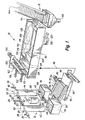
- Fig. 1 is an overall diagrammatic, perspective and schematic view of a first and presently preferred embodiment of a plant according to the present invention of carrying out the method according to the present invention of boiling and rinsing shrimps comprising three main sections, a boiler section, a peeling section and a rinsing and separation section,
- Fig. 2 is a vertical sectional view of the rinsing and separation section shown in Fig. 1,
- Fig. 3 is an elevational end view of an alternative embodiment of the rinsing and separation section shown in Figs. 1 and 2,
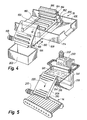
- Fig. 4 is a perspective, schematic and partly broken away view of an alternative embodiment of the rinsing and separation section shown in Figs. 1-3,
- Fig. 5 is a perspective and schematic view of a modified embodiment of the boiler section shown in Fig. 1 including a transfer section for the transfer of boiled shrimps from the boiler section to the peeling section,
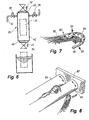
- Fig. 6 is a schematic and sectional view of a boiler of the batch steam boiler section shown in Fig. 1,
- Fig. 7 is a schematic and perspective view of a shrimp illustrating those areas at which the peeling process is preferably initiated, and
- Fig. 8 is a perspective, schematic and partly broken away view illustrating in greater details the peeling section of the plant shown in Fig. 1.
- In Fig. 1, a first and presently preferred embodiment of a plant according to the present invention for boiling, peeling, rinsing and separating shrimps according to the method according to the present invention is shown, composed of a plurality of sections.
- The plant is in its entirety designated the
reference numeral 10 and comprises a two-partbatch boiler section 12, apeeling section 14, a rinsing andseparation section 16 and finally thetransfer section 18. - The
individual sections plant 10 and the sections thereof is presented. In thesteam boiler section 12, two steam boilers are operated intermittently for providing a substantially continuous output of boiled and rapidly cooled shrimps to thepeeling section 14. In the peeling section, the boiled and cooled shrimps are peeled by breaking the shells of the shrimps for allowing the meat of the shrimps to be separated from the shell of the shrimps. In the rinsing and separation section, the meat of the shrimps is rinsed and the remainings, i.e. the shrimps shells and also the eggs of the shrimps are separated from the meat. Finally in the transfer section, the peeled and rinsed shrimps are transferred to a further processing section such as a packaging and freezing section, which section is not part of the present invention. - Now turning to the individual sections, the boiler section having two intermittently operated steam boilers are first to be described. The one boiler is designated the
reference numeral 20, and the other boiler is designated thereference numeral 22. The boilers receive high temperature and high pressure steam such as 12 bar 190°C steam from a steam supply tube 24 as the steam is input to the oneboiler 20 through aclosure valve 26 and similarly, the steam input to thesecond boiler 22 is input through aclosure valve 28. Theclosure valves steam inlet tubes 30 and 32, respectively. Theboilers tubes boilers additional closure valves 38 and 40, respectively. Each of theboilers high pressure enclosure 42 and 44, respectively, having abottom outlet boilers enclosures 42 and 44, respectively. - The
bottom outlet open cooling containers reference numerals 58 and 60, respectively. The cooling water is input to the coolingcontainers water supply tube 62 and awater supply reservoir 64 from which the cooling water is poured into the coolingcontainers additional valves containers valves valves water 58 and 60 or one of thecontainer - From the bottom of the
enclosures outlet ducts 70 and 72, respectively, extend for allowing the shrimps, which have been introduced into thewater 58 and 60 of the coolingreservoirs peeling section 14. - In the high pressure and high temperature steam boiler described above and shown in Fig. 1, the process time for the boiling of one batch of shrimps by the supply of 12 bar, 190°C steam is of the order of 4 sec. allowing one batch of shrimps to be boiled within a period of approximately 6-8 sec. including the time for the introduction of the batch into the boiler and the time for discharging the steam boiled shrimps to the cooling
containers - The steam boiled and cooled shrimps delivered from the
outlet ducts 70 and 72 are received in thepeeling section 14 including two parallel side bars 80 and 82 in which a plurality of parallelly extendingstainless rollers 84 are journalled and operated by means of amotor 86 causing therollers 84 to rotate in opposite directions as is illustrated in Fig. 8. Therollers 84 cause the shrimps to be slightly compressed between the two oppositely rotating rollers causing the shell of the shrimp to break as the shell of the individual shrimp has due to the rapid boiling and rapid cooling loosened its grip to the meat of the shrimp. - In Fig. 7 a
shrimp 90 is shown having ahead part 92, abody part 94 and atail 96. The transition between the head part and the body part is indicated by anarrow 93 and similarly, anarrow 95 indicates the transition from thebody part 94 to thetail 96. Due to the rapid boiling and rapid cooling of the shrimps, the shells constitute fairly loose encasings relative to the meat of the individual shrimps, the shells of the shrimp break at the above transitions indicated by thearrows - In fig. 8, a detail of the
rollers 84 of thepeeling section 14 is shown illustrating the peeling function of the rollers. Therollers 84 constitute revolving rollers, i.e. rollers which in the orientation shown in Fig. 1 rotate for an extended period of time in the clockwise direction and which are periodically reversed for rotating synchronically in the anti-clockwise direction. The unpeeled shrimps are in the clockwise direction performed by therollers 84 caused to be brought into the gap between any two adjacent rollers causing a crushing of the shrimps and slightly compressing the boiled shrimps thereby causing the shells to be separated from the meat. The distance between the rollers prevents the meat from falling between the rollers whereas the shells, the shell parts and the eggs separated from the meat of the shrimps fall between therollers 84 unto the conveyor belt shown in Fig. 1, from which conveyor belt the separated shell parts and any eggs attached to the shell parts are disposed. The shrimp meat and shrimp meat having attached shell parts and any eggs attached to the shell parts are carried along by therollers 84 and delivered from the peelingsection 14 to the rinsing andseparation section 16. It is to be realised that the material delivered from the peelingsection 14 to theseparation section 16 includes any remaining shell parts having eggs attached thereto and loose meat and further shrimp meat having shell parts attached thereto. The rinsing andseparation section 16 is physically mounted below theconveyor belt 88, however, in Fig. 1, as indicated by anarrow 98, the rinsing andseparation section 16 is for illustrative purposes positioned above theconveyor belt 88. - In the rinsing and
separation section 16, the shrimp meat is rinsed from any shell parts or eggs adhering to the meat and further separated from the shells and the eggs. The material including the shrimp meat, the shell or shell parts and the shrimp eggs are delivered from the output end of theconveyor belt 88 to a set of rotating agitators 100 which are journalled in two parallel side bars one of which is shown in Fig. 1 and designated thereference numeral 102 and which are rotated in opposite directions by means of amotor 104. Basically, the agitators 100 are operated similar to therollers 84 of thepeeling section 14, however, the agitators 100 are positioned in spaced apart relationship allowing the material after the mechanical agitation to be delivered into a separation bath of aseparation container 106. Thecontainer 106 is composed of twoopposite side walls front wall 112 and anend wall 114. The container also has abottom wall 116 in which anoutlet funnel 118 is provided which funnel communicates with abottom pump assembly 120 from which the shell parts and the shrimp eggs are delivered to anoutlet tube 122. Between the twoside walls chute wall 124 extends from below two downwardly protruding V-definingwalls funnel 118 for guiding the shell parts and the shrimp eggs to thebottom outlet funnel 118. - Within the
separation container 106, brine 130 is contained including approximately 9.5% NaCl by weight for providing a flotation separation of the shrimp meat from the remainings of the shrimps including the shell parts and the shrimp eggs. It has surprisingly been realised that a specific separation threshold exist allowing the shrimp meat to be separated from the remainings of the shrimps, namely the shrimp shells and the shrimp eggs. The brine is input to the separation container through twobrine inlet tubes separation chamber 106 at an outlet opening in therear wall 114 as the brine carrying the shrimp meat is allowed to fall down into thetransportation section 18. - In Fig. 2, a vertical sectional view of the
separation container 106 is shown, in which the shrimps including the shrimp meat, the shrimp shells and the shrimp eggs are introduced into the separation container through adelivery funnel 136 rather than by means of the agitators 100 shown in Fig. 1. - As the brine is introduced through the
tube 132, the water is forced upwardly along a vertical wall part of thechute wall 124 carrying along the material input through thefunnel 136 and including the shrimp meat, the shrimp eggs and the shrimp shells. The material carried along with the brine is forced downwardly below the two V-definingwalls shrimp meat parts 138 to float on top of the brine whereas theshell parts 140 and theeggs 142 sink to the bottom of theseparation container 106, allowing theshrimp shell parts 140 and theshrimp eggs 142 to deposit in theoutlet funnel 118 of the separation container from which outlet funnel shown in Fig. 1, the waste material, i.e. theshrimp shell parts 140 and theshrimp eggs 142 is output through theoutlet 122 shown in Fig. 1. - After the flotation separation process has been completed, the brine carrying the
shrimp meat parts 138 is output from the rear end of the separation container, i.e. opposite to the inlet end at which thebrine inlet 132 and thefunnel 136 are positioned, and transferred to thetransport section 18. - In the
transport section 18 shown in Fig. 1, aconveyor belt 144 which constitutes a filtering conveyor belt carries the shrimp meat parts to the packaging and freezing section not shown in the drawings, whereas the brine is expelled to abottom funnel 146, from which the brine may be wasted or alternatively, as shown in Fig. 2, be recirculated to the inlet end of the separation container by means of apump 148 delivering the recirculating brine to the inlet end of theseparation container 106. - The technique of removing the waste, i.e. the
shell parts 140 and theeggs 142, from theflotation separation container 106 may be accomplished in numerous ways as an intermittent operation or a continuous operation. - In Fig. 3, a modified embodiment of the separation container is shown, differing from the above described first and presently preferred embodiment shown in Fig. 1 and 2, in that the
side walls separation container 106, abelt 144 extends, which belt is driven by amotor 145. The belt is forced down into contact with the inner surface of theseparation container 106 by means of twopressure arms pressure rollers belt 144 is raised as illustrated in full line in fig. 3. Thebelt 144 passes round adrive roller 156 connected to thedrive motor 145 and round anidler roller 158 positioned symmetrical relative to thedrive roller 156 as thedrive roller 156 is positioned above the sloping side wall 110' whereas theidler roller 158 is positioned above the sloping side wall 108'. - The bottom part of the
belt 144 is guided round tworollers distance bar 164. Below the lower part of the belt contacting therollers rinsing wall 170 is positioned which rinsingwall 170 is fixated to supportinglegs separation section 16. - As shrimp shells and shrimp eggs are collected on the part of the
belt 144 positioned between the twopressure rollers pressure arms belt 144 to be raised and by operation of themotor 145 driving the belt by means of thedrive pulley 156, the waste material is carried by the belt round theroller 158 and delivered to an outlet passage connected to theseparation wall 170 against which the belt is pressed for mechanically rinsing the belt as the lower part of thebelt 144 is lowered into contact with thesloping rinsing wall 170 as thebar 164 swings downwardly as is illustrated in dotted line in Fig. 3. - In Fig. 4, a further modified embodiment of the
separation container 106 is shown in which a transversal conveyor is used for the removal of shrimp shells and shrimp eggs from the bottom of theseparation container 106. In Fig. 4, twoguide rails transversal conveyor belt 184 is guided transversally relative to the longitudinal direction of transportation of brine through theseparation container 106. Theconveyor belt 184 is provided with outwardly protrudingcarrier plates 186 by means of which the shrimp shells and shrimp eggs are lifted along theside wall 108 of theseparation container 106 as theconveyor belt 184 is moved in the direction indicated by twoarrows conveyor belt 184 is guided through theguide rails top rollers drive roller 196 powered by amotor 198 and round abottom idler roller 200. Between theroller 192 and thedrive roller 196, theconveyor belt 184 defines a sloping surface from which the shrimp shells and the shrimp eggs carried by the conveyor belt are thrown into awaste container 202. - Apart from the above described techniques of removing the waste material, i.e. the shrimp shells and the shrimp eggs from the
separation container 106 by means of a bottom funnel, a transversal, periodically operated belt and a continuous operated belt having carried plates, numerous other removal techniques are obvious to a person having ordinary skill in the art and are contemplated to be part of the present invention as defined in the appending claims. - In fig. 5, a modified cooling enclosure 54' is shown in which a sloping conveyor is used for the removal of the steam boiled and rapidly cooled shrimps from the cooling water 58', which conveyor belt is designated the
reference numeral 208 and is passed round adrive roller 210 powered by amotor 212 and a total of threeidler rollers arrow 220 for the transfer of the steam boiled and rapidly cooled shrimps to thepeeling section 14 positioned below thedrive roller 210 of the conveyor assembly including theconveyor belt 208. - Rather than a cooling water supply tube as illustrated in Fig. 1, the cooling enclosure 54' shown in Fig. 5 is provided with a recirculation circuit in which a
cooling apparatus 230 is included having aninternal pump 232 for the circulation of the cooling water through thecooling apparatus 230 and for the delivery of the cooling water to the cooling enclosure 54'. The cooling of the water is accomplished by means of conventional cooling compressor circuit having a cooling compressor, an evaporator, etc. as is well known in the art per se. - In Fig. 6, one of the two
batch steam boilers container 21 which is heated by means of steam input through theclosure valve 26 as thebadge container 21 in introduced into the interior of theenclosure 42 by opening thecap 50 by means of thumb wheel 51. From thebottom outlet 46, thebadge container 21 is delivered to the coolingwater 54 by the opening of the bottom outlet by means of athumb wheel 47. - Although the technique of steam boiling shrimps and rapidly cooling the shrimps for the loosening of the shrimp shell from the shrimp meat, the peeling of the shrimps by means of solid stainless steel rollers and finally the flotation separation technique according to the present invention has been described with reference to specific and presently preferred embodiments, the present invention is by no means limited to the above described embodiments, techniques or alternatives as numerous modifications and alterations are to be considered obvious to a person having ordinary skill in the art without deviating from the scope of the invention as defined in the appending claims.
Claims (25)
- A method of preparing shrimps (90), comprising the following steps:a) steam boiling said shrimps (90) at a high pressure exceeding the atmospheric pressure, and at an elevated temperature exceeding the boiling temperature of water at the atmospheric pressure for a specific period of time for keeping the meat (138) of said shrimps (90) in a compressed state due to the pressurisation while rapidly heating said shrimps (90) to said elevated temperature for causing the meat (138) of said shrimps (90) to solidify and cause the meat (138) of said shrimps (90) to loosen from the shells (140) of said shrimps (90),b) rapidly cooling said shrimps (90) to a temperature to or below the atmospheric temperature for causing substantially all meat (138) of said shrimps (90) to be separated from the shells (140) of said shrimps (90) between an area behind the head of the individual shrimp and a part above the tail of the individual shrimp,c) peeling said shrimps (90) by mechanically opening the shells(140) of the shrimps (90) for allowing the meat (138) loosely contained within the shells (140) of said shrimps (90) to fall out from the shells (140) of said shrimps (90),d) separating the meat (138) of said shrimps (90) from the remainings of the shrimps (90), including the shell parts and any eggs (142) by flotational separation of the meat (138) from said remainings by introducing the meat (138) and said remainings into a separation liquid such as a brine (130) solution, including a specific amount of NaCl by weight for causing the meat (138) to float on said separation liquid while allowing the remainings of the shrimps (90), including the shell parts (140) and any eggs (142) to sink, ande) removing the meat(138) from said separation liquid.
- The method according to claim 1, said pressure in step a) being of the order of 4-20 bar e.g. 6-16 bar, preferably 8-14 bar, further preferably approximately 12 bar, or of the order of 4-6 bar, 6-8 bar, 8-10 bar, 10-12 bar, 12-14 bar, 14-16 bar, 16-18 bar or 18-20 bar.
- The method according to any of the claims 1 or 2, said temperature in step a) being of the order of 150°C-250°C, such as 160°C-210°C, preferably 180°C-200°C, further preferably approximately 190°C, or 150°C-170°C, 170°C-190°C, 210°C-230°C or 230°C-250°C.
- The method according to any of the claims 1-3, said specific period of time in step a) being a short period of time of less than 20 sec., such as 1-15 sec., preferably 2-10 sec., further preferably 4-6 sec., or 1-2 sec., 2-3 sec., 3-4 sec., 4-5 sec., 5-6 sec., 6-8 sec., 8-10 sec., 10-12 sec., 12-14 sec., 14-16 sec. or 16-20 sec.
- The method according to any of the claims 1-4, said temperature in step b) being a low temperature, such as a temperature of approximately 0°C-20°C, e.g. 2°C-10°C, preferably 5°C-8°C, or 1°C-3°C, 3°C -5°C, 5°C -7°C, 7°C -10°C, 10°C -15°C, 15°C -20°C.
- The method according to any of the claims 1-5, said boiling being performed in a pressurised boiler (20,22) in an continuous operation.
- The method according to any of the claims 1-5, said boiling being performed in a pressurised boiler (20,22) in an intermittent batch operation.
- The method according to any of the claims 1-7, said rapid cooling being performed by introducing said boiled shrimps (90) into a water cooling bath.
- The method according to any of the claims 1-8, said separation being performed in an aqueous solution of NaCl, including 6-14% NaCl by weight, preferably approximately 9.5% NaCl by weight.
- The method according to any of the claims 1-9, further including a step prior to step d) of forcedly emerging said peeled shrimps into said separation liquid or alternatively stirring said peeled shrimps in said separation liquid for causing a physical separation of the meat (138) from the remainings of said shrimps (90) including said shell parts and any eggs (142).
- A plant for preparing shrimps(90), comprising:a) a boiler section (12) for steam boiling said shrimps (90) at a high pressure exceeding the atmospheric pressure, and at an elevated temperature exceeding the boiling temperature of water at the atmospheric pressure for a specific period of time for keeping the meat (138) of said shrimps (90) in a compressed state due to the pressurisation while rapidly heating said shrimps (90) to said elevated temperature for causing the meat (138) of said shrimps (90) to solidify and cause the meat (138) of said shrimps (90) to loosen from the shells (140) of said shrimps (90),b) a cooling section (54,56) for rapidly cooling said shrimps (90) to a temperature to or below the atmospheric temperature for causing substantially all meat (138) of said shrimps (90) to be separated from the shells (140) of said shrimps(90) between an area behind the head of the individual shrimp and a part above the tail of the individual shrimp,c) a peeling section(14) for peeling said shrimps (90) by mechanically opening the shells (140) of the shrimps (90) for allowing the meat (138) loosely contained within the shells (140) of said shrimps (90) to fall out from the shells (140) of said shrimps (90),d) a flotation separation section (16) separating the meat (138) of said shrimps (90) from the remainings of the shrimps (90), including the shell parts and any eggs (142) by flotational separation of the meat (138) from said remainings by introducing the meat (138) and said remainings into a separation liquid such as a brine (130) solution, including a specific amount of NaCl by weight for causing the meat (138) to float on said separation liquid while allowing the remainings of the shrimps (90), including the shell parts and any eggs (142) to sink, ande) a transfer section (18) for removing the meat (138) from said separation liquid.
- The plant according to claim 11, said pressure generated in said boiler section (12) being of the order of 4-20 bar e.g. 6-16 bar, preferably 8-14 bar, further preferably approximately 12 bar, or of the order of 4-6 bar, 6-8 bar, 8-10 bar, 10-12 bar, 12-14 bar, 14-16 bar, 16-18 bar or 18-20 bar.
- The plant according to any of the claims 11 or 12, said temperature generated in said boiler section (12) being of the order of 150°C-250°C, such as 160°C-210°C, preferably 180°C-200°C, further preferably approximately 190°C, or 150°C-170°C, 170°C-190°C, 210°C- 230°C or 230°C-250°C.
- The plant according to any of the claims 11-13, said specific period of time of boiling said shrimps (90) in said boiler section (12) being less than 20 sec., such as 1-15 sec., preferably 2-10 sec., further preferably 4-6 sec., or 1-2 sec., 2-3 sec., 3-4 sec., 4-5 sec., 5-6 sec., 6-8 sec., 8-10 sec., 10-12 sec., 12-14 sec., 14-16 sec. or 16-20 sec.
- The plant according to any of the claims 11-14, said temperature of said cooling section (54,56) being of the order of approximately 0°C-20°C, e.g. 2°C-10°C, preferably 5°C-8°C, or 1 °C-3°C, 3°C -5°C, 5°C -7°C, 7°C -10°C, 10°C -15°C, 15°C - 20°C.
- The plant according to any of the claims 11-15, said boiler section (12) including a pressurised boiler (20,22) for performing said boiling operation as a continuous operation.
- The plant according to any of the claims 11-15, said boiler section (12) including at least two pressurised boilers (20,22) for intermittent operation of said boilers (20,22) in a batch process.
- The plant according to any of the claims 11-17, said pressurised boiler (20,22) or said pressurised boilers (20,22) having a top inlet and a bottom outlet for the introduction of said shrimps (90) and the discharge of boiled shrimps (90), respectively.
- The plant according to any of the claims 11-18, said cooling section (54,56) having a cooling container including a cooling water bath for receiving said boiled shrimps (90) from said boiler section(12).
- The plant according to any of the claims 11-19, said peeling section (14) including a plurality of oppositely rotating rollers (84) for mechanically compressing and cracking the shells (140) of said boiled and cooled shrimps (90).
- The plant according to claim 20, said rollers (84) having an outer diameter of approximately 30 mm, defining a spacing between any two adjacent rollers (84) of the order of 1 mm and being revolvingly rotated at a speed of approximately 30 rpm.
- The plant according to any of the claims 11-21, said separation section including a separation container having an inlet end for receiving said peeled shrimps from said peeling section(14) and an outlet end communicating with said transfer section (18) and including a NaCl solution including approximately 6-14% NaCl by weight, preferably 9.5%, and having a bottom outlet for the removal of said remainings from said separation container.
- The plant according to claim 22, said outlet end of said container of said separation section defining an overflow for allowing said separation liquid to flow out from said separation container carrying along the meat (138) of said shrimps (90).
- The plant according to any of the claims 22 and 23, further having means for mechanically steering (126,128) said peeled shrimps at said inlet end of said container for causing a physical separation of the meat (138) from the remainings of said shrimps (90).
- The plant according to any of the claims 21-24, said separation container of said separation section including at said inlet end a separation wall for causing said peeled shrimps to be forcedly emerged into said separation liquid for causing a physical separation of the meat (138) from the remainings of said shrimps (90).
Priority Applications (9)
| Application Number | Priority Date | Filing Date | Title |
|---|---|---|---|
| AT03388011T ATE381265T1 (en) | 2003-02-12 | 2003-02-12 | METHOD AND DEVICE FOR PROCESSING SHRIMP |
| DE60318174T DE60318174T2 (en) | 2003-02-12 | 2003-02-12 | Method and device for processing shrimp |
| EP03388011A EP1447007B1 (en) | 2003-02-12 | 2003-02-12 | A method and a plant for preparing shrimps |
| DK03388011T DK1447007T3 (en) | 2003-02-12 | 2003-02-12 | Process and plant for processing shrimp |
| CA002455193A CA2455193A1 (en) | 2003-02-12 | 2004-01-14 | A method and a plant for preparing shrimps |
| NO20040194A NO20040194L (en) | 2003-02-12 | 2004-01-16 | Process and plant for the preparation of shrimp |
| US10/774,300 US7357706B2 (en) | 2003-02-12 | 2004-02-06 | Method and a plant for preparing shrimps |
| DK200400187A DK200400187A (en) | 2003-02-12 | 2004-02-06 | Process and plant for processing shrimp |
| IS7146A IS7146A (en) | 2003-02-12 | 2004-02-10 | Method and protects for shrimp processing |
Applications Claiming Priority (1)
| Application Number | Priority Date | Filing Date | Title |
|---|---|---|---|
| EP03388011A EP1447007B1 (en) | 2003-02-12 | 2003-02-12 | A method and a plant for preparing shrimps |
Publications (2)
| Publication Number | Publication Date |
|---|---|
| EP1447007A1 EP1447007A1 (en) | 2004-08-18 |
| EP1447007B1 true EP1447007B1 (en) | 2007-12-19 |
Family
ID=32669055
Family Applications (1)
| Application Number | Title | Priority Date | Filing Date |
|---|---|---|---|
| EP03388011A Expired - Lifetime EP1447007B1 (en) | 2003-02-12 | 2003-02-12 | A method and a plant for preparing shrimps |
Country Status (8)
| Country | Link |
|---|---|
| US (1) | US7357706B2 (en) |
| EP (1) | EP1447007B1 (en) |
| AT (1) | ATE381265T1 (en) |
| CA (1) | CA2455193A1 (en) |
| DE (1) | DE60318174T2 (en) |
| DK (2) | DK1447007T3 (en) |
| IS (1) | IS7146A (en) |
| NO (1) | NO20040194L (en) |
Cited By (4)
| Publication number | Priority date | Publication date | Assignee | Title |
|---|---|---|---|---|
| CN103271128A (en) * | 2013-06-15 | 2013-09-04 | 湖南湘湖水产有限公司 | Device for dissecting tortoises |
| CN104222249A (en) * | 2014-09-26 | 2014-12-24 | 南通宝泰机械科技有限公司 | Automatic shrimp peeling machine |
| CN105532837A (en) * | 2016-02-24 | 2016-05-04 | 许云飞 | Ultrasonic lobster cleaning machine |
| EP3656219A1 (en) * | 2018-11-22 | 2020-05-27 | Christin Klever | Method and device for the mechanical peeling of arthropods, in particular crabs |
Families Citing this family (30)
| Publication number | Priority date | Publication date | Assignee | Title |
|---|---|---|---|---|
| NL1033090C2 (en) | 2006-12-20 | 2008-06-23 | Maasland Nv | Milking establishment. |
| EP2174552A1 (en) * | 2008-10-09 | 2010-04-14 | Cabinplant A/S | A method of processing shrimps and a shrimp processing plant |
| GB0820599D0 (en) * | 2008-11-11 | 2008-12-17 | Albus Solutions Ltd | Apparatus for processing crustacaeans |
| EP2493323B1 (en) | 2009-10-28 | 2017-06-14 | Clearwater Seafoods Limited Partnership | Mollusc processing apparatus and related method |
| CN101773156A (en) * | 2010-03-05 | 2010-07-14 | 浙江大学 | Pre-processing process for shucking shrimps on basis of super-high pressure technique |
| CN102771546B (en) * | 2012-07-20 | 2015-11-04 | 中国水产科学研究院东海水产研究所 | A kind of method that shrimps shell meat is separated |
| BR112016002677A2 (en) * | 2013-08-06 | 2018-05-02 | Laitram Llc | shrimp processing apparatus and methods. |
| US20150044953A1 (en) * | 2013-08-06 | 2015-02-12 | Laitram, L.L.C. | Processing Shrimp with Hydrodynamic Turbulence and Hydrostatic Pressure |
| CN106305959A (en) * | 2015-07-03 | 2017-01-11 | 浙江大学自贡创新中心 | Shrimp shelling technology based on ultra-high pressure technology |
| CN206345860U (en) * | 2016-07-14 | 2017-07-21 | 农业部南京农业机械化研究所 | Turnover plate type continuously ferments system |
| CN106615018A (en) * | 2016-12-27 | 2017-05-10 | 浙江海洋大学 | Cleaning system for crab-type aquatic products |
| WO2019050826A2 (en) | 2017-09-05 | 2019-03-14 | Laitram, L.L.C. | Singulation and separation system for a shrimp processor |
| CN107771906A (en) * | 2017-12-08 | 2018-03-09 | 柳州市螺状元食品有限公司 | A kind of spiral shell meat cleaning device for the processing of spiral shell powder |
| CN108812849A (en) * | 2018-07-31 | 2018-11-16 | 贺春香 | A kind of cleaning systems of shrimps processing |
| CN108902277B (en) * | 2018-08-01 | 2020-11-24 | 桐乡市雪根种植专业合作社 | A device suitable for large-scale cleaning and soaking of drunk shrimp |
| CN108887370B (en) * | 2018-08-01 | 2021-03-02 | 唐伟 | Cleaning and soaking equipment convenient for processing crayfishes in batches |
| CN108835218B (en) * | 2018-08-01 | 2020-11-24 | 桐乡市雪根种植专业合作社 | Cleaning and soaking equipment for large-scale processing of crayfishes |
| CN108887369B (en) * | 2018-08-01 | 2020-12-01 | 王微静 | Equipment for batch cleaning and soaking of crayfish |
| CN108967501B (en) * | 2018-09-13 | 2020-11-24 | 龙庄润集团有限公司 | A kind of crayfish head removing cleaning device |
| CN109275698B (en) * | 2018-09-28 | 2020-11-17 | 湛江市卓成食品机械有限公司 | A belt cleaning device for aquatic products processing |
| FR3096873B1 (en) * | 2019-06-05 | 2021-06-25 | Yann Didelot | Process for preparing crab meat |
| CA3147307A1 (en) | 2019-08-01 | 2021-02-04 | Clearwater Seafoods Limited Partnership | Apparatus and methods for mollusc processing |
| CN111194764B (en) * | 2020-01-11 | 2021-06-22 | 苏州泰进食品有限公司 | Corbicula fluminea meat processing lines |
| CN111134268A (en) * | 2020-01-21 | 2020-05-12 | 广东国美水产食品有限公司 | Shrimp processing of unloading is with boiling device in convenience |
| US12458034B2 (en) | 2020-02-07 | 2025-11-04 | Nova-Tech Engineering, Llc | Shrimp processing apparatus and methods |
| EP4393308A3 (en) | 2020-02-07 | 2024-10-09 | Nova-Tech Engineering, LLC | Shrimp processing system, processing apparatus and methods |
| CN111543470B (en) * | 2020-06-30 | 2024-08-06 | 武汉轻工大学 | Lobster belt cleaning device |
| CN112335722A (en) * | 2020-10-26 | 2021-02-09 | 顺祥食品有限公司 | A rapid pretreatment device for crayfish |
| CN113785869B (en) * | 2021-08-25 | 2022-07-01 | 湖北科峰智能传动股份有限公司 | Shrimp machine is shelled to intelligence |
| CN115569731A (en) * | 2022-11-07 | 2023-01-06 | 珠海鸿伸机器有限公司 | Shrimp meat and dried small shrimp screener |
Family Cites Families (23)
| Publication number | Priority date | Publication date | Assignee | Title |
|---|---|---|---|---|
| US2600867A (en) * | 1943-06-12 | 1952-06-17 | Hartford Nat Bank & Trust Co | Method of separating shells and meat of shellfish |
| US2545517A (en) * | 1946-02-27 | 1951-03-20 | Blue Channel Corp | Apparatus for the recovery of crab meat from bony material by gravity liquid separation |
| US2929502A (en) * | 1957-03-14 | 1960-03-22 | Blue Channel Corp | Apparatus for recovering meat from bony material by flotation |
| US3513071A (en) * | 1967-05-05 | 1970-05-19 | Gottlieb Bernhard Fehmerling | Process and composition for loosening and removing edible tissue from shells of marine creatures |
| US3501317A (en) * | 1967-06-12 | 1970-03-17 | Grace W R & Co | Shrimp cooking process |
| US3471894A (en) * | 1968-10-25 | 1969-10-14 | Cape Ann Marine Research Co In | Method of cleaning shellfish |
| US3818818A (en) * | 1970-04-08 | 1974-06-25 | Vari Phase Inc | Apparatus for processing food |
| US3672908A (en) * | 1970-04-08 | 1972-06-27 | Jack O Hice Sr | Method of heat processing food |
| US3722035A (en) * | 1971-01-27 | 1973-03-27 | F Hanks | Method for removing meat from the shells of bivale mollusks |
| JPS58850B2 (en) * | 1975-03-14 | 1983-01-08 | 日魯漁業株式会社 | Processing method for krill from the Antarctic Ocean |
| US4111798A (en) * | 1976-11-30 | 1978-09-05 | Battelle Development Corporation | Separation of solids by varying the bulk density of a fluid separating medium |
| SU921497A1 (en) * | 1979-01-03 | 1982-04-23 | Всесоюзный Научно-Исследовательский И Экспериментально-Конструкторский Институт Продовольственного Машиностроения | Method of extracting meat from crustacea |
| WO1983000080A1 (en) * | 1981-07-08 | 1983-01-20 | Braginsky, Yakov, Isaakovich | Device for extracting meat from small crustacea |
| US4417507A (en) * | 1981-10-09 | 1983-11-29 | Shotwell Jesse A | Shrimp processing system |
| BR8208021A (en) * | 1981-12-17 | 1983-11-08 | Hansen Otto D | PROCESS AND SYSTEM FOR PEELING CRUSTACEOS |
| DK207586A (en) * | 1986-05-06 | 1987-11-07 | Hansen Otto D | PROCEDURE AND PLANTS FOR SHELLING OF SHELLS |
| US4916775A (en) * | 1987-11-17 | 1990-04-17 | Borden, Inc. | Harvesting, shucking and eviscerating clams at sea |
| DK160667C (en) * | 1988-05-13 | 1991-09-23 | Kaj Arne Soerensen | PROCEDURE FOR EXCELLENT CANCELED SEAFOODS, ISAAR SHRIMPERS AND APPARATUS FOR EXERCISING THE PROCEDURE |
| US4862794A (en) * | 1989-03-03 | 1989-09-05 | The Laitram Corporation | Apparatus for controlling precooking and machine peeling shrimp |
| US5156873A (en) * | 1991-09-03 | 1992-10-20 | Skrmetta Raphael O | Multiple zone shrimp precooking method and apparatus for machine peeling shrimp |
| US6099400A (en) * | 1998-02-06 | 2000-08-08 | Brontec Limited | Method and apparatus for processing shrimp |
| US5928072A (en) * | 1998-05-28 | 1999-07-27 | Garland Christopher Fulcher | Water based crab meat extraction process with water recirculation |
| CA2240079A1 (en) * | 1998-07-20 | 2000-01-20 | Cyril Gallant | Method for preparing a stuffed lobster product incorporating protease enzyme and vacuum extracted meat and roe from head-shells of raw lobster |
-
2003
- 2003-02-12 AT AT03388011T patent/ATE381265T1/en not_active IP Right Cessation
- 2003-02-12 DK DK03388011T patent/DK1447007T3/en active
- 2003-02-12 EP EP03388011A patent/EP1447007B1/en not_active Expired - Lifetime
- 2003-02-12 DE DE60318174T patent/DE60318174T2/en not_active Expired - Fee Related
-
2004
- 2004-01-14 CA CA002455193A patent/CA2455193A1/en not_active Abandoned
- 2004-01-16 NO NO20040194A patent/NO20040194L/en not_active Application Discontinuation
- 2004-02-06 DK DK200400187A patent/DK200400187A/en not_active Application Discontinuation
- 2004-02-06 US US10/774,300 patent/US7357706B2/en not_active Expired - Fee Related
- 2004-02-10 IS IS7146A patent/IS7146A/en unknown
Cited By (4)
| Publication number | Priority date | Publication date | Assignee | Title |
|---|---|---|---|---|
| CN103271128A (en) * | 2013-06-15 | 2013-09-04 | 湖南湘湖水产有限公司 | Device for dissecting tortoises |
| CN104222249A (en) * | 2014-09-26 | 2014-12-24 | 南通宝泰机械科技有限公司 | Automatic shrimp peeling machine |
| CN105532837A (en) * | 2016-02-24 | 2016-05-04 | 许云飞 | Ultrasonic lobster cleaning machine |
| EP3656219A1 (en) * | 2018-11-22 | 2020-05-27 | Christin Klever | Method and device for the mechanical peeling of arthropods, in particular crabs |
Also Published As
| Publication number | Publication date |
|---|---|
| CA2455193A1 (en) | 2004-08-12 |
| DK200400187A (en) | 2004-08-13 |
| EP1447007A1 (en) | 2004-08-18 |
| NO20040194L (en) | 2004-08-13 |
| ATE381265T1 (en) | 2008-01-15 |
| US20040219871A1 (en) | 2004-11-04 |
| DE60318174T2 (en) | 2008-10-16 |
| DK1447007T3 (en) | 2008-04-28 |
| DE60318174D1 (en) | 2008-01-31 |
| US7357706B2 (en) | 2008-04-15 |
| IS7146A (en) | 2004-08-13 |
Similar Documents
| Publication | Publication Date | Title |
|---|---|---|
| EP1447007A1 (en) | A method and a plant for preparing shrimps | |
| CA1201562A (en) | Method and a system for peeling crustaceans | |
| CA2270511C (en) | Water based crab meat extraction process with water recirculation | |
| CN108308627B (en) | A kind of physical method of pecan kernel stripping | |
| CN104856195B (en) | Walnut kernel peeling process | |
| CN109511986B (en) | An automatic passion fruit juice extraction device | |
| CN114223705A (en) | A land-based device for preparing low-fluoride Antarctic krill shrimp | |
| US3007801A (en) | Process for the recovery of oyster meats | |
| KR101730690B1 (en) | By-product collecting device from chionoxcxtes japonicus and and its method | |
| US3566438A (en) | Shucking of bivalves | |
| CN112021601A (en) | Cleaning device and cleaning method for bamboo shoot processing | |
| CN107348418B (en) | Preparation method of sour and hot ginger slices | |
| CN219438174U (en) | Egg product processing production line | |
| FR2963206A1 (en) | METHOD AND DEVICE FOR DECORTICATING MARINE MOLLUSCS WITH A SHELL | |
| CN101884426A (en) | A method and device for peeling red jujube skin | |
| CN215087946U (en) | Vegetable peeling device | |
| CN112852581B (en) | A kind of method for preparing fruit wine from the whole fruit of passion fruit | |
| CN107183447B (en) | Exempt from abluent grape juice apparatus for producing | |
| CN204273090U (en) | Integrated automatic shrimp shelling system | |
| CN112890129A (en) | Digital production system and process for deep-sea pet feed | |
| US3121252A (en) | Apparatus for separating materials | |
| CN206854121U (en) | A kind of sea cucumber production line with grading function | |
| CN112602456A (en) | Fresh corn peeling flotation machine for corn juice production and corn juice-containing fruit juice production method | |
| CN113951310B (en) | Automatic production processing method for abalone | |
| CN205757082U (en) | One pickles Armeniaca mume Sieb. segregation apparatus |
Legal Events
| Date | Code | Title | Description |
|---|---|---|---|
| PUAI | Public reference made under article 153(3) epc to a published international application that has entered the european phase |
Free format text: ORIGINAL CODE: 0009012 |
|
| AK | Designated contracting states |
Kind code of ref document: A1 Designated state(s): AT BE BG CH CY CZ DE DK EE ES FI FR GB GR HU IE IT LI LU MC NL PT SE SI SK TR |
|
| AX | Request for extension of the european patent |
Extension state: AL LT LV MK RO |
|
| REG | Reference to a national code |
Ref country code: SE Ref legal event code: TRCL |
|
| 17P | Request for examination filed |
Effective date: 20050218 |
|
| AKX | Designation fees paid |
Designated state(s): AT BE BG CH CY CZ DE DK EE ES FI FR GB GR HU IE IT LI LU MC NL PT SE SI SK TR |
|
| 17Q | First examination report despatched |
Effective date: 20061006 |
|
| GRAP | Despatch of communication of intention to grant a patent |
Free format text: ORIGINAL CODE: EPIDOSNIGR1 |
|
| GRAS | Grant fee paid |
Free format text: ORIGINAL CODE: EPIDOSNIGR3 |
|
| GRAA | (expected) grant |
Free format text: ORIGINAL CODE: 0009210 |
|
| AK | Designated contracting states |
Kind code of ref document: B1 Designated state(s): AT BE BG CH CY CZ DE DK EE ES FI FR GB GR HU IE IT LI LU MC NL PT SE SI SK TR |
|
| REG | Reference to a national code |
Ref country code: GB Ref legal event code: FG4D |
|
| REG | Reference to a national code |
Ref country code: IE Ref legal event code: FG4D |
|
| REG | Reference to a national code |
Ref country code: CH Ref legal event code: EP |
|
| REF | Corresponds to: |
Ref document number: 60318174 Country of ref document: DE Date of ref document: 20080131 Kind code of ref document: P |
|
| REG | Reference to a national code |
Ref country code: SE Ref legal event code: TRGR |
|
| REG | Reference to a national code |
Ref country code: DK Ref legal event code: T3 |
|
| PG25 | Lapsed in a contracting state [announced via postgrant information from national office to epo] |
Ref country code: CH Free format text: LAPSE BECAUSE OF FAILURE TO SUBMIT A TRANSLATION OF THE DESCRIPTION OR TO PAY THE FEE WITHIN THE PRESCRIBED TIME-LIMIT Effective date: 20071219 Ref country code: LI Free format text: LAPSE BECAUSE OF FAILURE TO SUBMIT A TRANSLATION OF THE DESCRIPTION OR TO PAY THE FEE WITHIN THE PRESCRIBED TIME-LIMIT Effective date: 20071219 |
|
| PGFP | Annual fee paid to national office [announced via postgrant information from national office to epo] |
Ref country code: DK Payment date: 20080319 Year of fee payment: 6 |
|
| PG25 | Lapsed in a contracting state [announced via postgrant information from national office to epo] |
Ref country code: FI Free format text: LAPSE BECAUSE OF FAILURE TO SUBMIT A TRANSLATION OF THE DESCRIPTION OR TO PAY THE FEE WITHIN THE PRESCRIBED TIME-LIMIT Effective date: 20071219 Ref country code: NL Free format text: LAPSE BECAUSE OF FAILURE TO SUBMIT A TRANSLATION OF THE DESCRIPTION OR TO PAY THE FEE WITHIN THE PRESCRIBED TIME-LIMIT Effective date: 20071219 Ref country code: SI Free format text: LAPSE BECAUSE OF FAILURE TO SUBMIT A TRANSLATION OF THE DESCRIPTION OR TO PAY THE FEE WITHIN THE PRESCRIBED TIME-LIMIT Effective date: 20071219 |
|
| PGFP | Annual fee paid to national office [announced via postgrant information from national office to epo] |
Ref country code: SE Payment date: 20080317 Year of fee payment: 6 |
|
| NLV1 | Nl: lapsed or annulled due to failure to fulfill the requirements of art. 29p and 29m of the patents act | ||
| REG | Reference to a national code |
Ref country code: CH Ref legal event code: PL |
|
| PG25 | Lapsed in a contracting state [announced via postgrant information from national office to epo] |
Ref country code: AT Free format text: LAPSE BECAUSE OF FAILURE TO SUBMIT A TRANSLATION OF THE DESCRIPTION OR TO PAY THE FEE WITHIN THE PRESCRIBED TIME-LIMIT Effective date: 20071219 |
|
| PG25 | Lapsed in a contracting state [announced via postgrant information from national office to epo] |
Ref country code: CZ Free format text: LAPSE BECAUSE OF FAILURE TO SUBMIT A TRANSLATION OF THE DESCRIPTION OR TO PAY THE FEE WITHIN THE PRESCRIBED TIME-LIMIT Effective date: 20071219 Ref country code: ES Free format text: LAPSE BECAUSE OF FAILURE TO SUBMIT A TRANSLATION OF THE DESCRIPTION OR TO PAY THE FEE WITHIN THE PRESCRIBED TIME-LIMIT Effective date: 20080330 |
|
| PG25 | Lapsed in a contracting state [announced via postgrant information from national office to epo] |
Ref country code: SK Free format text: LAPSE BECAUSE OF FAILURE TO SUBMIT A TRANSLATION OF THE DESCRIPTION OR TO PAY THE FEE WITHIN THE PRESCRIBED TIME-LIMIT Effective date: 20071219 Ref country code: BE Free format text: LAPSE BECAUSE OF FAILURE TO SUBMIT A TRANSLATION OF THE DESCRIPTION OR TO PAY THE FEE WITHIN THE PRESCRIBED TIME-LIMIT Effective date: 20071219 |
|
| PG25 | Lapsed in a contracting state [announced via postgrant information from national office to epo] |
Ref country code: PT Free format text: LAPSE BECAUSE OF FAILURE TO SUBMIT A TRANSLATION OF THE DESCRIPTION OR TO PAY THE FEE WITHIN THE PRESCRIBED TIME-LIMIT Effective date: 20080519 |
|
| EN | Fr: translation not filed | ||
| PLBE | No opposition filed within time limit |
Free format text: ORIGINAL CODE: 0009261 |
|
| STAA | Information on the status of an ep patent application or granted ep patent |
Free format text: STATUS: NO OPPOSITION FILED WITHIN TIME LIMIT |
|
| PG25 | Lapsed in a contracting state [announced via postgrant information from national office to epo] |
Ref country code: MC Free format text: LAPSE BECAUSE OF NON-PAYMENT OF DUE FEES Effective date: 20080228 |
|
| 26N | No opposition filed |
Effective date: 20080922 |
|
| PGFP | Annual fee paid to national office [announced via postgrant information from national office to epo] |
Ref country code: IE Payment date: 20080704 Year of fee payment: 6 |
|
| PGFP | Annual fee paid to national office [announced via postgrant information from national office to epo] |
Ref country code: GB Payment date: 20080704 Year of fee payment: 6 |
|
| PG25 | Lapsed in a contracting state [announced via postgrant information from national office to epo] |
Ref country code: GR Free format text: LAPSE BECAUSE OF FAILURE TO SUBMIT A TRANSLATION OF THE DESCRIPTION OR TO PAY THE FEE WITHIN THE PRESCRIBED TIME-LIMIT Effective date: 20080320 Ref country code: DE Free format text: LAPSE BECAUSE OF NON-PAYMENT OF DUE FEES Effective date: 20080902 Ref country code: EE Free format text: LAPSE BECAUSE OF FAILURE TO SUBMIT A TRANSLATION OF THE DESCRIPTION OR TO PAY THE FEE WITHIN THE PRESCRIBED TIME-LIMIT Effective date: 20071219 |
|
| PG25 | Lapsed in a contracting state [announced via postgrant information from national office to epo] |
Ref country code: BG Free format text: LAPSE BECAUSE OF FAILURE TO SUBMIT A TRANSLATION OF THE DESCRIPTION OR TO PAY THE FEE WITHIN THE PRESCRIBED TIME-LIMIT Effective date: 20080319 Ref country code: FR Free format text: LAPSE BECAUSE OF FAILURE TO SUBMIT A TRANSLATION OF THE DESCRIPTION OR TO PAY THE FEE WITHIN THE PRESCRIBED TIME-LIMIT Effective date: 20081010 |
|
| PG25 | Lapsed in a contracting state [announced via postgrant information from national office to epo] |
Ref country code: CY Free format text: LAPSE BECAUSE OF FAILURE TO SUBMIT A TRANSLATION OF THE DESCRIPTION OR TO PAY THE FEE WITHIN THE PRESCRIBED TIME-LIMIT Effective date: 20071219 |
|
| EUG | Se: european patent has lapsed | ||
| REG | Reference to a national code |
Ref country code: DK Ref legal event code: EBP |
|
| GBPC | Gb: european patent ceased through non-payment of renewal fee |
Effective date: 20090212 |
|
| PG25 | Lapsed in a contracting state [announced via postgrant information from national office to epo] |
Ref country code: IE Free format text: LAPSE BECAUSE OF NON-PAYMENT OF DUE FEES Effective date: 20090212 |
|
| PG25 | Lapsed in a contracting state [announced via postgrant information from national office to epo] |
Ref country code: GB Free format text: LAPSE BECAUSE OF NON-PAYMENT OF DUE FEES Effective date: 20090212 |
|
| PG25 | Lapsed in a contracting state [announced via postgrant information from national office to epo] |
Ref country code: DK Free format text: LAPSE BECAUSE OF NON-PAYMENT OF DUE FEES Effective date: 20090831 Ref country code: LU Free format text: LAPSE BECAUSE OF NON-PAYMENT OF DUE FEES Effective date: 20080212 Ref country code: HU Free format text: LAPSE BECAUSE OF FAILURE TO SUBMIT A TRANSLATION OF THE DESCRIPTION OR TO PAY THE FEE WITHIN THE PRESCRIBED TIME-LIMIT Effective date: 20080620 |
|
| PG25 | Lapsed in a contracting state [announced via postgrant information from national office to epo] |
Ref country code: TR Free format text: LAPSE BECAUSE OF FAILURE TO SUBMIT A TRANSLATION OF THE DESCRIPTION OR TO PAY THE FEE WITHIN THE PRESCRIBED TIME-LIMIT Effective date: 20071219 |
|
| PG25 | Lapsed in a contracting state [announced via postgrant information from national office to epo] |
Ref country code: IT Free format text: LAPSE BECAUSE OF NON-PAYMENT OF DUE FEES Effective date: 20080229 |
|
| PG25 | Lapsed in a contracting state [announced via postgrant information from national office to epo] |
Ref country code: SE Free format text: LAPSE BECAUSE OF NON-PAYMENT OF DUE FEES Effective date: 20090213 |