EP1445965A2 - Anzeigevorrichtung und Anzeigeverfahren - Google Patents
Anzeigevorrichtung und Anzeigeverfahren Download PDFInfo
- Publication number
- EP1445965A2 EP1445965A2 EP04250629A EP04250629A EP1445965A2 EP 1445965 A2 EP1445965 A2 EP 1445965A2 EP 04250629 A EP04250629 A EP 04250629A EP 04250629 A EP04250629 A EP 04250629A EP 1445965 A2 EP1445965 A2 EP 1445965A2
- Authority
- EP
- European Patent Office
- Prior art keywords
- display
- intensity
- chromaticity
- light
- display devices
- Prior art date
- Legal status (The legal status is an assumption and is not a legal conclusion. Google has not performed a legal analysis and makes no representation as to the accuracy of the status listed.)
- Ceased
Links
Images


Classifications
-
- H—ELECTRICITY
- H04—ELECTRIC COMMUNICATION TECHNIQUE
- H04N—PICTORIAL COMMUNICATION, e.g. TELEVISION
- H04N13/00—Stereoscopic video systems; Multi-view video systems; Details thereof
- H04N13/30—Image reproducers
- H04N13/398—Synchronisation thereof; Control thereof
-
- H—ELECTRICITY
- H04—ELECTRIC COMMUNICATION TECHNIQUE
- H04N—PICTORIAL COMMUNICATION, e.g. TELEVISION
- H04N13/00—Stereoscopic video systems; Multi-view video systems; Details thereof
- H04N13/30—Image reproducers
- H04N13/324—Colour aspects
-
- H—ELECTRICITY
- H04—ELECTRIC COMMUNICATION TECHNIQUE
- H04N—PICTORIAL COMMUNICATION, e.g. TELEVISION
- H04N13/00—Stereoscopic video systems; Multi-view video systems; Details thereof
- H04N13/30—Image reproducers
- H04N13/388—Volumetric displays, i.e. systems where the image is built up from picture elements distributed through a volume
- H04N13/395—Volumetric displays, i.e. systems where the image is built up from picture elements distributed through a volume with depth sampling, i.e. the volume being constructed from a stack or sequence of two-dimensional [2D] image planes
Definitions
- the present invention belongs to a technical field of a display apparatus having a plurality of display devices disposed in front and rear relation to one another in a direction of a line of sight of an observer, and a display method for enabling stereoscopic vision by controlling images displayed on the respective display devices.
- a liquid crystal shutter spectacle system and the like are well known as a display apparatus electrically rewritable and capable of displaying stereoscopic images.
- This liquid crystal shutter spectacle system performs imaging on the object from different directions with a camera, combines image data including obtained parallax information into one image signal, and inputs it in the display apparatus to display it thereon.
- the observer wears a liquid crystal shutter spectacles, and, for example, the liquid crystal shutter for the right eye is made in a transmissive state at the time of an odd number field, and the liquid crystal shutter for the left eye is in a light blocking state.
- the liquid crystal shutter for the left eye is in a transmissive state at the time of an even number field
- the liquid crystal shutter for the right eye is in a light blocking state.
- the observer visually sees a stereoscopic image by watching the images including parallax for the right eye and the left eye with the respective eyes.
- a display apparatus in which a plurality of display units are disposed on the line of sight of the observer in front and rear relation to one another, and, by superposing and watching images displayed on them, the images are visually seen as a stereoscopic image despite that the images are discrete in a depth direction. Further, there is a display apparatus improved so that the object is visually seen as if the object were located in a middle position of discrete positions and the more stereoscopic image can be displayed by making changes to the intensity of the images respectively displayed on the plurality of display units in order to improve its discrete state.
- a display apparatus of intensity modulation type that enables display in which a translucent object or an object behind can be seen through by superposing and displaying the object images from the plurality of display units using a plurality of half mirrors is proposed (For example, see Japanese Patent Application Laid-Open No. 2000-115812).
- the display apparatus having these plurality of display units disposed on the line of sight of the observer in front and rear relation to one another, if there are variations in color (i.e., chromaticity) or brightness (i.e., intensity) of the display units disposed in front and rear relation to one another, the observer has an uncomfortable feeling about the images displayed on the display units. That is, there is a technical inconvenience that it is difficult or impossible for the observer to visually see the stereoscopic image suitably.
- the display apparatus of intensity modulation type has a technical inconvenience that it is difficult or impossible for the observer to visually see the stereoscopic image unless the images displayed in front and rear relation to one another are displayed with suitable intensity or chromaticity.
- the invention is achieved in light of the above described inconveniences, for example, and objected to provide a display apparatus and a display method for enabling more preferable stereoscopic display, for example.
- the above object of the present invention can be achieved by a display unit of the present invention.
- the display unit is provided with a plurality of display devices disposed on a line of sight of an observer in front and rear relation to one another for superposing and displaying a plurality of images on an object to be displayed on the line of sight; an intensity adjustment device for adjusting intensity of light emitted by at least one display device of the plurality of display devices so that the intensity difference between the light having maximum intensity in an observation position of the observer and the light having minimum intensity in the observation position of light respectively emitted by the plurality of devices may fall within a first predetermined range; and a chromaticity adjustment device for adjusting chromaticity of light emitted by the one display device so that chromaticity coordinates in the observation position of the light emitted by the respective arbitrarily selected two display devices of the plurality of display devices of the light respectively emitted by the plurality of display devices distribute within a second predetermined range.
- the observer can visually see the plurality of images with no variation in intensity and chromaticity by superposing them on the line of sight.
- this display apparatus i.e., the display apparatus in which intensity adjustment and chromaticity adjustment are performed
- the observer can visually see, for example, the suitable images for stereoscopic display in a suitable state (i.e., with no variation in intensity or chromaticity produced) as the respective plurality of display devices essentially should display. That is, the stereoscopic image is visually seen more suitably.
- Such conditions have large advantages in the display apparatus capable of displaying the stereoscopic image by superposing and displaying the plurality of images that have been suitably intensity modulated on the line of sight of the observer. That is, by displaying the plurality of images that have been suitably intensity modulated on the display apparatus according to the invention, the observer can visually see the stereoscopic image more suitably.
- the intensity and chromaticity of the light emitted by the plurality of display devices are adjusted within the suitable range, and consequently, the observer can visually see the stereoscopic image suitably.
- the above object of the present invention can be achieved by a display unit of the present invention.
- the display unit is provided with a plurality of display devices disposed on a line of sight of an observer in front and rear relation to one another for superposing and displaying a plurality of images on an object to be displayed on the line of sight; an intensity adjustment device for adjusting intensity of light emitted by at least one display device of two adjacent display devices of the plurality of display devices so that the intensity difference between the light having maximum intensity in an observation position of the observer and the light having minimum intensity in the observation position of light respectively emitted by the adjacent two devices may fall within a first predetermined range; and a chromaticity adjustment device for adjusting chromaticity of light emitted by the one display device so that chromaticity coordinates in the observation position of the light respectively emitted by the adjacent two display devices distribute within a second predetermined range.
- the intensity and chromaticity of the light emitted by the plurality of display devices are adjusted within the suitable range, and consequently, the observer can visually see the stereoscopic image suitably.
- the display unit of the present invention can be achieved by the display unit of the present invention.
- the display unit is wherein assuming that the maximum intensity is C1 and the minimum intensity is C2, the intensity difference is expressed by (C1 - C2)/(C1 + C2), and the first predetermined range is equal to or less than 0.15.
- the observer in the display apparatus that satisfies the condition, the observer can visually see the stereoscopic image suitably almost or completely regardless of the existence of the variation in intensity.
- the display unit of the present invention In another aspect of the present invention can be achieved by the display unit of the present invention.
- the display unit is wherein the first predetermined range is less than 0.075.
- the observer when image signals on images having the same intensity and the same color are supplied to the plurality of display devices, respectively, the observer never recognizes the intensity difference of the images displayed on the respective display devices. Accordingly, by displaying images for stereoscopic display on such display devices, the observer can visually see the image with stereoscopic effect more suitably.
- the suitably intensity modulated image can be visually seen by the observer suitably while keeping the condition of the modulation.
- the display unit of the present invention is wherein the chromaticity coordinates are chromaticity coordinates indicated by the XYZ color system, and the second predetermined range is a range in which the difference between x coordinates and the difference between y coordinates of the chromaticity coordinates are equal to or less than 0.06, respectively.
- the observer can visually see the stereoscopic image suitably almost or completely regardless of the existence of the variation in chromaticity.
- the display unit of the present invention is wherein the second predetermined range is a range in which the difference between x coordinates and the difference between y coordinates of the chromaticity coordinates are equal to or less than 0.03, respectively.
- the observer when image signals on images having the same intensity and the same color are supplied to the plurality of display devices, respectively, the observer never recognizes the intensity difference of the images displayed on the respective display devices. Accordingly, by displaying images for stereoscopic display on such display devices, the observer can visually see the image with stereoscopic effect more suitably.
- the display unit of the present invention is wherein the plurality of display devices can perform display in R, G, and B colors, and at least one of the intensity adjustment device and the chromaticity adjustment device performs adjustment on the light with respect to the R, G, and B colors.
- the image constituted by the light within the above described range of intensity or chromaticity can be visually seen with respect to the light in R, G and B colors, i.e., red light (R), blue light (B), and green light (G). Accordingly, in the display apparatus of intensity modulation type, for example, in the image on the color display, the stereoscopic image can be visually seen more suitably.
- the display unit of the present invention is wherein at least one of the intensity adjustment device and the chromaticity adjustment device performs adjustment on white light emitted by the one display device.
- the adjustment can be also performed on the white light so as to satisfy the conditions on the above described range of intensity or chromaticity.
- the display unit of the present invention can be achieved by the display unit of the present invention.
- the display unit is wherein the intensity adjustment device further coordinates gamma characteristics of the plurality of display devices.
- the apparatus by coordinating the gamma characteristics, with respect to the image signals supplied to the respective display devices, for example, it becomes unnecessary for the intensity adjustment device, for example, to adjust the intensity by considering the variations in gamma characteristics of the respective display devices. That is, the apparatus has a large advantage that the load of processing required for the intensity adjustment can be reduced.
- the display unit of the present invention is wherein at least one of the intensity adjustment device and the chromaticity adjustment device performs adjustment on the light emitted by respective screen piece units as units into which the one display device is divided within its screen.
- the intensity or chromaticity is suitably adjusted with respect to the screen piece units, the same effect as that in the display apparatus according to the embodiment can be obtained. That is, the stereoscopic image can be visually seen suitably.
- the display unit of the present invention is wherein the screen piece unit is a pixel block or a pixel line constituted by one pixel or a group of a plurality of pixels in the one display device.
- the adverse effects on the stereoscopic display by the variations within the screen in display characteristics are reduced in the respective pixel blocks and the respective pixel lines, thereby, also as a whole, the suitably stereoscopic display can be easily performed.
- the construction in which the adverse effects on the stereoscopic display by the variations within the screen in display characteristics are reduced in the respective pixel blocks and the respective pixel lines can be adopted.
- the display unit of the present invention is wherein at least ones of gradients of intensity change and gradients of chromaticity within the respective screens of the plurality of display devices are equal to each other.
- each display device has intensity characteristics or chromaticity characteristics within the allowable range as a single body, and two screens having tendencies equal to each other are superposed, thereby, suitable stereoscopic display over the entire screen can be performed.
- the display unit of the present invention can be achieved by the display unit of the present invention.
- the display unit is wherein the intensity adjustment device adjusts the intensity of the light so that intensity irregularities of the one display device and intensity irregularities of another display device of the plurality of display devices may have the same tendency to each other.
- the margin of the variations in display characteristics becomes broader, and the rate of apparatuses that can be treated as good products in relation to the variations in display characteristics can be increased, and that leads to improvements in manufacturing yield and reduction of manufacturing cost.
- the display unit of the present invention is wherein the chromaticity adjustment device adjusts the chromaticity of the light so that color irregularities of the one display device and color irregularities of another display device of the plurality of display devices may have the same tendency to each other.
- the margin of the variations in display characteristics becomes broader, and the rate of apparatuses that can be treated as good products in relation to variations in display characteristics can be increased, and that leads to improvements in manufacturing yield and reduction of manufacturing cost.
- the display unit of the present invention is wherein at least one of the intensity adjustment device and the chromaticity adjustment device performs adjustment by rewriting image information on at least one of intensity and chromaticity that the one display device has.
- the intensity or chromaticity adjustment in response to the visual characteristics of the observer can be performed.
- the display unit of the present invention is further comprising an input device that can input an instruction for adjusting at least one of intensity and chromaticity of the light,wherein at least one of the intensity adjustment device and the chromaticity adjustment device performs adjustment according to the instruction.
- the input device includes various input devices such as a pointing device such as a mouse, a controller, a cross key, buttons, and a voice input device. Further, the input is performed by a touch panel disposed on the front of the display apparatus. Alternatively, the apparatus may have a construction in which an instruction is input automatically by a microcomputer.
- the display unit of the present invention is wherein at least display devices other than a display device disposed most rearward seen from the observer of the plurality of display devices are constituted by a translucent display device.
- the image displayed on the display device disposed at the rear as seen from the side of the observer can be visually seen through the display device disposed at the front as seen from the side of the observer, and the display device can be disposed directly on the line of sight of the observer.
- the display unit of the present invention is wherein the translucent display device is a liquid crystal display device or an electroluminescence display device.
- the stereoscopic image can be displayed by using the translucent display device in the form of a panel such as a liquid crystal display device or an electroluminescence display device.
- the display unit of the present invention is wherein the plurality of display devices include a display device constituted by a half mirror.
- the display device is not disposed directly on the line of sight of the observer, and the image is combined via the half mirror. Therefore, a device having no light transparency can be used as the display device.
- a cathode ray tube device, a plasma display device and so on can be utilized.
- the above object of the present invention can be achieved by a display method of the present invention.
- the display method relating a display apparatus including a plurality of display devices disposed on a line of sight of an observer in front and rear relation to one another for superposing and displaying a plurality of images on an object to be displayed on the line of sight, the method is provided with a display process of displaying the plurality of images on the plurality of display devices; an intensity adjustment process of adjusting intensity of light emitted by at least one display device of the plurality of display devices so that the intensity difference between the light having maximum intensity in an observation position of the observer and the light having minimum intensity in the observation position of light respectively emitted by the plurality of devices may fall within a first predetermined range; and a chromaticity adjustment process of adjusting chromaticity of light emitted by the one display device so that chromaticity coordinates in the observation position of the light emitted by the respective arbitrarily selected two display devices of the plurality of display devices of the light respectively emitted
- the observer is allowed to visually see the plurality of images having no variation in intensity and chromaticity on the line of sight by superposing them. That is, by displaying the images for stereoscopic display in the display process, the observer can visually see, for example, the suitable images for stereoscopic display in a suitable state (i.e., with no variation in intensity or chromaticity produced) as the plurality of display devices should display essentially. That is, the stereoscopic image is visually seen more suitably.
- the above object of the present invention can be achieved by a display method of the present invention.
- the display method relating a display apparatus including a plurality of display devices disposed on a line of sight of an observer in front and rear relation to one another for superposing and displaying a plurality of images on an object to be displayed on the line of sight, the method is provided with: a display process of displaying the plurality of images on the plurality of display devices; an intensity adjustment process of adjusting intensity of light emitted by at least one display device of two adjacent display devices of the plurality of display devices so that the intensity difference between the light having maximum intensity in an observation position of the observer and the light having minimum intensity in the observation position of light respectively emitted by the adjacent two devices may fall within a first predetermined range; and a chromaticity adjustment process of adjusting chromaticity of light emitted by the one display device so that chromaticity coordinates in the observation position of the light respectively emitted by the adjacent two display devices may distribute within a second predetermined range.
- the observer is allowed to visually see the plurality of images having no variation in intensity and chromaticity on the line of sight by superposing them.
- the display apparatus includes: a plurality of display devices disposed on a line of sight of an observer in front and rear relation to one another for superposing and displaying a plurality of images on an object to be displayed on the line of sight; an intensity adjustment device for adjusting intensity of light emitted by at least one display device of the plurality of display devices so that the intensity difference between the light having maximum intensity in an observation position of the observer and the light having minimum intensity in the observation position of light respectively emitted by the plurality of devices may fall within a first predetermined range; and a chromaticity adjustment device for adjusting chromaticity of light emitted by the one display device so that chromaticity coordinates in the observation position of the light emitted by the respective arbitrarily selected two display devices of the plurality of display devices of the light respectively emitted by the plurality of display devices may distribute within a second predetermined range.
- the stereoscopic display or three-dimensional display can be performed. That is, the observer can visually see the stereoscopic image.
- "superposing and displaying images on the line of sight of the observer” according to the invention indicates uniform superposition in a literal sense, and additionally, the degree of superposition enough to be displayed so that the observer may visually see the stereoscopic image.
- the plurality of images on the object to be displayed is not limited to the plurality of images on the same object to be displayed, but also includes the plurality of images on different objects to be displayed, such as, in the display apparatus in a car navigation system, for example, road images displayed by being superposed and an arrow image indicating traveling direction etc.
- stereoscopic display of intensity modulation type by allocating intensity with respect to the same image part displayed by two display devices, continuous stereoscopic display in which an image is seen as if it exists in some position in a depth direction between the two display devices can be performed.
- discrete stereoscopic display in which parts of an image are displayed in either of the two display devices can be performed.
- continuous or discrete stereoscopic display in which an image is seen as if it exists in some position between three or more display devices can be performed.
- the observer when the same image signal is supplied to the respective plurality of display devices and displayed and output, the same image is displayed on the plurality of display devices. Therefore, the observer essentially should have visually see these images as images having the same intensity and chromaticity.
- the plurality of images that the observer visually see which should have been the same, include images with variations in intensity or chromaticity due to variations in display characteristics between the plurality of display devices, variations in display characteristics caused by the variations in display characteristics within screens in the separate display devices and increased when the plurality of display devices are superposed, difference in distances between the observer and the respective plurality of display devices or in propagation paths between them.
- Such variations in intensity or chromaticity become a large inconvenience, for example, as the intensity modulation system, in the display apparatus for superposing and displaying the plurality of images in a condition with suitable intensity.
- the intensity adjustment device including a microcomputer, etc. for example, adjusts intensity of the light emitted by the respective display devices and the chromaticity adjustment device including a microcomputer, etc., for example, adjusts chromaticity of the light emitted by the respective display devices.
- the intensity adjustment device can adjust intensity of light of at least one of the plurality of display devices so that the intensity of the light emitted by the respective display devices in the position of the observer (i.e., observation position) may be intensity within the first predetermined range.
- the light emitted by the plurality of display devices may be the light emitted by the respective display devices when the same still image signal or moving image signal is supplied to the plurality of display devices.
- the intensity difference or the chromaticity coordinates may be determined by comparing the light emitted respectively by the same image parts or corresponding pixels of the plurality of display devices based on the still image signal.
- the intensity difference or the chromaticity coordinates may be determined by comparing the light emitted respectively by the same image parts or corresponding pixels at the same time based on the still image signal of the plurality of display devices.
- the intensity of the light emitted by at least one display device of the plurality of display devices is adjusted so that the intensity difference between the light that the observer feels brightest (i.e., the light having maximum intensity) and the light that the observer feels darkest (i.e., the light having minimum intensity) may fall within the first predetermined range.
- the former is adjusted to be brighter, and, contrary, when the rear screen is darker, this is adjusted to be brighter.
- the front screen is brighter than the rear screen
- the former is adjusted to be darker, and, when the rear screen is brighter, this is adjusted to be darker.
- the variations in intensity that can be produced by the variations in display characteristics in the separate display devices, the difference of propagation paths of light between the observer and the plurality of display devices, etc. can be reduced or eliminated.
- the chromaticity adjustment device can adjust chromaticity of the light emitted by the respective plurality of display devices. That is, the device can adjust chromaticity of the light emitted by at least one of the plurality of display devices so that the variations in color that the observer visually see in the observation position may be reduced (specifically, the respective chromaticity coordinates of the light emitted by the arbitrarily selected two display devices may distribute within the second predetermined range).
- the chromaticity of the light emitted by at least one display device of the plurality of display devices is adjusted so that the observer may visually see the light emitted by the plurality of display devices as the same color or substantially the same color, respectively.
- the observer can visually see the plurality of images with no variation in intensity and chromaticity by superposing them on the line of sight.
- this display apparatus i.e., the display apparatus in which intensity adjustment and chromaticity adjustment are performed
- the observer can visually see, for example, the suitable images for stereoscopic display in a suitable state (i.e., with no variation in intensity or chromaticity produced) as the respective plurality of display devices essentially should display. That is, the stereoscopic image will be visually seen more suitably.
- Such conditions have large advantages in the display apparatus capable of displaying the stereoscopic image by superposing and displaying the plurality of images that have been suitably intensity modulated on the line of sight of the observer. That is, by displaying the plurality of images that have been suitably intensity modulated on the display apparatus according to the invention, the observer can visually see the stereoscopic image more suitably.
- the intensity and chromaticity of the light emitted by the plurality of display devices are adjusted within the suitable range, and consequently, the observer can visually see the stereoscopic image suitably.
- the intensity and chromaticity adjustment as described above may be performed also on the image signal supplied to the display devices.
- the adjustment may be performed according to the instruction of the observer in each case.
- the above described intensity and chromaticity adjustment may be performed by displaying the images for adjustment etc. (for example, images with the same intensity and the same chromaticity) on the plurality of display devices, respectively, and adjusting the intensity or chromaticity of the light emitted from those respective images. These adjustments may be performed at the time of manufacturing the display apparatus according to the embodiment (or at the time of the factory shipment), or may be performed by the observer with the input device afterwards.
- the apparatus may include a recording device such as a RAM, for example, that can record the result of the intensity or chromaticity adjustment.
- a recording device such as a RAM, for example, that can record the result of the intensity or chromaticity adjustment.
- a second embodiment according to the display apparatus of the invention is a display apparatus includes: a plurality of display devices disposed on a line of sight of an observer in front and rear relation to one another for superposing and displaying a plurality of images on an object to be displayed on the line of sight; an intensity adjustment device for adjusting intensity of light emitted by at least one display device of two adjacent display devices of the plurality of display devices so that the intensity difference between the light having maximum intensity in an observation position of the observer and the light having minimum intensity in the observation position of light respectively emitted by the adjacent two devices may fall within a first predetermined range; and a chromaticity adjustment device for adjusting chromaticity of light emitted by the one display device so that chromaticity coordinates in the observation position of the light respectively emitted by the adjacent two display devices may distribute within a second predetermined range.
- the stereoscopic display can be performed as well as in the display apparatus according to the first embodiment.
- the intensity or the chromaticity has the predetermined relationship in adjacent two devices of the plurality of display devices, the same effects as those in the display apparatus according to the above described first embodiment can be obtained. That is, in the adjacent two devices of the plurality of display devices, by performing adjustment so that the intensity of the light emitted by the respective display devices may fall within the first predetermined range and the chromaticity of the light may fall within the second predetermined range, the variations in intensity or chromaticity can be suppressed in the display apparatus as a whole.
- the observer can visually see, for example, the suitable images for stereoscopic display in a suitable state (i.e., with no variation in intensity or chromaticity produced) as the plurality of display devices essentially should display. That is, the stereoscopic image will be visually seen more suitably.
- the intensity and chromaticity of the light emitted by the plurality of display devices are adjusted within the suitable range, and consequently, the observer can visually see the stereoscopic image suitably.
- the intensity difference is expressed by (C1 - C2)/(C1 + C2), and the first predetermined range is 15 percents.
- the images for stereoscopic display can be displayed more suitably by limiting the range of variations in intensity of the light (i.e., image) that the observer visually sees.
- the observer sometimes recognizes the difference (i.e., variations) in intensity of the images displayed on the respective display devices if the image signals on the images with the same intensity and the same color are supplied to the respective plurality of the display devices, for example, in the display apparatus that satisfies the condition.
- the observer can visually see the stereoscopic image suitably.
- the observer can visually see the stereoscopic image suitably almost or completely regardless of the existence of the variation in intensity.
- the aspect of the display apparatus in which the first predetermined range is 15 percents may be constructed so that the first predetermined range may be 7.5 percents.
- the suitably intensity modulated image can be visually seen by the observer suitably while keeping the condition of the modulation.
- the chromaticity coordinates are chromaticity coordinates indicated by the XYZ color system
- the second predetermined range is a range in which the difference between x coordinates and the difference between y coordinates of the chromaticity coordinates are equal to or less than 0.06, respectively.
- the images for stereoscopic display can be displayed more suitably by limiting the range of variations in intensity of the light (i.e., image) that the observer visually sees.
- the observer sometimes recognizes the difference (i.e., variations) of chromaticity of the images displayed on the respective display devices if the image signals on the images with the same intensity and the same color are supplied to the plurality of the respective display devices, for example, in the display apparatus that satisfies the condition.
- the observer can visually see the stereoscopic image suitably.
- the observer can visually see the stereoscopic image suitably almost or completely regardless of the existence of the variation in chromaticity.
- the aspect of the display apparatus in which the second predetermined range is 0.06 may be constructed so that the second predetermined range may be a range in which the difference between x coordinates and the difference between y coordinates of the chromaticity coordinates are equal to or less than 0.03, respectively.
- the plurality of display devices can perform display in R, G, and B colors, and at least one of the intensity adjustment device and the chromaticity adjustment device performs adjustment on the light with respect to the R, G, and B colors.
- the image constituted by the light within the above described range of intensity or chromaticity can be visually seen with respect to the light in R, G and B colors, i.e. , red light (R), blue light (B), and green light (G). Accordingly, in the display apparatus of intensity modulation type, for example, in the image on the color display, the stereoscopic image can be visually seen more suitably.
- the adjustment of intensity or chromaticity can be similarly performed on the predetermined light formed by mixing at least two of the respective R, G, and B colors.
- At least one of the intensity adjustment device and the chromaticity adjustment device performs adjustment on white light emitted by the one display device.
- the adjustment can be also performed on the white light so as to satisfy the conditions on the above described range of intensity or chromaticity.
- the intensity adjustment device further coordinates gamma characteristics of the plurality of display devices.
- gamma characteristics are characteristics that the intensity level of the images displayed and output by the display apparatus are nonlinear or not linear to the intensity level of the image signals essentially supplied to the display apparatus.
- the apparatus has a large advantage that the load of processing required for the intensity adjustment can be reduced.
- the apparatus has a large advantage that the color variations can be prevented when the respective colors of R, G, and B are mixed with middle intensity.
- the respective images displayed on the plurality of display devices can be visually seen as images with further less variations in intensity or chromaticity.
- At least one of the intensity adjustment device and the chromaticity adjustment device performs adjustment on the light emitted by respective screen piece units as units into which the one display device is divided within its screen.
- the same effect as that in the display apparatus according to the embodiment can be obtained. That is, the stereoscopic image can be visually seen suitably.
- the intensity adjustment device or the chromaticity adjustment adjusts the light emitted by the respective screen piece units so as to satisfy the above described condition between one screen piece unit on one display device and one screen piece unit on another display device disposed at the front or the rear of the one display device and corresponding to the screen piece.
- the display apparatus that satisfies the above described condition of intensity and chromaticity in a plurality of points on the screen can be realized.
- the observer can visually see the stereoscopic image more suitably by visually seeing the image with further less variations in intensity or chromaticity.
- another screen piece unit on another display device that does not correspond to the one piece unit on the one display device may satisfy the above described condition, or not.
- the observer can visually see the image with no variation in intensity or chromaticity.
- the aspect in which the light emitted by the respective screen piece units is adjusted may be constructed so that the screen piece unit may be a pixel block or a pixel line constituted by one pixel or a group of a plurality of pixels in the one display device.
- the images for stereoscopic display with suitably intensity or chromaticity adjusted by the pixel unit or pixel block or pixel line unit can be displayed.
- the pixel blocks formed by dividing the entire screen into a matrix form of four-, six-, eight-, nine-part split, etc., the pixel lines formed by dividing the entire screen longitudinally or laterally into a stripe form of two-, three-, four-, five-part split, etc. are conceivable. Accordingly, the observer can visually see the images of stereoscopic display more suitably with adjusted intensity or chromaticity.
- the plurality of display devices by disposing the plurality of display devices by superposing the parts having display characteristics relatively and slightly different with respect to the pixel blocks or pixel lines, or coordinating the tendency of the variations in display characteristics (that is, adjusting intensity or chromaticity so as to coordinate the tendency of variations), for example, the adverse effects on the stereoscopic display by the variations within the screen in display characteristics are reduced in the respective pixel blocks and the respective pixel lines, thereby, also as a whole, the suitably stereoscopic display can be easily performed.
- the construction in which the adverse effects on the stereoscopic display by the variations within the screen in display characteristics are reduced in the respective pixel blocks and the respective pixel lines can be adopted. Thereby, the margin with respect to the variations in display characteristics becomes broader, and the rate of apparatuses that can be treated as good products in relation to the variations in display characteristics can be increased, and that leads to improvements in manufacturing yield and reduction of manufacturing cost.
- At least ones of gradients of intensity change and gradients of chromaticity within the respective screens of the plurality of display devices are equal to each other.
- the deviation occurs at the time of light emission from the respective display devices.
- each display device has intensity characteristics and chromaticity characteristics as a single body, if the two screens having opposite tendencies in the vicinity of the periphery of the screen, the adverse effect on the stereoscopic display in the vicinity of the periphery of the screen by the difference between the tendencies of the intensity characteristics and chromaticity characteristics is increased.
- the apparatus is constructed so that the gradients of intensity of the respective plurality of display devices may be equal to each other.
- the apparatus is constructed so that the gradients of chromaticity of the respective plurality of display devices may be equal to each other.
- the gradients of intensity or the gradients of chromaticity equal to each other at least in two adjacent display devices, the similar effect can be obtained.
- each display device has intensity characteristics or chromaticity characteristics within the allowable range as a single body, and two screens having tendencies equal to each other are superposed, thereby, suitable stereoscopic display over the entire screen can be performed.
- the intensity adjustment device adjusts the intensity of the light so that intensity irregularities of the one display device and intensity irregularities of another display device of the plurality of display devices may have the same tendency to each other.
- the suitable light with adjusted intensity can be emitted without being affected by intensity irregularities unique to the display devices, which the plurality of display devices have. That is, the plurality of images with suitably adjusted intensity can be displayed.
- the intensity of the light emitted by another display device is adjusted so that the intensity irregularities of another display device of the plurality of display devices may have the same tendency as the one display device.
- the intensity of the light emitted by one display device is adjusted so that the intensity irregularities of another display device of the plurality of display devices may have the same tendency as the one display device.
- the intensity of the light emitted by one display device and another display device may be adjusted, respectively, so that the intensity irregularities of one display device and another display device may be eliminated (that is, be uniform).
- each display device has intensity irregularities or chromaticity irregularities within the allowable range as a single body, and two screens having tendencies of intensity irregularities equal to each other are superposed, thereby, suitable stereoscopic display over the entire screen can be performed.
- the above described intensity condition can be satisfied by the light emitted from a certain point on the screen, however, when the light emitted by the respective screen piece units is adjusted, the case where the intensity condition is not satisfied in some screen piece units is conceivable.
- the apparatus has an advantage that the display apparatus that satisfies the intensity condition can be also realized relatively easily with respect to screen piece units by coordinating the tendency of the intensity irregularities.
- the margin of the variations in display characteristics becomes broader, and the rate of apparatuses that can be treated as good products in relation to the variations in display characteristics can be increased, and that leads to improvements in manufacturing yield and reduction of manufacturing cost.
- the chromaticity adjustment device adjusts the chromaticity of the light so that color irregularities of the one display device and color irregularities of another display device of the plurality of display devices may have the same tendency to each other.
- the chromaticity irregularities can be coordinated in the plurality of display devices by chromaticity irregularities unique to the display devices, which the plurality of display devices have. That is, the observer can visually see the image with suitably adjusted chromaticity.
- the chromaticity of the light emitted by another display device is adjusted so that the chromaticity irregularities of another display device of the plurality of display devices may have the same tendency as the one display device.
- the chromaticity of the light emitted by one display device is adjusted so that the chromaticity irregularities of another display device of the plurality of display devices may have the same tendency as the one display device.
- the chromaticity of the light emitted by one display device and another display device may be adjusted, respectively, so that the chromaticity irregularities of one display device and another display device may be eliminated (that is, be uniform).
- each display device has chromaticity irregularities within the allowable range as a single body, and two screens having tendencies of the chromaticity irregularities equal to each other are superposed, thereby, suitable stereoscopic display over the entire screen can be performed.
- the above described chromaticity condition can be satisfied by the light emitted from a certain point on the screen, however, when the light emitted by the respective screen piece units is adjusted, the case where the chromaticity condition is not satisfied in some screen piece units is conceivable.
- the apparatus has an advantage that the display apparatus that satisfies the chromaticity condition can be also realized relatively easily with respect to screen piece units by coordinating the tendency of the chromaticity irregularities.
- the margin of the variations in display characteristics becomes broader, and the rate of apparatuses that can be treated as good products in relation to variations in display characteristics can be increased, and that leads to improvements in manufacturing yield and reduction of manufacturing cost.
- At least one of the intensity adjustment device and the chromaticity adjustment device performs adjustment by rewriting image information on at least one of intensity and chromaticity that the one display device has.
- intensity or chromaticity can be adjusted relatively easily.
- an input device that can input an instruction for adjusting at least one of intensity and chromaticity of the light is further provided, and at least one of the intensity adjustment device and the chromaticity adjustment device performs adjustment according to the instruction.
- the instruction for allowing the intensity adjustment device or the chromaticity adjustment device to perform suitable adjustment can be input. That is, according to the instruction input by the input device, the intensity adjustment device can adjust intensity of the light emitted by at least one display device of the plurality of display devices. Alternatively, according to the instruction input by the input device, the chromaticity adjustment device can adjust chromaticity of the light emitted by at least one display device of the plurality of display devices.
- the intensity or chromaticity adjustment in response to the visual characteristics of the observer can be performed.
- the input device includes, for example, various input devices such as a pointing device such as a mouse, a controller, a cross key, buttons, and a voice input device. Further, the input may be performed by a touch panel disposed on the front of the display apparatus. Alternatively, the apparatus may have a construction in which an instruction is input automatically by a microcomputer etc.
- At least display devices other than a display device disposed most rearward seen from the observer, of the plurality of display devices are constituted by a translucent display device.
- the image displayed on the display device disposed at the rear as seen from the side of the observer can be visually seen through the display device disposed at the front as seen from the side of the observer, and the display device can be disposed directly on the line of sight of the observer.
- the translucent display device may be a liquid crystal display device or an electroluminescence display device.
- the stereoscopic image can be displayed by using the translucent display device in the form of a panel such as a liquid crystal display device or an electroluminescence display device.
- the plurality of display devices include a display device constituted by a half mirror.
- the display device is not disposed directly on the line of sight of the observer, and the image is combined via the half mirror. Therefore, a device having no light transparency can be used as the display device, and a cathode ray tube device, a plasma display device, etc., for example, can be utilized.
- the display method relating a display apparatus including a plurality of display devices disposed on a line of sight of an observer in front and rear relation to one another for superposing and displaying a plurality of images on an object to be displayed on the line of sight, and the method includes: a display process of displaying the plurality of images on the plurality of display devices; an intensity adjustment process of adjusting intensity of light emitted by at least one display device of the plurality of display devices so that the intensity difference between the light having maximum intensity in an observation position of the observer and the light having minimum intensity in the observation position of light respectively emitted by the plurality of devices may fall within a first predetermined range; and a chromaticity adjustment process of adjusting chromaticity of light emitted by the one display device so that chromaticity coordinates in the observation position of the light emitted by the respective arbitrarily selected two display devices of the plurality of display devices of the light respectively emitted by the plurality of display
- the observer is allowed to visually see the plurality of images having no variation in intensity and chromaticity on the line of sight by superposing them. That is, by displaying the images for stereoscopic display in the display process, the observer can visually see, for example, the suitable images for stereoscopic display in a suitable state (i.e., with no variation in intensity or chromaticity produced) as the plurality of display devices essentially should display. That is, the stereoscopic image will be visually seen more suitably.
- the first embodiment of the display method of the invention can also adopt various aspects corresponding to the various aspects in the above described first embodiment of the display apparatus of the invention.
- the display method relating a display apparatus including a plurality of display devices disposed on a line of sight of an observer in front and rear relation to one another for superposing and displaying a plurality of images on an object to be displayed on the line of sight, the method includes: a display process of displaying the plurality of images on the plurality of display devices; an intensity adjustment process of adjusting intensity of light emitted by at least one display device of two adjacent display devices of the plurality of display devices so that the intensity difference between the light having maximum intensity in an observation position of the observer and the light having minimum intensity in the observation position of light respectively emitted by the adjacent two devices may fall within a first predetermined range; and a chromaticity adjustment process of adjusting chromaticity of light emitted by the one display device so that chromaticity coordinates in the observation position of the light respectively emitted by the adjacent two display devices may distribute within a second predetermined range.
- the observer is allowed to visually see the plurality of images having no variation in intensity and chromaticity on the line of sight by superposing them. That is, by displaying the images for stereoscopic display in the display process, the observer can visually see, for example, the suitable images for stereoscopic display in a suitable state (i.e., with no variation in intensity or chromaticity produced) as the plurality of display devices should display essentially. That is, the stereoscopic image will be visually seen more suitably.
- the second embodiment of the display method of the invention can adopt various aspects corresponding to the various aspects in the above described first embodiment of the display apparatus of the invention.
- the apparatus includes the plurality of display devices, the intensity adjustment device, and the chromaticity adjustment device.
- the method includes the display process, the intensity adjustment process, and the chromaticity adjustment process.
- FIG. 1 is a block diagram showing a construction of the example according to the display apparatus of the invention
- FIG. 2 is a schematic sectional view of an optical system showing another construction of an image display unit according to the example.
- the display apparatus 1 is constructed by including a front screen 11, a rear screen 12 disposed at the rear of the front screen 11, an image generating unit 14 for generating an image to be displayed on the front screen 11 and the rear screen 12, a first driving unit 15 for displaying an image signal from the image generating unit 14 on the front screen 11, a second driving unit 16 for displaying an image signal from the image generating unit 14 on the rear screen 12, and a control unit 17 for performing overall control on the display apparatus 1.
- the front screen 11 and the rear screen 12 form the image display unit of the display apparatus 1 and are disposed in front and rear relation to one another relative to the line of sight L from an observer with a predetermined distance between them.
- the front screen 11 is disposed forward and the rear screen 12 is displaced rearward.
- the front screen 11 employs a light transmission display device such as a liquid display device and a electroluminescence display device so that the image on the rear screen 12 at the rear may be transmitted and the observer may visually see the image.
- the rear screen 12 disposed rearward may be a liquid display device or an electroluminescence display device, and may be a cathode ray tube display device or a plasma display device because it is unnecessary that the rear screen 12 has light transmittance.
- Displaying images on these respective front screen 11 and rear screen 12 enables the observer to recognize a stereoscopic image though in a discrete way. Further, increasing or decreasing its intensity enables the stereoscopic image to be displayed as if there were an image between the front screen 11 and the rear screen 12. That is, the stereoscopic display by the intensity modulation system can be performed.
- the construction using a cathode ray tube display device or a plasma display device having no light transmittance may be adopted, other than using a liquid display device or an electroluminescence display device. That is, as shown in FIG. 2, the display apparatus having no transmittance can be introduced into the image display unit by disposing the front screen 11 so as not to block the line of sight L relative to the rear screen 12, providing a half mirror 18 on the line of sight of the observer, and determining the angle of this half mirror 18 so that the image displayed on the front screen 11 may be superposed on the image displayed on the rear screen 12.
- the image generating unit 14 generates images displayed on the front screen 11 and the rear screen 12 and stores them.
- the unit is arranged so that externally input images such as images created by a personal computer etc. may be recorded in a predetermined recording area, and read out according to need.
- Each image as a unit is controlled separately and processing for individual display can be performed.
- the position, size, brightness (i.e., intensity), and hue (i.e., chromaticity) of display, the display form, image modification, etc. for example, can be independently controlled. Alternatively, these may be controlled by the instruction of a control unit 17.
- the image generating unit 14 is constructed by including an intensity adjustment unit 141 and a chromaticity adjustment unit 142.
- the intensity adjustment unit 141 is arranged so that the signal on the image intensity (i.e., brightness), specifically, of image signals for driving the front screen 11 or the rear screen 12 to display images can be rewritten.
- the intensity of light emitted at least one of the front screen 11 and the rear screen 12 is adjusted by rewriting such signal.
- There are methods for intensity adjustment such as a method according to a table for intensity adjustment that is created in advance, for example, and a method for obtaining the adjustment by computation from the input signal level with a predetermined function.
- the adjustment may be performed based on the instruction by the input unit. Incidentally, this adjustment may be performed by the instruction of the control unit 17.
- the chromaticity adjustment unit 142 is arranged so that the signal on the image chromaticity (i.e., hue or display color), specifically, of image signals for driving the front screen 11 or the rear screen 12 to display images can be rewritten.
- the chromaticity of light emitted at least one of the front screen 11 and the rear screen 12 is adjusted by rewriting such signal.
- There are methods for chromaticity adjustment such as a method according to a table for chromaticity adjustment that is created in advance, for example, and a method for obtaining the adjustment by computation from the input signal level with a predetermined function.
- the adjustment may be performed based on the instruction by the input unit. Incidentally, this adjustment may be performed by the instruction of the control unit 17.
- the respective intensity adjustment unit 141 and chromaticity adjustment unit 142 may be provided commonly on the front screen 11 and the rear screen 12. Alternatively, they may be provided on the front screen 11 and the rear screen 12, respectively.
- the first driving unit 15 and the second driving unit 16 are for driving the front screen 11 and the rear screen 12 to display images, respectively, and they drive the screens to display images based on the image signal for the front screen 11 or the rear screen 12 formed in the image generating unit 14. They may have a function of performing decorative and effective driving such as display timing, blinking, etc. according to the control of the control unit 17.
- the control unit 17 performs overall control on the display apparatus 1. Regarding display of a stereoscopic image, the unit allows the image generating unit 14 to generate image signals to be displayed on the front screen 11 and the screen 12 by setting display forms such as intensity and the size thereof, respectively. In addition, the unit controls the operation of the intensity adjustment unit 141 and chromaticity adjustment unit 142. Further, the unit controls the operation of the first driving unit 15 and the second driving unit 16.
- FIG. 3 is a diagram schematically showing the principle of operation of the example according to the display apparatus of the invention
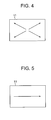
- FIG. 4 is a diagram schematically showing the state in which the front screen 11 has intensity irregularities
- FIG. 5 is a diagram schematically showing the state in which the front screen 11 has chromaticity irregularities
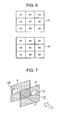
- FIG. 6 is a diagram showing an example in which the front screen 11 and the rear screen 12 are divided into a plurality of screen areas
- FIG. 7 is a schematic sectional view schematic showing a specific example of intensity or chromaticity adjustment
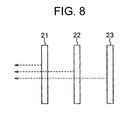
- FIG. 8 is a schematic sectional view schematically showing a specific example of a display apparatus having three screens.
- the observer visually sees the light respectively emitted by the front screen 11 and the rear screen 12.
- the light respectively emitted by the front screen 11 and the rear screen 12 is emitted with suitable intensity and chromaticity so as to satisfy the conditions of intensity and chromaticity, which will be described later, by the intensity adjustment unit 141 and the chromaticity adjustment unit 142.
- the observer can visually see the stereoscopic image by displaying the images with suitably adjusted intensity and chromaticity (that is, images with no intensity and chromaticity variation) on the front screen 11 and the rear screen 12, respectively.
- the light L2 emitted by the rear screen 12 is transmitted through the front screen 11 and visually seen by the observer.
- the light L2 is attenuated by being transmitted through the front screen 11. That is, for example, the intensity of the light L2 is reduced and the light with reduced intensity is to be visually seen by the observer. Therefore, in order to allow the observer to visually see the light with intensity that the rear screen 12 emits essentially, the light emitted by the rear screen 12 is raised in advance, for example. That is, in response to the image signal supplied to the rear screen 12, the intensity adjustment unit 141 rewrites the signal indicating the intensity of the image signals.
- the intensity adjustment unit 141 drives the rear screen 12 to display an image by the rewritten and input image signal.
- the rear screen 12 can eliminate the influence of the attenuation of the light L2 generated by being transmitted through the front screen 11 by emitting the light L2 having high intensity in advance. Therefore, the observer can visually see such image in a state of essential intensity of the image by displaying the image formed from such light L2 on the rear screen 12.
- an image that allows the observer to visually see the stereoscopic image is displayed also on the front screen by superposing and displaying another image on the image, thereby the observer can visually see the stereoscopic image suitably by the images respectively displayed on the front screen 11 and the rear screen 12.
- the chromaticity of the front screen 11 and the rear screen 12 can be similarly adjusted. For example, when the same image is displayed, if the image on the rear screen 12 only is visually seen by the observer with emphasis of "red" (that is, if variations occur in the chromaticity of the images), for example, only the image displayed on the rear screen 12 is adjusted so as to weaken the emission of read light by the chromaticity adjustment unit 142. Thereby, the observer can visually see the images respectively displayed on the front screen 11 and the rear screen 12 as the same image. That is, by displaying images for stereoscopic display on the front screen 11 and the rear screen 12in such state, the observer can visually see it as the stereoscopic image.
- the intensity of the light L1 emitted by the front screen 11 in the position of the observer is C1
- the intensity of the light L2 emitted by the rear screen 12 corresponding to the light L2 in the position of the observer is C2
- images with the same intensity and the same color is assumed to be displayed on the front screen 11 and the rear screen 12. That is, in FIG. 3, the intensity in the observation position 100 of the observer is shown.
- the observer can visually see the stereoscopic image more suitably.
- the display apparatus 1 that satisfy the condition of
- /(C1 + C2) 0.075, if the same image is displayed on the front screen 11 and the rear screen 12, respectively, the observer is in the state in which the observer hardly or never recognizes even the difference of intensity between the images respectively displayed on the screens. That is, when the image for stereoscopic display is displayed on the display apparatus 1 in such state, the image can be visually seen more suitably as the stereoscopic image.
- the observer can visually see the stereoscopic image.
- the observer recognizes the difference of color (i.e., variations of chromaticity) between the images respectively displayed on the screens.
- the stereoscopic image can be visually seen.
- the observer can visually see the stereoscopic image more suitably.
- the observer in such display apparatus 1, if the same image is displayed on the front screen 11 and the rear screen 12, respectively, the observer is in the state in which the observer hardly or never recognizes even the difference of color between the images respectively displayed on the screens. That is, when the image for stereoscopic display is displayed on the display apparatus 1 in such state, the image can be visually seen more suitably as the stereoscopic image.
- the above described conditions are satisfied in at least red light (R), blue light (B), green light (G), and white light (W). Further, it is more preferable that the above described conditions are satisfied by suitably varying the light intensity (i.e., luminous intensity or amount of light) with respect to the light of the respective colors. Alternatively, it is preferable that the above described conditions are also satisfied with respect to the predetermined light formed by mixing at least two of the respective colors of R, G, and B.
- the observer can visually see the stereoscopic image.
- the intensity adjustment unit 141 and the chromaticity adjustment unit 142 respectively adjusts intensity or chromaticity with a function or table
- a suitable function or table is created in consideration of conditions such as transmittance characteristics of the front screen 11 and a distance between the front screen 11 and the rear screen 12, for example.
- the transmittance characteristics of the half mirror 18 or the reflection characteristics of the half mirror 18 are also considered. In this case, it is preferable that the reflection characteristics of the half mirror 18 differ depending on its reflection angle.
- the case where the front screen 11 has intensity irregularities unique to the display device and shown by an arrow is conceivable. That is, the case where the screen has intensity irregularities that reduce from the starting point toward the end point of the arrow, for example, is conceivable.
- Such intensity irregularities are produced by the driving method of the front screen 11, distribution of backlight, angular characteristics of the half mirror and the dichroic mirror, etc, for example. Therefore, when the front screen 11 having such intensity irregularities is used as the image display unit of the display apparatus 1, it is preferable that the intensity adjustment unit 141 adjusts so that the rear screen 12 may have such intensity irregularities. Such adjustment is performed so as to satisfy the above described conditions of intensity.
- each of the front screen 11 and the rear screen 12 has intensity irregularities within an allowable range as a discrete display device.
- the front screen 11 and the rear screen 12 may be adjusted by the intensity adjustment unit 141 so as to be in a state in which they have no intensity irregularities, respectively.
- the display apparatus 1 that satisfies the above described condition can be realized.
- the case where the front screen 11 has chromaticity irregularities unique to the display device is conceivable. That is, the case where the screen has chromaticity irregularities having redness emphasized more from the starting point toward the end point of the arrow is conceivable.
- the rear screen 12 is adjusted by the chromaticity adjustment unit 142 so as to have such chromaticity irregularities as well as when the front screen 11 having intensity irregularities is used. Such chromaticity adjustment is performed so as to satisfy the above described conditions of chromaticity.
- each of the front screen 11 and the rear screen 12 has chromaticity irregularities within an allowable range as a discrete display device.
- the front screen 11 and the rear screen 12 may be adjusted by the chromaticity adjustment unit 142 so as to be in a state in which they have no chromaticity irregularities, respectively.
- the display apparatus 1 that satisfies the above described condition can be realized.
- the gamma characteristics as characteristics unique to the display devices of the front screen 11 and the rear screen 12, respectively, are coordinated with each other. That is, it is preferable that the form of the gamma curve of the front screen 11 and the gamma curve of the rear screen 12 are the same or substantially the same. In this case, the forms of the gamma curves of the front screen 11 and the rear screen 12 (i.e., gamma characteristics) can be coordinated by recording forms of gamma curves in the intensity adjustment unit 141, for example.
- the apparatus may have a construction in which the screens of the front screen 11 and the rear screen 12 are respectively divided into nine areas, and the above described conditions may be satisfied for the respective corresponding areas. That is, the apparatus may have the construction in which the screen area A1 of the front screen 11 and the screen area B1 of the rear screen 12 corresponding to the screen area A1 satisfy the above described conditions of intensity and chromaticity. In other words, the apparatus may have the construction in which the above described conditions of intensity and chromaticity are satisfied with respect to the areas the observer visually sees by superposing them on the line of sight.
- other screen areas B2, B3,..., B9 of the rear screen 12 which do not correspond to the screen area A1 may or may not satisfy the above described conditions of intensity and chromaticity in relation to the screen area A1.
- the apparatus is constructed so that the light emitted by the screen areas of the front screen 11 and the light emitted by the screen areas of the rear screen 12 corresponding to the screen areas may satisfy the above described conditions of intensity and chromaticity, by such display apparatus 1, the observer can visually see the image having stereoscopic effect suitably.
- the front screen 11 and the rear screen 12 are divided, the case where, despite that the light emitted by one screen area satisfies the above described conditions of intensity and chromaticity, the light emitted by another screen area does not satisfy the conditions is conceivable.
- the front screen 11 and the rear screen 12 are also adjusted so as to respectively have the same intensity irregularities or chromaticity irregularities or with a similar tendency thereof.
- the front screen 11 and the rear screen 12 having the same intensity irregularities or chromaticity irregularities or with a similar tendency thereof are used.
- the display apparatus 1 that satisfies the conditions of intensity and chromaticity also in the respective screen areas can be realized easier.
- front screen 11 and the rear screen 12 are respectively divided into screen areas, not limited to the nine-part split as shown in FIG. 6, they can be divided into a predetermined number.
- all of the screen areas may have the same size or at least one screen may have the different size.
- the intensity adjustment unit 141 and the chromaticity adjustment unit 142 are constructed so as to adjust the intensity and the chromaticity for the respective screen areas.
- the similar operation can be performed by reading out or controlling the signal indicating a predetermined screen area within the screens in addition to rewriting the signal indicating intensity or chromaticity of the image signals supplied to the front screen 11 and the rear screen 12, respectively.
- an image 110 is displayed on the front screen 11, and an image 120 is displayed on the rear screen 12. It is assumed that the two images 110 and 120 are displayed by the image signal with the same intensity and the same chromaticity.
- the intensity adjustment unit 141 or the chromaticity adjustment unit 142 adjusts the light L1 or L2 so that the light L1 emitted from the image 110 and the light L2 emitted from the image 120 may satisfy the above described conditions as seen from the side of the observer.
- the intensity or the chromaticity measured by an intensity or chromaticity measuring instrument disposed in the position of the observer is adjusted so as to satisfy the above described conditions.
- the light L1 and the light L2 are superposed.
- the respective light can be measured and adjusted so as to satisfy the above described conditions with respect to corresponding pixels.
- the display apparatus capable of displaying images with suitably adjusted intensity and chromaticity can be realized.
- the display apparatus may have a construction in which the result of the above described intensity or chromaticity adjustment can be stored.
- the apparatus may have a construction in which the result is recorded in a memory such as a RAM within the image generating unit 14.
- the front screen 11 and the rear screen 12 may be manufactured so as to satisfy the above described conditions of intensity or chromaticity in advance, and the result may be recorded within the memory as preset information at the time of factory shipment.
- the display apparatus 1 including an input unit such as a remote control device, controller, or touch panel, for example may have a construction in which an instruction of the observer can be input, for example.
- the instruction input from the input unit is received by a data receiving unit, input interface, etc. provided in the control unit 17, for example, and output to the image generating unit 14.
- desired adjustment is performed according to the instructions output from the control unit 17 by the intensity adjustment unit 141 or the chromaticity adjustment unit 142.
- the intensity or the chromaticity adjusted or set automatically by the intensity adjustment unit 141 or the chromaticity adjustment unit 142 for example, can be further adjusted according to the instruction of the observer, for example. Therefore, images can be displayed on the front screen 11 and the rear screen 12, respectively, with the intensity or chromaticity desired by the observer.
- the apparatus may adopt the construction in which the input result by such input unit is recorded in the above described memory, for example.
- the case of two screens i.e., the front screen 11 and the rear screen 12
- the above described conditions of intensity are determined by assuming that the intensity of the light having the maximum intensity is C1 and the intensity of the light having the minimum intensity is C2 in the position of the observer of the light emitted by the three or more screens according to the similar expression.
- condition on chromaticity is the condition in which "the maximum difference between x coordinates and the maximum difference between y coordinates of arbitrarily selected two chromaticity coordinates of chromaticity coordinates emitted by the three or more screens are equal to or less than 0.06 or 0.03 as described above, respectively.” If this condition is satisfied, the observer can visually see the stereoscopic image suitably by visually seeing the image with suppressed variations in intensity or chromaticity.
- each display device satisfies the above described conditions between adjacent devices, the effects equal to those in the display apparatus 1 according to the example can be obtained. That is, in FIG. 8, if the intensity or chromaticity of the light emitted by the respective screens is adjusted so that a screen 21 and a screen 22 may satisfy the above described conditions and the screen 22 and a screen 23 may satisfy the above described conditions, the observer can visually see the stereoscopic image with suppressed variations in intensity or chromaticity. That is, the observer can visually see the stereoscopic image suitably.
Landscapes
- Engineering & Computer Science (AREA)
- Multimedia (AREA)
- Signal Processing (AREA)
- Control Of Indicators Other Than Cathode Ray Tubes (AREA)
- Testing, Inspecting, Measuring Of Stereoscopic Televisions And Televisions (AREA)
- Liquid Crystal Display Device Control (AREA)
- Devices For Indicating Variable Information By Combining Individual Elements (AREA)
Applications Claiming Priority (2)
| Application Number | Priority Date | Filing Date | Title |
|---|---|---|---|
| JP2003027976A JP2004241962A (ja) | 2003-02-05 | 2003-02-05 | 表示装置及び方法 |
| JP2003027976 | 2003-02-05 |
Publications (2)
| Publication Number | Publication Date |
|---|---|
| EP1445965A2 true EP1445965A2 (de) | 2004-08-11 |
| EP1445965A3 EP1445965A3 (de) | 2004-09-15 |
Family
ID=32652980
Family Applications (1)
| Application Number | Title | Priority Date | Filing Date |
|---|---|---|---|
| EP04250629A Ceased EP1445965A3 (de) | 2003-02-05 | 2004-02-05 | Anzeigevorrichtung und Anzeigeverfahren |
Country Status (3)
| Country | Link |
|---|---|
| US (1) | US20040223379A1 (de) |
| EP (1) | EP1445965A3 (de) |
| JP (1) | JP2004241962A (de) |
Cited By (1)
| Publication number | Priority date | Publication date | Assignee | Title |
|---|---|---|---|---|
| CN113903254A (zh) * | 2020-10-12 | 2022-01-07 | 友达光电股份有限公司 | 显示元件以及显示装置 |
Families Citing this family (10)
| Publication number | Priority date | Publication date | Assignee | Title |
|---|---|---|---|---|
| JP2006208868A (ja) * | 2005-01-31 | 2006-08-10 | Nippon Telegr & Teleph Corp <Ntt> | 3次元表示装置 |
| JP2006276822A (ja) * | 2005-03-02 | 2006-10-12 | Hitachi Displays Ltd | 表示装置 |
| KR20060135450A (ko) * | 2005-06-25 | 2006-12-29 | 삼성전자주식회사 | 2차원 겸용 입체 영상 표시 장치 |
| US8446339B2 (en) * | 2007-03-30 | 2013-05-21 | Pioneer Corporation | Image display device |
| US9001194B2 (en) | 2009-05-14 | 2015-04-07 | Eizo Corporation | Stereo image display device that is capable of making a stereo image recognized based on a right-eye image and a left-eye image |
| JP5776136B2 (ja) * | 2009-09-18 | 2015-09-09 | 大日本印刷株式会社 | 広告表示体 |
| KR101182470B1 (ko) | 2011-11-09 | 2012-09-12 | (주)티원시스템즈 | 투명 엘시디 패널을 이용한 입체효과를 갖는 미디어 박스. |
| JP5629284B2 (ja) * | 2012-04-06 | 2014-11-19 | 株式会社ライツ | 3次元映像表示装置及びその制御方法、及び画面調整用プログラム |
| WO2021024600A1 (ja) * | 2019-08-02 | 2021-02-11 | パナソニックIpマネジメント株式会社 | 表示装置 |
| TWI754358B (zh) * | 2020-08-24 | 2022-02-01 | 友達光電股份有限公司 | 顯示裝置以及控制方法 |
Family Cites Families (10)
| Publication number | Priority date | Publication date | Assignee | Title |
|---|---|---|---|---|
| US5298993A (en) * | 1992-06-15 | 1994-03-29 | International Business Machines Corporation | Display calibration |
| DE69612647T2 (de) * | 1995-03-08 | 2001-10-18 | Koninklijke Philips Electronics N.V., Eindhoven | Dreidimensionales bildanzeigesystem |
| US5745197A (en) * | 1995-10-20 | 1998-04-28 | The Aerospace Corporation | Three-dimensional real-image volumetric display system and method |
| ATE500532T1 (de) * | 1998-02-20 | 2011-03-15 | Puredepth Ltd | Mehrschichtige anzeigevorrichtung und verfahren zur darstellung von bildern auf einer solchen anzeigevorrichtung |
| US6377229B1 (en) * | 1998-04-20 | 2002-04-23 | Dimensional Media Associates, Inc. | Multi-planar volumetric display system and method of operation using three-dimensional anti-aliasing |
| GB2337388A (en) * | 1998-05-12 | 1999-11-17 | Sharp Kk | Directional autereoscopic 3D display having directional illumination system |
| US6525699B1 (en) * | 1998-05-21 | 2003-02-25 | Nippon Telegraph And Telephone Corporation | Three-dimensional representation method and an apparatus thereof |
| KR100598137B1 (ko) * | 1998-09-16 | 2006-07-07 | 소니 가부시끼 가이샤 | 디스플레이 장치 |
| AU1363201A (en) * | 1999-12-08 | 2001-06-18 | Neurok, Llc | Volumetric display device |
| JP2001188513A (ja) * | 1999-12-28 | 2001-07-10 | Matsushita Electric Ind Co Ltd | 表示装置 |
-
2003
- 2003-02-05 JP JP2003027976A patent/JP2004241962A/ja not_active Abandoned
-
2004
- 2004-02-04 US US10/771,240 patent/US20040223379A1/en not_active Abandoned
- 2004-02-05 EP EP04250629A patent/EP1445965A3/de not_active Ceased
Cited By (2)
| Publication number | Priority date | Publication date | Assignee | Title |
|---|---|---|---|---|
| CN113903254A (zh) * | 2020-10-12 | 2022-01-07 | 友达光电股份有限公司 | 显示元件以及显示装置 |
| CN113903254B (zh) * | 2020-10-12 | 2023-11-14 | 友达光电股份有限公司 | 显示元件以及显示装置 |
Also Published As
| Publication number | Publication date |
|---|---|
| JP2004241962A (ja) | 2004-08-26 |
| US20040223379A1 (en) | 2004-11-11 |
| EP1445965A3 (de) | 2004-09-15 |
Similar Documents
| Publication | Publication Date | Title |
|---|---|---|
| KR101562415B1 (ko) | 멀티뷰 디스플레이에서의 인지된 이미지 크로스토크 감소 방법 | |
| US8144079B2 (en) | Multiple-viewer multiple-view display and display controller | |
| US5945965A (en) | Stereoscopic image display method | |
| KR100708838B1 (ko) | 입체 영상 표시 장치 및 그 구동 방법 | |
| CN102598675B (zh) | 使用全色彩立体图的立体双调制器显示装置 | |
| KR101977251B1 (ko) | 멀티 뷰 무안경 입체 영상 표시장치와 그 최적 시청 거리 제어 방법 | |
| US8154799B2 (en) | 2D/3D switchable autostereoscopic display apparatus and method | |
| KR101329076B1 (ko) | 액정표시장치 및 그 구동방법 | |
| US20040240056A1 (en) | Display apparatus and method | |
| US10460676B2 (en) | Display device | |
| KR20130002076A (ko) | 입체영상표시장치와 이의 구동방법 | |
| EP1445965A2 (de) | Anzeigevorrichtung und Anzeigeverfahren | |
| US9118890B2 (en) | 3D display | |
| JP4735234B2 (ja) | 画像表示システム | |
| KR101763942B1 (ko) | 입체영상표시장치 | |
| US8952957B2 (en) | Three-dimensional display apparatus | |
| Kreuzer et al. | 43‐1: Automotive Autostereoscopic 3D Display | |
| WO2020090584A1 (ja) | 画像表示装置、画像表示システム、及び移動体 | |
| JP2004361467A (ja) | 表示装置及び方法 | |
| KR101646494B1 (ko) | 입체 영상 디스플레이 장치 및 그 구동 장치 | |
| KR20180049294A (ko) | 뷰 맵 데이터 생성방법 및 장치 | |
| JP2004151508A (ja) | 表示装置及び方法 | |
| JP2021032962A (ja) | 表示装置 | |
| CN116453475A (zh) | 一种图像生成单元、抬头显示装置、载具和灯光调节方法 | |
| KR101888668B1 (ko) | 입체영상 표시장치 |
Legal Events
| Date | Code | Title | Description |
|---|---|---|---|
| PUAI | Public reference made under article 153(3) epc to a published international application that has entered the european phase |
Free format text: ORIGINAL CODE: 0009012 |
|
| PUAL | Search report despatched |
Free format text: ORIGINAL CODE: 0009013 |
|
| AK | Designated contracting states |
Kind code of ref document: A2 Designated state(s): AT BE BG CH CY CZ DE DK EE ES FI FR GB GR HU IE IT LI LU MC NL PT RO SE SI SK TR |
|
| AX | Request for extension of the european patent |
Extension state: AL LT LV MK |
|
| AK | Designated contracting states |
Kind code of ref document: A3 Designated state(s): AT BE BG CH CY CZ DE DK EE ES FI FR GB GR HU IE IT LI LU MC NL PT RO SE SI SK TR |
|
| AX | Request for extension of the european patent |
Extension state: AL LT LV MK |
|
| 17P | Request for examination filed |
Effective date: 20040910 |
|
| AKX | Designation fees paid |
Designated state(s): DE FR GB |
|
| STAA | Information on the status of an ep patent application or granted ep patent |
Free format text: STATUS: THE APPLICATION HAS BEEN REFUSED |
|
| 18R | Application refused |
Effective date: 20080524 |