EP1443720A2 - Verfahren zur Stationssuchverarbeitung und drahtloses Kommunikationsgerät - Google Patents
Verfahren zur Stationssuchverarbeitung und drahtloses Kommunikationsgerät Download PDFInfo
- Publication number
- EP1443720A2 EP1443720A2 EP04001993A EP04001993A EP1443720A2 EP 1443720 A2 EP1443720 A2 EP 1443720A2 EP 04001993 A EP04001993 A EP 04001993A EP 04001993 A EP04001993 A EP 04001993A EP 1443720 A2 EP1443720 A2 EP 1443720A2
- Authority
- EP
- European Patent Office
- Prior art keywords
- frame
- data
- discovery
- received
- response
- Prior art date
- Legal status (The legal status is an assumption and is not a legal conclusion. Google has not performed a legal analysis and makes no representation as to the accuracy of the status listed.)
- Withdrawn
Links
Images



Classifications
-
- H—ELECTRICITY
- H04—ELECTRIC COMMUNICATION TECHNIQUE
- H04W—WIRELESS COMMUNICATION NETWORKS
- H04W52/00—Power management, e.g. Transmission Power Control [TPC] or power classes
- H04W52/04—Transmission power control [TPC]
- H04W52/18—TPC being performed according to specific parameters
- H04W52/28—TPC being performed according to specific parameters using user profile, e.g. mobile speed, priority or network state, e.g. standby, idle or non-transmission
- H04W52/283—Power depending on the position of the mobile
-
- H—ELECTRICITY
- H04—ELECTRIC COMMUNICATION TECHNIQUE
- H04W—WIRELESS COMMUNICATION NETWORKS
- H04W8/00—Network data management
- H04W8/005—Discovery of network devices, e.g. terminals
Definitions
- the present invention relates to a station discovery processingmethodandawirelesscommunicationdeviceforrapidly performing connection processing in a wireless communication system that performs communication in compliance with a wireless communication method (e.g., the standards of infrared communication methods (IrDA: Infrared Data Association)) having a congestion control function.
- a wireless communication method e.g., the standards of infrared communication methods (IrDA: Infrared Data Association) having a congestion control function.
- Infrared communication has the advantages that costs and power consumption can be reduced, and devices can be miniaturized. It is used in various apparatuses including a remote control for television. Infrared ports must be made to face eachotherbecause infrared rays travel straightly, infrared rays do not pierce through shields such as walls, and the communication distance of infrared communication is short. For these reasons, infrared communication has less possibility to suffer hacking and has higher security than other wireless communications (e.g., wireless LAN IEEE802.11a, IEEE802.11b, etc.). Therefore, a study is being made of use in electronic settlement service.
- wireless LAN IEEE802.11a, IEEE802.11b, etc. wireless LAN IEEE802.11a, IEEE802.11b, etc.
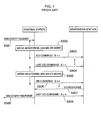
- FIG. 1 is a drawing showing the flow of a station discovery procedure based on the conventionally known IrDA standards.
- FIG. 1 mainly shows the operation of the IrLAP layer and lower layers.
- a starting station upon receiving a discovery request (step S501) from an upper layer (IrLMP (IrDA Link Management Protocol), to start infrared communication, a starting station (the side to start communication) performs media monitoring over 500 ms to monitor signals from other devices (step S502). If no signals arrive from other devices, the starting station transmits n (n is the number of slots (1, 6, 8, 16) ) pieces of infrared frames called XID (exchange ID) commands (step S503), and then a last XID command (step S504).
- n is the number of slots (1, 6, 8, 16)
- XID exchange ID
- the starting station performs media monitoring again over 500 ms (step S505) , and transmits n pieces of XID commands (step S506). If an XID response is obtained from a responding station (the side to receive the communication) in response to the XID commands (step S507), the starting station transmits a last XID command (step S508), and sends a discovery response indicating that a station is discovered, to the upper layer (IrLMP) (step S509).
- the discovery processing is completed by the above processing, subsequently connection processing is performed, and data exchange becomes possible.
- the station discovery procedure in the IrDA standards requires much time. If the number of slots is 6, one second or more is required. For example, if XID command transmission slot interval is 85 ms, and last XID command (46 bytes maximum) transmission time is 48 ms, time required for station discovery processing is 1058 ms (medium monitoring time 500 ms + XID command transmission time (transmission interval) 85 ms ⁇ the number of slots 6 + last XID command transmission time 48 ms). It is unrealistic to use the station discovery procedure under services requiring high speed.
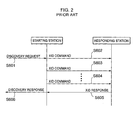
- FIG. 2 shows the flow of a high speed method of a prior art station discovery procedure described in Japanese Published Unexamined Patent Application 2002-204201.
- a starting station upon receiving a discovery request (step S601), a starting station immediately transmits an XID command (step S602).
- Thismethod continuestransmittingtheXIDcommand until a response is obtained from a responding station (steps S603 and S604).
- the starting station terminates the discovery processing and returns a discovery response to an upper layer (step S606).
- the aforementioned high speed method of the prior art station discovery procedure has several problems. Since plural responding stations can respond at the same time, when XID responses are returned, collision occurs in the starting station and no XID response may not be obtained.
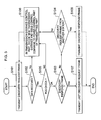
- FIG. 3 shows the flow of a prior art station discovery procedure.
- a starting station transmits a discovery request frame (XID command) (step S701). Thereafter, the starting station waits for the reception of data for prescribed time (step S702), and if no data is received, it transmits the discovery request frame again.
- the starting station determines whether the received data is a discovery response frame (XID response) (step S703), and if a discovery response frame, it transmits a last discovery request frame (last XID command) (step S704), and terminates the discovery procedure. If not a discovery response frame, the starting station deletes the received frame, determining that noise invaded, and transmits the discovery request frame again.
- XID response discovery response frame
- last XID command last discovery request frame
- the prior art method generally ignores frames other than discovery response frames received during discovery processing.
- XID responses are obtained at the same time from plural responding stations
- frames received in a starting station have been destroyed due to a collision.
- the starting station cannot determine whether the frames have been destroyed because responses have been obtained at the same time from plural responding stations, or noise invaded the frames.
- the starting station cannot discover other stations permanently.
- the infrared communication device described in Japanese Published Unexamined Patent Application 2002-204201 starts a station discovery operation without monitoring communication and continues the station discovery operation until the command to stop infrared communication is explicitly given from the user.
- the device interferes with discovery processing having been started earlier by another device, and the device having started earlier the discovery processing cannot make connection permanently.
- the present invention solves the problems of the aforementioned prior art and provides a station discovery processing method and a wireless communication device that enable rapid and sure connectionwith devices that performcommunication in compliance with a wireless communication method (e.g., the standards of infrared communicationmethods) having a congestion control function.
- a wireless communication method e.g., the standards of infrared communicationmethods
- a station discovery processing method includes the steps of: transmitting a discovery request frame; determining whether data is received, in response to the discovery request frame; if data is received, determining a transmission error of the received data; and if there is a transmission error in the received data, or if no data is received in response to the discovery request frame, deciding a new transmission distance and controlling the transmission power of a transmitting part to power corresponding to the decided transmission distance.
- a wireless communication device of the present invention includes: a transmitting part that transmits data to other communication devices; a receiving part that receives data from the other communication devices; a communication frame control part that generates the data to be transmitted from the transmitting part and detects data reception from the receiving part; a frame determining part that determines a frame type and validity of the data received from the receiving part; a transmission distance control part that decides a data transmission distance on the basis of notice from the communication frame control part and the frame determining part; and a power control part that controls transmission power of the data transmitted from the transmitting part so that the data is transmitted to another communication device existing in a position of the transmission distance decided by the transmission distance control part.
- the transmission distance control part decides a new transmission distance
- the power control part controls the transmission power of the data to be transmitted, and the transmitting part transmits the discovery request frame again.
- a new transmission distance is decided according to whether data is received in response to a discovery request frame, and the validity of the received data, the transmission power of the transmitting part is controlled to power corresponding to the decided transmission distance, and the transmission distance of the next discovery request frame is changed.
- the station discovery processing method of the present invention in the step of deciding the new transmission distance and controlling the transmission power of the transmitting part, decides a new transmission distance so that if there is a transmission error in the received data, the transmission distance is reduced, and if no data is received, the transmission distance is increased.
- the transmission distance control part decides the new transmission distance so that if there is the transmission error in the data received by the receiving part in response to the discovery request frame transmitted from the transmitting part, the transmission distance is reduced, and if no data is received from the receiving part, the transmission distance is increased.
- a station discovery processing method and a wireless communication device if there is a transmission error in received data, that is, a collision of response data occurs, a transmission distance is reduced determining that plural responding stations exist within the communication distance, and if no response data is received, a transmission distance is increased determining that no responding station exists within the transmission distance.
- the station discovery processing method of the present invention further includes the steps of: determining whether data received in response to the transmission of the discovery request frame is a discovery request frame from another communication device; and if it is the discovery request frame from the other communication device, immediately transmitting a discovery response frame to the other communication device.
- the frame determining part determines the frame type of the data received from the receiving part, and if the frame type of the received data is the discovery request frame from the other communication device, the communication frame control part generates the discovery response frame and the transmitting part immediately transmits the discovery response frame to the another communication device.
- the wireless communication device of the present invention even if the wireless communication device of the present invention that performs station discovery processing performs station discovery processing when other communication devices are performing the station discovery processing, upon receiving a discovery request frame from another communication device, the wireless communication device of the present invention immediately returns a discovery response frame and switches control to a responding station. Thereby, without interfering with the discovery processing of the communication device that started earlier the station discoveryprocessing, with the communication device as a starting station, connection can be made rapidly.
- the station discovery processing method of the present invention includes the steps of: determining whether data is received for specified waiting time; if no data is received for the waiting time, transmitting a discovery request frame; determining whether data is received in response to the transmission of the discovery request frame; if data is received in response to the transmission of the discovery request frame, determining whether the data is a discovery response frame; and updating the waiting time if it is not a discovery response frame, or no data is received in response to the transmission of the discovery request frame.
- a wireless communication device of the present invention includes: a transmitting part that transmits data to other communication devices; a receiving part that receives data from the other communication devices; a communication frame control part that generates the data to be transmitted from the transmitting part, transmits the generated data to the transmitting part after waiting for specified waiting time, and detects data reception from the receiving part; and a waiting time control part that decides waiting time before a discovery request frame is transmitted, on the basis of notice from the communication frame control part. If no data is received from the receiving part in response to a discovery request frame transmitted from the transmitting part, the waiting time control part decides newwaiting time and the transmitting part transmits the discovery request frame again after waiting for the new waiting time.
- the station discovery processing method of the present invention in the step of updating waiting time, if no response is obtained for a specified period of time in response to a discovery request frame, extends waiting time, and if a response is obtained in response to the discovery request frame, initializes waiting time.
- the waiting time control part decides the new waiting time so that if no data is received from the receiving part in response to the discovery request frame transmitted from the transmitting part, the waiting time is extended, and if a response is obtained from the receiving part in response to the discovery request frame, the waiting time is initialized.
- waiting time is extended toperformdiscoveryprocessing at long intervals, so that power consumption can be curbed. If a responding terminal appears, waiting time is initialized to switch to rapid discovery processing.
- the station discovery processing method of the present invention includes the steps of: if data is received within waiting time, or the received data is not a discovery response frame, determining whether the received data is a discovery request frame from another communication device; if the received data is the discovery request frame from the other communication device, immediately transmitting a discovery response frame to the other communication device.
- the communication frame control part determines a frame type of the data received from the receiving part, and if the frame type of the received data is a discovery request frame from another communication device, generates a discovery response frame, and the transmitting part immediately transmits the discovery response frame to the other communication device.
- a station discovery processing method and a wireless communication device when a discovery request frame is received from another communication device during a waiting time period, a discovery response frame is immediately returned to switch to a responding station. Thereby, even if a long waiting time period is set, the responding station can respond immediately to the other communication device performing discovery processing.
- the station discovery processing method and the wireless communication device of the present invention by controlling the transmission power of a starting station, a collision of responses during discovery processing can be avoided. Thereby, a wireless communication terminal existing in a minimum distance can be discovered without fail.
- a trade-off between speed and power saving can be automatically decided depending on the existence or absence of responding stations. In other words, switching can be automatically performed so that if other wireless communication terminals appear continuously, rapid discovery processing takes precedence, and if other wireless communication terminals appear infrequently, power saving takes precedence.
- the station discovery processing method and the wireless communication device of the present invention can apply to store terminals providing electronic settlement service by which the electronic data of credit cards and debit cards, and electronic values such as electronic money and electronic tickets that are stored in users' portable terminals are received from the store terminals over wireless communication.
- a wireless communication device of the present invention that performs station discovery processing is installed in a store terminal, if two or more user portable terminals exist within the communication range of the store terminal, two or more portable terminals return responses at the same time in response to a connection request, causing permanent failure in connection.
- a wireless communication device of the present invention that performs station discovery processing is installed in a store terminal, even if two ormore userportable terminals exist in the communication range of the store terminal, the portable terminal of a nearest user or the user to make settlement now can be automatically discovered.
- the wireless communication device of the present invention is applied to terminals in which operators are absent, such as automatic vending machines, self-service gas stations, ATMs, and the like, when users appear frequently, settlement processing is rapidly performed by rapid discovery processing, while when users appear infrequently, power consumption can be curbed by automatically extending waiting time.
- the station discovery processing method or the wireless communication device of the present invention is applied to portable terminals, since the portable terminals of users can be detected, the appearances of users can be detected without having to provide a new sensor, and a trade-off between speed and power saving can be automatically decided according to the frequency of the appearances of users.
- FIG. 4 is a block diagram showing the configuration of an infrared communication device according to a first embodiment of the present invention.
- the infrared communication device includes a communication control part 1100 and an application part 1200.
- the communication control part 1100 includes a communication frame control part 1110, a transmitting part 1120, a receiving part 1130, and a transmission distance control part 1140.
- the communication frame control part 1110 includes a frame determining part 1111, and the transmitting part 1120 includes a power control part 1121.
- the application part 1200 which is an application part using infrared communication, generates a data transmission request and other requests to the communication control part 1100.
- the communication control part 1100 which is a part corresponding to a communication protocol, upon receiving requests from the application part 1200, performs processing for discovery of other communication devices, performs processing for connection with other communication devices, and transmits and receives data to and from the other communication devices.
- the communication control part 1100 according to requests from the application part 1200, transmits data to other communication devices and sends data received from other communication devices to the application part 1200.
- the communication frame control part 1110 During transmitting, the communication frame control part 1110 generates a communication frame necessary for the transmission, and during receiving, determines the validity and type of a received communication frame in the frame determination part 1111.
- the transmission distance control part 1140 performs the control of data transmission distance L upon receiving a determination result from the frame determining part 1111 and a control command from the communication control part 1100.
- the transmitting part 1120 transmits the communication frame generated in the communication frame control part 1110.
- the power control part 1121 upon receiving a control command from the transmission distance control part 1140, controls transmission power so that data is transmitted to another communication device at a distance of L from the infrared communication device.
- the receiving part 1130 receives communication frames transmitted from other communication devices and sends them to the frame determining part 1111 of the communication frame control part 1110.
- the receiving part 1130 may include a receive sensitivity control part, which receives control commands from the transmission distance control part 1140 and controls receive sensitivity.
- FIG. 5 is a drawing showing the flow of processing after a discovery request is received in the communication frame control part 1110 until the discovery processing terminates.
- a method of controlling transmission power is described.
- the communication frame control part 1110 starts discovery processing upon receiving a discovery request, generates a discovery request frame, and transmits it from the transmitting part 1120 (step S101).
- the receiving part 1130 determines whether data is received from other communication devices, in response to the transmitted data (step S102). Upon receiving data, the receiving part 1130 sends the received data to the communication frame control part 1110, and the frame determining part 1111 checks FCS (step S105).
- FCS is a frame check sequence used to check the validity of frame transmission in the receiving end.
- the format of a frame received in the frame determining part 1111 during discovery processing is shown in FIG. 6.
- the frame consists of BOF (Begin of Frame: a start flag indicating the start of the frame), address field (the address of a communication party or connection plus command/response identification bit.
- the address of the communication party during the discovery processing is 1111111B), control field (defines the function of the frame), information field (used for the transmission of information message) , FCS, and EOF (End of Frame: end flag indicating the termination of the frame).
- FCS is computed from the address field, control field, and information field by use of a generator polynomial (CRC) and added in the transmitting end.
- CRC generator polynomial
- the frame determining part 1111 determines whether or not the received frame is a discovery response frame (step S103). If it is a discovery response frame, a last discovery request frame is generated in the communication frame control part 1110 and transmitted from the transmitting part 1120 (step S107), and the station discovery processing terminates. If it is determined in the frame determining part 1111 that the received frame is not a discovery response frame, the frame determining part 1111 determines whether it is a discovery request frame fromanothercommunicationdevice, that is, another station (step S104). If it is a discovery request frame from another station, a discovery response frame is transmitted immediately to the station (step S108), the discovery processing is terminated, and the operation is switched to the responding station from the starting station.
- step S102 If no data is received (step S102), if it is detected in the FCS check that the received frame has been destroyed (step S105) , or if the received frame is neither a discovery response frame nor a discovery request frame from another station (step S103, step S104), the frame determining part 1111 or the communication frame control part 1110 sends an undefined frame receive notice and data-not-received notice to the transmission distance control part 1140, which decides a new transmission distance and sends a command for controlling transmission power to the power control part 1121 of the transmitting part 1120 (step S106) .
- the communication frame control part 1110 transmits a discovery request frame again (step S101) to repeat the discovery processing.
- the data-not-received notice or the undefined frame receive notice may be sent after generating a last discovery request frame in the communication frame control part 1110 and transmitting it from the transmitting part 1120.
- the processing (step S104) that the frame determining part 1111 determines whether a received frame is a discovery request frame from another station may be omitted if the operation of a device performing station discovery processing in the first embodiment is limited to the operation as a starting station, in other words, the device does not need to receive discovery requests from other devices.
- the processing (step S108) that transmits a discovery response frame may be omitted. In that case, when received data is not a discovery response frame (step S103), the processing (step S106) that controls distance is immediately performed.
- step S103 that the frame determining part 1111 determines whether ornot a received frame is a discovery response frame, and the processing (step S104) that determines whether or not the frame is a discovery request frame from another station may be performed at the same time.
- the order of the processing may be changed.
- the frame determining part 1111 issues a command for reducing a transmission distance to the transmission distance control part 1140, and the power control part 1121 changes transmission power to the one corresponding to a specified transmission distance, whereby the communication range of the starting station is narrowed so that only a responding station nearest to the starting station can be discovered.
- the communication frame control part 1110 issues a command for increasing a transmission distance to the transmission distance control part 1140, and the power control part 1121 changes transmission power to the one corresponding to a specified transmission distance, whereby the communication range of the starting station is widened so that a responding station nearest to the starting station can be discovered.
- the above algorithm assumes that the initial values of Lmin and Lmax are stored in the transmission distance control part 1140.
- the initial value of L1 (initial data transmission distance) may be stored in the transmission distance control part 1140, and the value of L when a discovery response frame is received in previous discovery processing may be saved as a next initial value.
- the average of several previous values of L when discovery response frames of discovery processing were received may be saved as an initial value.
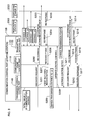
- FIG. 8 shows an example of a communication sequence between a starting station and responding stations in station discovery processing of the first embodiment.
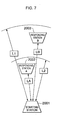
- FIG. 7 shows the positional relationship between the starting station and plural responding stations during execution of the sequence example of FIG. 8.
- the initial communication distance of a starting station 2001 is L1.
- Two responding stations A2002 and B2003 exist within the communication range of the starting station.
- the distance between the starting station 2001 and the responding station A2002 is LA, and the distance between the starting station 2001 and the responding station B2003 is LB.
- a discovery request is sent to the communication frame control part 1110 (step S201).
- the communication frame control part 1110 generates an XID command frame and sends it to the transmitting part 1120 (stepS202).
- the transmitting part 1120 transmits the XID command frame with initial transmission power (step S203).
- the initial transmission power is set according to the value of the transmission distance (L1) set in the transmission distance control part 1140 of the communication control part 1100.
- the receiving part 1130 of the starting station receives XID response frames from responding stations A and B existing within transmission distance L1 (initial data transmission distance) (steps S204 and S205).
- the receiving part 1130 sends the received frames to the communication frame control part 1110 (step S206).
- the communication frame control part 1110 analyzes the contents of the frames in the frame determining part 1111.
- the frame determining part 1111 sends undefined frame receive notice to the transmission distance control part 1140 (step S207).
- the transmission distance control part 1140 sets anew transmission distance L2 (step S208), and sends a distance control command to the power control part 1121 of the transmitting part 1120 (step S209).
- Thepowercontrol part 1121 changes the transmission power (step S210), and returns distance control notice to the transmission distance control part 1140 (step S211).
- the transmission distance control part 1140 sends a discovery request to the communication frame control part 1110 (step S212).
- the distance control notice (step S211) may be omitted so that after the distance control command (step S209) is sent from the transmission distance control part 1140, a discovery request is transmitted at appropriate timing (step S212).
- the communication frame control part 1110 Upon receiving the discovery request, the communication frame control part 1110 generates an XID command frame again and sends it to the transmitting part 1120 (step S213).
- the transmitting part 1120 transmits the XID command frame with the initial transmission power (step S214). Since the transmission power at this time is set to transmit transmission frames by about a distance L2, the receiving part 1130 of the starting station receives an XID response frame only from the responding station A2002 existing within the distance L2 (step S215).
- the receiving part 1130 sends the received frame to the communication frame control part 1110 (step S216).
- the communication frame control part 1110 analyzes the contents of the frame in the frame determining part 1111, upon determining that it is an XID response, sends a discovery response to the communication control part 1110, and terminates the discovery processing.
- the receiving part 1130 may further include a receive sensitivity control part so that the transmission distance control part 1140 sends a control command for lowering receive sensitivity to the receive sensitivity control part upon receiving undefined frame receive notice, and sends a control command for raising receive sensitivity to the receive sensitivity control part upon receiving data-not-received notice.
- a collision of XID responses occurring during an attempt to rapidly discover devices complying with the IrDA standards can be avoided, and a communication party existing within a minimum distance can be discovered rapidly and without fail.
- the infrared communication device in the first embodiment has an optimal configuration for solving the problems of the prior art, it can be physically realized in various ways.
- it may be realized as driver software of infrared communication I/F of personal computers, or the respective functions of the components of the infrared communication device may be combined in proper units into hardware modules so that the infrared communication device is realized by combining the hardware modules.
- the function of the aforementioned communication control part 1100 is realized as software executed by the CPU of the personal computer.
- the hardware modules may be realized by wired logics or a microcomputer.
- the functions of the communication frame control part 1110 and the transmission distance control part 1140 described above are realized by software such as microcodes executed by the microcomputer.
- the transmission distance control part 1140 decides data transmission distance L, and upon receiving a control command from the transmission distance control part 1140, the power control part 1121 controls transmission power so that data is transmitted to other communication devices at a distance of the transmission distance L.
- the transmission distance control part 1140 may control the power control part 1121 on the basis of a predetermined control logic so that transmission power is consequently controlled by the power control part 1121 in the same way.
- an infrared communication device to which the present invention is applied have been described in detail.
- the present invention can also apply to other types of wireless communication devices that perform station discovery processing.
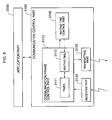
- FIG. 9 is a block diagram showing the configuration of an infrared communication device according to a second embodiment of the present invention.
- the infrared communication device includes a communication control part 3100 and an application part 3200.
- the communication control part 3100 includes a communication frame control part 3110, a transmitting part 3120, a receiving part 3130, and a waiting time control part 3140.
- the application part 3200 which is an application part using infrared communication, generates a data transmission request and other requests to the communication control part 3100.
- the communication control part 3100 which is a part corresponding to a communication protocol, upon receiving a request from the application part 3200, performs processing for discovery of other communication devices, performs processing for connection with other communication devices, and transmits and receives data to and from the other communication devices.
- the communication control part 3100 transmits data to other communication devices according to requests from the application part 3200, and sends data received from other communication devices to the application part 3200.
- the communication frame control part 3110 upon receiving a control command from the communication control part 3100, generates a communication frame necessary for transmission, and determines the validity and type of a received communication frame.
- the communication frame control part 3110 has an internal timer 3111 and holds the value of waiting time (T) 3112.
- the communication frame control part 3110 upon receiving a station discovery processing request from the communication control part 3100, waits for the waiting time (T) by use of the timer 3111 before sending a station discovery request frame to the transmitting part 3120.
- the waiting time control part 3140 Upon receiving a control command from the communication frame control part 3110, the waiting time control part 3140 changes a waiting time setting value 3112 within the communication frame control part 3110.
- the waiting time control part 3140 may exist within the communication frame control part 3110.
- the transmitting part 3120 transmits a communication frame generated in the communication frame control part 3110.
- the receiving part 3130 receives a communication frame transmitted from another communication device and sends it to the communication frame control part 3110.
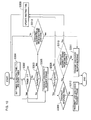
- FIG. 10 shows the flow of processing after the receipt of a discovery request in the communication frame control part 3110 until the termination of the discovery processing.
- the communication frame control part 3110 starts the discovery processing upon receiving a discovery request, sets the value of waiting time (T) in the timer 3111, and starts the timer (step S301).
- the communication frame control part 3110 determines whether or not the timer is equal to the waiting time (T) (step S302), and if not equal to T, monitors the reception of data for a given period of time (step S303). If no data is received, the communication frame control part 3110 determines again whether the timer is equal to the waiting time (T) (step S302).
- the data is sent to the communication frame control part 3110, which determines whether or not the received data is a discovery request frame from another station (step S313). If it is a discovery request frame, a discovery response frame is generated and immediately transmitted from the transmitting part 3120, the discovery processing is terminated, and the operation is switched to the responding station from the starting station. If data other than a discovery request frame is received, the received frame is discarded, the value of the waiting time (T) is set in the timer 3111, and the timer is stared (step S301) to perform the monitoring again.
- T waiting time
- the communication frame control part 3110 When the timer 3111 of the communication frame control part 3110 becomes equal to T, the communication frame control part 3110 generates a discovery request frame and transmits it from the transmitting part 3120 (step S305).
- the receiving part 3130 determines whether data is received from a communication device of the transmission party, in response to the transmitted data (step S306). If data is received, it is sent to the communication frame control part 3110 to determine whether or not the received data is a discovery response frame (step S309). If it is a discovery response frame, a last discovery request frame is transmitted (step S312) , and the discovery processing is terminated.
- the communication frame control part 3110 determines whether or not it is a discovery request frame from another station (step S310). If it is a discovery request frame from another station, the communication frame control part 3110 generates a discovery response frame and immediately transmits it from the transmitting part 3120 to the another station (step S311). Thus, the discovery processing is terminated and the operation is switched to the responding station from the starting station. If data other than a discovery request frame is received, the received frame is discarded.
- the communication frame control part 3110 issues a command for updating the waiting time (T) 3112 to the waiting time control part 3140.
- the waiting time control part 3140 updates the setting value of the waiting time 3112 (step S308)
- the communication frame control part 3110 repeats the discovery processing on the basis of new waiting time (T).
- the waiting time control part 3140 may perform the updating if receiving the update commands Mn (positive integer) times.
- the waiting time control part 3140 may perform the updating if continuing receiving the update commands for time ⁇ tn ( ⁇ tn is an optional positive number).
- the communication frame control part 3110 issues a waiting time updating command to the waiting time control part 3140, the communication frame control part 3110 may generate a last discovery request frame and transmit it from the transmitting part 3120.
- the processing (steps S310 and S313) that the communication frame control part 3110 determines whether received data is a discovery request frame from another station may be omitted if the operation of the infrared communication device is limited to the operation as a starting station, in other words, the device does not need to receive discovery requests from other devices.
- the processing (step S311) that transmits a discovery response frame may be omitted.
- control is returned to the processing immediately after the discovery processing is started, and when data received after timer expiration is not a discovery response frame (step S309), the waiting time is immediately updated (step S308).
- the waiting time 3112 is reset to the initial waiting time T1 irrespective of the waiting time at that time.
- the intervals ( ⁇ t1 , ⁇ t2 , ⁇ t3 , ..., ⁇ tn ) in which waiting time is updated may be constant.
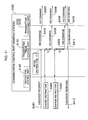
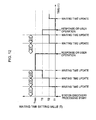
- FIG. 11 shows an example of communication sequence between a starting station and responding stations of station discovery processing in the second embodiment.
- the initial waiting time T1 in the second embodiment is 0. Waiting time is updated each time.
- a discovery request is sent to the communication frame control part 3110 (step S401).
- the communication frame control part 3110 sets the setting value T1 of waiting time (T) in the timer and starts the timer. Since T1 is 0, the communication frame control part 3110 immediately generates an XID command frame and sends it to the transmitting part 3120 (step S402).
- the transmitting part 3120 transmits the XID command frame to other apparatuses (step S403).
- the communication frame control part 3110 If no data is received from other apparatuses in response to the transmission of the XID command, the communication frame control part 3110 notifies the waiting time control part 3140 that no data is received, and changes the waiting time (T) to T2 (step S404).
- the communication frame control part 3110 again sets the setting value T2 of waiting time (T) in the timer and starts the timer.
- the communication frame control part 3110 When the timer becomes equal to T2, the communication frame control part 3110 generates an XID command frame and sends it to the transmitting part 3120 (step S405), and transmits the XID command frame to other apparatuses from the transmitting part 3120 (step S406).
- the communication frame control part 3110 notifies the waiting time control part 3140 that no data is received, and changes the waiting time (T) to T3 (step S407).
- the communication frame control part 3110 again sets the setting value T2 of waiting time (T) in the timer and starts the timer.
- the communication frame control part 3110 generates an XID command frame and sends it to the transmitting part 3120 (step S408), and transmits the XID command frame to other apparatuses from the transmitting part 3120 (step S409).
- the modes of discovery processing can be automatically switched so that if responding stations appear frequently, the discovery processing is rapidly performed, and if responding stations appear infrequently, the discovery processing is performed with low power consumption.
- the infrared communication device in the second embodiment has an optimal configuration for solving the problems of the prior art, it can be physically realized in various ways.
- it may be realized as driver software of infrared communication I/F of personal computers, or the respective functions of the components of the infrared communication device are combined in proper units into hardware modules, and the infrared communication device may be realized by combining the hardware modules.
- the function of the aforementioned communication control part 3100 is realized as software executed by the CPU of the personal computer.
- the hardware modules may be realized by wired logics or a microcomputer.
- the functions of the communication frame control part 3110 and the transmission distance control part 3140 described above are realized by software such as microcodes executed by the microcomputer.
- an infrared communication device to which the present invention is applied have been described in detail.
- the present invention can also apply to other types of wireless communication devices that perform station discovery processing.
- a response collision during discover processing can be prevented by controlling the transmission power of a starting station.
- other wireless communication terminals existing within a minimum distance can be discovered rapidly and without fail.
Landscapes
- Engineering & Computer Science (AREA)
- Computer Networks & Wireless Communication (AREA)
- Signal Processing (AREA)
- Databases & Information Systems (AREA)
- Mobile Radio Communication Systems (AREA)
- Optical Communication System (AREA)
- Detection And Prevention Of Errors In Transmission (AREA)
- Small-Scale Networks (AREA)
Applications Claiming Priority (2)
| Application Number | Priority Date | Filing Date | Title |
|---|---|---|---|
| JP2003023805 | 2003-01-31 | ||
| JP2003023805A JP4108495B2 (ja) | 2003-01-31 | 2003-01-31 | 局発見処理方法および無線通信装置 |
Publications (1)
| Publication Number | Publication Date |
|---|---|
| EP1443720A2 true EP1443720A2 (de) | 2004-08-04 |
Family
ID=32652914
Family Applications (1)
| Application Number | Title | Priority Date | Filing Date |
|---|---|---|---|
| EP04001993A Withdrawn EP1443720A2 (de) | 2003-01-31 | 2004-01-29 | Verfahren zur Stationssuchverarbeitung und drahtloses Kommunikationsgerät |
Country Status (4)
| Country | Link |
|---|---|
| US (1) | US7406093B2 (de) |
| EP (1) | EP1443720A2 (de) |
| JP (1) | JP4108495B2 (de) |
| CN (1) | CN100433578C (de) |
Cited By (2)
| Publication number | Priority date | Publication date | Assignee | Title |
|---|---|---|---|---|
| US9756582B2 (en) | 2013-11-30 | 2017-09-05 | Beijing Zhigu Rui Tuo Tech Co., Ltd | Broadcasting, and scanning for wireless communication |
| US10375653B2 (en) | 2013-11-30 | 2019-08-06 | Beijing Zhigu Rui Tuo Tech Co., Ltd | Reducing power consumption via adapting broadcast power for wireless communications |
Families Citing this family (36)
| Publication number | Priority date | Publication date | Assignee | Title |
|---|---|---|---|---|
| JP3707449B2 (ja) * | 2002-06-10 | 2005-10-19 | ソニー株式会社 | 通信方法、通信システム及び通信機器 |
| EP1780984A4 (de) | 2004-08-06 | 2012-05-30 | Sharp Kk | Sender, empfänger, kommunikationssystem, kommunikationsverfahren und kommunikationsprogramm |
| GB2420053A (en) * | 2004-11-05 | 2006-05-10 | Agilent Technologies Inc | Monitoring synchronisation of signal measurement reports |
| US7787391B2 (en) | 2005-01-28 | 2010-08-31 | Sharp Kabushiki Kaisha | Communication device, communication system, communication method, communication program, and communication circuit |
| US8284684B2 (en) | 2005-01-28 | 2012-10-09 | Sharp Kabushiki Kaisha | Communication device, communication system, communication method, and communication circuit |
| US8051182B2 (en) | 2005-01-28 | 2011-11-01 | Sharp Kabushiki Kaisha | Communication device, communication system, communication method, communication program, and communication circuit |
| CN101964705B (zh) | 2005-01-28 | 2012-08-08 | 夏普株式会社 | 通信设备、通信系统、通信方法、通信程序、通信电路 |
| EP1848178A4 (de) * | 2005-01-28 | 2013-12-04 | Sharp Kk | Einrichtung, system, verfahren, programm und schaltung zur kommunikation |
| JP4701018B2 (ja) * | 2005-06-22 | 2011-06-15 | キヤノン株式会社 | 通信装置及び通信方法 |
| JP4786664B2 (ja) * | 2005-11-10 | 2011-10-05 | シャープ株式会社 | データ送信装置およびその制御方法、データ送信装置制御プログラム、ならびに該プログラムを記録した記録媒体 |
| DE102005056852A1 (de) * | 2005-11-28 | 2007-06-14 | ASTRA Gesellschaft für Asset Management mbH & Co. KG | Wächterschutz- und Kontrollsystem |
| US8559350B2 (en) * | 2005-12-20 | 2013-10-15 | Microsoft Corporation | Mechanism to convey discovery information in a wireless network |
| US7613426B2 (en) * | 2005-12-20 | 2009-11-03 | Microsoft Corporation | Proximity service discovery in wireless networks |
| US8478300B2 (en) * | 2005-12-20 | 2013-07-02 | Microsoft Corporation | Proximity service discovery in wireless networks |
| US20070264991A1 (en) * | 2006-05-15 | 2007-11-15 | Microsoft Corporation | Services near me: discovering and connecting to available wireless services utilizing proximity discovery |
| US10681151B2 (en) | 2006-05-15 | 2020-06-09 | Microsoft Technology Licensing, Llc | Notification framework for wireless networks |
| JP4219950B2 (ja) | 2006-10-16 | 2009-02-04 | シャープ株式会社 | 通信機器、通信方法、通信回路、携帯電話機、プログラム、およびプログラムを記録したコンピュータ読み取り可能な記録媒体 |
| JP2008141253A (ja) * | 2006-11-29 | 2008-06-19 | Sharp Corp | 通信機器、通信方法、通信回路、通信システム、プログラム、およびプログラムを記録したコンピュータ読み取り可能な記録媒体 |
| JP2008141252A (ja) * | 2006-11-29 | 2008-06-19 | Sharp Corp | 通信機器、通信方法、通信回路、通信システム、プログラム、およびプログラムを記録したコンピュータ読み取り可能な記録媒体 |
| CN101584153B (zh) * | 2007-01-16 | 2012-10-10 | 皇家飞利浦电子股份有限公司 | 混合型定向终端的设备发现 |
| US8255537B2 (en) * | 2007-02-14 | 2012-08-28 | Mitsubishi Electric Corporation | Vehicle communication device |
| US8681691B2 (en) * | 2007-07-25 | 2014-03-25 | Microsoft Corporation | Base station initiated proximity service discovery and connection establishment |
| US7974574B2 (en) * | 2007-07-25 | 2011-07-05 | Microsoft Corporation | Base station initiated proximity service discovery and connection establishment |
| JP4314297B2 (ja) * | 2007-12-03 | 2009-08-12 | 株式会社東芝 | 情報処理装置、機器選択処理方法およびプログラム |
| US9105031B2 (en) | 2008-02-22 | 2015-08-11 | Microsoft Technology Licensing, Llc | Authentication mechanisms for wireless networks |
| US8730853B2 (en) | 2008-09-05 | 2014-05-20 | Mediatek Inc. | Methods for responding to co-located coexistence (CLC) request from a mobile electronic device and communications apparatuses capable of controlling multi-radio coexistence |
| US8437275B2 (en) * | 2009-12-11 | 2013-05-07 | Microsoft Corporation | Remote wireless service invocation with efficient power use on target wireless device |
| US9420599B2 (en) * | 2010-03-24 | 2016-08-16 | Mediatek Inc. | Synchronized activity bitmap generation method for co-located coexistence (CLC) devices |
| US8965286B2 (en) * | 2011-05-13 | 2015-02-24 | Nokia Corporation | Inquiry response event control |
| CN102790950B (zh) * | 2011-05-18 | 2016-06-01 | 中兴通讯股份有限公司 | 多接口终端邻居拓扑发现、协作通信方法和多接口终端 |
| JP5930179B2 (ja) * | 2012-03-03 | 2016-06-08 | 公立大学法人広島市立大学 | モバイルアドホックネットワークにおける自律的衝突回避システム及び自律的衝突回避方法 |
| JP6174022B2 (ja) * | 2012-06-06 | 2017-08-02 | 京セラ株式会社 | 通信制御方法、ユーザ端末、プロセッサ、及び記憶媒体 |
| US9124446B2 (en) * | 2012-09-28 | 2015-09-01 | Bristol, Inc. | Methods and apparatus to implement a remote terminal unit network |
| CN103825792B (zh) * | 2014-02-21 | 2015-02-25 | 株洲南车时代电气股份有限公司 | 一种基于组成强度的检测请求帧冲突消解的方法 |
| CN106160953B (zh) * | 2016-07-06 | 2019-04-16 | 四川大学 | 一种基于学习型能效模型的传输方法 |
| CN108446883A (zh) * | 2017-02-16 | 2018-08-24 | 平安科技(深圳)有限公司 | 一种佣金发放处理方法和装置 |
Family Cites Families (7)
| Publication number | Priority date | Publication date | Assignee | Title |
|---|---|---|---|---|
| JPH06169267A (ja) | 1992-11-30 | 1994-06-14 | Matsushita Electric Works Ltd | 移動体識別装置 |
| JPH0730482A (ja) | 1993-07-07 | 1995-01-31 | Nec Corp | 送信出力制御装置 |
| JPH10135955A (ja) * | 1996-10-24 | 1998-05-22 | Nec Eng Ltd | 赤外線通信方法及び赤外線通信システム並びにこれらに用いる送受信装置 |
| WO1999026364A1 (en) * | 1997-11-18 | 1999-05-27 | International Business Machines Corporation | Method for improved wireless optical communication and frames for use in a wireless optical communication system |
| US6104512A (en) * | 1998-01-23 | 2000-08-15 | Motorola, Inc. | Method for adjusting the power level of an infrared signal |
| JP3111966B2 (ja) | 1998-01-30 | 2000-11-27 | 日本電気株式会社 | 携帯電話装置 |
| JP2000349782A (ja) * | 1999-06-08 | 2000-12-15 | Nec Corp | 赤外線送受信装置および赤外線送受信方法 |
-
2003
- 2003-01-31 JP JP2003023805A patent/JP4108495B2/ja not_active Expired - Lifetime
-
2004
- 2004-01-29 EP EP04001993A patent/EP1443720A2/de not_active Withdrawn
- 2004-02-02 US US10/768,008 patent/US7406093B2/en not_active Expired - Lifetime
- 2004-02-02 CN CNB2004100040876A patent/CN100433578C/zh not_active Expired - Fee Related
Cited By (2)
| Publication number | Priority date | Publication date | Assignee | Title |
|---|---|---|---|---|
| US9756582B2 (en) | 2013-11-30 | 2017-09-05 | Beijing Zhigu Rui Tuo Tech Co., Ltd | Broadcasting, and scanning for wireless communication |
| US10375653B2 (en) | 2013-11-30 | 2019-08-06 | Beijing Zhigu Rui Tuo Tech Co., Ltd | Reducing power consumption via adapting broadcast power for wireless communications |
Also Published As
| Publication number | Publication date |
|---|---|
| JP4108495B2 (ja) | 2008-06-25 |
| JP2004236108A (ja) | 2004-08-19 |
| US20040170134A1 (en) | 2004-09-02 |
| CN1520062A (zh) | 2004-08-11 |
| CN100433578C (zh) | 2008-11-12 |
| US7406093B2 (en) | 2008-07-29 |
Similar Documents
| Publication | Publication Date | Title |
|---|---|---|
| EP1443720A2 (de) | Verfahren zur Stationssuchverarbeitung und drahtloses Kommunikationsgerät | |
| JP4477882B2 (ja) | 無線ローカル・エリア・ネットワーク中の隠れノードの検出 | |
| CN102685923B (zh) | 用于多模式无线电操作的系统和方法 | |
| US7224954B2 (en) | Method and device for communicating via an ad-hoc wireless network | |
| EP1280296B1 (de) | Bluetooth Ausserbandmanagement und -verkehrsüberwachung für drahtlose Zugangspunkte | |
| CN1829112B (zh) | 通信装置和方法 | |
| JPH10210053A (ja) | ワイアレスコンピュータネットワークの移動局 | |
| US20170270065A1 (en) | Hardware control interface for ieee standard 802.11 | |
| US20060104200A1 (en) | Terminal for automatically changing operating mode and wireless network system having the same, and method thereof | |
| EP2022192A1 (de) | Verfahren und vorrichtung zur handover-durchführung mit verbessertem durchsatz | |
| KR20050107427A (ko) | 서비스 주기의 동기화 방법 및 시스템 | |
| US6999443B1 (en) | Hardware MAC | |
| JP2005101788A (ja) | 無線通信システムおよび無線通信装置 | |
| EP1629630B1 (de) | Deaktivierung wenigstens teilweise von Empfängern als Antwort auf die wenigstens teilweise Ermittlung der Existenz einer Leerlaufbedingung | |
| EP1505759B1 (de) | Verfahren und Gerät zum Übertragen/Empfangen von Daten mittels bestätigter Transportschichtprotokolle | |
| EP2375679B1 (de) | Drahtloses Kommunikationssystem, Informations- und Kommunikationsendgerät, Mobiltelefon, Lese-/Schreibgerät, Kommunikationsverfahren und Computerprogramm | |
| EP1597870B1 (de) | Verfahren und system für handoff zu einer ziel-basisstation durch messung von trägersignal-feldstärken während mindestens einer csma-backoff zeit | |
| US20020013148A1 (en) | Telephone set identifying method, telephone set type identifying apparatus, processing apparatus and storage medium | |
| JP2003069492A (ja) | 無線通信装置 | |
| CN1953387B (zh) | 移动站及其在省电模式下侦测攻击的方法 | |
| JP2026011352A (ja) | 通信装置、通信方法、及びプログラム | |
| CN121510230A (zh) | 用于nfc终端的低功耗通信方法及装置、nfc终端 | |
| JPH0847045A (ja) | デジタル無線通信システム | |
| KR20010094376A (ko) | 더블유엘엘 단말기의 소프트웨어 핸드쉐이크 방법. | |
| JPH04183031A (ja) | 通信システムの端末装置 |
Legal Events
| Date | Code | Title | Description |
|---|---|---|---|
| PUAI | Public reference made under article 153(3) epc to a published international application that has entered the european phase |
Free format text: ORIGINAL CODE: 0009012 |
|
| AK | Designated contracting states |
Kind code of ref document: A2 Designated state(s): AT BE BG CH CY CZ DE DK EE ES FI FR GB GR HU IE IT LI LU MC NL PT RO SE SI SK TR |
|
| AX | Request for extension of the european patent |
Extension state: AL LT LV MK |
|
| RAP1 | Party data changed (applicant data changed or rights of an application transferred) |
Owner name: PANASONIC CORPORATION |
|
| STAA | Information on the status of an ep patent application or granted ep patent |
Free format text: STATUS: THE APPLICATION HAS BEEN WITHDRAWN |
|
| 18W | Application withdrawn |
Effective date: 20090910 |