EP1438348B1 - Conjugated polymer preparation via suzuki-coupling in emulsion - Google Patents
Conjugated polymer preparation via suzuki-coupling in emulsion Download PDFInfo
- Publication number
- EP1438348B1 EP1438348B1 EP02770088A EP02770088A EP1438348B1 EP 1438348 B1 EP1438348 B1 EP 1438348B1 EP 02770088 A EP02770088 A EP 02770088A EP 02770088 A EP02770088 A EP 02770088A EP 1438348 B1 EP1438348 B1 EP 1438348B1
- Authority
- EP
- European Patent Office
- Prior art keywords
- group
- groups
- solvent
- monomers
- boron
- Prior art date
- Legal status (The legal status is an assumption and is not a legal conclusion. Google has not performed a legal analysis and makes no representation as to the accuracy of the status listed.)
- Expired - Lifetime
Links
Images
Classifications
-
- C—CHEMISTRY; METALLURGY
- C08—ORGANIC MACROMOLECULAR COMPOUNDS; THEIR PREPARATION OR CHEMICAL WORKING-UP; COMPOSITIONS BASED THEREON
- C08G—MACROMOLECULAR COMPOUNDS OBTAINED OTHERWISE THAN BY REACTIONS ONLY INVOLVING UNSATURATED CARBON-TO-CARBON BONDS
- C08G61/00—Macromolecular compounds obtained by reactions forming a carbon-to-carbon link in the main chain of the macromolecule
- C08G61/12—Macromolecular compounds containing atoms other than carbon in the main chain of the macromolecule
- C08G61/122—Macromolecular compounds containing atoms other than carbon in the main chain of the macromolecule derived from five- or six-membered heterocyclic compounds, other than imides
- C08G61/123—Macromolecular compounds containing atoms other than carbon in the main chain of the macromolecule derived from five- or six-membered heterocyclic compounds, other than imides derived from five-membered heterocyclic compounds
- C08G61/126—Macromolecular compounds containing atoms other than carbon in the main chain of the macromolecule derived from five- or six-membered heterocyclic compounds, other than imides derived from five-membered heterocyclic compounds with a five-membered ring containing one sulfur atom in the ring
-
- C—CHEMISTRY; METALLURGY
- C08—ORGANIC MACROMOLECULAR COMPOUNDS; THEIR PREPARATION OR CHEMICAL WORKING-UP; COMPOSITIONS BASED THEREON
- C08G—MACROMOLECULAR COMPOUNDS OBTAINED OTHERWISE THAN BY REACTIONS ONLY INVOLVING UNSATURATED CARBON-TO-CARBON BONDS
- C08G61/00—Macromolecular compounds obtained by reactions forming a carbon-to-carbon link in the main chain of the macromolecule
- C08G61/02—Macromolecular compounds containing only carbon atoms in the main chain of the macromolecule, e.g. polyxylylenes
- C08G61/10—Macromolecular compounds containing only carbon atoms in the main chain of the macromolecule, e.g. polyxylylenes only aromatic carbon atoms, e.g. polyphenylenes
-
- C—CHEMISTRY; METALLURGY
- C08—ORGANIC MACROMOLECULAR COMPOUNDS; THEIR PREPARATION OR CHEMICAL WORKING-UP; COMPOSITIONS BASED THEREON
- C08G—MACROMOLECULAR COMPOUNDS OBTAINED OTHERWISE THAN BY REACTIONS ONLY INVOLVING UNSATURATED CARBON-TO-CARBON BONDS
- C08G61/00—Macromolecular compounds obtained by reactions forming a carbon-to-carbon link in the main chain of the macromolecule
- C08G61/12—Macromolecular compounds containing atoms other than carbon in the main chain of the macromolecule
-
- C—CHEMISTRY; METALLURGY
- C08—ORGANIC MACROMOLECULAR COMPOUNDS; THEIR PREPARATION OR CHEMICAL WORKING-UP; COMPOSITIONS BASED THEREON
- C08G—MACROMOLECULAR COMPOUNDS OBTAINED OTHERWISE THAN BY REACTIONS ONLY INVOLVING UNSATURATED CARBON-TO-CARBON BONDS
- C08G61/00—Macromolecular compounds obtained by reactions forming a carbon-to-carbon link in the main chain of the macromolecule
- C08G61/12—Macromolecular compounds containing atoms other than carbon in the main chain of the macromolecule
- C08G61/122—Macromolecular compounds containing atoms other than carbon in the main chain of the macromolecule derived from five- or six-membered heterocyclic compounds, other than imides
- C08G61/123—Macromolecular compounds containing atoms other than carbon in the main chain of the macromolecule derived from five- or six-membered heterocyclic compounds, other than imides derived from five-membered heterocyclic compounds
- C08G61/125—Macromolecular compounds containing atoms other than carbon in the main chain of the macromolecule derived from five- or six-membered heterocyclic compounds, other than imides derived from five-membered heterocyclic compounds with a five-membered ring containing one oxygen atom in the ring
-
- C—CHEMISTRY; METALLURGY
- C09—DYES; PAINTS; POLISHES; NATURAL RESINS; ADHESIVES; COMPOSITIONS NOT OTHERWISE PROVIDED FOR; APPLICATIONS OF MATERIALS NOT OTHERWISE PROVIDED FOR
- C09K—MATERIALS FOR MISCELLANEOUS APPLICATIONS, NOT PROVIDED FOR ELSEWHERE
- C09K11/00—Luminescent materials, e.g. electroluminescent or chemiluminescent
- C09K11/06—Luminescent materials, e.g. electroluminescent or chemiluminescent containing organic luminescent materials
-
- C—CHEMISTRY; METALLURGY
- C09—DYES; PAINTS; POLISHES; NATURAL RESINS; ADHESIVES; COMPOSITIONS NOT OTHERWISE PROVIDED FOR; APPLICATIONS OF MATERIALS NOT OTHERWISE PROVIDED FOR
- C09K—MATERIALS FOR MISCELLANEOUS APPLICATIONS, NOT PROVIDED FOR ELSEWHERE
- C09K2211/00—Chemical nature of organic luminescent or tenebrescent compounds
- C09K2211/14—Macromolecular compounds
- C09K2211/1408—Carbocyclic compounds
- C09K2211/1416—Condensed systems
-
- C—CHEMISTRY; METALLURGY
- C09—DYES; PAINTS; POLISHES; NATURAL RESINS; ADHESIVES; COMPOSITIONS NOT OTHERWISE PROVIDED FOR; APPLICATIONS OF MATERIALS NOT OTHERWISE PROVIDED FOR
- C09K—MATERIALS FOR MISCELLANEOUS APPLICATIONS, NOT PROVIDED FOR ELSEWHERE
- C09K2211/00—Chemical nature of organic luminescent or tenebrescent compounds
- C09K2211/14—Macromolecular compounds
- C09K2211/1408—Carbocyclic compounds
- C09K2211/1425—Non-condensed systems
-
- C—CHEMISTRY; METALLURGY
- C09—DYES; PAINTS; POLISHES; NATURAL RESINS; ADHESIVES; COMPOSITIONS NOT OTHERWISE PROVIDED FOR; APPLICATIONS OF MATERIALS NOT OTHERWISE PROVIDED FOR
- C09K—MATERIALS FOR MISCELLANEOUS APPLICATIONS, NOT PROVIDED FOR ELSEWHERE
- C09K2211/00—Chemical nature of organic luminescent or tenebrescent compounds
- C09K2211/14—Macromolecular compounds
- C09K2211/1408—Carbocyclic compounds
- C09K2211/1433—Carbocyclic compounds bridged by heteroatoms, e.g. N, P, Si or B
-
- C—CHEMISTRY; METALLURGY
- C09—DYES; PAINTS; POLISHES; NATURAL RESINS; ADHESIVES; COMPOSITIONS NOT OTHERWISE PROVIDED FOR; APPLICATIONS OF MATERIALS NOT OTHERWISE PROVIDED FOR
- C09K—MATERIALS FOR MISCELLANEOUS APPLICATIONS, NOT PROVIDED FOR ELSEWHERE
- C09K2211/00—Chemical nature of organic luminescent or tenebrescent compounds
- C09K2211/14—Macromolecular compounds
- C09K2211/1441—Heterocyclic
- C09K2211/145—Heterocyclic containing oxygen as the only heteroatom
-
- C—CHEMISTRY; METALLURGY
- C09—DYES; PAINTS; POLISHES; NATURAL RESINS; ADHESIVES; COMPOSITIONS NOT OTHERWISE PROVIDED FOR; APPLICATIONS OF MATERIALS NOT OTHERWISE PROVIDED FOR
- C09K—MATERIALS FOR MISCELLANEOUS APPLICATIONS, NOT PROVIDED FOR ELSEWHERE
- C09K2211/00—Chemical nature of organic luminescent or tenebrescent compounds
- C09K2211/14—Macromolecular compounds
- C09K2211/1441—Heterocyclic
- C09K2211/1458—Heterocyclic containing sulfur as the only heteroatom
-
- C—CHEMISTRY; METALLURGY
- C09—DYES; PAINTS; POLISHES; NATURAL RESINS; ADHESIVES; COMPOSITIONS NOT OTHERWISE PROVIDED FOR; APPLICATIONS OF MATERIALS NOT OTHERWISE PROVIDED FOR
- C09K—MATERIALS FOR MISCELLANEOUS APPLICATIONS, NOT PROVIDED FOR ELSEWHERE
- C09K2211/00—Chemical nature of organic luminescent or tenebrescent compounds
- C09K2211/14—Macromolecular compounds
- C09K2211/1441—Heterocyclic
- C09K2211/1466—Heterocyclic containing nitrogen as the only heteroatom
-
- C—CHEMISTRY; METALLURGY
- C09—DYES; PAINTS; POLISHES; NATURAL RESINS; ADHESIVES; COMPOSITIONS NOT OTHERWISE PROVIDED FOR; APPLICATIONS OF MATERIALS NOT OTHERWISE PROVIDED FOR
- C09K—MATERIALS FOR MISCELLANEOUS APPLICATIONS, NOT PROVIDED FOR ELSEWHERE
- C09K2211/00—Chemical nature of organic luminescent or tenebrescent compounds
- C09K2211/14—Macromolecular compounds
- C09K2211/1441—Heterocyclic
- C09K2211/1483—Heterocyclic containing nitrogen and sulfur as heteroatoms
-
- Y—GENERAL TAGGING OF NEW TECHNOLOGICAL DEVELOPMENTS; GENERAL TAGGING OF CROSS-SECTIONAL TECHNOLOGIES SPANNING OVER SEVERAL SECTIONS OF THE IPC; TECHNICAL SUBJECTS COVERED BY FORMER USPC CROSS-REFERENCE ART COLLECTIONS [XRACs] AND DIGESTS
- Y10—TECHNICAL SUBJECTS COVERED BY FORMER USPC
- Y10S—TECHNICAL SUBJECTS COVERED BY FORMER USPC CROSS-REFERENCE ART COLLECTIONS [XRACs] AND DIGESTS
- Y10S428/00—Stock material or miscellaneous articles
- Y10S428/917—Electroluminescent
Definitions
- the present invention relates to a process for the preparation of a conjugated polymer, in particular conjugated polymers suitable for use as an active material in organic semiconductor devices including optical devices such as electroluminescent or photovoltaic devices.
- Conjugated polyarylenes are widely used as the active material.
- examples of such materials include polyfluorenes as disclosed in, for example, WO 99/54385 , spirofluorenes as disclosed in, for example, EP 0707020 , polyphenylenes as disclosed in, for example, G.Grem, G. Leditzky, B. Ullrich, G. Leising, Adv. Mater. (1992), 4. 36 and phenylene-thienylene copolymers as disclosed in, for example, K.Kaeriyama et al, Synth. Met. (2000), 111-112, 519-522 .
- Polyarylenes may suitably be prepared by Suzuki or Yamamoto polymerisation. Of these two techniques, Suzuki polymerisation is the only technique that enables exertion of control over the regioregularity of the copolymer. Thus Suzuki polymerisation may be used to generate AB, block or random copolymers depending on the relative quantities of boron and halo monomers used.
- polyarylenes for use in the aforementioned optical devices it is desirable for polyarylenes for use in the aforementioned optical devices to be of high molecular weight as this improves their processability. High viscosity is also advantageous for certain applications.
- a known drawback of Suzuki polymerisation is the difficulty in reproducibly generating high molecular weight polymers. This has been attributed to the problem of side reactions competing with the polymerisation, e.g. reductive elimination and deboronation of the monomers, which limit the molecular weight of the polymer. These side reactions are initially relatively insignificant but become prevalent at longer reaction times. A fast reaction rate is therefore desirable from the point of view of obtaining high molecular weight material.
- US 5777070 discloses the use of the phase transfer catalyst tricaprylylmethyl ammonium chloride in Suzuki polymerisation reactions to facilitate the movement of the reactive boronate species between the organic and aqueous phases of the reaction mixture.
- GB 2360291 describes the use of tetraalkyl ammonium boronate salts soluble in the organic phase such that the polymerisation reaction takes place in a single phase.
- the invention provides a method for preparing a conjugated polymer, a specified in the claims.
- conjugated polymer refers to either a fully conjugated polymer i. e. a polymer which is conjugated along the full length of its chain, or a partially conjugated polymer i.e. a polymer which contains conjugated segments together with non-conjugated segments.
- emulsion refers to a colloidal suspension comprising a first solvent dispersed within a second solvent, or vice-versa, wherein each of said first and second solvents contain reactive species dissolved therein during at least part of the reaction.
- emulsifier refers to a substance that coats the particles of the dispersed solvent and prevents coagulation of colloidal particles.
- the boron anionic group is of formula -B(OR) 3 - wherein each R is independently selected from hydrogen or optionally substituted alkyl or aryl and two R groups may be linked.
- the emulsifier is used in an amount ranging from 1-20% w/v, more preferably in an amount ranging from 1-10% w/v.
- the first solvent is selected from the group comprising alkylated aromatics.
- the first solvent is toluene.
- the second solvent is preferably water.
- the ratio of first solvent to second solvent may range from 0.1:1 up to 10:1 by volume. Preferably, the ratio is in the range 1:1 up to 10:1.
- the monomers are selected from the group consisting of optionally substituted arylenes, heteroaromatics and fused aromatic systems.
- at least one of the monomers comprises a triarylamine, a phenylene, a thiophene, a benzothiadiazole or a fluorene wherein each of said monomers is optionally substituted by an alkyl or alkoxy group.
- Particularly preferred types of monomers include dialkylphenylenes, dialkoxy phenylenes, substituted and non-substituted thiophenes and benzothiadiazoles, and dialkylfluorenes such as 9,9-di-n-octylfluorenes.
- One or more of the monomers could also be a pre-formed oligomeric or polymeric chain comprising several smaller units with the necessary functional groups provided at the desired positions on the chain.
- this invention could also be extended to the use of monomers in which some or all of the functional groups are not directly substituted on an aromatic ring, in particular to other kinds of unsaturated monomers.
- the catalyst used in the method of the present invention is preferably a palladium catalyst
- the palladium catalyst may be a Pd (0) or Pd (II) species.
- Particularly preferred catalysts include Pd(Ph 3 P) 4 and PdCl 2 (Ph 3 P) 2 .
- the amount of palladium catalyst in the reaction mixture is 0.01 to 1 mol. %, preferably about 0.15 mol. %, based on the total number of moles of monomers used.
- the base may be an inorganic base such as a hydroxide, carbonate or hydrogencarbonate of an alkali or alkali earth metal.
- the base is an organic base, for example a tetraalkylammonium hydroxide, tetraalkylammonium carbonate or tetraalkylammonium hydrogencarbonate.
- the polymer produced is a semiconductive conjugated polymer, in particular a semiconductive conjugated luminescent polymer.
- the invention provides a process for the production of an optical device or acomponent for an optical device, which comprises providing a substrate and producing a polymer in accordance with the process of any one of the preceding claims, whereby the polymer is supported by the substrate.
- the optical device comprises an electroluminescent device or photovoltaic device.
- the present invention provides a method for the reproducible production of high molecular weight polymer in a short time. This is achieved by means of the emulsion which greatly increases the surface contact area between the two phases of the reaction mixture as compared with prior art systems.
- the process of the present invention applies to the polymerisation of monomers by Suzuki polymerisation. Accordingly, known methodology for Suzuki polymerisation as disclosed in, for example, WO 00/53656 or the aforementioned prior art, is applicable to the present invention.
- the process of the invention may be applied to a wide range of aromatic monomers such as fluorenes, phenylenes, heteroaromatics and triarylamines.
- triarylamine repeat units derived from triarylamine monomers include units of formulae 1-6:
- X and Y may be the same or different and are substituent groups.
- A, B, C and D may be the same or different and are substituent groups. It is preferred that one or more of X, Y, A, B, C and D is independently selected from the group consisting of alkyl, aryl, perfluoroalkyl, thioalkyl, cyano, alkoxy, heteroaryl, alkylaryl and arylalkyl groups.
- One or more of X, Y, A, B, C and D also may be hydrogen.
- one or more of X, Y, A, B, C and D is independently an unsubstituted, isobutyl group, an n-alkyl, an n-alkoxy or a trifluoromethyl group because they are suitable for helping to select the HOMO level and/or for improving solubility of the polymer.
- heteroaryl repeat units include units of formulae 7-21: wherein R 6 and R 7 are the same or different and are each independently hydrogen or a substituent group, preferably alkyl, aryl, perfluoroalkyl, thioalkyl, cyano, alkoxy, heteroaryl, alkylaryl or arylalkyl.
- R 6 and R 7 are preferably the same. More preferably, they are the same and are each a phenyl group.
- the first and second solvents may each independently comprise a single solvent or may comprise a blend of miscible solvents.
- emulsifiers include the following, available from either Aldrich Chemicals or Raschig GmbH: poly(ethylene glycol)-block-polypropylene glycol)-block-poly(ethyleneglycol) Mn 4400, Mn 1100, Mn 1900, Mn 8400, Mn 5800, Mn 2800, or Mn 2000; poly(ethylene glycol) 4-nonylphenyl ether acrylate Mn 450, poly(ethylene glycol) 4-nonylphenyl 3-sulfopropyl ether, potassium salt 9 EO/Mole, 20 EO/Mole, poly(ethylene glycol) methyl ether Mn 350, Mn 550, Mn 750, Mn 2000, or Mn 5000; poly(ethylene glycol) n-alkyl 3-sulfopropyl ether, potassium salt 7 EO/mole or 11 EO/mole; poly(ethylene glycol) Mn 10000, Mn 8000, Mn 4600, Mn 3400,
- Polymers preparable according to the invention include, but are not limited to" straight chain, branched and dendrimeric polymers.
- These polymers may have hole transporting, electron transporting and / or emissive properties.
- the polymer may have one or more of these properties. Where the polymer has more than one of these properties, different properties may be provided by different segments of the polymer, in particular segments of the polymer backbone as described in WO 00/55927 or pendant groups as described in WO 02/26859 . Alternatively, if the polymer of the invention has only one or two of the properties of hole transport, electron transport and emission, it may be blended with one or more further polymers having the remaining required property or properties.
- the monomers must each have the appropriate functional groups for the Suzuki reaction.
- a first reactive dihalide monomer is polymerised with a second monomer having two boron derivative functional groups.
- the first and the second monomers may be the same or different.
- a monomer having a boron derivative functional group and a reactive halide functional group is polymerised to form a homopolymer. It is also possible to form copolymers from this second arrangement simply by polymerising together two or more different types of monomers each containing both functionalities.
- the reactive halide functional group on the reactive dihalide monomer or the monomer having the reactive halide functional group is Br or I although it is possible to use instead groups such as chlorine, triflate (CF 3 SO 3 -), tosylate and mesylate.
- the boronic acid group is represented by -B(OH) 2 ;
- the boronic ester group is preferably -B(OR 1 )(OR 2 ) or -B(OR 5 O) and the borane group is preferably -BR 3 R 4 , wherein R 1 is a substituted or non-substituted C 1 -C 6 alkyl group and R 2 is H or a substituted or non-substituted C 1 -C 6 alkyl group;
- R 3 and R 4 are each independently substituted or nonsubstituted C 1 -C 6 alkyl groups, and
- R 5 is a substituted or non-substituted divalent hydrocarbon radical resulting in a 5 or 6 membered ester ring.
- suitable groups as R 5 include substituted or non-substituted C2 or C3 alkylene groups, or substituted or non-substituted ortho-or meta- phenylene groups.
- Suitable boronic ester groups include, for example, the products of esterification of the corresponding boronic acid group with monovalent C 1 -C 6 alcohols, ethane diols such as ethylene glycol, pinacol, propane diols or ortho aromatic diols such as 1,2-dihydroxybenzene.
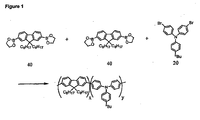
- a reaction vessel as described above was charged with 9,9-dioctylfluorene-2,7di(ethylenylboronate) (50.56 g; 95.33 mmol; 1.0 eq.), 2,7-dibromo-9,9'-dioctylfluorene (41.83 g; 76.26 mmol; 0.8 eq.).
- N,N-bis(4-bromophenyl)-N-(4-sec-butylphenyl)amine (8.76 g; 19.07 mmol; 0.2 eq.), toluene and emulsifier.
- the mixture was stirred for 5 minutes at room temperature and then degassed for 1 hour with a nitrogen sparge.
- Dichloro-bis(triphenylphosphine) palladium (0.21 g; 0.3 mmol; 0.003 eq.) was then added and followed by addition of 20% w/w aqueous tetraethylammonium hydroxide (available from Fluka Chemicals) (320 mL) at which point formation of an emulsion was observed.
- the stirring mixture was heated to arid maintained at reflux until the torque or viscosity no longer increased, or the reaction mixture gelled. In the event of gellation, additional toluene was added.
- the mixture was allowed to cool to room temperature and poured slowly into methanol to precipitate the polymer.
- the crude polymer was recovered by filtration, washed with fresh methanol polymer and then redissolved in toluene.
- the toluene solution is warmed to 65°C and washed with diethyldithiocarbamic acid sodium salt solution, dilute hydrochloric acid, aqueous sodium acetate and deionised water.
- the toluene phase was separated and filtered through Celite 545 (available from Aldrich Chemicals) and eluted with toluene.
- the toluene eluant was then concentrated in vacuo, the polymer was precipitated from it with methanol, isolated by filtration and dried in vacuo.
- the reaction was performed with varying emulsifiers, quantitites of emulsifiers, and quantities of solvents as illustrated in the table below wherein percentage weight of emulsifier per unit volume is calculated by multiplying the weight of emulsifier in grammes by the combined volume of toluene and aqueous base in millilitres.
- Example Emulsifier (g; % w/v) Toluene (mL) Product Mp 1 PEG-PPG-PEG 500 205,000 1 Mn 4400 (82g; 10) 2 PEG-PPG-PEG 500 304,000 1 Mn 4400 (20.5g; 2.5) 3 PEG-PPG-PEG 1000 323,000 1 Mn 4400 (82g; 6.2) 4 PEG-PPG-PEG 1500 379,000 2 Mn 4400 (82g; 4.5) 5 PEG-PPG-PEG 2000 330,000 1 Mn 4400 (82g; 3.5) 6 PEG-PPG-PEG 2500 320,000 1 Mn 4400 (82g; 2.9) 7 PEG-4NP-3SPE 1000 302,000 1 (30g; 2.2) 1 Mp after purification 2 Mp before end-capping
Landscapes
- Chemical & Material Sciences (AREA)
- Organic Chemistry (AREA)
- Health & Medical Sciences (AREA)
- Chemical Kinetics & Catalysis (AREA)
- Medicinal Chemistry (AREA)
- Polymers & Plastics (AREA)
- Engineering & Computer Science (AREA)
- Materials Engineering (AREA)
- Polyoxymethylene Polymers And Polymers With Carbon-To-Carbon Bonds (AREA)
- Compositions Of Macromolecular Compounds (AREA)
- Polysaccharides And Polysaccharide Derivatives (AREA)
Applications Claiming Priority (3)
| Application Number | Priority Date | Filing Date | Title |
|---|---|---|---|
| GB0125621 | 2001-10-25 | ||
| GBGB0125621.3A GB0125621D0 (en) | 2001-10-25 | 2001-10-25 | Polymer preparation |
| PCT/GB2002/004752 WO2003035713A1 (en) | 2001-10-25 | 2002-10-22 | Conjugated polymer preparation via suzuki-coupling in emulsion |
Publications (2)
| Publication Number | Publication Date |
|---|---|
| EP1438348A1 EP1438348A1 (en) | 2004-07-21 |
| EP1438348B1 true EP1438348B1 (en) | 2011-04-06 |
Family
ID=9924509
Family Applications (1)
| Application Number | Title | Priority Date | Filing Date |
|---|---|---|---|
| EP02770088A Expired - Lifetime EP1438348B1 (en) | 2001-10-25 | 2002-10-22 | Conjugated polymer preparation via suzuki-coupling in emulsion |
Country Status (7)
| Country | Link |
|---|---|
| US (1) | US7074884B2 (enExample) |
| EP (1) | EP1438348B1 (enExample) |
| JP (1) | JP4083121B2 (enExample) |
| AT (1) | ATE504613T1 (enExample) |
| DE (1) | DE60239695D1 (enExample) |
| GB (1) | GB0125621D0 (enExample) |
| WO (1) | WO2003035713A1 (enExample) |
Families Citing this family (17)
| Publication number | Priority date | Publication date | Assignee | Title |
|---|---|---|---|---|
| SG111090A1 (en) * | 2002-10-25 | 2005-05-30 | Agency Science Tech & Res | Cationic water-soluble conjugated polymers and their precursors |
| EP1660608B1 (en) * | 2003-08-19 | 2015-07-08 | Merck Patent GmbH | Oligomer and polymer comprising triphenyl phosphine units |
| KR100718103B1 (ko) * | 2003-12-09 | 2007-05-14 | 삼성에스디아이 주식회사 | 발광 고분자 및 이를 이용한 유기 전계 발광 소자 |
| KR20070006719A (ko) * | 2004-01-28 | 2007-01-11 | 솔베이 어드밴스트 폴리머스 엘.엘.씨. | 지지된 전이금속 촉매작용을 통한 치환 폴리페닐렌 |
| US9109081B2 (en) * | 2005-02-16 | 2015-08-18 | Sumitomo Chemical Company, Limited | Method for producing aromatic polymer |
| EP1754736B1 (en) | 2005-08-16 | 2011-05-11 | Merck Patent GmbH | Process for the polymerisation of thiophene or selenophene derivatives |
| ATE509055T1 (de) | 2005-08-16 | 2011-05-15 | Merck Patent Gmbh | Verfahren zur polymerisation von thiophen- oder selenophenderivaten |
| US20080074048A1 (en) * | 2006-05-25 | 2008-03-27 | Washington, University Of | Electroluminescent device having a surfactant-coated cathode |
| WO2008016090A1 (fr) * | 2006-07-31 | 2008-02-07 | Sumitomo Chemical Company, Limited | Procédé de production d'un composé polymère |
| JP2008056911A (ja) * | 2006-07-31 | 2008-03-13 | Sumitomo Chemical Co Ltd | 高分子化合物の製造方法 |
| US8436197B2 (en) * | 2007-10-25 | 2013-05-07 | West Chester University Of Pennsylvania Of The State System Of Higher Education | Palladium complexes and polymerization and coupling processes thereof |
| DE102008049037A1 (de) * | 2008-09-25 | 2010-04-22 | Merck Patent Gmbh | Neue Polymere mit niedriger Polydispersität |
| CN102753598B (zh) * | 2010-04-23 | 2014-01-01 | 海洋王照明科技股份有限公司 | 含蒽和苯并硒二唑类共聚物、其制造方法和应用 |
| KR101374377B1 (ko) | 2011-04-26 | 2014-03-18 | 국립대학법인 울산과학기술대학교 산학협력단 | 좁은 밴드갭을 갖는 평면성 공중합물 및 이를 이용한 유기 고분자 박막 태양 전지 소자 |
| GB201317966D0 (en) * | 2013-10-10 | 2013-11-27 | Univ Manchester | Nanoparticles |
| GB201405523D0 (en) | 2014-03-27 | 2014-05-14 | Sumitomo Chemical Co | Method of forming a polymer |
| GB2588100B (en) * | 2019-10-04 | 2022-09-07 | Sumitomo Chemical Co | Process of forming a conjugated polymer |
Family Cites Families (8)
| Publication number | Priority date | Publication date | Assignee | Title |
|---|---|---|---|---|
| DE4436773A1 (de) | 1994-10-14 | 1996-04-18 | Hoechst Ag | Konjugierte Polymere mit Spirozentren und ihre Verwendung als Elektrolumineszenzmaterialien |
| DE69608446T3 (de) * | 1995-07-28 | 2010-03-11 | Sumitomo Chemical Company, Ltd. | 2,7-aryl-9-substituierte fluorene und 9-substituierte fluorenoligomere und polymere |
| US6309763B1 (en) | 1997-05-21 | 2001-10-30 | The Dow Chemical Company | Fluorene-containing polymers and electroluminescent devices therefrom |
| US5777070A (en) * | 1997-10-23 | 1998-07-07 | The Dow Chemical Company | Process for preparing conjugated polymers |
| KR100697861B1 (ko) | 1998-03-13 | 2007-03-22 | 캠브리지 디스플레이 테크놀로지 리미티드 | 전장 발광 디바이스들 |
| DE60035970T2 (de) * | 1999-03-05 | 2008-05-15 | Cambridge Display Technology Ltd. | Polymerherstellung |
| GB2360291A (en) | 2000-03-16 | 2001-09-19 | Cambridge Display Tech Ltd | Polymer preparation |
| EP1322692B1 (en) | 2000-09-26 | 2006-12-13 | Cambridge Display Technology Limited | Polymer and uses thereof |
-
2001
- 2001-10-25 GB GBGB0125621.3A patent/GB0125621D0/en not_active Ceased
-
2002
- 2002-10-22 JP JP2003538225A patent/JP4083121B2/ja not_active Expired - Fee Related
- 2002-10-22 DE DE60239695T patent/DE60239695D1/de not_active Expired - Lifetime
- 2002-10-22 WO PCT/GB2002/004752 patent/WO2003035713A1/en not_active Ceased
- 2002-10-22 AT AT02770088T patent/ATE504613T1/de not_active IP Right Cessation
- 2002-10-22 US US10/493,650 patent/US7074884B2/en not_active Expired - Lifetime
- 2002-10-22 EP EP02770088A patent/EP1438348B1/en not_active Expired - Lifetime
Also Published As
| Publication number | Publication date |
|---|---|
| JP4083121B2 (ja) | 2008-04-30 |
| DE60239695D1 (de) | 2011-05-19 |
| US20050037230A1 (en) | 2005-02-17 |
| WO2003035713A1 (en) | 2003-05-01 |
| GB0125621D0 (en) | 2001-12-19 |
| ATE504613T1 (de) | 2011-04-15 |
| EP1438348A1 (en) | 2004-07-21 |
| JP2005506418A (ja) | 2005-03-03 |
| US7074884B2 (en) | 2006-07-11 |
Similar Documents
| Publication | Publication Date | Title |
|---|---|---|
| US7074884B2 (en) | Conjugated polymer preparation via Suzuki-coupling in emulsion | |
| JP5372402B2 (ja) | 芳香族モノマーの重合のためのスズキ法の改良 | |
| US9023978B2 (en) | Solution-processable phosphorescent materials | |
| JP4566185B2 (ja) | カルバゾールを含有する共役系ポリマー及びブレンド、その製造及びその使用 | |
| CN101215370B (zh) | 取代的芴聚合物,其制备方法和在光学设备中的用途 | |
| JP2009091591A (ja) | 重合体およびその調製方法と使用方法 | |
| US20130334505A1 (en) | Polymers, Their Preparation and Uses | |
| US20070032632A1 (en) | Electroluminescence polymer, organic el device, and display | |
| JP2004510039A (ja) | ポリマーおよびその使用方法 | |
| JP2009520864A5 (enExample) | ||
| CN104822797B (zh) | 形成聚合物的方法 | |
| Langecker et al. | Iridium‐functionalized polyfluorenes: Advantages and limitations of the Suzuki and Yamamoto approaches | |
| JP4218340B2 (ja) | 高分子化合物の製造方法 | |
| WO2013031638A1 (ja) | ボラン化合物と共役高分子化合物とを含む組成物及び素子 | |
| CN101184811B (zh) | 高分子组合物以及高分子发光元件 | |
| HK1081984B (en) | Solution-processable phosphorescent materials | |
| HK1158247A (en) | Solution-processable phosphorescent materials |
Legal Events
| Date | Code | Title | Description |
|---|---|---|---|
| PUAI | Public reference made under article 153(3) epc to a published international application that has entered the european phase |
Free format text: ORIGINAL CODE: 0009012 |
|
| 17P | Request for examination filed |
Effective date: 20040420 |
|
| AK | Designated contracting states |
Kind code of ref document: A1 Designated state(s): AT BE BG CH CY CZ DE DK EE ES FI FR GB GR IE IT LI LU MC NL PT SE SK TR |
|
| AX | Request for extension of the european patent |
Extension state: AL LT LV MK RO SI |
|
| RAP1 | Party data changed (applicant data changed or rights of an application transferred) |
Owner name: CAMBRIDGE DISPLAY TECHNOLOGY LIMITED |
|
| 111Z | Information provided on other rights and legal means of execution |
Free format text: ATBEBGCHCYCZDEDKEEESFIFRGBGRIEITLILUMCNLPTSESKTR Effective date: 20040930 |
|
| 17Q | First examination report despatched |
Effective date: 20070102 |
|
| GRAP | Despatch of communication of intention to grant a patent |
Free format text: ORIGINAL CODE: EPIDOSNIGR1 |
|
| GRAC | Information related to communication of intention to grant a patent modified |
Free format text: ORIGINAL CODE: EPIDOSCIGR1 |
|
| GRAS | Grant fee paid |
Free format text: ORIGINAL CODE: EPIDOSNIGR3 |
|
| GRAA | (expected) grant |
Free format text: ORIGINAL CODE: 0009210 |
|
| AK | Designated contracting states |
Kind code of ref document: B1 Designated state(s): AT BE BG CH CY CZ DE DK EE ES FI FR GB GR IE IT LI LU MC NL PT SE SK TR |
|
| REG | Reference to a national code |
Ref country code: GB Ref legal event code: FG4D |
|
| REG | Reference to a national code |
Ref country code: CH Ref legal event code: EP |
|
| REG | Reference to a national code |
Ref country code: IE Ref legal event code: FG4D |
|
| REF | Corresponds to: |
Ref document number: 60239695 Country of ref document: DE Date of ref document: 20110519 Kind code of ref document: P |
|
| REG | Reference to a national code |
Ref country code: DE Ref legal event code: R096 Ref document number: 60239695 Country of ref document: DE Effective date: 20110519 |
|
| REG | Reference to a national code |
Ref country code: CH Ref legal event code: NV Representative=s name: E. BLUM & CO. AG PATENT- UND MARKENANWAELTE VSP |
|
| REG | Reference to a national code |
Ref country code: NL Ref legal event code: T3 |
|
| PG25 | Lapsed in a contracting state [announced via postgrant information from national office to epo] |
Ref country code: SE Free format text: LAPSE BECAUSE OF FAILURE TO SUBMIT A TRANSLATION OF THE DESCRIPTION OR TO PAY THE FEE WITHIN THE PRESCRIBED TIME-LIMIT Effective date: 20110406 Ref country code: PT Free format text: LAPSE BECAUSE OF FAILURE TO SUBMIT A TRANSLATION OF THE DESCRIPTION OR TO PAY THE FEE WITHIN THE PRESCRIBED TIME-LIMIT Effective date: 20110808 |
|
| PG25 | Lapsed in a contracting state [announced via postgrant information from national office to epo] |
Ref country code: ES Free format text: LAPSE BECAUSE OF FAILURE TO SUBMIT A TRANSLATION OF THE DESCRIPTION OR TO PAY THE FEE WITHIN THE PRESCRIBED TIME-LIMIT Effective date: 20110717 Ref country code: GR Free format text: LAPSE BECAUSE OF FAILURE TO SUBMIT A TRANSLATION OF THE DESCRIPTION OR TO PAY THE FEE WITHIN THE PRESCRIBED TIME-LIMIT Effective date: 20110707 Ref country code: FI Free format text: LAPSE BECAUSE OF FAILURE TO SUBMIT A TRANSLATION OF THE DESCRIPTION OR TO PAY THE FEE WITHIN THE PRESCRIBED TIME-LIMIT Effective date: 20110406 Ref country code: CY Free format text: LAPSE BECAUSE OF FAILURE TO SUBMIT A TRANSLATION OF THE DESCRIPTION OR TO PAY THE FEE WITHIN THE PRESCRIBED TIME-LIMIT Effective date: 20110406 Ref country code: AT Free format text: LAPSE BECAUSE OF FAILURE TO SUBMIT A TRANSLATION OF THE DESCRIPTION OR TO PAY THE FEE WITHIN THE PRESCRIBED TIME-LIMIT Effective date: 20110406 |
|
| PG25 | Lapsed in a contracting state [announced via postgrant information from national office to epo] |
Ref country code: CZ Free format text: LAPSE BECAUSE OF FAILURE TO SUBMIT A TRANSLATION OF THE DESCRIPTION OR TO PAY THE FEE WITHIN THE PRESCRIBED TIME-LIMIT Effective date: 20110406 Ref country code: EE Free format text: LAPSE BECAUSE OF FAILURE TO SUBMIT A TRANSLATION OF THE DESCRIPTION OR TO PAY THE FEE WITHIN THE PRESCRIBED TIME-LIMIT Effective date: 20110406 |
|
| PLBE | No opposition filed within time limit |
Free format text: ORIGINAL CODE: 0009261 |
|
| STAA | Information on the status of an ep patent application or granted ep patent |
Free format text: STATUS: NO OPPOSITION FILED WITHIN TIME LIMIT |
|
| PG25 | Lapsed in a contracting state [announced via postgrant information from national office to epo] |
Ref country code: SK Free format text: LAPSE BECAUSE OF FAILURE TO SUBMIT A TRANSLATION OF THE DESCRIPTION OR TO PAY THE FEE WITHIN THE PRESCRIBED TIME-LIMIT Effective date: 20110406 Ref country code: DK Free format text: LAPSE BECAUSE OF FAILURE TO SUBMIT A TRANSLATION OF THE DESCRIPTION OR TO PAY THE FEE WITHIN THE PRESCRIBED TIME-LIMIT Effective date: 20110406 |
|
| 26N | No opposition filed |
Effective date: 20120110 |
|
| REG | Reference to a national code |
Ref country code: DE Ref legal event code: R097 Ref document number: 60239695 Country of ref document: DE Effective date: 20120110 |
|
| PG25 | Lapsed in a contracting state [announced via postgrant information from national office to epo] |
Ref country code: MC Free format text: LAPSE BECAUSE OF NON-PAYMENT OF DUE FEES Effective date: 20111031 |
|
| REG | Reference to a national code |
Ref country code: IE Ref legal event code: MM4A |
|
| PG25 | Lapsed in a contracting state [announced via postgrant information from national office to epo] |
Ref country code: IE Free format text: LAPSE BECAUSE OF NON-PAYMENT OF DUE FEES Effective date: 20111022 |
|
| PG25 | Lapsed in a contracting state [announced via postgrant information from national office to epo] |
Ref country code: LU Free format text: LAPSE BECAUSE OF NON-PAYMENT OF DUE FEES Effective date: 20111022 |
|
| PG25 | Lapsed in a contracting state [announced via postgrant information from national office to epo] |
Ref country code: BG Free format text: LAPSE BECAUSE OF FAILURE TO SUBMIT A TRANSLATION OF THE DESCRIPTION OR TO PAY THE FEE WITHIN THE PRESCRIBED TIME-LIMIT Effective date: 20110706 |
|
| PG25 | Lapsed in a contracting state [announced via postgrant information from national office to epo] |
Ref country code: TR Free format text: LAPSE BECAUSE OF FAILURE TO SUBMIT A TRANSLATION OF THE DESCRIPTION OR TO PAY THE FEE WITHIN THE PRESCRIBED TIME-LIMIT Effective date: 20110406 |
|
| PG25 | Lapsed in a contracting state [announced via postgrant information from national office to epo] |
Ref country code: IT Free format text: LAPSE BECAUSE OF FAILURE TO SUBMIT A TRANSLATION OF THE DESCRIPTION OR TO PAY THE FEE WITHIN THE PRESCRIBED TIME-LIMIT Effective date: 20110406 |
|
| REG | Reference to a national code |
Ref country code: FR Ref legal event code: PLFP Year of fee payment: 14 |
|
| REG | Reference to a national code |
Ref country code: FR Ref legal event code: PLFP Year of fee payment: 15 |
|
| REG | Reference to a national code |
Ref country code: FR Ref legal event code: PLFP Year of fee payment: 16 |
|
| REG | Reference to a national code |
Ref country code: FR Ref legal event code: PLFP Year of fee payment: 17 |
|
| PGFP | Annual fee paid to national office [announced via postgrant information from national office to epo] |
Ref country code: FR Payment date: 20180920 Year of fee payment: 17 |
|
| PGFP | Annual fee paid to national office [announced via postgrant information from national office to epo] |
Ref country code: GB Payment date: 20180926 Year of fee payment: 17 Ref country code: NL Payment date: 20180928 Year of fee payment: 17 |
|
| PGFP | Annual fee paid to national office [announced via postgrant information from national office to epo] |
Ref country code: BE Payment date: 20181016 Year of fee payment: 17 Ref country code: CH Payment date: 20181030 Year of fee payment: 17 |
|
| REG | Reference to a national code |
Ref country code: CH Ref legal event code: PL |
|
| REG | Reference to a national code |
Ref country code: NL Ref legal event code: MM Effective date: 20191101 |
|
| PG25 | Lapsed in a contracting state [announced via postgrant information from national office to epo] |
Ref country code: LI Free format text: LAPSE BECAUSE OF NON-PAYMENT OF DUE FEES Effective date: 20191031 Ref country code: CH Free format text: LAPSE BECAUSE OF NON-PAYMENT OF DUE FEES Effective date: 20191031 |
|
| REG | Reference to a national code |
Ref country code: BE Ref legal event code: MM Effective date: 20191031 |
|
| PG25 | Lapsed in a contracting state [announced via postgrant information from national office to epo] |
Ref country code: BE Free format text: LAPSE BECAUSE OF NON-PAYMENT OF DUE FEES Effective date: 20191031 Ref country code: NL Free format text: LAPSE BECAUSE OF NON-PAYMENT OF DUE FEES Effective date: 20191101 |
|
| GBPC | Gb: european patent ceased through non-payment of renewal fee |
Effective date: 20191022 |
|
| PG25 | Lapsed in a contracting state [announced via postgrant information from national office to epo] |
Ref country code: FR Free format text: LAPSE BECAUSE OF NON-PAYMENT OF DUE FEES Effective date: 20191031 Ref country code: GB Free format text: LAPSE BECAUSE OF NON-PAYMENT OF DUE FEES Effective date: 20191022 |
|
| PGFP | Annual fee paid to national office [announced via postgrant information from national office to epo] |
Ref country code: DE Payment date: 20200916 Year of fee payment: 19 |
|
| REG | Reference to a national code |
Ref country code: DE Ref legal event code: R119 Ref document number: 60239695 Country of ref document: DE |
|
| PG25 | Lapsed in a contracting state [announced via postgrant information from national office to epo] |
Ref country code: DE Free format text: LAPSE BECAUSE OF NON-PAYMENT OF DUE FEES Effective date: 20220503 |