EP1435744B1 - Traffic channel selecting method and base station equipment - Google Patents
Traffic channel selecting method and base station equipment Download PDFInfo
- Publication number
- EP1435744B1 EP1435744B1 EP04075096.0A EP04075096A EP1435744B1 EP 1435744 B1 EP1435744 B1 EP 1435744B1 EP 04075096 A EP04075096 A EP 04075096A EP 1435744 B1 EP1435744 B1 EP 1435744B1
- Authority
- EP
- European Patent Office
- Prior art keywords
- base station
- threshold value
- received power
- propagation loss
- transmission power
- Prior art date
- Legal status (The legal status is an assumption and is not a legal conclusion. Google has not performed a legal analysis and makes no representation as to the accuracy of the status listed.)
- Expired - Lifetime
Links
Images




Classifications
-
- H—ELECTRICITY
- H04—ELECTRIC COMMUNICATION TECHNIQUE
- H04W—WIRELESS COMMUNICATION NETWORKS
- H04W16/00—Network planning, e.g. coverage or traffic planning tools; Network deployment, e.g. resource partitioning or cells structures
- H04W16/02—Resource partitioning among network components, e.g. reuse partitioning
- H04W16/10—Dynamic resource partitioning
-
- H—ELECTRICITY
- H04—ELECTRIC COMMUNICATION TECHNIQUE
- H04W—WIRELESS COMMUNICATION NETWORKS
- H04W52/00—Power management, e.g. Transmission Power Control [TPC] or power classes
- H04W52/04—Transmission power control [TPC]
- H04W52/38—TPC being performed in particular situations
- H04W52/40—TPC being performed in particular situations during macro-diversity or soft handoff
-
- H—ELECTRICITY
- H04—ELECTRIC COMMUNICATION TECHNIQUE
- H04W—WIRELESS COMMUNICATION NETWORKS
- H04W16/00—Network planning, e.g. coverage or traffic planning tools; Network deployment, e.g. resource partitioning or cells structures
- H04W16/24—Cell structures
- H04W16/32—Hierarchical cell structures
-
- H—ELECTRICITY
- H04—ELECTRIC COMMUNICATION TECHNIQUE
- H04W—WIRELESS COMMUNICATION NETWORKS
- H04W24/00—Supervisory, monitoring or testing arrangements
- H04W24/02—Arrangements for optimising operational condition
-
- H—ELECTRICITY
- H04—ELECTRIC COMMUNICATION TECHNIQUE
- H04W—WIRELESS COMMUNICATION NETWORKS
- H04W72/00—Local resource management
- H04W72/02—Selection of wireless resources by user or terminal
Definitions
- the present invention relates to a traffic channel selecting method and base station equipment preferable for constructing a mobile communications system including a plurality of radio base stations and mobile stations.
- the present invention relates to a traffic channel selecting method and base station equipment applicable to such systems as a mobile communications system including a plurality of radio base stations and a plurality of mobile stations that carry out communications with them, and in particular to a system whose service area consists of a plurality of radio base stations assuming various cell radii, or to a system in which a plurality of systems, whose mobile stations that receive their services have different characteristics, share the same frequency band.
- a mobile communications system such as mobile phones or car phones which are widely available today carries out its services by dividing its service area into comparatively small radio zones referred to as cells.
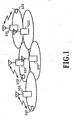
- Such a system comprises as shown in Fig. 1 a plurality of radio base stations 111 that cover the divided radio zones, and a plurality of mobile stations 112 that conduct communications with the base stations 111 by establishing radio channels.
- the receiving terminals require a specific level or over of the received power to achieve demodulation of the received radio wave at a desired quality.
- a processing what is called handover is carried out to continue communications by successively switching the radio base stations with the roaming of a mobile station.
- the handover processing when considered from the standpoint of the cell radius, presents the following problem as the cell radius reduces. That is, the frequency of the handover processing rises, which in turn increases the processing load of the network. When instantaneous interruption takes place because of the handover, it has great influence on the conversation quality a user feels. It is also possible that the handover processing cannot catch up with the roaming of the mobile station, so that the conversation can be disconnected.
- small radius cells are suitable for terminal equipment with low transmission power carried by pedestrians
- large radius cells are appropriate for terminal equipment with comparatively large power carried on motor vehicles.
- the small and large radius cells have their own advantages and disadvantages.
- a comparatively large cell with a radius from one kilometer to a few kilometers is often called a macrocell
- a rather small cell with a radius of a few hundred meters is commonly called a microcell.
- micro/macro overlay system Such a method that forms the area with the macrocells in combination with microcells is referred to as a micro/macro overlay system in the present specification.
- the micro/macro overlay system is characterized in its establishing method of the radio channels.
- the network conventionally carries out centralized management of the entire channels employed by the base stations.
- microcells are located in various propagation environments such as outdoors, underground shopping center and buildings in front of a station or in bustling streets as well as in homes, it is very difficult to assign radio channels considering the interference between the microcells. Since the systems in homes or offices operate as individual systems, it is difficult to apply to them a centralized management style assignment method. Thus, a method is desired in which the individual base stations establish their radio channels through their own autonomous control.
- a radio base station or mobile station measures the received power of interference signals, and decides that the channel is available when the received power (interference power) is less than a fixed level.
- Fig. 2 shows an example of making a decision as to whether a radio channel is available in a microcell adjacent to a macrocell.
- the horizontal axis represents distance
- the vertical axis represents transmission power or received power.
- Base stations A and C are low power base stations forming a microcell each.
- the base station A transmits at transmission power Pa through a radio channel f1.
- the base station B is a high power base station forming a macrocell, and transmits at transmission power Pb using a radio channel f2.
- the base station C is newly installed in addition to the base stations A and B, assuming that the base station C autonomously determines the radio channel of its own use. As shown in Fig. 2 , when the base station C receives signals from both the base stations A and B, the received levels of the signals at the base station C are identical at level L. If the level L is lower than the threshold value THR, both the frequencies f1 and f2 are available.
- the base station C When the base station C selects the radio channel f1, it receives the interference from the mobile station a with low transmission power, which does not presents any problem. However, when the base station C selects the radio channel f2, it will receive the interference from the mobile station b with high transmission power. Thus, the base station C cannot use the radio channel f2 in practice.
- the interference between the microcell and macrocell is unavoidable.
- the present invention proposes a traffic channel selecting method and station equipment capable of avoiding in advance the interference from a mobile station transmitting at large power by making a decision as to whether the radio base station causing the interference is present in a macrocell or microcell.
- the present invention also proposes a traffic channel selecting method and base station equipment capable of avoiding the occurrence of the interference, and constructing a mobile communications system with high quality and high frequency usage efficiency in a system whose service area consists of a plurality of radio base stations assuming various cell radii, or in a system in which a plurality of systems, whose mobile stations that receive their services have different characteristics, share the same frequency band.
- EP 0 752 766 discloses a mobile radio communication system with micro-macrocell overlay in which a base station receives uplink and downlink interference from other base stations and mobile stations, estimates from the downlink received interference the level of uplink interference, estimates the level of uplink interference and selects the channels that can be used by comparison of the interference with a predetermined threshold value.
- US-A-5, 594 946 discloses a system in which a base station in one cell mitigates interference caused by a mobile unit in communication with it occurring at a distant base station by monitoring the signal from the mobile station and determining the received signal strength estimating the noise caused by the signal at the distant base station from the propagation loss to that base station, and adjusting the transmit power of the mobile unit accordingly.
- thee is provided a traffic channel selecting method according to claim 1
- the present invention provides base station equipment according to claim 2
- the base station equipment may further comprise:
- Fig. 3 is a block diagram showing an overall configuration of radio base station equipment to which the present invention is applied.
- a traffic channel receiver 2 is connected to an antenna multiplexer 6 through a filter 4. The data received by the receiver 2 is processed by a baseband processor 8, and is transmitted to a switching center (not shown).
- a traffic channel transmitter 10 is connected to the antenna multiplexer 6 through a transmitting amplifier 12. The data transmitted from the switching center is processed by a baseband processor 14, and is supplied to the transmitter 10.
- a control channel transmitter 16 is also connected to the antenna multiplexer 6 through the transmitting amplifier 12. The data to be transmitted by the transmitter 16 is set by a control information setter 18.
- a receiver 20 for receiving a forward channel of another base station is connected to the antenna multiplexer 6 through a filter 22. The data received by the receiver 20 is supplied to a control information extractor 24 for extracting control information.
- the antenna multiplexer 6 is connected to an antenna 26.
- a bus 34 interconnects the control information setter 18; the control information extractor 24; a channel controller 28 for establishing channels of the transmitters 10 and 16, and the receivers 2 and 20; a memory 30 for storing various parameters such as threshold values for channel selection; and a controller 32 for selecting channels by making a decision on channel availability on the basis of the control information received from other radio base stations and the threshold values stored-in the memory 30.
- the receiver 20 for receiving the forward channels of other base stations uses frequency bands different from those of the traffic channel receiver 2.
- TDD Time Division Duplex
- the dedicated receiver 20 is installed in Fig. 3 for receiving forward channels of other base stations, the embodiment in accordance with the present invention is not limited to this. In either the FDD or TDD, the dedicated receiver is not essential.
- the present invention is applicable and achieves a similar effect by setting the traffic channel receiver 2 and filter 4 to receive the forward channels of other base stations to make them a means for receiving those channels.
- Figs. 4 and 5 show a first embodiment not in accordance with the present invention but described for information.
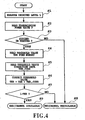
- Fig. 4 is a flowchart illustrating a control sequence of the controller 32 in the base station C.
- Fig. 5 is a schematic diagram illustrating the structure of the data stored in the memory 30 in the base station C.
- Steps of Fig. 4 are each controlled by the controller 32 (see, Fig. 3 ).
- the base station C receives the broadcast channels transmitted from other radio base stations A and B, and measures their received levels L.
- transmission power values P in the broadcast channels of the other radio base stations A and B are read. If the reading succeeds ("Yes" at step S3), the processing proceeds to step S4, whereas if the reading is unsuccessful, the processing makes a decision that the channel is unavailable; and proceeds to step S8.
- the threshold value THR of the received level is read from the memory 30 to be compared with the received level L (see, Fig. 5 ).
- the threshold value is corrected (THR THR + THR_corri). That is, a new threshold value is defined by adding THR_corri to the threshold value THR.
- step S7 the received levels L are compared with the corrected threshold value THR. If L ⁇ THR, a decision is made that the channel is available, and the processing proceeds to step S9. Otherwise ("No" at step S7), a decision is made that the channel is unavailable, and the processing proceeds to step S8.
- the corrected data of the threshold value are stored in the memory 30 as shown in Fig. 5 in connection with the transmission power values of the transmitting stations. This, however, does not restrict the embodiment in accordance with the present invention.
- the threshold values themselves can be stored in correspondence with the transmission power values of the transmitting stations.
- the threshold values can be calculated using an equation expressing the threshold value as a function of the transmission power of the transmitting stations.
- the present invention is applicable as long as it operates such that the threshold value is reduced with an increase in the transmission power of the transmitting station, and is increased with a decrease in the transmission power of the transmitting stations.
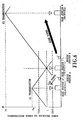
- Fig. 6 illustrates a decision example of the radio channel availability in a microcell adjacent to a macrocell.
- the horizontal axis represents the distance
- the vertical axis represents the transmission power or received power.
- the base stations A and C are low power base stations constituting the microcells, and assume that their transmission power is Pa (W), and the base station A employs the radio channel f1 for the transmission.
- the base station B is a high power base station that constitutes the macrocell, and assumes that its transmission power is Pb (W), where Pa ⁇ Pb, and uses the radio channel f2 for the transmission.
- Fig. 6 it is assumed that the base stations A and B have been operating already, and the base station C, which is newly added, autonomously determines its own radio channels to be used. As shown in Fig. 6 , the base station C receives signals transmitted from the base stations A and B, and their received levels at the base station C are identical at L. Since the transmission power of the base station B is greater than that of the base station A (Pa ⁇ Pb), the threshold value THRa is set greater than the threshold value THRb as shown in Fig.
- THRa is the threshold value to be compared with the received power from the base station A to determine the availability of the radio channel f1 in the base station C
- THRb is the threshold value to be compared with the received power from the base station B to determine the availability of the radio channel f2 in the base station C.
- the radio channel f1 is decided to be available because the received level is lower than THRa
- the radio channel f2 is decided to be unavailable because the received level is higher than THRb.
- the interference from the high power mobile station b can be prevented in advance, thereby providing high quality voice communications.
- Figs. 7 and 8 show a second embodiment in accordance with the present invention.
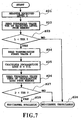
- Fig. 7 is a flowchart illustrating a control sequence of the controller 32 in the base station C.
- Fig. 8 is a schematic diagram illustrating the structure of the data stored in the memory 30 in the base station C.
- Steps of Fig. 7 are each controlled by the controller 32 (see, Fig. 3 ).
- the base station C receives the broadcast channels transmitted from other radio base stations A and B, and measures their received levels L.
- the received level threshold value THR is read from the memory 30 to be compared with the received level L (see, Fig. 8 ).
- step S23 if a decision is made that L ⁇ THR, the processing proceeds to step S24. Otherwise, a decision is made that the channel is unavailable, and the processing proceeds to step S28.
- the threshold value TURD of the propagation loss is read from the memory 30 to be compared with the calculated propagation loss (see, Fig. 8 ).
- step S27 the calculated propagation loss D is compared with the threshold value THRd. If D ⁇ THRd, a decision is made that the channel is available, and the processing proceeds to step S29. Otherwise ("No" at step S27), a decision is made that the channel is unavailable, and the processing proceeds to step S28.
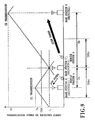
- Fig. 9 illustrates a decision example of the radio channel availability in a microcell adjacent to a macrocell.
- the horizontal axis represents the distance
- the vertical axis represents the transmission power or received power.
- the base stations A and C are low power base stations constituting the microcells, and assume that their transmission power Pa (W), and the base station A employs the radio channel f1 for the transmission.
- the base station B is a high power base station that constitutes the macrocell, and assumes that its transmission power is Pb (W), where Pa ⁇ Pb, and uses the radio channel f2 for the transmission.
- Fig. 9 it is assumed that the base stations A and B have been operating already, and the base station C, which is newly added, autonomously determines its own radio channels to be used. As shown in Fig. 9 , the base station C receives signals transmitted from the base stations A and B, and their received levels at the base station C are identical at L. In Fig. 9 , it is further assumed that the received level L is lower than the threshold value THR to be compared with the received level, and hence the base station C can use both the radio channels f1 and f2 from the view point of the received level.
- the radio channel f1 is decided to be available because the propagation loss is lower than THRd
- the radio channel f2 is decided to be unavailable because the propagation loss is higher than THRd.
- the interference from the high power mobile station b can be prevented in advance, thereby providing high quality voice communications.
- the present invention can employ various types of radio access schemes such as FDMA, TDMA, and CDMA, and can be applied to mobile communications systems adopting any of these schemes.
- radio access schemes such as FDMA, TDMA, and CDMA
- the base station in accordance with the present invention place into the broadcast information the transmission power values of the forward broadcast channel (forward perch).
- the newly installed base station C receiving the forward frequency band, measures the received level of each broadcast channel, and acquires the transmission power values. If the transmission power value is large, the threshold value of the received level is reduced (THRb), whereas if the transmission power value is small, the threshold value of the received level is increased (THRa). If the received level L is less than the threshold values thus determined, a decision is made that the channel is available.
- the propagation loss is calculated from the received level of the broadcast channel and the transmission power value acquired, and of the propagation loss is less than the threshold value of the propagation loss, and the received level is less than the threshold value of the received level, a decision is made that the channel is available.
- the radio base station acting as an interference source is present in the macrocell or microcell. This makes it possible to prevent in advance the interfer.ence from a high power mobile station.
- a mobile communications system with high quality and high frequency usage efficiency can be configured with avoiding the interference, in such a system whose service area consists of a plurality of radio base stations assuming a various cell radii, or a system in which a plurality of systems, whose mobile stations that receive their services have different characteristics, share the same frequency band.
Landscapes
- Engineering & Computer Science (AREA)
- Computer Networks & Wireless Communication (AREA)
- Signal Processing (AREA)
- Mobile Radio Communication Systems (AREA)
Applications Claiming Priority (3)
| Application Number | Priority Date | Filing Date | Title |
|---|---|---|---|
| JP01585998A JP3310209B2 (ja) | 1998-01-28 | 1998-01-28 | 通信チャネル選択方法および基地局装置 |
| JP1585998 | 1998-01-28 | ||
| EP99901897A EP0973353B1 (en) | 1998-01-28 | 1999-01-28 | Communication channel selecting method and base station device |
Related Parent Applications (2)
| Application Number | Title | Priority Date | Filing Date |
|---|---|---|---|
| EP99901897A Division EP0973353B1 (en) | 1998-01-28 | 1999-01-28 | Communication channel selecting method and base station device |
| EP99901897.1 Division | 1999-01-28 |
Publications (4)
| Publication Number | Publication Date |
|---|---|
| EP1435744A2 EP1435744A2 (en) | 2004-07-07 |
| EP1435744A3 EP1435744A3 (en) | 2004-10-06 |
| EP1435744A8 EP1435744A8 (en) | 2012-06-20 |
| EP1435744B1 true EP1435744B1 (en) | 2013-08-07 |
Family
ID=11900538
Family Applications (2)
| Application Number | Title | Priority Date | Filing Date |
|---|---|---|---|
| EP04075096.0A Expired - Lifetime EP1435744B1 (en) | 1998-01-28 | 1999-01-28 | Traffic channel selecting method and base station equipment |
| EP99901897A Expired - Lifetime EP0973353B1 (en) | 1998-01-28 | 1999-01-28 | Communication channel selecting method and base station device |
Family Applications After (1)
| Application Number | Title | Priority Date | Filing Date |
|---|---|---|---|
| EP99901897A Expired - Lifetime EP0973353B1 (en) | 1998-01-28 | 1999-01-28 | Communication channel selecting method and base station device |
Country Status (7)
| Country | Link |
|---|---|
| US (1) | US6453166B1 (enExample) |
| EP (2) | EP1435744B1 (enExample) |
| JP (1) | JP3310209B2 (enExample) |
| KR (2) | KR100367652B1 (enExample) |
| CN (1) | CN1112080C (enExample) |
| CA (1) | CA2285176C (enExample) |
| WO (1) | WO1999039536A1 (enExample) |
Families Citing this family (28)
| Publication number | Priority date | Publication date | Assignee | Title |
|---|---|---|---|---|
| JP3750390B2 (ja) * | 1999-01-08 | 2006-03-01 | 日本電気株式会社 | 移動体通信における呼制御方法及びそのシステム |
| US6950678B1 (en) * | 2000-05-24 | 2005-09-27 | Lucent Technologies Inc. | Control technique for a communication system |
| CN1128554C (zh) * | 2000-12-06 | 2003-11-19 | 深圳市中兴通讯股份有限公司 | 一种移动通信系统中均衡业务量分布的切换方法 |
| CN100468986C (zh) * | 2001-07-24 | 2009-03-11 | 株式会社Ntt都科摩 | 移动通信系统发送功率控制装置与方法以及移动台与通信装置 |
| JP4173293B2 (ja) * | 2001-08-28 | 2008-10-29 | 株式会社エヌ・ティ・ティ・ドコモ | 移動通信システム、基地局、無線ネットワーク制御装置、移動局及び移動局の消費電力削減方法 |
| GB2382269B (en) * | 2001-11-16 | 2005-11-16 | Hutchison Whampoa Three G Ip | Microcell deployment strategies in WCDMA networks |
| JP2005039367A (ja) * | 2003-07-16 | 2005-02-10 | Toshiba Corp | 移動通信端末のセルサーチ制御方法及び移動通信端末 |
| JP4531581B2 (ja) * | 2005-02-09 | 2010-08-25 | 株式会社エヌ・ティ・ティ・ドコモ | 無線通信用送受信装置における制御装置及び無線通信用送受信方法 |
| US8554146B2 (en) | 2006-09-18 | 2013-10-08 | Nokia Corporation | Method and apparatus for reducing the guard band between wireless communication systems operating in the same geographical area |
| US8681713B2 (en) * | 2006-09-20 | 2014-03-25 | Nec Corporation | Carrier assignment method for cellular system, cellular system, base station, and mobile station |
| EP2129003A4 (en) * | 2007-01-25 | 2015-01-14 | Zte Corp | POWER CONTROL DEVICE AND METHOD |
| GB2447439B (en) | 2007-02-02 | 2012-01-25 | Ubiquisys Ltd | Access point power control |
| KR101101217B1 (ko) | 2007-10-01 | 2012-01-04 | 닛본 덴끼 가부시끼가이샤 | 무선 통신 시스템, 무선 통신 방법, 기지국, 이동국, 기지국의 제어 방법, 이동국의 제어 방법, 및 제어 프로그램을 저장한 컴퓨터 판독가능한 매체 |
| KR20100067775A (ko) * | 2008-12-12 | 2010-06-22 | 삼성전자주식회사 | 무선통신시스템에서 소형 셀의 자원 운영 장치 및 방법 |
| CN101871978B (zh) | 2009-04-23 | 2012-11-07 | 大唐移动通信设备有限公司 | 一种确定干扰源位置的方法、系统和装置 |
| US8838116B2 (en) * | 2009-05-19 | 2014-09-16 | Qualcomm Incorporated | Minimizing interference to non-associated users |
| GB2471681B (en) | 2009-07-07 | 2011-11-02 | Ubiquisys Ltd | Interference mitigation in a femtocell access point |
| EP2456272A4 (en) * | 2009-07-17 | 2017-06-28 | Fujitsu Limited | Terminal device, communication system, and communication method |
| GB2472597B (en) | 2009-08-11 | 2012-05-16 | Ubiquisys Ltd | Power setting |
| US8396505B2 (en) * | 2009-10-02 | 2013-03-12 | Kyocera Corporation | Radio communication system, network side device, small cell base station, and transmission power control method |
| JP5430390B2 (ja) * | 2009-12-24 | 2014-02-26 | 京セラ株式会社 | 無線基地局及び無線基地局の周波数帯域選択方法 |
| JP4989737B2 (ja) * | 2010-01-29 | 2012-08-01 | 株式会社エヌ・ティ・ティ・ドコモ | 判定プログラム、判定装置及び判定方法 |
| EP2538711A4 (en) | 2010-02-15 | 2016-12-14 | Kyocera Corp | LOW-POWER BASE STATION AND WIRELESS CONTROLLED STEERING |
| WO2011122542A1 (ja) * | 2010-03-29 | 2011-10-06 | 京セラ株式会社 | 低電力基地局及び通信制御方法 |
| US8676216B2 (en) * | 2010-06-29 | 2014-03-18 | Qualcomm Incorporated | Method and apparatus for mitigating interference in femtocell deployments |
| JP5659138B2 (ja) * | 2011-12-21 | 2015-01-28 | オリンパス株式会社 | 映像送信装置、映像送信方法およびプログラム |
| US20150071104A1 (en) * | 2013-09-12 | 2015-03-12 | Qualcomm Incorporated | Autonomously selecting a communication channel having a co-channel operation constraint |
| US9861151B2 (en) * | 2014-12-05 | 2018-01-09 | SaPHIBeat Technologies, Inc. | Activity monitoring systems and methods for accident detection and response |
Family Cites Families (12)
| Publication number | Priority date | Publication date | Assignee | Title |
|---|---|---|---|---|
| JPH0618345B2 (ja) * | 1987-09-21 | 1994-03-09 | 日本電気株式会社 | 送信権制御方式 |
| US5276908A (en) * | 1990-10-25 | 1994-01-04 | Northern Telecom Limited | Call set-up and spectrum sharing in radio communication on systems with dynamic channel allocation |
| JPH05145460A (ja) * | 1991-11-22 | 1993-06-11 | Nippon Telegr & Teleph Corp <Ntt> | 信号検出装置 |
| AU670955B2 (en) * | 1992-08-04 | 1996-08-08 | Koninklijke Philips Electronics N.V. | Mobile radio system |
| MX9307243A (es) * | 1992-11-24 | 1994-05-31 | Ericsson Telefon Ab L M | Reintento analogico. |
| DE69634889T2 (de) * | 1995-01-25 | 2005-12-08 | Ntt Docomo Inc. | Mobile funkkommunikationsanordnung |
| US5594946A (en) * | 1995-02-28 | 1997-01-14 | Motorola, Inc. | Method and apparatus for mitigating interference produced by a communication unit in a communication system |
| US5956638A (en) * | 1996-01-24 | 1999-09-21 | Telcordia Technologies, Inc. | Method for unlicensed band port to autonomously determine interference threshold and power level |
| JPH09327059A (ja) * | 1996-06-07 | 1997-12-16 | N T T Ido Tsushinmo Kk | Cdma移動通信システムにおけるセル選択方法およびその基地局装置と移動局装置 |
| JP3179021B2 (ja) | 1996-06-19 | 2001-06-25 | 株式会社エヌ・ティ・ティ・ドコモ | 移動通信の呼受付制御方法 |
| JP2809273B2 (ja) * | 1996-06-25 | 1998-10-08 | 日本電気株式会社 | 移動通信システム |
| US5956642A (en) * | 1996-11-25 | 1999-09-21 | Telefonaktiebolaget L M Ericsson | Adaptive channel allocation method and apparatus for multi-slot, multi-carrier communication system |
-
1998
- 1998-01-28 JP JP01585998A patent/JP3310209B2/ja not_active Expired - Fee Related
-
1999
- 1999-01-28 CA CA002285176A patent/CA2285176C/en not_active Expired - Fee Related
- 1999-01-28 CN CN99800084A patent/CN1112080C/zh not_active Expired - Fee Related
- 1999-01-28 EP EP04075096.0A patent/EP1435744B1/en not_active Expired - Lifetime
- 1999-01-28 WO PCT/JP1999/000357 patent/WO1999039536A1/ja not_active Ceased
- 1999-01-28 KR KR10-1999-7008827A patent/KR100367652B1/ko not_active Expired - Fee Related
- 1999-01-28 KR KR10-2002-7011152A patent/KR100493685B1/ko not_active Expired - Fee Related
- 1999-01-28 EP EP99901897A patent/EP0973353B1/en not_active Expired - Lifetime
- 1999-01-28 US US09/402,034 patent/US6453166B1/en not_active Expired - Fee Related
Non-Patent Citations (1)
| Title |
|---|
| FUKUMOTO S ET AL: "Spectrum efficiency of sectorization for distributed dynamic channel assignment in cellular systems", PERSONAL, INDOOR AND MOBILE RADIO COMMUNICATIONS 1995 PIMRC ' 95, IEEE, US, vol. 2, 27 September 1995 (1995-09-27), pages 552 - 556, XP010150947, ISBN: 978-0-7803-3002-3, DOI: 10.1109/PIMRC.1995.480929 * |
Also Published As
| Publication number | Publication date |
|---|---|
| JP3310209B2 (ja) | 2002-08-05 |
| EP0973353A1 (en) | 2000-01-19 |
| KR20020077922A (ko) | 2002-10-14 |
| CA2285176C (en) | 2004-02-17 |
| CA2285176A1 (en) | 1999-08-05 |
| KR100367652B1 (ko) | 2003-01-10 |
| EP1435744A8 (en) | 2012-06-20 |
| JPH11215534A (ja) | 1999-08-06 |
| KR20010005756A (ko) | 2001-01-15 |
| CN1256058A (zh) | 2000-06-07 |
| WO1999039536A1 (en) | 1999-08-05 |
| EP1435744A2 (en) | 2004-07-07 |
| CN1112080C (zh) | 2003-06-18 |
| KR100493685B1 (ko) | 2005-06-07 |
| EP0973353A4 (en) | 2003-05-02 |
| EP1435744A3 (en) | 2004-10-06 |
| EP0973353B1 (en) | 2012-01-18 |
| US6453166B1 (en) | 2002-09-17 |
Similar Documents
| Publication | Publication Date | Title |
|---|---|---|
| EP0973353B1 (en) | Communication channel selecting method and base station device | |
| KR100295437B1 (ko) | 멀티주파수할당시스템의커버리지최적화방법 | |
| KR101059662B1 (ko) | Wan 시그널링 및 피어 투 피어 시그널링을 지원하는 혼합형 무선 통신 시스템에서의 전력 제어 및/또는 간섭 관리에 관한 방법 및 장치 | |
| US5903834A (en) | Distributed indoor digital multiple-access cellular telephone system | |
| EP1192828B1 (en) | Hot spot with tailored range for extra frequency to minimize interference | |
| AU668008B2 (en) | Communication management technique for a radiotelephone system including microcells | |
| US6038220A (en) | Method and apparatus of forward traffic channel power control for CDMA wireless local loop system | |
| US5995836A (en) | Method and system for variable handoff hysteresis in a radiocommunication system | |
| US5548807A (en) | Mobile communication system comprising base stations each having omnidirectional antenna for reception of interference wave | |
| CN101998415B (zh) | Td-lte系统干扰自避免的基站选址方法 | |
| US8666442B2 (en) | Method and apparatus for controlling uplink power in wireless communication system | |
| US7187664B2 (en) | Method and arrangement in a communication system | |
| EP0987915B1 (en) | Area supplementing method for a CDMA mobile communication system using supplemental base station | |
| EP0817406A2 (en) | Mobile communication system with improved antenna arrangement | |
| EP0964596B1 (en) | Method of assigning frequency using propagation loss | |
| WO1997008909A1 (en) | A method of levelling a traffic load of a base station in a cellular radio system, and a cellular radio system | |
| EP1576742B1 (en) | Method and apparatus for determining a transmit power | |
| US5765103A (en) | Spatially-oriented subscriber configuration in a fixed wireless system | |
| KR101410994B1 (ko) | 이동 통신 시스템, 디지털 신호 처리 장치 및 그 시스템에서의 동시 전송 영역 설정 방법 | |
| EP1131963B1 (en) | Method and communications system with dynamically adaptable subscriber units | |
| JP2560854B2 (ja) | 移動通信制御方法 | |
| JP2000023238A (ja) | 移動通信システムにおけるセル構成法、無線アクセス方式及び移動機 | |
| KR100299129B1 (ko) | 코드분할다중접속네트워크에서순방향링크의코드채널별전력할당최적화방법 | |
| Mori et al. | Downlink packet transmission control for asymmetric traffic in CDMA/shared-TDD cellular communication systems | |
| Chia | Cellular radio planning methods |
Legal Events
| Date | Code | Title | Description |
|---|---|---|---|
| PUAI | Public reference made under article 153(3) epc to a published international application that has entered the european phase |
Free format text: ORIGINAL CODE: 0009012 |
|
| AC | Divisional application: reference to earlier application |
Ref document number: 0973353 Country of ref document: EP Kind code of ref document: P |
|
| AK | Designated contracting states |
Kind code of ref document: A2 Designated state(s): DE FR GB IT SE |
|
| PUAL | Search report despatched |
Free format text: ORIGINAL CODE: 0009013 |
|
| RIN1 | Information on inventor provided before grant (corrected) |
Inventor name: ISHIKAWA, YOSHIHIRO Inventor name: ISHII, MINAMI Inventor name: NAKANO, ETSUHIRO C/O NTT DOCOMO, INC. Inventor name: ONOE, SEIZO Inventor name: HATA, MASAFUMI |
|
| AK | Designated contracting states |
Kind code of ref document: A3 Designated state(s): DE FR GB IT SE |
|
| 17P | Request for examination filed |
Effective date: 20041230 |
|
| REG | Reference to a national code |
Ref country code: DE Ref legal event code: R079 Ref document number: 69944850 Country of ref document: DE Free format text: PREVIOUS MAIN CLASS: H04Q0007360000 Ipc: H04B0007005000 |
|
| GRAP | Despatch of communication of intention to grant a patent |
Free format text: ORIGINAL CODE: EPIDOSNIGR1 |
|
| RIC1 | Information provided on ipc code assigned before grant |
Ipc: H04W 16/10 20090101ALI20130128BHEP Ipc: H04B 7/005 20060101AFI20130128BHEP Ipc: H04W 52/40 20090101ALI20130128BHEP |
|
| RIN1 | Information on inventor provided before grant (corrected) |
Inventor name: ISHII, MINAMI Inventor name: ONOE, SEIZO Inventor name: ISHIKAWA, YOSHIHIRO Inventor name: NAKANO, ETSUHIRO Inventor name: HATA, MASAFUMI |
|
| GRAS | Grant fee paid |
Free format text: ORIGINAL CODE: EPIDOSNIGR3 |
|
| GRAA | (expected) grant |
Free format text: ORIGINAL CODE: 0009210 |
|
| AC | Divisional application: reference to earlier application |
Ref document number: 0973353 Country of ref document: EP Kind code of ref document: P |
|
| AK | Designated contracting states |
Kind code of ref document: B1 Designated state(s): DE FR GB IT SE |
|
| REG | Reference to a national code |
Ref country code: GB Ref legal event code: FG4D |
|
| REG | Reference to a national code |
Ref country code: SE Ref legal event code: TRGR |
|
| REG | Reference to a national code |
Ref country code: DE Ref legal event code: R096 Ref document number: 69944850 Country of ref document: DE Effective date: 20131010 |
|
| PLBE | No opposition filed within time limit |
Free format text: ORIGINAL CODE: 0009261 |
|
| STAA | Information on the status of an ep patent application or granted ep patent |
Free format text: STATUS: NO OPPOSITION FILED WITHIN TIME LIMIT |
|
| 26N | No opposition filed |
Effective date: 20140508 |
|
| REG | Reference to a national code |
Ref country code: DE Ref legal event code: R119 Ref document number: 69944850 Country of ref document: DE |
|
| REG | Reference to a national code |
Ref country code: DE Ref legal event code: R097 Ref document number: 69944850 Country of ref document: DE Effective date: 20140508 |
|
| REG | Reference to a national code |
Ref country code: SE Ref legal event code: EUG |
|
| GBPC | Gb: european patent ceased through non-payment of renewal fee |
Effective date: 20140128 |
|
| REG | Reference to a national code |
Ref country code: DE Ref legal event code: R119 Ref document number: 69944850 Country of ref document: DE Effective date: 20140801 |
|
| PG25 | Lapsed in a contracting state [announced via postgrant information from national office to epo] |
Ref country code: DE Free format text: LAPSE BECAUSE OF NON-PAYMENT OF DUE FEES Effective date: 20140801 |
|
| REG | Reference to a national code |
Ref country code: FR Ref legal event code: ST Effective date: 20140930 |
|
| PG25 | Lapsed in a contracting state [announced via postgrant information from national office to epo] |
Ref country code: SE Free format text: LAPSE BECAUSE OF NON-PAYMENT OF DUE FEES Effective date: 20140129 Ref country code: GB Free format text: LAPSE BECAUSE OF NON-PAYMENT OF DUE FEES Effective date: 20140128 Ref country code: FR Free format text: LAPSE BECAUSE OF NON-PAYMENT OF DUE FEES Effective date: 20140131 |
|
| PG25 | Lapsed in a contracting state [announced via postgrant information from national office to epo] |
Ref country code: IT Free format text: LAPSE BECAUSE OF NON-PAYMENT OF DUE FEES Effective date: 20140128 |