EP1431256A2 - Verfahren zur Hydratisierung von Anhydriten - Google Patents
Verfahren zur Hydratisierung von Anhydriten Download PDFInfo
- Publication number
- EP1431256A2 EP1431256A2 EP03025950A EP03025950A EP1431256A2 EP 1431256 A2 EP1431256 A2 EP 1431256A2 EP 03025950 A EP03025950 A EP 03025950A EP 03025950 A EP03025950 A EP 03025950A EP 1431256 A2 EP1431256 A2 EP 1431256A2
- Authority
- EP
- European Patent Office
- Prior art keywords
- anhydrite
- granules
- solutions
- aqueous solutions
- gypsum
- Prior art date
- Legal status (The legal status is an assumption and is not a legal conclusion. Google has not performed a legal analysis and makes no representation as to the accuracy of the status listed.)
- Withdrawn
Links
Images

Classifications
-
- C—CHEMISTRY; METALLURGY
- C04—CEMENTS; CONCRETE; ARTIFICIAL STONE; CERAMICS; REFRACTORIES
- C04B—LIME, MAGNESIA; SLAG; CEMENTS; COMPOSITIONS THEREOF, e.g. MORTARS, CONCRETE OR LIKE BUILDING MATERIALS; ARTIFICIAL STONE; CERAMICS; REFRACTORIES; TREATMENT OF NATURAL STONE
- C04B11/00—Calcium sulfate cements
- C04B11/06—Calcium sulfate cements starting from anhydrite
-
- C—CHEMISTRY; METALLURGY
- C01—INORGANIC CHEMISTRY
- C01F—COMPOUNDS OF THE METALS BERYLLIUM, MAGNESIUM, ALUMINIUM, CALCIUM, STRONTIUM, BARIUM, RADIUM, THORIUM, OR OF THE RARE-EARTH METALS
- C01F11/00—Compounds of calcium, strontium, or barium
- C01F11/46—Sulfates
- C01F11/466—Conversion of one form of calcium sulfate to another
-
- C—CHEMISTRY; METALLURGY
- C04—CEMENTS; CONCRETE; ARTIFICIAL STONE; CERAMICS; REFRACTORIES
- C04B—LIME, MAGNESIA; SLAG; CEMENTS; COMPOSITIONS THEREOF, e.g. MORTARS, CONCRETE OR LIKE BUILDING MATERIALS; ARTIFICIAL STONE; CERAMICS; REFRACTORIES; TREATMENT OF NATURAL STONE
- C04B28/00—Compositions of mortars, concrete or artificial stone, containing inorganic binders or the reaction product of an inorganic and an organic binder, e.g. polycarboxylate cements
- C04B28/14—Compositions of mortars, concrete or artificial stone, containing inorganic binders or the reaction product of an inorganic and an organic binder, e.g. polycarboxylate cements containing calcium sulfate cements
- C04B28/16—Compositions of mortars, concrete or artificial stone, containing inorganic binders or the reaction product of an inorganic and an organic binder, e.g. polycarboxylate cements containing calcium sulfate cements containing anhydrite, e.g. Keene's cement
Definitions
- the present invention relates to a method for hydrating Anhydrites, in particular for the production of gypsum from anhydrite.
- Gypsum is an essential raw material for the manufacture of numerous products.
- the gypsum is used to manufacture gypsum binders that are used in different industrial areas. These are examples Construction, the ceramic industry and medical technology. To production high-quality special plaster for the ceramic industry and dental technology high demands are made on the raw materials. Such substances are increasingly difficult to access as natural resources.
- gypsum deposits have anhydrite and gypsum rocks socialized with each other. That geologically layers of gypsum (in the Rule 2 to 15 m) as plaster skin on the up to 80 m thick Anhydritkomplexen. By breaking down the layers of gypsum, the one below lying anhydrite exposed.
- the object of the present invention is accordingly to provide a process by means of which anhydrites can be hydrated.
- the anhydrite material in granular Form is present.
- Ganules are particularly preferred with an edge length of 5 to 10 cm.
- Anhydrous calcium sulfates (CaSO4 4 ) are preferably used as granules.
- Such anhydrous calcium sulfates occur as so-called anhydrite rocks in the form of compact, dense material in gypsum deposits. As shown above, these can either be under plaster skin or in the form of mixed rocks as anhydrite gypsum.
- both the pre-splitting process and the Splitting processes can be used.
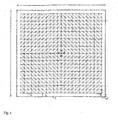
- the pre-gap process becomes chronological seen before the main detonation, a blasting outer wreath, which the entire anhydrite complex to be hydrated from the rest Rock formation releases and the release of the blasting energy on the inner Area concentrated.
- the following explosions make one Shredding of the internal, i.e. lying inside the curb Anhydrite material reached. This creates a tub in which the Granules are collected.
- the solution becomes the rest Rock bandage and the crushing of the anhydrite starting from one central burner burglary carried out almost simultaneously.
- the borehole diameter is preferably between 30 and 50 mm, particularly preferably between 35 and 45 mm.
- the distance between the boreholes is preferably between 20 and 50 cm, particularly preferably between 30 and 40 cm.
- Those located in the central area of the blasting field Extension holes are spaced and a default of 0.3 x 0.3 m up to 0.6 x 0.6 m, preferably 0.4 x 0.4 m to 0.5 x 0.5 m.
- the distance of this Drill holes to the profile drill holes of the outer ring is preferably 0.1-0.5 m, particularly preferably 0.2-0.4 m.
- the number of extension holes, igniter, charge quantity and charge type are designed as required.
- the ignition can be switched in Series connection or parallel connection. The is preferred Parallel.
- anhydrite granules described above are used in accordance with the invention aqueous solutions of reaction accelerators.
- aqueous solutions of reaction accelerators Preferably are solutions of the salts of mono- or divalent metals or Mixtures of these.
- alkali metal or Alkaline earth metals alkali metal salt solutions are very special. Maximum potassium is preferred.
- the alkali metal salt solutions preferably contain sulfates as anions, Carbonates, nitrates and chlorides. Sulfates are particularly preferred. Accordingly, alkali sulfates are particularly preferred. Among the most preferred sulfates include potassium sulfates.
- the aqueous solutions used according to the invention contain the described salts in concentrations of 0.02 to 0.9 mol per liter Solvents, particularly preferably 0.03 to 0.6 mol per liter of solvent, very particularly preferably 0.05 to 0.3 mol per liter of solvent.
- the anhydrite material is applied in a relatively flat manner on an inclined plane.
- Cyclic sprinkling with the reaction solution described above, preferably K 2 SO 4 solution exposes the material to alternating moist conditions.
- the wet-dry cycles promote the plastering by dissolving and crystallizing reactions of easily soluble salts, which loosen the structure of the anhydrite rock.
- anhydrite material in the loose bed is on the leaning Level easily accessible to fluctuations in climatic conditions.
- Factors promoting plastering such as freeze-thaw and thermally induced Tensions in the rock, e.g. by sun exposure, can with this open storage of the anhydrite has a great impact on the rock structure unfold effectively.
- Anhydrite, which is stored on the reaction solution, is this Influences less easily accessible.
- reaction solution runs back into a storage container on the inclined plane and is available for rewetting the material.
- a rectangular system became the result of an upstream blasting generated from cracks, so the explosive energy of the following main charges exclusively for crushing the inside of the explosive device Anhydrite material contributed.
- the stocking of the blast holes was chosen so that the subsurface was not damaged and jagged by the blasting. On this way it was ensured that the tub was as dense as possible, in which is the crushed granulate.
- the resulting granules mainly had a size of 5 to 10 cm.
- test field was cleared. It came into being rectangular hole with a well defined volume of 12 x 12 m, at 1.5 to 2 m depth.
- the test field was covered with a fleece and a 2 mm thick film to prevent the Reaction solution seeps into the subsoil due to any gaps. Anhydrite granules were then applied to the film.
- Salt solutions with 0.15 molar potassium sulfate solutions With these solutions in sprinkles the anhydrite material at regular intervals.
- FIG. 2 shows the further preferred method variant according to the invention the hydration of anhydrite schematized on an inclined plane. That too plastered anhydrite material (6) is stored flat on the inclined plane (7) applied. Cyclic sprinkling (8) with a reaction solution the material is exposed to changing damp conditions. The damp and dry cycles promote plastering through solution and Crystallization reactions of easily soluble salts, which the structure of Loosen up anhydrite rock.
- the reaction solution runs into the storage container (9) on the inclined plane (7). back and is available for rewetting the material. Therefor becomes the reaction solution via the pump (10) and the line (11) pumped back and fed to the cyclical irrigation device (8) again.
Landscapes
- Chemical & Material Sciences (AREA)
- Organic Chemistry (AREA)
- Engineering & Computer Science (AREA)
- Ceramic Engineering (AREA)
- Inorganic Chemistry (AREA)
- Materials Engineering (AREA)
- Structural Engineering (AREA)
- Life Sciences & Earth Sciences (AREA)
- Geology (AREA)
- Chemical Kinetics & Catalysis (AREA)
- Curing Cements, Concrete, And Artificial Stone (AREA)
- Organic Low-Molecular-Weight Compounds And Preparation Thereof (AREA)
Abstract
Description
Es wird ein äußerer Ring von Profilbohrlöchern mit einer Tiefe von 1-5 m, vorzugsweise 1-3 m angelegt. Der Bohrlochdurchmesser liegt vorzugsweise zwischen 30 und 50 mm, besonders bevorzugt zwischen 35 und 45 mm. Der Bohrlochabstand liegt vorzugsweise zwischen 20 und 50 cm, besonders bevorzugt zwischen 30 und 40 cm.
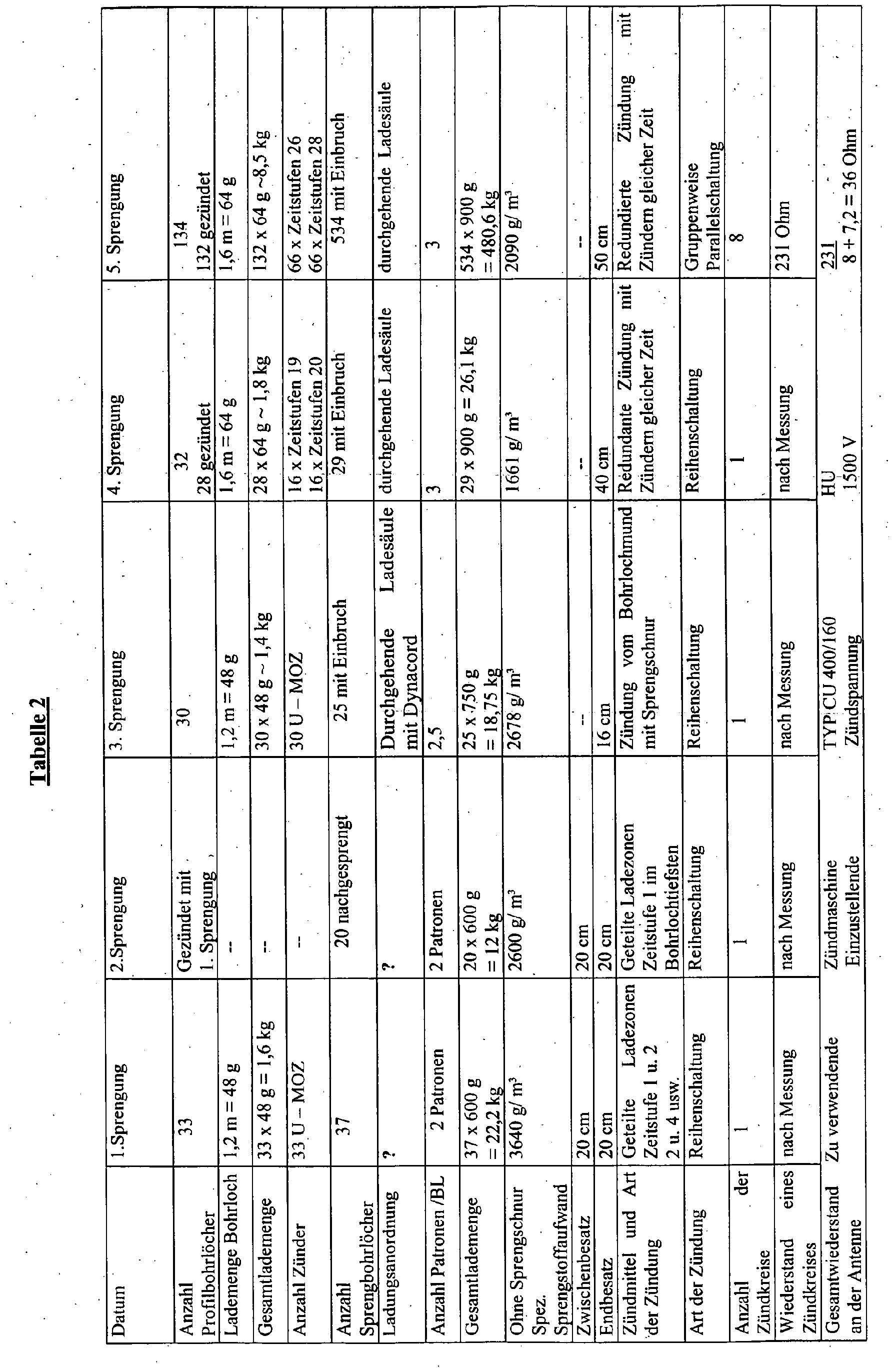
Anhydritmaterial eines Steinbruchs wurde sprengtechnisch vorzerkleinert. Es wurde ein spezielles Sprengverfahren angewandt, um die gewünschte Stückigkeit des Anhydritgranulats einzustellen. Auf einem ca. 150 qm2 großen Versuchsfeld wurde ein 1,5 bis 2 m tiefe Grube gesprengt. Hierbei wurden die Sprengparameter der 5. Sprengung vom 27.06.2002 gemäß den folgenden Tabellen 1 und 2 eingestellt.

Claims (16)
- Verfahren zur Hydratisierung von Anhydriten,
dadurch gekennzeichnet, dass Anhydrit-Granulate mit wässrigen Lösungen von Salzen ein- oder zweiwertiger Metalle oder Gemischen hiervon beaufschlagt werden. - Verfahren nach Anspruch 1,
dadurch gekennzeichnet, dass Granulate mit einer durchschnittlichen Größe von 5 - 10 cm eingesetzt werden. - Verfahren nach Anspruch 1 oder 2,
dadurch gekennzeichnet, dass Granulate mit einer Kantenlänge von 5 - 10 cm eingesetzt werden. - Verfahren nach Anspruch 1,
dadurch gekennzeichnet, dass wasserfreie Kalziumsulfate in granulierter Form eingesetzt werden. - Verfahren nach einem der Ansprüche 1 bis 4,
dadurch gekennzeichnet, dass die Anhydritgranulate auf einer schiefen Ebene ungeordnet und mit wässrigen Lösungen von Salzen einoder mehrwertiger Metalle oder Gemischen hiervon beaufschlagt werden. - Verfahren nach einem der Ansprüche 1 bis 5,
dadurch gekennzeichnet, dass wässrige Lösungen mit einer Salzkonzentration von 0,02 bis 0,9 Mol/Liter eingesetzt werden. - Verfahren nach einem der Ansprüche 1 bis 6,
dadurch gekennzeichnet, dass wässrige Lösungen mit einer Salzkonzentration von 0,05 bis 0,3 Mol/Liter eingesetzt werden. - Verfahren nach einem der Ansprüche 1 bis 7,
dadurch gekennzeichnet, dass Alkalimetall oder Erdalkalimetallsalzlösungen eingesetzt werden. - Verfahren nach einem der Ansprüche 1 bis 8,
dadurch gekennzeichnet, dass kaliumsalzhaltige Lösungen eingesetzt werden. - Verfahren nach einem der Ansprüche 1 bis 9,
dadurch gekennzeichnet, dass Metallsulfat enthaltende Lösungen eingesetzt werden. - Verfahren nach einem der Ansprüche 1 bis 10,
dadurch gekennzeichnet, dass Alkalisulfat enthaltende Lösungen eingesetzt werden. - Verfahren nach einem der Ansprüche 1 bis 11,
dadurch gekennzeichnet, dass Ton oder tonhaltige Materialien zugesetzt werden. - Verfahren nach einer der Ansprüche 1 bis 12,
dadurch gekennzeichnet, dass Anhydrid-Granulate aus Anhydrit-Gestein durch sprengtechnische Zerkleinerung hergestellt werden. - Verfahren nach einem der Ansprüche 1 bis 13,
dadurch gekennzeichnet, dass a) ein äußerer Ring von Sprenglöchern angelegt wird, in denen eine erste Sprengung eingeleitet wird und b) innerhalb des äußeren Rings Profilbohrlöcher angelegt werden, in denen die nachfolgenden Sprengungen erfolgen. - Verfahren nach einem der Ansprüche 1 bis 14,
dadurch gekennzeichnet, dass innerhalb des Außenkranzes konzentrierte Erweiterungsbohrlöcher angelegt werden, in denen im Anschluss an Schritt b weitere Sprengungen erfolgen. - Gips hergestellt in einem Verfahren nach einem der Ansprüche 1 bis 15.
Applications Claiming Priority (4)
| Application Number | Priority Date | Filing Date | Title |
|---|---|---|---|
| DE10259165 | 2002-12-18 | ||
| DE10259165 | 2002-12-18 | ||
| DE10330325 | 2003-07-09 | ||
| DE10330325A DE10330325A1 (de) | 2002-12-18 | 2003-07-09 | Verfahren zur Hydratisierung von Anhydriten |
Publications (2)
| Publication Number | Publication Date |
|---|---|
| EP1431256A2 true EP1431256A2 (de) | 2004-06-23 |
| EP1431256A3 EP1431256A3 (de) | 2006-04-26 |
Family
ID=32395024
Family Applications (1)
| Application Number | Title | Priority Date | Filing Date |
|---|---|---|---|
| EP03025950A Withdrawn EP1431256A3 (de) | 2002-12-18 | 2003-11-13 | Verfahren zur Hydratisierung von Anhydriten |
Country Status (1)
| Country | Link |
|---|---|
| EP (1) | EP1431256A3 (de) |
Family Cites Families (6)
| Publication number | Priority date | Publication date | Assignee | Title |
|---|---|---|---|---|
| US1442406A (en) * | 1921-04-04 | 1923-01-16 | Kaliwerke Salzdetfurth Ag | Process of obtaining from anhydrite a. substance which sets in the presence of water |
| CH96840A (de) * | 1921-04-29 | 1922-11-16 | Rudolf Hennicke Und Kaliwerke | Verfahren zur Gewinnung eines mit Wasser abbindenden Mittels aus Anhydrit. |
| US1898636A (en) * | 1931-02-16 | 1933-02-21 | United States Gypsum Co | Anhydrite plastic material |
| US1941188A (en) * | 1931-03-02 | 1933-12-26 | United States Gypsum Co | Manufacture of plaster of paris |
| GB561206A (en) * | 1942-07-13 | 1944-05-10 | Francis Robert Himsworth | Improvements in or relating to the production of gypsum from anhydrite |
| GB1429187A (en) * | 1972-05-11 | 1976-03-24 | Bpb Industries Ltd | Process for the conversion of anhydrite into gypsum |
-
2003
- 2003-11-13 EP EP03025950A patent/EP1431256A3/de not_active Withdrawn
Also Published As
| Publication number | Publication date |
|---|---|
| EP1431256A3 (de) | 2006-04-26 |
Similar Documents
| Publication | Publication Date | Title |
|---|---|---|
| DE3033376C2 (de) | ||
| DE3005366C2 (de) | ||
| EP2708520A1 (de) | Verfahren zur Herstellung von Zuschlag sowie von Kalziumcarbonat aus Beton-Gesteinskörnung sowie eine Vorrichtung zur Durchführung des Verfahrens | |
| DE2603699B1 (de) | Verfahren zur beseitigung des rueckstandes der abgaswaesche von feuerungen, insbesondere von steinkohlenkraftwerken | |
| EP4098641A1 (de) | Verbesserungen bei der kohlenstoffsequestrierung | |
| EP1431256A2 (de) | Verfahren zur Hydratisierung von Anhydriten | |
| DE3717240C2 (de) | ||
| DE10330325A1 (de) | Verfahren zur Hydratisierung von Anhydriten | |
| DE3530469A1 (de) | Nachtraegliche deponieabdichtungen mit bergmaennischem abbau | |
| DE3109632C2 (de) | Mechanisch verdichtbares Material | |
| RU93056544A (ru) | Способ ресурсосберегающей технологии закладки выработанного пространства | |
| DE3216896C1 (de) | Verfahren zum Sichern des Bruchfelds von untertägigen Grubenräumen gegen Selbstentzündungsbrände | |
| DE3605062A1 (de) | Abdichtung von deponien | |
| DE102008048240A1 (de) | Verfahren zum hydraulischen Versatz von Abfallstoffen | |
| EP0209613B2 (de) | Verfahren zur umweltfreundlichen Deponierung von Kohlekraftwerk-Reststoffen | |
| Valgma et al. | Low depth mining in Estonian oil shale deposit-Abbau von Ölschiefer in Estland | |
| EP1184092B1 (de) | Verfahren zum Verhindern des Eindringens einer Salzlösung in einen Hohlraum einer Salzlagerstätte | |
| RU2853714C1 (ru) | Способ разработки месторождений калийных солей | |
| EP0407546B1 (de) | Verfahren zur verfestigung und/oder abdichtung von altdeponien von abfallstoffen | |
| DE4103311C2 (de) | ||
| EP0233979B1 (de) | Abdichtung von Deponien | |
| AT382860B (de) | Mechanisch verdichtbares material | |
| SU1108195A1 (ru) | Способ кучного выщелачивани полезных ископаемых | |
| SU883445A1 (ru) | Способ подземного выщелачивани полезных ископаемых | |
| CH721528B1 (de) | Verfahren zum Sprengen von Gesteinsschichten |
Legal Events
| Date | Code | Title | Description |
|---|---|---|---|
| PUAI | Public reference made under article 153(3) epc to a published international application that has entered the european phase |
Free format text: ORIGINAL CODE: 0009012 |
|
| AK | Designated contracting states |
Kind code of ref document: A2 Designated state(s): AT BE BG CH CY CZ DE DK EE ES FI FR GB GR HU IE IT LI LU MC NL PT RO SE SI SK TR |
|
| AX | Request for extension of the european patent |
Extension state: AL LT LV MK |
|
| RAP1 | Party data changed (applicant data changed or rights of an application transferred) |
Owner name: DEHNE, GERALD, DR. Owner name: FORSCHUNGSZENTRUM KARLSRUHE GMBH |
|
| PUAL | Search report despatched |
Free format text: ORIGINAL CODE: 0009013 |
|
| AK | Designated contracting states |
Kind code of ref document: A3 Designated state(s): AT BE BG CH CY CZ DE DK EE ES FI FR GB GR HU IE IT LI LU MC NL PT RO SE SI SK TR |
|
| AX | Request for extension of the european patent |
Extension state: AL LT LV MK |
|
| 17P | Request for examination filed |
Effective date: 20060603 |
|
| 17Q | First examination report despatched |
Effective date: 20061109 |
|
| AKX | Designation fees paid |
Designated state(s): AT BE BG CH CY CZ DE DK EE ES FI FR GB GR HU IE IT LI LU MC NL PT RO SE SI SK TR |
|
| STAA | Information on the status of an ep patent application or granted ep patent |
Free format text: STATUS: THE APPLICATION IS DEEMED TO BE WITHDRAWN |
|
| 18D | Application deemed to be withdrawn |
Effective date: 20090120 |