EP1426331B1 - Procédé de production de sulfure de métal alcalin anhydre - Google Patents
Procédé de production de sulfure de métal alcalin anhydre Download PDFInfo
- Publication number
- EP1426331B1 EP1426331B1 EP03022119A EP03022119A EP1426331B1 EP 1426331 B1 EP1426331 B1 EP 1426331B1 EP 03022119 A EP03022119 A EP 03022119A EP 03022119 A EP03022119 A EP 03022119A EP 1426331 B1 EP1426331 B1 EP 1426331B1
- Authority
- EP
- European Patent Office
- Prior art keywords
- gas
- drying
- alkali sulfide
- alkali metal
- drying gas
- Prior art date
- Legal status (The legal status is an assumption and is not a legal conclusion. Google has not performed a legal analysis and makes no representation as to the accuracy of the status listed.)
- Expired - Lifetime
Links
- 238000000034 method Methods 0.000 title claims description 33
- 229910052977 alkali metal sulfide Inorganic materials 0.000 title description 11
- 238000002360 preparation method Methods 0.000 title description 5
- 239000007789 gas Substances 0.000 claims description 73
- 238000001035 drying Methods 0.000 claims description 48
- XLYOFNOQVPJJNP-UHFFFAOYSA-N water Substances O XLYOFNOQVPJJNP-UHFFFAOYSA-N 0.000 claims description 22
- 239000003513 alkali Substances 0.000 claims description 17
- UCKMPCXJQFINFW-UHFFFAOYSA-N Sulphide Chemical compound [S-2] UCKMPCXJQFINFW-UHFFFAOYSA-N 0.000 claims description 16
- 239000011261 inert gas Substances 0.000 claims description 13
- 238000001694 spray drying Methods 0.000 claims description 7
- 239000006185 dispersion Substances 0.000 claims description 5
- 238000002425 crystallisation Methods 0.000 claims description 3
- 239000000725 suspension Substances 0.000 claims description 3
- 238000009833 condensation Methods 0.000 claims description 2
- 230000005494 condensation Effects 0.000 claims description 2
- 239000011734 sodium Substances 0.000 description 13
- 239000002904 solvent Substances 0.000 description 11
- ZCYVEMRRCGMTRW-UHFFFAOYSA-N 7553-56-2 Chemical compound [I] ZCYVEMRRCGMTRW-UHFFFAOYSA-N 0.000 description 10
- 229910052740 iodine Inorganic materials 0.000 description 10
- 239000011630 iodine Substances 0.000 description 10
- IJGRMHOSHXDMSA-UHFFFAOYSA-N Atomic nitrogen Chemical compound N#N IJGRMHOSHXDMSA-UHFFFAOYSA-N 0.000 description 8
- 239000007787 solid Substances 0.000 description 6
- 229910052783 alkali metal Inorganic materials 0.000 description 4
- 229910052757 nitrogen Inorganic materials 0.000 description 4
- 239000002245 particle Substances 0.000 description 4
- 238000000926 separation method Methods 0.000 description 4
- AKHNMLFCWUSKQB-UHFFFAOYSA-L sodium thiosulfate Chemical compound [Na+].[Na+].[O-]S([O-])(=O)=S AKHNMLFCWUSKQB-UHFFFAOYSA-L 0.000 description 4
- 235000019345 sodium thiosulphate Nutrition 0.000 description 4
- 150000001340 alkali metals Chemical class 0.000 description 3
- QVGXLLKOCUKJST-UHFFFAOYSA-N atomic oxygen Chemical compound [O] QVGXLLKOCUKJST-UHFFFAOYSA-N 0.000 description 3
- 238000004140 cleaning Methods 0.000 description 3
- 230000003750 conditioning effect Effects 0.000 description 3
- 239000007788 liquid Substances 0.000 description 3
- 239000000155 melt Substances 0.000 description 3
- 239000001301 oxygen Substances 0.000 description 3
- 229910052760 oxygen Inorganic materials 0.000 description 3
- 239000000126 substance Substances 0.000 description 3
- 150000004763 sulfides Chemical class 0.000 description 3
- 238000004448 titration Methods 0.000 description 3
- XKRFYHLGVUSROY-UHFFFAOYSA-N Argon Chemical compound [Ar] XKRFYHLGVUSROY-UHFFFAOYSA-N 0.000 description 2
- 239000013543 active substance Substances 0.000 description 2
- 239000000470 constituent Substances 0.000 description 2
- 230000008025 crystallization Effects 0.000 description 2
- 238000001704 evaporation Methods 0.000 description 2
- 239000011521 glass Substances 0.000 description 2
- 239000000203 mixture Substances 0.000 description 2
- 238000004064 recycling Methods 0.000 description 2
- 229910052979 sodium sulfide Inorganic materials 0.000 description 2
- GRVFOGOEDUUMBP-UHFFFAOYSA-N sodium sulfide (anhydrous) Chemical compound [Na+].[Na+].[S-2] GRVFOGOEDUUMBP-UHFFFAOYSA-N 0.000 description 2
- RWSOTUBLDIXVET-UHFFFAOYSA-N Dihydrogen sulfide Chemical compound S RWSOTUBLDIXVET-UHFFFAOYSA-N 0.000 description 1
- 229920002472 Starch Polymers 0.000 description 1
- NINIDFKCEFEMDL-UHFFFAOYSA-N Sulfur Chemical compound [S] NINIDFKCEFEMDL-UHFFFAOYSA-N 0.000 description 1
- 239000004480 active ingredient Substances 0.000 description 1
- -1 alkali metal sulphides Chemical class 0.000 description 1
- 229910052786 argon Inorganic materials 0.000 description 1
- 238000000889 atomisation Methods 0.000 description 1
- 230000000052 comparative effect Effects 0.000 description 1
- 230000001143 conditioned effect Effects 0.000 description 1
- 239000008367 deionised water Substances 0.000 description 1
- 229910021641 deionized water Inorganic materials 0.000 description 1
- 230000001419 dependent effect Effects 0.000 description 1
- 238000007599 discharging Methods 0.000 description 1
- 238000009826 distribution Methods 0.000 description 1
- 239000000428 dust Substances 0.000 description 1
- 239000003344 environmental pollutant Substances 0.000 description 1
- 230000002349 favourable effect Effects 0.000 description 1
- 239000012530 fluid Substances 0.000 description 1
- 235000013305 food Nutrition 0.000 description 1
- 238000010438 heat treatment Methods 0.000 description 1
- 239000001307 helium Substances 0.000 description 1
- 229910052734 helium Inorganic materials 0.000 description 1
- SWQJXJOGLNCZEY-UHFFFAOYSA-N helium atom Chemical compound [He] SWQJXJOGLNCZEY-UHFFFAOYSA-N 0.000 description 1
- XMBWDFGMSWQBCA-UHFFFAOYSA-N hydrogen iodide Chemical compound I XMBWDFGMSWQBCA-UHFFFAOYSA-N 0.000 description 1
- 229910000037 hydrogen sulfide Inorganic materials 0.000 description 1
- 238000011068 loading method Methods 0.000 description 1
- 238000004519 manufacturing process Methods 0.000 description 1
- JTJMJGYZQZDUJJ-UHFFFAOYSA-N phencyclidine Chemical class C1CCCCN1C1(C=2C=CC=CC=2)CCCCC1 JTJMJGYZQZDUJJ-UHFFFAOYSA-N 0.000 description 1
- 231100000719 pollutant Toxicity 0.000 description 1
- 229920001021 polysulfide Polymers 0.000 description 1
- 239000005077 polysulfide Substances 0.000 description 1
- 150000008117 polysulfides Polymers 0.000 description 1
- 239000000843 powder Substances 0.000 description 1
- 230000001376 precipitating effect Effects 0.000 description 1
- 239000003380 propellant Substances 0.000 description 1
- 230000001681 protective effect Effects 0.000 description 1
- 238000000746 purification Methods 0.000 description 1
- 230000035484 reaction time Effects 0.000 description 1
- 238000011084 recovery Methods 0.000 description 1
- 239000000243 solution Substances 0.000 description 1
- 239000007921 spray Substances 0.000 description 1
- 238000005507 spraying Methods 0.000 description 1
- 229910001220 stainless steel Inorganic materials 0.000 description 1
- 239000010935 stainless steel Substances 0.000 description 1
- 235000019698 starch Nutrition 0.000 description 1
- 239000008107 starch Substances 0.000 description 1
- 238000003756 stirring Methods 0.000 description 1
- 238000003860 storage Methods 0.000 description 1
- 229910052717 sulfur Inorganic materials 0.000 description 1
- 239000011593 sulfur Substances 0.000 description 1
- DHCDFWKWKRSZHF-UHFFFAOYSA-L thiosulfate(2-) Chemical compound [O-]S([S-])(=O)=O DHCDFWKWKRSZHF-UHFFFAOYSA-L 0.000 description 1
- 238000005303 weighing Methods 0.000 description 1
Images

Classifications
-
- C—CHEMISTRY; METALLURGY
- C01—INORGANIC CHEMISTRY
- C01B—NON-METALLIC ELEMENTS; COMPOUNDS THEREOF; METALLOIDS OR COMPOUNDS THEREOF NOT COVERED BY SUBCLASS C01C
- C01B17/00—Sulfur; Compounds thereof
- C01B17/22—Alkali metal sulfides or polysulfides
- C01B17/38—Dehydration
-
- B—PERFORMING OPERATIONS; TRANSPORTING
- B01—PHYSICAL OR CHEMICAL PROCESSES OR APPARATUS IN GENERAL
- B01J—CHEMICAL OR PHYSICAL PROCESSES, e.g. CATALYSIS OR COLLOID CHEMISTRY; THEIR RELEVANT APPARATUS
- B01J2/00—Processes or devices for granulating materials, e.g. fertilisers in general; Rendering particulate materials free flowing in general, e.g. making them hydrophobic
- B01J2/02—Processes or devices for granulating materials, e.g. fertilisers in general; Rendering particulate materials free flowing in general, e.g. making them hydrophobic by dividing the liquid material into drops, e.g. by spraying, and solidifying the drops
- B01J2/04—Processes or devices for granulating materials, e.g. fertilisers in general; Rendering particulate materials free flowing in general, e.g. making them hydrophobic by dividing the liquid material into drops, e.g. by spraying, and solidifying the drops in a gaseous medium
-
- C—CHEMISTRY; METALLURGY
- C01—INORGANIC CHEMISTRY
- C01P—INDEXING SCHEME RELATING TO STRUCTURAL AND PHYSICAL ASPECTS OF SOLID INORGANIC COMPOUNDS
- C01P2004/00—Particle morphology
- C01P2004/50—Agglomerated particles
-
- C—CHEMISTRY; METALLURGY
- C01—INORGANIC CHEMISTRY
- C01P—INDEXING SCHEME RELATING TO STRUCTURAL AND PHYSICAL ASPECTS OF SOLID INORGANIC COMPOUNDS
- C01P2004/00—Particle morphology
- C01P2004/60—Particles characterised by their size
Definitions
- the invention relates to a process for the preparation of anhydrous alkali metal sulfide.
- EP 0 924 165 A1 discloses the preparation of anhydrous alkali metal sulfide, starting from the solid containing water of crystallization, by means of vacuum contact drying. Furthermore, from WO 01/25146 the convective spray-drying of anhydrous alkali metal sulphides by means of hot, anhydrous inert gases is known. Disadvantage of the known methods which use anhydrous inert gases, such as nitrogen, as the drying gas in the passage operation, are the high operating costs. A circular gas supply is therefore desirable. However recirculated gas can not be completely free of water and must therefore be dried.
- the object of the invention is to provide a method to provide, in which a cycle operation without drying the Gas is possible.
- the invention relates to a process for the preparation of anhydrous alkali metal sulfide, which comprises drying an alkali metal sulfide solution, alkali metal sulfide dispersion, alkali metal sulfide dispersion or alkali metal sulfide water melt by spray-drying with dry steam-laden inert drying gas.
- the inert drying gas may be nitrogen, helium, argon or a mixture of said gases.
- the loaded with steam inert drying gas may be pure superheater steam.
- the water vapor loading of the steam laden inert drying gas may be greater than 1 g / kg (dew point above -15 ° C), preferably greater than 5 g / kg (dew point above 5 ° C), more preferably greater than 15g / kg (dew point above 20 ° C)
- Alkali sulfide may be dialkali sulfide, alkali hydrogen sulfide or alkali polysulfide.
- the alkali metal sulphide solution, alkali sulphide suspension, alkali metal sulphide dispersion or alkali metal sulphide water melt can be sprayed in a chamber with a solids content of 10% by weight ⁇ X TS ⁇ 95% by weight, preferably 20% by weight ⁇ X TS ⁇ 70% by weight, especially preferably 40 wt .-% ⁇ X TS ⁇ 70 wt .-%.
- the alkali sulfide solution may be a solution of alkali sulfide in water.
- alkali metal sulfides Na 2 S * xH 2 O (3 ⁇ x ⁇ 9) can be used.
- the anhydrous alkali metal sulfide produced by the process according to the invention may have a residual water content of less than 10.0% by weight, preferably less than 3.0% by weight, particularly preferably less than 1.5% by weight.
- a liquid preparation solution, suspension, dispersion or melt of alkali metal sulfide
- Trocknerspeise a liquid preparation (solution, suspension, dispersion or melt of alkali metal sulfide), hereinafter called Trocknerspeise, can be atomized and brought into contact with a hot gas stream within the process space.
- the solvent can be completely or partially evaporated and there is an exhaust gas flow, consisting of the drying gas, the solid particles and the vaporous solvent. Subsequently, the separation of the solid from the exhaust stream can take place.
- the amount of energy added or removed from the system can be proportional to the flow of drying gas.
- the drying gas flow and the drying gas inlet temperature can be increased.
- the spraying or atomizing of the dryer feed in the process chamber can be effected by means of centrifugal atomizers or by means of nozzles. Through the nozzles one or more substances can be passed simultaneously. These can be designed as pressure nozzles or as pneumatic atomizers. In the case of the printing nozzles, only the pressurized dryer feed can be sprayed. On the other hand, if pneumatic atomizers are used, in addition to the liquid substances atomizing gas and nozzle cleaning gas can be sprayed.
- the technical design of the nozzles or the Eindüsraum in the process chamber can in principle be chosen freely and is product-dependent.
- the number of substances that can be passed through a maximum nozzle, should not be limiting for the drying of alkali sulfides.
- the auxiliary gas used for atomization may be an oxygen-poor, with less than 0.1 vol .-%, preferably less than 0.05 vol .-%, oxygen or oxygen-free inert gas.
- the drying gas can take on evaporating solvent as it passes through the process space and discharged from the process.
- the spray drying can be carried out continuously, but also batchwise.
- a partial flow of the circulating gas can be used cyclically in the cycle gas operation.
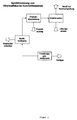
- the method according to the invention can be operated in the passage mode according to FIG.
- inert gas can be heated as the drying gas.
- the drying gas may be an oxygen-poor, with less than 0.1 vol.%, Preferably less than 0.05 vol.%, Oxygen or oxygen-free gas.
- the drying gas heaters can be operated electrically, with steam or with heat transfer media. For economical operation of the drying plant, a combination of drying gas heaters may be appropriate.
- the drying gas can then be used for spray-drying the dryer feed.
- the spray drying can be carried out at overpressure, atmospheric pressure or underpressure. A favorable process pressure range can be given if, with the drying gas, at the maximum permissible system temperature, specification-compliant powder is produced at maximum capacity.
- the heated drying gas within the process chamber may have a temperature of 250 ° to 800 ° C, so that upon contact of the dryer feed with the drying gas, the solvent evaporates. Subsequently, the product separation can take place with product discharge.
- the product stream can be separated from the exhaust gas stream in a suitable manner, for example by filters or cyclones, optionally cooled and stored or filled as required under a protective gas atmosphere. If surface filters with pressure surge cleaning are used for dust separation, the cleaning can be carried out with any oxygen-free gas, but preferably with preheated inert gas or a partial stream of the drying gas.
- the solvent can be condensed and the exhaust air aftertreated. In the passage operation, fresh drying gas is repeatedly conducted into the process space and the exhaust gas leaving the process space is discarded.
- the inventive method can be operated in the recycle gas operation according to FIG.
- the difference to the passage operation is that the exhaust gas can be recycled and conditioned by supplying energy so that it can be used again as a drying gas.
- the liquid constituents vaporized in the process chamber can be partly withdrawn from the exhaust gas, so that these can likewise be recycled.
- the most complete circulation of gas with discharge of the excess solvents and inert gases is to be aimed at economically.
- the pure inert gas used can be successively enriched with the solvent vapors.
- an equilibrium composition of the drying gas can be set, which is determined by the proportion of additionally introduced inert gas and the proportion of evaporating solvent.
- the water-vapor-containing exhaust gas can be discarded or, preferably, the water vapor is condensed and the gas is reprocessed for use as a drying gas.
- Alkali sulfides can produce an average of the Particle size distributions of 15 microns to 800 microns, preferably 20 ⁇ m to 300 ⁇ m, particularly preferably 30 ⁇ m to 150 ⁇ m, and may be powdered.
- Na 2 S * 3H 2 O is melted at a temperature of 120 ° C.
- the resulting melt has a water content of about 41 wt .-%.
- a gear pump is used for the promotion of the melt to the dryer.
- the melt is sprayed into the dryer using a two-fluid nozzle (model Schlick 970-S4) with a nozzle diameter of 1.2 mm.
- the nozzle is operated with a gas pressure of 3 bar and an atomizing gas flow rate of 4.5 m 3 / h.
- the spray dryer used consists of a drying chamber with a diameter of 150 mm and a height of 830 mm. Of these, the cylindrical part measures 630 mm and the conical part measures 200 mm.
- a cyclone with a diameter of 80 mm and a height of 300 mm and a filter are connected in series.
- a scrubber operated with water is used for further purification of the exhaust gas stream.
- the heating of the drying gas is carried out with an electric gas heater.
- the drying gas used is nitrogen and water vapor from the pipeline network.
- the water vapor is released from 10 bar to atmospheric pressure, passed through a condensation separator and then superheated.
- the drying gas is passed at a temperature of 600 ° C in the drying chamber, where it comes into contact with the sprayed melt and evaporates the solvent (water of crystallization).
- the drying takes place at an exhaust gas temperature between 100 and 350 ° C, wherein the flow rate of the melt controls the outlet temperature of the drying gas.
- the gas stream exiting the drying chamber passes through the cyclone and the filter where the dry solid is separated.
- the particle size of the deposited solid is between 20-120 ⁇ m. Drying is carried out in suction mode.
- the components of the apparatus are made of glass and stainless steel. Table 1 shows the setting parameters and the residual moisture content. parameter unit Comparative tests Examples Drying gas flow m 3 / h 35 Jet propellant N 2 m 3 / h 4.5 inlet temperature ° C 600 exhaust gas temperature ° C 100 150 200 250 300 350 150 200 250 300 350 drying gas nitrogen Steam residual moisture Wt .-% 10.6 4.7 1.2 0.5 0.2 0.1 9.8 4.3 1.5 0.7 0.3
- the examples of the method according to the invention show a Residual moisture below 10 wt .-% using water vapor as a drying gas.
- iodometry is a time reaction
- the reaction solution remains at room temperature for 15 minutes and is shaken more frequently during this time.
- the storage during this time takes place in a closed flask and, if possible, in the dark, since iodine is volatile or iodide is oxidized to iodine by light irradiation.
- the excess iodine is titrated with a 0.1 N sodium thiosulfate solution.
- initially enough normal solution is added until the solution of iodine present is just brown in color.
- After adding 2 ml of starch solution (blue color) titration is continued until the color changes and the amount of thiosulphate solution consumed is recorded. From each dissolved sample, a triplicate determination is made.
- the sodium sulfide reacts with iodine in a molar ratio of 1: 1.
Landscapes
- Chemical & Material Sciences (AREA)
- Organic Chemistry (AREA)
- Inorganic Chemistry (AREA)
- Chemical Kinetics & Catalysis (AREA)
- Vaporization, Distillation, Condensation, Sublimation, And Cold Traps (AREA)
- Drying Of Solid Materials (AREA)
- Organic Low-Molecular-Weight Compounds And Preparation Thereof (AREA)
- Physical Or Chemical Processes And Apparatus (AREA)
Claims (4)
- Procédé de production de sulfure de métal alcalin anhydre,
caractérisé en ce qu'
on sèche une solution de sulfure de métal alcalin, une suspension de sulfure de métal alcalin, une dispersion de sulfure de métal alcalin ou une masse fondue dans une eau de cristallisation de sulfure de métal alcalin, par séchage par pulvérisation avec un gaz de séchage inerte chargé de vapeur d'eau. - Procédé pour la production de sulfure de métal alcalin anhydre selon la revendication 1,
caractérisé en ce qu'
on sèche à la pression normale ou sous une légère surpression de Δp = 0 à 200 mbars au-dessus de la pression ambiante. - Procédé pour la production de sulfure de métal alcalin anhydre selon la revendication 1,
caractérisé en ce qu'
on évite l'utilisation de gaz inerte dans des conditions de fonctionnement stationnaires. - Procédé pour la production de sulfure de métal alcalin anhydre selon la revendication 1,
caractérisé en ce qu'
on fait circuler le gaz de séchage en circuit fermé, on évite l'utilisation de gaz inerte dans des conditions de fonctionnement stationnaires et on évacue, en l'absence de gaz effluent, la vapeur d'eau en excès par condensation.
Applications Claiming Priority (2)
| Application Number | Priority Date | Filing Date | Title |
|---|---|---|---|
| DE10256531 | 2002-12-04 | ||
| DE10256531A DE10256531A1 (de) | 2002-12-04 | 2002-12-04 | Verfahren zur Herstellung von wasserfreiem Alkalisulfid |
Publications (2)
| Publication Number | Publication Date |
|---|---|
| EP1426331A1 EP1426331A1 (fr) | 2004-06-09 |
| EP1426331B1 true EP1426331B1 (fr) | 2005-03-30 |
Family
ID=32308960
Family Applications (1)
| Application Number | Title | Priority Date | Filing Date |
|---|---|---|---|
| EP03022119A Expired - Lifetime EP1426331B1 (fr) | 2002-12-04 | 2003-09-30 | Procédé de production de sulfure de métal alcalin anhydre |
Country Status (10)
| Country | Link |
|---|---|
| US (1) | US7011806B2 (fr) |
| EP (1) | EP1426331B1 (fr) |
| JP (1) | JP2004182592A (fr) |
| KR (1) | KR20040048860A (fr) |
| CN (1) | CN1508063A (fr) |
| BR (1) | BR0305498A (fr) |
| DE (2) | DE10256531A1 (fr) |
| PL (1) | PL363848A1 (fr) |
| RU (1) | RU2003134924A (fr) |
| TW (1) | TW200424121A (fr) |
Families Citing this family (4)
| Publication number | Priority date | Publication date | Assignee | Title |
|---|---|---|---|---|
| CN104776687B (zh) * | 2014-09-05 | 2017-09-29 | 山东诚创医药技术开发有限公司 | 盐酸考来维仑聚合物的干燥方法 |
| CN105642904B (zh) * | 2016-01-05 | 2019-07-09 | 内蒙古电力(集团)有限责任公司内蒙古电力科学研究院分公司 | 一种纳米金属复合涂层材料的制备方法和装置 |
| JP6686737B2 (ja) * | 2016-06-29 | 2020-04-22 | Dic株式会社 | 無水アルカリ金属硫化物の製造方法 |
| CN108147372B (zh) * | 2017-12-05 | 2020-01-17 | 宜宾天原集团股份有限公司 | 聚苯硫醚生产中硫化钠反应前体的制备方法 |
Family Cites Families (7)
| Publication number | Priority date | Publication date | Assignee | Title |
|---|---|---|---|---|
| US1946089A (en) * | 1930-06-07 | 1934-02-06 | Rohm & Haas | Anhydrous sodium sulphide and process of making same |
| DE1208887B (de) * | 1963-11-14 | 1966-01-13 | Degussa | Verfahren zum Herstellen von freifliessendem Paraformaldehyd |
| US3786035A (en) * | 1972-05-15 | 1974-01-15 | Phillips Petroleum Co | Alkali metal sulfide-arylene sulfide polymer process |
| DE4326468A1 (de) * | 1993-08-09 | 1995-02-16 | Henkel Kgaa | Verwendung von überhitztem Wasserdampf zur praktisch abgasfreien Trocknung von Wertstoffen und temperatursensitiven Wertstoffgemischen und damit hergestellte Trockenprodukte mit verbesserten Eigenschaften |
| DE19755760A1 (de) | 1997-12-16 | 1999-06-24 | Degussa | Verfahren zur Herstellung von wasserfreiem Natriumsulfid |
| US6503474B1 (en) * | 1997-12-16 | 2003-01-07 | Degussa Ag | Process for the preparation of anhydrous sodium sulfide |
| AU7864000A (en) * | 1999-10-05 | 2001-05-10 | Ppg Industries Ohio, Inc. | Method of preparing anhydrous alkali metal sulfides |
-
2002
- 2002-12-04 DE DE10256531A patent/DE10256531A1/de not_active Ceased
-
2003
- 2003-09-30 DE DE50300411T patent/DE50300411D1/de not_active Expired - Fee Related
- 2003-09-30 EP EP03022119A patent/EP1426331B1/fr not_active Expired - Lifetime
- 2003-11-14 US US10/714,382 patent/US7011806B2/en not_active Expired - Fee Related
- 2003-11-27 TW TW092133425A patent/TW200424121A/zh unknown
- 2003-12-02 CN CNA200310118752XA patent/CN1508063A/zh active Pending
- 2003-12-03 PL PL03363848A patent/PL363848A1/xx unknown
- 2003-12-03 BR BR0305498-5A patent/BR0305498A/pt not_active Application Discontinuation
- 2003-12-03 RU RU2003134924/15A patent/RU2003134924A/ru not_active Application Discontinuation
- 2003-12-03 JP JP2003404689A patent/JP2004182592A/ja active Pending
- 2003-12-03 KR KR1020030087342A patent/KR20040048860A/ko not_active Withdrawn
Also Published As
| Publication number | Publication date |
|---|---|
| DE50300411D1 (de) | 2005-05-04 |
| RU2003134924A (ru) | 2005-05-27 |
| US7011806B2 (en) | 2006-03-14 |
| JP2004182592A (ja) | 2004-07-02 |
| DE10256531A1 (de) | 2004-06-24 |
| KR20040048860A (ko) | 2004-06-10 |
| CN1508063A (zh) | 2004-06-30 |
| PL363848A1 (en) | 2004-06-14 |
| BR0305498A (pt) | 2004-08-31 |
| TW200424121A (en) | 2004-11-16 |
| US20040109818A1 (en) | 2004-06-10 |
| EP1426331A1 (fr) | 2004-06-09 |
Similar Documents
| Publication | Publication Date | Title |
|---|---|---|
| DE19731062C2 (de) | Verfahren zur Entfernung von sauren Gasen aus Rauchgasen, insbesondere aus Kraftwerksabgasen und Abgasen von Müllverbrennungsanlagen | |
| DE2741427C2 (de) | Verfahren zur Herstellung von verbesserten Calciumcarbonat-Teilchen und deren Verwendung als Füllstoff | |
| DE69520593T2 (de) | Methode zur abtrennung von stoffen aus einem gasförmigen medium durch trockene adsorption | |
| DE2519928C3 (de) | Verfahren zur Herstellung von Schwefelsäure | |
| EP0061716B1 (fr) | Procédé pour l'utilisation de la chaleur perdue et pour la production de gaz à l'eau dans le refroidissement du coke chaud déchargé d'un four à chambres | |
| DE4136183C1 (en) | Removing nitrous oxide(s) from waste gas - by reacting with hydrogen peroxide in presence of inert solid catalyst, preventing evapn. of soln. | |
| EP0085086B1 (fr) | Procede et installation pour eliminer les impuretes d'un courant de gaz contenant des vapeurs de solvant | |
| DE2907177A1 (de) | Verfahren zur entfernung von schwefeloxiden aus abgasen | |
| EP0216292B1 (fr) | Procédé de traitement de gaz de queue contenant du gaz chlorhydrique | |
| DE19909318C2 (de) | Verfahren und Vorrichtung zur Expansion von Tabakmaterial | |
| EP0592025B1 (fr) | Procédé pour séparer des dioxines et furanes halogénés des gaz d'échappement de dispositifs de combustion | |
| DE2650225C2 (de) | Verfahren zur Herstellung von granulatförmigem Natriumperborat-monohydrat | |
| DE4218768A1 (de) | Verfahren zur Herstellung von Cholinchlorid enthaltenden Pulvern, diese Pulver und ihre Verwendung | |
| DE2106306C3 (de) | Verfahren zur Herstellung von Aluminiumfluorid | |
| DE2209477A1 (de) | Verfahren zur herstellung von festem, freifliessendem cholinchlorid | |
| DE10256530A1 (de) | Verfahren zur Herstellung von wasserfreiem Alkalisulfid | |
| EP1426331A1 (fr) | Procédé de production de sulfure de métal alcalin anhydre | |
| DE60204035T2 (de) | Verfahren zur Herstellung oder Beschichtung von Granulaten, Vorrichtung zur Durchführung des Verfahrens und hiernach erhältliche Granulate | |
| EP1529818B1 (fr) | Noir de carbone | |
| DE2529708A1 (de) | Verfahren zur herstellung von schwefelsaeure | |
| DE2510241A1 (de) | Verfahren zur absorption von gasfoermigen bestandteilen aus gasen | |
| DE2339859A1 (de) | Verfahren zur aufarbeitung waessriger abfallschwefelsaeure | |
| DE3635897A1 (de) | Verfahren und vorrichtung zur reinigung von rauchgasen | |
| DE3310604C2 (fr) | ||
| EP0903322A1 (fr) | Procédé de concentration d'acide dilué par un évaporateur à vide et à l'utilisation de chaleur industrielle |
Legal Events
| Date | Code | Title | Description |
|---|---|---|---|
| PUAI | Public reference made under article 153(3) epc to a published international application that has entered the european phase |
Free format text: ORIGINAL CODE: 0009012 |
|
| 17P | Request for examination filed |
Effective date: 20030930 |
|
| AK | Designated contracting states |
Kind code of ref document: A1 Designated state(s): AT BE BG CH CY CZ DE DK EE ES FI FR GB GR HU IE IT LI LU MC NL PT RO SE SI SK TR |
|
| AX | Request for extension of the european patent |
Extension state: AL LT LV MK |
|
| 17Q | First examination report despatched |
Effective date: 20040723 |
|
| GRAP | Despatch of communication of intention to grant a patent |
Free format text: ORIGINAL CODE: EPIDOSNIGR1 |
|
| GRAS | Grant fee paid |
Free format text: ORIGINAL CODE: EPIDOSNIGR3 |
|
| GRAA | (expected) grant |
Free format text: ORIGINAL CODE: 0009210 |
|
| AKX | Designation fees paid |
Designated state(s): BE DE FR IT |
|
| AK | Designated contracting states |
Kind code of ref document: B1 Designated state(s): BE DE FR IT |
|
| REF | Corresponds to: |
Ref document number: 50300411 Country of ref document: DE Date of ref document: 20050504 Kind code of ref document: P |
|
| REG | Reference to a national code |
Ref country code: IE Ref legal event code: FG4D Free format text: LANGUAGE OF EP DOCUMENT: GERMAN |
|
| ET | Fr: translation filed | ||
| PLBE | No opposition filed within time limit |
Free format text: ORIGINAL CODE: 0009261 |
|
| STAA | Information on the status of an ep patent application or granted ep patent |
Free format text: STATUS: NO OPPOSITION FILED WITHIN TIME LIMIT |
|
| 26N | No opposition filed |
Effective date: 20060102 |
|
| PGFP | Annual fee paid to national office [announced via postgrant information from national office to epo] |
Ref country code: FR Payment date: 20060922 Year of fee payment: 4 |
|
| PGFP | Annual fee paid to national office [announced via postgrant information from national office to epo] |
Ref country code: DE Payment date: 20060926 Year of fee payment: 4 |
|
| PGFP | Annual fee paid to national office [announced via postgrant information from national office to epo] |
Ref country code: IT Payment date: 20060930 Year of fee payment: 4 |
|
| PGFP | Annual fee paid to national office [announced via postgrant information from national office to epo] |
Ref country code: BE Payment date: 20061012 Year of fee payment: 4 |
|
| BERE | Be: lapsed |
Owner name: *DEGUSSA A.G. Effective date: 20070930 |
|
| PG25 | Lapsed in a contracting state [announced via postgrant information from national office to epo] |
Ref country code: DE Free format text: LAPSE BECAUSE OF NON-PAYMENT OF DUE FEES Effective date: 20080401 |
|
| PG25 | Lapsed in a contracting state [announced via postgrant information from national office to epo] |
Ref country code: BE Free format text: LAPSE BECAUSE OF NON-PAYMENT OF DUE FEES Effective date: 20070930 |
|
| REG | Reference to a national code |
Ref country code: FR Ref legal event code: ST Effective date: 20080531 |
|
| PG25 | Lapsed in a contracting state [announced via postgrant information from national office to epo] |
Ref country code: FR Free format text: LAPSE BECAUSE OF NON-PAYMENT OF DUE FEES Effective date: 20071001 |
|
| PG25 | Lapsed in a contracting state [announced via postgrant information from national office to epo] |
Ref country code: IT Free format text: LAPSE BECAUSE OF NON-PAYMENT OF DUE FEES Effective date: 20070930 |