EP1425332B1 - Process for preparing polycarbonate - Google Patents
Process for preparing polycarbonate Download PDFInfo
- Publication number
- EP1425332B1 EP1425332B1 EP02752735A EP02752735A EP1425332B1 EP 1425332 B1 EP1425332 B1 EP 1425332B1 EP 02752735 A EP02752735 A EP 02752735A EP 02752735 A EP02752735 A EP 02752735A EP 1425332 B1 EP1425332 B1 EP 1425332B1
- Authority
- EP
- European Patent Office
- Prior art keywords
- polycarbonate
- sulfonic acid
- acid ester
- quencher
- catalyst
- Prior art date
- Legal status (The legal status is an assumption and is not a legal conclusion. Google has not performed a legal analysis and makes no representation as to the accuracy of the status listed.)
- Expired - Lifetime
Links
Images
Classifications
-
- C—CHEMISTRY; METALLURGY
- C08—ORGANIC MACROMOLECULAR COMPOUNDS; THEIR PREPARATION OR CHEMICAL WORKING-UP; COMPOSITIONS BASED THEREON
- C08G—MACROMOLECULAR COMPOUNDS OBTAINED OTHERWISE THAN BY REACTIONS ONLY INVOLVING UNSATURATED CARBON-TO-CARBON BONDS
- C08G64/00—Macromolecular compounds obtained by reactions forming a carbonic ester link in the main chain of the macromolecule
- C08G64/40—Post-polymerisation treatment
- C08G64/406—Purifying; Drying
-
- C—CHEMISTRY; METALLURGY
- C08—ORGANIC MACROMOLECULAR COMPOUNDS; THEIR PREPARATION OR CHEMICAL WORKING-UP; COMPOSITIONS BASED THEREON
- C08G—MACROMOLECULAR COMPOUNDS OBTAINED OTHERWISE THAN BY REACTIONS ONLY INVOLVING UNSATURATED CARBON-TO-CARBON BONDS
- C08G64/00—Macromolecular compounds obtained by reactions forming a carbonic ester link in the main chain of the macromolecule
- C08G64/20—General preparatory processes
- C08G64/30—General preparatory processes using carbonates
- C08G64/307—General preparatory processes using carbonates and phenols
Definitions
- This disclosure relates to a manufacturing method for preparing polycarbonates, and more particularly, to a manufacturing method for preparing polycarbonates by melt polycondensation of a dihydroxy compound and a diester carbonate in the presence of a catalyst.
- Aromatic polycarbonates are used in a variety of applications due to their excellent mechanical and physical properties including, among others, impact and heat resistance, strength and transparency.
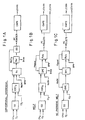
- FIG. 1 There are three general processes known for the commercial manufacture of aromatic polycarbonates, which are illustrated in FIG. 1 .
- the conventional interfacial process, as shown in FIG. 1A and the phosgene-based melt process, as shown in FIG. 1B , start with the reaction of phosgene with carbon monoxide.
- the third general process, a "no phosgene" melt process as shown in FIG. 1C was developed to eliminate the use of highly toxic phosgene in the process flow.
- the "no phosgene" melt process shown is preferred since it prepares polycarbonates less expensively than the interfacial process and avoids the use of highly toxic phosgene.
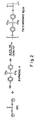
- FIGS. 1B, and 1C make use of a diarylcarbonate, such as diphenylcarbonate (DPC) as an intermediate, which is polymerized with a dihydric phenol such as bisphenol A (BPA) in the presence of an alkaline catalyst to form a polycarbonate in accordance with the general reaction scheme shown in FIG. 2 .
- This polycarbonate may be extruded or otherwise processed, and may be combined with additives such as dyes and UV stabilizers.
- the presence of residual catalyst in the finished polycarbonate has a detrimental affect on the quality of the product, leading to poor color, a decrease in molecular weight, a decrease in transparency, or undesirable rheological properties.
- Residual catalyst may also interact with additives, detracting from their efficacy and rendering the polycarbonate prone to thermal decomposition. Thus, it is desirable to reduce the levels of residual catalyst to minimize these interactions. Such reduction is referred to as "quenching.”
- a process for quenching a catalyst used in the manufacture of polycarbonate includes melt polycondensing an aromatic dihydroxy compound and a diester carbonate in the presence of a catalyst to produce a polycarbonate.
- the catalyst is
- a sulfonic acid ester quencher is added to the polycarbonate and the polycarbonate is extruded.
- the amount of sulfonic acid ester quencher added to the polycarbonate is effective to reduce the amount of branching species generated during extrusion of the polycarbonate to less than 100 parts per million.
- a method for preparing polycarbonates by melt polycondensation of a dihydroxy compound and a diester carbonate in the presence of a catalyst is described.
- the melt polycondensation reaction makes use of diarylcarbonate as an intermediate, which is polymerized with a dihydric phenol in the presence of a catalyst which is disodium magnesium ethylenediammetetraacetic acid.
- a catalyst which is disodium magnesium ethylenediammetetraacetic acid.
- compositions having structural units of the formula (I): in which at least about 60 percent of the total number of R 1 groups are aromatic organic radicals and the balance thereof are aliphatic, alicyclic, or aromatic radicals.
- R 1 is an aromatic organic radical and, more preferably, a radical of the formula (II): ——A 1 —Y 1 —A 2 ⁇ (II) wherein each of A 1 and A 2 is a monocyclic divalent aryl radical and Y 1 is a bridging radical having zero, one, or two atoms which separate A 1 from A 2 .
- one atom separates A 1 from A 2 .
- radicals of this type are -O-, -S-, -S(O)-, -S(O 2 )-, -C(O)-, methylene, cyclohexylmethylene, 2-[2,2,1]-bioyloheptylidene, ethylidene, isopropylidene, neopentylidene, cyclohexylidene, cyclopentadecylidene, cyclododecylidene, adamantylidene, and the like.
- zero atoms separate A 1 from A 2 , with an illustrative example being bisphenol (OH-benzene-benzene-OH).
- the bridging radical Y 1 can be a hydrocarbon group or a saturated hydrocarbon group such as methylene, cyclohexylidene or isopropylidene.
- Polycarbonates can be produced by the reaction of dihydroxy compounds in which only one atom separates A 1 and A 2 .
- dihydroxy compound includes, for example, bisphenol compounds having general formula (III) as follows: wherein R a and R b each independently represent hydrogen, a halogen atom, or a monovalent hydrocarbon group ; p and q are each independently integers from 0 to 4; and X a represents one of the groups of formula (IV): wherein R c and R d each independently represent a hydrogen atom or a monovalent linear or cyclic hydrocarbon group, and R e is a divalent hydrocarbon group.
- dihydroxy compounds include dihydric phenols and the dihydroxy-substituted aromatic hydrocarbons such as those disclosed by name or formula (generic or specific) in U.S. Patent No. 4,217,438 .
- a nonexclusive list of specific examples of the types of bisphenol compounds that may be represented by formula (III) includes the following: 1,1-bis(4-hydroxyphenyl) methane; 1,1-bis(4-hydroxyphenyl) ethane; 2,2-bis(4-hydroxyphenyl) propane (hereinafter "bisphenol A” or "BPA”); 2,2-bis(4-hydroxyphenyl) butane; 2,2-bis(4-hydroxyphenyl) octane; 1,1-bis(4-hydroxyphenyl) propane; 1,1-bis(4-hydroxyphenyl) n-butane; bis(4-hydroxyphenyl) phenylmethane; 2,2-bis(4-hydroxy-1-methylphenyl) propane; 1,1-bis(4-hydroxy-t-butylphenyl) propane; bis(hydroxyaryl) alkanes such as 2,2-bis(4-hydroxy-3-bromophenyl) propane; 1,1-bis(4-hydroxyphenyl) cyclopentane
- polycarbonates resulting from the polymerization of two or more different dihydric phenols or a copolymer of a dihydric phenol with a glycol or with a hydroxy- or acid-terminated polyester or with a dibasic acid or with a hydroxy acid or with an aliphatic diacid in the event a carbonate copolymer rather than a homopolymer is desired for use.
- useful aliphatic diacids have about 2 to about 40 carbons.
- a preferred aliphatic diacid is dodecandioic acid.
- Polyarylates and polyester-carbonate resins or their blends can also be employed.
- Preferred polycarbonates are based on bisphenol A, in which each of A 1 and A 2 is p-phenylene and Y 1 is isopropylidene.
- the weight average molecular weight of the polycarbonate is about 5,000 to about 100,000 atomic mass units, more preferably about 10,000 to about 65,000 atomic mass units, and most preferably about 15,000 to about 35,000 atomic mass units.
- the polycarbonate composition may also include various additives ordinarily incorporated in resin compositions of this type.
- additives are, for example, fillers or reinforcing agents; heat stabilizers; antioxidants; light stabilizers; plasticizers; antistatic agents; mold releasing agents; additional resins; blowing agents; and the like, as well as combinations comprising at least one of the foregoing additives.
- the melt polycondensation reaction generally takes place in a series of reactors.
- the temperature is increased and the pressure is reduced along the reactor train. Since the reaction is an equilibrium reaction, byproduct phenol is continuously removed from the reactors to ensure the desired or targeted molecular weight.
- the reaction preferably occurs at temperatures greater than about 260°C. More preferably, the temperature is in a range from about 270°C to about 310°C.
- the pressure of the reaction is preferably reduced to a pressure less than about 0.8 torr. More preferably, the reactor is pressurized to a pressure within a range from about 0.2 to about 0.6 torr.
- the quencher compositions comprise a sulfonic acid ester having the general formula (V): R 1 SO 3 R 2 (V) wherein R 1 is hydrogen, C 1 -C 12 alkyl, C 1 -C 12 aryl, or C 1 -C 18 alkylaryl; and R 2 is C 1 -C 12 alkyl, C 1 -C 12 aryl, or C 1 -C 18 alkylaryl.
- the quencher is an alkyl tosylate. More preferably, the quencher is butyl tosylate.
- the amount of quencher in the quencher composition can be varied over a substantial range, since the carrier acts primarily as a diluent to facilitate uniform addition of small amounts of quencher to the product of the melt polycondensation reaction. Quencher compositions with higher concentrations of quencher can be used in smaller amounts, while quencher compositions with lower quencher concentrations are used in larger amounts to arrive at the same final levels of quencher. In general, the level of quencher in the quencher composition will be from about 0.1 to 10% by volume, preferably around 1%.
- the quencher compositions are preferably formulated in a two carrier component system that effectively delivers the quencher to the product of the melt polycondensation reaction without the aforementioned processing difficulties.
- the first carrier component is a low boiling point solvent (lower boiling point than the quencher), which is capable of solubilizing the sulfonic acid ester quencher but which is essentially unreactive with the polycondensation product under conditions of high temperature and high vacuum.
- specific materials suitable for use as the first carrier component include xylene, toluene, benzene, chlorobenzene, anisole and ethylbenzene.
- the second component is selected to have a higher boiling point than the sulfonic acid quencher, and to be soluble in the first component.
- This second component will frequently be a component of the melt condensation reaction, thus avoiding the introduction of impurities.
- suitable materials for use as the second component include diphenylcarbonate, phenol, bisphenol A, polycarbonate oligomers, bisphenol A derivatives and propylene carbonate.
- the first and second components are combined in the quencher compositions at ratios of from about 4:1 to 1:4, preferably around 1:1.
- the resulting quencher composition is injected into a stream of melt polycondensation reaction product and professed (for example by extrusion) to disperse the quencher composition throughout the melt.
- the resulting products are high quality polycarbonate, and processing proceeds without the instabilities in flow rate observed when only the low-boiling solvent is utilized. While to wanting to be bound by theory, it is believed that the basic catalyst in the polycarbonate is neutralized and stabilized; therefore, when different types of additives are added, the basic properties of the additives are not lost, and a polycarbonate composition with a high heat resistance, weather resistance, and moisture resistance can be produced.
- the amount of quencher used to reduce the levels of residual catalyst has been found to be dependent on the particular quencher employed.
- the amount of quencher added to the polycarbonate is in an amount effective to prevent a change in molecular weight or an increase in the amount of branching compounds after extrusion.
- the presence of residual catalyst in the polycarbonate causes crosslinking to occur during the extrusion process. Suppressing the reactivity of the catalyst in the finished polycarbonate results in improved processing and residence stability.
- Example 1 and Example 2 are comparative examples, and Example 3 is an example according to the invention.
- diphenylcarbonate and bisphenol A were polymerized with sodium dihydrogen phosphite catalyst in a mini- reactor operating at 300°C and 1 millibar.
- the level of sodium dihydrogen phosphite catalyst was either 1 ⁇ 10 -6 mole/mole BPA or 3 x 10 -6 mole/mole BPA.
- a liquid solution at room temperature containing 1 part n-butyl tosylate and 99 parts toluene was injected into the reactor of the melt polycarbonate.
- the total amounts of quencher varied from 0 equivalents to 10 equivalents of the amount of catalyst.
- the reaction was continued and the changes in molecular weight and branching species were monitored. The results are shown in Table I. Table I.
- diphenylcarbonate and bisphenol A were polymerized with cesium dihydrogen phosphate catalyst in a mini- reactor operating at 300°C and 1 millibar.
- the level of cesium dihydrogen phosphate catalyst was either 1 x 10 -6 mole/mole BPA or 3 x 10 -6 mole/mole BPA.
- a liquid solution at room temperature containing 1 part n-butyl tosylate and 99 parts toluene was injected into the reactor of the melt polycarbonate.
- the total amounts of quencher varied from 0 equivalents to 10 equivalents of the amount of catalyst.
- the changes in molecular weight and branching species were monitored as in Example 1. The results are shown in Table II. Table II.
- diphenylcarbonate and bisphenol A were polymerized with disodium magnesium ethylenediaminetetraacetic acid catalyst in a mini- reactor operating at 300°C and I millibar.
- the level of disodium magnesium ethylenediaminetetraacetic acid catalyst was either 1 x 10 -6 mole/mole BPA or 3 x 10 -6 or 3.3 x 10 -7 mole/mole BPA.
- a liquid solution at room temperature containing 1 part n-butyl tosylate and 99 parts toluene was injected into the reactor of the melt polycarbonate.
- the total amounts of quencher varied from 0 equivalents to 10 equivalents of the amount of catalyst.
Landscapes
- Chemical & Material Sciences (AREA)
- Health & Medical Sciences (AREA)
- Chemical Kinetics & Catalysis (AREA)
- Medicinal Chemistry (AREA)
- Polymers & Plastics (AREA)
- Organic Chemistry (AREA)
- Polyesters Or Polycarbonates (AREA)
Applications Claiming Priority (3)
| Application Number | Priority Date | Filing Date | Title |
|---|---|---|---|
| US682412 | 2001-08-30 | ||
| US09/682,412 US6495654B1 (en) | 2001-08-30 | 2001-08-30 | Process for preparing polycarbonate |
| PCT/US2002/025108 WO2003020794A1 (en) | 2001-08-30 | 2002-08-05 | Process for preparing polycarbonate |
Publications (2)
| Publication Number | Publication Date |
|---|---|
| EP1425332A1 EP1425332A1 (en) | 2004-06-09 |
| EP1425332B1 true EP1425332B1 (en) | 2008-10-01 |
Family
ID=24739570
Family Applications (1)
| Application Number | Title | Priority Date | Filing Date |
|---|---|---|---|
| EP02752735A Expired - Lifetime EP1425332B1 (en) | 2001-08-30 | 2002-08-05 | Process for preparing polycarbonate |
Country Status (8)
| Country | Link |
|---|---|
| US (1) | US6495654B1 (cg-RX-API-DMAC7.html) |
| EP (1) | EP1425332B1 (cg-RX-API-DMAC7.html) |
| JP (1) | JP2005501945A (cg-RX-API-DMAC7.html) |
| CN (1) | CN1252127C (cg-RX-API-DMAC7.html) |
| AT (1) | ATE409716T1 (cg-RX-API-DMAC7.html) |
| DE (1) | DE60229148D1 (cg-RX-API-DMAC7.html) |
| TW (1) | TW570939B (cg-RX-API-DMAC7.html) |
| WO (1) | WO2003020794A1 (cg-RX-API-DMAC7.html) |
Cited By (1)
| Publication number | Priority date | Publication date | Assignee | Title |
|---|---|---|---|---|
| DE102009021388A1 (de) | 2009-05-14 | 2010-11-18 | Nano-X Gmbh | Phenolatesterverbindungen |
Families Citing this family (6)
| Publication number | Priority date | Publication date | Assignee | Title |
|---|---|---|---|---|
| US7309755B2 (en) * | 2005-08-24 | 2007-12-18 | General Electric Company | Method of producing polycarbonate articles by rotation molding and rotation molded articles made by the method |
| US8949033B2 (en) * | 2006-04-28 | 2015-02-03 | The Chemo-Sero-Therapeutic Research Institute | Method for quantification of neurotoxin |
| CN101125918B (zh) * | 2007-08-06 | 2011-07-20 | 天津大学 | 芳族二羟基化合物与碳酸二酯制备聚碳酸酯用催化剂中和处理方法及所使用的中和剂 |
| KR20160106658A (ko) * | 2014-01-06 | 2016-09-12 | 사우디 베이식 인더스트리즈 코포레이션 | 개선된 폴리카보네이트 안정성을 위한 개질 이형제 |
| CN106103545A (zh) | 2014-03-27 | 2016-11-09 | 沙特基础工业全球技术有限公司 | 熔融聚合聚碳酸酯淬灭 |
| US20180022918A1 (en) * | 2015-02-17 | 2018-01-25 | Sabic Global Technologies B.V. | A method of quenching a melt polycarbonate |
Family Cites Families (16)
| Publication number | Priority date | Publication date | Assignee | Title |
|---|---|---|---|---|
| US4217438A (en) | 1978-12-15 | 1980-08-12 | General Electric Company | Polycarbonate transesterification process |
| US4401804A (en) | 1982-05-24 | 1983-08-30 | Eastman Kodak Company | Deactivation of polyester catalyst residues |
| US4532290A (en) | 1984-05-02 | 1985-07-30 | General Electric Company | Stabilized polycarbonate-polyester compositions |
| KR940005956B1 (ko) | 1989-12-28 | 1994-06-25 | 아사히가세이고오교 가부시끼가이샤 | 방향족 카르보네이트의 연속 제조방법 |
| JPH0692529B2 (ja) | 1989-12-28 | 1994-11-16 | 日本ジーイープラスチックス株式会社 | 芳香族系ポリカーボネートの製造方法 |
| JP2924985B2 (ja) | 1991-06-28 | 1999-07-26 | 日本ジーイープラスチックス株式会社 | ポリカーボネートの製造方法 |
| US5922816A (en) | 1992-06-02 | 1999-07-13 | General Electric Company | Polyester-polycarbonate compositions stabilized against ester-carbonate interchange |
| US5319066A (en) | 1993-05-27 | 1994-06-07 | General Electric Company | Method for making polycarbonates |
| US5354791A (en) | 1993-10-19 | 1994-10-11 | General Electric Company | Epoxy-functional polyester, polycarbonate with metal phosphate |
| DE69522852T2 (de) | 1994-05-19 | 2002-05-02 | General Electric Co., Schenectady | Stabilisatorzusammensetzung |
| US5717057A (en) | 1994-12-28 | 1998-02-10 | General Electric Company | Method of manufacturing polycarbonate |
| JP3200338B2 (ja) | 1995-08-30 | 2001-08-20 | 帝人株式会社 | 芳香族ポリカーボネートの製造方法 |
| JP3613355B2 (ja) | 1995-09-19 | 2005-01-26 | 出光興産株式会社 | ポリカーボネート及びその製造方法 |
| SG54571A1 (en) | 1996-09-27 | 1998-11-16 | Ube Industries | Process for producing diaryl carbonate |
| US6177536B1 (en) | 1999-02-22 | 2001-01-23 | General Electric Company | Method for quenching of catalyst in the production of low molecular weight polycarbonates |
| US6228973B1 (en) * | 2000-06-02 | 2001-05-08 | General Electric Company | Method for preparing high molecular weight polycarbonate |
-
2001
- 2001-08-30 US US09/682,412 patent/US6495654B1/en not_active Expired - Lifetime
-
2002
- 2002-08-05 JP JP2003525061A patent/JP2005501945A/ja active Pending
- 2002-08-05 CN CN02817061.XA patent/CN1252127C/zh not_active Expired - Fee Related
- 2002-08-05 DE DE60229148T patent/DE60229148D1/de not_active Expired - Lifetime
- 2002-08-05 AT AT02752735T patent/ATE409716T1/de not_active IP Right Cessation
- 2002-08-05 EP EP02752735A patent/EP1425332B1/en not_active Expired - Lifetime
- 2002-08-05 WO PCT/US2002/025108 patent/WO2003020794A1/en not_active Ceased
- 2002-08-19 TW TW091118698A patent/TW570939B/zh not_active IP Right Cessation
Cited By (1)
| Publication number | Priority date | Publication date | Assignee | Title |
|---|---|---|---|---|
| DE102009021388A1 (de) | 2009-05-14 | 2010-11-18 | Nano-X Gmbh | Phenolatesterverbindungen |
Also Published As
| Publication number | Publication date |
|---|---|
| JP2005501945A (ja) | 2005-01-20 |
| EP1425332A1 (en) | 2004-06-09 |
| US6495654B1 (en) | 2002-12-17 |
| TW570939B (en) | 2004-01-11 |
| DE60229148D1 (de) | 2008-11-13 |
| ATE409716T1 (de) | 2008-10-15 |
| WO2003020794A1 (en) | 2003-03-13 |
| CN1252127C (zh) | 2006-04-19 |
| CN1549839A (zh) | 2004-11-24 |
Similar Documents
| Publication | Publication Date | Title |
|---|---|---|
| US6525163B1 (en) | Process for the production of polycarbonate | |
| US6747119B2 (en) | Method and system for preparing a polycarbonate, copolymerization reagent and polycarbonate | |
| US6653434B2 (en) | Process for the production of polycarbonate | |
| EP2548925A2 (en) | Poly (block-phosphonato-ester) and poly (block-phosphonato-carbonate) | |
| KR20110046526A (ko) | 방향족 폴리카르보네이트 및 폴리락트산의 블렌드, 이의 제조 방법 및 용도 | |
| EP1425332B1 (en) | Process for preparing polycarbonate | |
| CN102712804A (zh) | 聚碳酸酯树脂组合物和成型品 | |
| EP0913419B1 (en) | Polycarbonate redistribution method with catalyst decomposition | |
| EP1363962B1 (en) | Process for the production of polycarbonate | |
| US6504000B1 (en) | Process for preparing polycarbonate | |
| EP1423452B1 (en) | Process for preparing polycarbonate | |
| US8110649B2 (en) | Polycarbonates comprising cyclic oligomers and having an improved flow behavior | |
| US20030120025A1 (en) | Process for the production of polycarbonate | |
| US3157622A (en) | Resinous compositions | |
| EP0350088B1 (en) | Flame-resistant polycarbonates containing units derived from halogenated triphenyl compounds | |
| EP0176008A1 (en) | Aromatic polymers containing novel terminal groups | |
| KR20120067193A (ko) | 난연성 방향족 폴리카보네이트 수지 및 이의 제조방법 | |
| JP3390581B2 (ja) | ポリカーボネート樹脂の製造方法 | |
| JP3334723B2 (ja) | ポリカーボネートの製造方法 | |
| KR20110087333A (ko) | 내충격성이 개선된 선형 폴리카보네이트의 제조방법 | |
| EP0900816A1 (en) | Method for preparing brominated polycarbonates | |
| JP3390594B2 (ja) | ポリカーボネート樹脂の製造方法 | |
| CN104513389A (zh) | 用于精密构件的容器及其制备方法 | |
| US20240287251A1 (en) | Polycarbonate resin composition and molded article | |
| WO2002051906A2 (en) | Polycarbonate resin, method for the manufacture thereof, and articles formed therefrom |
Legal Events
| Date | Code | Title | Description |
|---|---|---|---|
| PUAI | Public reference made under article 153(3) epc to a published international application that has entered the european phase |
Free format text: ORIGINAL CODE: 0009012 |
|
| 17P | Request for examination filed |
Effective date: 20040330 |
|
| AK | Designated contracting states |
Kind code of ref document: A1 Designated state(s): AT BE BG CH CY CZ DE DK EE ES FI FR GB GR IE IT LI LU MC NL PT SE SK TR |
|
| AX | Request for extension of the european patent |
Extension state: AL LT LV MK RO SI |
|
| 17Q | First examination report despatched |
Effective date: 20040608 |
|
| GRAP | Despatch of communication of intention to grant a patent |
Free format text: ORIGINAL CODE: EPIDOSNIGR1 |
|
| GRAS | Grant fee paid |
Free format text: ORIGINAL CODE: EPIDOSNIGR3 |
|
| GRAA | (expected) grant |
Free format text: ORIGINAL CODE: 0009210 |
|
| RAP1 | Party data changed (applicant data changed or rights of an application transferred) |
Owner name: SABIC INNOVATIVE PLASTICS IP B.V. |
|
| AK | Designated contracting states |
Kind code of ref document: B1 Designated state(s): AT BE BG CH CY CZ DE DK EE ES FI FR GB GR IE IT LI LU MC NL PT SE SK TR |
|
| REG | Reference to a national code |
Ref country code: GB Ref legal event code: FG4D |
|
| REG | Reference to a national code |
Ref country code: CH Ref legal event code: EP |
|
| REG | Reference to a national code |
Ref country code: IE Ref legal event code: FG4D |
|
| REF | Corresponds to: |
Ref document number: 60229148 Country of ref document: DE Date of ref document: 20081113 Kind code of ref document: P |
|
| NLV1 | Nl: lapsed or annulled due to failure to fulfill the requirements of art. 29p and 29m of the patents act | ||
| PG25 | Lapsed in a contracting state [announced via postgrant information from national office to epo] |
Ref country code: ES Free format text: LAPSE BECAUSE OF FAILURE TO SUBMIT A TRANSLATION OF THE DESCRIPTION OR TO PAY THE FEE WITHIN THE PRESCRIBED TIME-LIMIT Effective date: 20090112 Ref country code: AT Free format text: LAPSE BECAUSE OF FAILURE TO SUBMIT A TRANSLATION OF THE DESCRIPTION OR TO PAY THE FEE WITHIN THE PRESCRIBED TIME-LIMIT Effective date: 20081001 Ref country code: BG Free format text: LAPSE BECAUSE OF FAILURE TO SUBMIT A TRANSLATION OF THE DESCRIPTION OR TO PAY THE FEE WITHIN THE PRESCRIBED TIME-LIMIT Effective date: 20090101 |
|
| PG25 | Lapsed in a contracting state [announced via postgrant information from national office to epo] |
Ref country code: FI Free format text: LAPSE BECAUSE OF FAILURE TO SUBMIT A TRANSLATION OF THE DESCRIPTION OR TO PAY THE FEE WITHIN THE PRESCRIBED TIME-LIMIT Effective date: 20081001 Ref country code: NL Free format text: LAPSE BECAUSE OF FAILURE TO SUBMIT A TRANSLATION OF THE DESCRIPTION OR TO PAY THE FEE WITHIN THE PRESCRIBED TIME-LIMIT Effective date: 20081001 Ref country code: PT Free format text: LAPSE BECAUSE OF FAILURE TO SUBMIT A TRANSLATION OF THE DESCRIPTION OR TO PAY THE FEE WITHIN THE PRESCRIBED TIME-LIMIT Effective date: 20090302 |
|
| PG25 | Lapsed in a contracting state [announced via postgrant information from national office to epo] |
Ref country code: DK Free format text: LAPSE BECAUSE OF FAILURE TO SUBMIT A TRANSLATION OF THE DESCRIPTION OR TO PAY THE FEE WITHIN THE PRESCRIBED TIME-LIMIT Effective date: 20081001 Ref country code: EE Free format text: LAPSE BECAUSE OF FAILURE TO SUBMIT A TRANSLATION OF THE DESCRIPTION OR TO PAY THE FEE WITHIN THE PRESCRIBED TIME-LIMIT Effective date: 20081001 Ref country code: BE Free format text: LAPSE BECAUSE OF FAILURE TO SUBMIT A TRANSLATION OF THE DESCRIPTION OR TO PAY THE FEE WITHIN THE PRESCRIBED TIME-LIMIT Effective date: 20081001 |
|
| PLBE | No opposition filed within time limit |
Free format text: ORIGINAL CODE: 0009261 |
|
| STAA | Information on the status of an ep patent application or granted ep patent |
Free format text: STATUS: NO OPPOSITION FILED WITHIN TIME LIMIT |
|
| PG25 | Lapsed in a contracting state [announced via postgrant information from national office to epo] |
Ref country code: CZ Free format text: LAPSE BECAUSE OF FAILURE TO SUBMIT A TRANSLATION OF THE DESCRIPTION OR TO PAY THE FEE WITHIN THE PRESCRIBED TIME-LIMIT Effective date: 20081001 Ref country code: SE Free format text: LAPSE BECAUSE OF FAILURE TO SUBMIT A TRANSLATION OF THE DESCRIPTION OR TO PAY THE FEE WITHIN THE PRESCRIBED TIME-LIMIT Effective date: 20090101 Ref country code: IT Free format text: LAPSE BECAUSE OF FAILURE TO SUBMIT A TRANSLATION OF THE DESCRIPTION OR TO PAY THE FEE WITHIN THE PRESCRIBED TIME-LIMIT Effective date: 20081001 |
|
| 26N | No opposition filed |
Effective date: 20090702 |
|
| PG25 | Lapsed in a contracting state [announced via postgrant information from national office to epo] |
Ref country code: SK Free format text: LAPSE BECAUSE OF FAILURE TO SUBMIT A TRANSLATION OF THE DESCRIPTION OR TO PAY THE FEE WITHIN THE PRESCRIBED TIME-LIMIT Effective date: 20081001 |
|
| PG25 | Lapsed in a contracting state [announced via postgrant information from national office to epo] |
Ref country code: MC Free format text: LAPSE BECAUSE OF NON-PAYMENT OF DUE FEES Effective date: 20090831 |
|
| REG | Reference to a national code |
Ref country code: CH Ref legal event code: PL |
|
| GBPC | Gb: european patent ceased through non-payment of renewal fee |
Effective date: 20090805 |
|
| PG25 | Lapsed in a contracting state [announced via postgrant information from national office to epo] |
Ref country code: CH Free format text: LAPSE BECAUSE OF NON-PAYMENT OF DUE FEES Effective date: 20090831 Ref country code: LI Free format text: LAPSE BECAUSE OF NON-PAYMENT OF DUE FEES Effective date: 20090831 |
|
| REG | Reference to a national code |
Ref country code: FR Ref legal event code: ST Effective date: 20100430 |
|
| REG | Reference to a national code |
Ref country code: IE Ref legal event code: MM4A |
|
| PG25 | Lapsed in a contracting state [announced via postgrant information from national office to epo] |
Ref country code: IE Free format text: LAPSE BECAUSE OF NON-PAYMENT OF DUE FEES Effective date: 20090805 Ref country code: FR Free format text: LAPSE BECAUSE OF NON-PAYMENT OF DUE FEES Effective date: 20090831 |
|
| PG25 | Lapsed in a contracting state [announced via postgrant information from national office to epo] |
Ref country code: GR Free format text: LAPSE BECAUSE OF FAILURE TO SUBMIT A TRANSLATION OF THE DESCRIPTION OR TO PAY THE FEE WITHIN THE PRESCRIBED TIME-LIMIT Effective date: 20090102 |
|
| PG25 | Lapsed in a contracting state [announced via postgrant information from national office to epo] |
Ref country code: GB Free format text: LAPSE BECAUSE OF NON-PAYMENT OF DUE FEES Effective date: 20090805 |
|
| PG25 | Lapsed in a contracting state [announced via postgrant information from national office to epo] |
Ref country code: LU Free format text: LAPSE BECAUSE OF NON-PAYMENT OF DUE FEES Effective date: 20090805 |
|
| PG25 | Lapsed in a contracting state [announced via postgrant information from national office to epo] |
Ref country code: TR Free format text: LAPSE BECAUSE OF FAILURE TO SUBMIT A TRANSLATION OF THE DESCRIPTION OR TO PAY THE FEE WITHIN THE PRESCRIBED TIME-LIMIT Effective date: 20081001 |
|
| PG25 | Lapsed in a contracting state [announced via postgrant information from national office to epo] |
Ref country code: CY Free format text: LAPSE BECAUSE OF FAILURE TO SUBMIT A TRANSLATION OF THE DESCRIPTION OR TO PAY THE FEE WITHIN THE PRESCRIBED TIME-LIMIT Effective date: 20081001 |
|
| REG | Reference to a national code |
Ref country code: DE Ref legal event code: R082 Ref document number: 60229148 Country of ref document: DE Representative=s name: SCHIEBER - FARAGO, DE Ref country code: DE Ref legal event code: R081 Ref document number: 60229148 Country of ref document: DE Owner name: SABIC GLOBAL TECHNOLOGIES B.V., NL Free format text: FORMER OWNER: SABIC INNOVATIVE PLASTICS IP B.V., BERGEN OP ZOOM, NL Ref country code: DE Ref legal event code: R082 Ref document number: 60229148 Country of ref document: DE Representative=s name: FARAGO PATENTANWAELTE, DE |
|
| PGFP | Annual fee paid to national office [announced via postgrant information from national office to epo] |
Ref country code: DE Payment date: 20170801 Year of fee payment: 16 |
|
| REG | Reference to a national code |
Ref country code: DE Ref legal event code: R119 Ref document number: 60229148 Country of ref document: DE |
|
| PG25 | Lapsed in a contracting state [announced via postgrant information from national office to epo] |
Ref country code: DE Free format text: LAPSE BECAUSE OF NON-PAYMENT OF DUE FEES Effective date: 20190301 |