EP1415306B1 - Verfahren zur herstellung eines mischoxid-kernbrennstoff-pulvers und eines mischoxid-kernbrennstoff-sinterkörpers - Google Patents
Verfahren zur herstellung eines mischoxid-kernbrennstoff-pulvers und eines mischoxid-kernbrennstoff-sinterkörpers Download PDFInfo
- Publication number
- EP1415306B1 EP1415306B1 EP02794565A EP02794565A EP1415306B1 EP 1415306 B1 EP1415306 B1 EP 1415306B1 EP 02794565 A EP02794565 A EP 02794565A EP 02794565 A EP02794565 A EP 02794565A EP 1415306 B1 EP1415306 B1 EP 1415306B1
- Authority
- EP
- European Patent Office
- Prior art keywords
- powder
- containing powder
- intimate
- process according
- powder mixture
- Prior art date
- Legal status (The legal status is an assumption and is not a legal conclusion. Google has not performed a legal analysis and makes no representation as to the accuracy of the status listed.)
- Expired - Lifetime
Links
- 239000000843 powder Substances 0.000 title claims description 438
- 239000003758 nuclear fuel Substances 0.000 title claims description 70
- 238000004519 manufacturing process Methods 0.000 title description 31
- 239000000203 mixture Substances 0.000 claims description 129
- 238000000034 method Methods 0.000 claims description 112
- 230000008569 process Effects 0.000 claims description 92
- 238000006243 chemical reaction Methods 0.000 claims description 50
- 238000002156 mixing Methods 0.000 claims description 29
- 239000002245 particle Substances 0.000 claims description 27
- 238000003825 pressing Methods 0.000 claims description 24
- 229910052770 Uranium Inorganic materials 0.000 claims description 16
- 229910003439 heavy metal oxide Inorganic materials 0.000 claims description 15
- 238000005245 sintering Methods 0.000 claims description 15
- 239000008187 granular material Substances 0.000 claims description 12
- 238000010574 gas phase reaction Methods 0.000 claims description 11
- JFALSRSLKYAFGM-UHFFFAOYSA-N uranium(0) Chemical compound [U] JFALSRSLKYAFGM-UHFFFAOYSA-N 0.000 claims description 9
- IJGRMHOSHXDMSA-UHFFFAOYSA-N Atomic nitrogen Chemical compound N#N IJGRMHOSHXDMSA-UHFFFAOYSA-N 0.000 claims description 8
- 239000007789 gas Substances 0.000 claims description 7
- 239000002574 poison Substances 0.000 claims description 7
- 231100000614 poison Toxicity 0.000 claims description 7
- 239000003795 chemical substances by application Substances 0.000 claims description 6
- 239000000314 lubricant Substances 0.000 claims description 6
- 239000000654 additive Substances 0.000 claims description 5
- 239000002019 doping agent Substances 0.000 claims description 5
- 239000001257 hydrogen Substances 0.000 claims description 5
- 229910052739 hydrogen Inorganic materials 0.000 claims description 5
- 238000003801 milling Methods 0.000 claims description 5
- UFHFLCQGNIYNRP-UHFFFAOYSA-N Hydrogen Chemical compound [H][H] UFHFLCQGNIYNRP-UHFFFAOYSA-N 0.000 claims description 4
- 229910052757 nitrogen Inorganic materials 0.000 claims description 4
- 230000003647 oxidation Effects 0.000 claims description 4
- 238000007254 oxidation reaction Methods 0.000 claims description 4
- 230000000996 additive effect Effects 0.000 claims description 2
- 229910052799 carbon Inorganic materials 0.000 claims description 2
- -1 milling aid Substances 0.000 claims description 2
- 229910004369 ThO2 Inorganic materials 0.000 claims 1
- CMIHHWBVHJVIGI-UHFFFAOYSA-N gadolinium(III) oxide Inorganic materials [O-2].[O-2].[O-2].[Gd+3].[Gd+3] CMIHHWBVHJVIGI-UHFFFAOYSA-N 0.000 claims 1
- FLDALJIYKQCYHH-UHFFFAOYSA-N plutonium(IV) oxide Inorganic materials [O-2].[O-2].[Pu+4] FLDALJIYKQCYHH-UHFFFAOYSA-N 0.000 claims 1
- 238000012216 screening Methods 0.000 claims 1
- ZCUFMDLYAMJYST-UHFFFAOYSA-N thorium dioxide Chemical compound O=[Th]=O ZCUFMDLYAMJYST-UHFFFAOYSA-N 0.000 claims 1
- 238000000227 grinding Methods 0.000 description 25
- 238000005469 granulation Methods 0.000 description 17
- 230000003179 granulation Effects 0.000 description 17
- 239000011148 porous material Substances 0.000 description 16
- 239000000126 substance Substances 0.000 description 14
- 239000000463 material Substances 0.000 description 12
- 239000000446 fuel Substances 0.000 description 11
- 229910001385 heavy metal Inorganic materials 0.000 description 10
- 238000000465 moulding Methods 0.000 description 9
- 238000011282 treatment Methods 0.000 description 8
- 238000011161 development Methods 0.000 description 7
- 230000018109 developmental process Effects 0.000 description 7
- XLYOFNOQVPJJNP-UHFFFAOYSA-N water Substances O XLYOFNOQVPJJNP-UHFFFAOYSA-N 0.000 description 7
- 230000008901 benefit Effects 0.000 description 6
- 238000011049 filling Methods 0.000 description 6
- 238000007792 addition Methods 0.000 description 5
- 230000000694 effects Effects 0.000 description 5
- YCKRFDGAMUMZLT-UHFFFAOYSA-N Fluorine atom Chemical compound [F] YCKRFDGAMUMZLT-UHFFFAOYSA-N 0.000 description 4
- 229910052778 Plutonium Inorganic materials 0.000 description 4
- 229910052776 Thorium Inorganic materials 0.000 description 4
- 238000000265 homogenisation Methods 0.000 description 4
- 239000011872 intimate mixture Substances 0.000 description 4
- 238000002360 preparation method Methods 0.000 description 4
- 230000009257 reactivity Effects 0.000 description 4
- FCTBKIHDJGHPPO-UHFFFAOYSA-N uranium dioxide Inorganic materials O=[U]=O FCTBKIHDJGHPPO-UHFFFAOYSA-N 0.000 description 4
- 238000005056 compaction Methods 0.000 description 3
- 150000001875 compounds Chemical class 0.000 description 3
- 239000011737 fluorine Substances 0.000 description 3
- 229910052731 fluorine Inorganic materials 0.000 description 3
- 239000008240 homogeneous mixture Substances 0.000 description 3
- 230000000877 morphologic effect Effects 0.000 description 3
- 238000007873 sieving Methods 0.000 description 3
- SANRKQGLYCLAFE-UHFFFAOYSA-H uranium hexafluoride Chemical compound F[U](F)(F)(F)(F)F SANRKQGLYCLAFE-UHFFFAOYSA-H 0.000 description 3
- ZOXJGFHDIHLPTG-UHFFFAOYSA-N Boron Chemical compound [B] ZOXJGFHDIHLPTG-UHFFFAOYSA-N 0.000 description 2
- KRHYYFGTRYWZRS-UHFFFAOYSA-N Fluorane Chemical compound F KRHYYFGTRYWZRS-UHFFFAOYSA-N 0.000 description 2
- ZOKXTWBITQBERF-UHFFFAOYSA-N Molybdenum Chemical compound [Mo] ZOKXTWBITQBERF-UHFFFAOYSA-N 0.000 description 2
- QVGXLLKOCUKJST-UHFFFAOYSA-N atomic oxygen Chemical compound [O] QVGXLLKOCUKJST-UHFFFAOYSA-N 0.000 description 2
- 229910052790 beryllium Inorganic materials 0.000 description 2
- ATBAMAFKBVZNFJ-UHFFFAOYSA-N beryllium atom Chemical compound [Be] ATBAMAFKBVZNFJ-UHFFFAOYSA-N 0.000 description 2
- 229910052796 boron Inorganic materials 0.000 description 2
- 238000001311 chemical methods and process Methods 0.000 description 2
- 238000005253 cladding Methods 0.000 description 2
- 238000003776 cleavage reaction Methods 0.000 description 2
- ZAASRHQPRFFWCS-UHFFFAOYSA-P diazanium;oxygen(2-);uranium Chemical compound [NH4+].[NH4+].[O-2].[O-2].[O-2].[O-2].[O-2].[O-2].[O-2].[U].[U] ZAASRHQPRFFWCS-UHFFFAOYSA-P 0.000 description 2
- 230000002349 favourable effect Effects 0.000 description 2
- 230000005484 gravity Effects 0.000 description 2
- 239000000543 intermediate Substances 0.000 description 2
- 230000014759 maintenance of location Effects 0.000 description 2
- 229910052750 molybdenum Inorganic materials 0.000 description 2
- 239000011733 molybdenum Substances 0.000 description 2
- 239000001301 oxygen Substances 0.000 description 2
- 229910052760 oxygen Inorganic materials 0.000 description 2
- OOAWCECZEHPMBX-UHFFFAOYSA-N oxygen(2-);uranium(4+) Chemical compound [O-2].[O-2].[U+4] OOAWCECZEHPMBX-UHFFFAOYSA-N 0.000 description 2
- 230000007017 scission Effects 0.000 description 2
- 239000002002 slurry Substances 0.000 description 2
- 239000007787 solid Substances 0.000 description 2
- XOOUIPVCVHRTMJ-UHFFFAOYSA-L zinc stearate Chemical class [Zn+2].CCCCCCCCCCCCCCCCCC([O-])=O.CCCCCCCCCCCCCCCCCC([O-])=O XOOUIPVCVHRTMJ-UHFFFAOYSA-L 0.000 description 2
- ZSLUVFAKFWKJRC-IGMARMGPSA-N 232Th Chemical compound [232Th] ZSLUVFAKFWKJRC-IGMARMGPSA-N 0.000 description 1
- QGZKDVFQNNGYKY-UHFFFAOYSA-O Ammonium Chemical compound [NH4+] QGZKDVFQNNGYKY-UHFFFAOYSA-O 0.000 description 1
- 229910052691 Erbium Inorganic materials 0.000 description 1
- 229910052688 Gadolinium Inorganic materials 0.000 description 1
- QCWXUUIWCKQGHC-UHFFFAOYSA-N Zirconium Chemical compound [Zr] QCWXUUIWCKQGHC-UHFFFAOYSA-N 0.000 description 1
- WZECUPJJEIXUKY-UHFFFAOYSA-N [O-2].[O-2].[O-2].[U+6] Chemical compound [O-2].[O-2].[O-2].[U+6] WZECUPJJEIXUKY-UHFFFAOYSA-N 0.000 description 1
- PSPBAKLTRUOTFX-UHFFFAOYSA-N [O-2].[Pu+4].[U+6].[O-2].[O-2].[O-2].[O-2] Chemical compound [O-2].[Pu+4].[U+6].[O-2].[O-2].[O-2].[O-2] PSPBAKLTRUOTFX-UHFFFAOYSA-N 0.000 description 1
- OWABYHHSRWZQQU-UHFFFAOYSA-N [O-2].[U+6].[O-2].[Th+4] Chemical compound [O-2].[U+6].[O-2].[Th+4] OWABYHHSRWZQQU-UHFFFAOYSA-N 0.000 description 1
- 229910052782 aluminium Inorganic materials 0.000 description 1
- 230000000712 assembly Effects 0.000 description 1
- 238000000429 assembly Methods 0.000 description 1
- 238000007664 blowing Methods 0.000 description 1
- 238000009835 boiling Methods 0.000 description 1
- 150000001639 boron compounds Chemical class 0.000 description 1
- 229910052804 chromium Inorganic materials 0.000 description 1
- 238000002485 combustion reaction Methods 0.000 description 1
- 238000010276 construction Methods 0.000 description 1
- 239000002826 coolant Substances 0.000 description 1
- 238000006115 defluorination reaction Methods 0.000 description 1
- 230000001419 dependent effect Effects 0.000 description 1
- RXWCTKVOMOOHCV-UHFFFAOYSA-N dioxouranium;dihydrofluoride Chemical compound F.F.O=[U]=O RXWCTKVOMOOHCV-UHFFFAOYSA-N 0.000 description 1
- 238000009826 distribution Methods 0.000 description 1
- 238000001035 drying Methods 0.000 description 1
- UYAHIZSMUZPPFV-UHFFFAOYSA-N erbium Chemical compound [Er] UYAHIZSMUZPPFV-UHFFFAOYSA-N 0.000 description 1
- 230000004992 fission Effects 0.000 description 1
- UIWYJDYFSGRHKR-UHFFFAOYSA-N gadolinium atom Chemical compound [Gd] UIWYJDYFSGRHKR-UHFFFAOYSA-N 0.000 description 1
- 150000002251 gadolinium compounds Chemical class 0.000 description 1
- 239000007792 gaseous phase Substances 0.000 description 1
- 150000002431 hydrogen Chemical class 0.000 description 1
- 230000006872 improvement Effects 0.000 description 1
- 229910052738 indium Inorganic materials 0.000 description 1
- 229910052742 iron Inorganic materials 0.000 description 1
- 230000002045 lasting effect Effects 0.000 description 1
- 229910052749 magnesium Inorganic materials 0.000 description 1
- 239000011159 matrix material Substances 0.000 description 1
- 229910052758 niobium Inorganic materials 0.000 description 1
- QIQXTHQIDYTFRH-UHFFFAOYSA-N octadecanoic acid Chemical compound CCCCCCCCCCCCCCCCCC(O)=O QIQXTHQIDYTFRH-UHFFFAOYSA-N 0.000 description 1
- OYEHPCDNVJXUIW-UHFFFAOYSA-N plutonium atom Chemical compound [Pu] OYEHPCDNVJXUIW-UHFFFAOYSA-N 0.000 description 1
- 238000001556 precipitation Methods 0.000 description 1
- 239000011164 primary particle Substances 0.000 description 1
- 239000002901 radioactive waste Substances 0.000 description 1
- 230000009467 reduction Effects 0.000 description 1
- 238000000926 separation method Methods 0.000 description 1
- 150000004760 silicates Chemical class 0.000 description 1
- 229910052710 silicon Inorganic materials 0.000 description 1
- 239000012798 spherical particle Substances 0.000 description 1
- 229910052719 titanium Inorganic materials 0.000 description 1
- 229910000439 uranium oxide Inorganic materials 0.000 description 1
- DSERHVOICOPXEJ-UHFFFAOYSA-L uranyl carbonate Chemical compound [U+2].[O-]C([O-])=O DSERHVOICOPXEJ-UHFFFAOYSA-L 0.000 description 1
- 238000007704 wet chemistry method Methods 0.000 description 1
- 229910052726 zirconium Inorganic materials 0.000 description 1
Images

Classifications
-
- G—PHYSICS
- G21—NUCLEAR PHYSICS; NUCLEAR ENGINEERING
- G21C—NUCLEAR REACTORS
- G21C3/00—Reactor fuel elements and their assemblies; Selection of substances for use as reactor fuel elements
- G21C3/42—Selection of substances for use as reactor fuel
- G21C3/58—Solid reactor fuel Pellets made of fissile material
- G21C3/62—Ceramic fuel
- G21C3/623—Oxide fuels
-
- G—PHYSICS
- G21—NUCLEAR PHYSICS; NUCLEAR ENGINEERING
- G21C—NUCLEAR REACTORS
- G21C3/00—Reactor fuel elements and their assemblies; Selection of substances for use as reactor fuel elements
- G21C3/42—Selection of substances for use as reactor fuel
- G21C3/58—Solid reactor fuel Pellets made of fissile material
- G21C3/62—Ceramic fuel
-
- Y—GENERAL TAGGING OF NEW TECHNOLOGICAL DEVELOPMENTS; GENERAL TAGGING OF CROSS-SECTIONAL TECHNOLOGIES SPANNING OVER SEVERAL SECTIONS OF THE IPC; TECHNICAL SUBJECTS COVERED BY FORMER USPC CROSS-REFERENCE ART COLLECTIONS [XRACs] AND DIGESTS
- Y02—TECHNOLOGIES OR APPLICATIONS FOR MITIGATION OR ADAPTATION AGAINST CLIMATE CHANGE
- Y02E—REDUCTION OF GREENHOUSE GAS [GHG] EMISSIONS, RELATED TO ENERGY GENERATION, TRANSMISSION OR DISTRIBUTION
- Y02E30/00—Energy generation of nuclear origin
- Y02E30/30—Nuclear fission reactors
Definitions
- the invention relates to a process for producing a MOX nuclear fuel powder and to a process for producing a MOX nuclear fuel sintered body.
- Nuclear fuels are usually provided in fuel assemblies. Depending on the type of reactor, these can have different constructions and geometric shapes (eg plate-like or oblong).
- d. H. All light water coolant reactors such as boiling water reactors, pressurized water reactors, and Russian reactors (VVER reactors), provide nuclear fuel in fuel rods bundled together into a fuel bundle.
- a fuel rod has a cladding usually made of a zirconium material which encloses the nuclear fuel and prevents leakage of nuclear fuel or fission products during reactor use.
- a nuclear fuel ie a uranium nuclear fuel or a mixed oxide nuclear fuel (MOX nuclear fuel) is present, for example, as a powder, shaped body or sintered body or in any other suitable form.
- MOX nuclear fuel mixed oxide nuclear fuel
- a uranium nuclear fuel has next to shares of UO 2 (uranium dioxide) virtually no further shares of a fissile heavy metal.
- a MOX nuclear fuel has further fissile heavy metals.
- the most commonly used MOX nuclear fuel has as a sintered body substantially Proportions of uranium-plutonium oxide (U, Pu) O 2 , ie a dioxide of a fissile heavy metal component consisting of uranium and a minor proportion of plutonium.
- the heavy metal component may also comprise another fissile heavy metal, for example thorium.
- Such an MOX nuclear fuel sintered body then substantially comprises uranium thorium dioxide (U, Th) O 2 . Further, portions of UO 2 , PuO 2 , ThO 2 and / or other fissile heavy metal oxides may be present.
- a MOX nuclear fuel For the production of a MOX nuclear fuel is based on suitable fissile heavy metal oxide-containing (UO 2 , PuO 2 , ThO 2 ) powders, which are mixed in the further manufacturing process.
- UO 2 -containing powder In addition to a UO 2 -containing powder, a U308-containing powder can also be mixed with a heavy metal oxide-containing powder.
- the ratio of oxygen to heavy metal may differ slightly from the stoichiometric ratio of 2: 1.
- the oxygen may be more than stoichiometric.
- the uranium oxide may be present as UO 2 + x.
- x can be up to 0.25.
- the heavy metal-containing powders are obtained in conversion processes.
- the conversion methods for UO 2 -containing powders can be fundamentally differentiated on the basis of the conversion method for the production of UO 2 from UF 6 . These are for a dry chemical or other direct conversion process (dry production process) and on the other wet chemical conversion process (wet production process).
- the dry production process for the production of a MOX nuclear fuel thus means those in which, in any case, a UO 2 -containing powder is produced using the dry conversion produced.
- UO 2 powder of uranium hexafluoride (UF 6 ) is recovered after precipitation and separation of an intermediate from a solution.
- a UO 2 powder is thus obtained indirectly from UF 6 .
- Known processes are named after their intermediates, for example the AUC process (ammonium uranyl carbonate) or the ADU process (ammonium diuranate).
- the powders obtained from wet chemical conversion processes have considerable differences in their nature (eg morphological structure and density) compared with those obtained by dry chemical conversion processes.
- the further treatment of a powder obtained from a wet chemical conversion process therefore takes place according to other conditions and considerations than that of a powder obtained from a dry chemical conversion process.
- the properties of powders from wet-chemical processes and knowledge regarding their further treatment can therefore not be used for powders from dry-chemical processes and their further treatment, since the types of dry-chemical and wet-chemically produced powders differ too much.
- the wet chemical conversion processes have a particularly high level of radioactive waste generation, which entails considerable ecological and economic disadvantages in comparison with the dry chemical processes.
- uranium hexafluoride In dry chemistry or other direct conversion processes (Dry Conversion, DC), uranium hexafluoride (UF 6 ) is usually converted directly to uranium dioxide with water and hydrogen, according to the following general equation: UF 6 + 2H 2 O + H 2 ⁇ UO 2 + 6HF
- the resulting UO 2 -containing powder can be used as a starting powder for the production of a MOX nuclear fuel powder and makes up the major part of a MOX nuclear fuel powder.
- MOX nuclear fuel powder For further treatment of a MOX nuclear fuel powder may u. a. for influencing the properties of a MOX nuclear fuel sintered body and / or for reasons relevant to the manufacturing process, additives may be added to a MOX nuclear fuel powder.
- the MOX nuclear fuel powder is then usually filled into a die and pressed into shaped articles, which are then sintered into nuclear fuel sintered bodies. During sintering of the shaped bodies, the crystallites of the starting powder grow together to form grains in the sintered body.
- the properties of a MOX nuclear fuel sintered body depend in many ways on the manufacturing process of the MOX nuclear fuel powder.
- the conversion process, the mixing process, the further treatment of the powder mixture, and the sintering process are important.
- a sintering process should be adapted to a powder obtained from a dry conversion or other direct conversion process in order to obtain a sintered body with respect to its mechanical, chemical, and chemical properties and thermal properties suitable for use in nuclear reactors.
- the production of a MOX nuclear fuel is to be distinguished from that of a conventional nuclear fuel.
- the invention has for its object to provide a method for producing a MOX nuclear fuel powder, which is based on a largely derived from a dry chemical or other direct conversion process UO 2 -containing powder and that in terms of providing a sinterable, intimate Powder mixture of a MOX nuclear fuel powder is improved.
- the effort to provide a sinterable, intimate powder mixture of a MOX nuclear fuel powder should be reduced.
- a corresponding method for producing a MOX nuclear fuel sintered body is to be specified.
- the intimate powder mixture is further treated and pressed into shaped bodies and the shaped bodies are sintered.
- a powder containing UO 2 -containing powder which is free-flowing immediately after the dry conversion, even in an unmilled state, is provided. Accordingly, it is either sufficient to grind at least one of the other starting powders to a first powder mixture (which advantageously eliminates a grinding process for virtually the entire amount of the UO 2 -containing powder) and then the UO 2 -containing powder with the first powder Mix mixture to the intimate powder mixture.
- the invention is based on the recognition that in order to achieve sufficient homogeneity of a MOX nuclear fuel Powder and a MOX nuclear fuel sintered body is one of the most important properties of a powder its flowability.
- the flowability of a powder is mainly due to the morphological structure of its particles.
- a powder whose particles are spheroidal in structure usually has good trickling properties.
- a free-flowing powder is characterized by a homogeneous particle size and a uniform and high bulk density compared to non-free-flowing powders.
- a free-flowing powder thus has sufficiently homogeneous properties.
- a free-flowing powder also already has a high bulk density.
- a free-flowing powder therefore has a particularly good submixing behavior with other powders. According to the above finding, this is an important prerequisite for the preparation of an intimate powder mixture for producing a MOX nuclear fuel powder and a MOX nuclear fuel powder having homogeneous properties. In addition, this greatly facilitates the process of producing a MOX nuclear fuel powder. In this case, a simple, evenly homogeneous and, preferably at high bulk density, as dense as possible filling of the powder into a press die is particularly advantageous. These advantages also have an advantageous effect on the homogeneity and density of a shaped body and sintered body produced from the MOX nuclear fuel powder.
- the present method differs fundamentally from previously known dry production process for MOX nuclear fuel powder and MOX nuclear fuel sintered body.
- hitherto customary processes use, at least to a considerable extent, powders which, when unground after conversion, have only insufficient flow properties.
- a powder usually has a non-spherical particle structure, for example angular or star-shaped particles.
- Such a powder then tends to clump and form larger agglomerates which are held together by the tilting of the particles of such a powder.
- Such a powder with poor flow properties must therefore generally undergo considerable post-treatments before a good and homogeneous mixture with other powders can even be successful.
- grinding processes in which said powder agglomerates are crushed at a non-free-flowing powder and at the same time a Sphotrodmaschine or at least homogenization of a powder can be achieved suitable.
- the intimate powder mixture with 0 to 25 wt.%, In particular 10 to 25 wt.%, U 3 O 8 -containing powder advantageously serves as a pore-forming agent in the MOX nuclear fuel sintered body.
- the U 3 O 8 -containing powder is predominantly produced by oxidation of a UO 2 -containing powder. So it is conveniently to sintering active U 3 O 8 , so not yet sintered so-called green U 3 O 8 .
- the oxidation is conveniently carried out in air at 400 ° C-1000 ° C, preferably at 400 ° C - 750 ° C, in particular at about 450 ° C.
- the U 3 O 8 -containing powder is produced to a lesser extent from uranium scrap or return material.
- the return material is, for example, abrasive slurry obtained during the grinding of moldings or sintered bodies. This so-called black U 3 O 8 is usually no longer sinter active.
- the U 3 O 8 -containing powder may also be produced predominantly from uranium scrap or return material.
- the U 3 O 8 -containing powder is ground at least together with the further heavy metal oxide-containing powder to form a first powder mixture.
- Either the U 3 O 8 -containing powder is milled together with the other heavy metal oxide-containing powder to the first powder mixture and then this first powder mixture is mixed with the UO 2 -containing powder to the intimate powder mixture. This conveniently eliminates a grinding process for the entire amount of UO 2 -containing powder.
- a first part of the UO 2 -containing powder with the U 3 O 8 -containing powder and the further heavy metal oxide-containing powder is already ground to the first powder mixture and then this first powder mixture with the second part of the UO 2 -containing powder to the intimate powder mixture mixed. This conveniently eliminates a grinding process for the second part of the UO 2 -containing powder.
- the production of the first powder mixture advantageously achieves a lasting improvement in the flowability of the U 3 O 8 -containing powder and the powder containing another heavy metal oxide.
- a free-flowing and particularly intimate mixture of the further starting powder with a first part of the powder is already mixed with the first powder mixture free-flowing UO 2 -containing powder achieved.
- This first powder mixture obtained in this way can then advantageously be mixed particularly simply with the second part of the free-flowing UO 2 -containing powder to form the intimate powder mixture.
- PuO 2 -containing powder Particularly advantageous as a further Schwermetalloxid inconveniences powder PuO 2 -containing powder.
- the preparation results in a UO 2 and PuO 2 -containing MOX nuclear fuel powder or a (U, Pu) O 2 -containing MOX nuclear fuel sintered body.
- Such MOX nuclear fuel powder then comprises UO 2 and ThO 2 -containing components or a MOX nuclear fuel sintered body (U, Th) O 2 -containing components.
- such a MOX nuclear fuel powder may comprise UO 2 , PuO 2 and ThO 2 -containing components or a MOX nuclear fuel sintered body (U, Pu, Th) O 2 -containing components.
- the intimate powder mixture may contain a compound selected from the group consisting of: PuO 2 , ThO 2 , UO 2 -ThO 2 and UO 2 -PuO 2 .
- a neutron-gum-containing powder especially a Gd 2 O 3 -containing powder
- this is provided for fuels that have a particularly high burn-up potential.
- fuels that have a particularly high burn-up potential.
- These include, for example, powders with high enrichment of UO 2 up to 5% or with enrichments above 5%.
- Gd 2 O 3 or boron unfolds the effect of a neutron poison. This makes it possible to regulate the reactivity of a fuel assembly, in particular for high-burn-off applications (for example above 50 MWd / kgSM) over a large number of use cycles, in particular for more than 3 use cycles.
- a neutron poison reduces the high initial reactivity in a particularly highly enriched Fuel element at the beginning of its service life. With increasing combustion of such a fuel element, however, consumes the neutron poison, so that the reactivity of the fuel assembly is maintained at a relatively uniform level.
- the effect of the neutron poison thus essentially consists in a leveling of the reactivity of a highly enriched fuel element, in particular at the beginning of its service life.
- other powders and / or additives can be added already with the grinding process for the first powder mixture or during mixing to the intimate powder mixture.
- the second part of the UO 2 -containing powder advantageously constitutes a significant part of the UO 2 -containing powder. It proves to be particularly advantageous that the amount of the second part of the UO 2 -containing powder exceeds the quantity of the first part of the UO 2 -containing powder. It is thus advantageously passed the larger amount of UO 2 -containing powder to the grinding process and fed only a smaller amount of the UO 2 -containing powder to a grinding process. This eliminates advantageously for a larger part of the UO 2 -containing powder, and thus for a significant portion of the MOX nuclear fuel powder, a grinding process and in particular further homogenization measures, which usually prove to be expensive.
- the amount of the first part of the UO 2 -containing powder makes particularly advantageously about 50-30% of the total amount of the UO 2 -containing powder and the amount of the second part of the UO 2 -containing powder corresponding to about 50-70% of the total amount of UO 2 -containing powder, from.
- the intimate powder mixture is again subjected to a mixing process, which leads to a build-up granulation.
- the bulk density of the intimate powder mixture is increased in a particularly simple manner.
- further preparatory measures to support the build-up granulation during mixing may be provided.
- the second part of the UO 2 -containing powder in order to increase the bulk density, is granulated into granules and / or compacted before it is mixed with the first mixture to form the intimate powder mixture.
- This has the advantage that the second part of the UO 2 -containing powder is already provided with a bulk density increased by granulation for mixing with the first powder mixture for intimate powder mixing.
- the intimate powder mixture in order to increase the bulk density, is granulated and / or compacted into granules.
- the Both of the above developments have the advantage that the intimate powder mixture is provided with a bulk density increased by granulation for the pressing process.
- a granulation or compaction process increases the bulk density of a powder by reducing the particle size of the particles of the powder.
- the granulated or compacted smaller particles thus allow a denser bed of the powder compared to a powder with non-granulated or non-compacted larger particles.
- Such a reduced granule size already leads to a bulk density of the intimate powder mixture, the further measure to increase the bulk density during pressing if not superfluous, then make at least easier. It has been found to be particularly advantageous to prepare the granules so that the powder has a bulk density of about 2.0-2.2 g / cm 3 .
- a powder should namely have a sufficiently high bulk density, so that a sufficiently high density of the molding is ensured, if possible without further measures during the pressing process to increase the density of the molding must be made.
- the density of the shaped body is in turn decisive for the final density of the sintered body, which is to be guided by the sintering process in a favorable range.
- an additive from the group consisting of: dopant, neutron poison, grinding assistant, lubricant, pore former and pressing aid.
- Dopants are used in particular for setting an advantageous grain size of the sintered body in the sintering process.
- the plasticity and the cleavage gas retention of a sintered body can advantageously be improved via the particle size.
- Suitable dopants include additions of oxides, silicates or other compounds, in particular of Fe, Cr, Nb, Al, Si, Mg and Ti.
- As neutron poison besides a gadolinium or a gadolinium compound, boron or a boron compound may also be advantageous ,
- Lubricant additions advantageously improve the handling of a powder during processing, in particular for producing a sintered body. They facilitate, for example, the filling of the powder in press dies for the molding process to form bodies.
- stearates in particular Al stearate and / or a Zn stearate, has proved to be particularly advantageous.
- the intimate powder mixture is gradually filled in a press die.
- the intimate powder mixture can be pressed into a shaped body with a pressing path of up to 10 cm, provided that the bulk density of the intimate powder mixture is already sufficiently high.
- a correspondingly extended press die into which the powder is filled is provided.
- the bulk density of the intimate powder mixture should not be sufficiently high, it is possible to achieve a sufficient density of the intimate powder mixture in the press die on the aforementioned measures.
- the aforementioned measures can prove to be advantageous even if the bulk density of the intimate powder mixture should already be sufficiently high.
- a dry-converted free-flowing powder having a sufficiently high bulk density immediately after dry conversion or after an additional mixing operation to effect build-up granulation may be provided after any of the above-mentioned granulation or compaction operations.
- the density of the intimate powder mixture in the press die can be further increased by a press path increase, a vibration of the press die and / or a sequence pressing, so that a particularly high density of the molding and the final sintered body can be achieved.
- a shaped body advantageously has a so-called green density of 6.0 to 6.3 g / cm 3 .
- the moldings are sintered in a gas atmosphere comprising at least hydrogen and nitrogen for a total of about 14 hours, and sintered at a sintering temperature in the range of 1600 ° C-1900 ° C for about 1-4 hours.
- a hold time at about 1780 ° C is about 2-3 hours.
- the molding compacts to a sintering density of about 10.3-10.55 g / cm 3 .
- sintering causes the aforementioned grain growth in the UO 2 matrix.
- the shaped body shrinks by about 45% of its original volume. This is followed by any pore channels that were generated by the expulsion of volatile components.
- a pore density predetermined by the addition of pore-forming agent to the powder also remains.
- the addition of pore-forming agent can thus be advantageous for setting a sintering density in the sintered body.
- Such pores can have a size of up to 100 .mu.m. Particularly advantageous is a pore size of 5-6 ⁇ m.
- pores are also formed by the reduction of U 3 O 8 to UO 2 . Such pores have a size of advantageously less than 2 microns.
- a pore-forming agent and U 3 O 8 -containing powder for an intimate powder mixture results in a substantially mono-modal pore structure in the sintered body with a pore size center of gravity which lies between 1 and 10 ⁇ m.
- a pore former can be used which produces pores with a size between 10-100 ⁇ m during sintering, so that after sintering a bi-modal pore structure in the sintered body is present, advantageously with a first pore size center of gravity between 1-10 ⁇ m and a second Size balance between 10-40 ⁇ m.
- Such a pore structure has a number of advantages, inter alia with respect to the Nachsinter s and the cleavage gas retention of a sintered body in the reactor.
- a sintered body is ground to remove roughness and burrs, so that an advantageous tailor-made size of the sintered body is set for the cladding tube filling.
- the resulting abrasive slurry can as uranium scrap or return material such mentioned above again a powder mixture, in particular the first or the intimate powder mixture, are supplied.
- UF 6 via UO 2 F 2 is almost completely converted in a single process step into free-flowing UO 2 -containing powder.
- the process step proceeds in particular with the participation of a gas phase reaction and a fluidized bed reaction.
- the particles of the resultant UO 2 -containing powder thus have a morphological structure which imparts flowability to the UO 2 -containing powder even in the unmilled state.
- the flowability of the UO 2 -containing powder is adjusted according to the development essentially by the process parameters of the single process step.
- the only process step preferably proceeds in a single reaction vessel, the gas phase reaction taking place in a first, preferably upper, region and the fluidized bed reaction taking place in a second, preferably lower, region of the reaction vessel.
- gaseous UF 6 (uranium hexafluoride in the gaseous phase) is preferably fed volume-controlled to the upper part of the reaction vessel and reacts with also supplied superheated steam exothermic, with release of heat, in the gas phase reaction according to: UF 6 + 4H 2 O ⁇ UO 2 F 2 + 4HF + 2H 2 O
- the solid UO has 2 F 2 primary particles in the sub-micron range.
- the bulk density of the UO 2 -containing powder, which is initially present here as UO 2 F 2 powder, is particularly advantageous after the single process step by a comparatively slow build-up of the particles of the UO 2 -containing powder, which is initially referred to as UO 2 F 2 - Powder is present, increased in the gas phase reaction.
- the density of the particles in the gas phase reaction is in the range of about 0.05-0.1 g / cm 3 or above.
- UO 2 F 2 powder (uranyl difluoride) falls advantageously in a fluidized bed in which it is endothermic at about 600 ° C to give solid UO 2 powder and volatile hydrofluoric acid with blowing preferably N 2 , H 2 and steam as process gases is implemented: UO 2 F 2 + H 2 ⁇ UO 2 + 2HF
- the UO2-containing powder thus obtained favorably has a particle size between 1-1000 ⁇ m.
- the UO 2 -containing powder is obtained on average with a particle size of about 80 .mu.m.
- this achieves a particularly homogeneous distribution of a powder comprising another heavy metal oxide and of the UO 2 -containing powder with one another during the preparation of the intimate powder mixture.
- the UO 2 -containing powder is particularly advantageous already obtained with a relatively high bulk density above about 1.4 g / cm 3 .
- This has the advantage that further measures to increase the bulk density, if not superfluous so much easier. In any case, further measures can be advantageously used to further increase the bulk density.
- the UO 2 -containing powder may still have a residual fluorine content in the range of about 5000-10000ppm directly after the single process step.
- the residual defluorination conveniently proceeds at a temperature of about 700 ° C using a process gas mixture comprising at least nitrogen, hydrogen and water vapor.
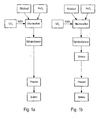
- the total amount of the UO 2 -containing powder, the PuO 2 -containing powder and the return material is mixed and then ground or subjected to a mixing-milling operation in which the powders are mixed and ground at the same time.
- Supplying the entire mass flow of the UO 2 -containing powder to a milling or mixing process means a considerable outlay in the production process.
- further process steps must be followed to properly shape the powder particles.
- a jagged or star-shaped shape of the powder particles present in the known methods must be eliminated in a spheroidizing step.
- the powder particles are formed spherical.
- a sieving step is provided according to FIG. 1b.
- the following steps, sphering and sieving, are necessary for non-free-flowing powders.
- the spheroidizing means a considerable effort in the manufacturing process.
- a first powder mixture (1.PM) is produced from the return material (essentially U 3 O 8 -containing powder) and PuO 2 -containing powder in a grinding process.
- the grinding step is therefore limited to the PuO 2 -containing powder and the return material.
- the total amount of the UO 2 -containing powder is then mixed with the first powder mixture to form an intimate powder mixture (iPM).
- iPM intimate powder mixture
- lubricant (SM) and pore-forming agent (PB) and, if appropriate, additives not shown in FIG. 1, such as dopants may be added to the powder during the mixing process.
- intimate powder mixture (iPM) is fed to a pressing process.
- intimate powder mixture (iPM) is poured into a press die and pressed into shaped bodies.
- further measures to increase the compacting density (EPD) are provided during pressing.
- EPD compacting density
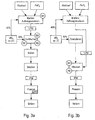
- powders are provided as in Fig. 2.
- a first powder mixture (1 .PM) in a grinding process.
- build-up granulation occurs in the powders involved. This has the advantage that the first powder mixture (1.PM) thus produced is already present with a relatively high bulk density. Furthermore, it is advantageous to add a grinding aid during the grinding process.
- the bulk density of the intimate powder mixture is increased in a particularly simple manner, namely by a build-up granulation occurring during premixing and repeated mixing. This is then pressed into shaped bodies. Further measures for increasing the compacting density (EPD), such as optionally or in combination an increase in the pressing travel, a vibration of the pressing die or a sequence pressing are provided in this case. The shaped bodies are then sintered.
- the UO 2 -containing powder is fed to a granulation process prior to mixing with the first powder mixture (1.PM).
- the majority (60%) of the UO 2 -containing powder is therefore first granulated before it is mixed with other heavy metal oxide-containing powder.
- a sufficiently high bulk density is already set for the largest amount of the powder.
- Multiple or correspondingly long mixing operations, such as in Fig. 3a, can therefore be omitted.
- SM lubricant
- PB pore former
- a grinding process advantageously disappears for the majority of the powder.
- the intimate powder mixture (iPM) has by the granulation process for the UO 2 -containing powder in this embodiment, a sufficiently high bulk density, so that further measures to increase the press density during pressing (EPD) can be omitted, but need not be omitted.
- the intimate powder mixture (iPM) is pressed into shaped bodies, which are then sintered.
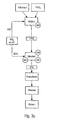
- Fig. 3c is first from the return material or substantially U 3 O 8 -containing powder, PuO 2 -containing powder and about 40% of the amount of UO 2 -containing powder, ie a first part of the UO. 2 containing powder, a first powder mixture (1.PM) produced in a grinding process.
- the entire intimate powder mixture (iPM) is fed after mixing a granulation process.
- the intimate powder mixture (iPM) has by the granulation process in this embodiment, a sufficiently high bulk density, so that further measures to increase the press density during pressing (EPD) can be omitted, but need not be omitted.
- the intimate powder mixture (iPM) is pressed into shaped bodies, which are then sintered.
Landscapes
- Engineering & Computer Science (AREA)
- Physics & Mathematics (AREA)
- Chemical & Material Sciences (AREA)
- Ceramic Engineering (AREA)
- Plasma & Fusion (AREA)
- General Engineering & Computer Science (AREA)
- High Energy & Nuclear Physics (AREA)
- Inorganic Compounds Of Heavy Metals (AREA)
Applications Claiming Priority (3)
| Application Number | Priority Date | Filing Date | Title |
|---|---|---|---|
| DE10138874A DE10138874A1 (de) | 2001-08-08 | 2001-08-08 | Verfahren zur Herstellung eines Mischoxid-Kernbrennstoff-Pulvers und eines Mischoxid-Kernbrennstoff-Sinterkörpers |
| DE10138874 | 2001-08-08 | ||
| PCT/EP2002/008800 WO2003015105A2 (de) | 2001-08-08 | 2002-08-07 | Verfahren zur herstellung eines mischoxid-kernbrennstoff-pulvers und eines mischoxid-kernbrennstoff-sinterkörpers |
Publications (2)
| Publication Number | Publication Date |
|---|---|
| EP1415306A2 EP1415306A2 (de) | 2004-05-06 |
| EP1415306B1 true EP1415306B1 (de) | 2007-06-27 |
Family
ID=7694754
Family Applications (1)
| Application Number | Title | Priority Date | Filing Date |
|---|---|---|---|
| EP02794565A Expired - Lifetime EP1415306B1 (de) | 2001-08-08 | 2002-08-07 | Verfahren zur herstellung eines mischoxid-kernbrennstoff-pulvers und eines mischoxid-kernbrennstoff-sinterkörpers |
Country Status (8)
| Country | Link |
|---|---|
| EP (1) | EP1415306B1 (enExample) |
| JP (1) | JP4019045B2 (enExample) |
| KR (1) | KR100717924B1 (enExample) |
| CN (1) | CN1251245C (enExample) |
| AU (1) | AU2002355467A1 (enExample) |
| DE (2) | DE10138874A1 (enExample) |
| WO (1) | WO2003015105A2 (enExample) |
| ZA (1) | ZA200400513B (enExample) |
Families Citing this family (18)
| Publication number | Priority date | Publication date | Assignee | Title |
|---|---|---|---|---|
| FR2861888B1 (fr) * | 2003-10-29 | 2008-02-29 | Franco Belge Combustibles | Procede de fabrication de pastilles de combustible nucleaire |
| KR100794071B1 (ko) * | 2006-12-05 | 2008-01-10 | 한국원자력연구원 | 핵연료 소결체의 제조 방법 |
| FR2909799A1 (fr) * | 2006-12-12 | 2008-06-13 | Commissariat Energie Atomique | Procede et fabrication d'elements de combustible nucleaire et contenant pour la mise en oeuvre d'un tel procede |
| CN101264514B (zh) * | 2007-03-14 | 2010-09-22 | 中国原子能科学研究院 | 制备238Pu源的粉末冶金工艺 |
| US9721679B2 (en) | 2008-04-08 | 2017-08-01 | Terrapower, Llc | Nuclear fission reactor fuel assembly adapted to permit expansion of the nuclear fuel contained therein |
| JP4885932B2 (ja) * | 2008-11-07 | 2012-02-29 | 独立行政法人日本原子力研究開発機構 | 粉粒体流動性測定装置及びその方法 |
| KR101002214B1 (ko) | 2009-04-02 | 2010-12-20 | 한국수력원자력 주식회사 | 고온가스로 핵연료 제조에서 중간화합물 통합 처리장치 및 방법 |
| FR2949598B1 (fr) * | 2009-09-02 | 2013-03-29 | Commissariat Energie Atomique | Procede de preparation d'un combustible nucleaire poreux a base d'au moins un actinide mineur |
| KR101104042B1 (ko) * | 2009-09-28 | 2012-01-06 | 한국원자력연구원 | 사용후 핵연료를 이용한 중수로용 핵연료 소결체 제조 방법 |
| FR2979469A1 (fr) * | 2011-08-22 | 2013-03-01 | Commissariat Energie Atomique | Procede de preparation d'un combustible nucleaire poreux |
| KR101407633B1 (ko) * | 2012-12-28 | 2014-06-13 | 한국원자력연구원 | U3o8 첨가에 따른 uo2 소결밀도 감소 경감화 방법 |
| FR3068169B1 (fr) | 2017-06-21 | 2019-08-23 | Commissariat A L'energie Atomique Et Aux Energies Alternatives | Procede de preparation de pastilles d'un combustible dense mixte a base d'uranium, de plutonium et eventuellement d'actinide(s) mineur(s) |
| CN107610796B (zh) * | 2017-08-29 | 2019-08-13 | 中核四0四有限公司 | Mox制备过程不合格粉末回收方法 |
| CN109724903A (zh) * | 2017-10-30 | 2019-05-07 | 中核四0四有限公司 | 一种mox混料结果评价方法 |
| CN108320829B (zh) * | 2017-12-27 | 2021-06-22 | 中核四0四有限公司 | 一种mox芯块废料的回收处理方法 |
| CN113125311B (zh) * | 2019-12-31 | 2022-11-22 | 中核四0四有限公司 | 一种mox混合颗粒的检测方法 |
| US20230059151A1 (en) * | 2020-01-22 | 2023-02-23 | The Research Foundation For The State University Of New York | Ceramic matrix composites enable through metal halide assisted sintering |
| KR102324478B1 (ko) | 2021-06-10 | 2021-11-12 | 한전원자력연료 주식회사 | Ibc 블렌더를 이용한 핵연료 제조용 uo2 혼합 분말 제조 방법 및 이에 의해 제조된 핵연료 제조용 uo2 혼합 분말 |
Family Cites Families (14)
| Publication number | Priority date | Publication date | Assignee | Title |
|---|---|---|---|---|
| GB2004256B (en) * | 1977-09-16 | 1982-01-20 | Alkem Gmbh | Process for the production of uo2/puo2 nuclear fuels |
| JPS61286225A (ja) * | 1985-06-11 | 1986-12-16 | Mitsubishi Metal Corp | 六フツ化ウランを二酸化ウランに変換する方法 |
| FR2599883B1 (fr) * | 1986-06-10 | 1990-08-10 | Franco Belge Fabric Combustibl | Procede de fabrication de pastilles de combustible nucleaire a base d'oxyde d'uranium |
| GB8702371D0 (en) * | 1987-02-03 | 1987-03-11 | British Nuclear Fuels Plc | Pellet fabrication |
| FR2738076B1 (fr) * | 1995-08-25 | 1997-09-26 | Commissariat Energie Atomique | Procede de fabrication de pastilles de combustible nucleaire a base d'oxyde mixte (u, pu)o2 avec addition d'un produit organique soufre |
| KR100287326B1 (ko) * | 1997-06-27 | 2001-04-16 | 이종훈 | 산화물 핵연료 소결체의 불량품을 재활용 하는 방법 |
| JP2958292B2 (ja) * | 1997-10-02 | 1999-10-06 | 核燃料サイクル開発機構 | ウラン・プルトニウム混合酸化物の均一化混合方法 |
| GB2330684A (en) * | 1997-10-25 | 1999-04-28 | British Nuclear Fuels Plc | Production of nuclear fuel pellets |
| DE19812320C1 (de) * | 1998-03-20 | 1999-11-04 | Siemens Ag | Verfahren zur Herstellung von Kernbrennstoff-Sinterkörpern und entsprechende Sinterkörper |
| FR2786479B1 (fr) * | 1998-11-26 | 2001-10-19 | Commissariat Energie Atomique | Preparation par atomisation-sechage d'une poudre coulable de bioxyde d'uranium obtenu par conversion en voie seche de l'uf6 |
| JP2002536628A (ja) * | 1999-01-26 | 2002-10-29 | ベルゴニュークレール・ソシエテ・アノニム | (U,Pu)O2混合酸化物核燃料スクラップの乾式リサイクル方法 |
| JP2003504596A (ja) * | 1999-07-02 | 2003-02-04 | ベルゴニュークレール・ソシエテ・アノニム | 非流動性UO2粉末から(U,Pu)O2混合酸化物核燃料ペレットを製造する方法 |
| DK1081716T3 (da) * | 1999-09-06 | 2004-09-13 | Europ Economic Community | Fremgangsmåde til fremstilling af kernekraftsbrændselspellets af MOX-typen |
| JP4889663B2 (ja) * | 2008-02-07 | 2012-03-07 | 株式会社セイシン企業 | 気流式ふるい分け方法および装置 |
-
2001
- 2001-08-08 DE DE10138874A patent/DE10138874A1/de not_active Withdrawn
-
2002
- 2002-08-07 DE DE50210390T patent/DE50210390D1/de not_active Expired - Lifetime
- 2002-08-07 WO PCT/EP2002/008800 patent/WO2003015105A2/de not_active Ceased
- 2002-08-07 EP EP02794565A patent/EP1415306B1/de not_active Expired - Lifetime
- 2002-08-07 KR KR1020047001897A patent/KR100717924B1/ko not_active Expired - Fee Related
- 2002-08-07 CN CNB02815472XA patent/CN1251245C/zh not_active Expired - Fee Related
- 2002-08-07 JP JP2003519946A patent/JP4019045B2/ja not_active Expired - Fee Related
- 2002-08-07 AU AU2002355467A patent/AU2002355467A1/en not_active Abandoned
-
2004
- 2004-01-23 ZA ZA200400513A patent/ZA200400513B/xx unknown
Also Published As
| Publication number | Publication date |
|---|---|
| CN1539149A (zh) | 2004-10-20 |
| DE10138874A1 (de) | 2003-03-06 |
| JP4019045B2 (ja) | 2007-12-05 |
| WO2003015105A3 (de) | 2003-05-01 |
| EP1415306A2 (de) | 2004-05-06 |
| KR20040029408A (ko) | 2004-04-06 |
| CN1251245C (zh) | 2006-04-12 |
| AU2002355467A1 (en) | 2003-02-24 |
| DE50210390D1 (de) | 2007-08-09 |
| WO2003015105A2 (de) | 2003-02-20 |
| ZA200400513B (en) | 2004-07-19 |
| KR100717924B1 (ko) | 2007-05-11 |
| JP2004538475A (ja) | 2004-12-24 |
Similar Documents
| Publication | Publication Date | Title |
|---|---|---|
| EP1415306B1 (de) | Verfahren zur herstellung eines mischoxid-kernbrennstoff-pulvers und eines mischoxid-kernbrennstoff-sinterkörpers | |
| DE69603132T2 (de) | Verfahren zur Herstellung von Kernbrennstofftabletten auf Basis von (U,PU)02 unter Zugabe von organischen Zwitterion-Schwefelverbindungen | |
| EP1246203B1 (de) | Verfahren zur Herstellung eines Kernbrennstoff-Sinterkörpers und Kernbrennstoff-Sinterkörper | |
| DE68927928T2 (de) | Verfahren zur Herstellung einer UO2-Tablette | |
| DE69010642T2 (de) | Verfahren zur Herstellung von UO2-Kernbrennstofftabletten aus metallischem Uranium ohne Produktion von Abwässern. | |
| DE69203755T2 (de) | Kernbrennstofftabletten und Verfahren zur Herstellung derselben. | |
| DE2713108C2 (de) | Verfahren zur Herstellung von keramischem Plutonium-Uran-Kernbrennstoff in Form von Sinterpellets | |
| EP0156018B1 (de) | Verfahren zum Herstellen von oxidischen Kernbrennstoffsinterkörpern | |
| DE3308889A1 (de) | Verfahren zum herstellen von kernbrennstoff-pellets | |
| DE2947375A1 (de) | Verfahren zur herstellung homogenisierter kernreaktor-brennstoffe | |
| DE60211528T2 (de) | VERFAHREN ZUR SULFORISIERUNG EINES UO2 PULVERS UND VERFAHREN ZUR HERSTELLUNG VON NUKLEARBRENNSTOFF-PELLETS AUF DER BASIS VON UO2 ODER GEMISCHTEM (U.Pu)O2 OXID MIT ZUSÄTZLICHEM SCHWEFEL | |
| DE3235944A1 (de) | Verfahren zum vergroessern der korngroesse von uranoxid | |
| EP0949631B1 (de) | Verfahren zur Herstellung von Kernbrennstoff-Sinterkörpern und entsprechende Sinterkörper | |
| DE60215348T2 (de) | Verfahren zur herstellung eines zusammengesetzten nuklearbrennstoffmaterials aus dispergierten (u, pu)o-2--agregaten | |
| EP0036214B1 (de) | Verfahren zur Herstellung salpetersäurelöslicher Mischoxidkernbrennstofftabletten | |
| DE2062126B2 (de) | Kernbrennstoff, welcher Uran und Plutonium enthält | |
| EP0136665B1 (de) | Verfahren zum Herstellen von oxidischen Kernbrennstoffsinterkörpern | |
| DE3802048A1 (de) | Verfahren zum herstellen von kernbrennstoffsinterkoerpern | |
| DE3100411A1 (de) | "presslinge und verfahren zu ihrer herstellung aus einem gemisch aus teilchenmaterial und fluechtigem bindemittel" | |
| EP2683477B1 (de) | Verfahren zur herstellung eines uranoxid-katalysatorkörpers | |
| DE2833054A1 (de) | Verfahren zur herstellung von puo tief 2 /uo tief 2 -kernbrennstoffen | |
| DE2741820C3 (de) | Verfahren zur Herstellung von PuO2AJO2 -Kernbrennstoffen | |
| DE3109067A1 (de) | Verfahren zur herstellung salpetersaeureloeslicher mischoxidkernbrennstofftabletten" | |
| DE2021395B2 (de) | Verfahren zum herstellen gesinterter tabletten aus einfachen oder gemischten actiniden-oxiden | |
| DE3426573A1 (de) | Verbessertes verfahren und bindemittel fuer die herstellung von kernbrennstoffpellets und dessen produkt |
Legal Events
| Date | Code | Title | Description |
|---|---|---|---|
| PUAI | Public reference made under article 153(3) epc to a published international application that has entered the european phase |
Free format text: ORIGINAL CODE: 0009012 |
|
| 17P | Request for examination filed |
Effective date: 20040120 |
|
| AK | Designated contracting states |
Kind code of ref document: A2 Designated state(s): AT BE BG CH CY CZ DE DK EE ES FI FR GB GR IE IT LI LU MC NL PT SE SK TR |
|
| AX | Request for extension of the european patent |
Extension state: AL LT LV MK RO SI |
|
| 17Q | First examination report despatched |
Effective date: 20040705 |
|
| RAP1 | Party data changed (applicant data changed or rights of an application transferred) |
Owner name: AREVA NP GMBH |
|
| GRAP | Despatch of communication of intention to grant a patent |
Free format text: ORIGINAL CODE: EPIDOSNIGR1 |
|
| RBV | Designated contracting states (corrected) |
Designated state(s): BE DE FR GB |
|
| GRAS | Grant fee paid |
Free format text: ORIGINAL CODE: EPIDOSNIGR3 |
|
| GRAA | (expected) grant |
Free format text: ORIGINAL CODE: 0009210 |
|
| AK | Designated contracting states |
Kind code of ref document: B1 Designated state(s): BE DE FR GB |
|
| REG | Reference to a national code |
Ref country code: GB Ref legal event code: FG4D Free format text: NOT ENGLISH |
|
| REF | Corresponds to: |
Ref document number: 50210390 Country of ref document: DE Date of ref document: 20070809 Kind code of ref document: P |
|
| GBT | Gb: translation of ep patent filed (gb section 77(6)(a)/1977) |
Effective date: 20070912 |
|
| ET | Fr: translation filed | ||
| RAP2 | Party data changed (patent owner data changed or rights of a patent transferred) |
Owner name: AREVA NP GMBH |
|
| PLBE | No opposition filed within time limit |
Free format text: ORIGINAL CODE: 0009261 |
|
| STAA | Information on the status of an ep patent application or granted ep patent |
Free format text: STATUS: NO OPPOSITION FILED WITHIN TIME LIMIT |
|
| 26N | No opposition filed |
Effective date: 20080328 |
|
| REG | Reference to a national code |
Ref country code: FR Ref legal event code: CA |
|
| PGFP | Annual fee paid to national office [announced via postgrant information from national office to epo] |
Ref country code: FR Payment date: 20100901 Year of fee payment: 9 |
|
| PGFP | Annual fee paid to national office [announced via postgrant information from national office to epo] |
Ref country code: BE Payment date: 20100823 Year of fee payment: 9 Ref country code: DE Payment date: 20100922 Year of fee payment: 9 |
|
| BERE | Be: lapsed |
Owner name: AREVA NP G.M.B.H. Effective date: 20110831 |
|
| REG | Reference to a national code |
Ref country code: FR Ref legal event code: ST Effective date: 20120430 |
|
| PG25 | Lapsed in a contracting state [announced via postgrant information from national office to epo] |
Ref country code: BE Free format text: LAPSE BECAUSE OF NON-PAYMENT OF DUE FEES Effective date: 20110831 |
|
| REG | Reference to a national code |
Ref country code: DE Ref legal event code: R119 Ref document number: 50210390 Country of ref document: DE Effective date: 20120301 |
|
| PG25 | Lapsed in a contracting state [announced via postgrant information from national office to epo] |
Ref country code: FR Free format text: LAPSE BECAUSE OF NON-PAYMENT OF DUE FEES Effective date: 20110831 |
|
| PG25 | Lapsed in a contracting state [announced via postgrant information from national office to epo] |
Ref country code: DE Free format text: LAPSE BECAUSE OF NON-PAYMENT OF DUE FEES Effective date: 20120301 |
|
| PGFP | Annual fee paid to national office [announced via postgrant information from national office to epo] |
Ref country code: GB Payment date: 20190821 Year of fee payment: 18 |
|
| GBPC | Gb: european patent ceased through non-payment of renewal fee |
Effective date: 20200807 |
|
| PG25 | Lapsed in a contracting state [announced via postgrant information from national office to epo] |
Ref country code: GB Free format text: LAPSE BECAUSE OF NON-PAYMENT OF DUE FEES Effective date: 20200807 |