EP1412113B1 - Sintermetallteile mit homogener verteilung nicht homogen schmelzender komponenten, sowie verfahren zu ihrer herstellung - Google Patents
Sintermetallteile mit homogener verteilung nicht homogen schmelzender komponenten, sowie verfahren zu ihrer herstellung Download PDFInfo
- Publication number
- EP1412113B1 EP1412113B1 EP20020754408 EP02754408A EP1412113B1 EP 1412113 B1 EP1412113 B1 EP 1412113B1 EP 20020754408 EP20020754408 EP 20020754408 EP 02754408 A EP02754408 A EP 02754408A EP 1412113 B1 EP1412113 B1 EP 1412113B1
- Authority
- EP
- European Patent Office
- Prior art keywords
- sinter
- sintered
- metal
- powder
- part according
- Prior art date
- Legal status (The legal status is an assumption and is not a legal conclusion. Google has not performed a legal analysis and makes no representation as to the accuracy of the status listed.)
- Revoked
Links
Images


Classifications
-
- B—PERFORMING OPERATIONS; TRANSPORTING
- B22—CASTING; POWDER METALLURGY
- B22F—WORKING METALLIC POWDER; MANUFACTURE OF ARTICLES FROM METALLIC POWDER; MAKING METALLIC POWDER; APPARATUS OR DEVICES SPECIALLY ADAPTED FOR METALLIC POWDER
- B22F3/00—Manufacture of workpieces or articles from metallic powder characterised by the manner of compacting or sintering; Apparatus specially adapted therefor ; Presses and furnaces
- B22F3/20—Manufacture of workpieces or articles from metallic powder characterised by the manner of compacting or sintering; Apparatus specially adapted therefor ; Presses and furnaces by extruding
-
- B—PERFORMING OPERATIONS; TRANSPORTING
- B22—CASTING; POWDER METALLURGY
- B22F—WORKING METALLIC POWDER; MANUFACTURE OF ARTICLES FROM METALLIC POWDER; MAKING METALLIC POWDER; APPARATUS OR DEVICES SPECIALLY ADAPTED FOR METALLIC POWDER
- B22F3/00—Manufacture of workpieces or articles from metallic powder characterised by the manner of compacting or sintering; Apparatus specially adapted therefor ; Presses and furnaces
- B22F3/20—Manufacture of workpieces or articles from metallic powder characterised by the manner of compacting or sintering; Apparatus specially adapted therefor ; Presses and furnaces by extruding
- B22F2003/206—Hydrostatic or hydraulic extrusion
-
- B—PERFORMING OPERATIONS; TRANSPORTING
- B22—CASTING; POWDER METALLURGY
- B22F—WORKING METALLIC POWDER; MANUFACTURE OF ARTICLES FROM METALLIC POWDER; MAKING METALLIC POWDER; APPARATUS OR DEVICES SPECIALLY ADAPTED FOR METALLIC POWDER
- B22F5/00—Manufacture of workpieces or articles from metallic powder characterised by the special shape of the product
- B22F2005/001—Cutting tools, earth boring or grinding tool other than table ware
-
- B—PERFORMING OPERATIONS; TRANSPORTING
- B22—CASTING; POWDER METALLURGY
- B22F—WORKING METALLIC POWDER; MANUFACTURE OF ARTICLES FROM METALLIC POWDER; MAKING METALLIC POWDER; APPARATUS OR DEVICES SPECIALLY ADAPTED FOR METALLIC POWDER
- B22F2998/00—Supplementary information concerning processes or compositions relating to powder metallurgy
-
- B—PERFORMING OPERATIONS; TRANSPORTING
- B22—CASTING; POWDER METALLURGY
- B22F—WORKING METALLIC POWDER; MANUFACTURE OF ARTICLES FROM METALLIC POWDER; MAKING METALLIC POWDER; APPARATUS OR DEVICES SPECIALLY ADAPTED FOR METALLIC POWDER
- B22F2998/00—Supplementary information concerning processes or compositions relating to powder metallurgy
- B22F2998/10—Processes characterised by the sequence of their steps
-
- B—PERFORMING OPERATIONS; TRANSPORTING
- B22—CASTING; POWDER METALLURGY
- B22F—WORKING METALLIC POWDER; MANUFACTURE OF ARTICLES FROM METALLIC POWDER; MAKING METALLIC POWDER; APPARATUS OR DEVICES SPECIALLY ADAPTED FOR METALLIC POWDER
- B22F2999/00—Aspects linked to processes or compositions used in powder metallurgy
Definitions
- the invention relates to sintered metal parts with a homogeneous distribution not homogeneous melting components, in the west. from non-homogeneous melting non-ferrum Metal pouf mixes and processes for their production.
- non-ferrum also means metal mixtures, the iron in small amounts, up to about 8 wt .-% - less Amounts of iron as alloy additives should be possible.
- HIP Hot Isostatic Pressing
- CIP Cold Isostatic Pressing
- Pressureless warm sintering requires less effort. Doing so the powder, granulate, semolina or the like to be sintered together with pressing aids in The final shape, as a rule, is pressed uniaxially and the green body thus produced in a sintering furnace at temperatures at 2/3 to 4/5 of the melting or solidus temperature of the metal powder, if necessary under a protective atmosphere, sintered.
- powder forging Another known technique for compacting metal powder is powder forging. It is also a batch process in which individual Parts are produced in dies.
- DD-23 510 A discloses a method of making wire made of a silver sintered material, a powder mixture being sintered and the sintered product using boron nitride as a lubricant at a Temperature between 400 and 900 ° C in a hydrostatic Is extruded.
- Multi-phase powders and powder mixtures are generally near the Melting or solidus temperature of the lowest melting component the mixture sintered. Sintering occurs due to slightly oxidizing materials the increased oxidation rate and the long-lasting holding time
- the sintered parts produced by known processes were not homogeneous melting metal mixtures, especially if not homogeneous melting powder mixtures were sintered, often by the different Diffusion speed of the elements caused by porous or segregated areas, in which individual phases of the immiscible components are inhomogeneous crystallize. This disrupts the sintered structure and its mechanical-technological Properties sustainable.
- the properties of the powder sintered so produced Parts were therefore due to these interference areas, their occurrence was unpredictable, deteriorated and there were large differences in individually made Sintered parts on what, for example, results in an increased tendency to break materials along the inhomogeneous areas and a reduced elasticity showed.
- the invention relates to a method for producing a near-net-shape sintered metal part as defined in claim 10.
- the continuous isostatic pressure sintering is carried out at a pressure according to the formula Maschinenge Division, where ⁇ y ( T ) represents the yield stress of the material at the intended pressure sintering temperature and D indicates the relative density of the cold isostatically pre-pressed starting product.
- the relative density is the quotient of the absolute density of the pre-pressed starting product ⁇ 0 and the density of the solid alloy ⁇ B.
- the pressure sintering process is carried out by a die open on one side Sintered profile; if necessary, separating the sintered profile into sintered products, heat treating the Sintered products or the sintered profile and, if necessary, reworking them.
- the typical continuous isostatic pressure sintering at temperatures up to about 70% of the melting point of the main constituent of the metal powder starting mixture is preferably carried out on a hydraulic extrusion press adapted to the process parameters - the usual extrusion which is carried out with homogeneously melting materials at temperatures near the melting point, due to excessive heating of the press strand leads to few dimensionally stable product strands, which then have to be further processed, for example by pressing, forging etc.
- the continuous isostatic pressure sinter used here at very high pressures according to the above formula additionally allows a temperature to be selected in which the Heating of the press strand due to friction is also taken into account.
- T means the temperature for the selected material's yield strength
- Q B the amount of heat supplied to the starting material
- Q ⁇ the amount of heat given off to the tool surface
- I the active tool length
- c B the compression speed
- the process is characterized in that by the possible reduction of the Preheating temperature, the powder material is only slightly and briefly heated - in Contrary to the usual extrusion, in which a continuous and higher Heating of the pressed material is desired.
- this process has a superior sintered parts Grain structure, which is characterized by an extremely homogeneous distribution of the distinguish miscible components and therefore compared to sintered parts according to conventional processes and also the powder forging better elastic Have properties and ductility. This has been achieved as the strong temperature-dependent volume diffusion, which means coarsening and segregation individual phases, is almost completely suppressed.
- a powder compact is preferred - by known pressing methods for powder compaction - without lubricants, lubricants or sintering aids - as Starting material used for continuous isostatic pressing.
- This Powder compact can already have an inhomogeneous material distribution - in particular if inhomogeneous sintered parts - i.e. composite parts - are to be produced.
- Typical is e.g. an outer material layer made of another, chemically or physically more resistant material - if, for example, a certain corrosion behavior is required in an outer or inner layer - as with powder metallurgy Pipes or discs - have. Then in a press with a die Powder compact is isostatically pressed / sintered relatively cold and experiences through the shear forces a connection reaction at the grain boundaries of the Ingredients without a liquid phase that could cause segregation occurs. So a homogeneous sintered product with superior material properties be preserved.
- this can be formed continuously by the die created sintered product by controlled cooling, for example by spraying be cooled with water in such a way that a finely crystalline state Quenching is generated or that a defined heat treatment, e.g. at Aluminum alloys can undergo a T4 heat treatment.
- the cooled one The strand can be mechanically reworked. That's usually how it is continuously produced profile-like sintered product separated at product height - by sawing, water jet cutting, laser cutting or other, the Processes familiar to a person skilled in the art.
- These sections defined length of the continuously produced sintered product can then be used as such or after post-processing - such as surface coating or calibration - can be used.
- the sintered part cut to length in this way can also be subjected to heat treatment if required be subjected to change or the material structure remunerated. For this, the heat treatment must be designed so that no liquid Phases can arise.
- a typical post-processing of the sintered product according to the invention Calibrate on a press to the dimensionally very tightly tolerated final form of the Product. Machining is "machining" usually not necessary.
- the sintered parts produced according to the invention metal mixtures which do not melt homogeneously show better machinability and higher ductility and higher elongation than those with processes were manufactured according to the state of the art. This is shown in the following Manufacturing process in the better reworkability.
- Components become the mechanical, technological characteristics of the sintered parts Elasticity, tensile strength, and elongation are influenced very favorably.
- a pressureless sintered component made of an aluminum alloy with 13% by weight silicon an elongation at break of less than 0.5% while a component made of the same Alloy produced by the method according to the invention, typical Has values in the elongation at break of 7 to 12%. That is through oppression the formation of the melting phase, so that the structure is not inhomogeneous can partially crystallize
- the scattering of the material parameters according to the invention sintered parts produced is much less than that of hot sintered Parts of the same composition - that is, narrower material value limits than is the case with conventional HIP or warm sintering.
- immiscible Components such as hard phases, are incorporated homogeneously distributed as well as materials that are very difficult or even impossible using classic sintering processes are not accessible.
- the material powder used is typically one Powder mixture of metals or their alloys and other materials, such as Hard parts, fibers, or wear carriers such as boron carbide, BN.
- metal matrix composites can be produced (metal matrix composite), wherein the second component can be fibrous or particulate.
- Short or long fibers or particles in proportions between 5- 30 vol% must be added.
- Short fibers or whiskers have a length that is west. smaller than 100 times the fiber diameter.
- Long, endless or continuous Fibers are those whose fiber length is greater than 100 times their diameter is. Fibers can serve to improve the strength of the sintered parts.
- Particle reinforced materials can also do so getting produced. So those with SiC, boron carbide etc.
- Typical sintered alloys such as. Ti alloys, in particular Ti / Nb alloys, TiAl, and TiAl Nb as well as Co-Ti-B Mg + SiC, boron carbide, Al2O3 or AlPb alloys with high heat storage capacity, the cannot be produced by melt metallurgy, are processed - i.e. sintered Composite materials are continuously manufactured or beryllium parts - Magnesium parts, etc.
- Typical compositions are, for example, aluminum with Si, Mg, Cu, Zn and possibly Fe e.g.
- the invention relates Light metal sintered parts made of difficult to machine light metal alloys. There are It is also possible to produce hypereutectic alloys, the expert being able to further advantages are obvious from his specialist knowledge.
- the advantages of the sintered parts produced according to the invention include: Finest and uniform grain sizes of wear carriers, clearly finer wear carrier distribution, no segregation and segregation, perfect homogeneous structure and extremely high dimensional accuracy - Warmsintem delays do not occur in the method according to the invention on and so very dimensionally accurate parts are produced.
- the former powder particles are no longer in the microscope according to the inventive method recognize, while the very fine grain structure of the structure also a elongated deformation, which shows the strength of the thus produced Sintered composite also improved mechanically. After all, they stand out sintered parts according to the invention by at least 150% higher elongation than those same material composition, by powder forging, sintering or cast are made.
- wear carriers are typical. It can be the finest and most even Grain size of the wear carrier and a significantly finer distribution of the same compared to other methods. There are no segregations and Separations on and get it like a homogeneous structure. It is about an extremely simple process for the production of highly wear-resistant sintered metal components with extremely high dimensional accuracy. It can also be hypereutectic Alloys are made.
- fibers such as ceramic fibers, carbon fibers or Hard fiber fibers become: higher strengths - increase in tensile strength, increase of the yield point, increase in the elastic modulus, better heat resistance and creep resistance - a reduction in thermal Expansion coefficients obtained.
- wear carriers or hard materials typical SiC particles, AIN, BN, TiB2, boron carbide, SiO2, WC: fibers, such as Carbon fibers, metal fibers, ceramic or glass fibers.
- Suitable metal phases can be selected from aluminum, titanium, copper, Beryllium, magnesium, calcium, nickel, lithium, chromium, molybdenum, tungsten, bronzes, Niobium, lead, zinc and cobalt.
- the method can also be used to make a composition of several areas - So a sintered part with layers, rings, strips, etc. existing Composite (preferably powder compact) are sintered.
- a hard layer is required as the outer material - e.g. for Cutting discs or the like - as an inner material but a cheaper, more ductile and more elastic material is desired.
- the method according to the invention enables the production in one step by common continuous isostatic Pressing which then sinters several materials together.
- sintered parts with a hard cutting edge can be made from a different material composition than other areas.
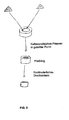
- Fig. 1 the process flow according to the teaching of the invention is shown schematically. As shown, the process involves the preparation of a continuous sintered part by continuous isostatic pressing of a sinterable Material mixture without lubricant from a closed by a matrix Sinter form is created.
- the starting material here a non-homogeneously melting mixture of aluminum powder with 13% by weight silicon powder (AlSi only melts in the range 5 - 7% homogeneous) is mixed intimately and then in a powder press for the production of Powder bolts not transferred to near-net shape. It gets cold there under high pressure pressed into a bolt-like green compact.
- the bolt-like green body turns into one Plant for continuous isostatic sintering - here an extrusion press - transferred and pressed through the die under sintering.
- the AlSi14 sintered part emerges the die at temperatures up to 70% of the melting point of the main component as a sintered continuous profile, the outer contour of which is close to the final shape.
- the continuously sintered profile is now mechanically according to the desired one Separate disc height and the material discs at 250 ° C for 30 min. heat treated.
- the sintered disks from the heat treatment are then calibrated in a calibration press at a force of 150 KN - i.e. the final, dimensionally very closely tolerated shape achieved.
- the sintered parts thus produced must be the same as conventional hot isostatically pressed parts Composition can no longer be decapsulated and have a calibration sufficient flow behavior. You can then do this without further post-processing are used as finished parts.
- AlSi14% sintered parts were conventionally made by sintering by Aluminum powder with 14 wt .-% silicon Si a green body with pressing aid Hoechst Wax C pressed into a disc, this disc then in a heat treatment step .20 min at 410 ° C, then in the sintering furnace, 30 min with Sintered at 590 ° C and then heat treated again at 400 ° C for 240 min, manufactured as comparative products.
- the isostatic pressure-sintered material initially has a greater surface roughness, but this is rolled out quickly, so that the coefficient of friction in the later course of the friction test for the isostatically pressure-sintered material is lower than for the hot isostatically pressed product. This suggests a higher ductility of the isostatically pressure-sintered material. Material characteristic ranges for AISi14% (at room temperature.
- Table 1 clearly shows that the process according to the invention produced sintered bodies have less scatter - so more precisely are adjustable and therefore also deliver fewer missing parts.
- the sintered parts are more homogeneous and also more stretchy which improves elastic behavior like it in particular of mechanically stressed parts, such as sprockets against steel chains, Rotor and stator in a camshaft phasing system or oil pump parts, Bearing parts, pump wheels, etc. is required.
- FIG. 5 shows the result of the production of sintered parts according to the invention with different ones Material areas shown - here in Fig. 5a a cut round Sintered part with a different outer layer - in FIG. 5b a two-layer angular sintered part; 5c shows a tubular sintered part with different layers; in Fig. 5d one strip-shaped distribution in sintered parts. Combining different sintered materials is thus possible simultaneously with the production of the sintered part - for example that Applying an outer layer reinforced with hard materials can be done by direct "Mitansinter" can be avoided as a separate process step - etc.
Landscapes
- Engineering & Computer Science (AREA)
- Manufacturing & Machinery (AREA)
- Mechanical Engineering (AREA)
- Powder Metallurgy (AREA)
- Adornments (AREA)
- Manufacture And Refinement Of Metals (AREA)
- Manufacture Of Metal Powder And Suspensions Thereof (AREA)
Description

wobei σy (T) die Fließspannung des Werkstoffs bei der vorgesehenen Drucksintertemperatur darstellt und D die relative Dichte des kaltisostatisch vorgepreßten Ausgangsproduktes angibt. Die relative Dichte ist der Quotient aus der absoluten Dichte des vorgepreßten Ausgangsproduktes ρ0 und der Dichte des massiven Legierung ρ B .
| Materialkennwertbereiche für AISi14% (bei Raumtemperatur. falls nicht anders angegeben) | ||
| Zusammensetzung | HIP-AISi14 | erfindungsgem.AlSi14 |
| Dichte g/cm3 | 2,65 | 2,7 |
| Härte HB | 95 - 150 | 80-105 |
| Zugfestigkeit N/mm2 | 210 - 250 | 260 - 280 |
| Streckgrenze N/mm2 | 130-210 | 160-180 |
| Dehnung % | 0,5 | 3-12 |
| E-Modul GPa | <80 | <80 |
| Si-Komgröße in µm | 10-20 | 5-10 |
| Si-Verteilung im Gefüge | rel. homogen | voltst. homogen |
| Flächenpressung N/mm2 bei 150°C | 780 | 550 |
Claims (11)
- Sintermetallteil mit homogener Verteilung nicht homogen schmelzender Komponenten, im wesentlichen aus nicht homogen schmelzenden non-ferrum Metallpulvermischungen, herstellbar durch:Herstellen eines ungesinterten Pulverpreßlings, kontinuierliches isostatisches Drucksintern des Pulverpreßlings auf Dichten, die im wesentlichen der Dichte eines heißisostatisch gepressten Festkörpers gleicher Zusammensetzung entsprechen durch eine zweiseitig offene Matritze unter Bedingungen, die das Auftreten einer flüssigen Phase im Pulver vermeiden, bei Temperaturen bis zu 70% des Metallschmefzpunktes; bevorzugt bis zu 60% der Metalischmelztemperatur unter Ausbildung eines Sinterprofils, das im wesentlichen Endkontur besitzt.
- Sintermetallteil nach Anspruch 1, ferner gekennzeichnet durch: mechanische Bearbeitung des Sinterprofils, wie durch Trennen auf Produktlänge bzw. -höhe unter Herstellung von Sinterprodukten.
- Sintermetallteil nach Anspruch 1 oder 2, gekennzeichnet durch Warmbehandeln der Sinterrohprodukte.
- Sintermetallteil nach Anspruch 1 - 3, dadurch gekennzeichnet, daß das eine um mindestens etwa 150% höhere Dehnung, bevorzugt etwa 120% höhere Dehnung als warmgesinterte Sinterteile aufweist
- Sintermetallteile nach Anspruch 1, dadurch gekennzeichnet, daß die Ausgangsmischung des zu sinternden Materialpulvers im wesentlichen Metalle und Metallegierungen, sowie geringere Mengen an Legierungsbestandteilen, Hartstoffen, Verschleißträgern, Fasern aufweist.
- Sintermetallteile nach einem der vorangehenden Ansprüche, dadurch gekennzeichnet, daß mindestens ein Metall ausgewählt ist aus Al, Ti, Cu, Mg, Be, Ni, Cr, Mo, W, Bronzen, Nb, Pb Co, Zn.
- Sintermetallteil nach Anspruch 6, gekennzeichnet dadurch, daß das kontinuierliche Drucksintem unter Inertgas, wie ein Edelgas, Stickstoff, Kohlendioxid, durchgeführt wird.
- Sintermetallteil nach einem der vorangehenden Ansprüche, dadurch gekennzeichnet, daß der als Ausgangsprodukt des kontinuierlichen kaitisostatischen Pressens eingesetzte Preßling Bereiche unterschiedlicher Materialzusammensetzung aufweist.
- Sintermetallteil nach Anspruch 8, dadurch gekennzeichnet, daß es definierte Bereiche unterschiedlicher Zusammensetzung aufweist, wie Schichten, Streifen, runde geschlossene Formen, Polygone.
- Verfahren zur Herstellung eines endkontumahen Sintermetallteils nach einem der vorangehenden Ansprüche, gekennzeichnet durch: Herstellen eines Pulverpreß-lings, kontinuierliches isostatisches Sintern desselben durch eine zweiseitig offene Matrize zu einem Sinterprofil auf Dichten, die der Dichte des Festkörpers entsprechen unter Bedingungen, die das Auftreten einer flüssigen Phase im Pulver vermeiden, bei Temperaturen bis zu 70% des Metallschmelzpunktes, ggf. Trennen des Sinterprofils in Sinterprodukte, ggf. Warmbehandeln der Sinterprodukte oder des Sinterprofils und ggf. Nachbearbeiten derselben.
- Verfahren nach Anspruch 10, dadurch gekennzeichnet, daß das Nachbearbeiten Kalibrieren in einer Kalibrierpresse aufweist.
Priority Applications (1)
| Application Number | Priority Date | Filing Date | Title |
|---|---|---|---|
| EP20020754408 EP1412113B1 (de) | 2001-07-20 | 2002-07-22 | Sintermetallteile mit homogener verteilung nicht homogen schmelzender komponenten, sowie verfahren zu ihrer herstellung |
Applications Claiming Priority (6)
| Application Number | Priority Date | Filing Date | Title |
|---|---|---|---|
| DE10135485 | 2001-07-20 | ||
| DE10135485A DE10135485A1 (de) | 2001-07-20 | 2001-07-20 | Verfahren zur endkonturnahen Fertigung von Bauteilen bzw. Halbzeugen aus schwer zerspanbaren Leichtmetalllegierungen, und Bauteil bzw. Halbzeug, hergestellt durch das Verfahren |
| EP01127413A EP1281461B1 (de) | 2001-07-20 | 2001-11-23 | Verfahren zur endkonturnahen Fertigung von Bauteilen bzw. Halbzeugen aus schwer zerspanbaren Leichtmetalllegierungen |
| EP01127413 | 2001-11-23 | ||
| PCT/DE2002/002692 WO2003011501A2 (de) | 2001-07-20 | 2002-07-22 | Sintermetallteile mit homogener verteilung nicht homogen schmelzender komponenten, sowie verfahren zu ihrer herstellung |
| EP20020754408 EP1412113B1 (de) | 2001-07-20 | 2002-07-22 | Sintermetallteile mit homogener verteilung nicht homogen schmelzender komponenten, sowie verfahren zu ihrer herstellung |
Publications (2)
| Publication Number | Publication Date |
|---|---|
| EP1412113A2 EP1412113A2 (de) | 2004-04-28 |
| EP1412113B1 true EP1412113B1 (de) | 2004-10-27 |
Family
ID=7692559
Family Applications (2)
| Application Number | Title | Priority Date | Filing Date |
|---|---|---|---|
| EP01127413A Revoked EP1281461B1 (de) | 2001-07-20 | 2001-11-23 | Verfahren zur endkonturnahen Fertigung von Bauteilen bzw. Halbzeugen aus schwer zerspanbaren Leichtmetalllegierungen |
| EP20020754408 Revoked EP1412113B1 (de) | 2001-07-20 | 2002-07-22 | Sintermetallteile mit homogener verteilung nicht homogen schmelzender komponenten, sowie verfahren zu ihrer herstellung |
Family Applications Before (1)
| Application Number | Title | Priority Date | Filing Date |
|---|---|---|---|
| EP01127413A Revoked EP1281461B1 (de) | 2001-07-20 | 2001-11-23 | Verfahren zur endkonturnahen Fertigung von Bauteilen bzw. Halbzeugen aus schwer zerspanbaren Leichtmetalllegierungen |
Country Status (11)
| Country | Link |
|---|---|
| US (1) | US20040208772A1 (de) |
| EP (2) | EP1281461B1 (de) |
| JP (1) | JP2004536232A (de) |
| KR (1) | KR20040030054A (de) |
| AT (2) | ATE275015T1 (de) |
| BR (1) | BR0211267A (de) |
| CA (1) | CA2438397A1 (de) |
| DE (4) | DE10135485A1 (de) |
| ES (2) | ES2227044T3 (de) |
| HU (1) | HUP0401206A2 (de) |
| WO (1) | WO2003011501A2 (de) |
Cited By (1)
| Publication number | Priority date | Publication date | Assignee | Title |
|---|---|---|---|---|
| DE102006031366C5 (de) * | 2006-07-06 | 2010-01-28 | Ecka Granulate Velden Gmbh | Verfahren zur Herstellung von Formteilen aus dispersionsverfestigten Metalllegierungen |
Families Citing this family (12)
| Publication number | Priority date | Publication date | Assignee | Title |
|---|---|---|---|---|
| EP1641727A4 (de) | 2003-06-12 | 2009-04-01 | Georgia Tech Res Inst | Verfahren und vorrichtung zur herstellung von borcarbid und borcarbidbauteilen |
| US8377369B2 (en) * | 2004-12-20 | 2013-02-19 | Georgia Tech Research Corporation | Density and hardness pressureless sintered and post-HIPed B4C |
| CN101193663A (zh) * | 2005-04-11 | 2008-06-04 | 佐治亚技术研究公司 | 碳化硼部件及其制备方法 |
| DE202008001976U1 (de) | 2007-03-14 | 2008-07-24 | Schwäbische Hüttenwerke Automotive GmbH & Co. KG | Fluiddichte Sintermetallteile |
| EP2123377A1 (de) | 2008-05-23 | 2009-11-25 | Rovalma, S.A. | Verfahren zur Herstellung eines Werkstücks, insbesondere eines Formgebungswerkzeugs oder eines Formgebungswerkzeugteils. |
| DE102010034014B4 (de) * | 2010-08-11 | 2015-06-25 | Schwäbische Hüttenwerke Automotive GmbH | Sinterverbund und Verfahren zu seiner Herstellung |
| DE102011009835A1 (de) | 2011-01-31 | 2012-08-02 | Audi Ag | Verfahren zur Herstellung von Blechhalbzeugen oder Blechbauteilen aus Aluminium-Matrix-Komposite |
| DE102013201334A1 (de) * | 2013-01-29 | 2014-07-31 | Schaeffler Technologies Gmbh & Co. Kg | Spannschiene mit einem Tragkörper aus einer AlSi-Legierung |
| CN105603271A (zh) * | 2016-01-27 | 2016-05-25 | 东莞佛亚铝业有限公司 | 一种高硅铝合金线材及其制备方法 |
| KR102219180B1 (ko) * | 2019-03-22 | 2021-02-23 | 부경대학교 산학협력단 | 알루미늄계 클래드 형재의 제조 방법 및 이를 이용하여 제조된 알루미늄계 클래드 형재 |
| KR102266847B1 (ko) * | 2019-04-15 | 2021-06-21 | 부경대학교 산학협력단 | 복합재료 제조를 위한 소성 가공용 빌렛의 제조방법 및 이에 의해 제조된 빌렛 |
| KR102228431B1 (ko) * | 2019-04-16 | 2021-03-16 | 부경대학교 산학협력단 | 알루미늄계 클래드 방열판의 제조방법 및 이에 의해 제조된 알루미늄계 클래드 방열판 |
Family Cites Families (16)
| Publication number | Priority date | Publication date | Assignee | Title |
|---|---|---|---|---|
| SE377434B (de) * | 1967-06-26 | 1975-07-07 | Asea Ab | |
| US3774290A (en) * | 1972-02-09 | 1973-11-27 | Brush Wellman | Method of fabricating a beryllium-titanium composite |
| FR2537654B2 (fr) * | 1982-06-17 | 1987-01-30 | Pechiney Aluminium | Perfectionnement des chemises de moteurs a base d'alliages d'aluminium et de grains de silicium calibres et leurs procedes d'obtention |
| JPS6134156A (ja) * | 1984-07-26 | 1986-02-18 | Nippon Gakki Seizo Kk | 装飾用複合材料 |
| DD231510B1 (de) * | 1984-12-21 | 1990-03-14 | Funk A Bergbau Huettenkombinat | Verfahren zur herstellung von draht aus einem silber-sinterwerkstoff |
| JPS6296603A (ja) * | 1985-10-22 | 1987-05-06 | Honda Motor Co Ltd | 耐熱高強度Al焼結合金製構造用部材の製造方法 |
| JPH07116541B2 (ja) * | 1985-11-29 | 1995-12-13 | 日産自動車株式会社 | アルミニウム系軸受合金およびその製造方法 |
| US4797085A (en) * | 1986-12-04 | 1989-01-10 | Aerojet-General Corporation | Forming apparatus employing a shape memory alloy die |
| DE3700805A1 (de) * | 1987-01-14 | 1990-03-08 | Fraunhofer Ges Forschung | Faserverstaerkter verbundwerkstoff auf der basis von wolframschwermetall |
| US4762679A (en) * | 1987-07-06 | 1988-08-09 | The United States Of America As Represented By The Secretary Of The Air Force | Billet conditioning technique for manufacturing powder metallurgy preforms |
| CH675089A5 (de) * | 1988-02-08 | 1990-08-31 | Asea Brown Boveri | |
| US5057273A (en) * | 1990-11-29 | 1991-10-15 | Industrial Materials Technology, Inc. | Method for uniaxial compaction of materials in a cold isostatic process |
| US5762843A (en) * | 1994-12-23 | 1998-06-09 | Kennametal Inc. | Method of making composite cermet articles |
| US5482672A (en) * | 1995-02-09 | 1996-01-09 | Friedman; Ira | Process for extruding tantalum and/or niobium |
| DE69814498T2 (de) * | 1997-02-12 | 2003-11-20 | Yamaha Hatsudoki K.K., Iwata | Kolben für eine Brennkraftmaschine und Verfahren seiner Herstellung |
| US6042779A (en) * | 1998-07-30 | 2000-03-28 | Reynolds Metals Company | Extrusion fabrication process for discontinuous carbide particulate metal matrix composites and super hypereutectic A1/Si |
-
2001
- 2001-07-20 DE DE10135485A patent/DE10135485A1/de not_active Withdrawn
- 2001-11-23 DE DE50103474T patent/DE50103474D1/de not_active Revoked
- 2001-11-23 ES ES01127413T patent/ES2227044T3/es not_active Expired - Lifetime
- 2001-11-23 EP EP01127413A patent/EP1281461B1/de not_active Revoked
- 2001-11-23 AT AT01127413T patent/ATE275015T1/de not_active IP Right Cessation
-
2002
- 2002-07-22 HU HU0401206A patent/HUP0401206A2/hu unknown
- 2002-07-22 BR BR0211267-1A patent/BR0211267A/pt not_active Application Discontinuation
- 2002-07-22 ES ES02754408T patent/ES2231721T3/es not_active Expired - Lifetime
- 2002-07-22 DE DE10293319T patent/DE10293319D2/de not_active Expired - Fee Related
- 2002-07-22 CA CA002438397A patent/CA2438397A1/en not_active Abandoned
- 2002-07-22 WO PCT/DE2002/002692 patent/WO2003011501A2/de not_active Ceased
- 2002-07-22 AT AT02754408T patent/ATE280647T1/de not_active IP Right Cessation
- 2002-07-22 KR KR10-2004-7000580A patent/KR20040030054A/ko not_active Withdrawn
- 2002-07-22 JP JP2003516724A patent/JP2004536232A/ja active Pending
- 2002-07-22 US US10/483,645 patent/US20040208772A1/en not_active Abandoned
- 2002-07-22 EP EP20020754408 patent/EP1412113B1/de not_active Revoked
- 2002-07-22 DE DE50201420T patent/DE50201420D1/de not_active Revoked
Cited By (1)
| Publication number | Priority date | Publication date | Assignee | Title |
|---|---|---|---|---|
| DE102006031366C5 (de) * | 2006-07-06 | 2010-01-28 | Ecka Granulate Velden Gmbh | Verfahren zur Herstellung von Formteilen aus dispersionsverfestigten Metalllegierungen |
Also Published As
| Publication number | Publication date |
|---|---|
| DE50103474D1 (de) | 2004-10-07 |
| CA2438397A1 (en) | 2003-02-13 |
| HUP0401206A2 (en) | 2004-10-28 |
| JP2004536232A (ja) | 2004-12-02 |
| WO2003011501A2 (de) | 2003-02-13 |
| DE10135485A1 (de) | 2003-02-06 |
| ATE280647T1 (de) | 2004-11-15 |
| DE50201420D1 (de) | 2004-12-02 |
| ES2227044T3 (es) | 2005-04-01 |
| EP1281461A1 (de) | 2003-02-05 |
| EP1281461B1 (de) | 2004-09-01 |
| BR0211267A (pt) | 2004-08-03 |
| KR20040030054A (ko) | 2004-04-08 |
| DE10293319D2 (de) | 2004-07-01 |
| ES2231721T3 (es) | 2005-05-16 |
| US20040208772A1 (en) | 2004-10-21 |
| WO2003011501A3 (de) | 2003-05-01 |
| ATE275015T1 (de) | 2004-09-15 |
| EP1412113A2 (de) | 2004-04-28 |
Similar Documents
| Publication | Publication Date | Title |
|---|---|---|
| DE3817350C2 (de) | ||
| EP1470261B1 (de) | Sinterfähige metallpulvermischung zur herstellung gesinterter bauteile | |
| EP2591132B1 (de) | Magnesiumlegierung | |
| EP1287173B1 (de) | Bauteil auf basis von gamma-tial-legierungen mit bereichen mit gradiertem gefüge | |
| DE69223194T2 (de) | Verfahren zur Herstellung von Verbundlegierungspulver mit Aluminiummatrix | |
| EP1469963B1 (de) | Verfahren zur herstellung von gesinterten bauteilen aus einem sinterfähigen material | |
| DE69303417T2 (de) | Metallmatrixverbundwerkstoff auf Aluminiumbasis | |
| DE69529502T2 (de) | Gleitstück aus gesinterter aluminiumlegierung | |
| DE69221690T2 (de) | Rotor für ölpumpe aus einer aluminiumlegierung und dessen herstellungsverfahren | |
| EP3409801B1 (de) | Pulvermetallurgisch hergestellter, hartstoffpartikel enthaltender verbundwerkstoff, verwendung eines verbundwerkstoffs und verfahren zur herstellung eines bauteils aus einem verbundwerkstoff | |
| WO2008125525A1 (de) | Werkzeug | |
| EP1412113A2 (de) | Sintermetallteile mit homogener verteilung nicht homogen schmelzender komponenten, sowie verfahren zu ihrer herstellung | |
| DE69906782T2 (de) | Stahl, verwendung des stahls, daraus hergestelltes produkt und verfahren zu dessen herstellung | |
| EP1943039B1 (de) | Verfahren zur herstellung einer verschleissbeständigen aluminiumlegierung, nach dem verfahren erhaltene aluminiumlegierung und deren verwendung | |
| DE3344450A1 (de) | Motormaentel auf basis von aluminiumlegierungen und intermetallischen verbindungen und verfahren zu deren herstellung | |
| DE69307848T2 (de) | Hoch warmfeste und verschleissfeste Aluminiumlegierung | |
| DE69223178T2 (de) | Verfahren zur herstellung von gegossenen zusammengesetzten zylinderköpfen | |
| DE10156925A1 (de) | Aushärtbare Kupferlegierung als Werkstoff zur Herstellung von Giessformen | |
| EP1680246B1 (de) | Verfahren zur herstellung von metall-matrix-verbundwerkstoffen | |
| DE60300144T2 (de) | Verfahren zur Herstellung von Al-Sinterlegierung | |
| EP3665313B1 (de) | Sondermessinglegierung und sondermessinglegierungsprodukt | |
| EP1709209B1 (de) | Verfahren zum leichtmetall-legierungs-sintern | |
| EP1281459B1 (de) | Verfahren zum Thixospritzgiessen zur Herstellung von Metallteilen | |
| AT10479U1 (de) | Fluiddichte sintermetallteile sowie verfahren zu ihrer herstellung | |
| DE19627020C2 (de) | Aus einer abriebbeständigen Aluminiumlegierung hergestelltes Lager |
Legal Events
| Date | Code | Title | Description |
|---|---|---|---|
| PUAI | Public reference made under article 153(3) epc to a published international application that has entered the european phase |
Free format text: ORIGINAL CODE: 0009012 |
|
| 17P | Request for examination filed |
Effective date: 20030703 |
|
| AK | Designated contracting states |
Kind code of ref document: A2 Designated state(s): AT BE BG CH CY CZ DE DK EE ES FI FR GB GR IE IT LI LU MC NL PT SE SK TR |
|
| AX | Request for extension of the european patent |
Extension state: AL LT LV MK RO SI |
|
| GRAP | Despatch of communication of intention to grant a patent |
Free format text: ORIGINAL CODE: EPIDOSNIGR1 |
|
| GRAS | Grant fee paid |
Free format text: ORIGINAL CODE: EPIDOSNIGR3 |
|
| GRAA | (expected) grant |
Free format text: ORIGINAL CODE: 0009210 |
|
| AK | Designated contracting states |
Kind code of ref document: B1 Designated state(s): AT BE BG CH CY CZ DE DK EE ES FI FR GB GR IE IT LI LU MC NL PT SE SK TR |
|
| AX | Request for extension of the european patent |
Extension state: AL LT LV MK RO SI |
|
| PG25 | Lapsed in a contracting state [announced via postgrant information from national office to epo] |
Ref country code: GB Free format text: LAPSE BECAUSE OF FAILURE TO SUBMIT A TRANSLATION OF THE DESCRIPTION OR TO PAY THE FEE WITHIN THE PRESCRIBED TIME-LIMIT Effective date: 20041027 Ref country code: IE Free format text: LAPSE BECAUSE OF FAILURE TO SUBMIT A TRANSLATION OF THE DESCRIPTION OR TO PAY THE FEE WITHIN THE PRESCRIBED TIME-LIMIT Effective date: 20041027 Ref country code: SK Free format text: LAPSE BECAUSE OF FAILURE TO SUBMIT A TRANSLATION OF THE DESCRIPTION OR TO PAY THE FEE WITHIN THE PRESCRIBED TIME-LIMIT Effective date: 20041027 Ref country code: FI Free format text: LAPSE BECAUSE OF FAILURE TO SUBMIT A TRANSLATION OF THE DESCRIPTION OR TO PAY THE FEE WITHIN THE PRESCRIBED TIME-LIMIT Effective date: 20041027 Ref country code: TR Free format text: LAPSE BECAUSE OF FAILURE TO SUBMIT A TRANSLATION OF THE DESCRIPTION OR TO PAY THE FEE WITHIN THE PRESCRIBED TIME-LIMIT Effective date: 20041027 Ref country code: BG Free format text: LAPSE BECAUSE OF FAILURE TO SUBMIT A TRANSLATION OF THE DESCRIPTION OR TO PAY THE FEE WITHIN THE PRESCRIBED TIME-LIMIT Effective date: 20041027 Ref country code: EE Free format text: LAPSE BECAUSE OF FAILURE TO SUBMIT A TRANSLATION OF THE DESCRIPTION OR TO PAY THE FEE WITHIN THE PRESCRIBED TIME-LIMIT Effective date: 20041027 Ref country code: NL Free format text: LAPSE BECAUSE OF FAILURE TO SUBMIT A TRANSLATION OF THE DESCRIPTION OR TO PAY THE FEE WITHIN THE PRESCRIBED TIME-LIMIT Effective date: 20041027 |
|
| REG | Reference to a national code |
Ref country code: GB Ref legal event code: FG4D Free format text: NOT ENGLISH |
|
| REG | Reference to a national code |
Ref country code: CH Ref legal event code: EP |
|
| REG | Reference to a national code |
Ref country code: IE Ref legal event code: FG4D Free format text: GERMAN |
|
| REF | Corresponds to: |
Ref document number: 50201420 Country of ref document: DE Date of ref document: 20041202 Kind code of ref document: P |
|
| PG25 | Lapsed in a contracting state [announced via postgrant information from national office to epo] |
Ref country code: GR Free format text: LAPSE BECAUSE OF FAILURE TO SUBMIT A TRANSLATION OF THE DESCRIPTION OR TO PAY THE FEE WITHIN THE PRESCRIBED TIME-LIMIT Effective date: 20050127 Ref country code: DK Free format text: LAPSE BECAUSE OF FAILURE TO SUBMIT A TRANSLATION OF THE DESCRIPTION OR TO PAY THE FEE WITHIN THE PRESCRIBED TIME-LIMIT Effective date: 20050127 |
|
| REG | Reference to a national code |
Ref country code: SE Ref legal event code: TRGR |
|
| LTIE | Lt: invalidation of european patent or patent extension |
Effective date: 20041027 |
|
| NLV1 | Nl: lapsed or annulled due to failure to fulfill the requirements of art. 29p and 29m of the patents act | ||
| REG | Reference to a national code |
Ref country code: ES Ref legal event code: FG2A Ref document number: 2231721 Country of ref document: ES Kind code of ref document: T3 |
|
| REG | Reference to a national code |
Ref country code: IE Ref legal event code: FD4D |
|
| GBV | Gb: ep patent (uk) treated as always having been void in accordance with gb section 77(7)/1977 [no translation filed] |
Effective date: 20041027 |
|
| PG25 | Lapsed in a contracting state [announced via postgrant information from national office to epo] |
Ref country code: LU Free format text: LAPSE BECAUSE OF NON-PAYMENT OF DUE FEES Effective date: 20050722 Ref country code: AT Free format text: LAPSE BECAUSE OF NON-PAYMENT OF DUE FEES Effective date: 20050722 Ref country code: CY Free format text: LAPSE BECAUSE OF FAILURE TO SUBMIT A TRANSLATION OF THE DESCRIPTION OR TO PAY THE FEE WITHIN THE PRESCRIBED TIME-LIMIT Effective date: 20050722 |
|
| PLBI | Opposition filed |
Free format text: ORIGINAL CODE: 0009260 |
|
| PG25 | Lapsed in a contracting state [announced via postgrant information from national office to epo] |
Ref country code: MC Free format text: LAPSE BECAUSE OF NON-PAYMENT OF DUE FEES Effective date: 20050731 Ref country code: BE Free format text: LAPSE BECAUSE OF NON-PAYMENT OF DUE FEES Effective date: 20050731 |
|
| PLBI | Opposition filed |
Free format text: ORIGINAL CODE: 0009260 |
|
| PLAX | Notice of opposition and request to file observation + time limit sent |
Free format text: ORIGINAL CODE: EPIDOSNOBS2 |
|
| 26 | Opposition filed |
Opponent name: PEAK WERKSTOFF GMBH Effective date: 20050726 Opponent name: POWDER LIGHT METALS GMBH Effective date: 20050723 |
|
| 26 | Opposition filed |
Opponent name: PEAK WERKSTOFF GMBH Effective date: 20050726 Opponent name: POWDER LIGHT METALS GMBH Effective date: 20050723 Opponent name: PLANSEE AKTIENGESELLSCHAFT Effective date: 20050727 |
|
| ET | Fr: translation filed | ||
| PLAF | Information modified related to communication of a notice of opposition and request to file observations + time limit |
Free format text: ORIGINAL CODE: EPIDOSCOBS2 |
|
| PLAB | Opposition data, opponent's data or that of the opponent's representative modified |
Free format text: ORIGINAL CODE: 0009299OPPO |
|
| R26 | Opposition filed (corrected) |
Opponent name: PLANSEE GMBH Effective date: 20050727 Opponent name: PEAK WERKSTOFF GMBH Effective date: 20050726 Opponent name: POWDER LIGHT METALS GMBH Effective date: 20050723 |
|
| PLAF | Information modified related to communication of a notice of opposition and request to file observations + time limit |
Free format text: ORIGINAL CODE: EPIDOSCOBS2 |
|
| PLAB | Opposition data, opponent's data or that of the opponent's representative modified |
Free format text: ORIGINAL CODE: 0009299OPPO |
|
| PLBB | Reply of patent proprietor to notice(s) of opposition received |
Free format text: ORIGINAL CODE: EPIDOSNOBS3 |
|
| R26 | Opposition filed (corrected) |
Opponent name: PEAK WERKSTOFF GMBH Effective date: 20050726 Opponent name: PLANSEE SE Effective date: 20050727 Opponent name: POWDER LIGHT METALS GMBH Effective date: 20050723 |
|
| REG | Reference to a national code |
Ref country code: FR Ref legal event code: GC |
|
| PG25 | Lapsed in a contracting state [announced via postgrant information from national office to epo] |
Ref country code: LI Free format text: LAPSE BECAUSE OF NON-PAYMENT OF DUE FEES Effective date: 20060731 Ref country code: CH Free format text: LAPSE BECAUSE OF NON-PAYMENT OF DUE FEES Effective date: 20060731 |
|
| PGFP | Annual fee paid to national office [announced via postgrant information from national office to epo] |
Ref country code: DE Payment date: 20060929 Year of fee payment: 5 |
|
| RAP2 | Party data changed (patent owner data changed or rights of a patent transferred) |
Owner name: SCHWAEBISCHE HUETTENWERKE AUTOMOTIVE GMBH & CO. KG |
|
| REG | Reference to a national code |
Ref country code: CH Ref legal event code: PL |
|
| RDAF | Communication despatched that patent is revoked |
Free format text: ORIGINAL CODE: EPIDOSNREV1 |
|
| PGFP | Annual fee paid to national office [announced via postgrant information from national office to epo] |
Ref country code: ES Payment date: 20070725 Year of fee payment: 6 |
|
| RDAG | Patent revoked |
Free format text: ORIGINAL CODE: 0009271 |
|
| STAA | Information on the status of an ep patent application or granted ep patent |
Free format text: STATUS: PATENT REVOKED |
|
| 27W | Patent revoked |
Effective date: 20070522 |
|
| BERE | Be: lapsed |
Owner name: *SCHWABISCHE HUTTENWERKE G.M.B.H. Effective date: 20050731 |
|
| PG25 | Lapsed in a contracting state [announced via postgrant information from national office to epo] |
Ref country code: PT Free format text: LAPSE BECAUSE OF NON-PAYMENT OF DUE FEES Effective date: 20050327 |
|
| PGFP | Annual fee paid to national office [announced via postgrant information from national office to epo] |
Ref country code: CZ Payment date: 20070709 Year of fee payment: 6 |
|
| PGFP | Annual fee paid to national office [announced via postgrant information from national office to epo] |
Ref country code: IT Payment date: 20070727 Year of fee payment: 6 Ref country code: SE Payment date: 20070724 Year of fee payment: 6 |
|
| PGFP | Annual fee paid to national office [announced via postgrant information from national office to epo] |
Ref country code: FR Payment date: 20070718 Year of fee payment: 6 |
|
| REG | Reference to a national code |
Ref country code: FR Ref legal event code: RG |