EP1408640B1 - DiversitätsKombinieren für phasenmodulierte Signale - Google Patents
DiversitätsKombinieren für phasenmodulierte Signale Download PDFInfo
- Publication number
- EP1408640B1 EP1408640B1 EP03006753A EP03006753A EP1408640B1 EP 1408640 B1 EP1408640 B1 EP 1408640B1 EP 03006753 A EP03006753 A EP 03006753A EP 03006753 A EP03006753 A EP 03006753A EP 1408640 B1 EP1408640 B1 EP 1408640B1
- Authority
- EP
- European Patent Office
- Prior art keywords
- symbol
- packet
- symbols
- erase
- basic
- Prior art date
- Legal status (The legal status is an assumption and is not a legal conclusion. Google has not performed a legal analysis and makes no representation as to the accuracy of the status listed.)
- Expired - Lifetime
Links
- 238000000034 method Methods 0.000 claims abstract description 55
- 238000004891 communication Methods 0.000 claims abstract description 16
- 238000012937 correction Methods 0.000 claims description 14
- 238000010586 diagram Methods 0.000 claims description 12
- 238000012545 processing Methods 0.000 claims description 2
- 230000008569 process Effects 0.000 description 13
- 238000004364 calculation method Methods 0.000 description 4
- 238000010276 construction Methods 0.000 description 2
- 238000001514 detection method Methods 0.000 description 2
- 230000006870 function Effects 0.000 description 2
- 230000010363 phase shift Effects 0.000 description 2
- 239000000654 additive Substances 0.000 description 1
- 230000000996 additive effect Effects 0.000 description 1
- 230000005540 biological transmission Effects 0.000 description 1
- 230000015572 biosynthetic process Effects 0.000 description 1
- 239000000969 carrier Substances 0.000 description 1
- 230000008859 change Effects 0.000 description 1
- 238000007796 conventional method Methods 0.000 description 1
- 230000001419 dependent effect Effects 0.000 description 1
- 238000005562 fading Methods 0.000 description 1
- 230000002452 interceptive effect Effects 0.000 description 1
- 238000012986 modification Methods 0.000 description 1
- 230000004048 modification Effects 0.000 description 1
- 238000001228 spectrum Methods 0.000 description 1
Images




Classifications
-
- H—ELECTRICITY
- H04—ELECTRIC COMMUNICATION TECHNIQUE
- H04L—TRANSMISSION OF DIGITAL INFORMATION, e.g. TELEGRAPHIC COMMUNICATION
- H04L27/00—Modulated-carrier systems
- H04L27/18—Phase-modulated carrier systems, i.e. using phase-shift keying
- H04L27/22—Demodulator circuits; Receiver circuits
-
- H—ELECTRICITY
- H04—ELECTRIC COMMUNICATION TECHNIQUE
- H04B—TRANSMISSION
- H04B7/00—Radio transmission systems, i.e. using radiation field
- H04B7/02—Diversity systems; Multi-antenna system, i.e. transmission or reception using multiple antennas
- H04B7/04—Diversity systems; Multi-antenna system, i.e. transmission or reception using multiple antennas using two or more spaced independent antennas
- H04B7/08—Diversity systems; Multi-antenna system, i.e. transmission or reception using multiple antennas using two or more spaced independent antennas at the receiving station
-
- H—ELECTRICITY
- H04—ELECTRIC COMMUNICATION TECHNIQUE
- H04L—TRANSMISSION OF DIGITAL INFORMATION, e.g. TELEGRAPHIC COMMUNICATION
- H04L1/00—Arrangements for detecting or preventing errors in the information received
- H04L1/12—Arrangements for detecting or preventing errors in the information received by using return channel
- H04L1/16—Arrangements for detecting or preventing errors in the information received by using return channel in which the return channel carries supervisory signals, e.g. repetition request signals
- H04L1/18—Automatic repetition systems, e.g. Van Duuren systems
- H04L1/1829—Arrangements specially adapted for the receiver end
- H04L1/1835—Buffer management
- H04L1/1845—Combining techniques, e.g. code combining
Definitions
- the present invention generally relates to a communications system, and more particularly to a system and method for performing an error control operation in a radio communications system.
- FIG. 1 shows a receiver in a conventional wireless communications system.
- This receiver includes an MPSK demodulator 10 for demodulating a re-transmitted packet signal using a soft decision method, a diversity combiner 20 for combining a symbol generated from the demodulator 10 with a previously received error packet signal (hereinafter referred to as 'original packet signal'), and a decoder 30 for decoding the combined symbol.
- MPSK demodulator 10 for demodulating a re-transmitted packet signal using a soft decision method
- a diversity combiner 20 for combining a symbol generated from the demodulator 10 with a previously received error packet signal (hereinafter referred to as 'original packet signal')
- 'original packet signal' a previously received error packet signal
- the MPSK (M-ary Phase Shift Keying) demodulator performs a modulation method in which only phase is changed with amplitude, a frequency of a carrier is constantly maintained, and a plurality of bits are transmitted at one time.
- 2-bit or 4-bit data is transmitted by one modulation signal. That is, an unmodulated signal is transmitted one bit at a time but in the case of 4 binary-PSK modulations 2 bits are transmitted at a time using a phase change of the signal. 16 binary-PSK allows transmission of 4 bits at a time.
- M is the number of modulation signals (or symbols) with different phases and n signifies the number if bits transmittable at a time.
- n signifies the number if bits transmittable at a time.
- a phase difference between carriers is 2 ⁇ /M and can be implemented using an orthogonal representation system.
- the diversity combiner performs a symbol diversity combining technique. According to this technique, symbols with noise are held, not discarded, and are then effectively combined with the same symbols which have been re-transmitted in order to control an error and thereby heighten reliability of the symbols. Adoption of a symbol diversity combining method in a radio communication system is desirable because it increases reliability of the symbols. Thus, various diversity combining methods have been proposed such as an equal-gaining-combining method and a maximal-ratio-combining, method.
- the maximal-ratio-combining method is considered the most effective. This method adds ratios of the sizes of signals and then maximizes a signal-to-noise ratio in an environment where a signal plus an additive white Gaussian noise is received.
- the maximal-ratio-combining method has excellent performance but its calculation method is very complicated because it uses a soft-decision value.
- the signal output from the MPSK demodulator (i.e. the symbol) is a value obtained by performing a soft-decision operation on a re-transmitted packet signal as received. This value is generally expressed as a real number with a decimal point.
- the diversity combiner combines it with a symbol of an original packet.
- the result value (1.768) of the combining process is transmitted to the decoder 30, and the decoder determines the re-transmitted packet signal using the received result value and performing error-correction decoding.
- the decoder 30 usually performs only an error-correction function.
- the MRC diversity combiner includes a channel estimator to overcome multipath fading. The channel estimator attempts to estimate a size of a channel through which received signals and phase information have passed.
- the MRC diversity combiner of the conventional art has disadvantages.
- this MRC requires use of the channel estimator.
- this MRC is hard to implement due to use of the soft decision value in the symbol demodulation process and requires a very large amount of calculations to be performed, which translates into increased complexity. These calculations include multiplication and addition of real numbers below a decimal point and are performed in the MRC scores of times more than the bit logical operation of the present invention, described in detail below.
- the conventional art MRC is therefore very complex.
- a channel estimated value, a soft-decision value, and a calculation result value are stored as real numbers. As a result memory space is wasted.
- the re-transmitted packet is first decoded by itself. If the decoding fails, a new packet is generated by the tone-by-tone logical AND operation between the currently received packet and the original packet (or a previously combined packet). This new packet is decoded again. If the decoding still fails, re-transmission of the packet must be requested.
- the present invention aims to provide a method and apparatus for performing a diversity operation which allows facilitated detection of errors, particularly in a QPSK-based communication system.
- the present invention provides a method for processing signals according to claim 1 and a communications receiver according to claim 6. Preferred embodiments are given in the dependent sub-claims.
- a logical operation diversity combining method includes: receiving and demodulating a re-transmitted packet, decoding a symbol generated from demodulation, combining the generated symbol with a symbol of an original packet when an error is detected from the decoded signal, decoding a symbol of the re-transmitted packet based on the combining result, and when an error is detected from the secondly decoded signal requesting a packet re-transmission.
- Figure 1 is a drawing illustrating a construction of receiving system in accordance with the conventional art.
- Figure 2 is a drawing illustrating a construction of a receiving system in accordance with the present invention.
- FIG. 3 is a drawing illustrating an MPSK demodulation in accordance with the present invention.
- Figures 4A and 4B show examples of original and re-transmitted packets that maybe combined in accordance with the present invention.
- Figure 5A is an exemplary view of a diversity combining method and of a case where the number of operation result value is '0' in accordance with the present invention
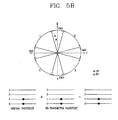
- Figure 5B is an exemplary view of a case that the number of operation result value is '2'
- Figure 5C is an exemplary view of a case that the number of operation result value is '1'.
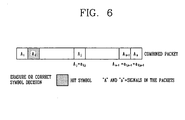
- Figure 6 shows an example of a combined packet formed by the present invention as a result of combining the packets of Figures 4A and 4B.
- Figure 7 is a flow chart of the diversity combining method in accordance with the present invention.
- FIG. 2 shows a receiving system in accordance with one embodiment of the present invention.
- the system includes an MPSK demodulator 50 for demodulating a re-transmitted packet according to hard-decision method, a diversity combiner 60 for combining a symbol generated from the demodulator 50 with a symbol of an original packet, and a decoder 70 for decoding a symbol of the re-transmitted packet based on a result output from the combiner.
- the diversity combiner 60 performs a combining process based on a logical operation
- the decoder 70 may be an erase-error correction decoder.
- the logical operation includes a logical AND of the combined symbols.
- FIG. 3 is a conceptual diagram how an MPSK demodulation may be performed in accordance with the present invention.
- this demodulation method uses QPSK (Quadrature Phase Shift Keying) techniques.
- QPSK Quadratture Phase Shift Keying
- each of the original and re-transmitted packets includes a plurality of signals.
- the signals in the original packet are illustratively shown as a 1,1, a 1,2 ... a 1,n in Fig. 4A and the signals in the re-transmitted packet are illustratively shown as a 2,1, a 2,2 ... a 2,n in Fig. 4B.
- demodulation is performed on a signal-by-signal basis for each signal in the re-transmitted packet.
- Demodulation is preferably performed based on the exemplarily phasor diagram shown in Fig. 3. As shown, this phasor diagram includes a predetermined number of sectional basic symbol regions and a predetermined number of sectional threshold symbol regions. For illustrative purposes only, 4 basic symbol regions and 4 threshold symbol regions are shown, with the threshold symbol regions situated between the basic symbol regions respectively. The range of the threshold symbol regions should be optimized in order to maximize MPSK demodulation performance.
- the MPSK demodulator 50 performs a demodulation using a hard-decision value. That is, each signal of a packet belongs to one of the 8 symbol regions of the phasor diagram and is converted into a symbol value of the region to which it belongs. Each symbol region may be determined as follows.
- each signal of a packet contains I and Q signals (or orthogonal coefficients).
- the I and Q signals correspond to a coordinate value which indicates a position of the packet signal when the packet signal is expressed on the phasor diagram.
- the MPSK demodulator 50 converts the packet signal into one of four basic symbols (0, 1, 2, 3) or converts it into one of four threshold symbols (0&1, 1&2, 2&3, 3&0).
- the threshold symbol (0&1) has a high possibility that a noise component is mixed in the basic symbol (0) or the basic symbol (1).
- the threshold symbol (1&2) has a high possibility that a noise component is mixed in the basic symbol (1) or the basic symbol (2).
- the threshold symbol (2&3) has a high possibility that a noise component is mixed in the basic symbol (2) or the basic symbol (3).
- the threshold symbol (3&0) has a high possibility that a noise component is mixed in the basic symbol (3) or the basic symbol (0).
- a packet signal belonging to one of the basic symbol regions is expressed only by a corresponding symbol, while a packet signal belonging to one of the threshold symbol regions is expressed by two basic symbols which adjoin the corresponding threshold symbol region. For example, if a packet signal is positioned at the basic symbol region (0), the packet signal is converted into a basic symbol (0). However, if a packet signal is positioned at the threshold symbol region (3&0) between the basic symbol region (3) and the basic symbol region (0), the packet signal is converted into a threshold symbol having both the basic symbol (3) value and the basic symbol (0) value.
- the signals of the re-transmitted packet from the MPSK demodulator 50 are sent to the decoder 70, and the decoder decodes the signals and checks whether there is an error in the re-transmitted packet.
- a threshold symbol may be processed by being regarded as an erase symbol. If there is an error in the error-checking process, the signals output from the MPSK demodulator 50 are sent to the diversity combiner 60.
- Figure 5A through 5C illustrate some of the techniques the diversity Combiner of the invention may implement and their results. This explanation is provided on a signal-by-signal basis with the understanding that all signals in the retransmitted packet may be combined with corresponding signals in the original packet.
- the diversity combiner 60 When a signal output from the MPSK demodulator 50 (that is, a signal from the demodulated re-transmitted packet) is transmitted to the diversity combiner 60, the diversity combiner 60 performs a logical operation on the symbol of the demodulated re-transmitted packet signal and the symbol of the corresponding signal in the original packet.
- This logical operation preferably includes an AND operation, but those skilled in the art can appreciate that other logic gate arrangements may also be used as long as these arrangements provide an output which may be used in accordance with the invention as described below.
- Figure 5A is an exemplary view of a diversity combining method in the case where the number of the combining result value is 0'
- Figure 5B is an exemplary view of a case where the number of operation result value is '2'
- Figure 5C is an exemplary view of a case where the number of operation result value is '1'.
- the symbols are decoded but are not regarded as erase symbols.
- Figure 5C if two compared symbols (A,A') are identical and are basic symbols, the number of the operation result value is '1'. Then, the decoder 70 decodes the corresponding symbols normally, i.e., based on their actual symbols. There symbols are therefore not considered erase symbols.
- the decoder 70 normally decodes the corresponding symbols.
- the decoder 70 normally decodes the corresponding symbols, i.e., not as erase symbols.
- the decoder 70 regards the corresponding symbol as an erase symbol and performs an erase-error correction decoding only if the number of the ANDing result value is '0' or '2'.
- the diversity combining method of the present invention may therefore be applied every type of erase-error correction decoding.
- the result of this combining step is a combined packet such as shown in Fig. 6.
- the shaded signal A 2 has been given an erase symbol because one of the aforementioned conditions has been satisfied for assigning an erase symbol.
- FIG. 7 is a flow chart showing steps included in a diversity combining method in accordance with the present invention.
- the method includes as an initial step receiving a re-transmitted packet (S10) and demodulating the received packet using MPSK modulation (S20). Next, a symbol generated for each signal in the packet from demodulation is decoded (S30). Next, it is determined whether an error exists in the re-transmitted packet signal. When any error is detected in the decoded signal, the generated symbol is combined with a symbol of a corresponding signal in the original packet (S40). Then, a second decoding step (S50) is performed in which a symbol of the re-transmitted packet is decoded based on the combining result. In step (S60), when an error is detected from the secondly decoded signal, a packet re-transmission is requested.
- step S10 if a re-transmitted packet is received (step S10), the re-transmitted packet is demodulated according to the demodulation method of the present invention (step S20). Erase-error correction decoding and error detecting are then performed on symbols generated for the signals in the demodulated packet (step S30). If there is an error in the demodulated re-transmitted packet, diversity combiner 60 ANDs the symbol generated from the demodulated re-transmitted packet with the symbol in the original packet on a signal-by-signal basis. This results in the formation of a combined packet. Then, erase-error correction decoding and error detecting are performed on the re-transmitted (or Combined) packet with reference to the operation result (step S50).
- the error detecting may be performed by an error detector (not shown) or a controller (not shown) at the next stage of the decoder 70.
- the error detecting step and the decoding steps are separately performed steps, but for this explanation's sake it is considered that decoder 70 also performs the error detecting function.
- the MPSK demodulator 50 demodulates the re-transmitted packet according to the demodulation method proposed in the present invention (step S20). Namely the signal demodulated by the MPSK demodulator 50 is expressed as one of 8 symbols (1, 0&1, 1, 1&2, 2, 2&3, 3, 3&0) depending on the position of the packet signal appearing on the phasor diagram.
- the demodulated signal (or the symbol) is decoded by the decoder 70 (step S30).
- the decoder 70 regards a threshold symbol among symbols outputted by the MPSK demodulator 50 as an erased symbol and decodes it.
- the decoder 70 also checks whether there is an error in the re-transmitted packet which has been through the decoding process.
- the symbol of the re-transmitted packet output from the MPSK demodulator 50 is sent to the diversity combiner 60. Then, the diversity combiner 60 ANDs the symbol of the re-transmitted packet with a symbol of the corresponding original packet (step S40).
- the decoder 70 performs decoding and error detecting with reference to the operation result of the diversity combiner 60 (step S50). That is, if the number of the ANDing result value is '0' or '2', the decoder 70 regards the corresponding symbol as an erased symbol and performs decoding of a combined packet and error detection. If the re-transmitted packet is determined to have an error again in the step S50, the receiving party requests re-transmission of the corresponding packet from the transmitting party (stepS60). If, however, the re-transmitted packet is determined to have no error in the step S30 or in the step S50, the error control routine for the corresponding packet is terminated.
- the first error control process is performed through the MPSK demodulation step (S20) and the erase-error correction decoding step (S30), and the second error control process is performed through the diversity combining step (S40) and the erase-error correction decoding step (S50).
- the error control routine is designed such that the diversity combining step (S40) is not performed if the error of the re-transmitted packet is correctable in the first error control process. This is advantageous in that the re-transmitted packet can be quickly processed without an error.
- the diversity combining method of the present invention thus has the following advantages.
Landscapes
- Engineering & Computer Science (AREA)
- Computer Networks & Wireless Communication (AREA)
- Signal Processing (AREA)
- Radio Transmission System (AREA)
- Digital Transmission Methods That Use Modulated Carrier Waves (AREA)
- Detection And Prevention Of Errors In Transmission (AREA)
Claims (9)
- Verfahren zur Verarbeitung von Signalen, die in einem Kommunikationssystem empfangen werden, wobei das Verfahren umfasst:- Ermitteln (S20) eines Symbols für jedes von mehreren Signalen, die in einem erneut übermittelten Paket enthalten sind,- Bilden (S40) eines kombinierten Pakets durch logische UND-Verknüpfung des Symbols für jedes Signal in dem erneut übermittelten Packet mit einem Symbol für ein entsprechendes Signal in einem ursprünglichen Paket,- Ermitteln für jedes Symbol des kombinierten Pakets, ob das Symbol ein Löschsymbol oder ein Nichtlöschsymbol ist,- Löschfehlerkorrekturdekodieren (S50) des kombinierten Pakets abhängig von den Lösch- und Nichtlöschsymbolen,wobei das Verfahren dadurch gekennzeichnet ist, dass:- das Symbol für jedes Signal in dem erneut übermittelten Paket dadurch ermittelt wird, dass dem betreffenden Signal entsprechende I- und Q-Komponenten bestimmt werden, die I- und Q-Komponenten auf einem Phasenzeigerdiagramm geortet werden und dem betreffenden Signal ein Symbol auf Grundlage des Orts der I- und Q-Komponenten in dem Phasenzeigerdiagramm zugeordnet wird, wobei das Phasenzeigerdiagramm eine vorbestimmte Anzahl von Basisregionen sowie eine vorbestimmte Anzahl von Schwellenregionen enthält, wobei die Schwellenregionen zwischen einem jeweiligen Paar von Basisregionen liegen, wobei jede Basisregion ein ihr zugeordnetes Basissymbol hat, so dass ein Signal, das in eine der Basisregionen fällt, durch ein entsprechendes Basissymbol ausgedrückt wird, wobei jede Schwellenregion ein ihr zugeordnetes Schwellensymbol hat, nämlich solchermaßen, dass ein Signal, das in eine der Schwellenregionen fällt, durch die Basissymbole der an die Schwellenregion angrenzenden Basisregionen ausgedrückt wird, und- ein Symbol des kombinierten Pakets als Löschsymbol bestimmt wird, wenn die entsprechenden Symbole des erneut übermittelten Pakets und des ursprünglichen Pakets zueinander fremde Basissymbole oder zueinander passende Schwellensymbole sind.
- Verfahren nach Anspruch 1, wobei die den Basisregionen und den Schwellenregionen jeweils zugeordneten Symbole QPSK-Werte sind.
- Verfahren nach Anspruch 1, ferner umfassend:Demodulieren (S20) des erneut übermittelten Pakets basierend auf einem hart entschiedenen Wert.
- Verfahren nach Anspruch 1, ferner umfassend:- Löschfehlerkorrekturdekodieren (S30) des erneut übermittelten Pakets unter Betrachtung von Schwellensymbolen als Löschsymbole und- Bilden des kombinierten Pakets, falls ein nicht korrigierbarer Fehler in dem erneut übermittelten Paket detektiert wird.
- Verfahren nach Anspruch 1, ferner umfassend:- Anfordern (S60) einer Paketneuübermittlung, falls in dem kombinierten Paket ein Fehler detektiert wird.
- Kommunikationsempfänger, umfassend:- einen Prozessor (50), welcher dazu eingerichtet ist, ein Symbol für jedes von mehreren Signalen zu ermitteln, die in einem erneut übermittelten Paket enthalten sind,- einen Kombinierer (60), welcher dazu eingerichtet ist, ein kombiniertes Paket durch logische UND-Verknüpfung des Symbols für jedes Signal in dem erneut übermittelten Paket mit einem Symbol für ein entsprechendes Signal in einem ursprünglichen Paket zu bilden und für jedes Symbol des kombinierten Pakets festzustellen, ob das Symbol ein Löschsymbol oder ein Nichtlöschsymbol ist, und- einen Dekodierer (70), welcher dazu eingerichtet ist, das kombinierte Paket auf Grundlage der Lösch- und Nichtlöschsymbole einer Löschfehlerkorrekturdekodierung zu unterziehen,wobei der Kommunikationsempfänger dadurch gekennzeichnet ist, dass:- der Prozessor dazu eingerichtet ist, das Symbol für jedes Signal in dem erneut übermittelten Paket dadurch zu ermitteln, dass er dem betreffenden Signal entsprechende I- und Q-Komponenten ermittelt, die I- und Q-Komponenten in einem Phasenzeigerdiagramm ortet und dem betreffenden Signal ein Symbol auf Grundlage des Orts der I- und Q-Komponenten in dem Phasenzeigerdiagramm zuordnet, wobei das Phasenzeigerdiagramm eine vorbestimmte Anzahl von Basisregionen sowie eine vorbestimmte Anzahl von Schwellenregionen aufweist, wobei die Schwellenregionen zwischen einen jeweiligen Paar von Basisregionen liegen, wobei jede Basisregion ein ihr zugeordnetes Basissymbol hat, so dass ein Signal, das in eine der Basisregionen fällt, durch ein entsprechendes Basissymbol ausgedrückt wird, wobei jede Schwellenregion ein ihr zugeordnetes Schwellensymbol hat, nämlich solchermaßen, dass ein Signal, das in eine der Schwellenregionen fällt, durch die Basissymbole der an die Schwellenregion angrenzenden Basisregionen ausgedrückt wird, und- der Kombinierer dazu eingerichtet ist, ein Symbol des kombinierten Pakets als Löschsymbol zu bestimmen, wenn die entsprechenden Symbole des erneut übermittelten Pakets und des ursprünglichen Pakets zueinander fremde Basissymbole oder zueinander passende Schwellensymbole sind.
- Kommunikationsempfänger nach Anspruch 6, ferner umfassend:einen Demodulator (50), welcher dazu eingerichtet ist, das erneut übermittelte Paket auf Grundlage eines hart entschiedenen Werts zu demodulieren.
- Kommunikationsempfänger nach Anspruch 6, wobei der Dekodierer (70) dazu eingerichtet ist, das erneut übermittelte Paket einer Löschfehlerkorrekturdekodierung zu unterziehen und dabei Schwellensymbole als Löschsymbole zu betrachten, und wobei der Kombinierer (60) dazu eingerichtet ist, das kombinierte Paket zu bilden, falls in dem erneut übermittelten Paket ein nichtkorrigierbarer Fehler detektiert wird.
- Kommunikationsempfänger nach Anspruch 6, ferner umfassend Mittel zum Anfordern einer Paketneuübermittlung, falls in dem kombinierten Paket ein Fehler detektiert wird.
Applications Claiming Priority (2)
| Application Number | Priority Date | Filing Date | Title |
|---|---|---|---|
| KR2002062141 | 2002-10-11 | ||
| KR1020020062141A KR100548314B1 (ko) | 2002-10-11 | 2002-10-11 | 무선통신 수신시스템의 오류제어방법 |
Publications (2)
| Publication Number | Publication Date |
|---|---|
| EP1408640A1 EP1408640A1 (de) | 2004-04-14 |
| EP1408640B1 true EP1408640B1 (de) | 2007-08-29 |
Family
ID=32026144
Family Applications (1)
| Application Number | Title | Priority Date | Filing Date |
|---|---|---|---|
| EP03006753A Expired - Lifetime EP1408640B1 (de) | 2002-10-11 | 2003-03-25 | DiversitätsKombinieren für phasenmodulierte Signale |
Country Status (7)
| Country | Link |
|---|---|
| US (1) | US7542409B2 (de) |
| EP (1) | EP1408640B1 (de) |
| JP (1) | JP3836803B2 (de) |
| KR (1) | KR100548314B1 (de) |
| CN (1) | CN100508511C (de) |
| AT (1) | ATE372004T1 (de) |
| DE (1) | DE60315935T2 (de) |
Families Citing this family (5)
| Publication number | Priority date | Publication date | Assignee | Title |
|---|---|---|---|---|
| PL207601B1 (pl) * | 2004-08-09 | 2011-01-31 | ABB Spółka z ograniczoną odpowiedzialnością | Sposób i urządzenie do diagnozowania urządzeń technicznych |
| US8942218B2 (en) * | 2006-09-29 | 2015-01-27 | Intel Corporation | Retransmission of data using sub-carrier frequency permutation |
| KR101467788B1 (ko) | 2007-12-11 | 2014-12-03 | 엘지전자 주식회사 | 랜덤 선형 부호화를 이용하는 통신방법 및 장치 |
| KR101490249B1 (ko) | 2007-12-11 | 2015-02-05 | 엘지전자 주식회사 | 연판정을 이용한 통신방법 및 장치 |
| KR101531502B1 (ko) | 2007-12-11 | 2015-06-26 | 엘지전자 주식회사 | 오류제어방법 |
Family Cites Families (13)
| Publication number | Priority date | Publication date | Assignee | Title |
|---|---|---|---|---|
| US5745502A (en) * | 1996-09-27 | 1998-04-28 | Ericsson, Inc. | Error detection scheme for ARQ systems |
| JPH10262281A (ja) * | 1997-03-18 | 1998-09-29 | Toshiba Corp | 再送制御機能を備えた無線データ伝送システム |
| FI103540B (fi) * | 1997-04-28 | 1999-07-15 | Nokia Mobile Phones Ltd | Menetelmä pakettikytkentäisen datan siirtoon matkapuhelinjärjestelmäss ä |
| FI972987A7 (fi) * | 1997-07-14 | 1999-01-15 | Nokia Telecommunications Oy | Lähetetyn datakehyksen uudelleenmuodostaminen |
| JP3382891B2 (ja) | 1999-07-02 | 2003-03-04 | エヌイーシービューテクノロジー株式会社 | 位相変調信号のデジタル処理による復調方法及びデジタル復調装置 |
| SE0000897D0 (sv) * | 2000-03-17 | 2000-03-17 | Ericsson Telefon Ab L M | Methods in a communication system |
| US6977972B1 (en) * | 2000-07-12 | 2005-12-20 | Sharp Laboratories Of America, Inc. | Method of hybrid soft/hard decision demodulation of signals with multilevel modulation |
| US6983029B2 (en) * | 2000-12-15 | 2006-01-03 | Maxim Integrated Products, Inc. | Blind channel estimation and data detection for PSK OFDM-based receivers |
| US7110351B2 (en) * | 2000-12-19 | 2006-09-19 | Nortel Networks Limited | Enhanced ARQ with OFDM modulation symbols |
| WO2002067491A1 (en) * | 2001-02-21 | 2002-08-29 | Matsushita Electric Industrial Co., Ltd. | Hybrid arq method with single constellation rearrangement |
| KR100800885B1 (ko) * | 2001-08-13 | 2008-02-04 | 삼성전자주식회사 | 다중레벨변조를 사용하는 통신시스템의 복조장치 및 방법 |
| KR100464325B1 (ko) * | 2001-10-15 | 2005-01-03 | 삼성전자주식회사 | 이동통신시스템에서 패킷 재전송을 위한 송수신 장치 및 방법 |
| KR100584170B1 (ko) * | 2002-07-11 | 2006-06-02 | 재단법인서울대학교산학협력재단 | 터보 부호화된 복합 재전송 방식 시스템 및 오류 검출 방법 |
-
2002
- 2002-10-11 KR KR1020020062141A patent/KR100548314B1/ko not_active Expired - Fee Related
-
2003
- 2003-03-25 DE DE60315935T patent/DE60315935T2/de not_active Expired - Lifetime
- 2003-03-25 EP EP03006753A patent/EP1408640B1/de not_active Expired - Lifetime
- 2003-03-25 AT AT03006753T patent/ATE372004T1/de not_active IP Right Cessation
- 2003-03-27 US US10/397,374 patent/US7542409B2/en not_active Expired - Fee Related
- 2003-04-01 JP JP2003098618A patent/JP3836803B2/ja not_active Expired - Fee Related
- 2003-04-22 CN CNB031220487A patent/CN100508511C/zh not_active Expired - Fee Related
Non-Patent Citations (1)
| Title |
|---|
| None * |
Also Published As
| Publication number | Publication date |
|---|---|
| DE60315935D1 (de) | 2007-10-11 |
| KR20040033203A (ko) | 2004-04-21 |
| US7542409B2 (en) | 2009-06-02 |
| CN100508511C (zh) | 2009-07-01 |
| JP2004135255A (ja) | 2004-04-30 |
| EP1408640A1 (de) | 2004-04-14 |
| ATE372004T1 (de) | 2007-09-15 |
| DE60315935T2 (de) | 2008-07-31 |
| CN1489351A (zh) | 2004-04-14 |
| US20040071093A1 (en) | 2004-04-15 |
| KR100548314B1 (ko) | 2006-02-02 |
| JP3836803B2 (ja) | 2006-10-25 |
Similar Documents
| Publication | Publication Date | Title |
|---|---|---|
| EP1253759B1 (de) | Funksender, funkempfänger und kommunikationssystem mit mehrstufenmodulation. | |
| US7400687B2 (en) | Multicarrier communication apparatus and multicarrier communication method | |
| EP1204256B1 (de) | Vermittlungsystem mit adaptiver modulation | |
| EP1422861B1 (de) | Sende-empfangs-vorrichtung und sende-empfangs-verfahren | |
| US5809043A (en) | Method and apparatus for decoding block codes | |
| EP1011245A1 (de) | Sender und empfänger und datenübertragungsverfahren | |
| US6993092B1 (en) | Transmission apparatus, reception apparatus and digital radio communication method | |
| US20070147487A1 (en) | Apparatus, method and computer program product providing dynamic modulation setting combined with power sequences | |
| US7672394B2 (en) | Transmission apparatus and transmission method | |
| EP1408640B1 (de) | DiversitätsKombinieren für phasenmodulierte Signale | |
| US7180962B2 (en) | Apparatus and method for demodulation using detection of channel adaptive modulation scheme | |
| CN1476703A (zh) | 确定调制类型的接收器 | |
| JP4213660B2 (ja) | 無線通信システム及び無線送信機 | |
| US20080292017A1 (en) | Modulation of Data Streams With Constellation Subset Mapping | |
| JP3233092B2 (ja) | 変調方式とそれを用いた無線通信システム | |
| US7630457B2 (en) | Method and apparatus for demodulating a received signal within a coded system | |
| JP4534037B2 (ja) | Ofdm通信装置 | |
| KR100546801B1 (ko) | 채널 적응형 변조방식 검출을 이용한 복조 장치 및 그 방법 | |
| EP1912368A1 (de) | Verfahren zur Dekodierung eines empfangenen multidimensionalen Signals und entsprechende Vorrichtung | |
| JP2006074081A (ja) | Ofdm通信装置 | |
| JP2004007785A (ja) | 変調方式及び送信装置 | |
| JP2004007786A (ja) | 受信装置 | |
| JP2001358789A (ja) | 変調方式、その受信装置及びそれを用いた無線通信システム |
Legal Events
| Date | Code | Title | Description |
|---|---|---|---|
| PUAI | Public reference made under article 153(3) epc to a published international application that has entered the european phase |
Free format text: ORIGINAL CODE: 0009012 |
|
| AK | Designated contracting states |
Kind code of ref document: A1 Designated state(s): AT BE BG CH CY CZ DE DK EE ES FI FR GB GR HU IE IT LI LU MC NL PT RO SE SI SK TR |
|
| AX | Request for extension of the european patent |
Extension state: AL LT LV MK |
|
| 17P | Request for examination filed |
Effective date: 20040910 |
|
| AKX | Designation fees paid |
Designated state(s): AT BE BG CH CY CZ DE DK EE ES FI FR GB GR HU IE IT LI LU MC NL PT RO SE SI SK TR |
|
| 17Q | First examination report despatched |
Effective date: 20050609 |
|
| GRAP | Despatch of communication of intention to grant a patent |
Free format text: ORIGINAL CODE: EPIDOSNIGR1 |
|
| GRAS | Grant fee paid |
Free format text: ORIGINAL CODE: EPIDOSNIGR3 |
|
| GRAA | (expected) grant |
Free format text: ORIGINAL CODE: 0009210 |
|
| AK | Designated contracting states |
Kind code of ref document: B1 Designated state(s): AT BE BG CH CY CZ DE DK EE ES FI FR GB GR HU IE IT LI LU MC NL PT RO SE SI SK TR |
|
| REG | Reference to a national code |
Ref country code: GB Ref legal event code: FG4D |
|
| REG | Reference to a national code |
Ref country code: CH Ref legal event code: EP |
|
| REG | Reference to a national code |
Ref country code: IE Ref legal event code: FG4D |
|
| REG | Reference to a national code |
Ref country code: SE Ref legal event code: TRGR |
|
| REF | Corresponds to: |
Ref document number: 60315935 Country of ref document: DE Date of ref document: 20071011 Kind code of ref document: P |
|
| ET | Fr: translation filed | ||
| PG25 | Lapsed in a contracting state [announced via postgrant information from national office to epo] |
Ref country code: ES Free format text: LAPSE BECAUSE OF FAILURE TO SUBMIT A TRANSLATION OF THE DESCRIPTION OR TO PAY THE FEE WITHIN THE PRESCRIBED TIME-LIMIT Effective date: 20071210 |
|
| PG25 | Lapsed in a contracting state [announced via postgrant information from national office to epo] |
Ref country code: LI Free format text: LAPSE BECAUSE OF FAILURE TO SUBMIT A TRANSLATION OF THE DESCRIPTION OR TO PAY THE FEE WITHIN THE PRESCRIBED TIME-LIMIT Effective date: 20070829 Ref country code: AT Free format text: LAPSE BECAUSE OF FAILURE TO SUBMIT A TRANSLATION OF THE DESCRIPTION OR TO PAY THE FEE WITHIN THE PRESCRIBED TIME-LIMIT Effective date: 20070829 Ref country code: CH Free format text: LAPSE BECAUSE OF FAILURE TO SUBMIT A TRANSLATION OF THE DESCRIPTION OR TO PAY THE FEE WITHIN THE PRESCRIBED TIME-LIMIT Effective date: 20070829 |
|
| REG | Reference to a national code |
Ref country code: CH Ref legal event code: PL |
|
| PG25 | Lapsed in a contracting state [announced via postgrant information from national office to epo] |
Ref country code: BE Free format text: LAPSE BECAUSE OF FAILURE TO SUBMIT A TRANSLATION OF THE DESCRIPTION OR TO PAY THE FEE WITHIN THE PRESCRIBED TIME-LIMIT Effective date: 20070829 |
|
| PG25 | Lapsed in a contracting state [announced via postgrant information from national office to epo] |
Ref country code: GR Free format text: LAPSE BECAUSE OF FAILURE TO SUBMIT A TRANSLATION OF THE DESCRIPTION OR TO PAY THE FEE WITHIN THE PRESCRIBED TIME-LIMIT Effective date: 20071130 Ref country code: DK Free format text: LAPSE BECAUSE OF FAILURE TO SUBMIT A TRANSLATION OF THE DESCRIPTION OR TO PAY THE FEE WITHIN THE PRESCRIBED TIME-LIMIT Effective date: 20070829 |
|
| PG25 | Lapsed in a contracting state [announced via postgrant information from national office to epo] |
Ref country code: PT Free format text: LAPSE BECAUSE OF FAILURE TO SUBMIT A TRANSLATION OF THE DESCRIPTION OR TO PAY THE FEE WITHIN THE PRESCRIBED TIME-LIMIT Effective date: 20080129 Ref country code: SK Free format text: LAPSE BECAUSE OF FAILURE TO SUBMIT A TRANSLATION OF THE DESCRIPTION OR TO PAY THE FEE WITHIN THE PRESCRIBED TIME-LIMIT Effective date: 20070829 Ref country code: CZ Free format text: LAPSE BECAUSE OF FAILURE TO SUBMIT A TRANSLATION OF THE DESCRIPTION OR TO PAY THE FEE WITHIN THE PRESCRIBED TIME-LIMIT Effective date: 20070829 |
|
| PG25 | Lapsed in a contracting state [announced via postgrant information from national office to epo] |
Ref country code: RO Free format text: LAPSE BECAUSE OF FAILURE TO SUBMIT A TRANSLATION OF THE DESCRIPTION OR TO PAY THE FEE WITHIN THE PRESCRIBED TIME-LIMIT Effective date: 20070829 |
|
| PLBE | No opposition filed within time limit |
Free format text: ORIGINAL CODE: 0009261 |
|
| STAA | Information on the status of an ep patent application or granted ep patent |
Free format text: STATUS: NO OPPOSITION FILED WITHIN TIME LIMIT |
|
| 26N | No opposition filed |
Effective date: 20080530 |
|
| PG25 | Lapsed in a contracting state [announced via postgrant information from national office to epo] |
Ref country code: MC Free format text: LAPSE BECAUSE OF NON-PAYMENT OF DUE FEES Effective date: 20080331 |
|
| PG25 | Lapsed in a contracting state [announced via postgrant information from national office to epo] |
Ref country code: EE Free format text: LAPSE BECAUSE OF FAILURE TO SUBMIT A TRANSLATION OF THE DESCRIPTION OR TO PAY THE FEE WITHIN THE PRESCRIBED TIME-LIMIT Effective date: 20070829 Ref country code: IE Free format text: LAPSE BECAUSE OF NON-PAYMENT OF DUE FEES Effective date: 20080325 |
|
| PG25 | Lapsed in a contracting state [announced via postgrant information from national office to epo] |
Ref country code: SI Free format text: LAPSE BECAUSE OF FAILURE TO SUBMIT A TRANSLATION OF THE DESCRIPTION OR TO PAY THE FEE WITHIN THE PRESCRIBED TIME-LIMIT Effective date: 20070829 |
|
| PG25 | Lapsed in a contracting state [announced via postgrant information from national office to epo] |
Ref country code: CY Free format text: LAPSE BECAUSE OF FAILURE TO SUBMIT A TRANSLATION OF THE DESCRIPTION OR TO PAY THE FEE WITHIN THE PRESCRIBED TIME-LIMIT Effective date: 20070829 |
|
| PG25 | Lapsed in a contracting state [announced via postgrant information from national office to epo] |
Ref country code: BG Free format text: LAPSE BECAUSE OF FAILURE TO SUBMIT A TRANSLATION OF THE DESCRIPTION OR TO PAY THE FEE WITHIN THE PRESCRIBED TIME-LIMIT Effective date: 20071129 |
|
| PG25 | Lapsed in a contracting state [announced via postgrant information from national office to epo] |
Ref country code: LU Free format text: LAPSE BECAUSE OF NON-PAYMENT OF DUE FEES Effective date: 20080325 Ref country code: HU Free format text: LAPSE BECAUSE OF FAILURE TO SUBMIT A TRANSLATION OF THE DESCRIPTION OR TO PAY THE FEE WITHIN THE PRESCRIBED TIME-LIMIT Effective date: 20080301 |
|
| PG25 | Lapsed in a contracting state [announced via postgrant information from national office to epo] |
Ref country code: TR Free format text: LAPSE BECAUSE OF FAILURE TO SUBMIT A TRANSLATION OF THE DESCRIPTION OR TO PAY THE FEE WITHIN THE PRESCRIBED TIME-LIMIT Effective date: 20070829 |
|
| REG | Reference to a national code |
Ref country code: FR Ref legal event code: PLFP Year of fee payment: 14 |
|
| PGFP | Annual fee paid to national office [announced via postgrant information from national office to epo] |
Ref country code: DE Payment date: 20160212 Year of fee payment: 14 |
|
| PGFP | Annual fee paid to national office [announced via postgrant information from national office to epo] |
Ref country code: FI Payment date: 20160212 Year of fee payment: 14 Ref country code: FR Payment date: 20160217 Year of fee payment: 14 Ref country code: SE Payment date: 20160216 Year of fee payment: 14 Ref country code: GB Payment date: 20160216 Year of fee payment: 14 Ref country code: NL Payment date: 20160216 Year of fee payment: 14 |
|
| PGFP | Annual fee paid to national office [announced via postgrant information from national office to epo] |
Ref country code: IT Payment date: 20160317 Year of fee payment: 14 |
|
| REG | Reference to a national code |
Ref country code: DE Ref legal event code: R119 Ref document number: 60315935 Country of ref document: DE |
|
| PG25 | Lapsed in a contracting state [announced via postgrant information from national office to epo] |
Ref country code: FI Free format text: LAPSE BECAUSE OF NON-PAYMENT OF DUE FEES Effective date: 20170325 |
|
| REG | Reference to a national code |
Ref country code: SE Ref legal event code: EUG |
|
| REG | Reference to a national code |
Ref country code: NL Ref legal event code: MM Effective date: 20170401 |
|
| GBPC | Gb: european patent ceased through non-payment of renewal fee |
Effective date: 20170325 |
|
| PG25 | Lapsed in a contracting state [announced via postgrant information from national office to epo] |
Ref country code: SE Free format text: LAPSE BECAUSE OF NON-PAYMENT OF DUE FEES Effective date: 20170326 |
|
| REG | Reference to a national code |
Ref country code: FR Ref legal event code: ST Effective date: 20171130 |
|
| PG25 | Lapsed in a contracting state [announced via postgrant information from national office to epo] |
Ref country code: DE Free format text: LAPSE BECAUSE OF NON-PAYMENT OF DUE FEES Effective date: 20171003 Ref country code: NL Free format text: LAPSE BECAUSE OF NON-PAYMENT OF DUE FEES Effective date: 20170401 Ref country code: FR Free format text: LAPSE BECAUSE OF NON-PAYMENT OF DUE FEES Effective date: 20170331 |
|
| PG25 | Lapsed in a contracting state [announced via postgrant information from national office to epo] |
Ref country code: IT Free format text: LAPSE BECAUSE OF NON-PAYMENT OF DUE FEES Effective date: 20170325 Ref country code: GB Free format text: LAPSE BECAUSE OF NON-PAYMENT OF DUE FEES Effective date: 20170325 |