EP1406607B1 - Verwendung einer antiviralen verbindungsklasse (dithiocarbamat-verbindungen) zur herstellung eines mittels zur behandlung bzw. prävention einer virusinfektion im respiratorischen trakt - Google Patents
Verwendung einer antiviralen verbindungsklasse (dithiocarbamat-verbindungen) zur herstellung eines mittels zur behandlung bzw. prävention einer virusinfektion im respiratorischen trakt Download PDFInfo
- Publication number
- EP1406607B1 EP1406607B1 EP02759851A EP02759851A EP1406607B1 EP 1406607 B1 EP1406607 B1 EP 1406607B1 EP 02759851 A EP02759851 A EP 02759851A EP 02759851 A EP02759851 A EP 02759851A EP 1406607 B1 EP1406607 B1 EP 1406607B1
- Authority
- EP
- European Patent Office
- Prior art keywords
- virus
- sub
- infection
- use according
- pdtc
- Prior art date
- Legal status (The legal status is an assumption and is not a legal conclusion. Google has not performed a legal analysis and makes no representation as to the accuracy of the status listed.)
- Expired - Lifetime
Links
Images


Classifications
-
- A—HUMAN NECESSITIES
- A61—MEDICAL OR VETERINARY SCIENCE; HYGIENE
- A61K—PREPARATIONS FOR MEDICAL, DENTAL OR TOILETRY PURPOSES
- A61K31/00—Medicinal preparations containing organic active ingredients
- A61K31/33—Heterocyclic compounds
- A61K31/395—Heterocyclic compounds having nitrogen as a ring hetero atom, e.g. guanethidine or rifamycins
- A61K31/40—Heterocyclic compounds having nitrogen as a ring hetero atom, e.g. guanethidine or rifamycins having five-membered rings with one nitrogen as the only ring hetero atom, e.g. sulpiride, succinimide, tolmetin, buflomedil
-
- A—HUMAN NECESSITIES
- A61—MEDICAL OR VETERINARY SCIENCE; HYGIENE
- A61K—PREPARATIONS FOR MEDICAL, DENTAL OR TOILETRY PURPOSES
- A61K31/00—Medicinal preparations containing organic active ingredients
- A61K31/325—Carbamic acids; Thiocarbamic acids; Anhydrides or salts thereof
-
- A—HUMAN NECESSITIES
- A61—MEDICAL OR VETERINARY SCIENCE; HYGIENE
- A61P—SPECIFIC THERAPEUTIC ACTIVITY OF CHEMICAL COMPOUNDS OR MEDICINAL PREPARATIONS
- A61P31/00—Antiinfectives, i.e. antibiotics, antiseptics, chemotherapeutics
-
- A—HUMAN NECESSITIES
- A61—MEDICAL OR VETERINARY SCIENCE; HYGIENE
- A61P—SPECIFIC THERAPEUTIC ACTIVITY OF CHEMICAL COMPOUNDS OR MEDICINAL PREPARATIONS
- A61P31/00—Antiinfectives, i.e. antibiotics, antiseptics, chemotherapeutics
- A61P31/12—Antivirals
- A61P31/14—Antivirals for RNA viruses
- A61P31/16—Antivirals for RNA viruses for influenza or rhinoviruses
Definitions
- the invention relates to a use of dithiocarbamate compounds as well as a disinfectant and a method for disinfection of surfaces, media or cell cultures.
- viruses that cause respiratory diseases Tract of humans and mammals. Although these respiratory pathogenic viruses structurally different is so and is to belong to different virus families All these viruses have in common that they are capable of being in the bodies to penetrate through the respiratory tract by e.g. specific cells of this tract, e.g. the epithelial cell layer in the respiratory tract, alveolar cells, Lung cells, .... Common to all are the classic symptoms of the influenza infection caused by local inflammation and disease in the respiratory tract (such as cold, hoarseness, Coughing, sores, sore throat).
- NF ⁇ B oxidant-specific Transcription factor
- Antioxidants can block the activation of NF ⁇ B by: intercept the ROIs that would otherwise lead to this activation. Therefore, the use of antioxidants has been mainly used proposed for the treatment of latent virus infections; However, it turned out that effective treatment of these latent Infections with individual antioxidants alone not possible is, but - if at all - only by a combined Therapy using a mixture of different (i.e. acting) antioxidants and other virus inhibiting agents (US 5,686,436). An inhibition of viral replication or even the virus infection by antioxidants could not so far especially not for infections with influenza or picornaviruses (Knobil et al Am.J.Physiol 274 (1) (1998) (134-142).
- antioxidants very different on their antioxidant activity. So serve L-ascorbic acid and vitamin E for the protection of glutathione; the vitamins K, A and E act as antagonists of peroxynitrite and others strong oxidants in the body.
- Anti-inflammatory steroids, Non-glucocorticoids lazaroids, dithiocarbamates or N-acetyl-L-cysteine are described as inhibitors of NF ⁇ B activation Service.
- Viruses may vary depending on their carrier's genetic information are divided into DNA and RNA viruses, wherein the nucleic acid single-stranded or double-stranded and of a protein shell is surrounded.
- RNA viruses The single-stranded RNA of these RNA viruses is either as Plus strand (mRNA) or minus strand. Furthermore, this genetic Information of the virus also exists in several pieces be such as in the case of the influenza virus.
- the picornaviruses are human rhinoviruses (HRV) the main cause of the worldwide cold.
- HRV human rhinoviruses
- This viral disease apart from a treatment of the symptoms.
- the consequences are e.g. a rhinovirus infection not so serious or even life-threatening, that intake of drugs that are a high risk of side effects have to be accepted. Means against Such viruses should therefore be used only small or have no side effects.
- EAV Equine Rhinitis A virus
- FMD foot-and-mouth disease
- influenza A and B viruses are needed 8 RNA segments
- influenza C viruses only 7th influenza A, B and C viruses can form homotypic reassortants in vivo, but not between the types. Theoretically, from the 8 segments each of two influenza A viruses 256 reassortants arise. But this random segregation does not take place, because at the protein level some proteins are their strain specific Need partners.
- influenza remains a reason for morbidity and mortality in the world and a major cause of disease and death in immunocompromised patients or in the elderly.
- the antiviral activity of Amantadine and rimantadine reduces the duration of symptoms of clinical influenza, but important side effects and onset of resistant mutants have been described (FIELDS et al., Virology, 3rd Edition (1995) Lippincott-Raven Publ., Philadelphia, Vol.1, p. 434-436).
- FIELDS et al. Virology, 3rd Edition (1995) Lippincott-Raven Publ., Philadelphia, Vol.1, p. 434-436.
- zanamivir and oseltamivir are inhibitors the influenza A and B virus neuraminidase; these medicines however, they only reduce the duration of the symptoms.
- US 5 686 436 discloses a method of suppressing proliferation of retroviruses and latent viruses in humans and animals, such as HIV, wherein a medicament comprising including antioxidants and NF ⁇ B induction inhibitors is administered.
- a medicament comprising including antioxidants and NF ⁇ B induction inhibitors
- the virus can be effectively controlled; a Treatment used only at the level of latent viruses may be inappropriate for the prevention or treatment of viral acute infections in the respiratory tract.
- the object of the present invention is achieved by the use of dithiocarbamate compounds of the structural formula R 1 R 2 NCS 2 H, wherein R 1 and R 2 independently of one another represent a straight or branched C 1 -C 4 alkyl or with the nitrogen atom an aliphatic Ring with 4 to 6 carbon atoms, where R 1 , R 2 or the aliphatic ring optionally with one or more substituents selected from OH, NO 2 , NH 2 , COOH, SH, F, Cl, Br, I, methyl or Ethyl, and oxidized forms of these compounds, especially dimers thereof, as well as pharmaceutically acceptable salts thereof, for the manufacture of an agent for treating or preventing infection by RNA viruses infecting and causing disease in the respiratory tract.
- the term "respiratory tract” is understood to mean all organs and regions starting from the body orifices (nose, mouth, eyes (including the tear duct) and ears) to the alveoli.
- the pharmaceutically acceptable salts are in particular Na, K, Ca, Mg, NH 4 and Zn. It has now surprisingly been found for the first time that the dithiocarbamate compounds according to the invention are effective against infections by RNA viruses that infect the respiratory tract and there a disease trigger - in the context of the present application called “respiratory RNA viruses" -, can be used. Contrary to the observations of Knobil et al. (Am J. Physiol. (1998), pp.
- the efficiency of the dithiocarbamate compounds according to the invention against infections with respiratory RNA viruses and multiplication of these viruses is not solely due to the inhibition of NF ⁇ B activation, but it was found that with the dithiocarbamate compounds according to the invention, wherein in the present Application also the oxidized forms, in particular the dimers, are to be understood, specifically the propagation of respiratory RNA viruses is prevented.
- DE 1963223 A relates to an agent for the treatment of viral infections in the brain, where the agent is an inhibitor of Biosynthesis of the monoamines norepinephrine, dopamine and 5-hydroxytryptamine should include.
- the example given in this document shows the effect of ⁇ -methyltyrosine methyl ester on herpes simplex-infected mice.
- the mechanism described in this document the inhibition of biosynthesis of specific monoamines is thus only for the treatment of DNA viral infections applicable in the brain.
- the innovative treatment of respiratory RNA virus works on a different principle and is not applicable to viral infections in the brain, like the negative examples on TBE (Example 13) and EMC (Example 14).
- DE 1963223 A relates to another field of application and is not comparable to the inventive application and does not suggest them.
- WO 95/03792 A1 relates to the use of thiol compounds for the preparation of a pharmaceutical composition for Treatment of virus-induced diseases, being in viral proteins Existing disulfide bridges destroyed by the thiol compound become.
- thiol compounds are given, i.a. generally Dithiocarbamate.
- N-acetylcysteine N-acetylcysteine
- DACEE S-diacetylcysteine ethyl ester
- GB 861 043 A relates to compositions which i.a. for protection used against viruses. These compositions include For example, dithiocarbamates, specific viruses are here, however not revealed.
- DE 2555730 A comprises an antimicrobial agent a DimethyldithiocarbamatENS described, these Compound an 8-Oxychinolinat-metal-N, N-dimethyldithiocarbamate complex is. However, only the fungicidal and antibacterial Effect disclosed in this document.
- WO 99/66918 A1 relates to the use of disulfide derivatives of dithiocarbamates for the reduction of nitrogen oxides in one Patients or for the inhibition of NF ⁇ B. It will, however, be in this Indicated a very large number of diseases, wherein the viral diseases are not described in detail.
- the inventive antiviral activity of the invention Dithiocarbamate compounds are not dependent on a combination of certain substances.
- the dithiocarbamate compounds of the invention can be completely alone, regardless of the others Additives, in particular antioxidants, as described in US 5,686,436 for an anti-retroviral effect of NF ⁇ B activation inhibitors is absolutely essential to be applied because, surprisingly, the antiviral effect is not only refers to the fight against oxidative stress, but the Infection / replication by the dithiocarbamate compounds of the invention can be inhibited.
- the dithiocarbamate compounds according to the invention Induce genes that induced as an antioxidant Transcription factors act (Meyer et al., EMBO J. 12, 2005-2015, 1993).
- the heterodimeric transcription factor AP1 can by NAC and the dithiocarbamate compounds of the invention which leads to DNA binding and transactivation.
- the Activation of AP1 by the dithiocarbamate compounds of the invention is dependent on protein synthesis and includes the transcription of c-jun and c-fos genes. The activation of However, AP1 alone is not responsible for the strong inhibition according to the invention responsible for the viruses.
- Pyrrolidine dithiocarbamate is already known as pro- and Antioxidant, inhibitor of transcription factor activation NF ⁇ B, zinc ionophore and metal chelating agent.
- PDTC Pyrrolidine dithiocarbamate
- NF ⁇ B transcription factor activation
- zinc ionophore zinc ionophore
- metal chelating agent in Sherman et al., Biochem. Biophys. Res. Comm., 191 (3): 1301-1308, 1993 PDTC as an inhibitor of NFKB activation and NO synthase described.
- WO 01/00193 A2 relates to compositions comprising Diethyldithiocarbamate in the picomolar and nanomolar range, which have a strong action against apoptosis.
- the inventive Dithiocarbamate compounds have a strong effect against RNA viruses that affect the respiratory tract and there cause a disease - "respiratory RNA viruses" - both in vitro as well as in vivo.
- the infection is already in a very early Phase countered, even before there is extensive cell damage or even cell death is coming.
- RNA viruses understood all viruses of humans and mammals, the over the respiratory tract, thus respiratory tract and Lungs, infest the body and invade the body, taking they trigger a disease in the respiratory tract.
- the biological processes that take place at this Infection occur, so similar that the effect of the invention Dithiocarbamate compounds in an analogous manner efficiently works - despite the biological heterogeneity of this group of viruses.
- Viruses that enter the body via other routes of infection and undergo other biological cycles e.g., as latent virus in the host genome can be integrated
- the disease in other organs e.g. in the brain
- the inventive Dithiocarbamate compounds the onset of a virus infection when taken prophylactically, e.g. in Regions at times where there is a risk or even an increased risk Risk for respiratory virus infections exists, for example in regions with epidemics or cold spells. preferably, are doing the dithiocarbamate compounds of the invention used to prevent the virus infection.
- the inventive Dithiocarbamate compounds targeted to inhibit the Replication of the viruses used so at a time before yet sustained damage occurred in the infected individual are.
- This can not only the consequences of a progressive Virus infection in the affected individual can be prevented even but also the spread of other infectious viruses other individuals; the further risk of infection is minimized, which is a great general, especially in human influenza virus health policy impact and meaning.
- respiratory RNA viruses are considered as part of the present invention: rhinoviruses, coxsackieviruses, echoviruses, Coronaviruses, enteroviruses, human orthomyxoviruses (e.g., influenza Virus (A, B and C)), paramyxoviruses (e.g., parainfluenza virus and Pneumovirus), respiratory syncytial virus (RSV) and others RNA viruses, as long as they have a disease (at least) in the respiratory Trigger the tract.
- Viruses or virus strains that are not disease in the respiratory tract but in another organ, in the brain, trigger e.g.
- RNA virus is the infection of epithelial cells of the upper or lower respiratory tract in common. Furthermore, in addition, other organs can be affected. The result caused local inflammation in the respiratory tract as the main cause of the emergence of the typical symptoms a flu-like infection, such as runny nose, sore throat, hoarseness, Cough, blisters or fever frequently. Also the frequent occurrence of secondary infections in the immunocompromised individual favored by the infection with these respiratory viruses.
- picornaviruses are used understood all “real" picornaviruses, according to the currently valid Classification of Picornaviridae based on King et al. ("Picornaviridae” in "Virus Taxonomy, Seventh Report of the International Committee for the Taxonomy of Viruses "(2000), Eds. Van Regenmortel et al., Academic Press 657-673), as far as they are enter the respiratory tract and cause illness there, i.e. the genera enterovirus, rhinovirus, aphthovirus, parechovirus, Erbovirus, Kobuvirus and Teschovirus. These viruses of Family Picornaviridae draws a similar genetic structure, Protein composition, cultivation properties or resistance capacity against temperature or virucidal agents.
- the present invention is particularly good to combat the human and animal pathogenic representatives of the real respiratory Picornaviridae, in particular from the genera Enterovirus (Enterovirus 70, 71, coxsackievirus) and rhinovirus (e.g., human rhinovirus) and aphthovirus (e.g., foot-and-mouth disease virus) whereas for other viruses, including the Picornaviruses which cause latent infections, e.g. HAV, the benefits of the invention could not be proven.
- Enterovirus Enterovirus 70, 71, coxsackievirus
- rhinovirus e.g., human rhinovirus
- aphthovirus e.g., foot-and-mouth disease virus
- Virus infection is used in the present application understood any attack of a respiratory virus on cells, for example, one of the following steps: Starting with the docking of the virus particle to a cell, and at a later stage introducing the genetic information of the virus into the cell as well as the production of new virus particles and the expression of infectious virus particles.
- oxidized forms of these compounds in particular dimers thereof, since these are rapidly metabolized to the reduced form as is known per se in the organism.
- such compounds are to be understood as "oxidized forms” whose S-residue has been oxidized.
- a preferred example of such an oxidized dimeric form is the disulfiram, also known under the name "Antabus” or “Abstinyl", which is a tetraethylthiuram disulfide (C 10 H 20 N 2 S 4 ).
- Disulfiram acts as a mediator in oxidoreductions and inactivates the aldehyde dehydrogenase.
- the intake of ethanol leads to the accumulation of acetaldehyde in the body, which has a pronounced negative effect on the general well-being: when disulfiram and alcohol are taken together, anxiety, nausea, loss of vision, chest pain, headache, etc., these symptoms For 3-4 days or even for a week. For this reason, disulfiram is given to alcoholics as a therapy, as any subsequent alcohol consumption should be avoided due to these strong negative effects.
- disulfiram is used to treat pediculosis and scabies as well as for the treatment of nickel dermatitis.
- the oxidized form of the dithiocarbamate compounds of the invention is good fat soluble and can be taken as an oral administering agent, the compounds be absorbed in the stomach.
- the connections could be particular also be provided as a powder spray.
- a depot effect achieves this agent, i. the dithiocarbamate compounds of the invention become gradually over a period of time delivered to the body and absorbed by it.
- this depot effect can be the oxidized dithiocarbamate compounds also implanted in the body to be treated as known per se become.
- a preferred compound according to the invention is characterized in that R 1 and R 2 independently of one another represent a C 1 -C 3 -alkyl or form, with the nitrogen atom, an aliphatic ring having 4 to 6 C atoms. These have been found to be particularly advantageous for the treatment or prevention of a respiratory RNA virus infection.
- the dithiocarbamate compound is selected from Pyrrolidine dithiocarbamate (PDTC) and N, N-diethyl dithiocarbamate (DDTC). These compounds have a markedly strong activity against respiratory RNA virus infections.
- PDTC Pyrrolidine dithiocarbamate
- DDTC N, N-diethyl dithiocarbamate
- the virus infection is an infection with Picornavirus, Orthomyxo- or Paramyxovirus.
- the invention Dithiocarbamate compounds are especially active against them Virus infections.
- Orthomyxovirus a human influenza virus is, in particular selected from the group consisting from influenza A, influenza B, influenza C or paramyxovirus is a parainfluenza virus or pneumovirus.
- viruses or viral strains which is not a disease in the respiratory tract, but rather in the brain or in nerve cells, e.g. Cardiovirus or Polioviruses, which in themselves belong to the Picornaviren.
- viruses or viral strains which is not a disease in the respiratory tract, but rather in the brain or in nerve cells, e.g. Cardiovirus or Polioviruses, which in themselves belong to the Picornaviren.
- Cardiovirus or Polioviruses which in themselves belong to the Picornaviren.
- the family of Picornaviridae includes a number of small ones RNA viruses including rhinoviruses (e.g., the human rhinovirus), Enteroviruses (e.g., Enterovirus 70, 71, Coxsackievirus, e.g. is a causative agent of hand, foot and mouth disease), Aphthoviruses (e.g., the foot-and-mouth disease virus, here one Disease in the mouth, as well as equine rhinitis virus A).
- rhinoviruses e.g., the human rhinovirus
- Enteroviruses e.g., Enterovirus 70, 71
- Coxsackievirus e.g. is a causative agent of hand, foot and mouth disease
- Aphthoviruses e.g., the foot-and-mouth disease virus, here one Disease in the mouth, as well as equine rhinitis virus A.
- Foot-and-mouth disease is special interesting, with the help of the compound of the invention the time between the vaccine and the effectiveness of the vaccine to bridge (about 10-12 days), since during this time the vaccinated Animals are not protected and may be after a Infection excrete large amounts of virus without becoming ill yourself.
- the compound of the invention could be the animals at the same time as the vaccine and possibly after about 2 weeks be administered long.
- Orthomyxo- and paramyxoviruses are a subdivision of the earlier ones Collective name for influenza viruses and other similar viruses.
- Paramyxoviruses call measles, mumps, respiratory and neurological disorders. Belong to the Paramyxoviren including the parainfluenza virus, mumps virus, Newcastle disease virus, the respiratory syncytial virus (RSV), the measles virus and the rinderpest virus. Belong to the Orthomyxoviruses including the influenza virus A, B and C, which are the causative agents of Are influenza in humans.
- influenza viruses are responsible for the majority influenza epidemics and all pandemics. Influenza A viruses Although also occur in horses and pigs, and also in birds, for example as a causative agent of classical avian influenza, however, only the human influenza viruses and the Influenza viruses of mammals, e.g. Horse, as respiratory Viruses in the strict sense apply, as the biology of the avian influenza virus (Avian Influenza Virus (AI)) completely from human influenza virus is different. Therefore, just that AI virus can not be considered a respiratory virus. In Ducks replicate the AI virus primarily in the intestinal tract, resulting in the People are not. As a consequence, AI viruses can also be isolated from faeces of birds. (Hinshaw et al., 1980, Canad.
- the nucleotide variation rate of AI viruses lower than those of viruses released by mammals can be isolated.
- the receptor specificity varies between different influenza viruses. Most AI viruses bind preferably to the alpha2-3-galactose sialic acid receptor.
- human influenza viruses bind primarily to the alpha2-6 galactose sialic acid receptor (Rogers + Paulson, 1983, Virology 127, 361-73; Baum + Paulson, 1990, Acta Histochem. Suppl. 40: 35-8).
- the viruses of the invention in humans and mammals to a Number of widespread diseases, is the antiviral Effect of the dithiocarbamate compounds of the invention particularly important in view of these viruses. Since the invention Dithiocarbamate compounds extremely effective are against these viruses, the dithiocarbamate compounds of the invention are in particular for the production of a Set of means for treating or preventing these viral infections.
- the dithiocarbamate compounds of the invention are easy and inexpensive to produce and work in large quantities even in higher concentrations hardly toxic to the treated Cells.
- the inventive Dithiocarbamate compounds in the agent in one concentration from 0.01 to 5000 mM, preferably 1 to 300 mM, especially preferably 10 to 100 mM, provided.
- the dithiocarbamate compounds according to the invention are especially effective against respiratory RNA virus infections and have little or no side effects.
- concentration to be used depending on the virus infection to be treated depending on Strength of the virus infection or depending on the organism to be treated, for example, whether animal or human or depending on the age, selected.
- the dithiocarbamate compounds according to the invention in the medium at a concentration of 10 mM are provided to 1 M.
- the invention Dithiocarbamate compounds in highly concentrated form before and the remedy may be given before the treatment depending on the desired concentration be diluted.
- the agent further comprises a pharmaceutically acceptable Carrier.
- a pharmaceutically acceptable Carrier such as phosphate-buffered saline (PBS) or otherwise buffered saline solutions or liposome-containing Formulations, again the carrier depending on the type of treatment, Virus infection or the organism to be treated is selected.
- PBS phosphate-buffered saline
- liposome-containing Formulations again the carrier depending on the type of treatment, Virus infection or the organism to be treated is selected.
- the agent is oral, intranasal, intravenous, parenteral, rectal or as eye or ear drops, gargle solution or aerosol-administered agent.
- the type depends the administration in particular of the virus infection to be treated from.
- an infection in the respiratory Tract e.g. by an intranasal agent, e.g. in the form of an aerosol comprising the dithiocarbamate compounds, be treated as the virus infection right there the virus attack is treated.
- the dithiocarbamate compounds are in a certain concentration
- the agent comprises or includes additional for this administration form cheap substances. It goes without saying possible to provide the agent approximately in a dried form, wherein Dilute it with a suitable solvent before treatment becomes.
- the agent includes other antiviral substances. This way you can the virus infection in the respiratory tract from several sides can be fought ago or it can be a whole range at the same time attenuated or completely switched off by different viruses become.
- Such other antiviral substances are substances, that inhibit replication, immune-stimulating substances, neutralizing antibodies, etc., but also optionally Substances that can generally support the immune system.
- the means comprises a combination of at least two different dithiocarbamates of the invention, in particular a mixture of PDTC and DDTC.
- the dithiocarbamate compounds of the invention practice pro- and anti-oxidative functions in cells. Their anti-oxidative effect includes elimination of hydrogen peroxide, removal of superoxide radicals, Peroxynitrites, hydroxyl radicals and lipid peroxidation products. These eliminations turn the dithiocarbamates into thiuram disulfide oxidized. Thiuram disulfides are responsible for the pro-oxidative effects of dithiocarbamates, where in some Cases the formation of thiuram depending on the present of metals. It has been described that the anti-apoptotic Activities of dithiocarbamates may be in use with inactivation of caspases by thiol oxidation stand.
- the agent according to the invention further comprises Substances selected from antibiotics, vaccines, immunosuppressants, Stabilizers, immunostimulating substances, blood products or mixtures thereof. Become additionally antibiotics In addition to the respiratory viruses, bacterial infections can also be used be fought. Includes the remedy additional Vaccines, including both passive and active Vaccines are to be understood simultaneously with the invention Treatment or prevention of the virus infection too certain other viral infections that prevent the weakened organism can easily infect. In addition, you can to increase the storage stability and life worns Stabilizers are added. Blood products are e.g. Plasma, Blood cells, coagulation factors, etc., depending on which treatment the patient is undergoing.
- the agent for inhibiting virus replication used. In this way it is assured that a already existing infection does not spread, but on the contrary treated very quickly.
- the invention also comprises a disinfectant at least a dithiocarbamate compound of the invention as described above.
- disinfectant is under the present Invention understood any means that outside of a human or animal organism for the control of viruses is used, for example on surfaces, in means, in particular Media, or for cell cultures.
- Such disinfectants can be used in particular when the substance to be treated is sensitive to other more aggressive antiviral Substances.
- disinfectants are comprehensively suitable the dithiocarbamate compounds according to the invention as an additive for Media or for the treatment of cells or cell cultures based on other, more aggressive disinfectants or antiviral substances sensitive.
- the dithiocarbamate compounds of the invention have proven to be especially effective in the treatment or prevention of respiratory RNA virus infections of respiratory cells and cell cultures.
- the disinfectant is particularly effective when it is the inventive Dithiocarbamate compounds in one concentration from 10 ⁇ M to 5 M, in particular 30 ⁇ M to 1 M.
- These Concentrations are on the one hand effective against respiratory RNA virus infections, on the other hand, is such a disinfectant extremely gentle, for example when it is considered antiviral Substance is used for cell cultures.
- the concentration depends on the type or the advanced stage virus infection from or used for treatment Substance, for example, the nature and sensitivity of the cells.
- the disinfectant be provided as a concentrate, wherein before use with a suitable solvent to the desired concentration of Dithiocarbamate compounds according to the invention is brought.
- the disinfectant comprises further disinfecting, in particular antiviral substances.
- substances known in the field of microbiology become then added when other viruses are being fought simultaneously should, such as DNA viruses.
- antibacterial substances especially antibiotics added become.
- Another aspect of the present invention relates to a method for the disinfection of surfaces, media or cell cultures, wherein a disinfectant according to the invention as described above applied to the surface or cell culture or in the medium is introduced.
- a disinfectant according to the invention as described above applied to the surface or cell culture or in the medium is introduced.
- the Concentration of the disinfectant as described above each can be varied according to purpose.
- the invention the treatment or prevention of respiratory RNA virus infection with the dithiocarbamate compounds of the invention.
- an agent comprising the inventive Dithiocarbamate compounds as described above in one appropriate form and in a suitable concentration to the patient or administered to the animal.
- Example 1 Reduction of production of infectious rhinovirus particles through PDTC
- HeLa cells were infected with HRV serotypes 1A, 2, 14 and 16 with 20 TCID 50 (tissue-culture infectious-dose 50) per cell.
- TCID 50 tissue-culture infectious-dose 50
- PDTC was added to the medium at a concentration of 125 ⁇ M. Excess virus was removed 4 hours after infection, while PDTC was again added to the fresh medium. 24 hours ( Figure 1, top) and 48 hours ( Figure 1, bottom) after infection (pI), the supernatants were collected and the amount of progeny virus determined by TCID 50 assays.
- Treatment of cells with PDTC reduces virus titer (vt) by 10 3 after 24 h ( Figure 1, above).
- the supernatants of PDTC-treated cells collected 48 hours after infection also show a significant reduction in virus titer ( Figure 1, below).
- CPE cytopathic effects
- Treatment with PDTC thus leads to a fight against the virus infection at a very early stage, so that more advanced Cell damage can be prevented.
- Example 3 Increasing the viability of infected cells through PDTC and DDTC
- a cell proliferation assay was performed to determine the effect of PDTC or DDTC on cell viability during to test a viral infection.
- a Cell-Titer 96® Aqout Non-radioactive Cell Proliferation Assay (Promega, Madison, Wisconsin, USA) was performed according to the manufacturer's instructions. One day before infection, cells were placed in 96-well plates. These cells were infected with various HRV serotypes with 20 TCID 50 / cell. The viability of the cells was determined by adding a tetrazolium substance, incubating for 2 h at 37 ° C and measuring the absorbance at 492 nm.
- the antiviral effect not only in the early stages of the viral life cycle occurs, for example during receptor binding or entry into the cell.
- proteolytic Activities A characteristic proteolytic Activity in the course of infections with rhino and enteroviruses occurs, is the enzymatic splitting of the cellular Translational initiation factors 4GI (eIF4GI) and 4GII with the viral 2A proteinase, allowing host cell protein synthesis is ended. Depending on the HRV serotype, eIF4G proteins already become split at an early stage of infection.
- Another, recently described cleavage activity during a rhinoviral Infection is the cleavage of the intermediate filament protein Cytokeratin 8. This cleavage is also dependent on the 2A protease, but occurs at a late stage during infection on.
- To the influence of a PDTC treatment on the course To test a virus infection was a Western blot analysis performed to analyze these 2A protease substrates.
- cleavage of eIF4GI can be detected 4 hours after infection (cp stands for cleavage product), the complete cleavage is reached 8 hours after infection (FIG ). At these times, no cleavage of the eIF4GI is detectable in infected cells in the presence of PDTC. At later time points, approximately 24 hours after infection, a slight eIF4GI cleavage can also be detected in PDTC-treated cells.
- capsid proteins of HRV2 were detected in protein extracts of HRV2-infected HeLa cells (100 TCID 50 per cell) by Western blot analysis (see FIG ).
- Western blot analysis was performed as described above under Example 5 using a polyclonal rabbit antiserum against HRV2.
- Significant levels of rhinoviral proteins VP1, VP2 and VP3 were detected in untreated cells at 6 hours post-infection.
- PDTC treatment prevents expression of these capsid proteins within the first 8 hours after infection.
- the weak expression of VP1, VP2 and vP3 was detected only at a late time point of about 24 hours after infection.
- 5x10 5 cells were infected with influenza virus A / PR8 / 34 or Vienna / 47/96 with a multiplicity of infection of 0.01 and incubated for 1 h at room temperature. Subsequently, the inoculum was removed and infecting medium with 5 ⁇ g / ml trypsin and 600 ⁇ M PDTC was added. The supernatant was removed after 48 h and 72 h and the virus titer in the supernatant was measured by a standard plate assay. As shown in Figure 8, the virus titer of A / PR8 / 34 in the presence of PDTC was reduced by more than 2 log levels compared to control (c).
- TCID 50 50% tissue culture infective dose assay was performed with and without PDTC.
- TCID 50 was calculated according to the method of Kaerber at each concentration: 96 well microtiter plates were infected with 2-fold serial dilutions of the indicated virus, 1 h after infection the supernatant was removed and medium containing the indicated concentrations of PDTC was added. The number of infected wells was determined after 4 days.
- FIG. 9 shows that at a concentration of 300 ⁇ M PDTC the TCID 50 was reduced by 76.4% and 82.2% for A / PR8 / 34 and A / Vienna / 47/96, respectively. An inhibition of more than 99.9% was achieved for both viruses at a concentration of 1200 ⁇ M.
- CPE cytopathic effect
- Vero cells were cultured in 96-well microtiter plates and incubated with 5 TCID 50 per well and 50 TCID 50 per well Influenza A / PR8 / 34 and 5 TCID 50 per well Well influenza A / Vienna / 47/96 infected.
- the supernatant was removed and medium supplemented with 5 ⁇ g / ml trypsin and a 2-fold dilution series of PDTC starting at a concentration of 1200 ⁇ M.
- the plates were visually examined for cytopathic effects during the subsequent 4 days. The occurrence of cytopathic effects relative to the control sample was calculated for each concentration.
- Example 11 Antiviral activity of PDTC against equine rhinitis A virus (ERAV)
- Vero cells were infected with 10 TCID 50 per cell ERAV. At the same time different concentrations of PDTC were added (1 mM - 50 ⁇ m). Four hours after infection, the inoculum was removed and fresh medium supplemented with PDTC. At 24 h post-infection, supernatants were removed and the viral titer determined in a standard plate assay.
- Figure 12 shows that the virus titer (vt) in the supernatant compared to untreated cells (-) decreases.
- IB-RS-2 cells were cultured in 96-well microtiter plates and infected with MKS virus O-Manisa with 0.1 TCID 50 per cell and incubated for 1 h at 37 ° C. Subsequently, the inoculum was removed and infecting medium with the indicated concentrations of PDTC (10 ⁇ M to 1200 ⁇ M) was added. The number of infected wells was determined by microscopic observation of the cytopathic effect after 24 h.
- FIG. 13A shows that the number of infected wells (% pos.) is dependent on the PDTC concentration after 24 h. 600 ⁇ M PDTC protect the cells 100% against virus-induced cytopathic Effect. A 50% reduction of infected wells is in the Concentration range between 75 uM and 150 uM achieved.
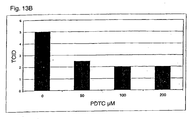
- IB-RS-2 cells in T25cm 2 cell culture flasks were infected with 0.001 TCID 50 per cell with MKS virus O-Manisa and incubated for 1 h at 37 ° C , Subsequently, the inoculum was removed and infecting medium was added at the indicated concentrations PDTC (0 ⁇ M to 200 ⁇ M). At 24 h post-infection, supernatants were removed and viral titre (TCID) determined in a standard plate assay.
- virus titer of MKS virus is O-Manisa in the presence of PDTC in comparison with the control sample (0) reduced by more than 2 log levels.
- the control sample was not PDTC added.
- TBE viruses do not belong to the picornaviruses nor do they solve one Disease in the respiratory tract.
- Confluent monolayers of BHK-21 cells were analyzed at 10 pfu / cell TBE virus (Neudörfel) in the presence of the following concentrations PDTC infected: 1000 ⁇ M, 500 ⁇ M, 250 ⁇ M, 125 ⁇ M, 62.5 ⁇ M, 31.25 ⁇ M, 15.6 ⁇ M, 7, 8 ⁇ M, 3, 9 ⁇ M, 1.95 ⁇ M, 0.975 ⁇ M.
- the cells were incubated for 4 days at 37 ° C and the Cell monolayer analyzed microscopically.
- the virus multiplication was determined by using an enzyme immunoassay.
- the microscopic Analysis shows no evidence of toxic effects of PDTC. Quantification of virus proliferation shows that PDTC in any of the concentrations tested is able to To reduce virus multiplication.
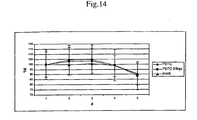
- mice were challenged with 10 TCID50 EMC virus intraperitoneally.
- the control group was then given once a day 50 ⁇ l of PBS treated intraperitoneally.
- Two more groups were treated with 50 ⁇ l of 50 mM PDTC per day, with one group the treatment was started simultaneously with the infection (PDTC), in the other group only 24 h after infection (PDTC 24hpi).
- FIG. 14 the change of the mouse weight after the beginning of the mouse is shown Infection shown. It is clear that treated and untreated animals do not differ. On average occurs in In the infected mice death in all groups in 5.5 days.
- EMC infection which is one of the picornaviruses, but not a disease in the respiratory tract but in nerve cells triggers.
Landscapes
- Health & Medical Sciences (AREA)
- Life Sciences & Earth Sciences (AREA)
- Chemical & Material Sciences (AREA)
- Medicinal Chemistry (AREA)
- Pharmacology & Pharmacy (AREA)
- Animal Behavior & Ethology (AREA)
- General Health & Medical Sciences (AREA)
- Public Health (AREA)
- Veterinary Medicine (AREA)
- Epidemiology (AREA)
- Virology (AREA)
- Organic Chemistry (AREA)
- Communicable Diseases (AREA)
- Oncology (AREA)
- Chemical Kinetics & Catalysis (AREA)
- General Chemical & Material Sciences (AREA)
- Nuclear Medicine, Radiotherapy & Molecular Imaging (AREA)
- Molecular Biology (AREA)
- Pulmonology (AREA)
- Pharmaceuticals Containing Other Organic And Inorganic Compounds (AREA)
- Acyclic And Carbocyclic Compounds In Medicinal Compositions (AREA)
- Medicines That Contain Protein Lipid Enzymes And Other Medicines (AREA)
- Respiratory Apparatuses And Protective Means (AREA)
- Agricultural Chemicals And Associated Chemicals (AREA)
Description
Claims (15)
- Verwendung von Dithiocarbamat-Verbindungen der Strukturformel R1R2NCS2H, worin R1 und R2 unabhängig voneinander ein gerades oder verzweigtes C1-C3-Alkyl darstellen oder mit dem Stickstoffatom einen aliphatischen Ring mit 4 bis 6 C-Atomen bilden, wobei R1, R2 oder der aliphatische Ring gegebenenfalls mit einem oder mehreren Substituenten ausgewählt aus OH, NO2, NH2, COOH, SH, F, Cl, Br, I, Methyl oder Ethyl substituiert ist, und oxidierte Formen dieser Verbindungen, insbesondere Dimere hievon, sowie pharmazeutisch akzeptable Salze hievon, zur Herstellung eines Mittels zur Behandlung oder Verhinderung einer Infektion durch RNA-viren, die den respiratorischen Trakt bei Mensch und Säugetieren befallen und dort eine Erkrankung auslösen.
- Verwendung nach Anspruch 1, dadurch gekennzeichnet, dass R1 und R2 unabhängig voneinander ein C1-C3-Alkyl darstellen oder mit dem Stickstoffatom einen aliphatischen Ring mit 4 bis 6 C-Atomen bilden.
- Verwendung nach Anspruch 1 oder 2, dadurch gekennzeichnet, dass die Dithiocarbamat-Verbindung ausgewählt ist aus Pyrrolidin-Dithiocarbamat und N,N-Diethyl-Dithiocarbamat.
- Verwendung nach einem der Ansprüche 1 bis 3, dadurch gekennzeichnet, dass die Virus-Infektion eine Infektion mit Picornavirus, Orthomyxo- oder Paramyxovirus ist.
- Verwendung nach Anspruch 4, dadurch gekennzeichnet, dass das orthomyxovirus ein humanes Influenzavirus ist, insbesondere ausgewählt aus der Gruppe bestehend aus Influenza A, Influenza B, Influenza C bzw. das Paramyxovirus ein Parainfluenzavirus oder Pneumovirus ist.
- verwendung nach Anspruch 4, dadurch gekennzeichnet, dass das orthomyxovirus ein Säugetier-Influenza A-Virus ist.
- verwendung nach einem der Ansprüche 1 bis 6, dadurch gekennzeichnet, dass das Picornavirus ein Rhinovirus, insbesondere humanes oder Pferde-Rhinovirus, ein Enterovirus, insbesondere Ente rovirus 70, 71 oder coxsackievirus, bzw. ein Aphthovirus, insbesondere das Maul- und Klauenseuche-Virus oder equines Rhinitisvirus A, ist.
- Verwendung nach einem der Ansprüche 1 bis 7, dadurch gekennzeichnet, dass die Pithiocarbamat-Verbindung in dem Mittel in einer Konzentration von 0,01 bis 5000 mM, vorzugsweise 1 bis 300 mM, besonders bevorzugt 10 bis 100 mM, vorgesehen ist.
- Verwendung nach einem der Ansprüche 1 bis 7, dadurch gekennzeichnet, dass die Dithiocarbamat-verbindungen in dem Mittel in einer Konzentration von 10 mM bis 1 M vorgesehen ist.
- Verwendung nach einem der Ansprüche 1 bis 9, dadurch gekennzeichnet, dass das Mittel weiters einen pharmazeutisch akzeptablen Träger umfasst.
- Verwendung nach einem der Ansprüche 1 bis 10, dadurch gekennzeichnet, dass das Mittel ein oral, intranasal, intravenös, rektal, parenteral oder als Augen- oder ohrentropfen, als Gurgellösung oder Aerosol zu verabreichendes Mittel ist.
- Verwendung nach einem der Ansprüche 1 bis 11, dadurch gekennzeichnet, dass das Mittel weitere antivirale Substanzen umfasst.
- Verwendung nach einem der Ansprüche 1 bis 12, dadurch gekennzeichnet, dass das Mittel eine Kombination von zumindest zwei verschiedenen Dithiocarbamat-Verbindungen umfasst.
- Verwendung nach einem der Ansprüche 1 bis 13, dadurch gekennzeichnet, dass das Mittel weitere Substanzen, ausgewählt aus Antibiotika, Impfstoffen, Immunsuppressiva, Stabilisatoren, immunstimulierenden Substanzen, Blutprodukten oder Mischungen davon, umfasst.
- Verwendung nach einem der Ansprüche 1 bis 14, dadurch gekennzeichnet, dass das Mittel zur Inhibierung der virusvermehrung eingesetzt wird.
Priority Applications (1)
| Application Number | Priority Date | Filing Date | Title |
|---|---|---|---|
| SI200230243T SI1406607T1 (sl) | 2001-07-16 | 2002-07-15 | Uporaba razreda antivirusnih spojin (ditiokarbamatne spojine) za pripravo sredstva za zdravljenje oz. preprecevanje virusne infekcije v resporatornemtraktu |
Applications Claiming Priority (10)
| Application Number | Priority Date | Filing Date | Title |
|---|---|---|---|
| AT11022001 | 2001-07-16 | ||
| AT11032001 | 2001-07-16 | ||
| AT11022001 | 2001-07-16 | ||
| AT11032001 | 2001-07-16 | ||
| AT19722001 | 2001-12-17 | ||
| AT19732001A AT411149B (de) | 2001-07-16 | 2001-12-17 | Verwendung von dithiocarbamaten zur herstellung eines mittels zur behandlung bzw. prävention einer virusinfektion im respiratorischen bereich |
| AT19722001 | 2001-12-17 | ||
| AT19732001 | 2001-12-17 | ||
| AT19702001 | 2001-12-17 | ||
| PCT/AT2002/000206 WO2003007935A2 (de) | 2001-07-16 | 2002-07-15 | Verwendung einer antiviralen verbindungsklasse (dithiocarbamat-verbindungen) zur herstellung eines mittels zur behandlung bzw. prävention einer virusinfektion im respiratorischen trakt |
Publications (2)
| Publication Number | Publication Date |
|---|---|
| EP1406607A2 EP1406607A2 (de) | 2004-04-14 |
| EP1406607B1 true EP1406607B1 (de) | 2005-11-30 |
Family
ID=27422335
Family Applications (1)
| Application Number | Title | Priority Date | Filing Date |
|---|---|---|---|
| EP02759851A Expired - Lifetime EP1406607B1 (de) | 2001-07-16 | 2002-07-15 | Verwendung einer antiviralen verbindungsklasse (dithiocarbamat-verbindungen) zur herstellung eines mittels zur behandlung bzw. prävention einer virusinfektion im respiratorischen trakt |
Country Status (10)
| Country | Link |
|---|---|
| US (1) | US7282599B2 (de) |
| EP (1) | EP1406607B1 (de) |
| CN (1) | CN1549709A (de) |
| AT (1) | ATE311181T1 (de) |
| CA (1) | CA2454167A1 (de) |
| DE (1) | DE50205128D1 (de) |
| DK (1) | DK1406607T3 (de) |
| ES (1) | ES2250692T3 (de) |
| SI (1) | SI1406607T1 (de) |
| WO (1) | WO2003007935A2 (de) |
Families Citing this family (2)
| Publication number | Priority date | Publication date | Assignee | Title |
|---|---|---|---|---|
| WO2022266330A1 (en) * | 2021-06-16 | 2022-12-22 | Arizona Board Of Regents On Behalf Of The University Of Arizona | Compounds that synergize with copper to kill streptococcus pneumoniae |
| KR102903494B1 (ko) * | 2022-04-28 | 2025-12-26 | (주)지뉴인텍 | 디티오카바메이트를 함유하는 백신 치료효과 증진용 조성물 |
Family Cites Families (10)
| Publication number | Priority date | Publication date | Assignee | Title |
|---|---|---|---|---|
| NL221579A (de) * | 1956-10-26 | |||
| US3786143A (en) | 1968-12-23 | 1974-01-15 | Haessle Ab | Method for treating virus infection affecting the brain |
| HU171736B (hu) | 1974-12-11 | 1978-03-28 | Eszakmagyar Vegyimuevek | Fungicid soderzhahhij 8-oksikhinolin v kachestve aktivnogo vehhestva i sposob poluchenija aktivnogo vehhestva |
| JPS51139632A (en) | 1975-05-26 | 1976-12-02 | Kao Corp | A polycyclic dithiocarbamate antiviral agent for animals |
| US5686436A (en) * | 1993-05-13 | 1997-11-11 | Hiv Diagnostics, Inc. | Multi-faceted method to repress reproduction of latent viruses in humans and animals |
| DE4325547C2 (de) | 1993-07-29 | 1997-11-27 | Max Planck Gesellschaft | Verwendung von Thiolverbindungen zur Therapie von Hepatitis-_Viren-induzierten Erkrankungen |
| DE19735120A1 (de) | 1997-08-13 | 1999-02-18 | Peter Hans Prof D Hofschneider | Verwendung von Thiolverbindungen zur Inaktivierung von Viren |
| JP4837827B2 (ja) * | 1998-06-12 | 2011-12-14 | マウント シナイ スクール オブ メディシン | 新規なウイルス増殖方法およびそのためのインターフェロン欠損培養基 |
| US6093743A (en) | 1998-06-23 | 2000-07-25 | Medinox Inc. | Therapeutic methods employing disulfide derivatives of dithiocarbamates and compositions useful therefor |
| US6930125B2 (en) | 2000-01-14 | 2005-08-16 | John F. Hunt | Airway alkalinization as a therapy for airway diseases |
-
2002
- 2002-07-15 CN CNA028171357A patent/CN1549709A/zh active Pending
- 2002-07-15 DK DK02759851T patent/DK1406607T3/da active
- 2002-07-15 SI SI200230243T patent/SI1406607T1/sl unknown
- 2002-07-15 EP EP02759851A patent/EP1406607B1/de not_active Expired - Lifetime
- 2002-07-15 US US10/483,975 patent/US7282599B2/en not_active Expired - Fee Related
- 2002-07-15 ES ES02759851T patent/ES2250692T3/es not_active Expired - Lifetime
- 2002-07-15 CA CA002454167A patent/CA2454167A1/en not_active Abandoned
- 2002-07-15 WO PCT/AT2002/000206 patent/WO2003007935A2/de not_active Ceased
- 2002-07-15 DE DE50205128T patent/DE50205128D1/de not_active Expired - Fee Related
- 2002-07-15 AT AT02759851T patent/ATE311181T1/de not_active IP Right Cessation
Also Published As
| Publication number | Publication date |
|---|---|
| SI1406607T1 (sl) | 2006-04-30 |
| ES2250692T3 (es) | 2006-04-16 |
| DK1406607T3 (da) | 2006-04-10 |
| US20060069153A1 (en) | 2006-03-30 |
| CN1549709A (zh) | 2004-11-24 |
| CA2454167A1 (en) | 2003-01-30 |
| WO2003007935A2 (de) | 2003-01-30 |
| EP1406607A2 (de) | 2004-04-14 |
| DE50205128D1 (de) | 2006-01-05 |
| ATE311181T1 (de) | 2005-12-15 |
| US7282599B2 (en) | 2007-10-16 |
| WO2003007935A3 (de) | 2003-09-12 |
Similar Documents
| Publication | Publication Date | Title |
|---|---|---|
| CN100411617C (zh) | 黄酮类化合物制备药物的用途 | |
| DE60318237T2 (de) | Pharmazeutische zusammensetzungen enthaltend flavonoide und menthol | |
| EP2249866B1 (de) | Verwendung eines acetylsalicylsäuresalzes zur behandlung viraler infektionen | |
| DE60121301T2 (de) | Flibanserin zur Behandlung extrapyramidaler Bewegungsstörungen | |
| KR101656791B1 (ko) | 항바이러스 활성을 가지는 사료 첨가제 조성물 | |
| DE202009017847U1 (de) | Zusammensetzung zur Prävention und Behandlung von Virusinfektionen | |
| DE102007040615A1 (de) | Osmolyte zur Behandlung von allergisch oder viral bedingten Atemwegserkrankungen | |
| US20250381234A1 (en) | Compositions and methods for treatment of conditions using fractionated honey | |
| DE19860802A1 (de) | Herstellung eines Mittels gegen Hepatitis B-, HI-, Paramyxo und Orthomyxo-Viren | |
| EP1406607A2 (de) | Verwendung einer antiviralen verbindungsklasse (dithiocarbamat-verbindungen) zur herstellung eines mittels zur behandlung bzw. pravention einer virusinfektion im respiratorischen trakt | |
| AT411149B (de) | Verwendung von dithiocarbamaten zur herstellung eines mittels zur behandlung bzw. prävention einer virusinfektion im respiratorischen bereich | |
| DE68915154T2 (de) | Anwendung von gegen retroviren aktiven wirkstoffen und so erhaltene produkte. | |
| CN114558022B (zh) | 布林西多福韦在制备抗伪狂犬病毒药物中的应用 | |
| RU2301669C2 (ru) | Применение соединений антивирусного класса для получения средства для лечения и профилактики вирусной инфекции дыхательного тракта | |
| CN112843073A (zh) | 瑞德西韦(Remdesivir)在制备抗牛副流感病毒3型药物中的应用 | |
| DE602004004085T2 (de) | Verwendung von natrium-2-mercaptoethansulphonat als antivirales mittel | |
| AU2023211580B2 (en) | Compositions and methods for disruption of biofilms using fractionated honey | |
| US20060035984A1 (en) | Method of inhibiting formation of neisseria gonorrhea and neisseria meningiditis | |
| EP4196099B1 (de) | Diphenylderivate für die verwendung in der therapie von viruserkrankungen, insbesondere corona-infektionen, insbesondere covid-19 | |
| US20090076132A1 (en) | Antiviral compositions and methods of treatment | |
| EP2385834B1 (de) | Verwendung von deuteriumoxid zur behandlung virus-basierter erkrankungen des respirationstraktes | |
| WO2008008494A2 (en) | Methods and compositions for treating mucosal inflammation | |
| US20230301884A1 (en) | Antiseptic compositions | |
| CN113318115A (zh) | 美他环素在制备防治牛副流感病毒3型病毒感染药物中的应用 | |
| EP4247350A1 (de) | Zusammensetzung zur verwendung in einem verfahren zur prävention und behandlung von erkrankungen des atemsystems |
Legal Events
| Date | Code | Title | Description |
|---|---|---|---|
| PUAI | Public reference made under article 153(3) epc to a published international application that has entered the european phase |
Free format text: ORIGINAL CODE: 0009012 |
|
| 17P | Request for examination filed |
Effective date: 20040124 |
|
| AK | Designated contracting states |
Kind code of ref document: A2 Designated state(s): AT BE BG CH CY CZ DE DK EE ES FI FR GB GR IE IT LI LU MC NL PT SE SK TR |
|
| AX | Request for extension of the european patent |
Extension state: AL LT LV MK RO SI |
|
| GRAP | Despatch of communication of intention to grant a patent |
Free format text: ORIGINAL CODE: EPIDOSNIGR1 |
|
| RAP1 | Party data changed (applicant data changed or rights of an application transferred) |
Owner name: GREENHILLS BIOTECHNOLOGY RESEARCH DEVELOPMENT TRAD |
|
| RIN1 | Information on inventor provided before grant (corrected) |
Inventor name: GAUDERNAK, ELISABETH Inventor name: GRASSAUER, ANDREAS Inventor name: SEIPELT, JOACHIM Inventor name: MUSTER, THOMAS Inventor name: KUECHLER, ERNST |
|
| GRAS | Grant fee paid |
Free format text: ORIGINAL CODE: EPIDOSNIGR3 |
|
| GRAA | (expected) grant |
Free format text: ORIGINAL CODE: 0009210 |
|
| AK | Designated contracting states |
Kind code of ref document: B1 Designated state(s): AT BE BG CH CY CZ DE DK EE ES FI FR GB GR IE IT LI LU MC NL PT SE SK TR |
|
| AX | Request for extension of the european patent |
Extension state: AL LT LV MK RO SI |
|
| REG | Reference to a national code |
Ref country code: GB Ref legal event code: FG4D Free format text: NOT ENGLISH Ref country code: CH Ref legal event code: EP Ref country code: CH Ref legal event code: NV Representative=s name: ROTTMANN, ZIMMERMANN + PARTNER AG |
|
| REG | Reference to a national code |
Ref country code: IE Ref legal event code: FG4D Free format text: LANGUAGE OF EP DOCUMENT: GERMAN |
|
| REF | Corresponds to: |
Ref document number: 50205128 Country of ref document: DE Date of ref document: 20060105 Kind code of ref document: P |
|
| REG | Reference to a national code |
Ref country code: GR Ref legal event code: EP Ref document number: 20060400047 Country of ref document: GR |
|
| REG | Reference to a national code |
Ref country code: SE Ref legal event code: TRGR |
|
| GBT | Gb: translation of ep patent filed (gb section 77(6)(a)/1977) |
Effective date: 20060313 |
|
| REG | Reference to a national code |
Ref country code: DK Ref legal event code: T3 |
|
| REG | Reference to a national code |
Ref country code: ES Ref legal event code: FG2A Ref document number: 2250692 Country of ref document: ES Kind code of ref document: T3 |
|
| REG | Reference to a national code |
Ref country code: EE Ref legal event code: FG4A Ref document number: E000247 Country of ref document: EE Effective date: 20060223 |
|
| RIN2 | Information on inventor provided after grant (corrected) |
Inventor name: MUSTER, THOMAS Inventor name: GRASSAUER, ANDREAS Inventor name: SEIPELT, JOACHIM Inventor name: GAUDERNAK, ELISABETH Inventor name: KUECHLER, ERNST |
|
| ET | Fr: translation filed | ||
| PLBE | No opposition filed within time limit |
Free format text: ORIGINAL CODE: 0009261 |
|
| STAA | Information on the status of an ep patent application or granted ep patent |
Free format text: STATUS: NO OPPOSITION FILED WITHIN TIME LIMIT |
|
| 26N | No opposition filed |
Effective date: 20060831 |
|
| PGFP | Annual fee paid to national office [announced via postgrant information from national office to epo] |
Ref country code: IE Payment date: 20070510 Year of fee payment: 6 |
|
| PGFP | Annual fee paid to national office [announced via postgrant information from national office to epo] |
Ref country code: BE Payment date: 20070511 Year of fee payment: 6 |
|
| PGFP | Annual fee paid to national office [announced via postgrant information from national office to epo] |
Ref country code: ES Payment date: 20070514 Year of fee payment: 6 Ref country code: MC Payment date: 20070514 Year of fee payment: 6 |
|
| PGFP | Annual fee paid to national office [announced via postgrant information from national office to epo] |
Ref country code: CZ Payment date: 20070515 Year of fee payment: 6 Ref country code: SK Payment date: 20070515 Year of fee payment: 6 |
|
| PGFP | Annual fee paid to national office [announced via postgrant information from national office to epo] |
Ref country code: LU Payment date: 20070524 Year of fee payment: 6 |
|
| PGFP | Annual fee paid to national office [announced via postgrant information from national office to epo] |
Ref country code: PT Payment date: 20070531 Year of fee payment: 6 |
|
| PGFP | Annual fee paid to national office [announced via postgrant information from national office to epo] |
Ref country code: EE Payment date: 20070605 Year of fee payment: 6 |
|
| PGFP | Annual fee paid to national office [announced via postgrant information from national office to epo] |
Ref country code: BG Payment date: 20070614 Year of fee payment: 6 |
|
| PGFP | Annual fee paid to national office [announced via postgrant information from national office to epo] |
Ref country code: DK Payment date: 20070703 Year of fee payment: 6 |
|
| PGFP | Annual fee paid to national office [announced via postgrant information from national office to epo] |
Ref country code: DE Payment date: 20070926 Year of fee payment: 6 |
|
| PGFP | Annual fee paid to national office [announced via postgrant information from national office to epo] |
Ref country code: AT Payment date: 20070724 Year of fee payment: 6 Ref country code: CH Payment date: 20070629 Year of fee payment: 6 Ref country code: FI Payment date: 20070709 Year of fee payment: 6 Ref country code: GB Payment date: 20070514 Year of fee payment: 6 Ref country code: TR Payment date: 20070625 Year of fee payment: 6 |
|
| PGFP | Annual fee paid to national office [announced via postgrant information from national office to epo] |
Ref country code: IT Payment date: 20070723 Year of fee payment: 6 Ref country code: NL Payment date: 20070717 Year of fee payment: 6 Ref country code: SE Payment date: 20070717 Year of fee payment: 6 |
|
| PGFP | Annual fee paid to national office [announced via postgrant information from national office to epo] |
Ref country code: FR Payment date: 20070515 Year of fee payment: 6 |
|
| PGFP | Annual fee paid to national office [announced via postgrant information from national office to epo] |
Ref country code: CY Payment date: 20070514 Year of fee payment: 6 Ref country code: GR Payment date: 20070514 Year of fee payment: 6 |
|
| REG | Reference to a national code |
Ref country code: PT Ref legal event code: MM4A Free format text: LAPSE DUE TO NON-PAYMENT OF FEES Effective date: 20090115 |
|
| REG | Reference to a national code |
Ref country code: CH Ref legal event code: PL |
|
| REG | Reference to a national code |
Ref country code: DK Ref legal event code: EBP |
|
| EUG | Se: european patent has lapsed | ||
| GBPC | Gb: european patent ceased through non-payment of renewal fee |
Effective date: 20080715 |
|
| LTLA | Lt: lapse of european patent or patent extension |
Effective date: 20080715 |
|
| PG25 | Lapsed in a contracting state [announced via postgrant information from national office to epo] |
Ref country code: MC Free format text: LAPSE BECAUSE OF NON-PAYMENT OF DUE FEES Effective date: 20080731 |
|
| NLV4 | Nl: lapsed or anulled due to non-payment of the annual fee |
Effective date: 20090201 |
|
| REG | Reference to a national code |
Ref country code: EE Ref legal event code: MM4A Ref document number: E000247 Country of ref document: EE Effective date: 20080731 |
|
| REG | Reference to a national code |
Ref country code: IE Ref legal event code: MM4A |
|
| PG25 | Lapsed in a contracting state [announced via postgrant information from national office to epo] |
Ref country code: AT Free format text: LAPSE BECAUSE OF NON-PAYMENT OF DUE FEES Effective date: 20080715 Ref country code: DE Free format text: LAPSE BECAUSE OF NON-PAYMENT OF DUE FEES Effective date: 20090203 Ref country code: EE Free format text: LAPSE BECAUSE OF NON-PAYMENT OF DUE FEES Effective date: 20080731 |
|
| REG | Reference to a national code |
Ref country code: FR Ref legal event code: ST Effective date: 20090331 |
|
| PG25 | Lapsed in a contracting state [announced via postgrant information from national office to epo] |
Ref country code: PT Free format text: LAPSE BECAUSE OF NON-PAYMENT OF DUE FEES Effective date: 20090115 Ref country code: SK Free format text: LAPSE BECAUSE OF NON-PAYMENT OF DUE FEES Effective date: 20080715 Ref country code: FI Free format text: LAPSE BECAUSE OF NON-PAYMENT OF DUE FEES Effective date: 20080715 Ref country code: CZ Free format text: LAPSE BECAUSE OF NON-PAYMENT OF DUE FEES Effective date: 20080715 Ref country code: NL Free format text: LAPSE BECAUSE OF NON-PAYMENT OF DUE FEES Effective date: 20090201 |
|
| PG25 | Lapsed in a contracting state [announced via postgrant information from national office to epo] |
Ref country code: GR Free format text: LAPSE BECAUSE OF NON-PAYMENT OF DUE FEES Effective date: 20090204 Ref country code: GB Free format text: LAPSE BECAUSE OF NON-PAYMENT OF DUE FEES Effective date: 20080715 Ref country code: CH Free format text: LAPSE BECAUSE OF NON-PAYMENT OF DUE FEES Effective date: 20080731 Ref country code: LI Free format text: LAPSE BECAUSE OF NON-PAYMENT OF DUE FEES Effective date: 20080731 |
|
| REG | Reference to a national code |
Ref country code: SI Ref legal event code: KO00 Effective date: 20090407 |
|
| PG25 | Lapsed in a contracting state [announced via postgrant information from national office to epo] |
Ref country code: CY Free format text: LAPSE BECAUSE OF NON-PAYMENT OF DUE FEES Effective date: 20080715 Ref country code: DK Free format text: LAPSE BECAUSE OF NON-PAYMENT OF DUE FEES Effective date: 20080731 Ref country code: IE Free format text: LAPSE BECAUSE OF NON-PAYMENT OF DUE FEES Effective date: 20080715 |
|
| PG25 | Lapsed in a contracting state [announced via postgrant information from national office to epo] |
Ref country code: FR Free format text: LAPSE BECAUSE OF NON-PAYMENT OF DUE FEES Effective date: 20080731 Ref country code: IT Free format text: LAPSE BECAUSE OF NON-PAYMENT OF DUE FEES Effective date: 20080715 |
|
| REG | Reference to a national code |
Ref country code: ES Ref legal event code: FD2A Effective date: 20080716 |
|
| PG25 | Lapsed in a contracting state [announced via postgrant information from national office to epo] |
Ref country code: ES Free format text: LAPSE BECAUSE OF NON-PAYMENT OF DUE FEES Effective date: 20080716 |
|
| PG25 | Lapsed in a contracting state [announced via postgrant information from national office to epo] |
Ref country code: SE Free format text: LAPSE BECAUSE OF NON-PAYMENT OF DUE FEES Effective date: 20080716 Ref country code: BE Free format text: LAPSE BECAUSE OF NON-PAYMENT OF DUE FEES Effective date: 20080731 Ref country code: LU Free format text: LAPSE BECAUSE OF NON-PAYMENT OF DUE FEES Effective date: 20080715 |
|
| PG25 | Lapsed in a contracting state [announced via postgrant information from national office to epo] |
Ref country code: BG Free format text: LAPSE BECAUSE OF NON-PAYMENT OF DUE FEES Effective date: 20080731 |
|
| PG25 | Lapsed in a contracting state [announced via postgrant information from national office to epo] |
Ref country code: TR Free format text: LAPSE BECAUSE OF NON-PAYMENT OF DUE FEES Effective date: 20100917 |
|
| PG25 | Lapsed in a contracting state [announced via postgrant information from national office to epo] |
Ref country code: TR Free format text: LAPSE BECAUSE OF NON-PAYMENT OF DUE FEES Effective date: 20080715 |