EP1402882A1 - Säurehaltige Desensibilisierungsmittel für Zähne - Google Patents
Säurehaltige Desensibilisierungsmittel für Zähne Download PDFInfo
- Publication number
- EP1402882A1 EP1402882A1 EP03021187A EP03021187A EP1402882A1 EP 1402882 A1 EP1402882 A1 EP 1402882A1 EP 03021187 A EP03021187 A EP 03021187A EP 03021187 A EP03021187 A EP 03021187A EP 1402882 A1 EP1402882 A1 EP 1402882A1
- Authority
- EP
- European Patent Office
- Prior art keywords
- radical
- acid
- weight
- composition according
- oder
- Prior art date
- Legal status (The legal status is an assumption and is not a legal conclusion. Google has not performed a legal analysis and makes no representation as to the accuracy of the status listed.)
- Granted
Links
- 239000002253 acid Substances 0.000 title claims abstract description 68
- 239000000463 material Substances 0.000 title description 4
- 239000000203 mixture Substances 0.000 claims abstract description 96
- 229920000642 polymer Polymers 0.000 claims abstract description 35
- 125000002887 hydroxy group Chemical group [H]O* 0.000 claims abstract description 11
- 125000003178 carboxy group Chemical group [H]OC(*)=O 0.000 claims abstract description 10
- -1 aliphatic hydrocarbon radical Chemical class 0.000 claims description 75
- XLYOFNOQVPJJNP-UHFFFAOYSA-N water Substances O XLYOFNOQVPJJNP-UHFFFAOYSA-N 0.000 claims description 35
- LFQSCWFLJHTTHZ-UHFFFAOYSA-N Ethanol Chemical compound CCO LFQSCWFLJHTTHZ-UHFFFAOYSA-N 0.000 claims description 33
- 229920002125 Sokalan® Polymers 0.000 claims description 25
- 229910052760 oxygen Inorganic materials 0.000 claims description 24
- CIUQDSCDWFSTQR-UHFFFAOYSA-N [C]1=CC=CC=C1 Chemical compound [C]1=CC=CC=C1 CIUQDSCDWFSTQR-UHFFFAOYSA-N 0.000 claims description 20
- 150000007513 acids Chemical class 0.000 claims description 18
- 239000004584 polyacrylic acid Substances 0.000 claims description 18
- 229920001223 polyethylene glycol Polymers 0.000 claims description 15
- 125000004432 carbon atom Chemical group C* 0.000 claims description 14
- NROKBHXJSPEDAR-UHFFFAOYSA-M potassium fluoride Chemical compound [F-].[K+] NROKBHXJSPEDAR-UHFFFAOYSA-M 0.000 claims description 14
- ABLZXFCXXLZCGV-UHFFFAOYSA-N Phosphorous acid Chemical compound OP(O)=O ABLZXFCXXLZCGV-UHFFFAOYSA-N 0.000 claims description 13
- 229910001414 potassium ion Inorganic materials 0.000 claims description 13
- 239000002904 solvent Substances 0.000 claims description 12
- 239000002202 Polyethylene glycol Substances 0.000 claims description 11
- 229910052739 hydrogen Inorganic materials 0.000 claims description 10
- 239000011698 potassium fluoride Substances 0.000 claims description 10
- 239000003795 chemical substances by application Substances 0.000 claims description 9
- 125000002496 methyl group Chemical group [H]C([H])([H])* 0.000 claims description 9
- 229920002153 Hydroxypropyl cellulose Polymers 0.000 claims description 8
- 235000010977 hydroxypropyl cellulose Nutrition 0.000 claims description 8
- 230000006920 protein precipitation Effects 0.000 claims description 8
- 108090000623 proteins and genes Proteins 0.000 claims description 8
- 102000004169 proteins and genes Human genes 0.000 claims description 8
- 239000001863 hydroxypropyl cellulose Substances 0.000 claims description 7
- 235000003270 potassium fluoride Nutrition 0.000 claims description 7
- 238000002360 preparation method Methods 0.000 claims description 7
- 239000000126 substance Substances 0.000 claims description 7
- 150000001338 aliphatic hydrocarbons Chemical class 0.000 claims description 5
- 125000002947 alkylene group Chemical group 0.000 claims description 5
- 125000001495 ethyl group Chemical group [H]C([H])([H])C([H])([H])* 0.000 claims description 5
- 125000000008 (C1-C10) alkyl group Chemical group 0.000 claims description 4
- 125000001931 aliphatic group Chemical group 0.000 claims description 4
- 125000000732 arylene group Chemical group 0.000 claims description 4
- 150000001875 compounds Chemical class 0.000 claims description 4
- QUPDWYMUPZLYJZ-UHFFFAOYSA-N ethyl Chemical compound C[CH2] QUPDWYMUPZLYJZ-UHFFFAOYSA-N 0.000 claims description 4
- STVZJERGLQHEKB-UHFFFAOYSA-N ethylene glycol dimethacrylate Chemical compound CC(=C)C(=O)OCCOC(=O)C(C)=C STVZJERGLQHEKB-UHFFFAOYSA-N 0.000 claims description 4
- 125000001153 fluoro group Chemical group F* 0.000 claims description 4
- WCYWZMWISLQXQU-UHFFFAOYSA-N methyl Chemical compound [CH3] WCYWZMWISLQXQU-UHFFFAOYSA-N 0.000 claims description 4
- 125000000391 vinyl group Chemical group [H]C([*])=C([H])[H] 0.000 claims description 4
- 229920002554 vinyl polymer Polymers 0.000 claims description 4
- PXGOKWXKJXAPGV-UHFFFAOYSA-N Fluorine Chemical group FF PXGOKWXKJXAPGV-UHFFFAOYSA-N 0.000 claims description 3
- 239000000796 flavoring agent Substances 0.000 claims description 3
- 235000019634 flavors Nutrition 0.000 claims description 3
- 150000004676 glycans Chemical class 0.000 claims description 3
- 229910052757 nitrogen Inorganic materials 0.000 claims description 3
- 229920000620 organic polymer Polymers 0.000 claims description 3
- 125000001997 phenyl group Chemical group [H]C1=C([H])C([H])=C(*)C([H])=C1[H] 0.000 claims description 3
- 229920001282 polysaccharide Polymers 0.000 claims description 3
- 239000005017 polysaccharide Substances 0.000 claims description 3
- 229910052717 sulfur Inorganic materials 0.000 claims description 3
- VGGSQFUCUMXWEO-UHFFFAOYSA-N Ethene Chemical compound C=C VGGSQFUCUMXWEO-UHFFFAOYSA-N 0.000 claims description 2
- XXBYVLZQVLPBRN-UHFFFAOYSA-N OC(=O)C1=CC(S(O)(=O)=O)=CC=C1O.OC(=O)C1=CC(S(O)(=O)=O)=CC=C1O Chemical compound OC(=O)C1=CC(S(O)(=O)=O)=CC=C1O.OC(=O)C1=CC(S(O)(=O)=O)=CC=C1O XXBYVLZQVLPBRN-UHFFFAOYSA-N 0.000 claims description 2
- OFOBLEOULBTSOW-UHFFFAOYSA-N Propanedioic acid Natural products OC(=O)CC(O)=O OFOBLEOULBTSOW-UHFFFAOYSA-N 0.000 claims description 2
- 125000003118 aryl group Chemical group 0.000 claims description 2
- 125000002993 cycloalkylene group Chemical group 0.000 claims description 2
- CYKDRLQDTUXOBO-UHFFFAOYSA-N cyclopropan-1,1-diyl Chemical compound [C]1CC1 CYKDRLQDTUXOBO-UHFFFAOYSA-N 0.000 claims description 2
- 229910052731 fluorine Chemical group 0.000 claims description 2
- 239000011737 fluorine Chemical group 0.000 claims description 2
- VZCYOOQTPOCHFL-UPHRSURJSA-N maleic acid Chemical compound OC(=O)\C=C/C(O)=O VZCYOOQTPOCHFL-UPHRSURJSA-N 0.000 claims description 2
- 239000011976 maleic acid Substances 0.000 claims description 2
- 125000000325 methylidene group Chemical group [H]C([H])=* 0.000 claims description 2
- 125000000962 organic group Chemical group 0.000 claims description 2
- 229920002401 polyacrylamide Polymers 0.000 claims description 2
- 229920006316 polyvinylpyrrolidine Polymers 0.000 claims description 2
- VZCYOOQTPOCHFL-UHFFFAOYSA-N trans-butenedioic acid Natural products OC(=O)C=CC(O)=O VZCYOOQTPOCHFL-UHFFFAOYSA-N 0.000 claims description 2
- YNJBWRMUSHSURL-UHFFFAOYSA-N trichloroacetic acid Chemical compound OC(=O)C(Cl)(Cl)Cl YNJBWRMUSHSURL-UHFFFAOYSA-N 0.000 claims description 2
- LSNNMFCWUKXFEE-UHFFFAOYSA-M Bisulfite Chemical compound OS([O-])=O LSNNMFCWUKXFEE-UHFFFAOYSA-M 0.000 claims 2
- 150000001732 carboxylic acid derivatives Chemical class 0.000 claims 2
- YMWUJEATGCHHMB-UHFFFAOYSA-N Dichloromethane Chemical compound ClCCl YMWUJEATGCHHMB-UHFFFAOYSA-N 0.000 description 27
- 239000000243 solution Substances 0.000 description 25
- 210000005239 tubule Anatomy 0.000 description 24
- 210000004268 dentin Anatomy 0.000 description 20
- 239000003975 dentin desensitizing agent Substances 0.000 description 17
- 150000002148 esters Chemical class 0.000 description 17
- 150000003009 phosphonic acids Chemical class 0.000 description 17
- WYURNTSHIVDZCO-UHFFFAOYSA-N Tetrahydrofuran Chemical compound C1CCOC1 WYURNTSHIVDZCO-UHFFFAOYSA-N 0.000 description 10
- 229910052799 carbon Inorganic materials 0.000 description 10
- OKKJLVBELUTLKV-UHFFFAOYSA-N Methanol Chemical compound OC OKKJLVBELUTLKV-UHFFFAOYSA-N 0.000 description 9
- FAPWRFPIFSIZLT-UHFFFAOYSA-M Sodium chloride Chemical compound [Na+].[Cl-] FAPWRFPIFSIZLT-UHFFFAOYSA-M 0.000 description 9
- RTZKZFJDLAIYFH-UHFFFAOYSA-N Diethyl ether Chemical compound CCOCC RTZKZFJDLAIYFH-UHFFFAOYSA-N 0.000 description 8
- 230000015572 biosynthetic process Effects 0.000 description 8
- 238000006243 chemical reaction Methods 0.000 description 8
- VOZRXNHHFUQHIL-UHFFFAOYSA-N glycidyl methacrylate Chemical compound CC(=C)C(=O)OCC1CO1 VOZRXNHHFUQHIL-UHFFFAOYSA-N 0.000 description 8
- 238000005481 NMR spectroscopy Methods 0.000 description 7
- NPYPAHLBTDXSSS-UHFFFAOYSA-N Potassium ion Chemical compound [K+] NPYPAHLBTDXSSS-UHFFFAOYSA-N 0.000 description 7
- 229940090898 Desensitizer Drugs 0.000 description 6
- 230000000694 effects Effects 0.000 description 6
- 238000011049 filling Methods 0.000 description 6
- 230000007062 hydrolysis Effects 0.000 description 6
- 238000006460 hydrolysis reaction Methods 0.000 description 6
- 239000007788 liquid Substances 0.000 description 6
- 238000000034 method Methods 0.000 description 6
- 238000001556 precipitation Methods 0.000 description 6
- XXEYEDZRUQKMLI-UHFFFAOYSA-N 2-(2-phosphonoethoxymethyl)prop-2-enoic acid Chemical compound OC(=O)C(=C)COCCP(O)(O)=O XXEYEDZRUQKMLI-UHFFFAOYSA-N 0.000 description 5
- PMZURENOXWZQFD-UHFFFAOYSA-L Sodium Sulfate Chemical compound [Na+].[Na+].[O-]S([O-])(=O)=O PMZURENOXWZQFD-UHFFFAOYSA-L 0.000 description 5
- 239000011575 calcium Substances 0.000 description 5
- 210000002569 neuron Anatomy 0.000 description 5
- 239000002244 precipitate Substances 0.000 description 5
- 229910052938 sodium sulfate Inorganic materials 0.000 description 5
- 235000011152 sodium sulphate Nutrition 0.000 description 5
- 229920002818 (Hydroxyethyl)methacrylate Polymers 0.000 description 4
- 238000001644 13C nuclear magnetic resonance spectroscopy Methods 0.000 description 4
- SXRSQZLOMIGNAQ-UHFFFAOYSA-N Glutaraldehyde Chemical compound O=CCCCC=O SXRSQZLOMIGNAQ-UHFFFAOYSA-N 0.000 description 4
- VEXZGXHMUGYJMC-UHFFFAOYSA-N Hydrochloric acid Chemical compound Cl VEXZGXHMUGYJMC-UHFFFAOYSA-N 0.000 description 4
- WOBHKFSMXKNTIM-UHFFFAOYSA-N Hydroxyethyl methacrylate Chemical compound CC(=C)C(=O)OCCO WOBHKFSMXKNTIM-UHFFFAOYSA-N 0.000 description 4
- NBIIXXVUZAFLBC-UHFFFAOYSA-N Phosphoric acid Chemical compound OP(O)(O)=O NBIIXXVUZAFLBC-UHFFFAOYSA-N 0.000 description 4
- XAENCCVVJRQRBW-UHFFFAOYSA-N [2-ethoxycarbonylprop-2-enoxy(phenyl)methyl]phosphonic acid Chemical compound CCOC(=O)C(=C)COC(P(O)(O)=O)C1=CC=CC=C1 XAENCCVVJRQRBW-UHFFFAOYSA-N 0.000 description 4
- IYYIVELXUANFED-UHFFFAOYSA-N bromo(trimethyl)silane Chemical compound C[Si](C)(C)Br IYYIVELXUANFED-UHFFFAOYSA-N 0.000 description 4
- 210000001175 cerebrospinal fluid Anatomy 0.000 description 4
- 239000002131 composite material Substances 0.000 description 4
- 238000000586 desensitisation Methods 0.000 description 4
- 150000005690 diesters Chemical class 0.000 description 4
- 238000001035 drying Methods 0.000 description 4
- HWCGKSVAYKZNKW-UHFFFAOYSA-N ethyl 2-[[dimethoxyphosphoryl(phenyl)methoxy]methyl]prop-2-enoate Chemical compound CCOC(=O)C(=C)COC(P(=O)(OC)OC)C1=CC=CC=C1 HWCGKSVAYKZNKW-UHFFFAOYSA-N 0.000 description 4
- 238000004519 manufacturing process Methods 0.000 description 4
- 239000008188 pellet Substances 0.000 description 4
- 239000000047 product Substances 0.000 description 4
- 210000002966 serum Anatomy 0.000 description 4
- 239000011780 sodium chloride Substances 0.000 description 4
- PUZPDOWCWNUUKD-UHFFFAOYSA-M sodium fluoride Chemical compound [F-].[Na+] PUZPDOWCWNUUKD-UHFFFAOYSA-M 0.000 description 4
- 238000005160 1H NMR spectroscopy Methods 0.000 description 3
- NIXOWILDQLNWCW-UHFFFAOYSA-N 2-Propenoic acid Natural products OC(=O)C=C NIXOWILDQLNWCW-UHFFFAOYSA-N 0.000 description 3
- 241000283690 Bos taurus Species 0.000 description 3
- OYPRJOBELJOOCE-UHFFFAOYSA-N Calcium Chemical compound [Ca] OYPRJOBELJOOCE-UHFFFAOYSA-N 0.000 description 3
- 229920001661 Chitosan Polymers 0.000 description 3
- LYCAIKOWRPUZTN-UHFFFAOYSA-N Ethylene glycol Chemical compound OCCO LYCAIKOWRPUZTN-UHFFFAOYSA-N 0.000 description 3
- WSFSSNUMVMOOMR-UHFFFAOYSA-N Formaldehyde Chemical compound O=C WSFSSNUMVMOOMR-UHFFFAOYSA-N 0.000 description 3
- 206010020751 Hypersensitivity Diseases 0.000 description 3
- UIIMBOGNXHQVGW-UHFFFAOYSA-M Sodium bicarbonate Chemical class [Na+].OC([O-])=O UIIMBOGNXHQVGW-UHFFFAOYSA-M 0.000 description 3
- HEMHJVSKTPXQMS-UHFFFAOYSA-M Sodium hydroxide Chemical compound [OH-].[Na+] HEMHJVSKTPXQMS-UHFFFAOYSA-M 0.000 description 3
- ZMANZCXQSJIPKH-UHFFFAOYSA-N Triethylamine Chemical compound CCN(CC)CC ZMANZCXQSJIPKH-UHFFFAOYSA-N 0.000 description 3
- 150000001298 alcohols Chemical class 0.000 description 3
- 125000000217 alkyl group Chemical group 0.000 description 3
- 239000000872 buffer Substances 0.000 description 3
- 229910052791 calcium Inorganic materials 0.000 description 3
- 150000001735 carboxylic acids Chemical class 0.000 description 3
- 210000003298 dental enamel Anatomy 0.000 description 3
- 238000005530 etching Methods 0.000 description 3
- 239000012530 fluid Substances 0.000 description 3
- 238000004128 high performance liquid chromatography Methods 0.000 description 3
- 230000035515 penetration Effects 0.000 description 3
- 229920002523 polyethylene Glycol 1000 Polymers 0.000 description 3
- 239000012460 protein solution Substances 0.000 description 3
- 238000003786 synthesis reaction Methods 0.000 description 3
- 238000012360 testing method Methods 0.000 description 3
- KIUKXJAPPMFGSW-DNGZLQJQSA-N (2S,3S,4S,5R,6R)-6-[(2S,3R,4R,5S,6R)-3-Acetamido-2-[(2S,3S,4R,5R,6R)-6-[(2R,3R,4R,5S,6R)-3-acetamido-2,5-dihydroxy-6-(hydroxymethyl)oxan-4-yl]oxy-2-carboxy-4,5-dihydroxyoxan-3-yl]oxy-5-hydroxy-6-(hydroxymethyl)oxan-4-yl]oxy-3,4,5-trihydroxyoxane-2-carboxylic acid Chemical compound CC(=O)N[C@H]1[C@H](O)O[C@H](CO)[C@@H](O)[C@@H]1O[C@H]1[C@H](O)[C@@H](O)[C@H](O[C@H]2[C@@H]([C@@H](O[C@H]3[C@@H]([C@@H](O)[C@H](O)[C@H](O3)C(O)=O)O)[C@H](O)[C@@H](CO)O2)NC(C)=O)[C@@H](C(O)=O)O1 KIUKXJAPPMFGSW-DNGZLQJQSA-N 0.000 description 2
- WJFKNYWRSNBZNX-UHFFFAOYSA-N 10H-phenothiazine Chemical compound C1=CC=C2NC3=CC=CC=C3SC2=C1 WJFKNYWRSNBZNX-UHFFFAOYSA-N 0.000 description 2
- SMZOUWXMTYCWNB-UHFFFAOYSA-N 2-(2-methoxy-5-methylphenyl)ethanamine Chemical compound COC1=CC=C(C)C=C1CCN SMZOUWXMTYCWNB-UHFFFAOYSA-N 0.000 description 2
- JXCDTORYGUGXIJ-UHFFFAOYSA-N 2-hydroxyethyl 2-methylprop-2-enoate;pentanedial Chemical compound O=CCCCC=O.CC(=C)C(=O)OCCO JXCDTORYGUGXIJ-UHFFFAOYSA-N 0.000 description 2
- VHYFNPMBLIVWCW-UHFFFAOYSA-N 4-Dimethylaminopyridine Chemical compound CN(C)C1=CC=NC=C1 VHYFNPMBLIVWCW-UHFFFAOYSA-N 0.000 description 2
- XKRFYHLGVUSROY-UHFFFAOYSA-N Argon Chemical compound [Ar] XKRFYHLGVUSROY-UHFFFAOYSA-N 0.000 description 2
- SNPLKNRPJHDVJA-ZETCQYMHSA-N D-panthenol Chemical compound OCC(C)(C)[C@@H](O)C(=O)NCCCO SNPLKNRPJHDVJA-ZETCQYMHSA-N 0.000 description 2
- 235000004866 D-panthenol Nutrition 0.000 description 2
- 239000011703 D-panthenol Substances 0.000 description 2
- 241000428456 Gluma Species 0.000 description 2
- KFZMGEQAYNKOFK-UHFFFAOYSA-N Isopropanol Chemical compound CC(C)O KFZMGEQAYNKOFK-UHFFFAOYSA-N 0.000 description 2
- 101100496858 Mus musculus Colec12 gene Proteins 0.000 description 2
- 125000000520 N-substituted aminocarbonyl group Chemical group [*]NC(=O)* 0.000 description 2
- 206010070834 Sensitisation Diseases 0.000 description 2
- QAOWNCQODCNURD-UHFFFAOYSA-N Sulfuric acid Chemical compound OS(O)(=O)=O QAOWNCQODCNURD-UHFFFAOYSA-N 0.000 description 2
- 238000005299 abrasion Methods 0.000 description 2
- 230000002378 acidificating effect Effects 0.000 description 2
- 239000000654 additive Substances 0.000 description 2
- 229910000147 aluminium phosphate Inorganic materials 0.000 description 2
- 239000008346 aqueous phase Substances 0.000 description 2
- 150000004945 aromatic hydrocarbons Chemical group 0.000 description 2
- 239000012230 colorless oil Substances 0.000 description 2
- 239000012043 crude product Substances 0.000 description 2
- 229960003949 dexpanthenol Drugs 0.000 description 2
- KPXRGIVPSXFJEX-UHFFFAOYSA-N ethyl 2-(chloromethyl)prop-2-enoate Chemical compound CCOC(=O)C(=C)CCl KPXRGIVPSXFJEX-UHFFFAOYSA-N 0.000 description 2
- 238000000227 grinding Methods 0.000 description 2
- 229910052736 halogen Inorganic materials 0.000 description 2
- 150000002367 halogens Chemical group 0.000 description 2
- 229920002674 hyaluronan Polymers 0.000 description 2
- 229960003160 hyaluronic acid Drugs 0.000 description 2
- 230000005923 long-lasting effect Effects 0.000 description 2
- 238000005259 measurement Methods 0.000 description 2
- 239000003921 oil Substances 0.000 description 2
- 229950000688 phenothiazine Drugs 0.000 description 2
- UEZVMMHDMIWARA-UHFFFAOYSA-M phosphonate Chemical compound [O-]P(=O)=O UEZVMMHDMIWARA-UHFFFAOYSA-M 0.000 description 2
- XHXFXVLFKHQFAL-UHFFFAOYSA-N phosphoryl trichloride Chemical compound ClP(Cl)(Cl)=O XHXFXVLFKHQFAL-UHFFFAOYSA-N 0.000 description 2
- FGIUAXJPYTZDNR-UHFFFAOYSA-N potassium nitrate Chemical compound [K+].[O-][N+]([O-])=O FGIUAXJPYTZDNR-UHFFFAOYSA-N 0.000 description 2
- 239000000843 powder Substances 0.000 description 2
- 230000008569 process Effects 0.000 description 2
- 238000000746 purification Methods 0.000 description 2
- 238000004621 scanning probe microscopy Methods 0.000 description 2
- 230000008313 sensitization Effects 0.000 description 2
- JHJLBTNAGRQEKS-UHFFFAOYSA-M sodium bromide Chemical compound [Na+].[Br-] JHJLBTNAGRQEKS-UHFFFAOYSA-M 0.000 description 2
- 235000013024 sodium fluoride Nutrition 0.000 description 2
- 239000011775 sodium fluoride Substances 0.000 description 2
- 239000011973 solid acid Substances 0.000 description 2
- 125000001424 substituent group Chemical group 0.000 description 2
- BDHFUVZGWQCTTF-UHFFFAOYSA-M sulfonate Chemical compound [O-]S(=O)=O BDHFUVZGWQCTTF-UHFFFAOYSA-M 0.000 description 2
- 150000003460 sulfonic acids Chemical class 0.000 description 2
- 229920003002 synthetic resin Polymers 0.000 description 2
- 239000000057 synthetic resin Substances 0.000 description 2
- 238000010792 warming Methods 0.000 description 2
- RMXLHIUHKIVPAB-UHFFFAOYSA-N 1,4-dibromobut-2-ene Chemical class BrCC=CCBr RMXLHIUHKIVPAB-UHFFFAOYSA-N 0.000 description 1
- OVSKIKFHRZPJSS-UHFFFAOYSA-N 2,4-D Chemical compound OC(=O)COC1=CC=C(Cl)C=C1Cl OVSKIKFHRZPJSS-UHFFFAOYSA-N 0.000 description 1
- MDRRYVHHDLWVGL-UHFFFAOYSA-N 2-(2-phosphonoethoxymethyl)pent-2-enoic acid Chemical compound C(C)C=C(C(=O)O)COCCP(=O)(O)O MDRRYVHHDLWVGL-UHFFFAOYSA-N 0.000 description 1
- YCJHKBWHJIRPAM-UHFFFAOYSA-N 2-[2-[hydroxy(methoxy)phosphoryl]ethoxymethyl]prop-2-enoic acid Chemical compound COP(O)(=O)CCOCC(=C)C(O)=O YCJHKBWHJIRPAM-UHFFFAOYSA-N 0.000 description 1
- WXHLLJAMBQLULT-UHFFFAOYSA-N 2-[[6-[4-(2-hydroxyethyl)piperazin-1-yl]-2-methylpyrimidin-4-yl]amino]-n-(2-methyl-6-sulfanylphenyl)-1,3-thiazole-5-carboxamide;hydrate Chemical compound O.C=1C(N2CCN(CCO)CC2)=NC(C)=NC=1NC(S1)=NC=C1C(=O)NC1=C(C)C=CC=C1S WXHLLJAMBQLULT-UHFFFAOYSA-N 0.000 description 1
- KXXHZVHYFQSELL-UHFFFAOYSA-N 2-diethoxyphosphorylethanol Chemical compound CCOP(=O)(CCO)OCC KXXHZVHYFQSELL-UHFFFAOYSA-N 0.000 description 1
- TZPPDWDHNIMTDQ-UHFFFAOYSA-N 2-dimethoxyphosphorylethanol Chemical compound COP(=O)(OC)CCO TZPPDWDHNIMTDQ-UHFFFAOYSA-N 0.000 description 1
- AFEWNSCLQLQUEJ-UHFFFAOYSA-N 2-ethenylcyclopropane-1,1-dicarboxylic acid Chemical compound OC(=O)C1(C(O)=O)CC1C=C AFEWNSCLQLQUEJ-UHFFFAOYSA-N 0.000 description 1
- FPQQSJJWHUJYPU-UHFFFAOYSA-N 3-(dimethylamino)propyliminomethylidene-ethylazanium;chloride Chemical compound Cl.CCN=C=NCCCN(C)C FPQQSJJWHUJYPU-UHFFFAOYSA-N 0.000 description 1
- QTBSBXVTEAMEQO-UHFFFAOYSA-M Acetate Chemical compound CC([O-])=O QTBSBXVTEAMEQO-UHFFFAOYSA-M 0.000 description 1
- NLZUEZXRPGMBCV-UHFFFAOYSA-N Butylhydroxytoluene Chemical compound CC1=CC(C(C)(C)C)=C(O)C(C(C)(C)C)=C1 NLZUEZXRPGMBCV-UHFFFAOYSA-N 0.000 description 1
- BHPQYMZQTOCNFJ-UHFFFAOYSA-N Calcium cation Chemical compound [Ca+2] BHPQYMZQTOCNFJ-UHFFFAOYSA-N 0.000 description 1
- BVKZGUZCCUSVTD-UHFFFAOYSA-L Carbonate Chemical compound [O-]C([O-])=O BVKZGUZCCUSVTD-UHFFFAOYSA-L 0.000 description 1
- 229920002101 Chitin Polymers 0.000 description 1
- KRKNYBCHXYNGOX-UHFFFAOYSA-K Citrate Chemical compound [O-]C(=O)CC(O)(CC([O-])=O)C([O-])=O KRKNYBCHXYNGOX-UHFFFAOYSA-K 0.000 description 1
- 102000008186 Collagen Human genes 0.000 description 1
- 108010035532 Collagen Proteins 0.000 description 1
- 239000005977 Ethylene Chemical group 0.000 description 1
- DBVJJBKOTRCVKF-UHFFFAOYSA-N Etidronic acid Chemical compound OP(=O)(O)C(O)(C)P(O)(O)=O DBVJJBKOTRCVKF-UHFFFAOYSA-N 0.000 description 1
- KRHYYFGTRYWZRS-UHFFFAOYSA-M Fluoride anion Chemical compound [F-] KRHYYFGTRYWZRS-UHFFFAOYSA-M 0.000 description 1
- 229920001503 Glucan Polymers 0.000 description 1
- 101001090860 Homo sapiens Myeloblastin Proteins 0.000 description 1
- 208000035154 Hyperesthesia Diseases 0.000 description 1
- 102000004310 Ion Channels Human genes 0.000 description 1
- 235000006679 Mentha X verticillata Nutrition 0.000 description 1
- 235000002899 Mentha suaveolens Nutrition 0.000 description 1
- 235000001636 Mentha x rotundifolia Nutrition 0.000 description 1
- 102100034681 Myeloblastin Human genes 0.000 description 1
- AFCARXCZXQIEQB-UHFFFAOYSA-N N-[3-oxo-3-(2,4,6,7-tetrahydrotriazolo[4,5-c]pyridin-5-yl)propyl]-2-[[3-(trifluoromethoxy)phenyl]methylamino]pyrimidine-5-carboxamide Chemical compound O=C(CCNC(=O)C=1C=NC(=NC=1)NCC1=CC(=CC=C1)OC(F)(F)F)N1CC2=C(CC1)NN=N2 AFCARXCZXQIEQB-UHFFFAOYSA-N 0.000 description 1
- 229910019142 PO4 Inorganic materials 0.000 description 1
- ZLMJMSJWJFRBEC-UHFFFAOYSA-N Potassium Chemical compound [K] ZLMJMSJWJFRBEC-UHFFFAOYSA-N 0.000 description 1
- 229910008449 SnF 2 Inorganic materials 0.000 description 1
- SXMUXFDPJBTNRM-UHFFFAOYSA-N [2-hydroxy-3-[4-[2-[4-[2-hydroxy-3-(2-methylprop-2-enoyloxy)propoxy]phenyl]propan-2-yl]phenoxy]propyl] 2-methylprop-2-enoate;2-[2-[2-(2-methylprop-2-enoyloxy)ethoxy]ethoxy]ethyl 2-methylprop-2-enoate Chemical compound CC(=C)C(=O)OCCOCCOCCOC(=O)C(C)=C.C1=CC(OCC(O)COC(=O)C(=C)C)=CC=C1C(C)(C)C1=CC=C(OCC(O)COC(=O)C(C)=C)C=C1 SXMUXFDPJBTNRM-UHFFFAOYSA-N 0.000 description 1
- 239000003929 acidic solution Substances 0.000 description 1
- 230000009471 action Effects 0.000 description 1
- 230000010933 acylation Effects 0.000 description 1
- 238000005917 acylation reaction Methods 0.000 description 1
- 230000000996 additive effect Effects 0.000 description 1
- 239000002318 adhesion promoter Substances 0.000 description 1
- 230000002411 adverse Effects 0.000 description 1
- 150000001299 aldehydes Chemical class 0.000 description 1
- 150000008044 alkali metal hydroxides Chemical class 0.000 description 1
- 238000005904 alkaline hydrolysis reaction Methods 0.000 description 1
- 125000005907 alkyl ester group Chemical group 0.000 description 1
- 150000001350 alkyl halides Chemical class 0.000 description 1
- 230000002152 alkylating effect Effects 0.000 description 1
- IYABWNGZIDDRAK-UHFFFAOYSA-N allene Chemical group C=C=C IYABWNGZIDDRAK-UHFFFAOYSA-N 0.000 description 1
- 208000026935 allergic disease Diseases 0.000 description 1
- 150000001412 amines Chemical class 0.000 description 1
- 239000007864 aqueous solution Substances 0.000 description 1
- GLGAUBPACOBAMV-DOFZRALJSA-N arachidonylcyclopropylamide Chemical compound CCCCC\C=C/C\C=C/C\C=C/C\C=C/CCCC(=O)NC1CC1 GLGAUBPACOBAMV-DOFZRALJSA-N 0.000 description 1
- 229910052786 argon Inorganic materials 0.000 description 1
- 230000004888 barrier function Effects 0.000 description 1
- 230000008901 benefit Effects 0.000 description 1
- 230000005540 biological transmission Effects 0.000 description 1
- 235000010354 butylated hydroxytoluene Nutrition 0.000 description 1
- WUKWITHWXAAZEY-UHFFFAOYSA-L calcium difluoride Chemical compound [F-].[F-].[Ca+2] WUKWITHWXAAZEY-UHFFFAOYSA-L 0.000 description 1
- 229910001634 calcium fluoride Inorganic materials 0.000 description 1
- 229910001424 calcium ion Inorganic materials 0.000 description 1
- 150000001718 carbodiimides Chemical class 0.000 description 1
- 150000001733 carboxylic acid esters Chemical group 0.000 description 1
- 210000004027 cell Anatomy 0.000 description 1
- 229920002678 cellulose Polymers 0.000 description 1
- 239000001913 cellulose Substances 0.000 description 1
- 229920003086 cellulose ether Polymers 0.000 description 1
- 229940045110 chitosan Drugs 0.000 description 1
- IJOOHPMOJXWVHK-UHFFFAOYSA-N chlorotrimethylsilane Chemical compound C[Si](C)(C)Cl IJOOHPMOJXWVHK-UHFFFAOYSA-N 0.000 description 1
- 238000003776 cleavage reaction Methods 0.000 description 1
- 230000001112 coagulating effect Effects 0.000 description 1
- 229920001436 collagen Polymers 0.000 description 1
- 230000006835 compression Effects 0.000 description 1
- 238000007906 compression Methods 0.000 description 1
- 230000003750 conditioning effect Effects 0.000 description 1
- 238000001816 cooling Methods 0.000 description 1
- 238000004132 cross linking Methods 0.000 description 1
- 239000003431 cross linking reagent Substances 0.000 description 1
- 239000013078 crystal Substances 0.000 description 1
- 125000002704 decyl group Chemical group [H]C([H])([H])C([H])([H])C([H])([H])C([H])([H])C([H])([H])C([H])([H])C([H])([H])C([H])([H])C([H])([H])C([H])([H])* 0.000 description 1
- 210000004262 dental pulp cavity Anatomy 0.000 description 1
- 230000001419 dependent effect Effects 0.000 description 1
- 238000011161 development Methods 0.000 description 1
- OECCEFXMNQKERN-UHFFFAOYSA-N dimethoxyphosphoryl(phenyl)methanol Chemical compound COP(=O)(OC)C(O)C1=CC=CC=C1 OECCEFXMNQKERN-UHFFFAOYSA-N 0.000 description 1
- IRXRGVFLQOSHOH-UHFFFAOYSA-L dipotassium;oxalate Chemical compound [K+].[K+].[O-]C(=O)C([O-])=O IRXRGVFLQOSHOH-UHFFFAOYSA-L 0.000 description 1
- 230000008034 disappearance Effects 0.000 description 1
- 238000004821 distillation Methods 0.000 description 1
- 238000005553 drilling Methods 0.000 description 1
- 238000000635 electron micrograph Methods 0.000 description 1
- 239000000839 emulsion Substances 0.000 description 1
- 230000003628 erosive effect Effects 0.000 description 1
- 238000010931 ester hydrolysis Methods 0.000 description 1
- 238000002474 experimental method Methods 0.000 description 1
- 239000000706 filtrate Substances 0.000 description 1
- GNBHRKFJIUUOQI-UHFFFAOYSA-N fluorescein Chemical compound O1C(=O)C2=CC=CC=C2C21C1=CC=C(O)C=C1OC1=CC(O)=CC=C21 GNBHRKFJIUUOQI-UHFFFAOYSA-N 0.000 description 1
- 210000004195 gingiva Anatomy 0.000 description 1
- 230000026030 halogenation Effects 0.000 description 1
- 238000005658 halogenation reaction Methods 0.000 description 1
- 230000036541 health Effects 0.000 description 1
- 230000003301 hydrolyzing effect Effects 0.000 description 1
- 230000002706 hydrostatic effect Effects 0.000 description 1
- XLYOFNOQVPJJNP-UHFFFAOYSA-M hydroxide Chemical compound [OH-] XLYOFNOQVPJJNP-UHFFFAOYSA-M 0.000 description 1
- 230000009610 hypersensitivity Effects 0.000 description 1
- 238000007654 immersion Methods 0.000 description 1
- 239000004615 ingredient Substances 0.000 description 1
- 238000011835 investigation Methods 0.000 description 1
- 230000007794 irritation Effects 0.000 description 1
- 150000002576 ketones Chemical class 0.000 description 1
- 229940127554 medical product Drugs 0.000 description 1
- 238000002156 mixing Methods 0.000 description 1
- 239000002324 mouth wash Substances 0.000 description 1
- 210000003739 neck Anatomy 0.000 description 1
- 230000003472 neutralizing effect Effects 0.000 description 1
- 150000007524 organic acids Chemical class 0.000 description 1
- 235000005985 organic acids Nutrition 0.000 description 1
- 150000002894 organic compounds Chemical class 0.000 description 1
- 239000012074 organic phase Substances 0.000 description 1
- 230000003204 osmotic effect Effects 0.000 description 1
- NWVVVBRKAWDGAB-UHFFFAOYSA-N p-methoxyphenol Chemical compound COC1=CC=C(O)C=C1 NWVVVBRKAWDGAB-UHFFFAOYSA-N 0.000 description 1
- 230000020477 pH reduction Effects 0.000 description 1
- 230000003239 periodontal effect Effects 0.000 description 1
- NBIIXXVUZAFLBC-UHFFFAOYSA-K phosphate Chemical compound [O-]P([O-])([O-])=O NBIIXXVUZAFLBC-UHFFFAOYSA-K 0.000 description 1
- 239000010452 phosphate Substances 0.000 description 1
- AQSJGOWTSHOLKH-UHFFFAOYSA-N phosphite(3-) Chemical class [O-]P([O-])[O-] AQSJGOWTSHOLKH-UHFFFAOYSA-N 0.000 description 1
- 125000001918 phosphonic acid ester group Chemical group 0.000 description 1
- 125000001476 phosphono group Chemical group [H]OP(*)(=O)O[H] 0.000 description 1
- 239000002504 physiological saline solution Substances 0.000 description 1
- 238000006116 polymerization reaction Methods 0.000 description 1
- 229910052700 potassium Inorganic materials 0.000 description 1
- 239000011591 potassium Substances 0.000 description 1
- 239000001103 potassium chloride Substances 0.000 description 1
- 235000010333 potassium nitrate Nutrition 0.000 description 1
- 239000004323 potassium nitrate Substances 0.000 description 1
- 159000000001 potassium salts Chemical class 0.000 description 1
- 230000001376 precipitating effect Effects 0.000 description 1
- 230000009290 primary effect Effects 0.000 description 1
- 102000004196 processed proteins & peptides Human genes 0.000 description 1
- 108090000765 processed proteins & peptides Proteins 0.000 description 1
- 230000001681 protective effect Effects 0.000 description 1
- 150000003254 radicals Chemical class 0.000 description 1
- 150000003839 salts Chemical class 0.000 description 1
- 229920006395 saturated elastomer Polymers 0.000 description 1
- 238000001878 scanning electron micrograph Methods 0.000 description 1
- 230000007017 scission Effects 0.000 description 1
- 230000001235 sensitizing effect Effects 0.000 description 1
- HBMJWWWQQXIZIP-UHFFFAOYSA-N silicon carbide Chemical compound [Si+]#[C-] HBMJWWWQQXIZIP-UHFFFAOYSA-N 0.000 description 1
- 229910010271 silicon carbide Inorganic materials 0.000 description 1
- 238000006884 silylation reaction Methods 0.000 description 1
- 239000002002 slurry Substances 0.000 description 1
- 235000017557 sodium bicarbonate Nutrition 0.000 description 1
- 229910000030 sodium bicarbonate Inorganic materials 0.000 description 1
- 238000003756 stirring Methods 0.000 description 1
- 229910001427 strontium ion Inorganic materials 0.000 description 1
- YLQBMQCUIZJEEH-UHFFFAOYSA-N tetrahydrofuran Natural products C=1C=COC=1 YLQBMQCUIZJEEH-UHFFFAOYSA-N 0.000 description 1
- 239000000606 toothpaste Substances 0.000 description 1
- BDZBKCUKTQZUTL-UHFFFAOYSA-N triethyl phosphite Chemical compound CCOP(OCC)OCC BDZBKCUKTQZUTL-UHFFFAOYSA-N 0.000 description 1
- ILWRPSCZWQJDMK-UHFFFAOYSA-N triethylazanium;chloride Chemical compound Cl.CCN(CC)CC ILWRPSCZWQJDMK-UHFFFAOYSA-N 0.000 description 1
- IMNIMPAHZVJRPE-UHFFFAOYSA-N triethylenediamine Chemical compound C1CN2CCN1CC2 IMNIMPAHZVJRPE-UHFFFAOYSA-N 0.000 description 1
- 230000001960 triggered effect Effects 0.000 description 1
- 239000002966 varnish Substances 0.000 description 1
- 230000002792 vascular Effects 0.000 description 1
- 229920001567 vinyl ester resin Polymers 0.000 description 1
- ZTWTYVWXUKTLCP-UHFFFAOYSA-N vinylphosphonic acid Chemical compound OP(O)(=O)C=C ZTWTYVWXUKTLCP-UHFFFAOYSA-N 0.000 description 1
Images


Classifications
-
- A—HUMAN NECESSITIES
- A61—MEDICAL OR VETERINARY SCIENCE; HYGIENE
- A61K—PREPARATIONS FOR MEDICAL, DENTAL OR TOILETRY PURPOSES
- A61K8/00—Cosmetics or similar toiletry preparations
- A61K8/18—Cosmetics or similar toiletry preparations characterised by the composition
- A61K8/72—Cosmetics or similar toiletry preparations characterised by the composition containing organic macromolecular compounds
- A61K8/81—Cosmetics or similar toiletry preparations characterised by the composition containing organic macromolecular compounds obtained by reactions involving only carbon-to-carbon unsaturated bonds
- A61K8/8141—Compositions of homopolymers or copolymers of compounds having one or more unsaturated aliphatic radicals, each having only one carbon-to-carbon double bond, and at least one being terminated by only one carboxyl radical, or of salts, anhydrides, esters, amides, imides or nitriles thereof; Compositions of derivatives of such polymers
- A61K8/8147—Homopolymers or copolymers of acids; Metal or ammonium salts thereof, e.g. crotonic acid, (meth)acrylic acid; Compositions of derivatives of such polymers
-
- A—HUMAN NECESSITIES
- A61—MEDICAL OR VETERINARY SCIENCE; HYGIENE
- A61K—PREPARATIONS FOR MEDICAL, DENTAL OR TOILETRY PURPOSES
- A61K8/00—Cosmetics or similar toiletry preparations
- A61K8/18—Cosmetics or similar toiletry preparations characterised by the composition
- A61K8/30—Cosmetics or similar toiletry preparations characterised by the composition containing organic compounds
- A61K8/33—Cosmetics or similar toiletry preparations characterised by the composition containing organic compounds containing oxygen
- A61K8/36—Carboxylic acids; Salts or anhydrides thereof
-
- A—HUMAN NECESSITIES
- A61—MEDICAL OR VETERINARY SCIENCE; HYGIENE
- A61K—PREPARATIONS FOR MEDICAL, DENTAL OR TOILETRY PURPOSES
- A61K8/00—Cosmetics or similar toiletry preparations
- A61K8/18—Cosmetics or similar toiletry preparations characterised by the composition
- A61K8/30—Cosmetics or similar toiletry preparations characterised by the composition containing organic compounds
- A61K8/55—Phosphorus compounds
-
- A—HUMAN NECESSITIES
- A61—MEDICAL OR VETERINARY SCIENCE; HYGIENE
- A61P—SPECIFIC THERAPEUTIC ACTIVITY OF CHEMICAL COMPOUNDS OR MEDICINAL PREPARATIONS
- A61P1/00—Drugs for disorders of the alimentary tract or the digestive system
- A61P1/02—Stomatological preparations, e.g. drugs for caries, aphtae, periodontitis
-
- A—HUMAN NECESSITIES
- A61—MEDICAL OR VETERINARY SCIENCE; HYGIENE
- A61P—SPECIFIC THERAPEUTIC ACTIVITY OF CHEMICAL COMPOUNDS OR MEDICINAL PREPARATIONS
- A61P23/00—Anaesthetics
- A61P23/02—Local anaesthetics
-
- A—HUMAN NECESSITIES
- A61—MEDICAL OR VETERINARY SCIENCE; HYGIENE
- A61Q—SPECIFIC USE OF COSMETICS OR SIMILAR TOILETRY PREPARATIONS
- A61Q11/00—Preparations for care of the teeth, of the oral cavity or of dentures; Dentifrices, e.g. toothpastes; Mouth rinses
-
- A—HUMAN NECESSITIES
- A61—MEDICAL OR VETERINARY SCIENCE; HYGIENE
- A61K—PREPARATIONS FOR MEDICAL, DENTAL OR TOILETRY PURPOSES
- A61K2800/00—Properties of cosmetic compositions or active ingredients thereof or formulation aids used therein and process related aspects
- A61K2800/80—Process related aspects concerning the preparation of the cosmetic composition or the storage or application thereof
- A61K2800/88—Two- or multipart kits
Definitions
- the invention relates to acidic compositions which are particularly suitable for the desensitization of teeth.
- Hypersensitivity or hyperesthesia of the teeth to physical (cold, contact, heat), chemical (acid) or osmotic stimuli is mostly due to an exposure of the dentin, especially in the area of the tooth necks and the root areas.
- the reason for this may be the disappearance of the protective enamel as a result of erosion, abrasion or breakage or due to the bare root surface being exposed due to gum loss or as a result of periodontal treatment.
- the development of a pain signal in a nerve cell is linked to a potassium ion gradient.
- the potassium ion concentration is higher inside the nerve cell than outside.
- ion channels are opened which allow the potassium ions to flow outwards and thus trigger the pain signal.
- the outflow of potassium ions from the cell and thus the generation and transmission of the pain signal can be prevented.
- only short-term successes are achieved by increasing the extracellular potassium ion concentration, for example by mouth rinse solutions or toothpastes containing potassium ions.
- sensitive teeth can be desensitized by closing the dentinal tubules. This prevents fluid movement in the tubi and thus irritation of the nerve cells.
- Isodan® which contains, in addition to potassium nitrate and sodium fluoride, hydroxyethyl methacrylate (HEMA) and which is intended to prevent fluid movement within the tubules by coagulating the tubule proteins.
- HEMA hydroxyethyl methacrylate
- the Gluma® product from Heraeus Kulzer combines the protein-precipitating properties of HEMA with the cross-linking properties of glutaraldehyde.
- Glutaraldehyde is said to covalently combine the precipitated tubule proteins with the collagen contained in the dentin.
- glutaraldehyde in medical products is not harmless from a health point of view because of its alkylating effect.
- only insufficient desensitization of the teeth is achieved with the known materials even when using crosslinking agents.
- the object of the invention is to provide desensitizing agents for teeth which enable long-lasting desensitization.
- compositions which, in addition to an acid, contain an organic polymer which has carboxyl and / or hydroxyl groups.
- Polymers containing carboxyl groups are not acids in the sense of the invention. According to the invention, acids are understood to mean non-polymeric compounds. Particularly suitable acids are organic acids, such as carboxylic acids, sulfonic acids and in particular phosphonic acids.
- those acids are preferred which have a high solubility in water or in water / ethanol mixtures.
- High solubility is understood to mean a solubility of 0.5 to 50% by weight, preferably 20 to 50% by weight in water or a mixture of 50% by weight of water and 50% by weight of ethanol.
- acids are particularly suitable which have calcium-precipitating properties in addition to protein-precipitating properties.
- Protein and calcium-precipitating properties are determined in standardized tests.
- the protein precipitation is measured as described in Example 6, the acid to be examined being added to the solution (2nd component) described in Example 5 in a concentration of 0.2 M.
- the acidic solution is mixed with the protein solution described in Example 6 and the mass of the precipitate obtained is determined.
- those acids are preferred which give a pellet weight of> 25 mg, preferably> 30 mg and in particular> 40 mg. The upper limit of the pellet weight is determined by the masses of the components used. Acids which give quantitative precipitation under the conditions described are particularly suitable according to the invention.
- a mixture of 5.0 g modified polyacrylic acid (PAA / GMA), 20 g polyethylene glycol (PEG 1000 DMA), 5.0 g hydroxypropyl cellulose, 0.3 g potassium fluoride and 65.6 g ethanol / water ( 50:50) with CaCl 2 to a Ca concentration of 0.1 M and 1 ml of this mixture was then mixed with 0.05 M of the acid to be tested.
- the acidic mixture is shaken vigorously, centrifuged in an Eppendorf centrifuge at 13,000 g for 5 minutes and dried to constant weight.
- Preferred acids are those which give a pellet weight of> 30 mg, preferably ⁇ 40 mg, particularly preferably 40 to 60 mg and in particular 40 to 50 mg in this test.
- the modified polyacrylic acid (PAA) used is polyacrylic acid with an average molecular weight of about 30,000 g / mol, which was modified in the polymer by reaction with 0.5 mol glycidyl methacrylate (GMA) per acrylic acid building block.
- Alkylene arylene radicals are understood to mean groups which contain both alkylene and arylene radicals, such as, for example, -CH 2 -phenylene-CH 2 -.
- Phosphonic acids in which several and preferably all variables have one of the preferred definitions are particularly preferred.
- Formula 1 includes all stereoisomers possible through the substituents mentioned and their mixtures, such as racemates.
- the phosphonic acids of formula (1) can be prepared by synthesis of the corresponding phosphonic diesters and subsequent selective ester hydrolysis.
- Suitable alkylphosphonic acid esters (APE) can be obtained in different ways.
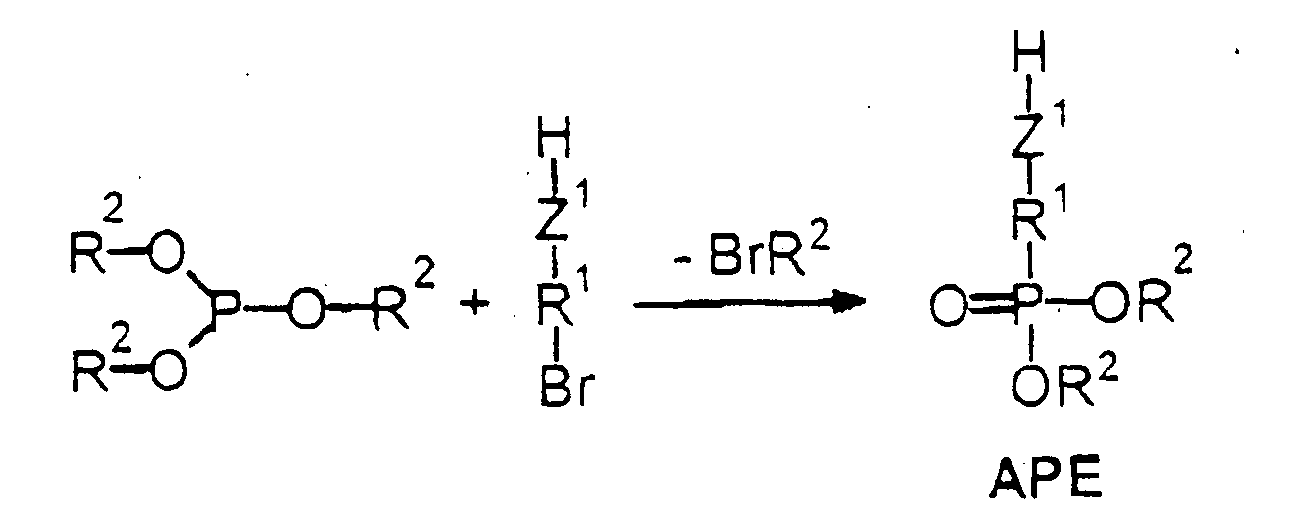
- a proven method for the production of alkane phosphonic acid esters is the Michaelis-Arbusow reaction (cf. GM Kosolapoff, Org. Reactions 6 (1951) 273), in which trialkyl phosphites, for example triethyl phosphite, and haloalkanes are reacted with one another, for example:
- the substituent Z may need to be protected.
- Acyloxyalkanephosphonic diesters can be obtained from carboxylic acid vinyl esters by addition to dialkylphosphites (DE-OS 2,127,821):
- the simple allyl halides are usually commercially available, activated ⁇ -halomethyl-acrylic compounds can be obtained by reaction of acrylic compounds with formaldehyde in the presence of 1,4-diazabicyclo [2.2.2] octane (DABCO) and subsequent halogenation with inorganic acid chlorides, such as SOCl 2 , PCl 3 or PBr 3 can be obtained (SCWarren, LJMathias, J. Polymer Science, Part A: Polymer Chemistry 28 (1990) 1637), for example:
- Carbodiimides or phosphorus oxychloride can be used as the condensing agent.
- the dialkoxyphosphorylacrylic acids DPA used can be prepared from the corresponding dialkoxyphosphorylacrylic acid alkyl esters DPAE (cf. N. Moszner, F. Zeuner, UK Fischer, V. Rheinberger, Macromol. Chem. Phys. 200 (1999) 1062) by selective alkaline hydrolysis.
- Corresponding vinylcyclopropane-1,1-dicarboxylic acid monoesters can be prepared by reacting malonic esters with 1,4-dibromobut-2-enes and then hydrolysing the diester to form the monoester (N. Moszner, F. Zeuner, V. Rheinberger, Macromol. Rapid Commun. 18 (1997) 775).
- Suitable phosphonic acids are commercially available in some cases, such as vinylphosphonic acid (Clariant), 1-hydroxyethane-diphosphonic acid, 2-hydroxyethylphoshonic acid (Rhodia), or can be prepared in the manner described above.
- Very particularly preferred phosphonic acids are 2- [4- (dihydroxyphosphoryl) -2-oxa-butyl] acrylic acid and 2- [4- (methoxy-hydroxyphosphoryl) -2-oxa-butyl] acrylic acid.
- An advantage of the phosphonic acids preferred according to the invention is that they have a self-conditioning effect, i.e. Dentin abrasion and plaque residues do not have to be removed before applying the desensitizing agent, but do not etch the dentin.
- carboxylic acids such as maleic acid and trichloroacetic acid
- sulfonic acids such as sulfosalicylic acid (2-hydroxy-5-sulfobenzoic acid
- the acids mentioned can be used alone or as a mixture for the preparation of the compositions according to the invention. Mixtures which contain 1 to 4, in particular 2 or 3, different acids are preferred. Mixtures which contain at least one phosphonic acid, very particularly preferably two or 3 phosphonic acids, are particularly preferred.
- Particularly suitable organic, carboxyl and / or hydroxyl group-containing polymers for combination with the acid are those Polymers that are soluble in water or water / alcohol mixtures. Polysaccharides, polyethylene glycols, polyacrylic acids, polyacrylamides, polyvinylpyrrolidines and mixtures of these substances are preferred.
- Preferred polysaccharides are chitin, chitosan and glucan.
- Preferred polyethylene glycols are those with a molecular weight of 200 to 20,000, particularly preferably 500 to 2,000 and very particularly preferably about 1,000 g / mol.
- Polyethylene glycol dimethacrylate with a molecular weight of 1,000 g / mol (PEG1000DMA) is very particularly preferred.
- Preferred polyacrylic acids are those with a molecular weight of 10,000 to 60,000 g / mol, particularly preferably 15,000 to 35,000 g / mol.
- PAA polyacrylic acid
- GMA 0.5 mol glycidyl methacrylate
- a mixture of different polymers particularly preferably a mixture of polyethylene glycol and polyacrylic acid, very particularly preferably a mixture of the preferred polyethylene glycols and polyacrylic acids defined above is used as the polymer containing carboxyl and / or hydroxyl groups.
- Acid and carboxyl- and / or hydroxyl-containing polymer are preferably used in a weight ratio of acid to polymer of 1: 4 to 1: 8, preferably 1: 5 to 1: 6.
- compositions according to the invention are liquid.
- they preferably also contain a solvent suitable for use in the patient's mouth, preferably water, ethanol or a mixture thereof.
- a solvent suitable for use in the patient's mouth preferably water, ethanol or a mixture thereof.
- solid acids and polymers the use of a solvent is mandatory.
- the tooth or teeth are dried, for example with an air stream.
- compositions according to the invention contain no glutaraldehyde and preferably also no hydroxyethyl methacrylate.
- compositions according to the invention can contain additional components to further improve their properties.
- potassium ion-releasing compounds preferably KF, KCl, potassium oxalate, K 2 SO 4 , K 2 CO 3
- the potassium salts of organic compounds for example polyacrylic acids and sugar acids
- strontium ions which are preferably added in the form of SrCl 2 .
- fluoride ion-releasing compounds preferably NaF, KF, organic and inorganic amine fluorides, SnF 2 and ZnF 2 .
- a particularly preferred additive is potassium fluoride, which can release both potassium and fluoride ions.
- Cellulose derivatives are preferred as film-forming substances, in particular cellulose ethers, such as, for example, hydroxypropyl cellulose.
- the pH of the compositions according to the invention is preferably in the range from 1 to 4, particularly preferably 1.5 to 3.5 and very particularly preferably 2 to 3.
- suitable buffer systems such as citrate, phosphate, phosphonate, acetate, carbonate, sulfonate buffers, preferably phosphonate or sulfonate buffers.
- Good conditioning of the dentin surface is achieved within the specified pH range, and protein and calcium precipitation are effected at the same time.
- Preferred solvents for the preparation of the compositions according to the invention are water and alcohols, such as methanol, isopropanol and in particular ethanol, and also mixtures of water and alcohol, particularly preferably mixtures of about 50% by weight of water and about 50% by weight of ethanol (based on the Total mass of solvent). Mixtures of water and alcohol preferably contain at least 20% by weight of water, based on the solvent mass.
- compositions in which the amounts of all components are within the defined ranges are preferred.
- the total amount of polymer containing carboxyl and / or hydroxyl groups is composed of 1.0 to 40% by weight, preferably 2.0 to 10% by weight, of polyacrylic acid and 1.0 to 40 wt .-%, preferably 5.0 to 30 wt .-% polyethylene glycol dimethacrylate together.
- compositions can contain 0.1 to 20% by weight of SrCl 2 .
- dexpanthenol is preferably used in an amount of 0 to 5% by weight, in particular 0.5 to 2.0% by weight, chitosan and hyaluronic acid in an amount of 0 to 20% by weight, in particular 0 to 5% by weight.
- -% used, each based on the total mass of the composition.
- Flavorings are preferably used in an amount of 0.1 to 1.0% by weight.
- kits contains e.g. a vessel with acid or a solution of the acid in a suitable solvent, such as water, (acid component) and a second vessel with the polymer and possibly the other components or a solution of the polymer and possibly the other components (polymer component).
- a suitable solvent such as water
- acid component e.g. a vessel with acid or a solution of the acid in a suitable solvent, such as water
- a second vessel with the polymer and possibly the other components or a solution of the polymer and possibly the other components (polymer component).
- multi-chamber vessels for example two-chamber vessels, can be used, which contain the acid and the remaining components in separate chambers.
- the components of the composition can also be distributed over more than two vessels or vascular chambers.
- the compositions of the acid component and the polymer component are preferably dimensioned such that the compositions defined above are obtained when the components are combined.
- Kits in which the acid is applied to a brush are particularly preferred.
- a solid acid is preferably dissolved in a solvent, the solution is applied to a brush and then the solvent is evaporated.
- the brush is immersed in a solution of the other components and then the tooth or teeth are treated with it.
- the amount of solution of the remaining ingredients is preferably tailored to a single application.
- the size, shape and bristle material of the brush are preferably chosen so that the brush absorbs the amount of acid which, together with the second component, gives the desired composition.
- the brush is preferably loaded with an amount of 2 to 15 mg, particularly preferably 2 to 8 mg, very particularly preferably 2.5 to 4 mg and very particularly approximately 3 mg of acid per brush.
- the amount of the second component for single use is, for example, about 60 mg, so that the amount of acid increases of the brush gives a total mass of the composition of 62.5 to 75 mg.
- the composition of the second component is selected so that after the combination thereof with the acid of the brush, the overall composition is within the ranges defined above.
- the brush and solution are preferably placed in a two-chamber vessel so that the brush and liquid can be brought into contact by simply moving the brush. Two-chamber vessels of this type are described, for example, in DE 199 56 705 A1.
- compositions according to the invention are generally suitable for precipitating protein, but especially for desensitizing sensitive teeth.
- Dentin tubules are often exposed by the dentist when the teeth are being worked on, for example when drilling or grinding the teeth, which is often associated with sensitization.
- the compositions according to the invention do not impair the action of conventional filling composites and can therefore advantageously be combined with them, i.e.
- cavities can be treated with a composition according to the invention before the filling is placed and then filled with the filling.
- the combined THF solutions were dried with sodium sulfate and evaporated to dryness.
- the crystal slurry obtained was first dried in a fine vacuum and then over P 2 O 5 in a desiccator. 48.8 g (83%) of a white powder which melted at 119-120 ° C. were obtained.
- the methanol was distilled off again and the residue was dried under a fine vacuum.
- the crude product is taken up in 50 ml of water, 3.15 g (37.5 mmol) of sodium hydrogen carbonate are added in portions and the mixture is washed twice with 25 ml of methylene chloride each time.
- the aqueous phase was then cooled with ice acidified with hydrochloric acid and the white emulsion from which the phosphonic acid partially separates is extracted twice with 25 ml of methylene chloride.
- the combined organic phases were dried with sodium sulfate, the methylene chloride was distilled off and the residue was dried under a fine vacuum. 7.50 g (86%) of a highly viscous oil were obtained.
- a desensitizer of the following composition was prepared by mixing the components: component Proportion [% by weight] Phosphonic acid from Ex. 1 4.0 Polyacrylic acid (PAA / GMA) 5.0 Polyethylene glycol (PEG 1000 DMA) 20 hydroxypropyl 5.0 potassium fluoride 0.3 Flavoring (Optamint) 0.1 Ethanol / water (50:50) 65.6
- a 20% by weight solution of the phosphonic acid from Example 1 in ethanol was prepared. Small brushes were dipped into this solution and then dried. This process was repeated until the amount of acid after drying was 3.0 ⁇ 0.3 mg per brush.
- a mixture of the following composition was produced as the second component: component Proportion [g] Polyacrylic acid (PAA / GMA) 5.0 Polyethylene glycol (PEG 1000 DMA) 20 hydroxypropyl 5.0 potassium fluoride 0.3 Flavoring (Optamint) 0.1 Ethanol / water (50:50) 65.6
- the second component was divided into 60 mg portions. A brush was then immersed in a 60 mg portion of the second component and mixed with the brush. A theoretical acid concentration in the composition of about 4.8% by weight is achieved.
- horse serum Horse Serum, PAA Laboratories GmbH, Linz, Austria, Cat. No. B15-021
- physiological saline 8.5 g NaCl per 1 1 H 2 O
- CaCl 2 2 mM was further added to the diluted protein solution in order to adjust the calcium ion concentration to that of dentin cerebrospinal fluid.
- 500 .mu.l of the protein solution were then mixed with 500 .mu.m of the composition to be tested and the mixture was left to stand for 30 minutes at room temperature, centrifuged and the precipitates obtained were dried at 75.degree. C. and weighed.
- Example 5 The solution (2nd component) described in Example 5 was used for protein precipitation, to which phosphonic acid was added in concentrations of 10 mM to 200 mM (cf. Table 1). 5 precipitations were carried out per concentration and the mean of the determinations was then calculated. The results are shown in Table 1.
- compositions according to the invention were tested in the manner described above.
- the compositions of the samples and the results are summarized in Table 2.
- Table 1 Influence of acid concentration on protein precipitation acid concentration [mM] Precipitation 1 [mg] 10 55.3 25 58.2 50 58.8 75 69.1 100 70.8 150 74.2 200 72.3 1 average of 5 measurements Protein precipitation of compositions according to the invention sample No.
- the composition to be examined was applied and left on the teeth for 30 seconds.
- the teeth were then rinsed again with water, then stored for 6 hours at 37 ° C. in 0.85% NaCl / 2 mM CaCl 2 solution and then dried for 4 days at 75 ° C.
- Figure 1 shows the surface of a ground and etched tooth that has not been treated with desensitizer. The dentinal tubi can be clearly seen.
- FIG. 2 shows the surface of a tooth that was treated with the desensitizing agent described in Example 4.
- the magnification corresponds to that of Figure 1 (1000 times).
- the dentine tubules are closed here.
- the gaps in the tubule plugs recognizable in FIG. 2 are due to the extreme drying of the teeth necessary for the SEM images.
- FIG. 3 is an image along the bridging edge of a tooth (3000 times). Both the tooth surface with the closed tubule openings and opened tubules can be clearly seen.
- the fracture technique allows insight into the tubules and shows that the plugs extend far, ie at least about 20 ⁇ m, into the tubules.
- the gaps between the plug and the tubule wall are in turn due to the drying of the teeth and the associated shrinkage.
- a tooth was treated in the manner described above with a desensitizing agent according to the prior art (Gluma, Heraeus Kulzer company).
- Gluma Heraeus Kulzer company
- the electron micrograph of the bruck edge of the tooth (magnification 3000 times) shown in FIG. 4 clearly shows the differences from the products according to the invention.
- no continuous, uniform precipitates are formed, but only cross-connections and short plugs.
- Example 5 The two-component material described in Example 5 was used to treat human molars.
- a small amount of fluorescein was first taken up with a brush and mixed with the liquid component of the desensitizing agent by repeated immersion (maximum six times).
- the product was applied to coarsely cleaned human molars and these were then rinsed with water.
- a slice was then cut out of each tooth with a slowly moving saw and examined with a confocal laser scanning microscope.
- Figure 5 shows a picture of such a disc. On the green edge, the film formation on both the dentin and the enamel of the tooth can be clearly seen. The green lines show a deep penetration of the desensitizing agent into the tubules. Penetration of more than 200 ⁇ m was observed.
- the horse serum solution described in Example 6 was passed through the pulp chamber into the tubules in a second experiment and the desensitizing agent was applied under a hydrostatic pressure of the simulated dentin CSF of 60 cm liquid column. It could be demonstrated that the desensitizing agent penetrates the tubules 40 to 50 ⁇ m even under these conditions (FIG. 6, areas with desensitizing agent appear green, areas without desensitizing agent red).
- Placing fillings usually requires - first of all - the removal of diseased tooth substance, which is associated with the exposure of dentine tubules and a sensitization of the tooth. It was therefore examined to what extent the desensitizing agents according to the invention are compatible with conventional filling composites.
- Bovine teeth were first etched for 15 seconds with a commercially available etching gel (37% phosphoric acid, Email Preparator blue, Ivoclar Vivadent AG) and then rinsed off with water. The desensitizing agent described in Example 4 was then applied (for 5 seconds) and left to act for 30 seconds. After rinsing again with water, it was dried in an air stream, a commercially available adhesion promoter (Excite, Ivoclar Vivadent AG), allowed to act for 10 seconds, dried again in an air stream and the tooth then with light of a wavelength of 400 to 510 nm (halogen light polymerization device, type Astralis 7, Ivoclar Vivadent AG) at 750 mW / cm 2 exposed for 20 seconds. Finally, 2 layers of a commercially available filling composite (Tetric Ceram, from Ivoclar Vivadent AG) were applied and each cured by exposure for 40 seconds as described above.
- a commercially available adhesion promoter Excite, Ivoclar
- the shear bond strength was then measured in the usual way. This was 30 MPa, while a value of 29.5 MPa was found for teeth treated in the same way without a desensitizing agent. This difference is not statistically significant. Thus, the desensitizing agent does not interfere with the adhesion process.
Landscapes
- Health & Medical Sciences (AREA)
- Life Sciences & Earth Sciences (AREA)
- Animal Behavior & Ethology (AREA)
- General Health & Medical Sciences (AREA)
- Public Health (AREA)
- Veterinary Medicine (AREA)
- Birds (AREA)
- Epidemiology (AREA)
- General Chemical & Material Sciences (AREA)
- Organic Chemistry (AREA)
- Anesthesiology (AREA)
- Pharmacology & Pharmacy (AREA)
- Chemical & Material Sciences (AREA)
- Chemical Kinetics & Catalysis (AREA)
- Emergency Medicine (AREA)
- Medicinal Chemistry (AREA)
- Nuclear Medicine, Radiotherapy & Molecular Imaging (AREA)
- Oral & Maxillofacial Surgery (AREA)
- Bioinformatics & Cheminformatics (AREA)
- Engineering & Computer Science (AREA)
- Cosmetics (AREA)
- Pharmaceuticals Containing Other Organic And Inorganic Compounds (AREA)
- Dental Tools And Instruments Or Auxiliary Dental Instruments (AREA)
- Medicinal Preparation (AREA)
- Dental Preparations (AREA)
- Compositions Of Macromolecular Compounds (AREA)
- Heat Sensitive Colour Forming Recording (AREA)
- Solid-Sorbent Or Filter-Aiding Compositions (AREA)
Abstract
Description
- Die Erfindung betrifft säurehaltige Zusammensetzungen, die sich insbesondere zur Desensibilisierung von Zähnen eignen.
- Eine Überempfindlichkeit oder Hyperästhesie der Zähne gegenüber physikalischen (Kälte, Kontakt, Wärme), chemischen (Säure) oder osmotischen Reizen ist meist auf eine Freilegung des Dentins, insbesondere im Bereich der Zahnhälse und der Wurzelbereiche zurückzuführen. Ursache hierfür kann das Verschwinden des schützenden Zahnschmelzes als Folge von Erosion, Abrasion oder Abbrechen oder durch das Entblößen der Wurzeloberfläche durch Zahnfleischschwund oder in Folge einer Parodontalbehandlung sein.
- Es wird angenommen, daß der Schmerz durch Bewegung der in den Tubili des Dentins vorhandenen Flüssigkeit (Dentinliquor) ausgelöst wird. Hierdurch kommt es zu einer kurzzeitigen Stauchung oder Dehnung der in der Pulpa vorhandenen Nervenzellen, die hierauf durch das Auslösen und Weiterleiten eines Schmerzsignals reagieren.
- Die Entstehung eines Schmerzsignals in einer Nervenzelle ist an einen Kaliumionengradienten gebunden. Die Kaliumionenkonzentration ist im Ruhezustand innerhalb der Nervenzelle größer als außerhalb. Bei einem Reiz werden Ionenkanäle geöffnet, die die Kaliumionen nach außen strömen lassen und so das Schmerzsignal auslösen. Durch das Einstellen einer hohen Kaliumionenkonzentration auf der Außenseite der Nervenzelle kann das Ausströmen von Kaliumionen aus der Zelle und damit die Entstehung und Weiterleitung des Schmerzsignals unterbunden werden. Bei der Therapie überempfindlicher Zähne werden jedoch durch das Erhöhen der extrazellulären Kaliumionenkonzentration, beispielsweise durch kaliumionenhaltige Mundspüllösungen oder Zahnpasten, nur kurzfristige Erfolge erzielt.
- Neben der Erhöhung der extrazellulären Kaliumionenkonzentration läßt sich eine Desensibilisierung empfindlicher Zähne durch den Verschluß der Dentintubuli erreichen. Hierdurch werden Flüssigkeitsbewegungen in den Tubili und damit Reizungen der Nerverzellen verhindert.
- Die Firma Septodont Pharm-Dental Handelsgesellschaft m.b.H. vertreibt unter der Bezeichnung Isodan® ein Produkt, das neben Kaliumnitrat und Natriumfluorid Hydroxyethylmethacrylat (HEMA) enthält und das durch Koagulation der Tubuliproteine Flüssigkeitsbewegungen innerhalb der Tubuli verhindern soll.
- In dem Produkt Gluma® der Firma Heraeus Kulzer werden die proteinfällenden Eigenschaften von HEMA mit den vernetzenden Eigenschaften von Glutaraldehyd kombiniert. Glutaraldehyd soll die gefällten Tubuliproteine kovalent mit dem im Dentin enthaltenen Kollagen verbinden.
- Die Anwendung von Glutaraldehyd in medizinischen Produkten ist wegen seiner alkylierenden Wirkung unter gesundheitlichen Gesichtspunkten nicht unbedenklich. Zudem wird mit den bekannten Materialien selbst bei der Verwendung von Vernetzungsmitteln nur eine unzureichende Desensibilisierung der Zähne erzielt.
- Die Aufgabe der Erfindung besteht in der Bereitstellung von Desensibilisierungsmitteln für Zähne, die eine langanhaltende Desensibilisierung ermöglichen.
- Diese Aufgabe wird durch Zusammensetzungen gelöst, die neben einer Säure ein organisches Polymer enthalten, das Carboxylund/oder Hydroxylgruppen aufweist.
- Carboxylgruppenhaltige Polymere stellen keine Säuren im Sinne der Erfindung dar. Unter Säuren werden erfindungsgemäß nicht polymere Verbindungen verstanden. Als Säuren eignen sich besonders organische Säuren, wie Carbonsäuren, Sulfonsäuren und insbesondere Phosphonsäuren.
- Erfindungsgemäß sind solche Säuren bevorzugt, die eine hohe Löslichkeit in Wasser oder in Wasser/Ethanol-Mischungen aufweisen. Unter einer hohen Löslichkeit wird eine Löslichkeit von 0,5 bis 50 Gew.-%, vorzugsweise 20 bis 50 Gew.-% in Wasser oder einer Mischung aus 50 Gew.-% Wasser und 50 Gew.-% Ethanol verstanden.
- Weiter sind Säuren besonders geeignet, die neben proteinfällenden auch calciumfällende Eigenschaften aufweisen. Protein- und calciumfällende Eigenschaften werden in standardisierten Tests ermittelt. Die Proteinfällung wird wie in Beispiel 6 beschrieben gemessen, wobei die zu untersuchende Säure zu der in Beispiel 5 beschriebenen Lösung (2. Komponente) in einer Konzentration von 0,2 M gegeben wird. Die säurehaltige Lösung wird mit der in Beispiel 6 beschriebenen Proteinlösung gemischt und die Masse des erhaltenen Präzipitats wird ermittelt. Erfindungsgemäß sind solche Säuren bevorzugt, die ein Pelletgewicht von > 25 mg, vorzugsweise > 30 mg und insbesondere > 40 mg ergeben. Die Obergrenze des Pelletgewichts wird durch die Massen der eingetzten Komponenten bestimmt. Säuren, die unter den beschriebenen Bedingungen eine quantitative Fällung ergeben, sind erfindungsgemäß besonders geeignet.
- Zur Bestimmung der calciumfällenden Eigenschaften wird eine Mischung aus 5,0 g modifizierter Polyacrylsäure (PAA/GMA), 20 g Polyethylenglykol (PEG 1000 DMA), 5,0 g Hydroxypropylcellulose, 0,3 g Kaliumfluorid und 65,6 g Ethanol/Wasser (50:50) mit CaCl2 auf eine Ca-Konzentration von 0,1 M eingestellt und 1 ml dieser Mischung anschließend mit 0,05 M der zu testenden Säure versetzt. Die säurehaltige Mischung wird kräfig geschüttelt, in einer Eppendorf-Zentrifuge bei 13.000 g für 5 Minuten zentrifugiert und bis zur Gewichtskonstanz getrocknet. Es sind solche Säuren bevorzugt, die in diesem Test ein Pelletgewicht von > 30 mg, vorzugsweise ≥ 40 mg, besonders bevorzugt 40 bis 60 mg und insbesondere 40 bis 50 mg ergeben. Als modifizierte Polyacrylsäure (PAA) wird Polyacrylsäure mit einem mittleren Molekulargewicht von etwa 30.000 g/mol verwendet, die durch Umsetzung mit 0,5 mol Glycidylmethacrylat (GMA) pro Acrylsäurebaustein im Polymer modifiziert wurde.
- Bevorzugte Phosphonsäuren sind solche gemäß der folgenden Formel 1:

- n
- 1, 2, 3 oder 4 ist,
- m
- 0, 1 oder 2 ist,
- p
- 0 oder 1 ist,
- R
- ein geradkettiger oder verzweigter aliphatischer Kohlenwasserstoffrest mit 1 bis 12 Kohlenstoffatomen oder ein aromatischer Kohlenwasserstoffrest mit 6 bis 12 Kohlenstoffatomen oder ein aliphatisch/arömatischer Kohlenwasserstoffrest mit 7 bis 16 Kohlenstoffatomen ist, der durch OH, NH2 und/oder COOR6 substituiert sein kann,
- R1
- ein C1- bis C12-Alkylen-, C4- bis C12 Cycloalkylen-, C6- bis C12-Arylen- oder C7- bis C16-Alkylenarylenrest ist, der durch OH, NH2 und/oder COOR6 substituiert sein kann, oder entfällt,
- R2
- H, ein C1- bis C6-Alkyl- oder ein Phenylrest ist,
- R3, R4
- unabhängig voneinander jeweils einen C1- bis C12-Alkylen- , C6- bis C12-Arylen- oder C7- bis C16-Alkylenarylenrest bedeuten, der durch Methyl, Phenyl oder Fluor substituiert sein kann, oder entfallen,
- R5
- -CH=CR13- , ein Prop-1-en- 1,3-diyl-, C1- bis C6-Alkenylen-, C3- bis C9-Cycloalkylen-, C1- bis C6-Alkylen- oder Phenylenrest oder eine Gruppe mit der Formel

- R6
- H, ein C1- bis C6-Alkyl- oder ein Phenylrest ist,
- Z1,Z2
- unabhängig voneinander jeweils CO-O, CO-NR7, O-CO-NH, O, NH, S bedeuten oder entfallen,
- Y1,Y2
- unabhängig voneinander jeweils O, CO-O, CO-NR8, O-CO-NH bedeuten oder entfallen,
- R7,R8
- unabhängig voneinander jeweils H, oder einen C1- bis C6-Alkylrest bedeuten,
- X
- H, CN, N(R9)2, OR10, COOR11 oder CONR2 12 ist,
- R9, R10, R11, R12
- unabhängig voneinander jeweils H, einen C1-bis C10-Alkyl- oder einen Phenylrest bedeuten,
- R13
- H oder ein Methylrest ist,
- R14
- H oder ein C1- bis C10-Alkyl-, Vinyl- oder Phenylrest ist.
- Unter Alkylenarylenresten werden Gruppen verstanden, die sowohl Alkylen- als auch Arylenreste enthalten, wie beispielsweie -CH2-Phenylen-CH2-.
- Unabhängig voneinander wählbare bevorzugte Definition für die Variablen der Formel 1 sind:
- n
- 1, 2 oder 3, insbesondere 1 oder 2 ist und/oder
- m
- 1 ist und/oder
- p
- 0 ist und/oder
- R
- ein aliphatischer geradkettiger oder verzweigter ein- bis fünf-wertiger Alkanrest mit 1 bis 7 Kohlenstoffatomen, ein aromatischer Kohlenwasserstoffrest mit 6 Kohlenstoffatomen oder ein aliphatisch/aromatischer Kohlenwasserstoffrest mit 8 Kohlenstoffatomen ist und/oder
- R1
- ein Methylen- oder Ethylenrest ist oder entfällt und/oder
- R2
- H, ein Methyl- oder Ethylrest ist und/oder
- R3, R4
- unabhängig voneinander jeweils einen Methylen-, Ethylen-, Trimethylen-, p-Phenylen-, Ethyliden-, 1-Methylenethan-1,2-diylrest bedeuten oder entfallen und/oder
- R5
- ein Methylen-, Ethylen-, Trimethylen-, Ethen-1,2-diyl-, Methylethylen-, Prop-1-en-1,3-diyl-, oder ein in 2-Stellung einfach substituierter Cyclopropylidenrest ist oder entfällt, insbesondere ein Methylen-, Ethylen- oder in 2-Stellung einfach substituierter Cyclopropylidenrest ist oder entfällt und/oder
- R6
- H ist und/oder
- Z1,Z2
- unabhängig voneinander jeweils CO-O, O-CO-NH oder O bedeuten oder entfallen und/oder
- Y1,Y2
- unabhängig voneinander jeweils O, CO-O oder CO-NR8 bedeuten oder entfallen und/oder
- R7,R8
- unabhängig voneinander jeweils H oder einen Methyl- oder Ethylrest bedeuten und/oder
- X
- H, CN, COOR11 oder CONR2 12 ist und/oder
- R9, R10, R11, R12
- unabhängig voneinander jeweils H oder einen Methyl-, Ethyl- oder Phenylrest bedeuten und/oder
- R13
- H oder ein Methylrest ist,
- R14
- H oder ein Vinyl- oder Phenylrest ist.
- Phosphonsäuren, bei denen mehrere und vorzugsweise alle Variablen eine der bevorzugten Definitionen aufweisen sind besonders bevorzugt.
- Die Formel 1 schließt alle durch die genannten Substituenten möglichen Stereoisomere und ihre Mischungen, wie Racemate, ein.
- Die Phosphonsäuren der Formel (1) lassen sich durch Synthese der entsprechenden Phosphonsäurediester und nachfolgende selektive Esterhydrolyse herstellen. Geeignete Alkylphosphonsäureester (APE) können auf unterschiedlichen Wegen erhalten werden. Eine bewährte Methode für die Herstellung von Alkanphosphonsäureestern ist die Michaelis-Arbusow-Reaktion (vgl. G. M. Kosolapoff, Org. Reactions 6 (1951) 273), bei der Trialkylphosphite, z.B. Triethylphosphit, und Halogenalkane miteinander umgesetzt werden, z.B.:
- Konkretes Beispiel:

- Dabei muß gegebenenfalls der Substituent Z geschützt werden.
- Eine weitere Möglichkeit der Synthese von Hydroxyalkylphosphonsäureestern (Z = OH) besteht in der basenkatalysierten Anlagerung von Dialkylphosphiten an mono- oder difunktionelle Aldehyde oder Ketone (analog: F. Texier-Boullet, A. Foucaud, Synthesis, 1982, 916) :

- Konkretes Beispiel:


- Konkretes Beispiel:

- Die Phosphonsäuren der Formel (1) mit p = 0, n = 1, m = 1, R = -CH2- (C=CH2) -, R2= H, Y2 = CO-O, CO-NR8 und X = H oder Y2 entfällt und X = COOR8, Z2, R4und R5 entfallen (ACPE) lassen sich durch Umsetzung von am Alkyl-Rest Z-funktionalisierten Alkylphosphonsäureestern APE (R2 = Alkyl) mit Allylhalogeniden (U = Halogen, vor allem C1 oder Br) und nachfolgende Abspaltung der Alkylgruppen R2 unter Anwendung der aus der organischen Chemie bekannten Methoden für die Knüpfung von C-C-, oder C-O- Bindungen (vgl. C. Weygand, G. Hilgetag, Organisch-chemische Experimentierkunst, Johann Ambrosius Bart Verlag, Leipzig 1970, S. 963f., 362f. und 657f.) herstellen.

- Konkretes Beispiel:

- Die einfachen Allylhalogenide sind meist kommerziell erhältlich, aktivierte α-Halogenmethylacrylverbindungen können durch Reaktion von Acrylverbindungen mit Formaldehyd in Gegenwart von 1,4-Diazabicyclo[2.2.2]octan (DABCO) und nachfolgende Halogenierung mit anorganischen Säurechloriden, wie SOCl2, PCl3 oder PBr3 erhalten werden (S.C.Warren, L.J.Mathias, J. Polymer Science, Part A: Polymer Chemistry 28 (1990) 1637), z.B.:

- Phosphonsäuren der Formel (1) mit p = 0, n = 1, m = 1, R = -CH2-(C=CH2)-, R2 = H, X = CO-W (W = N(R12)2 oder OR11) und Y2, Z2 , R4 und R5 entfallen (ACPA) lassen sich durch Umsetzung von Dialkoxyphosphorylacrylsäuren DPA mit Aminen oder Alkoholen in Gegenwart eines geeigneten Kondensationsmittels und nachfolgende Hydrolyse der Phosphonsäureestergruppen herstellen.

- Als Kondensationsmittel können Carbodiimide bzw. Phosphoroxychlorid (Houben-Weyl, Bd. 15/2, Peptide; 4. Auflage, Georg Thieme Verlag, Stuttgart 1974, S. 103ff und 232ff) eingesetzt werden. Die verwendeten Dialkoxyphosphorylacrylsäuren DPA lassen sich aus den entsprechenden Dialkoxyphosphorylacrylsäurealkylestern DPAE (vgl. N. Moszner, F. Zeuner, U. K. Fischer, V. Rheinberger, Macromol. Chem. Phys. 200 (1999) 1062) durch selektive alkalische Hydrolyse herstellen.
- Konkretes Beispiel:

- Darüber hinaus werden funktionalisierte Alkylphosphonsäureester durch Acylierung von am Rest Z1 funktionalisierten Alkylphosphonsäureestern APE (R2 = Alkyl) mit Carbonsäuren erhalten:

- Konkretes Beispiel:

- Entsprechende Vinylcyclopropan-1,1-dicarbonsäuremonoester können durch Umsetzung von Malonestern mit 1,4-Dibrom-but-2-enen und nach nachfolgende Hydrolyse des Diesters zum Monoester hergestellt werden (N. Moszner, F. Zeuner, V. Rheinberger, Macromol. Rapid Commun. 18 (1997) 775).
- Die vollständige Hydrolyse der Phosphonsäurediester zu den entsprechenden Di-Phosphonsäuren erfolgt günstigerweise durch Silylierung mit Trialkylsilylhalogeniden, z.B. Trimethylsilylchlorid/(NaI oder NaBr), und nachfolgende Umsetzung mit Alkoholen oder Wasser (S. Freeman, J. Chem. Soc., Perkin Trans. 2, 1991, 263.). Zur selektiven Hydrolyse nur einer Esterfunktion werden sterisch gehinderte Silylhalogenide eingesetzt. Soll gleichzeitig eine Carbonsäureesterfunktion verseift werden, wird mit Alkalilauge hydrolysiert und nach erfolgter Hydrolyse die Phosphonsäure durch Ansäuern wieder freigesetzt. Die Salze erhält man durch Neutralisierung der Phosphonsäuren mit 1 Äquivalent des entsprechenden Hydroxids.
- Konkretes Beispiel:

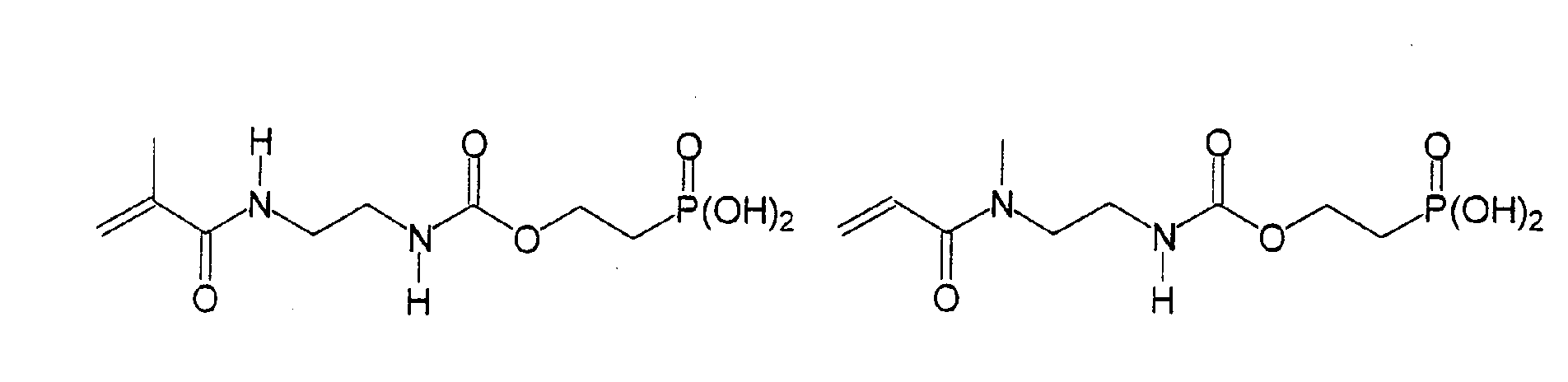
- Beispiele für die erfindungsgemäßen Phosphonsäuren der Formel 1 sind u.a.:




- Eine weitere Gruppe bevorzugter Phosphonsäuren bilden die in der DE 197 46 708 offenbarten Verbindungen. Hierbei handelt es sich um Säuren gemäß Formel 1 wobei
- n
- 1 ist,
- m
- 1 ist,
- p
- 0 ist,
- R
- ein C1- bis C3-Alkylen- oder Phenylenrest ist,
- R2
- H ist,
- R4
- ein verzweigter oder geradkettiger C1- bis C6-Alkylenrest ist, der durch 1 bis 2 Fluoratome und/oder 1 Phenylrest substituiert sein kann oder entfällt,
- R5
- ein 1-Methylenethan-1,2-diylrest ist,
- Z2
- entfällt,
- Y2
- O ist oder entfällt,
- X
- COOR11 ist und
- R11
- H oder ein C1- bis C5-Alkyl- oder Phenylrest ist.
- Weiter bevorzugt sind die in der DE 197 46 708 offenbarten Phosphonsäuren gemäß Formel 1 bei denen
- n
- 2 ist,
- m
- 2 ist,
- p
- 1 ist,
- R
- ein vierwertiger aliphatischer, aromatischer, oder aliphatisch-aromatischer Kohlenwasserstoffrest mit 2 bis 12 Kohlenstoffatomen ist,
- R1
- entfällt,
- R2
- H ist,
- R3
- ein C1- bis C3-Alkylen- oder Phenylenrest ist oder entfällt,
- R4
- ein verzweigter oder geradkettiger C1- bis C6-Alkylenrest ist, der durch 1 bis 2 Fluoratome und/oder 1 Phenylrest substituiert sein kann oder entfällt,
- R5
- ein 1-Methylenethan-1,2-diylrest ist,
- Z1, Z2
- entfallen,
- Y1
- entfällt,
- Y2
- O ist oder entfällt,
- X
- COOR11 ist und
- R11
- H oder ein C1- bis C5-Alkyl- oder Phenylrest ist.
- Die Herstellung dieser Phosphonsäuren wird in der DE 197 46 708 beschrieben.
- Ganz besonders bevorzugte Phosphonsäuren sind 2-[4-(Dihydroxyphosphoryl)-2-oxa-butyl]-acrylsäure und 2-[4-(Methoxy-hydroxyphosphoryl)-2-oxa-butyl]-acrylsäure.
- Ein Vorteil der erfindungsgemäß bevorzugten Phosphonsäuren ist darin zu sehen, daß sie eine selbstkonditionierende Wirkung haben, d.h. Dentinabrieb und Plaquereste vor dem Aufbringen der Desensibilisierungsmittel nicht entfernt werden müssen, das Dentin jedoch nicht anätzen.
- Neben den Phosphonsäuren eignen sich Carbonsäuren, wie Maleinsäure und Trichloressigsäure, und besonders Sulfonsäuren, wie Sulfosalicylsäure (2-Hydroxy-5-sulfobenzoesäure), zur Herstellung der Zusammensetzungen.
- Die genannten Säuren können allein oder als Mischung zur Herstellung der erfindungsgemäßen Zusammensetzungen eingesetzt werden. Bevorzugt sind Mischungen, die 1 bis 4, insbesondere 2 oder 3 verschiedene Säuren enthalten. Besonders bevorzugt sind Mischungen, die mindestens eine Phosphonsäure, ganz besonders bevorzugt zwei oder 3 Phosphonsäuren enthalten.
- Als organische, carboxyl- und/oder hydröxylgruppenhaltige Polymere zur Kombination mit der Säure eignen sich besonders solche Polymere, die in Wasser oder Wasser/Alkohol-Mischungen löslich sind. Bevorzugt sind Polysaccharide, Polyethylenglycole, Polyacrylsäuren, Polyacrylamide, Polyvinylpyrrolidine und Mischungen dieser Substanzen.
- Bevorzugte Polysaccharide sind Chitin, Chitosan und Glucan.
- Bevorzugte Polyethylenglykole (PEGs) sind solche mit einem Molekulargewicht von 200 bis 20.000, besonders bevorzugt 500 bis 2.000 und ganz besonders bevorzugt etwa 1.000 g/mol. Ganz besonders bevorzugt ist Polyethylenglycoldimethacrylat mit einem Molekulargewicht von 1.000 g/mol (PEG1000DMA).
- Bevorzugte Polyacrylsäuren sind solche mit einem Molekulargewicht von 10.000 bis 60.000 g/mol, besonders bevorzugt 15.000 bis 35.000 g/mol. Ganz besonders bevorzugt ist Polyacrylsäure (PAA) mit einem mittleren Molekulargewicht von etwa 30.000 g/mol, die durch Umsetzung mit 0,5 mol Glycidylmethacrylat (GMA) pro Acrylsäurebaustein im Polymer modifiziert wurde (PAA/GMA). Hierbei handelt es sich um Polyacrylsäure mit einem mittleren Molekulargewicht von 40.000 g/mol, die durch Umsetzung mit 0,5 mol Glycidylmethacrylat pro mol Polymer modifiziert ist.
- Als carboxyl- und/oder hydroxylgruppenhaltiges Polymer wird vorzugsweise eine Mischung verschiedener Polymere, besonders bevorzugt eine Mischung von Polyethylenglykol und Polyacrylsäure, ganz besonders bevorzugt eine Mischung der oben definierten bevorzugten Polyethylenglykole und Polyacrylsäuren verwendet.
- Säure und carboxyl- und/oder hydroxylgruppenhaltiges Polymer werden vorzugsweise in einem Gewichtsverhältnis von Säure zu Polymer von 1:4 bis 1:8, vorzugsweise 1:5 bis 1:6 eingesetzt.
- Zur Behandlung von überempfindlichen Zähnen werden Säure und Polymer miteinander gemischt und auf den zu behandelnden Zahn aufgebracht. Die erfindungsgemäßen Zusammensetzungen sind flüssig. Neben Säure und Polymer enthalten sie vorzugsweise auch ein zur Anwendung im Mundes des Patienten geeignetes Lösungsmittels, vorzugsweise Wasser, Ethanol oder eine Mischung derselben. Bei der Verwendung fester Säuren und Polymere ist die Verwendung eines Lösungsmittels zwingend. Nach dem Auftragen werden der oder die Zähne beispielsweise mit einem Luftstrom getrocknet.
- Es wurde gefunden, daß die gleichzeitige Verwendung von Säure und organischen, hydroxyl- und/oder carboxylgruppenhaltigen Polymeren einen praktisch vollständigen Verschluß der Dentintubuli bewirkt. Durch eine spezielle elektronenmikroskopische Aufnahmetechnik konnte gezeigt werden, daß der Verschluß durch weit in die Tubuli hineinreichende Pfropfen erfolgt (Figur 3), die einen sicheren und langanhaltenden Schutz gewährleisten. Dieses Ergebnis ist insofern überraschend als Säuren in der Regel eine sensibilisierende Wirkung zugeschrieben wird.
- Die im Stand der Technik bekannten Präparate zur Desensibilisierung von Zähnen ergeben demgegenüber keine durchgehenden, einheitlichen, pfropfförmigen Präzipitate sondern lediglich stegförmige Strukturen (Figur 4), die zwar ebenfalls eine gewisse Barriere gegen Bewegungen des Dentinliquors darstellen, jedoch keine dauerhafte Desensibilisierung der Zähne gewährleisten können.
- Es wird angenommen, daß es beim Zusammentreffen der erfindungsgemäß verwendeten Säuren und der erfindungsgemäß verwendeten Polymere mit den Dentinliquorproteinen zur gleichzeitigen und sich möglicherweise gegenseitig bedingenden Fällung von Proteinen, Calcium und Polymer kommt, was zur Ausbildung massiver Pfropfen führt, die durch zusätzliche Reaktion mit den Ca-Anteilen der Tubuliwänden in den Tubuli verankert werden.
- Die erfindungsgemäßen Zusammensetzungen enthalten kein Glutaraldehyd und vorzugsweise auch kein Hydroxyethylmethacrylat.
- Neben Säure und Polymer können die erfindungsgemäßen Zusammensetzungen zusätzliche Komponenten zur weiteren Verbesserung ihrer Eigenschaften enthalten.
- Beispielweise kann durch die Zugabe Kaliumionen freisetzender Verbindungen, vorzugsweise KF, KCl, Kaliumoxalat, K2SO4, K2CO3, den Kaliumsalzen organischer Verbindungen, z.B. von Polyacrylsäuren und Zuckersäuren, durch eine kurzfristige Erhöhung der extrazellulären Kaliumionenkonzentration ein rascher primärer desensibilisierender Effekt erzielt werden. Eine ähnliche Wirkung kann durch die Zugabe von Strontiumionen erzielt werden, die vorzugsweise in Form von SrCl2 zugegeben werden.
- Durch die Verwendung von Fluoridionen freisetzenden Verbindungen, vorzugsweise NaF, KF, organischen und anorganischen Aminfluoriden, SnF2 und ZnF2, läßt sich die Ausfällung von Calcium durch die Bildung von Calciumfluorid begünstigen.
- Ein besonders bevorzugter Zusatzstoff ist Kaliumfluorid, das sowohl Kalium- als auch Fluoridionen freizusetzen vermag.
- Weiterhin ist die Zugabe von filmbildenden Substanzen vorteilhaft, die einen mechanischen Verschluß der Tubuli bewirken. Hierdurch wird einerseits die Erzielung eines schnellen Primäreffekts begünstigt, andererseits die Zusammensetzung in den Tubuli fixiert und so ein tiefes Eindringen derselben in die Tubuli und das Ausbilden eines festsitzenden Pfropfens gefördert.
- Als filmbildenden Substanzen sind Cellulosederivate bevorzugt, insbesondere Celluloseether, wie beispielsweise Hydroxypropylcellulose.
- Der pH-Wert der erfindungsgemäßen Zusammensetzungen liegt vorzugsweise im Bereich von 1 bis 4, besonders bevorzugt 1,5 bis 3,5 und ganz besonders bevorzugt 2 bis 3. Zur Einstellung und/oder Konstanthaltung des pH-Wert kann es vorteilhaft sein, geeignete Puffersysteme, wie Citrat-, Phosphat-, Phosphonat-, Acetat-, Carbonat-, Sulfonatpuffer, vorzugsweise Phosphonatoder Sulfonatpuffer zuzugeben. Innerhalb des angegebenen pH-Bereichs wird eine gute Konditionierung der Dentinoberfläche erzielt und gleichzeitig die Protein- und Calciumfällung bewirkt.
- Bevorzugte Lösungsmittel zur Herstellung der erfindungsgemäßen Zusammensetzungen sind Wasser und Alkohole, wie Methanol, Isopropanol und insbesondere Ethanol, sowie Mischungen von Wasser und Alkohol, besonders bevorzugt Mischungen aus etwa 50 Gew.-% Wasser und etwa 50 Gew.-% Ethanol (bezogen auf die Gesamtmasse des Lösungsmittels) . Mischungen von Wasser und Alkohol enthalten vorzugsweise mindesten 20 Gew.-% Wasser, bezogen auf die Lösungsmittelmasse.
- Die genannten Komponenten werden vorzugsweise in den folgenden, unabhängig voneinander wählbaren Mengen eingesetzt:
- 0,5 bis 40 Gew.-%, vorzugsweise 1,0 bis 10,0 Gew.-% Säure,
- 1,0 bis 50 Gew.-%, vorzugsweise 5 bis 35 Gew.-% carboxyl- und/oder hydroxylgruppenhaltiges Polymer,
- 0,5 bis 30 Gew.-%, vorzugsweise 1,0 bis 10 Gew.-% einer filmbildenden Komponente,
- 0,1 bis 2,0 Gew.-%, vorzugsweise 0,1 bis 1,0 Gew-% Fluorid-Ionen,
- 0,1 bis 10 Gew.-%, vorzugsweise 0,1 bis 5 Gew.-% Kaliumionen,
- 0 bis 97,8 Gew.-%, vorzugsweise 40 bis 80 Gew.-% Lösungsmittel.
- Bevorzugt sind Zusammensetzungen, bei denen die Mengen aller Komponenten innerhalb der definierten Bereiche liegen.
- Die Gesamtmenge an carboxyl- und/oder hydroxylgruppenhaltigem Polymer setzt sich gemäß einer bevorzugten Ausführungsform aus 1,0 bis 40 Gew.-%, vorzugsweise 2,0 bis 10 Gew.-% Polyacrylsäure und
1,0 bis 40 Gew.-%, vorzugsweise 5,0 bis 30 Gew.-% Polyethylenglycoldimethacrylat zusammen. - Darüber hinaus können die Zusammensetzungen 0,1 bis 20 Gew.-% SrCl2 enthalten.
- Ferner können weitere Additive, wie Gingiva schonenden Substanzen, vorzugsweise Dexpanthenol, Chitosan und Hyaluronsäure, und Geschmacksstoffe, beispielsweise Minze, zugesetzt werden. Dexpanthenol wird vorzugsweise in einer Menge von 0 bis 5 Gew.-%, insbesondere 0,5 bis 2,0 Gew.-%, Chitosan und Hyaluronsäure in einer Menge von jeweils 0 bis 20 Gew.-%, insbesondere 0 bis 5 Gew.-% eingesetzt, jeweils bezogen auf die Gesamtmasse der Zusammensetzung. Geschmacksstoffe werden vorzugsweise in einer Menge von 0,1 bis 1,0 Gew-% verwendet.
- Ganz besonders bevorzugt sind Zusammensetzungen, die
- 1 bis 5 Gew.-%
- Phosphonsäure, insbesondere einer oder mehrerer der oben definierten bevorzugten Phonsphonsäuren,
- 3 bis 7 Gew.-%
- Polyacrylsäure,
- 15 bis 25 Gew.-%
- Polyethylenglycoldimethacrylat,
- 3 bis 7 Gew.-%
- Hydroxypropylcellulose,
- 0,1 bis 1,0 Gew.-%
- Kaliumfluorid,
- 0,05 bis 0,2 Gew.-%
- Geschmacksstoff und
- 53,8 bis 76,85 Gew.-%
- Ethanol/Wasser-Mischung (ca. 50 Gew.- %ig).
- Alle Prozentangaben hierin beziehen sich, wenn nicht anders angegeben, auf die Gesamtmasse der Zusammensetzung.
- Da die sich die Anwesenheit der Säure nachteilig auf die Haltbarkeit auswirken kann, werden Säure, Polymer und ggf. die übrigen Komponenten der erfindungsgemäßen Zusammensetzungen vorzugsweise in räumlich getrennter Form vertrieben, beispielsweise in Form von Kits. Ein Kit enthält z.B. ein Gefäß mit Säure oder einer Lösung der Säure in einem geeigneten Lösungsmittel, wie Wasser, (Säurekomponente) und ein zweites Gefäß mit dem Polymer und ggf. den übrigen Komponenten oder einer Lösung des Polymers und ggf. der übrigen Komponenten (Polymerkomponente). Alternativ können Mehrkammergefäße, beispielsweise Zweikammergefäße, verwendet werden, die die Säure und die übrige Komponenten in getrennten Kammern enthalten. Die Komponenten der Zusammensetzung können auch auf mehr als zwei Gefäße oder Gefäßkammern verteilt werden. Die Zusammensetzungen von Säurekomponente und Polymerkomponente werden vorzugsweise so bemessen, daß beim Vereinigen der Komponenten die oben definierten Zusammensetzungen erhalten werden.
- Besonders bevorzugt sind Kits bei denen die Säure auf einen Pinsel aufgebracht ist. Hierzu wird vorzugsweise eine feste Säure in einem Lösungsmittel gelöst, die Lösung auf einen Pinsel aufgebracht und anschließend das Lösungsmittel verdampft. Vor der Anwendung wird der Pinsel in eine Lösung der übrigen Komponenten eingetaucht und dann der oder die Zähne damit behandelt. Bei dieser Ausführungsform wird die Menge der Lösung der übrigen Bestandteile vorzugsweise auf eine einmalige Anwendung abgestimmt. Größe, Form und Borstenmaterial des Pinsels werden vorzugsweise so gewählt, daß der Pinsel die Menge an Säure aufnimmt, die zusammen mit der zweiten Komponente die gewünschte Zusammensetzung ergibt.
- Der Pinsel wird vorzugsweise mit einer Menge von 2 bis 15 mg, besonders bevorzugt 2 bis 8 mg, ganz besonders bevorzugt 2,5 bis 4 mg und ganz insbesondere etwa 3 mg Säure pro Pinsel beladen.
- Die Menge der zweiten Komponente beträgt zur einmaligen Anwendung beispielsweise etwa 60 mg, so daß sich mit der Säuremenge des Pinsels eine Gesamtmasse der Zusammensetzung von 62,5 bis 75 mg ergibt. Die Zusammensetzung der zweiten Komponente ist so gewählt, daß nach der Kombination derselben mit der Säure des Pinsels die Gesamtzusammensetzung innerhalb der oben definierten Bereiche liegt. Pinsel und Lösung sind vorzugsweise so in einem Zweikammergefäß untergebracht, daß Pinsel und Flüssigkeit durch einfaches Verschieben des Pinsels miteinander in Kontakt gebracht werden können. Zweikammergefäße diesen Typs werden z.B. in der DE 199 56 705 A1 beschrieben.
- Die erfindungsgemäßen Zusammensetzungen eignen sich allgemein zum Fällen von Protein, besonders jedoch zur Desensibilisierung von empfindlichen Zähnen.
- Dentintubuli werden häufig auch beim Bearbeiten der Zähne durch den Zahnarzt freigelegt, beispielsweise beim Bohren oder Schleifen der Zähne, was oft mit einer Sensibilisierung verbunden ist. Die erfindungsgemäßen Zusammensetzungen beeinträchtigen die Wirkung üblicher Füllungskomposite nicht und können daher vorteilhaft mit diesen kombiniert werden, d.h. Kavitäten können beispielsweise vor dem Legen der Füllung mit einer erfindungsgemäßen Zusammensetzung behandelt und anschließend mit der Füllung versorgt werden.
- Die Erfindung wird im folgenden anhand von Beispielen erläutert.
-

- Zu einer Lösung von 66.6 g (0.28 mol) 2-[4-(Dihydroxyphosphoryl)-2-oxa-butyl]-acrylsäureethylester, der durch Umsetzung von 2-Hydroxyethylphosphonsäurediethylester mit α-Chlormethylacrylsäureethylester und nachfolgende Hydrolyse mit Trimethylbromsilan zugänglich ist (vgl. N. Moszner, F. Zeuner, U. K. Fischer, V. Rheinberger, Macromol. Chem. Phys. 200 (1999) 1062), in 50 ml Wasser wurde eine Lösung von 69.6 g (1.74 mol) NaOH in 700 ml Wasser so zugetropft, daß 5 °C nicht überschritten wurden. Nach dem Erwärmen auf Raumtemperatur wurde die Mischung für 16 h gerührt. Die wäßrige Lösung wurde 3-mal mit je 100 ml Methylenchlorid gewaschen und dann unter Rühren und Kühlen (Eisbad) mit 20 %iger Schwefelsäure auf etwa pH 1 gestellt (ca. 500 ml, T < 10 °C) . Ausgefallenes Natriumsulfat wurde abfiltriert und die Lösung nochmals mit 250 ml Methylenchlorid gewaschen. Dann wurde die wäßrige Phase mit Kochsalz gesättigt und 3-mal mit je 250 ml Tetrahydrofuran extrahiert (THF, stabilisiert mit 300 ppm 2, 6-Di-tert. -butyl-p-kresol) . Die vereinigten THF-Lösungen wurden mit Natriumsulfat getrocknet und bis zur Trockene eingeengt. Der erhaltene Kristallbrei wurde erst im Feinvakuum und anschließend über P2O5 im Exsikkator nachgetrocknet. Man erhielt 48.8 g (83 %) eines weißen Pulvers, das bei 119 - 120 °C schmilzt.
HPLC: > 99 %
C6H11O6P Ber.: C 34.30 H 5.28
(210.12) Gef.: C 34.85 H 5.29
IR: 463 (m), 505 (w), 533 (w), 675 (w), 738 (w), 785 (w), 825 (w), 969 (s; sh), 1027s), 1100 (s; sh), 1172 (m), 1255 (s), 1278 (s), 1370 (w), 1396 (w), 1396 (w), 1427 (w), 1633 (m), 1694 (s), 2304 (m, b), 2924 (s; b)
1H-NMR (400 MHz, DMSO-d6, ppm) : 1.82-1. 97 (m; 2H; CH2-P), 3.56-3. 65 (m; 2H; OCH 2CH2), 4.15 (s; 2H; CH2C=C), 5.81 und 6.14 (s, 2x1H, =CH2); 10.29 (s; 3H; OH). 13 C-NMR (100 MHz; DMSO-d6, ppm): 27. 17 und 28.50 (CH2P), 65.01 und 67.60 (CH2OCH2), 124.43 (CH2=C), 137.24 (CH2=C), 167.48 (C=O). 31P-NMR (162 MHz, DMSO-d6, ppm): 23.82 -

- 36.8 g (0.2 mol) (cis/trans)-2-Vinylcyclopropan-1,1-dicarbonsäuremonoethylester, 32 mg Hydrochinonmonomethylether, 732 mg (6.0 mmol) 4-Dimethylamino-pyridin und 30.8 g (0.2 mmol) (2-Hydroxyethyl)-phosphonsäuredimethylester wurden in 800 ml absolutem Methylenchlorid gelöst und auf - 5 °C gekühlt. Zu der leicht trüben Lösung wurden unter Rühren portionsweise 38.4 g (0.2 mol) N-(3-Dimethylamino-propyl)-N'-ethyl-carbodiimid-hydrochlorid hinzugefügt. Nach dem Erwärmen auf Raumtemperatur wurde die Mischung von 20 h gerührt. Die Lösung wurde je 2-mal mit je 200 ml 2 N Salzsäure, gesättigter Natriumhydrogencarbonatlösung und gesättigter Kochsalzlösung gewaschen und über Natriumsulfat getrocknet. Das Lösungsmittel wurde abdestilliert und das verbleibende farblose Ö1 im Hochvakuum destilliert. Man erhielt 32.2 g (50%) eines farblosen Öls.
HPLC: 95 %
C13H21O7P Ber.: C 48.75 H 6.61
(320.28) Gef.: C 48.90 H 7.00
IR: 2956 (w, CH2, CH3) , 1720 (s, C=O), 1638 (w, C=C), 1447 (m, CH2, CH3) , 1370 (m, CH3) , 1021 (ss, C-O-C) .
1H-NMR (400 MHz, CDCl3, ppm) : δ = 1.26 (t; J = 7.2 Hz, 3 H, CH2CH 3), 1.57-1.61, 1.71-1.74 (m; 2 x 1 H, CH2-cyclopropyl), 2.16-2.25 (m; 2 H, CH2P), 2.55-2.65 (CH-cyclopropyl), 3.75, 3.78 (s; 2 x 3 H, OCH3), 4.20 (q; J = 7. 0 Hz, OCH 2CH3), 4.33-4.38 (m; 2 H, OCH 2CH2P), 5.24 (dd; 2 H, =CH2), 5.39-5.49 (m; 1 H, =CH) .
13C-NMR (CDCl3, 100 MHz, ppm) : δ = 12.8 (CH3CH2), 19.1 (CH2-cyclopropyl), 23.5 (d, J c-p = 141 Hz, CH2P), 30.0 (CH-cyclopropyl), 34.3 (CO-C-CO), 51.1 (OCH3), 58.1, 60.0 (2 x OCH2), 117.4 (=CH2), 131.5 (=CH), 165.6, 167.8 (2 x C=O).
31P-NMR (162 MHz, CDCl3, ppm): δ = 29.3 -

- 9.61 g (30 mmol) (cis-trans)-1-Carboxyethyl-2-vinyl-cyclopropan-1-carbonsäure- [2- (dimethoxyphosphoryl) ethyl] ester 2 wurden in 20 ml absolutem Methylenchlorid gelöst und zu der Lösung 11.5 g (75 mmol) 2.5 Mol-% (9.71 ml) Trimethylbromsilan getropft. Die Mischung wurde für 3 h bei 40 °C reagieren gelassen und dann das Methylenchlorid und überschüssiges Trimethylbromsilan abdestilliert. Der gebildete Silylester wurde mit 35 ml wasserfreiem Methanol versetzt und 6 h bei Raumtemperatur gerührt. Das Methanol wurde wieder abdestilliert und der Rückstand im Feinvakuum getrocknet. Zur Reinigung wird das Rohprodukt in 50 ml Wasser aufgenommen, portionsweise mit 3.15 g (37.5 mmol) Natriumhydrogencarbonat versetzt und 2-mal mit je 25 ml Methylenchlorid gewaschen. Anschließend wurde die wäßrige Phase unter Eiskühlung mit Salzsäure angesäuert und die weiße Emulsion, aus der sich die Phosphonsäure teilweise abscheidet 2-mal mit je 25 ml Methylenchlorid extrahiert. Die vereinigten organischen Phasen wurden mit Natriumsulfat getrocknet, das Methylenchlorid abdestilliert und der Rückstand im Feinvakuum getrocknet. Man erhielt 7.50 g (86 %) eines hochviskosen Öls.
HPLC: 95 %
C11H17O7P Ber.: C 45.20 H 5.88
(292.25) Gef.: C 44.98 H 5.70
IR: ν = 3200 (sb, OH), 2981 (w, CH2, CH3) , 1720 (s, C=O) , 1637 (m, C=C) , 1445 (w, CH2, CH3) , 1371 (m, CH3) , 1195, 1126 (s, C-O-C) , 989, 917 cm-1 (s, =C-H).
1H-NMR (CDCl3, 400 MHz, ppm) : δ = 1.26 (t; J = 7 Hz, 3 H, CH3) , 1.63-1.67, 1.75-1.78 (2 m; 2 x 1 H, CH2-cyclopropyl), 2.17-2.25 (m; 2 H, CH2P), 2.60-2.65 (m; 1 H, CH-cyclopropyl), 4.20 (q; J = 7 Hz, 2 H, CH 2CH3), 4.31-4.51 (m; 2 H, CH 2CH2P), 5.14-5.16, 5.29-5.34 (m; 2 x 1 H, =CH2), 5.41-5.50 (m; 1 H, =CH), 10.56 (br.; 2 H, OH) .
13C-NMR (100 MHz, CDCl3, ppm) : δ = 14.2 (CH3) , 20.8 (CH2-cyclopropyl) , 26.2 (d, Jc-p = 142 Hz, CH2P), 32.3 (CH-cyclopropyl) , 35.6 6 (CO-C-CO), 59.9, 61.9 (2x OCH2), 119.1 (=CH2), 132.6 (=CH), 167.8, 169.2 (2x C=O), 166.9, 169.9 (C=O, cis-Isomer) 31P-NMR (162 MHz, CDCl3, ppm): 2 Isomere: δ = 29.0 (86 %) + 28.9 (14 % cis-Isomer). -

- 21.6 g (0,1 mol) [(Dimethoxyphosphoryl) -hydroxymethyl]benzol, 10.1 g (0.1 mol) Triethylamin und 0.02 g Phenothiazin wurden unter Argon in 200 ml absolutem THF gelöst und zu der Lösung 14.86 g (0.1 mol) 2-Chlormethylacrylsäureethylester getropft. Die Mischung wurde für 15 h bei 60 - 64 °C reagieren gelassen, auf Raumtemperatur abgekühlt und vom ausgefallenen Triethylaminhydrochlorid abgesaugt. Der Niederschlag wurde mit Diethylether gewaschen und der Waschether mit dem Filtrat vereinigt. Die vereinigten organischen Lösungen wurden anschließend mit 400 ml Wasser gewaschen und das Waschwasser 3 mal mit je 100 ml Diethylether reextrahiert. Die organischen Lösungen wurden erneut vereinigt, mit 100 ml gesättigter Kochsalzlösung gewaschen und über Natriumsulfat getrocknet. Nach Einengen am Rotationsverdampfer und Entfernen des restlichen THF erhielt man 23 g eines farblosen flüssigen Rohprodukts. Zur weiteren Reinigung wurde im Hochvakuum, unter Zusatz von 0.1 g Phenothiazin, destilliert, und man erhielt 15.9 g (48 %) eines farblosen viskosen Öls.
C15H21O6P Ber.: C 54.88 H 6.45
(328.30) Gef.: C 54.70 H 6.23
IR: ν = 465 (s,b), 701 (m), 771 (w), 832 (m), 1031 (s, sh), 1095 (s), 1181 (s), 1262 (s), 1309 (m), 14001 (w), 1453 (m), 1637 (w), 1718 (s), 2854 (w), 2956 (m).
1H-NMR (400 MHz, CDCl3, ppm):1.29 (t; 3H, CH 3CH2), 3.65-3.73 (2d; 6 H, CH3O), 4.14-4.33 (m; 4H, CH2) , 4.78 (d; 1H, CH) , 5.97 und 6.34 (s; 2 x 1H, CH2=) , 7.34-7.47 (m; 5H, CH-arom).
13C-NMR (100 MHz, CDCl3, ppm) : 14.5 (s, CH3-CH2); 53.8 und 54.2 (s, 2 x CH3O), 61.1 (OCH2CH3), 69.88 (s, OCH2C=CH2), 78.5 (d, J c-p = 168 Hz, CHP); 126.9 (s, CH2=); 128.3 und 128.9 (s, CH-arom.); 135.0 und 136.8 (CH2=C und C-arom.), 165.4 (C=O).
31P (162 MHz, CDCl3, ppm) :21.30 (s) -

- 14.4 g (0.044 mol) 5-(Dimethoxyphosphoryl)-2-methylen-4-oxa-5-phenylpentansäureethylester 4 wurden analog Beispiel 2 (2. Stufe) mit 17.2 g (0.11 mol) Trimethylsilylbromid in 40 ml Methylenchlorid umgesetzt und aufgearbeitet. Man erhielt 10.0 g (76 %) eines weißen Pulvers.
C13H17O6P Ber.: C 52.00 H 5.71
(300.25) Gef.: C 52.15 H 5.67
IR: ν = 698 (s), 739 (w), 805 (w), 819 (w), 970 (s), 1026 (s, sh), 1094 (s, sh), 1178 (s, sh), 1280 (s, sh), 1320 (m), 1340 (m), 1402 (m, sh), 1453 (m, sh), 1490 (m), 1634 (m), 1713 (s), 2321 (m), 2910 (m), 2949 (m), 2982 (m).
1H-NMR (400 MHz, CDCl3, ppm): 1.22 (t; 3H, CH3) , 4.06 - 4.17 (m, 4H, CH2) , 4.50 (d; J = 4 Hz, 2H, CHP), 5.89 und 6.19 (s, 2 x 1H, CH2=), 7.18 - 7.33 (m, 5H, CH-arom.); 10.79 (s; 2H, OH, H/D-Aust.).
13C-NMR (100 MHz, CDCl3, ppm) :14.1 (CH3) , 60.7 (OCH2CH3, 68.5 (CH2OCH), 78.0 (d, J c-p = 166.5 Hz, CH-P) , 127.5 - 128.3, 135.2, 136.2 (alle C-arom. + CH2=C), 166.1 (C=O).
31P-NMR (162 MHz, CDCl3, ppm) :20.1. - Durch Mischen der Komponenten wurde ein Desensibilisierungsmittel folgender Zusammensetzung hergestellt:
Komponente Anteil [Gew.-%] Phosphonsäure aus Bsp. 1 4,0 Polyacrylsäure (PAA/GMA) 5,0 Polyethylenglykol (PEG 1000 DMA) 20 Hydroxypropylcellulose 5,0 Kaliumfluorid 0,3 Geschmacksstoff (Optamint) 0,1 Ethanol/Wasser (50:50) 65,6 - Es wurde eine 20 Gew.-%ige Lösung der Phosphonsäure aus Beispiel 1 in Ethanol hergestellt. In diese Lösung wurden kleine Pinsel getaucht und anschließend getrocknet. Dieser Vorgang wurde so oft wiederholt, bis die Säuremenge nach dem Trocknen 3,0 ± 0,3 mg pro Pinsel betrug.
- Als zweite Komponente wurde eine Mischung folgender Zusammensetzung hergestellt:
Komponente Anteil [g] Polyacrylsäure (PAA/GMA) 5,0 Polyethylenglykol (PEG 1000 DMA) 20 Hydroxypropylcellulose 5,0 Kaliumfluorid 0,3 Geschmacksstoff (Optamint) 0,1 Ethanol/Wasser (50:50) 65,6 - Die zweite Komponente wurde in Portionen von jeweils 60 mg aufgeteilt. Anschließend wurde jeweils ein Pinsel in eine 60 mg Portion der zweiten Komponente eingetaucht und mit dem Pinsel durchmischt. Es wird eine theoretische Säurekonzentration in der Zusammensetzung von etwa 4,8 Gew.-% erreicht.
- Zur Bestimmung der proteinfällenden Eigenschaften der erfindungsgemäßen Zusammensetzungen wurde Pferdeserum verwendet (Horse Serum, PAA Laboratories GmbH, Linz, Österreich, Kat.-Nr. B15-021) das mit physiologischer Kochsalzlösung (8,5 g NaCl pro 1 1 H2O) verdünnt wurde (1 Volumenteil Pferdeserum + 2 Volumenteile Kochsalzlösung), um eine mit Dentinliquor vergleichbare Proteinkonzentration zu erhalten. Die verdünnte Proteinlösung wurde weiterhin mit CaCl2 versetzt (2 mM), um die Calciumionenkonzentration an die von Dentinliquor anzugleichen.
- 500 µl der Proteinlösung wurden anschließend mit 500 µm der zu testenden Zusammensetzung versetzt und die Mischung für 30 Minuten bei Raumtemperatur stehengelassen, zentrifugiert und die erhaltenen Präzipitate bei 75 °C getrocknet und gewogen.
- Zur Proteinfällung wurde die in Beispiel 5 beschriebenen Lösung (2. Komponente) verwendet, die mit Phosphonsäure in Kozentrationen von 10 mM bis 200 mM versetzt wurde (vgl. Tabelle 1) . Pro Konzentration wurden 5 Fällungen durchgeführt und anschließend der Mittelwert der Bestimmungen berechnet. Die Ergebnisse sind in der Tabelle 1 angegeben.
- Diese Ergebnisse zeigen, daß bei den erfindungsgemäßen Zusammensetzungen schon sehr geringe Säurekonzentrationen eine nennenswerte Proteinfällung induzieren, bereits bei 150 mM Säure ist die Fällung quantitativ.
- Auf die oben beschriebene Weise wurden weitere erfindungsgemäße Zusammensetzungen getestet . Die Zusammensetzungen der Proben und die Ergebnisse sind in Tabelle 2 zusammengefaßt.
Tabelle 1 Einfluß der Säurekonzentration auf die Proteinfällung Säurekonzentration
[mM]Präzipität 1
[mg]10 55,3 25 58.2 50 58,8 75 69,1 100 70,8 150 74,2 200 72.3 1 Mittelwert von 5 Messungen Tabelle 2 Proteinfällung erfindungsgemäßer Zusammensetzungen Probe
Nr.Zusammensetzung (Angaben in Gew.-%, Differenz zu 100 %:H 2 O) Pellet
[mg]Säure Polymer KF 5 HPC 6 EtOH P-Säure1 SSA2 PEG1000-DMA3 PO-254 1 1,0 - 9,0 - - - - 24,9 2 1,8 - 5,5 9,1 - - 4,5 42,8 3 2,0 - 8,9 2,5 - - 0,05 57,5 4 1,0 - 8,9 2,5 - 0,25 2,15 59,3 5 - 2,5 - 3,0 - - - 45,2 6 - 1,4 5,5 1,4 - - 18,2 31,9 7 - 1,3 8,9 2,5 0,05 - - 55,7 8 - 0,6 8,9 2,5 0,05 0,25 2,1 57,4 1 Phosphonsäure aus Beispiel 1 2 Sulfosalicylsäure 3 Polyethylenglycoldimethacrylat, Molekulargewicht 1000 g/mol 4 Polyacrylsäure, mittleres Mw 40.000 g/mol, modifiziert mit 0,5 mol Glycidylmethacrylat/mol Polyacrylsäure 5 Kaliumfluorid 6 Hydroxypropylcellulose - Um die Wirkung von Desensibilisierungsmitteln auf natürliche Zähne zu untersuchen, wurden diese auf Rinderzähne appliziert. Hierzu wurden die Zähne in Kunstharz eingebettet und mit einer Schleifscheibe mit Siliciumcarbid-Schleifpapier (Grit 120/1000) auf die oberste Dentinschicht abgeschliffen. Anschließend wurden die Zähne aus dem Kunstharz herausgebrochen und mit Wasser abgespült. Danach wurde der Pulpen-Raum mit einem handelsüblichen Dentallack (Heliobond, Firma Ivoclar Vivadent AG) versiegelt. Die Zähne wurden dann einer Säureätzung unterworfen, indem das Dentin für 15 Sekunden mit einem handelsüblichen dentalen Ätzgel (37% Phosphorsäure, Email-Preparator blau, Firma Ivoclar Vivadent AG) behandelt wurde. Nach Spülen mit Wasser und Trocknen wurde die zu untersuchende Zusammensetzung aufgebracht und für 30 Sekunden auf den Zähnen belassen. Danach wurden die Zähne erneut mit Wasser gespült, dann für 6 Stunden bei 37 °C in 0,85 % NaCl/2 mM CaCl2-Lösung gelagert und anschließend für 4 Tage bei 75 °C getrocknet.
- Zur elektronenmikroskopischen Untersuchung der Zähne wurden diese gebrochen und sowohl die Dentinoberfläche als auch die Bruchkanten untersucht.
- Figur 1 zeigt die Oberfläche eines beschliffenen und geätzten Zahns, der nicht mit Desensibilisierungsmittel behandelt wurde. Deutlich sind die Dentintubili zu sehen.
- Figur 2 zeigt die Oberfläche eines Zahns, der mit dem in Beispiel 4 beschriebenen Desensibilisierungsmittel behandelt wurde. Die Vergrößerung entspricht der von Figur 1 (1000fach). Die Dentintubuli sind hier verschlossen. Die in Figur 2 erkennbaren Spalten in den Tubulipfropfen sind auf das extreme, für die REM-Aufnahmen notwendige Trocknen der Zähne zurückzuführen.
- Figur 3 ist eine Aufnahme entlang der Bruckkante eines Zahns (3000fach). Deutlich sind sowohl die Zahnoberfläche mit den verschlossenen Tubuliöffnungen als auch angebrochene Tubuli zu erkennen. Die Bruchtechnik ermöglicht Einblick in die Tubuli und zeigt, daß die Verschlußpfropfen weit, d.h. mindestens etwa 20 µm in die Tubuli hineinreichen. Die Spalte zwischen Pfropfen und Tubuliwand sind wiederum auf das Trocknen der Zähne und das damit verbundene Schrumpfen zurückzuführen.
- Zum Vergleich wurde ein Zahn auf die oben beschriebene Weise mit einem Desensibilisierungsmittel gemäß dem Stand der Technik behandelt (Gluma, Firma Heraeus Kulzer). Die in Figur 4 gezeigte elektronenmikroskopische Aufnahme der Bruckante des Zahns (Vergrößerung 3000fach) läßt deutlich die Unterschiede zu den erfindungsgemäßen Produkten erkennen. Anders als bei den erfindungsgemäßen Zusammensetzungen werden keine durchgehenden, einheitlichen Präzipitate, sondern lediglich Querverbindungen und kurze Pfropfen gebildet.
- Zur Behandlung menschlicher Molaren wurde das in Beispiel 5 beschriebene zweikomponentige Material verwendet. Um eine Untersuchung der Zähne durch Laser-Scanning-Mikroskopie zu ermöglichen, wurde mit einem Pinsel zunächst eine kleine Menge Fluorescein aufgenommen und durch mehrfaches Eintauchen (maximal sechsmal) mit der flüssigen Komponente des Desensibilisierungsmittels vermischt. Sofort im Anschluß wurde das Produkt auf grob gereinigte menschliche Molaren aufgetragen und diese anschließend mit Wasser gespült. Danach wurde mit einer sich langsam bewegenden Säge eine Scheibe aus jedem Zahn herausgeschnitten und mit einem konfokalen Laser-Scanning-Mikroskop untersucht.
- Figur 5 zeigt eine Aufnahme einer solchen Scheibe. An dem grünen Rand ist deutlich die Filmbildung sowohl auf dem Dentin als auch auf dem Enamel des Zahns zu erkennen. Die grünen Striche zeigen ein tiefes Eindringen des Desensibilisierungsmittels in die Tubuli. Es wurde ein Eindringen von mehr als 200 µm beobachtet.
- Um den natürlichen Dentinliquordruck zu simulieren wurde in einem zweiten Experiment die in Beispiel 6 beschriebene Pferdeserumlösung durch die Pulpakammer in die Tubuli geleitet und unter einem hydrostatischen Druck des simulierten Dentinliquors von 60 cm Flüssigkeitssäule das Desensibilisierungsmittel aufgetragen. Es konnte nachgewiesen werden, daß das Desensibilisierungsmittel selbst unter diesen Bedingungen noch 40 bis 50 µm in die Tubuli eindringt (Figur 6, Bereiche mit Desensibilisierungsmittel erscheinen grün, Bereiche ohne Desensibilisierungsmittel rot).
- Das legen von Füllungen erfordert in - der Regel zunächst ein Abtragen erkrankter Zahnsubstanz, was mit einem Freilegen von Dentintubuli und einer Sensibilisierung des Zahns verbunden ist. Es wurde daher untersucht, inwieweit erfindungsgemäße Desensibilisierungsmittel mit herkömmlichen Füllungskompositen kompatibel sind.
- Rinderzähne wurden zunächst für 15 Sekunden mit einem handelsüblichen Ätzgel (37% Phosphorsäure, Email Preparator blau, Firma Ivoclar Vivadent AG) angeätzt und dann mit Wasser abgespült. Anschließend wurde das in Beispiel 4 beschriebene Desensibilisierungsmittel appliziert (für 5 Sekunden) und für 30 Sekunden einwirken gelassen. Nach dem erneuten Spülen mit Wasser wurde im Luftstrom getrocknet, ein handelsüblicher Haftvermittler (Excite, Firma Ivoclar Vivadent AG) aufgetragen, für 10 Sekunden einwirken gelassen, erneut im Luftstrom getrocknet und der Zahn dann mit Licht einer Wellenlänge von 400 bis 510 nm (Halogenlicht-Polymerisationsgerät, Typ Astralis 7, Firma Ivoclar Vivadent AG) bei 750 mW/cm2 für 20 Sekunden belichtet. Schließlich wurden 2 Schichten eines handelsüblichen Füllungskomposits (Tetric Ceram, Fa. Ivoclar Vivadent AG) aufgetragen und jeweils durch Belichten für 40 Sekunden wie oben beschrieben gehärtet.
- Anschließend wurde die Scherhaftfestigkeit auf übliche Weise gemessen. Diese betrug 30 MPa, während sich bei gleich behandelten Zähnen ohne Desensibilisierungsmittel ein Wert von 29,5 MPa ergab. Dieser Unterschied ist statistisch nicht signifikant. Somit stellt das Desensibilisierungsmittel keine Beeinträchtigung des Adhäsionsprozesses dar.
Claims (28)
- Zusammensetzungen, dadurch gekennzeichnet, daß sie eine Säure und ein organisches Polymer enthält, das Carboxylund/oder Hydroxylgruppen aufweist.
- Zusammensetzung nach Anspruch 1, dadurch gekennzeichnet, daß sie eine Säure enthält, die in Wasser oder in einer Mischung aus 50 Gew.-% Wasser und 50 Gew.-% Ethanol eine Löslichkeit von 0,5 bis 20 Gew.-% aufweist.
- Zusammensetzung nach Anspuch 1 oder 2, dadurch gekennzeichnet, daß sie eine Säure mit protein- und/oder calciumfällenden Eigenschaften enthält.
- Zusammensetzung nach einem der Ansprüche 1 bis 3, dadurch gekennzeichnet, daß sie als Säure eine Carbonsäure, Sulfonsäure und/oder Phosphonsäure enthält.
- Zusammensetzung nach Anspruch 4, dadurch gekennzeichnet, daß sie eine Phosphonsäure mit der Formel
 n 1, 2, 3 oder 4 ist,m 0, 1 oder 2 ist,p 0 oder 1 ist,R ein geradkettiger oder verzweigter aliphatischer Kohlenwasserstoffrest mit 1 bis 12 Kohlenstoffatomen oder ein aromatischer Kohlenwasserstoffrest mit 6 bis 12 Kohlenstoffatomen oder ein aliphatisch/aromatischer Kohlenwasserstoffrest mit 7 bis 16 Kohlenstoffatomen ist, der durch OH, NH2 und/oder COOR6 substituiert sein kann,R1 ein C1- bis C12-Alkylen-, C4- bis C12 Cycloalkylen-, C6- bis C12-Arylen- oder C7- bis C16-Alkylenarylenrest ist, der durch OH, NH2 und/oder COOR6 substituiert sein kann, oder entfällt,R2 H, ein C1- bis C6-Alkyl- oder ein Phenylrest ist,R3, R4 unabhängig voneinander jeweils einen C1- bis C12-Alkylen-, C6- bis C12-Arylen- oder C7- bis C16-Alkylenarylenrest bedeuten, der durch Methyl, Phenyl oder Fluor substituiert sein kann, oder entfallen,R5 -CH=CR13-, ein Prop-1-en-1,3-diyl-, C1- bis C6-Alkenylen-, C3- bis C9-Cycloalkylen-, C1- bis C6-Alkylen- oder Phenylenrest oder eine Gruppe mit der Formel
 R6 H, ein C1- bis C6-Alkyl- oder ein Phenylrest ist,Z1,Z2 unabhängig voneinander jeweils CO-O, CO-NR7, O-CO-NH, O, NH, S bedeuten oder entfallen,Y1, Y2 unabhängig voneinander jeweils O, CO-O, CO-NR8, O-CO-NH bedeuten oder entfallen,R7,R8 unabhängig voneinander jeweils H, oder einen C1-bis C6-Alkylrest bedeuten,X H, CN, N(R9)2, OR10, COOR11 oder CONR2 12 ist,R9, R10, R11, R12 unabhängig voneinander jeweils H, einen C1-bis C10-Alkyl- oder einen Phenylrest bedeuten,R13 H oder ein Methylrest ist,R14 H oder ein C1- bis C10-Alkyl-, Vinyl- oder Phenylrest istenthält.
 - Zusammensetzung nach Anspruch 5, dadurch gekennzeichnet, daßn 1 oder 2 ist und/oderm 1 ist und/oderp 0 ist und/oderR ein aliphatischer geradkettiger oder verzweigter ein- bis fünf-wertiger Alkanrest mit 1 bis 7 Kohlenstoffatomen, ein aromatischer Kohlenwasserstoffrest mit 6 Kohlenstoffatomen oder ein aliphatisch/aromatischer Kohlenwasserstoffrest mit 8 Kohlenstoffatomen ist und/oderR1 ein Methylen- oder Ethylenrest ist oder entfällt und/oderR2 H, ein Methyl- oder Ethylrest ist und/oderR3,R4 unabhängig voneinander jeweils einen Methylen-, Ethylen-, Trimethylen-, p-Phenylen-, Ethyliden-, 1-Methylenethan-1,2-diylrest bedeuten oder entfallen und/oderR5 ein Methylen-, Ethylen-, Trimethylen-, Ethen-1,2-diyl-, Methylethylen-, Prop-1-en-1,3-diyl-, oder ein in 2-Stellung einfach substituierter Cyclopropylidenrest ist oder entfällt und/oderR6 H ist und/oderZ1,Z2 unabhängig voneinander jeweils CO-O, O-CO-NH oder O bedeuten oder entfallen und/oderY1,Y2 unabhängig voneinander jeweils O, CO-O oder CO-NR8 bedeuten oder entfallen und/oderR7, R8 unabhängig voneinander jeweils H oder einen Methyl-oder Ethylrest bedeuten und/oderX H, CN, COOR11 oder CONR2 12 ist und/oderR9, R10, R11, R12 unabhängig voneinander jeweils H oder einen Methyl-, Ethyl- oder Phenylrest bedeuten und/oderR13 H oder ein Methylrest ist,R14 H oder ein Vinyl- oder Phenylrest ist.
- Zusammensetzung nach Anspruch 5, dadurch gekennzeichnet, daßn 1 ist,m 1 ist,p 0 ist,R ein C1- bis C3-Alkylen- oder Phenylenrest ist,R2 H ist,R4 ein verzweigter oder geradkettiger C1- bis C6-Alkylenrest ist, der durch 1 bis 2 Fluoratome und/oder 1 Phenylrest substituiert sein kann oder entfällt,R5 ein 1-Methylenethan-1,2-diylrest ist,Z2 entfällt,Y2 O ist oder entfällt,X COOR11 ist undR11 H oder ein C1- bis C5-Alkyl- oder Phenylrest ist.
- Zusammensetzung nach Anspruch 5, dadurch gekennzeichnet, daßn 2 ist,m 2 ist,p 1 ist,R ein vierwertiger aliphatischer, aromatischer, oder aliphatisch-aromatischer Kohlenwasserstoffrest mit 2 bis 12 Kohlenstoffatomen ist,R1 entfällt,R2 H ist,R3 ein C1- bis C3-Alkylen- oder Phenylenrest ist oder entfällt,R4 ein verzweigter oder geradkettiger C1- bis C6-Alkylenrest ist, der durch 1 bis 2 Fluoratome und/oder 1 Phenylrest substituiert sein kann oder entfällt,R5 ein 1-Methylenethan-1,2-diylrest ist,Z1, Z2 entfallen,Y1 entfällt,Y2 O ist oder entfällt,X COOR11 ist undR11 H oder ein C1- bis C5-Alkyl- oder Phenylrest ist.
- Zusammensetzung nach einem der Ansprüche 4 bis 8, dadurch gekennzeichnet, daß sie als Carbonsäure Maleinsäure und/oder Trichloressigsäure enthält.
- Zusammensetzung nach einem der Ansprüche 4 bis 9, dadurch gekennzeichnet, daß sie als Sulfonsäure Sulfosalicylsäure (2-Hydroxy-5-sulfobenzoesäure) enthält.
- Zusammensetzung nach einem der Ansprüche 1 bis 10, dadurch gekennzeichnet, daß sie 1 bis 4 unterschiedliche Säuren enthält.
- Zusammensetzung nach einem der Ansprüche 1 bis 11, dadurch gekennzeichnet, daß sie als Polymer ein Polysaccharid, ein Polyethylenglycol, eine Polyacrylsäure, ein Polyacrylamid, ein Polyvinylpyrrolidin oder eine Mischungen dieser Substanzen enthält.
- Zusammensetzung nach Anspruch 12, dadurch gekennzeichnet, daß sie als Polymer eine Mischung aus Polyethylenglycoldimethacrylat und Polyacrylsäure enthält.
- Zusammensetzung nach einem der Ansprüche 1 bis 13, dadurch gekennzeichnet, daß sie weiterhin Fluoridionen enthält.
- Zusammensetzung nach einem der Ansprüche 1 bis 14, dadurch gekennzeichnet, daß sie weiterhin eine Kaliumionen freisetzende Verbindung enthält.
- Zusammensetzung nach einem der Ansprüche 1 bis 15, dadurch gekennzeichnet, daß sie weiterhin eine filmbildende Komponente enthält.
- Zusammensetzung nach Anspruch 16, dadurch gekennzeichnet, daß sie Hydroxypropylcellulose enthält.
- Zusammensetzung nach einem der Ansprüche 1 bis 17, dadurch gekennzeichnet, daß sie
0,5 bis 40 Gew.-% Phosphonsäure und/oder 1,0 bis 40 Gew.-% carboxyl- und/oder hydroxylgruppenhaltiges Polymer und/oder 0,5 bis 30 Gew.-% einer filmbildenden Komponente und/-oder 0,1 bis 1,0 Gew.-% Fluorid-Ionen und/oder 0,1 bis 10 Gew.-% Kaliumionen und 0 bis 97,8 Gew.-% Lösungsmittel - Zusammensetzung nach Anspruch 18, dadurch gekennzeichnet, daß sie zusätzlich 0,1 bis 1,0 Gew-% Geschmacksstoffe enthält.
- Zusammensetzung nach Anspruch 18 oder 19, dadurch gekennzeichnet, daß sie als Lösungsmittel ein Gemisch aus Ethanol und Wasser enthält.
- Zusammensetzung nach einem der Ansprüche 18 bis 20, dadurch gekennzeichnet, daß sie
1 bis 5 Gew.-% mindestens einer Phosphonsäure, 3 bis 7 Gew.-% Polyacrylsäure, 15 bis 25 Gew.-% Polyethylenglycoldimethacrylat, 3 bis 7 Gew.-% Hydroxypropylcellulose, 0,1 bis 1,0 Gew.-% Kaliumfluorid, 0,05 bis 0,2 Gew.-% Geschmacksstoff und 53,8 bis 76,9 Gew.-% Ethanol/Wasser-Mischung (ca. 50 Gew.-%ig) - Kit enthaltend eine Säure und in räumlich getrennter Form davon ein organisches, carboxyl- und/oder hydroxylgruppenhaltiges Polymer.
- Kit nach Anspruch 22, dadurch gekennzeichnet, daß die Säure auf einen Pinsel aufgebracht ist.
- Kit nach Anspruch 22 oder 23, dadurch gekennzeichnet, daß er eine Lösung des Polymers enthält, deren Zusammensetzung so bemessen ist, daß bei der Kombination der Lösung mit der Säure des Kits eine Zusammensetzung gemäß einem der Ansprüche 18 bis 21 erhalten wird.
- Kit nach einem der Ansprüche 22 bis 24, dadurch gekennzeichnet, daß Säure und Polymer in unterschiedlichen Kammern eines Zweikammergefäßes untergebracht sind.
- Verwendung einer wie in den Ansprüchen 1 bis 21 definierten Zusammensetzung zum Fällen von Protein.
- Verwendung einer wie in den Ansprüchen 1 bis 21 definierten Zusammensetzung zur Desensibilisierung von Zähnen.
- Verwendung einer Zusammensetzung gemäß einem der Ansprüche 1 bis 21 zur Herstellung enes Mittels zur Desensibilisierung von Zähnen.
Applications Claiming Priority (2)
| Application Number | Priority Date | Filing Date | Title |
|---|---|---|---|
| DE10245212 | 2002-09-27 | ||
| DE10245212A DE10245212B4 (de) | 2002-09-27 | 2002-09-27 | Verwendung säurehaltiger Mittel zur Desensibilisierung von Zähnen |
Publications (3)
| Publication Number | Publication Date |
|---|---|
| EP1402882A1 true EP1402882A1 (de) | 2004-03-31 |
| EP1402882B1 EP1402882B1 (de) | 2010-03-03 |
| EP1402882B9 EP1402882B9 (de) | 2010-09-01 |
Family
ID=31969666
Family Applications (1)
| Application Number | Title | Priority Date | Filing Date |
|---|---|---|---|
| EP03021187A Revoked EP1402882B9 (de) | 2002-09-27 | 2003-09-24 | Säurehaltige Desensibilisierungsmittel für Zähne |
Country Status (5)
| Country | Link |
|---|---|
| US (1) | US20040062743A1 (de) |
| EP (1) | EP1402882B9 (de) |
| JP (1) | JP4724361B2 (de) |
| AT (1) | ATE459327T1 (de) |
| DE (2) | DE10245212B4 (de) |
Families Citing this family (3)
| Publication number | Priority date | Publication date | Assignee | Title |
|---|---|---|---|---|
| JP2006045179A (ja) * | 2004-08-03 | 2006-02-16 | Shiyoufuu:Kk | 歯科用セラミックス接着性組成物 |
| US20070243142A1 (en) * | 2006-04-12 | 2007-10-18 | Discko John J | Dental liquid desensitizing preparation with resistant flow |
| DE102016214389B4 (de) * | 2016-08-03 | 2024-12-05 | Ivoclar Vivadent Ag | Dentalmaterialien auf der Basis von monofunktionellen Vinylcyclopropan-Derivaten |
Citations (4)
| Publication number | Priority date | Publication date | Assignee | Title |
|---|---|---|---|---|
| US4224307A (en) * | 1978-06-26 | 1980-09-23 | Oxford Hill, Ltd. | Mouthwash and methods |
| US5505933A (en) * | 1994-06-27 | 1996-04-09 | Colgate Palmolive Company | Desensitizing anti-tartar dentifrice |
| WO1998044964A1 (en) * | 1997-04-04 | 1998-10-15 | Bioxid Oy | A biocompatible composition, methods for its preparation and uses thereof |
| WO1999052498A1 (en) * | 1998-04-13 | 1999-10-21 | Mcg Research Institute | Method of reducing dentin sensitivity and compositions therefor |
Family Cites Families (33)
| Publication number | Priority date | Publication date | Assignee | Title |
|---|---|---|---|---|
| DE2123023C2 (de) * | 1971-05-06 | 1983-07-14 | Schering Ag, 1000 Berlin Und 4619 Bergkamen | Fungizide 1,3,4-Thiadiazol-Derivate |
| US4057621A (en) * | 1976-05-24 | 1977-11-08 | Pashley David H | Desensitizing oxalate dental composition and method of treatment |
| JPS6043324B2 (ja) * | 1977-10-20 | 1985-09-27 | ライオン株式会社 | 口腔用組成物 |
| US4183915A (en) * | 1978-10-13 | 1980-01-15 | Colgate-Palmolive Company | Stable solution for dental remineralization |
| US4568540A (en) * | 1984-04-18 | 1986-02-04 | Johnson & Johnson | Oral hygiene compositions |
| JPH0742219B2 (ja) * | 1984-07-26 | 1995-05-10 | ライオン株式会社 | 口腔用組成物 |
| US4538990A (en) * | 1984-09-24 | 1985-09-03 | Medical College Of Ga. Research Institute, Inc. | Method of decreasing the permeability of a dental cavity |
| NL8601585A (nl) * | 1986-06-19 | 1988-01-18 | Vereniging Voor Christelijk Wetenschappelijk Onderwijs | N-(2-gesubstitueerde alkyl)-n-imidazol-4-yl alkyl guanidine. |
| JPH0622567B2 (ja) * | 1986-12-16 | 1994-03-30 | 大日本塗料株式会社 | 医科用または歯科用セメント組成物 |
| DE3821578A1 (de) * | 1988-06-25 | 1989-12-28 | Bayer Ag | Fluessigkeit zur konditionierung von zahn- oder knochensubstanz |
| US5098297A (en) * | 1988-10-04 | 1992-03-24 | John O. Butler Company | Apparatus for application of a tooth desensitizing composition |
| US5202112A (en) * | 1991-08-01 | 1993-04-13 | Colgate-Palmolive Company | Viscoelastic dentifrice composition |
| US5116602A (en) * | 1989-09-27 | 1992-05-26 | Colgate-Palmolive Company | Antiplaque oral compositions |
| JP3157153B2 (ja) * | 1989-12-28 | 2001-04-16 | 株式会社ジーシー | 歯科用処置材 |
| US5190946A (en) * | 1990-02-23 | 1993-03-02 | Hoffmann-La Roche Inc. | Methods and compounds |
| US5240697A (en) * | 1991-10-17 | 1993-08-31 | Colgate-Palmolive Company | Desensitizing anti-tartar dentifrice |
| PL172401B1 (en) * | 1991-12-31 | 1997-09-30 | Minnesota Mining & Mfg | Composition for bonding or coating hard tissue |
| US5451401A (en) * | 1993-09-29 | 1995-09-19 | The Procter & Gamble Company | Diphosphonic acid esters as tartar control agents |
| US5660817A (en) * | 1994-11-09 | 1997-08-26 | Gillette Canada, Inc. | Desensitizing teeth with degradable particles |
| US5578293A (en) * | 1994-12-06 | 1996-11-26 | Colgate Palmolive Company | Oral compositions containing stabilized stannous compounds having antiplaque and antitartar efficacy |
| WO1996017581A1 (en) * | 1994-12-07 | 1996-06-13 | Sun Medical Co., Ltd. | Dental composition for hypersensitive dentin |
| CA2165013C (en) * | 1994-12-13 | 2004-01-06 | Nobuo Nakabayashi | Dental composition for relieving dentin hypersensitivity |
| US6004538A (en) * | 1995-04-28 | 1999-12-21 | The Procter & Gamble Company | Oral compositions |
| US5750145A (en) * | 1995-07-28 | 1998-05-12 | Bristol-Myers Squibb Company | Stable gelatin coated aspirin tablets |
| US5922786A (en) * | 1997-04-11 | 1999-07-13 | Minnesota Mining And Manufacturing Company | Dental primer composition |
| JP3793621B2 (ja) * | 1997-04-25 | 2006-07-05 | 花王株式会社 | 知覚過敏用口腔用組成物 |
| US5849267A (en) * | 1997-05-20 | 1998-12-15 | Colgate-Palmolive Company | Stable desensitizing antitartar dentifrice |
| US6436444B1 (en) * | 1997-09-26 | 2002-08-20 | Ecolab Inc. | Acidic aqueous chlorite teat dip providing shelf life sanitizing capacity and tissue protection |
| US6172131B1 (en) * | 1997-10-16 | 2001-01-09 | Ivoclar Ag | Hydrolysis-stable and polymerizable acrylphosphonic acids |
| DE19746708C2 (de) * | 1997-10-16 | 2000-02-17 | Ivoclar Ag Schaan | Hydrolysestabile und polymerisierbare Acrylphosphonsäuren |
| US6221341B1 (en) * | 1997-11-19 | 2001-04-24 | Oraceutical Llc | Tooth whitening compositions |
| US6432426B2 (en) * | 1998-11-30 | 2002-08-13 | Symbollon Corporation | Non-staining topical iodine composition and method |
| DE10063945A1 (de) * | 2000-12-20 | 2002-07-04 | Henkel Kgaa | Remineralisierende Dental-Klebefolie |
-
2002
- 2002-09-27 DE DE10245212A patent/DE10245212B4/de not_active Expired - Fee Related
-
2003
- 2003-09-09 US US10/658,953 patent/US20040062743A1/en not_active Abandoned
- 2003-09-18 JP JP2003326976A patent/JP4724361B2/ja not_active Expired - Lifetime
- 2003-09-24 EP EP03021187A patent/EP1402882B9/de not_active Revoked
- 2003-09-24 AT AT03021187T patent/ATE459327T1/de not_active IP Right Cessation
- 2003-09-24 DE DE50312470T patent/DE50312470D1/de not_active Expired - Lifetime
Patent Citations (4)
| Publication number | Priority date | Publication date | Assignee | Title |
|---|---|---|---|---|
| US4224307A (en) * | 1978-06-26 | 1980-09-23 | Oxford Hill, Ltd. | Mouthwash and methods |
| US5505933A (en) * | 1994-06-27 | 1996-04-09 | Colgate Palmolive Company | Desensitizing anti-tartar dentifrice |
| WO1998044964A1 (en) * | 1997-04-04 | 1998-10-15 | Bioxid Oy | A biocompatible composition, methods for its preparation and uses thereof |
| WO1999052498A1 (en) * | 1998-04-13 | 1999-10-21 | Mcg Research Institute | Method of reducing dentin sensitivity and compositions therefor |
Also Published As
| Publication number | Publication date |
|---|---|
| DE50312470D1 (de) | 2010-04-15 |
| JP2004115512A (ja) | 2004-04-15 |
| DE10245212B4 (de) | 2008-01-03 |
| EP1402882B9 (de) | 2010-09-01 |
| DE10245212A1 (de) | 2004-04-08 |
| US20040062743A1 (en) | 2004-04-01 |
| EP1402882B1 (de) | 2010-03-03 |
| ATE459327T1 (de) | 2010-03-15 |
| JP4724361B2 (ja) | 2011-07-13 |
Similar Documents
| Publication | Publication Date | Title |
|---|---|---|
| DE60006757T2 (de) | Organophosphor-verbindungen für dentale polymerisierbare zusammensetzungen | |
| DE3887303T2 (de) | An Kollagen und Kalzium haftende Adhäsivzusammensetzung. | |
| EP0366977B1 (de) | Mit sichtbarem Licht aushärtbare Dentalmassen | |
| AT393217B (de) | Zahnzementmasse | |
| DE2818068C2 (de) | Verwendung einer Phosphinsäureverbindung zur Herstellung eines Klebemittels zum Verkleben von Zähnen mit Zahnmaterialien | |
| DE69713175T2 (de) | Submikrometrischen Hydroxyapatit enthaltende Dentalzusammensetzungen | |
| EP1374829B1 (de) | Dentalmaterialien auf der Basis von Acrylesterphosphonsäuren | |
| DE102004061924B4 (de) | Hydrolysestabiles selbstätzendes Einkomponentendentaladhäsiv | |
| DE3888815T2 (de) | Lichthärtende Ionomerzemente. | |
| EP3166569B1 (de) | Komposite mit gesteuerter netzwerkstruktur | |
| DE2711234A1 (de) | Klebemittel | |
| EP0499923B1 (de) | Dentaladhäsive | |
| EP1674066B1 (de) | Selbstätzende Dentalmaterialien auf Basis von (Meth)acrylamidophosphaten | |
| EP0238025A2 (de) | Röntgenopake polymerisierbare Dentalmassen | |
| DE202006020477U1 (de) | Verwendung eines Infiltranten zur Behandlung oder Prävention von Kariesläsionen | |
| DE69232499T2 (de) | Verfahren zum kleben auf hartgeweben | |
| DE10162997A1 (de) | Nachweismaterial für auftretende Karies | |
| DE19806572B4 (de) | Adhäsive Befestigung von dentalen Füllungsmaterialien | |
| DE4137076C2 (de) | ||
| EP1148060B1 (de) | Hydrolysestabile und polymerisierbare Acrylphosphonsäure | |
| EP1402882B1 (de) | Säurehaltige Desensibilisierungsmittel für Zähne | |
| DE69938603T2 (de) | Preparation mit antibakteriellem wirkstoff für gewebe mit kalkablagerungen | |
| DD273846A1 (de) | Phosphorhaltiger haftvermittler | |
| DE102005022172A1 (de) | Haftverbessernde Additive für polymerisierbare Zusammensetzungen | |
| EP2578200B1 (de) | Zusammensetzungen zum Infiltrieren und/oder Versiegeln von Zahnhartsubstanz und entsprechende Verfahren |
Legal Events
| Date | Code | Title | Description |
|---|---|---|---|
| PUAI | Public reference made under article 153(3) epc to a published international application that has entered the european phase |
Free format text: ORIGINAL CODE: 0009012 |
|
| AK | Designated contracting states |
Kind code of ref document: A1 Designated state(s): AT BE BG CH CY CZ DE DK EE ES FI FR GB GR HU IE IT LI LU MC NL PT RO SE SI SK TR |
|
| AX | Request for extension of the european patent |
Extension state: AL LT LV MK |
|
| 17P | Request for examination filed |
Effective date: 20040930 |
|
| AKX | Designation fees paid |
Designated state(s): AT BE BG CH CY CZ DE DK EE ES FI FR GB GR HU IE IT LI LU MC NL PT RO SE SI SK TR |
|
| 17Q | First examination report despatched |
Effective date: 20050330 |
|
| GRAP | Despatch of communication of intention to grant a patent |
Free format text: ORIGINAL CODE: EPIDOSNIGR1 |
|
| RIC1 | Information provided on ipc code assigned before grant |
Ipc: A61K 6/08 20060101AFI20090910BHEP Ipc: A61K 8/24 20060101ALI20090910BHEP |
|
| GRAS | Grant fee paid |
Free format text: ORIGINAL CODE: EPIDOSNIGR3 |
|
| GRAA | (expected) grant |
Free format text: ORIGINAL CODE: 0009210 |
|
| RIN1 | Information on inventor provided before grant (corrected) |
Inventor name: MOSZNER, NORBERT, PROF. DR. Inventor name: ZEUNER, FRANK, DR. Inventor name: HUWIG, ALEXANDER KARL, DR. Inventor name: BOLIS, CARLO Inventor name: RHEINBERGER, VOLKER, DR. |
|
| AK | Designated contracting states |
Kind code of ref document: B1 Designated state(s): AT BE BG CH CY CZ DE DK EE ES FI FR GB GR HU IE IT LI LU MC NL PT RO SE SI SK TR |
|
| REG | Reference to a national code |
Ref country code: GB Ref legal event code: FG4D Free format text: NOT ENGLISH |
|
| REG | Reference to a national code |
Ref country code: CH Ref legal event code: NV Representative=s name: KELLER & PARTNER PATENTANWAELTE AG Ref country code: CH Ref legal event code: EP |
|
| REG | Reference to a national code |
Ref country code: IE Ref legal event code: FG4D |
|
| REG | Reference to a national code |
Ref country code: SE Ref legal event code: TRGR |
|
| REF | Corresponds to: |
Ref document number: 50312470 Country of ref document: DE Date of ref document: 20100415 Kind code of ref document: P |
|
| REG | Reference to a national code |
Ref country code: NL Ref legal event code: VDEP Effective date: 20100303 |
|
| PG25 | Lapsed in a contracting state [announced via postgrant information from national office to epo] |
Ref country code: SI Free format text: LAPSE BECAUSE OF FAILURE TO SUBMIT A TRANSLATION OF THE DESCRIPTION OR TO PAY THE FEE WITHIN THE PRESCRIBED TIME-LIMIT Effective date: 20100303 Ref country code: FI Free format text: LAPSE BECAUSE OF FAILURE TO SUBMIT A TRANSLATION OF THE DESCRIPTION OR TO PAY THE FEE WITHIN THE PRESCRIBED TIME-LIMIT Effective date: 20100303 |
|
| REG | Reference to a national code |
Ref country code: IE Ref legal event code: FD4D |
|
| PG25 | Lapsed in a contracting state [announced via postgrant information from national office to epo] |
Ref country code: EE Free format text: LAPSE BECAUSE OF FAILURE TO SUBMIT A TRANSLATION OF THE DESCRIPTION OR TO PAY THE FEE WITHIN THE PRESCRIBED TIME-LIMIT Effective date: 20100303 Ref country code: ES Free format text: LAPSE BECAUSE OF FAILURE TO SUBMIT A TRANSLATION OF THE DESCRIPTION OR TO PAY THE FEE WITHIN THE PRESCRIBED TIME-LIMIT Effective date: 20100614 Ref country code: IE Free format text: LAPSE BECAUSE OF FAILURE TO SUBMIT A TRANSLATION OF THE DESCRIPTION OR TO PAY THE FEE WITHIN THE PRESCRIBED TIME-LIMIT Effective date: 20100303 Ref country code: NL Free format text: LAPSE BECAUSE OF FAILURE TO SUBMIT A TRANSLATION OF THE DESCRIPTION OR TO PAY THE FEE WITHIN THE PRESCRIBED TIME-LIMIT Effective date: 20100303 Ref country code: RO Free format text: LAPSE BECAUSE OF FAILURE TO SUBMIT A TRANSLATION OF THE DESCRIPTION OR TO PAY THE FEE WITHIN THE PRESCRIBED TIME-LIMIT Effective date: 20100303 Ref country code: GR Free format text: LAPSE BECAUSE OF FAILURE TO SUBMIT A TRANSLATION OF THE DESCRIPTION OR TO PAY THE FEE WITHIN THE PRESCRIBED TIME-LIMIT Effective date: 20100604 Ref country code: CY Free format text: LAPSE BECAUSE OF FAILURE TO SUBMIT A TRANSLATION OF THE DESCRIPTION OR TO PAY THE FEE WITHIN THE PRESCRIBED TIME-LIMIT Effective date: 20100303 |
|
| PG25 | Lapsed in a contracting state [announced via postgrant information from national office to epo] |
Ref country code: SK Free format text: LAPSE BECAUSE OF FAILURE TO SUBMIT A TRANSLATION OF THE DESCRIPTION OR TO PAY THE FEE WITHIN THE PRESCRIBED TIME-LIMIT Effective date: 20100303 Ref country code: CZ Free format text: LAPSE BECAUSE OF FAILURE TO SUBMIT A TRANSLATION OF THE DESCRIPTION OR TO PAY THE FEE WITHIN THE PRESCRIBED TIME-LIMIT Effective date: 20100303 Ref country code: BG Free format text: LAPSE BECAUSE OF FAILURE TO SUBMIT A TRANSLATION OF THE DESCRIPTION OR TO PAY THE FEE WITHIN THE PRESCRIBED TIME-LIMIT Effective date: 20100603 |
|
| PLBI | Opposition filed |
Free format text: ORIGINAL CODE: 0009260 |
|
| 26 | Opposition filed |
Opponent name: 3M ESPE AG (DE)/ 3M INNOVATIVE PROPERTIES COMPANY Effective date: 20101201 |
|
| PG25 | Lapsed in a contracting state [announced via postgrant information from national office to epo] |
Ref country code: PT Free format text: LAPSE BECAUSE OF FAILURE TO SUBMIT A TRANSLATION OF THE DESCRIPTION OR TO PAY THE FEE WITHIN THE PRESCRIBED TIME-LIMIT Effective date: 20100705 Ref country code: DK Free format text: LAPSE BECAUSE OF FAILURE TO SUBMIT A TRANSLATION OF THE DESCRIPTION OR TO PAY THE FEE WITHIN THE PRESCRIBED TIME-LIMIT Effective date: 20100303 |
|
| PLAX | Notice of opposition and request to file observation + time limit sent |
Free format text: ORIGINAL CODE: EPIDOSNOBS2 |
|
| BERE | Be: lapsed |
Owner name: IVOCLAR VIVADENT AG Effective date: 20100930 |
|
| PG25 | Lapsed in a contracting state [announced via postgrant information from national office to epo] |
Ref country code: MC Free format text: LAPSE BECAUSE OF NON-PAYMENT OF DUE FEES Effective date: 20100930 |
|
| PLAF | Information modified related to communication of a notice of opposition and request to file observations + time limit |
Free format text: ORIGINAL CODE: EPIDOSCOBS2 |
|
| PG25 | Lapsed in a contracting state [announced via postgrant information from national office to epo] |
Ref country code: BE Free format text: LAPSE BECAUSE OF NON-PAYMENT OF DUE FEES Effective date: 20100930 |
|
| PLBB | Reply of patent proprietor to notice(s) of opposition received |
Free format text: ORIGINAL CODE: EPIDOSNOBS3 |
|
| PGFP | Annual fee paid to national office [announced via postgrant information from national office to epo] |
Ref country code: CH Payment date: 20110926 Year of fee payment: 9 |
|
| PG25 | Lapsed in a contracting state [announced via postgrant information from national office to epo] |
Ref country code: AT Free format text: LAPSE BECAUSE OF NON-PAYMENT OF DUE FEES Effective date: 20100924 |
|
| PLAB | Opposition data, opponent's data or that of the opponent's representative modified |
Free format text: ORIGINAL CODE: 0009299OPPO |
|
| R26 | Opposition filed (corrected) |
Opponent name: 3M DEUTSCHLAND GMBH (DE)/ 3M INNOVATIVE PROPERTIES Effective date: 20101201 |
|
| PG25 | Lapsed in a contracting state [announced via postgrant information from national office to epo] |
Ref country code: LU Free format text: LAPSE BECAUSE OF NON-PAYMENT OF DUE FEES Effective date: 20100924 Ref country code: HU Free format text: LAPSE BECAUSE OF FAILURE TO SUBMIT A TRANSLATION OF THE DESCRIPTION OR TO PAY THE FEE WITHIN THE PRESCRIBED TIME-LIMIT Effective date: 20100904 |
|
| RDAF | Communication despatched that patent is revoked |
Free format text: ORIGINAL CODE: EPIDOSNREV1 |
|
| PG25 | Lapsed in a contracting state [announced via postgrant information from national office to epo] |
Ref country code: TR Free format text: LAPSE BECAUSE OF FAILURE TO SUBMIT A TRANSLATION OF THE DESCRIPTION OR TO PAY THE FEE WITHIN THE PRESCRIBED TIME-LIMIT Effective date: 20100303 |
|
| PGFP | Annual fee paid to national office [announced via postgrant information from national office to epo] |
Ref country code: GB Payment date: 20120920 Year of fee payment: 10 Ref country code: SE Payment date: 20120920 Year of fee payment: 10 |
|
| REG | Reference to a national code |
Ref country code: DE Ref legal event code: R103 Ref document number: 50312470 Country of ref document: DE Ref country code: DE Ref legal event code: R064 Ref document number: 50312470 Country of ref document: DE |
|
| PGFP | Annual fee paid to national office [announced via postgrant information from national office to epo] |
Ref country code: IT Payment date: 20120925 Year of fee payment: 10 |
|
| PGFP | Annual fee paid to national office [announced via postgrant information from national office to epo] |
Ref country code: FR Payment date: 20121008 Year of fee payment: 10 Ref country code: DE Payment date: 20121126 Year of fee payment: 10 |
|
| RDAG | Patent revoked |
Free format text: ORIGINAL CODE: 0009271 |
|
| STAA | Information on the status of an ep patent application or granted ep patent |
Free format text: STATUS: PATENT REVOKED |
|
| 27W | Patent revoked |
Effective date: 20121105 |
|
| GBPR | Gb: patent revoked under art. 102 of the ep convention designating the uk as contracting state |
Effective date: 20121105 |
|
| PG25 | Lapsed in a contracting state [announced via postgrant information from national office to epo] |
Ref country code: LI Free format text: LAPSE BECAUSE OF THE APPLICANT RENOUNCES Effective date: 20100303 Ref country code: CH Free format text: LAPSE BECAUSE OF THE APPLICANT RENOUNCES Effective date: 20100303 |
|
| REG | Reference to a national code |
Ref country code: DE Ref legal event code: R107 Ref document number: 50312470 Country of ref document: DE Effective date: 20130502 |
|
| REG | Reference to a national code |
Ref country code: AT Ref legal event code: MA03 Ref document number: 459327 Country of ref document: AT Kind code of ref document: T Effective date: 20121105 |
|
| REG | Reference to a national code |
Ref country code: SE Ref legal event code: ECNC |
|
| REG | Reference to a national code |
Ref country code: SE Ref legal event code: ECNC |