EP1401433B1 - Azolsäure-derivate, allein oder kombiniert, zur behandlung von diabetes und dyslipidaemien; und zur behandlung von malignen erkrankungen - Google Patents
Azolsäure-derivate, allein oder kombiniert, zur behandlung von diabetes und dyslipidaemien; und zur behandlung von malignen erkrankungen Download PDFInfo
- Publication number
- EP1401433B1 EP1401433B1 EP02737192A EP02737192A EP1401433B1 EP 1401433 B1 EP1401433 B1 EP 1401433B1 EP 02737192 A EP02737192 A EP 02737192A EP 02737192 A EP02737192 A EP 02737192A EP 1401433 B1 EP1401433 B1 EP 1401433B1
- Authority
- EP
- European Patent Office
- Prior art keywords
- compound
- inhibitor
- mmol
- alkyl
- agent
- Prior art date
- Legal status (The legal status is an assumption and is not a legal conclusion. Google has not performed a legal analysis and makes no representation as to the accuracy of the status listed.)
- Expired - Lifetime
Links
- 0 CCBr1(C)*2C1C2 Chemical compound CCBr1(C)*2C1C2 0.000 description 10
- YTUCCSMZUSRDAE-QHCPKHFHSA-N CC(C)(C)OC([C@H](CCCC(c(cc1)ccc1OCCc1c(C)[o]c(-c2ccccc2)n1)=O)N)=O Chemical compound CC(C)(C)OC([C@H](CCCC(c(cc1)ccc1OCCc1c(C)[o]c(-c2ccccc2)n1)=O)N)=O YTUCCSMZUSRDAE-QHCPKHFHSA-N 0.000 description 1
- SAQACWOVZKNHSB-UHFFFAOYSA-N Cc(cc1)cc(O2)c1NC2=O Chemical compound Cc(cc1)cc(O2)c1NC2=O SAQACWOVZKNHSB-UHFFFAOYSA-N 0.000 description 1
- ATTMJDHCJOJQPD-UHFFFAOYSA-N Cc(cc1)cc2c1N=[I]O2 Chemical compound Cc(cc1)cc2c1N=[I]O2 ATTMJDHCJOJQPD-UHFFFAOYSA-N 0.000 description 1
- UMAAGHARZQGPAH-OAQYLSRUSA-N Cc1c(CCOc2ccc([C@@H](CC3)NN3C(OC)=O)cc2)nc(-c2ccccc2)[o]1 Chemical compound Cc1c(CCOc2ccc([C@@H](CC3)NN3C(OC)=O)cc2)nc(-c2ccccc2)[o]1 UMAAGHARZQGPAH-OAQYLSRUSA-N 0.000 description 1
- OHPXTAIORMQSMA-GOTSBHOMSA-N Cc1c(CCOc2ccc([C@H](CC=CC[C@H]3C(O)=O)N3C(C(F)(F)F)=O)cc2)nc(-c2ccccc2)[o]1 Chemical compound Cc1c(CCOc2ccc([C@H](CC=CC[C@H]3C(O)=O)N3C(C(F)(F)F)=O)cc2)nc(-c2ccccc2)[o]1 OHPXTAIORMQSMA-GOTSBHOMSA-N 0.000 description 1
- QRADAPWADFWLBJ-VMPREFPWSA-N Cc1c(CCOc2ccc([C@H](CC[C@H]3C(OC)=O)N3C(OCc3ccccc3)=O)cc2)nc(-c2ccccc2)[o]1 Chemical compound Cc1c(CCOc2ccc([C@H](CC[C@H]3C(OC)=O)N3C(OCc3ccccc3)=O)cc2)nc(-c2ccccc2)[o]1 QRADAPWADFWLBJ-VMPREFPWSA-N 0.000 description 1
Classifications
-
- C—CHEMISTRY; METALLURGY
- C07—ORGANIC CHEMISTRY
- C07D—HETEROCYCLIC COMPOUNDS
- C07D413/00—Heterocyclic compounds containing two or more hetero rings, at least one ring having nitrogen and oxygen atoms as the only ring hetero atoms
- C07D413/02—Heterocyclic compounds containing two or more hetero rings, at least one ring having nitrogen and oxygen atoms as the only ring hetero atoms containing two hetero rings
- C07D413/06—Heterocyclic compounds containing two or more hetero rings, at least one ring having nitrogen and oxygen atoms as the only ring hetero atoms containing two hetero rings linked by a carbon chain containing only aliphatic carbon atoms
-
- A—HUMAN NECESSITIES
- A61—MEDICAL OR VETERINARY SCIENCE; HYGIENE
- A61K—PREPARATIONS FOR MEDICAL, DENTAL OR TOILETRY PURPOSES
- A61K45/00—Medicinal preparations containing active ingredients not provided for in groups A61K31/00 - A61K41/00
- A61K45/06—Mixtures of active ingredients without chemical characterisation, e.g. antiphlogistics and cardiaca
-
- A—HUMAN NECESSITIES
- A61—MEDICAL OR VETERINARY SCIENCE; HYGIENE
- A61P—SPECIFIC THERAPEUTIC ACTIVITY OF CHEMICAL COMPOUNDS OR MEDICINAL PREPARATIONS
- A61P1/00—Drugs for disorders of the alimentary tract or the digestive system
-
- A—HUMAN NECESSITIES
- A61—MEDICAL OR VETERINARY SCIENCE; HYGIENE
- A61P—SPECIFIC THERAPEUTIC ACTIVITY OF CHEMICAL COMPOUNDS OR MEDICINAL PREPARATIONS
- A61P1/00—Drugs for disorders of the alimentary tract or the digestive system
- A61P1/04—Drugs for disorders of the alimentary tract or the digestive system for ulcers, gastritis or reflux esophagitis, e.g. antacids, inhibitors of acid secretion, mucosal protectants
-
- A—HUMAN NECESSITIES
- A61—MEDICAL OR VETERINARY SCIENCE; HYGIENE
- A61P—SPECIFIC THERAPEUTIC ACTIVITY OF CHEMICAL COMPOUNDS OR MEDICINAL PREPARATIONS
- A61P19/00—Drugs for skeletal disorders
- A61P19/08—Drugs for skeletal disorders for bone diseases, e.g. rachitism, Paget's disease
- A61P19/10—Drugs for skeletal disorders for bone diseases, e.g. rachitism, Paget's disease for osteoporosis
-
- A—HUMAN NECESSITIES
- A61—MEDICAL OR VETERINARY SCIENCE; HYGIENE
- A61P—SPECIFIC THERAPEUTIC ACTIVITY OF CHEMICAL COMPOUNDS OR MEDICINAL PREPARATIONS
- A61P3/00—Drugs for disorders of the metabolism
- A61P3/04—Anorexiants; Antiobesity agents
-
- A—HUMAN NECESSITIES
- A61—MEDICAL OR VETERINARY SCIENCE; HYGIENE
- A61P—SPECIFIC THERAPEUTIC ACTIVITY OF CHEMICAL COMPOUNDS OR MEDICINAL PREPARATIONS
- A61P3/00—Drugs for disorders of the metabolism
- A61P3/06—Antihyperlipidemics
-
- A—HUMAN NECESSITIES
- A61—MEDICAL OR VETERINARY SCIENCE; HYGIENE
- A61P—SPECIFIC THERAPEUTIC ACTIVITY OF CHEMICAL COMPOUNDS OR MEDICINAL PREPARATIONS
- A61P3/00—Drugs for disorders of the metabolism
- A61P3/08—Drugs for disorders of the metabolism for glucose homeostasis
- A61P3/10—Drugs for disorders of the metabolism for glucose homeostasis for hyperglycaemia, e.g. antidiabetics
-
- A—HUMAN NECESSITIES
- A61—MEDICAL OR VETERINARY SCIENCE; HYGIENE
- A61P—SPECIFIC THERAPEUTIC ACTIVITY OF CHEMICAL COMPOUNDS OR MEDICINAL PREPARATIONS
- A61P35/00—Antineoplastic agents
-
- A—HUMAN NECESSITIES
- A61—MEDICAL OR VETERINARY SCIENCE; HYGIENE
- A61P—SPECIFIC THERAPEUTIC ACTIVITY OF CHEMICAL COMPOUNDS OR MEDICINAL PREPARATIONS
- A61P43/00—Drugs for specific purposes, not provided for in groups A61P1/00-A61P41/00
-
- A—HUMAN NECESSITIES
- A61—MEDICAL OR VETERINARY SCIENCE; HYGIENE
- A61P—SPECIFIC THERAPEUTIC ACTIVITY OF CHEMICAL COMPOUNDS OR MEDICINAL PREPARATIONS
- A61P9/00—Drugs for disorders of the cardiovascular system
- A61P9/10—Drugs for disorders of the cardiovascular system for treating ischaemic or atherosclerotic diseases, e.g. antianginal drugs, coronary vasodilators, drugs for myocardial infarction, retinopathy, cerebrovascula insufficiency, renal arteriosclerosis
-
- C—CHEMISTRY; METALLURGY
- C07—ORGANIC CHEMISTRY
- C07D—HETEROCYCLIC COMPOUNDS
- C07D413/00—Heterocyclic compounds containing two or more hetero rings, at least one ring having nitrogen and oxygen atoms as the only ring hetero atoms
- C07D413/02—Heterocyclic compounds containing two or more hetero rings, at least one ring having nitrogen and oxygen atoms as the only ring hetero atoms containing two hetero rings
- C07D413/12—Heterocyclic compounds containing two or more hetero rings, at least one ring having nitrogen and oxygen atoms as the only ring hetero atoms containing two hetero rings linked by a chain containing hetero atoms as chain links
Definitions
- the present invention relates to novel substituted azole acid derivatives which modulate blood glucose levels, triglyceride levels, insulin levels and non-esterified fatty acid (NEFA) levels, and thus are particularly useful in the treatment of diabetes and obesity, and to treating diabetes, especially Type 2 diabetes, as well as hyperglycemia, byperinsulinemia, hyperlipidemia, obesity, atherosclerosis and related diseases employing such substituted acid derivatives alone or in combination with another antidiabetic agent and/or a hypolipidemic agent and/or other therapeutic agents.
- NEFA non-esterified fatty acid
- WO 01/21602 A relates to novel substituted acid derivatives which modulate blood glucose levels, triglyceride levels, insulin levels and non-esterified fatty acid (NEFA) levels, and thus are particularly useful in the treatment of diabetes and obesity, and to a method for treating diabetes, especially Type 2 diabetes, as well as hyperglycemia, hyperinsulinemia, hyperlipidemia, obesity, atherosclerosis and related diseases employing such substituted acid derivatives alone or in combination with another antidiabetic agent and/or a hypolipidemic agent.
- NEFA non-esterified fatty acid
- WO 01/38325 A1 discloses a novel nitrogen containing 5-membered heterocyclic compound having an excellent hypoglycemic action and hypolipidemic action, which is useful as an agent for preventing or treating diabetes mellitus, hyperlipidemia, impaired glucose tolerance, inflammatory diseases, arteriosclerosis, etc.
- substituted acid derivatives which have the structure I
- C may include CH.
- R 2a , R 2b and R 2c are each H, R 1 is lower alkyl, preferably CH 3 , A is (CH 2 ) x 1 , where x 1 is 2 to 5, with an alkenyl bond or an alkynyl bond embedded anywhere in the chain; or A is -(CH 2 ) x 2 -O-(CH 2 ) x 3 -where x 2 is 0, 1 or 2, and x 3 is 0, m is 0 or 1, Z is (CH 2 ) x 4 where x 4 is 2 or 3 or Z is (CH 2 ) x 5 where x 5 is 2, 3 or 4 and (CH 2 )x 5 includes a double bond, n is 0, and R 3 is arylalkyl, aryloxycarbonyl, arylalkyloxycarbonyl, with more preferred being alkoxyaryloxycarbonyl or phenoxyarylalkyl.
- Preferred compounds of the invention include the following:
- a treatment is provided for diabetes, especially Type 2 diabetes, and related diseases such as insulin resistance, hyperglycemia, hyperinsulinemia, elevated blood levels of fatty acids or glycerol, hyperlipidemia, obesity, hypertriglyceridemia, inflammation, Syndrome X, diabetic complications, dysmetabolic syndrome, atherosclerosis, and related diseases wherein a therapeutically effective amount of a compound of structure I is administered to a patient in need of treatment.
- diseases such as insulin resistance, hyperglycemia, hyperinsulinemia, elevated blood levels of fatty acids or glycerol, hyperlipidemia, obesity, hypertriglyceridemia, inflammation, Syndrome X, diabetic complications, dysmetabolic syndrome, atherosclerosis, and related diseases wherein a therapeutically effective amount of a compound of structure I is administered to a patient in need of treatment.
- a treatment is provided for early malignant lesions (such as ductal carcinoma in situ of the breast and lobular carcinoma in situ of the breast), premalignant lesions (such as fibroadenoma of the breast and prostatic intraepithelial neoplasia (PIN), liposarcomas and various other epithelial tumors (including breast, prostate, colon, ovarian, gastric and lung), irritable bowel syndrome, Crohn's disease, gastric ulceritis, and osteoporosis and proliferative diseases such as psoriasis, wherein a therapeutically effective amount of a compound of structure I is administered to a patient in need of treatment.
- premalignant lesions such as fibroadenoma of the breast and prostatic intraepithelial neoplasia (PIN), liposarcomas and various other epithelial tumors (including breast, prostate, colon, ovarian, gastric and lung), irritable bowel syndrome, Crohn's disease, gas
- a treatment is provided for diabetes and related diseases as defined above and hereinafter, wherein a therapeutically effective amount of a combination of a compound of structure I and another type antidiabetic agent and/or a hypolipidemic agent, and/or lipid modulating agent and/or other type of therapeutic agent, is administered to a patient in need of treatment.
- the compound of structure I will be employed in a weight ratio to the antidiabetic agent (depending upon its mode of operation) within the range from about 0.01:1 to about 100:1, preferably from about 0.5:1 to about 10:1.
- Dysmetabolic Syndrome includes hyperglycemia and/or prediabetic insulin resistance syndrome, and is characterized by an initial.insulin resistant state generating hyperinsulinemia, dyslipidemia, and impaired glucose tolerance, which can progress to Type II diabetes, characterized by hyperglycemia, which can progress to diabetic complications.
- diabetes and related diseases refers to Type II diabetes, Type I diabetes, impaired glucose tolerance, obesity, hyperglycemia, Syndrome X, dysmetabolic syndrome, diabetic complications and hyperinsulinemia.
- diabetes complications include retinopathy, neuropathy and nephropathy, and other known complications of diabetes.
- other type(s) of therapeutic agents refers to one or more antidiabetic agents (other than compounds of formula I), one or more anti-obesity agents, and/or one or more lipid-lowering agents, one or more lipid modulating agents (including anti-atherosclerosis agents), and/or one or more antiplatelet agents, one or more agents for treating hypertension, one or more anti-cancer drugs, one or more agents for treating arthritis, one or more anti-osteoporosis agents, one or more anti-obesity agents, one or more agents for treating immunomodulatory diseases, and/or one or more agents for treating anorexia nervosa.
- lipid-modulating agent refers to agents which lower LDL and/or raise HDL and/or lower triglycerides and/or lower total cholesterol and/or other known mechanisms for therapeutically treating lipid disorders.
- the compounds of the formula I of the present invention may be prepared according to the following general synthetic schemes, as well as relevant published literature procedures that are used by one skilled in the art. Exemplary reagents and procedures for these reactions appear hereinafter and in the working Examples. Protection and deprotection in the Schemes below may be carried out by procedures generally known in the art (see, for example, T. W. Greene & P. G. M. Wuts, Protecting Groups in Organic Synthesis, 3rd Edition, 1999 [Wiley ]).
- the alcohol 1 can be converted to its methanesulfonate ester 4 under standard conditions; the mesylate 4 can then be used to alkylate the hydroxy aryl- or heteroaryl-aldehyde 2 to furnish the aldehyde 3.
- Scheme 2 describes a synthesis of the proline analogs IB of the invention.
- a protected hydroxyaryl- or hydroxyheteroaryl-methyl ketone 5 undergoes a Mannich reaction with an amine such as N-methyl morpholine and paraformaldehyde (e.g. Kato, E. et al, Chem. Pharm. Bull, 1985, 33, 4836 ) to provide the ⁇ -aminoketone 6.
- Quaternization of the aminoketone 6 followed by displacement with an appropriately protected amino-malonate 7 under appropriate basic conditions gives the keto-amino-malonate 8 ( Kato, E. et al, Chem. Pharm. Bull, 1985, 33, 4836 ).
- Deprotection of the phenol of amino-malonate 8 provides the phenol 9, which is then reacted with the preferred alcohol 1 under standard Mitsunobu conditions to furnish the alkylated phenol 10.
- Acid-mediated deprotection of both the amine and the carboxylic acid followed by decarboxylation with concomitant internal cyclization of the amino-ketone provides the key intermediate imino-acid 11 ( Kato, E. et al, Chem. Pharm. Bull, 1985, 33, 4836 ).
- Reduction of the imine under standard conditions e.g. Abdel-Magid, A. F., et al, J. Org. Chem., 1996, 61, 3849 ) provides the corresponding 5-substituted proline analogs IB of the invention.
- amino acid I then can be reacted with an appropriate chloroformate 12 under standard Schotten-Baumann conditions to provide the carbamate-substituted proline analogs II of the invention.
- amino acid I can undergo reductive amination under standard conditions ( Abdel-Magid, A. F., et al, J. Org. Chem., 1996, 61, 3849 ) with an appropriate aldehyde 13 to furnish the N-substituted amino acid analog III of the invention.
- a protected hydroxyaryl- or hydroxy-heteroaryl-halide 14 is metalated with an appropriate lithiating agent (e.g. tert-butyllithium or n-butyllithium) to give the corresponding aryl- or heteroaryllithium reagent 15.
- an appropriate lithiating agent e.g. tert-butyllithium or n-butyllithium
- the appropriately protected chiral Weinreb amide 16 (with the preferred PG 2 being tert-butyl) is prepared in one step by coupling the corresponding chiral bis-protected amino-diacid with N-methoxy N-methyl amine under standard literature conditions (e.g. Rapopprt, H. et al, J. Org. Chem.
- the aryl- or heteroaryllithium reagent 15 is reacted with the Weinreb amide 16 to furnish the chiral protected keto-amino acid 17.
- Deprotection of the phenol functionality of the keto-amino acid 17 furnishes the phenol 18.
- This is then followed by alkylation of phenol 18 with the preferred alcohol 1 under standard Mitsunobu conditions to provide the alkylated phenol 19.
- Asymmetric reduction of the ketone functionality of the protected amino acid 19 under standard literature conditions (Corey, E. J., et al, Angew. Chem. Int. Ed., 1998, 37 , 1986) provides the diastereomerically pure hycroxy protected amino-acid 20.
- cyclic amino acids VI and VII can be synthesized in a different manner starting from the bis-protected keto-amino acid 19.
- Acid-mediated deprotection of the amine followed by internal cyclization (imine formation) furnishes the protected imino-acid 23 (e.g. Ezquerra, J., et al, Tetrahedron Lett., 1993, 34, 6317 ).
- Stereoselective imine reduction then furnishes the protected amino acid 24.
- Amino acid intermediate 24 then can be reacted with appropriate chloroformates, followed by deprotection of the carboxylic acid to furnish cyclic carbamate-acid analog VI of the invention.
- amino acid intermediate 24 can be reacted with an appropriate aldehyde 13 under reductive amination conditions, followed by deprotection of the carboxylic acid to furnish N-alkylated cyclic amino acid analog VII of the invention.
- Scheme 7 shows a third general method for the synthesis of cyclic acid analogs.
- the substituted alkylated hydroxyaryl or heteroaryl-aldehyde 3 is reacted with an appropriately protected amino acid 26 (which contains a terminal alkene in the ⁇ -side-chain) to furnish the protected imino-acid 27 (e. g. Loh, T. P., et al, Tetrahedron Lett., 1993, 34, 6317 ).
- the imine 27 is then reacted with an alkenyl-substituted halide in the presence of an appropriate transition metal (preferably indium) to provide the key bis-alkenyl amino acid intermediate 29 ( Loh, T.
- Scheme 8 shows a method for preparing cyclic alkenyl carbamate-acid analog X wherein the amino acid intermediate 31 is reacted with an appropriate chloroformate 12, followed by hydrogenation (e.g. with H 2 /Pd/C), followed by deprotection to form cyclic carbamate-acid analog X of the invention.
- the amino acid intermediate 31 can be reacted with an appropriate aldehyde 13 under standard reductive amination conditions, followed by hydrogenation and deprotection of the carboxylic acid to furnish N-alkylated cyclic amino acid analog XI of the invention.
- Scheme 9 shows the preparation of the required intermediate 2-aryl (or heteroaryl)-5-methyl-oxazol-4-yl mesylate 37 (following the general procedure described in Malamas, M. S., et al, J. Med. Chem., 1996, 39, 237-245 ).
- a substituted aryl aldehyde 32 is condensed with butane-2,3-dione mono-oxime under acidic conditions to give the corresponding oxazole N-oxide 33.
- Deoxygenation of the oxazole N-oxide 33 with concomitant chlorination furnishes the desired chloromethyl aryl (or heteroaryl)-oxazoles 34.
- Scheme 10 illustrates the synthesis of alkenyl and alkynyl-linked analogs of the invention.
- Asymmetric reduction of the ketone functionality of the protected amino acid 17 under standard literature conditions ( Corey, E. J., et al, Angew. Chem. Int. Ed., 1998, 37, 1986 ) provides the diastereomerically pure hycroxy protected amino-acid 38. It is understood that the conditions/reagents of the reduction can be changed such that either diastereomer can be obtained.
- Conversion of the hydroxyl group of 38 to a leaving group (such as methanesulfonate) followed by treatment with base (such as triethylamine) furnishes the protected chiral cyclic amino acid 39.
- H 2 /Pd/C provides the alkyl analogs XIV of the invention.
- complete reduction e.g. H 2 /Pd/C
- alkyne analogs XII of the invention also provides the alkyl analogs XIV of the invention.
- alkynyl acid analogs XV of the invention furnishes the corresponding alkynye, which then undergoes deprotection to give alknyl acid analogs XV of the invention.
- Selective reduction of the alkynyl acid XV of the invention e.g. H 2 /Lindlar catalyst
- E- or Z-alkenyl acids XVI of the invention provides the E- or Z-alkenyl acids XVI of the invention.
- Complete reduction of alkenyl acids XVI (hydrogenation) of the invention then provides the saturated alkyl acids XVII of the invention.
- lower alkyl as employed herein alone or as part of another group includes both straight and branched chain hydrocarbons, containing 1 to 20 carbons, preferably 1 to 10 carbons, more preferably 1 to 8 carbons, in the normal chain, and may optionally include an oxygen or nitrogen in the normal chain, such as methyl, ethyl, propyl, isopropyl, butyl, t-butyl, isobutyl, pentyl, hexyl, isohexyl, heptyl, 4,4-dimethylpentyl, octyl, 2,2,4-trimethylpentyl, nonyl, decyl, undecyl, dodecyl, the various branched chain isomers thereof, and the like as well as such groups including 1 to 4 substituents such as halo, for example F, Br, Cl or I or CF 3 , alkoxy, ary
- cycloalkyl as employed herein alone or as part of another group includes saturated or partially unsaturated (containing 1 or 2 double bonds) cyclic hydrocarbon groups containing 1 to 3 rings, including monocyclicalkyl, bicyclicalkyl and tricyclicalkyl, containing a total of 3 to 20 carbons forming the rings, preferably 3 to 10 carbons, forming the ring and which may be fused to 1 or 2 aromatic rings as described for aryl, which include cyclopropyl, cyclobutyl, cyclopentyl, cyclohexyl, cycloheptyl, cyclooctyl, cyclodecyl and cyclododecyl, cyclohexenyl, any of which groups may be optionally substituted with 1 to 4 substituents such as halogen, alkyl, alkoxy, hydroxy, aryl, aryloxy, arylalkyl, cycloalkyl, alkyla
- cycloalkenyl as employed herein alone or as part of another group refers to cyclic hydrocarbons containing 3 to 12 carbons, preferably 5 to 10 carbons and 1 or 2 double bonds.
- exemplary cycloalkenyl groups include cyclopentenyl, cyclohexenyl, cycloheptenyl, cyclooctenyl, cyclohexadienyl, and cycloheptadienyl, which may be optionally substituted as defined for cycloalkyl.
- cycloalkylene refers to a "cycloalkyl” group which includes free bonds and thus is a linking group such as and the like, and may optionally be substituted as defined above for "cycloalkyl".
- alkanoyl as used herein alone or as part of another group refers to alkyl linked to a carbonyl group.
- lower alkenyl or “alkenyl” as used herein by itself or as part of another group refers to straight or branched chain radicals of 2 to 20 carbons, preferably 2 to 12 carbons, and more preferably 1 to 8 carbons in the normal chain, which include one to six double bonds in the normal chain, and may optionally include an oxygen or nitrogen in the normal chain, such as vinyl, 2-propenyl, 3-butenyl, 2-butenyl, 4-pentenyl, 3-pentenyl, 2-hexenyl, 3-hexenyl, 2-heptenyl, 3-heptenyl, 4-heptenyl, 3-octenyl, 3-nonenyl, 4-decenyl, 3-undecenyl, 4-dodecenyl, 4,8,12-tetradecatrienyl, and the like, and which may be optionally substituted with 1 to 4 substituents, namely, halogen, haloalkyl, alky
- lower alkynyl or “alkynyl” as used herein by itself or as part of another group refers to straight or branched chain radicals of 2 to 20 carbons, preferably 2 to 12 carbons and more preferably 2 to 8 carbons in the normal chain, which include one triple bond in the normal chain, and may optionally include an oxygen or nitrogen in the normal chain, such as 2-propynyl, 3-butynyl, 2-butynyl, 4-pentynyl, 3-pentynyl, 2-hexynyl, 3-hexynyl, 2-heptynyl, 3-heptynyl, 4-heptynyl, 3-octynyl, 3-nonynyl, 4-decynyl,3-undecynyl, 4-dodecynyl and the like, and which may be optionally substituted with 1 to 4 substituents, namely, halogen, haloalkyl
- arylalkenyl and arylalkynyl as used alone or as part of another group refer to alkenyl and alkynyl groups as described above having an aryl substituent.
- alkyl groups as defined above have single bonds for attachment to other groups at two different carbon atoms, they are termed “alkylene” groups and may optionally be substituted as defined above for “alkyl”.
- alkenyl groups as defined above and alkynyl groups as defined above, respectively, have single bonds for attachment at two different carbon atoms, they are termed “alkenylene groups” and “alkynylene groups”, respectively, and may optionally be substituted as defined above for “alkenyl” and “alkynyl”.
- (CH 2 ) x includes alkylene, allenyl, alkenylene or alkynylene groups, as defined herein, each of which may optionally include an oxygen or nitrogen in the normal chain, which may optionally include 1, 2, or 3 substituents which include alkyl, alkenyl, halogen, cyano, hydroxy, alkoxy, amino, thioalkyl, keto, C 3 -C 6 cycloalkyl, alkylcarbonylamino or alkylcarbonyloxy; the alkyl substituent may be an alkylene moiety of 1 to 4 carbons which
- halogen or "halo” as used herein alone or as part of another group refers to chlorine, bromine, fluorine, and iodine as well as CF 3 , with chlorine or fluorine being preferred.
- metal ion refers to alkali metal ions such as sodium, potassium or lithium and alkaline earth metal ions such as magnesium and calcium, as well as zinc and aluminum.
- aryl or the group where Q is C, as employed herein alone or as part of another group refers to monocyclic and bicyclic aromatic groups containing 6 to 10 carbons in the ring portion (such as phenyl or naphthyl including 1-naphthyl and 2-naphthyl) and may optionally include one to three additional rings fused to a carbocyclic ring or a heterocyclic ring (such as aryl, cycloalkyl, heteroaryl or cycloheteroalkyl rings for example and may be optionally substituted through available carbon atoms with 1, 2, or 3 groups selected from hydrogen, halo, haloalkyl, alkyl, haloalkyl, alkoxy, haloalkoxy, alkenyl, trifluoromethyl, trifluoromethoxy, alkynyl, cycloalkyl-alkyl, cycloheteroalkyl, cycloheteroalkyl
- lower alkoxy as employed herein alone or as part of another group includes any of the above alkyl, aralkyl or aryl groups linked to an oxygen atom.
- substituted amino refers to amino substituted with one or two substituents, which may be the same or different, such as alkyl, aryl, arylalkyl, heteroaryl, heteroarylalkyl, cycloheteroalkyl, cycloheteroalkylalkyl, cycloalkyl, cycloalkylalkyl, haloalkyl, hydroxyalkyl, alkoxyalkyl or thioalkyl. These substituents may be further substituted with a carboxylic acid and/or any of the substituents for alkyl as set out above.
- amino substituents may be taken together with the nitrogen atom to which they are attached to form 1-pyrrolidinyl, 1-piperidinyl, 1-azepinyl, 4-morpholinyl, 4-thiamorpholinyl, 1-piperazinyl, 4-alkyl-1-piperazinyl, 4-arylalkyl-1-piperazinyl, 4-diarylalkyl-1-piperazinyl, 1-pyrrolidinyl, 1-piperidinyl, or 1-azepinyl, optionally substituted with alkyl, alkoxy, alkylthio, halo, trifluoromethyl or hydroxy.
- lower alkylthio alkylthio
- arylthio arylthio
- aralkylthio as employed herein alone or as part of another group includes any of the above alkyl, aralkyl or aryl groups linked to a sulfur atom.
- lower alkylamino , “alkylamino”, “arylamino”, or “arylalkylamino” as employed herein alone or as part of another group includes any of the above alkyl, aryl or arylalkyl groups linked to a nitrogen atom.
- acyl refers to an organic radical linked to a carbonyl group; examples of acyl groups include any of the R 3 groups attached to a carbonyl, such as alkanoyl, alkenoyl, aroyl, aralkanoyl, heteroaroyl, cycloalkanoyl, cycloheteroalkanoyl and the like.
- cycloheteroalkyl refers to a 5-, 6- or 7-membered saturated or partially unsaturated ring which includes 1 to 2 hetero atoms such as nitrogen, oxygen and/or sulfur, linked through a carbon atom or a heteroatom, where possible, optionally via the linker (CH 2 ) p (where p is 1, 2 or 3), such as and the like.
- the above groups may include 1 to 4 substituents such as alkyl, halo, oxo and/or any of of the substituents for alkyl or aryl set out herein.
- any of the cycloheteroalkyl rings can be fused to a cycloalkyl, aryl, heteroaryl or cycloheteroalkyl ring.
- heteroaryl refers to a 5- or 6- membered aromatic ring including where Q is N, which includes 1, 2, 3 or 4 hetero atoms such as nitrogen, oxygen or sulfur,and such rings fused to an aryl, cycloalkyl, heteroaryl or cycloheteroalkyl ring (e.g. benzothiophenyl, indolyl), and includes possible N-oxides.
- the heteroaryl group may optionally include 1 to 4 substituents such as any of the the substituents for alkyl or aryl set out above. Examples of heteroaryl groups include the following: and the like.
- groups include, but are not limited to,
- Examples of groups include, but are not limited to
- cycloheteroalkylalkyl refers to cycloheteroalkyl groups as defined above linked through a C atom or heteroatom to a (CH 2 ) p chain.
- heteroarylalkyl or “heteroarylalkenyl” as used herein alone or as part of another group refers to a heteroaryl group as defined above linked through a C atom or heteroatom to a -(CH 2 ) p - chain, alkylene or alkenylene as defined above.
- polyhaloalkyl refers to an "alkyl” group as defined above which includes from 2 to 9, preferably from 2 to 5, halo substituents, such as F or Cl, preferably F, such as CF 3 CH 2 , CF 3 or CF 3 CF 2 CH 2 .
- polyhaloalkyloxy refers to an "alkoxy” or “alkyloxy” group as defined above which includes from 2 to 9, preferably from 2 to 5, halo substituents, such as F or Cl, preferably F, such as CF 3 CH 2 O, CF 3 O or CF 3 CF 2 CH 2 O.
- esters as employed herein includes esters which are known in the art for carboxylic and phosphorus acid esters such as methyl, ethyl, benzyl.
- Other ester examples of R 4 include the following groups:
- esters R 4 examples include CH 3 CO 2 CH 2 -, t-C 4 H 9 CO 2 CH 2 -, or
- R 4 examples include wherein R a can be H, alkyl (such as methyl or t-butyl), arylalkyl (such as benzyl) or aryl (such as phenyl); R d is H, alkyl, halogen or alkoxy, R e is alkyl, aryl, arylalkyl or alkoxyl, and n 1 is 0, 1 or 2.
- the compounds of structure I may form a pharmaceutically acceptable salt such as alkali metal salts such as lithium, sodium or potassium, alkaline earth metal salts such as calcium or, magnesium as well as zinc or aluminum and other cations such as ammonium, choline, diethanolamine, lysine (D or L), ethylenediamine, t-butylamine, t-octylamine, tris-(hydroxymethyl)aminomethane (TRIS), N-methyl glucosamine (NMG), triethanolamine and dehydroabietylamine.
- alkali metal salts such as lithium, sodium or potassium
- alkaline earth metal salts such as calcium or, magnesium as well as zinc or aluminum
- other cations such as ammonium, choline, diethanolamine, lysine (D or L), ethylenediamine, t-butylamine, t-octylamine, tris-(hydroxymethyl)aminomethane (TRIS), N-methyl glucosamine
- All stereoisomers of the compounds of the instant invention are contemplated, either in admixture or in pure or substantially pure form.
- the compounds of the present invention can have asymmetric centers at any of the carbon atoms including any one or the R substituents. Consequently, compounds of formula I can exist in enantiomeric or diastereomeric forms or in mixtures thereof.
- the processes for preparation can utilize racemates, enantiomers or diastereomers as starting materials. When diastereomeric or enantiomeric products are prepared, they can be separated by conventional methods for example, chromatographic or fractional crystallization.
- the compounds of structure I may be used in combination with one or more hypolipidemic agents or lipid-lowering agents or lipid modulating agents and/or one or more other types of therapeutic agents including antidiabetic agents, anti-obesity agents, antihypertensive agents, platelet aggregation inhibitors, and/or anti-osteoporosis agents, which may be administered orally in the same dosage form, in a separate oral dosage form or by injection.
- one or more hypolipidemic agents or lipid-lowering agents or lipid modulating agents and/or one or more other types of therapeutic agents including antidiabetic agents, anti-obesity agents, antihypertensive agents, platelet aggregation inhibitors, and/or anti-osteoporosis agents, which may be administered orally in the same dosage form, in a separate oral dosage form or by injection.
- hypolipidemic agent or lipid-lowering agent or lipid modulating agents which may be optionally employed in combination with the compounds of formula I of the invention may include 1,2,3 or more MTP inhibitors, HMG CoA reductase inhibitors, squalene synthetase inhibitors, fibric acid derivatives, ACAT inhibitors, lipoxygenase inhibitors, cholesterol absorption inhibitors, ileal Na + /bile acid cotransporter inhibitors, upregulators of LDL receptor activity, bile acid sequestrants, and/or nicotinic acid and derivatives thereof.
- MTP inhibitors 1,2,3 or more MTP inhibitors, HMG CoA reductase inhibitors, squalene synthetase inhibitors, fibric acid derivatives, ACAT inhibitors, lipoxygenase inhibitors, cholesterol absorption inhibitors, ileal Na + /bile acid cotransporter inhibitors, upregulators of LDL receptor activity, bile acid sequestrants, and/or
- MTP inhibitors employed herein include MTP inhibitors disclosed in U.S. Patent No. 5,595,872 , U.S. Patent No. 5,739,135 , U.S. Patent No. 5,712,279 , U.S. Patent No. 5,760,246 , U.S. Patent No. 5,827,875 , U.S. Patent No. 5,885,983 and U.S. Application Serial No. 09/175,180 filed October 20, 1998 , now U.S. Patent No. 5,962,440 . Preferred are each of the preferred MTP inhibitors disclosed in each of the above patents and applications.
- MTP inhibitors to be employed in accordance with the present invention include preferred MTP inhibitors as set out in U.S. Patent Nos. 5,739,135 and 5,712,279 , and U.S. Patent No. 5,760,246 .
- MTP inhibitor 9-[4-[4-[[2-(2,2,2-Trifluoroethoxy)benzoyl]amino]-1-piperidinyl] butyl]-N-(2,2,2-trifluoroethyl)-9H-fluorene-9-carboxamide
- the hypolipidemic agent may be an HMG CoA reductase inhibitor which includes, but is not limited to, mevastatin and related compounds as disclosed in U.S. Patent No. 3,983,140 , lovastatin (mevinolin) and related compounds as disclosed in U.S. Patent No. 4,231,938 , pravastatin and related compounds such as disclosed in U.S. Patent No. 4,346,227 , simvastatin and related compounds as disclosed in U.S. Patent Nos. 4,448,784 and 4,450,171 .
- HMG CoA reductase inhibitors which may be employed herein include, but are not limited to, fluvastatin, disclosed in U.S. Patent No.
- Patent No. 4,499,289 keto analogs of mevinolin (lovastatin) as disclosed in European Patent Application No. 0,142,146 A2 , and quinoline and pyridine derivatives disclosed in U.S. Patent No. 5,506,219 and 5,691,322 .
- phosphinic acid compounds useful in inhibiting HMG CoA reductase suitable for use herein are disclosed in GB 2205837 .
- the squalene synthetase inhibitors suitable for use herein include, but are not limited to, ⁇ -phosphono-sulfonates disclosed in U.S. Patent No. 5,712,396 , those disclosed by Biller et al, J. Med. Chem., 1988, Vol. 31, No. 10, pp 1869-1871 , including isoprenoid (phosphinylmethyl)phosphonates as well as other known squalene synthetase inhibitors, for example, as disclosed in U.S. Patent No. 4,871,721 and 4,924,024 and in Biller, S.A., Neuenschwander, K., Ponpipom, M.M., and Poulter, C.D., Current Pharmaceutical Design, 2, 1-40 (1996 ).
- squalene synthetase inhibitors suitable for use herein include the terpenoid pyrophosphates disclosed by P. Ortiz de Montellano et al, J. Med. Chem., 1977, 20, 243-249 , the farnesyl diphosphate analog A and presqualene pyrophosphate (PSQ-PP) analogs as disclosed by Corey and Volante, J. Am. Chem. Soc., 1976, 98, 1291-1293 , phosphinylphosphonates reported by McClard, R.W.
- hypolipidemic agents suitable for use herein include, but are not limited to, fibric acid derivatives, such as fenofibrate, gemfibrozil, clofibrate, bezafibrate, ciprofibrate, clinofibrate and the like, probucol, and related compounds as disclosed in U.S. Patent No.
- bile acid sequestrants such as cholestyramine, colestipol and DEAE-Sephadex (Secholex®, Policexide®) and cholestagel (Sankyo/Geltex), as well as lipostabil (Rhone-Poulenc), Eisai E-5050 (an N-substituted ethanolamine derivative), imanixil (HOE-402), tetrahydrolipstatin (THL), istigmastanylphosphorylcholine (SPC, Roche), aminocyclodextrin (Tanabe Seiyoku), Ajinomoto AJ-814 (azulene derivative), melinamide (Sumitomo), Sandoz 58-035, American Cyanamid CL-277,082 and CL-283,546 (disubstituted urea derivatives), nicotinic acid (niacin), acipimox, acifran
- Patent No. 4,759,923 quaternary amine poly(diallyldimethylammonium chloride) and ionenes such as disclosed in U.S. Patent No. 4,027,009 , and other known serum cholesterol lowering agents.
- the hypolipidemic agent may be an ACAT inhibitor such as disclosed in, Drugs of the Future 24, 9-15 (1999 ), (Avasimibe); " The ACAT inhibitor, C1-1011 is effective in the prevention and regression of aortic fatty streak area in hamsters", Nicolosi et al, Atherosclerosis (Shannon, Irel). (1998), 137(1), 77-85 ; " The pharmacological profile of FCE 27677: a novel ACAT inhibitor with potent hypolipidemic activity mediated by selective suppression of the hepatic secretion of ApoB100-containing lipoprotein", Ghiselli, Giancarlo, Cardiovasc. Drug Rev.
- ACAT inhibitors physiologic mechanisms for hypolipidemic and anti-atherosclerotic activities in experimental animals, Krause et al, Editor(s): Ruffolo, Robert R., Jr.; Hollinger, Mannfred A., Inflammation: Mediators Pathways (1995), 173-98, Publisher: CRC, Boca Raton, F la.; " ACAT inhibitors: potential anti-atherosclerotic agents", Sliskovic et al, Curr. Med. Chem. (1994), 1(3), 204-25 ; " Inhibitors of acyl-CoA:cholesterol O-acyl transferase (ACAT) as hypocholesterolemic agents. 6.
- the first water-soluble ACAT inhibitor with lipid-regulating activity Inhibitors of acyl-CoA:cholesterol acyltransferase (ACAT). 7. Development of a series of substituted N-phenyl-N'-[(1-phenylcyclopentyl)methyl]ureas with enhanced hypocholesterolemic activity", Stout et al, Chemtracts: Org. Chem. (1995), 8(6), 359-62 , or TS-962 (Taisho Pharmaceutical Co. Ltd).
- the hypolipidemic agent may be an upregulator of LD2 receptor activity such as MD-700 (Taisho Pharmaceutical Co. Ltd) and LY295427 (Eli Lilly).
- the hypolipidemic agent may be a cholesterol absorption inhibitor preferably Schering-Plough's SCH48461 as well as those disclosed in Atherosclerosis 115, 45-63 (1995 ) and J. Med. Chem. 41, 973 (1998 ).
- the hypolipidemic agent may be an ileal Na + /bile acid cotransporter inhibitor such as disclosed in Drugs of the Future, 24, 425-430 (1999 ).
- the lipid-modulating agent may be a cholesteryl ester transfer protein (CETP) inhibitor such as Pfizer's CP 529,414 ( WO/0038722 and EP 818448 ) and Pharmacia's SC-744 and SC-795.
- CETP cholesteryl ester transfer protein
- the ATP citrate lyase inhibitor which may be employed in the combination of the invention may include, for example, those disclosed in U.S. Patent No. 5,447,954 .
- Preferred hypolipidemic agents are pravastatin, lovastatin, simvastatin, atorvastatin, fluvastatin, cerivastatin, itavastatin and visastatin and ZD-4522.
- the amounts and dosages employed will be as indicated in the Physician's Desk Reference and/or in the patents set out above.
- the compounds of formula I of the invention will be employed in a weight ratio to the hypolipidemic agent (were present), within the range from about 500:1 to about 1:500, preferably from about 100:1 to about 1:100.
- the dose administered must be carefully adjusted according to age, weight and condition of the patient, as well as the route of administration, dosage form and regimen and the desired result.
- the dosages and formulations for the hypolipidemic agent will be as disclosed in the various patents and applications discussed above.
- the MTP inhibitor for oral administration, a satisfactory result may be obtained employing the MTP inhibitor in an amount within the range of from about 0.01 mg to about 500 mg and preferably from about 0.1 mg to about 100 mg, one to four times daily.
- a preferred oral dosage form such as tablets or capsules, will contain the MTP inhibitor in an amount of from about 1 to about 500 mg, preferably from about 2 to about 400 mg, and more preferably from about 5 to about 250 mg, one to four times daily.
- an HUG CoA reductase inhibitor for example, pravastatin, lovastatin, simvastatin, atorvastatin, fluvastatin or cerivastatin in dosages employed as indicated in the Physician's Desk Reference, such as in an amount within the range of from about 1 to 2000 mg, and preferably from about 4 to about 200 mg.
- the squalene synthetase inhibitor may be employed in dosages in an amount within the range of from about 10 mg to about 2000 mg and preferably from about 25 mg to about 200 mg.
- a preferred oral dosage form such as tablets or capsules, will contain the HMG CoA reductase inhibitor in an amount from about 0.1 to about 100 mg, preferably from about 0.5 to about 80 mg, and more preferably from about 1 to about 40 mg.
- a preferred oral dosage form such as tablets or capsules will contain the squalene synthetase inhibitor in an amount of from about 10 to about 500 mg, preferably from about 25 to about 200 mg.
- the hypolipidemic agent may also be a lipoxygenase inhibitor including a 15-lipoxygenase (15-LO) inhibitor such as benzimidazole derivatives as disclosed in WO 97/12615 , 15-LO inhibitors as disclosed in WO 97/12613 , isothiazolones as disclosed in WO 96/38144 , and 15-LO inhibitors as disclosed by Sendobry et al "Attenuation of diet-induced atherosclerosis in rabbits with a highly selective 15-lipoxygenase inhibitor lacking significant antioxidant properties", Brit. J. Pharmacology (1997) 120, 1199-1206 , and Cornicelli et al, "15-Lipoxygenase and its Inhibition: A Novel Therapeutic Target for Vascular Disease", Current Pharmaceutical Design, 1999, 5, 11-20 .
- 15-LO 15-lipoxygenase
- 15-LO 15-lipoxygenase
- benzimidazole derivatives as disclosed in WO 97/12615
- the compounds of formula I and the hypolipidemic agent may be employed together in the same oral dosage form or in separate oral dosage forms taken at the same time.
- compositions described above may be administered in the dosage forms as described above in single or divided doses of one to four times daily. It may be advisable to start a patient on a low dose combination and work up gradually to a high dose combination.
- the preferred hypolipidemic agent is pravastatin, simvastatin, lovastatin, atorvastatin, fluvastatin or cerivastatin as well as niacin and/or cholestagel.
- the other antidiabetic agent which may be optionally employed in combination with the compound of formula I may be 1,2,3 or more antidiabetic agents or antihyperglycemic agents including insulin secretagogues or insulin sensitizers, or other antidiabetic agents preferably having a mechanism of action different from the compounds of formula I of the invention, which may include biguanides, sulfonyl ureas, glucosidase inhibitors, PPAR ⁇ agonists, such as thiazolidinediones, aP2 inhibitors, dipeptidyl peptidase IV (DP4) inhibitors, SGLT2 inhibitors, and/or meglitinides, as well as insulin, and/or glucagon-like peptide-1 (GLP-1).
- biguanides such as thiazolidinediones, aP2 inhibitors, dipeptidyl peptidase IV (DP4) inhibitors, SGLT2 inhibitors, and/or meglitinides,
- the other antidiabetic agent may be an oral antihyperglycemic agent preferably a biguanide such as metformin or phenformin or salts thereof, preferably metformin HCl.
- the compounds of structure I will be employed in a weight ratio to biguanide within the range from about 0.001:1 to about 10:1, preferably from about 0.01:1 to about 5:1.
- the other antidiabetic agent may also preferably be a sulfonyl urea such as glyburide (also known as glibenclamide), glimepiride (disclosed in U.S. Patent No. 4,379,785 ), glipizide, gliclazide or chlorpropamide, other known sulfonylureas or other antihyperglycemic agents which act on the ATP-dependent channel of the ⁇ -cells, with glyburide and glipizide being preferred, which may be administered in the same or in separate oral dosage forms.
- glyburide also known as glibenclamide
- glimepiride also known as glimepiride
- glipizide also known as gliclazide
- chlorpropamide other known sulfonylureas or other antihyperglycemic agents which act on the ATP-dependent channel of the ⁇ -cells
- glyburide and glipizide
- the compounds of structure I will be employed in a weight ratio to the sulfonyl urea in the range from about 0.01:1 to about 100:1, preferably from about 0.02:1 to about 5:1.
- the oral antidiabetic agent may also be a glucosidase inhibitor such as acarbose (disclosed in U.S. Patent No. 4,904,769 ) or miglitol (disclosed in U.S. Patent No. 4,639,436 ), which may be administered in the same or in a separate oral dosage forms.
- acarbose disclosed in U.S. Patent No. 4,904,769
- miglitol disclosed in U.S. Patent No. 4,639,436
- the compounds of structure I will be employed in a weight ratio to the glucosidase inhibitor within the range from about 0.01:1 to about 100:1, preferably from about 0.05:1 to about 10:1.
- the compounds of structure I may be employed in combination with a PPAR ⁇ agonist such as a thiazolidinedione oral anti-diabetic agent or other insulin sensitizers (which has an insulin sensitivity effect in NIDDM patients) such as troglitazone (Warner-Lambert's Rezulin ® , disclosed in U.S. Patent No. 4,572,912 ), rosiglitazone (SKB), pioglitazone (Takeda), Mitsubishi's MCC-555 (disclosed in U.S. Patent No.
- a PPAR ⁇ agonist such as a thiazolidinedione oral anti-diabetic agent or other insulin sensitizers (which has an insulin sensitivity effect in NIDDM patients) such as troglitazone (Warner-Lambert's Rezulin ® , disclosed in U.S. Patent No. 4,572,912 ), rosiglitazone (SKB), pioglitazone (
- Glaxo-Welcome's GL-262570 englitazone (CP-68722, Pfizer) or darglitazone (CP-86325, Pfizer, isaglitazone (MIT/J&J), JTT-501 (JPNT/P&U), L-895645 (Merck), R-119702 (Sankyo/WL), NN-2344 (Dr. Reddy/NN), or YM-440 (Yamanouchi), preferably rosiglitazone and pioglitazone.
- the compounds of structure I will be employed in a weight ratio to the thiazolidinedione in an amount within the range from about 0.01:1 to about 100:1, preferably from about 0.05 to about 10:1.
- the sulfonyl urea and thiazolidinedione in amounts of less than about 150 mg oral antidiabetic agent may be incorporated in a single tablet with the compounds of structure I.
- the compounds of structure I may also be employed in combination with a antihyperglycemic agent such as insulin or with glucagon-like peptide-1 (GLP-1) such as GLP-1(1-36) amide, GLP-1(7-36) amide, GLP-1(7-37) (as disclosed in U.S. Patent No. 5,614,492 to Habener ), as well as AC2993 (Amylin) and LY-315902 (Lilly), which may be administered via injection, intranasal, inhalation or by transdermal or buccal devices.
- GLP-1 glucagon-like peptide-1
- metformin the sulfonyl ureas, such as glyburide, glimepiride, glipyride, glipizide, chlorpropamide and gliclazide and the glucosidase inhibitors acarbose or miglitol or insulin (injectable, pulmonary, buccal, or oral) may be employed in formulations as described above and in amounts and dosing as indicated in the Physician's Desk Reference (PDR).
- PDR Physician's Desk Reference
- metformin or salt thereof may be employed in amounts within the range from about 500 to about 2000 mg per day which may be administered in single or divided doses one to four times daily.
- the thiazolidinedione anti-diabetic agent may be employed in amounts within the range from about 0.01 to about 2000 mg/day which may be administered in single or divided doses one to four times per day.
- insulin may be employed in formulations, amounts and dosing as indicated by the Physician's Desk Reference.
- GLP-1 peptides may be administered in oral buccal formulations, by nasal administration or parenterally as described in U.S. Patent Nos. 5,346,701 (TheraTech), 5,614,492 and 5,631,224 .
- the other antidiabetic agent may also be a PPAR ⁇ / ⁇ dual agonist such as AR-HO39242 (Astra/Zeneca), GW-409544 (Glaxo-Wellcome), KRP297 (Kyorin Merck) as well as those disclosed by Murakami et al, "A Novel Insulin Sensitizer Acts As a Coligand for Peroxisome Proliferation - Activated Receptor Alpha (PPAR alpha) and PPAR gamma. Effect on PPAR alpha Activation on Abnormal Lipid Metabolism in Liver of Zucker Fatty Rats", Diabetes 47, 1841-1847 (1998 ).
- the antidiabetic agent may be an SGLT2 inhibitor such as disclosed in U.S. application Serial No. 09/679,027, filed October 4, 2000 (attorney file LA49 NP), employing dosages as set out therein. Preferred are the compounds designated as preferred in the above application.
- the antidiabetic agent may be an aP2 inhibitor such as disclosed in U.S. application Serial No. 09/391,053, filed September 7, 1999 , and in U.S. application Serial No. 09/519,079, filed March 6, 2000 (attorney file LA27 NP), employing dosages as set out herein.
- the antidiabetic agent may be a DP4 inhibitor such as disclosed in U.S. application Serial No. 09/788,173 filed February 16, 2001 (attorney file LA50), WO99/38501 , WO99/46272 , WO99/67279 (PROBIODRUG), WO99/67278 (PROBIODRUG), WO99/61431 (PROBIODRUG), NVP-DPP728A (1-[[[2-[(5-cyanopyridin-2-yl)amino]ethyl]amino]acetyl]-2-cyano-(S)-pyrrolidine) (Novartis) (preferred) as disclosed by Hughes et al, Biochemistry, 38(36), 11597-11603, 1999 , TSL-225 (tryptophyl-1,2,3,4-tetrahydroisoquinoline-3-carboxylic acid (disclosed by Yamada et al, Bioorg.
- the meglitinide which may optionally be employed in combination with the compound of formula I of the invention may be repaglinide, nateglinide (Novartis) or KAD1229 (PF/Kissei), with repaglinide being preferred.
- the compound of formula I will be employed in a weight ratio to the meglitinide, PPAR ⁇ agonist, PPAR ⁇ / ⁇ dual agonist, aP2 inhibitor, DP4 inhibitor or SGLT2 inhibitor within the range from about 0.01:1 to about 100:1, preferably from about 0.05 to about 10:1.
- the other type of therapeutic agent which may be optionally employed with a compound of formula I may be 1, 2, 3 or more of an anti-obesity agent including a beta 3 adrenergic agonist, a lipase inhibitor, a serotonin (and dopamine) reuptake inhibitor, an aP2 inhibitor, a thyroid receptor agonist and/or an anorectic agent.
- an anti-obesity agent including a beta 3 adrenergic agonist, a lipase inhibitor, a serotonin (and dopamine) reuptake inhibitor, an aP2 inhibitor, a thyroid receptor agonist and/or an anorectic agent.
- the beta 3 adrenergic agonist which may be optionally employed in combination with a compound of formula I may be AJ9677 (Takeda/Dainippon), L750355 (Merck), or CP331648 (Pfizer) or other known beta 3 agonists as disclosed in U.S. Patent Nos. 5,541,204 , 5,770,615 , 5,491,134 , 5,776,983 and 5,488,064 , with AJ9677, L750,355 and CP331648 being preferred.
- the lipase inhibitor which may be optionally employed in combination with a compound of formula I may be orlistat or ATL-962 (Alizyme), with orlistat being preferred.
- the serotonin (and dopoamine) reuptake inhibitor which may be optionally employed in combination with a compound of formula I may be sibutramine, topiramate (Johnson & Johnson) or axokine (Regeneron), with sibutramine and topiramate being preferred.
- the thyroid receptor agonist which may be optionally employed in combination with a compound of formula I may be a thyroid receptor ligand as disclosed in WO97/21993 (U. Cal SF), WO99/00353 (KaroBio), GB98/284425 (KaroBio), and U.S. Provisional Application 60/183,223 filed February 17, 2000 , with compounds of the KaroBio applications and the above U.S. provisional application being preferred.
- the anorectic agent which may be optionally employed in combination with a compound of formula I may be dexamphetamine, phentermine, phenylpropanolamine or mazindol, with dexamphetamine being preferred.
- anti-obesity agents described above may be employed in the same dosage form with the compound of formula I or in different dosage forms, in dosages and regimens as generally known in the art or in the PDR.
- antihypertensive agents which may be employed in combination with the compound of formula I of the invention include ACE inhibitors, angiotensin II receptor antagonists, NEP/ACE inhibitors, as well as calcium channel blockers, ⁇ -adrenergic blockers and other types of antihypertensive agents including diuretics.
- the angiotensin converting enzyme inhibitor which may be employed herein includes those containing a mercapto (-S-) moiety such as substituted proline derivatives, such as any of those disclosed in U.S. Pat. No. 4,046,889 to Ondetti et al mentioned above, with captopril, that is, 1-[(2S)-3-mercapto-2-methylpropionyl]-L-proline, being preferred, and mercaptoacyl derivatives of substituted prolines such as any of those disclosed in U.S. Pat. No. 4,316,906 with zofenopril being preferred.
- a mercapto (-S-) moiety such as substituted proline derivatives, such as any of those disclosed in U.S. Pat. No. 4,046,889 to Ondetti et al mentioned above, with captopril, that is, 1-[(2S)-3-mercapto-2-methylpropionyl]-L-proline, being preferred, and mercaptoacyl
- mercapto containing ACE inhibitors examples include rentiapril (fentiapril, Santen) disclosed in Clin. Exp. Pharmacol. Physiol. 10:131 (1983 ); as well as pivopril and YS980.
- angiotensin converting enzyme inhibitors which may be employed herein include any of those disclosed in U.S. Pat. No. 4,374,829 mentioned above, with N-(1-ethoxycarbonyl-3-phenylpropyl)-L-alanyl-L-proline, that is, enalapril, being preferred, any of the phosphonate substituted amino or imino acids or salts disclosed in U.S. Pat. No.
- ACE inhibitors include Beecham's BRL 36,378 as disclosed in European Patent Application Nos. 80822 and 60668 ; Chugai's MC-838 disclosed in C.A. 102:72588v and Jap. J. Pharmacol. 40:373 (1986 ); Ciba-Geigy's CGS 14824 (3-([1-ethoxycarbonyl-3-phenyl-(1S)-propyl]amino)-2,3,4,5-tetrahydro-2-oxo-1-(3S)-benzazepine-1 acetic acid HCl) disclosed in U.K. Patent No.
- Preferred ACE inhibitors are captopril, fosinopril, enalapril, lisinopril, quinapril, benazepril, fentiapril, ramipril and moexipril.
- NEP/ACE inhibitors may also be employed herein in that they possess neutral endopeptidase (NEP) inhibitory activity and angiotensin converting enzyme (ACE) inhibitory activity.
- NEP/ACE inhibitors suitable for use herein include those disclosed in U.S. Pat. No.s. 5,362,727 , 5,366,973 , 5,225,401 , 4,722,810 , 5,223,516 , 4,749,688 , U.S. Patent. No. 5,552,397 , U.S. Pat. No. 5,504,080 , U.S. Patent No. 5,612,359 , U.S. Pat. No.
- NEP/ACE inhibitors and dosages thereof which are designated as preferred in the above patents/applications which U.S. patents are incorporated herein by reference; most preferred are omapatrilat, BMS 189,921 ([S-(R*,R*)]-hexahydro-6-[(2-mercapto-1-oxo-3-phenylpropyl)amino]-2,2-dimethyl-7-oxo-1H-azepine-1-acetic acid (gemopatrilat)) and CGS 30440.
- the angiotensin II receptor antagonist (also referred to herein as angiotensin II antagonist or AII antagonist) suitable for use herein includes, but is not limited to, irbesartan, losartan, valsartan, candesartan, telmisartan, tasosartan or eprosartan, with irbesartan, losartan or valsartan being preferred.
- a preferred oral dosage form such as tablets or capsules, will contain the ACE inhibitor or AII antagonist in an amount within the range from abut 0.1 to about 500 mg, preferably from about 5 to about 200 mg and more preferably from about 10 to about 150 mg.
- the ACE inhibitor, angiotensin II antagonist or NEP/ACE inhibitor will be employed in an amount within the range from about 0.005 mg/kg to about 10 mg/kg and preferably from about 0.01 mg/kg to about 1 mg/kg.
- a drug is to be administered intravenously, it will be formulated in conventional vehicles, such as distilled water, saline, Ringer's solution or other conventional carriers.
- omapatrilat Vanlev® amlodipine besylate (Norvasc®), prazosin HCl (Minipress®), verapamil, nifedipine, nadolol, diltiazem, felodipine, nisoldipine, isradipine, nicardipine, atenolol, carvedilol, sotalol, terazosin, doxazosin, propranolol, and clonidine HCl (Catapres®).
- Vanlev® amlodipine besylate
- prazosin HCl Minipress®
- verapamil verapamil
- nifedipine nadolol
- diltiazem felodipine
- nisoldipine isradipine
- nicardipine atenolol
- carvedilol sotalol
- terazosin doxazos
- Diuretics which may be employed in combination with compounds of formula I include hydrochlorothiazide, torasemide, furosemide, spironolactono, and indapamide.
- Antiplatelet agents which may be employed in combination with compounds of formula I of the invention include aspirin, clopidogrel, ticlopidine, dipyridamole, abciximab, tirofiban, eptifibatide, anagrelide, and ifetroban, with clopidogrel and aspirin being preferred.
- the antiplatelet drugs may be employed in amounts as indicated in the PDR. Ifetroban may be employed in amounts as set out in U.S. Patent No. 5,100,889 .
- Antiosteoporosis agents suitable for use herein in combination with the compounds of formula I of the invention include parathyroid hormone or bisphosphonates, such as MK-217 (alendronate) (Fosamax®). Dosages employed will be as set out in the PDR.
- a pharmaceutical composition will be employed containing the compounds of structure I, with or without another therapeutic agent, in association with a pharmaceutical vehicle or diluent.
- the pharmaceutical composition can be formulated employing conventional solid or liquid vehicles or diluents and pharmaceutical additives of a type appropriate to the mode of desired administration.
- the compounds can be administered to mammalian species including humans, monkeys, dogs, etc. by an oral route, for example, in the form of tablets, capsules, granules or powders, or they can be administered by a parenteral route in the form of injectable preparations.
- the dose for adults is preferably between 50 and 2,000 mg per day, which can be administered in a single dose or in the form of individual doses from 1-4 times per day.
- a typical capsule for oral administration contains compounds of structure I (250 mg), lactose (75 mg) and magnesium stearate (15 mg). The mixture is passed through a 60 mesh sieve and packed into a No. 1 gelatin capsule.
- a typical injectable preparation is produced by aseptically placing 250 mg of compounds of structure I into a vial, aseptically freeze-drying and sealing. For use, the contents of the vial are mixed with 2 mL of physiological saline, to produce an injectable preparation.
- Part B compound (0.74 g, 2.03 mmol) in THF (20 mL) at RT were successively added 2-(5-methyl-2-phenyloxazol-4-yl)ethanol (0.58 g, 2.85 mmol), Ph 3 P (0.75 g, 3.05 mmol) and DEAD (0.478 mL, 1.5 eq).
- the reaction mixture was stirred at RT overnight, after which volatiles were removed in vacuo.
- the residue was chromatographed (SiO 2 ; hexanes:acetone 3:1) to give Part C compound (0.71 g, 63.4%) as a yellow oil.
- Part C compound (0.71 g, 1.29 mmol) in aqueous 6N HCl (6 mL) was heated at reflux for 3 h. Volatiles were removed in vacuo to give a slightly pink solid residue, which was further dried overnight in vacuo to afford crude Part D compound as a foam, which was used without further purification in the next step.
- the mixture was concentrated in vacuo and divided into three portions for SCX cartridge purification (United Technology CUBCX12M6 cartridges, with 2 g sorbent).
- the SCX cartridge was successively conditioned with CH 2 Cl 2 , washed with CH 2 Cl 2 (20 mL), MeOH (10 mL) and finally 2M ammonia in MeOH (15 mL).
- the combined NH 3 /MeOH eluents were concentrated in vacuo to give Part E compound (150 mg; 27% yield) as a white solid.
- Example 1 Part D compound (362 mg, 0.85 mmol) in EtOH (10 mL) at RT was added NaBH 4 (32 mg, 0.85 mmol).
- the reaction mixture was stirred at RT for 4 h.
- the mixture was concentrated in vacuo and divided into three portions for SCX cartridge purification (United Technology CUBCX12M6 cartridges, with 2 g sorbent).
- the SCX cartridge was conditioned with CH 2 Cl 2 , after which the compound was eluted with CH 2 Cl 2 (20 mL), MeOH (10 mL) and finally 2M ammonia in MeOH (15 mL).
- Example 2 Part C compound 32 mg, 0.054 mmol
- LiOH 4 mg, 0.143 mmol
- MeOH 0.5 mL
- Part B compound (3.36 g; 97%) as a colorless oil.
- Part A compound (4.86 g; 17.0 mmol) in THF (80 mL) at -78°C under Ar was added n-BuLi (6.79 mL of a 2.5M solution in hexanes; 17.0 mmol) dropwise.
- the mixture was stirred at -78°C for 0.5h and was then added dropwise by cannula to a solution of Part B compound (2.18 g; 6.3 mmol) in THF (30 mL) at -20°C over 45 min.
- the mixture was stirred at -20°C overnight, then quenched with saturated aqueous NH 4 Cl (100 mL).
- the aqueous layer was extracted with EtOAc (2 x 200 mL).
- Part C compound 0.784 g; 1.59 mmol
- THF THF
- TBAF 1.9 mL of a 1 M solution in THF
- HOAC 109 ⁇ L
- the reaction mixture was stirred at RT for 40 min, at which point TLC showed that starting material had been consumed. Volatiles were removed in vacuo, and the residue was dissolved in a mixture of EtOAc and hexane. Precipitated solids were filtered off, and the filtrate was concentrated in vacuo. The residue was chromatographed (SiO 2 ; stepwise gradient from 3:1 hexane:EtOAc to 100% EtOAc) to give Part D compound (396 mg; 66%) as a yellow solid.
- Part D compound (500 mg; 86%) as a viscous oil.
- Part A compound was prepared from Boc-D-Glutamic acid t-butyl ester and N-methoxy N-methylamine hydrochloride in CHCl 3 using EDCI.HCl/HOBT as described for Example 4 Part B compound.
- Example 4 Part A compound (4.86 g; 17.0 mmol) in THF (80 mL) at -78°C under Ar was added n-BuLi (6.79 mL of a 2.5M solution in hexanes; 17.0 mmol) dropwise.
- the mixture was stirred at -78°C for 0.5h and was then added dropwise by cannula to a solution of Part A compound (2.18 g; 6.3 mmol) in THF (30 mL) at -20°C over 45 min.
- the mixture was stirred at -20°C overnight, then quenched with saturated aqueous NH 4 Cl (10 mL).
- the aqueous layer was extracted with EtOAc (2 x 150 mL).
- Part B compound (1.22 g; 39%) as a yellow oil.
- Part B compound (1.21 g; 2.45 mmol) in THF (46 mL) were successively added TBAF (3.04 mL of a 1 M solution in THF; 3.04 mmol) and HOAC (168 ⁇ L).
- THF a 1 M solution in THF
- HOAC a 1 M solution in THF
- HOAC a 1 M solution in THF
- HOAC a 1 M solution in THF
- HOAC 168 ⁇ L
- the reaction mixture was stirred at RT for 2 h, at which point TLC showed that starting material had been consumed. Volatiles were removed in vacuo, and the residue was dissolved in EtOAc. Precipitated solids were filtered off, and the filtrate was concentrated in vacuo. The residue was chromatographed (SiO 2 ; stepwise gradient from 3:1 hexane:EtOAc to 100% EtOAc) to give Part C compound (560 mg; 60%) as a yellow solid.
- Part E compound 500 mg; 0.89 mmol
- THF THF
- methanesulfonyl chloride 150 ⁇ L; 1.94 mmol
- Et 3 N 360 ⁇ L; 2.29 mmol
- the reaction mixture was allowed to warm to RT and stirred at RT for 4 h. Volatiles were removed in vacuo and the residue was chromatographed (SiO 2 ; stepwise gradient from 4:1 to 2:1 hexane:EtOAc) to give Part F compound (430 mg; 88%) as a colorless viscous oil.
- Part G compound 25 mg; 0.046 mmol
- pyridine 1 mL
- DMAP 4 mg
- the yellow reaction mixture was stirred at RT overnight.
- the reaction was incomplete at this point.
- Volatiles were removed in vacuo.
- the residue was chromatographed (SiO 2 ; stepwise gradient from 3:1 to 1:1 hexane:EtOAc) to give Part H compound (20 mg; 85%) as an oil.
- Part H compound (20 mg; 0.037 mmol) in MeOH:THF (0.55 mL of a 3:7 solution) and aqueous LiOH (3 mg [0.071 mmol] in 0.4 mL H 2 O) was stirred at RT. Volatiles were then removed in vacuo; H 2 O (1 mL) was added and the pH of the solution was adjusted to 5 with aqueous 1M HCl. The mixture was thoroughly extracted with EtOAc (25 mL). The organic phase was dried (Na 2 SO 4 ) and concentrated in vacuo.
- Example 7 Part G compound 25 mg; 0.062 mmol
- pyridine 1 mL
- 4-methoxy phenyl chloroformate 23 ⁇ L; 0.16 mmol
- DMAP 4 mg
- the yellow reaction mixture was stirred at RT overnight, after which volatiles were removed in vacuo.
- the residue was chromatographed (SiO 2 ; stepwise gradient from 3:1 to 2:1 hexane:EtOAc) to give Part A compound (22 mg; 63%) as a colorless oil.
- Example 7 Part G compound (30 mg; 0.074 mmol) and 4-phenoxybenzaldehyde (38 mg; 0.19 mmol) in DCE (1 mL) was added HOAc (2 drops). The reaction mixture was stirred at RT for 3 h, after which NaBH(OAc) 3 (45 mg; 0.21 mmol) was added in one portion. Stirring was continued at RT for 2 h, after which volatiles were removed in vacuo. The residue was chromatographed twice (SiO 2 ; 4:1 hexane:EtOAc followed by hexane:CH 2 Cl 2 :EtOAc 5:5:0.5) to give Part A compound (28 mg; 64%) as a colorless oil.
- Example 10-12 were prepared according to the synthetic sequence described above for Example 4, except that 3-bromo-phenol was used as the starting material instead of 4-bromo-phenol.
- a solution of diazomethane in Et 2 O was prepared according to the following procedure. To a 0°C mixture of 40% KOH (12.5 mL) and Et 2 O (50 mL) was added 1-methyl-3-nitro-1-nitrosoguanidine) portionwise (4.42 g; 30 mmol). The yellow mixture was swirled several times during each addition (after gas evolution had ceased). After 10 min, the ethereal diazomethane layer was decanted. The aqueous layer was was washed with Et 2 O (25 mL). The combined diazomethane-containing organic extracts were dried (KOH) at 0°C.
- Part E compound (668 mg; 68%) as an oil.
- Part E compound (435 mg; 84%) as an oil.
- Part F compound 600 mg; 1.53 mmol
- DMF dimethyl sulfoxide
- 2-phenyl 5-methyl oxazole-4-ethanol mesylate 649 mg; 2.31 mmol
- K 2 CO 3 powdered K 2 CO 3
- the reaction mixture was stirred at 80°C for 4 h.
- Analytical HPLC indicated that all starting material had been consumed at this point.
- the reaction mixture was partitioned between Et 2 O (200 mL) and H 2 O (50 mL).
- the organic phase was washed with water (2 x 50 mL), dried (MgSO4) and concentrated in vacuo.
- the residue was chromatographed (SiO 2 ; stepwise gradient from 5:1 to 2:1 hex:EtOAc) to give Part G compound (520 mg; 59%) as an oil.
- Part G compound 85 mg; 0.148 mmol
- a saturated HCl/MeOH solution 3 mL
- Volatiles were removed in vacuo to give Part H compound (79 mg crude material) as a foam which was used in the next step without further purification.
- Part H compound (79 mg) in DCE (2 mL) at RT was added NaBH(OAc) 3 (79 mg; 0.373 mmol). The reaction was stirred at RT for 20 h. Volatiles were removed in vacuo and the residue was loaded onto an SCX cartridge (2 g). The cartridge was successively washed with CH 2 Cl 2 (30 mL), CH 2 Cl 2 :MeOH (10:1; 20 mL) and MeOH (20 mL). The product was then eluted with excess 1M NH 3 solution in MeOH. This final fraction was concentrated in vacuo to give Part I compound (55 mg; 88% over 2 steps) as an oil.
- Part I compound 28 mg; 0.067 mmol
- pyridine 0.8 mL
- 4-methoxyphenyl chloroformate 31 mg; 0.167 mmol
- DMAP 6 mg; mmol
- the reaction was stirred at RT for 30 min, then heated at 80°C for 1 min, then at RT for another 1 h. Volatiles were removed in vacuo.
- the residue was chromatographed (SiO 2 ; stepwise gradient from 4:1 to 2:1 hex:EtOAc) to give Part J compound (32 mg; 84%) as a viscous oil.
- Part B compound 93 mg; 0.20 mmol
- CH 2 Cl 2 0.7 mL
- Et 3 N 85 ⁇ L; 0.60 mmol
- TFAA 57 ⁇ L; 0.404 mmol
- the slightly yellow reaction mixture was stirred at RT for 24h. Volatiles were removed in vacuo and the residue was chromatographed (SiO 2 ; hex:EtOAc 4:1) to give Part C compound (104 mg; 93%) as a viscous oil.
- Part C compound 600 mg; 1.08 mmol
- CH 2 Cl 2 15 mL
- the Grubbs olefin metathesis catalyst 54 mg; 0.066 mmol
- the reaction was stirred at RT for 16 h. Volatiles were removed in vacuo and the residue was chromatographed (SiO 2 ; stepwise gradient from 4:1 to 2:1 hex:EtOAc) to give Part D compound (460 mg; 81%) as an oil.
- Part D compound (90 mg; 0.17 mmol) in a saturated K 2 CO 3 /MeOH solution (3 mL) was stirred at RT overnight at RT. Water (3 mL) and additional K 2 CO 3 (45 mg; 0.325 mmol) were then added and the mixture heated at 50°C for 24h, after which the methyl ester had been hydrolyzed. KOH (45 mg; 0.80 mmol) was added and the mixture was stirred at RT overnight; more KOH (100 mg; 1.78 mmol) was added and the mixture was heated at 55°C for 48h, after which the trifluoroamide had been hydrolyzed.
- Part E compound 35 mg; 0.084 mmol
- MeOH MeOH
- Part F compound 10 mg; 0.023 mmol
- pyridine 0.5 mL
- DMAP 2 mg; 0.016 mmol
- 4-methoxyphenyl chloroformate 10.8 mg; 0.058 mmol
- Part G compound 10.5 mg; 78%) as an oil.
- Part G compound A mixture of Part G compound (5 mg; 0.0086 mmol) in a saturated solution of K 2 CO 3 in MeOH (0.5 mL) was stirred at RT for 1h, then heated at 60°C for 3h. Another batch of Part G compound (25 mg; 0.043 mmol) in saturated K 2 CO 3 in MeOH (2.5 mL) was heated at 60°C for 3h. The two reactions were combined and voatiles were removed in vacuo. The residue was dissolved in water (1 mL) and the pH was acidified to 6 with 1M aqueous HCl. The aqueous phase was extracted with EtOAc (20 mL).
- Example 14 Part F compound (77 mg; 0.18 mmol) and 10% Pd/C (20 mg) in MeOH (10 mL) was stirred under an atmosphere of hydrogen for 1 h at RT. The catalyst was then filtered off (Celite ® ) and the filtrate was concentrated in vacuo to give Part A compound (70 mg; 91%) as an oil.
- Part A compound (30 mg; 0.069 mmol) in pyridine/DMF (700 ⁇ L/100 ⁇ L) was added DMAP (5 mg) and 4-methoxyphenyl chloroformate (26 ⁇ L; 0.17 mmol).
- DMAP 5 mg
- 4-methoxyphenyl chloroformate 26 ⁇ L; 0.17 mmol
- the reaction mixture was heated at 60°C for 5 min and stirred at RT for 1 h. Volatiles were removed in vacuo and the residue was.chromatographed (SiO 2 ; stepwise gradient from 2:1 to 1:1 hex:EtOAc) to give Part B compound (32 mg; 79%) as an oil.
Landscapes
- Health & Medical Sciences (AREA)
- Chemical & Material Sciences (AREA)
- Organic Chemistry (AREA)
- General Health & Medical Sciences (AREA)
- Veterinary Medicine (AREA)
- Medicinal Chemistry (AREA)
- Life Sciences & Earth Sciences (AREA)
- Animal Behavior & Ethology (AREA)
- Pharmacology & Pharmacy (AREA)
- Public Health (AREA)
- Engineering & Computer Science (AREA)
- Bioinformatics & Cheminformatics (AREA)
- Chemical Kinetics & Catalysis (AREA)
- General Chemical & Material Sciences (AREA)
- Nuclear Medicine, Radiotherapy & Molecular Imaging (AREA)
- Diabetes (AREA)
- Obesity (AREA)
- Physical Education & Sports Medicine (AREA)
- Hematology (AREA)
- Orthopedic Medicine & Surgery (AREA)
- Epidemiology (AREA)
- Rheumatology (AREA)
- Heart & Thoracic Surgery (AREA)
- Urology & Nephrology (AREA)
- Vascular Medicine (AREA)
- Cardiology (AREA)
- Child & Adolescent Psychology (AREA)
- Emergency Medicine (AREA)
- Endocrinology (AREA)
- Pharmaceuticals Containing Other Organic And Inorganic Compounds (AREA)
- Medicines That Contain Protein Lipid Enzymes And Other Medicines (AREA)
- Acyclic And Carbocyclic Compounds In Medicinal Compositions (AREA)
- Plural Heterocyclic Compounds (AREA)
- Nitrogen Condensed Heterocyclic Rings (AREA)
- Compounds Of Unknown Constitution (AREA)
Claims (42)
- Verbindung, welche die Struktur
 hat, wobei m 0, 1 oder 2 ist; n = 0, 1 oder 2;Q C oder N ist;A (CH2)x ist, wo x 1 bis 5 ist; oder A (CH2)x 1 ist, wo x1 2 bis 5 ist, mit einer Alkenylbindung oder einer Alkinylbindung, eingebettet in die Kette; oder A -(CH2)x 2-O-(CH2)x 3- ist wo x2 0 bis 5 ist und x3 0 bis 5 ist, mit der Maßgabe, daß mindestens eines von x2 und x3 anders als 0 ist,X1 CH oder N ist;X2 C, N, O oder S ist;X3 C oder N ist;X4 C, N, O oder S ist, mit der Maßgabe, daß mindestens eines von X2, X3 und X4 N ist;in jedem von X1 bis X4, wie vorstehend definiert, C CH einschließen kann;R1 H oder Alkyl ist;R2 H, Alkyl, Alkoxy, Halogen, Amino oder substituiertes Amino ist;R2a, R2b und R2c gleich oder verschieden sein können und aus H, Alkyl, Alkoxy, Halogen, Amino oder substituiertem Amino ausgewählt sind;R3 aus H, Alkyl, Arylalkyl, Aryloxycarbonyl, Alkyloxycarbonyl, Alkinyloxycarbonyl, Alkenyloxycarbonyl, Arylcarbonyl, Alkylcarbonyl, Aryl, Heteroaryl, Cycloheteroalkyl, Heteroarylcarbonyl, Heteroaryl-heteroarylalkyl, Alkylcarbonylamino, Arylcarbonylamino, Heteroarylcarbonylamino, Alkoxycarbonylamino, Aryloxycarbonylamino, Heteroaryloxycarbonylamino, Heteroaryl-heteroarylcarbonyl, Alkylsulfonyl, Alkenylsulfonyl, Heteroaryloxycarbonyl, Cycloheteroalkyloxycarbonyl, Heteroarylalkyl, Aminocarbonyl, substituiertem Aminocarbonyl, Alkylaminocarbonyl, Arylaminocarbonyl, Heteroarylalkenyl, Cycloheteroalkyl-heteroarylalkyl; Hydroxyalkyl, Alkoxy, Alkoxyaryloxycarbonyl, Arylalkyloxycarbonyl, Alkylaryloxycarbonyl, Arylheteroarylalkyl, Arylalkylarylalkyl, Aryloxyarylalkyl, Halogenalkoxyaryloxycarbonyl, Alkoxycarbonylaryloxycarbonyl, Aryloxyaryloxycarbonyl, Arylsulfinylarylcarbonyl, Arylthioarylcarbonyl, Alkoxycarbonylaryloxycarbonyl, Arylalkenyloxycarbonyl, Heteroaryloxyarylalkyl, Aryloxyarylcarbonyl, Aryloxyarylalkyloxycarbonyl, Arylalkenyloxycarbonyl, Arylalkylcarbonyl, Aryloxyalkyloxycarbonyl, Arylalkylsulfonyl, Arylthiocarbonyl, Arylalkenylsulfonyl, Heteroarylsulfonyl, Arylsulfonyl, Alkoxyarylalkyl, Heteroarylalkoxycarbonyl, Arylheteroarylalkyl, Alkoxyarylcarbonyl, Aryloxyheteroarylalkyl, Heteroarylalkyloxyarylalkyl, Arylarylalkyl, Arylalkenylarylalkyl, Arylalkoxyarylalkyl, Arylcarbonylarylalkyl, Alkylaryloxyarylalkyl, Arylalkoxycarbonylheteroarylalkyl, Heteroarylarylalkyl, Arylcarbonylheteroarylalkyl, Heteroaryloxyarylalkyl, Arylalkenylheteroarylalkyl, Arylaminoarylalkyl, Aminocarbonylarylarylalkyl ausgewählt ist;Y CO2R4 ist (wo R4 H oder Alkyl, oder ein Ester ist) oder Y ein C-verknüpftes 1-Tetrazol, eine Phosphinsäure der Struktur P(O)(OR4a)R5 (wo R4a H oder ein Ester ist, R5 Alkyl oder Aryl ist) oder eine Phosphonsäure der Struktur P(O)(OR4a)2 ist;Z (CH2)x 4 ist, wo x4 1 bis 5 ist; oder Z (CH2)x 5 ist, wo x5 2 bis 5 ist, mit einer Alkenyl-(C=C)-Bindung, eingebettet innerhalb der Kette, oder Z -(CH2)x 6-O-(CH2)x 7- ist, wo x6 0 bis 4 ist und x7 0 bis 4 ist, mit der Maßgabe, daß mindestens eines von x6 und x7 anders als 0 ist;einschließlich aller Stereoisomere davon, Ester davon und pharmazeutisch verträglichen Salze davon.
 - Verbindung, wie in Anspruch 1 definiert, wobei (CH2)x, (CH2)x 1, (CH2)x 2, (CH2)x 3, (CH2)x 4, (CH2)x 5, (CH2)x 6, (CH2)x 7 Alkylen, Alkenylen, Allenyl oder Alkinylen ist.
- Verbindung, wie in Anspruch 1 definiert, wobei X CH ist.
- Verbindung, wie in Anspruch 1 definiert, wobei R2a, R2b und R2c jeweils H sind.
- Verbindung, wie in Anspruch 1 definiert, wobei R1 Niederalkyl ist; X2 O ist, X3 C ist und X4 N ist.
- Verbindung, wie in Anspruch 1 definiert, wobei A -(CH2)x 2-O-(CH2)x 3- ist.
- Verbindung, wie in Anspruch 1 definiert, wobei Z (CH2)X 4 ist, wo x4 2 oder 3 ist, oder Z (CH2)x 5 ist, welches eine C=C-Bindung einschließt, wo x5 2, 3 oder 4 ist.
- Verbindung, wie in Anspruch 1 definiert, wobei n 0 ist und m 0 oder 1 ist.
- Verbindung, wie in Anspruch 1 definiert, wobei R3 Arylalkyl, Aryloxycarbonyl oder Arylalkyloxycarbonyl ist.
- Verbindung wie in Anspruch 9 definiert, wobei R3 Alkoxyaryloxycarbonyl oder Phenoxyarylalkyl ist.
- Verbindung mit der Struktur
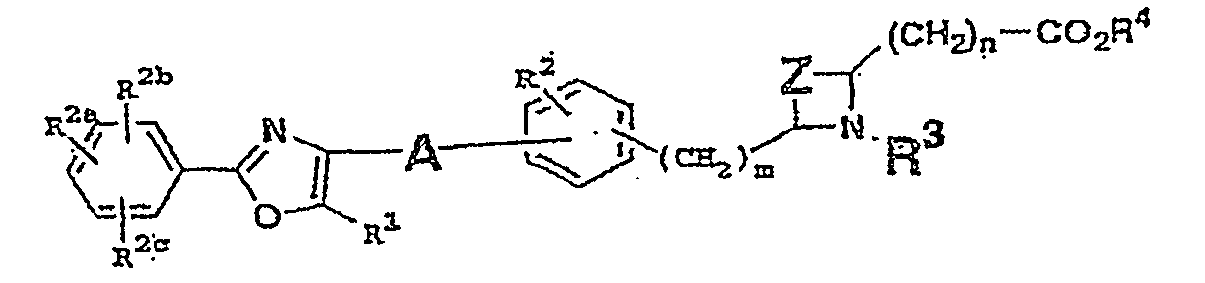 wobei m 0, 1 oder 2 ist; n = 0, 1 oder 2;A (CH2)x ist, wo x 1 bis 5 ist; oder A (CH2)x 1 ist, wo x1 2 bis 5 ist, mit einer Alkenylbindung oder einer Alkinylbindung, eingebettet in die Kette; oder A -(CH2)x 2-O-(CH2)x 3- ist, wo x2 0 bis 5 ist und x3 0 bis 5 ist, mit der Maßgabe, daß mindestens eines von x2 und x3 anders als 0 ist,R1 H oder Alkyl ist;R2 H, Alkyl, Alkoxy, Halogen, Amino oder substituiertes Amino ist;R2a, R2b und R2c gleich oder verschieden sein können und aus H, Alkyl, Alkoxy, Halogen, Amino oder substituiertem Amino ausgewählt sind;R3 aus H, Alkyl, Arylalkyl, Aryloxycarbonyl, Alkyloxycarbonyl, Alkinyloxycarbonyl, Alkenyloxycarbonyl, Arylcarbonyl, Alkylcarbonyl, Aryl, Heteroaryl, Cycloheteroalkyl, Heteroarylcarbonyl, Heteroaryl-heteroarylalkyl, Alkylcarbonylamino, Arylcarbonylamino, Heteroarylcarbonylamino, Alkoxycarbonylamino, Aryloxycarbonylamino, Heteroaryloxycarbonylamino, Heteroaryl-heteroarylcarbonyl, Alkylsulfonyl, Alkenylsulfonyl, Heteroaryloxycarbonyl, Cycloheteroalkyloxycarbonyl, Heteroarylalkyl, Aminocarbonyl, substituiertem Aminocarbonyl, Alkylaminocarbonyl, Arylaminocarbonyl, Heteroarylalkenyl, Cycloheteroalkyl-heteroarylalkyl, Hydroxyalkyl, Alkoxy, Alkoxyaryloxycarbonyl, Arylalkyloxycarbonyl, Alkylaryloxycarbonyl, Arylheteroarylalkyl, Arylalkylarylalkyl, Aryloxyarylalkyl, Halogenalkoxyaryloxycarbonyl, Alkoxycarbonylaryloxycarbonyl, Aryloxyaryloxycarbonyl, Arylsulfinylarylcarbonyl, Arylthioarylcarbonyl, Alkoxycarbonylaryloxycarbonyl, Arylalkenyloxycarbonyl, Heteroaryloxyarylalkyl, Aryloxyarylcarbonyl, Aryloxyarylalkyloxycarbonyl, Arylalkenyloxycarbonyl, Arylalkylcarbonyl, Aryloxyalkyloxycarbonyl, Arylalkylsulfonyl, Arylthiocarbonyl, Arylalkenylsulfonyl, Heteroarylsulfonyl, Arylsulfonyl, Alkoxyarylalkyl, Heteroarylalkoxycarbonyl, Arylheteroarylalkyl, Alkoxyarylcarbonyl, Aryloxyheteroarylalkyl, Heteroarylalkyloxyarylalkyl, Arylarylalkyl, Arylalkenylarylalkyl, Arylalkoxyarylalkyl, Arylcarbonylarylalkyl, Alkylaryloxyarylalkyl, Arylalkoxycarbonylheteroarylalkyl, Heteroarylarylalkyl, Arylcarbonylheteroarylalkyl, Heteroaryloxyarylalkyl, Arylalkenylheteroarylalkyl, Arylaminoarylalkyl, Aminocarbonylarylarylalkyl ausgewählt ist;R4 H oder Alkyl oder ein Ester ist;Z (CH2)x 4 ist, wo x4 1 bis 5 ist; oder Z (CH2)x 5 ist, wo x5 2 bis 5 ist, mit einer Alkenyl-(C=C)-Bindung, eingebettet innerhalb der Kette, oder Z -(CH2)x 6-O-(CH2)x 7- ist, wo x6 0 bis 4 ist und x7 0 bis 4 ist, mit der Maßgabe, daß mindestens eines von x6 und x7 anders als 0 ist;einschließlich aller Stereoisomere davon, Ester davon und einem pharmazeutisch verträglichen Salz davon.
 - Verbindung, wie in Anspruch 1 definiert, mit der Struktur


- Pharmazeutische Zusammensetzung, umfassend eine Verbindung, wie in Anspruch 1 definiert, und einen pharmazeutisch verträglichen Träger dafür.
- Verwendung einer Verbindung, wie in Anspruch 1 definiert, für die Herstellung eines Medikaments zum Senken von Blutglucosespiegeln.
- Verwendung einer Verbindung, wie in Anspruch 1 definiert, für die Herstellung eines Medikaments zum Behandeln von Diabetes.
- Verwendung einer Verbindung, wie in Anspruch 1 definiert, für die Herstellung eines Medikaments zum Behandeln einer prämalignen Krankheit, einer frühen malignen Krankheit, einer malignen Krankheit oder einer dysplastischen Krankheit.
- Pharmazeutische Kombination, umfassend eine Verbindung, wie in Anspruch 1 definiert, und ein Lipid senkendes Mittel, ein Lipid modulierendes Mittel, ein antidiabetisches Mittel, ein Mittel gegen Fettsucht, ein Blutdruck senkendes Mittel, einen Blutplättchenaggregationshemmer und/oder ein Mittel gegen Osteoporose.
- Pharmazeutische Kombination, wie in Anspruch 17 definiert, umfassend die Verbindung und ein antidiabetisches Mittel.
- Kombination, wie in Anspruch 18 definiert, wobei das antidiabetische Mittel 1, 2, 3 oder mehr von einem Biguanid, einem Sulfonylharnstoff, einem Glucosidase-Inhibitor, einem PPAR-γ-Agonisten, einem PPAR-α/γ-dualen Agonisten, einem SGLT2-Inhibitor, einem DP4-Inhibitor, einem aP2-Inhibitor, einem Insulinsensitizer, einem Glucagonähnlichen Peptid-1 (GLP-1), Insulin und/oder einem Meglitinid ist.
- Kombination, wie in Anspruch 19 definiert, wobei das antidiabetische Mittel 1, 2, 3 oder mehr von Metformin, Glyburid, Glimepirid, Glipyrid, Glipizid, Chlorpropamid, Gliclazid, Acarbose, Miglitol, Pioglitazon, Troglitazon, Rosiglitazon, Insulin, G1-262570, Isaglitazon, JTT-501, NN-2344, L895645, YM-440, R-119702, AJ9677, Repaglinid, Nateglinid, KAD1129, AR-HO39242, GW-409544, KRP297, AC2993, LY315902, P32/98 und/oder NVP-DPP-728A ist.
- Kombination, wie in Anspruch 18 definiert, wobei die Verbindung in einem Gewichtsverhältnis zu dem antidiabetischen Mittel innerhalb des Bereiches von etwa 0,001 bis etwa 100:1 1 vorhanden ist.
- Kombination, wie in Anspruch 17 definiert, wobei das Mittel gegen die Fettsucht ein β-3-adrenerger Agonist, ein Lipase-Inhibitor, ein Serotonin- (und Dopamin-) Wiederaufnahme-Inhibitor, ein Thyroid-Rezeptor-Agonist, ein aP2-Inhibitor und/oder ein anorektisches Mittel ist.
- Kombination, wie in Anspruch 22 definiert, wobei das Mittel gegen die Fettsucht Orlistat, ATL-962, AJ9677, L750355, CP331648, Sibutramin, Topiramat, Axokin, Dexamphetamin, Phentermin, Phenylpropanolamin und/oder Mazindol ist.
- Kombination, wie in Anspruch 17 definiert, wobei das Lipid senkende Mittel ein MTP-Inhibitor, ein HMG-CoA-Reduktase-Inhibitor, ein Squalen-Synthetase-Inhibitor, ein Fibrinsäurederivat, ein Upregulator der LDL-Rezeptor-Aktivität, ein Lipoxygenase-Inhibitor oder ein ACAT-Inhibitor ist.
- Kombination, wie in Anspruch 24 definiert, wobei das Lipid senkende Mittel Pravastatin, Lovastatin, Simvastatin, Atorvastatin, Cerivastatin, Fluvastatin, Itavastatin, Visastatin, Fenofibrat, Gemfibrozil, Clofibrat, Avasimib, TS-962, MD-700, Cholestagel, Niacin und/oder LY295427 ist.
- Kombination, wie in Anspruch 24 definiert, wobei die Verbindung in einem Gewichtsverhältnis zu dem Lipid senkenden Mittel innerhalb des Bereiches von etwa 0,001:1 bis etwa 100:1 1 vorhanden ist.
- Kombination, wie in Anspruch 17 definiert, wobei das Blutdruck senkende Mittel ein ACE-Inhibitor, Angiotensin-II-Rezeptor-Antagonist, NEP/ACE-Inhibitor, Calciumkanalblocker und/oder β-adrenerger Blocker ist.
- Kombination, wie in Anspruch 27 definiert, wobei das Blutdruck senkende Mittel ist ein ACE-Inhibitor, welcher Captopril, Fosinopril, Enalapril, Lisinopril, Quinapril, Benazepril, Fentiapril, Ramipril oder Moexipril ist;
ein NEP/ACE-Inhibitor, welcher Omapatrilat, [S[(R*,R*)]-Hexahydro-6-[(2-mercapto-1-oxo-3-phenylpropyl)amino]-2,2-dimethyl-7-oxo-1H-azepin-1-essigsäure (Gemopatrilat) oder CGS 30440 ist;
ein Angiotensin-II-Rezeptor-Antagonist, welcher Irbesartan, Losartan oder Valsartan; Amlodipin-Besylat, Prazosin-HCl, Verapamil, Nifedipin, Nadolol, Propranolol, Carvedilol oder Clonidin-HCl ist. - Kombination, wie in Anspruch 27 definiert, wobei der Blutplättchenaggregationshemmer Aspirin, Clopidogrel, Ticlopidin, Dipyridamol oder Ifetroban ist.
- Verwendung einer pharmazeutischen Kombination, wie in Anspruch 23 definiert, für die Herstellung eines Medikaments zum Behandeln von Insulinresistenz, Hyperglykämie, Hyperinsulinämie oder erhöhten Blutspiegeln von freien Fettsäuren oder Glycerol, Hyperlipidämie, Fettsucht, Syndrom X, dysmetabolischem Syndrom, Entzündung, diabetischen Komplikationen, beeinträchtigter Glucosehomöostase, beeinträchtigter Glucosetoleranz, Hypertriglyceridämie oder Atherosclerose.
- Verwendung einer Verbindung, wie in Anspruch 1 definiert, für die Herstellung eines Medikaments zum Behandeln von Reizkolonsyndrom, Crohnscher Krankheit, Magengeschwür oder Osteroporose oder Psoriasis.
- Verwendung, wie in Anspruch 16 definiert, wobei die Krankheit ein Liposarkom oder ein epithelialer Tumor ist.
- Verwendung, wie in Anspruch 32 definiert, wobei der epitheliale Tumor ein Tumor der Brust, der Prostata, des Kolon, der Ovarien, des Magens oder der Lunge ist.
- Verwendung, wie in Anspruch 16 definiert, wobei die Krankheit ein Duktuskrebs in situ der Brust, ein lobulärer Krebs in situ der Brust, ein Fibroadenom der Brust oder prostatische intraepitheliale Neoplasie ist.
- Verbindung, wie in Anspruch 1 definiert zur Verwendung beim Senken von Blutglucosespiegeln.
- Verbindung, wie in Anspruch 1 definiert, zur Verwendung bei der Behandlung von Diabetes.
- Verbindung, wie in Anspruch 1 definiert, zur Verwendung bei der Behandlung einer prämalignen Krankheit, einer frühen malignen Krankheit, einer malignen Krankheit oder einer dysplastischen Krankheit.
- Pharmazeutische Kombination, wie in Anspruch 23 definiert, zur Verwendung bei der Behandlung von Insulinresistenz, Hyperglykämie, Hyperinsulinämie oder erhöhten Blutspiegeln von freien Fettsäuren oder Glycerol, Hyperlipidämie, Fettsucht, Syndrom X, dysmetabolischem Syndrom, Entzündung, diabetischen Komplikationen, beeinträchtigter Glucosehomöostase, beeinträchtigter Glucosetoleranz, Hypertriglyceridämie oder Atherosclerose.
- Verbindung, wie in Anspruch 1 definiert, zur Verwendung bei der Behandlung von Reizkolonsyndrom, Crohnscher Krankheit, Magengeschwür oder Osteroporose oder Psoriasis.
- Verbindung zur Verwendung, wie in Anspruch 37 definiert, wobei die Krankheit ein Liposarkom oder ein epithelialer Tumor ist.
- Verbindung zur Verwendung, wie in Anspruch 40 definiert, wobei der epitheliale Tumor ein Tumor der Brust, der Prostata, des Kolon, der Ovarien, des Magens oder der Lunge ist.
- Verbindung zur Verwendung, wie in Anspruch 37 definiert, wobei die Krankheit ein Duktuskrebs in situ der Brust, ein lobulärer Krebs in situ der Brust, ein Fibroadenom der Brust oder prostatische intraepitheliale Neoplasie ist.
Applications Claiming Priority (3)
| Application Number | Priority Date | Filing Date | Title |
|---|---|---|---|
| US29450501P | 2001-05-30 | 2001-05-30 | |
| US294505P | 2001-05-30 | ||
| PCT/US2002/016628 WO2002096357A2 (en) | 2001-05-30 | 2002-05-23 | Conformationally constrained analogs useful as antidiabetic and antiobesity agents and method |
Publications (3)
| Publication Number | Publication Date |
|---|---|
| EP1401433A2 EP1401433A2 (de) | 2004-03-31 |
| EP1401433A4 EP1401433A4 (de) | 2005-10-12 |
| EP1401433B1 true EP1401433B1 (de) | 2010-11-10 |
Family
ID=23133727
Family Applications (1)
| Application Number | Title | Priority Date | Filing Date |
|---|---|---|---|
| EP02737192A Expired - Lifetime EP1401433B1 (de) | 2001-05-30 | 2002-05-23 | Azolsäure-derivate, allein oder kombiniert, zur behandlung von diabetes und dyslipidaemien; und zur behandlung von malignen erkrankungen |
Country Status (9)
| Country | Link |
|---|---|
| US (2) | US7105556B2 (de) |
| EP (1) | EP1401433B1 (de) |
| JP (1) | JP4365587B2 (de) |
| AT (1) | ATE487493T1 (de) |
| CA (1) | CA2449006A1 (de) |
| DE (1) | DE60238255D1 (de) |
| ES (1) | ES2354149T3 (de) |
| HU (1) | HUP0600226A3 (de) |
| WO (1) | WO2002096357A2 (de) |
Families Citing this family (57)
| Publication number | Priority date | Publication date | Assignee | Title |
|---|---|---|---|---|
| JP2003508391A (ja) * | 1999-08-31 | 2003-03-04 | マキシア・ファーマシューティカルズ・インコーポレイテッド | ベンジリデン−チアゾリジンジオン類およびアナログ類ならびに糖尿病の治療におけるその使用 |
| TW200300681A (en) * | 2001-11-12 | 2003-06-16 | Ono Pharmaceutical Co | Carboxylic acid derivative compound and medicament containing same as active ingredient |
| AU2003259131A1 (en) * | 2002-07-09 | 2004-01-23 | Bristol-Myers Squibb Company | Substituted heterocyclic derivatives useful as antidiabetic and antiobesity agents and method |
| CA2518465A1 (en) * | 2003-03-25 | 2004-10-14 | Takeda San Diego, Inc. | Dipeptidyl peptidase inhibitors |
| JP2007511467A (ja) | 2003-05-14 | 2007-05-10 | タケダ サン ディエゴ インコーポレイテッド | ジペプチジルペプチダーゼインヒビター |
| CA2525764C (en) * | 2003-05-20 | 2012-07-17 | Novartis Ag | N-acyl nitrogen heterocycles as ligands of peroxisome proliferator-activated receptors |
| US7169926B1 (en) | 2003-08-13 | 2007-01-30 | Takeda Pharmaceutical Company Limited | Dipeptidyl peptidase inhibitors |
| US7678909B1 (en) | 2003-08-13 | 2010-03-16 | Takeda Pharmaceutical Company Limited | Dipeptidyl peptidase inhibitors |
| KR20060041309A (ko) * | 2003-08-13 | 2006-05-11 | 다케다 야쿠힌 고교 가부시키가이샤 | 4-피리미돈 유도체 및 펩티딜 펩티다제 저해제로서의 그의용도 |
| EP1699777B1 (de) * | 2003-09-08 | 2012-12-12 | Takeda Pharmaceutical Company Limited | Dipeptidylpeptidase-hemmer |
| EP1697342A2 (de) * | 2003-09-08 | 2006-09-06 | Takeda Pharmaceutical Company Limited | Dipeptidyl peptidase inhibitoren |
| US20050054731A1 (en) * | 2003-09-08 | 2005-03-10 | Franco Folli | Multi-system therapy for diabetes, the metabolic syndrome and obesity |
| US7732446B1 (en) | 2004-03-11 | 2010-06-08 | Takeda Pharmaceutical Company Limited | Dipeptidyl peptidase inhibitors |
| UA85871C2 (uk) * | 2004-03-15 | 2009-03-10 | Такеда Фармасьютікал Компані Лімітед | Інгібітори дипептидилпептидази |
| US7687638B2 (en) * | 2004-06-04 | 2010-03-30 | Takeda San Diego, Inc. | Dipeptidyl peptidase inhibitors |
| DE602005025755D1 (de) | 2004-06-04 | 2011-02-17 | Teva Pharma | Irbesartan enthaltende pharmazeutische zusammensetzung |
| WO2006019965A2 (en) | 2004-07-16 | 2006-02-23 | Takeda San Diego, Inc. | Dipeptidyl peptidase inhibitors |
| EP1772149A1 (de) * | 2004-07-27 | 2007-04-11 | Kowa Company. Ltd. | Wirkstoff zur prävention oder behandlung von diabetes |
| WO2006064779A1 (ja) * | 2004-12-14 | 2006-06-22 | Shionogi & Co., Ltd. | 6’位にカルボキシを有するインドロモルヒナン誘導体 |
| JP2008524331A (ja) | 2004-12-21 | 2008-07-10 | 武田薬品工業株式会社 | ジペプチジルペプチダーゼ阻害剤 |
| US20070015839A1 (en) * | 2005-07-14 | 2007-01-18 | Franco Folli | Daily Dosage Regimen for Treating Diabetes, Obesity, Metabolic Syndrome and Polycystic Ovary Syndrome |
| WO2007014023A1 (en) * | 2005-07-21 | 2007-02-01 | Valeant Research & Development | Thiazolidinones, oxazolidinones, and pyrrolidinones for hbv |
| MY147393A (en) * | 2005-09-14 | 2012-11-30 | Takeda Pharmaceutical | Administration of dipeptidyl peptidase inhibitors |
| PT1931350E (pt) * | 2005-09-14 | 2014-02-12 | Takeda Pharmaceutical | Administração de inibidores de dipeptidil peptidase |
| CA2622642C (en) | 2005-09-16 | 2013-12-31 | Takeda Pharmaceutical Company Limited | Dipeptidyl peptidase inhibitors |
| TW200745080A (en) * | 2005-09-16 | 2007-12-16 | Takeda Pharmaceuticals Co | Polymorphs of tartrate salt of 2-[2-(3-(R)-amino-piperidin-1-yl)-5-fluoro-6-oxo-6H-pyrimidin-1-ylmethyl]-benzonitrile and methods of use therefor |
| TW200745079A (en) * | 2005-09-16 | 2007-12-16 | Takeda Pharmaceuticals Co | Polymorphs of benzoate salt of 2-[[6-[(3R)-3-amino-1-piperidinyl]-3,4-dihydro-3-methyl-2,4-dioxo-1(2H)-pyrimidinyl]methyl]-benzonitrile and methods of use therefor |
| WO2007112347A1 (en) | 2006-03-28 | 2007-10-04 | Takeda Pharmaceutical Company Limited | Dipeptidyl peptidase inhibitors |
| WO2007112368A1 (en) * | 2006-03-28 | 2007-10-04 | Takeda Pharmaceutical Company Limited | Preparation of (r)-3-aminopiperidine dihydrochloride |
| MX2009002772A (es) * | 2006-09-13 | 2009-05-28 | Takeda Pharmaceutical | Uso de 2-6-(3-amino-piperidin-1-il)-3-metil-2,4-dioxo-3,4-dihidro- 2h-pirimidin-1-ilmetil-4-fluoro-benzonitrilo. |
| US8324383B2 (en) | 2006-09-13 | 2012-12-04 | Takeda Pharmaceutical Company Limited | Methods of making polymorphs of benzoate salt of 2-[[6-[(3R)-3-amino-1-piperidinyl]-3,4-dihydro-3-methyl-2,4-dioxo-1(2H)-pyrimidinyl]methyl]-benzonitrile |
| TW200838536A (en) * | 2006-11-29 | 2008-10-01 | Takeda Pharmaceutical | Polymorphs of succinate salt of 2-[6-(3-amino-piperidin-1-yl)-3-methyl-2,4-dioxo-3,4-dihydro-2H-pyrimidin-1-ylmethy]-4-fluor-benzonitrile and methods of use therefor |
| US8093236B2 (en) | 2007-03-13 | 2012-01-10 | Takeda Pharmaceuticals Company Limited | Weekly administration of dipeptidyl peptidase inhibitors |
| TW200906823A (en) * | 2007-07-16 | 2009-02-16 | Lilly Co Eli | Compounds and methods for modulating FXR |
| WO2009017802A1 (en) | 2007-08-01 | 2009-02-05 | University Of Pittsburgh - Of The Commonwealth System Of Higher Education | Nitro-fattyacid modulation of type ii diabetes |
| RS56990B1 (sr) | 2007-09-10 | 2018-05-31 | Janssen Pharmaceutica Nv | Postupak za dobijanje jedinjenja koja su korisna kao inhibitori sglt |
| JP2011519373A (ja) | 2008-05-01 | 2011-07-07 | コンプレクザ インコーポレイテッド | ビニル置換脂肪酸 |
| US20140024713A1 (en) | 2008-06-19 | 2014-01-23 | University Of Utah Research Foundation | Use of nitrated lipids for treatment of side effects of toxic medical therapies |
| EP2299997A4 (de) | 2008-06-19 | 2012-01-11 | Univ Utah Res Found | Verwendung von nitrierten lipiden zur behandlung von nebenwirkungen von toxischen medizinischen therapien |
| US9056850B2 (en) | 2008-10-17 | 2015-06-16 | Janssen Pharmaceutica N.V. | Process for the preparation of compounds useful as inhibitors of SGLT |
| US20110009347A1 (en) | 2009-07-08 | 2011-01-13 | Yin Liang | Combination therapy for the treatment of diabetes |
| EP3045167A1 (de) | 2009-07-31 | 2016-07-20 | University of Pittsburgh - Of the Commonwealth System of Higher Education | Ketofettsäuren als entzündungshemmende wirkstoffe |
| EP2483233A4 (de) | 2009-10-02 | 2013-08-14 | Complexa Inc | Heteroatom mit substituierten fettsäuren |
| HUE031375T2 (en) | 2009-10-14 | 2017-07-28 | Janssen Pharmaceutica Nv | Process for the preparation of compounds useful as inhibitors of sglt2 |
| CN102812003B (zh) * | 2009-12-18 | 2015-01-21 | 欧洲筛选有限公司 | 吡咯烷羧酸衍生物、药物组合物以及在代谢紊乱中作为g-蛋白偶联受体43(gpr43)激动剂使用的方法 |
| SG10201506114UA (en) | 2010-05-11 | 2015-09-29 | Janssen Pharmaceutica Nv | Pharmaceutical formulations comprising 1 - (beta-d-glucopyranosyl) - 2 -thienylmethylbenzene derivatives as inhibitors of sglt |
| US20110319325A1 (en) * | 2010-06-28 | 2011-12-29 | Complexa, Inc. | Multi-component pharmaceuticals for treating diabetes |
| EP2697218B1 (de) | 2011-04-13 | 2016-05-25 | Janssen Pharmaceutica NV | Verfahren zur herstellung von verbindungen die als sglt2 inhibitoren verwendbar sind |
| TWI542596B (zh) | 2011-05-09 | 2016-07-21 | 健生藥品公司 | (2s,3r,4r,5s,6r)-2-(3-((5-(4-氟苯基)噻吩-2-基)甲基)-4-甲基苯基)-6-(羥甲基)四氫-2h-哌喃-3,4,5-三醇之l-脯胺酸及檸檬酸共晶體 |
| WO2013028501A1 (en) | 2011-08-19 | 2013-02-28 | The University Of Utah Research Foundation | Combination therapy with nitrated lipids and inhibitors of the renin-angiotensin-aldosterone system |
| US8652527B1 (en) | 2013-03-13 | 2014-02-18 | Upsher-Smith Laboratories, Inc | Extended-release topiramate capsules |
| US9101545B2 (en) | 2013-03-15 | 2015-08-11 | Upsher-Smith Laboratories, Inc. | Extended-release topiramate capsules |
| PT3865484T (pt) | 2015-07-07 | 2024-01-30 | H Lundbeck As | Inibidor da pde9 com esqueleto de imidazo pirazinona para tratamento de doenças periféricas |
| US20170071970A1 (en) | 2015-09-15 | 2017-03-16 | Janssen Pharmaceutica Nv | Co-therapy comprising canagliflozin and phentermine for the treatment of obesity and obesity related disorders |
| WO2017059451A1 (en) | 2015-10-02 | 2017-04-06 | Complexa, Inc. | Prevention, treatment and reversal of disease using therapeutically effective amounts of activated fatty acids |
| CA3100988A1 (en) | 2018-05-25 | 2019-11-28 | Imara Inc. | Monohydrate and crystalline forms of 6-[(3s,4s)-4-methyl-1-(pyrimidin-2-ylmethyl)pyrrolidin-3-yl]-3-tetrahydropyran-4-yl-7h-imidazo[1,5-a]pyrazin-8-one |
| CA3110680A1 (en) | 2018-08-31 | 2020-03-05 | Imara Inc. | Pde9 inhibitors for treating sickle cell disease |
Family Cites Families (4)
| Publication number | Priority date | Publication date | Assignee | Title |
|---|---|---|---|---|
| JPS584711B2 (ja) | 1978-08-02 | 1983-01-27 | 参天製薬株式会社 | ピロリジン誘導体 |
| FR2678938B1 (fr) | 1991-07-10 | 1993-10-08 | Rhone Poulenc Rorer Sa | Derives de pyrrolidine, leur preparation et les medicaments les contenant. |
| TWI302149B (en) | 1999-09-22 | 2008-10-21 | Bristol Myers Squibb Co | Substituted acid derivatives useful as antiodiabetic and antiobesity agents and method |
| IL149493A0 (en) | 1999-11-10 | 2002-11-10 | Takeda Chemical Industries Ltd | 5-membered n-heterocyclic compounds with hypoglycemic and hypolipidemic activity |
-
2002
- 2002-05-22 US US10/153,342 patent/US7105556B2/en not_active Expired - Lifetime
- 2002-05-23 EP EP02737192A patent/EP1401433B1/de not_active Expired - Lifetime
- 2002-05-23 DE DE60238255T patent/DE60238255D1/de not_active Expired - Lifetime
- 2002-05-23 CA CA002449006A patent/CA2449006A1/en not_active Abandoned
- 2002-05-23 HU HU0600226A patent/HUP0600226A3/hu not_active Application Discontinuation
- 2002-05-23 ES ES02737192T patent/ES2354149T3/es not_active Expired - Lifetime
- 2002-05-23 AT AT02737192T patent/ATE487493T1/de not_active IP Right Cessation
- 2002-05-23 WO PCT/US2002/016628 patent/WO2002096357A2/en not_active Ceased
- 2002-05-23 JP JP2002592870A patent/JP4365587B2/ja not_active Expired - Fee Related
-
2006
- 2006-04-19 US US11/406,799 patent/US7452907B2/en not_active Expired - Lifetime
Also Published As
| Publication number | Publication date |
|---|---|
| US20030092697A1 (en) | 2003-05-15 |
| US20060189598A1 (en) | 2006-08-24 |
| WO2002096357A3 (en) | 2003-09-25 |
| ATE487493T1 (de) | 2010-11-15 |
| JP4365587B2 (ja) | 2009-11-18 |
| EP1401433A4 (de) | 2005-10-12 |
| ES2354149T3 (es) | 2011-03-10 |
| DE60238255D1 (de) | 2010-12-23 |
| US7105556B2 (en) | 2006-09-12 |
| JP2005506954A (ja) | 2005-03-10 |
| US7452907B2 (en) | 2008-11-18 |
| HUP0600226A2 (en) | 2006-11-28 |
| WO2002096357A2 (en) | 2002-12-05 |
| HUP0600226A3 (en) | 2012-09-28 |
| CA2449006A1 (en) | 2002-12-05 |
| EP1401433A2 (de) | 2004-03-31 |
Similar Documents
| Publication | Publication Date | Title |
|---|---|---|
| EP1401433B1 (de) | Azolsäure-derivate, allein oder kombiniert, zur behandlung von diabetes und dyslipidaemien; und zur behandlung von malignen erkrankungen | |
| US6673815B2 (en) | Substituted acid derivatives useful as antidiabetic and antiobesity agents and method | |
| EP1531810B1 (de) | Substituierte heterozyklische derivate als mittel gegen diabetes und adipositas und verfahren | |
| US6727271B2 (en) | Substituted acid derivatives useful as antidiabetic and antiobesity agents and method | |
| RU2327692C2 (ru) | Окса- и тиазолпроизводные в качестве антидиабетических агентов и агентов против ожирения | |
| US7795291B2 (en) | Substituted acid derivatives useful as anti-atherosclerotic, anti-dyslipidemic, anti-diabetic and anti-obesity agents and method | |
| US20030092736A1 (en) | Substituted azole acid derivatives useful as antidiabetic and antiobesity agents and method | |
| AU2002259306A1 (en) | Substituted azole acid derivatives useful as antidiabetic and antiobesity agents and method | |
| AU2002310141B2 (en) | Conformationally constrained analogs useful as antidiabetic and antiobesity agents and method | |
| AU2002310141A1 (en) | Conformationally constrained analogs useful as antidiabetic and antiobesity agents and method | |
| EP1589006A1 (de) | Oxa- und Thiazolderivate sowie ihre Verwendung gegen Diabetes und Fettsucht |
Legal Events
| Date | Code | Title | Description |
|---|---|---|---|
| PUAI | Public reference made under article 153(3) epc to a published international application that has entered the european phase |
Free format text: ORIGINAL CODE: 0009012 |
|
| 17P | Request for examination filed |
Effective date: 20031219 |
|
| AK | Designated contracting states |
Kind code of ref document: A2 Designated state(s): AT BE CH CY DE DK ES FI FR GB GR IE IT LI LU MC NL PT SE TR |
|
| AX | Request for extension of the european patent |
Extension state: AL LT LV MK RO SI |
|
| RIN1 | Information on inventor provided before grant (corrected) |
Inventor name: CHENG, PETER, T. Inventor name: WANG, WEI Inventor name: JEON, YOON |
|
| A4 | Supplementary search report drawn up and despatched |
Effective date: 20050831 |
|
| RIC1 | Information provided on ipc code assigned before grant |
Ipc: 7C 07D 413/02 B Ipc: 7C 07D 413/12 B Ipc: 7A 61K 31/42 A Ipc: 7A 61P 3/04 B Ipc: 7A 61K 31/445 B Ipc: 7C 07D 403/02 B |
|
| 17Q | First examination report despatched |
Effective date: 20070604 |
|
| GRAP | Despatch of communication of intention to grant a patent |
Free format text: ORIGINAL CODE: EPIDOSNIGR1 |
|
| RIC1 | Information provided on ipc code assigned before grant |
Ipc: A61P 3/10 20060101ALI20100112BHEP Ipc: A61K 45/06 20060101AFI20100112BHEP Ipc: A61P 3/06 20060101ALI20100112BHEP Ipc: A61P 35/00 20060101ALI20100112BHEP |
|
| RTI1 | Title (correction) |
Free format text: AZOLE ACID DERIVATIVES, ALONE OR IN COMBINATION, FOR TREATING DIABETES AND DYSLIPIDEMIAS; AND FOR TREATING MALIGNANT DISEASES |
|
| GRAS | Grant fee paid |
Free format text: ORIGINAL CODE: EPIDOSNIGR3 |
|
| GRAA | (expected) grant |
Free format text: ORIGINAL CODE: 0009210 |
|
| AK | Designated contracting states |
Kind code of ref document: B1 Designated state(s): AT BE CH CY DE DK ES FI FR GB GR IE IT LI LU MC NL PT SE TR |
|
| AX | Request for extension of the european patent |
Extension state: AL LT LV MK RO SI |
|
| REG | Reference to a national code |
Ref country code: GB Ref legal event code: FG4D |
|
| REG | Reference to a national code |
Ref country code: CH Ref legal event code: EP |
|
| REG | Reference to a national code |
Ref country code: IE Ref legal event code: FG4D |
|
| REF | Corresponds to: |
Ref document number: 60238255 Country of ref document: DE Date of ref document: 20101223 Kind code of ref document: P |
|
| REG | Reference to a national code |
Ref country code: NL Ref legal event code: VDEP Effective date: 20101110 |
|
| REG | Reference to a national code |
Ref country code: ES Ref legal event code: FG2A Effective date: 20110228 |
|
| LTIE | Lt: invalidation of european patent or patent extension |
Effective date: 20101110 |
|
| PG25 | Lapsed in a contracting state [announced via postgrant information from national office to epo] |
Ref country code: AT Free format text: LAPSE BECAUSE OF FAILURE TO SUBMIT A TRANSLATION OF THE DESCRIPTION OR TO PAY THE FEE WITHIN THE PRESCRIBED TIME-LIMIT Effective date: 20101110 Ref country code: SE Free format text: LAPSE BECAUSE OF FAILURE TO SUBMIT A TRANSLATION OF THE DESCRIPTION OR TO PAY THE FEE WITHIN THE PRESCRIBED TIME-LIMIT Effective date: 20101110 Ref country code: PT Free format text: LAPSE BECAUSE OF FAILURE TO SUBMIT A TRANSLATION OF THE DESCRIPTION OR TO PAY THE FEE WITHIN THE PRESCRIBED TIME-LIMIT Effective date: 20110310 Ref country code: FI Free format text: LAPSE BECAUSE OF FAILURE TO SUBMIT A TRANSLATION OF THE DESCRIPTION OR TO PAY THE FEE WITHIN THE PRESCRIBED TIME-LIMIT Effective date: 20101110 Ref country code: NL Free format text: LAPSE BECAUSE OF FAILURE TO SUBMIT A TRANSLATION OF THE DESCRIPTION OR TO PAY THE FEE WITHIN THE PRESCRIBED TIME-LIMIT Effective date: 20101110 Ref country code: CY Free format text: LAPSE BECAUSE OF FAILURE TO SUBMIT A TRANSLATION OF THE DESCRIPTION OR TO PAY THE FEE WITHIN THE PRESCRIBED TIME-LIMIT Effective date: 20101110 |
|
| PG25 | Lapsed in a contracting state [announced via postgrant information from national office to epo] |
Ref country code: GR Free format text: LAPSE BECAUSE OF FAILURE TO SUBMIT A TRANSLATION OF THE DESCRIPTION OR TO PAY THE FEE WITHIN THE PRESCRIBED TIME-LIMIT Effective date: 20110211 |
|
| PG25 | Lapsed in a contracting state [announced via postgrant information from national office to epo] |
Ref country code: BE Free format text: LAPSE BECAUSE OF FAILURE TO SUBMIT A TRANSLATION OF THE DESCRIPTION OR TO PAY THE FEE WITHIN THE PRESCRIBED TIME-LIMIT Effective date: 20101110 |
|
| PG25 | Lapsed in a contracting state [announced via postgrant information from national office to epo] |
Ref country code: DK Free format text: LAPSE BECAUSE OF FAILURE TO SUBMIT A TRANSLATION OF THE DESCRIPTION OR TO PAY THE FEE WITHIN THE PRESCRIBED TIME-LIMIT Effective date: 20101110 |
|
| PLBE | No opposition filed within time limit |
Free format text: ORIGINAL CODE: 0009261 |
|
| STAA | Information on the status of an ep patent application or granted ep patent |
Free format text: STATUS: NO OPPOSITION FILED WITHIN TIME LIMIT |
|
| 26N | No opposition filed |
Effective date: 20110811 |
|
| REG | Reference to a national code |
Ref country code: DE Ref legal event code: R097 Ref document number: 60238255 Country of ref document: DE Effective date: 20110811 |
|
| PG25 | Lapsed in a contracting state [announced via postgrant information from national office to epo] |
Ref country code: MC Free format text: LAPSE BECAUSE OF NON-PAYMENT OF DUE FEES Effective date: 20110531 |
|
| REG | Reference to a national code |
Ref country code: CH Ref legal event code: PL |
|
| PG25 | Lapsed in a contracting state [announced via postgrant information from national office to epo] |
Ref country code: CH Free format text: LAPSE BECAUSE OF NON-PAYMENT OF DUE FEES Effective date: 20110531 Ref country code: LI Free format text: LAPSE BECAUSE OF NON-PAYMENT OF DUE FEES Effective date: 20110531 |
|
| REG | Reference to a national code |
Ref country code: IE Ref legal event code: MM4A |
|
| PG25 | Lapsed in a contracting state [announced via postgrant information from national office to epo] |
Ref country code: IE Free format text: LAPSE BECAUSE OF NON-PAYMENT OF DUE FEES Effective date: 20110523 |
|
| PG25 | Lapsed in a contracting state [announced via postgrant information from national office to epo] |
Ref country code: LU Free format text: LAPSE BECAUSE OF NON-PAYMENT OF DUE FEES Effective date: 20110523 |
|
| PG25 | Lapsed in a contracting state [announced via postgrant information from national office to epo] |
Ref country code: TR Free format text: LAPSE BECAUSE OF FAILURE TO SUBMIT A TRANSLATION OF THE DESCRIPTION OR TO PAY THE FEE WITHIN THE PRESCRIBED TIME-LIMIT Effective date: 20101110 |
|
| PGFP | Annual fee paid to national office [announced via postgrant information from national office to epo] |
Ref country code: GB Payment date: 20140521 Year of fee payment: 13 |
|
| PGFP | Annual fee paid to national office [announced via postgrant information from national office to epo] |
Ref country code: ES Payment date: 20140411 Year of fee payment: 13 Ref country code: DE Payment date: 20140521 Year of fee payment: 13 Ref country code: FR Payment date: 20140509 Year of fee payment: 13 Ref country code: IT Payment date: 20140513 Year of fee payment: 13 |
|
| REG | Reference to a national code |
Ref country code: DE Ref legal event code: R119 Ref document number: 60238255 Country of ref document: DE |
|
| GBPC | Gb: european patent ceased through non-payment of renewal fee |
Effective date: 20150523 |
|
| PG25 | Lapsed in a contracting state [announced via postgrant information from national office to epo] |
Ref country code: IT Free format text: LAPSE BECAUSE OF NON-PAYMENT OF DUE FEES Effective date: 20150523 |
|
| REG | Reference to a national code |
Ref country code: FR Ref legal event code: ST Effective date: 20160129 |
|
| PG25 | Lapsed in a contracting state [announced via postgrant information from national office to epo] |
Ref country code: DE Free format text: LAPSE BECAUSE OF NON-PAYMENT OF DUE FEES Effective date: 20151201 Ref country code: GB Free format text: LAPSE BECAUSE OF NON-PAYMENT OF DUE FEES Effective date: 20150523 |
|
| PG25 | Lapsed in a contracting state [announced via postgrant information from national office to epo] |
Ref country code: FR Free format text: LAPSE BECAUSE OF NON-PAYMENT OF DUE FEES Effective date: 20150601 |
|
| REG | Reference to a national code |
Ref country code: ES Ref legal event code: FD2A Effective date: 20170206 |
|
| PG25 | Lapsed in a contracting state [announced via postgrant information from national office to epo] |
Ref country code: ES Free format text: LAPSE BECAUSE OF NON-PAYMENT OF DUE FEES Effective date: 20150524 |