EP1400554A1 - Polyestergruppen aufweisende amphiphile Organopolysiloxane und deren Verwendung als Emulgatoren oder Dispergierhilfsmittel - Google Patents
Polyestergruppen aufweisende amphiphile Organopolysiloxane und deren Verwendung als Emulgatoren oder Dispergierhilfsmittel Download PDFInfo
- Publication number
- EP1400554A1 EP1400554A1 EP03020215A EP03020215A EP1400554A1 EP 1400554 A1 EP1400554 A1 EP 1400554A1 EP 03020215 A EP03020215 A EP 03020215A EP 03020215 A EP03020215 A EP 03020215A EP 1400554 A1 EP1400554 A1 EP 1400554A1
- Authority
- EP
- European Patent Office
- Prior art keywords
- radical
- group
- formula
- average
- spacer
- Prior art date
- Legal status (The legal status is an assumption and is not a legal conclusion. Google has not performed a legal analysis and makes no representation as to the accuracy of the status listed.)
- Granted
Links
- 229920001296 polysiloxane Polymers 0.000 title claims abstract description 44
- 229920000728 polyester Polymers 0.000 title claims abstract description 37
- 239000003995 emulsifying agent Substances 0.000 title claims description 20
- 239000002270 dispersing agent Substances 0.000 title description 2
- 230000001804 emulsifying effect Effects 0.000 title 1
- -1 siloxane residue Chemical group 0.000 claims abstract description 40
- 239000000839 emulsion Substances 0.000 claims abstract description 23
- KPUWHANPEXNPJT-UHFFFAOYSA-N disiloxane Chemical group [SiH3]O[SiH3] KPUWHANPEXNPJT-UHFFFAOYSA-N 0.000 claims abstract description 20
- 125000004432 carbon atom Chemical group C* 0.000 claims abstract description 17
- 150000001875 compounds Chemical class 0.000 claims abstract description 15
- 125000006850 spacer group Chemical group 0.000 claims abstract description 15
- PEDCQBHIVMGVHV-UHFFFAOYSA-N Glycerine Chemical compound OCC(O)CO PEDCQBHIVMGVHV-UHFFFAOYSA-N 0.000 claims abstract description 14
- 125000002887 hydroxy group Chemical group [H]O* 0.000 claims abstract description 10
- 239000007762 w/o emulsion Substances 0.000 claims abstract description 9
- 125000005529 alkyleneoxy group Chemical group 0.000 claims abstract description 8
- 125000003178 carboxy group Chemical group [H]OC(*)=O 0.000 claims abstract description 6
- 239000012634 fragment Substances 0.000 claims abstract description 6
- 238000000034 method Methods 0.000 claims abstract description 6
- 125000000217 alkyl group Chemical group 0.000 claims abstract description 5
- 125000002947 alkylene group Chemical group 0.000 claims abstract description 5
- 239000002537 cosmetic Substances 0.000 claims abstract description 5
- 239000000203 mixture Substances 0.000 claims abstract description 5
- 239000004372 Polyvinyl alcohol Substances 0.000 claims abstract description 4
- BVKZGUZCCUSVTD-UHFFFAOYSA-N carbonic acid Chemical compound OC(O)=O BVKZGUZCCUSVTD-UHFFFAOYSA-N 0.000 claims abstract description 4
- 230000032050 esterification Effects 0.000 claims abstract description 4
- 238000005886 esterification reaction Methods 0.000 claims abstract description 4
- 229920000223 polyglycerol Polymers 0.000 claims abstract description 4
- 229920002451 polyvinyl alcohol Polymers 0.000 claims abstract description 4
- QAOWNCQODCNURD-UHFFFAOYSA-L Sulfate Chemical compound [O-]S([O-])(=O)=O QAOWNCQODCNURD-UHFFFAOYSA-L 0.000 claims abstract description 3
- 150000007942 carboxylates Chemical class 0.000 claims abstract description 3
- 239000006185 dispersion Substances 0.000 claims abstract description 3
- 238000009472 formulation Methods 0.000 claims abstract description 3
- KWIUHFFTVRNATP-UHFFFAOYSA-N glycine betaine Chemical compound C[N+](C)(C)CC([O-])=O KWIUHFFTVRNATP-UHFFFAOYSA-N 0.000 claims abstract description 3
- 238000006459 hydrosilylation reaction Methods 0.000 claims abstract description 3
- 238000002360 preparation method Methods 0.000 claims abstract description 3
- 229910019142 PO4 Inorganic materials 0.000 claims abstract 2
- 239000010452 phosphate Substances 0.000 claims abstract 2
- 229920000570 polyether Polymers 0.000 claims description 16
- 239000004721 Polyphenylene oxide Substances 0.000 claims description 15
- ULQISTXYYBZJSJ-UHFFFAOYSA-N 12-hydroxyoctadecanoic acid Chemical compound CCCCCCC(O)CCCCCCCCCCC(O)=O ULQISTXYYBZJSJ-UHFFFAOYSA-N 0.000 claims description 5
- 238000004519 manufacturing process Methods 0.000 claims description 5
- 125000004435 hydrogen atom Chemical group [H]* 0.000 claims description 3
- 229940114072 12-hydroxystearic acid Drugs 0.000 claims description 2
- KWIUHFFTVRNATP-UHFFFAOYSA-O N,N,N-trimethylglycinium Chemical compound C[N+](C)(C)CC(O)=O KWIUHFFTVRNATP-UHFFFAOYSA-O 0.000 claims description 2
- 229960003237 betaine Drugs 0.000 claims description 2
- WBHHMMIMDMUBKC-XLNAKTSKSA-N ricinelaidic acid Chemical compound CCCCCC[C@@H](O)C\C=C\CCCCCCCC(O)=O WBHHMMIMDMUBKC-XLNAKTSKSA-N 0.000 claims description 2
- 229960003656 ricinoleic acid Drugs 0.000 claims description 2
- FEUQNCSVHBHROZ-UHFFFAOYSA-N ricinoleic acid Natural products CCCCCCC(O[Si](C)(C)C)CC=CCCCCCCCC(=O)OC FEUQNCSVHBHROZ-UHFFFAOYSA-N 0.000 claims description 2
- QGZKDVFQNNGYKY-UHFFFAOYSA-O Ammonium Chemical compound [NH4+] QGZKDVFQNNGYKY-UHFFFAOYSA-O 0.000 abstract description 2
- 125000001997 phenyl group Chemical group [H]C1=C([H])C([H])=C(*)C([H])=C1[H] 0.000 abstract 1
- NBIIXXVUZAFLBC-UHFFFAOYSA-K phosphate Chemical compound [O-]P([O-])([O-])=O NBIIXXVUZAFLBC-UHFFFAOYSA-K 0.000 abstract 1
- 235000019422 polyvinyl alcohol Nutrition 0.000 abstract 1
- 239000000306 component Substances 0.000 description 7
- YXFVVABEGXRONW-UHFFFAOYSA-N Toluene Chemical compound CC1=CC=CC=C1 YXFVVABEGXRONW-UHFFFAOYSA-N 0.000 description 6
- 239000002253 acid Substances 0.000 description 5
- 238000006243 chemical reaction Methods 0.000 description 5
- 150000001991 dicarboxylic acids Chemical class 0.000 description 5
- XLYOFNOQVPJJNP-UHFFFAOYSA-N water Substances O XLYOFNOQVPJJNP-UHFFFAOYSA-N 0.000 description 5
- AFVFQIVMOAPDHO-UHFFFAOYSA-N Methanesulfonic acid Chemical compound CS(O)(=O)=O AFVFQIVMOAPDHO-UHFFFAOYSA-N 0.000 description 4
- 230000002209 hydrophobic effect Effects 0.000 description 4
- 239000003795 chemical substances by application Substances 0.000 description 3
- 230000000052 comparative effect Effects 0.000 description 3
- 238000004132 cross linking Methods 0.000 description 3
- 235000011187 glycerol Nutrition 0.000 description 3
- 150000002596 lactones Chemical group 0.000 description 3
- 239000003921 oil Substances 0.000 description 3
- 229920000435 poly(dimethylsiloxane) Polymers 0.000 description 3
- 229920002545 silicone oil Polymers 0.000 description 3
- 150000005846 sugar alcohols Polymers 0.000 description 3
- 239000001993 wax Substances 0.000 description 3
- RTZKZFJDLAIYFH-UHFFFAOYSA-N Diethyl ether Chemical compound CCOCC RTZKZFJDLAIYFH-UHFFFAOYSA-N 0.000 description 2
- LFQSCWFLJHTTHZ-UHFFFAOYSA-N Ethanol Chemical compound CCO LFQSCWFLJHTTHZ-UHFFFAOYSA-N 0.000 description 2
- OFOBLEOULBTSOW-UHFFFAOYSA-N Malonic acid Chemical compound OC(=O)CC(O)=O OFOBLEOULBTSOW-UHFFFAOYSA-N 0.000 description 2
- 229910004298 SiO 2 Inorganic materials 0.000 description 2
- 229910020447 SiO2/2 Inorganic materials 0.000 description 2
- WNLRTRBMVRJNCN-UHFFFAOYSA-N adipic acid Chemical compound OC(=O)CCCCC(O)=O WNLRTRBMVRJNCN-UHFFFAOYSA-N 0.000 description 2
- CVSVTCORWBXHQV-UHFFFAOYSA-N creatine Chemical compound NC(=[NH2+])N(C)CC([O-])=O CVSVTCORWBXHQV-UHFFFAOYSA-N 0.000 description 2
- 239000004205 dimethyl polysiloxane Substances 0.000 description 2
- 235000013870 dimethyl polysiloxane Nutrition 0.000 description 2
- 150000002009 diols Chemical class 0.000 description 2
- 239000004615 ingredient Substances 0.000 description 2
- 229940098779 methanesulfonic acid Drugs 0.000 description 2
- 239000004200 microcrystalline wax Substances 0.000 description 2
- 235000019808 microcrystalline wax Nutrition 0.000 description 2
- 229920000642 polymer Polymers 0.000 description 2
- 238000007142 ring opening reaction Methods 0.000 description 2
- 238000003756 stirring Methods 0.000 description 2
- 239000004094 surface-active agent Substances 0.000 description 2
- WCOXQTXVACYMLM-UHFFFAOYSA-N 2,3-bis(12-hydroxyoctadecanoyloxy)propyl 12-hydroxyoctadecanoate Chemical compound CCCCCCC(O)CCCCCCCCCCC(=O)OCC(OC(=O)CCCCCCCCCCC(O)CCCCCC)COC(=O)CCCCCCCCCCC(O)CCCCCC WCOXQTXVACYMLM-UHFFFAOYSA-N 0.000 description 1
- LDXJRKWFNNFDSA-UHFFFAOYSA-N 2-(2,4,6,7-tetrahydrotriazolo[4,5-c]pyridin-5-yl)-1-[4-[2-[[3-(trifluoromethoxy)phenyl]methylamino]pyrimidin-5-yl]piperazin-1-yl]ethanone Chemical compound C1CN(CC2=NNN=C21)CC(=O)N3CCN(CC3)C4=CN=C(N=C4)NCC5=CC(=CC=C5)OC(F)(F)F LDXJRKWFNNFDSA-UHFFFAOYSA-N 0.000 description 1
- KIHBGTRZFAVZRV-UHFFFAOYSA-N 2-Hydroxyoctadecanoic acid Natural products CCCCCCCCCCCCCCCCC(O)C(O)=O KIHBGTRZFAVZRV-UHFFFAOYSA-N 0.000 description 1
- OPJWPPVYCOPDCM-UHFFFAOYSA-N 2-ethylhexyl octadecanoate Chemical compound CCCCCCCCCCCCCCCCCC(=O)OCC(CC)CCCC OPJWPPVYCOPDCM-UHFFFAOYSA-N 0.000 description 1
- YLZOPXRUQYQQID-UHFFFAOYSA-N 3-(2,4,6,7-tetrahydrotriazolo[4,5-c]pyridin-5-yl)-1-[4-[2-[[3-(trifluoromethoxy)phenyl]methylamino]pyrimidin-5-yl]piperazin-1-yl]propan-1-one Chemical compound N1N=NC=2CN(CCC=21)CCC(=O)N1CCN(CC1)C=1C=NC(=NC=1)NCC1=CC(=CC=C1)OC(F)(F)F YLZOPXRUQYQQID-UHFFFAOYSA-N 0.000 description 1
- LVDKZNITIUWNER-UHFFFAOYSA-N Bronopol Chemical compound OCC(Br)(CO)[N+]([O-])=O LVDKZNITIUWNER-UHFFFAOYSA-N 0.000 description 1
- 239000004215 Carbon black (E152) Substances 0.000 description 1
- UFHFLCQGNIYNRP-UHFFFAOYSA-N Hydrogen Chemical group [H][H] UFHFLCQGNIYNRP-UHFFFAOYSA-N 0.000 description 1
- WGVWLKXZBUVUAM-UHFFFAOYSA-N Pentanochlor Chemical compound CCCC(C)C(=O)NC1=CC=C(C)C(Cl)=C1 WGVWLKXZBUVUAM-UHFFFAOYSA-N 0.000 description 1
- 229920003171 Poly (ethylene oxide) Polymers 0.000 description 1
- 239000002202 Polyethylene glycol Substances 0.000 description 1
- 229910018540 Si C Inorganic materials 0.000 description 1
- 239000004904 UV filter Substances 0.000 description 1
- 150000007513 acids Chemical class 0.000 description 1
- 239000004480 active ingredient Substances 0.000 description 1
- 235000011037 adipic acid Nutrition 0.000 description 1
- 239000001361 adipic acid Substances 0.000 description 1
- 125000003158 alcohol group Chemical group 0.000 description 1
- 150000001413 amino acids Chemical class 0.000 description 1
- 230000001166 anti-perspirative effect Effects 0.000 description 1
- 239000003213 antiperspirant Substances 0.000 description 1
- 229960003168 bronopol Drugs 0.000 description 1
- 150000001732 carboxylic acid derivatives Chemical class 0.000 description 1
- 150000001735 carboxylic acids Chemical class 0.000 description 1
- 229940085262 cetyl dimethicone Drugs 0.000 description 1
- 238000009833 condensation Methods 0.000 description 1
- 230000003750 conditioning effect Effects 0.000 description 1
- 229960003624 creatine Drugs 0.000 description 1
- 239000006046 creatine Substances 0.000 description 1
- 235000014113 dietary fatty acids Nutrition 0.000 description 1
- 239000000539 dimer Substances 0.000 description 1
- 239000000975 dye Substances 0.000 description 1
- 235000013399 edible fruits Nutrition 0.000 description 1
- 230000000694 effects Effects 0.000 description 1
- 239000003792 electrolyte Substances 0.000 description 1
- 239000003925 fat Substances 0.000 description 1
- 239000000194 fatty acid Substances 0.000 description 1
- 229930195729 fatty acid Natural products 0.000 description 1
- 150000004665 fatty acids Chemical class 0.000 description 1
- 150000002191 fatty alcohols Chemical class 0.000 description 1
- 125000000524 functional group Chemical group 0.000 description 1
- 238000001879 gelation Methods 0.000 description 1
- 125000005842 heteroatom Chemical group 0.000 description 1
- 229930195733 hydrocarbon Natural products 0.000 description 1
- 239000001257 hydrogen Substances 0.000 description 1
- 229910052739 hydrogen Inorganic materials 0.000 description 1
- 230000007062 hydrolysis Effects 0.000 description 1
- 238000006460 hydrolysis reaction Methods 0.000 description 1
- 125000002768 hydroxyalkyl group Chemical group 0.000 description 1
- 239000007788 liquid Substances 0.000 description 1
- WRUGWIBCXHJTDG-UHFFFAOYSA-L magnesium sulfate heptahydrate Chemical class O.O.O.O.O.O.O.[Mg+2].[O-]S([O-])(=O)=O WRUGWIBCXHJTDG-UHFFFAOYSA-L 0.000 description 1
- 239000002480 mineral oil Substances 0.000 description 1
- 235000010446 mineral oil Nutrition 0.000 description 1
- 150000002763 monocarboxylic acids Chemical class 0.000 description 1
- WWZKQHOCKIZLMA-UHFFFAOYSA-N octanoic acid Chemical compound CCCCCCCC(O)=O WWZKQHOCKIZLMA-UHFFFAOYSA-N 0.000 description 1
- 125000004430 oxygen atom Chemical group O* 0.000 description 1
- 239000002304 perfume Substances 0.000 description 1
- 125000002467 phosphate group Chemical group [H]OP(=O)(O[H])O[*] 0.000 description 1
- 239000000049 pigment Substances 0.000 description 1
- 229920001281 polyalkylene Polymers 0.000 description 1
- 238000006068 polycondensation reaction Methods 0.000 description 1
- 229920001223 polyethylene glycol Polymers 0.000 description 1
- 229920005862 polyol Polymers 0.000 description 1
- 150000003077 polyols Chemical class 0.000 description 1
- 125000005372 silanol group Chemical group 0.000 description 1
- 229910010271 silicon carbide Inorganic materials 0.000 description 1
- 239000002904 solvent Substances 0.000 description 1
- 238000003860 storage Methods 0.000 description 1
- 150000003626 triacylglycerols Chemical class 0.000 description 1
- 230000007306 turnover Effects 0.000 description 1
- 235000013343 vitamin Nutrition 0.000 description 1
- 239000011782 vitamin Substances 0.000 description 1
- 229940088594 vitamin Drugs 0.000 description 1
- 229930003231 vitamin Natural products 0.000 description 1
- 238000005303 weighing Methods 0.000 description 1
Classifications
-
- A—HUMAN NECESSITIES
- A61—MEDICAL OR VETERINARY SCIENCE; HYGIENE
- A61K—PREPARATIONS FOR MEDICAL, DENTAL OR TOILETRY PURPOSES
- A61K8/00—Cosmetics or similar toiletry preparations
- A61K8/18—Cosmetics or similar toiletry preparations characterised by the composition
- A61K8/72—Cosmetics or similar toiletry preparations characterised by the composition containing organic macromolecular compounds
- A61K8/84—Cosmetics or similar toiletry preparations characterised by the composition containing organic macromolecular compounds obtained by reactions otherwise than those involving only carbon-carbon unsaturated bonds
- A61K8/89—Polysiloxanes
- A61K8/891—Polysiloxanes saturated, e.g. dimethicone, phenyl trimethicone, C24-C28 methicone or stearyl dimethicone
- A61K8/894—Polysiloxanes saturated, e.g. dimethicone, phenyl trimethicone, C24-C28 methicone or stearyl dimethicone modified by a polyoxyalkylene group, e.g. cetyl dimethicone copolyol
-
- A—HUMAN NECESSITIES
- A61—MEDICAL OR VETERINARY SCIENCE; HYGIENE
- A61K—PREPARATIONS FOR MEDICAL, DENTAL OR TOILETRY PURPOSES
- A61K8/00—Cosmetics or similar toiletry preparations
- A61K8/02—Cosmetics or similar toiletry preparations characterised by special physical form
- A61K8/04—Dispersions; Emulsions
- A61K8/06—Emulsions
-
- A—HUMAN NECESSITIES
- A61—MEDICAL OR VETERINARY SCIENCE; HYGIENE
- A61K—PREPARATIONS FOR MEDICAL, DENTAL OR TOILETRY PURPOSES
- A61K8/00—Cosmetics or similar toiletry preparations
- A61K8/02—Cosmetics or similar toiletry preparations characterised by special physical form
- A61K8/04—Dispersions; Emulsions
- A61K8/06—Emulsions
- A61K8/064—Water-in-oil emulsions, e.g. Water-in-silicone emulsions
-
- A—HUMAN NECESSITIES
- A61—MEDICAL OR VETERINARY SCIENCE; HYGIENE
- A61K—PREPARATIONS FOR MEDICAL, DENTAL OR TOILETRY PURPOSES
- A61K8/00—Cosmetics or similar toiletry preparations
- A61K8/18—Cosmetics or similar toiletry preparations characterised by the composition
- A61K8/72—Cosmetics or similar toiletry preparations characterised by the composition containing organic macromolecular compounds
- A61K8/84—Cosmetics or similar toiletry preparations characterised by the composition containing organic macromolecular compounds obtained by reactions otherwise than those involving only carbon-carbon unsaturated bonds
- A61K8/89—Polysiloxanes
- A61K8/896—Polysiloxanes containing atoms other than silicon, carbon, oxygen and hydrogen, e.g. dimethicone copolyol phosphate
- A61K8/898—Polysiloxanes containing atoms other than silicon, carbon, oxygen and hydrogen, e.g. dimethicone copolyol phosphate containing nitrogen, e.g. amodimethicone, trimethyl silyl amodimethicone or dimethicone propyl PG-betaine
-
- A—HUMAN NECESSITIES
- A61—MEDICAL OR VETERINARY SCIENCE; HYGIENE
- A61K—PREPARATIONS FOR MEDICAL, DENTAL OR TOILETRY PURPOSES
- A61K8/00—Cosmetics or similar toiletry preparations
- A61K8/18—Cosmetics or similar toiletry preparations characterised by the composition
- A61K8/72—Cosmetics or similar toiletry preparations characterised by the composition containing organic macromolecular compounds
- A61K8/84—Cosmetics or similar toiletry preparations characterised by the composition containing organic macromolecular compounds obtained by reactions otherwise than those involving only carbon-carbon unsaturated bonds
- A61K8/89—Polysiloxanes
- A61K8/896—Polysiloxanes containing atoms other than silicon, carbon, oxygen and hydrogen, e.g. dimethicone copolyol phosphate
- A61K8/899—Polysiloxanes containing atoms other than silicon, carbon, oxygen and hydrogen, e.g. dimethicone copolyol phosphate containing sulfur, e.g. sodium PG-propyldimethicone thiosulfate copolyol
-
- A—HUMAN NECESSITIES
- A61—MEDICAL OR VETERINARY SCIENCE; HYGIENE
- A61Q—SPECIFIC USE OF COSMETICS OR SIMILAR TOILETRY PREPARATIONS
- A61Q19/00—Preparations for care of the skin
-
- C—CHEMISTRY; METALLURGY
- C08—ORGANIC MACROMOLECULAR COMPOUNDS; THEIR PREPARATION OR CHEMICAL WORKING-UP; COMPOSITIONS BASED THEREON
- C08G—MACROMOLECULAR COMPOUNDS OBTAINED OTHERWISE THAN BY REACTIONS ONLY INVOLVING UNSATURATED CARBON-TO-CARBON BONDS
- C08G77/00—Macromolecular compounds obtained by reactions forming a linkage containing silicon with or without sulfur, nitrogen, oxygen or carbon in the main chain of the macromolecule
- C08G77/42—Block-or graft-polymers containing polysiloxane sequences
- C08G77/445—Block-or graft-polymers containing polysiloxane sequences containing polyester sequences
-
- C—CHEMISTRY; METALLURGY
- C08—ORGANIC MACROMOLECULAR COMPOUNDS; THEIR PREPARATION OR CHEMICAL WORKING-UP; COMPOSITIONS BASED THEREON
- C08G—MACROMOLECULAR COMPOUNDS OBTAINED OTHERWISE THAN BY REACTIONS ONLY INVOLVING UNSATURATED CARBON-TO-CARBON BONDS
- C08G77/00—Macromolecular compounds obtained by reactions forming a linkage containing silicon with or without sulfur, nitrogen, oxygen or carbon in the main chain of the macromolecule
- C08G77/42—Block-or graft-polymers containing polysiloxane sequences
- C08G77/46—Block-or graft-polymers containing polysiloxane sequences containing polyether sequences
-
- C—CHEMISTRY; METALLURGY
- C09—DYES; PAINTS; POLISHES; NATURAL RESINS; ADHESIVES; COMPOSITIONS NOT OTHERWISE PROVIDED FOR; APPLICATIONS OF MATERIALS NOT OTHERWISE PROVIDED FOR
- C09K—MATERIALS FOR MISCELLANEOUS APPLICATIONS, NOT PROVIDED FOR ELSEWHERE
- C09K23/00—Use of substances as emulsifying, wetting, dispersing, or foam-producing agents
- C09K23/54—Silicon compounds
Definitions
- EP-B-0 176 844 describes the use of polysiloxanes comb-like polyether and long-chain alkyl residues as emulsifiers for the production of W / O emulsions, their oily Phase consists of silicone oil or contains it.
- EP-A-0 819 426 describes the use of terminally modified Polyether siloxanes as emulsifiers in W / O emulsions.
- the object of the present invention is therefore to provide of emulsifiers for cosmetic W / O emulsions, the one have low viscosity.
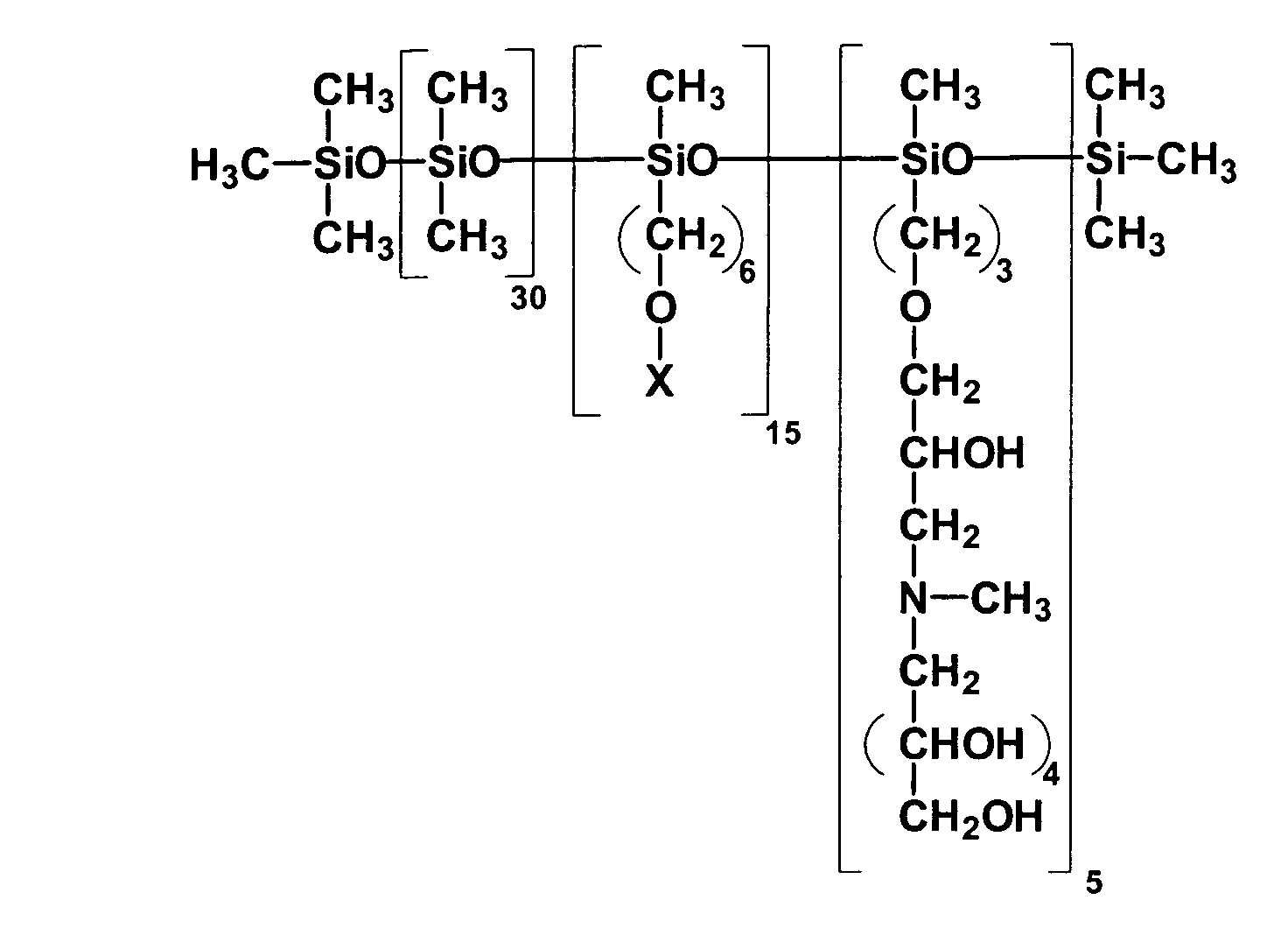
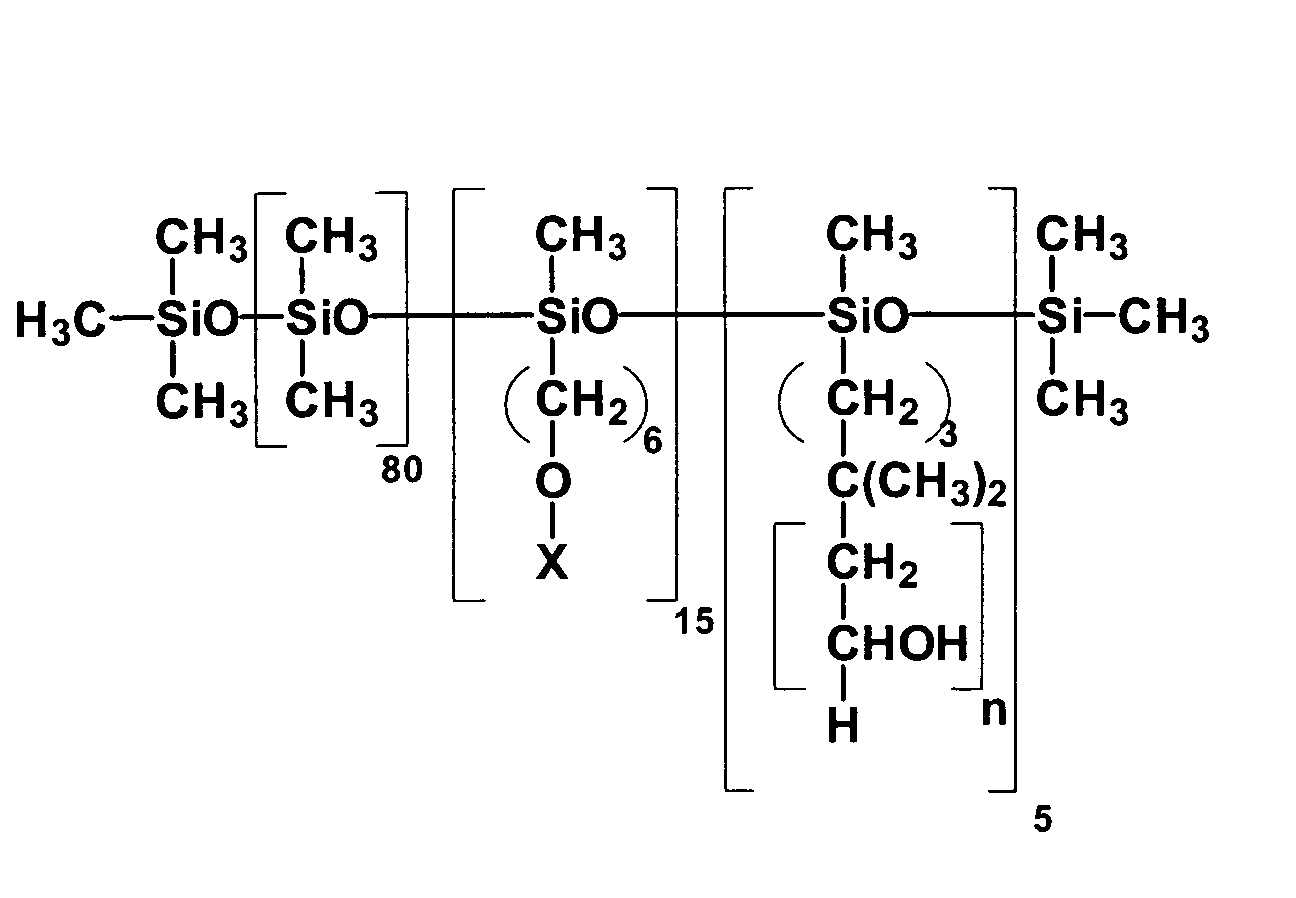
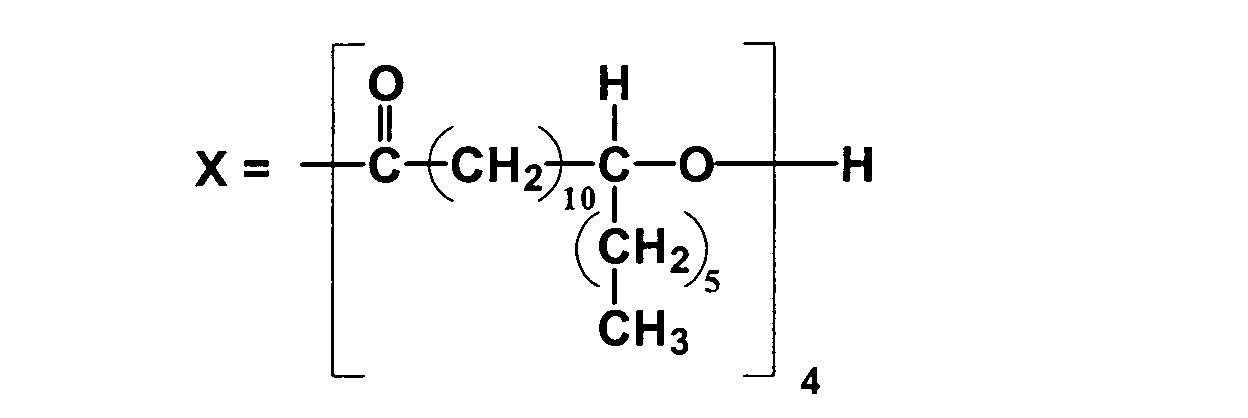
- this object is achieved through the use of organopolysiloxane copolymers containing on average at least a polyester group bonded to the siloxane via a spacer and on average at least one via a spacer the siloxane bound hydrophilic group.
- Another object of the present invention is the use the polysiloxane copolymers of the general formula (I) as emulsifiers, optionally with the use of further Emulsifiers, for the production of low viscosity W / O emulsions with a high content of disperse phase.
- the application also relates to processes for the preparation of the compounds according to the invention, characterized in that that the polyester residues either by hydrosilylation of double-bond-bearing polyesters on polyhydrogensiloxanes or by esterification of OH-functional polysiloxanes with free carboxyl-bearing polyesters, and the hydrophilic residues by methods known from the prior art be attached to the polysiloxane.
- the spacers (B) are the radicals known from the prior art, such as C 1-24 alkylene radicals, which may optionally be branched, may optionally contain multiple bonds or heteroatoms such as, in particular, oxygen atoms and / or functional groups such as, in particular, hydroxyl groups.
- the emulsions are made by the components of Phase B was added to the components of phase A with stirring and then 1 min. with a hand rotor stator mixer be homogenized.
- phase A In the case of emulsion 7, the components of phase A must be on approx. 80 ° C so that the waxy components (Microcrystalline Wax and Castor Wax) are melted. you can then cool the oil phase back down to room temperature and otherwise proceed as described above.
- Emulsions 4 to 7 also show that the inventive Compounds also in combination with conventional emulsifiers lead to the desired low emulsion viscosities.
Landscapes
- Health & Medical Sciences (AREA)
- Life Sciences & Earth Sciences (AREA)
- Chemical & Material Sciences (AREA)
- Animal Behavior & Ethology (AREA)
- Veterinary Medicine (AREA)
- Public Health (AREA)
- General Health & Medical Sciences (AREA)
- Birds (AREA)
- Epidemiology (AREA)
- Organic Chemistry (AREA)
- Chemical Kinetics & Catalysis (AREA)
- Polymers & Plastics (AREA)
- Dispersion Chemistry (AREA)
- Medicinal Chemistry (AREA)
- Engineering & Computer Science (AREA)
- Dermatology (AREA)
- Materials Engineering (AREA)
- Oil, Petroleum & Natural Gas (AREA)
- Cosmetics (AREA)
- Compositions Of Macromolecular Compounds (AREA)
- Silicon Polymers (AREA)
Abstract
Description
R3 = substituierte oder unsubstituierte Alkylengruppe mit 1 bis 20 Kohlenstoffatomen,
R4 = R,
n hat einen Wert von 5 bis 20 und
a ist 0 oder 1, und
Diese Emulgatoren mit seitenständigen Polyoxyalkylengruppen sollen verbesserte Eigenschaften für Antiperspirantsticks in bezug auf Stabilität und niedrigen Wachsanteil bewirken.
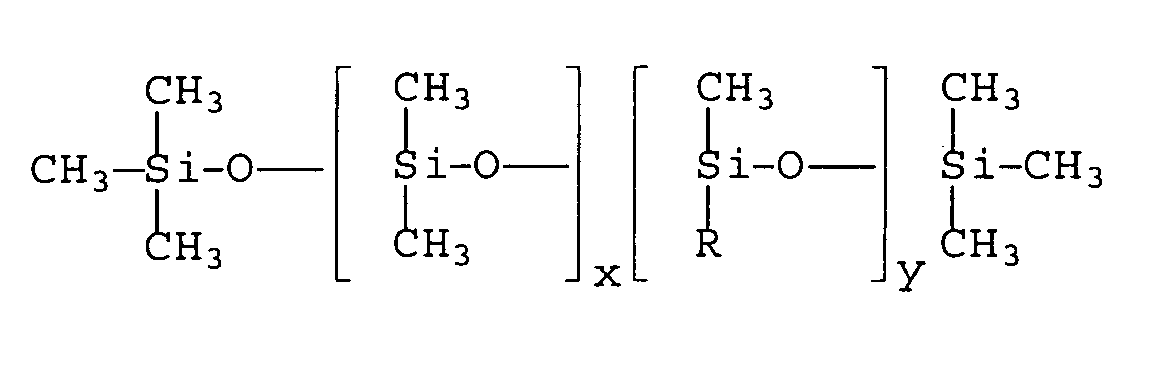
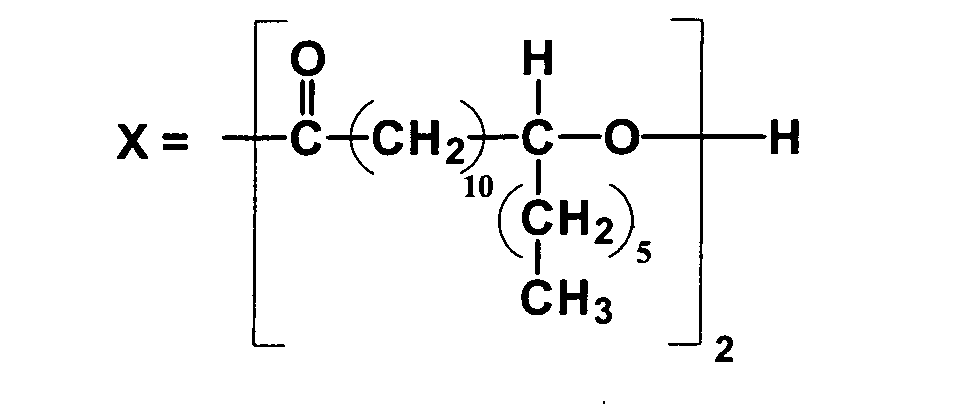
R = -H oder
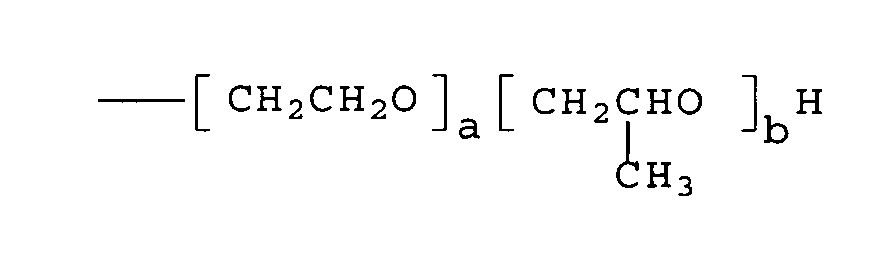
a einen Wert von 9 bis 115 hat,
b einen Wert von 0 bis 50 hat,
x einen Wert von 133 bis 673 hat,
y einen Wert von 25 bis 0,25 hat und

- R1
- gleich oder verschieden sind und Alkylreste mit 1 bis 30 Kohlenstoffatomen oder Phenylreste,
- R2
- unabhängig voneinander R1, -A-R3 oder -B-R4
in denen
- -A-
- eine divalente Alkylenoxy-Gruppe mit 3 bis
24 C-Atomen, die gegebenenfalls verzweigt ist
und/oder Doppelbindungen enthalten kann,
und/oder eine divalente Polyoxyalkylen-Gruppe der
allgemeinen durchschnittlichen Formel
q = 1 bis 100,
r = 0 bis 100,
s = 0 bis 100,
R5 eine divalente Alkylenoxy-Gruppe ist, mit 1 bis 24 C-Atomen, die gegebenenfalls verzweigt ist und/oder Doppelbindungen enthalten kann, - R3
- ein Polyesterrest der allgemeinen Formel
worin
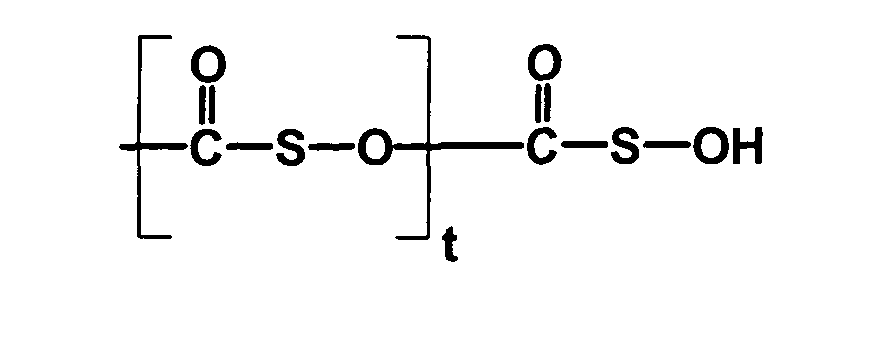
t ganze Zahlen im Bereich von 1 bis 10 darstellt, und [-(O=C)-S-O-] das Fragment einer entsprechenden Hydroxycarbonsäure HO-(O=C)-S-OH bedeutet, in dem
- S- ein gegebenenfalls verzweigter und/oder Doppelbindungen enthaltender Alkylenrest mit 5 bis 30 Kohlenstoffatomen ist, mit der Maßgabe, dass zwischen der Carboxylgruppe [HO-C(O)-] und der Hydroxylgruppe[-OH] mindestens 5 Kohlenstoffatome sind; - -B-
- als Spacer zwischen Siloxangerüst und dem Rest R4 fungiert und von aus dem Stand der Technik für hydrophilmodifizierte Siloxane bekannter Art ist
- R4
- ein hydrophiler Rest der allgemeinen durchschnittlichen
Formel
q = 1 bis 100,
r = 0 bis 100,
s = 0 bis 100,
R6 eine divalente Alkylen- oder Alkylenoxy-Gruppe mit 1 bis 24 C-Atomen, die gegebenenfalls verzweigt ist und/oder Doppelbindungen enthalten kann;
R7 ein Wasserstoffatom, Alkyl- oder Acyl-Rest mit 1 bis 20 C-Atomen ist, oder - R4
- ein Polyhydroxyorganyl-Rest, insbesondere ein Glycerin-, Polyglycerin-, Zucker- oder Zuckerderivat-Rest, ein Polyvinylalkoholrest, ein Carboxylat-, Sulfat- oder Phosphat-Rest, ein Ammonium-Rest oder ein amphoteres Betain- oder Amphoglycinat-Rest,
- a
- einen Wert von 1 bis 1.000, vorzugsweise 5 bis 500, insbesondere 10 bis 150 und
- b
- einen Wert von 0 bis 10 hat, insbesondere < 2 ist,
mit der Maßgabe, dass im statistischen Mittel mindestens
jeweils ein Rest R2 = -A-R3 und R2 = -B-R4 enthalten ist,
oder für den Fall, dass kein Rest -B-R4 enthalten ist, mindestens
ein Rest R2 = -A-R3 enthalten ist, bei dem -A- einer
divalenten Polyoxyalkylen-Gruppe der oben beschriebenen
allgemeinen durchschnittlichen Formel

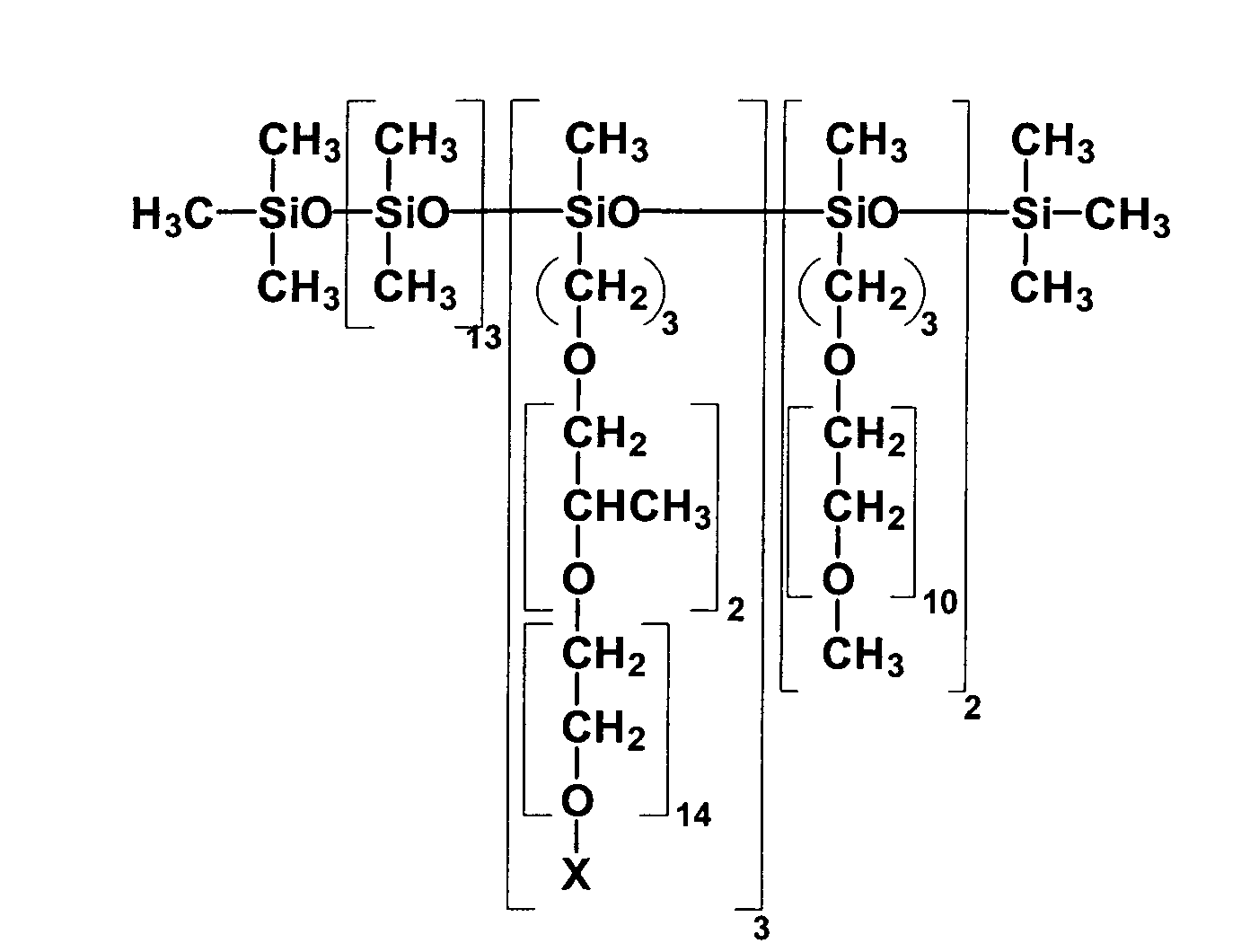
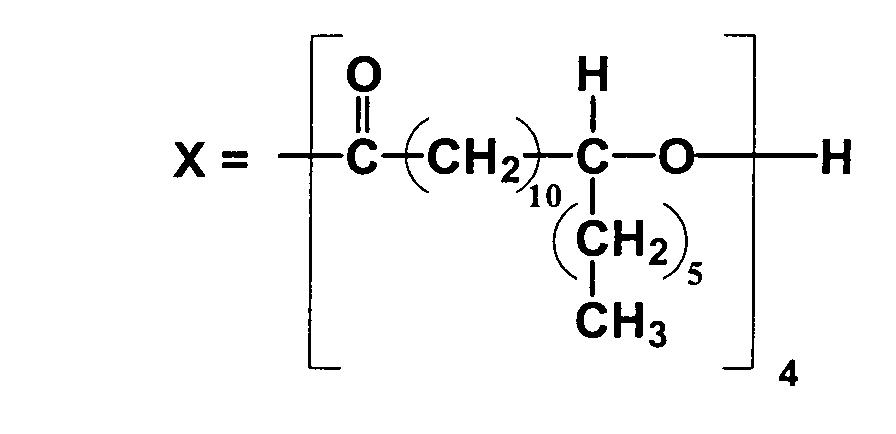



| Experimentelle Einzelheiten zu den Beispielen 2 bis 4 | |||||
| Beispiel Nr. | Polyethersiloxan: Siloxankettenlänge N, Molekulargewicht Polyether MW [g/mol], OH-Zahl Polyethersiloxan [mg KOH/g] | Einwaage Polyethersiloxan [g] | Einwaage Polyhydroxystearinsäure [g] | Einwaage Methansulfonsäure [g] | Einwaage Toluol [g] |
| 2 | N = 10, MW = 400, OH-Zahl = 80 | 98,2 | 93,5 | 0,58 | 120 |
| 3 | N = 20, MW = 400, OH-Zahl = 59 | 114,1 | 80,1 | 0,58 | 120 |
| 4 | N = 80, MW = 400, OH-Zahl = 93,7 | 154,3 | 36,7 | 0,57 | 120 |
| Phase | Emulsion Nr. (Angaben der Inhaltsstoffe in %) | 1 | 2 | 3 | 4 | 5 | 6 | 7 | 8 | 9 |
| A | Emulgator aus Beispiel 2 | - | 2 | - | 1,5 | 1,5 | - | - | - | - |
| Emulgator aus Beispiel 3 | 2 | - | 2 | - | - | 1,5 | 1,5 | - | - | |
| Cetyl Dimethicone Copolyol (ABIL EM 90) | - | - | - | - | - | - | - | 2 | 2 | |
| Diisostearoyl Polyglyceryl-3 Dimer Dilinoleate ( I SOLAN PDI) | - | - | - | 0,5 | 0,5 | 0,5 | 0,5 | - | - | |
| Microcrystalline Wax | - | - | - | - | - | - | 0,25 | - | - | |
| Castor Wax | - | - | - | - | - | - | 0,25 | - | - | |
| Mineral Oil | - | 23 | 23 | 23 | - | - | 8 | 23 | 7,6 | |
| Ethylhexyl Stearate | 23 | - | - | - | 23 | 23 | 8 | - | 7,7 | |
| Caprylic/Capric Triglyceride | - | - | - | - | - | 8 | - | 7,7 | ||
| B | Glycerin | 2,45 | 2,45 | 2,45 | 2,45 | 2,45 | 2,45 | 3,35 | 2,45 | 2,45 |
| Bronopol | 0,05 | 0,05 | 0,05 | 0,05 | 0,05 | 0,05 | 0,05 | 0,05 | 0,05 | |
| Magnesium Sulfate Heptahydrate | 0,5 | 0,5 | 0,5 | 0,5 | 0,5 | 0,5 | 0,5 | 0,5 | 0,5 | |
| Water | 72 | 72 | 72 | 72 | 72 | 72 | 68 | 72 | 72 | |
| Emulsions-viskosität [Pas] nach 2 Tagen bei Raumtemperatur (V 1) sowie nach 2 Monaten bei Raumtemperatur (V 2) | V1 = 9 V1 = 7 | V1 = 6 V2 = 6 | V1 = 10 V2 = 7 | V1 = 11 V2 = 10 | V1 = 8 V2 = 7 | V1 = 8 V2 = 9 | V1 = 12 V2 = 13 | V1 = 36 V2 = 22 | V1 = 52 V2 = 28 |
Claims (9)
- Organopolysiloxan-Copolymere, enthaltend im Mittel mindestens eine über einen Spacer an das Siloxan gebundene Polyestergruppe und im Mittel mindestens eine über einen Spacer an das Siloxan gebundene hydrophile Gruppe, der allgemeinen Formel (I):worin bedeuten

R1 gleich oder verschieden sind und Alkylreste mit 1 bis 30 Kohlenstoffatomen oder Phenylreste,
R2 unabhängig voneinander R1, -A-R3 oder -B-R4 in denen
- A- eine divalente Alkylenoxy-Gruppe mit 3 bis 24 C-Atomen, die gegebenenfalls verzweigt ist und/oder Doppelbindungen enthalten kann, und/oder eine divalente Polyoxyalkylen-Gruppe der allgemeinen durchschnittlichen Formel
q = 1 bis 100,
r = 0 bis 100,
s = 0 bis 100,
R5 eine divalente Alkylenoxy-Gruppe ist, mit 1 bis 24 C-Atomen, die gegebenenfalls verzweigt ist und/oder Doppelbindungen enthalten kann,
R3 ein Polyesterrest der allgemeinen Formelworin
t ganze Zahlen im Bereich von 1 bis 10 darstellt, und [-(O=C)-S-O-] das Fragment einer entsprechenden Hydroxycarbonsäure HO-(O=C)-S-OH bedeutet, in dem
- S- ein gegebenenfalls verzweigter und/oder Doppelbindungen enthaltender Alkylenrest mit 5 bis 30 Kohlenstoffatomen ist, mit der Maßgabe, dass zwischen der Carboxylgruppe [HO-C(O)-] und der Hydroxylgruppe[-OH] mindestens 5 Kohlenstoffatome sind;
-B- als Spacer zwischen Siloxangerüst und dem Rest R4 fungiert und von aus dem Stand der Technik für hydrophilmodifizierte Siloxane bekannter Art ist
R4 ein hydrophiler Rest der allgemeinen durchschnittlichen Formel
q = 1 bis 100,
r = 0 bis 100,
s = 0 bis 100,
R6 eine divalente Alkylen- oder Alkylenoxy-Gruppe mit 1 bis 24 C-Atomen, die gegebenenfalls verzweigt ist und/oder Doppelbindungen enthalten kann;
R7 ein Wasserstoffatom, Alkyl- oder Acyl-Rest mit 1 bis 20 C-Atomen ist, oder
R4 ein Polyhydroxyorganyl-Rest, insbesondere ein Glycerin-, Polyglycerin-, Zucker- oder Zuckerderivat-Rest, ein Polyvinylalkoholrest, ein Carboxylat-, Sulfat- oder Phosphat-Rest, ein Ammonium-Rest oder ein amphoteres Betain- oder Amphoglycinat-Rest,
a einen Wert von 1 bis 1.000 und
b einen Wert von 0 bis 10 hat
mit der Maßgabe, dass im statistischen Mittel mindestens jeweils ein Rest R2 = -A-R3 und R2 = -B-R4 enthalten ist, oder für den Fall, dass kein Rest -B-R4 enthalten ist, mindestens ein Rest R2 = -A-R3 enthalten ist, bei dem -A- einer divalenten Polyoxyalkylen-Gruppe der oben beschriebenen allgemeinen durchschnittlichen Formel - Organopolysiloxan-Copolymere gemäß Anspruch 1, dadurch gekennzeichnet, dass das Fragment [-(O=C)-S-O-]t dem Rest der 12-Hydroxystearinsäure oder der Ricinolsäure entspricht und t zwischen 2 und 5 liegt.
- Organopolysiloxan-Copolymere gemäß Anspruch 1, dadurch gekennzeichnet, dass der hydrophile Rest R4 ein Rest aus der Gruppe Polyether, Polyglycerin, Polyvinylalkohol, Zuckeroder Zuckerderivate ist.
- Organopolysiloxan-Copolymere gemäß einem der Ansprüche 1 bis 3, dadurch gekennzeichnet, dass b = 0 und a = 10 bis 150 ist.
- Verfahren zur Herstellung der Verbindungen der allgemeinen Formel (I), dadurch gekennzeichntet, dass die Polyesterreste entweder durch Hydrosilylierung von Doppelbindungen tragenden Polyestern an Polyhydrogensiloxane oder durch Veresterung von OH-funktionellen Polysiloxanen mit freien Carboxylgruppen tragenden Polyestern und die hydrophilen Reste durch aus dem Stand der Technik bekannte Verfahren an das Polysiloxan angelagert werden.
- Verwendung der Polysiloxan-Copolymeren der allgemeinen Formel (I) als Emulgatoren und Dispergierhilfsmittel.
- Verwendung der Polysiloxan-Copolymeren der allgemeinen Formel (I) als Emulgatoren, gegebenenfalls unter Mitverwendung weiterer Emulgatoren, für die Herstellung niedrigviskoser W/O-Emulsionen mit hohem Gehalt an disperser Phase.
- Dispersionen und Emulsionen, enthaltend mindestens eine der Verbindungen der allgemeinen Formel (I).
- Kosmetische W/O-Emlsionen, enthaltend 0,5 bis 4 Gew.-%, bezogen auf die Gesamtformulierung, mindestens einer der Verbindungen der allgemeinen Formel (I).
Applications Claiming Priority (2)
| Application Number | Priority Date | Filing Date | Title |
|---|---|---|---|
| DE10243992 | 2002-09-21 | ||
| DE10243992A DE10243992A1 (de) | 2002-09-21 | 2002-09-21 | Polyestergruppen aufweisende amphiphile Organopolysiloxane und deren Verwendung als Emulgatoren oder Dispergierhilfsmittel |
Publications (2)
| Publication Number | Publication Date |
|---|---|
| EP1400554A1 true EP1400554A1 (de) | 2004-03-24 |
| EP1400554B1 EP1400554B1 (de) | 2006-03-01 |
Family
ID=31896272
Family Applications (1)
| Application Number | Title | Priority Date | Filing Date |
|---|---|---|---|
| EP03020215A Expired - Lifetime EP1400554B1 (de) | 2002-09-21 | 2003-09-06 | Polyestergruppen aufweisende amphiphile Organopolysiloxane und deren Verwendung als Emulgatoren oder Dispergierhilfsmittel |
Country Status (4)
| Country | Link |
|---|---|
| US (2) | US7084215B2 (de) |
| EP (1) | EP1400554B1 (de) |
| DE (2) | DE10243992A1 (de) |
| ES (1) | ES2256632T3 (de) |
Cited By (3)
| Publication number | Priority date | Publication date | Assignee | Title |
|---|---|---|---|---|
| EP1598108A1 (de) * | 2004-05-12 | 2005-11-23 | VOMM CHEMIPHARMA S.r.l. | Verwendung von Siliconen zur Erhöhung der Fluidität von Dispersionen aus festen Teilchen in Flüssigkeiten |
| US8030363B2 (en) | 2008-01-25 | 2011-10-04 | Momentive Performance Materials Inc. | Polyorganosiloxane demulsifier compositions and methods of making the same |
| CN108047452A (zh) * | 2017-12-20 | 2018-05-18 | 山东东岳有机硅材料股份有限公司 | 一种流平剂用超高分子量聚醚改性聚硅氧烷及其制备方法与应用 |
Families Citing this family (9)
| Publication number | Priority date | Publication date | Assignee | Title |
|---|---|---|---|---|
| DE10302743A1 (de) * | 2003-01-24 | 2004-07-29 | Goldschmidt Ag | Verwendung von Siliconharzen als Dispergiermittel |
| WO2007075927A1 (en) * | 2005-12-22 | 2007-07-05 | The Dow Chemical Company | Branched polyglycols and branched polyether functional organopolysiloxanes and coatings containing same |
| US20080014166A1 (en) * | 2006-07-14 | 2008-01-17 | Clariant International, Ltd. | Cosmetic or pharmaceutical compositions comprising modified polyorganosiloxanes |
| EP1972330B1 (de) * | 2008-06-13 | 2012-09-12 | Clariant Finance (BVI) Limited | Kosmetische oder pharmazeutische Zusammensetzungen mit modifizierten Polysiloxanen mit mindestens einer Carbamatgruppe |
| CN101987070A (zh) * | 2009-07-31 | 2011-03-23 | 赢创德固赛(中国)投资有限公司 | 高载油量的水包油微乳液 |
| WO2011028214A1 (en) | 2009-09-02 | 2011-03-10 | Momentive Performance Materials Inc. | Silicone modified fatty acids, method of preparation and usage thereof |
| US8680225B1 (en) * | 2012-04-02 | 2014-03-25 | Surfatech Corporation | Terminal silicone polyglycerol polyesters |
| JP6172292B2 (ja) * | 2013-12-10 | 2017-08-02 | 信越化学工業株式会社 | 消泡剤組成物 |
| JP2025167207A (ja) * | 2024-04-25 | 2025-11-07 | 信越化学工業株式会社 | オルガノポリシロキサン及びこれを含有する化粧料 |
Citations (6)
| Publication number | Priority date | Publication date | Assignee | Title |
|---|---|---|---|---|
| EP0608921A2 (de) * | 1989-05-26 | 1994-08-03 | MITSUI TOATSU CHEMICALS, Inc. | Modifizierte Polyesterzusammensetzung, Verfahren zu deren Herstellung und deren Verwendung |
| US5411729A (en) * | 1994-02-14 | 1995-05-02 | Siltech Inc. | Silicone polyester polymers as durable humectants |
| US5475125A (en) * | 1995-01-23 | 1995-12-12 | Siltech Inc. | Silicone polyester emulsifiers |
| EP0819426A2 (de) * | 1996-06-20 | 1998-01-21 | Th. Goldschmidt AG | Alpha, Omega-Polyetherpolysiloxane als W/O-Emulgatoren |
| EP0879840A2 (de) * | 1997-05-22 | 1998-11-25 | Th. Goldschmidt AG | Polyhydroxyorganyl-, insbesondere Zucker- oder Zuckerderivatreste und Polyoxyalkylenreste aufweisende Organopolysiloxane |
| US5929268A (en) * | 1998-11-10 | 1999-07-27 | Lambent Technologies Inc | Silicone lactylates |
Family Cites Families (6)
| Publication number | Priority date | Publication date | Assignee | Title |
|---|---|---|---|---|
| DE3435704C1 (de) | 1984-09-28 | 1986-03-13 | Lázár, Peter, 4040 Neuss | Verfahren und Vorrichtung zur Herstellung eines Einbandes oder dergleichen sowie Einband |
| US4988504A (en) | 1987-08-19 | 1991-01-29 | General Electric Company | Silicone surfactants |
| JPH02196862A (ja) | 1989-01-26 | 1990-08-03 | Shin Etsu Chem Co Ltd | ラクトン変性シリコーン組成物及びそれを含有してなる化粧料又は艶出し材料 |
| GB8914905D0 (en) | 1989-06-29 | 1989-08-23 | Unilever Plc | Cosmetic composition |
| US5051489A (en) | 1990-01-25 | 1991-09-24 | Siltech Inc. | Novel silanol waxes |
| JP3046340B2 (ja) | 1990-10-12 | 2000-05-29 | 日清製油株式会社 | エステル化生成物およびこれらを配合してなる化粧料 |
-
2002
- 2002-09-21 DE DE10243992A patent/DE10243992A1/de not_active Withdrawn
-
2003
- 2003-09-06 EP EP03020215A patent/EP1400554B1/de not_active Expired - Lifetime
- 2003-09-06 DE DE50302508T patent/DE50302508D1/de not_active Expired - Lifetime
- 2003-09-06 ES ES03020215T patent/ES2256632T3/es not_active Expired - Lifetime
- 2003-09-18 US US10/664,713 patent/US7084215B2/en not_active Expired - Fee Related
-
2006
- 2006-04-10 US US11/400,979 patent/US7339011B2/en not_active Expired - Fee Related
Patent Citations (6)
| Publication number | Priority date | Publication date | Assignee | Title |
|---|---|---|---|---|
| EP0608921A2 (de) * | 1989-05-26 | 1994-08-03 | MITSUI TOATSU CHEMICALS, Inc. | Modifizierte Polyesterzusammensetzung, Verfahren zu deren Herstellung und deren Verwendung |
| US5411729A (en) * | 1994-02-14 | 1995-05-02 | Siltech Inc. | Silicone polyester polymers as durable humectants |
| US5475125A (en) * | 1995-01-23 | 1995-12-12 | Siltech Inc. | Silicone polyester emulsifiers |
| EP0819426A2 (de) * | 1996-06-20 | 1998-01-21 | Th. Goldschmidt AG | Alpha, Omega-Polyetherpolysiloxane als W/O-Emulgatoren |
| EP0879840A2 (de) * | 1997-05-22 | 1998-11-25 | Th. Goldschmidt AG | Polyhydroxyorganyl-, insbesondere Zucker- oder Zuckerderivatreste und Polyoxyalkylenreste aufweisende Organopolysiloxane |
| US5929268A (en) * | 1998-11-10 | 1999-07-27 | Lambent Technologies Inc | Silicone lactylates |
Cited By (5)
| Publication number | Priority date | Publication date | Assignee | Title |
|---|---|---|---|---|
| EP1598108A1 (de) * | 2004-05-12 | 2005-11-23 | VOMM CHEMIPHARMA S.r.l. | Verwendung von Siliconen zur Erhöhung der Fluidität von Dispersionen aus festen Teilchen in Flüssigkeiten |
| US7344648B2 (en) | 2004-05-12 | 2008-03-18 | Vomm Chemipharma S.R.L. | Use of silicones for causing or facilitating the flow of dispersions of solid particulates in liquids |
| US8030363B2 (en) | 2008-01-25 | 2011-10-04 | Momentive Performance Materials Inc. | Polyorganosiloxane demulsifier compositions and methods of making the same |
| CN108047452A (zh) * | 2017-12-20 | 2018-05-18 | 山东东岳有机硅材料股份有限公司 | 一种流平剂用超高分子量聚醚改性聚硅氧烷及其制备方法与应用 |
| CN108047452B (zh) * | 2017-12-20 | 2021-02-26 | 山东东岳有机硅材料股份有限公司 | 一种流平剂用超高分子量聚醚改性聚硅氧烷及其制备方法与应用 |
Also Published As
| Publication number | Publication date |
|---|---|
| EP1400554B1 (de) | 2006-03-01 |
| US20040214977A1 (en) | 2004-10-28 |
| US7339011B2 (en) | 2008-03-04 |
| US20060183847A1 (en) | 2006-08-17 |
| US7084215B2 (en) | 2006-08-01 |
| DE10243992A1 (de) | 2004-04-01 |
| DE50302508D1 (de) | 2006-04-27 |
| ES2256632T3 (es) | 2006-07-16 |
Similar Documents
| Publication | Publication Date | Title |
|---|---|---|
| DE60114488T2 (de) | Organopolysiloxangele zur Anwendung in kosmetischen Formulierungen | |
| EP0596304B1 (de) | Kosmetische oder pharmazeutische Zubereitungen | |
| EP2274355B1 (de) | Polyurethanverdicker | |
| EP1125574B1 (de) | Kosmetische und pharmazeutische Öl-in-Wasser-Emulsionen von polyethermodifizierten Polysiloxanen | |
| EP1911436B1 (de) | Kaltherstellbare, niedrigviskose und langzeitstabile kosmetische Emulsionen mit kationische Gruppen enthaltenden Coemulgatoren | |
| EP0093310B1 (de) | Verfahren zur Herstellung von feinteiligen, stabilen O/W-Emulsionen von Organopolysiloxanen | |
| DE60202747T2 (de) | Alkylgruppen substituierte Organopolysiloxan Gele | |
| DE60038457T2 (de) | Mit polarem lösemittel verträgliche polyethersiloxanelastomere | |
| EP2168564A2 (de) | Emulgatorsysteme für kosmetische und pharmazeutische Öl-in-Wasser-Emulsionen | |
| DE102005057857A1 (de) | Polyethermodifizierte Polysiloxane mit Blockcharakter und deren Verwendung zur Herstellung von kosmetischen Formulierungen | |
| EP1400554B1 (de) | Polyestergruppen aufweisende amphiphile Organopolysiloxane und deren Verwendung als Emulgatoren oder Dispergierhilfsmittel | |
| EP0631774B1 (de) | Flüssige oder pastöse, lagerstabile, multiple Emulsion des Typs W1/O/W2 | |
| EP0985698A1 (de) | Lineare Polyether-Polysiloxan-Copolymere, deren Herstellung und Verwendung | |
| DE3125333A1 (de) | "transparente silicon-emulsionen" | |
| DE3436177A1 (de) | Verwendung von polyoxyalkylen-polysiloxan-copolymerisaten mit an siliciumatomen gebundenen langkettigen alkylresten als emulgatoren zur herstellung von w/o-emulsionen | |
| DE19518449A1 (de) | Verfahren zum Herstellen von Mikroemulsionen aus Mischungen von Aminosilicon-Flüssigkeiten und MQ-Harz | |
| DE4206732A1 (de) | Fluessige, lagerstabile, multiple emulsion des typs o/w/o | |
| DE4440499A1 (de) | Antiperspirante Zusammensetzungen | |
| DE69803740T2 (de) | Wasser-in-Öl Polysiloxanemulsion und Verfahren zu ihrer Herstellung | |
| DE69920380T2 (de) | Organopolysiloxan Öl-in-Wasser Emulsion und Verfahren zur Herstellung | |
| EP1106169B1 (de) | Emulsionen | |
| DE60015909T2 (de) | Lippenstift enthaltend ein hydrophiles vernetztes Silicon | |
| EP0819426A2 (de) | Alpha, Omega-Polyetherpolysiloxane als W/O-Emulgatoren | |
| DE19504645C1 (de) | Entschäumerzubereitungen aus Siloxanen und hydrophoben Kieselsäuren sowie Verfahren zu deren Herstellung | |
| EP1533333B1 (de) | Emulgatorfreie Öl in Wasser-Emulsionen von Organopolysiloxanen und deren Verwendung in technischen Anwendungen |
Legal Events
| Date | Code | Title | Description |
|---|---|---|---|
| PUAI | Public reference made under article 153(3) epc to a published international application that has entered the european phase |
Free format text: ORIGINAL CODE: 0009012 |
|
| 17P | Request for examination filed |
Effective date: 20030916 |
|
| AK | Designated contracting states |
Kind code of ref document: A1 Designated state(s): AT BE BG CH CY CZ DE DK EE ES FI FR GB GR HU IE IT LI LU MC NL PT RO SE SI SK TR |
|
| AX | Request for extension of the european patent |
Extension state: AL LT LV MK |
|
| AKX | Designation fees paid |
Designated state(s): DE ES FR GB IT |
|
| RAP1 | Party data changed (applicant data changed or rights of an application transferred) |
Owner name: GOLDSCHMIDT GMBH |
|
| GRAP | Despatch of communication of intention to grant a patent |
Free format text: ORIGINAL CODE: EPIDOSNIGR1 |
|
| GRAS | Grant fee paid |
Free format text: ORIGINAL CODE: EPIDOSNIGR3 |
|
| GRAA | (expected) grant |
Free format text: ORIGINAL CODE: 0009210 |
|
| AK | Designated contracting states |
Kind code of ref document: B1 Designated state(s): DE ES FR GB IT |
|
| REG | Reference to a national code |
Ref country code: GB Ref legal event code: FG4D Free format text: NOT ENGLISH |
|
| REF | Corresponds to: |
Ref document number: 50302508 Country of ref document: DE Date of ref document: 20060427 Kind code of ref document: P |
|
| GBT | Gb: translation of ep patent filed (gb section 77(6)(a)/1977) |
Effective date: 20060504 |
|
| REG | Reference to a national code |
Ref country code: ES Ref legal event code: FG2A Ref document number: 2256632 Country of ref document: ES Kind code of ref document: T3 |
|
| ET | Fr: translation filed | ||
| PLBE | No opposition filed within time limit |
Free format text: ORIGINAL CODE: 0009261 |
|
| STAA | Information on the status of an ep patent application or granted ep patent |
Free format text: STATUS: NO OPPOSITION FILED WITHIN TIME LIMIT |
|
| 26N | No opposition filed |
Effective date: 20061204 |
|
| REG | Reference to a national code |
Ref country code: FR Ref legal event code: CD |
|
| PGFP | Annual fee paid to national office [announced via postgrant information from national office to epo] |
Ref country code: ES Payment date: 20110926 Year of fee payment: 9 Ref country code: DE Payment date: 20110923 Year of fee payment: 9 Ref country code: FR Payment date: 20110928 Year of fee payment: 9 Ref country code: GB Payment date: 20110920 Year of fee payment: 9 |
|
| PGFP | Annual fee paid to national office [announced via postgrant information from national office to epo] |
Ref country code: IT Payment date: 20110926 Year of fee payment: 9 |
|
| GBPC | Gb: european patent ceased through non-payment of renewal fee |
Effective date: 20120906 |
|
| REG | Reference to a national code |
Ref country code: FR Ref legal event code: ST Effective date: 20130531 |
|
| PG25 | Lapsed in a contracting state [announced via postgrant information from national office to epo] |
Ref country code: DE Free format text: LAPSE BECAUSE OF NON-PAYMENT OF DUE FEES Effective date: 20130403 Ref country code: GB Free format text: LAPSE BECAUSE OF NON-PAYMENT OF DUE FEES Effective date: 20120906 |
|
| REG | Reference to a national code |
Ref country code: DE Ref legal event code: R119 Ref document number: 50302508 Country of ref document: DE Effective date: 20130403 |
|
| PG25 | Lapsed in a contracting state [announced via postgrant information from national office to epo] |
Ref country code: IT Free format text: LAPSE BECAUSE OF NON-PAYMENT OF DUE FEES Effective date: 20120906 Ref country code: FR Free format text: LAPSE BECAUSE OF NON-PAYMENT OF DUE FEES Effective date: 20121001 |
|
| REG | Reference to a national code |
Ref country code: ES Ref legal event code: FD2A Effective date: 20131023 |
|
| PG25 | Lapsed in a contracting state [announced via postgrant information from national office to epo] |
Ref country code: ES Free format text: LAPSE BECAUSE OF NON-PAYMENT OF DUE FEES Effective date: 20120907 |