EP1388374A1 - Method of finishing with heat insulation coating - Google Patents
Method of finishing with heat insulation coating Download PDFInfo
- Publication number
- EP1388374A1 EP1388374A1 EP02708724A EP02708724A EP1388374A1 EP 1388374 A1 EP1388374 A1 EP 1388374A1 EP 02708724 A EP02708724 A EP 02708724A EP 02708724 A EP02708724 A EP 02708724A EP 1388374 A1 EP1388374 A1 EP 1388374A1
- Authority
- EP
- European Patent Office
- Prior art keywords
- coating
- heat insulating
- coating material
- resin
- thickening agent
- Prior art date
- Legal status (The legal status is an assumption and is not a legal conclusion. Google has not performed a legal analysis and makes no representation as to the accuracy of the status listed.)
- Withdrawn
Links
Classifications
-
- C—CHEMISTRY; METALLURGY
- C09—DYES; PAINTS; POLISHES; NATURAL RESINS; ADHESIVES; COMPOSITIONS NOT OTHERWISE PROVIDED FOR; APPLICATIONS OF MATERIALS NOT OTHERWISE PROVIDED FOR
- C09D—COATING COMPOSITIONS, e.g. PAINTS, VARNISHES OR LACQUERS; FILLING PASTES; CHEMICAL PAINT OR INK REMOVERS; INKS; CORRECTING FLUIDS; WOODSTAINS; PASTES OR SOLIDS FOR COLOURING OR PRINTING; USE OF MATERIALS THEREFOR
- C09D5/00—Coating compositions, e.g. paints, varnishes or lacquers, characterised by their physical nature or the effects produced; Filling pastes
- C09D5/18—Fireproof paints including high temperature resistant paints
-
- B—PERFORMING OPERATIONS; TRANSPORTING
- B05—SPRAYING OR ATOMISING IN GENERAL; APPLYING FLUENT MATERIALS TO SURFACES, IN GENERAL
- B05D—PROCESSES FOR APPLYING FLUENT MATERIALS TO SURFACES, IN GENERAL
- B05D5/00—Processes for applying liquids or other fluent materials to surfaces to obtain special surface effects, finishes or structures
-
- C—CHEMISTRY; METALLURGY
- C09—DYES; PAINTS; POLISHES; NATURAL RESINS; ADHESIVES; COMPOSITIONS NOT OTHERWISE PROVIDED FOR; APPLICATIONS OF MATERIALS NOT OTHERWISE PROVIDED FOR
- C09D—COATING COMPOSITIONS, e.g. PAINTS, VARNISHES OR LACQUERS; FILLING PASTES; CHEMICAL PAINT OR INK REMOVERS; INKS; CORRECTING FLUIDS; WOODSTAINS; PASTES OR SOLIDS FOR COLOURING OR PRINTING; USE OF MATERIALS THEREFOR
- C09D7/00—Features of coating compositions, not provided for in group C09D5/00; Processes for incorporating ingredients in coating compositions
- C09D7/40—Additives
- C09D7/43—Thickening agents
-
- C—CHEMISTRY; METALLURGY
- C09—DYES; PAINTS; POLISHES; NATURAL RESINS; ADHESIVES; COMPOSITIONS NOT OTHERWISE PROVIDED FOR; APPLICATIONS OF MATERIALS NOT OTHERWISE PROVIDED FOR
- C09D—COATING COMPOSITIONS, e.g. PAINTS, VARNISHES OR LACQUERS; FILLING PASTES; CHEMICAL PAINT OR INK REMOVERS; INKS; CORRECTING FLUIDS; WOODSTAINS; PASTES OR SOLIDS FOR COLOURING OR PRINTING; USE OF MATERIALS THEREFOR
- C09D7/00—Features of coating compositions, not provided for in group C09D5/00; Processes for incorporating ingredients in coating compositions
- C09D7/40—Additives
- C09D7/65—Additives macromolecular
-
- C—CHEMISTRY; METALLURGY
- C09—DYES; PAINTS; POLISHES; NATURAL RESINS; ADHESIVES; COMPOSITIONS NOT OTHERWISE PROVIDED FOR; APPLICATIONS OF MATERIALS NOT OTHERWISE PROVIDED FOR
- C09D—COATING COMPOSITIONS, e.g. PAINTS, VARNISHES OR LACQUERS; FILLING PASTES; CHEMICAL PAINT OR INK REMOVERS; INKS; CORRECTING FLUIDS; WOODSTAINS; PASTES OR SOLIDS FOR COLOURING OR PRINTING; USE OF MATERIALS THEREFOR
- C09D7/00—Features of coating compositions, not provided for in group C09D5/00; Processes for incorporating ingredients in coating compositions
- C09D7/40—Additives
- C09D7/66—Additives characterised by particle size
- C09D7/69—Particle size larger than 1000 nm
-
- C—CHEMISTRY; METALLURGY
- C09—DYES; PAINTS; POLISHES; NATURAL RESINS; ADHESIVES; COMPOSITIONS NOT OTHERWISE PROVIDED FOR; APPLICATIONS OF MATERIALS NOT OTHERWISE PROVIDED FOR
- C09D—COATING COMPOSITIONS, e.g. PAINTS, VARNISHES OR LACQUERS; FILLING PASTES; CHEMICAL PAINT OR INK REMOVERS; INKS; CORRECTING FLUIDS; WOODSTAINS; PASTES OR SOLIDS FOR COLOURING OR PRINTING; USE OF MATERIALS THEREFOR
- C09D7/00—Features of coating compositions, not provided for in group C09D5/00; Processes for incorporating ingredients in coating compositions
- C09D7/40—Additives
- C09D7/70—Additives characterised by shape, e.g. fibres, flakes or microspheres
-
- C—CHEMISTRY; METALLURGY
- C08—ORGANIC MACROMOLECULAR COMPOUNDS; THEIR PREPARATION OR CHEMICAL WORKING-UP; COMPOSITIONS BASED THEREON
- C08L—COMPOSITIONS OF MACROMOLECULAR COMPOUNDS
- C08L27/00—Compositions of homopolymers or copolymers of compounds having one or more unsaturated aliphatic radicals, each having only one carbon-to-carbon double bond, and at least one being terminated by a halogen; Compositions of derivatives of such polymers
- C08L27/02—Compositions of homopolymers or copolymers of compounds having one or more unsaturated aliphatic radicals, each having only one carbon-to-carbon double bond, and at least one being terminated by a halogen; Compositions of derivatives of such polymers not modified by chemical after-treatment
- C08L27/04—Compositions of homopolymers or copolymers of compounds having one or more unsaturated aliphatic radicals, each having only one carbon-to-carbon double bond, and at least one being terminated by a halogen; Compositions of derivatives of such polymers not modified by chemical after-treatment containing chlorine atoms
- C08L27/08—Homopolymers or copolymers of vinylidene chloride
-
- C—CHEMISTRY; METALLURGY
- C08—ORGANIC MACROMOLECULAR COMPOUNDS; THEIR PREPARATION OR CHEMICAL WORKING-UP; COMPOSITIONS BASED THEREON
- C08L—COMPOSITIONS OF MACROMOLECULAR COMPOUNDS
- C08L33/00—Compositions of homopolymers or copolymers of compounds having one or more unsaturated aliphatic radicals, each having only one carbon-to-carbon double bond, and only one being terminated by only one carboxyl radical, or of salts, anhydrides, esters, amides, imides or nitriles thereof; Compositions of derivatives of such polymers
- C08L33/18—Homopolymers or copolymers of nitriles
- C08L33/20—Homopolymers or copolymers of acrylonitrile
Definitions
- the present invention relates to a heat insulating finish coating method capable of forming a heat insulating coating film showing good properties in thick coating properties and beautiful appearance.
- a heat insulating component such as a polystyrene foam, glass wool and the like as a face component onto both internal and external surfaces of a building wall for the purpose of controlling temperature changes in the interior of an architectural structure.
- a heat insulating properties-imparting coating material which uses an inorganic or organic fine foam or fine hollow foam as an aggregate, is known in the art.
- Proposed heat insulating properties-imparting coating materials may include, for example, heat insulating coating material containing resin foam particles (see Japanese Patent Application Laid-Open Nos. 94470/85, 123362/99, 90328/99, 73001/00, etc.).
- the above heat insulating coating materials are such that a coating film showing heat insulating properties may be formed, but a generally large particle size may make it difficult to impart a beautiful appearance onto a coating surface, resulting in that a development of a heat insulating coating method capable of easily imparting beautiful appearance has been demanded.
- the present inventors made intensive studies for the purpose of solving the above problems to find out that coating of a specified heat insulating coating material containing a hollow bead by a specified coating method makes it possible to form a coating surface showing heat insulating properties and highly beautiful appearance having a ripple-like largely uneven pattern, resulting in accomplishing the present invention.
- the present invention relates to a heat insulating finish coating method which comprises coating by at least one coating a heat insulating coating material by use of (I) a porous-shaped roller or (II) a spray coating gun having a nozzle bore diameter of 0.3 to 15 mm to form a thick film having an uneven coating surface, said heat insulating coating material containing (A) a resin emulsion, (B) a hollow bead having a mean particle size of 1 to 300 ⁇ m and (C) a thickening agent and having a viscosity of 2 to 100 Pa ⁇ s, said hollow bead (B) being contained in an amount of 20 to 98% by volume based on a solid content of the heat insulating coating material, said thickening agent (B) being contained in an amount of 0.01 to 5% by weight based on a solid content of the heat insulating coating material, 2.
- the resin emulsion (A) used in the method of the present invention may include any ones known in the art without limitations, for example, acrylic resin, vinyl acetate resin, vinyl chloride resin, styrene ⁇ butadiene resin, epoxy resin, alkyd resin, polyester resin, silicone resin, fluorocarbon resin, polyurethane resin, acryl urethane resin including two pack type ones, and the like. These may be used alone or in combination.
- the resin emulsion (A) may preferably include, as a crosslinkable one, a (co)polymer prepared by subjecting at least one vinyl monomer selected from the group consisting of (meth)acrylic alkyl ester, styrene, vinyl acetate, unsaturated acid and the like to an emulsion polymerization; and, as a crosslinkable one, a crosslinkable emulsion (see, for example, Japanese Patent Application Laid-Open No. 249587/92) containing a carbonyl group-containing acrylic (co)polymer and a hydrazine compound, and a combination (see, for example, Japanese Patent Application Laid-Open No. 339542/93) of the above emulsion with a water based polyurethane resin, from the standpoint of drying properties.
- a crosslinkable one a (co)polymer prepared by subjecting at least one vinyl monomer selected from the group consisting of (meth)acrylic alkyl ester,
- the hollow bead (B) used in the method of the present invention may be used for the purpose of imparting heat insulating properties to a coating film formed by the coating method of the present invention.
- the hollow bead (B) has a hollow within a thin shell, and usually may be called as a balloon.
- the hollow may be encapsulated with a gas such as air, as the case may be, under reduced pressure or under vacuum.
- a gas such as air
- an inorganic balloon and resin balloon are known in the art.
- the hollow bead (B) in the present invention may preferably include the resin balloon having good heat insulating properties.
- the shell material may include various kinds of resins.
- the resin may include homopolymer and copolymer of monomers selected from, for example, acrylonitrile, acrylamide, acrylic acid, acrylic ester, methacrylonitrile, methacrylamide, methacrylic acid, methacrylic ester, vinyl chloride, vinylidene chloride and the like.
- a suitable crosslinking agent such as divinylbenzene, (poly)ethylene glycol (di)methacrylate, triallylisocyanurate, trimethylolpropane trimethacrylate, triacrylformal and the like, may be added to the above resin in a small amount.
- the inorganic balloon may include, for example, glassballoons, Shirasuballoons, aluminaballoons, zirconiaballoons, aluminosilicate balloons and the like, and these may be used alone or in combination.
- the resin balloon and the inorganic balloon may arbitrarily be combined to be used.
- the surface of the hollow bead (B) may arbitrarily be coated with an organic substance, inorganic substance, pigment, and the like for the purpose of improving dispersibility and opacifying properties, or coloring and the like.
- the hollow bead (B) may be in any forms, for example, sphere, flat sphere, scale and the like, and preferably has a mean particle size (longitudinal diameter) in the range of 1 to 300 ⁇ m, preferably 1 to 280 ⁇ m, more preferably 1 to 250 ⁇ m.
- a mean particle size (longitudinal diameter) less than 1 ⁇ m may reduce a hollow volume percentage of the particle, resulting in reduction of heat insulating properties.
- the hollow bead (B) becomes too large, so that clogging may take place on roller coating or spray coating.
- two or more hollow beads having a different mean particle size from each other may be used in combination.
- a mixing amount of the hollow bead (B) in the present invention is preferably in the range of 20 to 98% by volume, preferably 35 to 95% by volume based on a solid content of the heat insulating coating material.
- a mixing amount less than 20% by volume of the hollow bead (B) may reduce heat insulating properties.
- a small amount of the resin emulsion (A) as a binder may reduce coating film strength, water resistance and the like.
- the thickening agent (C) may be added for the purpose of preventing a flotation ⁇ sedimentation ⁇ separation of a coating material component such as the hollow bead (B) and the like by improving a viscosity of the coating material as a composition and by imparting a thixotropic viscosity characteristics to the coating material, and of imparting thick coating properties on coating.
- the thickening agent (C) may specifically include, for example, inorganic thickening agent such as water-soluble alkali silicate, montmorillonite, organic montmorillonite, colloidal alumina and the like; cellulose derivative thickening agent such as methyl cellulose, hydroxyethyl cellulose, carboxymethyl cellulose, and the like; polyether thickening agent such as pluronic polyether, polyether dialkyl ester, polyether dialkyl ether, polyether urethane-modified product, polyether epoxy-modified product and the like; polyacrylic thickening agent such as sodium polyacrylate, polyacrylic acid-(meth)acrylate copolymer and the like; polyvinyl thickening agent such as polyvinyl alcohol, polyvinyl pyrrolidone, polyvinyl benzyl alcohol copolymer and the like; alginic thickening agent such as sodium alginate and the like; protein thickening agent such as soda casein, ammonium casein and the like
- the thickening agent (C) in the present invention may preferably include the cellulose derivative thickening agent, polyacrylic thickening agent, polyether thickening agent and the like, in that a finish properties having thick coating properties and uneven coating surface can be obtained.
- a mixing amount of the thickening agent (C) is preferably such that an effective ingredient of the thickening agent (C) is in the range of 0.01 to 5% by weight, preferably 0.2 to 3% by weight based on the solid content of the heat insulating coating material.
- an effective ingredient of the thickening agent (C) is in the range of 0.01 to 5% by weight, preferably 0.2 to 3% by weight based on the solid content of the heat insulating coating material.
- an effective ingredient of the thickening agent (C) is in the range of 0.01 to 5% by weight, preferably 0.2 to 3% by weight based on the solid content of the heat insulating coating material.
- the heat insulating coating material used in the present invention may optionally contain a pigment from the standpoints such as coloring, improvements in opacifying properties, coating film properties and in water resistance, etc.
- the pigment used may include any ones known in the art, for example, a color pigment such as titanium oxide, carbon black, phthalocyanine blue, iron oxide, and the like; an extender pigment such as clay, talc, mica, silica, calcium carbonate and the like, and the like.
- a mixing amount of the pigment may preferably be in the range of 0.01 to 30% by volume, preferably 0.01 to 20% by volume.
- a mixing amount of the pigment less than 0.01% by volume may result unsatisfactory opacifying properties.
- a resulting coating film may show poor properties in weather resistance and heat insulating properties.
- the carbon black may easily absorb heat of sunlight and may cause a temperature rise of a building.
- carbon black may not preferably be used.
- the heat insulating coating material of the present invention may be used to obtain a deep paint finish preferably by obtaining a substractive color mixture formed by combining at least two color pigments, or by obtaining a low color value coating color formed by use of a specified black pigment.
- the black pigment may include, for example, an inorganic pigment such as Cu/Cr composite oxide, Cr/Fe composite oxide, Co/Cr/Fe composite oxide and the like; an organic pigment such as perylene black, azomethine, azo and the like.
- the heat insulating coating material used in the present invention may preferably contain a flame retardant for the purpose of preventing catch fire and flame propagation on fire.
- the flame retardant may preferably include an organic flame retardant.
- An inorganic flame retardant may undesirably reduce heat insulating properties.
- the organic flame retardant may include, for example, a nitrogen based flame retardant such as guanidine sulfamate, melamine cyanurate, melem and the like; a phosphorus based flame retardant such as ammonium polyphosphate, melamine polyphosphate, tricresyl phosphate, triethyl phosphate, cresyl phenyl phosphate, xylenyl diphenyl phosphate, acid phosphate and the like; a bromine based flame retardant such as tetrabromobisphenol A, octabromodiphenyl oxide, decabromodiphenyl oxide, hexabromocyclododecane, tris(tribromoalkyl) phosphate and the like, and the like. These may be used alone or in combination.
- the flame retardant may also contain an assistant component such as antimony trioxide, antimony pentaoxide and the like.
- a mixing amount of the retardant agent is suitably in the range of 2 to 80 parts by weight, preferably 5 to 70 parts by weight based on 100 parts by weight of a solid content of the resin.
- a mixing amount less than 2 parts by weight of the flame retardant may make it impossible to obtain a satisfactory flame retardant properties.
- a mixing amount more than 80 parts by weight may result a brittle coating film, and may reduce heat insulating properties.
- the heat insulating coating material used in the present invention may optionally contain an organic solvent, water, film-forming assistant, anti-foaming agent, dispersant, cellulose substance, anti-corrosive agent, mildewcide, algacide and the like.
- the heat insulating coating material used in the present invention may have a viscosity in the range of 2 to 100 Pa ⁇ s, preferably 5 to 50 Pa ⁇ s under the conditions of BROOK FIELD viscometer, 20 rpm at 20°C.
- a viscosity less than 2 Pa ⁇ s of the coating material may result unsatisfactory thick coating properties.
- a viscosity more than 100 Pa ⁇ s may reduce coating workability, may make very difficult the roller coating and spray coating, and makes it difficult to obtain a uniform uneven pattern surface.
- the present invention provides a heat insulating finish coating method which comprises coating by at least one coating onto a coating substrate a heat insulating coating material obtained as above by use of a coating device (I) a porous-shaped roller or (II) a spray coating gun having a nozzle bore diameter of 0.3 to 15 mm to form a thick film having an uneven coating surface.
- the porous-shaped roller may include, for example, a roller having a roller cover prepared by dissolving a thin film portion of a base material foam such as polyurethane and the like into a caustic soda so as to remain a big cellulose net portion.
- the roller may include a roller for use with sand-filled texture coating, mastic roller, pattern roller, design roller, stipple design roller, moltar roller, and the like.
- the usable spray coating gun may include, for example, a universal gun, multi-purpose gun, lythin gun, tail gun, stucco gun, durack gun, airless gun and the like.
- a spray coating by use of the above coating gun makes possible to easily obtain a thick coating, to obtain an uneven finish surface.
- the coating gun has a nozzle bore diameter of 0.3 to 15 mm. When less than 0.3 mm, clogging of the heat insulating coating material may take place, a small unevenness on the finish surface may result poor beautiful appearance. When more than 15 mm, sagging may take place, resulting in showing poor finish properties.
- an uneven coating surface may be formed by use of the coating device (I) or (II).
- an uneven pattern in the coating surface may arbitrarily be controlled by use of a coating material-free roller or spatula.
- the uneven coating surface means a coating surface showing beautiful appearance due to a visually three dimensional structure, and may include, for example, ripple-like, orange-peeled, stipple, spray tail-like, stucco-like, a pattern determined depending on the shape of the roller and the like.
- the uneven coating surface may impart beautiful appearance the thick-coated heat insulating coating material, and has functions such as changes in texture of an old coating film, opacifying of a substrate and the like.
- a coating film thickness in the method of the present invention may be such that a dry film thickness may be in the range of 0.1 to 20 mm, preferably 0.2 to 15 mm as a mean film thickness from a coating substrate surface to a convex surface from the standpoints of heat insulating effect, formation of the uneven coating surface and the like.
- a film thickness less than 0.1 mm may result an unsatisfactory heat insulating properties. When more than 20 mm, applicability may become poor.
- a suitable degree of unevenness is such that a mean depth from a convex side to a concave side in the direction of a film thickness is 0.02 mm or more from the standpoint of a visual beautiful appearance. When less than 0.02 mm, unevenness may be poor, and beautiful appearance may also be poor.
- the method by use of the coating device (I) may arbitrarily be selected, or both methods may be used in combination, depending on a coating substrate surface, finish surface, coating environment and the like.
- a coating substrate surface may include a surface of a substrate, for example, concrete, mortar, slate, ceramics such as pottery, tile and the like, plastic, wood, stone, metal and the like; and a surface of an old coating film formed on the substrate from acrylic resin, acrylic urethane resin, polyurethane resin, fluorocarbon resin, silicone acrylic resin, vinyl chloride resin, vinyl acetate resin, and the like. These surfaces may arbitrarily be subjected to a substrate treatment beforehand.
- the heat insulating coating material may be coated directly onto the surface of the substrate, or a sealer or primer layer may be formed onto the surface of the substrate beforehand.
- the sealer and primer are optionally coated onto the surface of the substrate, and are used for the purpose of improving adhesion properties between the substrate and a heat insulating coating film, preventing efflorescence from the substrate, and the like.
- the sealer or primer may specifically include ones having at least one resin component selected from acrylic resin, vinyl chloride resin, vinyl acetate resin, epoxy resin, chlorinated rubber and the like. In the case where high water resistance is required on coating the sealer or primer, an additional coating may be carried out on top thereof.
- the method of the present invention may form a heat insulating thick coating film showing an uneven beautiful appearance, but may optionally include a step of coating a topcoat coating composition thereonto.
- the topcoat coating composition may be coated for the purpose of improving gloss, weather resistance, durability, pollution resistance, heat ray reflecting properties, and the like.
- the topcoat coating composition may include any ones known in the art. However, in the case where a deep paint finish is required, the use of carbon black may be reduced to a minimum for the purpose of reducing absorption of heat rays from sunlight, so that a substractive color mixture formed by combining at least two color pigments and a low color value coating color formed by use of a specified black pigment may be obtained.
- the topcoat coating composition may be coated by a coating method such as spray coating, roller coating, brushing and the like in a coating weight in the range of 0.1 to 3 kg/m 2 .
- Respective formulations of components shown in Table 1 were mixed with agitation to obtain respective water based heat insulating coating material.
- Table 1 (Note 1) to (Note 11) are as follows.
- a test piece was prepared by a method as shown in the following (*1), and was subjected to evaluation of heat insulating properties according to the following evaluation criteria.
- EP Sealer White (trade name, marketed by Kansai Paint Co., Ltd., water based sealer) was coated onto a slate plate, followed by drying, coating respective heat insulating coating materials according to coating methods as shown in Table 2 onto the resulting dry surface by one coating, drying for 24 hours in a thermostatic chamber at 20°C ⁇ 65%RH to obtain a test plate. Respective test plates were subjected to evaluations of thick coating properties, beautiful appearance and weather resistance. The test pieces of Examples 3 and 7 were subjected to evaluation of flame retardant properties.
- a heat insulating coating material having a specified viscosity and containing the resin emulsion, hollow beads and thickening agent by use of a porous shaped roller or specified spray coating gun makes it possible to obtain a thick coating, and to form a heat insulating coating film showing good properties in coating workability and beautiful appearance, resulting in preferably being applicable to the external and internal walls of architectural structure.
Landscapes
- Chemical & Material Sciences (AREA)
- Engineering & Computer Science (AREA)
- Life Sciences & Earth Sciences (AREA)
- Materials Engineering (AREA)
- Wood Science & Technology (AREA)
- Organic Chemistry (AREA)
- Nanotechnology (AREA)
- Application Of Or Painting With Fluid Materials (AREA)
- Paints Or Removers (AREA)
Abstract
The present invention relates to a heat insulating
finish coating method which comprises coating by at least one
coating a heat insulating coating material by use of (I) a
porous-shaped roller or (II) a spray coating gun having a
nozzle bore diameter of 0.3 to 15 mm to form a thick film
having an uneven coating surface, said heat insulating
coating material containing (A) a resin emulsion, (B) a
hollow bead having a mean particle size of 1 to 300 µm and
(C) a thickening agent and having a viscosity of 2 to 100
Pa·s, said hollow bead (B) being contained in an amount of
20 to 98% by volume based on a solid content of the heat
insulating coating material, said thickening agent (B) being
contained in an amount of 0.01 to 5% by weight based on a
solid content of the heat insulating coating material.
Description
The present invention relates to a heat insulating
finish coating method capable of forming a heat insulating
coating film showing good properties in thick coating
properties and beautiful appearance.
It has widely been carried out in the art to apply a heat
insulating component such as a polystyrene foam, glass wool
and the like as a face component onto both internal and
external surfaces of a building wall for the purpose of
controlling temperature changes in the interior of an
architectural structure. On the other hand, a heat
insulating properties-imparting coating material, which uses
an inorganic or organic fine foam or fine hollow foam as an
aggregate, is known in the art. Proposed heat insulating
properties-imparting coating materials may include, for
example, heat insulating coating material containing resin
foam particles (see Japanese Patent Application Laid-Open Nos.
94470/85, 123362/99, 90328/99, 73001/00, etc.).
The above heat insulating coating materials are such
that a coating film showing heat insulating properties may be
formed, but a generally large particle size may make it
difficult to impart a beautiful appearance onto a coating
surface, resulting in that a development of a heat insulating
coating method capable of easily imparting beautiful
appearance has been demanded.
The present inventors made intensive studies for the
purpose of solving the above problems to find out that
coating of a specified heat insulating coating material
containing a hollow bead by a specified coating method makes
it possible to form a coating surface showing heat insulating
properties and highly beautiful appearance having a ripple-like
largely uneven pattern, resulting in accomplishing the
present invention.
That is, the present invention relates to a heat
insulating finish coating method which comprises coating by
at least one coating a heat insulating coating material by
use of (I) a porous-shaped roller or (II) a spray coating gun
having a nozzle bore diameter of 0.3 to 15 mm to form a thick
film having an uneven coating surface, said heat insulating
coating material containing (A) a resin emulsion, (B) a
hollow bead having a mean particle size of 1 to 300 µm and
(C) a thickening agent and having a viscosity of 2 to 100
Pa·s, said hollow bead (B) being contained in an amount of
20 to 98% by volume based on a solid content of the heat
insulating coating material, said thickening agent (B) being
contained in an amount of 0.01 to 5% by weight based on a
solid content of the heat insulating coating material,
2. A heat insulating finish coating method as the above method 1, wherein the hollow bead (B) is a resin balloon,
3. A heat insulating coating material used in the heat insulating finish coating method as in the above method 1 or 2,
4. A heat insulating coating material as in the above method 3, wherein the heat insulating coating material further contains a flame retardant.
2. A heat insulating finish coating method as the above method 1, wherein the hollow bead (B) is a resin balloon,
3. A heat insulating coating material used in the heat insulating finish coating method as in the above method 1 or 2,
4. A heat insulating coating material as in the above method 3, wherein the heat insulating coating material further contains a flame retardant.
The resin emulsion (A) used in the method of the
present invention may include any ones known in the art
without limitations, for example, acrylic resin, vinyl
acetate resin, vinyl chloride resin, styrene·butadiene resin,
epoxy resin, alkyd resin, polyester resin, silicone resin,
fluorocarbon resin, polyurethane resin, acryl urethane resin
including two pack type ones, and the like. These may be
used alone or in combination. Particularly, the resin
emulsion (A) may preferably include, as a crosslinkable one,
a (co)polymer prepared by subjecting at least one vinyl
monomer selected from the group consisting of (meth)acrylic
alkyl ester, styrene, vinyl acetate, unsaturated acid and the
like to an emulsion polymerization; and, as a crosslinkable
one, a crosslinkable emulsion (see, for example, Japanese
Patent Application Laid-Open No. 249587/92) containing a
carbonyl group-containing acrylic (co)polymer and a hydrazine
compound, and a combination (see, for example, Japanese
Patent Application Laid-Open No. 339542/93) of the above
emulsion with a water based polyurethane resin, from the
standpoint of drying properties.
The hollow bead (B) used in the method of the present
invention may be used for the purpose of imparting heat
insulating properties to a coating film formed by the coating
method of the present invention. The hollow bead (B) has a
hollow within a thin shell, and usually may be called as a
balloon. The hollow may be encapsulated with a gas such as
air, as the case may be, under reduced pressure or under
vacuum. Depending on the kind of a shell material, an
inorganic balloon and resin balloon are known in the art.
The hollow bead (B) in the present invention may preferably
include the resin balloon having good heat insulating
properties. The shell material may include various kinds of
resins. The resin may include homopolymer and copolymer of
monomers selected from, for example, acrylonitrile,
acrylamide, acrylic acid, acrylic ester, methacrylonitrile,
methacrylamide, methacrylic acid, methacrylic ester, vinyl
chloride, vinylidene chloride and the like. A suitable
crosslinking agent such as divinylbenzene, (poly)ethylene
glycol (di)methacrylate, triallylisocyanurate,
trimethylolpropane trimethacrylate, triacrylformal and the
like, may be added to the above resin in a small amount.
The inorganic balloon may include, for example,
glassballoons, Shirasuballoons, aluminaballoons,
zirconiaballoons, aluminosilicate balloons and the like, and
these may be used alone or in combination. The resin balloon
and the inorganic balloon may arbitrarily be combined to be
used.
The surface of the hollow bead (B) may arbitrarily be
coated with an organic substance, inorganic substance,
pigment, and the like for the purpose of improving
dispersibility and opacifying properties, or coloring and the
like.
The hollow bead (B) may be in any forms, for example,
sphere, flat sphere, scale and the like, and preferably has a
mean particle size (longitudinal diameter) in the range of 1
to 300 µm, preferably 1 to 280 µm, more preferably 1 to 250
µm. A mean particle size (longitudinal diameter) less than 1
µm may reduce a hollow volume percentage of the particle,
resulting in reduction of heat insulating properties. On the
other hand, when more than 300 µm, the hollow bead (B)
becomes too large, so that clogging may take place on roller
coating or spray coating. In the present invention, two or
more hollow beads having a different mean particle size from
each other may be used in combination.
A mixing amount of the hollow bead (B) in the present
invention is preferably in the range of 20 to 98% by volume,
preferably 35 to 95% by volume based on a solid content of
the heat insulating coating material. A mixing amount less
than 20% by volume of the hollow bead (B) may reduce heat
insulating properties. When more than 98% by volume, a small
amount of the resin emulsion (A) as a binder may reduce
coating film strength, water resistance and the like. Mixing
of the hollow bead (B) in the present invention provides such
advantages that heat insulating properties are imparted to
the coating film, and that a low specific gravity of the
coating material may improve coating workability and thick
coating properties.
The thickening agent (C) may be added for the purpose
of preventing a flotation·sedimentation·separation of a
coating material component such as the hollow bead (B) and
the like by improving a viscosity of the coating material as
a composition and by imparting a thixotropic viscosity
characteristics to the coating material, and of imparting
thick coating properties on coating.
The thickening agent (C) may specifically include, for
example, inorganic thickening agent such as water-soluble
alkali silicate, montmorillonite, organic montmorillonite,
colloidal alumina and the like; cellulose derivative
thickening agent such as methyl cellulose, hydroxyethyl
cellulose, carboxymethyl cellulose, and the like; polyether
thickening agent such as pluronic polyether, polyether
dialkyl ester, polyether dialkyl ether, polyether urethane-modified
product, polyether epoxy-modified product and the
like; polyacrylic thickening agent such as sodium
polyacrylate, polyacrylic acid-(meth)acrylate copolymer and
the like; polyvinyl thickening agent such as polyvinyl
alcohol, polyvinyl pyrrolidone, polyvinyl benzyl alcohol
copolymer and the like; alginic thickening agent such as
sodium alginate and the like; protein thickening agent such
as soda casein, ammonium casein and the like; maleic
anhydride copolymer thickening agent such as particle ester
of vinyl methyl ether-maleic anhydride copolymer, half ester
of a drying oil fatty acid allyl alcohol ester-maleic
anhydride reaction product and the like, and the like. These
may be used alone or in combination. Of these, the
thickening agent (C) in the present invention may preferably
include the cellulose derivative thickening agent,
polyacrylic thickening agent, polyether thickening agent and
the like, in that a finish properties having thick coating
properties and uneven coating surface can be obtained.
A mixing amount of the thickening agent (C) is
preferably such that an effective ingredient of the
thickening agent (C) is in the range of 0.01 to 5% by weight,
preferably 0.2 to 3% by weight based on the solid content of
the heat insulating coating material. When less than 0.01%
by weight, an unsatisfactory thickening effect may make it
impossible to obtain the thick coating properties. When more
than 5% by weight, a reduced water resistance may cause
swelling, peeling off and the like.
The heat insulating coating material used in the
present invention may optionally contain a pigment from the
standpoints such as coloring, improvements in opacifying
properties, coating film properties and in water resistance,
etc. The pigment used may include any ones known in the art,
for example, a color pigment such as titanium oxide, carbon
black, phthalocyanine blue, iron oxide, and the like; an
extender pigment such as clay, talc, mica, silica, calcium
carbonate and the like, and the like. A mixing amount of the
pigment may preferably be in the range of 0.01 to 30% by
volume, preferably 0.01 to 20% by volume. A mixing amount of
the pigment less than 0.01% by volume may result
unsatisfactory opacifying properties. When more than 30% by
volume, a resulting coating film may show poor properties in
weather resistance and heat insulating properties. The
carbon black may easily absorb heat of sunlight and may cause
a temperature rise of a building. Particularly, in the case
where the heat insulating coating material is used as a
topcoat coating, carbon black may not preferably be used.
The heat insulating coating material of the present invention
may be used to obtain a deep paint finish preferably by
obtaining a substractive color mixture formed by combining at
least two color pigments, or by obtaining a low color value
coating color formed by use of a specified black pigment.
The black pigment may include, for example, an inorganic
pigment such as Cu/Cr composite oxide, Cr/Fe composite oxide,
Co/Cr/Fe composite oxide and the like; an organic pigment
such as perylene black, azomethine, azo and the like.
The heat insulating coating material used in the
present invention may preferably contain a flame retardant
for the purpose of preventing catch fire and flame
propagation on fire. The flame retardant may preferably
include an organic flame retardant. An inorganic flame
retardant may undesirably reduce heat insulating properties.
The organic flame retardant may include, for example, a
nitrogen based flame retardant such as guanidine sulfamate,
melamine cyanurate, melem and the like; a phosphorus based
flame retardant such as ammonium polyphosphate, melamine
polyphosphate, tricresyl phosphate, triethyl phosphate,
cresyl phenyl phosphate, xylenyl diphenyl phosphate, acid
phosphate and the like; a bromine based flame retardant such
as tetrabromobisphenol A, octabromodiphenyl oxide,
decabromodiphenyl oxide, hexabromocyclododecane,
tris(tribromoalkyl) phosphate and the like, and the like.
These may be used alone or in combination. The flame
retardant may also contain an assistant component such as
antimony trioxide, antimony pentaoxide and the like.
A mixing amount of the retardant agent is suitably in
the range of 2 to 80 parts by weight, preferably 5 to 70
parts by weight based on 100 parts by weight of a solid
content of the resin. A mixing amount less than 2 parts by
weight of the flame retardant may make it impossible to
obtain a satisfactory flame retardant properties. On the
other hand, a mixing amount more than 80 parts by weight may
result a brittle coating film, and may reduce heat insulating
properties.
The heat insulating coating material used in the
present invention may optionally contain an organic solvent,
water, film-forming assistant, anti-foaming agent, dispersant,
cellulose substance, anti-corrosive agent, mildewcide,
algacide and the like.
The heat insulating coating material used in the
present invention may have a viscosity in the range of 2 to
100 Pa·s, preferably 5 to 50 Pa·s under the conditions of
BROOK FIELD viscometer, 20 rpm at 20°C. A viscosity less
than 2 Pa·s of the coating material may result
unsatisfactory thick coating properties. A viscosity more
than 100 Pa·s may reduce coating workability, may make very
difficult the roller coating and spray coating, and makes it
difficult to obtain a uniform uneven pattern surface.
The present invention provides a heat insulating finish
coating method which comprises coating by at least one
coating onto a coating substrate a heat insulating coating
material obtained as above by use of a coating device (I) a
porous-shaped roller or (II) a spray coating gun having a
nozzle bore diameter of 0.3 to 15 mm to form a thick film
having an uneven coating surface.
In the method by use of the coating device (I), the
porous-shaped roller may include, for example, a roller
having a roller cover prepared by dissolving a thin film
portion of a base material foam such as polyurethane and the
like into a caustic soda so as to remain a big cellulose net
portion. The roller may include a roller for use with sand-filled
texture coating, mastic roller, pattern roller, design
roller, stipple design roller, moltar roller, and the like.
The use of the above roller makes it possible to contain a
large amount of coating material by one coating on coating,
resulting in making easy a thick coating, and makes it
possible to impart an uneven beautiful appearance onto a
finish surface.
In the method by use of the coating device (II), the
usable spray coating gun may include, for example, a
universal gun, multi-purpose gun, lythin gun, tail gun,
stucco gun, durack gun, airless gun and the like. A spray
coating by use of the above coating gun makes possible to
easily obtain a thick coating, to obtain an uneven finish
surface. In the present invention, the coating gun has a
nozzle bore diameter of 0.3 to 15 mm. When less than 0.3 mm,
clogging of the heat insulating coating material may take
place, a small unevenness on the finish surface may result
poor beautiful appearance. When more than 15 mm, sagging may
take place, resulting in showing poor finish properties.
In the method of the present invention, an uneven
coating surface may be formed by use of the coating device
(I) or (II). Immediately after coating and before drying, an
uneven pattern in the coating surface may arbitrarily be
controlled by use of a coating material-free roller or
spatula.
In the present invention, the uneven coating surface
means a coating surface showing beautiful appearance due to a
visually three dimensional structure, and may include, for
example, ripple-like, orange-peeled, stipple, spray tail-like,
stucco-like, a pattern determined depending on the shape of
the roller and the like. The uneven coating surface may
impart beautiful appearance the thick-coated heat insulating
coating material, and has functions such as changes in
texture of an old coating film, opacifying of a substrate and
the like.
A coating film thickness in the method of the present
invention may be such that a dry film thickness may be in the
range of 0.1 to 20 mm, preferably 0.2 to 15 mm as a mean film
thickness from a coating substrate surface to a convex
surface from the standpoints of heat insulating effect,
formation of the uneven coating surface and the like. A film
thickness less than 0.1 mm may result an unsatisfactory heat
insulating properties. When more than 20 mm, applicability
may become poor. A suitable degree of unevenness is such
that a mean depth from a convex side to a concave side in the
direction of a film thickness is 0.02 mm or more from the
standpoint of a visual beautiful appearance. When less than
0.02 mm, unevenness may be poor, and beautiful appearance may
also be poor.
In the method of the present invention, the method by
use of the coating device (I) , or the method by use of the
coating device (II) may arbitrarily be selected, or both
methods may be used in combination, depending on a coating
substrate surface, finish surface, coating environment and
the like.
The method of the present invention is particularly
useful for an external and internal walls of an architectural
structure. A coating substrate surface may include a surface
of a substrate, for example, concrete, mortar, slate,
ceramics such as pottery, tile and the like, plastic, wood,
stone, metal and the like; and a surface of an old coating
film formed on the substrate from acrylic resin, acrylic
urethane resin, polyurethane resin, fluorocarbon resin,
silicone acrylic resin, vinyl chloride resin, vinyl acetate
resin, and the like. These surfaces may arbitrarily be
subjected to a substrate treatment beforehand.
In the method of the present invention, the heat
insulating coating material may be coated directly onto the
surface of the substrate, or a sealer or primer layer may be
formed onto the surface of the substrate beforehand. The
sealer and primer are optionally coated onto the surface of
the substrate, and are used for the purpose of improving
adhesion properties between the substrate and a heat
insulating coating film, preventing efflorescence from the
substrate, and the like. The sealer or primer may
specifically include ones having at least one resin component
selected from acrylic resin, vinyl chloride resin, vinyl
acetate resin, epoxy resin, chlorinated rubber and the like.
In the case where high water resistance is required on
coating the sealer or primer, an additional coating may be
carried out on top thereof.
The method of the present invention may form a heat
insulating thick coating film showing an uneven beautiful
appearance, but may optionally include a step of coating a
topcoat coating composition thereonto. The topcoat coating
composition may be coated for the purpose of improving gloss,
weather resistance, durability, pollution resistance, heat
ray reflecting properties, and the like. The topcoat coating
composition may include any ones known in the art. However,
in the case where a deep paint finish is required, the use of
carbon black may be reduced to a minimum for the purpose of
reducing absorption of heat rays from sunlight, so that a
substractive color mixture formed by combining at least two
color pigments and a low color value coating color formed by
use of a specified black pigment may be obtained. The
topcoat coating composition may be coated by a coating method
such as spray coating, roller coating, brushing and the like
in a coating weight in the range of 0.1 to 3 kg/m2.
The present invention is explained more in detail by
the following Examples, in which "%" and "part" mean "% by
weight" and "part by weight" respectively.
Respective formulations of components shown in Table 1
were mixed with agitation to obtain respective water based
heat insulating coating material. In Table 1, (Note 1) to
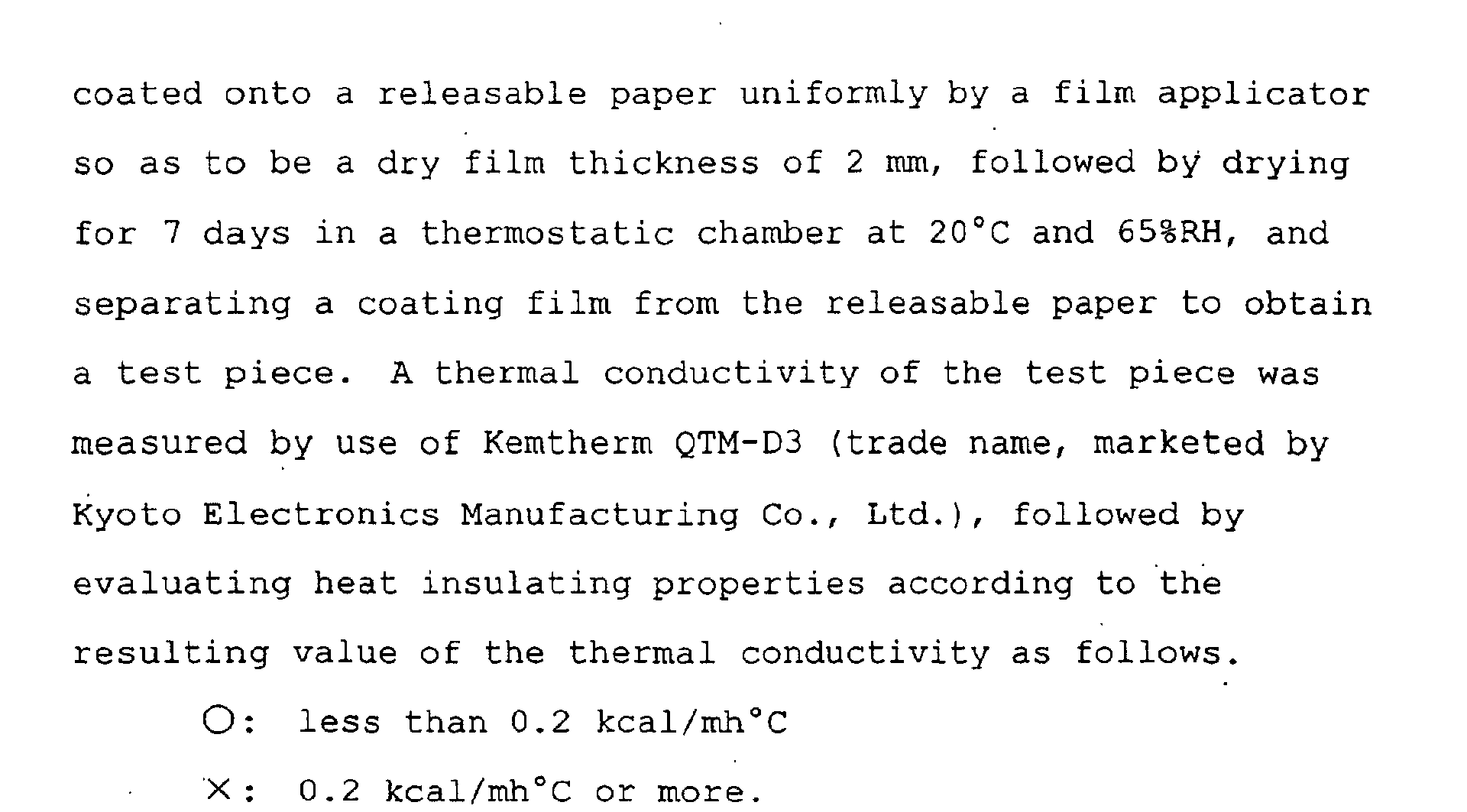
(Note 11) are as follows. A test piece was prepared by a
method as shown in the following (*1), and was subjected to
evaluation of heat insulating properties according to the
following evaluation criteria.
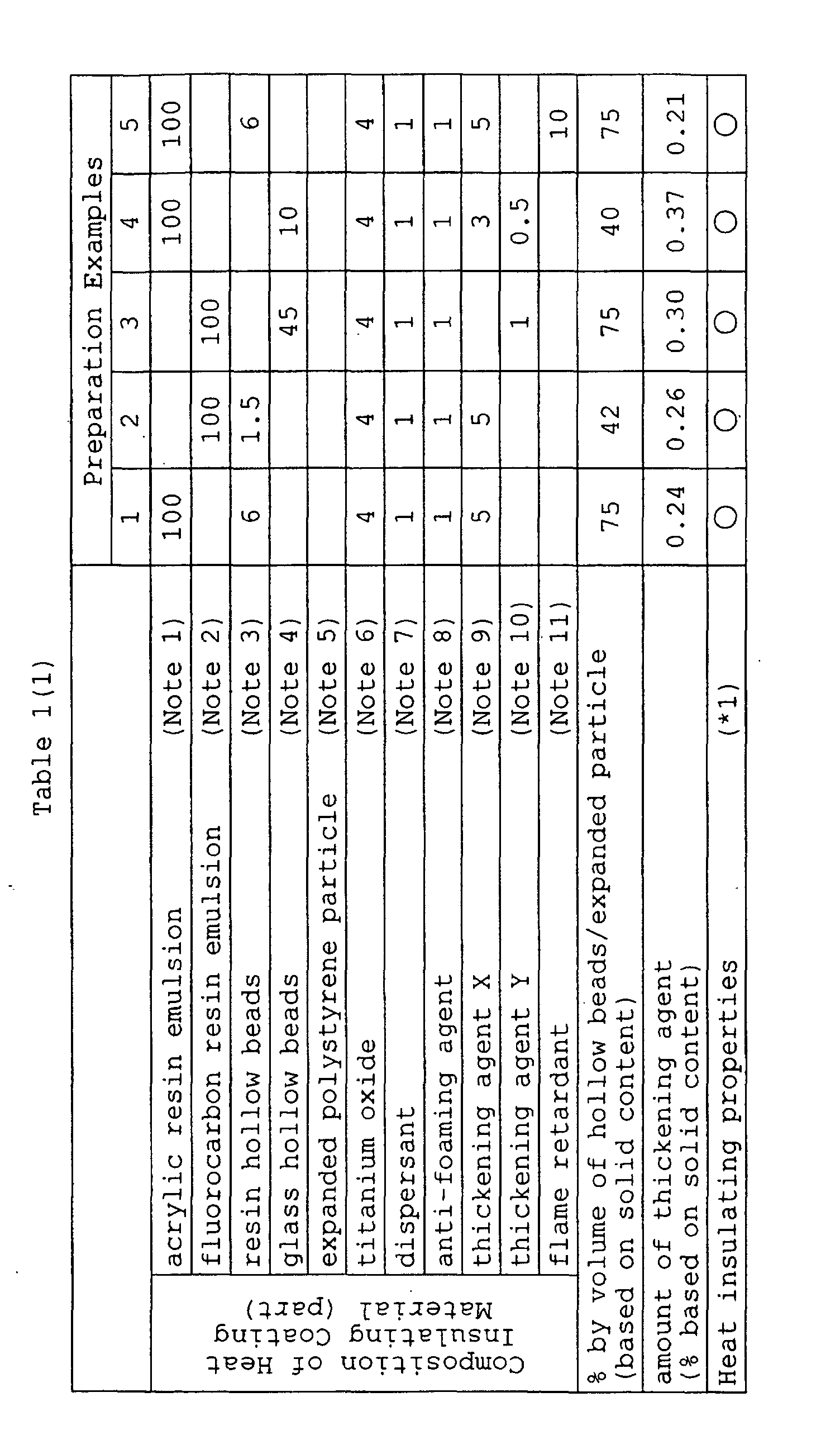
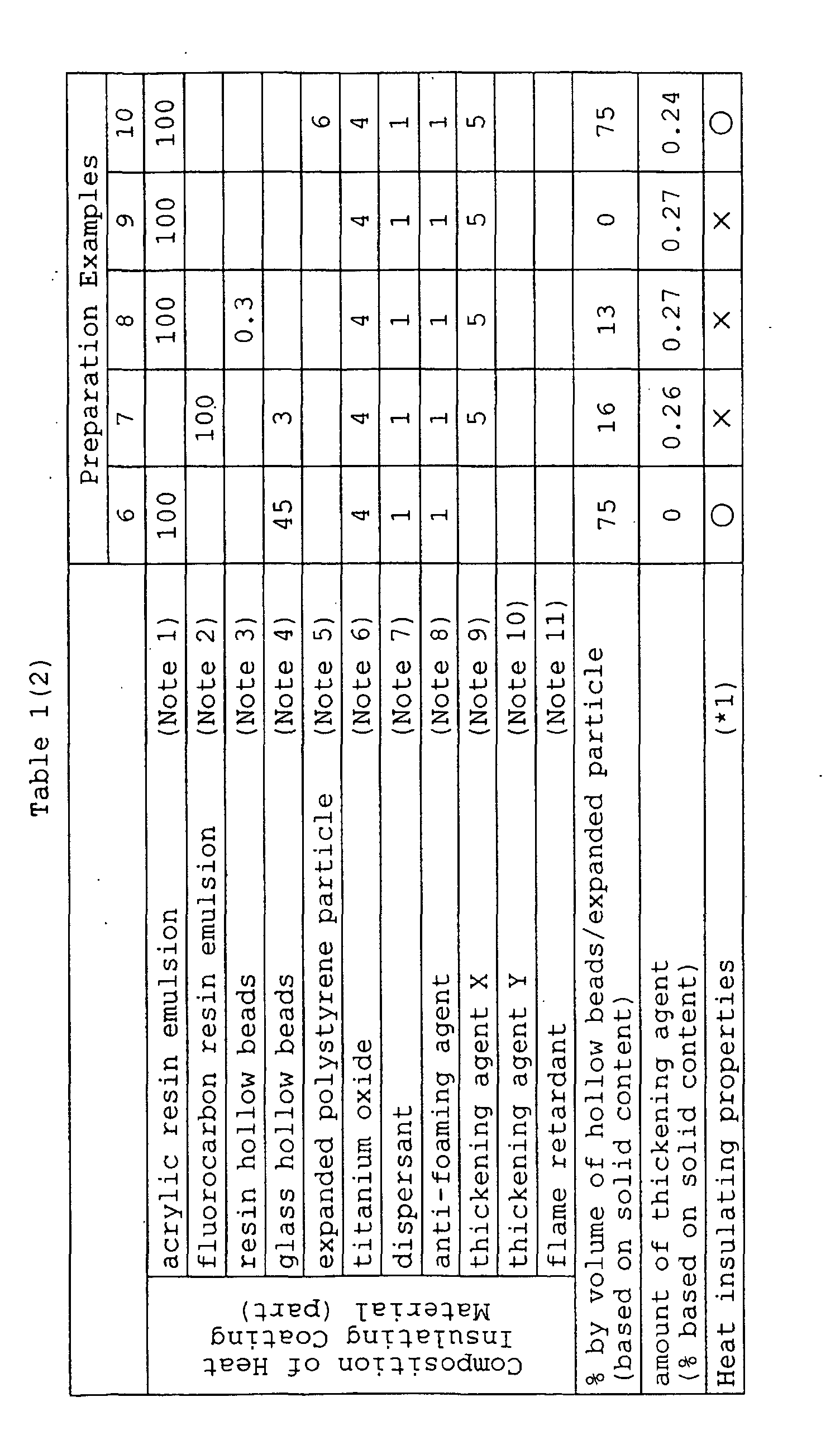

EP Sealer White (trade name, marketed by Kansai Paint
Co., Ltd., water based sealer) was coated onto a slate plate,
followed by drying, coating respective heat insulating
coating materials according to coating methods as shown in
Table 2 onto the resulting dry surface by one coating, drying
for 24 hours in a thermostatic chamber at 20°C·65%RH to
obtain a test plate. Respective test plates were subjected
to evaluations of thick coating properties, beautiful
appearance and weather resistance. The test pieces of
Examples 3 and 7 were subjected to evaluation of flame
retardant properties. The above test plates were vertically
standed, followed by contacting a candle flame onto the
surface of the coating film from side for 20 seconds, and
evaluating conditions just after removing the candle with the
results that flame spread onto the coating film in the case
of Example 3, and flame was immediately extinguished in the
case of Example 7, resulting in showing good flame retardant
effect.
(Note 12) Universal gun: nozzle bore diameter 5 mm.
(*1) Thick coating properties: The thick coating properties were evaluated according to a mean film thickness obtained by one coating according to respective coating methods as follows.
○: 0.2 mm or more
×: less than 0.2 mm.
(*2) Beautiful appearance: A finish surface of the test plate was visually evaluated.
○: showing beautiful appearance due to three dimensional uneven pattern.
×: showing poor beautiful appearance.
(*3) Weather resistance: Conditions of coating film were visually evaluated 250 hours after Sunshine Weather Meter accelerated test.
○: Nothing abnormal.
×: Some abnormalities such as cracking, swelling, color change, chalking and the like.

(Note 12) Universal gun: nozzle bore diameter 5 mm.
(*1) Thick coating properties: The thick coating properties were evaluated according to a mean film thickness obtained by one coating according to respective coating methods as follows.
○: 0.2 mm or more
×: less than 0.2 mm.
(*2) Beautiful appearance: A finish surface of the test plate was visually evaluated.
○: showing beautiful appearance due to three dimensional uneven pattern.
×: showing poor beautiful appearance.
(*3) Weather resistance: Conditions of coating film were visually evaluated 250 hours after Sunshine Weather Meter accelerated test.
○: Nothing abnormal.
×: Some abnormalities such as cracking, swelling, color change, chalking and the like.
According to the method of the present invention,
coating of a heat insulating coating material having a
specified viscosity and containing the resin emulsion, hollow
beads and thickening agent by use of a porous shaped roller
or specified spray coating gun makes it possible to obtain a
thick coating, and to form a heat insulating coating film
showing good properties in coating workability and beautiful
appearance, resulting in preferably being applicable to the
external and internal walls of architectural structure.
Claims (4)
- A heat insulating finish coating method which comprises coating by at least one coating a heat insulating coating material by use of (I) a porous-shaped roller or (II) a spray coating gun having a nozzle bore diameter of 0.3 to 15 mm to form a thick film having an uneven coating surface, said heat insulating coating material containing (A) a resin emulsion, (B) a hollow bead having a mean particle size of 1 to 300 µm and (C) a thickening agent and having a viscosity of 2 to 100 Pa·s, said hollow bead (B) being contained in an amount of 20 to 98% by volume based on a solid content of the heat insulating coating material, said thickening agent (B) being contained in an amount of 0.01 to 5% by weight based on a solid content of the heat insulating coating material.
- A heat insulating finish coating method as claimed in claim 1, wherein the hollow bead (B) is a resin balloon.
- A heat insulating coating material used in the heat insulating finish coating method as claimed in claim 1 or 2.
- A heat insulating coating material as claimed in claim 3, wherein the coating material further contains a flame retardant.
Applications Claiming Priority (3)
| Application Number | Priority Date | Filing Date | Title |
|---|---|---|---|
| JP2001115483 | 2001-04-13 | ||
| JP2001115483 | 2001-04-13 | ||
| PCT/JP2002/003175 WO2002083326A1 (en) | 2001-04-13 | 2002-03-29 | Method of finishing with heat insulation coating |
Publications (2)
| Publication Number | Publication Date |
|---|---|
| EP1388374A1 true EP1388374A1 (en) | 2004-02-11 |
| EP1388374A4 EP1388374A4 (en) | 2005-12-07 |
Family
ID=18966375
Family Applications (1)
| Application Number | Title | Priority Date | Filing Date |
|---|---|---|---|
| EP02708724A Withdrawn EP1388374A4 (en) | 2001-04-13 | 2002-03-29 | Method of finishing with heat insulation coating |
Country Status (4)
| Country | Link |
|---|---|
| US (1) | US20040137160A1 (en) |
| EP (1) | EP1388374A4 (en) |
| JP (1) | JPWO2002083326A1 (en) |
| WO (1) | WO2002083326A1 (en) |
Cited By (9)
| Publication number | Priority date | Publication date | Assignee | Title |
|---|---|---|---|---|
| EP1619223A1 (en) * | 2004-07-21 | 2006-01-25 | Nicole Diplom-Kauffrau Gross | Coating material for painting buildings comprising hollow glass spheres |
| EP1489056A3 (en) * | 2003-06-16 | 2007-07-04 | Lothar Dipl.-Ing. Schuster | Final coating for a heat-storing wall |
| WO2007080361A2 (en) | 2006-01-07 | 2007-07-19 | Polyseam Limited | Composition and method |
| EP1884536A1 (en) * | 2006-07-31 | 2008-02-06 | Bogdan Vasilevich Bodnarchuk | Heat-Reflecting Moisture-Proof Coating Paint |
| RU2318782C1 (en) * | 2006-06-02 | 2008-03-10 | Евгений Борисович Брянцев | Heat-insulating coat |
| CN102399460A (en) * | 2011-09-08 | 2012-04-04 | 皆爱西(上海)节能环保工程有限公司 | Quick-filling particle paint |
| RU2651718C1 (en) * | 2017-04-12 | 2018-04-23 | Федеральное государственное автономное образовательное учреждение высшего образования "Северный (Арктический) федеральный университет имени М.В. Ломоносова" (САФУ) | Mineral binder-based heat-insulating item |
| WO2022076269A1 (en) * | 2020-10-05 | 2022-04-14 | Ppg Industries Ohio, Inc. | High transfer efficiency application methods and shear thinning coating compositions for application using the methods |
| EP4019594A1 (en) * | 2020-12-22 | 2022-06-29 | Christoph Dirks | Wall paint with reduced weight |
Families Citing this family (22)
| Publication number | Priority date | Publication date | Assignee | Title |
|---|---|---|---|---|
| JP4519469B2 (en) * | 2004-01-07 | 2010-08-04 | 日本ペイント株式会社 | Wall remodeling method |
| BRPI0506446A (en) * | 2004-01-08 | 2006-12-26 | Hercules Inc | synthetic thickener compatible paint dye |
| JP5124732B2 (en) * | 2006-05-22 | 2013-01-23 | 浩 川手 | Thermal insulation method and thermal insulation structure |
| JP2008013648A (en) * | 2006-07-05 | 2008-01-24 | Sk Kaken Co Ltd | Foaming fireproof coating |
| JP5311438B2 (en) * | 2007-10-31 | 2013-10-09 | 国立大学法人 名古屋工業大学 | Method for producing hollow particle-containing heat insulating paint |
| JP4778979B2 (en) * | 2008-04-03 | 2011-09-21 | パル・ユニット株式会社 | Coating method for design tile, design tile, polyvinyl chloride sheet or aluminum sheet |
| JP5646826B2 (en) * | 2009-06-26 | 2014-12-24 | 菊水化学工業株式会社 | Paint composition |
| US9085097B2 (en) * | 2010-03-01 | 2015-07-21 | Cook Medical Technologies Llc | Reinforced catheter or sheath with reduced friction surface |
| CN102464932B (en) | 2010-11-16 | 2016-03-30 | 罗门哈斯公司 | Infrared reflective coating composition |
| WO2012131782A1 (en) * | 2011-03-31 | 2012-10-04 | Shimada Susumu | Method for applying heat-blocking film and thermal insulation panel formed by heat-blocking film |
| JP5931517B2 (en) * | 2011-04-20 | 2016-06-08 | 株式会社ミトクハーネス | Paint composition |
| CN102676014B (en) * | 2012-05-30 | 2013-03-13 | 浙江好途程新型建材有限公司 | Staining-resistant heat-insulation coating and preparation method thereof |
| JP6208984B2 (en) * | 2013-06-07 | 2017-10-04 | ケイミュー株式会社 | Painted body |
| JP6321934B2 (en) * | 2013-09-30 | 2018-05-09 | マツダ株式会社 | Method for manufacturing a heat insulating layer on a member surface facing an engine combustion chamber |
| JP6207071B2 (en) * | 2013-11-19 | 2017-10-04 | 関西ペイント株式会社 | Matte thermal barrier coating composition and coating film forming method using the composition |
| JP6635545B2 (en) * | 2016-02-09 | 2020-01-29 | 四国化成工業株式会社 | Wall coating material |
| JP6158975B1 (en) * | 2016-03-31 | 2017-07-05 | 日本ペイント株式会社 | Paint composition |
| JPWO2017200090A1 (en) * | 2016-05-20 | 2019-05-30 | 株式会社日進産業 | Thin film structure for suppressing heat transfer, and structure and substrate on which the thin film structure is laminated |
| KR102069312B1 (en) * | 2016-06-27 | 2020-01-22 | 주식회사 엘지화학 | Preparation method of super absorbent polymer, and super absorbent polymer |
| KR102069313B1 (en) * | 2016-06-27 | 2020-01-22 | 주식회사 엘지화학 | Preparation method of super absorbent polymer, and super absorbent polymer |
| JP7025841B2 (en) * | 2017-02-02 | 2022-02-25 | 大日本塗料株式会社 | Paint composition and multi-layer coating |
| JP7785860B1 (en) * | 2024-07-05 | 2025-12-15 | 大日本塗料株式会社 | Water-based coating composition and building |
Family Cites Families (11)
| Publication number | Priority date | Publication date | Assignee | Title |
|---|---|---|---|---|
| JPS536340A (en) * | 1976-07-06 | 1978-01-20 | Toppan Printing Co Ltd | Coating compositions |
| DE2939141C2 (en) * | 1979-09-27 | 1982-07-08 | Basf Farben + Fasern Ag, 2000 Hamburg | Use of coating compounds |
| US4413026A (en) * | 1981-06-30 | 1983-11-01 | Aperm Of South Carolina | Method for weatherproofing substrates |
| US4666960A (en) * | 1982-12-16 | 1987-05-19 | Spain Raymond G | Fire retardant coating for combustible substrates |
| JPH0625318B2 (en) * | 1988-05-17 | 1994-04-06 | 大日本塗料株式会社 | Multicolor pattern forming paint and multicolor pattern forming method |
| JPH0342075A (en) * | 1989-07-10 | 1991-02-22 | Ig Tech Res Inc | Coating method |
| JP4176847B2 (en) * | 1997-03-24 | 2008-11-05 | 関西ペイント株式会社 | Thick film type elastic heat insulating coating material and coating heat insulating method using the same |
| US6214450B1 (en) * | 1998-02-25 | 2001-04-10 | Tremco Incorporated | High solids water-borne surface coating containing hollow particulates |
| US6103003A (en) * | 1998-03-28 | 2000-08-15 | Ledbetter; C. Burgess | Textured coating and method of applying same |
| JP2000153570A (en) * | 1998-11-19 | 2000-06-06 | Yamamoto Yogyo Kako Kk | Decorative sheet for building surface finishing |
| JP2001040290A (en) * | 1999-07-30 | 2001-02-13 | Kikusui Chemical Industries Co Ltd | Foamed fireproof paint |
-
2002
- 2002-03-29 WO PCT/JP2002/003175 patent/WO2002083326A1/en not_active Ceased
- 2002-03-29 EP EP02708724A patent/EP1388374A4/en not_active Withdrawn
- 2002-03-29 JP JP2002581119A patent/JPWO2002083326A1/en active Pending
- 2002-03-29 US US10/474,661 patent/US20040137160A1/en not_active Abandoned
Cited By (10)
| Publication number | Priority date | Publication date | Assignee | Title |
|---|---|---|---|---|
| EP1489056A3 (en) * | 2003-06-16 | 2007-07-04 | Lothar Dipl.-Ing. Schuster | Final coating for a heat-storing wall |
| EP1619223A1 (en) * | 2004-07-21 | 2006-01-25 | Nicole Diplom-Kauffrau Gross | Coating material for painting buildings comprising hollow glass spheres |
| WO2007080361A2 (en) | 2006-01-07 | 2007-07-19 | Polyseam Limited | Composition and method |
| WO2007080361A3 (en) * | 2006-01-07 | 2007-09-07 | Polyseam Ltd | Composition and method |
| RU2318782C1 (en) * | 2006-06-02 | 2008-03-10 | Евгений Борисович Брянцев | Heat-insulating coat |
| EP1884536A1 (en) * | 2006-07-31 | 2008-02-06 | Bogdan Vasilevich Bodnarchuk | Heat-Reflecting Moisture-Proof Coating Paint |
| CN102399460A (en) * | 2011-09-08 | 2012-04-04 | 皆爱西(上海)节能环保工程有限公司 | Quick-filling particle paint |
| RU2651718C1 (en) * | 2017-04-12 | 2018-04-23 | Федеральное государственное автономное образовательное учреждение высшего образования "Северный (Арктический) федеральный университет имени М.В. Ломоносова" (САФУ) | Mineral binder-based heat-insulating item |
| WO2022076269A1 (en) * | 2020-10-05 | 2022-04-14 | Ppg Industries Ohio, Inc. | High transfer efficiency application methods and shear thinning coating compositions for application using the methods |
| EP4019594A1 (en) * | 2020-12-22 | 2022-06-29 | Christoph Dirks | Wall paint with reduced weight |
Also Published As
| Publication number | Publication date |
|---|---|
| WO2002083326A1 (en) | 2002-10-24 |
| JPWO2002083326A1 (en) | 2004-08-05 |
| US20040137160A1 (en) | 2004-07-15 |
| EP1388374A4 (en) | 2005-12-07 |
Similar Documents
| Publication | Publication Date | Title |
|---|---|---|
| US20040137160A1 (en) | Method of finishing with heat insulation coating | |
| CA2158088C (en) | Waterproof lightweight grain-tone decorative panel | |
| SK95493A3 (en) | Sealing or acrylic caulking agent | |
| JP2004183331A (en) | Heat insulating structure | |
| EP1006094B1 (en) | A method of coating an uncured mineral substrate | |
| JP2000230287A (en) | Foamed refractory laminate and method of forming the same | |
| JP4176847B2 (en) | Thick film type elastic heat insulating coating material and coating heat insulating method using the same | |
| KR100784738B1 (en) | High Density Oil-Based Foam Refractory Paint Composition Having Fire Resistance and Coating Method Thereof | |
| JP3285510B2 (en) | Multi-painted plaster-like finish coating material | |
| KR100198014B1 (en) | Water-based paints and paint finishing method using the same | |
| JP3490855B2 (en) | Thick film type elastic heat insulating coating material and coating heat insulating method using the same | |
| JP2000186229A (en) | Thick film insulation paint | |
| JP3165607B2 (en) | Concrete surface thickening rock style makeup method | |
| JP2004183330A (en) | Construction method for coating layered product | |
| EP0970931A1 (en) | Compositions useful for suppressing efflorescence on mineral substrates | |
| KR20040045548A (en) | Water-based paint materials for heat insulating and dew condensation protecting | |
| JP2000186239A (en) | Thermal insulation paint | |
| EP1260553B1 (en) | Aqueous polymer blend composition | |
| JP2000219823A (en) | Limy finish coating material composition | |
| JP6108424B2 (en) | Laminated structure | |
| JP7785860B1 (en) | Water-based coating composition and building | |
| EP1260554B1 (en) | Aqueous polymer composition | |
| JPH11228863A (en) | Heat insulating coating material | |
| JP5564169B2 (en) | Thermal insulation structure | |
| CA2315839C (en) | A method of coating an uncured mineral substrate |
Legal Events
| Date | Code | Title | Description |
|---|---|---|---|
| PUAI | Public reference made under article 153(3) epc to a published international application that has entered the european phase |
Free format text: ORIGINAL CODE: 0009012 |
|
| 17P | Request for examination filed |
Effective date: 20031105 |
|
| AK | Designated contracting states |
Kind code of ref document: A1 Designated state(s): AT BE CH CY DE DK ES FI FR GB GR IE IT LI LU MC NL PT SE TR |
|
| AX | Request for extension of the european patent |
Extension state: AL LT LV MK RO SI |
|
| A4 | Supplementary search report drawn up and despatched |
Effective date: 20051025 |
|
| STAA | Information on the status of an ep patent application or granted ep patent |
Free format text: STATUS: THE APPLICATION HAS BEEN WITHDRAWN |
|
| 18W | Application withdrawn |
Effective date: 20060220 |