EP1384677A1 - Dispositif comportant au moins deux boítiers configurés pour pouvoir se superposer - Google Patents
Dispositif comportant au moins deux boítiers configurés pour pouvoir se superposer Download PDFInfo
- Publication number
- EP1384677A1 EP1384677A1 EP03291758A EP03291758A EP1384677A1 EP 1384677 A1 EP1384677 A1 EP 1384677A1 EP 03291758 A EP03291758 A EP 03291758A EP 03291758 A EP03291758 A EP 03291758A EP 1384677 A1 EP1384677 A1 EP 1384677A1
- Authority
- EP
- European Patent Office
- Prior art keywords
- housings
- housing
- axis
- container
- cover
- Prior art date
- Legal status (The legal status is an assumption and is not a legal conclusion. Google has not performed a legal analysis and makes no representation as to the accuracy of the status listed.)
- Granted
Links
Images


Classifications
-
- B—PERFORMING OPERATIONS; TRANSPORTING
- B65—CONVEYING; PACKING; STORING; HANDLING THIN OR FILAMENTARY MATERIAL
- B65D—CONTAINERS FOR STORAGE OR TRANSPORT OF ARTICLES OR MATERIALS, e.g. BAGS, BARRELS, BOTTLES, BOXES, CANS, CARTONS, CRATES, DRUMS, JARS, TANKS, HOPPERS, FORWARDING CONTAINERS; ACCESSORIES, CLOSURES, OR FITTINGS THEREFOR; PACKAGING ELEMENTS; PACKAGES
- B65D43/00—Lids or covers for rigid or semi-rigid containers
- B65D43/14—Non-removable lids or covers
- B65D43/16—Non-removable lids or covers hinged for upward or downward movement
- B65D43/162—Non-removable lids or covers hinged for upward or downward movement the container, the lid and the hinge being made of one piece
-
- B—PERFORMING OPERATIONS; TRANSPORTING
- B65—CONVEYING; PACKING; STORING; HANDLING THIN OR FILAMENTARY MATERIAL
- B65D—CONTAINERS FOR STORAGE OR TRANSPORT OF ARTICLES OR MATERIALS, e.g. BAGS, BARRELS, BOTTLES, BOXES, CANS, CARTONS, CRATES, DRUMS, JARS, TANKS, HOPPERS, FORWARDING CONTAINERS; ACCESSORIES, CLOSURES, OR FITTINGS THEREFOR; PACKAGING ELEMENTS; PACKAGES
- B65D51/00—Closures not otherwise provided for
- B65D51/24—Closures not otherwise provided for combined or co-operating with auxiliary devices for non-closing purposes
- B65D51/28—Closures not otherwise provided for combined or co-operating with auxiliary devices for non-closing purposes with auxiliary containers for additional articles or materials
-
- B—PERFORMING OPERATIONS; TRANSPORTING
- B65—CONVEYING; PACKING; STORING; HANDLING THIN OR FILAMENTARY MATERIAL
- B65D—CONTAINERS FOR STORAGE OR TRANSPORT OF ARTICLES OR MATERIALS, e.g. BAGS, BARRELS, BOTTLES, BOXES, CANS, CARTONS, CRATES, DRUMS, JARS, TANKS, HOPPERS, FORWARDING CONTAINERS; ACCESSORIES, CLOSURES, OR FITTINGS THEREFOR; PACKAGING ELEMENTS; PACKAGES
- B65D81/00—Containers, packaging elements, or packages, for contents presenting particular transport or storage problems, or adapted to be used for non-packaging purposes after removal of contents
- B65D81/32—Containers, packaging elements, or packages, for contents presenting particular transport or storage problems, or adapted to be used for non-packaging purposes after removal of contents for packaging two or more different materials which must be maintained separate prior to use in admixture
- B65D81/3205—Separate rigid or semi-rigid containers joined to each other at their external surfaces
Definitions
- the present invention relates to packaging devices, and more particularly those intended to contain at least one cosmetic product.
- cosmetic product is meant a product as defined in the Directive 93/35 / EEC of June 14, 1993.
- the invention relates to a device comprising at at least two boxes configured so that they can overlap along an axis stacking and at least one hinge for pivoting at least partially one of the housings relative to the other about a geometric axis of non-parallel rotation to the stacking axis, the housings each defining a housing.
- the geometric axis of rotation can be perpendicular to the stacking axis.
- the device can be configured so that the housings of the two boxes can be opened independently of each other.
- the different boxes when superimposed, form a column which is behaves like a single piece that can be easily transported or stored.
- the user can "break" the column by rotating one by compared to the other two boxes, which allows access to the housing of one of the boxes.
- the column can be manipulated while the user is holding it with one hand.
- the user can be exempted from fitting a cover to access one of the housings, which facilitates the use of the device in particular in environments individuals such as the car or transport, in which the user does not have necessarily a stable horizontal flat surface where to put a cover. Avoiding having to put a cover also reduces the risk of bringing the cover in contact with clothes, for example, and stain them.
- One of the cases may have a cover, connected by the hinge to this housing, and the other housing can be fixed on this cover, in particular removably.
- One of the boxes can also be configured to form a cover for closing of the other box.
- Each box can have a cover.
- each cover can be secured to the case which is immediately superior to it when the cases are superimposed and the axis of the stack is vertical.
- each box can be used, except for the lowest case, to closing cover for the box immediately below it when the housings are superimposed and the axis of the stack is vertical.
- All boxes can be stacked in the same direction, or at least two of them, or even three boxes can be stacked in the same direction.
- Enclosures may each have an opening, the openings being directed in the same direction, especially up.
- At least one of the housings can be sealed when the boxes are superimposed. All housings can be sealed.
- the device can include at least two boxes, or even at least three enclosures, in particular four or even five enclosures, configured so that they can be overlap, and at least two hinges, or even at least three hinges.
- the device can comprise at least two hinges offset angularly around the stacking axis of the boxes. Two hinges can be offset angularly from an angle other than 180 °.
- At least one of the housings can contain a product, in particular a product cosmetic or care. At least two or more dwellings can contain different products, for example products with different colors or products containing different active ingredients.
- At least one of the housings can also contain an application member, in particular the housing defined by an end box.
- the device may include fixing means by screwing, snap-fastening or by friction on a container or on a closure cap of a container.
- the device can also be devoid of snap fastening means, screwing or friction on a container.
- the invention also relates to a device comprising at least two boxes configured so that they can be superimposed along a stacking axis, one at less of the housings having a hinged cover with a hinge, the other housing being attached to this cover, the hinge making it possible to pivot at least partially one of the housings relative to the other around a geometric axis of rotation not parallel to the stacking axis.
- the cover can be arranged so as to allow the removable fixing of the other box.
- the invention also relates to a device comprising at least three housings configured so that they can overlap along a stacking axis and at least one hinge making it possible to pivot at least partially one of the housings relative to another around a geometric axis of rotation not parallel to the stacking axis, these enclosures each defining a housing, each housing serving, except for the most bottom, closing cover for the case which is immediately below it when the boxes are superimposed and that the stacking axis is vertical.
- the invention also relates to a device comprising at least two boxes configured so that they can be superimposed along a stacking axis, and at minus a hinge connecting the two housings and allowing to rotate at least partially one of the housings relative to the other around a geometric axis of rotation not parallel to the stacking axis, these housings each defining a housing, at least two of the dwellings with different products.
- the invention also relates to a device comprising at least three housings configured so that they can overlap along a stacking axis, and at least one hinge making it possible to pivot at least partially one of the housings relative to the other around a geometric axis of rotation not parallel to the stacking axis, these housings each defining a housing, at least one of the housings being fixed so removable on the immediately lower case.
- the invention also relates to a device comprising at least two boxes configured so that they can be superimposed along a stacking axis, and at at least one hinge allowing one of the housings to be pivoted at least partially relative to each other around a geometric axis of rotation not parallel to the axis stacking, these boxes each defining a housing, at least the defined housing by the end box comprising an applicator member.
- the subject of the invention is also a capsule for closing a container, comprising a device as defined above.
- the capsule may include a base portion configured to attach to a container and allow the removable attachment of a device as defined above.
- the invention also relates to a container equipped with a device such as defined above.
- the container closure cap may include at least three housings.
- At least one of the boxes can be removably attached to the box immediately lower.
- FIG. 1 and 2 there is shown in Figures 1 and 2 an example of device 1 made according to the invention, comprising a plurality of housings which can be superimposed along a stacking axis X, namely a lower housing 2 and an upper housing 3, and possibly between them one or more intermediate boxes 4.
- Hinges 7 allow each housing to be pivoted at least partially relative to a adjacent housing.
- Each hinge 7 is preferably a film hinge produced by plastic molding with at least one of the housings.
- hinge 7. This can include two bridges of material 8 each comprising a zone thinned 9 allowing pivoting around a geometric axis of rotation Z no parallel to the stacking axis X and between the two material bridges 8 a connecting tab 10, configured to tend to hold the hinge in the open position when both parts hinged to each other have pivoted beyond a certain angular travel, by example of the order of 90 °.
- the connecting tab 10 goes through a state of maximum stress when the opening stroke reaches this value.
- the Z axis is substantially perpendicular to the X axis.
- hinges could still be used without it being sort of the scope of the present invention, for example film hinges devoid of connecting lug 10 and comprising for example only one bridge of material 8.
- Each box 2, 3 or 4 defines a housing 12 which can contain a product cosmetic P.
- the product P can be contained directly in the corresponding box, as illustrated in FIG. 4, or be contained in a cup 13, as illustrated in the Figure 5, this cup 13 can for example be removed if necessary from the housing 4 for replace it.
- the housings can be made of a plastic material, in particular a transparent or translucent plastic material.
- the hinges 7 are offset angularly with respect to each other around the stacking axis X.
- the first two housings there is shown, for the sake of clarity of the drawing, that the first two housings.
- the offset of the hinges 7 facilitates access to the legs 14 and 15, in particular when each housing has a relatively low height.
- Each case may include a body 16 and a cover 17 connected to the body 16 by the corresponding hinge 7, and the housing which is immediately above it can have a bottom wall 18 which is fixed for example by means of a layer of adhesive 19 on the upper face of the cover 17, as shown in FIG. 7. It can be seen in additionally in FIG. 7 that the cover 17 may include a sealing lip 24 intended to be applied to the inner surface of the body 16 of the lower housing.
- the upper housing may include means for attachment 21 intended to cooperate with complementary attachment means 22 integral of the cover 17.
- the fixing means 20 and 21 are configured to cooperate by latching in the example illustrated, but they could still cooperate by screwing or by friction.
- the force required to separate the housing from the cover is greater than that required to cause the lid to open.
- the wall bottom of the upper case so that it serves as a cover for the lower case, as illustrated in Figure 9.
- the bottom wall 18 of the upper housing has a sealing lip 24 configured to adjust sealingly on the inner surface of the body of the lower case.
- At least one of the housings 12 can be configured to receive not a product but an applicator member 27, as illustrated in FIG. 10.
- FIG. 10 partially shown the end box 3 with a cover 17 comprising a wall 28 configured to allow the application member 27 to be housed in the housing 3.
- the column of housings can be part of a closure capsule 29 of a container 30, as illustrated in FIG. 11.
- Such a closure cap 29 may include, as can be seen in the Figure 12, a skirt 32 configured to be screwed onto a threaded neck of the container 30 and a sealing lip 33 intended to be applied against a corresponding surface of the container 30, in order to obtain a tight closure thereof.
- the upper part of the closure cap is configured so as to form the body 34 of a first housing of the column, this body defining a housing 12 containing a product P.
- FIG. 13 shows a column of housings 2, 3, 4 similar to that described with reference to Figures 1 to 8, the housing 2 being further provided with means for attachment to a closure cap 39 of a container 30.
- the container 30 with a shape different from that of the container of FIG. 11, to illustrate the fact that the invention was not limited to a container having a particular shape.
- the housing 2 can be provided with a thread 40 intended to cooperate with a corresponding thread 41 of the capsule 39.
- the housing 2 can be provided for this purpose, by example, of an annular bead 43 intended to snap into an annular groove corresponding 44 produced on the capsule 39.
- the housing has a fixing part 45 configured to cooperate by friction with a surface 46 of the capsule 39.
- the user can "break” the column at the height corresponding to the product he wishes to use.
- the column “broken” at the end box 2 and FIG. 18, the “broken” column at the level of a housing adjacent to the housing 2.
- the user Before or after having “opened” the column to the desired level, the user can separate the capsule 39 from the container 30 and use for example an applicator member 48 integral with the container 30 for taking the product P contained in the housing which has been open, as illustrated in figure 19.
- the user can take only one product and then apply it on the support to be treated or, alternatively, remove for example by means of the same applicator body 48 several products successively in different housings of the column, for example to create a mixture of colors or textures.
- At least one of the products contained in the various housings 12 of the column can for example be composed of solid bodies of a relatively large important, for example glitter, which would be unable to pass through the organ application 48 if they were contained in the container 30, in the case where this member Application 48 would consist of a porous material, for example a foam.
- the product contained in the container 30 may for example be a liquid foundation and the user can come and collect with the application member 48, in one of the housings, glitter having the desired color.
- the column of boxes can include a number of boxes different from those of the examples illustrated, for example two boxes only, or three boxes, or even four boxes.
- the column of housings can also be associated with a container on which is fixed an application member other than a foam, for example a frit.
Landscapes
- Engineering & Computer Science (AREA)
- Mechanical Engineering (AREA)
- Closures For Containers (AREA)
- Stackable Containers (AREA)
- Details Of Rigid Or Semi-Rigid Containers (AREA)
- Packages (AREA)
Abstract
Description
- un corps de récipient, et
- une capsule de fermeture, la capsule de fermeture comportant :
- au moins deux boítiers configurés de manière à pouvoir se superposer selon un axe d'empilement, et
- au moins une charnière permettant de faire pivoter au moins partiellement l'un des boítiers par rapport à l'autre autour d'un axe géométrique de rotation non parallèle à l'axe d'empilement, ces boítiers définissant chacun un logement.
- un corps de récipient, et
- une capsule de fermeture comportant au moins deux boítiers configurés de manière à pouvoir se superposer selon un axe d'empilement, et au moins une charnière permettant de faire pivoter au moins partiellement l'un des boítiers par rapport à l'autre autour d'un axe géométrique de rotation non parallèle à l'axe d'empilement, ces boítiers définissant chacun un logement, au moins l'un des boítiers comportant un organe d'application.
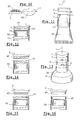
- la figure 1 représente en élévation un exemple de dispositif réalisé conformément à l'invention, les boítiers étant superposés et les logements correspondants fermés,
- la figure 2 représente le dispositif de la figure 1 après ouverture de la colonne,
- la figure 3 est une vue partielle et schématique, en perspective, d'un détail du dispositif des figures 1 et 2,
- la figure 4 est une vue partielle et schématique, en perspective, représentant le logement du boítier qui a été ouvert,
- la figure 5 est une vue analogue à la figure 4 illustrant une variante de réalisation dans laquelle le produit est contenu dans une coupelle placée à l'intérieur du boítier,
- la figure 6 est une vue schématique et partielle de dessus selon VI de la figure 1,
- les figures 7 à 9 illustrent, en coupe axiale, différentes possibilités parmi d'autres pour rendre les boítiers solidaires entre eux,
- la figure 10 illustre la possibilité de configurer le dispositif de manière à recevoir un organe d'application dans l'un des boítiers,
- la figure 11 représente un exemple de mise en oeuvre de l'invention dans lequel le dispositif est associé à une capsule de fermeture d'un récipient,
- la figure 12 est une coupe partielle et schématique du dispositif de la figure 9,
- la figure 13 représente une variante de réalisation dans laquelle la colonne de boítiers peut être fixée de manière amovible sur une capsule de fermeture d'un récipient,
- les figures 14 à 16 sont des coupes axiales schématiques illustrant différentes possibilités de fixation de la colonne sur la capsule de fermeture,
- les figures 17 et 18 illustrent la possibilité de casser la colonne à différentes hauteurs en fonction du produit auquel on souhaite accéder, et
- la figure 19 illustre le prélèvement du produit effectué au moyen d'un organe d'application monté sur le récipient.
Claims (33)
- Dispositif comportant au moins deux boítiers (2, 3, 4) configurés de manière à pouvoir se superposer selon un axe (X) d'empilement, l'un au moins des boítiers comportant un couvercle articulé avec une charnière (7), l'autre boítier étant rapporté sur ce couvercle, la charnière permettant de faire pivoter au moins partiellement l'un des boítiers par rapport à l'autre autour d'un axe géométrique de rotation (Z) non parallèle avec l'axe d'empilement.
- Dispositif selon la revendication précédente, caractérisé par le fait que les boítiers définissent chacun un logement (12), le dispositif étant configuré de telle sorte que les logements (12) puissent être ouverts indépendamment les uns des autres.
- Dispositif selon l'une des revendications 1 ou 2, caractérisé par le fait que chaque boítier comporte un couvercle de fermeture.
- Dispositif selon la revendication précédente, caractérisé par le fait que, sauf pour le couvercle de dessus, chaque couvercle (17) est solidaire du boítier qui lui est immédiatement supérieur lorsque les boítiers sont superposés et que l'axe d'empilement est vertical.
- Dispositif selon l'une quelconque des revendications précédentes, les boítiers définissant chacun un logement, caractérisé par le fait qu'au moins l'un des logements (12) est fermé d'une façon étanche lorsque les boítiers sont superposés.
- Dispositif selon l'une quelconque des revendications précédentes, caractérisé par le fait que le couvercle est agencé de manière à permettre la fixation amovible de l'autre boítier.
- Dispositif selon l'une quelconque des revendications précédentes, caractérisé par le fait qu'il comporte au moins deux charnières (7).
- Dispositif selon la revendication précédente, caractérisé par le fait que les charnières sont décalées angulairement autour de l'axe (X) d'empilement des boítiers.
- Dispositif selon l'une quelconque des revendications précédentes, caractérisé par le fait qu'au moins l'un des logements (12) contient un produit (P) cosmétique ou de soin.
- Dispositif selon l'une quelconque des revendications précédentes, caractérisé par le fait qu'au moins l'un des logements contient un organe d'application (27).
- Dispositif selon l'une quelconque des revendications précédentes, caractérisé par le fait qu'il comporte des moyens de fixation par vissage, encliquetage ou par friction sur un récipient (30) ou sur une capsule (39) de fermeture d'un récipient.
- Dispositif selon l'une quelconque des revendications 1 à 10, caractérisé par le fait qu'il est dépourvu de moyens de fixation par encliquetage, vissage ou friction sur un récipient.
- Dispositif comportant au moins deux boítiers (2, 3, 4) configurés de manière à pouvoir se superposer selon un axe (X) d'empilement et au moins une charnière (7) reliant les deux boítiers et permettant de faire pivoter au moins partiellement l'un des boítiers par rapport à l'autre autour d'un axe géométrique de rotation (Z) non parallèle à l'axe d'empilement, ces boítiers définissant chacun un logement (12), au moins deux des logements comportant des produits différents.
- Dispositif comportant au moins trois boítiers configurés de manière à pouvoir se superposer selon un axe d'empilement et au moins une charnière permettant de faire pivoter au moins partiellement l'un des boítiers par rapport à un autre autour d'un axe géométrique de rotation non parallèle à l'axe d'empilement, ces boítiers définissant chacun un logement, chaque boítier servant, sauf pour le boítier le plus bas, de couvercle de fermeture pour le boítier qui lui est immédiatement inférieur lorsque les boítiers sont superposés et que l'axe d'empilement est vertical.
- Dispositif comportant au moins trois boítiers configurés de manière à pouvoir se superposer selon un axe d'empilement, et au moins une charnière permettant de faire pivoter au moins partiellement l'un des boítiers par rapport à l'autre autour d'un axe géométrique de rotation non parallèle à l'axe d'empilement, ces boítiers définissant chacun un logement, au moins l'un des boítiers étant fixé de manière amovible sur le boítier immédiatement inférieur.
- Dispositif comportant au moins deux boítiers configurés de manière à pouvoir se superposer selon un axe d'empilement, et au moins une charnière permettant de faire pivoter au moins partiellement l'un des boítiers par rapport à l'autre autour d'un axe géométrique de rotation non parallèle à l'axe d'empilement, ces boítiers définissant chacun un logement, au moins le logement défini par le boítier d'extrémité comportant un organe d'application.
- Capsule de fermeture d'un récipient, caractérisée par le fait qu'elle comporte un dispositif tel que défini dans l'une quelconque des revendications 1 à 11 ou 14 à 16.
- Capsule selon la revendication 18, caractérisée par le fait qu'elle comporte une partie de base configurée pour se fixer sur un récipient et permettre la fixation amovible d'un dispositif tel que défini dans l'une quelconque des revendications 1 à 11 ou 14 à 16.
- Récipient équipé d'un dispositif tel que défini dans l'une quelconque des revendications 1 à 11 ou 14 à 16.
- Récipient comportant :un corps de récipient, etune capsule de fermeture, la capsule de fermeture comportant :au moins deux boítiers configurés de manière à pouvoir se superposer selon un axe d'empilement, etau moins une charnière permettant de faire pivoter au moins partiellement l'un des boítiers par rapport à l'autre autour d'un axe géométrique de rotation non parallèle à l'axe d'empilement, ces boítiers définissant chacun un logement.
- Récipient selon la revendication précédente, caractérisé par le fait que la capsule comporte au moins trois boítiers.
- Récipient selon l'une quelconque des deux revendications précédentes, caractérisé par le fait qu'au moins l'un des boítiers est fixé de façon amovible sur le boítier immédiatement inférieur.
- Récipient selon l'une quelconque des revendications 20 à 22, caractérisé par le fait qu'il est configuré de telle sorte que les logements (12) puissent être ouverts indépendamment les uns des autres.
- Récipient selon l'une quelconque des revendications 20 à 23, caractérisé par le fait que l'un des boítiers comporte un couvercle (17), relié par la charnière (7) à ce boítier, et par le fait que l'autre boítier est fixé sur ce couvercle.
- Récipient selon l'une quelconque des revendications 20 à 23, caractérisé par le fait que l'un des boítiers est configuré pour former un couvercle de fermeture de l'autre boítier.
- Récipient selon l'une quelconque des revendications 20 à 24, caractérisé par le fait que chaque boítier comporte un couvercle de fermeture.
- Récipient selon la revendication précédente, caractérisé par le fait que, sauf pour le couvercle de dessus, chaque couvercle (17) est solidaire du boítier qui lui est immédiatement supérieur lorsque les boítiers sont superposés et que l'axe d'empilement est vertical.
- Récipient selon la revendication 25, caractérisé par le fait que, sauf pour le boítier le plus bas, chaque boítier sert de couvercle de fermeture pour le boítier qui lui est immédiatement inférieur lorsque les boítiers sont superposés et que l'axe d'empilement est vertical.
- Récipient selon l'une quelconque des revendications 20 à 28, caractérisé par le fait qu'au moins l'un des logements (12) est fermé d'une façon étanche lorsque les boítiers sont superposés.
- Récipient selon l'une quelconque des revendications 20 à 29, caractérisé par le fait qu'il comporte au moins deux charnières (7).
- Récipient selon la revendication précédente, caractérisé par le fait que les charnières sont décalées angulairement autour de l'axe (X) d'empilement des boítiers.
- Récipient selon l'une quelconque des revendications 20 à 31, caractérisé par le fait qu'au moins l'un des logements (12) contient un produit (P), notamment un produit cosmétique ou de soin.
- Récipient selon l'une quelconque des revendications 20 à 32, caractérisé par le fait qu'au moins l'un des logements contient un organe d'application (27).
Applications Claiming Priority (2)
| Application Number | Priority Date | Filing Date | Title |
|---|---|---|---|
| FR0209059 | 2002-07-17 | ||
| FR0209059A FR2842506B1 (fr) | 2002-07-17 | 2002-07-17 | Dispositif comportant au moins deux boitiers configures pour pouvoir se superposer |
Publications (2)
| Publication Number | Publication Date |
|---|---|
| EP1384677A1 true EP1384677A1 (fr) | 2004-01-28 |
| EP1384677B1 EP1384677B1 (fr) | 2007-03-14 |
Family
ID=29797509
Family Applications (1)
| Application Number | Title | Priority Date | Filing Date |
|---|---|---|---|
| EP20030291758 Expired - Lifetime EP1384677B1 (fr) | 2002-07-17 | 2003-07-16 | Récipient fermé par une capsule comportant des boîtiers |
Country Status (5)
| Country | Link |
|---|---|
| EP (1) | EP1384677B1 (fr) |
| JP (2) | JP4118203B2 (fr) |
| DE (1) | DE60312441T2 (fr) |
| ES (1) | ES2283728T3 (fr) |
| FR (1) | FR2842506B1 (fr) |
Cited By (2)
| Publication number | Priority date | Publication date | Assignee | Title |
|---|---|---|---|---|
| DE102006002865A1 (de) * | 2006-01-19 | 2007-08-02 | Henkel Kgaa | Behälterverschluss |
| GB2501529A (en) * | 2012-04-27 | 2013-10-30 | Richard Colin Thomas Allan | A cosmetics container with a mixing medium well |
Citations (10)
| Publication number | Priority date | Publication date | Assignee | Title |
|---|---|---|---|---|
| DE843141C (de) * | 1949-09-20 | 1952-07-07 | Richard Toepfer | Huelse fuer Verbrauchsgueter |
| FR1022625A (fr) * | 1949-09-20 | 1953-03-06 | Inconex Handelsgesellschaft M | étui pour matières consommables |
| FR1271249A (fr) * | 1960-07-29 | 1961-09-08 | Soc Ind Fab Antibiotiques Sifa | Bouchon pour récipient de produits solides |
| US4634011A (en) * | 1984-06-05 | 1987-01-06 | Polyblank Alan H | Double opening lid |
| US5535908A (en) * | 1994-11-04 | 1996-07-16 | Sheu; Miin-Tsang | Receptacle combination for milk powder |
| JPH08198310A (ja) * | 1995-01-27 | 1996-08-06 | Unicom:Kk | 容器のプラスチック製二重蓋 |
| JPH08318949A (ja) * | 1995-05-24 | 1996-12-03 | Yoshino Kogyosho Co Ltd | ペア容器 |
| EP0989067A1 (fr) * | 1998-09-11 | 2000-03-29 | Filippo Lizzio | Récipient pour le transport d'aliments chauffés, en particulier pizza |
| FR2797156A1 (fr) * | 1999-08-06 | 2001-02-09 | Lir France Sa | Distributeur de poudre |
| US20010025855A1 (en) * | 1998-05-27 | 2001-10-04 | Xavier Leboucher | Integral injected container and top |
Family Cites Families (1)
| Publication number | Priority date | Publication date | Assignee | Title |
|---|---|---|---|---|
| US1552997A (en) * | 1924-05-17 | 1925-09-08 | Kasimir T Marczak | Ice-cream container |
-
2002
- 2002-07-17 FR FR0209059A patent/FR2842506B1/fr not_active Expired - Fee Related
-
2003
- 2003-07-16 EP EP20030291758 patent/EP1384677B1/fr not_active Expired - Lifetime
- 2003-07-16 DE DE2003612441 patent/DE60312441T2/de not_active Expired - Lifetime
- 2003-07-16 ES ES03291758T patent/ES2283728T3/es not_active Expired - Lifetime
- 2003-07-17 JP JP2003198506A patent/JP4118203B2/ja not_active Expired - Fee Related
-
2007
- 2007-01-10 JP JP2007002592A patent/JP2007106501A/ja not_active Abandoned
Patent Citations (10)
| Publication number | Priority date | Publication date | Assignee | Title |
|---|---|---|---|---|
| DE843141C (de) * | 1949-09-20 | 1952-07-07 | Richard Toepfer | Huelse fuer Verbrauchsgueter |
| FR1022625A (fr) * | 1949-09-20 | 1953-03-06 | Inconex Handelsgesellschaft M | étui pour matières consommables |
| FR1271249A (fr) * | 1960-07-29 | 1961-09-08 | Soc Ind Fab Antibiotiques Sifa | Bouchon pour récipient de produits solides |
| US4634011A (en) * | 1984-06-05 | 1987-01-06 | Polyblank Alan H | Double opening lid |
| US5535908A (en) * | 1994-11-04 | 1996-07-16 | Sheu; Miin-Tsang | Receptacle combination for milk powder |
| JPH08198310A (ja) * | 1995-01-27 | 1996-08-06 | Unicom:Kk | 容器のプラスチック製二重蓋 |
| JPH08318949A (ja) * | 1995-05-24 | 1996-12-03 | Yoshino Kogyosho Co Ltd | ペア容器 |
| US20010025855A1 (en) * | 1998-05-27 | 2001-10-04 | Xavier Leboucher | Integral injected container and top |
| EP0989067A1 (fr) * | 1998-09-11 | 2000-03-29 | Filippo Lizzio | Récipient pour le transport d'aliments chauffés, en particulier pizza |
| FR2797156A1 (fr) * | 1999-08-06 | 2001-02-09 | Lir France Sa | Distributeur de poudre |
Non-Patent Citations (2)
| Title |
|---|
| PATENT ABSTRACTS OF JAPAN vol. 1996, no. 12 26 December 1996 (1996-12-26) * |
| PATENT ABSTRACTS OF JAPAN vol. 1997, no. 04 30 April 1997 (1997-04-30) * |
Cited By (3)
| Publication number | Priority date | Publication date | Assignee | Title |
|---|---|---|---|---|
| DE102006002865A1 (de) * | 2006-01-19 | 2007-08-02 | Henkel Kgaa | Behälterverschluss |
| DE102006002865B4 (de) * | 2006-01-19 | 2008-05-29 | Henkel Kgaa | Behälterverschluss |
| GB2501529A (en) * | 2012-04-27 | 2013-10-30 | Richard Colin Thomas Allan | A cosmetics container with a mixing medium well |
Also Published As
| Publication number | Publication date |
|---|---|
| FR2842506B1 (fr) | 2005-01-21 |
| FR2842506A1 (fr) | 2004-01-23 |
| ES2283728T3 (es) | 2007-11-01 |
| DE60312441D1 (de) | 2007-04-26 |
| JP2007106501A (ja) | 2007-04-26 |
| JP4118203B2 (ja) | 2008-07-16 |
| DE60312441T2 (de) | 2007-11-29 |
| JP2004059155A (ja) | 2004-02-26 |
| EP1384677B1 (fr) | 2007-03-14 |
Similar Documents
| Publication | Publication Date | Title |
|---|---|---|
| CA1325196C (fr) | Ensemble de maquillage a utilisation unique | |
| EP0750865B1 (fr) | Boitier transparent pour produits cosmétiques | |
| FR2785510A1 (fr) | Structure de boite a cosmetiques | |
| FR2926706A1 (fr) | Tamis a cadran rotatif | |
| FR2787687A1 (fr) | Boitier a godet etanche orientable | |
| CA2677408A1 (fr) | Dispositif de bouchage pour un recipient, recipient equipe d'un tel dispositif et procede de fermeture d'un lot de tel recipient | |
| EP1382541B1 (fr) | Dispositif de conditionnement et de distribution d'un produit, notamment un produit cosmétique | |
| FR3046142A1 (fr) | Conteneur de stockage et de decharge individuelle de capsules | |
| FR2758795A1 (fr) | Conditionnement pour produit liquide a semi-liquide | |
| EP0926074B1 (fr) | Récipient comportant une pièce anti-fuite et pièce anti-fuite | |
| FR2814446A1 (fr) | Pot distributeur pour produit de consistance visqueuse | |
| EP4176763A1 (fr) | Boîtier rechargeable pour produit cosmetique pulverulent | |
| EP1384677A1 (fr) | Dispositif comportant au moins deux boítiers configurés pour pouvoir se superposer | |
| EP2178415A2 (fr) | Dispositif de produit cosmetique comprenant un reservoir et un applicateur | |
| EP1129957A1 (fr) | Récipient à couvercle intégré articulé | |
| FR2905241A1 (fr) | Dose echantillon avec applicateur | |
| EP1384416A1 (fr) | Dispositif de conditionnement et d'application d'un produit, notamment d'un dissolvant de vernis à ongles | |
| FR2807390A1 (fr) | Dispositif d'emballage de produits solides en elements separes immerges dans un liquide, plus particulierement destines a l'emballage de feta | |
| FR2767513A1 (fr) | Conditionnement pour produit alimentaire, notamment pour patisserie et produit laitier | |
| FR2816287A1 (fr) | Dispositif de conditionnement | |
| FR2870439A1 (fr) | Base de support en particulier pour produits cosmetiques, et ensemble base de support/recharge | |
| EP1479311B1 (fr) | Dispositif de conditionnement et d'application d'un produit cosmétique | |
| FR2558447A1 (fr) | Emballage pour l'expedition de fruits | |
| EP0908114B1 (fr) | Ensemble de conditionnement et d'application notamment d'un produit cosmétique | |
| EP1508534A1 (fr) | Dispositif de conditionnement et de distribution pour applicateurs. |
Legal Events
| Date | Code | Title | Description |
|---|---|---|---|
| PUAI | Public reference made under article 153(3) epc to a published international application that has entered the european phase |
Free format text: ORIGINAL CODE: 0009012 |
|
| 17P | Request for examination filed |
Effective date: 20030719 |
|
| AK | Designated contracting states |
Kind code of ref document: A1 Designated state(s): AT BE BG CH CY CZ DE DK EE ES FI FR GB GR HU IE IT LI LU MC NL PT RO SE SI SK TR |
|
| AX | Request for extension of the european patent |
Extension state: AL LT LV MK |
|
| AKX | Designation fees paid |
Designated state(s): DE ES FR GB IT |
|
| 17Q | First examination report despatched |
Effective date: 20041115 |
|
| RTI1 | Title (correction) |
Free format text: CONTAINER CLOSED BY A CAP INCLUDING BOXES |
|
| GRAP | Despatch of communication of intention to grant a patent |
Free format text: ORIGINAL CODE: EPIDOSNIGR1 |
|
| GRAS | Grant fee paid |
Free format text: ORIGINAL CODE: EPIDOSNIGR3 |
|
| GRAA | (expected) grant |
Free format text: ORIGINAL CODE: 0009210 |
|
| AK | Designated contracting states |
Kind code of ref document: B1 Designated state(s): DE ES FR GB IT |
|
| REG | Reference to a national code |
Ref country code: GB Ref legal event code: FG4D Free format text: NOT ENGLISH |
|
| REF | Corresponds to: |
Ref document number: 60312441 Country of ref document: DE Date of ref document: 20070426 Kind code of ref document: P |
|
| GBT | Gb: translation of ep patent filed (gb section 77(6)(a)/1977) |
Effective date: 20070522 |
|
| REG | Reference to a national code |
Ref country code: ES Ref legal event code: FG2A Ref document number: 2283728 Country of ref document: ES Kind code of ref document: T3 |
|
| PLBE | No opposition filed within time limit |
Free format text: ORIGINAL CODE: 0009261 |
|
| STAA | Information on the status of an ep patent application or granted ep patent |
Free format text: STATUS: NO OPPOSITION FILED WITHIN TIME LIMIT |
|
| 26N | No opposition filed |
Effective date: 20071217 |
|
| PGFP | Annual fee paid to national office [announced via postgrant information from national office to epo] |
Ref country code: GB Payment date: 20100714 Year of fee payment: 8 |
|
| PGFP | Annual fee paid to national office [announced via postgrant information from national office to epo] |
Ref country code: FR Payment date: 20110727 Year of fee payment: 9 |
|
| PGFP | Annual fee paid to national office [announced via postgrant information from national office to epo] |
Ref country code: DE Payment date: 20110713 Year of fee payment: 9 Ref country code: ES Payment date: 20110817 Year of fee payment: 9 |
|
| PGFP | Annual fee paid to national office [announced via postgrant information from national office to epo] |
Ref country code: IT Payment date: 20110715 Year of fee payment: 9 |
|
| GBPC | Gb: european patent ceased through non-payment of renewal fee |
Effective date: 20110716 |
|
| PG25 | Lapsed in a contracting state [announced via postgrant information from national office to epo] |
Ref country code: GB Free format text: LAPSE BECAUSE OF NON-PAYMENT OF DUE FEES Effective date: 20110716 |
|
| REG | Reference to a national code |
Ref country code: FR Ref legal event code: ST Effective date: 20130329 |
|
| PG25 | Lapsed in a contracting state [announced via postgrant information from national office to epo] |
Ref country code: FR Free format text: LAPSE BECAUSE OF NON-PAYMENT OF DUE FEES Effective date: 20120731 Ref country code: DE Free format text: LAPSE BECAUSE OF NON-PAYMENT OF DUE FEES Effective date: 20130201 |
|
| PG25 | Lapsed in a contracting state [announced via postgrant information from national office to epo] |
Ref country code: IT Free format text: LAPSE BECAUSE OF NON-PAYMENT OF DUE FEES Effective date: 20120716 |
|
| REG | Reference to a national code |
Ref country code: DE Ref legal event code: R119 Ref document number: 60312441 Country of ref document: DE Effective date: 20130201 |
|
| REG | Reference to a national code |
Ref country code: ES Ref legal event code: FD2A Effective date: 20131018 |
|
| PG25 | Lapsed in a contracting state [announced via postgrant information from national office to epo] |
Ref country code: ES Free format text: LAPSE BECAUSE OF NON-PAYMENT OF DUE FEES Effective date: 20120717 |