-
The present invention relates to a catalyst for
producing a rigid polyurethane foam and a process for
producing a rigid polyurethane foam by means of such a
catalyst. In the present invention, the rigid
polyurethane foam includes an isocyanurate ring-containing
polyurethane foam (hereinafter referred to as
a rigid polyisocyanurate foam). More particularly, the
present invention relates to:
- (1) a catalyst for producing a rigid polyurethane
foam by means of at least one blowing agent selected from
the group consisting of 1,1,1,3,3-pentafluoropropane
(HFC-245fa), 1,1,1,3,3-pentafluorobutane (HFC-365mfc) and
a low boiling point hydrocarbon, which comprises:
- (A) an aliphatic amine compound and at least one
amine compound selected from the group consisting of
triethylenediamine, N,N,N',N'-tetramethyl-1,6-hexanediamine
and N,N-dimethylcyclohexylamine: or
- (B) an amine compound having an alkyl ether group
and/or an aryl ether group in its molecule;
- (2) a catalyst for producing a rigid
polyisocyanurate foam by means of at least one blowing
agent selected from the group consisting of 1,1,1,3,3-pentafluoropropane
(HFC-245fa), 1,1,1,3,3-pentafluorobutane
(HFC-365mfc) and a low boiling point
hydrocarbon, which comprises an aliphatic amine compound
and a polyisocyanurate catalyst;
- (3) a process for producing a rigid polyurethane
foam excellent in the adhesive strength and flame
retardancy of the foam, by means of the above-mentioned
catalyst for forming a rigid polyurethane foam and, as a
blowing agent, at least one blowing agent selected from
the group consisting of 1,1,1,3,3-pentafluoropropane
(HFC-245fa), 1,1,1,3,3-pentafluorobutane (HFC-365mfc) and
a low boiling point hydrocarbon; and
- (4) a process for producing a rigid polyisocyanurate
foam excellent in the flame retardancy, adhesive strength
and dimensional stability of the foam, by means of the
above-mentioned catalyst for producing a rigid
polyisocyanurate foam and, as a blowing agent, at least
one blowing agent selected from the group consisting of
1,1,1,3,3-pentafluoropropane (HFC-245fa), 1,1,1,3,3-pentafluorobutane
(HFC-365mfc) and a low boiling point
hydrocarbon.
-
-
Polyurethane foams are widely used as flexible foams
to be used for seat cushions for automobiles, mattresses,
furnitures, etc., as semirigid foams to be used for
instrument panels for automobiles, headrests, armrests,
etc., and as rigid foams to be used for electric
refrigerators, building materials, etc.
-
The reaction for forming a rigid polyurethane foam
consists mainly of a urethane bond-forming reaction
(gelling reaction) by a reaction of a polyol with an
isocyanate, and a urea group-forming reaction (blowing
reaction) by a reaction of an isocyanate with water. The
reaction for forming a rigid polyisocyanurate foam
comprises, in addition to the above two types of
reactions, an isocyanurate ring-forming reaction
(trimerization reaction) by trimerization of an
isocyanate. A catalyst presents a substantial influence
not only to the rates of such reactions but also to the
thermal conductivity of the foam, the curing rate of the
foam surface, the adhesive strength, the moldability, the
dimensional stability and the physical properties.
-
In recent years, in the production of rigid
polyurethane foams, it is strongly desired to improve the
thermal conductivity from the viewpoint of reduction of
costs or energy saving, to attain an excellent curing
rate to improve the productivity, and to secure excellent
moldability to improve the yield.
-
Further, dichloromonofluoroethanes (HCFC analogues)
which used to be employed as blowing agents in the
production of rigid polyurethane foams, have an ozone
depletion problem. Accordingly, as substitute blowing
agents, in recent years, it has been proposed to use
1,1,1,3,3-pentafluoropropane (HFC-245fa) or 1,1,1,3,3-pentafluorobutane
(HFC-365mfc) as a hydrofluorocarbon
(HFC) free from the ozone depletion problem, or a
hydrocarbon such as 2-methylpropane, pentane, 2-methylbutane
or cyclopropane (e.g. JP-A-2001-158815).
-
Further, the flame retardancy, safety, etc. of rigid
polyurethane foams have become important to satisfy
Product Liability (PL) Law, Responsible Care (RC), etc.
Among rigid polyurethane foams, an isocyanurate ring-containing
polyurethane foam is a foam having an
isocyanurate structure formed by a trimerization of an
isocyanate and has been widely used as a flame retardant
material, since the decomposition temperature of the
isocyanurate ring is as high as at least 300°C.
-
As a catalyst for producing a polyurethane foam, it
is common to employ a catalyst which accelerates the
reaction of a polyisocyanate with a polyol (gelling
reaction) and/or the reaction of a polyisocyanate with
water (blowing reaction). Heretofore, an organic metal
catalyst or a tertiary amine catalyst has been used, and
particularly, it is already widely known that a tertiary
amine catalyst will be a catalyst excellent for the
production of a polyurethane foam. Among such tertiary
amine catalysts, those industrially used as catalysts for
production of polyurethanes, may, for example, be
compounds such as triethylenediamine, N,N,N',N'-tetramethyl-1,6-hexanediamine,
N,N-dimethylcyclohexylamine,
bis(2-dimethylaminoethyl) ether,
N,N,N',N",N"-pentamethyldiethylenetriamine, N-methylmorpholine
and N-ethylmorpholine (e.g. JP-A-01-168717,
or "Polyurethane Resin Handbook", edited by Keiji
Iwata, published by Nikkan Kogyo Shinbunsha K.K. in 1987,
p. 118).
-
On the other hand, as catalysts to accelerate the
polyisocyanurate reaction (trimerization of a
polyisocyanate), heretofore, organic metal type catalysts
such as alkali metal salts of carboxylic acids, alkaline
earth metal salts or carboxylic acids, metal alcoholates,
metal phenolates and metal hydroxides, tertiary amines,
tertiary phosphines, onium salt compounds of phosphorus
and quaternary ammonium salts, have been used. Among
such polyisocyanurate catalysts, alkali metal salts of
carboxylic acids, such as potassium acetate and potassium
2-ethylhexanoate, quaternary ammonium salts such as a
hydroxyalkyltrimethyl quaternary ammonium 2-ethylhexanoate,
S-triazine compounds such as 1,3,5-tris(N,N-dimethylaminopropyl)hexahydro-S-triazine,
or
specific tertiary amines such as 2,4,6-tris(dimethylaminomethyl)phenol,
are industrially widely
used, since their isocyanurate activities are high.
-
Further, it is known that a hydroxyalkylquaternary
ammonium compound of the following formula (7) has a high
isocyanurate activities (e.g. JP-A-52-17484):
wherein a is 0 or 1; each of R
1, R
2 and R
3 which are
independent of one another, is a C
1-20 alkyl or
hydroxyalkyl group, a C
3-8 cycloalkyl group, an aralkyl
group, an aryl group, a C
2-20 alkenyl group, or a C
2-6
alkynyl group, or R
1, R
2 and R
3 together form a
heterocyclic structure selected from the group consisting
of triethylenediamine, quinuclidine, N-methylmorpholine,
N-ethylmorpholine and N,N'-dimethylpiperazine; R
4 is
hydrogen, a phenyl group, a C
1-15 alkyl group, a C
2-15
alkenyl group, a C
1-9 hydroxyalkyl group, a ketoalkyl
group having a total carbon number of from 3 to 15, or an
alkoxyalkyl group having a total carbon number of from 2
to 20; Y is hydrogen, a C
1-20 alkyl group, a C
2-15 alkenyl
group, a C
3-6 cycloalkyl group, a phenyl group, an
alkylphenyl group having one or more C
1-9 alkyl groups
attached to the phenyl ring, a benzyl group, an
alkylbenzyl group having one or more C
1-9 alkyl groups
attached to the ring, or a CH
(3-b)Z
(b) group (wherein b=1
to 3; Z=OH, CN, Cl, a C
1-5 alkoxy group, a phenyl or
methoxyphenyl group, or a (CH
2)
dCOOR group, wherein d=0
to 4; R=hydrogen or an alkyl group having at most 20
carbon atoms).
-
Further, a process for producing a rigid
polyisocyanurate foam has been proposed wherein a
hydroxyalkyl type quaternary ammonium organic salt such
as a quaternary ammonium salt of the following formula
(8), or a quaternary ammonium organic salt of the
following formula (9) is used as a catalyst (e.g. JP-A-10-017638,
JP-A-09-124760):
wherein each of A and B which are independent of each
other, is a linear or branched alkylene group having 2 or
3 carbon atoms, n is an integer of from 1 to 3, each of
R
1, R
2, R
3, R
4, and R
4 which are independent of one
another, is a C
1-6 alkyl group, or R
1, R
2 and R
3, or R
3, R
4
and R
5 may be bonded to one another to form a
heterocyclic structure of a piperazine ring, R is
hydrogen, a phenyl group, a C
1-10 alkyl group, a C
2-10
alkenyl group or a C
2-10 alkynyl group, and Y- is a C
1-20
alkyl or hydroxyalkyl group, a C
2-10 alkenyl group, a C
3-7
cycloalkyl group, a C
6-24 aryl group, a C
7-24 aralkyl group,
or a carboxylic acid anion having a methoxybenzyl group;
wherein each of R
1 to R
3 is a C
1-11 linear or branched,
saturated or unsaturated hydrocarbon group, provided that
two among R
1 to R
3 may form a hetero ring via a carbon,
oxygen or nitrogen atom, R
4 is a C
1-8 alkyl group or an
aromatic hydrocarbon group, and X is an organic acid
group.
-
As a catalyst for the production of a
polyisocyanurate foam, it is already known to use in
combination a catalyst to accelerate the reaction of a
polyisocyanate with a polyol (gelling reaction) and/or a
catalyst to accelerate the reaction of a polyisocyanate
with water (blowing reaction), and a catalyst to
accelerate the polyisocyanurate reaction (trimerization
of a polyisocyanate).
-
For example, JP-A-11-140150 discloses, as examples
of such a catalyst, an amine type catalyst such as
triethylamine, N,N-dimethylcyclohexylamine,
dimethylpropylamine, N,N,N',N'-tetramethylethylenediamine,
N,N,N',N'-tetramethylpropane, 1,3-diamine, N,N,N',N'-tetramethylhexane-1,6-diamine,
pentamethyldiethylenetriamine, tetramethylguanidine or
triethylenediamine; an alcohol amine type catalyst such
as dimethylaminoethanol or dimethylaminoethoxyethanol; an
ether amine type catalyst such as aminopropyl ether,
bis(2-dimethylaminoethyl) ether, ethylene glycol bis(3-diethyl)-aminopropyl
ether; an organic metal catalyst,
such as stannous octoate, dibutyltin diacetate,
dibutyltin laurate, dibutyltin mercaptide, dibutyltin
dimaleate, dioctyltin mercaptide, dioctyltin
thiocarboxylate, phenylmercury propionate, an octenate or
an organic metal catalyst which can be represented by the
formula R3Si-SR' or RZn-OR'; a metal oxide type catalyst
such as lithium oxide or tributyltin oxide; a hydride
type catalyst such as sodium borohydride; an alkoxide
type catalyst such as sodium methoxide; a hydroxide type
catalyst containing an element such as quaternary
nitrogen or phosphorus; and a carboxylate type catalyst
such as sodium acetate, sodium carbonate, potassium
acetate, nickel naphthenate, cobalt naphthenate and an
alkali soap. It is disclosed that such catalysts may be
used alone or in combination as a mixture.
-
Further, as such a catalyst, JP-A-2002-121252
discloses to use in combination a trimerization catalyst
(isocyanurate catalyst) such as an alkali metal salt of a
carboxylic acid such as potassium octylate, potassium
acetate or potassium propionate, a lead compound such as
lead octylate or lead naphthenate, or a s-triazine
compound such as N,N',N"-tris(diaminopropyl)hexahydro-s-triazine,
and a tertiary amine catalyst such as
triethylamine, dimethylethanolamine or
pentamethyldiethylenetriamine (PMDETA).
-
However, HFC-245fa, HFC-365mfc or a hydrocarbon such
as 2-methylpropane, pentane, 2-methylbutane or
cyclopropane, is hardly soluble in a polyol as compared
with HCFC analogues and is expensive, and as such, it may
be used only in a small amount in an admixture.
Accordingly, in a formulation of a rigid polyurethane
foam using HFC-245fa, HFC-365mfc or a hydrocarbon such as
2-methylpropane, pentane, 2-methylbutane or cyclopropane,
as a blowing agent, if the above-mentioned tertiary amine
catalyst is used, the amount of water to be used will be
substantial, whereby there will be a problem that as
compared with a rigid polyurethane foam using
conventional HCFC or the like as a blowing agent, the
foam will be inferior in flowability, adhesive strength
and dimensional stability, and it has been strongly
desired to improve such properties.
-
Further, in the process for the production of a
rigid polyisocyanurate foam, in a case where the above-mentioned
conventional polyisocyanurate catalyst, is used
alone or in combination with the above-mentioned catalyst
for producing a polyurethane foam, the urethane and
isocyanurate activities are high at a relatively high
temperature, but under a low temperature reaction
condition, such activities are not high enough for curing,
and there has been a problem that brittleness of the
surface of the foam (friability) tends to deteriorate,
and the adhesive strength with a face material will
deteriorate, or the flame retardancy will be
substantially poor.
-
In a case where a HFC analogue such as HFC-245fa or
HFC-365mfc is used as a blowing agent in the process for
producing a rigid polyisocyanurate foam, as mentioned
above, it is hardly soluble in a polyol and expensive
from the viewpoint of the price, as compared with a HCFC
analogue, whereby it may be used only in a small amount
in an admixture. Accordingly, a formulation is being
studied wherein the amount of the HFC analogue is reduced,
and instead, the amount of water is increased. However,
in a case where the above-mentioned conventional catalyst
for producing a polyurethane foam and polyisocyanurate
catalyst are used in combination, as the amount of water
used is increased, the curing rate, moldability and
flowability of the foam will deteriorate, and brittleness
of the surface of the rigid foam (friability) will
increase, whereby the adhesive strength and the
dimensional stability, flame retardancy, etc. will
substantially deteriorate. Therefore, it is strongly
desired to develop a catalyst suitable for a formulation
wherein the amount of a HFC analogue is reduced and the
amount of water is increased.
-
Further, it is common to add a flame retardant in
order to improve the flame retardancy of a polyurethane
foam. However, in the case of a rigid polyisocyanurate
foam, it is important to have highly thermally stable
isocyanurate rings properly formed in the foam structure
in combination with proper use of a flame retardant. For
this purpose, it is strongly desired to develop a
catalyst which has a high polyisocyanurate activity
(trimerization activity) and which is capable of
improving the flame retardancy of the polyisocyanurate
foam.
-
The present invention has been made in view of the
above problems, and it is an object of the present
invention to solve the problems of the prior art and to
provide a process for producing a rigid polyurethane foam
having the flowability, adhesive strength and dimensional
stability of the foam improved in a case where HFC-245fa,
HFC-365mfc or a hydrocarbon is used as a blowing agent,
and a catalyst composition for such a process.
-
As a result of an extensive study to solve the above
problems, the present inventors have found a catalyst
composition for producing a rigid polyurethane foam by
means of HFC-245fa, HFC-365mfc or a hydrocarbon as a
blowing agent, and have found that by using the catalyst
composition, it is possible to obtain a rigid
polyurethane foam excellent in the flowability, adhesive
strength and dimensional stability of the foam. Further,
it has been found that by using a specific aliphatic
amine compound and a polyisocyanurate catalyst in
combination, it is possible to obtain a rigid
polyisocyanurate foam excellent in the curing rate,
adhesive strength, dimensional stability and flame
retardancy of the foam surface. The present invention
has been accomplished on the basis of these discoveries.
-
Namely, the present invention provides:
- (1) A catalyst for producing a rigid polyurethane
foam by means of at least one blowing agent selected from
the group consisting of 1,1,1,3,3-pentafluoropropane
(HFC-245fa), 1,1,1,3,3-pentafluorobutane (HFC-365mfc) and
a low boiling point hydrocarbon, which comprises:
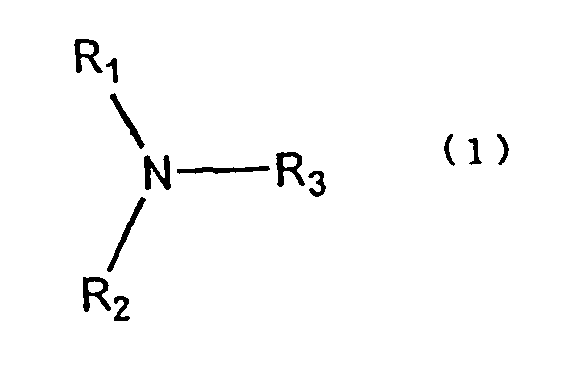
- (A) an amine compound of the following formula (1):
wherein each of R1, R2 and R3 which are independent of one
another, is a C1-20 alkyl group, and at least one amine
compound selected from the group consisting of
triethylenediamine, N,N,N',N'-tetramethyl-1,6-hexanediamine
and N,N-dimethylcyclohexylamine; or
- (B) an amine compound having an alkyl ether group
and/or an aryl ether group in its molecule;
- (2) A catalyst for producing a rigid
polyisocyanurate foam by means of at least one blowing
agent selected from the group consisting of 1,1,1,3,3-pentafluoropropane
(HFC-245fa), 1,1,1,3,3-pentafluorobutane
(HFC-365mfc) and a low boiling point
hydrocarbon, which comprises an aliphatic amine compound
of the following formula (1):
wherein each of R1, R2 and R3 which are independent of one
another, is a C1-20 alkyl group, and a polyisocyanurate
catalyst; - (3) A process for producing a rigid polyurethane
foam, which comprises reacting a polyol with a
polyisocyanate in the presence of an amine catalyst and a
blowing agent, wherein the amine catalyst is:
- (A) a catalyst composition comprising an amine
compound of the following formula (1):
wherein each of R1, R2 and R3 which are independent of one
another, is a C1-20 alkyl group, and at least one compound
selected from the group consisting of triethylenediamine,
N,N,N',N'-tetramethyl-1,6-hexanediamine and N,N-dimethylcyclohexylamine;
or
- (B) a catalyst comprising an amine compound having
an alkyl ether group and/or an aryl ether group in its
molecule; and the blowing agent is:
- at least one blowing agent selected from the group
consisting of 1,1,1,3,3-pentafluoropropane (HFC-245fa),
1,1,1,3,3-pentafluorobutane (HFC-365mfc) and a low
boiling point hydrocarbon; and
- (4) A process for producing a rigid polyisocyanurate
foam, which comprises reacting a polyol with a
polyisocyanate in the presence of a catalyst and a
blowing agent, wherein the catalyst is a catalyst
composition comprising an aliphatic amine compound of the
following formula (1):
wherein each of R1, R2 and R3 which are independent of one
another, is a C1-20 alkyl group, and a polyisocyanurate
catalyst, and the blowing agent is at least one blowing
agent selected from the group consisting of 1,1,1,3,3-pentafluoropropane
(HFC-245fa), 1,1,1,3,3-pentafluorobutane
(HFC-365mfc) and a low boiling point
hydrocarbon.-
-
Now, the present invention will be described in
detail with reference to the preferred embodiments.
-
In the present invention, the rigid urethane foam
means a foam having a highly crosslinked closed cell
structure, which is not reversibly deformable as
disclosed by Gunter Oertel, "Polyurethane Handbook"
(1985) Hanser Publishers (Germany), p. 234-313 or by
Keiji Iwata "Polyurethane Resin Handbook" (first edition
in 1987) published by Nikkan Kogyo Shinbunsha, p. 224-283.
The physical properties of the rigid urethane foam are
not particularly limited. However, the density is
usually within a range of from 10 to 100 kg/m3, and the
compressive strength is within a range of from 50 to
1,000 kPa. Further, in the present invention, the rigid
polyurethane foam includes an isocyanurate ring-containing
polyurethane foam (hereinafter referred to as
a rigid polyisocyanurate foam).
-
Firstly, the rigid polyurethane foam catalyst of the
present invention will be described.
-
The amine catalyst in the present invention is:
- (A) A catalyst composition comprising an amine
compound of the following formula (1):
wherein each of R1, R2 and R3 which are independent of one
another, is a C1-20 alkyl group, and at least one amine
compound selected from the group consisting of
triethylenediamine, N,N,N',N'-tetramethyl-1,6-hexanediamine
and N,N-dimethylcyclohexylamine; or
- (B) A catalyst comprising an amine compound having
an alkyl ether group and/or an aryl ether group in its
molecule.
-
-
In the amine compound of the formula (1) in the
present invention, each of R1, R2 and R3 which are
independent of one another, is preferably a C1-16 alkyl
group, such as, a methyl group, an ethyl group, a propyl
group, a butyl group, a pentyl group, a hexyl group, a
heptyl group, an octyl group, a nonyl group, a decyl
group, an undecyl group, a dodecyl group, a tridecyl
group, a tetradecyl group, a heptadecyl group or a
hexadecyl group.
-
In the present invention, the amine compound of the
formula (1) is not particularly limited so long as it
corresponds to the above-described amine compound.
Specifically, it may, for example, be trimethylamine,
dimethylethylamine, dimethylpropylamine,
dimethylbutylamine, dimethylpentylamine,
dimethylhexylamine, dimethylheptylamine,
dimethyloctylamine, dimethylnonylamine,
dimethyldecylamine, dimethylundecylamine,
dimethyldodecylamine, dimethyltridecylamine,
dimethyltetradecylamine, dimethylpentadecylamine,
dimethylhexadecylamine, dimethylheptadecylamine,
dimethyloctadecylamine, diethylmethylamine, triethylamine,
diethylpropylamine, diethylbutylamine, diethylpentylamine,
diethylhexylamine, diethylheptylamine, diethyloctylamine,
diethylnonylamine, diethyldecylamine, diethylundecylamine,
diethyldodecylamine, diethyltridecylamine,
diethyltetradecylamine, diethylpentadecylamine,
diethylhexadecylamine, diethylheptadecylamine,
diethyloctadecylamine, methylethylpropylamine,
methylethylbutylamine, methylethylpentylamine,
methylethylhexylamine, methylethylheptylamine,
methylethyloctylamine, methylethylnonylamine,
methylethyldecylamine, methylethylundecylamine,
methylethyldodecylamine, methylethyltridecylamine,
methylethyltetradecylamine, methylethylpentadecylamine,
methylethylhexadecylamine, methylethylheptadecylamine or
methylethyloctadecylamine.
-
Among these aliphatic amine compounds, an aliphatic
amine compound wherein each of R1 and R2 is a methyl
group, and R3 is a C2-16 alkyl group, is particularly
preferred, since its catalytic activities are high, and
it can industrially advantageously be used. Specifically,
dimethylethylamine, dimethylpropylamine,
dimethylbutylamine, dimethylpentylamine,
dimethylhexylamine, dimethylheptylamine,
dimethyloctylamine, dimethylnonylamine,
dimethyldecylamine, dimethylundecylamine,
dimethyldodecylamine, dimethyltridecylamine,
dimethyltetradecylamine, dimethylpentadecylamine or
dimethylhexadecylamine may, for example, be mentioned as
a particularly preferred aliphatic amine compound.
-
The amine compound of the formula (1) to be used for
the catalyst composition of the present invention, can
easily be produced by a method known in literature. For
example, a method by reductive methylation of a monoamine
or amination of an alcohol, or a method by a reaction of
an alkyl halide with a dialkylamine, may be mentioned.
The composition of the amine compound of the above
formula (1) and at least one amine compound selected from
the group consisting of triethylenediamine, N,N,N',N'-tetramethyl-1,6-hexanediamine
and N,N-dimethylcyclohexylamine,
to be used in the present
invention, is not particularly limited, but it preferably
comprises from 10 to 95 wt% of the amine compound of the
formula (1) and from 90 to 5 wt% of at least one amine
compound selected from the group consisting of
triethylenediamine, N,N,N',N'-tetramethyl-1,6-hexanediamine
and N,N-dimethylcyclohexylamine. If the
amine compound of the formula (1) is less than 10 wt%,
the adhesive strength of the foam is likely to be poor.
On the other hand, if the amine compound of the formula
(1) exceeds 95 wt%, the flowability or dimensional
stability of the foam is likely to deteriorate, or the
amount of the catalyst to be used, will increase, and
such may be disadvantageous from the viewpoint of the
cost.
-
Further, the rigid polyurethane production catalyst
of the present invention which comprises an amine
compound having an alkyl ether group and/or an aryl ether
group in its molecule, is not particularly limited.
However, at least one amine compound having an alkyl
ether group and/or an aryl ether group in its molecule,
selected from the group consisting of an amine compound
of the following formula (2):
wherein each of R
1 to R
7 which are independent of one
another, is hydrogen, a C
1-16 alkyl group, a C
1-16 aryl
group, a C
1-6 dimethylaminoalkyl group or a C
1-16
alkoxyalkyl group, A is a C
1-16 alkyl group or a C
1-16 aryl
group, n is an integer of from 1 to 11, m is an integer
of from 1 to 11, a is an integer of from 0 to 10, b is an
integer of from 1 to 10, provided that R
5 and R
1 or R
2 may
bond to form a 5- to 7-membered ring, and an amine
compound of the following formula (3):
wherein R
1, R
6, R
7, A, m and b are as defined in the above
formula (2), may, for example, be mentioned as a
preferred compound.
-
Among these, an amine compound of the above formula
(2) wherein each of R1 to R7 which are independent of one
another, is a hydrogen atom, a C1-10 alkyl group, a C1-10
aryl group, a C1-6 dimethylaminoalkyl group or a C1-10
alkoxyalkyl group, n is an integer of from 1 to 11, m is
an integer of from 1 to 11, a is an integer of from 0 to
5, b is an integer of from 1 to 5, provided that R5 and
R1 or R2 may be bonded to form a 5- to 7-membered ring,
or an amine compound of the above formula (3) wherein
each of R1, R6 and R7 which are independent of one another,
is a hydrogen atom, a C1-10 alkyl group, a C1-10 aryl group,
a C1-6 dimethylaminoalkyl group or a C1-10 alkoxyalkyl
group, m is an integer of from 1 to 11, and b is an
integer of from 1 to 5, is preferred as the catalyst for
producing a rigid polyurethane foam of the present
invention.
-
In the present invention, each of R1 to R7 in the
amine compound of the above formula (2), which are
independent of one another, is preferably a hydrogen atom,
a methyl group, a dimethylaminoethyl group, a
dimethylaminopropyl group, a methoxyethyl group, a
methoxypropyl group, a methoxyisopropyl group, an
ethoxyethyl group, an ethoxypropyl group, an
ethoxyisopropyl group, a propoxyethyl group, a
propoxypropyl group, a propoxyisopropyl group, a
butoxyethyl group, a butoxypropyl group or a
butoxyisopropyl group, provided that R5 and R1 or R2 may
be bonded to form a 5- to 7-membered ring.
-
In the present invention, each of R1, R6 and R7 in
the amine compound of the above formula (3), which are
independent of one another, is preferably a hydrogen atom,
a methyl group, a dimethylaminoethyl group, a
dimethylaminopropyl group, a methoxyethyl group, a
methoxypropyl group, a methoxyisopropyl group, an
ethoxyethyl group, an ethoxypropyl group, an
ethoxyisopropyl group, a propoxyethyl group, a
propoxypropyl group, a propoxyisopropyl group, a
butoxyethyl group, a butoxypropyl group or a
butoxyisopropyl group.
-
In the present invention, substituent A in the amine
compound of the above formula (2) or (3) is preferably a
methyl group, an ethyl group, a propyl group, a butyl
group, an amyl group, a hexyl group, a phenyl group or a
benzyl group, particularly preferably a methyl group or
an ethyl group, in order to obtain a rigid polyurethane
foam excellent in the adhesive strength and dimensional
stability.
-
The amine compound of the above formula (2) wherein
R
5 and R
1 or R
2 are bonded to form a 5- to 7-membered ring,
may, for example, be an amine compound of the following
formula (4):
wherein R
1, R
6, R
7, A, m and b are as defined in the above
formula (2), an amine compound of the following formula
(5):
wherein R
1, R
6, R
7, A, m and b are as defined in the above
formula (2), or an amine compound of the following
formula (6):
wherein R
1, R
6, R
7, A, m and b are as defined in the above
formula (2).
-
In the present invention, the catalyst for producing
a rigid polyurethane foam is not particularly limited so
long as it corresponds to the above-mentioned amine
compound. Specifically, the compound of the above
formula (1) may, for example, be N,N-dimethylaminoethyl
methyl ether, N,N-dimethylaminoethyl ethyl ether, N,N-dimethylaminopropyl
methyl ether, N,N-dimethylaminopropyl
ethyl ether, N,N-dimethylaminobutyl methyl ether, N,N-dimethylaminobutyl
ethyl ether, N,N-dimethylaminopentyl
methyl ether, N,N-dimethylaminopentyl ethyl ether, N,N-dimethylaminohexyl
methyl ether, N,N-dimethylaminohexyl
ethyl ether, N,N-dimethylaminoheptyl methyl ether, N,N-dimethylaminoheptyl
ethyl ether, N,N-dimethylaminooctyl
methyl ether, N,N-dimethylaminooctyl ethyl ether, N,N-dimethylaminononyl
methyl ether, N,N-dimethylaminononyl
ethyl ether, N,N-dimethylaminodecyl methyl ether, N,N-dimethylaminodecyl
ethyl ether, N,N-dimethylaminoethoxyethyl
methyl ether, N,N-dimethylaminoethoxyethyl
ethyl ether, N,N-dimethylaminoethoxyisopropyl
methyl ether, N,N-dimethylaminoethoxyisopropyl
ethyl ether, N,N-dimethylaminoethoxyethoxyethyl
methyl ether, N,N-dimethylaminoethoxyethoxyethyl
ethyl ether, N,N-dimethylaminoethoxyethoxyisopropyl
methyl ether, N,N-dimethylaminoethoxyethoxyisopropyl
ethyl ether, N,N-dimethylaminoethyl-N'-methylaminoethoxy
methyl ether,
N,N-dimethylaminoethyl-N'-methylaminoethoxy ethyl ether,
N,N-dimethylaminoethyl-N'-methylaminoisopropyl methyl
ether, N,N-dimethylaminoethyl-N'-methylaminoisopropyl
ethyl ether, N,N-dimethylaminopropyl-N'-methylaminoethyl
methyl ether, N,N-dimethylaminopropyl-N'-methylaminoethyl
ethyl ether, N,N-dimethylaminopropyl-N'-methylaminoisopropyl
methyl ether, N,N-dimethylaminopropyl-N'-methylaminoisopropyl
ethyl ether,
N,N,N'-trimethyl-N'-methoxyethyl bisaminoethyl ether,
N,N,N'-trimethyl-N'-ethoxyethyl bisaminoethyl ether,
N,N,N'-trimethyl-N'-methoxyisopropyl bisaminoethyl ether,
N,N,N'-trimethyl-N'-ethoxyisopropyl bisaminoethyl ether,
N,N-dimethylaminoethyl-N'-methylaminoethyl-N"-methylaminoethyl
methyl ether, N,N-dimethylaminoethyl-N'-methylaminoethyl-N"-methylaminoethyl
ethyl ether, N,N-dimethylaminoethyl-N'-methylaminoethyl-N"-
methylaminoisopropyl methyl ether, N,N-dimethylaminoethyl-N'-methylaminoethyl-N"-methylaminoisopropyl
ethyl ether, N,N-dimethylaminoethyl-N'
-methylaminoethyl-N"-methylaminoethyl-N‴-methylaminoethyl
methyl ether, N,N-dimethylaminoethyl-N'-methylaminoethyl-N"-methylaminoethyl-N‴-methylaminoethyl
ethyl ether, N,N-dimethylaminoethyl-N'-methylaminoethyl-N"-methylaminoethyl-N‴-methylaminoisopropyl
methyl ether,
N,N-dimethylaminoethyl-N'-methylaminoethyl-N"-methylaminoethyl-N‴-methylaminoisopropyl
ethyl ether,
N,N-bis(3-dimethylaminopropyl)-N-isopropyl methyl ether,
N,N-bis(3-dimethylaminopropyl)-N-isopropyl ethyl ether,
N-(2-methoxyethyl)-N'-methylpiperazine, N-(2-ethoxyethyl)-N'-methylpiperazine,
5-dimethylamino-3-methyl-1-pentyl
methyl ether or 5-dimethylamino-3-methyl-1-pentyl
ethyl ether. Further, the amine compound of the
above formula (3) may, for example, be 1-(2'-methoxyethyl)imidazole,
1-(2'-ethoxyethyl)imidazole, 1-(2'-methoxyethyl)-2-methylimidazole,
1-(2'-ethoxyethyl)-2-methylimidazole,
1-(2'-methoxypropyl)-2-methylimidazole
or 1-(2'-ethoxypropyl) -2-methylimidazole.
-
Among these amine compounds, particularly preferred
from the viewpoint of high catalytic activities are N,N-dimethylaminoethyl
methyl ether, N,N-dimethylaminoethyl
ethyl ether, N,N-dimethylaminopropyl methyl ether, N,N-dimethylaminopropyl
ethyl ether, N,N-dimethylaminobutyl
methyl ether, N,N-dimethylaminobutyl ethyl ether, N,N-dimethylaminopentyl
methyl ether, N,N-dimethylaminopentyl
ethyl ether, N,N-dimethylaminohexyl methyl ether, N,N-dimethylaminohexyl
ethyl ether, N,N-dimethylaminoethoxyethyl
methyl ether, N,N-dimethylaminoethoxyethyl
ethyl ether, N,N-dimethylaminoethyl-N'-methylaminoethyl
methyl ether, N,N-dimethylaminoethyl-N'-methylaminoethyl
ethyl ether, N,N-dimethylaminopropyl-N'-methylaminoethyl
methyl ether,
N,N-dimethylaminopropyl-N'-methylaminoethyl ethyl ether,
N,N,N'-trimethyl-N'-methoxyethylbisaminoethyl ether,
N,N,N'-trimethyl-N'-ethoxyethylbisaminoethyl ether, N,N-dimethylaminoethyl-N'-methylaminoethyl-N"-methylaminoisopropyl
methyl ether, N,N-dimethylaminoethyl-N'-methylaminoethyl-N"-methylaminoisopropyl
ethyl ether, N,N-bis(3-dimethylaminopropyl)
-N-isopropyl methyl ether, N,N-bis(3-dimethylaminopropyl)
-N-isopropyl ethyl ether, N-(2-methoxyethyl)-N'-methylpiperazine,
N-(2-ethoxyethyl)-N'-methylpiperazine,
5-dimethylamino-3-methyl-1-pentyl
methyl ether and 5-dimethylamino-3-methyl-1-pentyl ethyl
ether.
-
The amine compound of the above formula (1) or (2)
to be used as the catalyst for producing a rigid
polyurethane foam of the present invention, can be easily
produced by a method known in literature. For example, a
method by etherification of a dialkylamino alcohol or by
a reaction of an alkyl ether containing a halogenated
group with a dialkylamine, may be mentioned.
-
Now, the catalyst for producing a rigid
polyisocyanurate foam of the present invention will be
described.
-
The catalyst for producing a rigid polyisocyanurate
foam of the present invention comprises an aliphatic
amine compound of the following formula (1):
wherein each of R
1, R
2 and R
3 which are independent of one
another, is a C
1-20 alkyl group, and a polyisocyanurate
catalyst.
-
In the aliphatic amine compound of the above formula
(1), each of R1, R2 and R3 which are independent of one
another, is preferably a C1-16 alkyl group, such as a
methyl group, an ethyl group, a propyl group, a butyl
group, a pentyl group, a hexyl group, a heptyl group, an
octyl group, a nonyl group, a decyl group, an undecyl
group, a dodecyl group, a tridecyl group, a tetradecyl
group, a heptadecyl group or a hexadecyl group.
-
The aliphatic amine compound of the above formula
(1) is not particularly limited so long as it corresponds
to the above-mentioned amine compound. Specifically, it
may, for example, be trimethylamine, triethylamine,
tributylamine, dimethylethylamine, dimethylpropylamine,
dimethylbutylamine, dimethylpentylamine,
dimethylhexylamine, dimethylheptylamine,
dimethyloctylamine, dimethylnonylamine,
dimethyldecylamine, dimethylundecylamine,
dimethyldodecylamine, dimethyltridecylamine,
dimethyltetradecylamine, dimethylpentadecylamine,
dimethylhexadecylamine, dimethylheptadecylamine,
dimethyloctadecylamine, diethylmethylamine, triethylamine,
diethylpropylamine, diethylbutylamine, diethylpentylamine,
diethylhexylamine, diethylheptylamine, diethyloctylamine,
diethylnonylamine, diethyldecylamine, diethylundecylamine,
diethyldodecylamine, diethyltridecylamine,
diethyltetradecylamine, diethylpentadecylamine,
diethylhexadecylamine, diethylheptadecylamine,
diethyloctadecylamine, methylethylpropylamine,
methylethylbutylamine, methylethylpentylamine,
methylethylhexylamine, methylethylheptylamine,
methylethyloctylamine, methylethylnonylamine,
methylethyldecylamine, methylethylundecylamine,
methylethyldodecylamine, methylethyltridecylamine,
methylethyltetradecylamine, methylethylpentadecylamine,
methylethylhexadecylamine, methylethylheptadecylamine or
methylethyldiethyloctadecylamine.
-
Among these aliphatic amine compounds, particularly
preferred is an aliphatic amine compound wherein each of
R1 and R2 is a methyl group, and R3 is a C2-16 alkyl group,
since its catalytic activities are high, and it can be
industrially advantageously used. Specifically,
dimethylethylamine, dimethylpropylamine,
dimethylbutylamine, dimethylpentylamine,
dimethylhexylamine, dimethylheptylamine,
dimethyloctylamine, dimethylnonylamine,
dimethyldecylamine, dimethylundecylamine,
dimethyldodecylamine, dimethyltridecylamine,
dimethyltetradecylamine, dimethylpentadecylamine or
dimethylhexadecylamine may, for example, be mentioned as
a particularly preferred aliphatic amine compound.
-
As mentioned above, the amine compound of the above
formula (1) to be used for the catalyst composition of
the present invention, can easily be produced by a method
known in literature. Namely, a method by reductive
methylation of a monoamine or by amination of an alcohol,
or a method by a reaction of an alkyl halide with a
dialkylamine, may be mentioned.
-
The polyisocyanurate catalyst of the present
invention is not particularly limited so long as it is a
catalyst to accelerate the polyisocyanurate reaction
(trimerization of a polyisocyanate). For example, as
mentioned above, a conventional organic metal type
catalyst, such as an alkali metal salt of a carboxylic
acid, an alkaline earth metal salt of a carboxylic acid,
a metal alcoholate, a metal phenolate or a metal
hydroxide, a tertiary amine, a tertiary phosphine, an
onium salt compound of phosphorus or a quaternary
ammonium salt, may, for example, be used.
-
Among them, as an alkali metal salt of a carboxylic
acid, potassium acetate or potassium 2-ethylhexanoate may,
for example, be preferably employed, since the
isocyanurate activities are high. Further, as the
tertiary amine, a S-triazine compound such as 1,3,5-tris(N,N-dimethylaminopropyl)hexahydro-S-triazine,
or
2,4,6-tris(dimethylaminomethyl)phenol, is preferably
employed, since the catalytic activities and isocyanurate
activities are high, and the total amount of the catalyst
to be used, can be reduced.
-
Further, as the quaternary ammonium salt, a
tetraalkylammonium halide such as tetramethylammonium
chloride, a tetraalkylammonium hydroxide such as
tetramethylammonium hydroxide, a hydroxyalkyl quaternary
ammonium compound of the above formula (7) (JP-A-52-17484),
a hydroxyalkyl type quaternary ammonium organic
salt such as a quaternary ammonium salt of the above
formula (8) (JP-A-10-017638), a quaternary ammonium
organic salt of the above formula (9) (JP-A-09-124760), a
tetraalkylammonium carbonate such as a quaternary
ammonium carbonate of the following formula (10):
wherein each of R
1 to R
8 is a C
1-12 linear or branched,
saturated or unsaturated hydrocarbon group, n is from 0
to 3, provided that when n=0, any of R
1 to R
3 may be
optionally bonded to R
5 or R
6 to form a hetero ring, or
in a case where n is from 1 to 3, R
5 or R
6 may be bonded
to R
4 to form a hetero ring, (JP-A-11-199644), may, for
example, be preferably employed, since the catalytic
activities and the isocyanurate activities are high, and
the total amount of the catalyst to be used can be
reduced.
-
In the present invention, the composition of the
aliphatic amine compound of the above formula (1) and the
polyisocyanurate catalyst, is not particularly limited,
but it preferably comprises from 10 to 90 wt% of the
aliphatic amine compound of the formula (1) and from 90
to 10 wt% of the polyisocyanurate catalyst. More
preferably, it comprises from 20 to 90 wt% of the amine
compound and from 80 to 10 wt% of the polyisocyanurate
catalyst. If the polyisocyanurate catalyst exceeds 80
wt%, the adhesive strength of the foam is likely to
deteriorate. On the other hand, if it is less than 10
wt%, the flame retardancy and dimensional stability of
the foam tends to deteriorate, and the amount of the
catalyst to be used, tends to increase, such being
disadvantageous from the viewpoint of the cost.
-
Now, the process for producing a rigid polyurethane
foam of the present invention will be described.
-
The catalyst for producing a rigid polyurethane foam
of the present invention is used as an amine catalyst in
the process for producing a rigid polyurethane foam which
comprises reacting a polyol with a polyisocyanate in the
presence of an amine catalyst and a blowing agent.
-
In the process of the present invention, in a case
where a catalyst composition comprising the amine
compound of the above formula (1) and at least one member
selected from the group consisting of triethylenediamine,
N,N,N',N'-tetramethyl-1,6-hexanediamine and N,N-dimethylcyclohexylamine,
is used as the amine catalyst,
its amount is usually within a range of from 0.01 to 20
parts by weight, preferably from 0.05 to 10 parts by
weight, per 100 parts by weight of the polyol to be used.
If the amount of the amine catalyst is less than 0.01
part by weight, the moldability of the foam tends to
deteriorate, and the dimensional stability is likely to
be poor. On the other hand, if the amount of the amine
catalyst exceeds 20 parts by weight, not only the effect
corresponding to the increase of the catalyst can not be
obtained, but also the flowability of the foam is likely
to deteriorate.
-
Further, in the process of the present invention, in
a case where the catalyst comprising an amine compound
having an alkyl ether group and/or an aryl ether group in
its molecule, is used as the amine catalyst, its amount
is usually within a range of from 0.01 to 20 parts by
weight, preferably from 0.05 to 10 parts by weight, per
100 parts by weight of the polyol to be used. If it is
less than 0.01 part by weight, the moldability and
adhesive strength of the foam may deteriorate, and the
dimensional stability may deteriorate. On the other hand,
if it exceeds 20 parts by weight, not only the effect
corresponding to the increase of the catalyst can not be
obtained, but also the flowability of the foam may
deteriorate.
-
The amine catalyst used for the process for
producing a rigid polyurethane foam of the present
invention, is the above-described catalyst for producing
a rigid polyurethane foam of the present invention.
However, in addition, other catalysts may be used within
a range not to depart from the present invention. As
such other catalysts, a conventional organic metal
catalyst, a metal carboxylate, a tertiary amine or a
quaternary ammonium salt, may, for example, be mentioned.
-
The organic metal catalyst may be conventional one
and is not particularly limited. For example, stannous
diacetate, stannous dioctoate, stannous dioleate,
stannous dilaurate, dibutyltin oxide, dibutyltin
diacetate, dibutyltin dilaurate, dibutyltin dichloride,
dioctyltin dilaurate, lead octanoate, lead naphthenate,
nickel naphthenate or cobalt naphthenate, may, for
example, be mentioned.
-
The metal carboxylate may be conventional one and is
not particularly limited. For example, an alkali metal
salt or alkaline earth metal salt of a carboxylic acid
may be mentioned. The carboxylic acid is not
particularly limited, and it may, for example, be an
aliphatic mono- or dicarboxylic acid such as acetic acid,
propionic acid, 2-ethylhexanoic acid or adipic acid, or
an aromatic mono- or dicarboxylic acid such as benzoic
acid or phthalic acid. Further, the metal to form a
carboxylate is preferably an alkali metal such as lithium,
sodium or potassium, or an alkaline earth metal such as
calcium or magnesium, as a preferred example.
-
The tertiary amine may be conventional one and is
not particularly limited. For example, it may be a
tertiary amine compound such as N,N,N',N'-tetramethylethylenediamine,
N,N,N',N'-tetramethylpropylenediamine,
N,N,N',N",N"-pentamethyldiethylenetriamine,
N,N,N',N",N"-pentamethyl-(3-aminopropyl)ethylenediamine,
N,N,N',N",N"-pentamethyldipropylenetriamine,
N,N,N',N'-tetramethylguanidine,
1,3,5-tris(N,N-dimethylaminopropyl)
hexahydro-S-triazine, 1,8-diazabicyclo[5.4.0]undecene-7,
N,N'-dimethylpiperazine,
N-methylmorpholine, N-ethylmorpholine, bis(2-dimethylaminoethyl)ether,
1-methylimidazole, 1,2-dimethylimidazole,
1-isobutyl-2-methylimidazole or 1-dimethylaminopropylimidazole.
-
The quaternary ammonium salt may be conventional one
and is not particularly limited. For example, it may be
a tetraalkylammonium halide such as tetramethylammonium
chloride, a tetraalkylammonium hydroxide such as
tetramethylammonium hydroxide, or a tetraalkylammonium
organic acid salt such as tetramethylammonium 2-ethylhexanoate,
2-hydroxypropyltrimethylammonium formate
or 2-hydroxypropyltrimethylammonium 2-ethylhexanoate.
-
As mentioned above, the catalyst for producing a
rigid polyurethane foam of the present invention may be
used alone or as mixed with other catalyst. To prepare a
mixture, if necessary, a solvent such as dipropylene
glycol, ethylene glycol, 1,4-butanediol or water may be
used. The amount of the solvent is not limited, but
preferably at most 3 times by weight the total amount of
the catalyst. If it exceeds 3 times by weight, the
physical properties of the foam may be influenced, and
such is not desirable also from the economical reason.
In the present invention, the catalyst thus formulated
may be added to a polyol, or various amine catalysts may
be separately added to a polyol. Thus, the manner of its
use is not particularly limited.
-
The polyol to be used in the present invention may,
for example, be a conventional polyether polyol,
polyester polyol or polymer polyol, and it may further be
a flame retardant polyol such as a phosphorus-containing
polyol or a halogen-containing polyol. These polyols may
be used alone or in combination as a mixture, as the case
requires.
-
The polyether polyol to be used in the process of
the present invention may, for example, be one produced
by a method disclosed e.g. by Gunter Oertel,
"Polyurethane Handbook" (1985) Hanser Publishers
(Germany), p. 42-53 by using as a starting material a
compound having at least two active hydrogen groups, such
as a polyhydric alcohol such as ethylene glycol,
propylene glycol, glycerol, trimethylolpropane,
pentaerythritol, sorbitol or sucrose, an amine such as
ethylenediamine, an aromatic amine compound such as
toluenediamine or diphenylmethane-4,4-diamine, or an
alkanolamine such as ethanolamine or diethanolamine, and
by subjecting such a starting material to addition
reaction with an alkylene oxide such as ethylene oxide or
propylene oxide.
-
The polyester polyol to be used in the process of
the present invention may, for example, be one obtained
from a reaction of a dibasic acid with glycol, a
polyester polyol obtained from a DMT residue or phthalic
anhydride as the starting material, or a polyester polyol
led by a waste from the production of nylon, a waste of
pentaerythritol or trimethylolpropane, a waste of a
phthalic acid type polyester, or derivatives from these
waste products, as disclosed by Keiji Iwata "Polyurethane
Resin Handbook" (first edition in 1987), Nikkan Kogyo
Shinbunsha, p.116-p.117.
-
The polymer polyol to be used in the process of the
present invention may, for example, be a polymer polyol
obtained by reacting the above-mentioned polyether polyol
with an ethylenically unsaturated monomer such as
butadiene, acrylonitrile or styrene in the presence of a
radical polymerization catalyst.
-
The flame retardant polyol to be used in the process
of the present invention may, for example, be a
phosphorus-containing polyol obtained by adding an
alkylene oxide to a phosphoric acid compound, a halogen-containing
polyol obtained by ring opening polymerization
of epichlorohydrin or trichlorobutylene oxide, or phenol
polyol.
-
In the process of the present invention, a polyol
having an average hydroxyl value of from 100 to 800
mgKOH/g is preferred, and a polyol having an average
hydroxyl value of from 200 to 700 mgKOH/g is particularly
preferred.
-
The polyisocyanate to be used in the present
invention may be conventional one and is not particularly
limited. For example, it may be an aromatic
polyisocyanate such as toluene diisocyanate (TDI),
diphenylmethane diisocyanate (MDI), naphthylene
diisocyanate or xylylene diisocyanate, an aliphatic
polyisocyanate such as hexamethylene diisocyanate, an
alicyclic polyisocyanate such as dicyclohexyl
diisocyanate or isophorone diisocyanate, or a mixture
thereof. Among these, preferred is TDI or its derivative,
or MDI or its derivative, and they may be used in
combination as a mixture.
-
TDI and its derivative may, for example, be a
mixture of 2,4-TDI and 2,6-TDI, or a terminal isocyanate
prepolymer derivative of TDI. MDI or its derivative may,
for example, be a mixture of MDI and its polymer
polyphenylpolymethylene diisocyanate, and/or a
diphenylmethane diisocyanate derivative having a terminal
isocyanate group.
-
The mixing ratio of the polyisocyanate and the
polyol is not particularly limited, but as represented by
the isocyanate index (isocyanate groups/active hydrogen
groups reactive with isocyanate groups), it is usually
preferably within a range of from 60 to 400.
-
The blowing agent to be used in the process of the
present invention is at least one blowing agent selected
from the group consisting of 1,1,1,3,3-pentafluoropropane
(HFC-245fa), 1,1,1,3,3-pentafluorobutane (HFC-365mfc) and
a low boiling point hydrocarbon.
-
In the present invention, the low boiling point
hydrocarbon means a hydrocarbon having a boiling point of
from -30 to 90°C. Among such, preferred is propane,
butane, 2-methylpropane, pentane, cyclopentane, 2-methylbutane,
2,2-dimethylpropane, cylopropane, hexane,
2-methylpentane, 3-methylpentane, 2,2-dimethylbutane,
cyclohexane, 2,4-dimethylpropane, 3,3-dimethylpropane or
2,2,3-trimethylbutane, since it is inexpensive from the
viewpoint of the price or since it is easy to handle.
More preferred is propane, butane, pentane, cyclopentane
or hexane, which is a hydrocarbon having a boiling point
of from -30 to 70°C.
-
In the process of the present invention, as the
blowing agent, it is possible to further use water or a
flon compound other than 1,1,1,3,3-pentafluoropropane
(HFC-245fa) or 1,1,1,3,3-pentafluorobutane (HFC-365mfc).
-
Such a flon compound may, for example, be a HCFC
analogue such as 1,1-dichloro-1-fluoroethane (HCFC-141b),
1-chloro-1,1-difluoroethane (HCFC-142b) or
chlorodifluoromethane (HCFC-22), a HFC-134 analogue such
as 1,1,1,2-tetrafluoroethane (HFC-134a), a HFC-227
analogue such as 1,1,1,2,3,3,3-heptafluoropropane (HFC-227ea),
or a HFE analogue such as 1,1,1-trifluoroethyldifluoromethyl
ether (HFE-245mf), 1,1,2,2-tetrafluoroethyl
methyl ether (HFE-254pc) or 1,1,2,2-tetrafluoroethyl-1,1,1-trifluoroethyl
ether (HFE-347pc-f).
-
In the process of the present invention, a specific
combination of blowing agents may, for example, be a
mixture of HFC-245fa and water and/or a low boiling point
hydrocarbon, a mixture of HFC-365mfc and water and/or a
low boiling point hydrocarbon, a mixture of HFC-245fa,
HFC-365mfc and water and/or a low boiling point
hydrocarbon, or a mixture of water and a low boiling
point hydrocarbon.
-
In the process of the present invention, the amount
of the blowing agent is determined depending upon the
desired density and physical properties of the foam and
is not particularly limited. Specifically, however, it
is selected so that the density of the obtained foam will
usually be from 10 to 200 kg/m3, preferably from 20 to
100 kg/m3. The amount of water is not particularly
limited, but it is usually from 0.1 to 10 parts by weight,
preferably from 0.5 to 5 parts by weight, per 100 parts
by weight of the polyol. If the amount of water is less
than 0.1 part by weight, the amount of at least one
blowing agent selected from the group consisting of
1,1,1,3,3-pentafluoropropane (HFC-245fa), 1,1,1,3,3-pentafluorobutane
(HFC-365mfc) and a low boiling point
hydrocarbon, will increase, such being disadvantageous
from the viewpoint of the cost. On the other hand, if
the amount of water exceeds 10 parts by weight, the
curing speed of the foam tends to be slow, and the
friability of the foam surface tends to be large, whereby
the adhesion with a face material is likely to be
substantially poor.
-
In the process of the present invention, the polyol
and the polyisocyanate may be reacted in the presence of
the amine catalyst, the blowing agent and an auxiliary
agent, as the case requires. Such an auxiliary agent may,
for example, be a foam stabilizer, a crosslinking agent
and/or a chain extender, or a flame retardant.
-
In the process of the present invention, as the foam
stabilizer, a surfactant may be employed. As a useful
surfactant, a conventional organic silicone type
surfactant may, for example, be mentioned. Specifically,
a nonionic surfactant such as an organic
siloxane/polyoxyalkylene copolymer or a silicone/grease
copolymer, or a mixture thereof, may, for example, be
mentioned. The amount of such a foam stabilizer is
usually from 0.1 to 10 parts by weight per 100 parts by
weight of the polyol.
-
In the present invention, the crosslinking agent or
the chain extender may, for example, be a polyhydric
alcohol such as ethylene glycol, 1,4-butanediol or
glycerol, an amine polyol having a low molecular weight
such as diethanolamine or triethanolamine, or a polyamine
such as ethylenediamine, xylylenediamine or
methylenebisorthochloroaniline.
-
In the process of the present invention, the flame
retardant may, for example, be a reactive flame retardant
like a phosphorus-containing polyol such as propoxylated
phosphoric acid or propoxylated dibutylpyrophosphoric
acid obtainable by an addition reaction of phosphoric
acid with an alkylene oxide, a tertiary phosphoric acid
ester such as tricresyl phosphate, a halogen-containing
tertiary phosphoric acid ester such as tris(2-chloroethyl)
phosphate or tris(chloropropyl) phosphate, a
halogen-containing organic compound such as
dibromopropanol, dibromoneopentyl glycol or
tetrabromobisphenol A, or an inorganic compound such as
antimony oxide, magnesium carbonate, calcium carbonate or
aluminum phosphate. The amount of the flame retardant is
not particularly limited, since it varies depending upon
the required flame retardancy, but it is usually from 4
to 20 parts by weight, per 100 parts by weight of the
polyol.
-
In the present invention, a colorant, an age-preventing
agent and other conventional known additives
may further be used, as the case requires. The types and
amounts of such additives may be within the usual ranges
of the additives to be used.
-
The process of the present invention is carried out
by rapidly mixing and stirring a mixed solution obtained
by mixing the above-mentioned starting materials (the
polyol, the polyisocyanate, the amine catalyst, the
blowing agent, the auxiliary agent, the additives, etc.),
and then injecting it into a suitable container or mold,
followed by foam molding. The mixing and stirring may be
carried out by using a common stirrer or dedicated
polyurethane foaming machine. As the polyurethane
foaming machine, high pressure, low pressure and spray
type machines can be used.
-
The product produced by the process of the present
invention may be used for various applications. For
example, it may be applied to a freezer, a refrigerator,
a heat shielding building material, etc.
-
Now, among processes for forming rigid polyurethane
foams of the present invention, a process for forming a
rigid polyisocyanurate foam will be described.
-
The catalyst for producing a rigid polyisocyanurate
foam of the present invention is used as a catalyst when
a rigid polyisocyanurate foam is produced by reacting a
polyol with a polyisocyanate in the presence of a
catalyst and a blowing agent.
-
In the process for producing a rigid
polyisocyanurate foam of the present invention, the
amount of the catalyst composition for producing a rigid
polyisocyanurate foam, which comprises an aliphatic amine
compound of the above formula (1) and a polyisocyanurate
catalyst, is usually within a range of from 0.01 to 40
parts by weight, preferably from 0.1 to 20 parts by
weight, per 100 parts by weight of the polyol to be used.
If the amount is less than 0.01 part by weight, the
moldability of the foam tends to deteriorate, and the
dimensional stability is likely to be poor. On the other
hand, if it exceeds 40 parts by weight, not only the
effect of increasing the catalyst can not be obtained,
but the flowability of the foam is likely to deteriorate.
-
The catalyst to be used in the process for producing
a rigid polyisocyanurate foam of the present invention,
is the above-mentioned catalyst for producing a rigid
polyisocyanurate foam of the present invention. However,
other catalysts may further be used in combination within
a range not to depart from the present invention. As
such other catalysts, a known tertiary amine or organic
metal compound may, for example, be mentioned.
-
The tertiary amine may be conventional one and is
not particularly limited. It may, for example, be
N,N,N'.N'-tetramethylethylenediamine, N,N,N',N'-tetra
methylpropylenediamine, N,N,N',N",N"-pentamethyldiethylenetriamine,
N,N,N',N",N"-pentamethyl-(3-aminopropyl)ethylenediamine,
N,N,N',N",N"-pentamethyldipropylenetriamine,
N,N,N',N'-tetramethylguanidine,
1,3,5-tris(N,N-dimethylaminopropyl)hexahydro-S-triazine,
1,8-diazabicyclo[5.4.0]undecene-7,
N,N'-dimethylpiperazine,
N-methylmorpholine, N-ethylmorpholine, bis(2-dimethylaminoethyl)ether,
1-methylimidazole, 1,2-dimethylimidazole,
1-isobutyl-2-methylimidazole or 1-dimethylaminopropylimidazole.
-
Further, the organic metal compound may be
conventional one and is not particularly limited. It may,
for example, be stannous diacetate, stannous dioctoate,
stannous dioleate, stannous dilaurate, dibutyltin oxide,
dibutyltin diacetate, dibutyltin dilaurate, dibutyltin
dichloride, dioctyltin dilaurate, lead octylate, lead
naphthenate, nickel naphthenate, cobalt naphthenate, or
lithium, sodium or potassium carboxylate.
-
The catalyst composition comprising the aliphatic
amine compound of the above formula (1) and the
polyisocyanurate catalyst, of the present invention, may
be used alone or as mixed with other catalysts, as
mentioned above. To prepare a mixture, a solvent such as
dipropylene glycol, ethylene glycol, 1,4-butanediol or
water may be used, as the case requires. The amount of
the solvent is not particularly limited, but it is
preferably at most 3 times by weight to the total amount
of the catalyst. If it exceeds 3 times by weight, the
physical properties of the foam will be influenced, and
such is undesirable also for an economical reason. The
catalyst thus formulated, may be used by adding it to the
polyol, or various amine catalysts may separately be
added to the polyol. Thus, the manner of its use is not
particularly limited.
-
The polyol to be used in the process of the present
invention may, for example, be a conventional polyether
polyol, polyester polyol or polymer polyol, and it may
further be a flame retardant polyol such as a phosphorus-containing
polyol or a halogen-containing polyol, or a
phenol type polyol such as a Mannich base polyol. These
polyols may be used alone or in combination as a mixture,
as the case requires.
-
The polyether polyol may, for example, be one
produced by a method disclosed, for example, by Gunter
Oertel, "Polyurethane Handbook" (1985) Hanser Publishers
(Germany), p. 42-53 by using as a starting material a
compound having at least two active hydrogen groups, such
as a polyhydric alcohol such as ethylene glycol,
propylene glycol, glycerol, trimethylolpropane or
pentaerythritol, an aliphatic amine such as
ethylenediamine, an aromatic amine such as toluenediamine,
an alkanolamine such as ethanolamine or diethanolamine,
sorbitol or sucrose and by subjecting such a starting
material to addition reaction with an alkylene oxide such
as ethylene oxide or propylene oxide.
-
The polyester polyol to be used in the process
of the present invention may, for example, be one
obtained from a reaction of a dibasic acid with glycol, a
polyester polyol obtained from a DMT residue or phthalic
anhydride as the starting material, or a polyester polyol
led by a waste from the production of nylon, a waste of
pentaerythritol or trimethylolpropane, a waste of a
phthalic acid type polyester, or derivatives from these
waste products, as disclosed by Keiji Iwata "Polyurethane
Resin Handbook" (first edition in 1987), Nikkan Kogyo
Shinbunsha, p.116-p.117.
-
The polymer polyol may, for example, be a polymer
polyol obtained by reacting the above-mentioned polyether
polyol with an ethylenically unsaturated monomer such as
butadiene, acrylonitrile or styrene in the presence of a
radical polymerization catalyst.
-
The flame retardant polyol may, for example, be a
phosphorus-containing polyol obtained by adding an
alkylene oxide to a phosphoric acid compound, a halogen-containing
polyol obtained by ring opening polymerization
of epichlorohydrin or trichlorobutylene oxide, or phenol
polyol such as Mannich base polyol.
-
Such a polyol is preferably a polyol having an
average hydroxyl value of from 50 to 1,000 mgKOH/g,
particularly preferably a polyol having an average
hydroxyl value of from 100 to 800 mgKOH/g.
-
The polyisocyanate to be used in the present
invention may be conventional one and is not particularly
limited. It may, for example, be an aromatic
polyisocyanate such as toluene diisocyanate (TDI),
diphenylmethane diisocyanate (MDI), naphthylene
diisocyanate or xylylene diisocyanate, an aliphatic
polyisocyanate such as hexamethylene diisocyanate, an
alicyclic polyisocyanate such as dicyclohexyl
diisocyanate or isophorone diisocyanate, or a mixture
thereof. Among these, preferred is TDI or its derivative,
or MDI or its derivative, and they may be used in
combination as a mixture.
-
TDI and its derivative may, for example, be a
mixture of 2,4-TDI and 2,6-TDI, or a terminal isocyanate
prepolymer derivative of TDI. MDI or its derivative may,
for example, be a mixture of MDI and its polymer
polyphenylpolymethylene diisocyanate, and/or a
diphenylmethane diisocyanate derivative having a terminal
isocyanate group.
-
The mixing ratio of the polyisocyanate and the
polyol is not particularly limited, but as represented by
the isocyanate index (isocyanate groups/active hydrogen
groups reactive with isocyanate groups), it is usually
preferably within a range of from 110 to 400.
-
The blowing agent to be used in the process of the
present invention is at least one blowing agent selected
from the group consisting of 1,1,1,3,3-pentafluoropropane
(HFC-245fa), 1,1,1,3,3-pentafluorobutane (HFC-365mfc) and
a low boiling point hydrocarbon.
-
In the present invention, the low boiling point
hydrocarbon means a hydrocarbon having a boiling point of
from -30 to 90°C. Among such, preferred is propane,
butane, 2-methylpropane, pentane, cyclopentane, 2-methylbutane,
2,2-dimethylpropane, cylopropane, hexane,
2-methylpentane, 3-methylpentane, 2,2-dimethylbutane,
cyclohexane, 2,4-dimethylpropane, 3,3-dimethylpropane or
2,2,3-trimethylbutane, since it is inexpensive from the
viewpoint of the price or since it is easy to handle.
More preferred is propane, butane, pentane, cyclopentane
or hexane.
-
In the process of the present invention, as the
blowing agent, water or a flon compound other than
1,1,1,3,3-pentafluoropropane (HFC-245fa) or 1,1,1,3,3-pentafluorobutane
(HFC-365mfc), may further be used.
-
Such a flon compound may, for example, be a HCFC
analogue such as 1, 1-dichloro-1-fluoroethane (HCFC-141b),
1-chloro-1,1-difluoroethane (HCFC-142b) or
chlorodifluoromethane (HCFC-22), a HFC-134 analogue such
as 1,1,1,2-tetrafluoroethane (HFC-134a), a HFC-227
analogue such as 1,1,1,2,3,3,3-heptafluoropropane (HFC-227ea),
or a HFE analogue such as 1,1,1-trifluoroethyldifluoromethyl
ether (HFE-245mf), 1,1,2,2-tetrafluoroethyl
methyl ether (HFE-254pc) or 1,1,2,2-tetrafluoroethyl-1,1,1-trifluoroethyl
ether (HFE-347pc-f).
-
In the process of the present invention, a specific
combination of blowing agents may, for example, be a
mixture of HFC-245fa and water and/or a low boiling point
hydrocarbon, a mixture of HFC-365mfc and water and/or a
low boiling point hydrocarbon, a mixture of HFC-245fa,
HFC-365mfc and water and/or a low boiling point
hydrocarbon, or a mixture of water and a low boiling
point hydrocarbon.
-
In the process of the present invention, the amount
of the blowing agent is determined depending upon the
desired density and physical properties of the foam and
is not particularly limited. Specifically, however, it
is selected so that the density of the obtained foam will
usually be from 10 to 200 kg/m3, preferably from 20 to
100 kg/m3. The amount of water is not particularly
limited, but it is usually from 0.1 to 10 parts by weight,
preferably from 0.5 to 5 parts by weight, per 100 parts
by weight of the polyol. If the amount of water is less
than 0.1 part by weight, the amount of at least one
blowing agent selected from the group consisting of
1,1,1,3,3-pentafluoropropane (HFC-245fa), 1,1,1,3,3-pentafluorobutane
(HFC-365mfc) and a low boiling point
hydrocarbon, will increase, such being disadvantageous
from the viewpoint of the cost.
-
In the process for producing a rigid
polyisocyanurate foam of the present invention, an
auxiliary agent other than the above may be used, as the
case requires. Such an auxiliary agent may, for example,
be a foam stabilizer, a crosslinking agent or a chain
extender, or a flame retardant.
-
In the present invention, if required, as a foam
stabilizer, a surfactant may be used. A useful
surfactant may for example, be a conventional organic
silicone type surfactant. Specifically, it may, for
example, be a nonionic surfactant such as an organic
siloxane/polyoxyalkylene copolymer or a silicone/grease
copolymer, or a mixture thereof. The amount of such a
foam stabilizer is usually from 0.1 to 10 parts by weight
per 100 parts by weight of the polyol.
-
In the present invention, the crosslinking agent or
the chain extender may, for example, be a polyhydric
alcohol such as ethylene glycol, 1,4-butanediol or
glycerol, an amine polyol having a low molecular weight
such as diethanolamine or triethanolamine, or a polyamine
such as ethylenediamine, xylylenediamine or
methylenebisorthochloroaniline.
-
In the process of the present invention, a flame
retardant may be employed as the case requires. A useful
flame retardant may, for example, be a reactive flame
retardant like a phosphorus-containing polyol such as a
propoxylated phosphoric acid or a propoxylated
dibutylpyrophosphoric acid, obtained by an addition
reaction of phosphoric acid with an alkylene oxide, a
tertiary phosphoric acid ester such as tricresyl
phosphate, a halogen-containing tertiary phosphoric acid
ester such as tris(2-chloroethyl) phosphate or
tris(chloropropyl) phosphate, a halogen-containing
organic compound such as dibromopropanol,
dibromoneopentyl glycol or tetrabromobisphenol A, or an
inorganic compound such as antimony oxide, magnesium
carbonate, calcium carbonate or aluminum phosphate. Its
amount is not particularly limited and varies depending
upon the required flame retardancy, but it is usually
from 4 to 20 parts by weight, per 100 parts by weight of
the polyol.
-
In the present invention, a colorant, an age-preventing
agent and other conventional known additives
may further be used, as the case requires. The types and
amounts of such additives may be within the usual ranges
of the additives to be used.
-
The process of the present invention is carried out
by rapidly mixing and stirring a mixed solution obtained
by mixing the above-mentioned starting materials and then
injecting it into a suitable container or mold, followed
by foam molding. The mixing and stirring may be carried
out by using a common stirrer or dedicated polyurethane
foaming machine. As the polyurethane foaming machine,
high pressure, low pressure and spray type machines can
be used.
-
The product produced by the process of the present
invention may be used for various applications. For
example, it may be applied to a freezer, a refrigerator,
a heat shielding building material, etc.
-
According to the process of the present invention,
even if at least one blowing agent selected from the
group consisting of 1,1,1,3,3-pentafluoropropane (HFC-245fa),
1,1,1,3,3-pentafluorobutane (HFC-365mfc) and a
low boiling point hydrocarbon, is used as a blowing agent,
it is possible to produce a rigid polyurethane foam
excellent in the flowability, adhesive strength and
dimensional stability of the foam, without impairing the
physical properties of the foam. Further, according to
the process of the present invention, it is possible to
obtain a rigid polyurethane foam having physical
properties comparable to a foam produced by means of a
conventional blowing agent (HCFC-141b).
-
Further, according to the process of the present
invention, even if at least one blowing agent selected
from the group consisting of 1,1,1,3,3-pentafluoropropane
(HFC-245fa), 1,1,1,3,3-pentafluorobutane (HFC-365mfc) and
a low boiling point hydrocarbon, is used as a blowing
agent, it is possible to produce a rigid polyisocyanurate
foam excellent in the flame retardancy, adhesive strength
and dimensional stability of the foam, without impairing
the physical properties of the foam. Further, according
to the process of the present invention, it is possible
to obtain a rigid polyisocyanurate foam having physical
properties comparable to a foam produced by a
conventional process.
-
Now, with reference to Examples and Comparative
Examples, the catalyst for producing a rigid polyurethane
foam and the process for producing a rigid polyurethane
foam by means of such a catalyst, will be described.
However, it should be understood that the present
invention is no by means restricted by such specific
Examples.
-
In the following Examples and Comparative Examples,
the various properties were measured by the following
measuring methods.
·Measured items for the reactivity
-
Cream time: The time until the foam starts to rise
was measured by visual observation.
-
Gel time: As the reaction proceeds, the time until
the liquid substance changes to a resinous substance, was
measured.
-
Tack free time: The time until tackiness of the foam
surface disappears, was measured.
-
Rise time: The time until the rise of the foam
stops, was measured by visual observation.
-
·Flowability of foam: A predetermined amount of a
mixed liquid was injected into an aluminum mold of
100×25×3.0 cm, and the length (cm) of the formed foam
was measured. The longer the length of the foam, the
better the flowability.
·Core density of foam:
-
Free foaming was carried out by means of an aluminum
mold of 50×50×4.5 cm, and the center portion of the
formed foam was cut into a size of 20×20×3 cm, whereupon
the size and weight were accurately measured, and core
density was calculated.
·Adhesive strength of foam:
-
Forming was carried out by setting a zinc-lined iron
plate of 5×5 cm on the upper side of an aluminum mold of
25×25×8.0 cm. After foaming for 1 hour, the peel
strength at 90° of the set iron plate was measured and
taken as the adhesive strength of the foam.
·Dimensional stability of foam:
-
A foam foamed in an aluminum mold of 50×50×4.5 cm
was maintained under a condition of -30°C × 48 hours,
whereby a change in the thickness direction was measured.
EXAMPLES 1 to 12
-
A polyol, a blowing agent and a foam stabilizer were
mixed in a blend ratio as identified in Table 1 to
prepare Premix A. 47.1 g of Premix A was taken into a
300 ml polyethylene cup, and a catalyst as identified in
Table 1 was added in an amount such that the reactivity
as represented by the following gel time would be 90
seconds, whereupon the temperature was adjusted to 10°C.
A polyisocyanate liquid (MR-200) having the temperature
adjusted to 10°C in a separate container, was put into
the cup of Premix A in such an amount that the isocyanate
index [isocyanate groups/OH groups (molar ratio) × 100)]
would be 110, and immediately stirred by a stirrer at
6,500 rpm for 5 seconds. The mixed and stirred liquid
was transferred to a 2 liter polyethylene cup having the
temperature adjusted to 40°C, and the reactivity during
foaming was measured. Then, the starting material scale
was increased, and in the same manner, the mixed liquid
was put into a mold having the temperature adjusted to
40°C, whereupon foam molding was carried out. Upon
expiration of 10 minutes from the introduction of the
mixed liquid, the foam was removed from the mold. From
the molded foam, the flowability, core density, adhesive
strength and dimensional stability of the foam were
evaluated. The results are shown in Table 2.
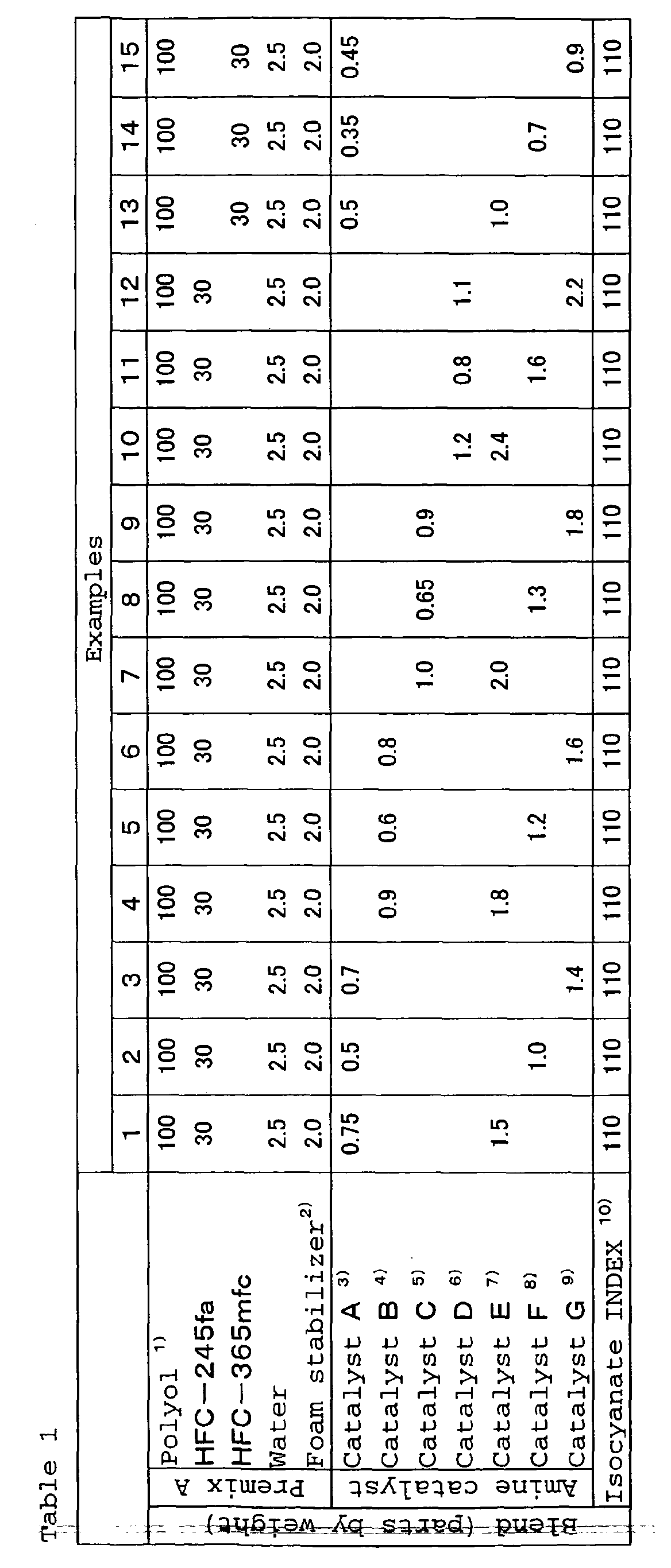

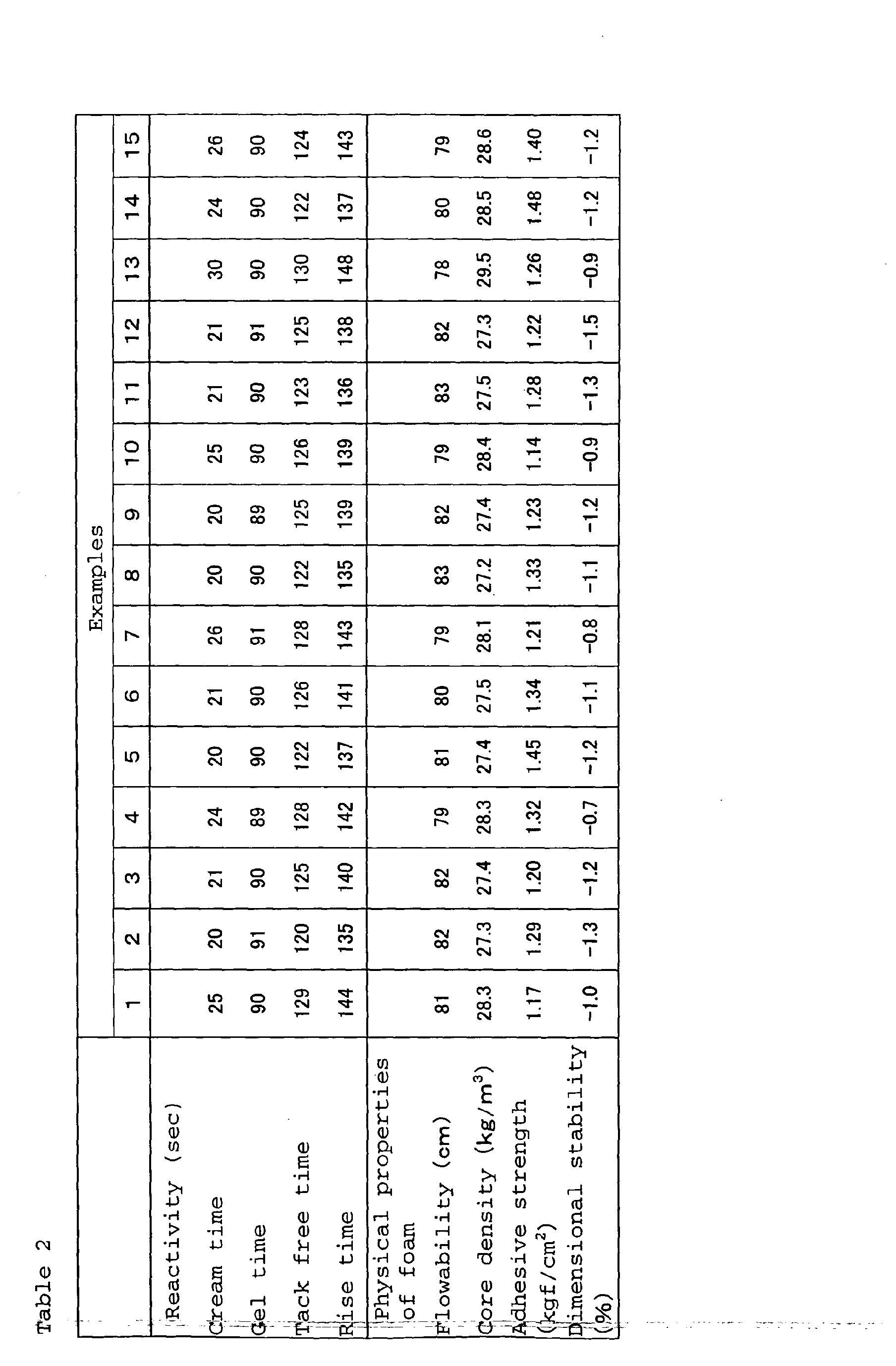
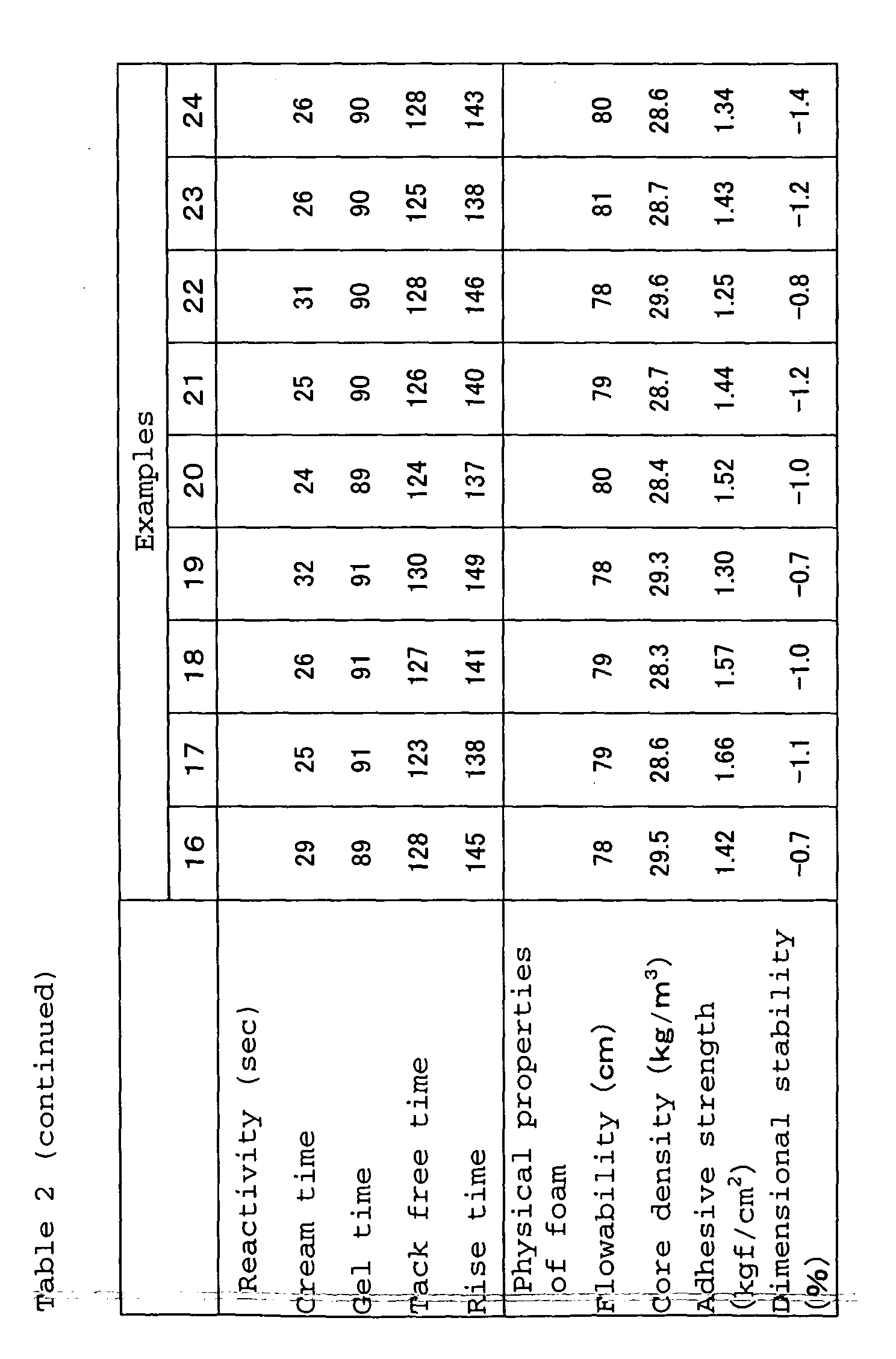
COMPARATIVE EXAMPLES 1 to 7
-
A polyol, a blowing agent and a foam stabilizer were
mixed in a blend ratio as identified in Table 3 to
prepare Premix A. 47.1 g of Premix A was taken into a
300 ml polyethylene cup, and a catalyst as identified in
Table 3 was added in an amount such that the reactivity
as represented by the following gel time would be 90
seconds, whereupon the temperature was adjusted to 10°C.
A polyisocyanate liquid (MR-200) having the temperature
adjusted to 10°C in a separate container, was put into
the cup of Premix A in such an amount that the isocyanate
index [isocyanate groups/OH groups (molar ratio) × 100)]
would be 110, and immediately stirred by a stirrer at
6,500 rpm for 5 seconds. The mixed and stirred liquid
was transferred to a 2 liter polyethylene cup having the
temperature adjusted to 40°C, and the reactivity during
foaming was measured. Then, the starting material scale
was increased, and in the same manner, the mixed liquid
was put into a mold having the temperature adjusted to
40°C, whereupon foam molding was carried out. Upon
expiration of 10 minutes from the introduction of the
mixed liquid, the foam was removed from the mold. From
the molded foam, the flowability, core density, adhesive
strength and dimensional stability of the foam were
evaluated. The results are shown in Table 4.
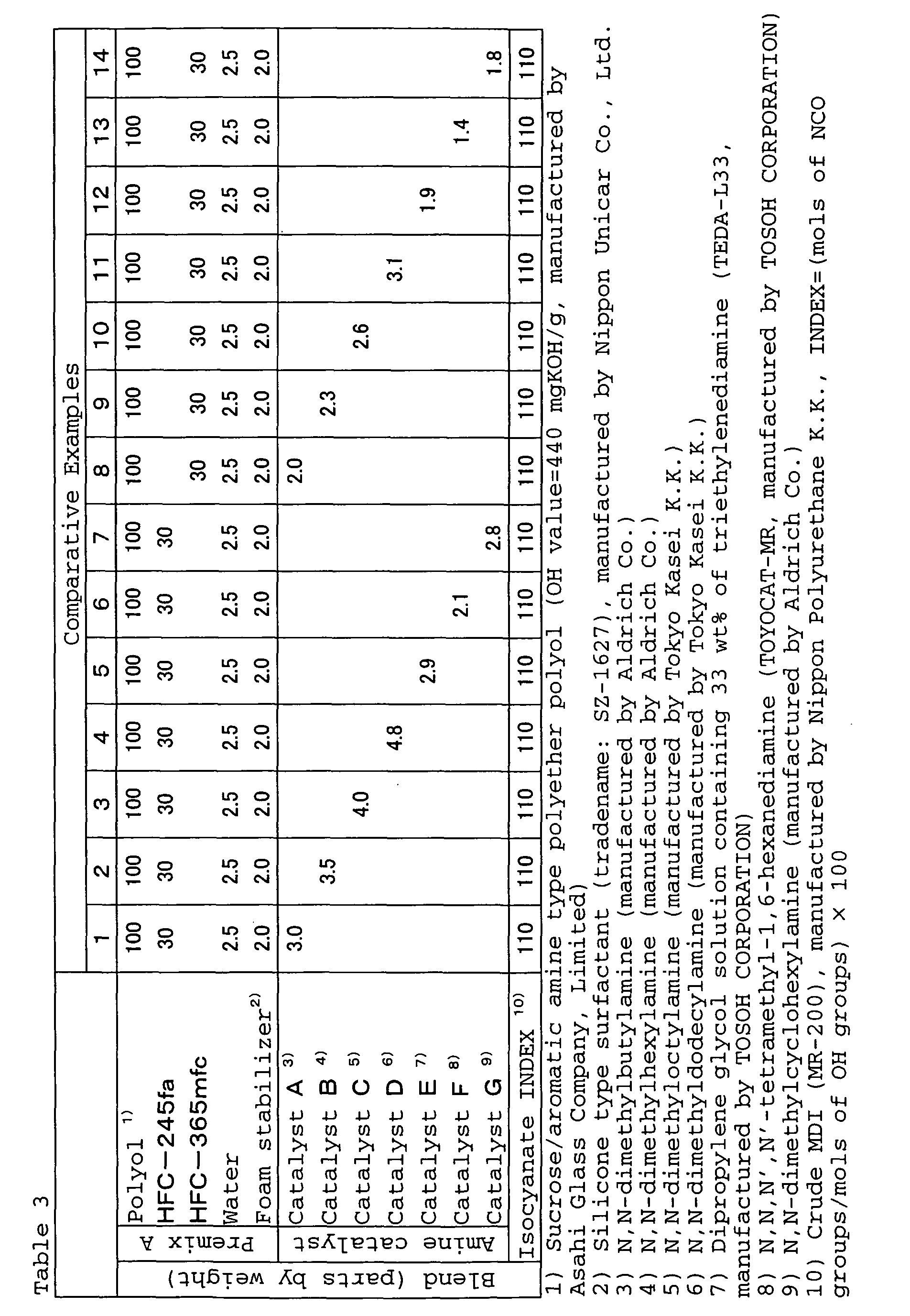
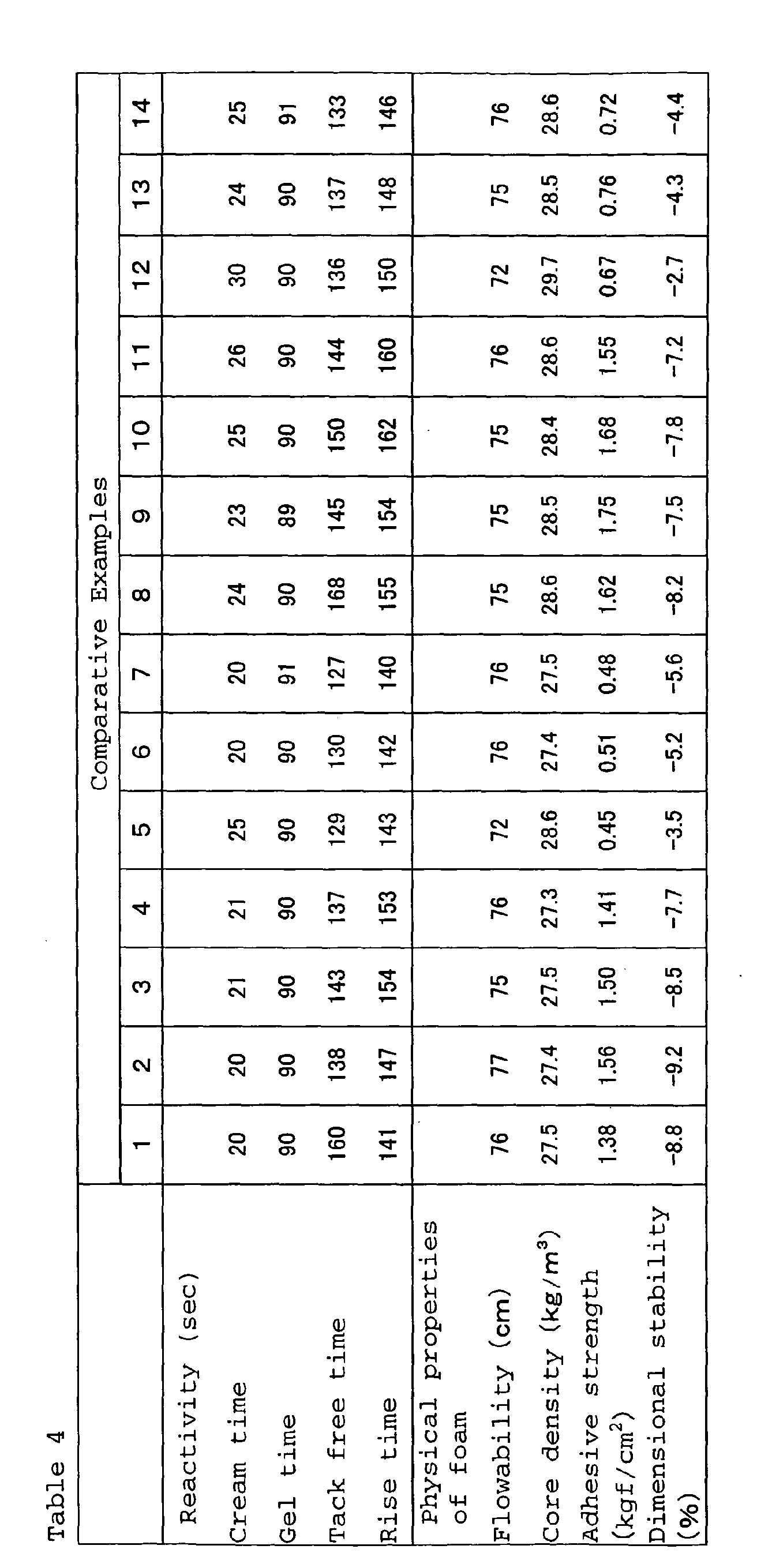
EXAMPLES 13 to 24
-
A polyol, a blowing agent and a foam stabilizer were
mixed in a blend ratio as identified in Table 1 to
prepare Premix A. 47.1 g of Premix A was taken into a
300 ml polyethylene cup, and a catalyst as identified in
Table 1 was added in an amount such that the reactivity
as represented by the following gel time would be 90
seconds, whereupon the temperature was adjusted to 10°C.
A polyisocyanate liquid (MR-200) having the temperature
adjusted to 10°C in a separate container, was put into
the cup of Premix A in such an amount that the isocyanate
index [isocyanate groups/OH groups (molar ratio) × 100)]
would be 110, and immediately stirred by a stirrer at
6,500 rpm for 5 seconds. The mixed and stirred liquid
was transferred to a 2 liter polyethylene cup having the
temperature adjusted to 40°C, and the reactivity during
foaming was measured. Then, the starting material scale
was increased, and in the same manner, the mixed liquid
was put into a mold having the temperature adjusted to
40°C, whereupon foam molding was carried out. Upon
expiration of 10 minutes from the introduction of the
mixed liquid, the foam was removed from the mold. From
the molded foam, the flowability, core density, adhesive
strength and dimensional stability of the foam were
evaluated. The results are shown in Table 2.
COMPARATIVE EXAMPLES 8 to 14
-
A polyol, a blowing agent and a foam stabilizer were
mixed in a blend ratio as identified in Table 3 to
prepare Premix A. 47.1 g of Premix A was taken into a
300 ml polyethylene cup, and a catalyst as identified in
Table 3 was added in an amount such that the reactivity
as represented by the following gel time would be 90
seconds, whereupon the temperature was adjusted to 20°C.
A polyisocyanate liquid (MR-200) having the temperature
adjusted to 20°C in a separate container, was put into
the cup of Premix A in such an amount that the isocyanate
index [isocyanate groups/OH groups (molar ratio) × 100)]
would be 110, and immediately stirred by a stirrer at
6,500 rpm for 5 seconds. The mixed and stirred liquid
was transferred to a 2 liter polyethylene cup having the
temperature adjusted to 40°C, and the reactivity during
foaming was measured. Then, the starting material scale
was increased, and in the same manner, the mixed liquid
was put into a mold having the temperature adjusted to
40°C, whereupon foam molding was carried out. Upon
expiration of 10 minutes from the introduction of the
mixed liquid, the foam was removed from the mold. From
the molded foam, the flowability, core density, adhesive
strength and dimensional stability of the foam were
evaluated. The results are shown in Table 4.
COMPARATIVE EXAMPLES 15 to 29
-
A polyol, a blowing agent and a foam stabilizer were
mixed in a blend ratio as identified in Table 5 to
prepare Premix A. 47.1 g of Premix A was taken into a
300 ml polyethylene cup, and a catalyst as identified in
Table 5 was added in an amount such that the reactivity
as represented by the following gel time would be 90
seconds, whereupon the temperature was adjusted to 20°C.
A polyisocyanate liquid (MR-200) having the temperature
adjusted to 20°C in a separate container, was put into
the cup of Premix A in such an amount that the isocyanate
index [isocyanate groups/OH groups (molar ratio) × 100)]
would be 110, and immediately stirred by a stirrer at
6,500 rpm for 5 seconds. The mixed and stirred liquid
was transferred to a 2 liter polyethylene cup having the
temperature adjusted to 40°C, and the reactivity during
foaming was measured. Then, the starting material scale
was increased, and in the same manner, the mixed liquid
was put into a mold having the temperature adjusted to
40°C, whereupon foam molding was carried out. Upon
expiration of 10 minutes from the introduction of the
mixed liquid, the foam was removed from the mold. From
the molded foam, the flowability, core density, adhesive
strength and dimensional stability of the foam were
evaluated. The results are shown in Table 6.

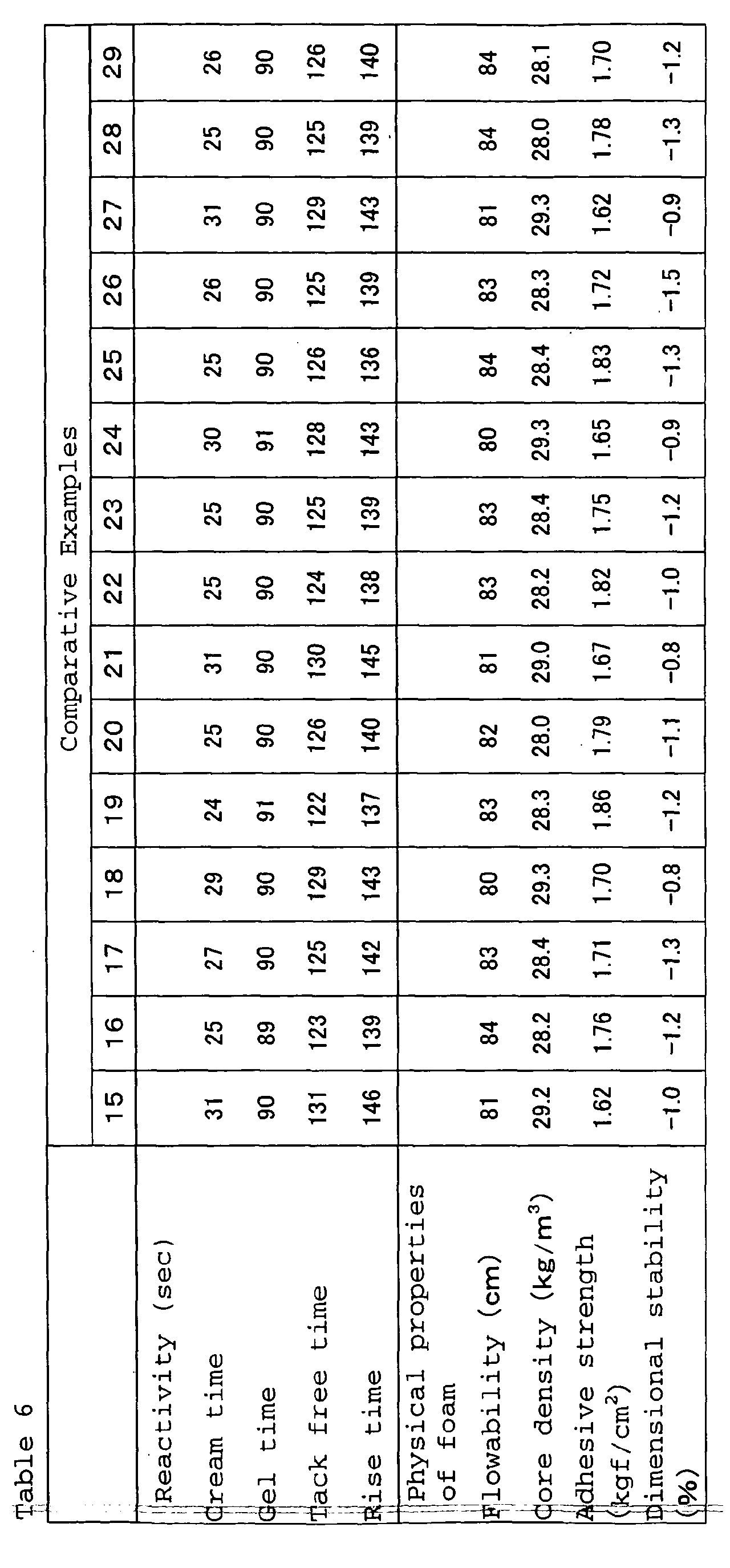
-
As is evident from Tables 2, 4 and 6, it is possible
to produce foams excellent in flowability, adhesive
strength and dimensional stability by using amine
compounds of the present invention as catalysts.
-
Namely, Examples 1 to 12 are examples wherein rigid
polyurethane foams were produced by using catalysts of
the present invention and 1,1,1,3,3-pentafluoropropane
(HFC-245fa) as a blowing agent. In each Example, a rigid
urethane foam excellent in flowability, adhesive strength
and dimensional stability, was obtained. Further,
Examples 13 to 24 are Examples wherein rigid polyurethane
foams were produced by using the catalysts of the present
invention and 1,1,1,3,3-pentafluorobutane (HFC-365mfc) as
a blowing agent. In each Example, a rigid urethane foam
excellent in flowability, adhesive strength and
dimensional stability, was obtained.
-
Whereas, Comparative Examples 1 to 4 and Comparative
Examples 8 to 11 are examples wherein rigid polyurethane
foams were produced by using only the aliphatic amine
compounds of the above formula (1) as catalysts, whereby
large amounts of the catalysts were required, and the
foams were inferior in flowability and dimensional
stability.
-
Further, Comparative Examples 5 to 7 and Comparative
Examples 12 to 14 are examples wherein rigid polyurethane
foams were produced by using triethylenediamine,
N,N,N',N'-tetramethyl-1,6-hexanediamine or N,N-dimethylcyclohexylamine
solely as the catalyst without
using the aliphatic amine compound of the above formula
(1), whereby the obtained foams were inferior in
flowability, adhesive strength and dimensional stability.
-
Further, Comparative Examples 15 to 21 are examples
in which 1,1-dichloro-1-fluoroethane (HCFC-141b) was used
as a blowing agent, whereby even if the catalyst of the
present invention was used, no remarkable effect was
observed in the flowability, adhesive strength and
dimensional stability of the foams.
EXAMPLES 25 to 48
-
A polyol, a blowing agent and a foam stabilizer were
mixed in a blend ratio as identified in Table 7 to
prepare Premix A. 47.1 g of Premix A was taken into a
300 ml polyethylene cup, and a catalyst as identified in
Table 7 was added in an amount such that the reactivity
as represented by the following gel time would be 90
seconds, whereupon the temperature was adjusted to 20°C.
A polyisocyanate liquid (MR-200) having the temperature
adjusted to 10°C in a separate container, was put into
the cup of Premix A in such an amount that the isocyanate
index [isocyanate groups/OH groups (molar ratio) × 100)]
would be 110, and immediately stirred by a stirrer at
6,500 rpm for 5 seconds. The mixed and stirred liquid
was transferred to a 2 liter polyethylene cup having the
temperature adjusted to 40°C, and the reactivity during
foaming was measured. Then, the starting material scale
was increased, and in the same manner, the mixed liquid
was put into a mold having the temperature adjusted to
40°C, whereupon foam molding was carried out. Upon
expiration of 10 minutes from the introduction of the
mixed liquid, the foam was removed from the mold. From
the molded foam, the flowability, core density, adhesive
strength and dimensional stability of the foam were
evaluated. The results are shown in Table 8.
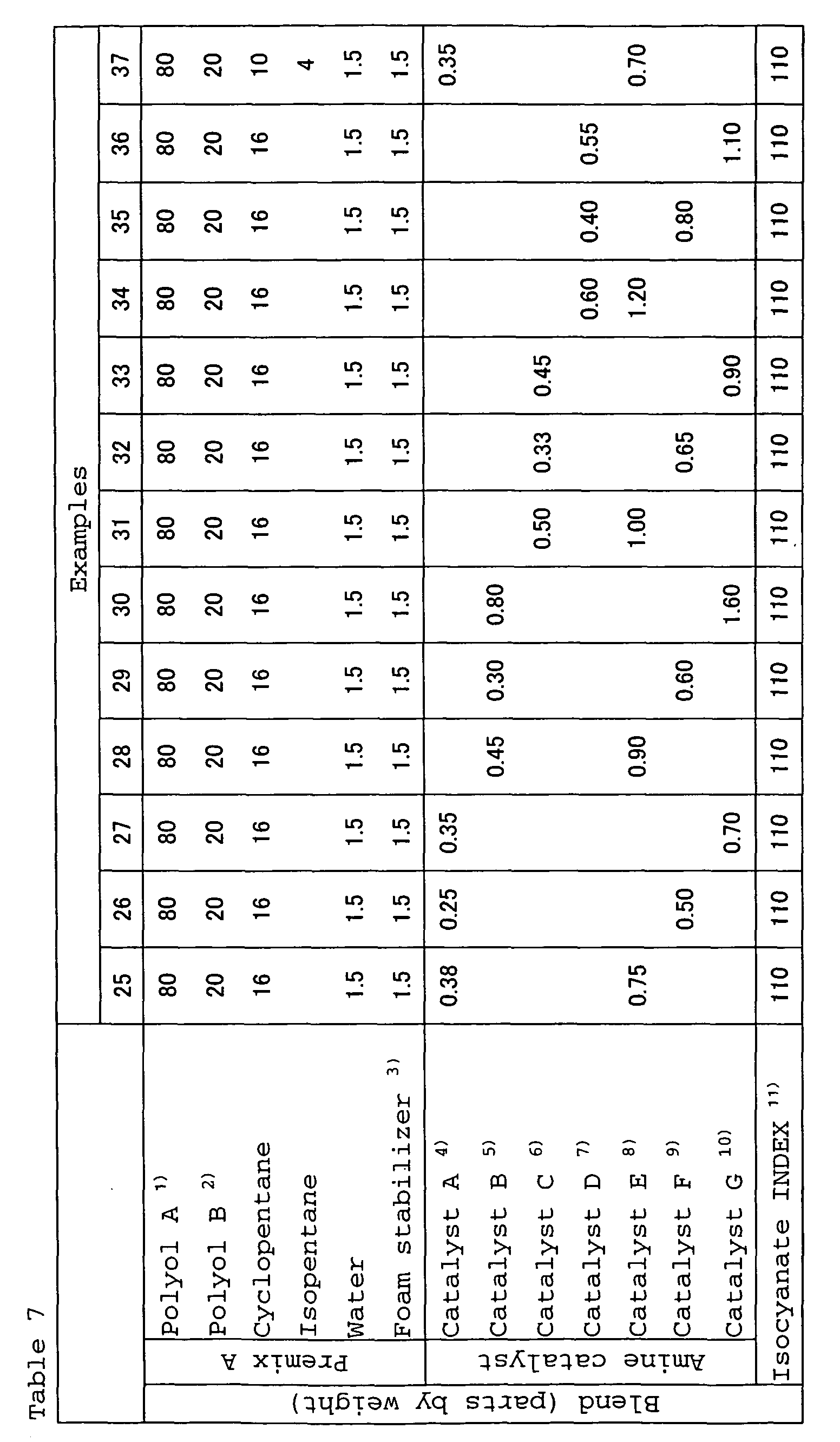
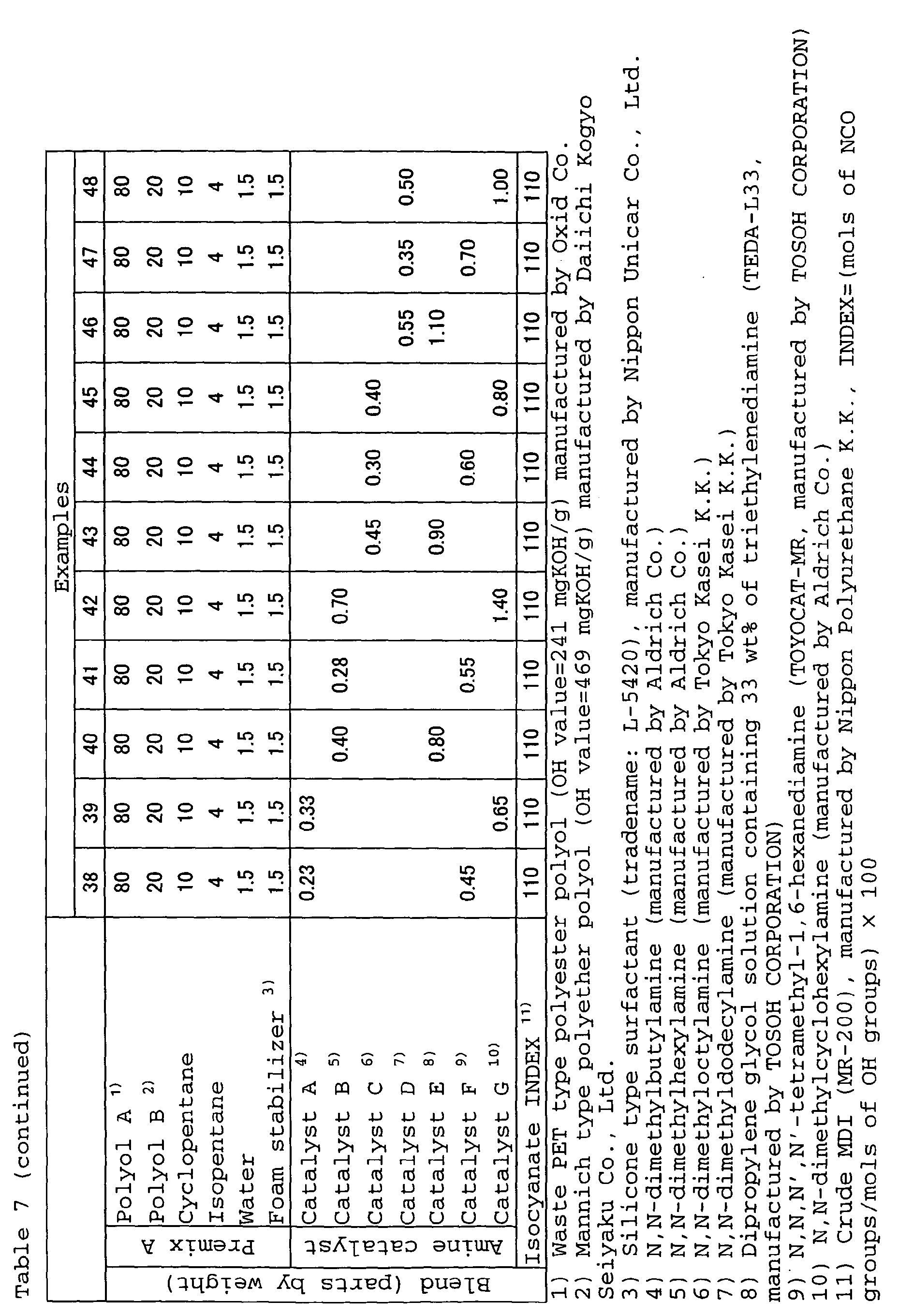
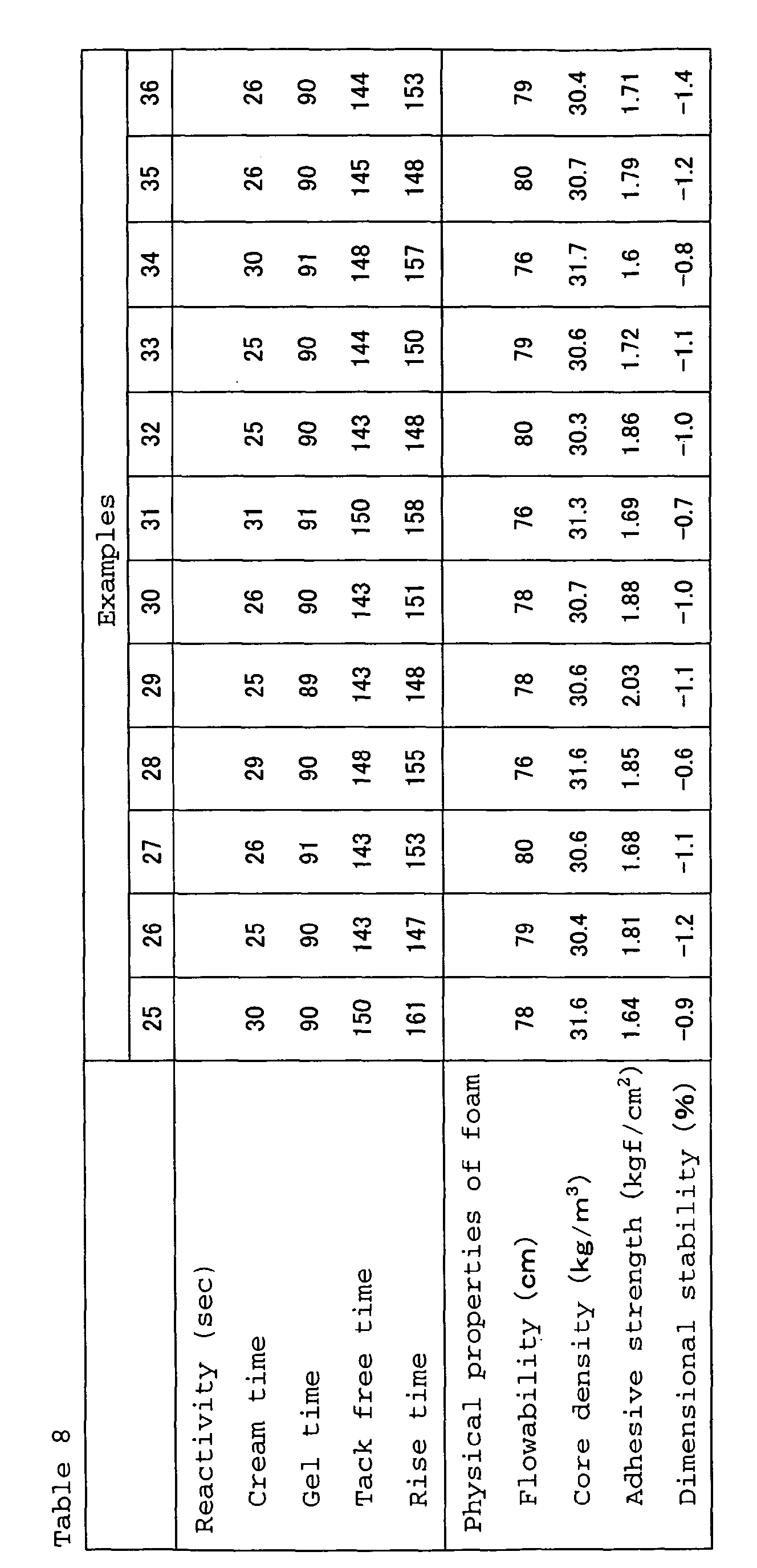

COMPARATIVE EXAMPLES 30 to 43
-
A polyol, a blowing agent and a foam stabilizer were
mixed in a blend ratio as identified in Table 9 to
prepare Premix A. 47.1 g of Premix A was taken into a
300 ml polyethylene cup, and a catalyst as identified in
Table 9 was added in an amount such that the reactivity
as represented by the following gel time would be 90
seconds, whereupon the temperature was adjusted to 20°C.
A polyisocyanate liquid (MR-200) having the temperature
adjusted to 20°C in a separate container, was put into
the cup of Premix A in such an amount that the isocyanate
index [isocyanate groups/OH groups (molar ratio) × 100)]
would be 110, and immediately stirred by a stirrer at
6,500 rpm for 5 seconds. The mixed and stirred liquid
was transferred to a 2 liter polyethylene cup having the
temperature adjusted to 40°C, and the reactivity during
foaming was measured. Then, the starting material scale
was increased, and in the same manner, the mixed liquid
was put into a mold having the temperature adjusted to
40°C, whereupon foam molding was carried out. Upon
expiration of 10 minutes from the introduction of the
mixed liquid, the foam was removed from the mold. From
the molded foam, the flowability, core density, adhesive
strength and dimensional stability of the foam were
evaluated. The results are shown in Table 10.


COMPARATIVE EXAMPLES 44 to 58
-
A polyol, a blowing agent and a foam stabilizer were
mixed in a blend ratio as identified in Table 11 to
prepare Premix A. 47.1 g of Premix A was taken into a
300 ml polyethylene cup, and a catalyst as identified in
Table 11 was added in an amount such that the reactivity
as represented by the following gel time would be 90
seconds, whereupon the temperature was adjusted to 20°C.
A polyisocyanate liquid (MR-200) having the temperature
adjusted to 20°C in a separate container, was put into
the cup of Premix A in such an amount that the isocyanate
index [isocyanate groups/OH groups (molar ratio) × 100)]
would be 110, and immediately stirred by a stirrer at
6,500 rpm for 5 seconds. The mixed and stirred liquid
was transferred to a 2 liter polyethylene cup having the
temperature adjusted to 40°C, and the reactivity during
foaming was measured. Then, the starting material scale
was increased, and in the same manner, the mixed liquid
was put into a mold having the temperature adjusted to
40°C, whereupon foam molding was carried out. Upon
expiration of 10 minutes from the introduction of the
mixed liquid, the foam was removed from the mold. From
the molded foam, the flowability, core density, adhesive
strength and dimensional stability of the foam were
evaluated. The results are shown in Table 12.


-
As is evident from Tables 8, 10 and 12, it is
possible to produce foams excellent in flowability,
adhesive strength and dimensional stability by using
amine compounds of the present invention as catalysts.
-
Namely, Examples 25 to 48 are examples wherein rigid
polyurethane foams were produced by using low boiling
point hydrocarbons having boiling points of from -30 to
90°C as blowing agents. In each Example, a rigid
urethane foam excellent in flowability, adhesive strength
and dimensional stability, was obtained.
-
Whereas, Comparative Examples 30 to 33 and
Comparative Examples 37 to 40 are examples wherein rigid
polyurethane foams were produced by using only the
aliphatic amine compounds of the above formula (1) as
catalysts, whereby large amounts of the catalysts were
required, and the foams were inferior in flowability and
dimensional stability.
-
Further, Comparative Examples 34 to 36 and
Comparative Examples 41 to 43 are examples wherein rigid
polyurethane foams were produced by using
triethylenediamine, N,N,N',N'-tetramethyl-1,6-hexanediamine
or N,N-dimethylcyclohexylamine solely as
the catalyst without using the aliphatic amine compound
of the above formula (1), whereby the foams were inferior
in flowability, adhesive strength and dimensional
stability.
-
Further, Comparative Examples 44 to 58 are examples
in which 1,1-dichloro-l-fluoroethane (HCFC-141b) was used
as a blowing agent, whereby even if the catalyst of the
present invention was used, no distinct effect to the
flowability, adhesive strength and dimensional stability,
was observed.
EXAMPLES 49 to 52 and COMPARATIVE EXAMPLES 59 to 61
-
A polyol, a blowing agent and a foam stabilizer were
mixed in a blend ratio as identified in Table 13 to
prepare Premix A. 47.1 g of Premix A was taken into a
300 ml polyethylene cup, and a catalyst as identified in
Table 13 was added in an amount such that the reactivity
as represented by the following gel time would be 90
seconds, whereupon the temperature was adjusted to 10°C.
A polyisocyanate liquid (MR-200) having the temperature
adjusted to 10°C in a separate container, was put into
the cup of Premix A in such an amount that the isocyanate
index [isocyanate groups/OH groups (molar ratio) × 100)]
would be 110, and immediately stirred by a stirrer at
6,500 rpm for 5 seconds. The mixed and stirred liquid
was transferred to a 2 liter polyethylene cup having the
temperature adjusted to 40°C, and the reactivity during
foaming was measured. Then, the starting material scale
was increased, and in the same manner, the mixed liquid
was put into a mold having the temperature adjusted to
40°C, whereupon foam molding was carried out. Upon
expiration of 10 minutes from the introduction of the
mixed liquid, the foam was removed from the mold. From
the molded foam, the flowability, core density, adhesive
strength and dimensional stability of the foam were
evaluated. The results are shown in Table 14.

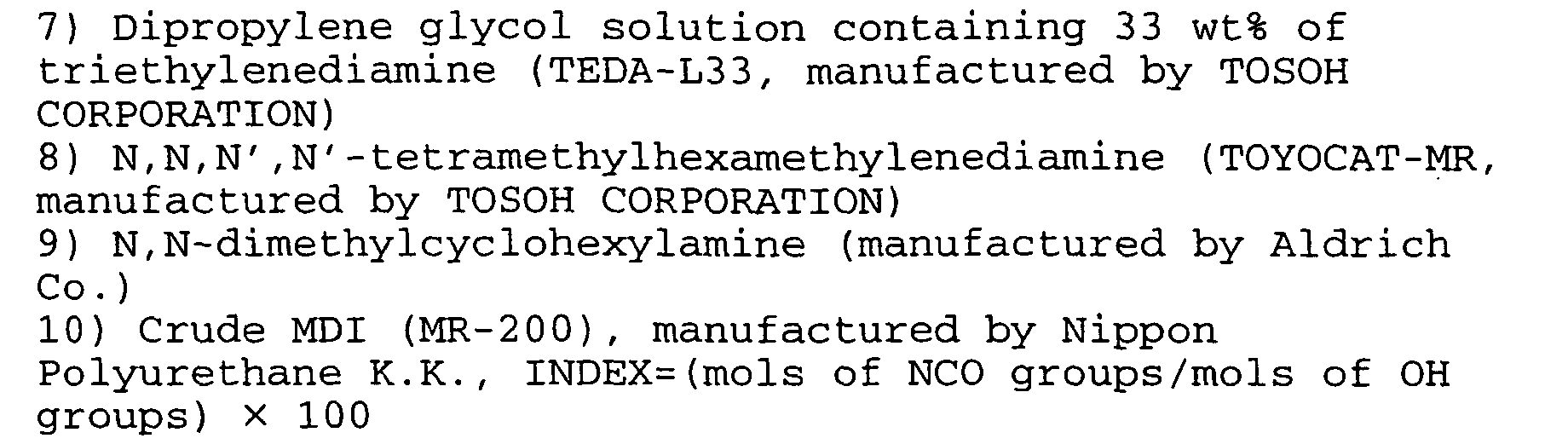
| | Examples | Comparative
Examples |
| | 49 | 50 | 51 | 52 | 59 | 60 | 61 |
| Reactivity (sec) |
| Cream time | 23 | 22 | 20 | 21 | 25 | 20 | 20 |
| Gel time | 91 | 90 | 90 | 91 | 90 | 90 | 91 |
| Tack free time | 151 | 146 | 135 | 148 | 129 | 130 | 127 |
| Rise time | 158 | 155 | 148 | 155 | 143 | 142 | 140 |
Physical
properties of foam |
| Flowability (cm) | 83 | 82 | 80 | 81 | 72 | 76 | 76 |
| Core density (kg/m3) | 27.3 | 27.3 | 27.4 | 27.6 | 28.6 | 27.4 | 27.5 |
| Adhesive strength (kgf/cm2) | 1.14 | 1.18 | 1.25 | 0.96 | 0.45 | 0.51 | 0.48 |
Dimensional
stability (%) | -1.2 | -1.1 | -1.0 | -1.5 | -3.5 | -5.2 | -5.6 |
-
As is evident from Table 14, it is possible to
produce foams excellent in flowability, adhesive strength
and dimensional stability by using amine compounds of the
present invention as catalysts.
-
Namely, Examples 49 to 52 are examples wherein rigid
polyurethane foams were produced by using the catalysts
of the present invention. In each Example, a rigid
urethane foam excellent in flowability, adhesive strength
and dimensional stability, was obtained.
-
Whereas, Comparative Examples 59 to 61 are examples
wherein tertiary amine catalysts having no alkyl ether
group or no aryl ether group in their molecules, were
used, whereby the foams were inferior in flowability,
adhesive strength and dimensional stability.
EXAMPLES 53 to 56 and COMPARATIVE EXAMPLES 62 to 64
-
A polyol, a blowing agent and a foam stabilizer were
mixed in a blend ratio as identified in Table 15 to
prepare Premix A. 47.1 g of Premix A was taken into a
300 ml polyethylene cup, and a catalyst as identified in
Table 15 was added in an amount such that the reactivity
as represented by the following gel time would be 90
seconds, whereupon the temperature was adjusted to 20°C.
A polyisocyanate liquid (MR-200) having the temperature
adjusted to 20°C in a separate container, was put into
the cup of Premix A in such an amount that the isocyanate
index [isocyanate groups/OH groups (molar ratio) × 100)]
would be 110, and immediately stirred by a stirrer at
6,500 rpm for 5 seconds. The mixed and stirred liquid
was transferred to a 2 liter polyethylene cup having the
temperature adjusted to 40°C, and the reactivity during
foaming was measured. Then, the starting material scale
was increased, and in the same manner, the mixed liquid
was put into a mold having the temperature adjusted to
40°C, whereupon foam molding was carried out. Upon
expiration of 10 minutes from the introduction of the
mixed liquid, the foam was removed from the mold. From
the molded foam, the flowability, core density, adhesive
strength and dimensional stability of the foam were
evaluated. The results are shown in Table 16.


| | Examples | Comparative
Examples |
| | 53 | 54 | 55 | 56 | 62 | 63 | 64 |
| Reactivity (sec) |
| Cream time | 25 | 24 | 21 | 23 | 30 | 24 | 25 |
| Gel time | 90 | 90 | 89 | 90 | 90 | 90 | 91 |
| Tack free time | 155 | 150 | 141 | 153 | 136 | 137 | 133 |
| Rise time | 162 | 159 | 152 | 164 | 150 | 148 | 146 |
Physical
properties of foam |
| Flowability (cm) | 81 | 81 | 80 | 80 | 72 | 75 | 76 |
| Core density (kg/m3) | 28.3 | 28.4 | 28.5 | 28.7 | 29.7 | 28.5 | 28.6 |
| Adhesive strength (kgf/cm2) | 1.38 | 1.43 | 1.50 | 1.18 | 0.67 | 0.76 | 0.72 |
Dimensional
stability (%) | -1.1 | -1.1 | -0.8 | -1.4 | -2.7 | -4.3 | -4.4 |
-
As is evident from Table 16, it is possible to
produce foams excellent in flowability, adhesive strength
and dimensional stability by using amine compounds of the
present invention as catalysts.
-
Namely, Examples 53 to 56 are examples wherein rigid
polyurethane foams were produced by using the catalysts
of the present invention. In each Example, a rigid
urethane foam excellent in flowability, adhesive strength
and dimensional stability, was obtained.
-
Whereas, Comparative Examples 62 to 64 are examples
wherein tertiary amine catalysts having no alkyl ether
group or no aryl ether group in their molecules, were
used, whereby the foams were inferior in flowability,
adhesive strength and dimensional stability.
EXAMPLES 57 to 60 and COMPARATIVE EXAMPLES 65 to 67
-
A polyol, a blowing agent and a foam stabilizer were
mixed in a blend ratio as identified in Table 17 to
prepare Premix A. 47.1 g of Premix A was taken into a
300 ml polyethylene cup, and a catalyst as identified in
Table 17 was added in an amount such that the reactivity
as represented by the following gel time would be 90
seconds, whereupon the temperature was adjusted to 20°C.
A polyisocyanate liquid (MR-200) having the temperature
adjusted to 20°C in a separate container, was put into
the cup of Premix A in such an amount that the isocyanate
index [isocyanate groups/OH groups (molar ratio) × 100)]
would be 110, and immediately stirred by a stirrer at
6,500 rpm for 5 seconds. The mixed and stirred liquid
was transferred to a 2 liter polyethylene cup having the
temperature adjusted to 40°C, and the reactivity during
foaming was measured. Then, the starting material scale
was increased, and in the same manner, the mixed liquid
was put into a mold having the temperature adjusted to
40°C, whereupon foam molding was carried out. Upon
expiration of 10 minutes from the introduction of the
mixed liquid, the foam was removed from the mold. From
the molded foam, the flowability, core density, adhesive
strength and dimensional stability of the foam were
evaluated. The results are shown in Table 18.
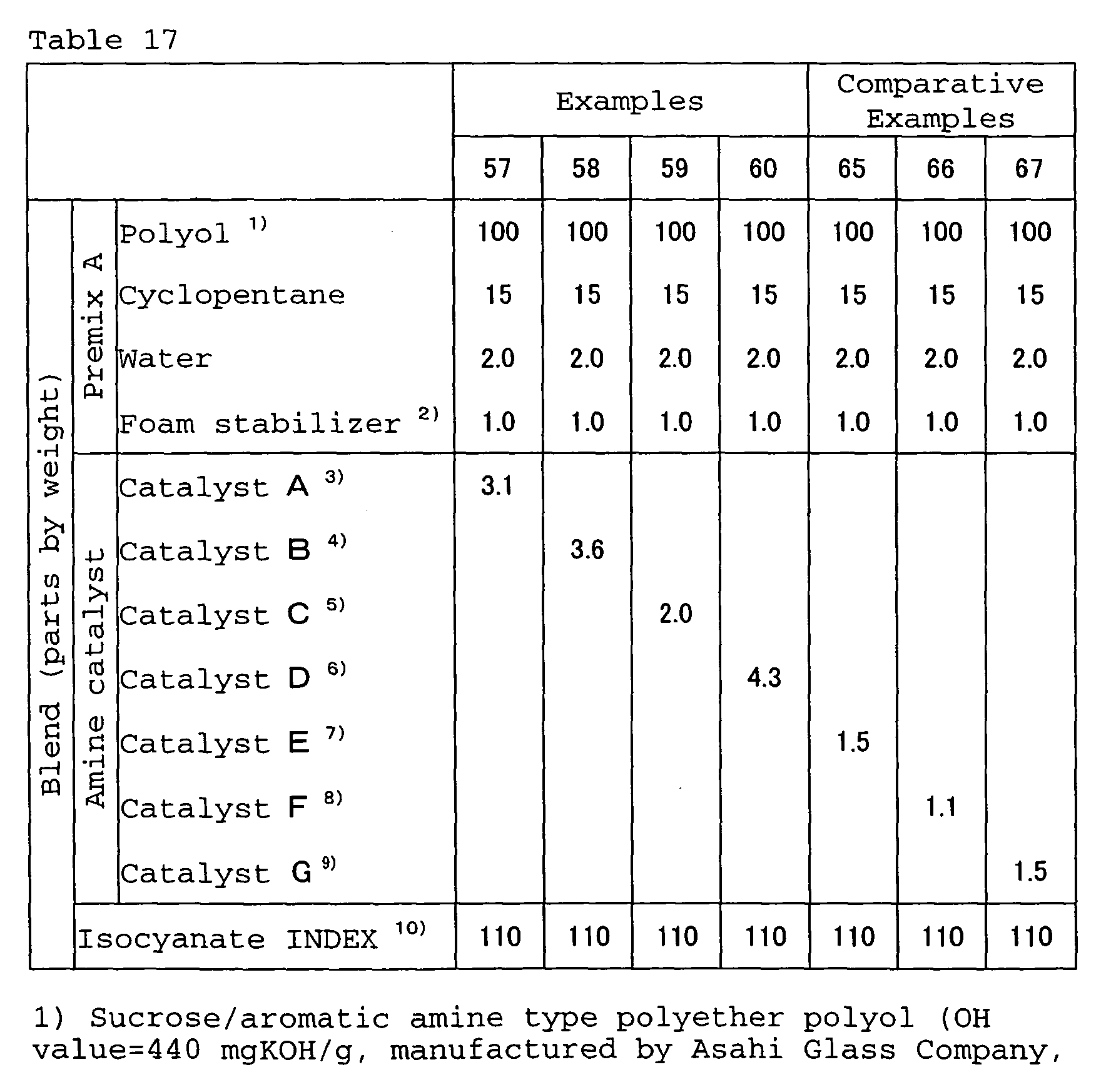

| | Examples | Comparative
Examples |
| | 57 | 58 | 59 | 60 | 65 | 66 | 67 |
| Reactivity (sec) |
| Cream time | 28 | 27 | 26 | 25 | 31 | 26 | 25 |
| Gel time | 91 | 90 | 90 | 90 | 90 | 90 | 90 |
| Tack free time | 153 | 148 | 136 | 150 | 132 | 132 | 128 |
| Rise time | 159 | 157 | 150 | 158 | 148 | 146 | 143 |
Physical
properties of foam |
| Flowability (cm) | 79 | 78 | 77 | 78 | 70 | 72 | 72 |
| Core density (kg/m3) | 30.4 | 30.5 | 30.5 | 30.8 | 31.9 | 30.5 | 30.6 |
| Adhesive strength (kgf/cm2) | 1.66 | 1.72 | 1.81 | 1.43 | 0.94 | 1.07 | 1.01 |
Dimensional
stability (%) | -1.1 | -1.0 | -0.9 | -1.2 | -2.2 | -3.0 | -3.2 |
-
As is evident from Table 18, it is possible to
produce foams excellent in flowability, adhesive strength
and dimensional stability by using amine compounds of the
present invention as catalysts.
-
Namely, Examples 57 to 60 are examples wherein rigid
polyurethane foams were produced by using the catalysts
of the present invention. In each Example, a rigid
urethane foam excellent in flowability, adhesive strength
and dimensional stability, was obtained.
-
Whereas, Comparative Examples 65 to 67 are examples
wherein tertiary amine catalysts having no alkyl ether
group or no aryl ether group in their molecules, were
used, whereby the foams were inferior in flowability,
adhesive strength and dimensional stability.
EXAMPLES 61 to 64 and COMPARATIVE EXAMPLES 68 to 71
-
A polyol, a blowing agent and a foam stabilizer were
mixed in a blend ratio as identified in Table 19 to
prepare Premix A. 47.1 g of Premix A was taken into a
300 ml polyethylene cup, and a catalyst as identified in
Table 19 was added in an amount such that the reactivity
as represented by the following gel time would be 90
seconds, whereupon the temperature was adjusted to 20°C.
A polyisocyanate liquid (MR-200) having the temperature
adjusted to 20°C in a separate container, was put into
the cup of Premix A in such an amount that the isocyanate
index [isocyanate groups/OH groups (molar ratio) × 100)]
would be 110, and immediately stirred by a stirrer at
6,500 rpm for 5 seconds. The mixed and stirred liquid
was transferred to a 2 liter polyethylene cup having the
temperature adjusted to 40°C, and the reactivity during
foaming was measured. Then, the starting material scale
was increased, and in the same manner, the mixed liquid
was put into a mold having the temperature adjusted to
40°C, whereupon foam molding was carried out. Upon
expiration of 10 minutes from the introduction of the
mixed liquid, the foam was removed from the mold. From
the molded foam, the flowability, core density, adhesive
strength and dimensional stability of the foam were
evaluated. The results are shown in Table 20.


| | Examples | Comparative
Examples |
| | 61 | 62 | 63 | 64 | 68 | 69 | 71 |
| Reactivity (sec) |
| Cream time | 25 | 24 | 22 | 23 | 29 | 24 | 25 |
| Gel time | 91 | 90 | 90 | 90 | 90 | 90 | 90 |
| Tack free time | 156 | 151 | 148 | 152 | 146 | 147 | 143 |
| Rise time | 162 | 159 | 162 | 164 | 155 | 158 | 156 |
Physical
properties of foam |
| Flowability (cm) | 84 | 83 | 82 | 82 | 73 | 77 | 77 |
| Core density (kg/m3) | 26.8 | 26.8 | 26.9 | 27.1 | 28.3 | 27.5 | 27.6 |
| Adhesive strength (kgf/cm2) | 1.43 | 1.48 | 1.55 | 1.22 | 0.69 | 0.78 | 0.75 |
Dimensional
stability (%) | -1.2 | -1.1 | -0.9 | -1.4 | -2.8 | -4.5 | -4.4 |
-
As is evident from Table 20, it is possible to
produce foams excellent in flowability, adhesive strength
and dimensional stability by using amine compounds of the
present invention as catalysts.
-
Namely, Examples 61 to 64 are examples wherein rigid
polyurethane foams were produced by using the catalysts
of the present invention. In each Example, a rigid
urethane foam excellent in flowability, adhesive strength
and dimensional stability, was obtained.
-
Whereas, Comparative Examples 68 to 71 are examples
wherein tertiary amine catalysts having no alkyl ether
group or no aryl ether group in their molecules, were
used, whereby the foams were inferior in flowability,
adhesive strength and dimensional stability.
-
Now, referring to Examples and Comparative Examples,
the catalyst for producing a rigid polyisocyanurate foam
of the present invention, and the process for producing a
rigid polyisocyanurate foam by using such a catalyst,
will be described. However, it should be understood that
the present invention is by no means restricted by such
specific Examples.
·Measured items for the reactivity
-
Cream time: The time until the foam starts to rise
was measured by visual observation.
-
Gel time: As the reaction proceeds, the time until
the liquid substance changes to a resinous substance, was
measured.
-
Tack free time: The time until tackiness of the foam
surface disappears, was measured.
-
Rise time: The time until the rise of the foam
stops, was measured by visual observation.
-
·Oxygen index: The oxygen index is an index to show
the flame retardancy of a foam, and the combustion test
method was carried out in accordance with ASTMD 2863D-74.
·Core density of foam:
-
Free foaming was carried out in a 0.5L polyethylene
cup, and the center portion of the formed foam was cut
into a size of 10×5×5 cm, whereupon the size and weight
were accurately measured, and the core density was
calculated.
·Adhesive strength of foam:
-
Free foaming was carried out by setting a zinc-lined
iron plate of 5×5 cm on the upper side of a 0.5L
polyethylene cup. After foaming for 1 hour, the peel
strength at 90° of the set iron plate was measured and
taken as the adhesive strength of the foam.
·Dimensional stability of foam:
-
A foam freely foam in a 0.5L polyethylene cup was
maintained under a condition of -30°C × 48 hours, whereby
a change in the thickness direction was measured.
EXAMPLES 65 to 77 and 90
-
A polyol, a blowing agent and a foam stabilizer were
mixed in a blend ratio as identified in Table 21 to
prepare Premix A. As the blowing agent, 1,1,1,3,3-pentafluoropropane
(HFC-245fa) was used. 24.0 g of
Premix A was taken into a 0.5 L polyethylene cup, and a
catalyst as identified in Table 21 was added in an amount
such that the reactivity as represented by the following
gel time would be 12 to 13 seconds, whereupon the
temperature was adjusted to 10°C. A polyisocyanate
liquid (MR-200) having the temperature adjusted to 10°C
in a separate container, was put into the cup of Premix A
in such an amount that the isocyanate index [isocyanate
groups/OH groups (molar ratio) × 100)] would be 210, and
immediately stirred by a stirrer at 7,000 rpm for 3
seconds. The reactivity during foaming of the mixed and
stirred liquid, was measured. Then, using a foam freely
foamed by the same operation as described above, the
oxygen index, core density, adhesive strength and
dimensional stability were evaluated.
EXAMPLES 78 to 89
-
A polyol, a blowing agent and a foam stabilizer were
mixed in a blend ratio as identified in Table 21 to
prepare Premix A. As the blowing agent, 1,1,1,3,3-pentafluorobutane
(HFC-365mfc) or 1,1-dichloro-1-fluoroethane
(HCFC-141b) was used. 24.0 g of Premix A
was taken into a 0.5 L polyethylene cup, and a catalyst
as identified in Table 21 was added in an amount such
that the reactivity as represented by the following gel
time would be 12 to 13 seconds, whereupon the temperature
was adjusted to 20°C. A polyisocyanate liquid (MR-200)
having the temperature adjusted to 20°C in a separate
container, was put into the cup of Premix A in such an
amount that the isocyanate index [isocyanate groups/OH
groups (molar ratio) × 100)] would be 210, and
immediately stirred by a stirrer at 7,000 rpm for 3
seconds. The reactivity during foaming of the mixed and
stirred liquid, was measured. Then, using a foam freely
foamed by the same operation as described above, the
oxygen index, core density, adhesive strength and
dimensional stability were evaluated.
-
The results of Examples 65 to 90 are shown in Table
22.
COMPARATIVE EXAMPLES 72 to 79, 84 to 85, 88 to 89 and 92
-
A polyol, a blowing agent and a foam stabilizer were
mixed in a blend ratio as identified in Table 23 to
prepare Premix A. As the blowing agent, 1,1,1,3,3-pentafluoropropane
(HFC-245fa) was used. 24.0 g of
Premix A was taken into a 0.5 L polyethylene cup, and a
catalyst as identified in Table 23 was added in an amount
such that the reactivity as represented by the following
gel time would be 12 to 13 seconds, whereupon the
temperature was adjusted to 10°C. A polyisocyanate
liquid (MR-200) having the temperature adjusted to 10°C
in a separate container, was put into the cup of Premix A
in such an amount that the isocyanate index [isocyanate
groups/OH groups (molar ratio) × 100)] would be 210, and
immediately stirred by a stirrer at 7,000 rpm for 3
seconds. The reactivity during foaming of the mixed and
stirred liquid, was measured. Then, using a foam freely
foamed by the same operation as described above, the
oxygen index, core density, adhesive strength and
dimensional stability were evaluated.
COMPARATIVE EXAMPLES 80 to 83, 86 to 87, 90 and 91
-
A polyol, a blowing agent and a foam stabilizer were
mixed in a blend ratio as identified in Table 23 to
prepare Premix A. As the blowing agent, 1,1,1,3,3-pentafluorobutane
(HFC-365mfc) or 1,1-dichloro-1-fluoroethane
(HCFC-141b) was used. 24.0 g of Premix A
was taken into a 0.5 L polyethylene cup, and a catalyst
as identified in Table 23 was added in an amount such
that the reactivity as represented by the following gel
time would be 12 to 13 seconds, whereupon the temperature
was adjusted to 20°C. A polyisocyanate liquid (MR-200)
having the temperature adjusted to 20°C in a separate
container, was put into the cup of Premix A in such an
amount that the isocyanate index [isocyanate groups/OH
groups (molar ratio) × 100)] would be 210, and
immediately stirred by a stirrer at 7,000 rpm for 3
seconds. The reactivity during foaming of the mixed and
stirred liquid, was measured. Then, using a foam freely
foamed by the same operation as described above, the
oxygen index, core density, adhesive strength and
dimensional stability were evaluated.
-
The results of Comparative Examples 72 to 92 are
shown in Table 24.
-
As is evident from Tables 22 and 24, it is possible
to produce foams excellent in flame retardancy, adhesive
strength and dimensional stability by using amine
compounds of the present invention as catalysts.
-
Namely, Examples 65 to 71 and 73 to 76 are examples
wherein rigid polyisocyanurate foams were produced by
using the catalysts of the present invention and
1,1,1,3,3-pentafluoropropane (HFC-245fa) as a blowing
agent. In each Example, a rigid polyisocyanurate foam
excellent in flame retardancy, adhesive strength and
dimensional stability, was obtained.
-
Further, Examples 78 to 89 are examples wherein
rigid polyisocyanurate foams were produced by using
catalysts of the present invention and 1,1,1,3,3-pentafluorobutane
(HFC-365mfc) or 1,1-dichloro-1-fluoroethane
(HCFC-141b) as a blowing agent. In each
Example, a rigid polyisocyanurate foam excellent in flame
retardancy, adhesive strength and dimensional stability
was obtained.
-
Examples 72 is an example wherein the composition of
the polyisocyanurate catalyst in the catalyst composition
of the present invention exceeded 90 wt%, whereby a
slight decrease in adhesive strength is observed. On the
other hand, Example 77 is an example wherein the
composition of the polyisocyanurate catalyst in the
catalyst composition of the present invention was less
than 10 wt%, a slight decrease in the flame retardancy
and dimensional stability of the foam is observed.
Accordingly, it is evident that the composition
comprising from 10 to 90 wt% of an aliphatic amine
compound of the above formula (1) and from 90 to 10 wt%
of the polyisocyanurate catalyst, is advantageous from
the viewpoint of the cost.
-
Whereas, Comparative Examples 72 to 83 are examples
wherein rigid polyisocyanurate foams were produced by
means of catalyst compositions comprising an amine
compound other than the aliphatic amine compound of the
present invention and the polyisocyanurate catalyst,
whereby the foams were inferior in the flame retardancy,
adhesive strength and dimensional stability.
-
Further, Comparative Examples 84 to 87 are examples
wherein rigid polyisocyanunate foams were produced by
using only the aliphatic amine compounds as catalysts,
whereby large amounts of the catalysts were required, and
the foams were inferior in the flame retardancy and
dimensional stability. Further, Comparative Examples 88
to 91 are examples wherein rigid polyisocyanurate foams
were produced by using only the polyisocyanurate catalyst
(trimerization catalyst) without using an aliphatic amine
compound, whereby the foams were inferior in the adhesive
strength and dimensional stability.
-
Example 90 and Comparative Example 92 are examples
wherein a rigid polyisocyanurate foam was produced
without using a flame retardant and using 1,1,1,3,3-pentafluoropropane
(HFC-245fa) as a blowing agent. In
the case of Example 90 wherein the catalyst composition
of the present invention was used, a rigid
polyisocyanurate foam was obtained which was excellent in
flame retardancy, adhesive strength and dimensional
stability as compared with Comparative Example 92 wherein
a catalyst composition comprising an amine compound other
than the amine compound of the present invention and the
polyisocyanurate catalyst, was used.
EXAMPLES 91 to 100
-
A polyol, a blowing agent and a foam stabilizer were
mixed in a blend ratio as identified in Table 25 to
prepare Premix A. 24.0 g of Premix A was taken into a
0.5 L polyethylene cup, and a catalyst as identified in
Table 25 was added in an amount such that the reactivity
as represented by the following gel time would be 29 to
30 seconds, whereupon the temperature was adjusted to
20°C. A polyisocyanate liquid (MR-200) having the
temperature adjusted to 20°C in a separate container, was
put into the cup of Premix A in such an amount that the
isocyanate index [isocyanate groups/OH groups (molar
ratio) × 100)] would be 250, and immediately stirred by
a stirrer at 6,000 rpm for 5 seconds. The reactivity
during foaming of the mixed and stirred liquid, was
measured. Then, using a foam freely foamed by the same
operation as described above, the oxygen index, core
density, adhesive strength and dimensional stability were
evaluated.
-
The results of Examples 91 to 100 are shown in Table
26.
COMPARATIVE EXAMPLES 93 to 103
-
A polyol, a blowing agent and a foam stabilizer were
mixed in a blend ratio as identified in Table 27 to
prepare Premix A. 24.0 g of Premix A was taken into a
0.5 L polyethylene cup, and a catalyst as identified in
Table 27 was added in an amount such that the reactivity
as represented by the following gel time would be 29 to
30 seconds, whereupon the temperature was adjusted to
20°C. A polyisocyanate liquid (MR-200) having the
temperature adjusted to 20°C in a separate container, was
put into the cup of Premix A in such an amount that the
isocyanate index [isocyanate groups/OH groups (molar
ratio) × 100)] would be 250, and immediately stirred by
a stirrer at 6,000 rpm for 5 seconds. The reactivity
during foaming of the mixed and stirred liquid, was
measured. Then, using a foam freely foamed by the same
operation as described above, the oxygen index, core
density, adhesive strength and dimensional stability were
evaluated.
-
The results of Comparative Examples 93 to 103 are
shown in Table 28.
-
As is evident from Tables 26 and 28, it is possible
to produce foams excellent in flame retardancy, adhesive
strength and dimensional stability by using amine
compounds of the present invention as catalysts.
-
Namely, Examples 91 to 100 are examples wherein
rigid polyisocyanurate foams were produced by using the
catalysts of the present invention and cyclopentane as a
blowing agent. In each Example, a rigid polyisocyanurate
foam excellent in flame retardancy, adhesive strength and
dimensional stability, was obtained.
-
Whereas, Comparative Examples 93 to 98 are examples
wherein rigid polyisocyanurate foams were produced by
using a catalyst composition comprising an amine compound
other than the amine compound of the present invention
and the polyisocyanurate catalyst, whereby the foams were
inferior in flame retardancy, adhesive strength and
dimensional stability.
-
Further, Comparative Examples 99 and 100 are
examples wherein rigid polyisocyanurate foams were
produced by using only aliphatic amine compounds as
catalysts, whereby large amounts of the catalysts were
required, and the foams were inferior in flame retardancy,
adhesive strength and dimensional stability. Further,
Comparative Examples 101 to 103 are examples wherein
rigid polyisocyanurate foams were produced by using only
the polyisocyanurate catalyst as the catalyst without
using an amine compound of the present invention, whereby
the foams were inferior in adhesive strength and
dimensional stability.
-
The entire disclosures of Japanese Patent
Application No. 2002-205506 filed on July 15, 2002,
Japanese Patent Application No. 2002-245644 filed on
August 26, 2002, Japanese Patent Application No. 2002-261282
filed on September 6, 2002 and Japanese Patent
Application No. 2003-110020 filed on April 15, 2003
including specifications, claims and summaries are
incorporated herein by reference in their entireties.
-
The present invention relates to:
- (1) a catalyst for producing a rigid polyurethane
foam by means of at least one blowing agent selected from
the group consisting of 1,1,1,3,3-pentafluoropropane
(HFC-245fa), 1,1,1,3,3-pentafluorobutane (HFC-365mfc) and
a low boiling point hydrocarbon, which comprises:
- (A) an aliphatic amine compound and at least one
amine compound selected from the group consisting of
triethylenediamine, N,N,N',N'-tetramethyl-1,6-hexanediamine
and N,N-dimethylcyclohexylamine: or
- (B) an amine compound having an alkyl ether group
and/or an aryl ether group in its molecule;
- (2) a catalyst for producing a rigid
polyisocyanurate foam by means of at least one blowing
agent selected from the group consisting of 1,1,1,3,3-pentafluoropropane
(HFC-245fa), 1,1,1,3,3-pentafluorobutane
(HFC-365mfc) and a low boiling point
hydrocarbon, which comprises an aliphatic amine compound
and a polyisocyanurate catalyst;
- (3) a process for producing a rigid polyurethane
foam excellent in the adhesive strength and flame
retardancy of the foam, by means of the above-mentioned
catalyst for forming a rigid polyurethane foam and, as a
blowing agent, at least one blowing agent selected from
the group consisting of 1,1,1,3,3-pentafluoropropane
(HFC-245fa), 1,1,1,3,3-pentafluorobutane (HFC-365mfc) and
a low boiling point hydrocarbon; and
- (4) a process for producing a rigid polyisocyanurate
foam excellent in the flame retardancy, adhesive strength
and dimensional stability of the foam, by means of the
above-mentioned catalyst for producing a rigid
polyisocyanurate foam and, as a blowing agent, at least
one blowing agent selected from the group consisting of
1,1,1,3,3-pentafluoropropane (HFC-245fa), 1,1,1,3,3-pentafluorobutane
(HFC-365mfc) and a low boiling point
hydrocarbon.
-
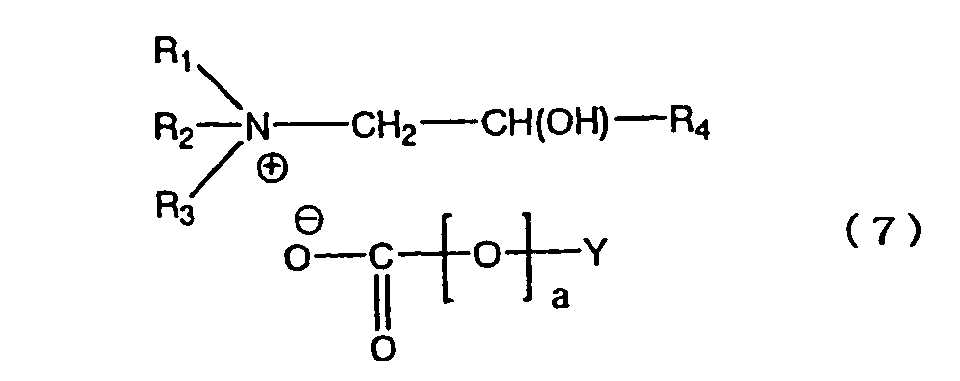
 wherein each of R1 to R3 is a C1-11 linear or branched, saturated or unsaturated hydrocarbon group, provided that two among R1 to R3 may form a hetero ring via a carbon, oxygen or nitrogen atom, R4 is a C1-8 alkyl group or an aromatic hydrocarbon group, and X is an organic acid group.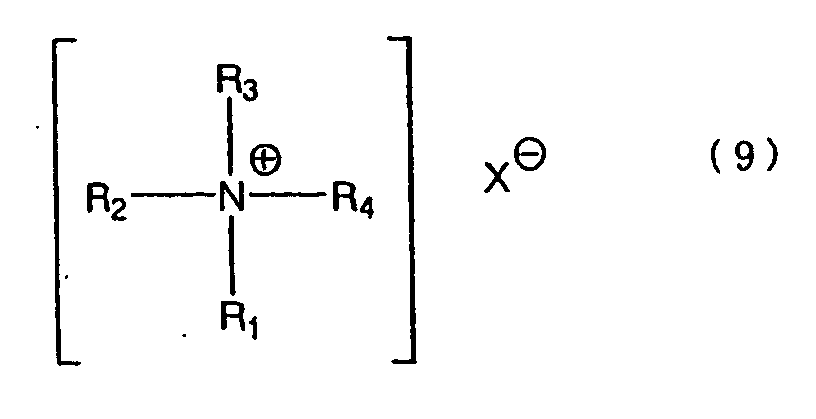

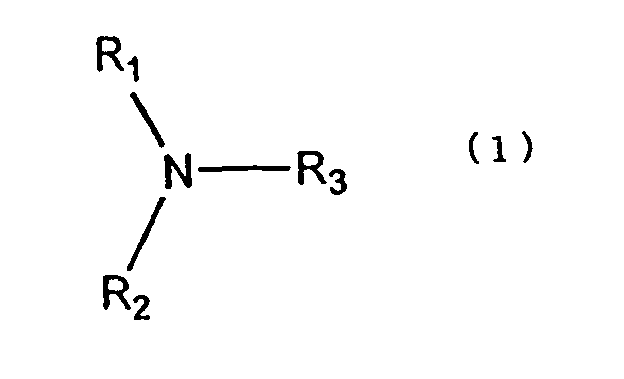

 wherein each of R1, R2 and R3 which are independent of one
another, is a C1-20 alkyl group, and a polyisocyanurate
catalyst, and the blowing agent is at least one blowing
agent selected from the group consisting of 1,1,1,3,3-pentafluoropropane
(HFC-245fa), 1,1,1,3,3-pentafluorobutane
(HFC-365mfc) and a low boiling point
hydrocarbon.
wherein each of R1, R2 and R3 which are independent of one
another, is a C1-20 alkyl group, and a polyisocyanurate
catalyst, and the blowing agent is at least one blowing
agent selected from the group consisting of 1,1,1,3,3-pentafluoropropane
(HFC-245fa), 1,1,1,3,3-pentafluorobutane
(HFC-365mfc) and a low boiling point
hydrocarbon.
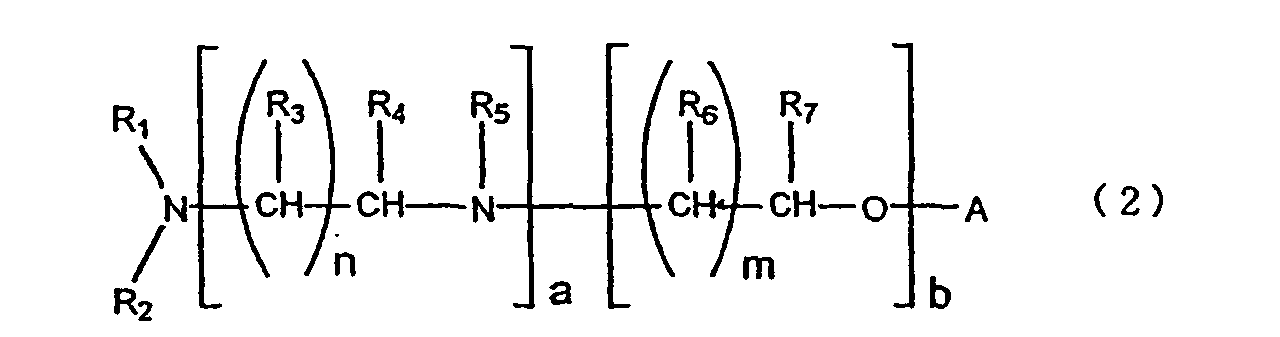 wherein R1, R6, R7, A, m and b are as defined in the above formula (2), may, for example, be mentioned as a preferred compound.
 wherein R1, R6, R7, A, m and b are as defined in the above formula (2), or an amine compound of the following formula (6):
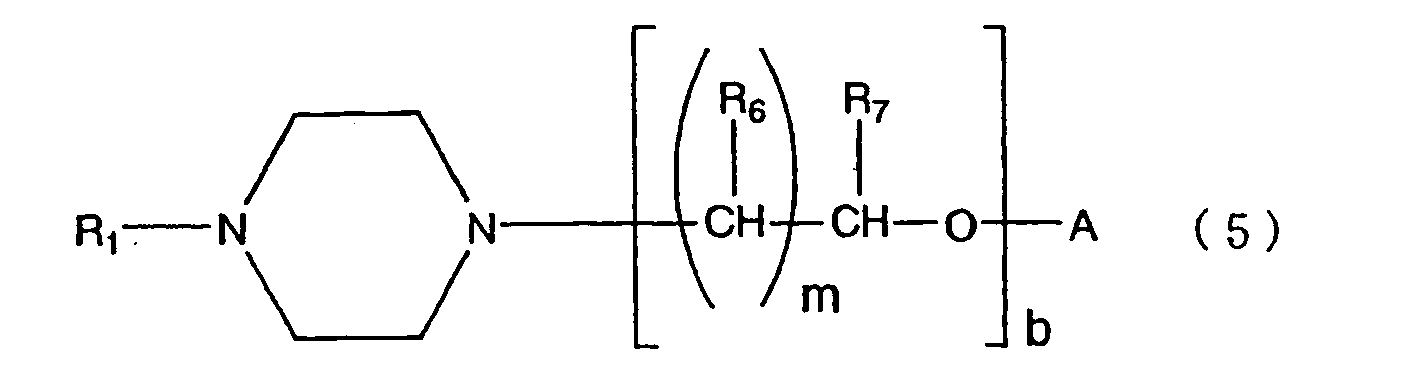 wherein R1, R6, R7, A, m and b are as defined in the above formula (2).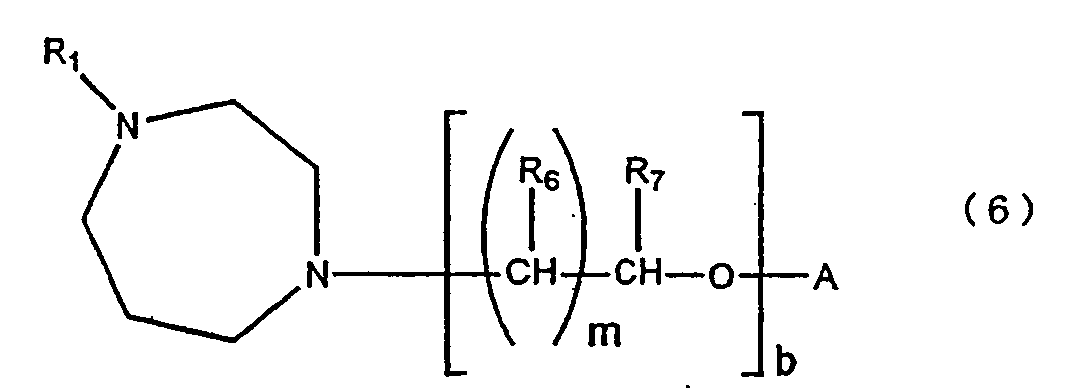

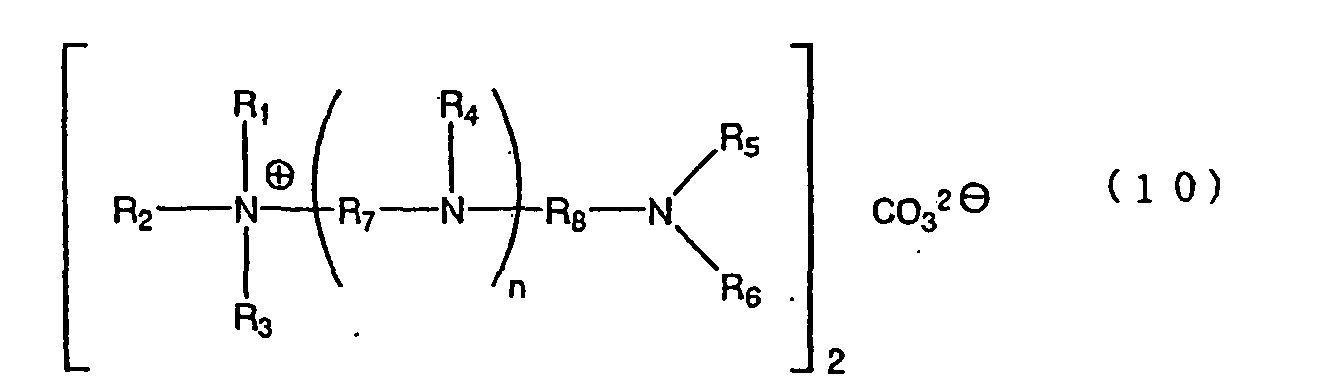


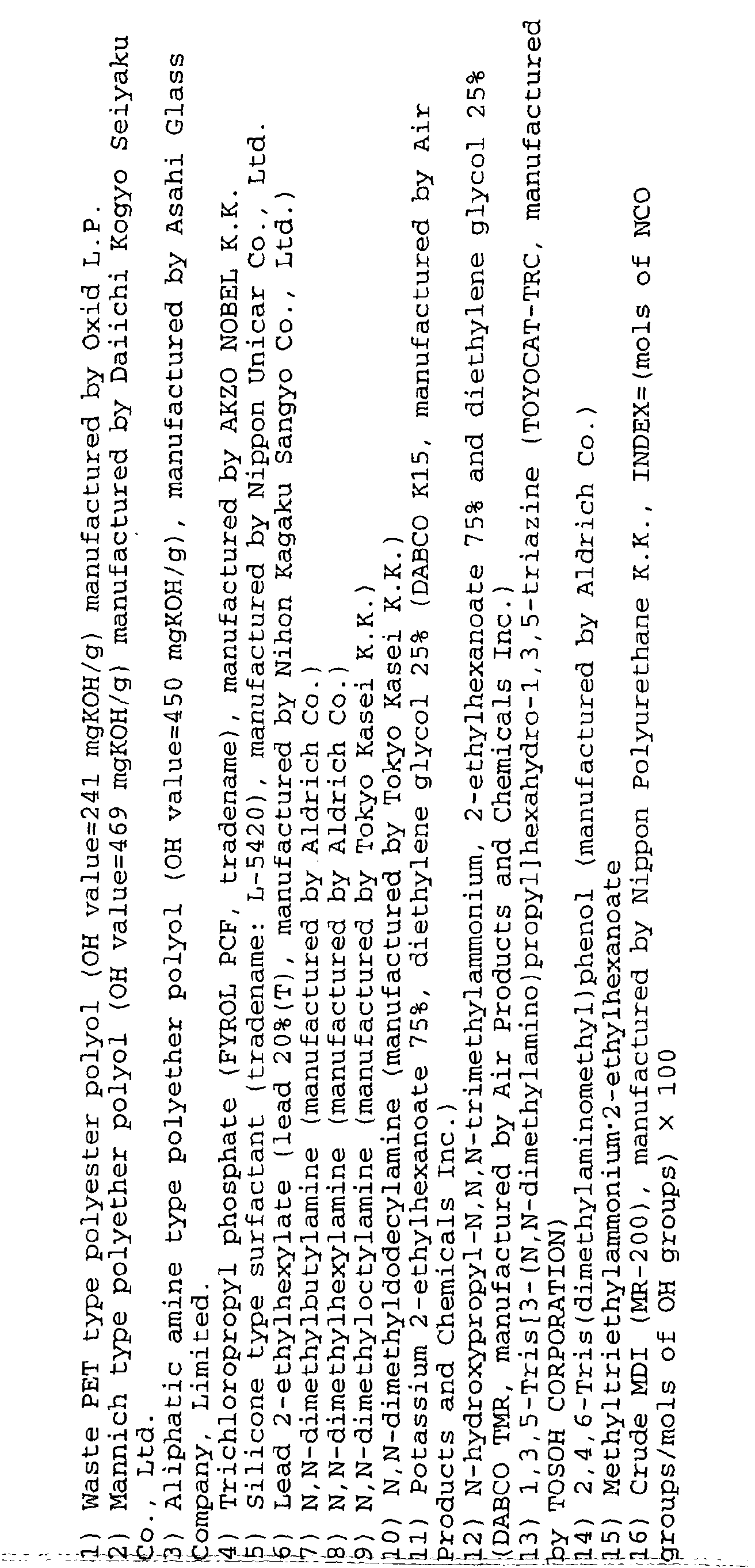


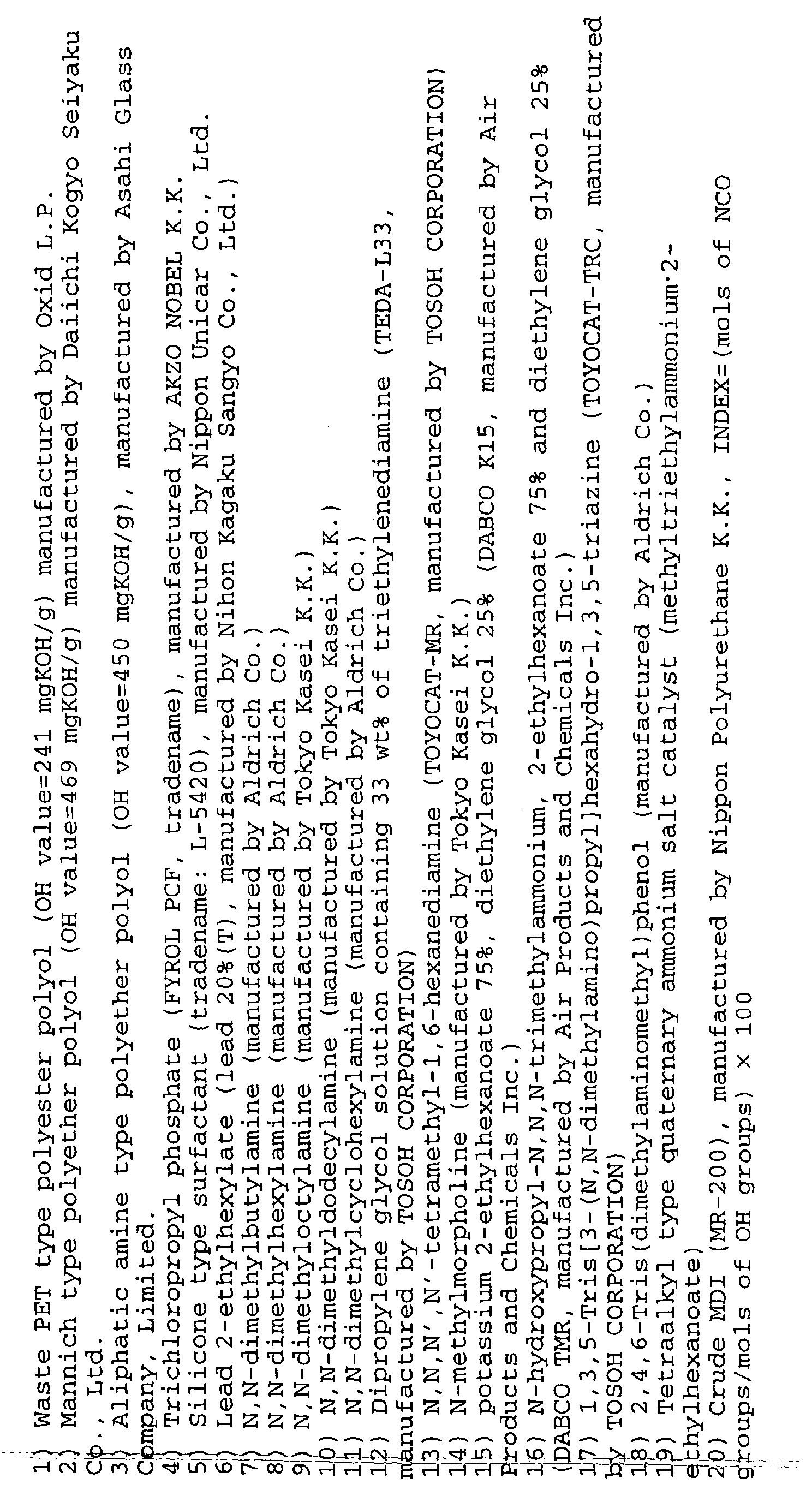


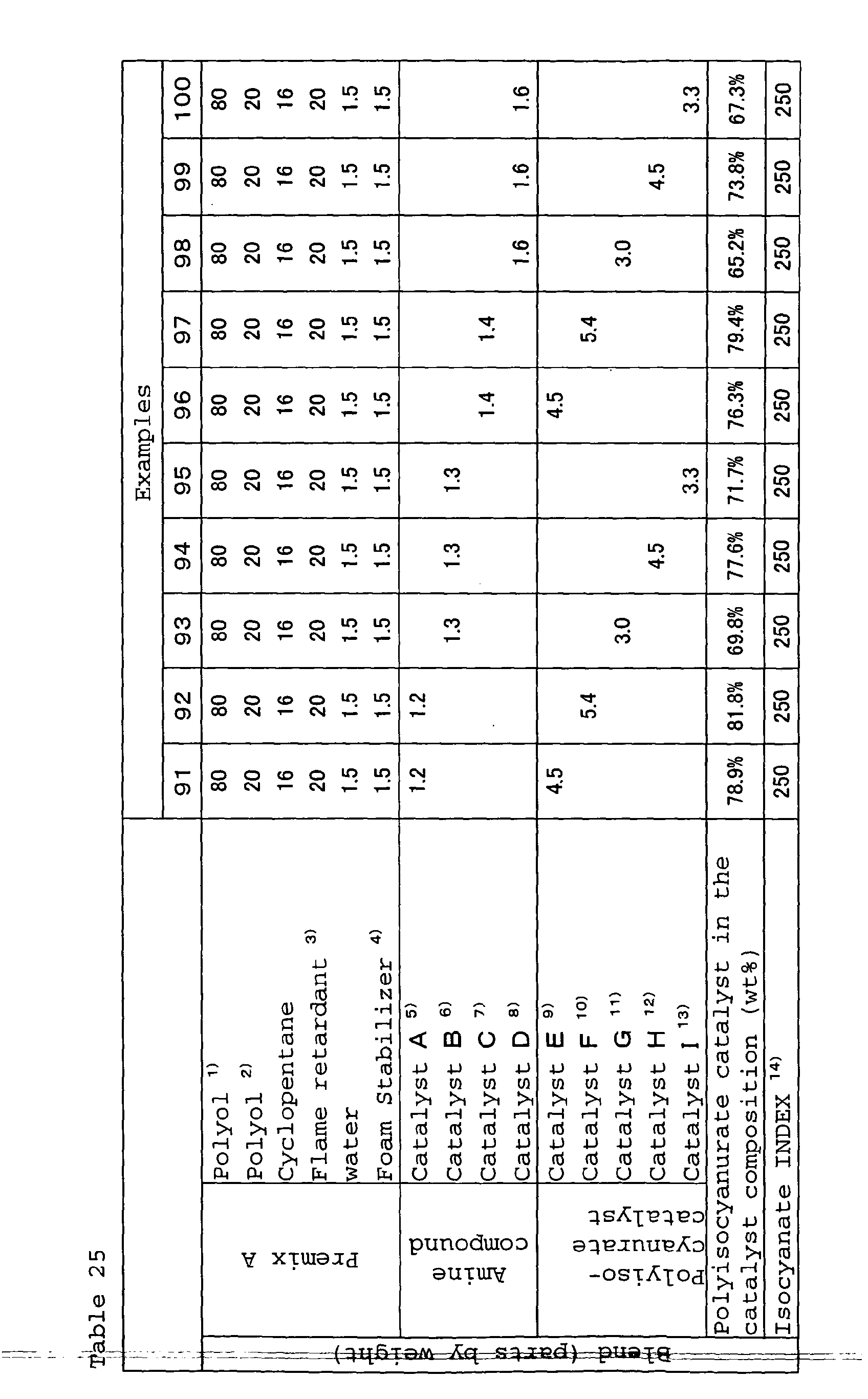
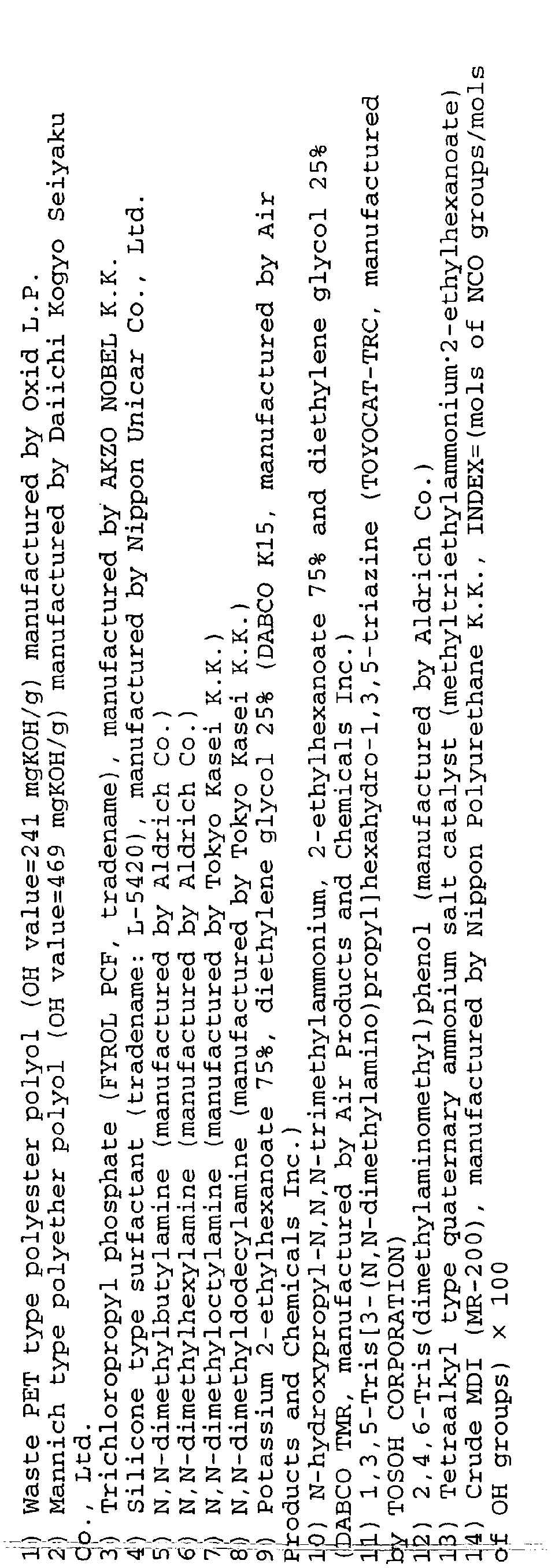

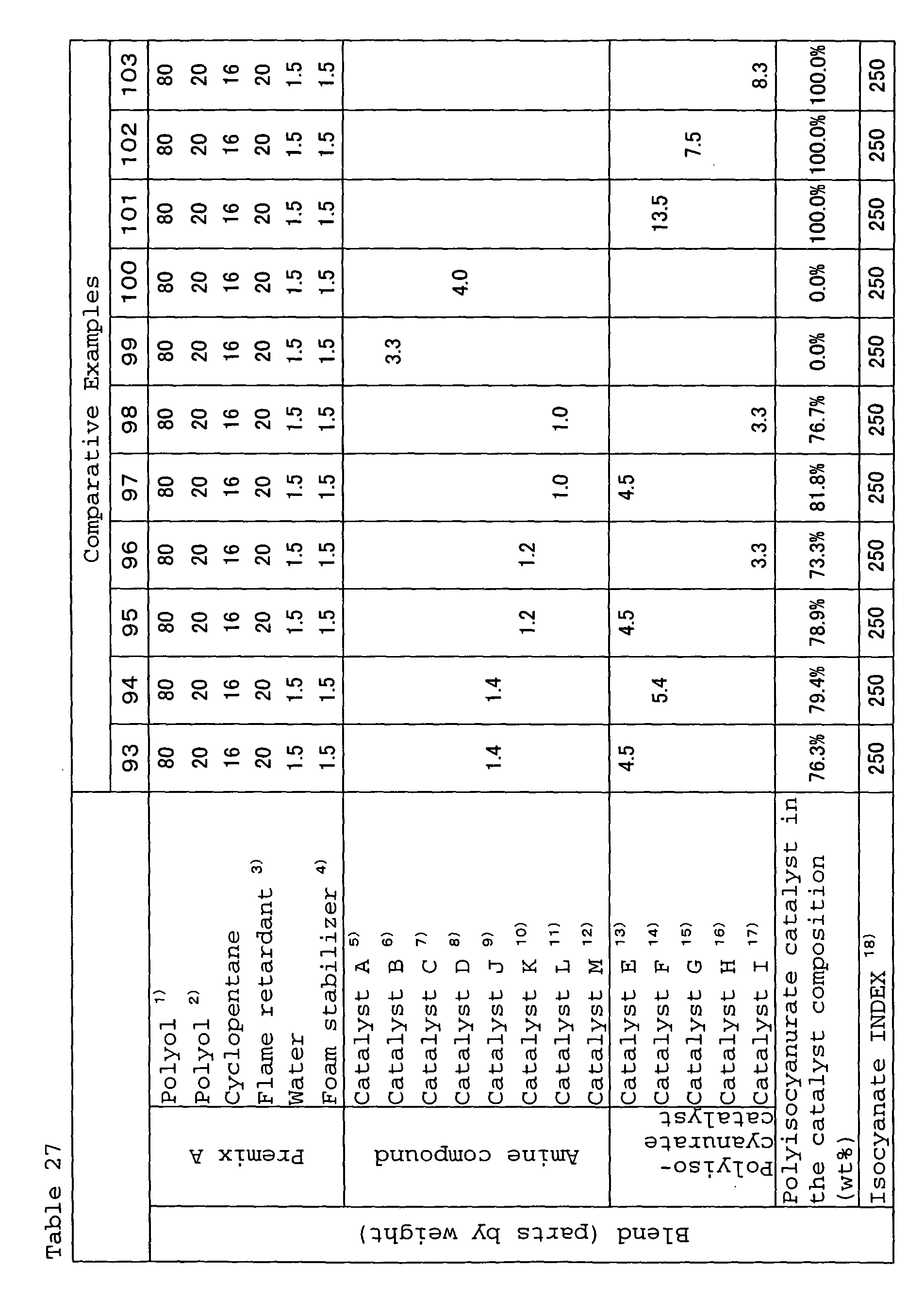

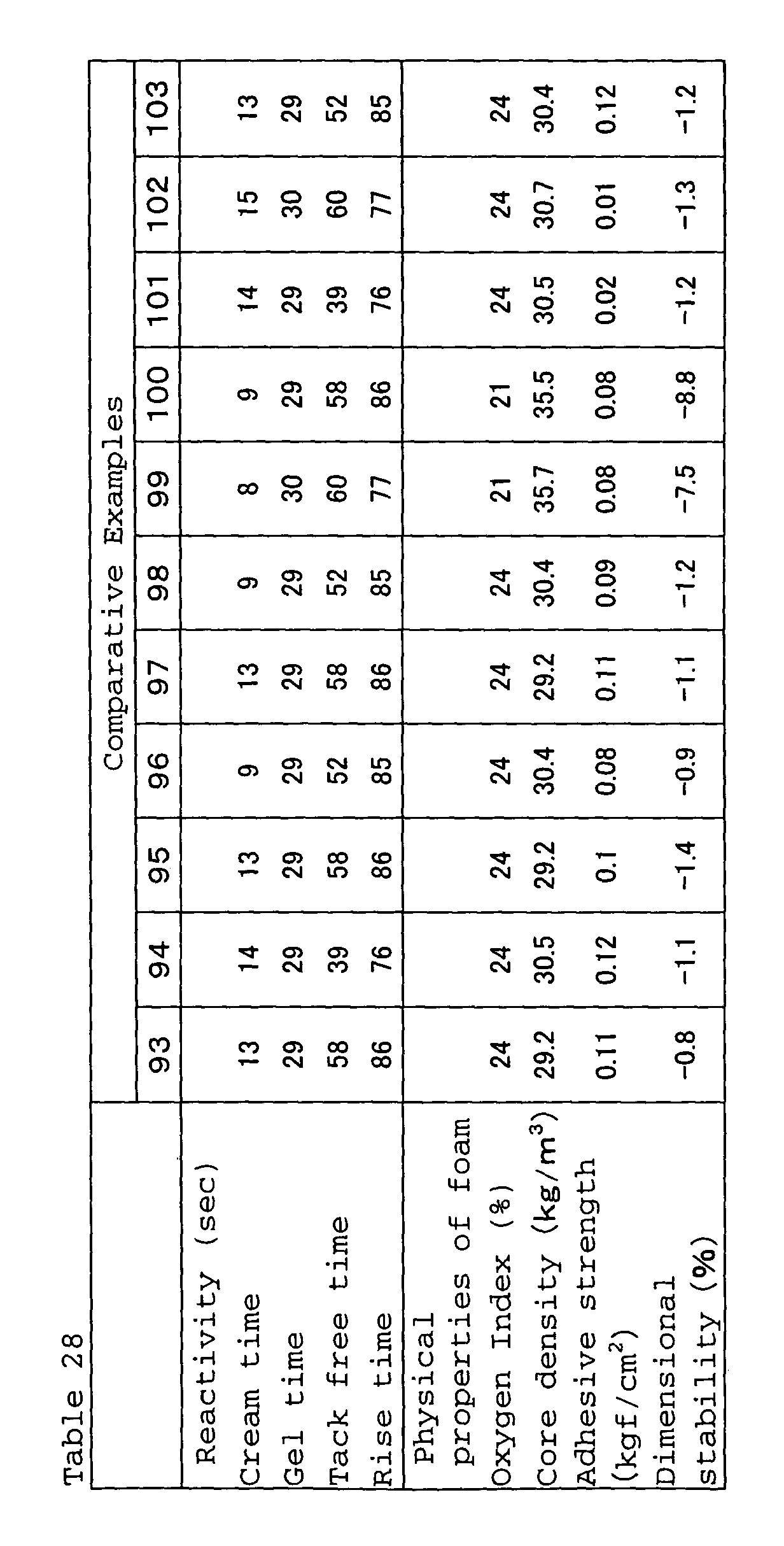
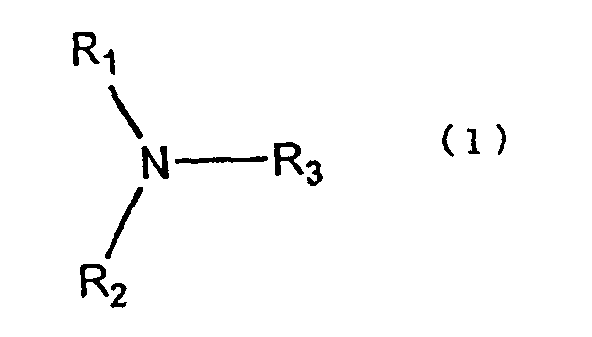 (B) an amine compound having an alkyl ether group and/or an aryl ether group in its molecule.
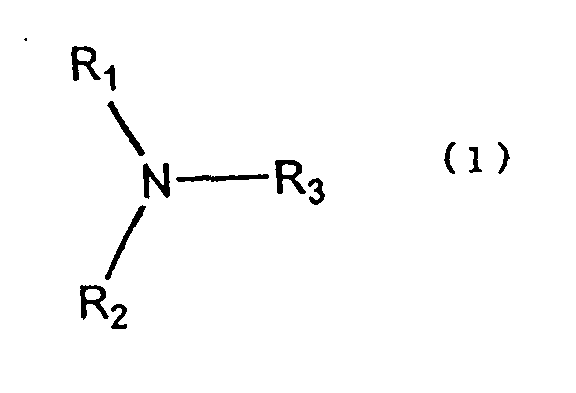 (B) a catalyst comprising an amine compound having an alkyl ether group and/or an aryl ether group in its molecule; and the blowing agent is:at least one blowing agent selected from the group consisting of 1,1,1,3,3-pentafluoropropane (HFC-245fa), 1,1,1,3,3-pentafluorobutane (HFC-365mfc) and a low boiling point hydrocarbon.