EP1371416A1 - Exhaust gas clarification catalyst - Google Patents
Exhaust gas clarification catalyst Download PDFInfo
- Publication number
- EP1371416A1 EP1371416A1 EP02711302A EP02711302A EP1371416A1 EP 1371416 A1 EP1371416 A1 EP 1371416A1 EP 02711302 A EP02711302 A EP 02711302A EP 02711302 A EP02711302 A EP 02711302A EP 1371416 A1 EP1371416 A1 EP 1371416A1
- Authority
- EP
- European Patent Office
- Prior art keywords
- zro
- composite particles
- catalyst
- exhaust gas
- purifying
- Prior art date
- Legal status (The legal status is an assumption and is not a legal conclusion. Google has not performed a legal analysis and makes no representation as to the accuracy of the status listed.)
- Granted
Links
Images


Classifications
-
- F—MECHANICAL ENGINEERING; LIGHTING; HEATING; WEAPONS; BLASTING
- F01—MACHINES OR ENGINES IN GENERAL; ENGINE PLANTS IN GENERAL; STEAM ENGINES
- F01N—GAS-FLOW SILENCERS OR EXHAUST APPARATUS FOR MACHINES OR ENGINES IN GENERAL; GAS-FLOW SILENCERS OR EXHAUST APPARATUS FOR INTERNAL-COMBUSTION ENGINES
- F01N3/00—Exhaust or silencing apparatus having means for purifying, rendering innocuous, or otherwise treating exhaust
- F01N3/08—Exhaust or silencing apparatus having means for purifying, rendering innocuous, or otherwise treating exhaust for rendering innocuous
- F01N3/0807—Exhaust or silencing apparatus having means for purifying, rendering innocuous, or otherwise treating exhaust for rendering innocuous by using absorbents or adsorbents
- F01N3/0828—Exhaust or silencing apparatus having means for purifying, rendering innocuous, or otherwise treating exhaust for rendering innocuous by using absorbents or adsorbents characterised by the absorbed or adsorbed substances
- F01N3/0842—Nitrogen oxides
-
- B—PERFORMING OPERATIONS; TRANSPORTING
- B01—PHYSICAL OR CHEMICAL PROCESSES OR APPARATUS IN GENERAL
- B01D—SEPARATION
- B01D53/00—Separation of gases or vapours; Recovering vapours of volatile solvents from gases; Chemical or biological purification of waste gases, e.g. engine exhaust gases, smoke, fumes, flue gases, aerosols
- B01D53/34—Chemical or biological purification of waste gases
- B01D53/74—General processes for purification of waste gases; Apparatus or devices specially adapted therefor
- B01D53/86—Catalytic processes
- B01D53/8621—Removing nitrogen compounds
- B01D53/8625—Nitrogen oxides
- B01D53/8628—Processes characterised by a specific catalyst
-
- B—PERFORMING OPERATIONS; TRANSPORTING
- B01—PHYSICAL OR CHEMICAL PROCESSES OR APPARATUS IN GENERAL
- B01D—SEPARATION
- B01D53/00—Separation of gases or vapours; Recovering vapours of volatile solvents from gases; Chemical or biological purification of waste gases, e.g. engine exhaust gases, smoke, fumes, flue gases, aerosols
- B01D53/34—Chemical or biological purification of waste gases
- B01D53/92—Chemical or biological purification of waste gases of engine exhaust gases
- B01D53/94—Chemical or biological purification of waste gases of engine exhaust gases by catalytic processes
- B01D53/9404—Removing only nitrogen compounds
- B01D53/9409—Nitrogen oxides
- B01D53/9413—Processes characterised by a specific catalyst
- B01D53/9422—Processes characterised by a specific catalyst for removing nitrogen oxides by NOx storage or reduction by cyclic switching between lean and rich exhaust gases (LNT, NSC, NSR)
-
- B—PERFORMING OPERATIONS; TRANSPORTING
- B01—PHYSICAL OR CHEMICAL PROCESSES OR APPARATUS IN GENERAL
- B01J—CHEMICAL OR PHYSICAL PROCESSES, e.g. CATALYSIS OR COLLOID CHEMISTRY; THEIR RELEVANT APPARATUS
- B01J21/00—Catalysts comprising the elements, oxides, or hydroxides of magnesium, boron, aluminium, carbon, silicon, titanium, zirconium, or hafnium
- B01J21/02—Boron or aluminium; Oxides or hydroxides thereof
- B01J21/04—Alumina
-
- B—PERFORMING OPERATIONS; TRANSPORTING
- B01—PHYSICAL OR CHEMICAL PROCESSES OR APPARATUS IN GENERAL
- B01J—CHEMICAL OR PHYSICAL PROCESSES, e.g. CATALYSIS OR COLLOID CHEMISTRY; THEIR RELEVANT APPARATUS
- B01J21/00—Catalysts comprising the elements, oxides, or hydroxides of magnesium, boron, aluminium, carbon, silicon, titanium, zirconium, or hafnium
- B01J21/06—Silicon, titanium, zirconium or hafnium; Oxides or hydroxides thereof
- B01J21/063—Titanium; Oxides or hydroxides thereof
-
- B—PERFORMING OPERATIONS; TRANSPORTING
- B01—PHYSICAL OR CHEMICAL PROCESSES OR APPARATUS IN GENERAL
- B01J—CHEMICAL OR PHYSICAL PROCESSES, e.g. CATALYSIS OR COLLOID CHEMISTRY; THEIR RELEVANT APPARATUS
- B01J21/00—Catalysts comprising the elements, oxides, or hydroxides of magnesium, boron, aluminium, carbon, silicon, titanium, zirconium, or hafnium
- B01J21/06—Silicon, titanium, zirconium or hafnium; Oxides or hydroxides thereof
- B01J21/066—Zirconium or hafnium; Oxides or hydroxides thereof
-
- B—PERFORMING OPERATIONS; TRANSPORTING
- B01—PHYSICAL OR CHEMICAL PROCESSES OR APPARATUS IN GENERAL
- B01J—CHEMICAL OR PHYSICAL PROCESSES, e.g. CATALYSIS OR COLLOID CHEMISTRY; THEIR RELEVANT APPARATUS
- B01J23/00—Catalysts comprising metals or metal oxides or hydroxides, not provided for in group B01J21/00
- B01J23/38—Catalysts comprising metals or metal oxides or hydroxides, not provided for in group B01J21/00 of noble metals
- B01J23/40—Catalysts comprising metals or metal oxides or hydroxides, not provided for in group B01J21/00 of noble metals of the platinum group metals
-
- B—PERFORMING OPERATIONS; TRANSPORTING
- B01—PHYSICAL OR CHEMICAL PROCESSES OR APPARATUS IN GENERAL
- B01J—CHEMICAL OR PHYSICAL PROCESSES, e.g. CATALYSIS OR COLLOID CHEMISTRY; THEIR RELEVANT APPARATUS
- B01J23/00—Catalysts comprising metals or metal oxides or hydroxides, not provided for in group B01J21/00
- B01J23/38—Catalysts comprising metals or metal oxides or hydroxides, not provided for in group B01J21/00 of noble metals
- B01J23/40—Catalysts comprising metals or metal oxides or hydroxides, not provided for in group B01J21/00 of noble metals of the platinum group metals
- B01J23/46—Ruthenium, rhodium, osmium or iridium
- B01J23/464—Rhodium
-
- B—PERFORMING OPERATIONS; TRANSPORTING
- B01—PHYSICAL OR CHEMICAL PROCESSES OR APPARATUS IN GENERAL
- B01J—CHEMICAL OR PHYSICAL PROCESSES, e.g. CATALYSIS OR COLLOID CHEMISTRY; THEIR RELEVANT APPARATUS
- B01J23/00—Catalysts comprising metals or metal oxides or hydroxides, not provided for in group B01J21/00
- B01J23/38—Catalysts comprising metals or metal oxides or hydroxides, not provided for in group B01J21/00 of noble metals
- B01J23/54—Catalysts comprising metals or metal oxides or hydroxides, not provided for in group B01J21/00 of noble metals combined with metals, oxides or hydroxides provided for in groups B01J23/02 - B01J23/36
- B01J23/56—Platinum group metals
- B01J23/58—Platinum group metals with alkali- or alkaline earth metals
-
- C—CHEMISTRY; METALLURGY
- C01—INORGANIC CHEMISTRY
- C01B—NON-METALLIC ELEMENTS; COMPOUNDS THEREOF; METALLOIDS OR COMPOUNDS THEREOF NOT COVERED BY SUBCLASS C01C
- C01B3/00—Hydrogen; Gaseous mixtures containing hydrogen; Separation of hydrogen from mixtures containing it; Purification of hydrogen; Reversible storage of hydrogen
- C01B3/02—Production of hydrogen; Production of gaseous mixtures containing hydrogen
- C01B3/32—Production of hydrogen; Production of gaseous mixtures containing hydrogen by reaction of gaseous or liquid organic compounds with gasifying agents, e.g. water, carbon dioxide or air
- C01B3/34—Production of hydrogen; Production of gaseous mixtures containing hydrogen by reaction of gaseous or liquid organic compounds with gasifying agents, e.g. water, carbon dioxide or air by reaction of hydrocarbons with gasifying agents
- C01B3/38—Production of hydrogen; Production of gaseous mixtures containing hydrogen by reaction of gaseous or liquid organic compounds with gasifying agents, e.g. water, carbon dioxide or air by reaction of hydrocarbons with gasifying agents using catalysts
- C01B3/40—Production of hydrogen; Production of gaseous mixtures containing hydrogen by reaction of gaseous or liquid organic compounds with gasifying agents, e.g. water, carbon dioxide or air by reaction of hydrocarbons with gasifying agents using catalysts characterised by the catalyst
-
- F—MECHANICAL ENGINEERING; LIGHTING; HEATING; WEAPONS; BLASTING
- F01—MACHINES OR ENGINES IN GENERAL; ENGINE PLANTS IN GENERAL; STEAM ENGINES
- F01N—GAS-FLOW SILENCERS OR EXHAUST APPARATUS FOR MACHINES OR ENGINES IN GENERAL; GAS-FLOW SILENCERS OR EXHAUST APPARATUS FOR INTERNAL-COMBUSTION ENGINES
- F01N3/00—Exhaust or silencing apparatus having means for purifying, rendering innocuous, or otherwise treating exhaust
- F01N3/08—Exhaust or silencing apparatus having means for purifying, rendering innocuous, or otherwise treating exhaust for rendering innocuous
- F01N3/0807—Exhaust or silencing apparatus having means for purifying, rendering innocuous, or otherwise treating exhaust for rendering innocuous by using absorbents or adsorbents
- F01N3/0814—Exhaust or silencing apparatus having means for purifying, rendering innocuous, or otherwise treating exhaust for rendering innocuous by using absorbents or adsorbents combined with catalytic converters, e.g. NOx absorption/storage reduction catalysts
-
- B—PERFORMING OPERATIONS; TRANSPORTING
- B01—PHYSICAL OR CHEMICAL PROCESSES OR APPARATUS IN GENERAL
- B01D—SEPARATION
- B01D2255/00—Catalysts
- B01D2255/20—Metals or compounds thereof
- B01D2255/207—Transition metals
- B01D2255/20707—Titanium
-
- B—PERFORMING OPERATIONS; TRANSPORTING
- B01—PHYSICAL OR CHEMICAL PROCESSES OR APPARATUS IN GENERAL
- B01D—SEPARATION
- B01D2255/00—Catalysts
- B01D2255/20—Metals or compounds thereof
- B01D2255/207—Transition metals
- B01D2255/20715—Zirconium
-
- B—PERFORMING OPERATIONS; TRANSPORTING
- B01—PHYSICAL OR CHEMICAL PROCESSES OR APPARATUS IN GENERAL
- B01D—SEPARATION
- B01D2255/00—Catalysts
- B01D2255/20—Metals or compounds thereof
- B01D2255/209—Other metals
- B01D2255/2092—Aluminium
-
- B—PERFORMING OPERATIONS; TRANSPORTING
- B01—PHYSICAL OR CHEMICAL PROCESSES OR APPARATUS IN GENERAL
- B01J—CHEMICAL OR PHYSICAL PROCESSES, e.g. CATALYSIS OR COLLOID CHEMISTRY; THEIR RELEVANT APPARATUS
- B01J35/00—Catalysts, in general, characterised by their form or physical properties
- B01J35/19—Catalysts containing parts with different compositions
-
- B—PERFORMING OPERATIONS; TRANSPORTING
- B01—PHYSICAL OR CHEMICAL PROCESSES OR APPARATUS IN GENERAL
- B01J—CHEMICAL OR PHYSICAL PROCESSES, e.g. CATALYSIS OR COLLOID CHEMISTRY; THEIR RELEVANT APPARATUS
- B01J37/00—Processes, in general, for preparing catalysts; Processes, in general, for activation of catalysts
- B01J37/02—Impregnation, coating or precipitation
- B01J37/03—Precipitation; Co-precipitation
-
- C—CHEMISTRY; METALLURGY
- C01—INORGANIC CHEMISTRY
- C01B—NON-METALLIC ELEMENTS; COMPOUNDS THEREOF; METALLOIDS OR COMPOUNDS THEREOF NOT COVERED BY SUBCLASS C01C
- C01B2203/00—Integrated processes for the production of hydrogen or synthesis gas
- C01B2203/10—Catalysts for performing the hydrogen forming reactions
- C01B2203/1041—Composition of the catalyst
- C01B2203/1047—Group VIII metal catalysts
- C01B2203/1064—Platinum group metal catalysts
-
- C—CHEMISTRY; METALLURGY
- C01—INORGANIC CHEMISTRY
- C01B—NON-METALLIC ELEMENTS; COMPOUNDS THEREOF; METALLOIDS OR COMPOUNDS THEREOF NOT COVERED BY SUBCLASS C01C
- C01B2203/00—Integrated processes for the production of hydrogen or synthesis gas
- C01B2203/10—Catalysts for performing the hydrogen forming reactions
- C01B2203/1041—Composition of the catalyst
- C01B2203/1082—Composition of support materials
-
- Y—GENERAL TAGGING OF NEW TECHNOLOGICAL DEVELOPMENTS; GENERAL TAGGING OF CROSS-SECTIONAL TECHNOLOGIES SPANNING OVER SEVERAL SECTIONS OF THE IPC; TECHNICAL SUBJECTS COVERED BY FORMER USPC CROSS-REFERENCE ART COLLECTIONS [XRACs] AND DIGESTS
- Y02—TECHNOLOGIES OR APPLICATIONS FOR MITIGATION OR ADAPTATION AGAINST CLIMATE CHANGE
- Y02P—CLIMATE CHANGE MITIGATION TECHNOLOGIES IN THE PRODUCTION OR PROCESSING OF GOODS
- Y02P20/00—Technologies relating to chemical industry
- Y02P20/50—Improvements relating to the production of bulk chemicals
- Y02P20/52—Improvements relating to the production of bulk chemicals using catalysts, e.g. selective catalysts
Definitions
- the present invention relates to an NO x sorption-and-reduction type catalyst for purifying an exhaust gas, more particularly to a catalyst for purifying an exhaust gas which can reveal a high NO x purifying ability for a long period of time by suppressing sulfur poisoning.
- an NO x sorption-and-reduction type catalyst As a catalyst for purifying NO x in an exhaust gas of an oxygen-excessive lean atmosphere, an NO x sorption-and-reduction type catalyst has been utilized.
- This NO x sorption-and-reduction type catalyst for example, as disclosed in Japanese Unexamined Patent Publication (KOKAI) No. 5-317,625, is one in which a noble metal, such as Pt and Rh, and an NO x sorption member, such as K and Ba, are loaded on a porous support, such as Al 2 O 3 .
- NO x sorption-and-reduction type catalyst By using this NO x sorption-and-reduction type catalyst and controlling an air-fuel ratio from a lean side to a stoichiometric as well as rich side in a pulsating manner (rich spiking), since an exhaust gas, too, becomes from a lean atmosphere to a stoichiometric as well as rich atmosphere, NO x are sorbed in the NO x sorption member on the lean side, and they are released on the stoichiometric or rich side to react with reductive components, such as HC and CO, so that they are purified. Therefore, even when it is an exhaust gas from a lean burn engine, it is possible to purify NO x with good efficiency. Moreover, since HC and CO in the exhaust gas are oxidized by the noble metal and, at the same time, are consumed in the reduction of NO x , HC as well as CO are also purified with good efficiency.
- a catalyst for purifying an exhaust gas is proposed in which an alkaline-earth metal, such as Ba, and Pt are loaded on a porous oxide support, such as Al 2 O 3 .
- a catalyst for purifying an exhaust gas is proposed in which an alkali metal, such as K, and Pt are loaded on a porous oxide support, such as Al 2 O 3 .
- a catalyst for purifying an exhaust gas is proposed in which a rare-earth element, such as La, and Pt are loaded on a porous oxide support, such as Al 2 O 3 .
- SO 2 which is generated by burning sulfur (S) contained in a fuel
- SO 3 sulfur
- This is referred to as the sulfur poisoning of the NO x sorption member.
- the porous oxide support such as Al 2 O 3
- the porous oxide support has a property that it is likely to adsorb SO x
- the NO x sorption member is thus turned into sulfites and sulfates so that it is poisoned to degrade, it can no longer sorb NO x , as a result, there is a drawback in that the NO x purifying performance lowers after a high-temperature durability test (hereinafter, referred to as "post-durability").
- the alkali component is likely to move in a coating layer, such as Al 2 O 3 , and simultaneously exhibits a high reactivity to Si. Accordingly, it is believed that the alkali component moves in the coating layer when the temperature is high, arrives at the support substrate and reacts with Si in cordierite to form silicate, being a composite oxide. Since this silicate is a stable compound, the alkali component, which has been turned into silicate, no longer has an ability of sorbing NO x , and accordingly the NO x purifying performance has been lowered.
- K which exhibits a high basicity and is stable at a high temperature, is made into an NO x sorption member, but, in a catalyst in which K is loaded on Al 2 O 3 , and so on, there has been a problem in that the NO x sorption ability in a high temperature region is not improved so much.
- the present invention has been done in view of such circumstances, it is a main object to further suppress the sulfur poisoning of an NO x sorption-and-reduction type catalyst, thereby furthermore improving the high-temperature post-durability NO x purifying rate.
- the second object of the present invention is to make a catalyst which can satisfy both of the contradictory phenomena, such as the improvement of the NO x sorption ability in a high temperature region and the suppression of the sulfur poisoning, and which is good in terms of the heat resistance.
- the characteristic of a catalyst for purifying an exhaust gas, of an NO x sorption-and-reduction type catalyst comprising a noble metal and an NO x sorptionmember loaded on a porous oxide support which solves the aforementioned assignments and is set forth in claim 1, lies in that the porous oxide support includes composite particles having a structure comprising a core portion in which ZrO 2 is a major component and a superficial portion formed on a surface of the core portion and including an oxide, whose basicity is lower than ZrO 2 , more than the core portion.
- the characteristic of a catalyst for purifying an exhaust gas of an NO x sorption-and-reduction type catalyst comprising a support substrate, a coating layer formed on the support substrate and comprising a porous oxide, a noble metal loaded on the coating layer and at least one NO x sorption member loaded on the coating layer and selected from the group consisting of alkali metals, alkaline-earth metals and rare-earth elements, which solves the aforementioned assignments and is set forth in claim 9, lies in that composite particles, having a structure comprising a core portion in which ZrO 2 is a major component and a superficial portion formed on a surface of the core portion and including an oxide, whose basicity is lower than ZrO 2 , more than the core portion, are included in the coating layer.
- the oxide, whose basicity is lower than ZrO 2 can be Al 2 O 3
- the composite particles can be a ZrO 2 -Al 2 O 3 composite oxide.
- the oxide, whose basicity is lower than ZrO 2 can be TiO 2
- the composite particles can be a ZrO 2 -TiO 2 composite oxide.
- TiO 2 can desirably be included in an amount of 30% by weight or more in the superficial portion of the composite particles.
- the composite particles can desirably further include Al 2 O 3 , and Al 2 O 3 can desirably be included in an amount of 10% by mol or more in said composite particles.
- an average particle diameter of the composite particles can desirably be 10 ⁇ m or less.
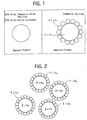
- Fig. 1 is an explanatory diagram for schematically illustrating the structures of a general ZrO 2 -Al 2 O 3 composite oxide particle and a composite particle which is its improved product.
- Fig. 2 is an explanatory diagram for schematically illustrating the structure of composite particles which comprise a ZrO 2 -TiO 2 composite oxide.
- Fig. 3 is a graph for illustrating the fed compositions and superficial compositions of ZrO 2 -Al 2 O 3 composite particles which were manufactured in a testing example.
- Fig. 4 is a graph for illustrating the relationships between the fed Al 2 O 3 amounts and superficial Al 2 O 3 amounts of ZrO 2 -Al 2 O 3 composite particles which were used in the catalysts of examples of the present invention and those of comparative examples.
- Fig. 5 is a graph for illustrating the saturated NO x sorption amount of the catalysts of examples of the present invention and those of comparative examples after a durability test.
- Fig. 6 is a graph for illustrating the relationship between the average particle diameters and specific surfaces areas of ZrO 2 -Al 2 O 3 composite particles, which were used in an example, after a durability test.
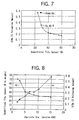
- Fig. 7 is a graph for illustrating the relationship between the superficial TiO 2 amounts of composite particles and sulfur poisoning amounts of the catalysts of an example.
- Fig. 8 is a graph for illustrating the relationships between the average particle diameters and the superficial TiO 2 amounts of composite particles as well as sulfur poisoning amounts of the catalysts of an example.
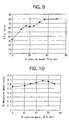
- Fig. 9 is a graph for illustrating the relationship between the Al contents and specific surfaces areas of composite particles, which were used in an example, after a durability test.
- Fig. 10 is a graph for illustrating the relationship between the Al contents of composite particles which were used in the catalysts of an example and the CO adsorption amounts of the catalysts.
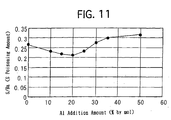
- Fig. 11 is a graph for illustrating the relationship between theAl contents of composite particles which were used in the catalysts of an example and the sulfur poisoning amounts of the catalysts.
- the porous oxide support includes composite particles having a structure comprising a core portion in which ZrO 2 is a major component and a superficial portion formed on a surface of the core portion and including an oxide, whose basicity is lower than ZrO 2 , more than the core portion. Since the composite particles exhibit a basicity, which is lower than ZrO 2 , at the superficial portion, it is believed SO x are inhibited from approaching, and accordingly the catalyst for purifying an exhaust gas of the present invention is improved in terms of the sulfur-poisoning resistance. Moreover, similarly to a ZrO 2 -Al 2 O 3 composite oxide having a uniform composition, it has the function of improving the steam reforming reaction activity of Rh.
- Al 2 O 3 , TiO 2 , SiO 2 , and the like, are exemplified as the oxide whose basicity is lower than ZrO 2 .
- a general ZrO 2 -Al 2 O 3 composite oxide particle as illustrated as "General Product” in Fig. 1, is made into a uniform composition from the surface to the inside.
- the composite particle which is used in the present invention as illustrated as "Improved Product” in Fig. 1, is made into a structure comprising a core portion in which ZrO 2 is a major component and a superficial portion formed on a surface of the core portion and including Al 2 O 3 more than the core portion.
- the Al 2 O 3 in the superficial portion can be formed as a fine particle shape or a film shape, but ZrO 2 can desirablybe exposed partially. Moreover, the Al 2 O 3 in the superficial portion can desirably exist in a highly dispersed state.
- the basicity of the inside is high by the core portion in which ZrO 2 is a major component, and the basicity of the superficial portion is low by the Al 2 O 3 which exists more in the surface of the core portion than in the core portion. Accordingly, the sulfur-poisoning resistance is improved, and, at the same time, although the reason is not clear, the NO x sorption ability in a high temperature region is improved.
- both of the particles illustrated in Fig. 1 are a ZrO 2 -Al 2 O 3 composite oxide each, in order to distinguish them, the composite oxide particle, whose structure comprises a core portion in which ZrO 2 is a major component and a superficial portion formed on a surface of the core portion and including Al 2 O 3 more than the core portion, is referred to as a composite particle, and the composite oxide particle, whose structure is uniform from the inside to the surface, is referred to as a ZrO 2 -Al 2 O 3 composite oxide particle.
- zirconia precursors are precipitated out of a zirconium salt aqueous solution by pH adjustment, and they are calcined to make a ZrO 2 powder.
- a zirconium salt aqueous solution is mixed in water, an aluminum salt aqueous solution is added, and alumina precursors are precipitated on the surface of the ZrO 2 powder by further carrying out pH adjustment.
- alumina precursors are precipitated on the surface of the ZrO 2 powder by further carrying out pH adjustment.
- it is possible to manufacture the composite particles whose structure comprises a core portion in which ZrO 2 is a major component and a superficial portion formed on a surface of the core portion and including Al 2 O 3 more than the core portion.
- the ZrO 2 is less than this range, the NO x sorption ability in a high temperature region lowers, when the ZrO 2 is more this range, the sulfur-poisoning resistance and heat resistance lower.
- the composite particles whose structure comprises a core portion in which ZrO 2 is a major component and a superficial portion formed on a surface of the core portion and including Al 2 O 3 more than the core portion, having an average particle diameter of 10 ⁇ m or less.
- the oxide whose basicity is lower than ZrO 2 it is also preferable to select TiO 2 , and to use composite particles whose structure comprises a core portion in which ZrO 2 is a major component and a superficial portion formed on a surface of the core portion and including TiO 2 more than the core portion.
- the composite particles since the TiO 2 is included more in the surface, the utility efficiency of TiO 2 is improved. Then, since TiO 2 has less basic sites so that SO x are less likely to adsorb thereto, or so that adsorbed SO x are likely to eliminate therefrom, all in all, the adsorption amount of SO x is reduced.
- the composite particles whose structure comprises a core portion in which ZrO 2 is a major component and a superficial portion formed on a surface of the core portion and including TiO 2 more than the core portion, are formed as a dual structure as illustrated in Fig. 2.
- the sulfur-poisoning-suppression action lowers. Note that, it has been found out that, even when the TiO 2 in the superficial portion is too much, the sulfur-poisoning-suppression effect lowers, and accordingly it is desirable tomake the TiO 2 in the superficial portion less than 80% by weight.
- the composite particles whose structure comprises a core portion in which ZrO 2 is a major component and a superficial portion formed on a surface of the core portion and including TiO 2 more than the core portion, can be particles having a particle diameter of 10 ⁇ m or less.
- the particle diameter exceeds 10 ⁇ m, since the surface area of TiO 2 , which contacts with sulfur components, becomes too small so that the sulfur-poisoning-suppression action lowers.
- the probability of contacting the TiO 2 with each other or the ZrO 2 with each other lowers, and it is believed that the different members become partition walls so that the sintering is suppressed. Accordingly, the heat resistance is improved, and it is possible to suppress the lowering of the post-durability specific surface area.
- the composite particles whose structure comprises a core portion in which ZrO 2 is a major component and a superficial portion formed on a surface of the core portion and including TiO 2 more than the core portion, it is desirable to further include Al 2 O 3 .
- Al 2 O 3 the heat resistance is improved, and it is possible to suppress the lowering of the high-temperature post-durability specific surface area, at the same time, it is possible to suppress the granular growth of noble metal accompanied therewith, and the durability is improved.
- the Al 2 O 3 can be included in at least one of the core portion and superficial portion, and is ordinarily included in both of the core portion and superficial portion.
- the Al 2 O 3 can be included in an amount of 10% by mol ormore. When it is less than 10% by mol, it is difficult to reveal the adding effect. Although the more the content of Al 2 O 3 is the larger the high-temperature post-durability specific surface area is, since the amount of TiO 2 decreases relatively, it is preferable to make the amount of Al 2 O 3 in a range of 50% by mol or less.
- zirconia precursors are precipitated out of a zirconium salt aqueous solution by pH adjustment, and they are calcined to make a ZrO 2 powder.
- a titanium salt aqueous solution is added, and titania precursors are precipitated on the surface of the ZrO 2 powder by further carrying out pH adjustment.
- the composite oxide particles whose structure comprises a core portion in which ZrO 2 is a major component and a superficial portion formed on a surface of the core portion and including TiO 2 more than the core portion.
- an aluminum salt can be solved in one of the zirconium salt and titanium salt aqueous solutions or both of the aqueous solutions.
- the support substrate it is possible to use one which is formed of heat resistant ceramics, such as cordierite, or a metal, and its shape can be selected from the group consisting of a honeycomb-shaped monolithic type, foam type, pellet type, and so on.
- the porous oxide support in the catalyst for purifying an exhaust gas of the present invention can be formed of a powder of the aforementioned composite particles alone, or the other oxide powder, such as Al 2 O 3 , TiO 2 , ZrO 2 , SiO 2 and CeO 2 , can be mixed to use.
- the other oxide powder is mixed to use, it is desirable to include the composite particles in an amount of 20% by weight or more at least. When the composite particles are less than this, it is difficult to reveal the effects of the improvement of the sulfur-poisoning resistance as well as the improvement of the NO x sorption ability in a high temperature region.
- the catalyst for purifying an exhaust gas of the present invention can be formed as a shape, such as a pellet shape, a honeycomb shape or a foam shape, similarly to the conventional catalysts for purifying an exhaust gas.
- a shape such as a pellet shape, a honeycomb shape or a foam shape
- it in order to form it as a pellet shape, it can be molded into a pellet shape out of an NO x sorption-and-reduction type catalyst powder.
- it is possible to manufacture it by forming a coating layer on a support substrate out of the aforementioned various porous oxide powders and loading a noble metal and an NO x sorption member on the coating layer.
- the coating layer it is possible to form the coating layer by a general wash coating method.
- a binder in this case, it is possible to use an alumina sol or a zirconia sol, and the like.
- at least one optimum composite particle powder selected from the group consisting of a powder comprising composite particles which have a structure comprising a core portion in which ZrO 2 is a major component and a superficial portion formed on a surface of the core portion and including Al 2 O 3 more than the core portion, a powder comprising composite particles which have a structure comprising a core portion in which ZrO 2 is a major component and a superficial portion formed on a surface of the core portion and including TiO 2 more than the core portion, or a powder comprising particles further including Al 2 O 3 in addition to the latter composite particles.
- it can further include an arbitrary porous oxide powder, such as Al 2 O 3 , SiO 2 , ZrO 2 , TiO 2 and CeO 2 .
- an arbitrary porous oxide powder such as Al 2 O 3 , SiO 2 , ZrO 2 , TiO 2 and CeO 2 .
- the coating layer in a range of from 150 to 500 g with respect to 1 liter of a support substrate.
- the forming amount of the coating layer is less than this, since the loading densities of the noble metal and NO x sorption member heighten, the durability of the purifying performance lowers, when it is formed more than this, such a drawback arises that the ventilation resistance enlarges.
- the noble metal loaded on the coating layer it is possible to use one or more members of Pt, Rh, Pd, Ir or Ru.
- the NO x sorption member it is possible to use at least one member selected from the group consisting of alkali metals, alkaline-earth metals and rare-earth elements. Among them, it is preferable to use at least one of alkali metals and alkaline-earth metals which exhibit a high alkalinity and a high NO x sorption ability.
- alkalimetal Li, Na, K, Cs, and the like
- the alkaline-earth metals refer to the 2A group elements in the periodic table of the elements, and Ba, Be, Mg, Ca, Sr, and so on, are exemplified.
- rare-earth element Sc, Y, La, Ce, Pr, Nd, Dy, Yb, and the like, are exemplified.
- the loading amount of the noble metal on the coating layer in the case of Pt and Pd, can preferably be from 0.1 to 10 g, especially preferably from 0.5 to 10 g, with respect to 1 liter of a support substrate. Further, in the case of Rh, it can preferably be from 0.01 to 10 g, especially preferably from 0.05 to 5 g. Furthermore, the loading amount of the NO x sorption member can desirably fall in a range of from 0. 05 to 1 . 0 mol with respect to 1 liter of a support substrate. When the loading amount of the NO x sorption member is less than 0.05 mol/L, the NO x sorption ability lowers, when it is more than 1.0 mol/L, the sintering of noble metal is promoted.
- the coating layer is formed of a plurality of the porous oxide powders
- Pt and Rh on different supports, and accordingly it is possible to suppress the lowering of the oxidizing ability of Pt by Rh.
- Rh and the NO x sorption member the poorness in the mutual compatibility is not revealed so that the characteristics of the NO x sorption member and Rh are fully exhibited.
- an oxygen-excessive-atmosphere exhaust gas which has been burned at an air-fuel ratio (A/F) of about 18 or more, is contacted therewith so that NO x , which are contained in the exhaust gas, are sorbed in the NO x sorption member, and the air-fuel ratio is fluctuated intermittently to be stoichiometric as well as oxygen-excessive so that NO x , which have been released from the NO x sorption member, are reduced and purified.
- A/F air-fuel ratio
- NO which is contained in an exhaust gas
- NO x is oxidized on the catalyst to be turned into NO x , and it is sorbed in the NO x sorption member. Then, when being put into a stoichiometric as well as oxygen-excessive atmosphere, NO x are released from the NO x sorption member, and they react with HC and CO, which are contained in the exhaust gas, on the catalyst so that they are reduced.
- the composite particles since the composite particles are included, SO x are less likely to be adsorbed so that the sulfur poisoning of the NO x sorption member is suppressed.
- the composite particles which have a structure comprising a core portion in which ZrO 2 is a major component and a superficial portion formed on a surface of the core portion and including TiO 2 more than the core portion, are included, are included, due to such reasons that the interface between the TiO 2 and NO x sorption member enlarges, and that composite oxide precursors, which are likely to decompose, are thereby formed, it is believed that the elimination of adsorbed SO x becomes more readily, accordingly it is possible to fully suppress the sulfur poisoning of the NO x sorption member even in post-durability, and it is possible to fully suppress the lowering of the NO x purifying ability.
- the catalyst for purifying an exhaust gas of the present invention since the sulfur poisoning is suppressed to a higher extent, the durability is improved so that it is possible to stably purify NO x . Moreover, it is good in terms of the NO x sorption ability in a high temperature region.
- This ZrO 2 powder was mixed into distilled water, while stirring it, a predetermined amount of an aluminum nitrate aqueous solution having a concentration of 30% by weight was stirred and mixed, and ammonia water having a concentration of 10% by weight was added gradually thereto so that a molar ratio, Al : NH 3 , become 2 : 3, thereby precipitating alumina precursors on the surface of the ZrO 2 powder. After filtering and washing the resulting deposits, they were dried at 200 °C for 3 hours, and were calcined at 500 °C for 2 hours, thereby preparing a ZrO 2 -Al 2 O 3 composite oxide powder.
- ZrO 2 -Al 2 O 3 composite oxide powders were prepared in which a molar ratio, ZrO 2 : Al 2 O 3 , was 99 : 1, 90 : 10, 80 : 20, 70 : 30 by fed composition.
- composite particles which have a structure comprising a core portion in which ZrO 2 is a major component and a superficial portion formed on a surface of the core portion and including Al 2 O 3 more than the core portion.
- This suspension was filtered and dried, and, after drying at 200 °C for 3 hours, a powder comprising ZrO 2 -Al 2 O 3 composite particles, which had a structure comprising a core portion in which ZrO 2 was a major component and a superficial portion formed on a surface of the core portion and including Al 2 O 3 more than the core portion, was obtained by calcining at 500 °C for 2 hours.
- Al 2 O 3 was included in an amount of 5% bymol of the entirety, and their average particle diameter was 8 ⁇ m.
- K was loaded by drying at 250 °C for 15 minutes and calcining at 300 °C for 30 minutes.
- the loading amount of K was 0.2 mol with respect to 1 liter of the honeycomb substrate.
- Example No. 4 Except that a powder (The production process was the same as Example No. 1.) comprising ZrO 2 -Al 2 O 3 composite particles, in which the Al 2 O 3 amount was 10% by mol, was used, a catalyst of Example No. 2 was prepared in the same manner as Example No. 1. On the used ZrO 2 -Al 2 O 3 composite particles, the same XPS analysis as Example No. 1 was carried out, therebymeasuring the Al 2 O 3 amount in the superficial portion. The result is illustrated in Fig. 4.
- Example No. 4 Except that a powder (The production process was the same as Example No. 1.) comprising ZrO 2 -Al 2 O 3 composite particles, in which the Al 2 O 3 amount was 15% by mol, was used, a catalyst of Example No. 3 was prepared in the same manner as Example No. 1. On the used ZrO 2 -Al 2 O 3 composite particles, the same XPS analysis as Example No. 1 was carried out, thereby measuring the Al 2 O 3 amount in the superficial portion. The result is illustrated in Fig. 4.
- Example No. 4 a catalyst of Example No. 4 was prepared in the same manner as Example No. 1. On the used ZrO 2 -Al 2 O 3 composite particles, the same XPS analysis as Example No. 1 was carriedout, therebymeasuring the Al 2 O 3 amount in the superficial portion. The result is illustrated in Fig. 4.
- a powder comprising ZrO 2 -Al 2 O 3 composite oxide particles (Al 2 O 3 was 5% by mol.), which had a uniform composition from the surface to the inside, was prepared.
- a catalyst of Comparative Example No. 1 was prepared in the same manner as Example No. 1.
- the same XPS analysis as Example No. 1 was carried out, thereby measuring the Al 2 O 3 amount in the superficial portion. The result is illustrated in Fig. 4.
- a powder (The production process was the same as Comparative Example No. 1.) comprising ZrO 2 -Al 2 O 3 composite oxide particles (Al 2 O 3 was 20% by mol . ) , which had a uniform structure from the surface to the inside, was used instead of the ZrO 2 -Al 2 O 3 composite particles, a catalyst of Comparative Example No. 4 was prepared in the same manner as Example No. 1. On the used ZrO 2 -Al 2 O 3 composite oxide particles, the same XPS analysis as Example No. 1 was carried out, thereby measuring the Al 2 O 3 amount in the superficial portion. The result is illustrated in Fig. 4.
- Example No. 1 Except that powders (The production process was the same as Example No. 1.) comprising ZrO 2 -Al 2 O 3 composite particles, which were the same as Example No. 2 except that the average particle diameter differed and in which the Al 2 O 3 amount was 10% by mol, were used, 5 kinds of catalysts were prepared in the same manner as Example No. 1. These catalysts were put in an evaluating apparatus, and a durability test was carried out in which the model gases set forth in Table 1 were flowed therethrough at a catalyst-inlet temperature of 800 °C in a cycle of 55-second lean gas and 5-second rich gas in a total flow rate of 30 L/min. repeatedly for 3 hours. The specific surface areas after the durability test were measured, respectively, and the results are illustrated in Fig. 6.
- This suspension was filtered and washed, and, after drying at 200 °C for 3 hours, a powder comprising ZrO 2 -TiO 2 composite particles, which had a structure comprising a core portion in which ZrO 2 was a major component and a superficial portion formed on a surface of the core portion and including TiO 2 more than the core portion, was obtained by calcining at 500 °C for 2 hours.
- a powder comprising ZrO 2 -TiO 2 composite particles which had a structure comprising a core portion in which ZrO 2 was a major component and a superficial portion formed on a surface of the core portion and including TiO 2 more than the core portion, was prepared.
- powders were prepared which comprised several kinds of ZrO 2 -TiO 2 composite particles in which the TiO 2 amounts in the superficial portions differed variously.
- the fed compositions, which comprised the respective ZrO 2 -TiO 2 composite particles, were identical so that TiO 2 was 30% by weight and ZrO 2 was 70% by weight, and the particle diameters were also identical so that they were 5 ⁇ m, respectively.
- a predetermined amount of a platinum dinitrodiammine aqueous solution having a predetermined concentration was impregnated, evaporated and dried to solidify, and Pt was loaded by further calcining at 300 °C for 2 hours.
- a predetermined amount of a barium acetate aqueous solution having a predetermined concentration was impregnated, evaporated and dried to solidify, and Ba was loaded by further calcining at 500 °C for 2 hours.
- the loading amounts were such that Pt was 2 g and Ba was 0.2 mol with respect to 120 g of the powders comprising the ZrO 2 -TiO 2 composite particles.
- the resulting respective catalyst powders were pelletized by an ordinary method, were turned into pellet catalysts, respectively, were filled in an evaluating apparatus, and a model gas, which contained SO 2 , was flowed therethrough at 600 °C for 3 hours. Then, the weight increments of the catalysts were measured, respectively, and the results of calculating the molar ratios (S/Ba) of SO 2 , which was reacted with Ba, are illustrated as the sulfur poisoning amount in Fig. 7.
- the sulfur poisoning amount was measured similarly on a ZrO 2 -TiO 2 composite oxide powder which had a uniform composition from the surface to the inside, and the result is illustrate in Fig. 7.
- Example No. 6 powders were prepared, respectively, which comprised several kinds of ZrO 2 -TiO 2 composite particles which had a structure comprising a core portion in which ZrO 2 was a major component and a superficial portion formed on a surface of the core portion and including TiO 2 more than the core portion, and whose average particle diameter differed variously.
- the suspension was heated after precipitating zirconium hydroxide, anditwascarried out by differing the heating time.
- the fed compositions of the respective ZrO 2 -TiO 2 composite particles were identical so that TiO 2 was 30% by weight and ZrO 2 was 70% by weight.
- the respective superficial compositions were measured by XPS, and the TiO 2 amounts (% by weight) in the superficial portions are illustrated in Fig. 8.
- Composite particles were made which had a structure comprising a core portion in which ZrO 2 was a major component and a superficial portion formed on a surface of the core portion and including TiO 2 more than the core portion, and in which Al 2 O 3 was further included, and powders were prepared which comprised several kinds of ZrO 2 -TiO 2 -Al 2 O 3 composite particles in which the Al 2 O 3 contents differed variously.
- the preparation was carried out in the same manner as Example No. 6 by further solving aluminum nitrate in the aqueous solution of Example No. 6.
- the weight ratios of TiO 2 to ZrO 2 were identical so that they were 30/70, and the particle diameters were also identical so that they were 5 ⁇ m, respectively.
- a predetermined amount of a platinum dinitrodiammine aqueous solution having a predetermined concentration was impregnated, evaporated and dried to solidify, and Pt was loaded by further calcining at 300 °C for 2 hours.
- the loading amount of Pt was 2 g with respect to 120 g of the powders comprising the ZrO 2 -TiO 2 -Al 2 O 3 composite particles.
- the addition amount of Al 2 O 3 can desirably be 10% by mol or more.
- Example No. 11 By using the same respective ZrO 2 -TiO 2 -Al 2 O 3 composite particles as Example No. 8, pellet catalysts were made on which Pt and Ba were loaded in the same manner as Example No. 6. Then, the sulfur poisoning amounts were measured, respectively, in the same manner as Example No. 6, and the results are illustrated in Fig. 11.
Landscapes
- Chemical & Material Sciences (AREA)
- Engineering & Computer Science (AREA)
- Chemical Kinetics & Catalysis (AREA)
- Organic Chemistry (AREA)
- Materials Engineering (AREA)
- Combustion & Propulsion (AREA)
- Environmental & Geological Engineering (AREA)
- Health & Medical Sciences (AREA)
- General Chemical & Material Sciences (AREA)
- Analytical Chemistry (AREA)
- Biomedical Technology (AREA)
- Oil, Petroleum & Natural Gas (AREA)
- Mechanical Engineering (AREA)
- General Engineering & Computer Science (AREA)
- General Health & Medical Sciences (AREA)
- Inorganic Chemistry (AREA)
- Catalysts (AREA)
- Exhaust Gas Treatment By Means Of Catalyst (AREA)
- Exhaust Gas After Treatment (AREA)
- Hydrogen, Water And Hydrids (AREA)
Abstract
Description
| H2 % | NO ppm | C3H6 ppmC | CO2 % | CO % | O2 % | SO2 ppm | N2 | |
| Lean | none | 400 | 2500 | 9.5 | 0.1 | 7.0 | 100 | balance |
| Rich | 2.0 | 400 | 3200 | 12 | 6.0 | none | 100 | balance |
Claims (16)
- A catalyst for purifying an exhaust gas, of an NOx sorption-and-reduction type catalyst comprising a noble metal and an NOx sorption member loaded on a porous oxide support, characterized in that saidporous oxide support includes composite particles having a structure comprising a core portion inwhich ZrO2 is amajor component and a superficial portion formed on a surface of the core portion and including an oxide, whose basicity is lower than ZrO2, more than the core portion.
- The catalyst for purifying an exhaust gas set forth in claim 1, wherein said oxide, whose basicity is lower than ZrO2, is Al2O3, and said composite particles are a ZrO2-Al2O3 composite oxide.
- The catalyst for purifying an exhaust gas set forth in claim 2, wherein a composition of said composite particles falls in a range of Al2O3/ZrO2 = 3/97 - 15/85 by molar ratio.
- The catalyst for purifying an exhaust gas set forth in claim 1, wherein said oxide, whose basicity is lower than ZrO2, is TiO2, and said composite particles are a ZrO2-TiO2 composite oxide.
- The catalyst for purifying an exhaust gas set forth in claim 4, wherein TiO2 is included in an amount of 30% by weight or more in the superficial portion of said composite particles.
- The catalyst for purifying an exhaust gas set forth in claim 4 or 5, wherein said composite particles further include Al2O3.
- The catalyst for purifying an exhaust gas set forth in claim 6, wherein said Al2O3 is included in an amount of 10% by mol or more in said composite particles.
- The catalyst for purifying an exhaust gas set forth in either one of claims 1 through 7, wherein an average particle diameter of said composite particles is 10 µm or less.
- A catalyst for purifying an exhaust gas, of an NOx sorption-and-reduction typecatalystcomprising a support substrate, a coating layer formed on the support substrate and comprising a porous oxide, a noble metal loaded on the coating layer and at least one NOx sorption member loaded on the coating layer and selected from the group consisting of alkali metals, alkaline-earth metals and rare-earth elements, characterized in that composite particles, having a structure comprising a core portion in which ZrO2 is a major component and a superficial portion formed on a surface of the core portion and including an oxide, whose basicity is lower than ZrO2, more than the core portion, are included in the coating layer.
- The catalyst for purifying an exhaust gas set forth in claim 9, wherein said oxide, whose basicity is lower than ZrO2, is Al2O3, and said composite particles are a ZrO2-Al2O3 composite oxide.
- The catalyst for purifying an exhaust gas set forth in claim 10, wherein a composition of said composite particles falls in a range of Al2O3/ZrO2 = 3/97 - 15/85 by molar ratio.
- The catalyst for purifying an exhaust gas set forth in claim 1, wherein said oxide, whose basicity is lower than ZrO2, is TiO2, and said composite particles are a ZrO2-TiO2 composite oxide.
- The catalyst for purifying an exhaust gas set forth in claim 12, wherein TiO2 is included in an amount of 30% by weight or more in the superficial portion of said composite particles.
- The catalyst for purifying an exhaust gas set forth in claim 12 or 13, wherein said composite particles further include Al2O3.
- The catalyst for purifying an exhaust gas set forth in claim 14, wherein said Al2O3 is included in an amount of 10% by mol or more in said composite particles.
- The catalyst for purifying an exhaust gas set forth in either one of claims 9 through 15, wherein an average particle diameter of said composite particles is 10 µm or less.
Applications Claiming Priority (7)
| Application Number | Priority Date | Filing Date | Title |
|---|---|---|---|
| JP2001041714 | 2001-02-19 | ||
| JP2001041714 | 2001-02-19 | ||
| JP2001104322 | 2001-04-03 | ||
| JP2001104322 | 2001-04-03 | ||
| JP2001240616 | 2001-08-08 | ||
| JP2001240616 | 2001-08-08 | ||
| PCT/JP2002/000900 WO2002066155A1 (en) | 2001-02-19 | 2002-02-04 | Exhaust gas clarification catalyst |
Publications (3)
| Publication Number | Publication Date |
|---|---|
| EP1371416A1 true EP1371416A1 (en) | 2003-12-17 |
| EP1371416A4 EP1371416A4 (en) | 2004-11-10 |
| EP1371416B1 EP1371416B1 (en) | 2006-12-06 |
Family
ID=27346020
Family Applications (2)
| Application Number | Title | Priority Date | Filing Date |
|---|---|---|---|
| EP02711303A Expired - Lifetime EP1371415B1 (en) | 2001-02-19 | 2002-02-04 | Catalyst for hydrogen generation and catalyst for purification of exhaust gas |
| EP02711302A Expired - Lifetime EP1371416B1 (en) | 2001-02-19 | 2002-02-04 | Exhaust gas clarification catalyst |
Family Applications Before (1)
| Application Number | Title | Priority Date | Filing Date |
|---|---|---|---|
| EP02711303A Expired - Lifetime EP1371415B1 (en) | 2001-02-19 | 2002-02-04 | Catalyst for hydrogen generation and catalyst for purification of exhaust gas |
Country Status (6)
| Country | Link |
|---|---|
| US (2) | US7220702B2 (en) |
| EP (2) | EP1371415B1 (en) |
| JP (2) | JP3826357B2 (en) |
| DE (2) | DE60216573T2 (en) |
| MX (2) | MXPA03007404A (en) |
| WO (2) | WO2002066155A1 (en) |
Families Citing this family (52)
| Publication number | Priority date | Publication date | Assignee | Title |
|---|---|---|---|---|
| JP4131370B2 (en) * | 2002-01-28 | 2008-08-13 | トヨタ自動車株式会社 | Method for producing exhaust gas purification catalyst |
| JP4171977B2 (en) * | 2003-04-21 | 2008-10-29 | 株式会社豊田中央研究所 | Catalyst carrier, production method thereof, catalyst, and exhaust gas purification method |
| JP5217072B2 (en) * | 2003-11-14 | 2013-06-19 | トヨタ自動車株式会社 | Exhaust gas purification catalyst and process for producing the same |
| JP4165419B2 (en) | 2004-03-09 | 2008-10-15 | トヨタ自動車株式会社 | Method for producing metal oxide particles and exhaust gas purification catalyst |
| EP1736241B1 (en) * | 2004-03-11 | 2012-10-03 | Cataler Corporation | Exhaust gas-purifying catalyst |
| JP2005305338A (en) * | 2004-04-22 | 2005-11-04 | Toyota Motor Corp | Exhaust gas purification catalyst and method for producing the same |
| JP4165443B2 (en) | 2004-04-27 | 2008-10-15 | トヨタ自動車株式会社 | Method for producing metal oxide particles and exhaust gas purification catalyst |
| CN104096594A (en) | 2004-04-27 | 2014-10-15 | 丰田自动车株式会社 | Process for producing metal oxide particle and exhaust gas purifying catalyst |
| JP3852466B2 (en) * | 2004-11-30 | 2006-11-29 | いすゞ自動車株式会社 | NOx purification system |
| JP5019019B2 (en) * | 2006-01-31 | 2012-09-05 | 株式会社豊田中央研究所 | Exhaust gas purification catalyst carrier, exhaust gas purification catalyst and exhaust gas purification method using the same |
| CN100588458C (en) * | 2007-04-17 | 2010-02-10 | 中国科学院上海硅酸盐研究所 | Zinc oxide/titanium dioxide composite photocatalyst with core/shell structure, preparation and application |
| JP4793316B2 (en) * | 2007-04-20 | 2011-10-12 | トヨタ自動車株式会社 | Sulfur storage catalyst |
| WO2008140025A1 (en) * | 2007-05-08 | 2008-11-20 | Kabushiki Kaisha Toyota Chuo Kenkyusho | Exhaust gas purification catalyst, and exhaust gas purification apparatus and exhaust gas purification method each using the catalyst |
| JP2008289971A (en) * | 2007-05-23 | 2008-12-04 | Toyota Motor Corp | CORE-SHELL STRUCTURE, PROCESS FOR PRODUCING THE SAME, AND EXHAUST GAS PURIFYING CATALYST CONTAINING CORE-SHELL |
| JP5690716B2 (en) * | 2008-04-22 | 2015-03-25 | ビーエーエスエフ ソシエタス・ヨーロピアBasf Se | Method for pre-reforming ethanol |
| EP2308595B1 (en) * | 2008-07-04 | 2019-04-17 | Nissan Motor Co., Ltd. | Exhaust gas purifying catalyst |
| JP5526502B2 (en) * | 2008-07-16 | 2014-06-18 | 日産自動車株式会社 | Exhaust gas purification catalyst and method for producing the same |
| WO2010013574A1 (en) * | 2008-07-31 | 2010-02-04 | 日産自動車株式会社 | Catalyst for purification of exhaust gas |
| EP2404668B1 (en) * | 2009-03-04 | 2014-05-07 | Nissan Motor Co., Ltd. | Exhaust gas purification catalyst and process for producing same |
| US8207084B2 (en) | 2009-06-23 | 2012-06-26 | Ford Global Technologies, Llc | Urea-resistant catalytic units and methods of using the same |
| JP5041103B2 (en) | 2009-11-17 | 2012-10-03 | 日産自動車株式会社 | Exhaust gas purification catalyst and method for producing the same |
| EP2505262B1 (en) * | 2009-11-25 | 2020-02-12 | Solvay Special Chem Japan, Ltd. | Complex oxide, method for producing same and exhaust gas purifying catalyst |
| CN102741515B (en) | 2010-03-15 | 2014-10-01 | 丰田自动车株式会社 | Exhaust purification system of internal combustion engine |
| EP2402572B1 (en) | 2010-03-15 | 2014-08-06 | Toyota Jidosha Kabushiki Kaisha | Method of operating an exhaust purification system for an internal combustion engine |
| KR101321294B1 (en) | 2010-04-01 | 2013-10-28 | 도요타지도샤가부시키가이샤 | Exhaust purification system of internal combustion engine |
| CN102985647B (en) | 2010-07-28 | 2015-06-03 | 丰田自动车株式会社 | Exhaust purification apparatus for internal combustion engine |
| BRPI1012614A2 (en) | 2010-08-30 | 2020-06-02 | Toyota Jidosha Kabushiki Kaisha | INTERNAL COMBUSTION ENGINE DISCHARGE PURIFICATION SYSTEM |
| CN103180558B (en) | 2010-08-30 | 2017-04-05 | 丰田自动车株式会社 | The emission-control equipment of internal combustion engine |
| EP2472078B1 (en) | 2010-10-04 | 2018-05-16 | Toyota Jidosha Kabushiki Kaisha | An exhaust purification system of an internal combustion engine |
| WO2012046332A1 (en) | 2010-10-04 | 2012-04-12 | トヨタ自動車株式会社 | Exhaust gas purifying device for internal combustion engine |
| JP5131393B2 (en) | 2010-10-18 | 2013-01-30 | トヨタ自動車株式会社 | Exhaust gas purification device for internal combustion engine |
| JP5168411B2 (en) | 2010-12-06 | 2013-03-21 | トヨタ自動車株式会社 | Exhaust gas purification device for internal combustion engine |
| EP2495410B1 (en) | 2010-12-20 | 2020-02-12 | Toyota Jidosha Kabushiki Kaisha | Exhaust gas purification method for an internal combustion engine |
| WO2012086094A1 (en) | 2010-12-24 | 2012-06-28 | トヨタ自動車株式会社 | Exhaust gas purification device for internal combustion engine |
| WO2012108059A1 (en) | 2011-02-07 | 2012-08-16 | トヨタ自動車株式会社 | Exhaust-gas purifying device for internal-combustion engine |
| JP5131394B2 (en) | 2011-02-10 | 2013-01-30 | トヨタ自動車株式会社 | Exhaust gas purification device for internal combustion engine |
| JP5152417B2 (en) | 2011-03-17 | 2013-02-27 | トヨタ自動車株式会社 | Exhaust gas purification device for internal combustion engine |
| JP5218672B2 (en) | 2011-04-15 | 2013-06-26 | トヨタ自動車株式会社 | Exhaust gas purification device for internal combustion engine |
| JP5354104B1 (en) | 2011-11-07 | 2013-11-27 | トヨタ自動車株式会社 | Exhaust gas purification device for internal combustion engine |
| JP5288055B1 (en) | 2011-11-09 | 2013-09-11 | トヨタ自動車株式会社 | Exhaust gas purification device for internal combustion engine |
| CN103228883B (en) | 2011-11-30 | 2015-08-19 | 丰田自动车株式会社 | The Exhaust gas purifying device of internal-combustion engine |
| CN103228882B (en) | 2011-11-30 | 2015-11-25 | 丰田自动车株式会社 | The Exhaust gas purifying device of internal-combustion engine |
| WO2013118254A1 (en) | 2012-02-07 | 2013-08-15 | トヨタ自動車株式会社 | Exhaust purification device for internal combustion engine |
| CN102744086B (en) * | 2012-07-24 | 2013-12-04 | 江苏淮河化工有限公司 | Preparation method of ZrO2-TiO2/SO42-solid acid catalyst |
| US10906017B2 (en) * | 2013-06-11 | 2021-02-02 | University Of Florida Research Foundation, Inc. | Solar thermochemical reactor and methods of manufacture and use thereof |
| JP6805129B2 (en) * | 2014-09-05 | 2020-12-23 | ビーエーエスエフ コーポレーション | Titania-doped zirconia as a platinum group metal support in catalysts for treating combustion engine exhaust streams |
| US9616386B2 (en) * | 2015-03-23 | 2017-04-11 | Kabushiki Kaisha Toyota Chuo Kenkyusho | Catalyst for purification of exhaust gas, NOx storage-reduction catalyst, and method for purifying exhaust gas |
| US20230038575A1 (en) * | 2019-12-24 | 2023-02-09 | Kanto Denka Kogyo Co., Ltd. | Coated zirconia fine particle and method for producing the same |
| JP2022186014A (en) * | 2021-06-04 | 2022-12-15 | トヨタ自動車株式会社 | Exhaust gas purification device |
| JP7827541B2 (en) | 2022-05-23 | 2026-03-10 | トヨタ自動車株式会社 | Manufacturing method for exhaust gas purification material and manufacturing method for exhaust gas purification device |
| JP7434489B1 (en) * | 2022-10-18 | 2024-02-20 | 株式会社キャタラー | Exhaust gas purification catalyst and catalyst body using the same |
| WO2026116245A1 (en) * | 2024-11-29 | 2026-06-04 | 三井金属株式会社 | Exhaust gas purification catalyst composition, exhaust gas purification catalyst using said exhaust gas purification catalyst composition, and method for manufacturing said exhaust gas purification catalyst composition |
Family Cites Families (38)
| Publication number | Priority date | Publication date | Assignee | Title |
|---|---|---|---|---|
| JPH05168924A (en) | 1991-08-30 | 1993-07-02 | Tonen Corp | Steam reforming catalyst |
| JP2783074B2 (en) | 1991-10-29 | 1998-08-06 | トヨタ自動車株式会社 | Exhaust gas purification device for internal combustion engine |
| JPH05168860A (en) | 1991-12-26 | 1993-07-02 | Toyota Motor Corp | Exhaust gas purification method |
| JPH05317625A (en) | 1992-05-18 | 1993-12-03 | Mitsubishi Electric Corp | Filter maintenance warning output device |
| JP3328318B2 (en) | 1992-05-22 | 2002-09-24 | トヨタ自動車株式会社 | Exhaust gas purification method |
| JP3328322B2 (en) | 1992-07-13 | 2002-09-24 | トヨタ自動車株式会社 | Exhaust gas purification method |
| DE69417889T2 (en) * | 1993-06-25 | 1999-10-07 | Engelhard Corp., Iselin | COMPOSITE LAYER CATALYST |
| JP4098835B2 (en) | 1993-12-07 | 2008-06-11 | トヨタ自動車株式会社 | Exhaust gas purification catalyst |
| EP0707882A1 (en) | 1994-10-21 | 1996-04-24 | Toyota Jidosha Kabushiki Kaisha | Catalyst for purifying exhaust gases |
| JP3378096B2 (en) | 1994-10-21 | 2003-02-17 | トヨタ自動車株式会社 | Exhaust gas purification catalyst |
| JPH0924274A (en) | 1995-05-09 | 1997-01-28 | Hitachi Ltd | Exhaust gas purification catalyst and exhaust gas purification system |
| JP3446915B2 (en) | 1995-06-22 | 2003-09-16 | 株式会社豊田中央研究所 | Exhaust gas purification catalyst |
| JP3496348B2 (en) | 1995-07-14 | 2004-02-09 | 株式会社豊田中央研究所 | Exhaust gas purification catalyst |
| JP3473295B2 (en) | 1995-11-16 | 2003-12-02 | 株式会社豊田中央研究所 | Catalyst carrier and catalyst for exhaust gas purification |
| JP3741292B2 (en) | 1996-06-13 | 2006-02-01 | トヨタ自動車株式会社 | Exhaust gas purification catalyst and exhaust gas purification method |
| DE69731663T2 (en) * | 1996-08-13 | 2005-12-15 | Toyota Jidosha K.K., Toyota | CATALYST FOR EXHAUST GAS CONTROL FOR DIESEL ENGINES |
| US6025297A (en) | 1996-11-14 | 2000-02-15 | Toyota Jidosha Kabushiki Kaisha | Catalyst for purifying exhaust gas and process for producing the same |
| JP3640130B2 (en) | 1996-11-14 | 2005-04-20 | トヨタ自動車株式会社 | Exhaust gas purification catalyst and method for producing the same |
| JPH10180099A (en) * | 1996-12-20 | 1998-07-07 | Ngk Insulators Ltd | Exhaust gas purification catalyst and exhaust gas purification system |
| JP3589383B2 (en) | 1997-09-02 | 2004-11-17 | トヨタ自動車株式会社 | Exhaust gas purification catalyst |
| US6165429A (en) | 1997-01-10 | 2000-12-26 | Toyota Jidosha Kabushiki Kaisha | Exhaust gas purifying catalyst and exhaust gas purifying method |
| JPH11138021A (en) | 1997-11-06 | 1999-05-25 | Toyota Motor Corp | Method for producing exhaust gas purifying catalyst |
| US6440378B1 (en) * | 1997-12-22 | 2002-08-27 | Toyota Jidosha Kabushiki Kaisha | Catalyst for purifying exhaust gases, a method of producing the same, and a method of purifying exhaust gases |
| ES2299221T3 (en) * | 1997-12-26 | 2008-05-16 | Toyota Jidosha Kabushiki Kaisha | PROCEDURE TO PRODUCE A CATALYST TO PURIFY EXHAUST GASES. |
| JPH11197503A (en) | 1998-01-14 | 1999-07-27 | Toyota Central Res & Dev Lab Inc | Composite particles |
| JPH11262666A (en) | 1998-03-19 | 1999-09-28 | Toyota Central Res & Dev Lab Inc | Nitrogen oxide purification catalyst |
| WO2000000283A1 (en) | 1998-06-30 | 2000-01-06 | Toyota Jidosha Kabushiki Kaisha | Catalyst for exhaust gas purification, process for producing the same, and method of purifying exhaust gas |
| JP2000102728A (en) | 1998-09-29 | 2000-04-11 | Mazda Motor Corp | Exhaust gas purification catalyst |
| DE19847008A1 (en) * | 1998-10-13 | 2000-04-20 | Degussa | Nitrogen oxide storage catalytic converter |
| JP3952617B2 (en) * | 1998-12-11 | 2007-08-01 | 株式会社日立製作所 | Exhaust gas purification device, exhaust gas purification method and exhaust gas purification catalyst for internal combustion engine |
| JP3739226B2 (en) | 1998-12-25 | 2006-01-25 | トヨタ自動車株式会社 | Exhaust gas purification catalyst and exhaust gas purification method |
| US6511642B1 (en) * | 1999-01-12 | 2003-01-28 | Kabushiki Kaisha Toyota Chuo Kenkyusho | Porous material, catalyst, method of producing the porous material and method for purifying exhaust gas |
| US6335305B1 (en) * | 1999-01-18 | 2002-01-01 | Kabushiki Kaisha Toyota Chuo Kenkyusho | Catalyst for purifying exhaust gas |
| JP3643948B2 (en) * | 1999-03-15 | 2005-04-27 | 株式会社豊田中央研究所 | Titania-zirconia powder and method for producing the same |
| US6261989B1 (en) * | 1999-05-19 | 2001-07-17 | Daihatsu Motor Co., Ltd. | Catalytic converter for cleaning exhaust gas |
| JP4240250B2 (en) | 1999-06-29 | 2009-03-18 | 株式会社豊田中央研究所 | Exhaust gas purification catalyst, method for producing the same, and exhaust gas purification method |
| JP3858625B2 (en) | 2000-07-27 | 2006-12-20 | 株式会社豊田中央研究所 | Composite oxide and its production method, exhaust gas purification catalyst and its production method |
| US6537511B1 (en) * | 2000-08-21 | 2003-03-25 | Ford Global Technologies, Inc. | Modified platinum NOx trap for automotive emission reduction |
-
2002
- 2002-02-04 EP EP02711303A patent/EP1371415B1/en not_active Expired - Lifetime
- 2002-02-04 WO PCT/JP2002/000900 patent/WO2002066155A1/en not_active Ceased
- 2002-02-04 WO PCT/JP2002/000901 patent/WO2002066153A1/en not_active Ceased
- 2002-02-04 DE DE60216573T patent/DE60216573T2/en not_active Expired - Lifetime
- 2002-02-04 EP EP02711302A patent/EP1371416B1/en not_active Expired - Lifetime
- 2002-02-04 US US10/468,354 patent/US7220702B2/en not_active Expired - Fee Related
- 2002-02-04 JP JP2002565705A patent/JP3826357B2/en not_active Expired - Fee Related
- 2002-02-04 MX MXPA03007404A patent/MXPA03007404A/en active IP Right Grant
- 2002-02-04 JP JP2002565707A patent/JP3826358B2/en not_active Expired - Fee Related
- 2002-02-04 DE DE60216572T patent/DE60216572T2/en not_active Expired - Lifetime
- 2002-02-04 MX MXPA03007403A patent/MXPA03007403A/en active IP Right Grant
- 2002-02-04 US US10/468,417 patent/US7229947B2/en not_active Expired - Fee Related
Also Published As
| Publication number | Publication date |
|---|---|
| JPWO2002066153A1 (en) | 2004-06-17 |
| JP3826358B2 (en) | 2006-09-27 |
| JPWO2002066155A1 (en) | 2004-06-17 |
| US20040077495A1 (en) | 2004-04-22 |
| EP1371416B1 (en) | 2006-12-06 |
| EP1371416A4 (en) | 2004-11-10 |
| WO2002066155A1 (en) | 2002-08-29 |
| EP1371415A1 (en) | 2003-12-17 |
| DE60216573T2 (en) | 2007-09-20 |
| DE60216572T2 (en) | 2007-09-13 |
| JP3826357B2 (en) | 2006-09-27 |
| US7220702B2 (en) | 2007-05-22 |
| EP1371415A4 (en) | 2004-11-10 |
| US20040157733A1 (en) | 2004-08-12 |
| MXPA03007404A (en) | 2004-08-12 |
| US7229947B2 (en) | 2007-06-12 |
| WO2002066153A1 (en) | 2002-08-29 |
| EP1371415B1 (en) | 2006-12-06 |
| MXPA03007403A (en) | 2004-07-30 |
| DE60216573D1 (en) | 2007-01-18 |
| DE60216572D1 (en) | 2007-01-18 |
Similar Documents
| Publication | Publication Date | Title |
|---|---|---|
| US7220702B2 (en) | Exhaust gas purification catalyst | |
| EP2104567B1 (en) | Method of making a NOx storage material | |
| US5643542A (en) | Process for simultaneously reducing the amounts of hydrocarbons, carbon monoxide and nitrogen oxides contained in the exhaust gas from an internal combustion engine | |
| KR100535165B1 (en) | Nitrogen oxide storage material, process for the production thereof and nitrogen oxide storing catalyst prepared from nitrogen oxide storage material | |
| JP3861303B2 (en) | Exhaust gas purification catalyst | |
| US11559788B2 (en) | Oxygen storage and release material, catalyst, exhaust gas purification system, and exhaust gas treatment method | |
| US20190126248A1 (en) | Exhaust gas purifying catalyst | |
| JP2003190818A (en) | Method for preparing a metal or metal oxide-doped oxide catalyst having high denitration selectivity in a lean NOx exhaust gas aftertreatment system | |
| JP5327048B2 (en) | Exhaust gas purification catalyst carrier manufacturing method and exhaust gas purification catalyst carrier | |
| JP3997783B2 (en) | Method for producing catalyst carrier | |
| JPWO2007052821A1 (en) | Catalyst carrier particles, exhaust gas purification catalyst, and production method thereof | |
| JP2013166130A (en) | Exhaust gas cleaning three way catalyst | |
| JPH11347410A (en) | Exhaust gas purification catalyst and method for producing the same | |
| JP5168527B2 (en) | Oxide powder and production method thereof | |
| JP3551472B2 (en) | Exhaust gas purification catalyst | |
| JP7262975B2 (en) | Ceria-Zirconia Composite Oxygen Absorption-Desorption Material and Exhaust Gas Purification Catalyst | |
| JP2003020227A (en) | Fine mixed oxide powder, method for producing the same and catalyst | |
| JP2020062645A (en) | Exhaust gas purification catalyst carrier and exhaust gas purification catalyst | |
| EP3711853B1 (en) | NITROGEN OXIDE SORPTIONS AND EXHAUST GAS CATALYST | |
| JP4807620B2 (en) | Exhaust gas purification catalyst and exhaust gas purification method using the same | |
| ZA200306104B (en) | Catalyst for purifying exhaust gas. | |
| JP4737149B2 (en) | Catalyst carrier and catalyst | |
| JP2000051705A (en) | Exhaust gas purification catalyst and method for producing the same | |
| JP2007301471A (en) | Exhaust gas purification catalyst | |
| JP2005342580A (en) | Catalyst carrier and method for producing the same |
Legal Events
| Date | Code | Title | Description |
|---|---|---|---|
| PUAI | Public reference made under article 153(3) epc to a published international application that has entered the european phase |
Free format text: ORIGINAL CODE: 0009012 |
|
| 17P | Request for examination filed |
Effective date: 20030819 |
|
| AK | Designated contracting states |
Kind code of ref document: A1 Designated state(s): AT BE CH CY DE DK ES FI FR GB GR IE IT LI LU MC NL PT SE TR |
|
| A4 | Supplementary search report drawn up and despatched |
Effective date: 20040927 |
|
| 17Q | First examination report despatched |
Effective date: 20050311 |
|
| GRAP | Despatch of communication of intention to grant a patent |
Free format text: ORIGINAL CODE: EPIDOSNIGR1 |
|
| GRAS | Grant fee paid |
Free format text: ORIGINAL CODE: EPIDOSNIGR3 |
|
| GRAA | (expected) grant |
Free format text: ORIGINAL CODE: 0009210 |
|
| AK | Designated contracting states |
Kind code of ref document: B1 Designated state(s): DE FR GB |
|
| REG | Reference to a national code |
Ref country code: GB Ref legal event code: FG4D |
|
| REF | Corresponds to: |
Ref document number: 60216573 Country of ref document: DE Date of ref document: 20070118 Kind code of ref document: P |
|
| ET | Fr: translation filed | ||
| PLBE | No opposition filed within time limit |
Free format text: ORIGINAL CODE: 0009261 |
|
| STAA | Information on the status of an ep patent application or granted ep patent |
Free format text: STATUS: NO OPPOSITION FILED WITHIN TIME LIMIT |
|
| 26N | No opposition filed |
Effective date: 20070907 |
|
| REG | Reference to a national code |
Ref country code: GB Ref legal event code: 746 Effective date: 20100430 |
|
| PGFP | Annual fee paid to national office [announced via postgrant information from national office to epo] |
Ref country code: GB Payment date: 20130130 Year of fee payment: 12 Ref country code: FR Payment date: 20130301 Year of fee payment: 12 Ref country code: DE Payment date: 20130131 Year of fee payment: 12 |
|
| REG | Reference to a national code |
Ref country code: DE Ref legal event code: R119 Ref document number: 60216573 Country of ref document: DE |
|
| GBPC | Gb: european patent ceased through non-payment of renewal fee |
Effective date: 20140204 |
|
| REG | Reference to a national code |
Ref country code: FR Ref legal event code: ST Effective date: 20141031 |
|
| REG | Reference to a national code |
Ref country code: DE Ref legal event code: R119 Ref document number: 60216573 Country of ref document: DE Effective date: 20140902 |
|
| PG25 | Lapsed in a contracting state [announced via postgrant information from national office to epo] |
Ref country code: DE Free format text: LAPSE BECAUSE OF NON-PAYMENT OF DUE FEES Effective date: 20140902 Ref country code: GB Free format text: LAPSE BECAUSE OF NON-PAYMENT OF DUE FEES Effective date: 20140204 Ref country code: FR Free format text: LAPSE BECAUSE OF NON-PAYMENT OF DUE FEES Effective date: 20140228 |