EP1364592A1 - Trennbarer unterer Endanschlag für Reissverschluss - Google Patents
Trennbarer unterer Endanschlag für Reissverschluss Download PDFInfo
- Publication number
- EP1364592A1 EP1364592A1 EP03253150A EP03253150A EP1364592A1 EP 1364592 A1 EP1364592 A1 EP 1364592A1 EP 03253150 A EP03253150 A EP 03253150A EP 03253150 A EP03253150 A EP 03253150A EP 1364592 A1 EP1364592 A1 EP 1364592A1
- Authority
- EP
- European Patent Office
- Prior art keywords
- slide
- slider
- female member
- male member
- bottom end
- Prior art date
- Legal status (The legal status is an assumption and is not a legal conclusion. Google has not performed a legal analysis and makes no representation as to the accuracy of the status listed.)
- Granted
Links
Images



Classifications
-
- A—HUMAN NECESSITIES
- A44—HABERDASHERY; JEWELLERY
- A44B—BUTTONS, PINS, BUCKLES, SLIDE FASTENERS, OR THE LIKE
- A44B19/00—Slide fasteners
- A44B19/24—Details
- A44B19/38—Means at the end of stringer by which the slider can be freed from one stringer, e.g. stringers can be completely separated from each other
-
- A—HUMAN NECESSITIES
- A44—HABERDASHERY; JEWELLERY
- A44B—BUTTONS, PINS, BUCKLES, SLIDE FASTENERS, OR THE LIKE
- A44B19/00—Slide fasteners
- A44B19/24—Details
- A44B19/38—Means at the end of stringer by which the slider can be freed from one stringer, e.g. stringers can be completely separated from each other
- A44B19/384—Separable slide fasteners with quick opening devices
- A44B19/388—Bottom end stop means for quick opening slide fasteners
-
- Y—GENERAL TAGGING OF NEW TECHNOLOGICAL DEVELOPMENTS; GENERAL TAGGING OF CROSS-SECTIONAL TECHNOLOGIES SPANNING OVER SEVERAL SECTIONS OF THE IPC; TECHNICAL SUBJECTS COVERED BY FORMER USPC CROSS-REFERENCE ART COLLECTIONS [XRACs] AND DIGESTS
- Y10—TECHNICAL SUBJECTS COVERED BY FORMER USPC
- Y10T—TECHNICAL SUBJECTS COVERED BY FORMER US CLASSIFICATION
- Y10T24/00—Buckles, buttons, clasps, etc.
- Y10T24/25—Zipper or required component thereof
-
- Y—GENERAL TAGGING OF NEW TECHNOLOGICAL DEVELOPMENTS; GENERAL TAGGING OF CROSS-SECTIONAL TECHNOLOGIES SPANNING OVER SEVERAL SECTIONS OF THE IPC; TECHNICAL SUBJECTS COVERED BY FORMER USPC CROSS-REFERENCE ART COLLECTIONS [XRACs] AND DIGESTS
- Y10—TECHNICAL SUBJECTS COVERED BY FORMER USPC
- Y10T—TECHNICAL SUBJECTS COVERED BY FORMER US CLASSIFICATION
- Y10T24/00—Buckles, buttons, clasps, etc.
- Y10T24/25—Zipper or required component thereof
- Y10T24/2516—Zipper or required component thereof with distinct separable-fastener
-
- Y—GENERAL TAGGING OF NEW TECHNOLOGICAL DEVELOPMENTS; GENERAL TAGGING OF CROSS-SECTIONAL TECHNOLOGIES SPANNING OVER SEVERAL SECTIONS OF THE IPC; TECHNICAL SUBJECTS COVERED BY FORMER USPC CROSS-REFERENCE ART COLLECTIONS [XRACs] AND DIGESTS
- Y10—TECHNICAL SUBJECTS COVERED BY FORMER USPC
- Y10T—TECHNICAL SUBJECTS COVERED BY FORMER US CLASSIFICATION
- Y10T24/00—Buckles, buttons, clasps, etc.
- Y10T24/25—Zipper or required component thereof
- Y10T24/2561—Slider having specific configuration, construction, adaptation, or material
- Y10T24/2563—Slider having specific configuration, construction, adaptation, or material including relatively movable spaced wings [i.e., restraining walls]
-
- Y—GENERAL TAGGING OF NEW TECHNOLOGICAL DEVELOPMENTS; GENERAL TAGGING OF CROSS-SECTIONAL TECHNOLOGIES SPANNING OVER SEVERAL SECTIONS OF THE IPC; TECHNICAL SUBJECTS COVERED BY FORMER USPC CROSS-REFERENCE ART COLLECTIONS [XRACs] AND DIGESTS
- Y10—TECHNICAL SUBJECTS COVERED BY FORMER USPC
- Y10T—TECHNICAL SUBJECTS COVERED BY FORMER US CLASSIFICATION
- Y10T24/00—Buckles, buttons, clasps, etc.
- Y10T24/25—Zipper or required component thereof
- Y10T24/2593—Zipper or required component thereof including complementary, aligning means attached to ends of interlocking surfaces
-
- Y—GENERAL TAGGING OF NEW TECHNOLOGICAL DEVELOPMENTS; GENERAL TAGGING OF CROSS-SECTIONAL TECHNOLOGIES SPANNING OVER SEVERAL SECTIONS OF THE IPC; TECHNICAL SUBJECTS COVERED BY FORMER USPC CROSS-REFERENCE ART COLLECTIONS [XRACs] AND DIGESTS
- Y10—TECHNICAL SUBJECTS COVERED BY FORMER USPC
- Y10T—TECHNICAL SUBJECTS COVERED BY FORMER US CLASSIFICATION
- Y10T24/00—Buckles, buttons, clasps, etc.
- Y10T24/25—Zipper or required component thereof
- Y10T24/2593—Zipper or required component thereof including complementary, aligning means attached to ends of interlocking surfaces
- Y10T24/2595—Zipper or required component thereof including complementary, aligning means attached to ends of interlocking surfaces having specific mounting connection or reinforcing structure at connection
-
- Y—GENERAL TAGGING OF NEW TECHNOLOGICAL DEVELOPMENTS; GENERAL TAGGING OF CROSS-SECTIONAL TECHNOLOGIES SPANNING OVER SEVERAL SECTIONS OF THE IPC; TECHNICAL SUBJECTS COVERED BY FORMER USPC CROSS-REFERENCE ART COLLECTIONS [XRACs] AND DIGESTS
- Y10—TECHNICAL SUBJECTS COVERED BY FORMER USPC
- Y10T—TECHNICAL SUBJECTS COVERED BY FORMER US CLASSIFICATION
- Y10T24/00—Buckles, buttons, clasps, etc.
- Y10T24/25—Zipper or required component thereof
- Y10T24/2596—Zipper or required component thereof including means attaching interlocking surfaces together
Definitions
- the present invention relates to separable bottom end stop assembly of a slide fastener. More particularly it relates to separable bottom end stop assembly of a lateral-inserting type slide fastener in which one of the separable bottom end stops attached to a lower end of a fastener stringer is a male member and the other is a female member, and after the male member and the female member are engaged from both surfaces of the fastener surface by a snapping system, the male member and the female member are caused to join up against each other from the transverse direction of the fastener, thereby fitting the fastener stringer inside the slider.
- a box pin and a box are attached to an end portion of one of left and right fastener stringers and an insert pin is attached to the other fastener stringer.
- the slider is slid so as to contact the box, and then the insert pin is inserted into the element guide groove of the slider.
- the slider is pulled upwards and caused to slide and the closing operation is thereby carried out.
- the insertion operation is extremely difficult for children and elderly people.
- One known separable bottom end stop assembly which can be operated simply is a lateral-inserting type in which a male member having a projecting pin and a female member having a socket are provided at an end portion of the right and left fastener stringers so as to be engaged with each other, and the fastener stringer is fit-inserted from the side of the slider and thereby closed.
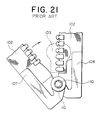
- This lateral-inserting type separable bottom end stop is disclosed, for example, in the specification of United States Patent No. 4139927, which is shown in FIG. 21.
- an incline surface having a screw-like configuration is provided at a portion of the periphery of each of the pin 110 and socket 112 of the male member 107 and the female member 108 which are provided at end portions of the left and right fastener stringers 102, 102.
- the fastener stringer 102 in order to rotate the fastener stringer 102 in the opposite direction and separate the pin 110 from the socket 112, the fastener stringer 102 must be rotated to a great extent, or else the fastener stringer 102 at the socket side must be twisted and detached. Thus there is the problem that the engagement and separation operations are extremely difficult.
- the present invention obviates the aforementioned problems and has a principal object to provide a lateral-inserting type separable bottom end stop assembly of a slide fastener in which the engagement and separation operations are extremely simple and particularly, children and elderly people can perform the operation of closing of the left and right fastener stringers in a simple manner.
- Still another object of the invention is to provide a separable bottom end stop assembly of a slide fastener which automatically, speedily and accurately guides an insert plate to an inner portion of the slider which is held by a holding portion which opposes the insert plate.
- Still another object of the invention is to provide a separable bottom end stop assembly of a slide fastener in which by specifying the configuration of a sliding surface of slide plate of the male member or the female member, the operation can be effective and accurate, and the separation of the male member and the female member can be carried out simply.
- Still another object of the invention is to provide a separable bottom end stop assembly of a slide fastener in which by specifying the surface configuration of the slide plate of the male member or the female member, the engagement and separation of the male member and the female member and the opening and closing of the fastener chain can be carried out smoothly and easily.
- Still another object of the invention is to provide a separable bottom end stop assembly of a slide fastener in which by specifying the surface shape of the male member or the female member, the operation of initial movement of the slider attached at the separable bottom end stop assembly can be started simply and reliably using the finger tips.
- Still another object of the invention is to provide a separable bottom end stop assembly of a slide fastener in which by specifying the configuration of the slider which is adapted to be mounted to the fastener chain, even children and elderly people can carry out the engagement and separation operation smoothly while the male member and the female member are visible.
- a lateral-inserting type separable bottom end stop assembly which comprises a male member and a female member which are engageable with and releasable from each other.
- the male member is provided with a first slide plate from which an engagement leg portion projects, while the female member is provided with a second sliding plate in which an engagement hole is formed to be fitly engaged with the engagement leg portion.
- First and second sliding surfaces are formed respectively at the peripheries of the engagement leg portion and the engagement hole.
- Each of the first and second slide surfaces is formed with a steep incline surface and a gentle incline surface.
- the steep incline surface and the gentle incline surface serve to automatically advance an insert plate which is disposed at one of the male member and the female member to an inside of a slider which is held by a holding portion which is disposed at the other of the male member and the female member when the first and second slide plates are pressed from both surfaces thereof.
- the insert plate can be automatically and speedily moved towards the slider which is held at the holding portion due to the action of the cam. Consequently the operation can be carried out easily even by children and elderly people or by using only one hand. Further, when the male member and the female member are opened to a certain extent, the male member and the female member can be automatically taken out from each other due to the action of the cam, thereby making the engagement and release operation extremely easy.
- the steep incline surface disposed at each of the slide surfaces is continuous to the gentle incline surface, and the steep incline surface automatically advances the insert plate toward the slider which is held at the holding portion when the first and second sliding plates are pressed from both surfaces thereof, and the gentle incline surface automatically guides the insert plate to the inside of the slider to be accommodated therein.
- the steep incline surface causes the insert plate to be automatically and speedily brought in close proximity with the slider which is held at the holding portion.
- the gentle incline surface maintains the action of the steep incline surface and guides the insert plate which is in contact with the slider to the inside of the slider automatically and accurately so that it is accommodated therein.
- the "steep incline surface” is a surface having a larger inclination than the "gentle incline surface”.
- each of the first and second slide surfaces has an elevation angle of 50-70 degrees, and the gentle incline surface has an elevation angle of 5-10 degrees.
- each of the first and second slide surfaces is provided with an upper step horizontal surface and a lower step horizontal surface which are disposed through a step. Consequently the engagement and release of the male member and the female member can be achieved easily and simply under optimum conditions.
- first steep incline surface a gentle incline surface, further preferably a second steep incline surface, which are inclined at different angles with respect to the horizontal surfaces, successively in the direction from the lower step horizontal surface towards the upper step horizontal surface. Consequently the insert plate can be automatically and speedily brought in close proximity with the slider which is held at the holding portion more easily, and can be guided and inserted into the slider automatically and accurately.
- each of the slide surfaces is provided with a vertical surface at a holding portion or an insert plate side thereof, and the upper step horizontal surface and the lower step horizontal surface are provided on both sides of the vertical surface, and the steep incline surface has a starting point which is between 160° and 170° from the vertical surface about the center of the engagement leg portion and the engagement hole, and the gentle incline surface is provided between 50° to 60° from an end point the steep incline surface. Consequently the steep incline surface and the gentle incline surface are disposed at the optimal positions, so that the advancing operation of the insert plate can be carried out accurately and the female member can be separated from the male member naturally and without resistance.
- grip portions are formed with an outer side edge of a front surface of the first slide plate of the male member and an outer side edge of a front surface of the second slide plate of the female member respectively such that said grip portions form thick portions. Consequently the separable bottom end stop assembly can be easy to grip, so that all the operations can be carried out easily.
- a surface of the second slide plate of the female member facing the insert plate has a gentle slant, which pushes the slider forward when the operation for closing the male member and the female member is carried out.
- the slider which is attached to the fastener stringer is the one having a semi-automatic stopping device.
- the slider is in a release state. That is, when a pull of the slider is caused to fall to a shoulder side of the slider body, and when the pull is caused to stand on the slider body, a locking pawl of the slider is pulled up so as to maintain a state that the stop operation cannot be carried out. Consequently the pull of the slider is prevented from being an obstruction at the time of the engagement and release operation of the separable bottom end stop assembly, and the engaging mechanism is directly visible so that the engagement and release operation can be carried out quickly and easily.
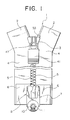
- the separable bottom end stop assembly of a slide fastener is a lateral-inserting type shown in FIG. 1.
- a male member 7 and a female member 8 having a pin or an engagement leg portion 11 and a socket or an engagement hole 12 respectively are attached to disc-shaped slides plates 9 and 10 of left and right fastener stringers 2, 2 of the slide fastener.
- the sliding plates 9 and 10 of the male member 7 and the female member 8 are superposed and when pressed from both front and back directions, the engagement leg portion 11 and the engagement hole 12 are engaged, and at the same time the sliding plate 10 of the female member 8 is automatically rotated around the engagement leg portion 11 in a horizontal direction thereof.
- an insert plate 30 of the female member 8 is inserted between guide flanges 44 of a slider 3 which is held by a holding portion 21 of the male member 7.
- the sliding plate 10 is further rotated automatically, so that the insert plate 30 is advanced into an inner portion of the slider.
- the insert plate 30 is inserted into a concave insert portion 22 of the male member 7, so that the fastener chain is thereby closed.
- Respective end portions of fastener tapes 4, 4 are reinforced by pressing reinforcing tapes 6, 6 which are formed of thermoplastic resin films to both front and back surfaces of the fastener tapes 4, 4.
- the male member 7 and the female member 8 are formed integrally with front surfaces of the reinforcement tapes 6, 6 using thermoplastic resin such as polyamide, polyacetal, polypropylene, polybutylene terephthalate by injection molding means so to be continuous with the fastener elements 5.
- thermoplastic resin such as polyamide, polyacetal, polypropylene, polybutylene terephthalate by injection molding means so to be continuous with the fastener elements 5.
- the separable bottom end stop assembly may also be formed using thermohardening resin or formed by metal die-casting.
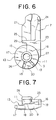
- the male member 7 which is attached so as to be integral with the end portion of one of the fastener stringers 2, is as shown in FIGS. 6 and 7, provided with a circular slide plate 9 at a front terminal end thereof.
- an engagement leg portion 11 which is a pin, is provided so as to project from the front surface thereof.
- An enlarged engagement head portion 26 is provided at a front end of the engagement leg portion 11 so as to project sideways. Further, a concave portion 27 is provided on an inner side surface of the engagement head portion 26.
- a slide surface 13 having a step is formed at the periphery of the base portion of the engagement leg portion 11 of the slide plate 9, a slide surface 13 having a step is formed.
- This slide surface 13 is circular, and has a vertical surface 15 at the portion along the side edge of the fastener tape 4, that is, from the holding portion 21 side toward the center of the engagement leg portion 11.
- An upper step horizontal surface 16 and a lower step horizontal surface 17 are disposed such that the vertical surface 15 is interposed therebetween.
- the lower step horizontal surface 17 projects from the side edge of the fastener stringer 2 to the outer side thereof, while the upper step horizontal surface 16 is provided so as to be positioned from the side edge of the fastener stringer 2 toward the inner side thereof.
- a first steep incline surface 18 is provided at a position of approximately 165° from the vertical surface 15 in the horizontal direction.
- the first steep incline surface 18 is formed with an elevation angle approximately in the range from 50° to 70°.
- a gentle incline surface 20 having an elevation angle of approximately 5° to 10°is provided so as to extend between the ranges of approximately 50° and 60 °about the center of the engagement leg portion 11.
- the terminal end of the gentle incline surface 20 is provided with a second steep incline surface 19 which has an elevation angle of 50- 70° and this is provided so as to be continuous to the upper step horizontal surface 16. Consequently, a continuous slide surface 13 having a cam mechanism is formed.
- a thick external portion 23 which protrude from the slide surface 13 is provided at the fastener element 5 side, and a stop portion 25 for stopping the slider 3 which is one step lower is provided at the external portion 23 close to the slide surface 13.
- the inner edge of the stop portion 25 extends to the upper end side so as to accommodate the guide flange 44 of the slider 3.
- fastener elements 5 are attached continuously to the outer side of the stop portion 25.
- the stop portion 25 has a holding portion 21, which can hold the slider 3 and extends to the upper end side.
- Ann insert recess groove 22 is formed at the outer surface of the holding portion 21 such that the insert plate 30 of the female member 8 can be fit-inserted therein.
- a convex portion 29 which projects from the vertical surface 15 to the side is formed at the external portion 23 of the lower end of the holding portion 21. This convex portion 29 can be fit-inserted into the concave portion 37 of the female member 8.
- the back surface of the slide plate 9 projects to the outer side and forms a thick grip portion 28.
- the grip portion 28 has a plurality of grooves cut into the front surface thereof to provide a rough surface which prevents slipping so that the slide plate 9 can be easily gripped.
- the back surface of the slide plate 9 is formed with each of a thick external portion 23, a holding portion 21 for the slider 3, a guide surface 24 and a stop portion 25 in a similar manner to the front surface thereof.
- a female member 8, which opposes the male member 7, is provided at the end portion of the other side fastener stringer 2.
- the female member 8 has a circular slide plate 10 at the terminal end thereof, and an engagement hole 12 is formed in the center thereof as the socket.
- a small engagement ridge 35 is provided at the inner peripheral surface of the engagement hole 12 so as project toward the inner side from the thinnest portion thereof. This engagement ridge 35 engages with the engagement head portion 26 of the engagement leg portion 11 of the male member 7.
- the back side of this slide plate 10, that is, the front surface which opposes the slide surface 13, has a slide surface 14, which has a step formed at the periphery of the engagement hole 12.
- the slide surface 14 is circular and has a vertical surface at the portion along the side edge of the fastener tape 4, that is, from the insert plate 30 side to the center of the engagement hole 12.
- an upper step horizontal surface 16 and a lower step horizontal surface 17 are disposed such that the vertical surface 15 is interposed therebetween.
- the upper step horizontal surface 16 projects from the side edge of the fastener stringer 2 to the outer side thereof, while the lower step horizontal surface 17 is provided so as to be positioned from the side edge of the fastener stringer 2 toward the inner side thereof.
- the upper step horizontal surface 16 has a first steep incline surface 18 at a position of approximately 165° from the vertical surface 15 in the horizontal direction thereof.
- the first steep incline surface 18 is formed with an elevation angle approximately in the range from 50° to 70°.
- a gentle incline surface 20 having an elevation angle of approximately 5° to 10° is provided so as to extend between the ranges of approximately 50° and 60° about the center of the engagement leg portion 11.
- the terminal end of gentle incline surface 20 is provided with a second steep incline surface 19 which has an elevation angle of 50- 70° and this is provided so as to be continuous to the lower step horizontal surface 17. Consequently, a continuous slide surface 14 having a cam mechanism is formed.
- the slide surface 14 around the engagement hole 12 is provided with a suitable beveling 39 in a range from the thickest lower step horizontal surface 17 to the gentle incline surface 20 which is the second thickest and from the front surfaces of these surface to the engagement ridge 35 provided at the inner peripheral surface, so that the engagement head portion 26 of the male member 7 can be easily fit therein.
- the inner side edge of the stop portion 34 extends to the upper end and can accommodate the slider 3.
- an insert plate 30 having a flat guide surface 33 is formed at the front surface, so that the insert plate 30 can be inserted into the insert recess groove 22 of the male member 7.
- the upper end of the outer side edge of the insert plate 30 has a coupling portion 31 which can couple with the opposing fastener element 5.
- a concave portion 37 is provided near the front end of the stop portion 34 and can thus be fit together with the convex portion 29 of the male member 7.
- the front surface of the slide plate 10 is formed with a thick grip portion 36 at an outermost end thereof so as to project to the outer side.
- the grip portion 36 has a plurality of grooves cut into the front surface thereof to provide a rough surface which prevents slipping.
- the surface of the slide plate 10 in which the opposite sides of the grip portion 36 and the engagement hole 12 are joined is at a higher position than the external portion 32 as shown in FIG. 14, and accordingly, the external portion 32 is lower than the slide portion 10.
- an incline surface 38 which inclines gently toward the external portion 32 is formed at the end side.
- the external portion 32 has a stop portion 34 for stopping the slider close to the slide plate 10, and a concave portion 37 is provided close to the front end of the stop portion 34.
- the side edge of the external portion 37 extends to the upper end side and is formed so as to accommodate the slider 3.
- the front surface of the external portion 37 has a flat guide surface 33 and thus the insert plate 30 is formed.
- the coupling portion 31 is provided at the upper end of the outer side edge of the insert plate 30. The back side of these parts are configured in the same manner.
- the slider 3 which is fit-inserted and used in the fastener chain 1 having a male member 7 and a female member 8 is a slider having a semi-automatic stopping device and is generally called a semi-automatic slider.
- the slider 3 has an accommodation hole 45 through which a guide pillar 43 of the body 40 and the upper wing plate 42 has a pair of mounting portions 49 for mounting a pull 41.
- a claw hole 46 is formed at a rear opening side of the slider close to the mounting portions 49.
- a plate spring 47 which is to be mounted to the body 40 has an M-shaped cross section, and one end thereof is accommodated and fixed in the accommodating hole 45 while the other end has a locking pawl 48 which fits into the claw hole 46.
- a rubber plate 52 is attached to the pull 41 so as to impart flexibility thereto.
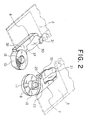
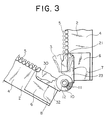
- FIG. 2 shows a state in which the male member 7 and the female member 8 attached to fastener stringers 2,2 are separated. From this state, first the slider 3 which has been inserted through the fastener stringer 2 having the male member 7 is pulled down to the holding portion 21 of the male member 7 and held therein. While the slider 3 causes the pull 41 to stand upright from the body 40 or when the pull 41 caused to fall to the shoulder side, the right and left fastener stringers 2, 2 are opened at approximately 70° about the center of the slide plate 9 or 10as shown in FIG. 3.
- the gentle incline surface 20 causes a force to be generated, which attempts to rotate the slide plate 10 of the female member 8 around the engagement leg portion 11.
- the gentle incline surface 20 of the slide surface 14 of the female member 8 slides on the upper step horizontal surface 16 of the slide surface 13 of the male member 7, and the lower step horizontal surface 17 of the slide surface 14 of the female member 8 slides and moves on the gentle incline surface 20 of the slide surface 13 of the male member 7.
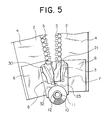
- the steep incline surfaces 18 and 19 of both the slide surfaces 13 and 14 contact with each other, the slide plate 10 moves forcefully along the incline surfaces 18 and 19 in front and back directions thereof.
- the positional relationship between the slide surface 13 and the slide surface 14 is such that the lower step horizontal surface 17 of the slide surface 13 and the lower step horizontal surface 17 of the slide surface 14, and also the upper step horizontal surface 16 of the slide surface 13 and the upper step horizontal surface 16 of the slide surface 14 are in contact with each other.
- the steep incline surface 18, the gentle incline surface 20 and the second steep incline surface 19 of the slide surface 13 oppose the second steep incline surface 19, the gentle incline surface 20 and the first steep incline surface 18 of the slide surface 14 with a small space between each of them.
- the first steep incline surface 18 and the second steep incline surface 19 of the slide surface 13 of the male member 7 are about to oppose and contact the second steep incline surface 19 and the first steep incline surface 18 of the slide surface 14 of the female member 8.
- the insert plate 30 is quickly led between the guide flanges 44 of the slider 3. At this time force is applied by bringing the male member 7 close to the female member 8 on the back side thereof by using the index finger.
- the slider 3 When the fastener chain 1 is to be separated, the slider 3 is pulled down to the holding portion 21 of the male member 7. Then in a state in which the pull 41 is upright or made to fall towards the shoulder side, the female member 8 is opened and separated in the horizontal direction with respect to the male member 7. As a result, the second steep incline surface 19 of the slide surface 13 and the second steep incline surface 19 of the slide surface 14 contact each other. Due to the action of the cam, the engagement head portion 26 of the engagement leg portion 11 and the engagement projection 35 of the engagement hole 12 are automatically released, so that the slide plate 10 of the female member 8 can be easily removed from the slide plate 9 of male member 7. It is to be noted that the reference number 53 shown in FIG. 1 represents a top end stop for preventing the slider 3 from coming off from the stringer 2.
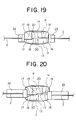
- FIGS. 16 to 20 is the same as that of the first embodiment except that configurations of the slide surfaces 13 and 14 of the sliding plates 9 and 10 on the male member 7 and the female member 8.
- the slide surface 13 of the male member 7 is, as shown in FIG. 16, formed with a vertical surface 15 at the holding portion 21 side, on opposite sides of which an upper step horizontal surface 16 and a lower step horizontal surface 17 are formed through a step.
- a steep incline surface 18 is provided at the lower step horizontal surface 17 so as to be disposed at a position of approximately 165° from the vertical surface 15 in the horizontal direction.
- the first steep incline surface 18 is formed with an elevation angle approximately in the range from 50° to 70°.
- a gentle incline surface 20 having an elevation angle of approximately 5° to 10°is provided so as to extend between the ranges of approximately 50° and 60° about the center of the engagement leg portion 11.
- the gentle incline surface 20 is continuous to the upper step horizontal surface 16.
- a slide surface 13 provided with a cam mechanism is formed.
- the difference between the first embodiment is in that the terminal end of the gentle incline surface 20 is not provided with a steep incline surface but contacts the upper step horizontal surface 16.
- the slide surface 14 of the female member 8 has a vertical surface 15 at the insert plate 30 side thereof.
- This vertical surface 15 is formed between the upper step horizontal surface 16 and the lower step horizontal surface 17.
- a steep incline surface 19 is provided at the lower step horizontal surface 17, which is at a position of approximately 165° from the vertical surface 15 in the horizontal direction thereof.
- the steep incline surface 19 is formed with an elevation angle approximately in the range from 50° to 70°.
- a gentle incline surface 20 having an elevation angle of approximately 5° to 10°is provided so as to extend between the ranges of approximately 50° and 60° about the center of the engagement hole 12.
- the terminal end of the gentle incline surface 20 connects to the upper step horizontal surface 16.
- a slide surface 14 provided with a cam mechanism is formed.
- the difference between this second embodiment and the first embodiment is in that the terminal end of the gentle incline surface 20 is not provided with a steep incline surface but contacts the upper step horizontal surface.
- the female member 8 is pushed upwards and the engaged state of the engagement head portion 26 of the engagement leg portion 11 and the engagement projection 35 of the engagement hole 12 is released, and the female member 8 is taken out and thus released.
- the steep incline surface 18, 19, the gentle incline surface 20 and the limiting conditions of the specified angles adopted in this invention can be suitably modified in accordance with the size of the fastener chain, the various uses of the fastener and the needs of the customers. However it is necessary to provide the cam mechanism.
Landscapes
- Slide Fasteners (AREA)
- Buckles (AREA)
Applications Claiming Priority (2)
| Application Number | Priority Date | Filing Date | Title |
|---|---|---|---|
| JP2002145065A JP3733343B2 (ja) | 2002-05-20 | 2002-05-20 | スライドファスナー用開離嵌挿具 |
| JP2002145065 | 2002-05-20 |
Publications (2)
| Publication Number | Publication Date |
|---|---|
| EP1364592A1 true EP1364592A1 (de) | 2003-11-26 |
| EP1364592B1 EP1364592B1 (de) | 2005-04-27 |
Family
ID=29397746
Family Applications (1)
| Application Number | Title | Priority Date | Filing Date |
|---|---|---|---|
| EP03253150A Expired - Lifetime EP1364592B1 (de) | 2002-05-20 | 2003-05-20 | Trennbarer unterer Endanschlag für Reissverschluss |
Country Status (8)
| Country | Link |
|---|---|
| US (1) | US6826810B2 (de) |
| EP (1) | EP1364592B1 (de) |
| JP (1) | JP3733343B2 (de) |
| KR (1) | KR100465473B1 (de) |
| CN (1) | CN1228009C (de) |
| DE (1) | DE60300559T2 (de) |
| ES (1) | ES2240915T3 (de) |
| TW (1) | TW586915B (de) |
Cited By (3)
| Publication number | Priority date | Publication date | Assignee | Title |
|---|---|---|---|---|
| GB2441144A (en) * | 2006-08-23 | 2008-02-27 | Touac Internat Ltd | Zip fastener with separable bottom stop which retains slider |
| GB2483429A (en) * | 2010-08-26 | 2012-03-14 | Ykk Europ Ltd | Slide fastener bottom stop |
| US9883202B2 (en) | 2006-10-06 | 2018-01-30 | Nxp Usa, Inc. | Scaling video processing complexity based on power savings factor |
Families Citing this family (33)
| Publication number | Priority date | Publication date | Assignee | Title |
|---|---|---|---|---|
| JP4464802B2 (ja) * | 2004-11-30 | 2010-05-19 | Ykk株式会社 | ファスナー |
| JP4628329B2 (ja) * | 2006-08-17 | 2011-02-09 | Ykk株式会社 | 開離嵌挿具付きスライドファスナー |
| ITTO20060659A1 (it) | 2006-09-15 | 2008-03-16 | Ykk Europ Ltd | Arresto di fondo corsa per una cerniera lampo, e cerniera lampo comprendente un tale arresto di fondo corsa. |
| US8146214B2 (en) | 2009-06-15 | 2012-04-03 | Dns Designs, Llc | Zipper |
| CN102106630B (zh) * | 2009-12-24 | 2013-04-10 | 福建浔兴拉链科技股份有限公司 | 闭口拉链下止及使用该下止的闭口拉链 |
| US8910352B2 (en) * | 2010-06-23 | 2014-12-16 | Ykk Corporation | Slide fastener |
| KR101559220B1 (ko) * | 2011-03-30 | 2015-10-13 | 와이케이케이 가부시끼가이샤 | 개방 분리 끼움 삽입구가 구비된 슬라이드 파스너 |
| KR101045303B1 (ko) * | 2011-04-05 | 2011-06-29 | (주)대원시스템 | 조립식 난간의 레일 파이프 도난방지용 체결구 |
| KR101103391B1 (ko) * | 2011-06-14 | 2012-01-05 | 신성컨트롤(주) | 차량 방호 울타리 |
| US9027210B2 (en) | 2011-09-12 | 2015-05-12 | Dns Designs, Llc | Self-aligning zipper |
| CN103005791B (zh) * | 2011-09-26 | 2015-01-21 | 福建浔兴拉链科技股份有限公司 | 开口拉链下止及使用该下止的开口拉链 |
| KR101196382B1 (ko) * | 2012-02-14 | 2012-11-02 | 이옥경 | 슬라이더 어셈블리 |
| US9693606B2 (en) * | 2012-12-31 | 2017-07-04 | KMK Zipper Co., Ltd. | Slider assembly and zipper comprising same |
| JP3189659U (ja) * | 2013-12-19 | 2014-03-27 | Ykk株式会社 | 止具、スライドファスナー、飾りファスナー |
| US20240324732A1 (en) * | 2014-12-04 | 2024-10-03 | Nite Ize, Inc. | Systems and methods for extruded zippers, zipper garages, connection techniques, and uses therefore |
| JP6367488B2 (ja) * | 2014-12-04 | 2018-08-01 | ナイト・アイズ,インコーポレーテッド | 改良されたジッパ・スライダ・ガレージのためのシステムおよび方法 |
| US11109650B2 (en) | 2014-12-04 | 2021-09-07 | Nite Ize, Inc. | Systems and methods for improved zipper slider garage |
| WO2016114456A1 (ko) * | 2015-01-12 | 2016-07-21 | 주식회사 케이엠케이 | 슬라이드 파스너 |
| USD818394S1 (en) * | 2016-06-30 | 2018-05-22 | Ideal Fastener (Guangdong) Industries Ltd. | Zipper tooth |
| KR102143199B1 (ko) | 2016-09-30 | 2020-08-11 | 와이케이케이 가부시끼가이샤 | 슬라이드 파스너용의 분리 가능한 고정구의 회전 기구 및 이것을 포함하는 슬라이드 파스너 |
| CN111148446B (zh) * | 2017-09-26 | 2022-09-13 | Ykk株式会社 | 拉链 |
| CN111148447B (zh) * | 2017-09-26 | 2023-03-24 | Ykk株式会社 | 拉链 |
| CN107928023B (zh) * | 2017-12-18 | 2024-09-06 | 江苏驰马科技股份有限公司 | 一种可单手操作使用的拉链 |
| KR102460171B1 (ko) * | 2018-03-12 | 2022-10-31 | 와이케이케이 가부시끼가이샤 | 고정구 및 이것을 포함하는 슬라이드 파스너 |
| US10477928B1 (en) * | 2018-07-17 | 2019-11-19 | Abdullah C. Erdal | System for zippers |
| JP7135104B2 (ja) * | 2018-11-06 | 2022-09-12 | Ykk株式会社 | スライドファスナー用の止め具 |
| WO2020095364A1 (ja) * | 2018-11-06 | 2020-05-14 | Ykk株式会社 | スライドファスナー用の止め具 |
| KR102209939B1 (ko) * | 2019-06-18 | 2021-02-01 | 주식회사 우진프라스틱 | 버클 |
| CN210809540U (zh) * | 2019-06-21 | 2020-06-23 | 开易(广东)服装配件有限公司 | 拉链的磁吸式尾止组件及其应用的拉链 |
| JP7229386B2 (ja) * | 2019-11-12 | 2023-02-27 | Ykk株式会社 | スライドファスナー |
| US11432622B2 (en) * | 2020-03-17 | 2022-09-06 | Nike, Inc. | Releasable coupling device |
| US11805864B1 (en) * | 2022-05-09 | 2023-11-07 | Kcc Zipper Co., Ltd. | Lower stop device of an anti-pinch zipper and its assembly structure |
| CN218418702U (zh) * | 2022-08-22 | 2023-02-03 | 浙江伟星实业发展股份有限公司 | 拉链下止及拉链 |
Citations (5)
| Publication number | Priority date | Publication date | Assignee | Title |
|---|---|---|---|---|
| US4139927A (en) * | 1976-02-12 | 1979-02-20 | Optilon W. Erich Heilmann Gmbh | Slide fastener with separable endstop members |
| US4221026A (en) * | 1978-06-15 | 1980-09-09 | Yoshida Kogyo K.K. | Separable end stop of a slide fastener |
| EP0917837A2 (de) * | 1997-11-20 | 1999-05-26 | Ykk Corporation | Trennbarer unterer Endanschlag für Reissverschlüsse |
| US6009602A (en) * | 1997-12-18 | 2000-01-04 | Ykk Corporation | Separable bottom end stop and a slider having a locking mechanism of a slide fastener |
| US20010047574A1 (en) * | 2000-05-31 | 2001-12-06 | Ykk Corporation | Meshing slide fastener with an engaging device |
Family Cites Families (6)
| Publication number | Priority date | Publication date | Assignee | Title |
|---|---|---|---|---|
| US1704579A (en) * | 1929-03-05 | Fasteneb fob gabments and otheb abticles | ||
| US2039976A (en) * | 1931-10-19 | 1936-05-05 | Hookless Fastener Co | Separable fastener |
| US2203005A (en) * | 1937-01-07 | 1940-06-04 | Wittenberg Erich | Separable fastener and detachable end connecting member therefor |
| DE2603241C3 (de) * | 1976-01-29 | 1979-08-16 | Optilon W. Erich Heilmann Gmbh, Cham (Schweiz) | Reißverschluß mit teilbarer Endkupplung |
| US4232430A (en) * | 1979-03-15 | 1980-11-11 | Friedberg Martin F | Device for connecting the ends of a separable zipper |
| JPH0216650Y2 (de) * | 1985-06-26 | 1990-05-09 |
-
2002
- 2002-05-20 JP JP2002145065A patent/JP3733343B2/ja not_active Expired - Fee Related
-
2003
- 2003-04-25 TW TW092109768A patent/TW586915B/zh not_active IP Right Cessation
- 2003-05-01 US US10/427,594 patent/US6826810B2/en not_active Expired - Fee Related
- 2003-05-19 KR KR10-2003-0031486A patent/KR100465473B1/ko not_active Expired - Fee Related
- 2003-05-20 DE DE60300559T patent/DE60300559T2/de not_active Expired - Lifetime
- 2003-05-20 CN CNB031368409A patent/CN1228009C/zh not_active Expired - Lifetime
- 2003-05-20 ES ES03253150T patent/ES2240915T3/es not_active Expired - Lifetime
- 2003-05-20 EP EP03253150A patent/EP1364592B1/de not_active Expired - Lifetime
Patent Citations (5)
| Publication number | Priority date | Publication date | Assignee | Title |
|---|---|---|---|---|
| US4139927A (en) * | 1976-02-12 | 1979-02-20 | Optilon W. Erich Heilmann Gmbh | Slide fastener with separable endstop members |
| US4221026A (en) * | 1978-06-15 | 1980-09-09 | Yoshida Kogyo K.K. | Separable end stop of a slide fastener |
| EP0917837A2 (de) * | 1997-11-20 | 1999-05-26 | Ykk Corporation | Trennbarer unterer Endanschlag für Reissverschlüsse |
| US6009602A (en) * | 1997-12-18 | 2000-01-04 | Ykk Corporation | Separable bottom end stop and a slider having a locking mechanism of a slide fastener |
| US20010047574A1 (en) * | 2000-05-31 | 2001-12-06 | Ykk Corporation | Meshing slide fastener with an engaging device |
Cited By (4)
| Publication number | Priority date | Publication date | Assignee | Title |
|---|---|---|---|---|
| GB2441144A (en) * | 2006-08-23 | 2008-02-27 | Touac Internat Ltd | Zip fastener with separable bottom stop which retains slider |
| US9883202B2 (en) | 2006-10-06 | 2018-01-30 | Nxp Usa, Inc. | Scaling video processing complexity based on power savings factor |
| GB2483429A (en) * | 2010-08-26 | 2012-03-14 | Ykk Europ Ltd | Slide fastener bottom stop |
| GB2483429B (en) * | 2010-08-26 | 2016-01-27 | Ykk Europ Ltd | Slide fastener bottom stop |
Also Published As
| Publication number | Publication date |
|---|---|
| ES2240915T3 (es) | 2005-10-16 |
| US6826810B2 (en) | 2004-12-07 |
| DE60300559T2 (de) | 2006-02-23 |
| DE60300559D1 (de) | 2005-06-02 |
| TW200307519A (en) | 2003-12-16 |
| KR100465473B1 (ko) | 2005-01-13 |
| TW586915B (en) | 2004-05-11 |
| KR20030090521A (ko) | 2003-11-28 |
| CN1460443A (zh) | 2003-12-10 |
| JP2003334109A (ja) | 2003-11-25 |
| EP1364592B1 (de) | 2005-04-27 |
| CN1228009C (zh) | 2005-11-23 |
| HK1058131A1 (en) | 2004-05-07 |
| US20030213106A1 (en) | 2003-11-20 |
| JP3733343B2 (ja) | 2006-01-11 |
Similar Documents
| Publication | Publication Date | Title |
|---|---|---|
| US6826810B2 (en) | Separable bottom end stop assembly for slide fastener | |
| US8844101B2 (en) | Reverse opening slide fastener | |
| JP7229386B2 (ja) | スライドファスナー | |
| EP0917837B1 (de) | Trennbarer unterer Endanschlag für Reissverschlüsse | |
| EP1029465B1 (de) | Unterer Endanschlag für Reissverschlüsse | |
| JP4307413B2 (ja) | スライドファスナー用開離嵌挿具 | |
| EP0581319B1 (de) | Trennbarer unterer Endanschlag für verdeckte Reissverschlüsse und Verfahren zu seinem Trennen und Zusammensetzen | |
| EP2460430B1 (de) | Reissverschluss | |
| JP3621040B2 (ja) | スライドファスナーの逆開き開離嵌挿具 | |
| KR100399516B1 (ko) | 결합장치를 구비한 교합 슬라이드 파스너 | |
| US20120124788A1 (en) | Slide Fastener | |
| CN114126445B (zh) | 拉链用拉头 | |
| EP1776889A1 (de) | Reissverschlussschieber mit Verriegelungsvorrichtung | |
| CN203492918U (zh) | 拉链用拉头 | |
| JP4324927B2 (ja) | オープンファスナーの連結用具 | |
| HK1058131B (en) | Separable bottom end stop assembly for slide fastener | |
| JPH052093Y2 (de) | ||
| JPH0793888B2 (ja) | スライドファスナーの開離嵌挿具 | |
| CN103584415B (zh) | 拉链用拉头 | |
| CN113796629A (zh) | 拉链用拉头及具有其的拉链 | |
| HK1159440A1 (en) | Slide zipper with slider insert | |
| HK1001485B (en) | Separable bottom end stop assembly and its assembling and separating method for concealed slide fasteners | |
| HK1159440B (en) | Slide zipper with slider insert | |
| HK1096266B (zh) | 拉链 |
Legal Events
| Date | Code | Title | Description |
|---|---|---|---|
| PUAI | Public reference made under article 153(3) epc to a published international application that has entered the european phase |
Free format text: ORIGINAL CODE: 0009012 |
|
| 17P | Request for examination filed |
Effective date: 20030529 |
|
| AK | Designated contracting states |
Kind code of ref document: A1 Designated state(s): AT BE BG CH CY CZ DE DK EE ES FI FR GB GR HU IE IT LI LU MC NL PT RO SE SI SK TR |
|
| AX | Request for extension of the european patent |
Extension state: AL LT LV MK |
|
| 17Q | First examination report despatched |
Effective date: 20040225 |
|
| AKX | Designation fees paid |
Designated state(s): DE ES FR GB IT |
|
| GRAP | Despatch of communication of intention to grant a patent |
Free format text: ORIGINAL CODE: EPIDOSNIGR1 |
|
| GRAS | Grant fee paid |
Free format text: ORIGINAL CODE: EPIDOSNIGR3 |
|
| GRAA | (expected) grant |
Free format text: ORIGINAL CODE: 0009210 |
|
| AK | Designated contracting states |
Kind code of ref document: B1 Designated state(s): DE ES FR GB IT |
|
| REG | Reference to a national code |
Ref country code: GB Ref legal event code: FG4D |
|
| REG | Reference to a national code |
Ref country code: IE Ref legal event code: FG4D |
|
| REF | Corresponds to: |
Ref document number: 60300559 Country of ref document: DE Date of ref document: 20050602 Kind code of ref document: P |
|
| REG | Reference to a national code |
Ref country code: ES Ref legal event code: FG2A Ref document number: 2240915 Country of ref document: ES Kind code of ref document: T3 |
|
| ET | Fr: translation filed | ||
| PLBE | No opposition filed within time limit |
Free format text: ORIGINAL CODE: 0009261 |
|
| STAA | Information on the status of an ep patent application or granted ep patent |
Free format text: STATUS: NO OPPOSITION FILED WITHIN TIME LIMIT |
|
| 26N | No opposition filed |
Effective date: 20060130 |
|
| PGFP | Annual fee paid to national office [announced via postgrant information from national office to epo] |
Ref country code: ES Payment date: 20120518 Year of fee payment: 10 |
|
| PGFP | Annual fee paid to national office [announced via postgrant information from national office to epo] |
Ref country code: GB Payment date: 20130515 Year of fee payment: 11 Ref country code: DE Payment date: 20130515 Year of fee payment: 11 |
|
| PGFP | Annual fee paid to national office [announced via postgrant information from national office to epo] |
Ref country code: IT Payment date: 20130520 Year of fee payment: 11 Ref country code: FR Payment date: 20130531 Year of fee payment: 11 |
|
| REG | Reference to a national code |
Ref country code: DE Ref legal event code: R119 Ref document number: 60300559 Country of ref document: DE |
|
| GBPC | Gb: european patent ceased through non-payment of renewal fee |
Effective date: 20140520 |
|
| REG | Reference to a national code |
Ref country code: DE Ref legal event code: R119 Ref document number: 60300559 Country of ref document: DE Effective date: 20141202 |
|
| REG | Reference to a national code |
Ref country code: FR Ref legal event code: ST Effective date: 20150130 |
|
| PG25 | Lapsed in a contracting state [announced via postgrant information from national office to epo] |
Ref country code: IT Free format text: LAPSE BECAUSE OF NON-PAYMENT OF DUE FEES Effective date: 20140520 Ref country code: DE Free format text: LAPSE BECAUSE OF NON-PAYMENT OF DUE FEES Effective date: 20141202 |
|
| PG25 | Lapsed in a contracting state [announced via postgrant information from national office to epo] |
Ref country code: GB Free format text: LAPSE BECAUSE OF NON-PAYMENT OF DUE FEES Effective date: 20140520 Ref country code: FR Free format text: LAPSE BECAUSE OF NON-PAYMENT OF DUE FEES Effective date: 20140602 |
|
| REG | Reference to a national code |
Ref country code: ES Ref legal event code: FD2A Effective date: 20150629 |
|
| PG25 | Lapsed in a contracting state [announced via postgrant information from national office to epo] |
Ref country code: ES Free format text: LAPSE BECAUSE OF NON-PAYMENT OF DUE FEES Effective date: 20140521 |