EP1347073A1 - HIGH Cr FERRITIC HEAT RESISTANCE STEEL - Google Patents
HIGH Cr FERRITIC HEAT RESISTANCE STEEL Download PDFInfo
- Publication number
- EP1347073A1 EP1347073A1 EP01956916A EP01956916A EP1347073A1 EP 1347073 A1 EP1347073 A1 EP 1347073A1 EP 01956916 A EP01956916 A EP 01956916A EP 01956916 A EP01956916 A EP 01956916A EP 1347073 A1 EP1347073 A1 EP 1347073A1
- Authority
- EP
- European Patent Office
- Prior art keywords
- oxide
- perovskite structure
- structure compound
- composition ratio
- piezoelectric ceramic
- Prior art date
- Legal status (The legal status is an assumption and is not a legal conclusion. Google has not performed a legal analysis and makes no representation as to the accuracy of the status listed.)
- Granted
Links
Images



Classifications
-
- C—CHEMISTRY; METALLURGY
- C22—METALLURGY; FERROUS OR NON-FERROUS ALLOYS; TREATMENT OF ALLOYS OR NON-FERROUS METALS
- C22C—ALLOYS
- C22C38/00—Ferrous alloys, e.g. steel alloys
- C22C38/005—Ferrous alloys, e.g. steel alloys containing rare earths, i.e. Sc, Y, Lanthanides
-
- C—CHEMISTRY; METALLURGY
- C22—METALLURGY; FERROUS OR NON-FERROUS ALLOYS; TREATMENT OF ALLOYS OR NON-FERROUS METALS
- C22C—ALLOYS
- C22C38/00—Ferrous alloys, e.g. steel alloys
- C22C38/001—Ferrous alloys, e.g. steel alloys containing N
-
- C—CHEMISTRY; METALLURGY
- C22—METALLURGY; FERROUS OR NON-FERROUS ALLOYS; TREATMENT OF ALLOYS OR NON-FERROUS METALS
- C22C—ALLOYS
- C22C38/00—Ferrous alloys, e.g. steel alloys
- C22C38/18—Ferrous alloys, e.g. steel alloys containing chromium
- C22C38/22—Ferrous alloys, e.g. steel alloys containing chromium with molybdenum or tungsten
-
- C—CHEMISTRY; METALLURGY
- C22—METALLURGY; FERROUS OR NON-FERROUS ALLOYS; TREATMENT OF ALLOYS OR NON-FERROUS METALS
- C22C—ALLOYS
- C22C38/00—Ferrous alloys, e.g. steel alloys
- C22C38/18—Ferrous alloys, e.g. steel alloys containing chromium
- C22C38/24—Ferrous alloys, e.g. steel alloys containing chromium with vanadium
-
- C—CHEMISTRY; METALLURGY
- C22—METALLURGY; FERROUS OR NON-FERROUS ALLOYS; TREATMENT OF ALLOYS OR NON-FERROUS METALS
- C22C—ALLOYS
- C22C38/00—Ferrous alloys, e.g. steel alloys
- C22C38/18—Ferrous alloys, e.g. steel alloys containing chromium
- C22C38/26—Ferrous alloys, e.g. steel alloys containing chromium with niobium or tantalum
-
- C—CHEMISTRY; METALLURGY
- C22—METALLURGY; FERROUS OR NON-FERROUS ALLOYS; TREATMENT OF ALLOYS OR NON-FERROUS METALS
- C22C—ALLOYS
- C22C38/00—Ferrous alloys, e.g. steel alloys
- C22C38/18—Ferrous alloys, e.g. steel alloys containing chromium
- C22C38/30—Ferrous alloys, e.g. steel alloys containing chromium with cobalt
-
- C—CHEMISTRY; METALLURGY
- C22—METALLURGY; FERROUS OR NON-FERROUS ALLOYS; TREATMENT OF ALLOYS OR NON-FERROUS METALS
- C22C—ALLOYS
- C22C38/00—Ferrous alloys, e.g. steel alloys
- C22C38/18—Ferrous alloys, e.g. steel alloys containing chromium
- C22C38/32—Ferrous alloys, e.g. steel alloys containing chromium with boron
Definitions
- the present invention relates to a piezoelectric ceramic widely used in the field of actuators, sensors, resonators or the like.
- Piezoelectric materials have an effect of creating a distortion by externally applying an electric field (conversion from an electrical energy into a mechanical energy) and an effect of generating an electric charge on a surface thereof by externally imposing a stress (conversion from a mechanical energy into an electrical energy), and in recent years, the piezoelectric materials have been widely used in various fields.
- piezoelectric materials such as lead zirconate titanate (Pb(Zr,Ti)O 3 ; PZT) create a distortion substantially proportional to an applied voltage on the order of 1 ⁇ 10 -10 m/V
- the piezoelectric materials are superior in fine positioning, etc., therefore, the piezoelectric materials are used for fine adjustments, etc. in optical systems.
- the piezoelectric materials generate an electric charge proportional to an imposed stress or the amount of strain in the piezoelectric materials by the imposed stress
- the piezoelectric materials are used as sensors for detecting a minute force, deformation or the like.
- the piezoelectric materials have an excellent response, so that by applying an AC electric field, the piezoelectric materials can excite themselves or an elastic body connected thereto to produce resonance. Therefore, the piezoelectric materials are used as piezoelectric transformers, ultrasonic motors or the like.
- PZT-based piezoelectric materials are solid solutions (PZT-based) including PbZrO 3 (PZ)-PbTiO 3 (PT), because superior piezoelectric properties can be obtained by the use of a composition of rhombohedral PZ and tetragonal PT near a crystallographic morphotropic phase boundary (M.P.B.).
- the PZT-based piezoelectric materials have been widely developed in response to various needs through adding various auxiliary components or additives.
- PZT-based piezoelectric materials ranging, for example, from those with a small mechanical quality factor (Qm) and a large piezoelectric constant (d 33 ) used for DC devices such as actuators, etc. for positioning which can obtain a large amount of displacement to those with a small piezoelectric constant (d 33 ) and a large mechanical quality factor (Qm) suitable for AC devices such as ultrasonic generating devices, for example, ultrasonic motors.
- Qm mechanical quality factor
- piezoelectric materials except for the PZT-based piezoelectric materials, there are other practically used piezoelectric materials, most of which are solid solutions including a lead-based perovskite composition such as lead magnesium niobate (Pb(Mg,Nb)O 3 ; PMN) or the like as a main component.
- a lead-based perovskite composition such as lead magnesium niobate (Pb(Mg,Nb)O 3 ; PMN) or the like as a main component.
- these lead-based piezoelectric materials include lead oxide (PbO) with extremely high volatility even at a low temperature as much as the order of 60 to 70% by mass as a main component.
- PbO lead oxide
- approximately 2/3 of PZT or PMN contains lead oxide in mass ratio. Therefore, when manufacturing these piezoelectric materials, in heat treatment such as a firing step for ceramics and a melting step for single crystal products, a very large amount of lead oxide volatilizes and diffuses at an industrial level.
- lead oxide released in a manufacturing step can be recovered, it is difficult to recover lead oxide included in piezoelectric products placed on the market as industrial products under the status quo, so if lead oxide is widely released into the environment, there are worries that lead may be leached due to acid rain. Therefore, when the piezoelectric ceramics and single crystals have a wider area of application, and the amount of use thereof increases in future, a very important challenge is to develop lead-free piezoelectric materials.
- barium titanate BaTiO 3
- bismuth layer ferroelectric As piezoelectric materials including no lead, for example, barium titanate (BaTiO 3 ) or bismuth layer ferroelectric is known.
- barium titanate has a low Curie point of 120°C, so that a temperature higher than 120°C destroys the piezoelectric properties thereof. Therefore, for soldering and application for vehicles, barium titanate is not practical.
- bismuth layer ferroelectric typically has a Curie point of 400°C or over, so the thermal stability thereof is superior, but the crystal anisotropy thereof is large. Therefore, it is required to orient a spontaneous polarization through hot-forging or the like, so there is a problem in productivity. Further, when lead is not included at all, it is difficult to obtain large piezoelectric properties.
- a first piezoelectric ceramic according to the invention comprises three kinds or more of perovskite structure compounds having different crystal structures.
- a second piezoelectric ceramic according to the invention comprises a solid solution including three kinds or more of perovskite structure compounds having different crystal structures.
- the piezoelectric properties can be improved. Moreover, it is preferable in the point of ultra-low emission, environmental friendliness and ecology that the content of lead (Pb) is 1% by mass or less.
- perovskite structure compounds having different crystal structures a rhombohedral perovskite structure compound, a tetragonal perovskite structure compound and an orthorhombic perovskite structure compound are preferably comprised.
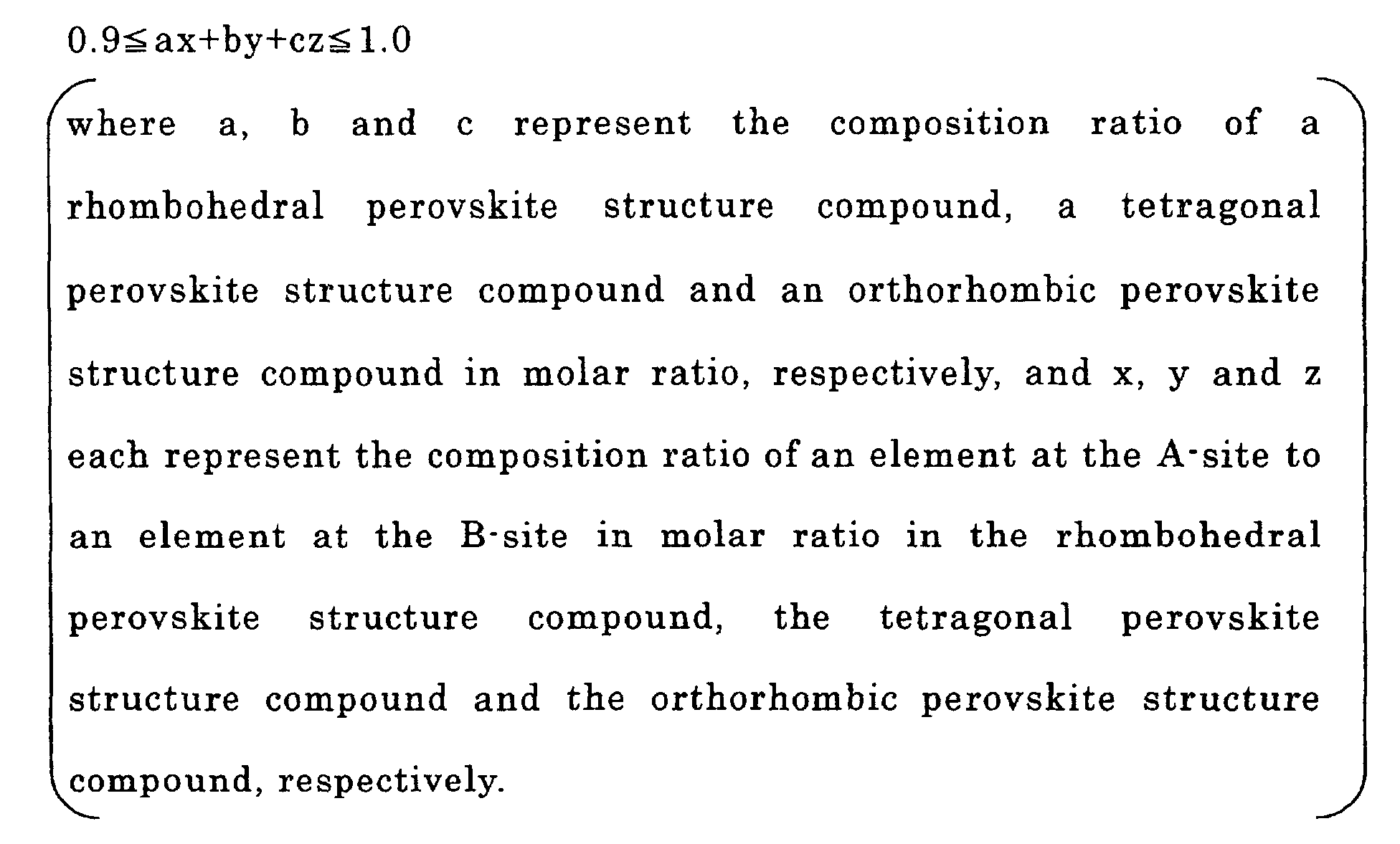
- composition ratio of these compounds and the composition ratio of an element at the A-site to an element at the B-site in each of these compounds preferably have a relation shown in Mathematical Formula 1. That is, the sum of the products of the composition ratio of each of three kinds of compounds and the composition ratio of an element at the A-site to an element at the B-site in the each of three kinds of compounds is preferably within a range from 0.9 to 1.0 inclusive.
- perovskite structure compounds having different crystal structures a rhombohedral perovskite structure compound, a tetragonal perovskite structure compound and a cubic perovskite structure compound are preferably comprised.
- composition ratio of these compounds and the composition ratio of an element at the A-site to an element at the B-site in each of these compounds preferably have a relation shown in Mathematical Formula 2. That is, the sum of the products of the composition ratio of each of three kinds of compounds and the composition ratio of an element at the A-site to an element at the B-site in the each of three kinds of compounds is preferably within a range from 0.9 to 1.0 inclusive.
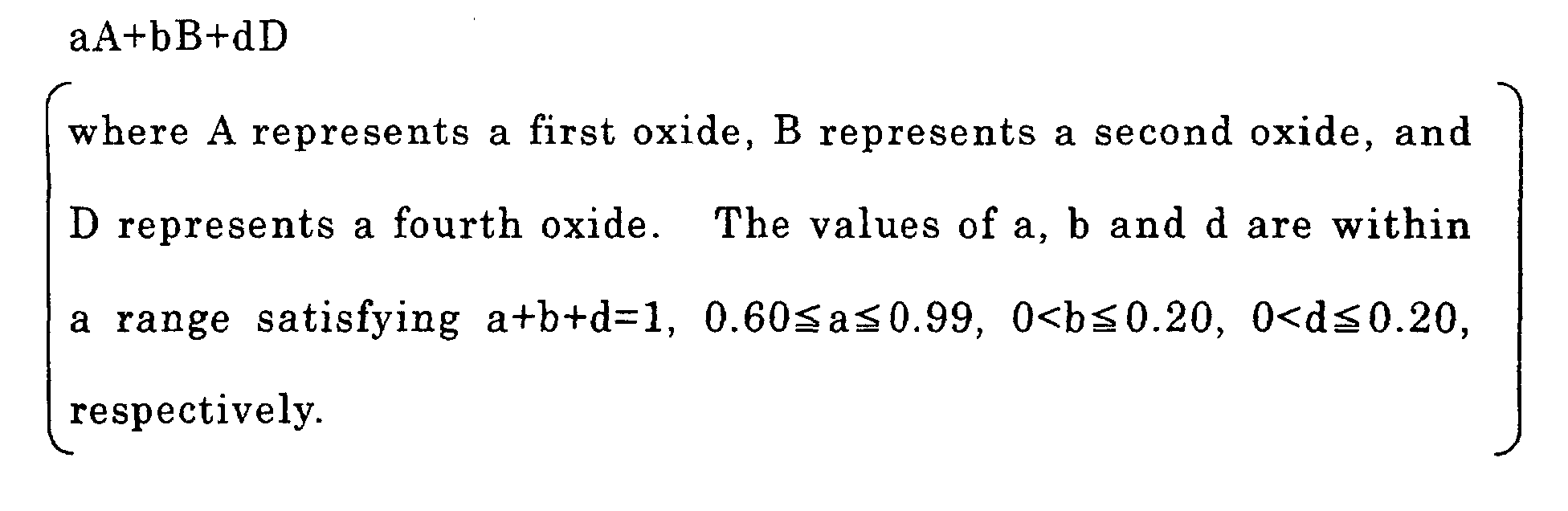
- a third piezoelectric ceramic according to the invention comprises a first oxide including sodium bismuth titanate, at least one kind of second oxide selected from the group consisting of potassium bismuth titanate and barium titanate, and at least one kind of third oxide selected from the group consisting of sodium niobate, potassium niobate and calsium titanate.
- a fourth piezoelectric ceramic according to the invention comprises a solid solution including a first oxide including sodium bismuth titanate, at least one kind of second oxide selected from the group consisting of potassium bismuth titanate and barium titanate, and at least one kind of third oxide selected from the group consisting of sodium niobate, potassium niobate and calsium titanate.
- the piezoelectric properties can be improved.
- the second oxide potassium bismuth titanate or barium titanate is preferably included.
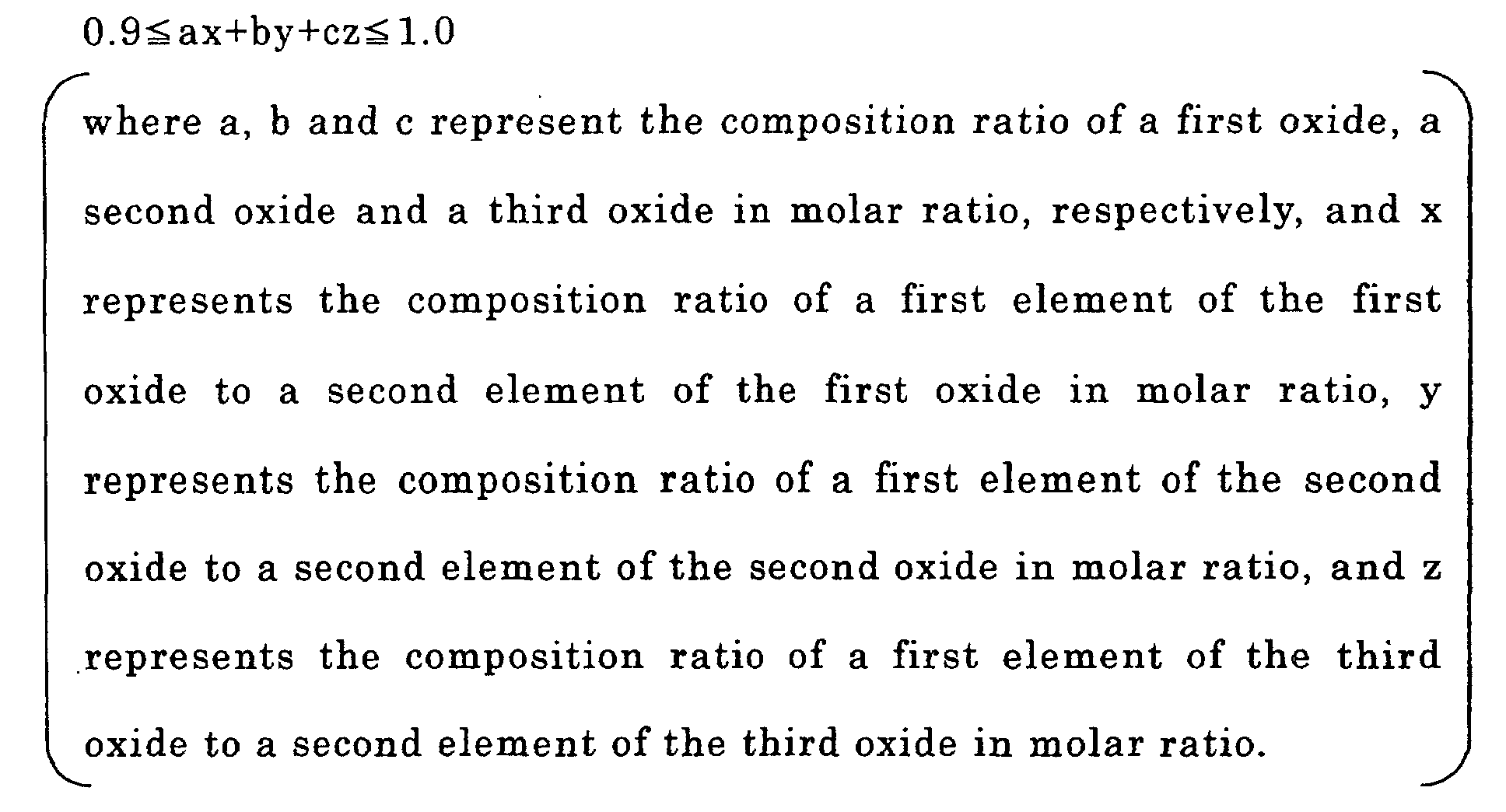
- composition ratio of the first oxide, the second oxide and the third oxide and the composition ratio of a first element of the first oxide to a second element of the first oxide, the composition ratio of a first element of the second oxide to a second element of the second oxide, and the composition ratio of a first element of the third oxide to a second element of the third oxide preferably have a relation shown in Mathematical Formula 3.
- the sum of the product of the composition ratio a of the first oxide and the composition ratio x of the first element of the first oxide to the second element of the first oxide, the product of the composition ratio b of the second oxide and the composition ratio y of the first element of the second oxide to the second element of the second oxide, and the product of the composition ratio c of the third oxide and the composition ratio z of the first element of the third oxide to the second element of the third oxide is preferably within a range from 0.9 to 1.0 inclusive.
- a fifth piezoelectric ceramic according to the invention comprises a first oxide including sodium bismuth titanate, at least one kind of second oxide selected from the group consisting of potassium bismuth titanate and barium titanate and a fourth oxide including strontium titanate.
- a sixth piezoelectric ceramic according to the invention comprises a solid solution including a first oxide including sodium bismuth titanate, at least one kind of second oxide selected from the group consisting of potassium bismuth titanate and barium titanate and a fourth oxide including strontium titanate.
- the piezoelectric properties can be improved.
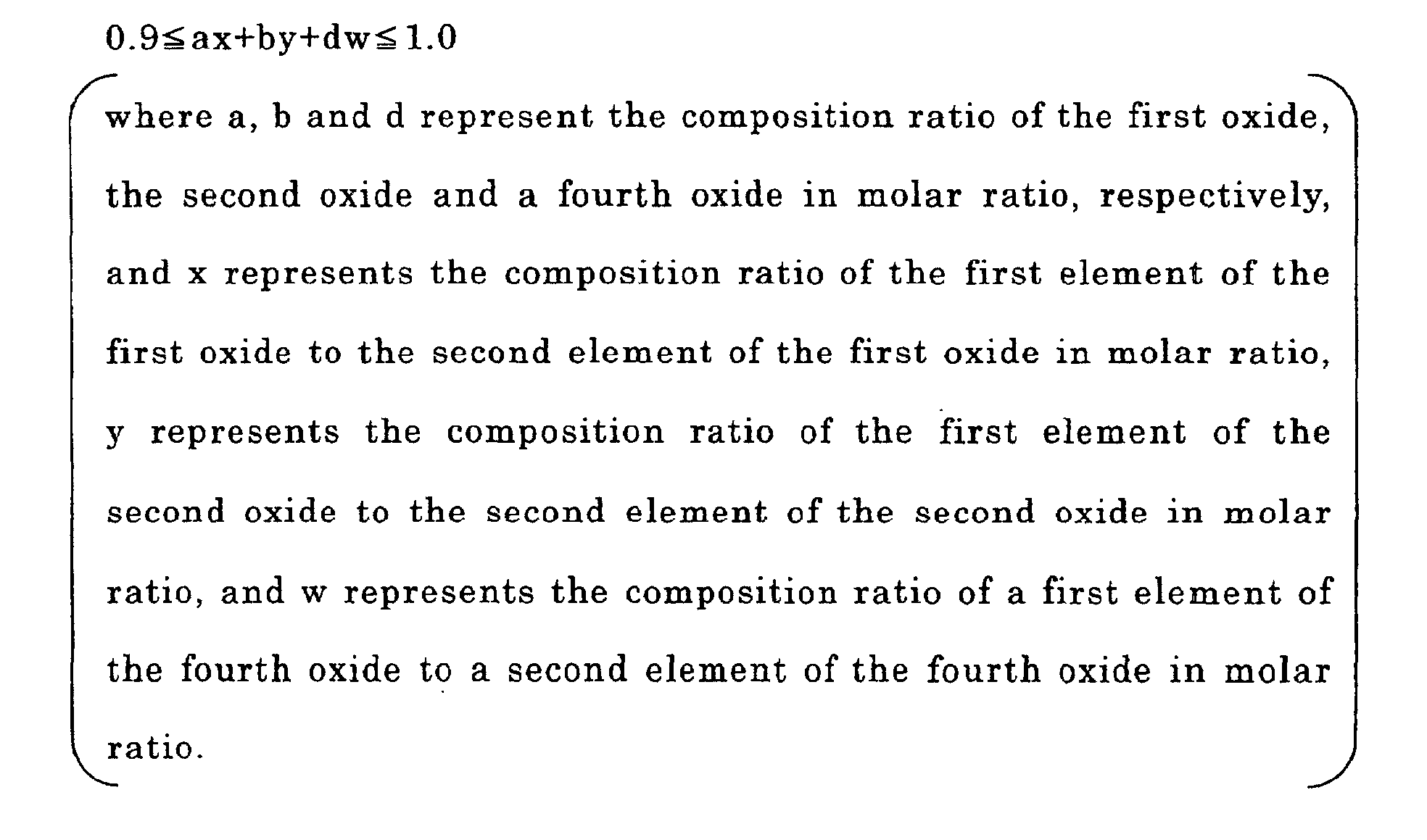
- composition ratio of the first oxide, the second oxide and the fourth oxide and the composition ratio of a first element of the first oxide to a second element of the first oxide, the composition ratio of a first element of the second oxide to a second element of the second oxide, and the composition ratio of a first element of the fourth oxide to a second element of the fourth oxide preferably have a relation shown in Mathematical Formula 4.
- the sum of the product of the composition ratio a of the first oxide and the composition ratio x of the first element of the first oxide to the second element of the first oxide, the product of the composition ratio b of the second oxide and the composition ratio y of the first element of the second oxide to the second element of the second oxide, and the product of the composition ratio d of the fourth oxide and the composition ratio w of the first element of the fourth oxide to the second element of the fourth oxide is preferably within a range from 0.9 to 1.0 inclusive.
- a piezoelectric ceramic according to a first embodiment of the invention comprises a rhombohedral perovskite structure compound, a tetragonal perovskite structure compound and an orthorhombic perovskite structure compound, or comprises a solid solution including a rhombohedral perovskite structure compound, a tetragonal perovskite structure compound and an orthorhombic perovskite structure compound. That is, the piezoelectric ceramic comprises three kinds of perovskite structure compounds having different crystal structures, which may form a solid solution or may not perfectly form a solid solution.
- a crystallographic morphotropic phase boundary (M.P.B.) is formed so as to improve the piezoelectric properties. More specifically, compared with a one- or two-component based piezoelectric ceramic, in the piezoelectric ceramic, the electromechanical coupling factor and the relative dielectric constant are improved, and accordingly the amount of displacement is improved.
- the rhombohedral perovskite structure compound for example, there is a first oxide including sodium bismuth titanate.
- the first oxide includes a first element of the first oxide at the A-site of the perovskite structure, a second element of the first oxide at the B-site of the perovskite structure and oxygen, and the composition thereof is expressed by, for example, Chemical Formula 5.
- A1 represents the first element of the first oxide
- A2 represents the second element of the first oxide.
- x is 1, but the first oxide may deviate from the stoichiometric composition. It is preferable that x is 1 or less because the sinterability can be improved, and higher piezoelectric properties can be obtained.
- the composition of oxygen is determined from the stoichiometric composition, and may deviate from the stoichiometric composition.
- sodium (Na) and bismuth (Bi) correspond to the first element of the first oxide.
- the composition ratio of sodium to bismuth in sodium bismuth titanate is 1:1 in molar ratio in the case of the stoichiometric composition, but it may deviate from the stoichiometric composition.
- titanium (Ti) corresponds to the second element of the first oxide.
- the rhombohedral perovskite structure compound may include one kind of compound or a plurality of kinds of compounds. In the case where it includes a plurality of kinds of compounds, the compounds may form a solid solution or not.
- the tetragonal perovskite structure compound for example, there is at least one kind of second oxide selected from the group consisting of potassium bismuth titanate and barium titanate.
- the second oxide includes a first element of the second oxide at the A-site of the perovskite structure, a second element of the second oxide at the B-site of the perovskite structure and oxygen, and the composition thereof is expressed by, for example, Chemical Formula 6.
- B1 represents the first element of the second oxide
- B2 represents the second element of the second oxide.
- y is 1, but the second oxide may deviate from the stoichiometric composition.
- the composition of oxygen is determined from the stoichiometric composition, and it may deviate from the stoichiometric composition.
- potassium (K) and bismuth correspond to the first element of the second oxide
- barium (Ba) corresponds to the first element of the second oxide
- the composition ratio of potassium to bismuth in potassium bismuth titanate is 1:1 in molar ratio in the case of the stoichiometric composition, but it may deviate from the stoichiometric composition.
- titanium corresponds to the second element of the second oxide.
- the tetragonal perovskite structure compound may include one kind of compound or a plurality of kinds of compounds. In the case where it includes a plurality of kinds of compounds, they may form a solid solution or not. Further, it is preferable that the tetragonal perovskite structure compound includes potassium bismuth titanate, so that a larger amount of displacement can be obtained and the tetragonal perovskite structure compound includes potassium bismuth titanate and barium titanate, so that a larger amount of displacement can be obtained.
- the orthorhombic perovskite structure compound for example, there is at least one kind of third oxide selected from the group consisting of sodium niobate , potassium niobate and calsium titanate.
- the third oxide includes a first element of the third oxide at the A-site of the perovskite structure, a second element of the third oxide at the B-site of the perovskite structure and oxygen, and the composition thereof is expressed by, for example, Chemical Formula 7.
- C1 represents the first element of the third oxide
- C2 represents the second element of the third oxide.
- z is 1, but it may deviate from the stoichiometric composition.
- the composition of oxygen is determined from the stoichiometric composition, and it may deviate from the stoichiometric composition.
- sodium corresponds to the first element of the third oxide
- potassium corresponds to the first element of the third oxide
- calsium titanate in the case of calsium titanate
- niobium corresponds to the second element of the third oxide
- titanium corresponds to the second element of the third oxide.
- the orthorhombic perovskite structure compound may include one kind of compound or a plurality of kinds of compounds.
- the ortherhombic perovsikite structure compound includes a plurality of kinds of compounds, they may form a solid solution or not.
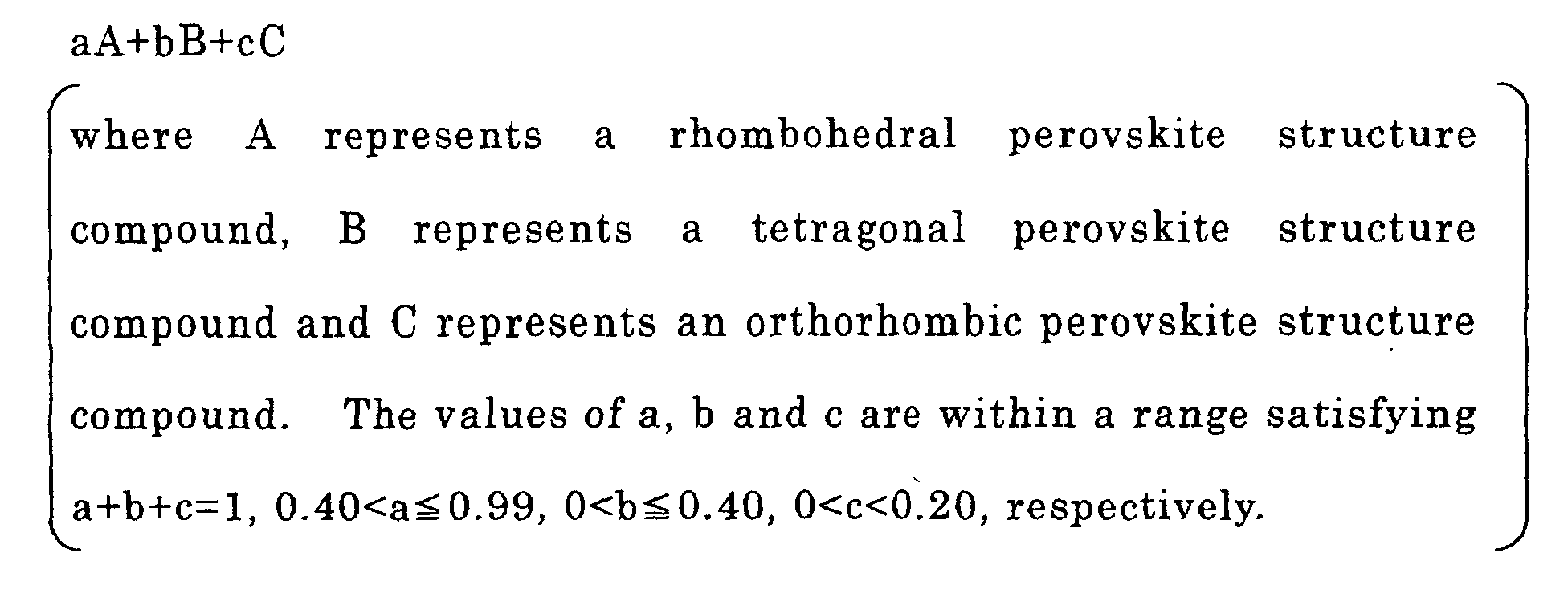
- the composition ratio of the rhombohedral perovskite structure compound, the tetragonal perovskite structure compound and the orthorhombic perovskite structure compound for example, the composition ratio of the first oxide, the second oxide and the third oxide is preferably within a range shown in Chemical Formula 8 in molar ratio.
- the contents of the tetragonal perovskite structure compound and the orthorhombic perovskite structure compound are too high, the piezoelectric properties decline, and when the contents thereof are too low, effects achieved through comprising three kinds of perovskite structure compounds having different crystal structures cannot be sufficiently obtained.
- A represents the rhombohedral perovskite structure compound (for example, the first oxide)
- B represents the tetragonal perovskite structure compound (for example, the second oxide)
- C represents the orthorhombic perovskite structure compound (for example, the third oxide).
- the composition ratio is a value in the piezoelectric ceramic including a compound forming a solid solution and a compound not forming a solid solution.
- the value of b is preferably within a range less than 0.40, more preferably within a range of 0.35 or less, and most preferably within a range of 0.30 or less.
- the value of c is more preferably within a range of 0.15 or less. Thus, a larger amount of displacement can be obtained within the above ranges.
- the optimum range of the composition ratio thereof may vary.
- the tetragonal perovskite structure compound includes barium titanate
- composition ratio of the rhombohedral perovskite structure compound, the tetragonal perovskite structure compound and the orthorhombic perovskite structure compound and the composition ratio of an element at the A-site to an element at the B-site in each of these compounds have a relation shown in Mathematical Formula 5.
- a, b and c represent the composition ratio of the rhombohedral perovskite structure compound, the tetragonal perovskite structure compound and the orthorhombic perovskite structure compound in molar ratio, respectively.
- x, y and z represent the composition ratio of an element at the A-site in molar ratio in the case where an element at the B-site is 1 in each of the rhombohedral perovskite structure compound , the tetragonal perovskite structure compound and the orthorhombic perovskite structure compound, that is, the composition ratio of an element at the A-site to an element at the B-site in molar ratio.
- the sum of the product of the composition ratio a of the first oxide and the composition ratio x of the first element of the first oxide to the second element of the first oxide, the product of the composition ratio b of the second oxide and the composition ratio y of the first element of the second oxide to the second element of the second oxide, and the product of the composition ratio c of the third oxide and the composition ratio z of the first element of the third oxide to the second element of the third oxide is preferably within a range from 0.9 to 1.0 inclusive. It is because, as described in Chemical Formula 5, in the case where the sum is 1.0 or less, higher sinterability and superior piezoelectric properties can be obtained, and on the other hand, when the sum is less than 0.9, the piezoelectric properties will decline.
- the piezoelectric ceramic may include lead, although the content of lead is preferably 1% by mass or less, and more preferably the piezoelectric ceramic does not include lead at all.
- the volatilization of lead during firing and the release of lead into the environment after the piezoelectric ceramic as a piezoelectric ceramic product is distributed into the market and then discarded can be minimized, so it is preferable in the point of ultra-low emission, environmental friendliness and ecology.
- the average particle diameter of the crystal particle of the piezoelectric ceramic is, for example, within a range from 0.5 ⁇ m to 20 ⁇ m.
- the piezoelectric ceramic having such a structure can be manufactured, for example, through the following method.
- bismuth oxide (Bi 2 O 3 ) powders, sodium carbonate (Na 2 CO 3 ) powders, potassium carbonate (K 2 CO 3 ) powders, barium carbonate (BaCO 3 ) powders, calcium carbonate (CaCO 3 ) powders, titanium oxide (TiO 2 ) powders, niobium oxide (Nb 2 O 5 ) powders and so on are prepared as required, and after the powders are sufficiently dried at 100°C or over, the powders are weighed according to a target composition.
- oxides materials such as carbonates or oxalates which become oxides through firing may be used, and instead of carbonates, oxides or any other materials which become oxides through firing may be used.
- the weighed starting materials are sufficiently mixed in an organic solvent or water by the use of a ball mill or the like for 5 to 20 hours, and then the mixture is sufficiently dried, press-molded and pre-calcined for about 1 to 3 hours at 750°C to 900°C. Then, after the pre-calcined body is pulverized by the ball mill or the like in the organic solvent or water for 10 to 30 hours, the pulverized body is dried again, and a binder is added to granulate the body. After granulating, for example, the granulated body is press-molded through pressing with a load of 100 MPa to 400 MPa by the use of a uniaxial press molding apparatus or a cold isostatic pressing (CIP) apparatus to be pelletized.
- CIP cold isostatic pressing
- the pelletized body After pelletized, for example, the pelletized body is heated for the order of 2 hours to 4 hours at 400°C to 800°C to volatilize the binder, and then are fired for the order of 2 hours to 4 hours at 950°C to 1300°C.
- the heating rate and the cooling rate during firing are, for example, within a range from 50°C/hour to 300°C/hour.
- the sintered body obtained After firing, the sintered body obtained is polished as required, and then an electrode is disposed thereon. After that, in silicon oil at 25°C to 100°C, an electric field of 5 MV/m to 10MV/m is applied to the sintered body for 5 minutes to 1 hour to carry out a polarization treatment. Thereby, the above-described piezoelectric ceramic can be obtained.
- the piezoelectric ceramic comprises the rhombohedral perovskite structure compound such as the first oxide, the tetragonal perovskite structure compound such as the second oxide and the orthorhombic perovskite structure compound such as the third oxide, or a solid solution including them, compared with a one- or two-component based piezoelectric ceramic, the electromechanical coupling factor and the relative dielectric constant can be improved, and accordingly the amount of displacement can be improved.
- the piezoelectric ceramic including no lead or a small amount of lead can have higher applicability. That is, the piezoelectric ceramic superior in the point of ultra-low emission, environmental friendliness and ecology, which can minimize the volatilization of lead during firing and the release of lead into the environment after the piezoelectric ceramic as a piezoelectric ceramic product is distributed into the market and then discarded, can be used.
- the piezoelectric properties can be further improved.
- potassium bismuth titanate is included as the tetragonal perovskite structure compound, and more specifically when potassium bismuth titanate and barium titanate are included, a larger amount of displacement can be obtained.
- a piezoelectric ceramic according to a second embodiment of the invention comprises a rhombohedral perovskite structure compound, a tetragonal perovskite structure compound and a cubic perovskite structure compound, or comprises a solid solution including the rhombohedral perovskite structure compound, the tetragonal perovskite structure compound and the cubic perovskite structure compound. That is, as in the case of the piezoelectric ceramic according to the first embodiment, the piezoelectric ceramic comprises three kinds of perovskite structure compounds having different crystal structures, except that the cubic perovskite structure compound is comprised instead of the orthorhombic perovskite structure compound. They may form a solid solution or may not perfectly form a solid solution.
- a crystallographic morphotropic phase boundary (M.P.B.) is formed so as to improve the piezoelectric properties. More specifically, compared with a one- or two-component based piezoelectric ceramic, in the piezoelectric ceramic, the electromechanical coupling factor and the relative dielectric constant are improved, and accordingly the amount of displacement is improved.
- the rhombohedral perovskite structure compound and the tetragonal perovskite structure compound are the same as those of the first embodiment.
- the tetragonal perovskite structure compound may include potassium bismuth titanate, barium titanate, or both.
- the fourth oxide includes a first element of the fourth oxide at the A-site of the perovskite structure, a second element of the fourth oxide at the B-site of the perovskite structure and oxygen, and the composition thereof is expressed by, for example, Chemical Formula 9.
- D1 represents the first element of the fourth oxide
- D2 represents the second element of the fourth oxide.
- w is 1, but it may deviate from the stoichiometric composition.
- the composition of oxygen is determined from the stoichiometric composition, and it may deviate from the stoichiometric composition.
- strontium titanate strontium (Sr) corresponds to the first element of the fourth oxide
- titanium corresponds to the second element of the fourth oxide
- the cubic perovskite structure compound may include one kind of compound or a plurality of kinds of compounds. In the case where it includes a plurality of kinds of compounds, the compounds may form a solid solution or not.
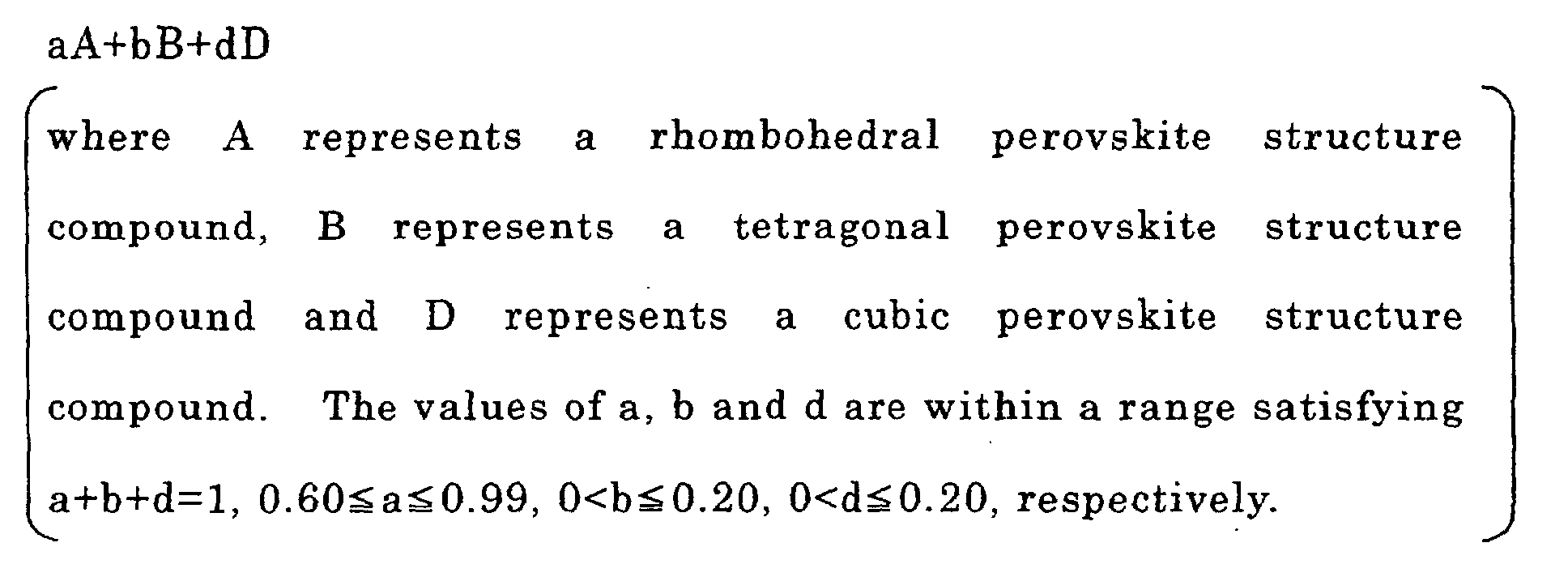
- the composition ratio of the rhombohedral perovskite structure compound, the tetragonal perovskite structure compound and the cubic perovskite structure compound for example, the composition ratio of the first oxide, the second oxide and the fourth oxide is preferably within a range shown in Chemical Formula 10 in molar ratio.
- the contents of the tetragonal perovskite structure compound and the cubic perovskite structure compound are too high, the piezoelectric properties decline, and when the contents thereof are too low, effects achieved through comprising three kinds of perovskite structure compounds having different crystal structures cannot be sufficiently obtained.
- A represents the rhombohedral perovskite structure compound (for example, the first oxide)
- B represents the tetragonal perovskite structure compound (for example, the second oxide)
- D represents the cubic perovskite structure compound (for example, the fourth oxide).
- the composition ratio is a value in the piezoelectric ceramic including a compound forming a solid solution and a compound not forming a solid solution.
- the value of b is more preferably within a range of 0 ⁇ b ⁇ 0.15, and most preferably within a range of 0 ⁇ b ⁇ 0.1.
- the value of b is more preferably within a range of 0.10 ⁇ b ⁇ 0.20.
- the value of d is more preferably within a range of 0 ⁇ d ⁇ 0.15. Thus, a larger amount of displacement can be obtained within the above ranges.
- composition ratio of the rhombohedral perovskite structure compound, the tetragonal perovskite structure compound and the cubic perovskite structure compound and the composition ratio of an element at the A-site to an element at the B-site in each of these compounds have a relation shown in Mathematical Formula 6.
- a, b and d represent the composition ratio of the rhombohedral perovskite structure compound, the tetragonal perovskite structure compound and the cubic perovskite structure compound in molar ratio, respectively.
- x, y and w represent the composition ratio of an element at the A-site in molar ratio in the case where an element at the B-site is 1 in each of the rhombohedral perovskite structure compound , the tetragonal perovskite structure compound and the cubic perovskite structure compound, that is, the composition ratio of an element at the A-site to an element at the B-site in molar ratio.
- the sum of the product of the composition ratio a of the first oxide and the composition ratio x of the first element of the first oxide to the second element of the first oxide, the product of the composition ratio b of the second oxide and the composition ratio y of the first element of the second oxide to the second element of the second oxide, and the product of the composition ratio d of the fourth oxide and the composition ratio w of the first element of the fourth oxide to the second element of the fourth oxide is preferably within a range from 0.9 to 1.0 inclusive.
- the sum is 1.0 or less, higher sinterability and superior piezoelectric properties can be obtained, and on the other hand, when the sum is less than 0.9, the piezoelectric properties will decline.
- the piezoelectric ceramic may include lead, although, as described in the first embodiment, the content of lead is preferably 1% by mass or less, and more preferably, the piezoelectric ceramic does not include lead at all.
- the average particle diameter of the crystal particle of the piezoelectric ceramic is, for example, within a range from 0.5 ⁇ m to 20 ⁇ m, which is the same as that in the first embodiment.
- the piezoelectric ceramic having such a structure can be manufactured, for example, as in the same manner as the first embodiment.
- starting materials powders of bismuth oxide, sodium carbonate, potassium carbonate, barium carbonate, strontium carbonate (SrCO 3 ), titanium oxide (TiO 2 ) and so on are prepared as required.
- oxides materials such as carbonates or oxalates which become oxides through firing may be used, and instead of carbonates, oxides or any other materials which become oxides through firing may be used.
- the piezoelectric ceramic comprises the rhombohedral perovskite structure compound such as the first oxide, the tetragonal perovskite structure compound such as the second oxide and the cubic perovskite structure compound such as the fourth oxide, or a solid solution including them, like the first embodiment, compared with a one- or two-component based piezoelectric ceramic, the electromechanical coupling factor and the relative dielectric constant can be improved, and accordingly, the amount of displacement can be improved. Therefore, the piezoelectric ceramic including no lead or a small amount of lead can have higher applicability.
- the piezoelectric properties can be further improved.
- Piezoelectric ceramic comprising the first oxide (Na 0.5 Bi 0.5 )TiO 3 as the rhombohedral perovskite structure compound, the second oxide BaTiO 3 as the tetragonal perovskite structure compound and the third oxide NaNbO 3 as the orthorhombic perovskite structure compound were produced.
- starting materials bismuth oxide powders, sodium carbonate powders, barium carbonate powders, titanium oxide powders and niobium oxide powders were prepared, and after sufficiently dried at 100°C or over, they were weighed.
- the composition ratios of the starting materials in Examples 1-1 to 1-16 varied so that the composition ratios a, b and c shown in Chemical Formula 11 in molar ratio after firing had the values shown in Table 1.
- the granulated body was pre-molded through pressing with a load of 100 MPa by the use of a uniaxial press molding apparatus, then the pre-molded body was molded into the form of a disk-shaped pellet having a diameter of 17 mm and a thickness of 1 mm through pressing with a load of 400 MPa by the use of a CIP.
- the molded body was heated at 700°C for approximately 3 hours to volatilize the binder, and then was fired at 1100°C to 1300°C for 2 hours. The heating rate and the cooling rate during firing were 200°C/hour.
- the sintered body obtained was polished to form into a shape of a 0.4 mm-thick parallel plate. Then, a silver paste was applied and fired to the both surfaces of the plate to form an electrode. After that, in silicon oil at 30°C to 150°C, an electric field of 10 MV/m was applied to the plate for 15 minutes to carry out a polarization treatment. Thereby, the piezoelectric ceramics of Examples 1-1 to 1-16 were obtained.
- the obtained piezoelectric ceramics of Example 1-1 to 1-16 were measured in terms of relative dielectric constant ⁇ d, electromechanical coupling factor kr in a spreading direction, and amount of displacement when a voltage pulse of 3 MV/m was applied.
- the relative dielectric constant ⁇ d was measured by a LCR meter (Hewlett-Packard's HP4284A) and the electromechanical coupling factor kr was measured by an automatic measuring instrument using an impedance analyzer (Hewlett-Packard's HP4194A) and a desktop computer through a resonance-antiresonance method.
- the amount of displacement was measured through controlling an eddy-current type noncontact displacement gage, an amplifier, an oscillator, and a multimeter, etc. by the desktop computer and applying voltage to the obtained ceramics in silicon oil.
- piezoelectric ceramics were produced under the same conditions as those in the examples except that the composition ratios of the starting materials varied so that the composition ratios a, b and c shown in Chemical Formula 11 in molar ratio had the values shown in Table 1.
- the relative dielectric constant ⁇ d, the electromechanical coupling factor kr and the amount of displacement when a voltage pulse of 3 MV/m was applied were measured. These results are also shown in Table 1.
- Comparison 1-1 comprised only the rhombohedral perovskite structure compound
- Comparison 1-2 comprised only the rhombohedral perovskite structure compound and the orthorhombic perovskite structure compound
- Comparisons 1-3 to 1-6 comprised only the rhombohedral perovskite structure compound and the tetragonal perovskite structure compound.
- Comparison 1-1 corresponds to a comparison with Examples 1-1 to 1-16
- Comparison 1-2 corresponds to a comparison with Examples 1-3, 1-8, 1-11 and 1-15
- Comparison 1-3 corresponds to a comparison with Examples 1-1 to 1-5
- Comparison 1-4 corresponds to a comparison with Examples 1-6 to 1-8
- Comparison 1-5 corresponds to a comparison with Examples 1-9 to 1-12
- Comparison 1-6 corresponds to a comparison with Examples 1-13 to 1-16.
- Examples 2-1 to 2-26 instead of barium carbonate powders, potassium carbonate powders were prepared as a starting material.
- piezoelectric ceramics were produced under the same conditions as those in Examples 1-1 to 1-16, except that (K 0.5 Bi 0.5 )TiO 3 was used instead of the second oxide of BaTiO 3 as the tetragonal perovskite structure compound.
- the composition ratios of the starting materials in Examples 2-1 to 2-26 varied so that the composition ratios a, b and c shown in Chemical Formula 12 in molar ratio after firing had the values shown in Table 2.
- Comparison 2-1 comprised only the rhombohedral perovskite structure compound and the orthorhombic perovskite structure compound
- Comparisons 2-2 to 2-7 comprised only the rhombohedral perovskite structure compound and the tetragonal perovskite structure compound.
- the result of Comparison 1-1 which comprised only the rhombohedral perovskite structure compound and the result of Comparison 1-2 which comprised only the rhombohedral perovskite structure compound and the orthorhombic perovskite structure compound are also shown in Table 3.
- Comparison 1-1 corresponds to a comparison with Examples 2-1 to 2-26
- Comparison 1-2 corresponds to a comparison with Examples 2-3, 2-8, 2-13, 2-18 and 2-23
- Comparison 2-1 corresponds to a comparison with Examples 2-5, 2-10, 2-15, 2-20 and 2-25
- Comparison 2-2 corresponds to a comparison with Examples 2-1 to 2-5
- Comparison 2-3 corresponds to a comparison with Examples 2-6 to 2-10
- Comparison 2-4 corresponds to a comparison with Examples 2-11 to 2-15
- Comparison 2-5 corresponds to a comparison with Examples 2-16 to 2-20
- Comparison 2-6 corresponds to a comparison with Examples 2-21 to 2-25
- Comparison 2-7 corresponds to a comparison with Example 2-26.
- Examples 3-1 to 3-4 potassium carbonate powders were further prepared as a starting material.
- piezoelectric ceramics were produced under the same conditions as those in Examples 1-1 to 1-16 except that BaTiO 3 and (K 0.5 Bi 0.5 )TiO 3 were comprised as the second oxide of the tetragonal perovskite structure compound.
- the composition ratios of the starting materials in Examples 3-1 to 3-4 varied so that the composition ratios a, b1, b2 and c shown in Chemical Formula 13 in molar ratio after firing had the values shown in Table 4.
- Examples 3-1 to 3-4 were measured in terms of relative dielectric constant ⁇ d, electromechanical coupling factor kr, and amount of displacement when a voltage pulse of 3 MV/m was applied. These results together with the results of Examples 1-7, 2-7, 2-17, 2-22 and 2-26 are shown in Table 4.
- Examples 3-1, 3-2, 3-3, and 3-4 could obtain a larger amount of displacement than Examples 1-7 and 2-7, 2-17, 2-22, and 2-26, respectively. That is, it was found that when BaTiO 3 and (K 0.5 Bi 0.5 )TiO 3 were comprised as the second oxide of the tetragonal perovskite structure compound, the piezoelectric properties could be further improved. Moreover, the amount of displacement demonstrated a tendency to increase to the maximum value, and then decrease when the content of potassium bismuth titanate increased. Thereby, it was found that when the composition ratio b1+b2 of the tetragonal perovskite structure compound was 0.40 or less, more specifically 0.35 or less and the most specifically 0.30 or less, the piezoelectric properties could be further improved.
- Example 4-1 to 4-3 were measured in terms of relative dielectric constant ⁇ d, electromechanical coupling factor kr and amount of displacement when a voltage pulse of 3 MV/m was applied. These results together with the result of Example 1-7 are shown in Table 5.
- Examples 4-1 to 4-3 could obtain a larger amount of displacement. That is, as shown in Mathematical Formula 5, it was found that when the sum of the product of the composition ratio a of the first oxide and the composition ratio x of the first element of the first oxide to the second element of the first oxide, the product of the composition ratio b of the second oxide and the composition ratio y of the first element of the second oxide to the second element of the second oxide, and the product of the composition ratio c of the third oxide and the composition ratio z of the first element of the third oxide to the second element of the third oxide was within a range from 0.9 to 1.0 inclusive, higher sinterability could be obtained, and the piezoelectric properties could be improved.
- Piezoelectric ceramics comprising the first oxide (Na 0.5 Bi 0.5 )TiO 3 as the rhombohedral perovskite structure compound, the second oxide BaTiO 3 as the tetragonal perovskite structure compound and the fourth oxide SrTiO 3 as the cubic perovskite structure compound were produced as in the case of Examples 1-1 to 1-16. Further, as the starting materials, bismuth oxide powders, sodium carbonate powders, barium carbonate powders, strontium carbonate powders and titanium oxide powders were prepared. The composition ratios of the starting materials in Examples 5-1 to 5-20 varied so that the composition ratios a, b and d shown in Chemical Formula 15 in molar ratio after firing had the values shown in Table 6.
- the obtained piezoelectric ceramics of Examples 5-1 to 5-20 were measured in terms of relative dielectric constant ⁇ d, electromechanical coupling factor kr in a spreading direction, and amount of displacement when a voltage pulse of 3 MV/m was applied. These results are shown in Table 6.
- piezoelectric ceramics were produced under the same conditions as those in the examples except that the composition ratios of the starting materials varied so that the composition ratios a, b and d shown in Chemical Formula 15 in molar ratio had the values shown in Table 7.
- the relative dielectric constant ⁇ d, the electromechanical coupling factor kr and the amount of displacement when a voltage pulse of 3 MV/m was applied were measured. These results are shown in Table 7.
- Comparison 5-1 comprised only the rhombohedral perovskite structure compound
- Comparisons 5-2 and 5-3 comprised only the rhombohedral perovskite structure compound and the cubic perovskite structure compound
- Comparisons 5-4 to 5-7 comprised only the rhombohedral perovskite structure compound and the tetragonal perovskite structure compound.
- Comparison 5-1 corresponds to a comparison with Examples 5-1 to 5-20
- Comparison 5-2 corresponds to a comparison with Examples 5-3, 5-8, 5-13 and 5-18
- Comparison 5-3 corresponds to a comparison with Example 5-5, 5-10, 5-15 and 5-20
- Comparison 5-4 corresponds to a comparison with Examples 5-1 to 5-5
- Comparison 5-5 corresponds to a comparison with Examples 5-6 to 5-10
- Comparison 5-6 corresponds to a comparison with Examples 5-11 to 5-15
- Comparison 5-7 corresponds to a comparison with Examples 5-16 to 5-20.
- Examples 6-1 to 6-20 instead of barium carbonate powders, potassium carbonate powders were prepared as a starting material. As shown in Chemical Formula 16, piezoelectric ceramics were produced under the same conditions as those in Examples 5-1 to 5-20 except that (K 0.5 Bi 0.5 )TiO 3 was used instead of the second oxide of BaTiO 3 as the tetragonal perovskite structure compound. Further, the composition ratios of the starting materials in Examples 6-1 to 6-20 varied so that the composition ratios a, b and d shown in Chemical Formula 16 in molar ratio after firing had the values shown in Table 8.
- Comparisons 6-1 to 6-4 comprised only the rhombohedral perovskite structure compound and the tetragonal perovskite structure compound. Further, in Table 9, the result of Comparison 5-1 which comprised only the rhombohedral perovskite structure compound and the results of Comparisons 5-2 and 5-3 which comprised only the rhombohedral perovskite structure compound and the cubic perovskite structure compound are also shown.
- Comparison 5-1 corresponds to a comparison with Examples 6-1 to 6-20
- Comparison 5-2 corresponds to a comparison with Examples 6-3, 6-8, 6-13 and 6-18
- Comparison 5-3 corresponds to a comparison with Examples 6-5, 6-10, 6-15 and 6-20
- Comparison 6-1 corresponds to a comparison with Examples 6-1 to 6-5
- Comparison 6-2 corresponds to a comparison with Examples 6-6 to 6-10
- Comparison 6-3 corresponds to a comparison with Examples 6-11 to 6-15
- Comparison 6-4 corresponds to a comparison with Examples 6-16 to 6-20.
- the piezoelectric properties could be improved. Moreover, it was found that it was more preferable that the value of b was 0.10 or over, or the value of d was 0.15 or less, more specifically 0.10 or less.
- Example 7-1 to 7-3 were measured in terms of relative dielectric constant ⁇ d, electromechanical coupling factor kr and amount of displacement when a voltage pulse of 3 MV/m was applied. These results together with the result of Example 5-7 are shown in Table 10.
- Examples 7-1 to 7-3 could obtain a larger amount of displacement. That is, as shown in Mathematical Formula 6, it was found that when the sum of the product of the composition ratio a of the first oxide and the composition ratio x of the first element of the first oxide to the second element of the first oxide, the product of the composition ratio b of the second oxide and the composition ratio y of the first element of the second oxide to the second element of the second oxide, and the product of the composition ratio d of the fourth oxide and the composition ratio w of the first element of the fourth oxide to the second element of the fourth oxide was within a range from 0.9 to 1.0 inclusive, higher sinterability could be obtained, and the piezoelectric properties could be improved.
- the first oxide, the second oxide, the third oxide and the fourth oxide are described as the rhombohedral perovskite structure compound, the tetragonal perovskite structure compound, the orthorhombic perovskite structure compound and the cubic perovskite structure compound, respectively, although any other compounds having these crystal structures may be comprised.
- the first oxide, the second oxide, the third oxide and the fourth oxide are described referring to the specific examples, although any materials other than the above-described oxides may be comprised.
- the crystal structures of the first oxide, the second oxide, the third oxide and the fourth oxide are described, although, needless to say, as long as oxides having the above compositions are comprised, or a solid solution including them is comprised, they are within a scope of the invention.
- any elements other than the elements forming the rhombohedral perovskite structure compound, the tetragonal perovskite structure compound and the orthorhombic perovskite structure compound may be included as elements forming impurities or compounds having any other crystal structures.
- any elements other than the elements forming the rhombohedral perovskite structure compound, the tetragonal perovskite structure compound and the cubic perovskite structure compound may be included as elements forming impurities or compounds having any other crystal structures.
- the piezoelectric ceramic according to the invention since three kinds or more of perovskite structure compounds having different crystal structures or a solid solution including these compounds is comprised, or the first oxide, the second oxide and the third oxide or a solid solution including these oxides is comprised, compared with a one- or two-component based piezoelectric ceramic, the electromechanical coupling factor and the relative dielectric constant can be improved, and accordingly the amount of displacement can be improved. Therefore, the piezoelectric ceramic including no lead or a small amount of lead can have higher applicability. That is, the piezoelectric ceramic can minimize the volatilization of lead during firing and the release of lead into the environment after the piezoelectric ceramic as a piezoelectric ceramic product is distributed into the market and then discarded.
- the rhombohedral perovskite structure compound, the tetragonal perovskite structure compound and the orthorhombic perovskite structure compound, or the rhombohedral perovskite structure compound, the tetragonal perovskite structure compound and the cubic perovskite structure compound are comprised as the perovskite structure compounds, higher piezoelectric properties can be obtained.
- the sum of the products of the composition ratio of each of three kinds of compounds and the composition ratio of an element at the A-site to an element at the B-site in the each of three kinds of compounds is within a range from 0.9 to 1.0 inclusive, or as shown in Mathematical Formula 3, the sum of the product of the composition ratio a of the first oxide and the composition ratio x of the first element of the first oxide to the second element of the first oxide, the product of the composition ratio b of the second oxide and the composition ratio y of the first element of the second oxide to the second element of the second oxide and the product of the composition ratio c of the third oxide and the composition ratio z of the first element of the third oxide to the second element of the third oxide is within a range from 0.9 to 1.0 inclusive, or as shown in Mathematical Formula 4, the sum of the product of the composition ratio a of the first oxide and the composition ratio x of
Landscapes
- Chemical & Material Sciences (AREA)
- Engineering & Computer Science (AREA)
- Materials Engineering (AREA)
- Mechanical Engineering (AREA)
- Metallurgy (AREA)
- Organic Chemistry (AREA)
- Heat Treatment Of Steel (AREA)
- Turbine Rotor Nozzle Sealing (AREA)
- Compositions Of Oxide Ceramics (AREA)
Abstract
Description


| COMPOSITION RATIO a OF RHOMBOHEDRAL (NaBi)TiO3 | COMPOSITION RATIO b OF TETRAGONAL BaTiO3 | COMPOSITION RATIO c OF ORTHORHOMBIC NaNbO3 | RELATIVE DIELECTRIC CONSTANT εd | ELECTROMECHANICAL COUPLING FACTOR kr (%) | AMOUNT OF DISPLACEMENT (%) | |
| EXAMPLE 1-1 | 0.98 | 0.01 | 0.01 | 984 | 23.7 | 0.017 |
| EXAMPLE 1-2 | 0.95 | 0.01 | 0.04 | 1023 | 25.5 | 0.018 |
| EXAMPLE 1-3 | 0.90 | 0.01 | 0.09 | 1036 | 24.1 | 0.017 |
| EXAMPLE 1-4 | 0.85 | 0.01 | 0.14 | 998 | 22.9 | 0.016 |
| EXAMPLE 1-5 | 0.80 | 0.01 | 0.19 | 983 | 16.2 | 0.011 |
| EXAMPLE 1-6 | 0.94 | 0.05 | 0.01 | 1494 | 28.0 | 0.024 |
| EXAMPLE 1-7 | 0.90 | 0.05 | 0.05 | 1569 | 25.5 | 0.022 |
| EXAMPLE 1-8 | 0.85 | 0.05 | 0.10 | 1641 | 24.8 | 0.022 |
| EXAMPLE 1-9 | 0.89 | 0.10 | 0.01 | 1536 | 15.8 | 0.014 |
| EXAMPLE 1-10 | 0.85 | 0.10 | 0.05 | 1970 | 17.4 | 0.017 |
| EXAMPLE 1-11 | 0.80 | 0.10 | 0.10 | 1675 | 16.9 | 0.015 |
| EXAMPLE 1-12 | 0.75 | 0.10 | 0.15 | 1729 | 16.0 | 0.015 |
| EXAMPLE 1-13 | 0.84 | 0.15 | 0.01 | 1117 | 15.5 | 0.012 |
| EXAMPLE 1-14 | 0.80 | 0.15 | 0.05 | 1193 | 15.9 | 0.012 |
| EXAMPLE 1-15 | 0.75 | 0.15 | 0.10 | 1094 | 16.4 | 0.012 |
| EXAMPLE 1-16 | 0.70 | 0.15 | 0.15 | 954 | 16.0 | 0.012 |
| COMPARISON 1-1 | 1.00 | 0.00 | 0.00 | 644 | 15.9 | 0.009 |
| COMPARISON 1-2 | 0.90 | 0.00 | 0.10 | 756 | 15.7 | 0.010 |
| COMPARISON 1-3 | 0.99 | 0.01 | 0.00 | 672 | 17.0 | 0.010 |
| COMPARISON 1-4 | 0.95 | 0.05 | 0.00 | 1144 | 25.7 | 0.019 |
| COMPARISON 1-5 | 0.90 | 0.10 | 0.00 | 1014 | 14.3 | 0.010 |
| COMPARISON 1-6 | 0.85 | 0.15 | 0.00 | 1006 | 13.8 | 0.010 |
| COMPOSITION RATIO a OF RHOMBOHEDRAL (NaBi)TiO3 | COMPOSITION RATIO b OF TETRAGONAL (KBi)TiO3 | COMPOSITION RATIO c OF ORTHORHOMBIC NaNbO3 | RELATIVE DIELECTRIC CONSTANT εd | ELECTROMECHANICAL COUPLING FACTOR kr (%) | AMOUNT OF DISPLACEMENT (%) | |
| EXAMPLE 2-1 | 0.94 | 0.05 | 0.01 | 772 | 19.6 | 0.013 |
| EXAMPLE 2-2 | 0.90 | 0.05 | 0.05 | 1089 | 18.9 | 0.014 |
| EXAMPLE 2-3 | 0.85 | 0.05 | 0.10 | 1455 | 19.1 | 0.017 |
| EXAMPLE 2-4 | 0.80 | 0.05 | 0.15 | 1570 | 18.3 | 0.017 |
| EXAMPLE 2-5 | 0.75 | 0.05 | 0.20 | 1691 | ||
| EXAMPLE 2-6 | 0.89 | 0.10 | 0.01 | 860 | 21.6 | 0.015 |
| EXAMPLE 2-7 | 0.85 | 0.10 | 0.05 | 1170 | 19.3 | 0.015 |
| EXAMPLE 2-8 | 0.80 | 0.10 | 0.10 | 1664 | 19.0 | 0.018 |
| EXAMPLE 2-9 | 0.75 | 0.10 | 0.15 | 1725 | 18.7 | 0.018 |
| EXAMPLE 2-10 | 0.70 | 0.10 | 0.20 | 1752 | - | |
| EXAMPLE 2-11 | 0.84 | 0.15 | 0.01 | 1193 | 27.0 | 0.021 |
| EXAMPLE 2-12 | 0.80 | 0.15 | 0.05 | 1830 | 27.9 | 0.027 |
| EXAMPLE 2-13 | 0.75 | 0.15 | 0.10 | 1956 | 28.9 | 0.029 |
| EXAMPLE 2-14 | 0.70 | 0.15 | 0.15 | 2218 | 27.5 | 0.030 |
| EXAMPLE 2-15 | 0.65 | 0.15 | 0.20 | 2347 | ||
| EXAMPLE 2-16 | 0.79 | 0.20 | 0.01 | 1310 | 27.2 | 0.023 |
| EXAMPLE 2-17 | 0.75 | 0.20 | 0.05 | 1946 | 26.8 | 0.027 |
| EXAMPLE 2-18 | 0.70 | 0.20 | 0.10 | 2103 | 27.7 | 0.029 |
| EXAMPLE 2-19 | 0.65 | 0.20 | 0.15 | 2217 | 26.6 | 0.029 |
| EXAMPLE 2-20 | 0.60 | 0.20 | 0.20 | 2268 | ||
| EXAMPLE 2-21 | 0.69 | 0.30 | 0.01 | 1367 | 23.8 | 0.020 |
| EXAMPLE 2-22 | 0.65 | 0.30 | 0.05 | 1994 | 23.6 | 0.024 |
| EXAMPLE 2-23 | 0.60 | 0.30 | 0.10 | 2116 | 24.1 | 0.025 |
| EXAMPLE 2-24 | 0.55 | 0.30 | 0.15 | 2241 | 23.3 | 0.025 |
| EXAMPLE 2-25 | 0.50 | 0.30 | 0.20 | 2323 | ||
| EXAMPLE 2-26 | 0.55 | 0.40 | 0.05 | 1935 | 15.2 | 0.014 |
| COMPOSITION RATIO a OF RHOMBOHEDRAL (NaBi)TiO3 | COMPOSITION RATIO b OF TETRAGONAL (KBi)TiO3 | COMPOSITION RATIO c OF ORTHORHOMBIC NaNbO3 | RELATIVE DIELECTRIC CONSTANT εd | ELECTROMECHANICAL COUPLING FACTOR kr (%) | AMOUNT OF DISPLACEMENT (%) | |
| COMPARISON 1-1 | 1.00 | 0.00 | 0.00 | 644 | 15.9 | 0.009 |
| COMPARISON 1.2 | 0.90 | 0.00 | 0.10 | 756 | 15.7 | 0.010 |
| COMPARISON 2-1 | 0.80 | 0.00 | 0.20 | 798 | 16.3 | 0.010 |
| COMPARISON 2-2 | 0.95 | 0.05 | 0.00 | 673 | 19.8 | 0.012 |
| COMPARISON 2-3 | 0.90 | 0.10 | 0.00 | 685 | 22.6 | 0.014 |
| COMPARISON 2-4 | 0.85 | 0.15 | 0.00 | 827 | 29.0 | 0.019 |
| COMPARISON 2-5 | 0.80 | 0.20 | 0.00 | 911 | 27.2 | 0.018 |
| COMPARISON 2-6 | 0.70 | 0.30 | 0.00 | 986 | 24.1 | 0.017 |
| COMPARISON 2-7 | 0.60 | 0.40 | 0.00 | 885 | 19.9 | 0.013 |
| COMPOSITION RATIO a OF RHOMBOHEDRAL (NaBi)TiO3 | TETRAGONAL | COMPOSITION RATIO c OF ORTHO-RHOMBIC NaNbO3 | RELATIVE DIELECTRIC CONSTANT εd | ELECTRO-MECHANICAL COUPLING FACTOR kr (%) | AMOUNT OF DISPLACEMENT (%) | ||
| COMPOSITION RATIO b1 OF BaTiO3 | COMPOSITION RATIO b2 OF (KBi)TiO3 | ||||||
| EXAMPLE 3-1 | 0.80 | 0.05 | 0.1 | 0.05 | 1720 | 34.9 | 0.032 |
| EXAMPLE 3-2 | 0.70 | 0.05 | 0.2 | 0.05 | 1783 | 42.1 | 0.040 |
| EXAMPLE 3-3 | 0.60 | 0.05 | 0.3 | 0.05 | 1685 | 27.6 | 0.025 |
| EXAMPLE 3-4 | 0.50 | 0.05 | 0.4 | 0.05 | 1311 | 18.3 | 0.015 |
| EXAMPLE 1-7 | 0.90 | 0.05 | 0.0 | 0.05 | 1569 | 25.5 | 0.022 |
| EXAMPLE 2-7 | 0.85 | 0.00 | 0.1 | 0.05 | 1170 | 19.3 | 0.015 |
| EXAMPLE 2-17 | 0.76 | 0.00 | 0.2 | 0.05 | 1946 | 26.8 | 0.027 |
| EXAMPLE 2-22 | 0.65 | 0.00 | 0.3 | 0.05 | 1994 | 23.6 | 0.024 |
| EXAMPLE 2-26 | 0.55 | 0.00 | 0.4 | 0.05 | 1935 | 15.2 | 0.014 |
| COMPOSITION RATIO a OF RHOMBOHEDRAL (NaBi)TiO3 | COMPOSITION RATIO b OF TETRAGONAL BaTiO3 | COMPOSITION RATIO c OF ORTHORHOMBIC NaNbO3 | ax+by+cz | RELATIVE DIELECTRIC CONSTANT εd | ELECTROMECHANICAL COUPLING FACTOR kr (%) | AMOUNT OF DISPLACEMENT (%) | |
| EXAMPLE 1-7 | 0.9 | 0.05 | 0.05 | 1.00 | 1569 | 25.5 | 0.022 |
| EXAMPLE 4-1 | 0.9 | 0.05 | 0.05 | 0.99 | 1614 | 26.8 | 0.024 |
| EXAMPLE 4-2 | 0.9 | 0.05 | 0.05 | 0.95 | 1593 | 28.2 | 0.025 |
| EXAMPLE 4-3 | 0.9 | 0.05 | 0.05 | 0.90 | 1601 | 25.4 | 0.023 |
| COMPOSITION RATIO a OF RHOMBOHEDRAL (NaBi)TiO3 | COMPOSITION RATIO b OF TETRAGONAL BaTiO3 | COMPOSITION RATIO d OF CUBIC SrTiO3 | RELATIVE DIELECTRIC CONSTANT εd | ELECTROMECHANICAL COUPLING FACTOR kr (%) | AMOUNT OF DISPLACEMENT (%) | |
| EXAMPLE 5-1 | 0.98 | 0.01 | 0.01 | 992 | 24.1 | 0.017 |
| EXAMPLE 5-2 | 0.95 | 0.01 | 0.04 | 1119 | 30.4 | 0.023 |
| EXAMPLE 5-3 | 0.90 | 0.01 | 0.09 | 1352 | 27.3 | 0.023 |
| EXAMPLE 5-4 | 0.85 | 0.01 | 0.14 | 1507 | 25.9 | 0.023 |
| EXAMPLE 5-5 | 0.80 | 0.01 | 0.19 | 1576 | 23.3 | 0.021 |
| EXAMPLE 5-6 | 0.94 | 0.05 | 0.01 | 1404 | 30.3 | 0.026 |
| EXAMPLE 5-7 | 0.90 | 0.05 | 0.05 | 1668 | 34.0 | 0.032 |
| EXAMPLE 5-8 | 0.85 | 0.05 | 0.10 | 1848 | 27.1 | 0.027 |
| EXAMPLE 5-9 | 0.80 | 0.05 | 0.15 | 1954 | 23.6 | 0.024 |
| EXAMPLE 5-10 | 0.75 | 0.05 | 0.20 | 2098 | 18.4 | 0.020 |
| EXAMPLE 5-11 | 0.89 | 0.10 | 0.01 | 1498 | 27.6 | 0.024 |
| EXAMPLE 5-12 | 0.85 | 0.10 | 0.05 | 1822 | 30.2 | 0.030 |
| EXAMPLE 5-13 | 0.80 | 0.10 | 0.10 | 1975 | 28.5 | 0.029 |
| EXAMPLE 5-14 | 0.75 | 0.10 | 0.15 | 2113 | 21.6 | 0.021 |
| EXAMPLE 5-15 | 0.70 | 0.10 | 0.20 | 2148 | 17.2 | 0.018 |
| EXAMPLE 5-16 | 0.84 | 0.15 | 0.01 | 1207 | 26.9 | 0.021 |
| EXAMPLE 5-17 | 0.80 | 0.15 | 0.05 | 1328 | 27.1 | 0.023 |
| EXAMPLE 5-18 | 0.75 | 0.15 | 0.10 | 1274 | 25.2 | 0.021 |
| EXAMPLE 5-19 | 0.70 | 0.15 | 0.15 | 1339 | 20.5 | 0.017 |
| EXAMPLE 5-20 | 0.65 | 0.15 | 0.20 | 1300 | 17.3 | 0.014 |
| COMPOSITION RATIO a OF RHOMBOHEDRAL (NaBi)TiO3 | COMPOSITION RATIO b OF TETRAGONAL BaTiO3 | COMPOSITION RATIO d OF CUBIC SrTiO3 | RELATIVE DIELECTRIC CONSTANT εd | ELECTROMECHANICAL COUPLING FACTOR kr (%) | AMOUNT OF DISPLACEMENT (%) | |
| COMPARISON 5-1 | 1.00 | 0.00 | 0.00 | 644 | 15.9 | 0.009 |
| COMPARISON 5-2 | 0.90 | 0.00 | 0.10 | 985 | 18.2 | 0.013 |
| COMPARISON 5-3 | 0.80 | 0.00 | 0.20 | 1113 | 16.3 | 0.013 |
| COMPARISON 5-4 | 0.99 | 0.01 | 0.00 | 672 | 17.0 | 0.010 |
| COMPARISON 5-5 | 0.95 | 0.05 | 0.00 | 1144 | 25.7 | 0.019 |
| COMPARISON 5-6 | 0.90 | 0.10 | 0.00 | 1014 | 14.3 | 0.010 |
| COMPARISON 5-7 | 0.85 | 0.15 | 0.00 | 1006 | 13.8 | 0.010 |
| COMPOSITION RATIO a OF RHOMBOHEDRAL (NaBi)TiO3 | COMPOSITION RATIO b OF TETRAGONAL (KBi)TiO3 | COMPOSITION RATIO d OF CUBIC SrTiO3 | RELATIVE DIELECTRIC CONSTANT εd | ELECTROMECHANICAL COUPLING FACTOR kr (%) | AMOUNT OF DISPLACEMENT (%) | |
| EXAMPLE 6-1 | 0.94 | 0.05 | 0.01 | 734 | 22.4 | 0.014 |
| EXAMPLE 6-2 | 0.90 | 0.05 | 0.05 | 907 | 23.6 | 0.016 |
| EXAMPLE 6-3 | 0.85 | 0.05 | 0.10 | 1382 | 24.7 | 0.021 |
| EXAMPLE 6-4 | 0.80 | 0.05 | 0.15 | 1528 | 23.4 | 0.021 |
| EXAMPLE 6-5 | 0.75 | 0.05 | 0.20 | 1735 | 21.9 | 0.021 |
| EXAMPLE 6-6 | 0.89 | 0.10 | 0.01 | 811 | 24.1 | 0.016 |
| EXAMPLE 6-7 | 0.85 | 0.10 | 0.05 | 1017 | 23.9 | 0.018 |
| EXAMPLE 6-8 | 0.80 | 0.10 | 0.10 | 1624 | 24.6 | 0.023 |
| EXAMPLE 6-9 | 0.75 | 0.10 | 0.15 | 2149 | 22.3 | 0.024 |
| EXAMPLE 6-10 | 0.70 | 0.10 | 0.20 | 2433 | 20.0 | 0.023 |
| EXAMPLE 6-11 | 0.84 | 0.15 | 0.01 | 803 | 30.2 | 0.020 |
| EXAMPLE 6-12 | 0.80 | 0.15 | 0.05 | 1416 | 32.2 | 0.028 |
| EXAMPLE 6-13 | 0.75 | 0.15 | 0.10 | 1753 | 32.0 | 0.031 |
| EXAMPLE 6-14 | 0.70 | 0.15 | 0.15 | 2080 | 29.5 | 0.030 |
| EXAMPLE 6-15 | 0.65 | 0.15 | 0.20 | 2092 | 26.8 | 0.028 |
| EXAMPLE 6-16 | 0.79 | 0.20 | 0.01 | 1229 | 26.7 | 0.022 |
| EXAMPLE 6-17 | 0.75 | 0.20 | 0.05 | 1584 | 25.2 | 0.023 |
| EXAMPLE 6-18 | 0.70 | 0.20 | 0.10 | 1674 | 23.6 | 0.022 |
| EXAMPLE 6-19 | 0.65 | 0.20 | 0.15 | 1977 | 22.1 | 0.023 |
| EXAMPLE 6-20 | 0.60 | 0.20 | 0.20 | 1908 | 20.9 | 0.021 |
| COMPOSITION RATIO a OF RHOMBOHEDRAL (NaBi)TiO3 | COMPOSITION RATIO b OF TETRAGONAL (KBi)TiO3 | COMPOSITION RATIO d OF CUBIC SrTiO3 | RELATIVE DIELECTRIC CONSTANT εd | ELECTROMECHANICAL COUPLING FACTOR kr (%) | AMOUNT OF DISPLACEMENT (%) | |
| COMPARISON 5-1 | 1.00 | 0.00 | 0.00 | 644 | 15.9 | 0.009 |
| COMPARISON 5-2 | 0.90 | 0.00 | 0.10 | 985 | 18.2 | 0.013 |
| COMPARISON 5-3 | 0.80 | 0.00 | 0.20 | 1113 | 16.3 | 0.013 |
| COMPARISON 6-1 | 0.95 | 0.05 | 0.00 | 673 | 19.8 | 0.012 |
| COMPARISON 6-2 | 0.90 | 0.10 | 0.00 | 685 | 22.6 | 0.014 |
| COMPARISON 6-3 | 0.85 | 0.15 | 0.00 | 827 | 29.0 | 0.019 |
| COMPARISON 6-4 | 0.80 | 0.20 | 0.00 | 911 | 27.2 | 0.018 |
| COMPOSITION RATIO a OF RHOMBOHEDRAL (NaBi)TiO3 | COMPOSITION RATIO b OF TETRAGONAL BaTiO3 | COMPOSITION RATIO d OF CUBIC SrTiO3 | ax+by+dw | RELATIVE DIELECTRIC CONSTANT εd | ELECTROMECHANICAL COUPLING FACTOR kr (%) | AMOUNT OF DISPLACEMENT (%) | |
| EXAMPLE 5-7 | 0.90 | 0.05 | 0.05 | 1.00 | 1668 | 34.0 | 0.032 |
| EXAMPLE 7-1 | 0.90 | 0.05 | 0.05 | 0.99 | 1773 | 35.5 | 0.034 |
| EXAMPLE 7-2 | 0.90 | 0.05 | 0.05 | 0.95 | 1808 | 36.2 | 0.035 |
| EXAMPLE 7-3 | 0.90 | 0.05 | 0.05 | 0.90 | 1694 | 33.9 | 0.033 |
Claims (20)
- A piezoelectric ceramic comprising three kinds or more of perovskite structure compounds having different crystal structures.
- A piezoelectric ceramic comprising a solid solution including three kinds or more of perovskite structure compounds having different crystal structures.
- A piezoelectric ceramic according to any one of claims 1 and 2, wherein
the content of lead (Pb) is 1% by mass or less. - A piezoelectric ceramic according to any one of claims 1 to 3, wherein
the perovskite structure compounds include:a rhombohedral perovskite structure compound;a tetragonal perovskite structure compound; andan orthorhombic perovskite structure compound. - A piezoelectric ceramic according to claim 4, wherein
the composition ratio of the rhombohedral perovskite structure compound, the tetragonal perovskite structure compound and the orthorhombic perovskite structure compound is within a range shown in Chemical Formula 18 in molar ratio. - A piezoelectric ceramic according to claim 5, wherein
in Chemical Formula 18, the values of a, b and c are within a range satisfying a+b+c=1, 0.50<a≦0.99, 0<b≦0.30, 0< c<0.20, respectively. - A piezoelectric ceramic according to any one of claims 4 to 6, wherein
the composition ratio of the rhombohedral perovskite structure compound, the tetragonal perovskite structure compound and the orthorhombic perovskite structure compound and the composition ratio of an element at the A-site to an element at the B-site in each of these compounds have a relation shown in Mathematical Formula 7. - A piezoelectric ceramic according to any one of claims 1 to 3, wherein
the perovskite structure compounds include:a rhombohedral perovskite structure compound;a tetragonal perovskite structure compound; anda cubic perovskite structure compound. - A piezoelectric ceramic according to claim 8, wherein
the composition ratio of the rhombohedral perovskite structure compound, the tetragonal perovskite structure compound and the cubic perovskite structure compound is within a range shown in Chemical Formula 19 in molar ratio. - A piezoelectric ceramic according to any one of claims 8 and 9, wherein
the composition ratio of the rhombohedral perovskite structure compound, the tetragonal perovskite structure compound and the cubic perovskite structure compound and the composition ratio of an element at the A-site to an element at the B-site in each of these compounds have a relation shown in Mathematical Formula 8. - A piezoelectric ceramic comprising:a first oxide including sodium bismuth titanate;at least one kind of second oxide selected from the group consisting of potassium bismuth titanate and barium titanate; andat least one kind of third oxide selected from the group consisting of sodium niobate, potassium niobate and calsium titanate.
- A piezoelectric ceramic comprising a solid solution including:a first oxide including sodium bismuth titanate;at least one kind of second oxide selected from the group consisting of potassium bismuth titanate and barium titanate; andat least one kind of third oxide selected from the group consisting of sodium niobate, potassium niobate and calsium titanate.
- A piezoelectric ceramic according to any one of claims 11 and 12, wherein
potassium bismuth titanate or barium titanate is included as the second oxide. - A piezoelectric ceramic according to any one of claims 11 to 13, wherein
the composition ratio of the first oxide, the second oxide and the third oxide is within a range shown in Chemical Formula 20 in molar ratio. - A piezoelectric ceramic according to claim 14, wherein
in Chemical Formula 20, the values of a, b and c are within a range satisfying a+b+c=1, 0.50<a≦0.99, 0<b≦0.30, 0<c<0.20, respectively. - A piezoelectric ceramic according to any one of claims 11 to 15, wherein
the first oxide includes a first element of the first oxide having at least one selected from the group consisting of sodium (Na) and bismuth (Bi), a second element of the first oxide having titanium (Ti), and oxygen (O),
the second oxide includes a first element of the second oxide having at least one selected from the group consisting of potassium (K), bismuth and barium (Ba), a second element of the second oxide having titanium, and oxygen,
the third oxide includes a first element of the third oxide having at least one selected from the group consisting of sodium, potassium and calcium (Ca), a second element of the third oxide having at least one selected from the group consisting of niobium and titanium, and oxygen,
the composition ratio of the first oxide, the second oxide and the third oxide, the composition ratio of the first element of the first oxide to the second element of the first oxide, the composition ratio of the first element of the second oxide to the second element of the second oxide, and the composition ratio of the first element of the third oxide to the second element of the third oxide have a relation shown in Mathematical Formula 9. - A piezoelectric ceramic comprising:a first oxide including sodium bismuth titanate;at least one kind of second oxide selected from the group consisting of potassium bismuth titanate and barium titanate; anda fourth oxide including strontium titanate.
- A piezoelectric ceramic comprising a solid solution including:a first oxide including sodium bismuth titanate;at least one kind of second oxide selected from the group consisting of potassium bismuth titanate and barium titanate; anda fourth oxide including strontium titanate.
- A piezoelectric ceramic according to any one of claims 17 and 18, wherein
the composition ratio of the first oxide, the second oxide and the fourth oxide is within a range shown in Chemical Formula 21 in molar ratio. - A piezoelectric ceramic according to any one of claims 17 to 19, wherein
the first oxide includes a first element of the first oxide having sodium (Na) and bismuth (Bi), a second element of the first oxide having titanium (Ti), and oxygen (O),
the second oxide includes a first element of the second oxide having at least one selected from the group consisting of potassium (K), bismuth and barium (Ba), a second element of the second oxide having titanium, and oxygen,
the fourth oxide includes a first element of the fourth oxide having strontium (Sr), a second element of the fourth oxide having titanium, and oxygen, and
the composition ratio of the first oxide, the second oxide and the fourth oxide and the composition ratio of the first element of the first oxide to the second element of the first oxide, the composition ratio of the first element of the second oxide to the second element of the second oxide, and the composition ratio of the first element of the fourth oxide to the second element of the fourth oxide have a relation shown in Mathematical Formula 10.
Applications Claiming Priority (5)
| Application Number | Priority Date | Filing Date | Title |
|---|---|---|---|
| JP2000396014 | 2000-12-26 | ||
| JP2000396014 | 2000-12-26 | ||
| JP2001038383A JP4262414B2 (en) | 2000-12-26 | 2001-02-15 | High Cr ferritic heat resistant steel |
| JP2001038383 | 2001-02-15 | ||
| PCT/JP2001/007056 WO2002052056A1 (en) | 2000-12-26 | 2001-08-16 | HIGH Cr FERRITIC HEAT RESISTANCE STEEL |
Publications (4)
| Publication Number | Publication Date |
|---|---|
| EP1347073A1 true EP1347073A1 (en) | 2003-09-24 |
| EP1347073A9 EP1347073A9 (en) | 2003-12-17 |
| EP1347073A4 EP1347073A4 (en) | 2006-01-18 |
| EP1347073B1 EP1347073B1 (en) | 2008-10-29 |
Family
ID=26606728
Family Applications (1)
| Application Number | Title | Priority Date | Filing Date |
|---|---|---|---|
| EP01956916A Expired - Lifetime EP1347073B1 (en) | 2000-12-26 | 2001-08-16 | HIGH Cr FERRITIC HEAT RESISTANCE STEEL |
Country Status (7)
| Country | Link |
|---|---|
| US (1) | US7820098B2 (en) |
| EP (1) | EP1347073B1 (en) |
| JP (1) | JP4262414B2 (en) |
| KR (2) | KR20090035745A (en) |
| CN (1) | CN1205349C (en) |
| DE (1) | DE60136383D1 (en) |
| WO (1) | WO2002052056A1 (en) |
Cited By (2)
| Publication number | Priority date | Publication date | Assignee | Title |
|---|---|---|---|---|
| EP2221393A1 (en) * | 2009-02-19 | 2010-08-25 | Alstom Technology Ltd | Welding Filler Material and steel containing 0.05-0.14 %C; 8-13 %Cr; 1-2.6 %Ni; 0.5-1.9 %Mo; 0.5-1.5 %Mn; 0.15-00.5 %Si; 0.2-0.4 %V; 0-0.04 %B, 2.1-4 %Re; 0-0.07 %Ta, 0-60 ppm Pd |
| US8999078B2 (en) | 2010-12-28 | 2015-04-07 | Kabushiki Kaisha Toshiba | Forging heat resistant steel, manufacturing method thereof, forged parts and manufacturing method thereof |
Families Citing this family (26)
| Publication number | Priority date | Publication date | Assignee | Title |
|---|---|---|---|---|
| CN1300363C (en) * | 2005-07-31 | 2007-02-14 | 东方汽轮机厂 | Refractory steel material used as steam turbine rotor |
| JP4542491B2 (en) * | 2005-09-29 | 2010-09-15 | 株式会社日立製作所 | High-strength heat-resistant cast steel, method for producing the same, and uses using the same |
| CN100413988C (en) * | 2005-10-27 | 2008-08-27 | 广东省韶关钢铁集团有限公司 | Hammer for hammer crusher |
| JP5201999B2 (en) | 2006-02-03 | 2013-06-05 | パナソニック株式会社 | Input device and method thereof |
| JP5283908B2 (en) * | 2006-02-06 | 2013-09-04 | バブコック日立株式会社 | Heat resistant steel |
| US20080099176A1 (en) * | 2006-10-26 | 2008-05-01 | Husky Injection Molding Systems Ltd. | Component of Metal Molding System |
| CN101469370B (en) * | 2007-12-28 | 2010-11-24 | 上海重型机器厂有限公司 | Method for manufacturing large-sized high purity 12Cr% low-ilicon low-aluminum electroslag remelting steel ingot |
| KR101193727B1 (en) * | 2008-06-18 | 2012-10-23 | 미츠비시 쥬고교 가부시키가이샤 | Rotor of rotary machine and method for manufacturing same |
| CN101381790B (en) * | 2008-10-23 | 2012-05-30 | 衡阳华菱连轧管有限公司 | Method for smelting 10Cr9Mo1VNbN ferrite heat-resistant steel in electric furnace and horizontally continuously casting into round pipe billet |
| JP5265325B2 (en) * | 2008-12-12 | 2013-08-14 | 株式会社日本製鋼所 | Heat resistant steel with excellent creep strength and method for producing the same |
| DE102009039552B4 (en) * | 2009-09-01 | 2011-05-26 | Thyssenkrupp Vdm Gmbh | Process for producing an iron-chromium alloy |
| US20110100961A1 (en) * | 2009-11-05 | 2011-05-05 | Alstom Technology Ltd | Welding process for producing rotating turbomachinery |
| CN102453843B (en) * | 2010-10-25 | 2014-03-12 | 宝钢特钢有限公司 | Ferrite heat resistant steel |
| CN102994888A (en) * | 2012-11-27 | 2013-03-27 | 天津大学 | Novel high-chromium ferritic heat resistant steel and thermo-mechanical treatment process |
| CN103667967B (en) * | 2013-12-28 | 2016-03-30 | 无锡透平叶片有限公司 | A kind of Heat-resistant steel for ultra-supercritical steam turbine rotor |
| JP6334384B2 (en) * | 2014-12-17 | 2018-05-30 | 三菱日立パワーシステムズ株式会社 | Steam turbine rotor, steam turbine using the steam turbine rotor, and thermal power plant using the steam turbine |
| CN104726779B (en) * | 2015-04-21 | 2016-09-14 | 武汉科技大学 | A kind of high Cr ferritic heat-resistant steel and preparation method thereof |
| CN105369145A (en) * | 2015-11-09 | 2016-03-02 | 北京科技大学 | Manufacturing method of blade for blast furnace top gas recovery turbine unit |
| CN105821312B (en) * | 2016-03-23 | 2017-07-04 | 北京科技大学 | Alloy wet ball mill liner plate and preparation method thereof in a kind of low-carbon (LC) |
| JP2019528375A (en) * | 2016-07-28 | 2019-10-10 | ボーグワーナー インコーポレーテッド | Ferritic steel for turbochargers |
| CN106591709A (en) * | 2016-12-26 | 2017-04-26 | 重庆派馨特机电有限公司 | Creep-resistant alloy steel material for stir-welding head |
| CN108034798B (en) * | 2017-11-29 | 2019-06-04 | 无锡透平叶片有限公司 | A kind of heat treatment method reducing 2Cr12Ni4Mo3VNbN turbine blade yield tensile ratio |
| JP2019105250A (en) * | 2017-12-14 | 2019-06-27 | 株式会社東芝 | Turbine rotor and method of manufacturing turbine rotor |
| CN109112424B (en) * | 2018-10-26 | 2023-12-19 | 上海电气电站设备有限公司 | Heat-resistant steel for steam turbine |
| JP2025034439A (en) * | 2023-08-31 | 2025-03-13 | 株式会社日本製鋼所 | Hot work tool steel and material for metal injection molding machine |
| CN118127410A (en) * | 2024-04-19 | 2024-06-04 | 营口市特殊钢锻造有限责任公司 | A high-strength wear-resistant material, preparation method and application thereof on sprocket |
Family Cites Families (22)
| Publication number | Priority date | Publication date | Assignee | Title |
|---|---|---|---|---|
| US4340840A (en) | 1980-04-21 | 1982-07-20 | International Business Machines Corporation | DC Gas discharge display panel with internal memory |
| JPS60165359A (en) | 1984-02-09 | 1985-08-28 | Toshio Fujita | High strength and high toughness steel for high and medium pressure rotor of steam turbine |
| JPH0830251B2 (en) * | 1989-02-23 | 1996-03-27 | 日立金属株式会社 | High temperature strength ferritic heat resistant steel |
| JP2947913B2 (en) | 1990-10-12 | 1999-09-13 | 株式会社日立製作所 | Rotor shaft for high temperature steam turbine and method of manufacturing the same |
| JP2689198B2 (en) | 1992-05-14 | 1997-12-10 | 新日本製鐵株式会社 | Martensitic heat resistant steel with excellent creep strength |
| JPH0734202A (en) * | 1993-07-23 | 1995-02-03 | Toshiba Corp | Rotor for steam turbine |
| JPH07278761A (en) | 1994-04-14 | 1995-10-24 | Daido Steel Co Ltd | Heat resistant cast steel |
| JPH083697A (en) | 1994-06-13 | 1996-01-09 | Japan Steel Works Ltd:The | Heat resistant steel |
| EP0778356B1 (en) * | 1994-07-06 | 2003-03-05 | Morinaga, Masahiko | Ferritic heat resistant steels |
| JP3723924B2 (en) | 1995-04-03 | 2005-12-07 | 株式会社日本製鋼所 | Heat-resistant cast steel and method for producing the same |
| JP3397508B2 (en) | 1995-04-21 | 2003-04-14 | 株式会社日本製鋼所 | Heat resistant steel |
| JPH0959746A (en) * | 1995-08-21 | 1997-03-04 | Mitsubishi Heavy Ind Ltd | High chromium ferritic steel excellent in high temperature strength |
| JPH0959747A (en) | 1995-08-25 | 1997-03-04 | Hitachi Ltd | High-strength heat-resistant cast steel, steam turbine casing, steam turbine power plant, and steam turbine |
| JP3798456B2 (en) * | 1995-12-28 | 2006-07-19 | 関西電力株式会社 | Ferritic heat resistant steel for turbines |
| JP3358951B2 (en) | 1996-09-10 | 2002-12-24 | 三菱重工業株式会社 | High strength, high toughness heat-resistant cast steel |
| JP3866816B2 (en) | 1997-02-04 | 2007-01-10 | 新日本製鐵株式会社 | High strength ferritic heat resistant steel with excellent high temperature creep strength and room temperature toughness |
| JPH10245658A (en) | 1997-03-05 | 1998-09-14 | Mitsubishi Heavy Ind Ltd | High cr precision casting material and turbine blade |
| JPH1136038A (en) * | 1997-07-16 | 1999-02-09 | Mitsubishi Heavy Ind Ltd | Heat resistant cast steel |
| US5906791A (en) | 1997-07-28 | 1999-05-25 | General Electric Company | Steel alloys |
| JP4212132B2 (en) * | 1997-09-22 | 2009-01-21 | 独立行政法人物質・材料研究機構 | Ferritic heat resistant steel having martensitic structure and method for producing the same |
| JPH11217655A (en) | 1998-01-28 | 1999-08-10 | Toshiba Corp | High strength heat resistant steel and method for producing the same |
| JP2000248337A (en) | 1999-03-02 | 2000-09-12 | Kansai Electric Power Co Inc:The | Method for improving steam oxidation resistance of high Cr ferritic heat resistant steel for boiler and high Cr ferritic heat resistant steel for boiler having excellent steam oxidation resistance |
-
2001
- 2001-02-15 JP JP2001038383A patent/JP4262414B2/en not_active Expired - Lifetime
- 2001-08-16 DE DE60136383T patent/DE60136383D1/en not_active Expired - Lifetime
- 2001-08-16 CN CNB018056482A patent/CN1205349C/en not_active Expired - Lifetime
- 2001-08-16 KR KR1020097005444A patent/KR20090035745A/en not_active Ceased
- 2001-08-16 EP EP01956916A patent/EP1347073B1/en not_active Expired - Lifetime
- 2001-08-16 US US10/181,318 patent/US7820098B2/en not_active Expired - Fee Related
- 2001-08-16 WO PCT/JP2001/007056 patent/WO2002052056A1/en not_active Ceased
- 2001-08-16 KR KR1020027008274A patent/KR100899801B1/en not_active Expired - Fee Related
Cited By (3)
| Publication number | Priority date | Publication date | Assignee | Title |
|---|---|---|---|---|
| EP2221393A1 (en) * | 2009-02-19 | 2010-08-25 | Alstom Technology Ltd | Welding Filler Material and steel containing 0.05-0.14 %C; 8-13 %Cr; 1-2.6 %Ni; 0.5-1.9 %Mo; 0.5-1.5 %Mn; 0.15-00.5 %Si; 0.2-0.4 %V; 0-0.04 %B, 2.1-4 %Re; 0-0.07 %Ta, 0-60 ppm Pd |
| US8007715B2 (en) | 2009-02-19 | 2011-08-30 | Alstom Technology Ltd. | Welding additive material |
| US8999078B2 (en) | 2010-12-28 | 2015-04-07 | Kabushiki Kaisha Toshiba | Forging heat resistant steel, manufacturing method thereof, forged parts and manufacturing method thereof |
Also Published As
| Publication number | Publication date |
|---|---|
| KR20090035745A (en) | 2009-04-10 |
| KR100899801B1 (en) | 2009-05-28 |
| EP1347073A4 (en) | 2006-01-18 |
| US7820098B2 (en) | 2010-10-26 |
| CN1406287A (en) | 2003-03-26 |
| WO2002052056A1 (en) | 2002-07-04 |
| DE60136383D1 (en) | 2008-12-11 |
| JP4262414B2 (en) | 2009-05-13 |
| KR20020080352A (en) | 2002-10-23 |
| JP2002256396A (en) | 2002-09-11 |
| US20030024609A1 (en) | 2003-02-06 |
| EP1347073A9 (en) | 2003-12-17 |
| EP1347073B1 (en) | 2008-10-29 |
| CN1205349C (en) | 2005-06-08 |
Similar Documents
| Publication | Publication Date | Title |
|---|---|---|
| EP1340731B1 (en) | Piezoelectric ceramic | |
| EP1347073A1 (en) | HIGH Cr FERRITIC HEAT RESISTANCE STEEL | |
| JP4973931B2 (en) | Piezoelectric ceramic composition | |
| EP2159206B1 (en) | Piezoelectric ceramic, and piezoelectric, dielectric, and pyroelectric elements using the piezoelectric ceramic | |
| US7309450B2 (en) | Piezoelectric porcelain and method for preparation thereof | |
| JP4849338B2 (en) | Piezoelectric ceramic composition | |
| JP4674405B2 (en) | Piezoelectric ceramic | |
| JP2002321976A (en) | Piezoelectric ceramic | |
| JP2005047745A (en) | Piezoelectric ceramic | |
| JP4001362B2 (en) | Piezoelectric ceramic and manufacturing method thereof | |
| JP4779243B2 (en) | Piezoelectric ceramic | |
| JP4529301B2 (en) | Piezoelectric ceramic | |
| JP2001220226A (en) | Piezoelectric ceramic | |
| JP2005047748A (en) | Piezoelectric ceramic | |
| JP4070967B2 (en) | Piezoelectric ceramic | |
| JP4636222B2 (en) | Piezoelectric ceramic | |
| JP4569062B2 (en) | Piezoelectric ceramic | |
| JP4383120B2 (en) | Piezoelectric ceramic | |
| KR20050117517A (en) | Piezoelectric ceramic | |
| JP2008156172A (en) | Lead-free piezoelectric ceramic composition | |
| JP4387134B2 (en) | Piezoelectric ceramic | |
| JPH10324569A (en) | Piezoelectric ceramic composition | |
| JP3830345B2 (en) | Piezoelectric ceramic | |
| JP4001363B2 (en) | Piezoelectric ceramic | |
| JP4788936B2 (en) | Piezoelectric ceramic |
Legal Events
| Date | Code | Title | Description |
|---|---|---|---|
| PUAI | Public reference made under article 153(3) epc to a published international application that has entered the european phase |
Free format text: ORIGINAL CODE: 0009012 |
|
| 17P | Request for examination filed |
Effective date: 20020723 |
|
| AK | Designated contracting states |
Kind code of ref document: A1 Designated state(s): AT BE CH CY DE DK ES FI FR GB GR IE IT LI LU MC NL PT SE TR |
|
| RBV | Designated contracting states (corrected) |
Designated state(s): AT BE CH CY DE FR GB IT LI |
|
| A4 | Supplementary search report drawn up and despatched |
Effective date: 20051206 |
|
| 17Q | First examination report despatched |
Effective date: 20061103 |
|
| GRAP | Despatch of communication of intention to grant a patent |
Free format text: ORIGINAL CODE: EPIDOSNIGR1 |
|
| RBV | Designated contracting states (corrected) |
Designated state(s): DE FR GB IT |
|
| GRAS | Grant fee paid |
Free format text: ORIGINAL CODE: EPIDOSNIGR3 |
|
| GRAA | (expected) grant |
Free format text: ORIGINAL CODE: 0009210 |
|
| AK | Designated contracting states |
Kind code of ref document: B1 Designated state(s): DE FR GB IT |
|
| REG | Reference to a national code |
Ref country code: GB Ref legal event code: FG4D |
|
| REF | Corresponds to: |
Ref document number: 60136383 Country of ref document: DE Date of ref document: 20081211 Kind code of ref document: P |
|
| PLBE | No opposition filed within time limit |
Free format text: ORIGINAL CODE: 0009261 |
|
| STAA | Information on the status of an ep patent application or granted ep patent |
Free format text: STATUS: NO OPPOSITION FILED WITHIN TIME LIMIT |
|
| 26N | No opposition filed |
Effective date: 20090730 |
|
| REG | Reference to a national code |
Ref country code: FR Ref legal event code: PLFP Year of fee payment: 16 |
|
| REG | Reference to a national code |
Ref country code: FR Ref legal event code: PLFP Year of fee payment: 17 |
|
| REG | Reference to a national code |
Ref country code: FR Ref legal event code: PLFP Year of fee payment: 18 |
|
| PGFP | Annual fee paid to national office [announced via postgrant information from national office to epo] |
Ref country code: FR Payment date: 20200821 Year of fee payment: 20 Ref country code: DE Payment date: 20200819 Year of fee payment: 20 Ref country code: GB Payment date: 20200706 Year of fee payment: 20 |
|
| PGFP | Annual fee paid to national office [announced via postgrant information from national office to epo] |
Ref country code: IT Payment date: 20200821 Year of fee payment: 20 |
|
| REG | Reference to a national code |
Ref country code: DE Ref legal event code: R071 Ref document number: 60136383 Country of ref document: DE |
|
| REG | Reference to a national code |
Ref country code: GB Ref legal event code: PE20 Expiry date: 20210815 |
|
| PG25 | Lapsed in a contracting state [announced via postgrant information from national office to epo] |
Ref country code: GB Free format text: LAPSE BECAUSE OF EXPIRATION OF PROTECTION Effective date: 20210815 |