EP1345656B1 - Apparat zur behandlung von symptomen unter verwendung von getöntem licht - Google Patents
Apparat zur behandlung von symptomen unter verwendung von getöntem licht Download PDFInfo
- Publication number
- EP1345656B1 EP1345656B1 EP01271246A EP01271246A EP1345656B1 EP 1345656 B1 EP1345656 B1 EP 1345656B1 EP 01271246 A EP01271246 A EP 01271246A EP 01271246 A EP01271246 A EP 01271246A EP 1345656 B1 EP1345656 B1 EP 1345656B1
- Authority
- EP
- European Patent Office
- Prior art keywords
- illumination
- spectral
- observer
- subject
- light sources
- Prior art date
- Legal status (The legal status is an assumption and is not a legal conclusion. Google has not performed a legal analysis and makes no representation as to the accuracy of the status listed.)
- Expired - Lifetime
Links
- 208000024891 symptom Diseases 0.000 title claims abstract description 7
- 238000005286 illumination Methods 0.000 claims abstract description 31
- 230000000007 visual effect Effects 0.000 claims abstract description 19
- 238000000034 method Methods 0.000 claims abstract description 15
- 239000000203 mixture Substances 0.000 claims abstract description 15
- 238000009472 formulation Methods 0.000 claims abstract description 6
- 230000007547 defect Effects 0.000 claims abstract description 5
- 230000001575 pathological effect Effects 0.000 claims abstract description 5
- 238000003745 diagnosis Methods 0.000 claims abstract 2
- 230000003595 spectral effect Effects 0.000 claims description 38
- 230000004044 response Effects 0.000 claims description 11
- 238000001228 spectrum Methods 0.000 claims description 11
- 238000009826 distribution Methods 0.000 claims description 6
- 239000000463 material Substances 0.000 claims description 6
- 238000001429 visible spectrum Methods 0.000 claims description 6
- 238000000411 transmission spectrum Methods 0.000 claims description 4
- 230000005540 biological transmission Effects 0.000 claims description 3
- 238000000985 reflectance spectrum Methods 0.000 claims description 3
- 208000037265 diseases, disorders, signs and symptoms Diseases 0.000 claims description 2
- 230000002207 retinal effect Effects 0.000 claims description 2
- 238000004088 simulation Methods 0.000 claims description 2
- 239000000654 additive Substances 0.000 claims 2
- 230000000996 additive effect Effects 0.000 claims 2
- 238000000576 coating method Methods 0.000 claims 2
- 239000011248 coating agent Substances 0.000 claims 1
- 230000002301 combined effect Effects 0.000 claims 1
- 206010013932 dyslexia Diseases 0.000 abstract description 8
- 208000019695 Migraine disease Diseases 0.000 abstract description 5
- 206010027599 migraine Diseases 0.000 abstract description 4
- 208000002780 macular degeneration Diseases 0.000 abstract description 3
- 230000000694 effects Effects 0.000 description 10
- 230000006870 function Effects 0.000 description 8
- 239000003086 colorant Substances 0.000 description 6
- 230000035945 sensitivity Effects 0.000 description 5
- 230000000638 stimulation Effects 0.000 description 5
- 230000008859 change Effects 0.000 description 4
- 238000000295 emission spectrum Methods 0.000 description 4
- 210000001525 retina Anatomy 0.000 description 4
- 230000001419 dependent effect Effects 0.000 description 2
- 206010015037 epilepsy Diseases 0.000 description 2
- 238000005259 measurement Methods 0.000 description 2
- 208000002177 Cataract Diseases 0.000 description 1
- 206010047531 Visual acuity reduced Diseases 0.000 description 1
- 230000009471 action Effects 0.000 description 1
- 230000002411 adverse Effects 0.000 description 1
- 238000004458 analytical method Methods 0.000 description 1
- 238000000149 argon plasma sintering Methods 0.000 description 1
- 230000008901 benefit Effects 0.000 description 1
- 238000012505 colouration Methods 0.000 description 1
- 230000003247 decreasing effect Effects 0.000 description 1
- 230000006735 deficit Effects 0.000 description 1
- 238000010586 diagram Methods 0.000 description 1
- 208000035475 disorder Diseases 0.000 description 1
- 230000007717 exclusion Effects 0.000 description 1
- 238000001914 filtration Methods 0.000 description 1
- 208000013403 hyperactivity Diseases 0.000 description 1
- 230000001771 impaired effect Effects 0.000 description 1
- 230000006872 improvement Effects 0.000 description 1
- 239000011159 matrix material Substances 0.000 description 1
- 230000005499 meniscus Effects 0.000 description 1
- 230000004048 modification Effects 0.000 description 1
- 238000012986 modification Methods 0.000 description 1
- 238000010606 normalization Methods 0.000 description 1
- 230000003287 optical effect Effects 0.000 description 1
- 230000002265 prevention Effects 0.000 description 1
- 230000009467 reduction Effects 0.000 description 1
- 239000000758 substrate Substances 0.000 description 1
- 208000011580 syndromic disease Diseases 0.000 description 1
- 238000012360 testing method Methods 0.000 description 1
- 230000009466 transformation Effects 0.000 description 1
- WFKWXMTUELFFGS-UHFFFAOYSA-N tungsten Chemical compound [W] WFKWXMTUELFFGS-UHFFFAOYSA-N 0.000 description 1
- 229910052721 tungsten Inorganic materials 0.000 description 1
- 239000010937 tungsten Substances 0.000 description 1
- 230000016776 visual perception Effects 0.000 description 1
- 238000012800 visualization Methods 0.000 description 1
Images


Classifications
-
- A—HUMAN NECESSITIES
- A61—MEDICAL OR VETERINARY SCIENCE; HYGIENE
- A61N—ELECTROTHERAPY; MAGNETOTHERAPY; RADIATION THERAPY; ULTRASOUND THERAPY
- A61N5/00—Radiation therapy
- A61N5/06—Radiation therapy using light
- A61N5/0613—Apparatus adapted for a specific treatment
- A61N5/0618—Psychological treatment
-
- A—HUMAN NECESSITIES
- A61—MEDICAL OR VETERINARY SCIENCE; HYGIENE
- A61B—DIAGNOSIS; SURGERY; IDENTIFICATION
- A61B3/00—Apparatus for testing the eyes; Instruments for examining the eyes
- A61B3/02—Subjective types, i.e. testing apparatus requiring the active assistance of the patient
- A61B3/06—Subjective types, i.e. testing apparatus requiring the active assistance of the patient for testing light sensitivity, e.g. adaptation; for testing colour vision
- A61B3/066—Subjective types, i.e. testing apparatus requiring the active assistance of the patient for testing light sensitivity, e.g. adaptation; for testing colour vision for testing colour vision
-
- A—HUMAN NECESSITIES
- A61—MEDICAL OR VETERINARY SCIENCE; HYGIENE
- A61N—ELECTROTHERAPY; MAGNETOTHERAPY; RADIATION THERAPY; ULTRASOUND THERAPY
- A61N5/00—Radiation therapy
- A61N5/06—Radiation therapy using light
- A61N2005/065—Light sources therefor
- A61N2005/0651—Diodes
- A61N2005/0652—Arrays of diodes
-
- A—HUMAN NECESSITIES
- A61—MEDICAL OR VETERINARY SCIENCE; HYGIENE
- A61N—ELECTROTHERAPY; MAGNETOTHERAPY; RADIATION THERAPY; ULTRASOUND THERAPY
- A61N5/00—Radiation therapy
- A61N5/06—Radiation therapy using light
- A61N2005/0658—Radiation therapy using light characterised by the wavelength of light used
- A61N2005/0662—Visible light
- A61N2005/0663—Coloured light
Definitions
- the current invention is concerned with the provision or filtration of the illumination for a given task, such as reading or writing, and, specifically, with helping to alleviate the symptoms of certain physiological defects, such as dyslexia, or pathological conditions, such as migraine or macular degeneration, which may be suffered by the subject undertaking the task.
- the response of the visual system is affected by the stimuli, which it receives.
- the threshold for such stimulation varies between individuals and, under adverse conditions, can significantly reduce performance.
- the visual system reacts in a number of ways. Amongst a variety of undesirable effects, which can be caused, two examples include a drop in convergence sufficiency and a reduction in the ability to accommodate or fuse images.
- visual dyslexia may become apparent and migraines can be caused.
- Visual dyslexia is a condition of impaired reading and writing ability due to visual perception or visualisation problems. It is apparent therefore that for some it is necessary to modify the visual stimulus by changing the spectral distribution in a specific task e.g. reading and writing in school.
- a specific controllable light source for a particular task can be preferable to other forms of treatment (e.g. tinted spectacles), as the task lighting can be tailored precisely, for example to take account of the ambient conditions.
- a specific light is also of particular importance in certain eye conditions such as macular degeneration or cataract as optimum performance is directly related to visual stimulus input, particularly if the person has relatively poor vision.
- Specific stimulus modification will also be of great use in migraine prevention and treatment with possible uses in attention deficit hyperactivity syndrome and some types of epilepsy.
- a controllable light source as described herein, is a useful tool for defining the preferred filter characteristics of the tinted lenses.
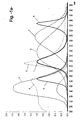
- Figure 1a shows the so-called spectral tristimulus values as a function of wavelength ⁇ . These curves, which represent the amounts of idealised primaries required to match any of the pure spectral colours in the visible range and are related to the colour sensitivity characteristics of the human eye. Curve 1, typically designated as the function x ( ⁇ ), primarily comprises the responsivity of the red sensitive cones of the human retina. The blue sensitive cones' responsivity is, suitably scaled, also included in this first tristimulus curve (see Figure 1b ).
- Curve 2 is, to a good approximation, a summation of the green and red cones' responsivity curves and is designated as the function y ( ⁇ ) and actually corresponds to the overall spectral sensitivity of the eye.
- Curve 3 essentially comprises the blue cones' spectral sensitivity characteristic z ( ⁇ ). It will be clear from these curves that the x ( ⁇ ) curve has a subsidiary maximum in the blue region of the visible spectrum.
- Line 4 represents, following some normalisation, the ratio between z ( ⁇ ) and the root mean squares of x ( ⁇ ) and y ( ⁇ ) and line 5 represents, on the same basis, the ratio between y ( ⁇ ) and the root mean squares of x ( ⁇ ) and z ( ⁇ ).
- the objective in calculating these functions is to find those points within the visible spectrum where the effect of the resultant stimulus of the human visual system is substantially expressed as a change to one of the tristimulus values, with the change to the other two being minimised relative thereto.
- What the two curves show is that, for a maximum change to Z relative to X and Y, stimulation of the human visual system at a wavelength of around 470 nm should be used and that, for maximum change of Y relative to X and Z, stimulation of the human visual system at a wavelength of around 520 nm is most effective.
- X There is no clear choice for X , but a wavelength of around 640 nm is found to achieve good red saturation without too much loss of overall sensitivity.
- the visual or related disability and/or symptom of the subject, experienced under normal illumination can be substantially alleviated.
- a combination of controllable narrow-band light sources located respectively at substantially 470 nm, 520 nm and, say, 640 nm, will readily achieve this goal. All of these wavelengths are substantially achieved with commercially available LED's, the bandwidths of which typically vary from 17 nm to 47 nm.
- Typical examples of such emitted spectra are shown in Figure la as curve 6, for Z, peaking at 470 nm (defined as blue herein), curve 7, for Y, peaking at 524 nm (defined as green herein) and curve 8, for X, peaking at around 640 nm in the red portion of the spectrum.
- the red wavelength is not as critical as the other two, for the reasons stated above.
- a lamp comprising one or more of each type of LED, arranged in a variety of different ways, in which each group of a specific colour is controlled by an adjustable signal, can be used to optimise the illumination for a given subject carrying out a specific task, such as reading or writing. For example, a person who suffers from dyslexia may have a reading difficulty significantly alleviated by the partial or complete exclusion of the red illumination, in effect, by reducing the stimulation of the red sensitive cones.
- Embodiments of the current invention use a multi-colour light emitting diode (LED) array, operated within an optical assembly so that colours can be mixed to create the optimum lighting for any patient.
- An array of different coloured LEDs typically red, green and blue, in accordance with the principles outlined above are operated either individually or together, so that it is possible to select single primary colours or combine the various LEDs to give different hues and illuminance.
- the primary advantage with this type of lighting being that it can be used for both reading and writing.
- a colour selectable lamp allows much greater flexibility and the opportunity to suit the lighting to each user. This could have important applications in the office and school environment where ambient lighting limitations contribute to reading and writing problems for some individuals.
- FIG. 2 this shows diagrammatically how a number of components may be combined in accordance with the principles of the invention to form a colour controllable light source.
- An array of LED's 11 is comprised of red emitters 12, having an emission spectrum peaking at 640 nm, green emitters 13, having an emission spectrum peaking at 524 nm, and blue emitters 14, having an emission spectrum peaking at 470 nm.
- the LED's are distributed in such a manner that the field illuminated by each type at a reading surface 15 is approximately the same.
- a diffuser 16 is placed in the path of the emitted light. This diffuser may take several different forms.
- a lenticular screen or microlens array is found to be effective, as well as other kinds of efficient light scattering media. For example, a material comprising changes of refractive index over short distances can be very effective.
- a divergent lens assembly 18 can be very useful. Although this is shown as a conventional meniscus lens, a compact equivalent, such as a fresnel lens may also be used.
- a control unit 19 receives a number of different inputs, prior to driving each group of LED's via outputs 20 for blue, 21 for green and 22 for red.
- variable resistors 23, 24 and 25 are used to set the light output from the red, green and blue LED's respectively.
- the components identified, thus far, comprise a colour controllable lamp. This can be used by a subject to select a particular combination of red, green and blue spectral components, which is optimal for his or her reading or writing performance.
- a lens 26 forms an image on the receiving surface 27 of a camera 28.
- This may be a CCD or other photo-detector array, behind a colour filter array.
- the video signal from the CCD can be analysed to provide a reading of the level of illumination at surface 15, in addition to its colour mix.
- There will be a specific matrix, which will allow the measure of light passing through each component of the camera's colour filter array to be translated into a red, green and blue LED light combination. Some of this will be contributed by the ambient light impinging on surface 15.
- the output, required from each type of LED, is adjusted by control unit 19, accordingly.
- the resulting system will also be stabilised against other variations, such as changes in the efficiency of the optics or LED's.
- the apparatus of Figure 2 can be very useful as a diagnostic tool, particularly when used in conjunction with a computer, shown as block 29.
- the computer can be used to store the selected tint of the illumination at surface 15, when this has been optimised for the subject.
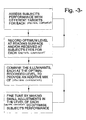
- FIG. 3 this outlines, in summary form, a methodology in accordance with the invention for establishing the optimal illumination for a specific subject, such as, for example, a person suffering from visual dyslexia.
- the first step in the procedure is to determine the best illumination conditions for a variety of different reading tests. This is done by illuminating the reading material at surface 15 of Figure 2 with one of the spectral components. This is increased in brightness, until the subject is satisfied that the optimal brightness has been found. It may be necessary to pass through the optimum and to reduce the brightness slightly to establish that setting. This step is repeated for each of the spectral components (LED groups), separately. It is quite possible that the optimum level for the red illumination may be at 50% of maximum, for a particular subject, whereas the green and blue spectral components would be quite acceptable at their maximum levels. The particular settings for each spectral component will be highly subject dependent. Step 2 is to record the optimum level for each spectral component, either directly from the controls or transferred automatically to a computer.
- Step 3 of the procedure is to fine tune this mixture by making small adjustments to each spectral component (red, green and blue), in small steps, until an optimum mix is established for the subject.
- the step changes would be made in both directions, decreasing or increasing the particular spectral component, and establishing whether there is an improvement or otherwise in the subject's performance.
- One of the key objectives of this invention is to use the arrangement of Figure 2 as a diagnostic tool, in order to arrive at an optimal formulation for the filters to be provided for the lenses of spectacles or contact lenses to be worn by the subject.
- the colour of the light reaching the subject's eyes is recorded by the system of Figure 2 and stored in computer 29. This record will typically contain information about the settings of the LED sources and, if any, the colour and level of the ambient illumination at the time that the measurements were made. By prior knowledge or use of colour camera 28, any colouration of the reading surface 15 may also be accommodated.
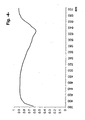
- Curve 41 represents the percentage transmission of a red absorbing (blue tinted) filter as a function T( ⁇ ) of the wavelength ⁇ of the light incident upon it.
- T( ⁇ ) the percentage transmission of a red absorbing (blue tinted) filter as a function of the wavelength ⁇ of the light incident upon it.
- Our interest is in knowing what the response at the retina of each eye will be for each of the cones when the subject views material through this filter. In order to calculate this we must multiply each of the tristimulus curves at every wavelength with the spectral distribution of the light arriving at the retina and integrate this result over the visible spectrum.
- the result will be one of the tristimulus values for the particular tint, as defined by the CIE 1931 chromaticity diagram. It will comprise a number of components, including the following:-
- I( ⁇ ) is the illumination spectrum
- T( ⁇ ) is the filter's transmission spectrum
- R( ⁇ ) is the illuminated substrate's reflectance spectrum
- x ( ⁇ ) is the relevant tristimulus curve, curve 1 in Figure 1a .
- Two further integrals would be calculated for the Y and Z tristimulus values.
- the apparatus of Figure 2 may be used to determine the relative colour response of an individual's eye.
- a surface of known colour reflectance is made to look white by adjusting r, g and b values above.
- CC[f ( ⁇ )] is the colour co-ordinate transformation of a spectrum
- CC p is the perceived white colour response
- E g ( ⁇ ) and E b ( ⁇ ) are the eye responses.
- the embodiment of Figure 2 incorporates a divergent lens to spread the illumination over the desired area, this is not an essential component for the operation of the lamp, as the combination of a diffuser and suitably positioned LED's can be chosen to illuminate any specific area. Whilst the embodiments illustrated herein utilise LED's with relatively narrow-band emission spectra, other devices such as laser sources may be used as alternative illuminants. Furthermore, whereas a camera 28 is employed to analyse the colour of the illumination of surface 15, this could, in practice, be replaced by a series of photodiodes receiving light from this surface through suitable colour filters.
Landscapes
- Health & Medical Sciences (AREA)
- Life Sciences & Earth Sciences (AREA)
- Engineering & Computer Science (AREA)
- Biomedical Technology (AREA)
- General Health & Medical Sciences (AREA)
- Animal Behavior & Ethology (AREA)
- Veterinary Medicine (AREA)
- Public Health (AREA)
- Nuclear Medicine, Radiotherapy & Molecular Imaging (AREA)
- Physics & Mathematics (AREA)
- Psychology (AREA)
- Radiology & Medical Imaging (AREA)
- Developmental Disabilities (AREA)
- Hospice & Palliative Care (AREA)
- Child & Adolescent Psychology (AREA)
- Psychiatry (AREA)
- Social Psychology (AREA)
- Pathology (AREA)
- Biophysics (AREA)
- Ophthalmology & Optometry (AREA)
- Heart & Thoracic Surgery (AREA)
- Medical Informatics (AREA)
- Molecular Biology (AREA)
- Surgery (AREA)
- Radiation-Therapy Devices (AREA)
- Circuit Arrangement For Electric Light Sources In General (AREA)
- Eye Examination Apparatus (AREA)
- Lighting Device Outwards From Vehicle And Optical Signal (AREA)
Claims (13)
- Vorrichtung zur quantitativen Diagnose und/oder Linderung der Symptome von einer Vielzahl von visuell induzierten physiologischen Defekten und/oder pathologischen Zuständen, erlitten von einem Beobachter, umfassend- eine Vielzahl von steuerbaren schmalbandigen farbigen Lichtquellen (12, 13, 14), wobei die Lichtquellen so angeordnet sind, dass sie eine Beleuchtung einer Oberfläche (15) zum Betrachten durch den Beobachter bereitstellen, wobei die Oberfläche zum Lesen oder Schreiben von Texten geeignet ist, und- jede der Lichtquellen (12, 13, 14) eine jeweilige spektrale Komponente des sichtbaren Spektrums emittiert, welche vorwiegend zu einem der Trisiimulus-Werte X, Y, Z des in ein Auge des Beobachters gelangenden Lichtes beiträgt, wodurch Lichtquellen, die vorwiegend zu einem der drei Tristimulus-Werte X, Y und Z beitragen, vorliegen, und- Steuermittel (19) zum Auswählen eines ausgewogenen Gemisches der Spektralkomponenten, wobei das Gemisch eine additive Kombination der Spektralkomponenten, die durch die Lichtquellen emittiert werden, ist, und das Kontrollmittel die Mittel (23, 24, 25) zum Variieren der Beleuchtungsmenge aus jeder der Lichtquellen (12, 13, 14) bereitstellt,dadurch gekennzeichnet, dass
die Spektralkomponente, die vorwiegend zu dem Y-Tristimulus-Wert beiträgt, ihren Peak bei einer Wellenlänge aufweist, die sich zwischen 520 nm und 530 nm befindet, wodurch ihr Beitrag zu den X- und Z-Tristimulus-Werten minimiert wird. - Vorrichtung nach Anspruch 1, worin die spektrale Komponente, die vorwiegend zu dem Z-Tristimulus-Wert beiträgt, ihren Peak bei einer maßgebenden (dominanten) Wellenlänge aufweist, die sich zwischen 465 nm und 475 nm befindet.
- Vorrichtung nach Anspruch 1, worin die spektrale Komponente, die vorwiegend zu dem X-Tristimulus-Wert beiträgt, ihren Peak bei einer Wellenlänge in dem Bereich 610 nm und 650 nm aufweist.
- Vorrichtung nach Anspruch 1, worin jede der Lichtquellen mindestens eine jeweiliges Licht emittierende Diode umfasst, die angeordnet ist, um eine von den Spektralkomponenten bereitzustellen.
- Vorrichtung nach Anspruch 1, worin eine Spektralkomponente eine spektrale Leistungsverteilung mit einer Bandbreite auf halber Höhe, die 50 nm nicht übersteigt, aufweist.
- Vorrichtung nach Anspruch 1, worin die Beleuchtung aus jeder der Lichtquellen vor dem Auftreffen auf der Oberfläche diffus gestaltet wird, sodass die relative Intensität des Lichtes, das bei zwei beabstandeten Punkten auf der Oberfläche auftrifft, im Wesentlichen die Gleiche für jede der Spektralkomponeriten ist.
- Vorrichtung nach Anspruch 1, weiterhin umfassend Mittel zum Berechnen der kombinierten Wirkung von mindestens zwei von den aktiven Beleuchtungsspektren, dem Umgebungsbeleuchtungsspektrum, dem Reflektanzspektrum des Ziels oder einer beleuchteten Oberfläche, dem Transmissionsspektrum von mindestens einem Filter und dem Transmissionsspektrum einer Oberflächenbeschichtung über das sichtbare Spektrum, sodass bei Verwendung die retinale Reaktion einer Person vorhergesagt werden kann und die Einstellungen der aktiven Lichtquelle und/oder die Formulierung von einem durch die Person zu bedienenden Filter optimiert werden kann.
- Verfahren zum Auffinden der optimalen Beleuchtung für eine Person, gekennzeichnet durch Einbeziehen der aufeinander folgenden Schritte von:a) Anordnen der Vorrichtung nach Anspruch 1, um eine Vielzahl von Spektralkomponenten bereitzustellen,b) Bewerten der Leistung der Person mit einer Reihe von Zielen unter verschiedenen Anteilen von jeder der Vielzahl von Spektralkomponenten, entweder einzeln oder kombiniert in vorbestimmten Verhältnissen davon,c) Aufzeichnen des optimalen Anteils von jeder der Spektralkomponenten,d) Kombinieren der Anteile von jeder entsprechenden Spektralkomponente, wie in Schritt (c) aufgezeichnet, um ein sich ergebendes Additivgemisch von den Spektralkomponenten bereitzustellen.
- Verfahren nach Anspruch 8, einschließlich des weiteren Schritts der Anwendung von Variationen auf den Anteil von jeder Spektralkomponente in kleinen Schritten, während die Spektralkomponenten vereinigt werden, um das Gemisch der Spektralkomponenten, das im Wesentlichen die Leistung der Person optimiert, herzustellen.
- Verfahren für die Simulierung der Anwendung eines bestimmten Filters unter erwarteten Lichtbedingungen, das die Schritte umfasst von:a) Definieren der Tristimulus-Werte der Tönung, die unter den erwarteten Lichtbedingungen von einem Beobachter beobachtet werden würde, wenn der Filter bei einer Transmission zum Betrachten der Leseoberfläche verwendet wird,b) Bereitstellen der Vorrichtung von Anspruch 1,c) Auswählen des durch jede Lichtquelle der Vorrichtung bereitgestellten Beleuchtungsanteils,d) Beleuchten der Leseoberfläche zum Betrachten durch den Betrachter mit der Vorrichtung, sodass bei Verwendung die definierten Tristimulus-Werte von dem Betrachter beobachtet werden.
- Verfahren nach Anspruch 10, weiterhin umfassend den Schritt des Simulierens eines Bereichs von vorformulierten Filtern und Lithtbedingungen, wodurch der Betrachter einen oder mehrere Filter zur Verwendung unter den Bedingungen auswählen kann.
- Verfahren nach Anspruch 10 oder Anspruch 11, das den weiteren Schritt des Formulierens und/oder Auswählens des Filters zum Optimieren der Leistung des Betrachters einschließt.
- Verfahren nach einem der Ansprüche 10 bis 12, das auf die Formulierung von Filtern und/oder Antireflexionsbeschichtungen für Brillen, Kontaktlinsen, farbige Overlays oder beliebiges anderes getöntes Material, dessen Zweck es ist, Probleme zu lindern, die durch farbbedingte Störungen des menschlichen Sehsystems verursacht werden, angewendet wird.
Applications Claiming Priority (5)
| Application Number | Priority Date | Filing Date | Title |
|---|---|---|---|
| GB0031384A GB0031384D0 (en) | 2000-12-21 | 2000-12-21 | A means to optimise the illumination for sufferers of disorder such as dyslexiamigraine and epilepsy using a task light with controllable colour |
| GB0031384 | 2000-12-21 | ||
| GB0128705 | 2001-11-30 | ||
| GB0128705A GB0128705D0 (en) | 2001-11-30 | 2001-11-30 | Apparatus and method for alleviation of symptons by application of tinted light |
| PCT/GB2001/005544 WO2002049721A1 (en) | 2000-12-21 | 2001-12-17 | Apparatus and method for alleviation of symptoms by application of tinted light |
Publications (2)
| Publication Number | Publication Date |
|---|---|
| EP1345656A1 EP1345656A1 (de) | 2003-09-24 |
| EP1345656B1 true EP1345656B1 (de) | 2008-07-23 |
Family
ID=26245476
Family Applications (1)
| Application Number | Title | Priority Date | Filing Date |
|---|---|---|---|
| EP01271246A Expired - Lifetime EP1345656B1 (de) | 2000-12-21 | 2001-12-17 | Apparat zur behandlung von symptomen unter verwendung von getöntem licht |
Country Status (7)
| Country | Link |
|---|---|
| US (2) | US20030223036A1 (de) |
| EP (1) | EP1345656B1 (de) |
| JP (1) | JP2004524067A (de) |
| AT (1) | ATE401932T1 (de) |
| AU (1) | AU2002222220A1 (de) |
| DE (1) | DE60135018D1 (de) |
| WO (1) | WO2002049721A1 (de) |
Cited By (1)
| Publication number | Priority date | Publication date | Assignee | Title |
|---|---|---|---|---|
| US11826100B2 (en) | 2018-02-13 | 2023-11-28 | Essilor International | Wearable binocular optoelectronic device for measuring light sensitivity threshold of a user |
Families Citing this family (38)
| Publication number | Priority date | Publication date | Assignee | Title |
|---|---|---|---|---|
| GB2329756A (en) | 1997-09-25 | 1999-03-31 | Univ Bristol | Assemblies of light emitting diodes |
| US6200134B1 (en) | 1998-01-20 | 2001-03-13 | Kerr Corporation | Apparatus and method for curing materials with radiation |
| EP1345656B1 (de) | 2000-12-21 | 2008-07-23 | Orthoscopics Limited | Apparat zur behandlung von symptomen unter verwendung von getöntem licht |
| MXPA05001029A (es) | 2002-07-25 | 2005-09-12 | Jonathan S Dahm | Metodo y aparato para utilizar diodos emisores de luz para curacion. |
| US7182597B2 (en) | 2002-08-08 | 2007-02-27 | Kerr Corporation | Curing light instrument |
| AU2003298561A1 (en) | 2002-08-23 | 2004-05-13 | Jonathan S. Dahm | Method and apparatus for using light emitting diodes |
| DE10301867A1 (de) * | 2003-01-17 | 2004-07-29 | Günther, Andreas | Lichttherapievorrichtung |
| GB0311122D0 (en) * | 2003-05-15 | 2003-06-18 | Orthoscopics Ltd | Apparatus for the concurrent alleviation of visually induced symptoms and assessment of performance and associated methods |
| CA2589570C (en) | 2004-06-15 | 2010-04-13 | Henkel Corporation | High power led electro-optic assembly |
| JP4822451B2 (ja) * | 2005-02-07 | 2011-11-24 | パナソニック株式会社 | 波長多重光の空間送信装置及び空間送信方法 |
| JP2007052954A (ja) * | 2005-08-16 | 2007-03-01 | Seiwa Electric Mfg Co Ltd | 照明装置 |
| DE102006010105A1 (de) * | 2006-02-28 | 2007-08-30 | Carl Zeiss Meditec Ag | Ophthalmologisches Gerät |
| DE102007004364A1 (de) * | 2007-01-29 | 2008-07-31 | Carl Zeiss Meditec Ag | Vorrichtung zur Herstellung eines optischen Elements zur Korrektur von altersbedingter Makuladegeneration (AMD) eines Auges |
| JP2010527728A (ja) * | 2007-05-31 | 2010-08-19 | コーニンクレッカ フィリップス エレクトロニクス エヌ ヴィ | 光刺激及び生理的刺激をもたらす方法及びシステム |
| US9066777B2 (en) | 2009-04-02 | 2015-06-30 | Kerr Corporation | Curing light device |
| US9072572B2 (en) | 2009-04-02 | 2015-07-07 | Kerr Corporation | Dental light device |
| KR100998473B1 (ko) * | 2010-05-20 | 2010-12-06 | 전자부품연구원 | 자외선 발광 다이오드를 이용한 살균 장치 |
| US10359552B2 (en) | 2011-01-17 | 2019-07-23 | University Of Utah Research Foundation | Methods, systems, and apparatus for reducing the frequency and/or severity of photophobic responses or for modulating circadian cycles |
| US9606277B2 (en) | 2011-01-17 | 2017-03-28 | University Of Utah Research Foundation | Apparatus and methods for reducing frequency or severity of photophobic responses or modulating circadian cycles |
| US9764157B2 (en) | 2011-01-17 | 2017-09-19 | University Of Utah Research Foundation | Methods, systems, and apparatus for reducing the frequency and/or severity of photophobic responses or for modulating circadian cycles |
| GB201106882D0 (en) | 2011-04-26 | 2011-06-01 | Univ Leicester | Apparatus and method |
| US9820643B2 (en) | 2013-08-13 | 2017-11-21 | Jasper Ridge Inc. | Illumination evaluation or recommendation using visual function |
| WO2015023676A1 (en) * | 2013-08-13 | 2015-02-19 | Jasper Ridge Inc. | Illumination evaluation or recommendation using visual function |
| WO2015073933A1 (en) | 2013-11-15 | 2015-05-21 | University Of Utah Research Foundation | Nanoparticle light filtering method and apparatus |
| US10234608B2 (en) | 2013-11-15 | 2019-03-19 | University Of Utah Research Foundation | Nanoparticle light filtering method and apparatus |
| US9378563B2 (en) | 2014-02-18 | 2016-06-28 | Herbert A. Wertheim | Method for simulating the effect of viewing an image through a colored filter or ophthalmic spectacle lens |
| US10806890B2 (en) | 2015-06-19 | 2020-10-20 | Beth Israel Deaconess Medical Center, Inc. | Method and apparatus for managing photophobia and migraine photophobia |
| GB201519117D0 (en) * | 2015-10-29 | 2015-12-16 | Univ Essex Entpr Ltd | Visual stress assessment device |
| BR112019006852A2 (pt) * | 2016-10-07 | 2019-08-06 | Enchroma Inc | sistema de iluminação para simulação de condições de visão de deficiência de cores e demonstração da eficácia do compositivo de cinza |
| IT201600129679A1 (it) * | 2016-12-21 | 2018-06-21 | Probiomedica S R L | Capsula ingeribile per il trattamento fototerapico di infezioni |
| JP2019024952A (ja) * | 2017-07-28 | 2019-02-21 | パナソニックIpマネジメント株式会社 | 浴光装置 |
| EP3495875A1 (de) * | 2017-12-06 | 2019-06-12 | Essilor International | Verfahren und system zur auswahl eines farbfilters, optischer artikel mit solch einem farbfilter |
| WO2019124449A1 (ja) * | 2017-12-22 | 2019-06-27 | 株式会社ビジュアル・テクノロジー研究所 | 視機能検査および光学特性算出システム |
| KR102108634B1 (ko) * | 2018-08-24 | 2020-05-28 | 송인실 | 광치료장치 |
| EP3629080B1 (de) | 2018-09-25 | 2025-12-24 | Essilor International | Ophthalmische vorrichtung mit einem blinkenden leuchtenden element zur reduzierung von dyslexieeffekten |
| US12005268B2 (en) | 2020-05-27 | 2024-06-11 | Norb Lighting, LLC | Ocular light therapy arrangement and method for treating neurological disorders |
| JP7184414B1 (ja) | 2022-08-08 | 2022-12-06 | 株式会社薫化舎 | 特性情報収集方法および特性情報収集装置 |
| JP7220000B1 (ja) | 2022-08-08 | 2023-02-09 | 株式会社薫化舎 | 特性情報収集方法および特性情報収集装置 |
Citations (1)
| Publication number | Priority date | Publication date | Assignee | Title |
|---|---|---|---|---|
| EP1114608A1 (de) * | 2000-01-07 | 2001-07-11 | Nidek Co., Ltd. | Augenbeobachtungsgerät mit einzeln angesteuerten Leuchtdioden zur farbkorrigierten Beleuchtung |
Family Cites Families (19)
| Publication number | Priority date | Publication date | Assignee | Title |
|---|---|---|---|---|
| US5319A (en) | 1847-10-02 | pkoto-tltho | ||
| NL8200517A (nl) * | 1982-02-11 | 1983-09-01 | Tno | Instelschakeling voor licht-emitterende diode met temperatuurcompensatie. |
| US4961640A (en) * | 1982-08-20 | 1990-10-09 | Irlen Helen L | Method and apparatus of treatment of symptoms of the Irlen syndrom |
| US4648051A (en) * | 1984-10-15 | 1987-03-03 | The Board Of Trustees Of The Leland Stanford Junior University | Color imaging process |
| JPH06502318A (ja) * | 1990-07-25 | 1994-03-17 | セリウム グループ リミテッド | 視覚での色合いを得るための装置と方法 |
| US6459425B1 (en) * | 1997-08-25 | 2002-10-01 | Richard A. Holub | System for automatic color calibration |
| JPH09329497A (ja) * | 1996-04-11 | 1997-12-22 | Olympus Optical Co Ltd | 測色装置及び測色方法 |
| GB9608476D0 (en) | 1996-04-25 | 1996-07-03 | Medical Res Council | Apparatus for obtaining a desired tint |
| US20040052076A1 (en) * | 1997-08-26 | 2004-03-18 | Mueller George G. | Controlled lighting methods and apparatus |
| US7014336B1 (en) * | 1999-11-18 | 2006-03-21 | Color Kinetics Incorporated | Systems and methods for generating and modulating illumination conditions |
| US5929999A (en) * | 1998-09-01 | 1999-07-27 | Hewlett-Packard Company | Light source for tristimulus colorimetry |
| DE19901669A1 (de) * | 1999-01-18 | 2000-08-17 | Jb Lighting Lichtanlagentechni | Scheinwerfer |
| NZ516443A (en) * | 1999-07-15 | 2002-10-25 | Tintavision Ltd | Method of testing and corresponding vision aid |
| DE19942177A1 (de) * | 1999-09-03 | 2001-03-22 | Osram Opto Semiconductors Gmbh | Beleuchtungsvorrichtung |
| JP4495814B2 (ja) * | 1999-12-28 | 2010-07-07 | アビックス株式会社 | 調光式led照明器具 |
| US6870523B1 (en) * | 2000-06-07 | 2005-03-22 | Genoa Color Technologies | Device, system and method for electronic true color display |
| EP1345656B1 (de) | 2000-12-21 | 2008-07-23 | Orthoscopics Limited | Apparat zur behandlung von symptomen unter verwendung von getöntem licht |
| US6851809B1 (en) * | 2001-10-22 | 2005-02-08 | Massachusetts Institute Of Technology | Color vision deficiency screening test resistant to display calibration errors |
| US6851807B2 (en) * | 2002-09-25 | 2005-02-08 | Kd Holdings Group, Inc. | Vision therapy system and method |
-
2001
- 2001-12-17 EP EP01271246A patent/EP1345656B1/de not_active Expired - Lifetime
- 2001-12-17 DE DE60135018T patent/DE60135018D1/de not_active Expired - Lifetime
- 2001-12-17 AT AT01271246T patent/ATE401932T1/de not_active IP Right Cessation
- 2001-12-17 JP JP2002551054A patent/JP2004524067A/ja active Pending
- 2001-12-17 AU AU2002222220A patent/AU2002222220A1/en not_active Abandoned
- 2001-12-17 WO PCT/GB2001/005544 patent/WO2002049721A1/en not_active Ceased
-
2003
- 2003-06-19 US US10/464,491 patent/US20030223036A1/en not_active Abandoned
-
2007
- 2007-02-05 US US11/702,179 patent/US7380940B2/en not_active Expired - Fee Related
Patent Citations (1)
| Publication number | Priority date | Publication date | Assignee | Title |
|---|---|---|---|---|
| EP1114608A1 (de) * | 2000-01-07 | 2001-07-11 | Nidek Co., Ltd. | Augenbeobachtungsgerät mit einzeln angesteuerten Leuchtdioden zur farbkorrigierten Beleuchtung |
Cited By (1)
| Publication number | Priority date | Publication date | Assignee | Title |
|---|---|---|---|---|
| US11826100B2 (en) | 2018-02-13 | 2023-11-28 | Essilor International | Wearable binocular optoelectronic device for measuring light sensitivity threshold of a user |
Also Published As
| Publication number | Publication date |
|---|---|
| ATE401932T1 (de) | 2008-08-15 |
| WO2002049721A1 (en) | 2002-06-27 |
| EP1345656A1 (de) | 2003-09-24 |
| US20070139611A1 (en) | 2007-06-21 |
| JP2004524067A (ja) | 2004-08-12 |
| US20030223036A1 (en) | 2003-12-04 |
| WO2002049721A9 (en) | 2002-08-15 |
| AU2002222220A1 (en) | 2002-07-01 |
| US7380940B2 (en) | 2008-06-03 |
| DE60135018D1 (de) | 2008-09-04 |
Similar Documents
| Publication | Publication Date | Title |
|---|---|---|
| EP1345656B1 (de) | Apparat zur behandlung von symptomen unter verwendung von getöntem licht | |
| EP3523569B1 (de) | Beleuchtungssystem zur simulation von zuständen einer farbsehstörung und demonstration der wirksamkeit von brillen zum ausgleich von farbenblindheit | |
| CN111448507B (zh) | 用于选择彩色滤光片的方法和系统、包括此彩色滤光片的光学制品 | |
| US20060262272A1 (en) | Apparatus and method for application of tinted light and concurrent assessment of performance | |
| US10499805B2 (en) | Visual stress assessment device | |
| Hammond et al. | The effect of a short-wave filtering contact lens on color appearance | |
| BE1032912B1 (nl) | Kleurmeet- en kleuraanpassingsapparaat | |
| McCann et al. | Temporary Tritanopia: Effects of cataract surgery on color | |
| Ikeda et al. | Desaturation of color by environment light in cataract eyes | |
| Wilkins et al. | Management of visual stress | |
| Wilkins et al. | Coloured filters: clinical tools | |
| van Creveld | An investigation into the relationship between luminance and brightness of strongly chromatic light sources | |
| Wei | Effects of spectral modification on perceived brightness and color discrimination | |
| Wilkerson | Reallocation of narrow bands of spectral energy: The effect on brightness perception and color preference | |
| Davson | Some general aspects of vision | |
| Bao et al. | Light Sources with a Larger Gamut Area Can Enhance Color Preference under a Lower Light Level | |
| Petrulis et al. | Metameric Light Sources: A Recent Paradigm for Functional Lighting | |
| Akita et al. | Differences of unique‐yellow loci between individuals | |
| Vik | COLORIMETRY | |
| Eisner | Retinal chromaticity co-ordinates and color appearance | |
| Ronchi et al. | The Excentric blue an abridged historical review: Fondazione Giorgio Ronchi | |
| Songden et al. | On The Models of Colour Vision. | |
| Bodrogi et al. | The Human Visual System and Its Modeling for Lighting Engineering | |
| Ciardullo et al. | Magnitude estimations of brightness for lights of different wavelengths | |
| Hertog | THE CHROMATICITY OF WHITE LIGHT |
Legal Events
| Date | Code | Title | Description |
|---|---|---|---|
| PUAI | Public reference made under article 153(3) epc to a published international application that has entered the european phase |
Free format text: ORIGINAL CODE: 0009012 |
|
| 17P | Request for examination filed |
Effective date: 20030718 |
|
| AK | Designated contracting states |
Kind code of ref document: A1 Designated state(s): AT BE CH CY DE DK ES FI FR GB GR IE IT LI LU MC NL PT SE TR |
|
| AX | Request for extension of the european patent |
Extension state: AL LT LV MK RO SI |
|
| GRAP | Despatch of communication of intention to grant a patent |
Free format text: ORIGINAL CODE: EPIDOSNIGR1 |
|
| RTI1 | Title (correction) |
Free format text: APPARATUS FOR ALLEVIATION OF SYMPTOMS BY APPLICATION OF TINTED LIGHT |
|
| GRAS | Grant fee paid |
Free format text: ORIGINAL CODE: EPIDOSNIGR3 |
|
| RAP1 | Party data changed (applicant data changed or rights of an application transferred) |
Owner name: ORTHOSCOPICS LIMITED |
|
| GRAA | (expected) grant |
Free format text: ORIGINAL CODE: 0009210 |
|
| AK | Designated contracting states |
Kind code of ref document: B1 Designated state(s): AT BE CH CY DE DK ES FI FR GB GR IE IT LI LU MC NL PT SE TR |
|
| REG | Reference to a national code |
Ref country code: GB Ref legal event code: FG4D |
|
| REG | Reference to a national code |
Ref country code: CH Ref legal event code: EP |
|
| REG | Reference to a national code |
Ref country code: IE Ref legal event code: FG4D |
|
| REF | Corresponds to: |
Ref document number: 60135018 Country of ref document: DE Date of ref document: 20080904 Kind code of ref document: P |
|
| NLV1 | Nl: lapsed or annulled due to failure to fulfill the requirements of art. 29p and 29m of the patents act | ||
| PG25 | Lapsed in a contracting state [announced via postgrant information from national office to epo] |
Ref country code: ES Free format text: LAPSE BECAUSE OF FAILURE TO SUBMIT A TRANSLATION OF THE DESCRIPTION OR TO PAY THE FEE WITHIN THE PRESCRIBED TIME-LIMIT Effective date: 20081103 Ref country code: NL Free format text: LAPSE BECAUSE OF FAILURE TO SUBMIT A TRANSLATION OF THE DESCRIPTION OR TO PAY THE FEE WITHIN THE PRESCRIBED TIME-LIMIT Effective date: 20080723 Ref country code: PT Free format text: LAPSE BECAUSE OF FAILURE TO SUBMIT A TRANSLATION OF THE DESCRIPTION OR TO PAY THE FEE WITHIN THE PRESCRIBED TIME-LIMIT Effective date: 20081223 |
|
| PG25 | Lapsed in a contracting state [announced via postgrant information from national office to epo] |
Ref country code: AT Free format text: LAPSE BECAUSE OF FAILURE TO SUBMIT A TRANSLATION OF THE DESCRIPTION OR TO PAY THE FEE WITHIN THE PRESCRIBED TIME-LIMIT Effective date: 20080723 Ref country code: FI Free format text: LAPSE BECAUSE OF FAILURE TO SUBMIT A TRANSLATION OF THE DESCRIPTION OR TO PAY THE FEE WITHIN THE PRESCRIBED TIME-LIMIT Effective date: 20080723 |
|
| PG25 | Lapsed in a contracting state [announced via postgrant information from national office to epo] |
Ref country code: BE Free format text: LAPSE BECAUSE OF FAILURE TO SUBMIT A TRANSLATION OF THE DESCRIPTION OR TO PAY THE FEE WITHIN THE PRESCRIBED TIME-LIMIT Effective date: 20080723 |
|
| PG25 | Lapsed in a contracting state [announced via postgrant information from national office to epo] |
Ref country code: DK Free format text: LAPSE BECAUSE OF FAILURE TO SUBMIT A TRANSLATION OF THE DESCRIPTION OR TO PAY THE FEE WITHIN THE PRESCRIBED TIME-LIMIT Effective date: 20080723 |
|
| PLBE | No opposition filed within time limit |
Free format text: ORIGINAL CODE: 0009261 |
|
| STAA | Information on the status of an ep patent application or granted ep patent |
Free format text: STATUS: NO OPPOSITION FILED WITHIN TIME LIMIT |
|
| 26N | No opposition filed |
Effective date: 20090424 |
|
| PG25 | Lapsed in a contracting state [announced via postgrant information from national office to epo] |
Ref country code: MC Free format text: LAPSE BECAUSE OF NON-PAYMENT OF DUE FEES Effective date: 20081231 |
|
| REG | Reference to a national code |
Ref country code: CH Ref legal event code: PL |
|
| PG25 | Lapsed in a contracting state [announced via postgrant information from national office to epo] |
Ref country code: IT Free format text: LAPSE BECAUSE OF FAILURE TO SUBMIT A TRANSLATION OF THE DESCRIPTION OR TO PAY THE FEE WITHIN THE PRESCRIBED TIME-LIMIT Effective date: 20080723 |
|
| PG25 | Lapsed in a contracting state [announced via postgrant information from national office to epo] |
Ref country code: CH Free format text: LAPSE BECAUSE OF NON-PAYMENT OF DUE FEES Effective date: 20081231 Ref country code: LI Free format text: LAPSE BECAUSE OF NON-PAYMENT OF DUE FEES Effective date: 20081231 |
|
| PG25 | Lapsed in a contracting state [announced via postgrant information from national office to epo] |
Ref country code: SE Free format text: LAPSE BECAUSE OF FAILURE TO SUBMIT A TRANSLATION OF THE DESCRIPTION OR TO PAY THE FEE WITHIN THE PRESCRIBED TIME-LIMIT Effective date: 20081023 |
|
| PGFP | Annual fee paid to national office [announced via postgrant information from national office to epo] |
Ref country code: IE Payment date: 20091028 Year of fee payment: 9 |
|
| PG25 | Lapsed in a contracting state [announced via postgrant information from national office to epo] |
Ref country code: LU Free format text: LAPSE BECAUSE OF NON-PAYMENT OF DUE FEES Effective date: 20081217 Ref country code: CY Free format text: LAPSE BECAUSE OF FAILURE TO SUBMIT A TRANSLATION OF THE DESCRIPTION OR TO PAY THE FEE WITHIN THE PRESCRIBED TIME-LIMIT Effective date: 20080723 |
|
| PG25 | Lapsed in a contracting state [announced via postgrant information from national office to epo] |
Ref country code: TR Free format text: LAPSE BECAUSE OF FAILURE TO SUBMIT A TRANSLATION OF THE DESCRIPTION OR TO PAY THE FEE WITHIN THE PRESCRIBED TIME-LIMIT Effective date: 20080723 |
|
| PG25 | Lapsed in a contracting state [announced via postgrant information from national office to epo] |
Ref country code: GR Free format text: LAPSE BECAUSE OF FAILURE TO SUBMIT A TRANSLATION OF THE DESCRIPTION OR TO PAY THE FEE WITHIN THE PRESCRIBED TIME-LIMIT Effective date: 20081024 |
|
| REG | Reference to a national code |
Ref country code: IE Ref legal event code: MM4A |
|
| PGFP | Annual fee paid to national office [announced via postgrant information from national office to epo] |
Ref country code: DE Payment date: 20110519 Year of fee payment: 10 |
|
| PG25 | Lapsed in a contracting state [announced via postgrant information from national office to epo] |
Ref country code: IE Free format text: LAPSE BECAUSE OF NON-PAYMENT OF DUE FEES Effective date: 20101217 |
|
| PGFP | Annual fee paid to national office [announced via postgrant information from national office to epo] |
Ref country code: FR Payment date: 20111220 Year of fee payment: 11 |
|
| REG | Reference to a national code |
Ref country code: FR Ref legal event code: ST Effective date: 20130830 |
|
| REG | Reference to a national code |
Ref country code: DE Ref legal event code: R119 Ref document number: 60135018 Country of ref document: DE Effective date: 20130702 |
|
| PG25 | Lapsed in a contracting state [announced via postgrant information from national office to epo] |
Ref country code: DE Free format text: LAPSE BECAUSE OF NON-PAYMENT OF DUE FEES Effective date: 20130702 |
|
| PG25 | Lapsed in a contracting state [announced via postgrant information from national office to epo] |
Ref country code: FR Free format text: LAPSE BECAUSE OF NON-PAYMENT OF DUE FEES Effective date: 20130102 |
|
| PGFP | Annual fee paid to national office [announced via postgrant information from national office to epo] |
Ref country code: GB Payment date: 20201217 Year of fee payment: 20 |
|
| REG | Reference to a national code |
Ref country code: GB Ref legal event code: PE20 Expiry date: 20211216 |
|
| PG25 | Lapsed in a contracting state [announced via postgrant information from national office to epo] |
Ref country code: GB Free format text: LAPSE BECAUSE OF EXPIRATION OF PROTECTION Effective date: 20211216 |