EP1338269B1 - Verwendung von Kreatinin und/oder Kreatinin-Derivaten zur Aufhellung der Haut und Milderung von Pigmentstörungen - Google Patents
Verwendung von Kreatinin und/oder Kreatinin-Derivaten zur Aufhellung der Haut und Milderung von Pigmentstörungen Download PDFInfo
- Publication number
- EP1338269B1 EP1338269B1 EP02003483A EP02003483A EP1338269B1 EP 1338269 B1 EP1338269 B1 EP 1338269B1 EP 02003483 A EP02003483 A EP 02003483A EP 02003483 A EP02003483 A EP 02003483A EP 1338269 B1 EP1338269 B1 EP 1338269B1
- Authority
- EP
- European Patent Office
- Prior art keywords
- skin
- creatinine
- weight
- parts
- derivatives
- Prior art date
- Legal status (The legal status is an assumption and is not a legal conclusion. Google has not performed a legal analysis and makes no representation as to the accuracy of the status listed.)
- Expired - Lifetime
Links
- LFDYTBSSEYRGHO-UHFFFAOYSA-N CN(C1)C2NC2NC1=O Chemical compound CN(C1)C2NC2NC1=O LFDYTBSSEYRGHO-UHFFFAOYSA-N 0.000 description 1
Classifications
-
- A—HUMAN NECESSITIES
- A01—AGRICULTURE; FORESTRY; ANIMAL HUSBANDRY; HUNTING; TRAPPING; FISHING
- A01K—ANIMAL HUSBANDRY; AVICULTURE; APICULTURE; PISCICULTURE; FISHING; REARING OR BREEDING ANIMALS, NOT OTHERWISE PROVIDED FOR; NEW BREEDS OF ANIMALS
- A01K61/00—Culture of aquatic animals
- A01K61/70—Artificial fishing banks or reefs
- A01K61/77—Artificial fishing banks or reefs of monolithic form, e.g. blocks
-
- A—HUMAN NECESSITIES
- A61—MEDICAL OR VETERINARY SCIENCE; HYGIENE
- A61Q—SPECIFIC USE OF COSMETICS OR SIMILAR TOILETRY PREPARATIONS
- A61Q19/00—Preparations for care of the skin
- A61Q19/02—Preparations for care of the skin for chemically bleaching or whitening the skin
-
- A—HUMAN NECESSITIES
- A61—MEDICAL OR VETERINARY SCIENCE; HYGIENE
- A61K—PREPARATIONS FOR MEDICAL, DENTAL OR TOILETRY PURPOSES
- A61K8/00—Cosmetics or similar toiletry preparations
- A61K8/18—Cosmetics or similar toiletry preparations characterised by the composition
- A61K8/30—Cosmetics or similar toiletry preparations characterised by the composition containing organic compounds
- A61K8/49—Cosmetics or similar toiletry preparations characterised by the composition containing organic compounds containing heterocyclic compounds
- A61K8/494—Cosmetics or similar toiletry preparations characterised by the composition containing organic compounds containing heterocyclic compounds with more than one nitrogen as the only hetero atom
-
- A—HUMAN NECESSITIES
- A61—MEDICAL OR VETERINARY SCIENCE; HYGIENE
- A61P—SPECIFIC THERAPEUTIC ACTIVITY OF CHEMICAL COMPOUNDS OR MEDICINAL PREPARATIONS
- A61P17/00—Drugs for dermatological disorders
-
- A—HUMAN NECESSITIES
- A61—MEDICAL OR VETERINARY SCIENCE; HYGIENE
- A61P—SPECIFIC THERAPEUTIC ACTIVITY OF CHEMICAL COMPOUNDS OR MEDICINAL PREPARATIONS
- A61P43/00—Drugs for specific purposes, not provided for in groups A61P1/00-A61P41/00
-
- E—FIXED CONSTRUCTIONS
- E02—HYDRAULIC ENGINEERING; FOUNDATIONS; SOIL SHIFTING
- E02B—HYDRAULIC ENGINEERING
- E02B3/00—Engineering works in connection with control or use of streams, rivers, coasts, or other marine sites; Sealings or joints for engineering works in general
- E02B3/04—Structures or apparatus for, or methods of, protecting banks, coasts, or harbours
- E02B3/043—Artificial seaweed
-
- E—FIXED CONSTRUCTIONS
- E02—HYDRAULIC ENGINEERING; FOUNDATIONS; SOIL SHIFTING
- E02B—HYDRAULIC ENGINEERING
- E02B3/00—Engineering works in connection with control or use of streams, rivers, coasts, or other marine sites; Sealings or joints for engineering works in general
- E02B3/04—Structures or apparatus for, or methods of, protecting banks, coasts, or harbours
- E02B3/046—Artificial reefs
Definitions
- Subject of the invention is the use of Keratinin and / or creatinine derivatives to lighten the skin and alleviation of pigmentary disorders.
- the hue of human skin is determined by the amount of determined melanin determined.
- Melanin is a brown-black Pigment found in the basal layer of the epidermis of special pigment-forming cells, the melanocytes becomes. This pigmentation contributes to UV protection because of their absorption capacity harmful UV radiation can be greatly attenuated.
- people of different skin color about a comparable number of melanocytes, only the neoplasm of melanin, whose Concentration and distribution are different.
- UV irradiation induces the formation of melanin in special Parts of the melanocytes, the so-called melanosomes.
- the formed melanin is transported into the keratinocytes and is there as a brown skin color visible. The more melanin the darker and rounder the skin is.
- melanin is polymeric indole-5,6-quinoids, which in a complex reaction cascade the aromatic amino acid L-tyrosine are formed.
- Raper and Mason involves tyrosinases as a class of key enzymes.
- Tyrosinase belongs to the family of type 3 copper proteins and is responsible for the hydroxylation of mono- to ortho-diphenols. A more detailed description can be found in Angew. Chem. 2000, 112 (9), 1656-1660. Tyrosinase is going through UV light is activated, which makes it the oxidative transformation of L-tyrosine catalyzed to L-3,4-dihydroxyphenylalanine (L-Dopa). L-Dopa, in turn, is also produced by tyrosinase in another Reaction steps to dopaquinone and ultimately to melanin oxidized. This mechanism comes ubiquitous in nature before, these are tyrosinases from fungi, plants and mammals regarding their substrate specificity and effect directly comparable.
- Unwanted pigmentary disorders can be treated with depigmenting agents be treated, including one of skin bleaching preparations or Skin whitening understands.
- such an active ingredient is already in small Use concentrations cause a significant effect, be non-toxic, preferably of natural origin, very well tolerated by the skin, a high Compatibility with other ingredients and have themselves can be easily incorporated into skin treatment products.
- JP 2000-247866 are skin cosmetics which Whitening agents such as ellagic acid, hydroquinone, Arbutin, kojic acid and other materials in combination with Creatine and / or creatinine involve and improved Should have whitening effect.
- Whitening agents such as ellagic acid, hydroquinone, Arbutin, kojic acid and other materials in combination with Creatine and / or creatinine involve and improved Should have whitening effect.
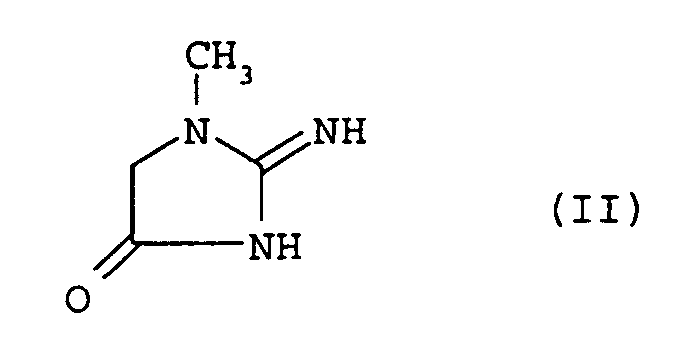
- Creatinine (CAS # 60-27-5) is the common name for 2-imino-N-methylhydantoin, a cyclic condensation product that can be obtained by intramolecular dehydration of creatine (Formula II).
- Creatinine naturally occurs in the body and is used in medicine as a biological marker. Further information on this can be found, inter alia, in DW Cockcroft and MHGault in Prediction of creatinine clearance from serum creatinine, nephron . 1976 (16) 31-41.
- Creatinine is found regularly in the urine and arises through Transfer of the amidino grouping of arginine to glycine. It is also contained in the sweat and another role comes from Substance as part of the natural moisturizing factor of the Skin too.
- JP 2000-247866 discloses skin cosmetics which creatine and / or creatinine in combination with a further pharmaceutical active ingredient and / or a include bioactive substance and improved Care should have.
- a further pharmaceutical active ingredient like a further pharmaceutical active ingredient and / or a include bioactive substance and improved Care should have.
- the effective skin lightening effect is attributed here alone to these brighteners.
- the effect of creatinine and its derivatives alone is in this However, publication have not been recognized and therefore are This document also no indication of such properties refer to.
- Creatinine has been found and is therefore preferred. But also Creatine derivatives such as its salts with inorganic acids such as For example, phosphoric acid, preferably organic or polybasic acids such as acetic acid, Glycolic acid, lactic acid, citric acid, malic acid, salicylic acid or sorbic acid and mixtures thereof, or as Creatinine pyruvate is very suitable. It is in the sense The present invention also possible, suitable Creatinine derivatives among themselves in mixtures to use.
- inorganic acids such as For example, phosphoric acid, preferably organic or polybasic acids such as acetic acid, Glycolic acid, lactic acid, citric acid, malic acid, salicylic acid or sorbic acid and mixtures thereof, or as Creatinine pyruvate. It is in the sense The present invention also possible, suitable Creatinine derivatives among themselves in mixtures to use.
- the creatinine derivatives of the general formula (I) can according to conventional esterification, amidation and alkylation or Addition method or based on these methods getting produced. To this is on the usual technical literature such as. Houben-Weyl, Methods of Organic Chemistry 4TH EDITION, Supplementary Series, Volumes E4 CARBONIC ACID DERIVATIVES (1983) and E5 CARBOXYLIC ACID, DERIVATIVES (1985) as well as to the annually appearing writings to "Guanidino Compounds in Biology and Medicine "(Eds. P. P. DeDeyn, Marescau, V. Stalon, J.A. Qureshi), John Libbey and Co. Ltd., London.
- Creatinine itself is in equilibrium with aqueous solution Creatine before, with the balance depending on ph value and temperature can be shifted. It can therefore for the cosmetic or dermatological formulations both Creatine and creatine / creatinine mixtures are used if by observing appropriate storage and / or Application conditions is ensured that at the Application, a sufficiently effective creatinine content is available.
- cosmetic or dermatological Preparations for depigmentation are especially those Means understood on the facial skin and / or others hyperpigmented body parts are applied.
- agents are the commonly used cosmetic ones or dermatological formulations, generally referred to as aqueous alcoholic solutions, creams, emulsions, lotions, Gels, aerosol spray or foam, non-rosé aerosol or foam and in which the compounds of the general Formula (I) can be used and they can therefore be adapted
- aqueous alcoholic solutions creams, emulsions, lotions, Gels, aerosol spray or foam, non-rosé aerosol or foam
- other common ingredients which for Treatment, care, cleansing and protection of the skin, such as skin cosmetic agents (active ingredients) such as e.g.
- the combination with commonly used organic or inorganic UV filter substances is particularly advantageous because during the application of skin bleaching formulations on the one hand the Melaninneu disguise the skin effectively is prevented and thereby the natural protective function of Melanins is reduced, on the other hand, by avoiding Sunlight also of the new production of melanin is prevented.
- Such excipients are e.g. solubilizers such as ethanol, isopropanol, ethylene glycol; Propylene glycol, Glycerol and diethylene glycol.
- solubilizers such as ethanol, isopropanol, ethylene glycol; Propylene glycol, Glycerol and diethylene glycol.
- To the other components include cosmetic oils herbal and synthetic Origin, emollients, fats, waxes, moisturizers, emulsifiers, Thickener, anionic, zwitterionic, ampholytic and nonionic surfactants and fragrances and preservatives.
- the formulations according to the invention can also complexing agents such as EDTA, NTA, ⁇ -alaninediacetic acid and Phosphonic acid, dyes for staining the cosmetic Preparation, opacifiers such as latex, styrene / PVP and styrene-acrylamide copolymers, Pearlescing agents such as ethylene glycol mono- and distearate and PEG-3-distearate, pigments, sunscreens, Thickener or propellant included.
- complexing agents such as EDTA, NTA, ⁇ -alaninediacetic acid and Phosphonic acid, dyes for staining the cosmetic Preparation, opacifiers such as latex, styrene / PVP and styrene-acrylamide copolymers, Pearlescing agents such as ethylene glycol mono- and distearate and PEG-3-distearate, pigments, sunscreens, Thickener or propellant included.
- Typical frame formulations for skin treatment products belong to the known prior art and are for example in the Brochures of the manufacturers of the respective basic and active ingredients contain.
- An informative source for such formulations represents e.g. the annual Cosmetic Yearbook (publisher: B. Ziolkowsky, publishing house for the chemical industry) is.
- Creatinine and its derivatives can generally be found in one Concentration of 0.05 to 10.0 wt .-%, preferably in one Concentration of 0.2 to 5.0 wt .-%, be contained.
- the cosmetic preparations according to the invention for lightening Treatment of the skin have a pH of 3 to 7 and therefore preferably contain a suitable water-soluble acid or buffer mixtures, which this pH stabilize.
- Suitable acids are in particular the low molecular weight organic acids, such as Acetic acid, glycolic acid, lactic acid, citric acid, malic acid, Salicylic acid or sorbic acid and mixtures of these acids with their alkali salts.
- the formulations of the invention are prepared in the usual way being the creatine and its derivatives preferably dissolved in the aqueous phase of the formulation become.
- the adjustment of the pH preferably takes place last by adding the appropriate acid and / or the buffer mixture.
- For better solubility of creatine and its Derivatives may be the inventive preparation before Application on the hair can be heated slightly.
- the DOPA solution and the tyrosinase stock solution were only made before the start of the experiment.
- the L-DOPA solutions should dark and kept in well-closed containers.
- Table 1 summarizes tyrosinase inhibition as a function of creatinine concentration. Concentration (% by volume) Tyrosinase inhibition (%) 0.00 0.00 0.05 1.77 0.30 9.97 0.60 14,21 0.90 20.75 1.10 24.81 1.40 28.15 1.70 32.18
- the tyrosinase-inhibiting properties characterize creatinine as mild skin whitening, whose use in cosmetics with depigmenting effect is advantageous.
- the skin lightening effect was validated on an in vitro skin model, the MelanoDerm TM from MatTek.
- the model is very close in structure and function to the natural skin and has the relevant in the epidermis cell types including the melanocytes as the synthesis site of the skin pigment melanin. Further information can be found eg in MK King et al. In Proceedings of Society of Cosmetic Chemists Annual Scientific Meeting and Technology Showcase 1998, 35-36, can be found.
- Creatinine, kojic acid dipalmitate as a positive standard and water as a negative control were applied to the in vitro skin model every 48 hours for a period of 21 days.
- Table 2 demonstrates that creatinine with prolonged use is twice as effective as the one used as a positive standard Kojic dipalmitate.
Landscapes
- Health & Medical Sciences (AREA)
- Life Sciences & Earth Sciences (AREA)
- Engineering & Computer Science (AREA)
- General Engineering & Computer Science (AREA)
- Veterinary Medicine (AREA)
- Public Health (AREA)
- General Health & Medical Sciences (AREA)
- Animal Behavior & Ethology (AREA)
- Dermatology (AREA)
- Environmental & Geological Engineering (AREA)
- Civil Engineering (AREA)
- Organic Chemistry (AREA)
- Nuclear Medicine, Radiotherapy & Molecular Imaging (AREA)
- Medicinal Chemistry (AREA)
- General Chemical & Material Sciences (AREA)
- Chemical Kinetics & Catalysis (AREA)
- Chemical & Material Sciences (AREA)
- Bioinformatics & Cheminformatics (AREA)
- Ocean & Marine Engineering (AREA)
- Mechanical Engineering (AREA)
- Pharmacology & Pharmacy (AREA)
- Structural Engineering (AREA)
- Epidemiology (AREA)
- Birds (AREA)
- Environmental Sciences (AREA)
- Biodiversity & Conservation Biology (AREA)
- Animal Husbandry (AREA)
- Zoology (AREA)
- Marine Sciences & Fisheries (AREA)
- Cosmetics (AREA)
- Pharmaceuticals Containing Other Organic And Inorganic Compounds (AREA)
- Medicines Containing Antibodies Or Antigens For Use As Internal Diagnostic Agents (AREA)
Description
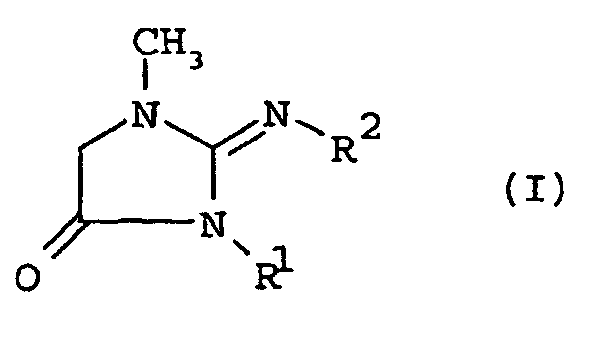
- R1
- H, Alkyl-, Hydroxyalkyl-, Carboxyalkylrest mit 2 bis 30 C-Atomen;
- R2
- H oder ein gegebenenfalls verzweigter, gegebenenfalls Doppelbindungen enthaltender Kohlenwasserstoffrest mit 1 bis 30 C-Atomen sein kann,
| Grundrezeptur: Hautcreme | ||
| Erfindungsgemäße Verbindung | 0,05 bis 10 | Gew.-Teile |
| Glycerinmonodistearat | 2 bis 10 | Gew.-Teile |
| Cetylalkohol | 1 bis 4 | Gew.-Teile |
| Paraffinöl 3,5°E | 4 bis 12 | Gew.-Teile |
| Glycerin | 1 bis 5 | Gew.-Teile |
| demin. Wasser | ad 100 | |
| Konservierungsmittel | n. B. |
| Konzentration (Vol.-%) | Tyrosinase-Inhibition (%) |
| 0,00 | 0,00 |
| 0,05 | 1,77 |
| 0,30 | 9,97 |
| 0,60 | 14,21 |
| 0,90 | 20,75 |
| 1,10 | 24,81 |
| 1,40 | 28,15 |
| 1,70 | 32,18 |
| Melanin (µg) | ||
| Tag 17 | Tag 21 | |
| Kreatinin | 94,5 | 12,67 |
| Kojisäuredipalmitat | 102,5 | 82,67 |
| Wasser | 205,0 | 162,17 |
| Hautaufhellende Creme | Gew.-% |
| Phase A | |
| ABIL® Care 85 (Bis-PEG/PPG-16/16 PEG/PPG-16/16 Dimethicone; Caprylic/Capric Triglycerides) | 1,5 |
| TEGINACID® C (Ceteareth-25) | 0,5 |
| TEGIN® M(Glyceryl Stearate) | 2,0 |
| TEGO® Alkanol 1618 (Cetearyl Alcohol) | 6,0 |
| Cyclomethicone | 5,0 |
| Phase B | |
| Verbindung Formel (I) R1, R2 = H (Kreatinin) | 0,5 |
| Glycerin | 3,0 |
| Wasser | ad 100 |
| Phase C | |
| TEGO® Carbomer 134(Carbomer) | 0,15 |
| TEGOSOFT® O (Ethylhexyl Palmitate) | 0,6 |
| Phase D | |
| Natriumhydroxid (10 % in Wasser) | q.s. |
| Konservierungsmittel, Parfüm | q.s. |
| Herstellung: | |
| 1. | Phase A und B auf ungefähr 75 °C erhitzen. |
| 2. | Phase A unter Rühren zu Phase B geben. |
| 3. | Homogenisieren. |
| 4. | Unter Rühren auf ca. 60 °C abkühlen und anschließend Phase C zugeben. |
| 5. | Kurz Homogenisieren. |
| 6. | Unter Rühren abkühlen und unterhalb 40 °C Phase D zugeben. |
Claims (5)
- Verwendung von Verbindungen der allgemeinen Formel (I) und/oder deren Salzein denen
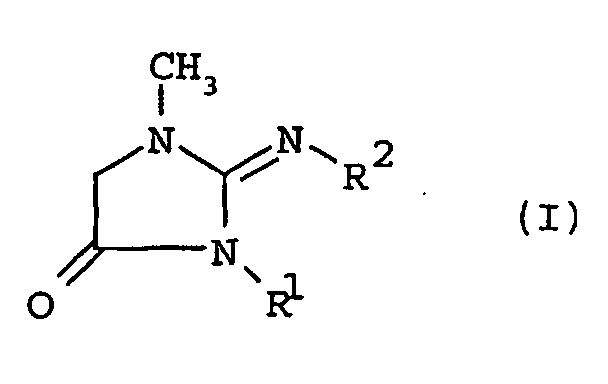
- R1
- H, Alkyl-, Hydroxyalkyl-, Carboxyalkylrest mit 2 bis 30 C-Atomen;
- R2
- H oder ein gegebenenfalls verzweigter, gegebenenfalls Doppelbindungen enthaltender Kohlenwasserstoffrest mit 1 bis 30 C-Atomen sein kann,
- Verwendung von Verbindungen gemäß Anspruch 1, dadurch gekennzeichnet, dass die Reste R1 und/oder R2 2 bis 20 C-Atome aufweisen.
- Verwendung von Verbindungen gemäß den Ansprüchen 1 und/oder 2, dadurch gekennzeichnet, dass die Reste R1 und/oder R2 Wasserstoff sind.
- Verwendung von Verbindungen gemäß mindestens einem der Ansprüche 1 bis 3, dadurch gekennzeichnet, dass 0,05 bis 10,0 Gew.-%, mindestens eine der Verbindungen der allgemeinen Formel (I) als Wirksubstanz enthalten ist.
- Verwendung von wässrigen kosmetischen oder dermatologischen Formulierungen enthaltendzur Aufhellung der Haut und Milderung von Pigmentstörungen.a) 0,05 bis 10 Gew.-Teile mindestens einer der Verbindungen der allgemeinen Formel (I) undb) 1 bis 10 Gew.-Teile mindestens eines Tensids aus der Gruppe der nichtionischen, amphoteren, zwitterionischen, ionischen Tenside und gegebenenfallsc) 2 bis 10 Gew.-Teile pflanzliche oder mineralische Öle, Esteröled) 1 bis 5 Gew.-Teile Konsistenzgebere) 0,5 bis 5,0 Gew.-Teile Duftstoffe, Farbstoffe, Pflanzenextrakte, Konservierungsmittelf) ad 100 Wasser
Priority Applications (9)
| Application Number | Priority Date | Filing Date | Title |
|---|---|---|---|
| EP02003483A EP1338269B1 (de) | 2002-02-15 | 2002-02-15 | Verwendung von Kreatinin und/oder Kreatinin-Derivaten zur Aufhellung der Haut und Milderung von Pigmentstörungen |
| DE50203746T DE50203746D1 (de) | 2002-02-15 | 2002-02-15 | Verwendung von Kreatinin und/oder Kreatinin-Derivaten zur Aufhellung der Haut und Milderung von Pigmentstörungen |
| ES02003483T ES2243606T3 (es) | 2002-02-15 | 2002-02-15 | Utilizacion de creatinina y/o de derivados de creatinina para el aclaramiento de la piel y el alivio de trastornos de pigmentacion. |
| AT02003483T ATE300280T1 (de) | 2002-02-15 | 2002-02-15 | Verwendung von kreatinin und/oder kreatinin- derivaten zur aufhellung der haut und milderung von pigmentstörungen |
| AU2003200465A AU2003200465B2 (en) | 2002-02-15 | 2003-02-11 | Compositions for Skin Lightening and Toning Down Pigment Disorders, Comprising Creatinine and/or Creatinine Derivatives as Active Substances |
| JP2003034585A JP2003238353A (ja) | 2002-02-15 | 2003-02-13 | クレアチニンおよび/またはクレアチニン誘導体を活性物質として含む皮膚淡色化用および色素障害緩和用組成物 |
| KR10-2003-0009077A KR20030069072A (ko) | 2002-02-15 | 2003-02-13 | 활성 성분으로 크레아티닌 및/또는 크레아티닌 유도체를포함하는 피부 미백 및 색소 질환의 색조 완화를 위한조성물 |
| US10/367,229 US20030180237A1 (en) | 2002-02-15 | 2003-02-14 | Compositions for skin lightening and toning down pigment disorders, comprising creatinine and/or creatinine derivatives as active substances |
| US12/038,272 US20080146633A1 (en) | 2002-02-15 | 2008-02-27 | Compositions for skin lightening and toning down pigment disorders, comprising creatinine and/or creatinine derivatives as active substances |
Applications Claiming Priority (1)
| Application Number | Priority Date | Filing Date | Title |
|---|---|---|---|
| EP02003483A EP1338269B1 (de) | 2002-02-15 | 2002-02-15 | Verwendung von Kreatinin und/oder Kreatinin-Derivaten zur Aufhellung der Haut und Milderung von Pigmentstörungen |
Publications (2)
| Publication Number | Publication Date |
|---|---|
| EP1338269A1 EP1338269A1 (de) | 2003-08-27 |
| EP1338269B1 true EP1338269B1 (de) | 2005-07-27 |
Family
ID=27635802
Family Applications (1)
| Application Number | Title | Priority Date | Filing Date |
|---|---|---|---|
| EP02003483A Expired - Lifetime EP1338269B1 (de) | 2002-02-15 | 2002-02-15 | Verwendung von Kreatinin und/oder Kreatinin-Derivaten zur Aufhellung der Haut und Milderung von Pigmentstörungen |
Country Status (8)
| Country | Link |
|---|---|
| US (2) | US20030180237A1 (de) |
| EP (1) | EP1338269B1 (de) |
| JP (1) | JP2003238353A (de) |
| KR (1) | KR20030069072A (de) |
| AT (1) | ATE300280T1 (de) |
| AU (1) | AU2003200465B2 (de) |
| DE (1) | DE50203746D1 (de) |
| ES (1) | ES2243606T3 (de) |
Families Citing this family (5)
| Publication number | Priority date | Publication date | Assignee | Title |
|---|---|---|---|---|
| EA015357B1 (ru) * | 2005-03-23 | 2011-06-30 | Мэри Кэй Инк. | Осветляющая кожу композиция |
| US8263053B2 (en) * | 2005-11-22 | 2012-09-11 | Access Business Group International | Hair treatment compositions |
| PL2051691T3 (pl) * | 2006-10-13 | 2010-10-29 | Evonik Degussa Gmbh | Kompozycja do leczenia skóry |
| ES2687780T3 (es) * | 2009-09-30 | 2018-10-29 | Shiseido Company, Ltd. | Inhibidor de la actividad heparanasa |
| JP7116683B2 (ja) * | 2016-01-22 | 2022-08-10 | ティー. アームストロング,アーネスト | 皮膚を明るくし、日光からの保護をもたらし、ビタミンd産生を可能にする組成物 |
Family Cites Families (4)
| Publication number | Priority date | Publication date | Assignee | Title |
|---|---|---|---|---|
| US5091171B2 (en) * | 1986-12-23 | 1997-07-15 | Tristrata Inc | Amphoteric compositions and polymeric forms of alpha hydroxyacids and their therapeutic use |
| US5973005A (en) * | 1998-02-26 | 1999-10-26 | Bio-Bontanica, Inc. | Aqueous creatine solution and process of producing a stable, bioavailable aqueous creatine solution |
| DE19841385A1 (de) * | 1998-09-10 | 2000-03-16 | Sueddeutsche Kalkstickstoff | Verwendung von Kreatin und/oder Kreatin-derivaten als Feuchthaltemittel in kosmetischen Zubereitungen |
| JP3923226B2 (ja) * | 1998-12-28 | 2007-05-30 | ライオン株式会社 | 皮膚外用剤 |
-
2002
- 2002-02-15 DE DE50203746T patent/DE50203746D1/de not_active Expired - Lifetime
- 2002-02-15 EP EP02003483A patent/EP1338269B1/de not_active Expired - Lifetime
- 2002-02-15 ES ES02003483T patent/ES2243606T3/es not_active Expired - Lifetime
- 2002-02-15 AT AT02003483T patent/ATE300280T1/de not_active IP Right Cessation
-
2003
- 2003-02-11 AU AU2003200465A patent/AU2003200465B2/en not_active Ceased
- 2003-02-13 JP JP2003034585A patent/JP2003238353A/ja active Pending
- 2003-02-13 KR KR10-2003-0009077A patent/KR20030069072A/ko not_active Ceased
- 2003-02-14 US US10/367,229 patent/US20030180237A1/en not_active Abandoned
-
2008
- 2008-02-27 US US12/038,272 patent/US20080146633A1/en not_active Abandoned
Also Published As
| Publication number | Publication date |
|---|---|
| ES2243606T3 (es) | 2005-12-01 |
| KR20030069072A (ko) | 2003-08-25 |
| AU2003200465B2 (en) | 2007-09-06 |
| US20080146633A1 (en) | 2008-06-19 |
| EP1338269A1 (de) | 2003-08-27 |
| US20030180237A1 (en) | 2003-09-25 |
| DE50203746D1 (de) | 2005-09-01 |
| JP2003238353A (ja) | 2003-08-27 |
| ATE300280T1 (de) | 2005-08-15 |
| AU2003200465A1 (en) | 2003-09-04 |
Similar Documents
| Publication | Publication Date | Title |
|---|---|---|
| DE69900081T2 (de) | Zusammensetzung zum Aufhellen der Haut und/oder der Haare | |
| DE69730604T2 (de) | Oxadisäuren und verwandte verbindungen zur behandlung von hautstörungen | |
| DE69416153T2 (de) | Kosmetische zusammensetzung enthaltend ein hydrochalkon und retinol oder dessen derivate | |
| DE112007001469B4 (de) | Collagensynthese-Promotor, der Zinkpyrrolidoncarboxylat als aktiven Bestandteil enthält | |
| EP0751763B1 (de) | Gegen hautalterung wirksame stoffe oder wirkstoffkombinationen und zubereitungen | |
| DE68902353T2 (de) | Hautdepigmentierungsmittel. | |
| DE69731385T2 (de) | Oxa-säuren und verwandte verbindungen zur behandlung von störungen der haut | |
| DE60016670T2 (de) | Kosmetische Mittel, die mindestens ein Hydroxystilben und Ascorbinsäure enthalten | |
| KR101262388B1 (ko) | 카스타니아 사티바의 잎 추출물을 포함하는 미용 조성물 | |
| DE69611754T2 (de) | Hydrochalconderivate, sie enthaltende kosmetische zusammensetzungen, und verfahren zur herstellung von beiden | |
| EP1633206B1 (de) | Verwendung von diphenylmethan-derivaten als tyrosinase-inhibitoren | |
| DE69907163T2 (de) | Synergistische zusammensetzung enthaltend einer lipoaminosäure struktur und ein nenuphar-extrakte | |
| DE69807070T2 (de) | Tocoferol estern und deren verwendung in kosmetika und pharmazie | |
| DE60035059T2 (de) | Mittel zur verbesserung der hauttextur | |
| DE69002539T2 (de) | Kosmetische Zubereitung gegen das Altern der Haut. | |
| CH684739A5 (de) | Hautaufhellungsmittel. | |
| DE60207026T2 (de) | Verwendung von Pantetheinsulfonsäure und/oder ihren Salzen als Radikalfänger | |
| DE69925882T2 (de) | Aminosäurederivate als Entzündungshemmende Mittel | |
| EP1066821A1 (de) | Topische kosmetische Mittel, enthaltend Benzaldoxime | |
| DE60128860T2 (de) | Zusammensetzungen zur Inhibierung der radikal initierten Polymerisation in der Haut und dem Haar | |
| DE19720339A1 (de) | Wirkstoffe und Zubereitungen für die Hautaufhellung und zur Verhinderung der Hautbräunung | |
| DE69803119T2 (de) | Verwendung von Sulfiten und Metabisulfiten zur Herstellung von kosmetischen oder pharmazeutischen, insbesondere dermatologischen Zusammensetzungen, welche einen inhibitorischen Effekt auf die Melanogenese oder eine hautdepigmentierende Wirkung besitzen | |
| JPH08175958A (ja) | 皮膚外用剤 | |
| US20080146633A1 (en) | Compositions for skin lightening and toning down pigment disorders, comprising creatinine and/or creatinine derivatives as active substances | |
| US20030211183A1 (en) | Skin-improving agent |
Legal Events
| Date | Code | Title | Description |
|---|---|---|---|
| PUAI | Public reference made under article 153(3) epc to a published international application that has entered the european phase |
Free format text: ORIGINAL CODE: 0009012 |
|
| 17P | Request for examination filed |
Effective date: 20020221 |
|
| AK | Designated contracting states |
Designated state(s): AT BE CH CY DE DK ES FI FR GB GR IE IT LI LU MC NL PT SE TR |
|
| AX | Request for extension of the european patent |
Extension state: AL LT LV MK RO SI |
|
| AKX | Designation fees paid |
Designated state(s): AT BE CH CY DE DK ES FI FR GB GR IE IT LI LU MC NL PT SE TR |
|
| 17Q | First examination report despatched |
Effective date: 20040526 |
|
| GRAP | Despatch of communication of intention to grant a patent |
Free format text: ORIGINAL CODE: EPIDOSNIGR1 |
|
| RTI1 | Title (correction) |
Free format text: USE OF CREATININE AND/OR CREATININE DERIVATIVES FOR WHITENING THE SKIN AND ALLEVIATING OF PIGMENTATION DISORDERS |
|
| RAP1 | Party data changed (applicant data changed or rights of an application transferred) |
Owner name: GOLDSCHMIDT GMBH |
|
| GRAS | Grant fee paid |
Free format text: ORIGINAL CODE: EPIDOSNIGR3 |
|
| GRAA | (expected) grant |
Free format text: ORIGINAL CODE: 0009210 |
|
| AK | Designated contracting states |
Kind code of ref document: B1 Designated state(s): AT BE CH CY DE DK ES FI FR GB GR IE IT LI LU MC NL PT SE TR |
|
| PG25 | Lapsed in a contracting state [announced via postgrant information from national office to epo] |
Ref country code: FI Free format text: LAPSE BECAUSE OF FAILURE TO SUBMIT A TRANSLATION OF THE DESCRIPTION OR TO PAY THE FEE WITHIN THE PRESCRIBED TIME-LIMIT Effective date: 20050727 Ref country code: IE Free format text: LAPSE BECAUSE OF FAILURE TO SUBMIT A TRANSLATION OF THE DESCRIPTION OR TO PAY THE FEE WITHIN THE PRESCRIBED TIME-LIMIT Effective date: 20050727 Ref country code: TR Free format text: LAPSE BECAUSE OF FAILURE TO SUBMIT A TRANSLATION OF THE DESCRIPTION OR TO PAY THE FEE WITHIN THE PRESCRIBED TIME-LIMIT Effective date: 20050727 |
|
| REG | Reference to a national code |
Ref country code: GB Ref legal event code: FG4D Free format text: NOT ENGLISH |
|
| REG | Reference to a national code |
Ref country code: CH Ref legal event code: EP |
|
| REG | Reference to a national code |
Ref country code: IE Ref legal event code: FG4D Free format text: LANGUAGE OF EP DOCUMENT: GERMAN |
|
| REF | Corresponds to: |
Ref document number: 50203746 Country of ref document: DE Date of ref document: 20050901 Kind code of ref document: P |
|
| PG25 | Lapsed in a contracting state [announced via postgrant information from national office to epo] |
Ref country code: SE Free format text: LAPSE BECAUSE OF FAILURE TO SUBMIT A TRANSLATION OF THE DESCRIPTION OR TO PAY THE FEE WITHIN THE PRESCRIBED TIME-LIMIT Effective date: 20051027 Ref country code: GR Free format text: LAPSE BECAUSE OF FAILURE TO SUBMIT A TRANSLATION OF THE DESCRIPTION OR TO PAY THE FEE WITHIN THE PRESCRIBED TIME-LIMIT Effective date: 20051027 Ref country code: DK Free format text: LAPSE BECAUSE OF FAILURE TO SUBMIT A TRANSLATION OF THE DESCRIPTION OR TO PAY THE FEE WITHIN THE PRESCRIBED TIME-LIMIT Effective date: 20051027 |
|
| GBT | Gb: translation of ep patent filed (gb section 77(6)(a)/1977) | ||
| REG | Reference to a national code |
Ref country code: ES Ref legal event code: FG2A Ref document number: 2243606 Country of ref document: ES Kind code of ref document: T3 |
|
| PG25 | Lapsed in a contracting state [announced via postgrant information from national office to epo] |
Ref country code: PT Free format text: LAPSE BECAUSE OF FAILURE TO SUBMIT A TRANSLATION OF THE DESCRIPTION OR TO PAY THE FEE WITHIN THE PRESCRIBED TIME-LIMIT Effective date: 20051227 |
|
| PG25 | Lapsed in a contracting state [announced via postgrant information from national office to epo] |
Ref country code: AT Free format text: LAPSE BECAUSE OF NON-PAYMENT OF DUE FEES Effective date: 20060215 |
|
| REG | Reference to a national code |
Ref country code: IE Ref legal event code: FD4D |
|
| PG25 | Lapsed in a contracting state [announced via postgrant information from national office to epo] |
Ref country code: CH Free format text: LAPSE BECAUSE OF NON-PAYMENT OF DUE FEES Effective date: 20060228 Ref country code: BE Free format text: LAPSE BECAUSE OF NON-PAYMENT OF DUE FEES Effective date: 20060228 Ref country code: LI Free format text: LAPSE BECAUSE OF NON-PAYMENT OF DUE FEES Effective date: 20060228 Ref country code: MC Free format text: LAPSE BECAUSE OF NON-PAYMENT OF DUE FEES Effective date: 20060228 Ref country code: LU Free format text: LAPSE BECAUSE OF NON-PAYMENT OF DUE FEES Effective date: 20060228 |
|
| ET | Fr: translation filed | ||
| PLBE | No opposition filed within time limit |
Free format text: ORIGINAL CODE: 0009261 |
|
| STAA | Information on the status of an ep patent application or granted ep patent |
Free format text: STATUS: NO OPPOSITION FILED WITHIN TIME LIMIT |
|
| 26N | No opposition filed |
Effective date: 20060428 |
|
| REG | Reference to a national code |
Ref country code: CH Ref legal event code: PL |
|
| BERE | Be: lapsed |
Owner name: GOLDSCHMIDT G.M.B.H. Effective date: 20060228 |
|
| PGFP | Annual fee paid to national office [announced via postgrant information from national office to epo] |
Ref country code: NL Payment date: 20080214 Year of fee payment: 7 |
|
| PG25 | Lapsed in a contracting state [announced via postgrant information from national office to epo] |
Ref country code: CY Free format text: LAPSE BECAUSE OF FAILURE TO SUBMIT A TRANSLATION OF THE DESCRIPTION OR TO PAY THE FEE WITHIN THE PRESCRIBED TIME-LIMIT Effective date: 20050727 |
|
| NLV4 | Nl: lapsed or anulled due to non-payment of the annual fee |
Effective date: 20090901 |
|
| PG25 | Lapsed in a contracting state [announced via postgrant information from national office to epo] |
Ref country code: NL Free format text: LAPSE BECAUSE OF NON-PAYMENT OF DUE FEES Effective date: 20090901 |
|
| REG | Reference to a national code |
Ref country code: FR Ref legal event code: CD |
|
| REG | Reference to a national code |
Ref country code: DE Ref legal event code: R081 Ref document number: 50203746 Country of ref document: DE Owner name: EVONIK DEGUSSA GMBH, DE Free format text: FORMER OWNER: EVONIK GOLDSCHMIDT GMBH, 45127 ESSEN, DE Effective date: 20131024 |
|
| REG | Reference to a national code |
Ref country code: GB Ref legal event code: 732E Free format text: REGISTERED BETWEEN 20140320 AND 20140326 |
|
| REG | Reference to a national code |
Ref country code: ES Ref legal event code: PC2A Owner name: EVONIK DEGUSSA GMBH Effective date: 20140424 |
|
| REG | Reference to a national code |
Ref country code: FR Ref legal event code: TP Owner name: EVONIK DEGUSSA GMBH, DE Effective date: 20140411 |
|
| PGFP | Annual fee paid to national office [announced via postgrant information from national office to epo] |
Ref country code: IT Payment date: 20150223 Year of fee payment: 14 |
|
| REG | Reference to a national code |
Ref country code: FR Ref legal event code: PLFP Year of fee payment: 15 |
|
| PG25 | Lapsed in a contracting state [announced via postgrant information from national office to epo] |
Ref country code: IT Free format text: LAPSE BECAUSE OF NON-PAYMENT OF DUE FEES Effective date: 20160215 |
|
| REG | Reference to a national code |
Ref country code: FR Ref legal event code: PLFP Year of fee payment: 16 |
|
| REG | Reference to a national code |
Ref country code: FR Ref legal event code: PLFP Year of fee payment: 17 |
|
| REG | Reference to a national code |
Ref country code: DE Ref legal event code: R081 Ref document number: 50203746 Country of ref document: DE Owner name: EVONIK OPERATIONS GMBH, DE Free format text: FORMER OWNER: EVONIK DEGUSSA GMBH, 45128 ESSEN, DE |
|
| PGFP | Annual fee paid to national office [announced via postgrant information from national office to epo] |
Ref country code: FR Payment date: 20210224 Year of fee payment: 20 |
|
| PGFP | Annual fee paid to national office [announced via postgrant information from national office to epo] |
Ref country code: GB Payment date: 20210219 Year of fee payment: 20 Ref country code: DE Payment date: 20210217 Year of fee payment: 20 |
|
| PGFP | Annual fee paid to national office [announced via postgrant information from national office to epo] |
Ref country code: ES Payment date: 20210421 Year of fee payment: 20 |
|
| REG | Reference to a national code |
Ref country code: DE Ref legal event code: R071 Ref document number: 50203746 Country of ref document: DE |
|
| REG | Reference to a national code |
Ref country code: GB Ref legal event code: PE20 Expiry date: 20220214 |
|
| PG25 | Lapsed in a contracting state [announced via postgrant information from national office to epo] |
Ref country code: GB Free format text: LAPSE BECAUSE OF EXPIRATION OF PROTECTION Effective date: 20220214 |
|
| REG | Reference to a national code |
Ref country code: ES Ref legal event code: FD2A Effective date: 20220526 |
|
| PG25 | Lapsed in a contracting state [announced via postgrant information from national office to epo] |
Ref country code: ES Free format text: LAPSE BECAUSE OF EXPIRATION OF PROTECTION Effective date: 20220216 |