EP1330474B1 - Diagnostische verwendung eines spezifischen co-aktivators für humane nukleäre rezeptoren - Google Patents
Diagnostische verwendung eines spezifischen co-aktivators für humane nukleäre rezeptoren Download PDFInfo
- Publication number
- EP1330474B1 EP1330474B1 EP01990381A EP01990381A EP1330474B1 EP 1330474 B1 EP1330474 B1 EP 1330474B1 EP 01990381 A EP01990381 A EP 01990381A EP 01990381 A EP01990381 A EP 01990381A EP 1330474 B1 EP1330474 B1 EP 1330474B1
- Authority
- EP
- European Patent Office
- Prior art keywords
- receptor
- cells
- ranbpm
- protein
- activator
- Prior art date
- Legal status (The legal status is an assumption and is not a legal conclusion. Google has not performed a legal analysis and makes no representation as to the accuracy of the status listed.)
- Expired - Lifetime
Links
- 241000282414 Homo sapiens Species 0.000 title claims abstract description 7
- 102000006255 nuclear receptors Human genes 0.000 title claims description 18
- 108020004017 nuclear receptors Proteins 0.000 title claims description 18
- 108020005497 Nuclear hormone receptor Proteins 0.000 title claims description 16
- 239000012190 activator Substances 0.000 title abstract description 10
- 108090000623 proteins and genes Proteins 0.000 claims abstract description 23
- 108010080146 androgen receptors Proteins 0.000 claims abstract description 22
- 102000004169 proteins and genes Human genes 0.000 claims abstract description 13
- 238000012360 testing method Methods 0.000 claims abstract description 10
- 230000003054 hormonal effect Effects 0.000 claims abstract description 5
- 108010049838 Ran binding protein 9 Proteins 0.000 claims description 19
- 102100033982 Ran-binding protein 9 Human genes 0.000 claims description 19
- 210000004027 cell Anatomy 0.000 claims description 17
- 239000000126 substance Substances 0.000 claims description 11
- 230000001548 androgenic effect Effects 0.000 claims description 9
- 108090000079 Glucocorticoid Receptors Proteins 0.000 claims description 7
- 108090000375 Mineralocorticoid Receptors Proteins 0.000 claims description 7
- 102100021316 Mineralocorticoid receptor Human genes 0.000 claims description 7
- 230000002280 anti-androgenic effect Effects 0.000 claims description 7
- 238000000034 method Methods 0.000 claims description 6
- 108010007005 Estrogen Receptor alpha Proteins 0.000 claims description 5
- 108010041356 Estrogen Receptor beta Proteins 0.000 claims description 5
- 108010090371 progesterone receptor B Proteins 0.000 claims description 5
- 230000002103 transcriptional effect Effects 0.000 claims description 5
- 230000000694 effects Effects 0.000 claims description 4
- 102000007594 Estrogen Receptor alpha Human genes 0.000 claims description 3
- 102000000509 Estrogen Receptor beta Human genes 0.000 claims description 3
- 230000002068 genetic effect Effects 0.000 claims description 3
- 238000000338 in vitro Methods 0.000 claims description 3
- 108010090388 progesterone receptor A Proteins 0.000 claims description 3
- 102100038595 Estrogen receptor Human genes 0.000 claims description 2
- 102100029951 Estrogen receptor beta Human genes 0.000 claims description 2
- 210000000663 muscle cell Anatomy 0.000 claims description 2
- 210000002569 neuron Anatomy 0.000 claims description 2
- 210000005267 prostate cell Anatomy 0.000 claims description 2
- 102100032187 Androgen receptor Human genes 0.000 claims 2
- 102100033417 Glucocorticoid receptor Human genes 0.000 claims 2
- 239000008177 pharmaceutical agent Substances 0.000 claims 1
- 230000001131 transforming effect Effects 0.000 claims 1
- 102000001307 androgen receptors Human genes 0.000 abstract description 20
- 102000005962 receptors Human genes 0.000 abstract description 7
- 108020003175 receptors Proteins 0.000 abstract description 7
- 241000282412 Homo Species 0.000 abstract description 3
- 239000000470 constituent Substances 0.000 abstract 1
- RJKFOVLPORLFTN-LEKSSAKUSA-N Progesterone Chemical compound C1CC2=CC(=O)CC[C@]2(C)[C@@H]2[C@@H]1[C@@H]1CC[C@H](C(=O)C)[C@@]1(C)CC2 RJKFOVLPORLFTN-LEKSSAKUSA-N 0.000 description 6
- 239000003446 ligand Substances 0.000 description 6
- 102000003676 Glucocorticoid Receptors Human genes 0.000 description 5
- 101000928259 Homo sapiens NADPH:adrenodoxin oxidoreductase, mitochondrial Proteins 0.000 description 5
- 239000002299 complementary DNA Substances 0.000 description 5
- 102000046818 human AR Human genes 0.000 description 5
- 101000836540 Homo sapiens Aldo-keto reductase family 1 member B1 Proteins 0.000 description 4
- 101000809450 Homo sapiens Amphiregulin Proteins 0.000 description 4
- 239000003098 androgen Substances 0.000 description 4
- 230000027455 binding Effects 0.000 description 4
- 229940011871 estrogen Drugs 0.000 description 4
- 239000000262 estrogen Substances 0.000 description 4
- 239000012634 fragment Substances 0.000 description 4
- 102000003728 Peroxisome Proliferator-Activated Receptors Human genes 0.000 description 3
- 108090000029 Peroxisome Proliferator-Activated Receptors Proteins 0.000 description 3
- 102000034527 Retinoid X Receptors Human genes 0.000 description 3
- 108010038912 Retinoid X Receptors Proteins 0.000 description 3
- 230000004913 activation Effects 0.000 description 3
- 150000001413 amino acids Chemical class 0.000 description 3
- 238000003556 assay Methods 0.000 description 3
- 210000004556 brain Anatomy 0.000 description 3
- 210000004899 c-terminal region Anatomy 0.000 description 3
- 230000001605 fetal effect Effects 0.000 description 3
- 230000003993 interaction Effects 0.000 description 3
- 239000000463 material Substances 0.000 description 3
- 239000000186 progesterone Substances 0.000 description 3
- 229960003387 progesterone Drugs 0.000 description 3
- 239000000523 sample Substances 0.000 description 3
- 238000012216 screening Methods 0.000 description 3
- 108010035563 Chloramphenicol O-acetyltransferase Proteins 0.000 description 2
- 108020004414 DNA Proteins 0.000 description 2
- 108700026244 Open Reading Frames Proteins 0.000 description 2
- 108700008625 Reporter Genes Proteins 0.000 description 2
- 240000004808 Saccharomyces cerevisiae Species 0.000 description 2
- 239000013543 active substance Substances 0.000 description 2
- 238000004458 analytical method Methods 0.000 description 2
- 102000005936 beta-Galactosidase Human genes 0.000 description 2
- 108010005774 beta-Galactosidase Proteins 0.000 description 2
- 238000006243 chemical reaction Methods 0.000 description 2
- 208000037265 diseases, disorders, signs and symptoms Diseases 0.000 description 2
- 239000003814 drug Substances 0.000 description 2
- 239000003862 glucocorticoid Substances 0.000 description 2
- 229940088597 hormone Drugs 0.000 description 2
- 239000005556 hormone Substances 0.000 description 2
- 108020001756 ligand binding domains Proteins 0.000 description 2
- 239000002395 mineralocorticoid Substances 0.000 description 2
- 210000004897 n-terminal region Anatomy 0.000 description 2
- 102000005969 steroid hormone receptors Human genes 0.000 description 2
- 102000004217 thyroid hormone receptors Human genes 0.000 description 2
- 108090000721 thyroid hormone receptors Proteins 0.000 description 2
- 238000013518 transcription Methods 0.000 description 2
- 230000035897 transcription Effects 0.000 description 2
- 102000009310 vitamin D receptors Human genes 0.000 description 2
- 108050000156 vitamin D receptors Proteins 0.000 description 2
- 238000001086 yeast two-hybrid system Methods 0.000 description 2
- PCTMTFRHKVHKIS-BMFZQQSSSA-N (1s,3r,4e,6e,8e,10e,12e,14e,16e,18s,19r,20r,21s,25r,27r,30r,31r,33s,35r,37s,38r)-3-[(2r,3s,4s,5s,6r)-4-amino-3,5-dihydroxy-6-methyloxan-2-yl]oxy-19,25,27,30,31,33,35,37-octahydroxy-18,20,21-trimethyl-23-oxo-22,39-dioxabicyclo[33.3.1]nonatriaconta-4,6,8,10 Chemical compound C1C=C2C[C@@H](OS(O)(=O)=O)CC[C@]2(C)[C@@H]2[C@@H]1[C@@H]1CC[C@H]([C@H](C)CCCC(C)C)[C@@]1(C)CC2.O[C@H]1[C@@H](N)[C@H](O)[C@@H](C)O[C@H]1O[C@H]1/C=C/C=C/C=C/C=C/C=C/C=C/C=C/[C@H](C)[C@@H](O)[C@@H](C)[C@H](C)OC(=O)C[C@H](O)C[C@H](O)CC[C@@H](O)[C@H](O)C[C@H](O)C[C@](O)(C[C@H](O)[C@H]2C(O)=O)O[C@H]2C1 PCTMTFRHKVHKIS-BMFZQQSSSA-N 0.000 description 1
- 102000008169 Co-Repressor Proteins Human genes 0.000 description 1
- 108010060434 Co-Repressor Proteins Proteins 0.000 description 1
- 230000004568 DNA-binding Effects 0.000 description 1
- 101000775732 Homo sapiens Androgen receptor Proteins 0.000 description 1
- 108060001084 Luciferase Proteins 0.000 description 1
- 239000005089 Luciferase Substances 0.000 description 1
- 108091022875 Microtubule Proteins 0.000 description 1
- 102000029749 Microtubule Human genes 0.000 description 1
- ORNBQBCIOKFOEO-YQUGOWONSA-N Pregnenolone Natural products O=C(C)[C@@H]1[C@@]2(C)[C@H]([C@H]3[C@@H]([C@]4(C)C(=CC3)C[C@@H](O)CC4)CC2)CC1 ORNBQBCIOKFOEO-YQUGOWONSA-N 0.000 description 1
- 108010085012 Steroid Receptors Proteins 0.000 description 1
- 102000040945 Transcription factor Human genes 0.000 description 1
- 108091023040 Transcription factor Proteins 0.000 description 1
- HCHKCACWOHOZIP-UHFFFAOYSA-N Zinc Chemical compound [Zn] HCHKCACWOHOZIP-UHFFFAOYSA-N 0.000 description 1
- 230000009471 action Effects 0.000 description 1
- 239000000556 agonist Substances 0.000 description 1
- 125000000539 amino acid group Chemical group 0.000 description 1
- 229940030486 androgens Drugs 0.000 description 1
- 239000005557 antagonist Substances 0.000 description 1
- 230000001833 anti-estrogenic effect Effects 0.000 description 1
- 210000003793 centrosome Anatomy 0.000 description 1
- 238000010367 cloning Methods 0.000 description 1
- 230000006552 constitutive activation Effects 0.000 description 1
- 230000003247 decreasing effect Effects 0.000 description 1
- 230000001419 dependent effect Effects 0.000 description 1
- 238000011161 development Methods 0.000 description 1
- 238000003745 diagnosis Methods 0.000 description 1
- 238000006471 dimerization reaction Methods 0.000 description 1
- 201000010099 disease Diseases 0.000 description 1
- 229940079593 drug Drugs 0.000 description 1
- 238000007877 drug screening Methods 0.000 description 1
- 238000003255 drug test Methods 0.000 description 1
- 230000002708 enhancing effect Effects 0.000 description 1
- 230000007613 environmental effect Effects 0.000 description 1
- 230000001076 estrogenic effect Effects 0.000 description 1
- 238000011156 evaluation Methods 0.000 description 1
- 238000002866 fluorescence resonance energy transfer Methods 0.000 description 1
- 231100000508 hormonal effect Toxicity 0.000 description 1
- 108091008039 hormone receptors Proteins 0.000 description 1
- 238000001114 immunoprecipitation Methods 0.000 description 1
- 239000012535 impurity Substances 0.000 description 1
- 238000002955 isolation Methods 0.000 description 1
- 238000009533 lab test Methods 0.000 description 1
- 238000002372 labelling Methods 0.000 description 1
- 238000005259 measurement Methods 0.000 description 1
- 210000004688 microtubule Anatomy 0.000 description 1
- 230000006911 nucleation Effects 0.000 description 1
- 238000010899 nucleation Methods 0.000 description 1
- 230000008506 pathogenesis Effects 0.000 description 1
- 229940037129 plain mineralocorticoids for systemic use Drugs 0.000 description 1
- 230000023603 positive regulation of transcription initiation, DNA-dependent Effects 0.000 description 1
- 229960000249 pregnenolone Drugs 0.000 description 1
- ORNBQBCIOKFOEO-QGVNFLHTSA-N pregnenolone Chemical compound C1C=C2C[C@@H](O)CC[C@]2(C)[C@@H]2[C@@H]1[C@@H]1CC[C@H](C(=O)C)[C@@]1(C)CC2 ORNBQBCIOKFOEO-QGVNFLHTSA-N 0.000 description 1
- 238000002360 preparation method Methods 0.000 description 1
- 108090000765 processed proteins & peptides Proteins 0.000 description 1
- 102000004196 processed proteins & peptides Human genes 0.000 description 1
- 239000000583 progesterone congener Substances 0.000 description 1
- 229940095055 progestogen systemic hormonal contraceptives Drugs 0.000 description 1
- 230000001737 promoting effect Effects 0.000 description 1
- 238000010379 pull-down assay Methods 0.000 description 1
- 230000000754 repressing effect Effects 0.000 description 1
- 230000004044 response Effects 0.000 description 1
- 150000004492 retinoid derivatives Chemical class 0.000 description 1
- 238000012163 sequencing technique Methods 0.000 description 1
- 108020003113 steroid hormone receptors Proteins 0.000 description 1
- 230000003637 steroidlike Effects 0.000 description 1
- 150000003431 steroids Chemical class 0.000 description 1
- 229940037128 systemic glucocorticoids Drugs 0.000 description 1
- 230000001225 therapeutic effect Effects 0.000 description 1
- 238000002560 therapeutic procedure Methods 0.000 description 1
- 230000005758 transcription activity Effects 0.000 description 1
- 230000005026 transcription initiation Effects 0.000 description 1
- 230000009466 transformation Effects 0.000 description 1
- 238000000844 transformation Methods 0.000 description 1
- 239000011701 zinc Substances 0.000 description 1
- 229910052725 zinc Inorganic materials 0.000 description 1
Images
Classifications
-
- C—CHEMISTRY; METALLURGY
- C07—ORGANIC CHEMISTRY
- C07K—PEPTIDES
- C07K14/00—Peptides having more than 20 amino acids; Gastrins; Somatostatins; Melanotropins; Derivatives thereof
- C07K14/435—Peptides having more than 20 amino acids; Gastrins; Somatostatins; Melanotropins; Derivatives thereof from animals; from humans
- C07K14/46—Peptides having more than 20 amino acids; Gastrins; Somatostatins; Melanotropins; Derivatives thereof from animals; from humans from vertebrates
- C07K14/47—Peptides having more than 20 amino acids; Gastrins; Somatostatins; Melanotropins; Derivatives thereof from animals; from humans from vertebrates from mammals
- C07K14/4701—Peptides having more than 20 amino acids; Gastrins; Somatostatins; Melanotropins; Derivatives thereof from animals; from humans from vertebrates from mammals not used
- C07K14/4702—Regulators; Modulating activity
Definitions
- the invention describes a cloned gene coding for a protein which functions as a co-activator of hormone receptors in humans, in particular the androgen receptor, and the use of this co-activator protein as an important component of clinical tests for the diagnosis of human diseases ,
- the superfamily of nuclear receptors which includes more than 50 different proteins, is a group of related transcription factors that direct transcription of the respective target gene in response to specific ligands.
- the family can be divided into several subfamilies according to specific characteristics such as dimerization status, type of ligand or structure of the DNA reaction element ( Beato et al., 2000, Human Reproduct. Update, 6, 225-236 ).
- Characteristic feature of NR is the consistent structure of the functional domains (designated A to F) with a highly variable, poorly conserved N-terminal region with autonomous constitutive activation function (AF-1), a highly conserved DNA binding domain (DBD).
- PPAR peroxisome proliferator-activated receptor
- RXR retinoid X receptor
- NRs eg AR
- ER estrogen
- PR progesterone
- GR glucocorticoid
- MR mineralocorticoid
- AR androgen
- Ligand binding activates the receptor and controls the expression of corresponding target genes.
- co-modulators has been identified as a class of substances that serve as bridge molecules between the transcription initiation complex and the NR in the activation (co-activators) or repression (co-repressors) of gene transcription ( McKenna et al., 1999, Endocr. Rev., 20, 321-347 ).
- a co-activator must be able to enhance receptor function and to interact directly with the activation domain of NR, depending on the agonist, but not in the presence of an antagonist. He also has to interact with the basal transcriptional apparatus, and finally he is not allowed to amplify the basal transcriptional activity himself.
- co-modulators interact with the NR-2 domain of NR using one or more LXXLL motifs (NR box), but some co-modulators have also been described that interact with other NR regions ( Ding et al., 1998, Mol. Endocrinol., 12, 302-313 ). In addition, many identified co-modulators similarly interact with several different NRs so that the degree of specificity of each isolated co-modulator must be tested. To identify new potential co-activators, a fetal brain cDNA library with androgen receptor (AR) fragments was screened as probes. This was done with the help of the yeast two hybrid system.
- AR androgen receptor
- the WO 00/01813 describes non-androgenic ligand binding peptides derived from androgen receptor amino acids 234-391 and their use for the preparation of a medicament for the treatment of androgen-related disorders.
- the invention isolates a specific co-modulator for the human AR with an interaction between AR and RanBPM.
- the co-modulator gene (RanBPM) is described as a 500 amino acid residue protein with a molecular weight of 55 kD localized in the centrosome involved in nucleation of the microtubules (GenBank: NM_005493) ( Nakamura et al., 1998, J. Cell. Biol., 143, 1041-1052 ).
- the present invention through the cloning and reproduction of the AR activator gene, enables the development of new laboratory tests to test the androgen specificity of potential therapeutically active substances.
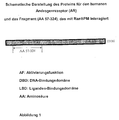
- Figure 1/1 contains a schematic representation of the AR with labeling of the AR domain reaching from AS 57 to AS 324, which is capable of interacting with RanBPM.
- This control protein is the NR-associated protein, referred to herein as RanBPM, which is a co-mediator, particularly a co-activator for the AR and other nuclear receptors, e.g. for the receptors ER, PR, GR, MR, TR (thyroid hormone receptor), VDR (vitamin D receptor), PPAR, RAR (retinoid A receptor) and RXR.
- RanBPM is a protein that can act as a specific co-mediator by enhancing or repressing the transcriptional effect of binding hormones to the nuclear receptor and, in addition, promoting binding and activation of the nuclear receptor by molecules that were previously thought to have no hormonal effect ,
- a double-hybridized yeast system was used as a probe to screen a fetal brain cDNA library with the human AR fragment coding for amino acids 57 to 324 ( illustration 1 ).
- a cDNA clone isolated on screening was indistinguishable from a previously identified cDNA clone (RanBPM) (Genbank accession number NM_005493; Nakamura et al. 1998, J. Cell. Biol., 143, 1041-1052 ).
- RanBPM is expected to have a particular field of application as part of a drug testing or screening protocol.
- administration of pharmacologically active substances androgenic or antiandrogenic side effects are in some cases of importance.
- methods of assaying for androgenic activity were those which measured the ability to bind and activate the transcriptional activity of androgen receptors.
- the RanBPM molecule could be useful not only for testing substances for their potential suitability for pharmaceutical use, but also for testing non-pharmaceutical substances for potential androgenic or antiandrogenic effects. Because many, present in small quantities in the environment impurities are believed to have an androgenic / antiandrogenic or estrogenic / antiestrogenic activity in different parts of the population.
- genetic constructs such as expression cassettes for both the androgen receptor and RanBPM could be transformed in vitro into eukaryotic host cells, eg, in prostate, nerve or muscle cell lines.
- an easily detectable and quantifiable detector gene could be transformed into the cells.
- a suitable detector gene would be the gene encoding luciferase, CAT (chloramphenicol acetyltransferase), ⁇ -galactosidase, or similar systems whose expression is can be detected photometrically.
- the cells are then exposed to the action of the drug or environmental test material.
- a yeast two-hybrid system screening was performed.
- the number of clones screened was 3x10 6 , which corresponded to almost the number of independent clones according to the manufacturer (3.5x10 6 ).
- 500 positive clones were selected and tested with a ⁇ -galactosidase assay; 200 were confirmed as IacZ positive clones.
- the inserts of these clones were amplified by PCR. At least 17 different clones were identified by restriction fragment analysis and sequencing. One of these was a clone with a 2500bp insert coding for the entire ORF (open reading frame) of RanBPM (Genbank accession number NM_005493). This clone was once identified during screening of the library.
Landscapes
- Chemical & Material Sciences (AREA)
- Health & Medical Sciences (AREA)
- Life Sciences & Earth Sciences (AREA)
- Organic Chemistry (AREA)
- Medicinal Chemistry (AREA)
- Molecular Biology (AREA)
- Biochemistry (AREA)
- Biophysics (AREA)
- General Health & Medical Sciences (AREA)
- Genetics & Genomics (AREA)
- Zoology (AREA)
- Gastroenterology & Hepatology (AREA)
- Proteomics, Peptides & Aminoacids (AREA)
- Toxicology (AREA)
- Medicines That Contain Protein Lipid Enzymes And Other Medicines (AREA)
- Medicines Containing Antibodies Or Antigens For Use As Internal Diagnostic Agents (AREA)
- Investigating Or Analysing Biological Materials (AREA)
- Peptides Or Proteins (AREA)
- Measuring Or Testing Involving Enzymes Or Micro-Organisms (AREA)
- Micro-Organisms Or Cultivation Processes Thereof (AREA)
Description
- In der Erfindung wird ein geklontes Gen beschrieben, welches für ein Protein kodiert, das beim Menschen als Co-Aktivator von Hormonrezeptoren - insbesondere des Androgenrezeptors - fungiert, sowie die Anwendung dieses Co-Aktivatorproteins als wichtiger Bestandteil von klinischen Tests zur Diagnostizierung von Erkrankungen beim Menschen.
- Die Superfamilie der nukleären Rezeptoren (NR), zu der mehr als 50 verschiedene Proteine gehören, ist eine Gruppe verwandter Transkriptionsfaktoren, die die Transkription des jeweiligen Zielgens als Reaktion auf spezifische Liganden steuern. Die Familie kann nach bestimmten Charakteristika wie z.B. Dimerisationsstatus, Art des Liganden oder Struktur des DNA-Reaktionselements, in mehrere Subfamilien unterteilt werden (Beato et al., 2000, Human Reproduct. Update, 6, 225-236). Charakteristisches Merkmal der NR ist die übereinstimmende Struktur der funktionellen Domänen (mit den Bezeichnungen A bis F) mit einer stark variablen, nur schwach konservierten N-terminalen Region mit autonomer konstitutiver Aktivierungsfunktion (AF-1), einer stark konservierten DNA-Bindungsdomäne (DBD), die für die Erkennung von speziellen DNA-Reaktionselementen verantwortlich ist und aus zwei Zinkfinger-Motiven besteht, einer variablen Scharnierdomäne und einer konservierten multifunktionalen C-terminalen Ligandenbindungsdomäne (LBD) mit Dimerisations- und Ligandenabhängiger Transaktivierungsfunktion (AF-2). Im Anschluss daran folgt die am weitesten C-terminal gelegene Region, deren Funktion nicht bekannt ist und die bei Rezeptoren wie z.B. PPAR (Peroxisomproliferator-aktivierter Rezeptor) und RXR (Retinoid-X-Rezeptor) fehlt (Mangelsdorf & Evans, 1995; Cell, 83, 841-850; Robyr et al., 2000, Mol. Endocrinol., 14, 329-347). Für einige NR (z.B. AR) wurde nachgewiesen, dass die N-terminale Region in der Lage ist, mit der C-terminalen Region zu interagieren (Brinkmann et al., 1999, J. Steroid Biochem. and Mol. Biol., 69, 307-313). Steroidhormonrezeptoren wie z.B. Estrogen- (ER), Progesteron- (PR), Glukokortikoid- (GR), Mineralokortikoid- (MR) und Androgenrezeptoren (AR) binden steroidale Liganden, die sich von Pregnenolon ableiten wie die Gestagene, die Estrogene, die Glukokortikoide, Mineralokortikoide und die Androgene. Die Ligandenbindung aktiviert den Rezeptor und steuert die Expression entsprechender Zielgene.
- Darüber hinaus wurde eine weitere Proteinklasse, die sog. Co-Modulatoren, als Klasse von Substanzen identifiziert, die bei der Aktivierung (Co-Aktivatoren) bzw. Repression (Co-Repressoren) der Gentranskription als Brückenmoleküle zwischen dem Transkriptionsinitiationskomplex und den NR dienen (McKenna et al., 1999, Endocr. Rev., 20, 321-347). Ein Co-Aktivator muss fähig sein, die Rezeptorfunktion zu verstärken und agonistenabhängig - aber nicht in Anwesenheit eines Antagonisten - mit der Aktivierungsdomäne von NR direkt zu interagieren. Er muss auch mit dem basalen Transkriptionsapparat interagieren, und schließlich darf er nicht selbst die basale Transkriptionsaktivität verstärken. Die meisten Co-Modulatoren interagieren mit Hilfe eines oder mehrerer LXXLL-Motive (NR-Boxes) mit der AF-2-Domäne von NR, jedoch wurden auch einige Co-Modulatoren beschrieben, die mit anderen NR-Regionen interagieren (Ding et al., 1998, Mol. Endocrinol., 12, 302-313). Darüber hinaus interagieren viele identifizierte Co-Modulatoren in ähnlicher Weise mit mehreren verschiedenen NR, so dass der Spezifitätsgrad jedes isolierten Co-Modulators getestet werden muss. Um neue potenzielle Co-Aktivatoren zu identifizieren, wurde eine cDNA-Bibliothek aus fetalem Gehirn mit Fragmenten des Androgenrezeptors (AR) als Sonden gescreent. Dies geschah mit Hilfe des Hefe-zwei Hybrid-Systems.
- Die
WO 00/01813 - Mit der Erfindung wird ein spezifischer Co-Modulator für den humanen AR isoliert mit einer Interaktion zwischen AR und RanBPM.
- Das Gen für den Co-Modulator (RanBPM) wird als ein aus 500 Aminosäureresten bestehendes Protein mit einem Molekulargewicht von 55 kD beschrieben, das in dem an der Nukleation der Mikrotubuli beteiligten Zentrosom lokalisiert ist (GenBank: NM_005493) (Nakamura et al., 1998, J. Cell. Biol., 143, 1041-1052).
- Die vorliegende Erfindung ermöglicht durch die Klonierung und Reproduktion des AR-Aktivatorgens die Entwicklung neuer Labortests zur Prüfung der Androgenspezifizität potenzieller therapeutisch wirksamer Substanzen.
- Die vorliegende Erfindung stellt ein Verfahren zur Testung des hormonellen, insbesondere des androgenen und antiandrogenen in-vitro-Effekts einer chemischen Substanz bereit, das die Schritte umfaßt
- a) Transformationen von Wirtszellen mit Hilfe eines genetischen Konstrukts, welches bewirkt, daß die Wirtszellen künftig sowohl humanes nukleäres Rezeptorprotein, ausgewählt aus der Gruppe bestehend aus Androgenrezeptor (AR), Estrogenrezeptor α (ERα), Estrogenrezeptor β (ERβ), Progesteronrezeptor A (PRA), Progesteronrezeptor B (PRB), Glukokortikoidrezeptor (GR) und Mineralkortikoidrezeptor (MR), als auch RanBPM (Genbank NM_005493)-Protein produzieren,
- b) Exposition der transformierten Wirtszellen gegenüber der chemischen Substanz und
- c) Messung der Transkriptionsaktivität des nukleären Rezeptors in Anwesenheit von RanBPM.
- Weitere Ziele, Vorteile und Eigenschaften der vorliegenden Erfindung sind aus der folgenden Spezifikation ersichtlich.
-
Abbildung 1/1 enthält eine schematische Darstellung des AR mit Kennzeichnung der von AS 57 bis AS 324 reichenden AR-Domäne, die zur Interaktion mit RanBPM fähig ist. - Die vorliegende Erfindung wird durch die Isolierung eines neuen Steuerungsproteins beim Menschen ermöglicht. Bei diesem Steuerungsprotein handelt es sich um das NR-assoziierte Protein, das hier als RanBPM bezeichnet wird und einen Co-Mediator, insbesondere einen Co-Aktivator für den AR und weitere nukleäre Rezeptoren darstellt, z.B. für die Rezeptoren ER, PR, GR, MR, TR (Schilddrüsenhormon-Rezeptor), VDR (Vitamin-D-Rezeptor), PPAR, RAR (Retinoid-A-Rezeptor) und RXR. RanBPM ist ein Protein, das als spezifischer Co-Mediator fungieren kann, indem es den Transkriptionseffekt der Bindung von Hormonen an den nukleären Rezeptor verstärkt oder reprimiert und darüber hinaus die Bindung und Aktivierung des nukleären Rezeptors durch Moleküle fördert, denen früher keine hormonelle Wirkung zugeschrieben wurde.
- Im Folgenden wird die vorliegende Erfindung anhand von AR als Beispiel veranschaulicht.
- Mit Hilfe des zweifach hybridisierten Hefe-Systems wurde eine cDNA-Bibliothek aus fetalem Gehirn mit dem humanen AR-Fragment, das für die Aminosäuren 57 bis 324 kodiert, als Sonde gescreent (
Abbildung 1 ). Ein beim Screenen isolierter cDNA-Klon war nicht von einem bereits früher identifizierten cDNA-Klon (RanBPM) unterscheidbar (Genbank-Zugangsnummer NM_005493; Nakamura et al. 1998, J. Cell. Biol., 143, 1041-1052). - Es wird insbesondere erwartet, dass RanBPM ein besonderes Anwendungsgebiet als Bestandteil eines Arzneimittel-Prüf- oder - Screeningprotokolls haben wird. Bei der Evaluation neuer klinischer Substanzen für die pharmazeutische Anwendung ist es allgemein üblich, die Substanzen auf eine eventuelle hormonelle Aktivität zu prüfen. Bei der Verabreichung pharmakologisch wirksamer Substanzen sind androgene oder antiandrogene Nebenwirkungen in manchen Fällen von Bedeutung. Zur Prüfung der androgenen Aktivität dienten früher Verfahren, bei denen die Fähigkeit zur Bindung und Aktivierung der Transkriptionsaktivität der Androgenrezeptoren gemessen wurde.
- Das RanBPM-Molekül könnte aber nicht nur zur Testung von Substanzen auf ihre potenzielle Eignung zur pharmazeutischen Anwendung, sondern auch zur Testung nicht-pharmazeutischer Substanzen auf eine potenzielle androgene bzw. antiandrogene Wirkung nützlich sein. Denn von vielen, in geringen Mengen in der Umwelt vorhandenen Verunreinigungen wird angenommen, dass sie bei verschiedenen Teilen der Bevölkerung eine androgene/antiandrogene bzw. estrogene/antiestrogene Aktivität aufweisen.
- Um Substanzproben auf ihre eventuelle androgene/antiandrogene Wirksamkeit zu prüfen, könnten genetische Konstrukte wie Expressionskassetten sowohl für den Androgenrezeptor als auch für RanBPM in vitro in eukaryote Wirtszellen transformiert werden, z.B. in Prostata-, Nerven- oder Muskelzelllinien. Dabei könnte gleichzeitig auch ein leicht nachweis- und quantifizierbares Detektorgen in die Zellen transformiert werden. Ein geeignetes Detektorgen (Reportergen) wäre das für Luciferase, für CAT (Chloramphenicolazetyltransferase), für β-Galaktosidase oder für ähnliche Systeme kodierende Gen, dessen Expression sich photometrisch nachweisen lässt. Die Zellen werden dann der Einwirkung des Arzneimittels bzw. des aus der Umwelt stammenden Testmaterials ausgesetzt. Material mit androgener/antiandrogener Aktivität ist dann an der erhöhten bzw. verminderten Aktivität des Reportergens erkennbar. Möglich wäre auch die Messung des Einflusses von Testmaterial auf die AR/RanBPM-Interaktion durch doppelt-hybride Systeme, Immunpräzipitation, GST-Pull-down-Assays, Gelretardationsassays, FRET-Analayse, ABCD-Assays etc.
- Unter Verwendung einer cDNA-Library aus fetalem Gehirn und eines humanen AR-Fragments, das für die Aminosäuren 57 bis 324 kodiert, als Sonde (
Abbildung 1 ) wurde ein Screening mittels des Hefe-zwei Hybrid-Systems durchgeführt. In Übereinstimmung mit den Anweisungen des Herstellers (Clontech) betrug die Zahl der gescreenten Klone 3x10⁶, entsprach also fast der Zahl unabhängiger Klone laut Angaben des Herstellers (3,5x10⁶). Davon wurden 500 positive Klone ausgewählt und mit einem β-Galaktosidase-Assay getestet; 200 wurden als IacZ-positive Klone bestätigt. Die Inserts dieser Klone wurden durch PCR amplifiziert. Mittels Restriktionsfragmentanalysen und Sequenzierung wurden mindestens 17 verschiedene Klone identifiziert. Einer davon war ein Klon mit einem 2500bp-Insert, das für den gesamten ORF (Open reading frame) von RanBPM kodiert (Genbank-Zugangsnummer NM_005493). Dieser Klon wurde beim Screening der Bibliothek einmal identifiziert. - Hier weisen wir mittels zweifach hybridisiertem Hefe-System nach, dass RanBPM an humane AR bindet. Damit wird erstmals die Co-Aktivatorfunktion des RanBPM-Proteins für Steroidrezeptoren (z.B. AR) nachgewiesen. Diese Interaktion eröffnet die Möglichkeit einer spezifischen therapeutischen Intervention bei verschiedenen Indikationen, an deren Pathogenese oder Therapie Hormone beteiligt sind.
Claims (4)
- Verfahren zur Testung des hormonellen, insbesondere des androgenen und antiandrogenen in-vitro-Effekts einer chemischen Substanz, das die Schritte umfaßta) Transformationen von Wirtszellen mit Hilfe eines genetischen Konstrukts, welches bewirkt, daß die Wirtszellen künftig sowohl humanes nukleäres Rezeptorprotein, ausgewählt aus der Gruppe bestehend aus Androgenrezeptor (AR), Estrogenrezeptor α (ERα), Estrogenrezeptor β (ERβ), Progesteronrezeptor A (PRA), Progesteronrezeptor B (PRB), Glukokortikoidrezeptor (GR) und Mineralkortikoidrezeptor (MR), als auch RanBPM (Genbank NM_005493)-Protein produzieren,b) Exposition der transformierten Wirtszellen gegenüber der chemischen Substanz undc) Messung der Transkriptionsaktivität des nukleären Rezeptors in Anwesenheit von RanBPM.
- Verfahren nach Anspruch 1, dadurch gekennzeichnet, daß eukaryote Zellen als Wirtszellen verwendet werden, wobei die Zellen Keine menschlichen embryonalen Zellen sind.
- Verfahren nach Anspruch 2, dadurch gekennzeichnet, daß Prostatazellen, Nervenzellen oder Muskelzellen als eukaryote Zellen verwendet werden.
- Verfahren nach einem der Ansprüche 1 bis 3, dadurch gekennzeichnet, daß ein Arzneimittel als chemische Substanz verwendet wird.
Applications Claiming Priority (3)
| Application Number | Priority Date | Filing Date | Title |
|---|---|---|---|
| DE10054639 | 2000-11-03 | ||
| DE10054639A DE10054639B4 (de) | 2000-11-03 | 2000-11-03 | Verwendung von RanBPM als Co-Modulator von Steroidhormonrezeptoren |
| PCT/EP2001/012668 WO2002036621A1 (de) | 2000-11-03 | 2001-11-01 | Medizinische und diagnostische verwendung eines spezifischen co-aktivators fürs humane nukleäre rezeptoren |
Publications (2)
| Publication Number | Publication Date |
|---|---|
| EP1330474A1 EP1330474A1 (de) | 2003-07-30 |
| EP1330474B1 true EP1330474B1 (de) | 2008-02-20 |
Family
ID=7662101
Family Applications (1)
| Application Number | Title | Priority Date | Filing Date |
|---|---|---|---|
| EP01990381A Expired - Lifetime EP1330474B1 (de) | 2000-11-03 | 2001-11-01 | Diagnostische verwendung eines spezifischen co-aktivators für humane nukleäre rezeptoren |
Country Status (8)
| Country | Link |
|---|---|
| US (1) | US20030054334A1 (de) |
| EP (1) | EP1330474B1 (de) |
| JP (1) | JP3593529B2 (de) |
| AT (1) | ATE386940T1 (de) |
| AU (1) | AU2002229527A1 (de) |
| DE (2) | DE10054639B4 (de) |
| NO (1) | NO20022980D0 (de) |
| WO (1) | WO2002036621A1 (de) |
Families Citing this family (2)
| Publication number | Priority date | Publication date | Assignee | Title |
|---|---|---|---|---|
| ATE343795T1 (de) | 2003-03-04 | 2006-11-15 | Schering Ag | Verfahren zur bestimmung des hormonellen effekts von substanzen mittels der interaktion zwischen dem androgenrezeptor und ewing sarkoma protein. |
| JPWO2005035780A1 (ja) * | 2003-10-14 | 2006-12-21 | 株式会社セルフリーサイエンス | 指標物質の新規スクリーニング方法 |
Family Cites Families (9)
| Publication number | Priority date | Publication date | Assignee | Title |
|---|---|---|---|---|
| US851444A (en) * | 1905-11-13 | 1907-04-23 | Agfa Ag | Amido-oxy-sulfonic acid of phenylnaphthimidazol and process of making same. |
| US4435417A (en) * | 1981-02-20 | 1984-03-06 | Gruppo Lepetit S.P.A. | Antiinflammatory 3H-naphtho[1,2-d]imidazoles |
| ES523609A0 (es) * | 1982-07-05 | 1985-03-01 | Erba Farmitalia | Procedimiento para preparar derivados n-imidazolilicos de compuestos biciclicos. |
| US4880788A (en) * | 1987-10-30 | 1989-11-14 | Baylor College Of Medicine | Method for preventing and treating thrombosis |
| US5428546A (en) * | 1992-10-16 | 1995-06-27 | Mobile Information Systems | Method and apparatus for tracking vehicle location |
| AU4586697A (en) * | 1996-09-20 | 1998-04-14 | Board Of Regents, The University Of Texas System | Compositions and methods comprising bard1 and other brca1 binding proteins |
| US6479256B1 (en) * | 1998-03-04 | 2002-11-12 | Icos Corporation | Lectomedin materials and methods |
| EP1107987A2 (de) * | 1998-08-26 | 2001-06-20 | Trustees Of Boston University | Irap-bp polypeptid, nucleinsäuremoleküle, und deren anwendung |
| US6214813B1 (en) * | 2000-04-07 | 2001-04-10 | Kinetek Pharmaceuticals, Inc. | Pyrazole compounds |
-
2000
- 2000-11-03 DE DE10054639A patent/DE10054639B4/de not_active Expired - Fee Related
-
2001
- 2001-11-01 EP EP01990381A patent/EP1330474B1/de not_active Expired - Lifetime
- 2001-11-01 JP JP2002539379A patent/JP3593529B2/ja not_active Expired - Fee Related
- 2001-11-01 AT AT01990381T patent/ATE386940T1/de not_active IP Right Cessation
- 2001-11-01 WO PCT/EP2001/012668 patent/WO2002036621A1/de not_active Ceased
- 2001-11-01 US US10/169,365 patent/US20030054334A1/en not_active Abandoned
- 2001-11-01 AU AU2002229527A patent/AU2002229527A1/en not_active Abandoned
- 2001-11-01 DE DE50113640T patent/DE50113640D1/de not_active Expired - Fee Related
-
2002
- 2002-06-20 NO NO20022980A patent/NO20022980D0/no not_active Application Discontinuation
Also Published As
| Publication number | Publication date |
|---|---|
| AU2002229527A1 (en) | 2002-05-15 |
| JP2004513334A (ja) | 2004-04-30 |
| US20030054334A1 (en) | 2003-03-20 |
| NO20022980L (no) | 2002-06-20 |
| ATE386940T1 (de) | 2008-03-15 |
| DE50113640D1 (de) | 2008-04-03 |
| EP1330474A1 (de) | 2003-07-30 |
| JP3593529B2 (ja) | 2004-11-24 |
| WO2002036621A8 (de) | 2002-07-11 |
| NO20022980D0 (no) | 2002-06-20 |
| DE10054639A1 (de) | 2002-05-16 |
| DE10054639B4 (de) | 2004-05-06 |
| WO2002036621A1 (de) | 2002-05-10 |
Similar Documents
| Publication | Publication Date | Title |
|---|---|---|
| Kamei et al. | A CBP integrator complex mediates transcriptional activation and AP-1 inhibition by nuclear receptors | |
| Norman et al. | 1, 25 (OH) 2-vitamin D3, a steroid hormone that produces biologic effects via both genomic and nongenomic pathways | |
| DE69334150T2 (de) | Mutierte steroidhormonrezeptoren, methoden für ihre benutzung und molekularer schalter für gentherapie | |
| DE69937368T2 (de) | Nachweis von erkrankungen der nieren und behandlung | |
| Savory et al. | Discrimination between NL1-and NL2-mediated nuclear localization of the glucocorticoid receptor | |
| Zhang et al. | Identification of a group of Ser-Pro motif hormone-inducible phosphorylation sites in the human progesterone receptor. | |
| DE69029197T2 (de) | Gamma-retinoinsäure-rezeptor | |
| Chen et al. | Estrogen and estrogen receptor-α-mediated transrepression of bile salt export pump | |
| DE60126337T2 (de) | Verfahren zum screenen für gpr40-liganden | |
| DE69634638T2 (de) | Transkriptioneller Korepressor, welcher mit Hormonrezeptoren des Zellkerns wechselwirkt, und dessen Anwendungen | |
| US20030124508A1 (en) | Method for testing the hormonal effect of substances | |
| DE10054639B4 (de) | Verwendung von RanBPM als Co-Modulator von Steroidhormonrezeptoren | |
| EP1371988B1 (de) | Verfahren zur Testung des hormonellen Effekts von Substanzen | |
| Wang et al. | Amino-terminal domain of TIF2 is involved in competing for corepressor binding to glucocorticoid and progesterone receptors | |
| EP1376136B1 (de) | Verfahren zur Testung des hormonellen Effekts von Substanzen | |
| DE69835741T2 (de) | Inhibitoren der wechselwirkung zwischen nukleäre protein und nukleären rezeptoren | |
| DE69708081T2 (de) | Interaktion von cyclin d1 mit estrogenrezeptor und entsprechende anwendungen in versuchen | |
| DE60116109T2 (de) | In vitro Screening nach Liganden des Östrogenrezeptors | |
| DE60019988T2 (de) | Verfahren zur Bestimmung von Rezeptorbindungseigenschaften und Reagenz zum Assay | |
| EP1455190B1 (de) | Verfahren zur Bestimmung des hormonellen Effekts von Substanzen mittels der Interaktion zwischen dem Androgenrezeptor und Ewing Sarkoma Protein. | |
| Zeng et al. | Detection of potential ligands for nuclear receptors in cellular extracts | |
| Nakajima et al. | Characterization of the activation function-2 domain of the human 1, 25-dihydroxyvitamin D3 receptor | |
| DE10046647A1 (de) | Verfahren zur Bestimmung der Peptidhormon-Aktivitäten oder der Steroidhormon-Aktivitäten eines Materials oder Stoffgemisches | |
| DE10121710A1 (de) | Verfahren zur Testung des hormonellen Effekts von Substanzen | |
| DE10161325A1 (de) | Verfahren zur Testung des hormonellen Effekts von Substanzen |
Legal Events
| Date | Code | Title | Description |
|---|---|---|---|
| PUAI | Public reference made under article 153(3) epc to a published international application that has entered the european phase |
Free format text: ORIGINAL CODE: 0009012 |
|
| 17P | Request for examination filed |
Effective date: 20020522 |
|
| AK | Designated contracting states |
Designated state(s): AT BE CH CY DE DK ES FI FR GB GR IE IT LI LU MC NL PT SE TR |
|
| AX | Request for extension of the european patent |
Extension state: AL LT LV MK RO SI |
|
| RAP1 | Party data changed (applicant data changed or rights of an application transferred) |
Owner name: SCHERING AKTIENGESELLSCHAFT |
|
| 17Q | First examination report despatched |
Effective date: 20061208 |
|
| RAP1 | Party data changed (applicant data changed or rights of an application transferred) |
Owner name: BAYER SCHERING PHARMA AG |
|
| RAP1 | Party data changed (applicant data changed or rights of an application transferred) |
Owner name: BAYER SCHERING PHARMA AKTIENGESELLSCHAFT |
|
| 17Q | First examination report despatched |
Effective date: 20061208 |
|
| GRAP | Despatch of communication of intention to grant a patent |
Free format text: ORIGINAL CODE: EPIDOSNIGR1 |
|
| RIC1 | Information provided on ipc code assigned before grant |
Ipc: G01N 33/68 20060101AFI20070919BHEP |
|
| RTI1 | Title (correction) |
Free format text: DIAGNOSTIC USE OF A SPECIFIC CO-ACTIVATOR FOR HUMAN NUCLEAR RECEPTORS |
|
| GRAS | Grant fee paid |
Free format text: ORIGINAL CODE: EPIDOSNIGR3 |
|
| GRAA | (expected) grant |
Free format text: ORIGINAL CODE: 0009210 |
|
| AK | Designated contracting states |
Kind code of ref document: B1 Designated state(s): AT BE CH CY DE DK ES FI FR GB GR IE IT LI LU MC NL PT SE TR |
|
| REG | Reference to a national code |
Ref country code: GB Ref legal event code: FG4D Free format text: NOT ENGLISH |
|
| REG | Reference to a national code |
Ref country code: CH Ref legal event code: EP |
|
| REG | Reference to a national code |
Ref country code: IE Ref legal event code: FG4D Free format text: LANGUAGE OF EP DOCUMENT: GERMAN |
|
| REF | Corresponds to: |
Ref document number: 50113640 Country of ref document: DE Date of ref document: 20080403 Kind code of ref document: P |
|
| PG25 | Lapsed in a contracting state [announced via postgrant information from national office to epo] |
Ref country code: FI Free format text: LAPSE BECAUSE OF FAILURE TO SUBMIT A TRANSLATION OF THE DESCRIPTION OR TO PAY THE FEE WITHIN THE PRESCRIBED TIME-LIMIT Effective date: 20080220 Ref country code: ES Free format text: LAPSE BECAUSE OF FAILURE TO SUBMIT A TRANSLATION OF THE DESCRIPTION OR TO PAY THE FEE WITHIN THE PRESCRIBED TIME-LIMIT Effective date: 20080531 |
|
| NLV1 | Nl: lapsed or annulled due to failure to fulfill the requirements of art. 29p and 29m of the patents act | ||
| REG | Reference to a national code |
Ref country code: IE Ref legal event code: FD4D |
|
| PG25 | Lapsed in a contracting state [announced via postgrant information from national office to epo] |
Ref country code: SE Free format text: LAPSE BECAUSE OF FAILURE TO SUBMIT A TRANSLATION OF THE DESCRIPTION OR TO PAY THE FEE WITHIN THE PRESCRIBED TIME-LIMIT Effective date: 20080520 Ref country code: PT Free format text: LAPSE BECAUSE OF FAILURE TO SUBMIT A TRANSLATION OF THE DESCRIPTION OR TO PAY THE FEE WITHIN THE PRESCRIBED TIME-LIMIT Effective date: 20080721 Ref country code: NL Free format text: LAPSE BECAUSE OF FAILURE TO SUBMIT A TRANSLATION OF THE DESCRIPTION OR TO PAY THE FEE WITHIN THE PRESCRIBED TIME-LIMIT Effective date: 20080220 Ref country code: IE Free format text: LAPSE BECAUSE OF FAILURE TO SUBMIT A TRANSLATION OF THE DESCRIPTION OR TO PAY THE FEE WITHIN THE PRESCRIBED TIME-LIMIT Effective date: 20080220 Ref country code: DK Free format text: LAPSE BECAUSE OF FAILURE TO SUBMIT A TRANSLATION OF THE DESCRIPTION OR TO PAY THE FEE WITHIN THE PRESCRIBED TIME-LIMIT Effective date: 20080220 |
|
| EN | Fr: translation not filed | ||
| PLBE | No opposition filed within time limit |
Free format text: ORIGINAL CODE: 0009261 |
|
| STAA | Information on the status of an ep patent application or granted ep patent |
Free format text: STATUS: NO OPPOSITION FILED WITHIN TIME LIMIT |
|
| 26N | No opposition filed |
Effective date: 20081121 |
|
| PG25 | Lapsed in a contracting state [announced via postgrant information from national office to epo] |
Ref country code: FR Free format text: LAPSE BECAUSE OF FAILURE TO SUBMIT A TRANSLATION OF THE DESCRIPTION OR TO PAY THE FEE WITHIN THE PRESCRIBED TIME-LIMIT Effective date: 20081212 |
|
| BERE | Be: lapsed |
Owner name: BAYER SCHERING PHARMA A.G. Effective date: 20081130 |
|
| PG25 | Lapsed in a contracting state [announced via postgrant information from national office to epo] |
Ref country code: MC Free format text: LAPSE BECAUSE OF NON-PAYMENT OF DUE FEES Effective date: 20081130 |
|
| REG | Reference to a national code |
Ref country code: CH Ref legal event code: PL |
|
| GBPC | Gb: european patent ceased through non-payment of renewal fee |
Effective date: 20081101 |
|
| PG25 | Lapsed in a contracting state [announced via postgrant information from national office to epo] |
Ref country code: CY Free format text: LAPSE BECAUSE OF FAILURE TO SUBMIT A TRANSLATION OF THE DESCRIPTION OR TO PAY THE FEE WITHIN THE PRESCRIBED TIME-LIMIT Effective date: 20080220 |
|
| PG25 | Lapsed in a contracting state [announced via postgrant information from national office to epo] |
Ref country code: IT Free format text: LAPSE BECAUSE OF FAILURE TO SUBMIT A TRANSLATION OF THE DESCRIPTION OR TO PAY THE FEE WITHIN THE PRESCRIBED TIME-LIMIT Effective date: 20080220 |
|
| PG25 | Lapsed in a contracting state [announced via postgrant information from national office to epo] |
Ref country code: BE Free format text: LAPSE BECAUSE OF NON-PAYMENT OF DUE FEES Effective date: 20081130 |
|
| PG25 | Lapsed in a contracting state [announced via postgrant information from national office to epo] |
Ref country code: CH Free format text: LAPSE BECAUSE OF NON-PAYMENT OF DUE FEES Effective date: 20081130 Ref country code: LI Free format text: LAPSE BECAUSE OF NON-PAYMENT OF DUE FEES Effective date: 20081130 Ref country code: DE Free format text: LAPSE BECAUSE OF NON-PAYMENT OF DUE FEES Effective date: 20090603 |
|
| PG25 | Lapsed in a contracting state [announced via postgrant information from national office to epo] |
Ref country code: GB Free format text: LAPSE BECAUSE OF NON-PAYMENT OF DUE FEES Effective date: 20081101 |
|
| PG25 | Lapsed in a contracting state [announced via postgrant information from national office to epo] |
Ref country code: AT Free format text: LAPSE BECAUSE OF NON-PAYMENT OF DUE FEES Effective date: 20081101 |
|
| PG25 | Lapsed in a contracting state [announced via postgrant information from national office to epo] |
Ref country code: LU Free format text: LAPSE BECAUSE OF NON-PAYMENT OF DUE FEES Effective date: 20081101 |
|
| PG25 | Lapsed in a contracting state [announced via postgrant information from national office to epo] |
Ref country code: TR Free format text: LAPSE BECAUSE OF FAILURE TO SUBMIT A TRANSLATION OF THE DESCRIPTION OR TO PAY THE FEE WITHIN THE PRESCRIBED TIME-LIMIT Effective date: 20080220 |
|
| PG25 | Lapsed in a contracting state [announced via postgrant information from national office to epo] |
Ref country code: GR Free format text: LAPSE BECAUSE OF FAILURE TO SUBMIT A TRANSLATION OF THE DESCRIPTION OR TO PAY THE FEE WITHIN THE PRESCRIBED TIME-LIMIT Effective date: 20080521 |