EP1329968A2 - Funktionsfolie, Verfahren zur Herstellung einer derartigen Funktionsfolie sowie Verwendung derselben - Google Patents
Funktionsfolie, Verfahren zur Herstellung einer derartigen Funktionsfolie sowie Verwendung derselben Download PDFInfo
- Publication number
- EP1329968A2 EP1329968A2 EP03000121A EP03000121A EP1329968A2 EP 1329968 A2 EP1329968 A2 EP 1329968A2 EP 03000121 A EP03000121 A EP 03000121A EP 03000121 A EP03000121 A EP 03000121A EP 1329968 A2 EP1329968 A2 EP 1329968A2
- Authority
- EP
- European Patent Office
- Prior art keywords
- functional film
- film according
- functional
- depression
- open
- Prior art date
- Legal status (The legal status is an assumption and is not a legal conclusion. Google has not performed a legal analysis and makes no representation as to the accuracy of the status listed.)
- Withdrawn
Links
Images


Classifications
-
- H—ELECTRICITY
- H01—ELECTRIC ELEMENTS
- H01M—PROCESSES OR MEANS, e.g. BATTERIES, FOR THE DIRECT CONVERSION OF CHEMICAL ENERGY INTO ELECTRICAL ENERGY
- H01M10/00—Secondary cells; Manufacture thereof
- H01M10/05—Accumulators with non-aqueous electrolyte
- H01M10/056—Accumulators with non-aqueous electrolyte characterised by the materials used as electrolytes, e.g. mixed inorganic/organic electrolytes
- H01M10/0564—Accumulators with non-aqueous electrolyte characterised by the materials used as electrolytes, e.g. mixed inorganic/organic electrolytes the electrolyte being constituted of organic materials only
- H01M10/0565—Polymeric materials, e.g. gel-type or solid-type
-
- H—ELECTRICITY
- H01—ELECTRIC ELEMENTS
- H01M—PROCESSES OR MEANS, e.g. BATTERIES, FOR THE DIRECT CONVERSION OF CHEMICAL ENERGY INTO ELECTRICAL ENERGY
- H01M10/00—Secondary cells; Manufacture thereof
- H01M10/05—Accumulators with non-aqueous electrolyte
- H01M10/052—Li-accumulators
-
- H—ELECTRICITY
- H01—ELECTRIC ELEMENTS
- H01M—PROCESSES OR MEANS, e.g. BATTERIES, FOR THE DIRECT CONVERSION OF CHEMICAL ENERGY INTO ELECTRICAL ENERGY
- H01M10/00—Secondary cells; Manufacture thereof
- H01M10/05—Accumulators with non-aqueous electrolyte
- H01M10/056—Accumulators with non-aqueous electrolyte characterised by the materials used as electrolytes, e.g. mixed inorganic/organic electrolytes
- H01M10/0561—Accumulators with non-aqueous electrolyte characterised by the materials used as electrolytes, e.g. mixed inorganic/organic electrolytes the electrolyte being constituted of inorganic materials only
- H01M10/0562—Solid materials
-
- H—ELECTRICITY
- H01—ELECTRIC ELEMENTS
- H01M—PROCESSES OR MEANS, e.g. BATTERIES, FOR THE DIRECT CONVERSION OF CHEMICAL ENERGY INTO ELECTRICAL ENERGY
- H01M6/00—Primary cells; Manufacture thereof
- H01M6/14—Cells with non-aqueous electrolyte
- H01M6/18—Cells with non-aqueous electrolyte with solid electrolyte
-
- H—ELECTRICITY
- H01—ELECTRIC ELEMENTS
- H01M—PROCESSES OR MEANS, e.g. BATTERIES, FOR THE DIRECT CONVERSION OF CHEMICAL ENERGY INTO ELECTRICAL ENERGY
- H01M8/00—Fuel cells; Manufacture thereof
- H01M8/002—Shape, form of a fuel cell
-
- H—ELECTRICITY
- H01—ELECTRIC ELEMENTS
- H01M—PROCESSES OR MEANS, e.g. BATTERIES, FOR THE DIRECT CONVERSION OF CHEMICAL ENERGY INTO ELECTRICAL ENERGY
- H01M8/00—Fuel cells; Manufacture thereof
- H01M8/02—Details
- H01M8/0289—Means for holding the electrolyte
-
- H—ELECTRICITY
- H01—ELECTRIC ELEMENTS
- H01M—PROCESSES OR MEANS, e.g. BATTERIES, FOR THE DIRECT CONVERSION OF CHEMICAL ENERGY INTO ELECTRICAL ENERGY
- H01M8/00—Fuel cells; Manufacture thereof
- H01M8/10—Fuel cells with solid electrolytes
- H01M8/1004—Fuel cells with solid electrolytes characterised by membrane-electrode assemblies [MEA]
- H01M8/1006—Corrugated, curved or wave-shaped MEA
-
- H—ELECTRICITY
- H01—ELECTRIC ELEMENTS
- H01M—PROCESSES OR MEANS, e.g. BATTERIES, FOR THE DIRECT CONVERSION OF CHEMICAL ENERGY INTO ELECTRICAL ENERGY
- H01M8/00—Fuel cells; Manufacture thereof
- H01M8/10—Fuel cells with solid electrolytes
- H01M8/12—Fuel cells with solid electrolytes operating at high temperature, e.g. with stabilised ZrO2 electrolyte
- H01M8/1213—Fuel cells with solid electrolytes operating at high temperature, e.g. with stabilised ZrO2 electrolyte characterised by the electrode/electrolyte combination or the supporting material
- H01M8/122—Corrugated, curved or wave-shaped MEA
-
- Y—GENERAL TAGGING OF NEW TECHNOLOGICAL DEVELOPMENTS; GENERAL TAGGING OF CROSS-SECTIONAL TECHNOLOGIES SPANNING OVER SEVERAL SECTIONS OF THE IPC; TECHNICAL SUBJECTS COVERED BY FORMER USPC CROSS-REFERENCE ART COLLECTIONS [XRACs] AND DIGESTS
- Y02—TECHNOLOGIES OR APPLICATIONS FOR MITIGATION OR ADAPTATION AGAINST CLIMATE CHANGE
- Y02E—REDUCTION OF GREENHOUSE GAS [GHG] EMISSIONS, RELATED TO ENERGY GENERATION, TRANSMISSION OR DISTRIBUTION
- Y02E60/00—Enabling technologies; Technologies with a potential or indirect contribution to GHG emissions mitigation
- Y02E60/10—Energy storage using batteries
-
- Y—GENERAL TAGGING OF NEW TECHNOLOGICAL DEVELOPMENTS; GENERAL TAGGING OF CROSS-SECTIONAL TECHNOLOGIES SPANNING OVER SEVERAL SECTIONS OF THE IPC; TECHNICAL SUBJECTS COVERED BY FORMER USPC CROSS-REFERENCE ART COLLECTIONS [XRACs] AND DIGESTS
- Y02—TECHNOLOGIES OR APPLICATIONS FOR MITIGATION OR ADAPTATION AGAINST CLIMATE CHANGE
- Y02E—REDUCTION OF GREENHOUSE GAS [GHG] EMISSIONS, RELATED TO ENERGY GENERATION, TRANSMISSION OR DISTRIBUTION
- Y02E60/00—Enabling technologies; Technologies with a potential or indirect contribution to GHG emissions mitigation
- Y02E60/30—Hydrogen technology
- Y02E60/50—Fuel cells
-
- Y—GENERAL TAGGING OF NEW TECHNOLOGICAL DEVELOPMENTS; GENERAL TAGGING OF CROSS-SECTIONAL TECHNOLOGIES SPANNING OVER SEVERAL SECTIONS OF THE IPC; TECHNICAL SUBJECTS COVERED BY FORMER USPC CROSS-REFERENCE ART COLLECTIONS [XRACs] AND DIGESTS
- Y02—TECHNOLOGIES OR APPLICATIONS FOR MITIGATION OR ADAPTATION AGAINST CLIMATE CHANGE
- Y02P—CLIMATE CHANGE MITIGATION TECHNOLOGIES IN THE PRODUCTION OR PROCESSING OF GOODS
- Y02P70/00—Climate change mitigation technologies in the production process for final industrial or consumer products
- Y02P70/50—Manufacturing or production processes characterised by the final manufactured product
Definitions
- the invention relates to a functional film comprising a solid electrolyte which separates a catalytically active anode and a catalytically active cathode.
- the functional film itself can also have coatings, for example the Anode and / or cathode can be provided as a coating on the functional film.
- a large number of flat, flat functional foils are known, and also as tubes or hollow fibers formed functional films, such as those in the PCT / EP97 / 00255, the PCT / EP98 / 02410, the PCT / EP98 / 04410, the PCT / EP98 / 08432, the PCT / EP00 / 02208, the PCT / EP00 / 02973, the PCT / EP99 / 05317 and the DE 198 60 056 A1 are described.
- the disclosure content of these registrations becomes full made part of the present application, in particular with regard to the materials used.
- the invention is based on the object, a functional film of the aforementioned Way to develop and improve.
- the functional film which has depressions according to the invention which are preferably in Generated as a result of a forming or molding process, it is a Functional film, which comprises a solid electrolyte or a membrane, which is a catalytic effective anode and a catalytically active cathode. These are preferably in a diffusible, open-cell and mobile form.
- a solid electrolyte is understood to mean an electrolyte that is capable of protons or conduct ions.
- the functional film according to the invention can be used in electrolysis, in which water is decomposed by the introduction of electricity, but also in the fuel cell in which electricity is generated. You could also use it in photovoltaics can be used, the solid electrolyte being an absorber. It can also catalysis and electrodialysis. Other applications are Use in bipolar cells, use for measuring oxygen (oxygen sensor), for example as a lambda probe.
- diffusible means that material flows are sufficient for the electrodes can happen. More precisely, diffusible means that fuel and oxidizing agents to the desired reaction product, preferably water, can unite.
- both the individual particles have voids have as well as that there are spaces between the individual particles are, i.e. the particles as a whole behave like molecular sieves or activated carbon or Zeolites.
- the presence of these communicating voids and gaps improves the catalytic properties and diffusibility in all directions guaranteed because the existing material flows are more effective. A good one too electrical conductivity is guaranteed.
- the open-cell shape ensures one greatest possible diffusion with the lowest current resistance or the least flow restriction, whereby the use of additional diffusion electrodes is unnecessary.
- Mobile or also vagabond means that the diffusible, catalytically active electrodes separated by the solid electrolyte are not fixed but are easily replaceable.
- the mobile electrodes can be fluidized, ie loosened or raised with a liquid or gas flow.
- a functional film is placed on a flat integral bed reactor. If you now apply atmospheric pressure and the particles move, there is a mobile form. If, on the other hand, there is no movement of the particles, then there is an immobile shape. This is a test that is usual in the field in question. This is known, for example, in connection with SCR (selective catalytic reduction) and NSCR catalytic processes.
- a filter cake also called a filter jersey
- mobility is maintained.
- the open-cell shape or arrangement is also completely retained when a filter cake is formed, so that the diffusion ability is not influenced by the formation of the filter cake.
- the particles are preferably in the form of nanoparticles with a diameter of up to about 100,000 nm, preferably up to about 50,000 nm and in particular up to about 20,000 nm.
- the use of nanoparticles creates a larger surface achieved since these can embed the entire solid electrolyte.
- the particles are preferably ground up, preferably from fibers or filaments obtained in profile shape, polygonal shape or as hollow fibers.
- the particles can also with a spray process can be obtained.
- Electrodes are not in an immobilized form, but mobile, is a Exchanging them without much effort, for example by vacuuming, possible. This has the advantage that if individual electrodes fail, not all of them Functional film must be replaced, but only the one that is no longer functional Component.
- the solid electrolyte is made of a wide variety of materials.
- the solid electrolyte is to permit the diffusion of hydrogen, as in PEM fuel cells (polymer electrolyte membrane fuel cells), then it can be constructed from a polymeric material.
- This polymeric material can be fluorinated, phosphated and / or sulfonated.
- PEEKK polyether ether ketone
- the operating temperature is 0 to 140 ° C, in particular 35 to 120 ° C, a condensate (aspiration) on the oxidation current side of the solid electrolyte is to be expected, which leads to a Humidification is coming.
- zirconium dioxide is used as the starting material, preferably with ScO x (scandium oxide), LaO x (lanthanum oxide), CeO x (cerium oxide), MnO x (manganese oxide) and / or YO x (yttrium oxide), doped with ScO x and YO x in particular.
- the operating temperature is 380 to 1050 ° C.
- condensation aspiration
- the solid electrolyte is preferably almost gradient-free, i.e. it has no holes on and has a wall thickness that is as regular as possible, whereby at the transitions Transitions between the different wall thicknesses are as smooth as possible are.
- the wall thickness in the area of the depression (s) is less than the wall thickness in the flat area.
- the wall thickness, especially in the area of the depressions, are usually less than 50 ⁇ m, but not less than 0.05 ⁇ m.
- the approximate gradient freedom has the advantage that a good isotherm is achieved.
- the anode is preferably constructed from electrically conductive graphite, carbon black, perovskite (CaTiO 3 ), electrically conductive activated carbon or combinations of these materials.
- the cathode is preferably composed of electrically conductive graphite, carbon black, perovskite, electrically conductive activated carbon, metals, preferably nickel (Ni), copper (Cu), zinc (Zn) and tantalum (Ta) or combinations of these materials. Nickel, copper and zinc are inexpensive. Copper and zinc also protect the catalysts used, especially when working with MeOH.
- the anode and the cathode are preferably made of the same material.
- All proven materials can be used as catalysts, in particular materials from the eighth subgroup of the periodic table, such as heavy and light platinum (Pt) and palladium (Pd), ruthenium (Ru) and rhodium (Rh), but also copper and zinc.
- Pt heavy and light platinum
- Pd palladium
- Ru ruthenium
- Rh rhodium
- Copper oxide, zinc oxide, Al 2 O 3 , copper and zinc on Al 2 O 3 , TiO 2 (in particular in its anastase form), WO 3 , V 2 O 5 , Fe 3 O 4 , Fe 2 O 3 can also be used as catalyst materials , Molybdenum oxides, nickel oxides and mixed oxides thereof, aluminosilicates such as cordierite, spinels, also with traces of strontium, zeolites such as faujasite, SiC, hematite, magnetite and activated carbon.
- the catalytic anode and cathode material be ferromagnetic Add material, as this protects the catalytic converter, thereby the proton or ion conductivity is improved.
- ferromagnetic material Fe (II) oxide is particularly suitable, especially in combination with activated carbon.
- ceramic material used here, it should be noted that this term is used here in its broadest sense. This is a collective term for materials made up of inorganic and predominantly non-metallic compounds or elements, which in particular represent more than 30% crystallized materials. In this context, Römpp Chemie Lexikon, 10th ed., Vol. 3, p. 2113 f. directed.
- the ceramic films preferably consist of an oxide, silicate, nitrite and / or carbide ceramic material.
- Such ceramic materials based on aluminum oxide, calcium phosphate (apatite) or related phosphates, porcelain or cordierite-like compositions, mullite, titanium oxide, titanates, zirconium oxide, zirconium silicate, zirconates, spinels, emerald, sapphire, corundum, nitrides or carbides of silicon are particularly preferred or other chemical elements or their mixtures.
- the crystalline precursors in particular are ground extremely finely.
- the substances known in ceramics such as MgO, CaO, ZrO 2 , ZrSiO 4 , Y 2 O 3 and others, or their precursors, are optionally added to the main inorganic constituents.
- the depressions preferably have a diameter-length ratio of 1: 1 to 1: 100, preferably 1: 5 to 1:10, with the hydraulically equivalent diameter Diameter should be understood.
- the hydraulically equivalent diameter is preferably 1 to 3000 ⁇ m.
- stiffeners on the lateral surface of the Indentation provided, the indentation being stiffened by structuring (s).
- the depression can serve as a supply / discharge line, an elastic (preferably with "textile” properties, i.e. a corresponding hollow fiber could in principle be appropriate a textile thread can be processed) or non-elastic design possible is.
- an elastic preferably with "textile” properties, i.e. a corresponding hollow fiber could in principle be appropriate a textile thread can be processed
- the functional films according to the invention are preferred in fuel cells or for used electrolysis.
- the individual functional foils are arranged in such a way that they are stacked according to the arrangement of their depressions. Here you can also appropriately trained, open and closed functional foils alternately be stacked. In the case of fuel cells, voltages of over 42V can be reached.
- a functional film according to the invention can also be used in chip card batteries be provided, or for electric motor drives (in cascade connection).
- the depression closed at the bottom i.e. the depression has a kind of dished bottom.
- This embodiment can preferably be used to study the effectiveness of medication be used.
- PEM functional films or composites are manufactured by a catalytic Electrode, a membrane and a further catalytic electrode, in particular in one single working step, reshaped so that the recess according to the invention is formed becomes.
- the functional film (blank) is preferably placed under a predetermined one Atmosphere warmed. This can "deepen” into an embossing cavity by means of an embossing process. Other forming processes, such as deep drawing are also possible. Following the forming process, there can be a sintering process connect.
- a cathode in particular a Perowski ceramic cathode, after shaping and sintering with the solid electrolyte material be coated. Another is then preferably carried out Coating with the material of the anode.
- the depression (s) are preferably essentially cylindrical or frustoconical educated.
- a functional film from a ceramic precursor material
- Corresponding green body foils (brown body foils) are formed or shaped in one step, so that depressions are formed, and then sintered.
- the others receives functional layers, for example by means of sputtering.
- the functional film coated with one or both electrodes after shaping can also use floury, stray particles as catalyst electrodes for the anode and / or cathode can be provided.
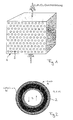
- a functional film 1 shows a functional film 1, in the present case a PEM functional film, which as Fuel cell is used, with essentially cylindrical recesses 2, whereby the diameter of the tubes or tubules decreases only minimally towards the bottom.
- the tubes are open at the bottom and have a hydraulically equivalent Diameter (in this case a minimum inside diameter) of 30 ⁇ m.
- the Functional film 1 is approx. 15 ⁇ m thick in the flat area, the wall thickness in the area of the depressions 2 in the present case, due to the production, significantly less than the film thickness 1 is in the flat area, which is approximately the original thickness of the functional film 1 equivalent.
- the depressions 2 are arranged offset.
- FIGS. 2 and 3 show a cross section through a tube, including the electrodes A (anode) and K (cathode), the contacting being shown only schematically.
- the inner hydrogen flows through the tube, which serves as fuel.
- 3 is a corresponding view of the functional film 1 is shown.
- the tubes themselves will be surrounded by oxygen (air) on the outside.
- the electrodes A and K are in the present case Coating formed with coal.
- the fuel cell works at relatively low Temperatures (0-140 ° C).
- the derivatives are shown symbolically in FIGS. 2 and 3.
- FIG. 4 illustrates a second embodiment, as shown in FIG. 4, several are the same trained functional films 101 with tube-forming, frustoconical depressions 102 stacked in the axial direction of the depressions 102, being between the individual Functional foils serving as electrolytes 101 mobile anodes A (for example coal dust) and cathodes K (for example coal dust) are provided.
- mobile anodes A for example coal dust
- cathodes K for example coal dust
- FIG. 4 is a truncated cone-shaped configuration of depressions 102 that is open at the bottom of a functional film 101, wherein a plurality of functional films 101 are arranged in a stack are.
- electrodes are in between the individual functional foils 101 Form of stray, mealy coal provided by the appropriate fuel are washed around.
- FIG. 5 shows a further functional film 201 with an essentially cylindrical one Recess 202 which is closed at the bottom, i.e. has a floor.
- the depression has a hydraulically equivalent diameter of 10 mm in the area of the floor.
- a Electrode in the present case the cathode K, is connected to the bottom of the recess 202 and the other electrode, i.e. in the present case the anode A protrudes in the form of a wire or pin into the interior of the recess 202.
- This functional film 201 serves to test the effectiveness of medication a specific patient (Freeflow Electrophoresis - FFE).
- the in-depth 202 a body fluid of the patient, for example blood, without and in one or several other tests filled with certain doses of the drug.
- the pH value is usually between 3 and 10.
- the test is carried out A voltage is applied across the electrodes A, K, the effectiveness of a drug in the patient from the current course, i.e. the course of resistance can be.
- several wells can be used corresponding electrode arrangement may be provided. Alternatively, each well can be contain another sample.
- Fig. 6 shows a variant with a closed bottom.
- a cover in Fig. 6 shown from top to bottom on the right
- the cover is in turn preferably also made of a solid electrolyte educated.
- a fuel-encapsulated, catalytic electrode in the present case in powder form (with nano / microfine particles), arranged, indicated by small dots in FIG. 6.
- the flow directions of the operating materials are indicated by arrows.
- FIGS. 7 and 8 show a variant of FIG. 6, an open floor being provided here is.
- the end of the recesses penetrates the corresponding cover, as shown in detail in Fig. 8 enlarged.
- Fig. 7 shows the functional film before assembling with the cover.
- Functional foils are provided with adhesive seams or weld seams when passing through. Further the end may be flared, as shown in FIG. 8. Otherwise this variant corresponds the variant shown in Fig. 6.
Landscapes
- Chemical & Material Sciences (AREA)
- Engineering & Computer Science (AREA)
- Manufacturing & Machinery (AREA)
- Chemical Kinetics & Catalysis (AREA)
- Electrochemistry (AREA)
- General Chemical & Material Sciences (AREA)
- Sustainable Energy (AREA)
- Sustainable Development (AREA)
- Life Sciences & Earth Sciences (AREA)
- Physics & Mathematics (AREA)
- Condensed Matter Physics & Semiconductors (AREA)
- General Physics & Mathematics (AREA)
- Inorganic Chemistry (AREA)
- Dispersion Chemistry (AREA)
- Shaping Of Tube Ends By Bending Or Straightening (AREA)
- Inert Electrodes (AREA)
Abstract
Description
Die offenzellige Form bzw. Anordnung bleibt bei der Bildung eines Filterkuchens ebenfalls vollständig erhalten, so dass die Diffusionsfähigkeit durch die Bildung des Filterkuchens nicht beeinflusst wird.
Dabei kann dieses polymere Material fluoriert, phosphatiert und/oder sulfoniert sein. Der Einsatz von Polytetrafluorethylen in sulfonierter Form und Polyetheretherketon (PEEKK) ist bevorzugt. Da bei PEM-, d.h. Nieder-Temperatur-Brennstoffzellen, die Betriebstemperatur bei 0 bis 140°C, insbesondere bei 35 bis 120°C, liegt, ist mit einem Kondensat (Aspiration) auf der Oxidationsstromseite des Feststoffeletrolyten zu rechnen, wodurch es zu einer Befeuchtung kommt. Im Falle von SOFC-Brennstoffzellen (oxidkeramischen Brennstoffzellen) wird als Ausgangsmaterial Zirkoniumdioxid, das vorzugsweise mit ScOx (Scandiumoxid), LaOx (Lanthanoxid), CeOx (Ceroxid), MnOx (Manganoxid) und/oder YOx (Yttriumoxid), insbesondere mit ScOx und YOx dotiert ist, bevorzugt. Bei SOFC-, d.h. Hoch-Temperatur-Brennstoffzellen, beträgt die Betriebstemperatur 380 bis 1050°C. Hier entsteht auf der Brennstoffseite des Feststoffelektrolyten kein Kondensat (Aspiration), da Wasser ausschließlich in gasförmigem Aggregatzustand vorliegt. Funktionsfolien aus anderen Materialien, die sich entsprechend gestalten, insbesondere umformen, lassen, sind ebenfalls möglich.
- Fig. 1
- eine schematisch Darstellung eines ersten Ausführungsbeispiels,
- Fig. 2
- einen Schnitt durch ein Röhrchen von Fig. 1,
- Fig. 3
- eine leicht schematisierte Anordnung gemäß Fig. 1,
- Fig. 4
- ein zweites Ausführungsbeispiel,
- Fig. 5
- ein drittes Ausführungsbeispiel, und
- Fig. 6-8
- Darstellungen weiterer Varianten von Funktionsfolien in geschnittener Darstellung.
Claims (14)
- Funktionsfolie, umfassend einen Feststoffelektrolyten, der eine katalytisch wirksame Anode (A) und eine katalytisch wirksame Kathode (K) trennt, dadurch gekennzeichnet, dass die Funktionsfolie (1; 101; 201) zumindest eine Vertiefung (2; 102; 202) aufweist.
- Funktionsfolie nach Anspruch 1, dadurch gekennzeichnet, dass die Vertiefung (2; 102; 202) in einer Richtung in einem Winkel von 90° bis 120° zur Ebene der Funktionsfolie (1; 101; 201) angeordnet sind.
- Funktionsfolie nach Anspruch 2, dadurch gekennzeichnet, dass keine Hinterschneidungen vorgesehen sind.
- Funktionsfolie nach einem der vorhergehenden Ansprüche, dadurch gekennzeichnet, dass die Vertiefung (2; 102) an ihrem unteren Ende offen ist.
- Funktionsfolie nach einem der vorhergehenden Ansprüche, dadurch gekennzeichnet, dass die Vertiefung (2; 102; 202) am unteren Ende einen hydraulisch gleichwertigen Innendurchmesser von minimal 3 µm und maximal 10 mm aufweist.
- Funktionsfolie nach einem der vorhergehenden Ansprüche, dadurch gekennzeichnet, dass der hydraulisch gleichwertige Innendurchmesser der Vertiefung (2; 102; 202) im Verhältnis zu den Längen der Vertiefung (2; 102; 202) 1:1 bis 1:100, vorzugsweise 1:5 bis 1:10 beträgt.
- Funktionsfolie nach einem der vorhergehenden Ansprüche, dadurch gekennzeichnet, dass die Funktionsfolie (101) in einem Stapel angeordnet ist.
- Funktionsfolie nach Anspruch 7, dadurch gekennzeichnet, dass die offenen oder geschlossenen Vertiefungen (2; 102) der einzelnen Funktionsfolien (101) des Stapels in entsprechenden offenen oder geschlossenen Vertiefungen (2; 102) anderer Funktionsfolien (101) des Stapels angeordnet sind.
- Funktionsfolie nach einem der vorhergehenden Ansprüche, dadurch gekennzeichnet, dass an der Funktionsfolie (1; 101; 201) eine Anode (A) und/oder Kathode (K) vorgesehen ist, die in diffusionsfähiger und/oder offenzelliger und/oder mobiler Form vorliegt.
- Funktionsfolie nach einem der vorhergehenden Ansprüche, dadurch gekennzeichnet, dass die Wandstärke der Funktionsfolie (1; 101; 201) im ebenen Bereich größer als die Wandstärke im Bereich der Vertiefung (2; 102; 202) ist.
- Verwendung einer Funktionsfolie nach einem der vorhergehenden Ansprüche als Brennstoffzelle, zur Elektrolyse, in der Fotovoltaik, bei der Katalyse, in der Elektrodialyse, bei der Freeflow Elektrophorese, in bipolare Zellen oder zur Messung von Sauerstoff.
- Verfahren zur Herstellung einer Funktionsfolie gemäß einem der Ansprüche 1 bis 10, dadurch gekennzeichnet, dass eine ebene Funktionsfolie (1; 101; 201) bereichsweise plastisch verformt wird, wobei in Folge der plastischen Verformung zumindest eine Vertiefung (2; 102; 202) entsteht.
- Verfahren nach Anspruch 12, dadurch gekennzeichnet, dass gleichzeitig oder in einem Arbeitsgang eine Mehrzahl von Vertiefungen (2; 102; 202) hergestellt werden.
- Verfahren nach einem der Ansprüche 12 bis 13, dadurch gekennzeichnet, dass die Funktionsfolie (1; 101; 201) als Grünling oder Bräunling ausgeformt, gesintert und anschließend mit weiteren Funktionsschichten beschichtet wird.
Applications Claiming Priority (2)
| Application Number | Priority Date | Filing Date | Title |
|---|---|---|---|
| DE10200162 | 2002-01-04 | ||
| DE10200162 | 2002-01-04 |
Publications (2)
| Publication Number | Publication Date |
|---|---|
| EP1329968A2 true EP1329968A2 (de) | 2003-07-23 |
| EP1329968A3 EP1329968A3 (de) | 2007-04-04 |
Family
ID=7711521
Family Applications (1)
| Application Number | Title | Priority Date | Filing Date |
|---|---|---|---|
| EP03000121A Withdrawn EP1329968A3 (de) | 2002-01-04 | 2003-01-03 | Funktionsfolie, Verfahren zur Herstellung einer derartigen Funktionsfolie sowie Verwendung derselben |
Country Status (1)
| Country | Link |
|---|---|
| EP (1) | EP1329968A3 (de) |
Cited By (2)
| Publication number | Priority date | Publication date | Assignee | Title |
|---|---|---|---|---|
| DE10312773A1 (de) * | 2003-03-23 | 2004-10-21 | Rennebeck, Klaus, Dr. | Verfahren zur Herstellung von elektrisch leitenden Mikrofolien, Mikrofasern, Mikro-Hohlfasern, Nano- und Mikropartikel, entsprechend hergestellte Teile und deren Verwendung |
| DE102004062449A1 (de) * | 2004-12-17 | 2006-07-06 | Klaus Dr. Rennebeck | Brennstoffzellensystem auf Mikrohohlfaser-Basis zur Wassermineralisierung |
Family Cites Families (3)
| Publication number | Priority date | Publication date | Assignee | Title |
|---|---|---|---|---|
| US5716664A (en) * | 1995-12-22 | 1998-02-10 | Marchetti; George A. | Method of making a hydrophilic, graphite electrode membrane assembly |
| US6197450B1 (en) * | 1998-10-22 | 2001-03-06 | Ramot University Authority For Applied Research & Industrial Development Ltd. | Micro electrochemical energy storage cells |
| AU4542600A (en) * | 1999-04-25 | 2000-11-10 | Klaus Rennebeck | Method and device for obtaining hydrogen |
-
2003
- 2003-01-03 EP EP03000121A patent/EP1329968A3/de not_active Withdrawn
Cited By (2)
| Publication number | Priority date | Publication date | Assignee | Title |
|---|---|---|---|---|
| DE10312773A1 (de) * | 2003-03-23 | 2004-10-21 | Rennebeck, Klaus, Dr. | Verfahren zur Herstellung von elektrisch leitenden Mikrofolien, Mikrofasern, Mikro-Hohlfasern, Nano- und Mikropartikel, entsprechend hergestellte Teile und deren Verwendung |
| DE102004062449A1 (de) * | 2004-12-17 | 2006-07-06 | Klaus Dr. Rennebeck | Brennstoffzellensystem auf Mikrohohlfaser-Basis zur Wassermineralisierung |
Also Published As
| Publication number | Publication date |
|---|---|
| EP1329968A3 (de) | 2007-04-04 |
Similar Documents
| Publication | Publication Date | Title |
|---|---|---|
| EP3980580B1 (de) | Elektrisch leitfähige nanofasern für eine polymermembran-basierte elektrolyse | |
| DE60118884T2 (de) | Verfahren zur herstellung einer anoden-tragenden elektrolyt enthaltende anordnung und solche anordnung enthaltende keramische zelle | |
| DE19949431A1 (de) | Festoxidbrennstoffzelle mit einem Mischungsgradienten zwischen Elektrode und Elektrolyt | |
| DE102008048632A1 (de) | Nanoröhrenanordnung, Bipolarplatte und Prozess zu deren Herstellung | |
| WO2010072460A1 (de) | Strukturierte elektrode für keramische sensorelemente | |
| DE102022115552A1 (de) | Elektrochemische Zelle | |
| DE102011081553A1 (de) | Inert geträgerte tubulare Brennstoffzelle | |
| WO2005045979A2 (de) | Kathodenwerkstoff für eine hochtemperatur-brennstoffzelle (sofc) sowie eine daraus herstellbare kathode | |
| WO2023208279A2 (de) | Elektrochemische zelle und verfahren zur herstellung eines bauteils einer elektrochemischen zelle | |
| DE7738098U1 (de) | Elektrochemische zelle | |
| DE102016123910B4 (de) | Gasdiffusionselektrode | |
| DE112007000467T5 (de) | Protonenleitender Elektrolyt und diesen verwendende elektrochemische Zelle | |
| DE112023000760T5 (de) | Elektrochemische zelle | |
| EP1329968A2 (de) | Funktionsfolie, Verfahren zur Herstellung einer derartigen Funktionsfolie sowie Verwendung derselben | |
| WO2016016181A1 (de) | Brennstoffzellenvorrichtung | |
| DE10342691A1 (de) | Stapelbare Hochtemperaturbrennstoffzelle | |
| DE112006000121T5 (de) | Hohlförmige Membran-Elektroden-Einheit für Brennstoffzelle und Brennstoffzelle hohler Bauart | |
| EP3108528B1 (de) | Gasdiffusionselektrode, verfahren zum herstellen einer gasdiffusionselektrode und batterie | |
| DE2824408C3 (de) | Verfahren zur Herstellung eines elektronisch | |
| DE10208136B4 (de) | Funktionsfolie, umfassend einen Feststoffelektrolyten, eine katalytisch wirksame Anode und eine katalytisch wirksame Kathode, Herstellung der Funktionsfolie und Verwendung derselben | |
| DE102012221427A1 (de) | Brennstoffzellensystem | |
| EP2669984A2 (de) | Anoden-Schichtsystem für elektrochemische Anwendungen sowie Verfahren zur Herstellung desselben | |
| DE10212966B4 (de) | Hochtemperatur-Brennstoffzelle und Verfahren zu deren Herstellung | |
| EP1790025B1 (de) | Stapelbare hochtemperaturbrennstoffzelle | |
| DE112019000078T5 (de) | Legierungsbauteil, zellenstapel und zellenstapelvorrichtung |
Legal Events
| Date | Code | Title | Description |
|---|---|---|---|
| PUAI | Public reference made under article 153(3) epc to a published international application that has entered the european phase |
Free format text: ORIGINAL CODE: 0009012 |
|
| AK | Designated contracting states |
Designated state(s): AT BE BG CH CY CZ DE DK EE ES FI FR GB GR HU IE IT LI LU MC NL PT SE SI SK TR |
|
| AX | Request for extension of the european patent |
Extension state: AL LT LV MK RO |
|
| PUAL | Search report despatched |
Free format text: ORIGINAL CODE: 0009013 |
|
| AK | Designated contracting states |
Kind code of ref document: A3 Designated state(s): AT BE BG CH CY CZ DE DK EE ES FI FR GB GR HU IE IT LI LU MC NL PT SE SI SK TR |
|
| AX | Request for extension of the european patent |
Extension state: AL LT LV MK RO |
|
| AKX | Designation fees paid | ||
| REG | Reference to a national code |
Ref country code: DE Ref legal event code: 8566 |
|
| STAA | Information on the status of an ep patent application or granted ep patent |
Free format text: STATUS: THE APPLICATION IS DEEMED TO BE WITHDRAWN |
|
| 18D | Application deemed to be withdrawn |
Effective date: 20071005 |