EP1325967A1 - High strength steel pipe having strength higher than that of api x65 grade - Google Patents
High strength steel pipe having strength higher than that of api x65 grade Download PDFInfo
- Publication number
- EP1325967A1 EP1325967A1 EP02746006A EP02746006A EP1325967A1 EP 1325967 A1 EP1325967 A1 EP 1325967A1 EP 02746006 A EP02746006 A EP 02746006A EP 02746006 A EP02746006 A EP 02746006A EP 1325967 A1 EP1325967 A1 EP 1325967A1
- Authority
- EP
- European Patent Office
- Prior art keywords
- steel pipe
- temperature
- api
- grade
- steel
- Prior art date
- Legal status (The legal status is an assumption and is not a legal conclusion. Google has not performed a legal analysis and makes no representation as to the accuracy of the status listed.)
- Withdrawn
Links
Images


Classifications
-
- C—CHEMISTRY; METALLURGY
- C22—METALLURGY; FERROUS OR NON-FERROUS ALLOYS; TREATMENT OF ALLOYS OR NON-FERROUS METALS
- C22C—ALLOYS
- C22C38/00—Ferrous alloys, e.g. steel alloys
- C22C38/02—Ferrous alloys, e.g. steel alloys containing silicon
-
- C—CHEMISTRY; METALLURGY
- C21—METALLURGY OF IRON
- C21D—MODIFYING THE PHYSICAL STRUCTURE OF FERROUS METALS; GENERAL DEVICES FOR HEAT TREATMENT OF FERROUS OR NON-FERROUS METALS OR ALLOYS; MAKING METAL MALLEABLE, e.g. BY DECARBURISATION OR TEMPERING
- C21D8/00—Modifying the physical properties of ferrous metals or ferrous alloys by deformation combined with, or followed by, heat treatment
- C21D8/02—Modifying the physical properties of ferrous metals or ferrous alloys by deformation combined with, or followed by, heat treatment during manufacturing of plates or strips
-
- C—CHEMISTRY; METALLURGY
- C21—METALLURGY OF IRON
- C21D—MODIFYING THE PHYSICAL STRUCTURE OF FERROUS METALS; GENERAL DEVICES FOR HEAT TREATMENT OF FERROUS OR NON-FERROUS METALS OR ALLOYS; MAKING METAL MALLEABLE, e.g. BY DECARBURISATION OR TEMPERING
- C21D8/00—Modifying the physical properties of ferrous metals or ferrous alloys by deformation combined with, or followed by, heat treatment
- C21D8/10—Modifying the physical properties of ferrous metals or ferrous alloys by deformation combined with, or followed by, heat treatment during manufacturing of tubular bodies
-
- C—CHEMISTRY; METALLURGY
- C21—METALLURGY OF IRON
- C21D—MODIFYING THE PHYSICAL STRUCTURE OF FERROUS METALS; GENERAL DEVICES FOR HEAT TREATMENT OF FERROUS OR NON-FERROUS METALS OR ALLOYS; MAKING METAL MALLEABLE, e.g. BY DECARBURISATION OR TEMPERING
- C21D9/00—Heat treatment, e.g. annealing, hardening, quenching or tempering, adapted for particular articles; Furnaces therefor
- C21D9/08—Heat treatment, e.g. annealing, hardening, quenching or tempering, adapted for particular articles; Furnaces therefor for tubular bodies or pipes
-
- C—CHEMISTRY; METALLURGY
- C22—METALLURGY; FERROUS OR NON-FERROUS ALLOYS; TREATMENT OF ALLOYS OR NON-FERROUS METALS
- C22C—ALLOYS
- C22C38/00—Ferrous alloys, e.g. steel alloys
- C22C38/002—Ferrous alloys, e.g. steel alloys containing In, Mg, or other elements not provided for in one single group C22C38/001 - C22C38/60
-
- C—CHEMISTRY; METALLURGY
- C22—METALLURGY; FERROUS OR NON-FERROUS ALLOYS; TREATMENT OF ALLOYS OR NON-FERROUS METALS
- C22C—ALLOYS
- C22C38/00—Ferrous alloys, e.g. steel alloys
- C22C38/04—Ferrous alloys, e.g. steel alloys containing manganese
-
- C—CHEMISTRY; METALLURGY
- C22—METALLURGY; FERROUS OR NON-FERROUS ALLOYS; TREATMENT OF ALLOYS OR NON-FERROUS METALS
- C22C—ALLOYS
- C22C38/00—Ferrous alloys, e.g. steel alloys
- C22C38/06—Ferrous alloys, e.g. steel alloys containing aluminium
-
- C—CHEMISTRY; METALLURGY
- C22—METALLURGY; FERROUS OR NON-FERROUS ALLOYS; TREATMENT OF ALLOYS OR NON-FERROUS METALS
- C22C—ALLOYS
- C22C38/00—Ferrous alloys, e.g. steel alloys
- C22C38/12—Ferrous alloys, e.g. steel alloys containing tungsten, tantalum, molybdenum, vanadium, or niobium
-
- C—CHEMISTRY; METALLURGY
- C22—METALLURGY; FERROUS OR NON-FERROUS ALLOYS; TREATMENT OF ALLOYS OR NON-FERROUS METALS
- C22C—ALLOYS
- C22C38/00—Ferrous alloys, e.g. steel alloys
- C22C38/14—Ferrous alloys, e.g. steel alloys containing titanium or zirconium
-
- Y—GENERAL TAGGING OF NEW TECHNOLOGICAL DEVELOPMENTS; GENERAL TAGGING OF CROSS-SECTIONAL TECHNOLOGIES SPANNING OVER SEVERAL SECTIONS OF THE IPC; TECHNICAL SUBJECTS COVERED BY FORMER USPC CROSS-REFERENCE ART COLLECTIONS [XRACs] AND DIGESTS
- Y10—TECHNICAL SUBJECTS COVERED BY FORMER USPC
- Y10S—TECHNICAL SUBJECTS COVERED BY FORMER USPC CROSS-REFERENCE ART COLLECTIONS [XRACs] AND DIGESTS
- Y10S148/00—Metal treatment
- Y10S148/902—Metal treatment having portions of differing metallurgical properties or characteristics
- Y10S148/909—Tube
Definitions
- the present invention relates to a high-strength steel pipe having a strength of API X65 grade or higher which is used for line pipes, more particularly, a high-strength steel pipe having excellent hydrogen-induced cracking resistance (HIC resistance), and a manufacturing method thereof.
- HIC resistance hydrogen-induced cracking resistance
- a steel pipe for line pipes which is used for transportation of crude oil or natural gas containing hydrogen sulfide, is required to have what we call sour resistance including HIC resistance and stress corrosion cracking resistance (SCC resistance) as well as high strength, excellent toughness, and good weldability.
- HIC is caused by an internal pressure that is produced by a phenomenon that hydrogen ions created by corrosion reaction are adsorbed on the steel surface, intrude into steel as atomic hydrogen, and accumulate around nonmetallic inclusions such as MnS and hard second phases such as martensite in steel.
- Unexamined Japanese Patent Publication No. 54-110119 has disclosed a manufacturing method of linepipe steels, in which by adding Ca or Ce in proper amounts relative to the amount of S, and forming fine spherical inclusions to decrease stress concentration instead of formation of needle-like MnS inclusions.
- 61-165207 have disclosed a steel in which the formation of island-like martensite that functions as an origin of cracking in a center segregation region and hard phases such as martensite or bainite that function as a propagation path of cracking is restrained by a decrease in amount of segregation-prone elements (C, Mn, P, etc.), soaking treatment at a stage of slab heating, accelerated cooling during transformation at a stage of cooling, etc.
- segregation-prone elements C, Mn, P, etc.
- 7-173536 have disclosed a steel plate having a strength of API X80 grade or higher, in which the shape of inclusions is controlled by adding Ca to a low-S steel, center segregation is restrained by lower contents of C and Mn, and high strength is provided by the addition of Cr, Mn and Ni and accelerated cooling. All of these methods for preventing HIC are methods for preventing HIC caused by center segregation.
- a steel plate having a strength of API X65 grade or higher is usually manufactured by accelerated cooling or direct quenching, so that a near surface region of the steel plate which receives high cooling rate is more liable to be hardened than the interior thereof, and hence HIC occurs easily in the near surface region.
- microstructure obtained by accelerated cooling consists of bainite and acicular ferrite having relatively high HIC sensitivity not only in the near surface region but also in the interior, so that the above-described method for preventing HIC caused by center segregation does not suffice. Therefore, in order to prevent HIC of steel plate completely, measures must be taken against HIC caused by the microstructure of the near surface region of steel plate and HIC caused by inclusions such as sulfide or oxide as well as HIC caused by center segregation.
- Unexamined Japanese Patent Publication No. 7-216500 has disclosed an API X80 grade HIC-resistant steel that is composed of ferrite and bainite phases and does not contain block-like bainite or martensite phases with high HIC sensitivity.
- Unexamined Japanese Patent Publication No. 61-227129 and Unexamined Japanese Patent Publication No. 7-70697 have disclosed high-strength steels in which SCC resistance and HIC resistance are improved by ferritic microstructure and Mo or Ti is added to utilize precipitation strengthening by carbides.
- the microstructure of the high-strength steel described in Unexamined Japanese Patent Publication No. 7-216500 consists of bainite phases with relatively high HIC sensitivity. Also, this steel is high in manufacturing cost because the content of S and Mn is restricted severely and Ca treatment is necessary.
- the microstructure of the high-strength steels described in Unexamined Japanese Patent Publication No. 61-227129 and Unexamined Japanese Patent Publication No. 7-70697 consists of ductile ferritic phases, so that the HIC sensitivity is very low, while the strength is low. In order to obtain higher strength for the steel described in Unexamined Japanese Patent Publication No.
- An object of the present invention is to provide a high-strength steel pipe of API X65 grade or higher which has excellent HIC resistance and good toughness after welding, and which can be manufactured stably at a low cost, and a manufacturing method thereof.
- the above object can be attained by a high-strength steel pipe of API X65 grade or higher consisting essentially of, by mass %, 0.02 to 0.08% of C, 0.01 to 0.5% of Si, 0.5 to 1.8% of Mn, 0.01 or less of P, 0.002 or less of S, 0.01 to 0.07% of Al, 0.005 to 0.04% of Ti, 0.05 to 0.50% Mo, at least one element selected from 0.005 to 0.05% of Nb and 0.005 to 0.10% of V, and the balance being Fe, in which the volume percentage of ferritic phase is 90% or higher, and complex carbides containing Ti, Mo, and at least one element selected from Nb and V are precipitated in the ferritic phase.
- This high-strength steel pipe is manufactured, for example, by a manufacturing method for a high-strength steel pipe of API X65 grade or higher, comprising the steps of heating a steel slab having chemical composition described above to a temperature in the range of 1000 to 1250°C; hot rolling the steel slab at a finish temperature not lower than the Ar3 transformation temperature to make a steel plate; cooling the steel plate at a cooling rate not lower than 2°C/s; coiling the cooled steel plate at a temperature in the range of 550 to 700°C; and forming the coiled steel plate into a steel pipe.
- a manufacturing method for a high-strength steel pipe of API X65 grade or higher comprising the steps of heating a steel slab having chemical composition described above to a temperature in the range of 1000 to 1250°C; hot rolling the steel slab at a finish temperature not lower than the Ar3 transformation temperature to make a steel plate; cooling the steel plate at a cooling rate not lower than 2°C/s; coiling the cooled steel
- the inventors obtained the following findings as a result of study on HIC resistance and toughness of welded part of a high-strength steel pipe having a strength of API X65 grade or higher which is used for line pipes.
- C is an element for strengthening steel by precipitation as carbides.
- the C content should be 0.02 to 0.08%.
- Si is an element necessary for deoxidization of steel. However, if the Si content is lower than 0.01%, the deoxidization effect is insufficient, and if it exceeds 0.5%, the weldability and the toughness deteriorate. Therefore, the Si content should be 0.01 to 0.5%.
- Mn is an element for strengthening steel and improving the toughness. However, if the Mn content is lower than 0.5%, its effect is insufficient, and if it exceeds 1.8%, the weldability and the HIC resistance deteriorate. Therefore, the Mn content should be 0.5 to 1.8%.
- P is an element that deteriorates the weldability and the HIC resistance. Therefore, the P content should be not higher than 0.01%.
- S turns to MnS inclusion in steel and hence deteriorates the HIC resistance. Therefore, the S content should not be higher than 0.002%.
- Al is added as a deoxidizer. If the Al content is lower than 0.01%, the deoxidization effect is not achieved, and if it exceeds 0.07, the cleanliness of steel degrades and thus the HIC resistance deteriorates. Therefore, the Al content should be 0.01 to 0.07%.
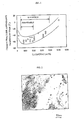
- Ti is an important element in the present invention. If the Ti content is not lower than 0.005%, Ti forms complex carbides together with Mo as described above, so that strengthening of steel is promoted. However, as shown in FIG. 1, if the Ti content exceeds 0.04%, the Charpy fracture appearance transition temperature of heat-affected zone exceeds -20°, and hence the toughness deteriorates. Therefore, the Ti content should be 0.005 to 0.04%. Further, if the Ti content is lower than 0.02%, the Charpy fracture appearance transition temperature of heat-affected zone is not higher than -40°, and hence higher toughness is obtained. Therefore, the Ti content should preferably be 0.005 to less than 0.02%.
- Mo is an important element in the present invention, like Ti. If the Mo content is not lower than 0.05%, pearlite transformation is restrained at a stage of cooling after hot rolling, and fine complex carbides are formed together with Ti so that the strengthening of steel is promoted. However, if the Mo content exceeds 0.50%, hard phases such as bainite or martensite are formed, and hence the HIC resistance deteriorates. Therefore, the Mo content should be 0.05 to 0.50%.
- Nb improves the toughness by microstructure refining, and forms complex carbides together with Ti and Mo, contributing to the strengthening of steel. However, if the Nb content is lower than 0.005%, its effect is not achieved, and if it exceeds 0.05%, the toughness of heat-affected zone deteriorates. Therefore, the Nb content should be 0.005 to 0.05%.
- V forms complex carbides together with Ti and Mo, like Nb, contributing to the strengthening of steel.
- the V content is lower than 0.005%, its effect is not achieved, and if it exceeds 0.1%, the toughness of welded part deteriorates. Therefore, the Nb content should be 0.005 to 0.1%.
- the balance other than the above-described components is Fe. Also, other elements such as unavoidable impurities may be contained as far as these elements exert no influence on the operation and effects of the present invention.
- the ratio of the number of complex carbides smaller than 10 nm and containing Mo and Ti to the number of all the precipitates excluding TiN, which contributes less to the strengthening of steel is not smaller than 80%, preferably not smaller than 95%, the strengthening of steel can be promoted.
- FIG. 2 shows one example of a microstructure of the steel in accordance with the present invention, which is manufactured in a hot rolling mill for steel sheet (coiling temperature : 650°C) using a steel having composition of 0.05% C, 0.15% Si, 1.26% Mn, 0.11% Mo, 0.018% Ti, 0.039% Nb, and 0.048% V. It can be verified that many fine precipitates smaller than 10 nm in size are dispersed. Also, FIG. 3 shows a result of analysis of precipitates made by an energy dispersion X-ray spectroscopy method (EDX). It can be seen that the precipitates are complex carbides containing Ti, Nb, V and Mo.
- EDX energy dispersion X-ray spectroscopy method
- W is added in place of Mo or together with Mo so that the content of (W/2 + Mo) is in the range of 0.05 to 0.50%.
- fine complex carbides are formed together with Ti, and hence the strengthening of steel is promoted. If the content of (W/2 + Mo) exceeds 0.50%, hard phases such as bainite or martensite are formed, deteriorating the HIC resistance.
- the Ca content should be 0.0005 to 0.0040%.
- Cu is an effective element for improving the toughness and increasing the strength. However, if the Cu content exceeds 0.5%, the weldability deteriorates. Therefore, the Cu content should be not higher than 0.5%.
- Ni is an effective element for improving the toughness and increasing the strength. However, if the Ni content exceeds 0.5%, the HIC resistance deteriorates. Therefore, the Ni content should be not higher than 0.5%.
- Cr Cr is an effective element for increasing the strength, like Mn. However, if the Cr content exceeds 0.5%, the weldability deteriorates. Therefore, the Cr content should be not higher than 0.5%.
- Ceq be not higher than 0.30% for API X65 grade, Ceq be not higher than 0.32% for API X70 grade, and Ceq be not higher than 0.34% for API X80 grade.
- Ceq C + Mn/6 + (Cu+Ni)/15 + (Cr+Mo+V)/5
- R expressed by the following equation (2) is in the range of 0.5 to 3.0, thermally stable and very fine complex carbides can be obtained, so that strengthening of steel and improvement in toughness of heat-affected zone can be achieved more stably.
- the R should preferably be 0.7 to 2:0.
- R (C/12)/[(Mo/96)+(Ti/48)+(Nb/93)+(V/51)+(W/184)]
- a steel slab having the above-described composition is heated to a temperature in the range of 1000 to 1250°C, and is hot rolled at a finish temperature not lower than the Ar3 transformation temperature. Then the rolled plate is cooled at a cooling rate not lower than 2°C/s and is coiled at a temperature in the range of 550 to 700°C, and finally, a steel pipe is formed.
- a high-strength steel pipe of API X65 grade or higher which is composed of ferritic phase with a volume percentage not lower than 90% and complex carbides containing Ti, Mo, and at least one element selected from Nb and V which are dispersed in the ferritic phase can be obtained.
- the heating temperature of slab should be 1000 to 1250°C.
- hot rolling should be performed at a finish temperature not lower than the Ar3 transformation temperature.
- hot rolling should preferably be performed at a finish temperature not higher than 950°C.
- the cooling finish temperature should preferably be not lower than the coiling temperature and not higher than 750°C.
- the steel plate After being cooled at a cooling rate not lower than 2°C /s, the steel plate must be coiled at a temperature in the range of 550 to 700°C, preferably in the range of 600 to 660°C, to obtain ferritic phase and fine complex carbides. If the coiling temperature is lower than 550°C, bainitic phase is formed, and hence the HIC resistance deteriorates. If the coiling temperature exceeds 700°C, the complex carbides coarsen, and hence a sufficient strength cannot be obtained.
- This coiling method for coiling the steel plate at a temperature in the range of 550 to 700°C is used when a steel plate which is a raw material for a steel pipe is manufactured in a hot rolling mill for steel sheet.
- the steel plate is formed into an electric resistance welded steel pipe or a spiral steel pipe by the press bent forming method or the roll forming method.
- the steel plate which is a raw material for a steel pipe is manufactured in a hot rolling mill for heavy gauge steel plate, instead of being coiled at a temperature in the range of 550 to 700°C, it is necessary that the steel plate be cooled to a temperature in the range of 600 to 700°C at a cooling rate not lower than 2°C/s, and then it be slowly cooled at least to 550°C at a cooling rate not higher than 0.1°C/s, or the steel plate be cooled to a temperature in the range of 550 to 700°C, and immediately after that, it be subjected to heat treatment at temperatures in the range of 550 to 700°C for three minutes or longer.
- the steel plate is formed into a UOE steel pipe by the UOE forming method.
- the heat treatment at temperatures in the range of 550 to 700°C for three minutes or longer can be accomplished without a decrease in the temperature of steel plate to below 550°C, which does not result in decreased productivity.
- FIG. 4 shows one example of an equipment layout on a plate manufacturing line.
- a hot rolling mill 3, an accelerated cooling apparatus 4, an induction heating apparatus 5 and a hot leveler 6 are arranged in order from the upstream side to the downstream side.
- the steel plate 2 is cooled by the accelerated cooling apparatus 4, and is subjected to heat treatment by the induction heating apparatus 5. Then, the steel plate 2 is corrected in shape by the hot leveler 6, and is sent to a pipe manufacturing process.
- FIG. 5 shows one example of heat treatment using the induction heating apparatus.
- the steel plate is kept at temperatures in the range of 550 to 700°C by performing two cycles of heating using the induction heating apparatus.
- the induction heating apparatus is turned on and off so that the highest temperature (Tmax) does not exceed 700°C and the lowest temperature (Tmin) is not lower than 550°C, by which the steel plate is kept at temperatures in the range of 550 to 700°C for three minutes or longer in total.
- the induction heating arises a difference in temperature between the surface layer and the interior of steel plate.
- the temperature specified herein is an average plate temperature when heat transfers from the surface layer to the interior and becomes even.
- Electric resistance welded steel pipes Nos. 1 to 29 with an outside diameter of 508.0 mm and a wall thickness of 12.7 mm were manufactured, using the steels A to O having chemical composition given in Table 1 and hot rolled under conditions given in Table 2 in a hot rolling mill for steel sheet.
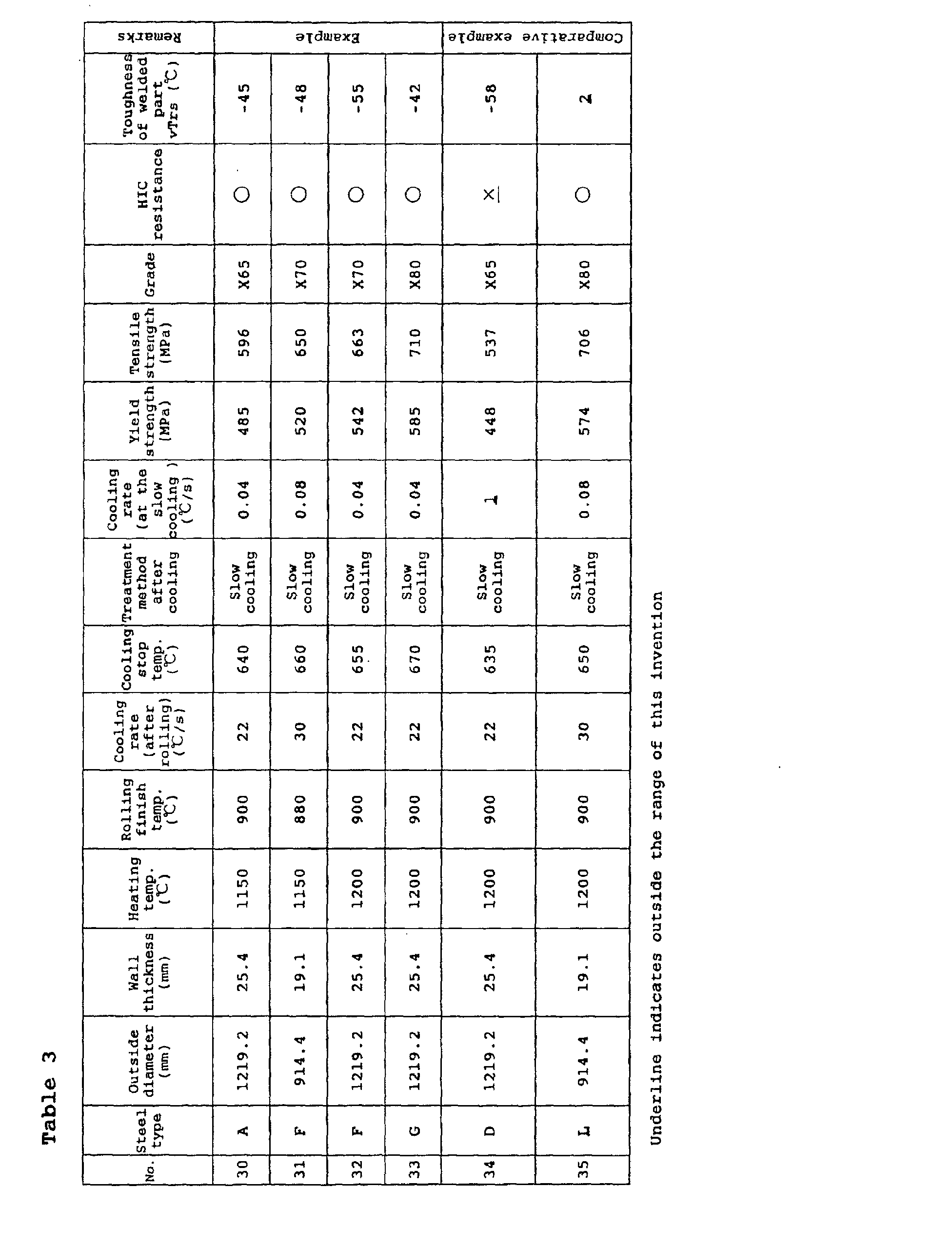
- UOE steel pipes Nos. 30 to 35 with an outside diameter of 914.4 mm and a wall thickness of 19.1 mm and with an outside diameter of 1219.2 mm and a wall thickness of 25.4 mm were manufactured, using steel plates which were produced under conditions given in Table 3 in a hot rolling mill for steel plate.
- the steel plates were piled and slowly cooled to room temperature from a certain temperature.
- the mean cooling rate from the start of slow cooling to 550°C is additionally shown in Table 3.
- the UOE steel pipes given in Table 3 were expanded by 1.2% after they were seam welded by submerged arc welding.
- the microstructure of steel pipe was observed using an optical microscope and a transmission electron microscope (TEM).
- the composition of precipitates was analyzed by an energy dispersion X-ray spectroscopy method (EDX).
- a full-thickness tensile test piece in accordance with API standard was cut out in the circumference direction to conduct a tensile test, by which yield strength and tensile strength were measured.
- the steel pipe having a tensile strength not lower than 550 MPa was regarded as meeting the standard of API X65 grade
- the steel pipe having a tensile strength not lower than 590 MPa was regarded as meeting the standard of API X70 grade
- the steel pipe having a tensile strength not lower than 680 MPa was regarded as meeting the standard of API X80 grade.
- HIC resistance and toughness of heat-affected zone were measured.
- HIC resistance a HIC test of dipping time of 96 hours in accordance with NACE Standard TM-02-84 was conducted, and the case where cracking was not recognized was indicated by ⁇ , and the case where cracking occurred was indicated by .
- HAZ toughness a 2-mm V notch Charpy test piece was taken in the circumference direction in the electric resistance welded portion or the seam welded portion to measure fracture appearance transition temperature (vTrs). At this time, the V notch was formed in the center of electric resistance welded portion for steel pipes Nos. 1 to 29 and in the bond portion (fusion line) at the position of t/2 (t is plate thickness) for steel pipes Nos. 30 to 35.
- All of steel pipes Nos. 1 to 18 in accordance with the present invention were of X65 grade or higher, and had excellent HIC resistance and HAZ toughness.
- the microstructure of those steel pipes was substantially a ferritic phase, in which fine carbides with a particle diameter smaller than 10 nm which contained Ti, Mo, and at least one element selected from Nb and V were dispersed.
- Steel pipes Nos. 3, 4, 5, 10, 11, 12, 17 and 18 using B, C, F and I steels in which the Ti content is lower than 0.005 to 0.02% exhibited higher HAZ toughness.
- steel pipes Nos. 1 to 15 using A to G steels in which the ratio of the C content to the total content of Mo, Ti, Nb, V and W was in the range of 0.7 to 2.0 had a higher strength than steel pipes Nos. 16 to 18 using H and I steels.
- the microstructure thereof was not substantially a ferritic phase because the manufacturing method was outside the range of the present invention, and fine carbides containing Ti, Mo, and at least one element selected from Nb and V were not precipitated, so that a sufficient strength was not obtained and cracking was observed in the HIC test.
- a sufficient amount of solute carbon could not be secured because of low heating temperature, and a sufficient strength could not be obtained because of lack in carbides precipitated at the coiling time.
- the rolling finish temperature was low, the microstructure became elongated in the rolling direction, and hence the HIC resistance deteriorated.
- steel pipes Nos. 24 to 29 as comparative examples had problems of insufficient strength, occurrence of cracking in HIC test, and deteriorated HAZ toughness because the chemical composition was outside the range of the present invention.
- steel pipes Nos. 24 and 25 since the content of Mo or Ti was low, sufficient precipitation strengthening was not achieved, so that the strength was low.
- steel pipe No. 26 since the Ti content was too high, the microstructure was coarsened by welding heat, so that the HAZ toughness deteriorated.
- steel pipe No. 27 since the C content was low, sufficient precipitation strengthening was not achieved, so that the strength was low.
- steel pipe No. 28 since the C content was too high, bainitic phase was formed, and hence the HIC resistance deteriorated.
- steel pipe No. 29 since the S content was too high, many sulfide inclusions were formed, so that the HIC resistance deteriorated.
- All of steel pipes Nos. 30 to 33 in accordance with the present invention had a tensile strength of 580 MPa or higher, and also had high HIC resistance and HAZ toughness.
- the structure of steel pipe was substantially a ferritic phase, in which fine carbides with a particle diameter smaller than 10 nm which contained Ti, Mo, and at least one element selected from Nb and V were dispersed.
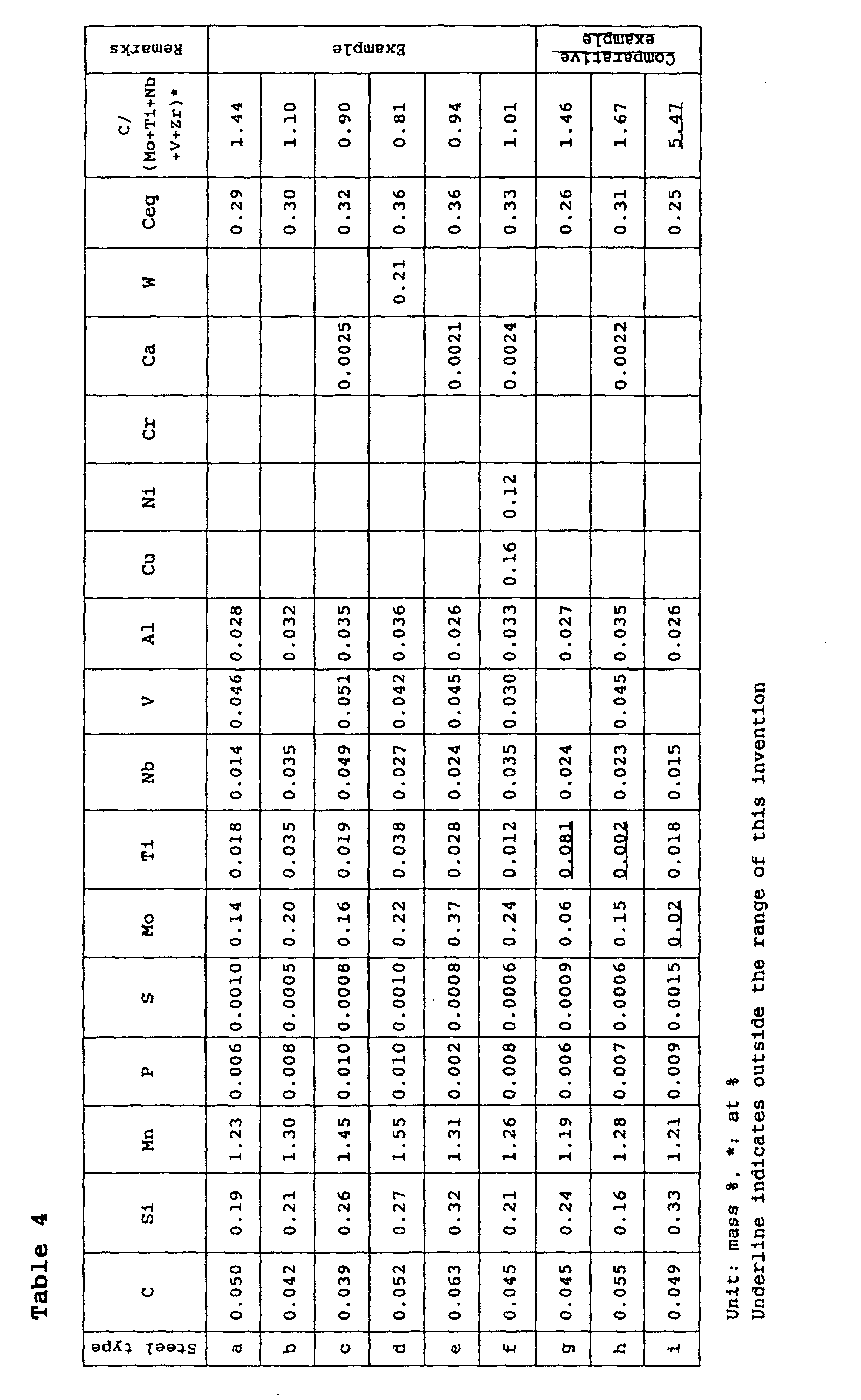
- Steel plates were manufactured under the conditions given in Table 5 in a hot rolling mill for a steel plate by making slabs from steels a to i having chemical composition given in Table 4 by the continuous casting method. After being hot rolled, the rolled steel plates were immediately cooled by using a water-cooled inline accelerated cooling apparatus, and were subjected to heat treatment by using three inline induction heating apparatuses provided in series on the manufacturing line or a gas-fired furnace.
- each temperature is an average plate temperature
- the maximum and minimum temperatures are the above-described highest and lowest temperatures at the time of heat treatment.
- the number of cycles means the number of cycles of heating performed by using the induction heating apparatuses to keep the steel plate at temperatures in the range of 550 to 700°C for three minutes or longer. In the case of gas firing, the steel plate was kept at a fixed temperature.
- UOE steel pipes Nos. 36 to 51 with an outside diameter of 914.4 mm and a wall thickness of 19.1 mm and with an outside diameter of 1219.2 mm and a wall thickness of 25.4 mm were manufactured, and the microstructure, yield strength, tensile strength, HIC resistance, and HAZ toughness were measured.
- All of steel pipes Nos. 36 to 43 which were examples of the present invention, had a tensile strength not lower than 600 MPa, and also had high HIC resistance and HAZ toughness.
- the microstructure of steel pipe was substantially a ferrite phase, in which fine carbides with a particle diameter smaller than 10 nm which contained at least one element selected from Ti, Mo, and Nb and V were dispersed.
- the manufacturing method thereof was outside the range of the present invention
- the chemical composition thereof was outside the range of the present invention. Therefore, for these steel pipes, the microstructure thereof was not substantially a ferrite phase, and fine carbides containing at least one element selected from Ti, Mo, and Nb and V were not precipitated, so that there caused a problem in that a sufficient strength was not obtained and cracking occurred in the HIC test.
Landscapes
- Chemical & Material Sciences (AREA)
- Engineering & Computer Science (AREA)
- Mechanical Engineering (AREA)
- Materials Engineering (AREA)
- Metallurgy (AREA)
- Organic Chemistry (AREA)
- Physics & Mathematics (AREA)
- Thermal Sciences (AREA)
- Crystallography & Structural Chemistry (AREA)
- Manufacturing & Machinery (AREA)
- Heat Treatment Of Steel (AREA)
Abstract
The present invention provides a high-strength steel pipe
of API X65 grade or higher consisting essentially of, by mass %,
0.02 to 0.08% of C, 0.01 to 0.5% of Si, 0.5 to 1.8% of Mn, 0.01%
or less of P, 0.002% or less of S, 0.01 to 0.07% of Al, 0.005
to 0.04% of Ti, 0.05 to 0.50% Mo, at least one element selected
from 0.005 to 0.05% of Nb and 0.005 to 0.10% of V, and the balance
being Fe, in which the volume percentage of ferritic phase is
90% or higher, and complex carbides containing Ti, Mo, and at
least one element selected from Nb and V are precipitated in the
ferritic phase. The high-strength steel pipe in accordance with
the present invention has excellent HIC resistance and good
toughness of heat-affected zone, and can be manufactured stably
at a low cost.
Description
The present invention relates to a high-strength steel pipe
having a strength of API X65 grade or higher which is used for
line pipes, more particularly, a high-strength steel pipe having
excellent hydrogen-induced cracking resistance (HIC resistance),
and a manufacturing method thereof.
A steel pipe for line pipes, which is used for
transportation of crude oil or natural gas containing hydrogen
sulfide, is required to have what we call sour resistance
including HIC resistance and stress corrosion cracking
resistance (SCC resistance) as well as high strength, excellent
toughness, and good weldability. It is said that HIC is caused
by an internal pressure that is produced by a phenomenon that
hydrogen ions created by corrosion reaction are adsorbed on the
steel surface, intrude into steel as atomic hydrogen, and
accumulate around nonmetallic inclusions such as MnS and hard
second phases such as martensite in steel.
To prevent HIC, Unexamined Japanese Patent Publication No.
54-110119 has disclosed a manufacturing method of linepipe steels,
in which by adding Ca or Ce in proper amounts relative to the
amount of S, and forming fine spherical inclusions to decrease
stress concentration instead of formation of needle-like MnS
inclusions. Unexamined Japanese Patent Publication No. 61-60866
and Unexamined Japanese Patent Publication No. 61-165207 have
disclosed a steel in which the formation of island-like
martensite that functions as an origin of cracking in a center
segregation region and hard phases such as martensite or bainite
that function as a propagation path of cracking is restrained
by a decrease in amount of segregation-prone elements (C, Mn,
P, etc.), soaking treatment at a stage of slab heating,
accelerated cooling during transformation at a stage of cooling,
etc. Unexamined Japanese Patent Publication No. 5-9575,
Unexamined Japanese Patent Publication No. 5-271766, and
Unexamined Japanese Patent Publication No. 7-173536 have
disclosed a steel plate having a strength of API X80 grade or
higher, in which the shape of inclusions is controlled by adding
Ca to a low-S steel, center segregation is restrained by lower
contents of C and Mn, and high strength is provided by the addition
of Cr, Mn and Ni and accelerated cooling. All of these methods
for preventing HIC are methods for preventing HIC caused by center
segregation.
However, a steel plate having a strength of API X65 grade
or higher is usually manufactured by accelerated cooling or
direct quenching, so that a near surface region of the steel plate
which receives high cooling rate is more liable to be hardened
than the interior thereof, and hence HIC occurs easily in the
near surface region. Also, microstructure obtained by
accelerated cooling consists of bainite and acicular ferrite
having relatively high HIC sensitivity not only in the near
surface region but also in the interior, so that the above-described
method for preventing HIC caused by center segregation
does not suffice. Therefore, in order to prevent HIC of steel
plate completely, measures must be taken against HIC caused by
the microstructure of the near surface region of steel plate and
HIC caused by inclusions such as sulfide or oxide as well as HIC
caused by center segregation.
On the other hand, Unexamined Japanese Patent Publication
No. 7-216500 has disclosed an API X80 grade HIC-resistant steel
that is composed of ferrite and bainite phases and does not contain
block-like bainite or martensite phases with high HIC sensitivity.
Unexamined Japanese Patent Publication No. 61-227129 and
Unexamined Japanese Patent Publication No. 7-70697 have
disclosed high-strength steels in which SCC resistance and HIC
resistance are improved by ferritic microstructure and Mo or Ti
is added to utilize precipitation strengthening by carbides.
However, the microstructure of the high-strength steel
described in Unexamined Japanese Patent Publication No. 7-216500
consists of bainite phases with relatively high HIC sensitivity.
Also, this steel is high in manufacturing cost because the content
of S and Mn is restricted severely and Ca treatment is necessary.
The microstructure of the high-strength steels described in
Unexamined Japanese Patent Publication No. 61-227129 and
Unexamined Japanese Patent Publication No. 7-70697 consists of
ductile ferritic phases, so that the HIC sensitivity is very low,
while the strength is low. In order to obtain higher strength
for the steel described in Unexamined Japanese Patent Publication
No. 61-227129, large amounts of C and Mo are added, cold-rolling
is performed after quench-and-temper, and tempering is performed
again to precipitate a large amount of carbides, resulting in
increased manufacturing cost . The steel described in Unexamined
Japanese Patent Publication No. 7-70697 cannot achieve high
strength stably because Ti is added to obtain high strength by
utilizing precipitation strengthening of TiC at a stage of
coiling, but TiC is liable to be coarsened by the influence of
coiling temperature. Although high strength can be achieved
stably by adding large amount of Ti, the toughness of heat-affected
zone deteriorates significantly when the welding such
as electric resistance welding or submerged arc welding are
applied.
An object of the present invention is to provide a
high-strength steel pipe of API X65 grade or higher which has
excellent HIC resistance and good toughness after welding, and
which can be manufactured stably at a low cost, and a manufacturing
method thereof.
The above object can be attained by a high-strength steel
pipe of API X65 grade or higher consisting essentially of, by
mass %, 0.02 to 0.08% of C, 0.01 to 0.5% of Si, 0.5 to 1.8% of
Mn, 0.01 or less of P, 0.002 or less of S, 0.01 to 0.07% of
Al, 0.005 to 0.04% of Ti, 0.05 to 0.50% Mo, at least one element
selected from 0.005 to 0.05% of Nb and 0.005 to 0.10% of V, and
the balance being Fe, in which the volume percentage of ferritic
phase is 90% or higher, and complex carbides containing Ti, Mo,
and at least one element selected from Nb and V are precipitated
in the ferritic phase.
This high-strength steel pipe is manufactured, for example,
by a manufacturing method for a high-strength steel pipe of API
X65 grade or higher, comprising the steps of heating a steel slab
having chemical composition described above to a temperature in
the range of 1000 to 1250°C; hot rolling the steel slab at a finish
temperature not lower than the Ar3 transformation temperature
to make a steel plate; cooling the steel plate at a cooling rate
not lower than 2°C/s; coiling the cooled steel plate at a
temperature in the range of 550 to 700°C; and forming the coiled
steel plate into a steel pipe.
The inventors obtained the following findings as a result
of study on HIC resistance and toughness of welded part of a
high-strength steel pipe having a strength of API X65 grade or
higher which is used for line pipes.
The present invention has been made based on the above
findings. The reason for limiting the content of each element
will be described below.
C: C is an element for strengthening steel by precipitation
as carbides. However, if the C content is lower than 0.02%, a
strength of API X65 grade or higher cannot be obtained, and if
it exceeds 0.08%, the HIC resistance and the toughness of welded
part deteriorate. Therefore, the C content should be 0.02 to
0.08%.
Si: Si is an element necessary for deoxidization of steel.
However, if the Si content is lower than 0.01%, the deoxidization
effect is insufficient, and if it exceeds 0.5%, the weldability
and the toughness deteriorate. Therefore, the Si content should
be 0.01 to 0.5%.
Mn: Mn is an element for strengthening steel and improving
the toughness. However, if the Mn content is lower than 0.5%,
its effect is insufficient, and if it exceeds 1.8%, the
weldability and the HIC resistance deteriorate. Therefore, the
Mn content should be 0.5 to 1.8%.
P: P is an element that deteriorates the weldability and
the HIC resistance. Therefore, the P content should be not higher
than 0.01%.
S: S turns to MnS inclusion in steel and hence deteriorates
the HIC resistance. Therefore, the S content should not be higher
than 0.002%.
Al: Al is added as a deoxidizer. If the Al content is lower
than 0.01%, the deoxidization effect is not achieved, and if it
exceeds 0.07, the cleanliness of steel degrades and thus the
HIC resistance deteriorates. Therefore, the Al content should
be 0.01 to 0.07%.
Ti: Ti is an important element in the present invention.
If the Ti content is not lower than 0.005%, Ti forms complex
carbides together with Mo as described above, so that
strengthening of steel is promoted. However, as shown in FIG.
1, if the Ti content exceeds 0.04%, the Charpy fracture appearance
transition temperature of heat-affected zone exceeds -20°, and
hence the toughness deteriorates. Therefore, the Ti content
should be 0.005 to 0.04%. Further, if the Ti content is lower
than 0.02%, the Charpy fracture appearance transition
temperature of heat-affected zone is not higher than -40°, and
hence higher toughness is obtained. Therefore, the Ti content
should preferably be 0.005 to less than 0.02%.
Mo : As described above, Mo is an important element in the
present invention, like Ti. If the Mo content is not lower than
0.05%, pearlite transformation is restrained at a stage of
cooling after hot rolling, and fine complex carbides are formed
together with Ti so that the strengthening of steel is promoted.
However, if the Mo content exceeds 0.50%, hard phases such as
bainite or martensite are formed, and hence the HIC resistance
deteriorates. Therefore, the Mo content should be 0.05 to 0.50%.
Nb: Nb improves the toughness by microstructure refining,
and forms complex carbides together with Ti and Mo, contributing
to the strengthening of steel. However, if the Nb content is
lower than 0.005%, its effect is not achieved, and if it exceeds
0.05%, the toughness of heat-affected zone deteriorates.
Therefore, the Nb content should be 0.005 to 0.05%.
V: V forms complex carbides together with Ti and Mo, like
Nb, contributing to the strengthening of steel. However, if the
V content is lower than 0.005%, its effect is not achieved, and
if it exceeds 0.1%, the toughness of welded part deteriorates.
Therefore, the Nb content should be 0.005 to 0.1%.
If at least one element selected from Nb and V is contained,
the strengthening and improvement in toughness of heat-affected
zone are achieved.
The balance other than the above-described components is
Fe. Also, other elements such as unavoidable impurities may be
contained as far as these elements exert no influence on the
operation and effects of the present invention.
If the ratio of the number of complex carbides smaller than
10 nm and containing Mo and Ti to the number of all the precipitates
excluding TiN, which contributes less to the strengthening of
steel, is not smaller than 80%, preferably not smaller than 95%,
the strengthening of steel can be promoted.
FIG. 2 shows one example of a microstructure of the steel
in accordance with the present invention, which is manufactured
in a hot rolling mill for steel sheet (coiling temperature : 650°C)
using a steel having composition of 0.05% C, 0.15% Si, 1.26% Mn,
0.11% Mo, 0.018% Ti, 0.039% Nb, and 0.048% V. It can be verified
that many fine precipitates smaller than 10 nm in size are
dispersed. Also, FIG. 3 shows a result of analysis of
precipitates made by an energy dispersion X-ray spectroscopy
method (EDX). It can be seen that the precipitates are complex
carbides containing Ti, Nb, V and Mo.
Further, W is added in place of Mo or together with Mo so
that the content of (W/2 + Mo) is in the range of 0.05 to 0.50%.
In this case as well, fine complex carbides are formed together
with Ti, and hence the strengthening of steel is promoted. If
the content of (W/2 + Mo) exceeds 0.50%, hard phases such as
bainite or martensite are formed, deteriorating the HIC
resistance.
Further, if Ca is added, the shape of sulfide inclusions
is controlled, and hence the HIC resistance is improved. However,
if the Ca content is lower than 0.0005%, its effect is insufficient,
and if it exceeds 0.0040%, the cleanliness of steel degrades and
thus the HIC resistance deteriorates. Therefore, the Ca content
should be 0.0005 to 0.0040%.
Still further, if at least one element selected from Cu,
Ni and Cr is contained in an amount described below, further
strengthening of steel can be achieved.
Cu: Cu is an effective element for improving the toughness
and increasing the strength. However, if the Cu content exceeds
0.5%, the weldability deteriorates. Therefore, the Cu content
should be not higher than 0.5%.
Ni: Ni is an effective element for improving the toughness
and increasing the strength. However, if the Ni content exceeds
0.5%, the HIC resistance deteriorates. Therefore, the Ni content
should be not higher than 0.5%.
Cr: Cr is an effective element for increasing the strength,
like Mn. However, if the Cr content exceeds 0.5%, the weldability
deteriorates. Therefore, the Cr content should be not higher
than 0.5%.
If not only the content of each component but also Ceq
expressed by the following equation (1) is controlled, the
toughness of heat-affected zone is further improved. In
particular, it is preferable that Ceq be not higher than 0.30%
for API X65 grade, Ceq be not higher than 0.32% for API X70 grade,
and Ceq be not higher than 0.34% for API X80 grade.
Ceq = C + Mn/6 + (Cu+Ni)/15 + (Cr+Mo+V)/5
Further, if R expressed by the following equation (2) is
in the range of 0.5 to 3.0, thermally stable and very fine complex
carbides can be obtained, so that strengthening of steel and
improvement in toughness of heat-affected zone can be achieved
more stably. In order to obtain a far higher strength, the R
should preferably be 0.7 to 2:0.
R=(C/12)/[(Mo/96)+(Ti/48)+(Nb/93)+(V/51)+(W/184)]
Next, a manufacturing method for the high-strength steel
pipe in accordance with the present invention will be described.
A steel slab having the above-described composition is
heated to a temperature in the range of 1000 to 1250°C, and is
hot rolled at a finish temperature not lower than the Ar3
transformation temperature. Then the rolled plate is cooled at
a cooling rate not lower than 2°C/s and is coiled at a temperature
in the range of 550 to 700°C, and finally, a steel pipe is formed.
Thereby, a high-strength steel pipe of API X65 grade or higher
which is composed of ferritic phase with a volume percentage not
lower than 90% and complex carbides containing Ti, Mo, and at
least one element selected from Nb and V which are dispersed in
the ferritic phase can be obtained.
If the heating temperature of slab is lower than 1000°C,
the carbides are not resolved sufficiently, so that a necessary
strength cannot be obtained, and if the heating temperature
exceeds 1250°C, the toughness deteriorates. Therefore, the
heating temperature of slab should be 1000 to 1250°C.
If hot rolling is performed at a finish temperature lower
than the Ar3 transformation temperature, the microstructure
becomes elongated in the rolling direction, and hence the HIC
resistance deteriorates. Therefore, hot rolling should be
performed at a finish temperature not lower than the Ar3
transformation temperature. To prevent a decrease in toughness
due to coarse microstructure, hot rolling should preferably be
performed at a finish temperature not higher than 950°C.
After hot rolling, if the rolled plate is cooled at a cooling
rate lower than 2°C/s as in the case of air cooling or slow cooling,
complex carbides begin to precipitate at a high temperature
region and coarsen easily, which inhibits the strengthening of
steel. For this reason, the rolled plate must be cooled at a
cooling rate not lower than 2°C/s. At this time, if the cooling
finish temperature is too high, the precipitates are coarsened,
so that a sufficient strength is not obtained. Therefore, the
cooling finish temperature should preferably be not lower than
the coiling temperature and not higher than 750°C.
After being cooled at a cooling rate not lower than 2°C
/s, the steel plate must be coiled at a temperature in the range
of 550 to 700°C, preferably in the range of 600 to 660°C, to obtain
ferritic phase and fine complex carbides. If the coiling
temperature is lower than 550°C, bainitic phase is formed, and
hence the HIC resistance deteriorates. If the coiling
temperature exceeds 700°C, the complex carbides coarsen, and
hence a sufficient strength cannot be obtained.
This coiling method for coiling the steel plate at a
temperature in the range of 550 to 700°C is used when a steel plate
which is a raw material for a steel pipe is manufactured in a
hot rolling mill for steel sheet. In this case, the steel plate
is formed into an electric resistance welded steel pipe or a spiral
steel pipe by the press bent forming method or the roll forming
method.
When a steel plate which is a raw material for a steel pipe
is manufactured in a hot rolling mill for heavy gauge steel plate,
instead of being coiled at a temperature in the range of 550 to
700°C, it is necessary that the steel plate be cooled to a
temperature in the range of 600 to 700°C at a cooling rate not
lower than 2°C/s, and then it be slowly cooled at least to 550°C
at a cooling rate not higher than 0.1°C/s, or the steel plate
be cooled to a temperature in the range of 550 to 700°C, and
immediately after that, it be subjected to heat treatment at
temperatures in the range of 550 to 700°C for three minutes or
longer. In this case, the steel plate is formed into a UOE steel
pipe by the UOE forming method.
As means for slowly cooling the steel plate at a cooling
rate not higher than 0.1°C/s, there can be used a method in which
steel plates are piled and cooled or a method in which the steel
plate is cooled in a box furnace etc.
If an induction heating apparatus is provided on a plate
manufacturing line, the heat treatment at temperatures in the
range of 550 to 700°C for three minutes or longer can be
accomplished without a decrease in the temperature of steel plate
to below 550°C, which does not result in decreased productivity.
FIG. 4 shows one example of an equipment layout on a plate
manufacturing line.
On the manufacturing line 1, a hot rolling mill 3, an
accelerated cooling apparatus 4, an induction heating apparatus
5 and a hot leveler 6 are arranged in order from the upstream
side to the downstream side. After a slab coming out of a heating
furnace is rolled into a steel plate 2 by the hot rolling mill
3, the steel plate 2 is cooled by the accelerated cooling apparatus
4, and is subjected to heat treatment by the induction heating
apparatus 5. Then, the steel plate 2 is corrected in shape by
the hot leveler 6, and is sent to a pipe manufacturing process.
FIG. 5 shows one example of heat treatment using the
induction heating apparatus.
In this example, the steel plate is kept at temperatures
in the range of 550 to 700°C by performing two cycles of heating
using the induction heating apparatus. The induction heating
apparatus is turned on and off so that the highest temperature
(Tmax) does not exceed 700°C and the lowest temperature (Tmin)
is not lower than 550°C, by which the steel plate is kept at
temperatures in the range of 550 to 700°C for three minutes or
longer in total. The induction heating arises a difference in
temperature between the surface layer and the interior of steel
plate. The temperature specified herein is an average plate
temperature when heat transfers from the surface layer to the
interior and becomes even.
Electric resistance welded steel pipes Nos. 1 to 29 with
an outside diameter of 508.0 mm and a wall thickness of 12.7 mm
were manufactured, using the steels A to O having chemical
composition given in Table 1 and hot rolled under conditions given
in Table 2 in a hot rolling mill for steel sheet. Also, UOE steel
pipes Nos. 30 to 35 with an outside diameter of 914.4 mm and a
wall thickness of 19.1 mm and with an outside diameter of 1219.2
mm and a wall thickness of 25.4 mm were manufactured, using steel
plates which were produced under conditions given in Table 3 in
a hot rolling mill for steel plate. The steel plates were piled
and slowly cooled to room temperature from a certain temperature.
The mean cooling rate from the start of slow cooling to 550°C
is additionally shown in Table 3. Also, the UOE steel pipes given
in Table 3 were expanded by 1.2% after they were seam welded by
submerged arc welding.
The microstructure of steel pipe was observed using an
optical microscope and a transmission electron microscope (TEM).
The composition of precipitates was analyzed by an energy
dispersion X-ray spectroscopy method (EDX).
Also, a full-thickness tensile test piece in accordance
with API standard was cut out in the circumference direction to
conduct a tensile test, by which yield strength and tensile
strength were measured. Considering variations due to
manufacturing conditions, the steel pipe having a tensile
strength not lower than 550 MPa was regarded as meeting the
standard of API X65 grade, the steel pipe having a tensile strength
not lower than 590 MPa was regarded as meeting the standard of
API X70 grade, and the steel pipe having a tensile strength not
lower than 680 MPa was regarded as meeting the standard of API
X80 grade.
Further, HIC resistance and toughness of heat-affected
zone (HAZ) were measured. For HIC resistance, a HIC test of
dipping time of 96 hours in accordance with NACE Standard TM-02-84
was conducted, and the case where cracking was not recognized
was indicated by ○, and the case where cracking occurred was
indicated by . For HAZ toughness, a 2-mm V notch Charpy test
piece was taken in the circumference direction in the electric
resistance welded portion or the seam welded portion to measure
fracture appearance transition temperature (vTrs). At this time,
the V notch was formed in the center of electric resistance welded
portion for steel pipes Nos. 1 to 29 and in the bond portion (fusion
line) at the position of t/2 (t is plate thickness) for steel
pipes Nos. 30 to 35.
The test results are given in Tables 2 and 3.
All of steel pipes Nos. 1 to 18 in accordance with the
present invention were of X65 grade or higher, and had excellent
HIC resistance and HAZ toughness. The microstructure of those
steel pipes was substantially a ferritic phase, in which fine
carbides with a particle diameter smaller than 10 nm which
contained Ti, Mo, and at least one element selected from Nb and
V were dispersed. Steel pipes Nos. 3, 4, 5, 10, 11, 12, 17 and
18 using B, C, F and I steels in which the Ti content is lower
than 0.005 to 0.02% exhibited higher HAZ toughness. Also, steel
pipes Nos. 1 to 15 using A to G steels in which the ratio of the
C content to the total content of Mo, Ti, Nb, V and W was in the
range of 0.7 to 2.0 had a higher strength than steel pipes Nos.
16 to 18 using H and I steels.
For steel pipes Nos. 19 to 23 as comparative examples, the
microstructure thereof was not substantially a ferritic phase
because the manufacturing method was outside the range of the
present invention, and fine carbides containing Ti, Mo, and at
least one element selected from Nb and V were not precipitated,
so that a sufficient strength was not obtained and cracking was
observed in the HIC test. For steel pipe No. 19, a sufficient
amount of solute carbon could not be secured because of low heating
temperature, and a sufficient strength could not be obtained
because of lack in carbides precipitated at the coiling time.
For steel pipe No. 20, since the rolling finish temperature was
low, the microstructure became elongated in the rolling direction,
and hence the HIC resistance deteriorated. For steel pipe No.
21, since the cooling rate after rolling was low, carbides began
to precipitate from a high temperature region and were coarsened,
so that the strength was decreased. For steel pipe No. 22, since
the coiling temperature was high, carbides were coarsened, so
that a sufficient strength was not obtained. For steel pipe No.
23, since the coiling temperature was low, the structure
contained bainitic phase, so that the HIC resistance
deteriorated.
Also, steel pipes Nos. 24 to 29 as comparative examples
had problems of insufficient strength, occurrence of cracking
in HIC test, and deteriorated HAZ toughness because the chemical
composition was outside the range of the present invention. For
steel pipes Nos. 24 and 25, since the content of Mo or Ti was
low, sufficient precipitation strengthening was not achieved,
so that the strength was low. For steel pipe No. 26, since the
Ti content was too high, the microstructure was coarsened by
welding heat, so that the HAZ toughness deteriorated. For steel
pipe No. 27, since the C content was low, sufficient precipitation
strengthening was not achieved, so that the strength was low.
For steel pipe No. 28, since the C content was too high, bainitic
phase was formed, and hence the HIC resistance deteriorated. For
steel pipe No. 29, since the S content was too high, many sulfide
inclusions were formed, so that the HIC resistance deteriorated.
All of steel pipes Nos. 30 to 33 in accordance with the
present invention had a tensile strength of 580 MPa or higher,
and also had high HIC resistance and HAZ toughness. The structure
of steel pipe was substantially a ferritic phase, in which fine
carbides with a particle diameter smaller than 10 nm which
contained Ti, Mo, and at least one element selected from Nb and
V were dispersed.
For steel pipe No. 34 as comparative examples, since the
cooling rate was high at the time of slow cooling, and the
microstructure contained bainitic phase, the HIC resistance
deteriorated. Also, for steel pipe No. 35, since the chemical
composition was outside the range of the present invention and
the Ti content was high, the HAZ toughness deteriorated.


Steel plates were manufactured under the conditions given
in Table 5 in a hot rolling mill for a steel plate by making slabs
from steels a to i having chemical composition given in Table
4 by the continuous casting method. After being hot rolled, the
rolled steel plates were immediately cooled by using a
water-cooled inline accelerated cooling apparatus, and were
subjected to heat treatment by using three inline induction
heating apparatuses provided in series on the manufacturing line
or a gas-fired furnace. In Table 5, each temperature is an
average plate temperature, and the maximum and minimum
temperatures are the above-described highest and lowest
temperatures at the time of heat treatment. Also, the number
of cycles means the number of cycles of heating performed by using
the induction heating apparatuses to keep the steel plate at
temperatures in the range of 550 to 700°C for three minutes or
longer. In the case of gas firing, the steel plate was kept at
a fixed temperature.
As in example 1, UOE steel pipes Nos. 36 to 51 with an outside
diameter of 914.4 mm and a wall thickness of 19.1 mm and with
an outside diameter of 1219.2 mm and a wall thickness of 25.4
mm were manufactured, and the microstructure, yield strength,
tensile strength, HIC resistance, and HAZ toughness were
measured.
The measurement results are given in Table 5.
All of steel pipes Nos. 36 to 43, which were examples of
the present invention, had a tensile strength not lower than 600
MPa, and also had high HIC resistance and HAZ toughness. The
microstructure of steel pipe was substantially a ferrite phase,
in which fine carbides with a particle diameter smaller than 10
nm which contained at least one element selected from Ti, Mo,
and Nb and V were dispersed.
For steel pipes Nos. 44 to 48, which were comparative
examples, the manufacturing method thereof was outside the range
of the present invention , and for steel pipes Nos. 49 to 51, the
chemical composition thereof was outside the range of the present
invention. Therefore, for these steel pipes, the microstructure
thereof was not substantially a ferrite phase, and fine carbides
containing at least one element selected from Ti, Mo, and Nb and
V were not precipitated, so that there caused a problem in that
a sufficient strength was not obtained and cracking occurred in
the HIC test.
Even if heat treatment was accomplished by either the
induction heating apparatus or the gas-fired furnace, no
difference in result was recognized.

Claims (20)
- A high-strength steel pipe of API X65 grade or higher consisting essentially of, by mass %, 0.02 to 0.08% of C, 0.01 to 0.5% of Si, 0.5 to 1.8% of Mn, 0.01% or less of P, 0.002% or less of S, 0.01 to 0.07% of Al, 0.005 to 0.04 of Ti, 0.05 to 0.50% Mo, at least one element selected from 0.005 to 0.05% of Nb and 0.005 to 0.10% of V, and the balance being Fe, in which the volume percentage of ferritic phase is 90% or higher, and complex carbides containing Ti, Mo, and at least one element selected from Nb and V are precipitated in said ferritic phase.
- The high-strength steel pipe of API X65 grade or higher according to claim 1, wherein the content of Ti is 0.005 to less than 0.02%.
- A high-strength steel pipe of API X65 grade or higher consisting essentially of, by mass %, 0.02 to 0.08% of C, 0.01 to 0.5% of Si, 0.5 to 1.8% of Mn, 0.01% or less of P, 0.002% or less of S, 0.01 to 0.07% of Al, 0.005 to 0.04% of Ti, at least one element selected from 0.005 to 0.05% of Nb and 0.005 to 0.10% of V, W and Mo meeting the condition that the content of (W/2 + Mo) is in the range of 0.05 to 0.50% (however, a case where the content of Mo is 0% is included), and the balance being Fe, in which the volume percentage of ferritic phase is 90% or higher, and complex carbides containing Ti, W, Mo, and at least one element selected from Nb and V are precipitated in said ferritic phase.
- The high-strength steel pipe of API X65 grade or higher according to claim 3, wherein the content of Ti is 0.005 to less than 0.02%.
- The high-strength steel pipe of API X65 grade or higher according to claim 1, wherein said steel pipe further contains 0.0005 to 0.0040% of Ca.
- The high-strength steel pipe of API X65 grade or higher according to claim 3, wherein said steel pipe further contains 0.0005 to 0.0040% of Ca.
- The high-strength steel pipe of API X65 grade or higher according to claim 1, wherein said steel pipe further contains at least one element selected from 0.5% or less of Cu, 0.5% or less of Ni, and 0.5% or less of Cr, by mass %.
- The high-strength steel pipe of API X65 grade or higher according to claim 3, wherein said steel pipe further contains at least one element selected from 0.5% or less of Cu, 0.5% or less of Ni, and 0.5% or less of Cr, by mass %.
- The high-strength steel pipe of API X65 grade or higher according to claim 1, wherein the ratio of the C content to the total content of Mo, Ti, Nb, V and W, R = (C/12) / [(Mo/96)+(Ti/48)+(Nb/93)+(V/51)+(W/184)], expressed by mass %, is in the range of 0.5 to 3.0.
- The high-strength steel pipe of API X65 grade or higher according to claim 3, wherein the ratio R is in the range of 0.5 to 3.0.
- The high-strength steel pipe of API X65 grade or higher according to claim 9, wherein the ratio R is in the range of 0.7 to 2.0.
- The high-strength steel pipe of API X65 grade or higher according to claim 10, wherein the ratio R is in the range of 0.7 to 2.0.
- A manufacturing method for a high-strength steel pipe of API X65 grade or higher, comprising the steps of:heating a steel slab having chemical composition described in claim 1 to a temperature in the range of 1000 to 1250°C;hot rolling said steel slab at a finish temperature not lower than the Ar3 transformation temperature to make a steel plate;cooling said steel plate at a cooling rate not lower than 2°C/s;coiling said cooled steel plate at a temperature in the range of 550 to 700°C; andforming said coiled steel plate into a steel pipe.
- A manufacturing method for a high-strength steel pipe of API X65 grade or higher, comprising the steps of:heating a steel slab having chemical composition described in claim 3 to a temperature in the range of 1000 to 1250°C;hot rolling said steel slab at a finish temperature not lower than the Ar3 transformation temperature to make a steel plate;cooling said steel plate at a cooling rate not lower than 2°C/s;coiling said cooled steel plate at a temperature in the range of 550 to 700°C; andforming said coiled steel plate into a steel pipe.
- A manufacturing method for a high-strength steel pipe of API X65 grade or higher, comprising the steps of:heating a steel slab having chemical composition described in claim 1 to a temperature in the range of 1000 to 1250°C;hot rolling said steel slab at a finish temperature not lower than the Ar3 transformation temperature to make a steel plate;cooling said steel plate to a temperature in the range of 600 to 700°C at a cooling rate not lower than 2°C/s;cooling said cooled steel plate to at least 550°C at a cooling rate not higher than 0.1°C/s; andforming said steel plate into a steel pipe.
- A manufacturing method for a high-strength steel pipe of API X65 grade or higher, comprising the steps of:heating a steel slab having chemical composition described in claim 3 to a temperature in the range of 1000 to 1250°C;hot rolling said steel slab at a finish temperature not lower than the Ar3 transformation temperature to make a steel plate;cooling said steel plate to a temperature in the range of 600 to 700°C at a cooling rate not lower than 2°C/s;cooling said cooled steel plate to at least 550°C at a cooling rate not higher than 0.1°C/s; andforming said steel plate into a steel pipe.
- A manufacturing method for a high-strength steel pipe of API X65 grade or higher, comprising the steps of:heating a steel slab having chemical composition described in claim 1 to a temperature in the range of 1000 to 1250°C;hot rolling said steel slab at a finish temperature not lower than the Ar3 transformation temperature to make a steel plate;cooling said steel plate to a temperature in the range of 550 to 700°C at a cooling rate not lower than 2°C/s;heating said cooled steel plate immediately after being cooled and keeping it at a temperature in the range of 550 to 700°C for three minutes or longer; andforming said steel plate into a steel pipe.
- A manufacturing method for a high-strength steel pipe of API X65 grade or higher, comprising the steps of:heating a steel slab having chemical composition described in claim 3 to a temperature in the range of 1000 to 1250°C;hot rolling said steel slab at a finish temperature not lower than the Ar3 transformation temperature to make a steel plate;cooling said steel plate to a temperature in the range of 550 to 700°C at a cooling rate not lower than 2°C/s;heating said cooled steel plate immediately after being cooled and keeping it at a temperature in the range of 550 to 700°C for three minutes or longer; andforming said steel plate into a steel pipe.
- The manufacturing method for a high-strength steel pipe of API X65 grade or higher according to claim 17, where in the heat treatment for keeping said steel plate at a temperature in the range of 550 to 700 °C for three minutes or longer is accomplished by using two or more induction heating apparatuses provided in series on the same line as rolling equipment and cooling equipment.
- The manufacturing method for a high-strength steel pipe of API X65 grade or higher according to claim 18, where in the heat treatment for keeping said steel plate at a temperature in the range of 550 to 700°C for three minutes or longer is accomplished by using two or more induction heating apparatuses provided in series on the same line as rolling equipment and cooling equipment.
Applications Claiming Priority (5)
| Application Number | Priority Date | Filing Date | Title |
|---|---|---|---|
| JP2001213145 | 2001-07-13 | ||
| JP2001213145 | 2001-07-13 | ||
| JP2001364103 | 2001-11-29 | ||
| JP2001364103 | 2001-11-29 | ||
| PCT/JP2002/007102 WO2003006699A1 (en) | 2001-07-13 | 2002-07-12 | High strength steel pipe having strength higher than that of api x65 grade |
Publications (2)
| Publication Number | Publication Date |
|---|---|
| EP1325967A1 true EP1325967A1 (en) | 2003-07-09 |
| EP1325967A4 EP1325967A4 (en) | 2005-02-23 |
Family
ID=26618660
Family Applications (1)
| Application Number | Title | Priority Date | Filing Date |
|---|---|---|---|
| EP02746006A Withdrawn EP1325967A4 (en) | 2001-07-13 | 2002-07-12 | STEEL TUBE WITH HIGH RESISTANCE, HIGHER THAN THAT OF API X6 STANDARD |
Country Status (3)
| Country | Link |
|---|---|
| US (3) | US20030180174A1 (en) |
| EP (1) | EP1325967A4 (en) |
| WO (1) | WO2003006699A1 (en) |
Cited By (12)
| Publication number | Priority date | Publication date | Assignee | Title |
|---|---|---|---|---|
| EP1462535A1 (en) * | 2003-03-27 | 2004-09-29 | JFE Steel Corporation | Hot-rolled steel strip for high strength electric resistance welding pipe and manufacturing method thereof |
| NO20063773L (en) * | 2004-02-04 | 2006-09-01 | Sumitomo Chemical Co | Stable product for pipeline that is excellent HIC resistant and pipeline manufactured with this stables product |
| EP1681364A4 (en) * | 2003-10-20 | 2010-12-22 | Jfe Steel Corp | CONTINUOUSLY CONTINUOUS STEEL DRIVE WITH EXPANSION POTENTIAL FOR OIL WELLS AND PROCESS FOR PRODUCING THE SAME |
| EP2224028A4 (en) * | 2007-11-07 | 2011-07-27 | Jfe Steel Corp | STEEL PLATES FOR PIPELINES AND STEEL TUBES |
| EP2116625A4 (en) * | 2007-02-28 | 2011-07-27 | Jfe Steel Corp | ELECTRICALLY RESISTANT-WELDED STEEL PIPE FOR PIPE TUBE HAVING EXCELLENT WELDING RESISTANCE |
| EP2420586A1 (en) * | 2002-02-07 | 2012-02-22 | JFE Steel Corporation | High strength steel plate and method for manufacturing the same |
| RU2479638C1 (en) * | 2012-02-17 | 2013-04-20 | Открытое акционерное общество "Магнитогорский металлургический комбинат" | Manufacturing method of plates from low-alloy pipe steel with strength class k60 |
| US9062356B2 (en) | 2007-03-08 | 2015-06-23 | Nippon Steel & Sumitomo Metal Corporation | High strength hot rolled steel plate for spiral line pipe superior in low temperature toughness and method of production of same |
| US9493865B2 (en) | 2008-07-31 | 2016-11-15 | Jfe Steel Corporation | Thick-walled high-strength hot rolled steel sheet with excellent low-temperature toughness and method of producing same |
| US9580782B2 (en) | 2009-01-30 | 2017-02-28 | Jfe Steel Corporation | Thick high-tensile-strength hot-rolled steel sheet having excellent low-temperature toughness and manufacturing method thereof |
| US9809869B2 (en) | 2009-01-30 | 2017-11-07 | Jfe Steel Corporation | Thick-walled high-strength hot rolled steel sheet having excellent hydrogen induced cracking resistance and manufacturing method thereof |
| US9896748B2 (en) | 2009-04-06 | 2018-02-20 | Exxon Mobil Upstream Research Company | Low yield ratio dual phase steel linepipe with superior strain aging resistance |
Families Citing this family (35)
| Publication number | Priority date | Publication date | Assignee | Title |
|---|---|---|---|---|
| WO2003042419A1 (en) * | 2001-11-13 | 2003-05-22 | Fundacion Inasmet | Method of producing products made from carbide-reinforced, structural metal materials |
| KR101044161B1 (en) | 2003-06-12 | 2011-06-24 | 제이에프이 스틸 가부시키가이샤 | High strength, high toughness hot rolled steel sheet and welded steel pipe |
| JP4282731B2 (en) * | 2006-08-11 | 2009-06-24 | 新日本製鐵株式会社 | Manufacturing method of automobile underbody parts with excellent fatigue characteristics |
| RU2345149C2 (en) * | 2006-09-28 | 2009-01-27 | Федеральное Государственное Унитарное Предприятие "Центральный Научно-Исследовательский Институт Конструкционных Материалов "Прометей" (Фгуп "Цнии Км "Прометей") | Cold-resistant rolled plate manufacturing method (versions) |
| CN100435987C (en) * | 2006-11-10 | 2008-11-26 | 广州珠江钢铁有限责任公司 | A method for producing 700MPa grade high-strength weathering steel using Ti microalloying process based on thin slab continuous casting and rolling process |
| CN101939454A (en) * | 2007-12-17 | 2011-01-05 | 埃克森美孚研究工程公司 | High strength nickel alloy weld by precipitation hardening |
| RU2383633C1 (en) * | 2008-07-07 | 2010-03-10 | Федеральное Государственное Унитарное Предприятие "Центральный Научно-Исследовательский Институт Конструкционных Материалов "Прометей" (Фгуп "Цнии Км "Прометей") | Method of production strips for pipes of mains |
| RU2374333C1 (en) * | 2008-07-22 | 2009-11-27 | Федеральное государственное унитарное предприятие "Центральный научно-исследовательский институт черной металлургии им.И.П.Бардина (ФГУП "ЦНИИЧермет" им.И.П.Бардина) | Method of cold-resistant sheet products manufacturing |
| US20100136369A1 (en) * | 2008-11-18 | 2010-06-03 | Raghavan Ayer | High strength and toughness steel structures by friction stir welding |
| RU2426800C2 (en) * | 2008-12-12 | 2011-08-20 | Открытое акционерное общество "Северсталь" (ОАО "Северсталь") | Procedure for production of strip for pipes of mains |
| RU2385350C1 (en) * | 2008-12-12 | 2010-03-27 | Федеральное Государственное Унитарное Предприятие "Центральный Научно-Исследовательский Институт Конструкционных Материалов "Прометей" (Фгуп "Цнии Км "Прометей") | Method of production strips for pipes of main pipelines |
| RU2393236C1 (en) * | 2009-06-09 | 2010-06-27 | Открытое акционерное общество "Северсталь" (ОАО "Северсталь") | Procedure for production of plate iron |
| RU2397254C1 (en) * | 2009-06-15 | 2010-08-20 | Открытое акционерное общество "Северсталь" (ОАО "Северсталь") | Procedure for production of tube strips for mains |
| RU2391415C1 (en) * | 2009-06-29 | 2010-06-10 | Открытое акционерное общество "Северсталь" (ОАО "Северсталь") | Method of low-alloy steel strip production |
| CN102639277B (en) * | 2009-12-04 | 2015-08-19 | 新日铁住金株式会社 | Butt-welded joints using a high-energy-density beam |
| RU2418866C1 (en) * | 2010-02-24 | 2011-05-20 | Открытое акционерное общество "Северсталь" (ОАО "Северсталь") | Procedure for production of high durable strip for main pipes out of low alloyed steel |
| RU2442831C1 (en) * | 2010-10-15 | 2012-02-20 | Федеральное государственное образовательное учреждение высшего профессионального образования "Национальный исследовательский технологический университет "МИСиС" | Method for production of high-strength steel |
| RU2460809C1 (en) * | 2011-05-31 | 2012-09-10 | Федеральное государственное бюджетное образовательное учреждение высшего профессионального образования "Санкт-Петербургский государственный политехнический университет" (ФГБОУ ВПО "СПбГПУ") | Manufacturing method of plates from micro-alloyed steels |
| RU2458156C1 (en) * | 2011-07-08 | 2012-08-10 | Открытое акционерное общество "Магнитогорский металлургический комбинат" | Method of producing sheets from low-alloyed tube steel of x60 strength grade |
| RU2490336C1 (en) * | 2012-03-06 | 2013-08-20 | Открытое акционерное общество "Северсталь" (ОАО "Северсталь") | Manufacturing method of plate strips for main pipes on reversing mill |
| US9412881B2 (en) | 2012-07-31 | 2016-08-09 | Silanna Asia Pte Ltd | Power device integration on a common substrate |
| CN103060690A (en) | 2013-01-22 | 2013-04-24 | 宝山钢铁股份有限公司 | High-strength steel plate and manufacturing method thereof |
| RU2549807C1 (en) * | 2013-12-30 | 2015-04-27 | Публичное акционерное общество "Северсталь" (ПАО "Северсталь") | Manufacturing method of rolled stock from high-strength cold-resistant steel |
| RU2551324C1 (en) * | 2013-12-30 | 2015-05-20 | Публичное акционерное общество "Северсталь" (ПАО "Северсталь") | Manufacturing method of strips of low-alloyed weld steel |
| CN104152810B (en) * | 2014-08-26 | 2016-08-17 | 武汉钢铁(集团)公司 | The chain link steel of a kind of forklift tire protection link network and production method |
| EP3239316B1 (en) * | 2014-12-25 | 2020-08-26 | JFE Steel Corporation | High-strength thick-walled electric resistance welded steel pipe for conductor casing for deep well, production method therefor, and high-strength thick-walled conductor casing for deep well |
| CA2967906C (en) | 2014-12-25 | 2020-12-29 | Jfe Steel Corporation | High-strength thick-walled electric-resistance-welded steel pipe for deep-well conductor casing, method for manufacturing the same, and high-strength thick-walled conductor casing for deep wells |
| JP6137435B2 (en) | 2015-03-27 | 2017-05-31 | Jfeスチール株式会社 | High strength steel and method for manufacturing the same, steel pipe and method for manufacturing the same |
| CN109252089B (en) * | 2018-08-20 | 2020-11-06 | 安阳钢铁股份有限公司 | Strain design pipeline steel X65 steel plate and production method thereof |
| CN109234612B (en) * | 2018-08-20 | 2020-10-16 | 安阳钢铁股份有限公司 | High-toughness B-containing hot-rolled low-carbon bainite steel plate and production method thereof |
| CN114737109B (en) * | 2022-02-28 | 2023-03-17 | 鞍钢股份有限公司 | Steel for X52 straight welded pipe for thick-wall HIC-resistant oil and gas pipeline and manufacturing method thereof |
| CN114921727A (en) * | 2022-06-21 | 2022-08-19 | 湖南华菱湘潭钢铁有限公司 | Production method of acid-resistant pipeline steel X65MS |
| CN115386784B (en) * | 2022-09-15 | 2023-08-01 | 哈尔滨工程大学 | A metallurgical method to effectively improve the hydrogen damage resistance of pipeline steel |
| DE102022124366A1 (en) | 2022-09-22 | 2024-03-28 | Thyssenkrupp Steel Europe Ag | Process for producing a hot-rolled flat steel product for use in pipe production |
| CN120505566B (en) * | 2025-07-18 | 2025-10-28 | 鞍钢股份有限公司 | A 450MPa grade steel for hydrogen-doped transmission pipeline and its production method |
Family Cites Families (21)
| Publication number | Priority date | Publication date | Assignee | Title |
|---|---|---|---|---|
| JPS607686B2 (en) * | 1978-02-16 | 1985-02-26 | 住友金属工業株式会社 | Manufacturing method for line pipe steel with excellent resistance to hydrogen-induced cracking |
| JPS6160866A (en) * | 1984-08-31 | 1986-03-28 | Kawasaki Steel Corp | Steel material for line pipe superior in sour resistance |
| JPS61157628A (en) * | 1984-12-28 | 1986-07-17 | Nippon Steel Corp | Manufacture of hot coil for high-toughness sour-resistant steel pipe |
| JPS61165207A (en) * | 1985-01-14 | 1986-07-25 | Nippon Steel Corp | Manufacture of unrefined steel plate excellent in sour-resistant property |
| JPS61227129A (en) | 1985-03-30 | 1986-10-09 | Sumitomo Metal Ind Ltd | Manufacture of high strength steel having superior resistance to sulfide stress corrosion cracking |
| JPH01234521A (en) * | 1988-03-14 | 1989-09-19 | Nippon Steel Corp | Production of high-toughness low-yielding ratio steel material having excellent sulfide stress corrosion cracking resistance |
| JP2975087B2 (en) * | 1990-10-31 | 1999-11-10 | 川崎製鉄株式会社 | Manufacturing method of high toughness and high tensile strength hot rolled steel sheet with excellent uniformity |
| JPH059575A (en) * | 1991-07-09 | 1993-01-19 | Nippon Steel Corp | Manufacturing method of high strength steel plate with excellent corrosion resistance |
| JP2647302B2 (en) | 1992-03-30 | 1997-08-27 | 新日本製鐵株式会社 | Method for producing high-strength steel sheet with excellent resistance to hydrogen-induced cracking |
| JP2770718B2 (en) | 1993-09-03 | 1998-07-02 | 住友金属工業株式会社 | High strength hot rolled steel strip excellent in HIC resistance and method for producing the same |
| JPH07173536A (en) | 1993-12-16 | 1995-07-11 | Nippon Steel Corp | Manufacturing method of steel plate for high strength line pipe with excellent sour resistance |
| JPH07216500A (en) | 1994-01-28 | 1995-08-15 | Sumitomo Metal Ind Ltd | High-strength steel with excellent corrosion resistance and method for producing the same |
| US5545270A (en) * | 1994-12-06 | 1996-08-13 | Exxon Research And Engineering Company | Method of producing high strength dual phase steel plate with superior toughness and weldability |
| CN1148416A (en) * | 1995-02-03 | 1997-04-23 | 新日本制铁株式会社 | High strength line-pipe steel having low-yield ratio and excullent low-temp toughness |
| KR100257900B1 (en) * | 1995-03-23 | 2000-06-01 | 에모토 간지 | Hot rolled sheet and method for forming hot rolled steel sheet having low yield ratio high strength and excellent toughness |
| JP3143054B2 (en) * | 1995-05-30 | 2001-03-07 | 株式会社神戸製鋼所 | High-strength hot-rolled steel sheet with low yield strength after forming, pipe formed using the same, and method for producing the high-strength hot-rolled steel sheet |
| JP3096959B2 (en) * | 1996-02-10 | 2000-10-10 | 住友金属工業株式会社 | Low Mn and low Cr ferrite heat resistant steel with excellent high temperature strength |
| JP3445997B2 (en) * | 1996-07-15 | 2003-09-16 | Jfeスチール株式会社 | Manufacturing method of high strength and high toughness hot rolled steel strip |
| JPH10176239A (en) * | 1996-10-17 | 1998-06-30 | Kobe Steel Ltd | Hot-rolled steel sheet for high-strength low-yield-ratio pipe and method for producing the same |
| CA2295582C (en) * | 1997-07-28 | 2007-11-20 | Exxonmobil Upstream Research Company | Ultra-high strength, weldable steels with excellent ultra-low temperature toughness |
| JP3518515B2 (en) * | 2000-03-30 | 2004-04-12 | 住友金属工業株式会社 | Low / medium Cr heat resistant steel |
-
2002
- 2002-07-12 EP EP02746006A patent/EP1325967A4/en not_active Withdrawn
- 2002-07-12 WO PCT/JP2002/007102 patent/WO2003006699A1/en not_active Ceased
-
2003
- 2003-03-10 US US10/385,257 patent/US20030180174A1/en not_active Abandoned
-
2006
- 2006-05-15 US US11/434,047 patent/US7959745B2/en not_active Expired - Fee Related
-
2011
- 2011-05-09 US US13/103,586 patent/US20110253267A1/en not_active Abandoned
Cited By (19)
| Publication number | Priority date | Publication date | Assignee | Title |
|---|---|---|---|---|
| EP2420586A1 (en) * | 2002-02-07 | 2012-02-22 | JFE Steel Corporation | High strength steel plate and method for manufacturing the same |
| EP1473376B1 (en) * | 2002-02-07 | 2015-11-18 | JFE Steel Corporation | High strength steel plate and method for production thereof |
| EP1462535A1 (en) * | 2003-03-27 | 2004-09-29 | JFE Steel Corporation | Hot-rolled steel strip for high strength electric resistance welding pipe and manufacturing method thereof |
| US8512487B2 (en) | 2003-10-20 | 2013-08-20 | Jfe Steel Corporation | Seamless expandable oil country tubular goods and manufacturing method thereof |
| EP1681364A4 (en) * | 2003-10-20 | 2010-12-22 | Jfe Steel Corp | CONTINUOUSLY CONTINUOUS STEEL DRIVE WITH EXPANSION POTENTIAL FOR OIL WELLS AND PROCESS FOR PRODUCING THE SAME |
| NO20063773L (en) * | 2004-02-04 | 2006-09-01 | Sumitomo Chemical Co | Stable product for pipeline that is excellent HIC resistant and pipeline manufactured with this stables product |
| NO343333B1 (en) * | 2004-02-04 | 2019-02-04 | Sumitomo Metal Ind | Pipe steel product that is excellent HIC resistant and pipeline manufactured with this steel product |
| EP1719821B2 (en) † | 2004-02-04 | 2017-11-08 | Nippon Steel & Sumitomo Metal Corporation | Steel product for line pipe excellent in resistance to hic and line pipe produced by using the steel product |
| EP2116625A4 (en) * | 2007-02-28 | 2011-07-27 | Jfe Steel Corp | ELECTRICALLY RESISTANT-WELDED STEEL PIPE FOR PIPE TUBE HAVING EXCELLENT WELDING RESISTANCE |
| US8328957B2 (en) | 2007-02-28 | 2012-12-11 | Jfe Steel Corporation | Electric resistance welded steel pipe with excellent weld toughness for line pipe |
| US9062356B2 (en) | 2007-03-08 | 2015-06-23 | Nippon Steel & Sumitomo Metal Corporation | High strength hot rolled steel plate for spiral line pipe superior in low temperature toughness and method of production of same |
| EP2133441B1 (en) * | 2007-03-08 | 2017-05-03 | Nippon Steel & Sumitomo Metal Corporation | High-strength hot-rolled steel plate excellent in low-temperature toughness for spiral pipe and process for producing the same |
| US8801874B2 (en) | 2007-11-07 | 2014-08-12 | Jfe Steel Corporation | Steel plate and steel pipe for line pipes |
| EP2224028A4 (en) * | 2007-11-07 | 2011-07-27 | Jfe Steel Corp | STEEL PLATES FOR PIPELINES AND STEEL TUBES |
| US9493865B2 (en) | 2008-07-31 | 2016-11-15 | Jfe Steel Corporation | Thick-walled high-strength hot rolled steel sheet with excellent low-temperature toughness and method of producing same |
| US9580782B2 (en) | 2009-01-30 | 2017-02-28 | Jfe Steel Corporation | Thick high-tensile-strength hot-rolled steel sheet having excellent low-temperature toughness and manufacturing method thereof |
| US9809869B2 (en) | 2009-01-30 | 2017-11-07 | Jfe Steel Corporation | Thick-walled high-strength hot rolled steel sheet having excellent hydrogen induced cracking resistance and manufacturing method thereof |
| US9896748B2 (en) | 2009-04-06 | 2018-02-20 | Exxon Mobil Upstream Research Company | Low yield ratio dual phase steel linepipe with superior strain aging resistance |
| RU2479638C1 (en) * | 2012-02-17 | 2013-04-20 | Открытое акционерное общество "Магнитогорский металлургический комбинат" | Manufacturing method of plates from low-alloy pipe steel with strength class k60 |
Also Published As
| Publication number | Publication date |
|---|---|
| EP1325967A4 (en) | 2005-02-23 |
| US7959745B2 (en) | 2011-06-14 |
| US20060201592A1 (en) | 2006-09-14 |
| WO2003006699A1 (en) | 2003-01-23 |
| US20110253267A1 (en) | 2011-10-20 |
| US20030180174A1 (en) | 2003-09-25 |
Similar Documents
| Publication | Publication Date | Title |
|---|---|---|
| US7959745B2 (en) | High-strength steel pipe of API X65 grade or higher | |
| US7935197B2 (en) | High strength steel plate | |
| AU726316B2 (en) | High-tensile-strength steel and method of manufacturing the same | |
| US7879287B2 (en) | Hot-rolled steel sheet for high-strength electric-resistance welded pipe having sour-gas resistance and excellent weld toughness, and method for manufacturing the same | |
| KR101247089B1 (en) | Steel plate for line pipes and steel pipes | |
| JP5353156B2 (en) | Steel pipe for line pipe and manufacturing method thereof | |
| JP4940886B2 (en) | High strength steel plate for line pipe with excellent HIC resistance and method for producing the same | |
| CN102741443B (en) | High strength welded steelpipe and manufacture method thereof | |
| JP5903880B2 (en) | High-strength steel sheet for line pipes with excellent sour resistance and weld heat-affected zone toughness and method for producing the same | |
| JP5884201B2 (en) | Hot-rolled steel sheet for high-strength line pipe with a tensile strength of 540 MPa or more | |
| CN104937125A (en) | Hot-rolled steel plate for high-strength line pipe | |
| WO2021038632A1 (en) | Electric-resistance-welded steel pipe for line pipes | |
| JP4419744B2 (en) | High strength steel plate for line pipes with excellent HIC resistance and weld heat affected zone toughness and method for producing the same | |
| JP2004003015A (en) | High strength steel sheet for line pipe having excellent HIC resistance and method for producing the same | |
| JP2004003014A (en) | High strength steel sheet for line pipe having excellent HIC resistance and method for producing the same | |
| JP3896915B2 (en) | High strength steel plate with excellent HIC resistance and method for producing the same | |
| JP2003226922A (en) | Method for producing high-strength steel sheet with excellent HIC resistance | |
| JP2003301236A (en) | High strength steel with excellent HIC resistance | |
| JP2008223134A (en) | High strength ERW line pipe | |
| AU742179B2 (en) | High-tensile-strength steel and method of manufacturing the same | |
| WO2025182839A1 (en) | Steel sheet, steel tube, method for producing steel sheet, and method for producing steel tube | |
| JPH0885841A (en) | High strength steel plate for sour line pipes with excellent low temperature toughness |
Legal Events
| Date | Code | Title | Description |
|---|---|---|---|
| PUAI | Public reference made under article 153(3) epc to a published international application that has entered the european phase |
Free format text: ORIGINAL CODE: 0009012 |
|
| 17P | Request for examination filed |
Effective date: 20030318 |
|
| AK | Designated contracting states |
Designated state(s): AT BE BG CH CY CZ DE DK EE ES FI FR GB GR IE IT LI LU MC NL PT SE SK TR |
|
| RAP1 | Party data changed (applicant data changed or rights of an application transferred) |
Owner name: JFE STEEL CORPORATION |
|
| A4 | Supplementary search report drawn up and despatched |
Effective date: 20050111 |
|
| 17Q | First examination report despatched |
Effective date: 20060809 |
|
| STAA | Information on the status of an ep patent application or granted ep patent |
Free format text: STATUS: THE APPLICATION IS DEEMED TO BE WITHDRAWN |
|
| 18D | Application deemed to be withdrawn |
Effective date: 20140625 |