EP1322052B1 - Verfahren zur überwachende optischen Übertragung von Signalisierungsinformationen in optischen Verbindungen - Google Patents
Verfahren zur überwachende optischen Übertragung von Signalisierungsinformationen in optischen Verbindungen Download PDFInfo
- Publication number
- EP1322052B1 EP1322052B1 EP02293000A EP02293000A EP1322052B1 EP 1322052 B1 EP1322052 B1 EP 1322052B1 EP 02293000 A EP02293000 A EP 02293000A EP 02293000 A EP02293000 A EP 02293000A EP 1322052 B1 EP1322052 B1 EP 1322052B1
- Authority
- EP
- European Patent Office
- Prior art keywords
- optical
- status information
- data signal
- transmission line
- signal
- Prior art date
- Legal status (The legal status is an assumption and is not a legal conclusion. Google has not performed a legal analysis and makes no representation as to the accuracy of the status listed.)
- Expired - Lifetime
Links
- 230000003287 optical effect Effects 0.000 title claims abstract description 116
- 238000004891 communication Methods 0.000 title abstract description 10
- 230000011664 signaling Effects 0.000 title abstract description 6
- 230000005540 biological transmission Effects 0.000 claims abstract description 54
- 238000000034 method Methods 0.000 claims abstract description 21
- 241001481828 Glyptocephalus cynoglossus Species 0.000 claims 1
- 238000001228 spectrum Methods 0.000 description 13
- 230000000694 effects Effects 0.000 description 5
- 238000005259 measurement Methods 0.000 description 5
- 238000001514 detection method Methods 0.000 description 4
- 238000010521 absorption reaction Methods 0.000 description 3
- 239000000835 fiber Substances 0.000 description 3
- 230000009467 reduction Effects 0.000 description 3
- 230000008859 change Effects 0.000 description 2
- 230000008878 coupling Effects 0.000 description 2
- 238000010168 coupling process Methods 0.000 description 2
- 238000005859 coupling reaction Methods 0.000 description 2
- 238000012986 modification Methods 0.000 description 2
- 230000004048 modification Effects 0.000 description 2
- 230000010287 polarization Effects 0.000 description 2
- 206010000117 Abnormal behaviour Diseases 0.000 description 1
- 230000004075 alteration Effects 0.000 description 1
- 230000003321 amplification Effects 0.000 description 1
- 230000015556 catabolic process Effects 0.000 description 1
- 238000006731 degradation reaction Methods 0.000 description 1
- 239000006185 dispersion Substances 0.000 description 1
- 238000005516 engineering process Methods 0.000 description 1
- 238000001914 filtration Methods 0.000 description 1
- 238000010348 incorporation Methods 0.000 description 1
- 238000003780 insertion Methods 0.000 description 1
- 230000037431 insertion Effects 0.000 description 1
- 238000012806 monitoring device Methods 0.000 description 1
- 238000012544 monitoring process Methods 0.000 description 1
- 238000003199 nucleic acid amplification method Methods 0.000 description 1
- 230000000737 periodic effect Effects 0.000 description 1
- 238000005070 sampling Methods 0.000 description 1
Images

Classifications
-
- H—ELECTRICITY
- H04—ELECTRIC COMMUNICATION TECHNIQUE
- H04B—TRANSMISSION
- H04B10/00—Transmission systems employing electromagnetic waves other than radio-waves, e.g. infrared, visible or ultraviolet light, or employing corpuscular radiation, e.g. quantum communication
- H04B10/07—Arrangements for monitoring or testing transmission systems; Arrangements for fault measurement of transmission systems
- H04B10/075—Arrangements for monitoring or testing transmission systems; Arrangements for fault measurement of transmission systems using an in-service signal
- H04B10/077—Arrangements for monitoring or testing transmission systems; Arrangements for fault measurement of transmission systems using an in-service signal using a supervisory or additional signal
- H04B10/0775—Performance monitoring and measurement of transmission parameters
-
- H—ELECTRICITY
- H04—ELECTRIC COMMUNICATION TECHNIQUE
- H04B—TRANSMISSION
- H04B2210/00—Indexing scheme relating to optical transmission systems
- H04B2210/07—Monitoring an optical transmission system using a supervisory signal
- H04B2210/078—Monitoring an optical transmission system using a supervisory signal using a separate wavelength
Definitions
- the present invention relates to supervisory signalling for optical communications equipment. More particularly, it relates to a method and apparatus for supervisory signalling relating to submarine optical communications equipment on a submarine optical communications system.
- Submarine optical transmission lines are used to transmit optical data signals.
- the transmission lines have the capacity to transmit high volumes of data.
- Conventional optical transmission systems usually include more than simply an optical transmission line with terminals at either end.
- Ancillary equipment and devices such as repeaters (for long distance propagation of the optical data signals), branching units, etc. are required in real life optical communication systems.
- a branching unit may be used in a submarine environment to join one optical transmission line to another. It is sometimes necessary to switch an electrical power feed from one branch of a branching unit to another. Typically, this is carried out by a command from a terminal based on dry land. It is important to find out whether or not such a command has been carried out satisfactorily. For this reason, the branching unit has monitoring devices for monitoring the status of various aspects of the operation of the branching unit. These can detect failures in the operation of the branching unit but can also detect quantitatively measurable criteria of the performance of the branching unit.
- measurement signals are signals which are ancillary to the main data signals, which indicate some aspect of the optical transmission system such as the quantity of operation of devices associated with the system.
- optical signals may be injected into the optical transmission line using pump lasers and coupling devices, the output of the pump lasers being modulated according to the supervisory signal.
- a method for transmitting supervisory signal from fiber amplifier is know from US-A-6 111 687 wherein an optical band-pass filter, responsive to an external control signal, is used for modulating a signal passing through the fiber amplifier on a low frequency and amplitude such that this modulation does not disturb the actual data transmission.
- the control signal of the band-pass filter is used in the amplifier for modulating the output signal of the fiber amplifier at the rate of a supervisory message.
- the present invention provides a method of transmitting status information on an optical transmission line used to transmit a data signal, the method including the step of:-
- the status information indicates a status of first apparatus coupled to the optical transmission line.
- the signal corresponding to the status information is characteristic of first apparatus.
- the data signal may be modulated by a signal corresponding to status information indicating a status of second apparatus coupled to the optical transmission line.
- the signal corresponding to the status information of the second apparatus is characteristic of the second apparatus.
- the first apparatus is one of a branching unit and an optical equaliser.
- the optical equaliser is preferably an active equaliser.
- the method includes the step of obtaining status information regarding apparatus associated with the optical transmission line.
- the method typically includes the step of controlling the optical alternator via power control means.
- the method includes the step of providing status information about the quality of the data signal.
- the present invention provides an optical transmission system for transmitting status information, including an optical transmission line for carrying an optical data signal, an optical attenuator adapted to allow the passage of the data signal through the same, control means capable of applying a control signal to the optical attenuator, wherein the optical attenuator is adapted for modulating the data signal by a signal corresponding to the status information, where in the optical attenuator, is adapted to have optical attenuation characteristics being substantially independent of the frequency of the data signal.
- the second aspect includes any of the features of the first aspect of the invention.
- the status information is information regarding a branching unit coupled to the optical transmission line.
- the status information is information regarding an optical equaliser coupled to the optical transmission line.
- the optical equaliser is an active equaliser.
- the system preferably includes status information control means. Additionally or alternatively, the system may include power control means for controlling the optical attenuator.
- the system includes means for taking a signal from the optical transmission line to provide status information about key system parameters.
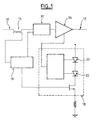
- Fig. 1 represents a status information input system according to the prior art.
- the system here is used to provide status information about device 10.
- Device 10 may be, for example, a branching unit or an optical equaliser (these specific devices are discussed below) but the identity of device 10 is not essential to the operation of the prior art system or to the operation of the present invention.
- a coupling device 14 takes a portion of the data signal being transmitted along transmission line 12. This portion of the data signal is fed to supervisory control means 16.
- Supervisory control means 16 measures properties of the data signal portion e.g. intensity, quality, etc.
- supervisory control means 16 controls power control means 18.
- Power control means 18 includes pump lasers 20, 22.
- the output from the pump lasers 20, 22 is input into optical amplifier 24 located on the optical transmission line 12.
- the control of the power control means 18 by the supervisory control means 16 leads to a variation in the pump laser output which reaches amplifier 24.
- the gain of amplifier 24 is varied accordingly.
- This variation can give a measurable modulation in the intensity of the data signal which passes through amplifier 24.
- This modulation corresponds to the status information collected by the supervisory control means, e.g. the intensity of the data signal at optical coupler 14.
- the status information could relate to some other aspect of device 10, for example its electrical power feed status.
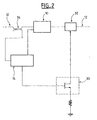
- Fig. 2 represents a status information input system according to an embodiment of the present invention.
- device 10 is supervised by supervisory control means 16, for example by sampling (via optical coupler 14) the data signal transmitted along the optical transmission line.
- Supervisory control means 16 controls power control means 30.
- power control means 30 applies a control signal to optical attenuator 32 located on the optical transmission line.
- the intensity of the data signal on the optical transmission line is modulated according to the control signal applied to the optical attenuator 32.
- the optical attenuator 32 can modulate the data signal by a signal corresponding to the status information collected by the supervisory control means 16.
- optical attenuator 32 rather than an optical amplifier 24 means that pump lasers 20, 22 are not required. Pump lasers and optical amplifiers are expensive and difficult to maintain, and so the invention can give rise to a less expensive and more efficient optical transmission system.
- An electromagnetic attenuator device may be used but components based on other technologies, i.e. Optoceramic, MEMs or Thermo-optic devices may be suitable.
- a suitable attenuator may have the following characteristics 0-10dB attenuation for 0 - 40mA, flatness 0.3dB and a 1535nm - 1568nm wavelength range.
- a further suitable example might be:- Item Specification Condition Operating Wavelength ( ⁇ ) 1525-1570 nm Operating Temperature (T op ) -2 to 43 Deg C Driving Current (I) ⁇ 70 mA Min. loss (Insertion loss at 0 mA) ⁇ 1.0 dB Attenuation Range ⁇ 10 dB @ T op(-2 to 43 Deg C).
- the basic data that originates from the unit to be interrogated is digital data e.g. a block of 22 digital bits, representing the address of the unit and the key system parameters. Each bit is encoded into a pulse width modulation (PWM) format as shown in Figure 3 .
- PWM pulse width modulation
- the resultant data signal is used in turn to gate a digital carrier signal, which in turn would drive the modulation to the Optical attenuator.
- the bias voltage or current through the VOA is altered in sympathy with the modulation signal as described above in order to achieve the desired return signalling.
- a branching unit is included in an optical communication system as device 10.
- a main optical transmission cable 12 is connected to the main terminal of the branching unit.
- the unit has two (or possibly more) branch terminals to which branch optical transmission cables are attachable.
- the branching unit provides alternate paths for the optical data signals transmitted along the main optical transmission cables.
- the branching unit provides a path for a power feed along each respective branch.
- the power feed is required to power various devices along the system, such as repeaters, equalisers, etc.
- the power feed may be switched from one branch to another.
- the branching unit includes detection means to detect the operational status of the unit. In particular, if the power feed has been switched from one branch to another, it is important for the switching to be verified.
- the detection means typically including electronic detection circuitry detects whether or not the required switching has occurred.
- the detection means passes this information on to a control device such as supervisory control means 16.
- the supervisory control means sends an appropriate signal to power control means 30.
- the signal sent may be in the form of a digital or analogue wave form.
- the signal indicates the device (in this case the branching unit) to which it relates, and also the status information (in this case the fact that the power switching has occurred).
- Appropriate signal coding for digital information signalling is known and will not be discussed further here.
- optical transmission system transmits optical data signals.
- data signals do not usually relate to the status of any device located on the system, but instead correspond to the data which the system carries from one user to another, e.g. a telephone conversation or other data transaction.
- the signal applied to the optical attenuator 32 by the control means 30 leads to the optical attenuator applying a corresponding attenuation signal to the data signal.
- the attenuation signal results in a modulated data signal.
- the modulation consists of reducing the intensity of some parts of the data signal and not reducing the intensity of other parts of the data signal.
- the intensity reduction typically does not reduce the data signal intensity to zero. Instead, the intensity reduction of the modulation is usually in the range 0% to 20%, for example.
- the data band width of the signal is high due to the use of light (which has a relatively high frequency) and the use of techniques such as multiplexing.
- the device status information to be sent via the optical attenuator 32 is not particularly complex in comparison to the complexity (and volume) of data in the data signal. Accordingly, in analogue terms, the status information can be sent at low frequency (i.e. in a narrow band width).
- the modulation signal applied to the data signal typically has a relatively low frequency, or is the digital signal equivalent of a relatively low frequency analogue signal.
- the status of the branching unit can be independently verified by the detector and the status signal applied to the data signal by the optical attenuator.
- optical attenuation in a branching unit is to achieve a reduction in output light intensity of a branching unit.
- this could be achieved by locating the optical attenuator in the branch of interest and applying a signal to activate the attenuator to reduce the output light intensity by a predetermined amount.
- BU Output level control is particular desired feature of Add-Drop Branching Units.
- a number of optical channels may be dropped off from the main data path to a third terminal.
- Channels at the same wavelength are re-inserted into the main path and may be equalized to the correct mean level with the through channels that had in trunk path.
- BU Output level control also gives scope to alter the actual number of channels added and dropped, from say 1-2 or 2-4 where again it would be necessary to make adjustment to channels in the trunk path.
- Wavelength division multiplexing is a well known method for sending large volumes of information along an optical transmission line.
- WDM Wavelength division multiplexing
- many different data channels are used which each correspond to light of slightly different wavelength.
- Each wavelength has a data signal applied to it and all the different wavelengths are sent down the same transmission line at once.
- the breadth of the spectrum (in terms of wavelength) sent down the optical transmission line may be from, say, 8nm to around 27nm.
- the spectrum is de-multiplexed and the individual channels are separated again.
- the intensity of the light signals varies with distance along the optical transmission line.
- the different wavelengths are not typically absorbed equally.
- This differential wavelength absorption can lead to a spectrum received at the other end of the optical transmission line which is more intense at certain wavelengths compared to others. It can be affected and accentuated by the different wavelength amplification characteristics of the optical amplifiers along the length of the optical transmission line. This non-uniformity of intensity of different channels can lead to data degradation or data loss and so needs to be addressed.
- an equaliser Effectively, this is an optical filter which removes the more intense parts of the received spectrum in order to achieve a more uniform spectrum. Additionally or alternatively, of course, the equaliser could amplify the less intense parts of the spectrum in order to achieve a more uniform spectrum.
- the equaliser can apply a filtering effect of opposing slope to the spectrum. As the name suggests, this has the effect of equalising the intensities of the channels across the spectrum.
- the slope applied to the received spectrum may be altered. Typically, this alteration may be achieved by applying a different DC voltage to the active equaliser. It is desirable to know the slope which is being applied to the spectrum, and therefore to know the voltage being applied to the active equaliser.
- the active equaliser is monitored using control circuitry. The status information gathered needs to be sent to a user terminal, as for the branching unit embodiment.
- One way to send a status information signal is by modulating the slope element itself (i.e. by modulating the dc voltage applied to the active equaliser). This will result in a periodic change in intensity of the data signal channels which can be received and interpreted.
- the change in intensity will not be uniform across the channels. Changing the slope of the equaliser will raise the intensity of some channels, reduce the intensity of others and may not affect the intensity of one or more channels (typically near the centre of the spectrum). Therefore, the status information will need to be measured at a particular wavelength (i.e. on a particular channel) in order to be consistent, preferably a wavelength at an extreme of the WDM spectrum.
- another embodiment of the invention uses an optical attenuator 32 as described above to input a status information signal onto the data signal.
- the optical attenuator attenuates substantially all of the wavelengths of the WDM channels substantially by the same amount. Therefore the status information signal typically can be received and interpreted via any channel.
- control circuitry can measure the status of the device, here the active equaliser, and input a corresponding signal onto the data signal being transmitted down the optical transmission line.
- the present invention may also be used with optical amplifiers and/or repeaters.
Landscapes
- Physics & Mathematics (AREA)
- Electromagnetism (AREA)
- Engineering & Computer Science (AREA)
- Computer Networks & Wireless Communication (AREA)
- Signal Processing (AREA)
- Optical Communication System (AREA)
- Monitoring And Testing Of Transmission In General (AREA)
Claims (17)
- Verfahren zur Übermittlung von Statusinformationen über eine optische Übertragungsleitung (12), die zum Übertragen eines Datensignals dient, wobei das Verfahren den Schritt beinhaltet,- ein optisches Dämpfungsglied (32), das vom Datensignal durchlaufen wird, mit einem Steuersignal zu beaufschlagen,wobei das Dämpfungsglied (32) das Datensignal durch ein Signal moduliert, das der Statusinformation entspricht,
dadurch gekennzeichnet, dass die optischen Dämpfungseigenschaften des optischen Dämpfungsgliedes (32) im Wesentlichen von der Frequenz des Datensignals unabhängig sind. - Verfahren gemäß Anspruch 1, wobei die Statusinformation einen Status einer ersten Vorrichtung (10) angibt, die mit der optischen Übertragungsleitung (12) gekoppelt ist.
- Verfahren gemäß Anspruch 2, wobei das Signal, das der Statusinformation entspricht, charakteristisch für die erste Vorrichtung (10) ist.
- Verfahren gemäß Anspruch 3, wobei das Datensignal durch ein Signal moduliert wird, das der Statusinformation entspricht, die einen Status einer zweiten Vorrichtung angibt, die mit der optischen Übertragungsleitung gekoppelt ist.
- Verfahren gemäß Anspruch 4, wobei das Signal, das der Statusinformation der zweiten Vorrichtung entspricht, charakteristisch für die zweite Vorrichtung ist.
- Verfahren gemäß einem oder mehreren der Ansprüche 2 bis 5, wobei die erste Vorrichtung (10) eine Vorrichtung einer Abzweigeinheit und eines optischen Equalizers ist.
- Verfahren gemäß einem oder mehreren der vorgenannten Ansprüche einschließlich des Schrittes zur Gewinnung von Statusinformationen im Hinblick auf die Vorrichtung (10), die der optischen Übertragungsleitung zugeordnet ist.
- Verfahren gemäß einem oder mehreren der vorgenannten Ansprüche einschließlich des Schrittes, das optische Dämpfungsglied (32) über Leistungssteuerungsmittel (30) zu steuern.
- Verfahren gemäß einem oder mehreren der vorgenannten Ansprüche einschließlich des Schrittes zur Bereitstellung von Statusinformationen über die Qualität des Datensignals.
- Optisches Übertragungssystem zum Übertragen von Statusinformationen einschließlich einer optischen Übertragungsleitung (12) zum Übertragen eines optischen Datensignals,
eines optischen Dämpfungsgliedes (32), das so ausgelegt ist, dass es das Passieren des Datensignals durch dasselbe gestattet, und
Steuerungsmitteln (30), die in der Lage sind, das optische Dämpfungsglied (32) mit einem Steuersignal zu beaufschlagen,
wobei das optische Dämpfungsglied dafür ausgelegt ist, das Datensignal durch ein Signal zu modulieren, das der Statusinformation entspricht,
dadurch gekennzeichnet, dass das optische Dämpfungsglied (32) so ausgelegt ist, dass es optische Dämpfungseigenschaften besitzt, die im Wesentlichen von der Frequenz des Datensignals unabhängig sind. - System gemäß Anspruch 10 einschließlich beliebiger Merkmale des Verfahrens aus den Ansprüchen 1 bis 9.
- System gemäß Anspruch 10 oder Anspruch 11, wobei die Statusinformation eine Information im Hinblick auf eine Abzweigeinheit ist, die mit der optischen Übertragungsleitung (12) gekoppelt ist.
- System gemäß Anspruch 10 oder Anspruch 11, wobei die Statusinformation eine Information im Hinblick auf einen optischen Equalizer ist, der mit der optischen Übertragungsleitung (12) gekoppelt ist.
- System gemäß Anspruch 13, wobei der optische Equalizer ein aktiver Equalizer ist.
- System gemäß einem oder mehreren der Ansprüche 10 bis 14 einschließlich Mitteln (16) zum Messen von Statusinformationen.
- System gemäß einem oder mehreren der Ansprüche 10 bis 15 einschließlich Leistungssteuerungsmitteln (30) zum Steuern des optischen Dämpfungsgliedes.
- System gemäß einem oder mehreren der Ansprüche 10 bis 16 einschließlich Mitteln (14) zum Abzweigen eines Signals aus der optischen Übertragungsleitung (12) zur Bereitstellung von Statusinformationen über die Qualität des Datensignals.
Applications Claiming Priority (2)
| Application Number | Priority Date | Filing Date | Title |
|---|---|---|---|
| GB0130214 | 2001-12-18 | ||
| GBGB0130214.0A GB0130214D0 (en) | 2001-12-18 | 2001-12-18 | Supervisory signalling for optical communications equipment |
Publications (3)
| Publication Number | Publication Date |
|---|---|
| EP1322052A2 EP1322052A2 (de) | 2003-06-25 |
| EP1322052A3 EP1322052A3 (de) | 2003-10-22 |
| EP1322052B1 true EP1322052B1 (de) | 2008-04-30 |
Family
ID=9927829
Family Applications (1)
| Application Number | Title | Priority Date | Filing Date |
|---|---|---|---|
| EP02293000A Expired - Lifetime EP1322052B1 (de) | 2001-12-18 | 2002-12-05 | Verfahren zur überwachende optischen Übertragung von Signalisierungsinformationen in optischen Verbindungen |
Country Status (6)
| Country | Link |
|---|---|
| US (1) | US20030142976A1 (de) |
| EP (1) | EP1322052B1 (de) |
| JP (1) | JP3923887B2 (de) |
| AT (1) | ATE393988T1 (de) |
| DE (1) | DE60226307T2 (de) |
| GB (1) | GB0130214D0 (de) |
Families Citing this family (4)
| Publication number | Priority date | Publication date | Assignee | Title |
|---|---|---|---|---|
| GB0324586D0 (en) | 2003-10-22 | 2003-11-26 | Cit Alcatel | System and method for a supervisory signal modulation scheme using variable optical attenuators |
| JP5169538B2 (ja) * | 2008-06-30 | 2013-03-27 | 富士通株式会社 | 光伝送装置、光伝送システム及び同システムの通信方法 |
| DE102009000988A1 (de) * | 2009-02-18 | 2010-08-19 | Adva Ag Optical Networking | Verfahren und Anordnung zur Messung einer Signalleistung |
| EP2938014B1 (de) | 2013-01-15 | 2017-08-09 | Huawei Marine Networks Co., Limited | Kommunikationsvorrichtung und verfahren |
Family Cites Families (12)
| Publication number | Priority date | Publication date | Assignee | Title |
|---|---|---|---|---|
| NL8200002A (nl) * | 1982-01-04 | 1983-08-01 | Philips Nv | Foutlocalisatie-inrichting voor digitaal optische transmissiesysteem. |
| JPH088835A (ja) * | 1994-06-21 | 1996-01-12 | Fujitsu Ltd | 光伝送方式 |
| FI954809L (fi) * | 1995-10-09 | 1997-04-10 | Nokia Telecommunications Oy | Ylläpitosanomien välittäminen kuituvahvistimelta |
| JP3422398B2 (ja) * | 1995-12-07 | 2003-06-30 | 富士通株式会社 | 重心波長モニタ方法及び装置、光増幅器並びに光通信システム |
| JPH09321701A (ja) * | 1996-05-31 | 1997-12-12 | Fujitsu Ltd | 光通信システム及び光増幅器 |
| GB2347809B (en) * | 1999-03-12 | 2001-06-20 | Marconi Comm Ltd | Signal transmission system |
| US6771905B1 (en) * | 1999-06-07 | 2004-08-03 | Corvis Corporation | Optical transmission systems including optical switching devices, control apparatuses, and methods |
| US6347008B1 (en) * | 1999-06-14 | 2002-02-12 | Tellium, Inc. | Optical amplifier system and optical network having flattened gain and constant per channel output power |
| US6207949B1 (en) * | 1999-11-10 | 2001-03-27 | Telcordia Technologies, Inc. | Method and apparatus for stabilizing attenuators in optical networks |
| JP2003528524A (ja) * | 2000-03-23 | 2003-09-24 | マルコニ コミュニケイションズ リミテッド | パルス巾変調信号を発生する方法及び装置並びにパルス巾変調信号により制御される光学的減衰器 |
| CA2444965A1 (en) * | 2001-04-30 | 2002-11-07 | Pirelli Submarine Telecom Systems Italia S.P.A. | Optical transmission system comprising a supervisory system |
| US7224514B2 (en) * | 2002-06-27 | 2007-05-29 | Nortel Networks Limited | Using gain tilt for local compensation of unwanted power gradients |
-
2001
- 2001-12-18 GB GBGB0130214.0A patent/GB0130214D0/en not_active Ceased
-
2002
- 2002-12-05 JP JP2002353593A patent/JP3923887B2/ja not_active Expired - Fee Related
- 2002-12-05 AT AT02293000T patent/ATE393988T1/de not_active IP Right Cessation
- 2002-12-05 DE DE60226307T patent/DE60226307T2/de not_active Expired - Lifetime
- 2002-12-05 EP EP02293000A patent/EP1322052B1/de not_active Expired - Lifetime
- 2002-12-17 US US10/320,504 patent/US20030142976A1/en not_active Abandoned
Also Published As
| Publication number | Publication date |
|---|---|
| DE60226307D1 (de) | 2008-06-12 |
| US20030142976A1 (en) | 2003-07-31 |
| JP2003204306A (ja) | 2003-07-18 |
| DE60226307T2 (de) | 2009-05-14 |
| JP3923887B2 (ja) | 2007-06-06 |
| EP1322052A3 (de) | 2003-10-22 |
| GB0130214D0 (en) | 2002-02-06 |
| ATE393988T1 (de) | 2008-05-15 |
| EP1322052A2 (de) | 2003-06-25 |
Similar Documents
| Publication | Publication Date | Title |
|---|---|---|
| US6078414A (en) | Optical transmitter system | |
| US6661974B1 (en) | Optical transmitter and optical transmission system | |
| US7149428B2 (en) | OSNR monitoring method and apparatus using tunable optical bandpass filter and polarization nulling method | |
| US5784192A (en) | Optical amplifying repeater | |
| US20040136727A1 (en) | Optical transmission system comprising a supervisory system | |
| US7646983B2 (en) | Apparatus and method for commissioning an optical transmission system | |
| CN112292819B (zh) | 对应答器噪声性能的自动测量 | |
| CA2341674A1 (en) | Method and apparatus for optical system link control | |
| US20040151502A1 (en) | Optical fiber transmission system with noise loaded idler channels | |
| Feiste et al. | 40 Gbit/s transmission over 434 km standard fibre using polarisation independent mid-span spectral inversion | |
| WO2010072423A1 (en) | Identifying a characteristic of a mesh network | |
| EP1322052B1 (de) | Verfahren zur überwachende optischen Übertragung von Signalisierungsinformationen in optischen Verbindungen | |
| JP4172547B2 (ja) | 可変光学減衰器を用いた監視信号変調方式のためのシステムおよび方法 | |
| Kilper et al. | Monitoring optical network performance degradation due to amplifier noise | |
| US20040208569A1 (en) | System adopting wavelength division multiplexing and method of operating the system | |
| EP1211763B1 (de) | Wellenlängenmultiplexer | |
| EP1596511A1 (de) | Spektrales Neigungsregelungssystem and -verfahren eines optischen Mediums | |
| CN1543720A (zh) | 光放大器 | |
| US6366712B1 (en) | Apparatus and method for combining two separate RF signals on a single optical fiber with monitoring and alarm capabilities | |
| Wuth et al. | Impact of self-phase modulation on bandwidth efficient modulation formats | |
| JP4391645B2 (ja) | 帯域幅が可変な受信フィルタを備えた光ファイバ伝送システム | |
| KR100219288B1 (ko) | 파장분할다중 광전송 시스템의 이득가변 보상장치 | |
| Sumiya et al. | WDM optical fiber transmission systems | |
| JP2007150588A (ja) | 放送通信融合光伝送システムおける波長決定方法 | |
| AU2002315293A1 (en) | Optical transmission system comprising a supervisory system |
Legal Events
| Date | Code | Title | Description |
|---|---|---|---|
| PUAI | Public reference made under article 153(3) epc to a published international application that has entered the european phase |
Free format text: ORIGINAL CODE: 0009012 |
|
| AK | Designated contracting states |
Designated state(s): AT BE BG CH CY CZ DE DK EE ES FI FR GB GR IE IT LI LU MC NL PT SE SI SK TR |
|
| AX | Request for extension of the european patent |
Extension state: AL LT LV MK RO |
|
| PUAL | Search report despatched |
Free format text: ORIGINAL CODE: 0009013 |
|
| AK | Designated contracting states |
Kind code of ref document: A3 Designated state(s): AT BE BG CH CY CZ DE DK EE ES FI FR GB GR IE IT LI LU MC NL PT SE SI SK TR |
|
| AX | Request for extension of the european patent |
Extension state: AL LT LV MK RO |
|
| 17P | Request for examination filed |
Effective date: 20040422 |
|
| AKX | Designation fees paid |
Designated state(s): AT BE BG CH CY CZ DE DK EE ES FI FR GB GR IE IT LI LU MC NL PT SE SI SK TR |
|
| 17Q | First examination report despatched |
Effective date: 20070103 |
|
| RAP1 | Party data changed (applicant data changed or rights of an application transferred) |
Owner name: ALCATEL LUCENT |
|
| GRAP | Despatch of communication of intention to grant a patent |
Free format text: ORIGINAL CODE: EPIDOSNIGR1 |
|
| GRAS | Grant fee paid |
Free format text: ORIGINAL CODE: EPIDOSNIGR3 |
|
| GRAA | (expected) grant |
Free format text: ORIGINAL CODE: 0009210 |
|
| AK | Designated contracting states |
Kind code of ref document: B1 Designated state(s): AT BE BG CH CY CZ DE DK EE ES FI FR GB GR IE IT LI LU MC NL PT SE SI SK TR |
|
| REG | Reference to a national code |
Ref country code: GB Ref legal event code: FG4D |
|
| REG | Reference to a national code |
Ref country code: CH Ref legal event code: EP |
|
| REG | Reference to a national code |
Ref country code: IE Ref legal event code: FG4D Free format text: LANGUAGE OF EP DOCUMENT: FRENCH |
|
| REF | Corresponds to: |
Ref document number: 60226307 Country of ref document: DE Date of ref document: 20080612 Kind code of ref document: P |
|
| PG25 | Lapsed in a contracting state [announced via postgrant information from national office to epo] |
Ref country code: SI Free format text: LAPSE BECAUSE OF FAILURE TO SUBMIT A TRANSLATION OF THE DESCRIPTION OR TO PAY THE FEE WITHIN THE PRESCRIBED TIME-LIMIT Effective date: 20080430 |
|
| NLV1 | Nl: lapsed or annulled due to failure to fulfill the requirements of art. 29p and 29m of the patents act | ||
| PG25 | Lapsed in a contracting state [announced via postgrant information from national office to epo] |
Ref country code: PT Free format text: LAPSE BECAUSE OF FAILURE TO SUBMIT A TRANSLATION OF THE DESCRIPTION OR TO PAY THE FEE WITHIN THE PRESCRIBED TIME-LIMIT Effective date: 20080930 Ref country code: BG Free format text: LAPSE BECAUSE OF FAILURE TO SUBMIT A TRANSLATION OF THE DESCRIPTION OR TO PAY THE FEE WITHIN THE PRESCRIBED TIME-LIMIT Effective date: 20080730 Ref country code: ES Free format text: LAPSE BECAUSE OF FAILURE TO SUBMIT A TRANSLATION OF THE DESCRIPTION OR TO PAY THE FEE WITHIN THE PRESCRIBED TIME-LIMIT Effective date: 20080810 Ref country code: FI Free format text: LAPSE BECAUSE OF FAILURE TO SUBMIT A TRANSLATION OF THE DESCRIPTION OR TO PAY THE FEE WITHIN THE PRESCRIBED TIME-LIMIT Effective date: 20080430 Ref country code: NL Free format text: LAPSE BECAUSE OF FAILURE TO SUBMIT A TRANSLATION OF THE DESCRIPTION OR TO PAY THE FEE WITHIN THE PRESCRIBED TIME-LIMIT Effective date: 20080430 |
|
| PG25 | Lapsed in a contracting state [announced via postgrant information from national office to epo] |
Ref country code: AT Free format text: LAPSE BECAUSE OF FAILURE TO SUBMIT A TRANSLATION OF THE DESCRIPTION OR TO PAY THE FEE WITHIN THE PRESCRIBED TIME-LIMIT Effective date: 20080430 |
|
| PG25 | Lapsed in a contracting state [announced via postgrant information from national office to epo] |
Ref country code: SE Free format text: LAPSE BECAUSE OF FAILURE TO SUBMIT A TRANSLATION OF THE DESCRIPTION OR TO PAY THE FEE WITHIN THE PRESCRIBED TIME-LIMIT Effective date: 20080731 Ref country code: DK Free format text: LAPSE BECAUSE OF FAILURE TO SUBMIT A TRANSLATION OF THE DESCRIPTION OR TO PAY THE FEE WITHIN THE PRESCRIBED TIME-LIMIT Effective date: 20080430 Ref country code: CZ Free format text: LAPSE BECAUSE OF FAILURE TO SUBMIT A TRANSLATION OF THE DESCRIPTION OR TO PAY THE FEE WITHIN THE PRESCRIBED TIME-LIMIT Effective date: 20080430 |
|
| EN | Fr: translation not filed | ||
| PG25 | Lapsed in a contracting state [announced via postgrant information from national office to epo] |
Ref country code: BE Free format text: LAPSE BECAUSE OF FAILURE TO SUBMIT A TRANSLATION OF THE DESCRIPTION OR TO PAY THE FEE WITHIN THE PRESCRIBED TIME-LIMIT Effective date: 20080430 Ref country code: SK Free format text: LAPSE BECAUSE OF FAILURE TO SUBMIT A TRANSLATION OF THE DESCRIPTION OR TO PAY THE FEE WITHIN THE PRESCRIBED TIME-LIMIT Effective date: 20080430 |
|
| PLBE | No opposition filed within time limit |
Free format text: ORIGINAL CODE: 0009261 |
|
| STAA | Information on the status of an ep patent application or granted ep patent |
Free format text: STATUS: NO OPPOSITION FILED WITHIN TIME LIMIT |
|
| 26N | No opposition filed |
Effective date: 20090202 |
|
| PG25 | Lapsed in a contracting state [announced via postgrant information from national office to epo] |
Ref country code: EE Free format text: LAPSE BECAUSE OF FAILURE TO SUBMIT A TRANSLATION OF THE DESCRIPTION OR TO PAY THE FEE WITHIN THE PRESCRIBED TIME-LIMIT Effective date: 20080430 Ref country code: FR Free format text: LAPSE BECAUSE OF FAILURE TO SUBMIT A TRANSLATION OF THE DESCRIPTION OR TO PAY THE FEE WITHIN THE PRESCRIBED TIME-LIMIT Effective date: 20090227 |
|
| ET | Fr: translation filed | ||
| PG25 | Lapsed in a contracting state [announced via postgrant information from national office to epo] |
Ref country code: MC Free format text: LAPSE BECAUSE OF NON-PAYMENT OF DUE FEES Effective date: 20081231 |
|
| REG | Reference to a national code |
Ref country code: CH Ref legal event code: PL |
|
| PG25 | Lapsed in a contracting state [announced via postgrant information from national office to epo] |
Ref country code: IT Free format text: LAPSE BECAUSE OF FAILURE TO SUBMIT A TRANSLATION OF THE DESCRIPTION OR TO PAY THE FEE WITHIN THE PRESCRIBED TIME-LIMIT Effective date: 20080430 |
|
| PG25 | Lapsed in a contracting state [announced via postgrant information from national office to epo] |
Ref country code: LI Free format text: LAPSE BECAUSE OF NON-PAYMENT OF DUE FEES Effective date: 20081231 Ref country code: CH Free format text: LAPSE BECAUSE OF NON-PAYMENT OF DUE FEES Effective date: 20081231 Ref country code: IE Free format text: LAPSE BECAUSE OF NON-PAYMENT OF DUE FEES Effective date: 20081205 |
|
| PG25 | Lapsed in a contracting state [announced via postgrant information from national office to epo] |
Ref country code: LU Free format text: LAPSE BECAUSE OF NON-PAYMENT OF DUE FEES Effective date: 20081205 Ref country code: CY Free format text: LAPSE BECAUSE OF FAILURE TO SUBMIT A TRANSLATION OF THE DESCRIPTION OR TO PAY THE FEE WITHIN THE PRESCRIBED TIME-LIMIT Effective date: 20080430 |
|
| PG25 | Lapsed in a contracting state [announced via postgrant information from national office to epo] |
Ref country code: TR Free format text: LAPSE BECAUSE OF FAILURE TO SUBMIT A TRANSLATION OF THE DESCRIPTION OR TO PAY THE FEE WITHIN THE PRESCRIBED TIME-LIMIT Effective date: 20080430 |
|
| PG25 | Lapsed in a contracting state [announced via postgrant information from national office to epo] |
Ref country code: GR Free format text: LAPSE BECAUSE OF FAILURE TO SUBMIT A TRANSLATION OF THE DESCRIPTION OR TO PAY THE FEE WITHIN THE PRESCRIBED TIME-LIMIT Effective date: 20080731 |
|
| REG | Reference to a national code |
Ref country code: FR Ref legal event code: GC Effective date: 20131018 |
|
| REG | Reference to a national code |
Ref country code: FR Ref legal event code: RG Effective date: 20141016 |
|
| REG | Reference to a national code |
Ref country code: FR Ref legal event code: CA Effective date: 20150521 |
|
| REG | Reference to a national code |
Ref country code: FR Ref legal event code: CA Effective date: 20150521 |
|
| REG | Reference to a national code |
Ref country code: FR Ref legal event code: PLFP Year of fee payment: 14 |
|
| PGFP | Annual fee paid to national office [announced via postgrant information from national office to epo] |
Ref country code: GB Payment date: 20151221 Year of fee payment: 14 Ref country code: DE Payment date: 20151211 Year of fee payment: 14 |
|
| PGFP | Annual fee paid to national office [announced via postgrant information from national office to epo] |
Ref country code: FR Payment date: 20151221 Year of fee payment: 14 |
|
| REG | Reference to a national code |
Ref country code: DE Ref legal event code: R119 Ref document number: 60226307 Country of ref document: DE |
|
| GBPC | Gb: european patent ceased through non-payment of renewal fee |
Effective date: 20161205 |
|
| REG | Reference to a national code |
Ref country code: FR Ref legal event code: ST Effective date: 20170831 |
|
| PG25 | Lapsed in a contracting state [announced via postgrant information from national office to epo] |
Ref country code: FR Free format text: LAPSE BECAUSE OF NON-PAYMENT OF DUE FEES Effective date: 20170102 |
|
| PG25 | Lapsed in a contracting state [announced via postgrant information from national office to epo] |
Ref country code: GB Free format text: LAPSE BECAUSE OF NON-PAYMENT OF DUE FEES Effective date: 20161205 Ref country code: DE Free format text: LAPSE BECAUSE OF NON-PAYMENT OF DUE FEES Effective date: 20170701 |