EP1319715A1 - IMP Dehydrogenase und deren Verwendung zum Identifizieren von fungizid wirksamen Verbindungen - Google Patents
IMP Dehydrogenase und deren Verwendung zum Identifizieren von fungizid wirksamen Verbindungen Download PDFInfo
- Publication number
- EP1319715A1 EP1319715A1 EP02026487A EP02026487A EP1319715A1 EP 1319715 A1 EP1319715 A1 EP 1319715A1 EP 02026487 A EP02026487 A EP 02026487A EP 02026487 A EP02026487 A EP 02026487A EP 1319715 A1 EP1319715 A1 EP 1319715A1
- Authority
- EP
- European Patent Office
- Prior art keywords
- polypeptide
- impdh
- sequences
- nucleic acid
- seq
- Prior art date
- Legal status (The legal status is an assumption and is not a legal conclusion. Google has not performed a legal analysis and makes no representation as to the accuracy of the status listed.)
- Granted
Links
- 108010087227 IMP Dehydrogenase Proteins 0.000 title claims description 32
- 102000006674 IMP dehydrogenase Human genes 0.000 title claims description 31
- 230000000855 fungicidal effect Effects 0.000 title claims description 16
- 239000000126 substance Substances 0.000 title description 30
- 229920001184 polypeptide Polymers 0.000 claims abstract description 143
- 108090000765 processed proteins & peptides Proteins 0.000 claims abstract description 141
- 102000004196 processed proteins & peptides Human genes 0.000 claims abstract description 139
- 150000007523 nucleic acids Chemical class 0.000 claims abstract description 60
- 102000039446 nucleic acids Human genes 0.000 claims abstract description 54
- 108020004707 nucleic acids Proteins 0.000 claims abstract description 54
- 241000233866 Fungi Species 0.000 claims abstract description 53
- 238000000034 method Methods 0.000 claims abstract description 50
- 150000001875 compounds Chemical class 0.000 claims abstract description 47
- 230000003032 phytopathogenic effect Effects 0.000 claims abstract description 41
- 230000004071 biological effect Effects 0.000 claims abstract description 40
- 230000014509 gene expression Effects 0.000 claims abstract description 29
- 239000000417 fungicide Substances 0.000 claims abstract description 26
- 238000000338 in vitro Methods 0.000 claims abstract description 12
- 210000004027 cell Anatomy 0.000 claims description 40
- 239000003112 inhibitor Substances 0.000 claims description 36
- 108020004414 DNA Proteins 0.000 claims description 28
- 244000301083 Ustilago maydis Species 0.000 claims description 28
- 102000053602 DNA Human genes 0.000 claims description 20
- FWMNVWWHGCHHJJ-SKKKGAJSSA-N 4-amino-1-[(2r)-6-amino-2-[[(2r)-2-[[(2r)-2-[[(2r)-2-amino-3-phenylpropanoyl]amino]-3-phenylpropanoyl]amino]-4-methylpentanoyl]amino]hexanoyl]piperidine-4-carboxylic acid Chemical compound C([C@H](C(=O)N[C@H](CC(C)C)C(=O)N[C@H](CCCCN)C(=O)N1CCC(N)(CC1)C(O)=O)NC(=O)[C@H](N)CC=1C=CC=CC=1)C1=CC=CC=C1 FWMNVWWHGCHHJJ-SKKKGAJSSA-N 0.000 claims description 19
- 125000003275 alpha amino acid group Chemical group 0.000 claims description 17
- 239000012634 fragment Substances 0.000 claims description 16
- 239000002299 complementary DNA Substances 0.000 claims description 13
- 108091035707 Consensus sequence Proteins 0.000 claims description 12
- 108091034117 Oligonucleotide Proteins 0.000 claims description 11
- JLCPHMBAVCMARE-UHFFFAOYSA-N [3-[[3-[[3-[[3-[[3-[[3-[[3-[[3-[[3-[[3-[[3-[[5-(2-amino-6-oxo-1H-purin-9-yl)-3-[[3-[[3-[[3-[[3-[[3-[[5-(2-amino-6-oxo-1H-purin-9-yl)-3-[[5-(2-amino-6-oxo-1H-purin-9-yl)-3-hydroxyoxolan-2-yl]methoxy-hydroxyphosphoryl]oxyoxolan-2-yl]methoxy-hydroxyphosphoryl]oxy-5-(5-methyl-2,4-dioxopyrimidin-1-yl)oxolan-2-yl]methoxy-hydroxyphosphoryl]oxy-5-(6-aminopurin-9-yl)oxolan-2-yl]methoxy-hydroxyphosphoryl]oxy-5-(6-aminopurin-9-yl)oxolan-2-yl]methoxy-hydroxyphosphoryl]oxy-5-(6-aminopurin-9-yl)oxolan-2-yl]methoxy-hydroxyphosphoryl]oxy-5-(6-aminopurin-9-yl)oxolan-2-yl]methoxy-hydroxyphosphoryl]oxyoxolan-2-yl]methoxy-hydroxyphosphoryl]oxy-5-(5-methyl-2,4-dioxopyrimidin-1-yl)oxolan-2-yl]methoxy-hydroxyphosphoryl]oxy-5-(4-amino-2-oxopyrimidin-1-yl)oxolan-2-yl]methoxy-hydroxyphosphoryl]oxy-5-(5-methyl-2,4-dioxopyrimidin-1-yl)oxolan-2-yl]methoxy-hydroxyphosphoryl]oxy-5-(5-methyl-2,4-dioxopyrimidin-1-yl)oxolan-2-yl]methoxy-hydroxyphosphoryl]oxy-5-(6-aminopurin-9-yl)oxolan-2-yl]methoxy-hydroxyphosphoryl]oxy-5-(6-aminopurin-9-yl)oxolan-2-yl]methoxy-hydroxyphosphoryl]oxy-5-(4-amino-2-oxopyrimidin-1-yl)oxolan-2-yl]methoxy-hydroxyphosphoryl]oxy-5-(4-amino-2-oxopyrimidin-1-yl)oxolan-2-yl]methoxy-hydroxyphosphoryl]oxy-5-(4-amino-2-oxopyrimidin-1-yl)oxolan-2-yl]methoxy-hydroxyphosphoryl]oxy-5-(6-aminopurin-9-yl)oxolan-2-yl]methoxy-hydroxyphosphoryl]oxy-5-(4-amino-2-oxopyrimidin-1-yl)oxolan-2-yl]methyl [5-(6-aminopurin-9-yl)-2-(hydroxymethyl)oxolan-3-yl] hydrogen phosphate Polymers Cc1cn(C2CC(OP(O)(=O)OCC3OC(CC3OP(O)(=O)OCC3OC(CC3O)n3cnc4c3nc(N)[nH]c4=O)n3cnc4c3nc(N)[nH]c4=O)C(COP(O)(=O)OC3CC(OC3COP(O)(=O)OC3CC(OC3COP(O)(=O)OC3CC(OC3COP(O)(=O)OC3CC(OC3COP(O)(=O)OC3CC(OC3COP(O)(=O)OC3CC(OC3COP(O)(=O)OC3CC(OC3COP(O)(=O)OC3CC(OC3COP(O)(=O)OC3CC(OC3COP(O)(=O)OC3CC(OC3COP(O)(=O)OC3CC(OC3COP(O)(=O)OC3CC(OC3COP(O)(=O)OC3CC(OC3COP(O)(=O)OC3CC(OC3COP(O)(=O)OC3CC(OC3COP(O)(=O)OC3CC(OC3COP(O)(=O)OC3CC(OC3CO)n3cnc4c(N)ncnc34)n3ccc(N)nc3=O)n3cnc4c(N)ncnc34)n3ccc(N)nc3=O)n3ccc(N)nc3=O)n3ccc(N)nc3=O)n3cnc4c(N)ncnc34)n3cnc4c(N)ncnc34)n3cc(C)c(=O)[nH]c3=O)n3cc(C)c(=O)[nH]c3=O)n3ccc(N)nc3=O)n3cc(C)c(=O)[nH]c3=O)n3cnc4c3nc(N)[nH]c4=O)n3cnc4c(N)ncnc34)n3cnc4c(N)ncnc34)n3cnc4c(N)ncnc34)n3cnc4c(N)ncnc34)O2)c(=O)[nH]c1=O JLCPHMBAVCMARE-UHFFFAOYSA-N 0.000 claims description 10
- 238000009396 hybridization Methods 0.000 claims description 10
- 239000000203 mixture Substances 0.000 claims description 10
- 230000002538 fungal effect Effects 0.000 claims description 6
- 238000004519 manufacturing process Methods 0.000 claims description 6
- 108020004999 messenger RNA Proteins 0.000 claims description 6
- 238000003786 synthesis reaction Methods 0.000 claims description 6
- 230000000295 complement effect Effects 0.000 claims description 4
- 239000001963 growth medium Substances 0.000 claims description 4
- 230000036961 partial effect Effects 0.000 claims description 4
- 230000003321 amplification Effects 0.000 claims description 3
- 238000003199 nucleic acid amplification method Methods 0.000 claims description 3
- 230000001105 regulatory effect Effects 0.000 claims description 3
- 230000001276 controlling effect Effects 0.000 claims description 2
- 230000002068 genetic effect Effects 0.000 claims description 2
- 238000002955 isolation Methods 0.000 claims description 2
- 210000003527 eukaryotic cell Anatomy 0.000 claims 2
- 210000001236 prokaryotic cell Anatomy 0.000 claims 2
- 108091032973 (ribonucleotides)n+m Proteins 0.000 claims 1
- 108020004682 Single-Stranded DNA Proteins 0.000 claims 1
- 238000002372 labelling Methods 0.000 claims 1
- 230000000694 effects Effects 0.000 abstract description 54
- 238000012360 testing method Methods 0.000 abstract description 32
- GRSZFWQUAKGDAV-KQYNXXCUSA-N IMP Chemical compound O[C@@H]1[C@H](O)[C@@H](COP(O)(O)=O)O[C@H]1N1C(NC=NC2=O)=C2N=C1 GRSZFWQUAKGDAV-KQYNXXCUSA-N 0.000 abstract description 26
- 235000013902 inosinic acid Nutrition 0.000 abstract description 8
- 101710088194 Dehydrogenase Proteins 0.000 abstract description 6
- 238000012258 culturing Methods 0.000 abstract 1
- 101710200424 Inosine-5'-monophosphate dehydrogenase Proteins 0.000 description 138
- 108090000623 proteins and genes Proteins 0.000 description 33
- BAWFJGJZGIEFAR-NNYOXOHSSA-O NAD(+) Chemical compound NC(=O)C1=CC=C[N+]([C@H]2[C@@H]([C@H](O)[C@@H](COP(O)(=O)OP(O)(=O)OC[C@@H]3[C@H]([C@@H](O)[C@@H](O3)N3C4=NC=NC(N)=C4N=C3)O)O2)O)=C1 BAWFJGJZGIEFAR-NNYOXOHSSA-O 0.000 description 22
- 238000006243 chemical reaction Methods 0.000 description 22
- 235000001014 amino acid Nutrition 0.000 description 21
- 150000001413 amino acids Chemical class 0.000 description 21
- 229950006238 nadide Drugs 0.000 description 21
- 239000000758 substrate Substances 0.000 description 21
- 102000004169 proteins and genes Human genes 0.000 description 20
- 102000004190 Enzymes Human genes 0.000 description 18
- 108090000790 Enzymes Proteins 0.000 description 18
- HPNSFSBZBAHARI-UHFFFAOYSA-N micophenolic acid Natural products OC1=C(CC=C(C)CCC(O)=O)C(OC)=C(C)C2=C1C(=O)OC2 HPNSFSBZBAHARI-UHFFFAOYSA-N 0.000 description 17
- 229960000951 mycophenolic acid Drugs 0.000 description 17
- HPNSFSBZBAHARI-RUDMXATFSA-N mycophenolic acid Chemical compound OC1=C(C\C=C(/C)CCC(O)=O)C(OC)=C(C)C2=C1C(=O)OC2 HPNSFSBZBAHARI-RUDMXATFSA-N 0.000 description 17
- 229930027945 nicotinamide-adenine dinucleotide Natural products 0.000 description 17
- BOPGDPNILDQYTO-NNYOXOHSSA-N nicotinamide-adenine dinucleotide Chemical compound C1=CCC(C(=O)N)=CN1[C@H]1[C@H](O)[C@H](O)[C@@H](COP(O)(=O)OP(O)(=O)OC[C@@H]2[C@H]([C@@H](O)[C@@H](O2)N2C3=NC=NC(N)=C3N=C2)O)O1 BOPGDPNILDQYTO-NNYOXOHSSA-N 0.000 description 17
- PEDCQBHIVMGVHV-UHFFFAOYSA-N Glycerine Chemical compound OCC(O)CO PEDCQBHIVMGVHV-UHFFFAOYSA-N 0.000 description 16
- 239000000872 buffer Substances 0.000 description 16
- 235000018102 proteins Nutrition 0.000 description 16
- 241000196324 Embryophyta Species 0.000 description 14
- 241000222122 Candida albicans Species 0.000 description 11
- 235000015919 Ustilago maydis Nutrition 0.000 description 11
- 239000004480 active ingredient Substances 0.000 description 11
- 230000005764 inhibitory process Effects 0.000 description 11
- 239000003446 ligand Substances 0.000 description 11
- 239000002609 medium Substances 0.000 description 10
- 241000894007 species Species 0.000 description 10
- IAZDPXIOMUYVGZ-UHFFFAOYSA-N Dimethylsulphoxide Chemical compound CS(C)=O IAZDPXIOMUYVGZ-UHFFFAOYSA-N 0.000 description 9
- 101100452131 Rattus norvegicus Igf2bp1 gene Proteins 0.000 description 9
- 230000027455 binding Effects 0.000 description 9
- 108091028043 Nucleic acid sequence Proteins 0.000 description 7
- 239000013543 active substance Substances 0.000 description 7
- 230000015572 biosynthetic process Effects 0.000 description 7
- 230000000875 corresponding effect Effects 0.000 description 7
- 244000000008 fungal human pathogen Species 0.000 description 7
- 230000004927 fusion Effects 0.000 description 7
- 239000000047 product Substances 0.000 description 7
- DCTLYFZHFGENCW-UUOKFMHZSA-N 5'-xanthylic acid Chemical compound O[C@@H]1[C@H](O)[C@@H](COP(O)(O)=O)O[C@H]1N1C(NC(=O)NC2=O)=C2N=C1 DCTLYFZHFGENCW-UUOKFMHZSA-N 0.000 description 6
- 241000282414 Homo sapiens Species 0.000 description 6
- 239000000556 agonist Substances 0.000 description 6
- 239000005557 antagonist Substances 0.000 description 6
- 239000000284 extract Substances 0.000 description 6
- 235000011187 glycerol Nutrition 0.000 description 6
- 238000013537 high throughput screening Methods 0.000 description 6
- 238000005259 measurement Methods 0.000 description 6
- 230000008569 process Effects 0.000 description 6
- 241000221198 Basidiomycota Species 0.000 description 5
- DFPAKSUCGFBDDF-UHFFFAOYSA-N Nicotinamide Chemical compound NC(=O)C1=CC=CN=C1 DFPAKSUCGFBDDF-UHFFFAOYSA-N 0.000 description 5
- 241000233872 Pneumocystis carinii Species 0.000 description 5
- 108020001507 fusion proteins Proteins 0.000 description 5
- 102000037865 fusion proteins Human genes 0.000 description 5
- 239000013612 plasmid Substances 0.000 description 5
- 238000006467 substitution reaction Methods 0.000 description 5
- 235000001674 Agaricus brunnescens Nutrition 0.000 description 4
- 108091026890 Coding region Proteins 0.000 description 4
- 241000588724 Escherichia coli Species 0.000 description 4
- WQZGKKKJIJFFOK-GASJEMHNSA-N Glucose Natural products OC[C@H]1OC(O)[C@H](O)[C@@H](O)[C@@H]1O WQZGKKKJIJFFOK-GASJEMHNSA-N 0.000 description 4
- 240000004808 Saccharomyces cerevisiae Species 0.000 description 4
- 235000014680 Saccharomyces cerevisiae Nutrition 0.000 description 4
- 241000221566 Ustilago Species 0.000 description 4
- 239000011324 bead Substances 0.000 description 4
- 238000002523 gelfiltration Methods 0.000 description 4
- 125000003729 nucleotide group Chemical group 0.000 description 4
- 238000003752 polymerase chain reaction Methods 0.000 description 4
- 238000000746 purification Methods 0.000 description 4
- 241000221204 Cryptococcus neoformans Species 0.000 description 3
- 240000005979 Hordeum vulgare Species 0.000 description 3
- 235000007340 Hordeum vulgare Nutrition 0.000 description 3
- XUJNEKJLAYXESH-REOHCLBHSA-N L-Cysteine Chemical compound SC[C@H](N)C(O)=O XUJNEKJLAYXESH-REOHCLBHSA-N 0.000 description 3
- ROHFNLRQFUQHCH-YFKPBYRVSA-N L-leucine Chemical compound CC(C)C[C@H](N)C(O)=O ROHFNLRQFUQHCH-YFKPBYRVSA-N 0.000 description 3
- 241000228453 Pyrenophora Species 0.000 description 3
- 239000007983 Tris buffer Substances 0.000 description 3
- 241000514371 Ustilago avenae Species 0.000 description 3
- 238000010521 absorption reaction Methods 0.000 description 3
- 238000007792 addition Methods 0.000 description 3
- 238000013459 approach Methods 0.000 description 3
- 229940095731 candida albicans Drugs 0.000 description 3
- 238000004140 cleaning Methods 0.000 description 3
- 238000001514 detection method Methods 0.000 description 3
- 239000003814 drug Substances 0.000 description 3
- 238000000605 extraction Methods 0.000 description 3
- FVTCRASFADXXNN-SCRDCRAPSA-N flavin mononucleotide Chemical compound OP(=O)(O)OC[C@@H](O)[C@@H](O)[C@@H](O)CN1C=2C=C(C)C(C)=CC=2N=C2C1=NC(=O)NC2=O FVTCRASFADXXNN-SCRDCRAPSA-N 0.000 description 3
- FVTCRASFADXXNN-UHFFFAOYSA-N flavin mononucleotide Natural products OP(=O)(O)OCC(O)C(O)C(O)CN1C=2C=C(C)C(C)=CC=2N=C2C1=NC(=O)NC2=O FVTCRASFADXXNN-UHFFFAOYSA-N 0.000 description 3
- 239000011768 flavin mononucleotide Substances 0.000 description 3
- 230000001408 fungistatic effect Effects 0.000 description 3
- 239000008103 glucose Substances 0.000 description 3
- RAXXELZNTBOGNW-UHFFFAOYSA-N imidazole Natural products C1=CNC=N1 RAXXELZNTBOGNW-UHFFFAOYSA-N 0.000 description 3
- 230000002401 inhibitory effect Effects 0.000 description 3
- 239000013642 negative control Substances 0.000 description 3
- 239000002773 nucleotide Substances 0.000 description 3
- 230000001717 pathogenic effect Effects 0.000 description 3
- 239000013641 positive control Substances 0.000 description 3
- 238000002360 preparation method Methods 0.000 description 3
- 230000002441 reversible effect Effects 0.000 description 3
- 235000019231 riboflavin-5'-phosphate Nutrition 0.000 description 3
- 229920002477 rna polymer Polymers 0.000 description 3
- 238000010998 test method Methods 0.000 description 3
- 238000013518 transcription Methods 0.000 description 3
- 230000035897 transcription Effects 0.000 description 3
- LENZDBCJOHFCAS-UHFFFAOYSA-N tris Chemical compound OCC(N)(CO)CO LENZDBCJOHFCAS-UHFFFAOYSA-N 0.000 description 3
- YBJHBAHKTGYVGT-ZKWXMUAHSA-N (+)-Biotin Chemical compound N1C(=O)N[C@@H]2[C@H](CCCCC(=O)O)SC[C@@H]21 YBJHBAHKTGYVGT-ZKWXMUAHSA-N 0.000 description 2
- QKNYBSVHEMOAJP-UHFFFAOYSA-N 2-amino-2-(hydroxymethyl)propane-1,3-diol;hydron;chloride Chemical compound Cl.OCC(N)(CO)CO QKNYBSVHEMOAJP-UHFFFAOYSA-N 0.000 description 2
- KDCGOANMDULRCW-UHFFFAOYSA-N 7H-purine Chemical compound N1=CNC2=NC=NC2=C1 KDCGOANMDULRCW-UHFFFAOYSA-N 0.000 description 2
- 229930024421 Adenine Natural products 0.000 description 2
- GFFGJBXGBJISGV-UHFFFAOYSA-N Adenine Chemical compound NC1=NC=NC2=C1N=CN2 GFFGJBXGBJISGV-UHFFFAOYSA-N 0.000 description 2
- IJGRMHOSHXDMSA-UHFFFAOYSA-N Atomic nitrogen Chemical compound N#N IJGRMHOSHXDMSA-UHFFFAOYSA-N 0.000 description 2
- 241000371644 Curvularia ravenelii Species 0.000 description 2
- 108020005199 Dehydrogenases Proteins 0.000 description 2
- NYHBQMYGNKIUIF-UUOKFMHZSA-N Guanosine Chemical compound C1=NC=2C(=O)NC(N)=NC=2N1[C@@H]1O[C@H](CO)[C@@H](O)[C@H]1O NYHBQMYGNKIUIF-UUOKFMHZSA-N 0.000 description 2
- 101000599778 Homo sapiens Insulin-like growth factor 2 mRNA-binding protein 1 Proteins 0.000 description 2
- 101000988591 Homo sapiens Minor histocompatibility antigen H13 Proteins 0.000 description 2
- -1 IMP Nucleic acids Chemical class 0.000 description 2
- 108050006182 Inosine-5'-monophosphate dehydrogenases Proteins 0.000 description 2
- 102000016600 Inosine-5'-monophosphate dehydrogenases Human genes 0.000 description 2
- 108060001084 Luciferase Proteins 0.000 description 2
- 239000005089 Luciferase Substances 0.000 description 2
- KDXKERNSBIXSRK-UHFFFAOYSA-N Lysine Natural products NCCCCC(N)C(O)=O KDXKERNSBIXSRK-UHFFFAOYSA-N 0.000 description 2
- 241000124008 Mammalia Species 0.000 description 2
- 102100029083 Minor histocompatibility antigen H13 Human genes 0.000 description 2
- HZQDCMWJEBCWBR-UUOKFMHZSA-N Mizoribine Chemical compound OC1=C(C(=O)N)N=CN1[C@H]1[C@H](O)[C@H](O)[C@@H](CO)O1 HZQDCMWJEBCWBR-UUOKFMHZSA-N 0.000 description 2
- 241000736122 Parastagonospora nodorum Species 0.000 description 2
- 229920001213 Polysorbate 20 Polymers 0.000 description 2
- 241000235070 Saccharomyces Species 0.000 description 2
- 102000002933 Thioredoxin Human genes 0.000 description 2
- 241000221576 Uromyces Species 0.000 description 2
- 241000007070 Ustilago nuda Species 0.000 description 2
- 229960000643 adenine Drugs 0.000 description 2
- 238000001042 affinity chromatography Methods 0.000 description 2
- 125000001931 aliphatic group Chemical group 0.000 description 2
- POJWUDADGALRAB-UHFFFAOYSA-N allantoin Chemical compound NC(=O)NC1NC(=O)NC1=O POJWUDADGALRAB-UHFFFAOYSA-N 0.000 description 2
- 150000001408 amides Chemical class 0.000 description 2
- 230000000840 anti-viral effect Effects 0.000 description 2
- 239000004599 antimicrobial Substances 0.000 description 2
- 238000003556 assay Methods 0.000 description 2
- 230000001580 bacterial effect Effects 0.000 description 2
- 210000004899 c-terminal region Anatomy 0.000 description 2
- 230000003327 cancerostatic effect Effects 0.000 description 2
- 230000003197 catalytic effect Effects 0.000 description 2
- 239000003153 chemical reaction reagent Substances 0.000 description 2
- 239000003795 chemical substances by application Substances 0.000 description 2
- 238000010367 cloning Methods 0.000 description 2
- 239000004020 conductor Substances 0.000 description 2
- 230000003247 decreasing effect Effects 0.000 description 2
- 230000001419 dependent effect Effects 0.000 description 2
- 238000011161 development Methods 0.000 description 2
- 235000013399 edible fruits Nutrition 0.000 description 2
- 238000001962 electrophoresis Methods 0.000 description 2
- 239000003995 emulsifying agent Substances 0.000 description 2
- 230000002255 enzymatic effect Effects 0.000 description 2
- 238000006911 enzymatic reaction Methods 0.000 description 2
- 238000011156 evaluation Methods 0.000 description 2
- 230000005284 excitation Effects 0.000 description 2
- 244000000004 fungal plant pathogen Species 0.000 description 2
- 238000004128 high performance liquid chromatography Methods 0.000 description 2
- 230000002209 hydrophobic effect Effects 0.000 description 2
- 230000001506 immunosuppresive effect Effects 0.000 description 2
- 238000001727 in vivo Methods 0.000 description 2
- 238000011534 incubation Methods 0.000 description 2
- 230000003993 interaction Effects 0.000 description 2
- 238000004255 ion exchange chromatography Methods 0.000 description 2
- 150000002632 lipids Chemical class 0.000 description 2
- 230000007246 mechanism Effects 0.000 description 2
- 238000002844 melting Methods 0.000 description 2
- 230000008018 melting Effects 0.000 description 2
- 229950000844 mizoribine Drugs 0.000 description 2
- 230000004048 modification Effects 0.000 description 2
- 238000012986 modification Methods 0.000 description 2
- 239000006225 natural substrate Substances 0.000 description 2
- 229960003966 nicotinamide Drugs 0.000 description 2
- 235000005152 nicotinamide Nutrition 0.000 description 2
- 239000011570 nicotinamide Substances 0.000 description 2
- 239000002245 particle Substances 0.000 description 2
- 230000026731 phosphorylation Effects 0.000 description 2
- 238000006366 phosphorylation reaction Methods 0.000 description 2
- 244000000003 plant pathogen Species 0.000 description 2
- 239000000256 polyoxyethylene sorbitan monolaurate Substances 0.000 description 2
- 235000010486 polyoxyethylene sorbitan monolaurate Nutrition 0.000 description 2
- 238000001556 precipitation Methods 0.000 description 2
- 238000012545 processing Methods 0.000 description 2
- 239000011814 protection agent Substances 0.000 description 2
- 230000002285 radioactive effect Effects 0.000 description 2
- 230000002829 reductive effect Effects 0.000 description 2
- 238000002821 scintillation proximity assay Methods 0.000 description 2
- 239000000243 solution Substances 0.000 description 2
- 239000002904 solvent Substances 0.000 description 2
- 108060008226 thioredoxin Proteins 0.000 description 2
- 229940094937 thioredoxin Drugs 0.000 description 2
- FVRDYQYEVDDKCR-DBRKOABJSA-N tiazofurine Chemical compound NC(=O)C1=CSC([C@H]2[C@@H]([C@H](O)[C@@H](CO)O2)O)=N1 FVRDYQYEVDDKCR-DBRKOABJSA-N 0.000 description 2
- 238000005406 washing Methods 0.000 description 2
- ZOOGRGPOEVQQDX-UUOKFMHZSA-N 3',5'-cyclic GMP Chemical compound C([C@H]1O2)OP(O)(=O)O[C@H]1[C@@H](O)[C@@H]2N1C(N=C(NC2=O)N)=C2N=C1 ZOOGRGPOEVQQDX-UUOKFMHZSA-N 0.000 description 1
- 230000005730 ADP ribosylation Effects 0.000 description 1
- CXISPYVYMQWFLE-VKHMYHEASA-N Ala-Gly Chemical compound C[C@H]([NH3+])C(=O)NCC([O-])=O CXISPYVYMQWFLE-VKHMYHEASA-N 0.000 description 1
- POJWUDADGALRAB-PVQJCKRUSA-N Allantoin Natural products NC(=O)N[C@@H]1NC(=O)NC1=O POJWUDADGALRAB-PVQJCKRUSA-N 0.000 description 1
- 241000223600 Alternaria Species 0.000 description 1
- 241001149961 Alternaria brassicae Species 0.000 description 1
- 108091093088 Amplicon Proteins 0.000 description 1
- 241000219195 Arabidopsis thaliana Species 0.000 description 1
- 239000004475 Arginine Substances 0.000 description 1
- 241000235349 Ascomycota Species 0.000 description 1
- HCAUEJAQCXVQQM-ACZMJKKPSA-N Asn-Glu-Asp Chemical compound [H]N[C@@H](CC(N)=O)C(=O)N[C@@H](CCC(O)=O)C(=O)N[C@@H](CC(O)=O)C(O)=O HCAUEJAQCXVQQM-ACZMJKKPSA-N 0.000 description 1
- 108090000363 Bacterial Luciferases Proteins 0.000 description 1
- 241000190150 Bipolaris sorokiniana Species 0.000 description 1
- 241001480061 Blumeria graminis Species 0.000 description 1
- 241001465180 Botrytis Species 0.000 description 1
- 241000233684 Bremia Species 0.000 description 1
- 241000233685 Bremia lactucae Species 0.000 description 1
- 206010007134 Candida infections Diseases 0.000 description 1
- 241001157813 Cercospora Species 0.000 description 1
- 241000906476 Cercospora canescens Species 0.000 description 1
- 241000760356 Chytridiomycetes Species 0.000 description 1
- 241000228437 Cochliobolus Species 0.000 description 1
- 108020004635 Complementary DNA Proteins 0.000 description 1
- MIKUYHXYGGJMLM-GIMIYPNGSA-N Crotonoside Natural products C1=NC2=C(N)NC(=O)N=C2N1[C@H]1O[C@@H](CO)[C@H](O)[C@@H]1O MIKUYHXYGGJMLM-GIMIYPNGSA-N 0.000 description 1
- 201000007336 Cryptococcosis Diseases 0.000 description 1
- ZGERHCJBLPQPGV-ACZMJKKPSA-N Cys-Ser-Gln Chemical compound C(CC(=O)N)[C@@H](C(=O)O)NC(=O)[C@H](CO)NC(=O)[C@H](CS)N ZGERHCJBLPQPGV-ACZMJKKPSA-N 0.000 description 1
- LEVWYRKDKASIDU-QWWZWVQMSA-N D-cystine Chemical compound OC(=O)[C@H](N)CSSC[C@@H](N)C(O)=O LEVWYRKDKASIDU-QWWZWVQMSA-N 0.000 description 1
- NYHBQMYGNKIUIF-UHFFFAOYSA-N D-guanosine Natural products C1=2NC(N)=NC(=O)C=2N=CN1C1OC(CO)C(O)C1O NYHBQMYGNKIUIF-UHFFFAOYSA-N 0.000 description 1
- 241001465328 Eremothecium gossypii Species 0.000 description 1
- 241000221787 Erysiphe Species 0.000 description 1
- 108700024394 Exon Proteins 0.000 description 1
- 108010014531 FMN Reductase Proteins 0.000 description 1
- YTNIXZGTHTVJBW-SCRDCRAPSA-N FMNH2 Chemical compound OP(=O)(O)OC[C@@H](O)[C@@H](O)[C@@H](O)CN1C=2C=C(C)C(C)=CC=2NC2=C1NC(=O)NC2=O YTNIXZGTHTVJBW-SCRDCRAPSA-N 0.000 description 1
- 241000223218 Fusarium Species 0.000 description 1
- 241000223194 Fusarium culmorum Species 0.000 description 1
- 102000003688 G-Protein-Coupled Receptors Human genes 0.000 description 1
- 108090000045 G-Protein-Coupled Receptors Proteins 0.000 description 1
- 102000013446 GTP Phosphohydrolases Human genes 0.000 description 1
- 108091006109 GTPases Proteins 0.000 description 1
- FTIJVMLAGRAYMJ-MNXVOIDGSA-N Gln-Ile-Leu Chemical compound CC(C)C[C@@H](C(O)=O)NC(=O)[C@H]([C@@H](C)CC)NC(=O)[C@@H](N)CCC(N)=O FTIJVMLAGRAYMJ-MNXVOIDGSA-N 0.000 description 1
- 108010078321 Guanylate Cyclase Proteins 0.000 description 1
- 102000014469 Guanylate cyclase Human genes 0.000 description 1
- 244000286779 Hansenula anomala Species 0.000 description 1
- 235000014683 Hansenula anomala Nutrition 0.000 description 1
- RXVOMIADLXPJGW-GUBZILKMSA-N His-Asp-Glu Chemical compound [H]N[C@@H](CC1=CNC=N1)C(=O)N[C@@H](CC(O)=O)C(=O)N[C@@H](CCC(O)=O)C(O)=O RXVOMIADLXPJGW-GUBZILKMSA-N 0.000 description 1
- MMBKSAPXEVKALE-KCDQGTFASA-N I25 Chemical compound C1=NC(C(NC=N2)=O)=C2N1[C@@H]1O[C@H](CO)[C@@H](OP(O)(=O)OC[C@@H]2[C@H]([C@@H](O)[C@@H](O2)N2C3=C(C(NC=N3)=O)N=C2)OP(O)(=O)OC[C@@H]2[C@H]([C@@H](O)[C@@H](O2)N2C3=C(C(NC=N3)=O)N=C2)OP(O)(=O)OC[C@@H]2[C@H]([C@@H](O)[C@@H](O2)N2C3=C(C(NC=N3)=O)N=C2)OP(O)(=O)OC[C@@H]2[C@H]([C@@H](O)[C@@H](O2)N2C3=C(C(NC=N3)=O)N=C2)OP(O)(=O)OC[C@@H]2[C@H]([C@@H](O)[C@@H](O2)N2C3=C(C(NC=N3)=O)N=C2)OP(O)(=O)OC[C@@H]2[C@H]([C@@H](O)[C@@H](O2)N2C3=C(C(NC=N3)=O)N=C2)OP(O)(=O)OC[C@@H]2[C@H]([C@@H](O)[C@@H](O2)N2C3=C(C(NC=N3)=O)N=C2)OP(O)(=O)OC[C@@H]2[C@H]([C@@H](O)[C@@H](O2)N2C3=C(C(NC=N3)=O)N=C2)OP(O)(=O)OC[C@@H]2[C@H]([C@@H](O)[C@@H](O2)N2C3=C(C(NC=N3)=O)N=C2)OP(O)(=O)OC[C@@H]2[C@H]([C@@H](O)[C@@H](O2)N2C3=C(C(NC=N3)=O)N=C2)OP(O)(=O)OC[C@@H]2[C@H]([C@@H](O)[C@@H](O2)N2C3=C(C(NC=N3)=O)N=C2)OP(O)(=O)OC[C@@H]2[C@H]([C@@H](O)[C@@H](O2)N2C3=C(C(NC=N3)=O)N=C2)OP(O)(=O)OC[C@@H]2[C@H]([C@@H](O)[C@@H](O2)N2C3=C(C(NC=N3)=O)N=C2)OP(O)(=O)OC[C@@H]2[C@H]([C@@H](O)[C@@H](O2)N2C3=C(C(NC=N3)=O)N=C2)OP(O)(=O)OC[C@@H]2[C@H]([C@@H](O)[C@@H](O2)N2C3=C(C(NC=N3)=O)N=C2)OP(O)(=O)OC[C@@H]2[C@H]([C@@H](O)[C@@H](O2)N2C3=C(C(NC=N3)=O)N=C2)OP(O)(=O)OC[C@@H]2[C@H]([C@@H](O)[C@@H](O2)N2C3=C(C(NC=N3)=O)N=C2)OP(O)(=O)OC[C@@H]2[C@H]([C@@H](O)[C@@H](O2)N2C3=C(C(NC=N3)=O)N=C2)OP(O)(=O)OC[C@@H]2[C@H]([C@@H](O)[C@@H](O2)N2C3=C(C(NC=N3)=O)N=C2)OP(O)(=O)OC[C@@H]2[C@H]([C@@H](O)[C@@H](O2)N2C3=C(C(NC=N3)=O)N=C2)OP(O)(=O)OC[C@@H]2[C@H]([C@@H](O)[C@@H](O2)N2C3=C(C(NC=N3)=O)N=C2)OP(O)(=O)OC[C@@H]2[C@H]([C@@H](O)[C@@H](O2)N2C3=C(C(NC=N3)=O)N=C2)OP(O)(=O)OC[C@@H]2[C@H]([C@@H](O)[C@@H](O2)N2C3=C(C(NC=N3)=O)N=C2)OP(O)(=O)OC[C@@H]2[C@H]([C@@H](O)[C@@H](O2)N2C3=C(C(NC=N3)=O)N=C2)O)[C@H]1O MMBKSAPXEVKALE-KCDQGTFASA-N 0.000 description 1
- GRSZFWQUAKGDAV-KQYNXXCUSA-L IMP(2-) Chemical compound O[C@@H]1[C@H](O)[C@@H](COP([O-])([O-])=O)O[C@H]1N1C(N=CNC2=O)=C2N=C1 GRSZFWQUAKGDAV-KQYNXXCUSA-L 0.000 description 1
- RENBRDSDKPSRIH-HJWJTTGWSA-N Ile-Phe-Met Chemical compound N[C@@H]([C@@H](C)CC)C(=O)N[C@@H](CC1=CC=CC=C1)C(=O)N[C@@H](CCSC)C(=O)O RENBRDSDKPSRIH-HJWJTTGWSA-N 0.000 description 1
- 206010062016 Immunosuppression Diseases 0.000 description 1
- 108091092195 Intron Proteins 0.000 description 1
- 244000285963 Kluyveromyces fragilis Species 0.000 description 1
- 235000014663 Kluyveromyces fragilis Nutrition 0.000 description 1
- WHUUTDBJXJRKMK-VKHMYHEASA-N L-glutamic acid Chemical compound OC(=O)[C@@H](N)CCC(O)=O WHUUTDBJXJRKMK-VKHMYHEASA-N 0.000 description 1
- ZDXPYRJPNDTMRX-VKHMYHEASA-N L-glutamine Chemical compound OC(=O)[C@@H](N)CCC(N)=O ZDXPYRJPNDTMRX-VKHMYHEASA-N 0.000 description 1
- TYYLDKGBCJGJGW-UHFFFAOYSA-N L-tryptophan-L-tyrosine Natural products C=1NC2=CC=CC=C2C=1CC(N)C(=O)NC(C(O)=O)CC1=CC=C(O)C=C1 TYYLDKGBCJGJGW-UHFFFAOYSA-N 0.000 description 1
- OUYCCCASQSFEME-QMMMGPOBSA-N L-tyrosine Chemical compound OC(=O)[C@@H](N)CC1=CC=C(O)C=C1 OUYCCCASQSFEME-QMMMGPOBSA-N 0.000 description 1
- KZSNJWFQEVHDMF-BYPYZUCNSA-N L-valine Chemical compound CC(C)[C@H](N)C(O)=O KZSNJWFQEVHDMF-BYPYZUCNSA-N 0.000 description 1
- 241000228456 Leptosphaeria Species 0.000 description 1
- 241000228457 Leptosphaeria maculans Species 0.000 description 1
- ROHFNLRQFUQHCH-UHFFFAOYSA-N Leucine Natural products CC(C)CC(N)C(O)=O ROHFNLRQFUQHCH-UHFFFAOYSA-N 0.000 description 1
- YKIRNDPUWONXQN-GUBZILKMSA-N Lys-Asn-Gln Chemical compound C(CCN)C[C@@H](C(=O)N[C@@H](CC(=O)N)C(=O)N[C@@H](CCC(=O)N)C(=O)O)N YKIRNDPUWONXQN-GUBZILKMSA-N 0.000 description 1
- 241001344131 Magnaporthe grisea Species 0.000 description 1
- 241001330975 Magnaporthe oryzae Species 0.000 description 1
- 241000235048 Meyerozyma guilliermondii Species 0.000 description 1
- 241001226034 Nectria <echinoderm> Species 0.000 description 1
- 241001668536 Oculimacula yallundae Species 0.000 description 1
- 108010038807 Oligopeptides Proteins 0.000 description 1
- 102000015636 Oligopeptides Human genes 0.000 description 1
- 241000233654 Oomycetes Species 0.000 description 1
- 108700026244 Open Reading Frames Proteins 0.000 description 1
- 102000004316 Oxidoreductases Human genes 0.000 description 1
- 108090000854 Oxidoreductases Proteins 0.000 description 1
- 241000201565 Peronospora viciae f. sp. pisi Species 0.000 description 1
- BQMFWUKNOCJDNV-HJWJTTGWSA-N Phe-Val-Ile Chemical compound [H]N[C@@H](CC1=CC=CC=C1)C(=O)N[C@@H](C(C)C)C(=O)N[C@@H]([C@@H](C)CC)C(O)=O BQMFWUKNOCJDNV-HJWJTTGWSA-N 0.000 description 1
- 241000233614 Phytophthora Species 0.000 description 1
- 241000233622 Phytophthora infestans Species 0.000 description 1
- 241000235645 Pichia kudriavzevii Species 0.000 description 1
- 241001503460 Plasmodiophorida Species 0.000 description 1
- 241000233626 Plasmopara Species 0.000 description 1
- 241001281803 Plasmopara viticola Species 0.000 description 1
- 101001033594 Pneumocystis carinii Inosine-5'-monophosphate dehydrogenase Proteins 0.000 description 1
- 241000896242 Podosphaera Species 0.000 description 1
- 241000317981 Podosphaera fuliginea Species 0.000 description 1
- 241001337928 Podosphaera leucotricha Species 0.000 description 1
- FDINZVJXLPILKV-DCAQKATOSA-N Pro-His-Asn Chemical compound [H]N1CCC[C@H]1C(=O)N[C@@H](CC1=CNC=N1)C(=O)N[C@@H](CC(N)=O)C(O)=O FDINZVJXLPILKV-DCAQKATOSA-N 0.000 description 1
- 241000682843 Pseudocercosporella Species 0.000 description 1
- 241001281802 Pseudoperonospora Species 0.000 description 1
- 241001281805 Pseudoperonospora cubensis Species 0.000 description 1
- 241000342307 Pseudoperonospora humuli Species 0.000 description 1
- 241001123569 Puccinia recondita Species 0.000 description 1
- 241000228454 Pyrenophora graminea Species 0.000 description 1
- 241000520648 Pyrenophora teres Species 0.000 description 1
- 241000231139 Pyricularia Species 0.000 description 1
- 241000233639 Pythium Species 0.000 description 1
- 241000918584 Pythium ultimum Species 0.000 description 1
- 239000013614 RNA sample Substances 0.000 description 1
- 108700008625 Reporter Genes Proteins 0.000 description 1
- 241000221662 Sclerotinia Species 0.000 description 1
- 241000221696 Sclerotinia sclerotiorum Species 0.000 description 1
- 241001533598 Septoria Species 0.000 description 1
- 244000061456 Solanum tuberosum Species 0.000 description 1
- 235000002595 Solanum tuberosum Nutrition 0.000 description 1
- 241000579741 Sphaerotheca <fungi> Species 0.000 description 1
- 108091081024 Start codon Proteins 0.000 description 1
- 206010042674 Swelling Diseases 0.000 description 1
- 241001617088 Thanatephorus sasakii Species 0.000 description 1
- GQPQJNMVELPZNQ-GBALPHGKSA-N Thr-Ser-Trp Chemical compound C[C@H]([C@@H](C(=O)N[C@@H](CO)C(=O)N[C@@H](CC1=CNC2=CC=CC=C21)C(=O)O)N)O GQPQJNMVELPZNQ-GBALPHGKSA-N 0.000 description 1
- AYFVYJQAPQTCCC-UHFFFAOYSA-N Threonine Natural products CC(O)C(N)C(O)=O AYFVYJQAPQTCCC-UHFFFAOYSA-N 0.000 description 1
- 239000004473 Threonine Substances 0.000 description 1
- 241000722133 Tilletia Species 0.000 description 1
- 241000722093 Tilletia caries Species 0.000 description 1
- 108020004566 Transfer RNA Proteins 0.000 description 1
- 241000209140 Triticum Species 0.000 description 1
- 235000021307 Triticum Nutrition 0.000 description 1
- 102000004142 Trypsin Human genes 0.000 description 1
- 108090000631 Trypsin Proteins 0.000 description 1
- LUMQYLVYUIRHHU-YJRXYDGGSA-N Tyr-Ser-Thr Chemical compound [H]N[C@@H](CC1=CC=C(O)C=C1)C(=O)N[C@@H](CO)C(=O)N[C@@H]([C@@H](C)O)C(O)=O LUMQYLVYUIRHHU-YJRXYDGGSA-N 0.000 description 1
- FZADUTOCSFDBRV-RNXOBYDBSA-N Tyr-Tyr-Trp Chemical compound C([C@H](N)C(=O)N[C@@H](CC=1C=CC(O)=CC=1)C(=O)N[C@@H](CC=1C2=CC=CC=C2NC=1)C(O)=O)C1=CC=C(O)C=C1 FZADUTOCSFDBRV-RNXOBYDBSA-N 0.000 description 1
- 241000509513 Ustilago hordei Species 0.000 description 1
- GVJUTBOZZBTBIG-AVGNSLFASA-N Val-Lys-Arg Chemical compound CC(C)[C@@H](C(=O)N[C@@H](CCCCN)C(=O)N[C@@H](CCCN=C(N)N)C(=O)O)N GVJUTBOZZBTBIG-AVGNSLFASA-N 0.000 description 1
- KZSNJWFQEVHDMF-UHFFFAOYSA-N Valine Natural products CC(C)C(N)C(O)=O KZSNJWFQEVHDMF-UHFFFAOYSA-N 0.000 description 1
- 241000317942 Venturia <ichneumonid wasp> Species 0.000 description 1
- 241000228452 Venturia inaequalis Species 0.000 description 1
- 240000008042 Zea mays Species 0.000 description 1
- 241001360088 Zymoseptoria tritici Species 0.000 description 1
- 230000021736 acetylation Effects 0.000 description 1
- 238000006640 acetylation reaction Methods 0.000 description 1
- 230000003213 activating effect Effects 0.000 description 1
- 230000004913 activation Effects 0.000 description 1
- 239000012190 activator Substances 0.000 description 1
- 230000010933 acylation Effects 0.000 description 1
- 238000005917 acylation reaction Methods 0.000 description 1
- 108010047495 alanylglycine Proteins 0.000 description 1
- 125000000217 alkyl group Chemical group 0.000 description 1
- 229960000458 allantoin Drugs 0.000 description 1
- 230000009435 amidation Effects 0.000 description 1
- 238000007112 amidation reaction Methods 0.000 description 1
- AVKUERGKIZMTKX-NJBDSQKTSA-N ampicillin Chemical compound C1([C@@H](N)C(=O)N[C@H]2[C@H]3SC([C@@H](N3C2=O)C(O)=O)(C)C)=CC=CC=C1 AVKUERGKIZMTKX-NJBDSQKTSA-N 0.000 description 1
- 229960000723 ampicillin Drugs 0.000 description 1
- 230000000692 anti-sense effect Effects 0.000 description 1
- ODKSFYDXXFIFQN-UHFFFAOYSA-N arginine Natural products OC(=O)C(N)CCCNC(N)=N ODKSFYDXXFIFQN-UHFFFAOYSA-N 0.000 description 1
- 125000003118 aryl group Chemical group 0.000 description 1
- 235000021028 berry Nutrition 0.000 description 1
- 230000006696 biosynthetic metabolic pathway Effects 0.000 description 1
- 239000011616 biotin Substances 0.000 description 1
- 229960002685 biotin Drugs 0.000 description 1
- 235000020958 biotin Nutrition 0.000 description 1
- 201000003984 candidiasis Diseases 0.000 description 1
- 238000005251 capillar electrophoresis Methods 0.000 description 1
- 230000001413 cellular effect Effects 0.000 description 1
- 230000007541 cellular toxicity Effects 0.000 description 1
- 239000004464 cereal grain Substances 0.000 description 1
- 230000008859 change Effects 0.000 description 1
- 238000012512 characterization method Methods 0.000 description 1
- 238000001311 chemical methods and process Methods 0.000 description 1
- 239000007795 chemical reaction product Substances 0.000 description 1
- 238000003776 cleavage reaction Methods 0.000 description 1
- 238000012411 cloning technique Methods 0.000 description 1
- 239000005515 coenzyme Substances 0.000 description 1
- 229940126214 compound 3 Drugs 0.000 description 1
- 239000000287 crude extract Substances 0.000 description 1
- 235000018417 cysteine Nutrition 0.000 description 1
- XUJNEKJLAYXESH-UHFFFAOYSA-N cysteine Natural products SCC(N)C(O)=O XUJNEKJLAYXESH-UHFFFAOYSA-N 0.000 description 1
- 229960003067 cystine Drugs 0.000 description 1
- 230000034994 death Effects 0.000 description 1
- 238000012217 deletion Methods 0.000 description 1
- 230000037430 deletion Effects 0.000 description 1
- 230000017858 demethylation Effects 0.000 description 1
- 238000010520 demethylation reaction Methods 0.000 description 1
- 239000008121 dextrose Substances 0.000 description 1
- 230000029087 digestion Effects 0.000 description 1
- 201000010099 disease Diseases 0.000 description 1
- 208000037265 diseases, disorders, signs and symptoms Diseases 0.000 description 1
- 238000006073 displacement reaction Methods 0.000 description 1
- 238000002224 dissection Methods 0.000 description 1
- 230000006334 disulfide bridging Effects 0.000 description 1
- 229940079593 drug Drugs 0.000 description 1
- 230000002900 effect on cell Effects 0.000 description 1
- 230000007613 environmental effect Effects 0.000 description 1
- 238000002474 experimental method Methods 0.000 description 1
- 230000002349 favourable effect Effects 0.000 description 1
- 238000000855 fermentation Methods 0.000 description 1
- 230000004151 fermentation Effects 0.000 description 1
- 239000000835 fiber Substances 0.000 description 1
- 229940013640 flavin mononucleotide Drugs 0.000 description 1
- 150000002211 flavins Chemical class 0.000 description 1
- 239000007850 fluorescent dye Substances 0.000 description 1
- 230000022244 formylation Effects 0.000 description 1
- 238000006170 formylation reaction Methods 0.000 description 1
- 230000006251 gamma-carboxylation Effects 0.000 description 1
- 108010042598 glutamyl-aspartyl-glycine Proteins 0.000 description 1
- 230000013595 glycosylation Effects 0.000 description 1
- 238000006206 glycosylation reaction Methods 0.000 description 1
- VPZXBVLAVMBEQI-UHFFFAOYSA-N glycyl-DL-alpha-alanine Natural products OC(=O)C(C)NC(=O)CN VPZXBVLAVMBEQI-UHFFFAOYSA-N 0.000 description 1
- UYTPUPDQBNUYGX-UHFFFAOYSA-N guanine Chemical class O=C1NC(N)=NC2=C1N=CN2 UYTPUPDQBNUYGX-UHFFFAOYSA-N 0.000 description 1
- 229940029575 guanosine Drugs 0.000 description 1
- 150000003278 haem Chemical class 0.000 description 1
- 125000000487 histidyl group Chemical group [H]N([H])C(C(=O)O*)C([H])([H])C1=C([H])N([H])C([H])=N1 0.000 description 1
- 230000033444 hydroxylation Effects 0.000 description 1
- 238000005805 hydroxylation reaction Methods 0.000 description 1
- 230000028993 immune response Effects 0.000 description 1
- 230000016784 immunoglobulin production Effects 0.000 description 1
- 229960003444 immunosuppressant agent Drugs 0.000 description 1
- 230000001861 immunosuppressant effect Effects 0.000 description 1
- 239000003018 immunosuppressive agent Substances 0.000 description 1
- 239000004615 ingredient Substances 0.000 description 1
- 238000002347 injection Methods 0.000 description 1
- 239000007924 injection Substances 0.000 description 1
- 238000003780 insertion Methods 0.000 description 1
- 230000037431 insertion Effects 0.000 description 1
- 238000009413 insulation Methods 0.000 description 1
- 230000026045 iodination Effects 0.000 description 1
- 238000006192 iodination reaction Methods 0.000 description 1
- 230000002427 irreversible effect Effects 0.000 description 1
- BPHPUYQFMNQIOC-NXRLNHOXSA-N isopropyl beta-D-thiogalactopyranoside Chemical compound CC(C)S[C@@H]1O[C@H](CO)[C@H](O)[C@H](O)[C@H]1O BPHPUYQFMNQIOC-NXRLNHOXSA-N 0.000 description 1
- 230000031700 light absorption Effects 0.000 description 1
- 238000003670 luciferase enzyme activity assay Methods 0.000 description 1
- 125000003588 lysine group Chemical group [H]N([H])C([H])([H])C([H])([H])C([H])([H])C([H])([H])C([H])(N([H])[H])C(*)=O 0.000 description 1
- 239000012139 lysis buffer Substances 0.000 description 1
- 229920002521 macromolecule Polymers 0.000 description 1
- 239000003550 marker Substances 0.000 description 1
- 235000019988 mead Nutrition 0.000 description 1
- 230000001404 mediated effect Effects 0.000 description 1
- 238000013160 medical therapy Methods 0.000 description 1
- 239000012528 membrane Substances 0.000 description 1
- 230000011987 methylation Effects 0.000 description 1
- 238000007069 methylation reaction Methods 0.000 description 1
- 230000000813 microbial effect Effects 0.000 description 1
- 244000005700 microbiome Species 0.000 description 1
- 239000004005 microsphere Substances 0.000 description 1
- 239000000178 monomer Substances 0.000 description 1
- RTGDFNSFWBGLEC-SYZQJQIISA-N mycophenolate mofetil Chemical compound COC1=C(C)C=2COC(=O)C=2C(O)=C1C\C=C(/C)CCC(=O)OCCN1CCOCC1 RTGDFNSFWBGLEC-SYZQJQIISA-N 0.000 description 1
- 229960004866 mycophenolate mofetil Drugs 0.000 description 1
- 230000007498 myristoylation Effects 0.000 description 1
- 229910052757 nitrogen Inorganic materials 0.000 description 1
- 239000002777 nucleoside Substances 0.000 description 1
- 210000000056 organ Anatomy 0.000 description 1
- 230000002018 overexpression Effects 0.000 description 1
- 230000003647 oxidation Effects 0.000 description 1
- 238000007254 oxidation reaction Methods 0.000 description 1
- 230000007918 pathogenicity Effects 0.000 description 1
- 230000037361 pathway Effects 0.000 description 1
- 239000008188 pellet Substances 0.000 description 1
- 150000003905 phosphatidylinositols Chemical class 0.000 description 1
- 230000001124 posttranscriptional effect Effects 0.000 description 1
- 230000001323 posttranslational effect Effects 0.000 description 1
- 125000002924 primary amino group Chemical group [H]N([H])* 0.000 description 1
- 238000000159 protein binding assay Methods 0.000 description 1
- 230000002797 proteolythic effect Effects 0.000 description 1
- 230000006337 proteolytic cleavage Effects 0.000 description 1
- 239000002994 raw material Substances 0.000 description 1
- 239000011541 reaction mixture Substances 0.000 description 1
- 230000036632 reaction speed Effects 0.000 description 1
- 238000003259 recombinant expression Methods 0.000 description 1
- 238000011084 recovery Methods 0.000 description 1
- 230000009467 reduction Effects 0.000 description 1
- 238000011160 research Methods 0.000 description 1
- 230000004044 response Effects 0.000 description 1
- 238000010839 reverse transcription Methods 0.000 description 1
- 238000007363 ring formation reaction Methods 0.000 description 1
- 239000000523 sample Substances 0.000 description 1
- 230000007017 scission Effects 0.000 description 1
- 238000012216 screening Methods 0.000 description 1
- 230000003248 secreting effect Effects 0.000 description 1
- 230000035945 sensitivity Effects 0.000 description 1
- 238000000926 separation method Methods 0.000 description 1
- 238000012163 sequencing technique Methods 0.000 description 1
- 230000019491 signal transduction Effects 0.000 description 1
- 230000009870 specific binding Effects 0.000 description 1
- 238000001228 spectrum Methods 0.000 description 1
- 230000000087 stabilizing effect Effects 0.000 description 1
- 230000004936 stimulating effect Effects 0.000 description 1
- 238000003860 storage Methods 0.000 description 1
- 239000012536 storage buffer Substances 0.000 description 1
- 239000006228 supernatant Substances 0.000 description 1
- 230000004083 survival effect Effects 0.000 description 1
- 230000008961 swelling Effects 0.000 description 1
- 208000024891 symptom Diseases 0.000 description 1
- 229960003723 tiazofurine Drugs 0.000 description 1
- 230000001988 toxicity Effects 0.000 description 1
- 231100000419 toxicity Toxicity 0.000 description 1
- 230000009466 transformation Effects 0.000 description 1
- 238000002054 transplantation Methods 0.000 description 1
- 239000012588 trypsin Substances 0.000 description 1
- 108010044292 tryptophyltyrosine Proteins 0.000 description 1
- 239000004474 valine Substances 0.000 description 1
- 239000002023 wood Substances 0.000 description 1
Images


Classifications
-
- C—CHEMISTRY; METALLURGY
- C12—BIOCHEMISTRY; BEER; SPIRITS; WINE; VINEGAR; MICROBIOLOGY; ENZYMOLOGY; MUTATION OR GENETIC ENGINEERING
- C12N—MICROORGANISMS OR ENZYMES; COMPOSITIONS THEREOF; PROPAGATING, PRESERVING, OR MAINTAINING MICROORGANISMS; MUTATION OR GENETIC ENGINEERING; CULTURE MEDIA
- C12N9/00—Enzymes; Proenzymes; Compositions thereof; Processes for preparing, activating, inhibiting, separating or purifying enzymes
- C12N9/0004—Oxidoreductases (1.)
- C12N9/0006—Oxidoreductases (1.) acting on CH-OH groups as donors (1.1)
-
- C—CHEMISTRY; METALLURGY
- C12—BIOCHEMISTRY; BEER; SPIRITS; WINE; VINEGAR; MICROBIOLOGY; ENZYMOLOGY; MUTATION OR GENETIC ENGINEERING
- C12Q—MEASURING OR TESTING PROCESSES INVOLVING ENZYMES, NUCLEIC ACIDS OR MICROORGANISMS; COMPOSITIONS OR TEST PAPERS THEREFOR; PROCESSES OF PREPARING SUCH COMPOSITIONS; CONDITION-RESPONSIVE CONTROL IN MICROBIOLOGICAL OR ENZYMOLOGICAL PROCESSES
- C12Q1/00—Measuring or testing processes involving enzymes, nucleic acids or microorganisms; Compositions therefor; Processes of preparing such compositions
- C12Q1/26—Measuring or testing processes involving enzymes, nucleic acids or microorganisms; Compositions therefor; Processes of preparing such compositions involving oxidoreductase
- C12Q1/32—Measuring or testing processes involving enzymes, nucleic acids or microorganisms; Compositions therefor; Processes of preparing such compositions involving oxidoreductase involving dehydrogenase
-
- G—PHYSICS
- G01—MEASURING; TESTING
- G01N—INVESTIGATING OR ANALYSING MATERIALS BY DETERMINING THEIR CHEMICAL OR PHYSICAL PROPERTIES
- G01N2500/00—Screening for compounds of potential therapeutic value
Definitions
- the invention relates to polypeptides from phytopathogenic fungi with the biological activity of an inosine monophosphate dehydrogenase, coding therefor Nucleic acids, the use of the polypeptides and nucleic acids for identification of modulators of the polypeptides, methods for identifying them Modulators and the use of these modulators as fungicides.
- fungicides are often found in essential biosynthetic pathways searched.
- the ideal fungicides continue to be those substances, the gene products inhibit which is of crucial importance in the expression of pathogenicity of a mushroom.
- the object of the present invention was therefore to find a suitable new one Identify the target for potential fungicidal agents and make them accessible and to provide a method for identifying Allows modulators of this point of attack, which are used as fungicides can.
- Inosine monophosphate dehydrogenase (EC 1.1.1.205), hereinafter abbreviated to IMP dehydrogenase or IMPDH, catalyzes the speed-limiting and irreversible step of de novo GTP synthesis.
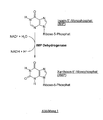
- Inosine 5'monophosphate (IMP) is converted with nicotinamide adenine dinucleotide (NAD + ) by the IMPDH to NADH / H + and XMP (Fig. 1).
- Inosine-5'-monophosphate is the end product of de novo purine biosynthesis and an essential intermediate in the above-mentioned synthesis of adenine and guanine nucleotides.
- the IMPDH is thus a key enzyme for providing the GTP, which is of immense importance for the cell.
- GTP is incorporated into RNA and DNA, serves as a substrate for GTPases (e.g. in cell signal transduction pathways such as G-protein coupled receptors), for guanylate cyclase (production of the secondary messenger cGMP) and as a co-substrate in many enzymatic reactions and plays plays a role in the post-transcriptional modification of the mRNA (5'-cap structure).
- GTPases e.g. in cell signal transduction pathways such as G-protein coupled receptors
- guanylate cyclase production of the secondary messenger cGMP
- the IMPDH has therefore been a target for the search for antiviral, immunosuppressive, cancerostatic and antimicrobial agents for quite some time.
- Polypeptides with the activity of an IMPDH have also become known from certain fungi. This includes the IMPDH from Candida albicans, a human pathogenic fungus, the sequence of which comprises 521 amino acids. The associated sequence can be obtained, for example, from the so-called "tremb1" database (U85049, AF249293).
- Mycophenolic acid a well-known specific inhibitor of IMPDH
- Mycophenolic acid is a well-known medication for suppressing the immune response, for example after organ transplants.
- the structure of an IMPDH together with the inhibitor mycophenolic acid has already been elucidated (Sintack et al. (1996) "Structure and Mechanism of Inosine Monophosphate Dehydrogenase in Complex with the Immunosuppressant Mycophenolic Acid". Cell 86, 921), as well as work on biochemical Mechanism of inhibition of IMPDH by mycophenolic acid (Fleming et al. (1996) "Inhibition of IMPDH by Mycophenolic Acid: Dissection of Forward and Reverse Pathways Using Capillary Electrophoresis". Biochemistry 35, 6990).
- the mycophenolic acid shows a very good activity against the IMPDH from mammals, but is significantly less effective as an antimicrobial agent (Digits et al. (1999) "Species Specific Inhibition of Inosine 5'-Monophosphate Dehydrogenase by Mycophenolic Acid.” Biochemistry, 38 , 15388 ).
- the mycophenolic acid binds in the nicotinamide binding pocket of the NAD + binding site to the intermediate which is formed when XMP is formed from IMP. Due to the differences in the polypeptides originating from different species, however, there is a 20 to 450-fold greater sensitivity of a human to a microbial IMPDH (see also Zhang et al. (1999) "Differential Signatures of Bacterial and Mammalian IMP Dehydrogenase Enzymes.” Current Medicinal Chemistry 6, 537).
- IMPDH IMPDH
- ribovirin an analog of guanosine which has antiviral properties
- tiazofurin a C-nucleoside which, after phosphorylation of the 5'-hydroxyl group, is a NAD-like tiazofurin Forms adenine dinucleotide and serves as a cancerostatic agent
- mizoribine which is used in transplantation medicine for immunosuppression
- Mizoribin on the other hand, has hardly any effect on the human pathogenic fungus C. albicans and is obviously not at all usable as an active ingredient against candidiasis (Ishikawa (1999) "Mizoribine and Mycophenolate Mofetil”. Current Medicinal Chemistry 6, 575)
- the sequence of the IMPDH isolated from C. albicans shows clear sequence similarity to the IMPDH from S. cerevisiae and other organisms.
- the ORF open reading frame
- the ORF is interrupted by a small intron (289 base pairs (bp)) that has typical exon-intron limits (Kohler et al. (1997) Overexpression of a cloned IMP dehydrogenase gene of Candida albicans confers resistance to the specific inhibitor mycophenolic acid. J Bacteriol . 179, 2331).
- the growth of C. albicans cells can be inhibited by 1 ⁇ g / ml mycophenolic acid, whereas those cells which have a plasmid with recombinant IMPDH are resistant to up to 40 ⁇ g / ml.
- Pneumocystis carinii mycophenolic acid can act as an inhibitor of IMPDH from this organism (O'Gara et al. (1997) "IMP dehydrogenase from Pneumocystis carinii as a potential target”. Antimicrob. Agents Chemother. 41, 40) and the use of IMPDH as a sensitive target of this organism was suggested.
- Pneumocystis carinii IMPDH (amino acid sequence) shows homology to bacterial IMPDH (31 to 38%), protozoan IMPDH (48 to 59%), mammals (60 to 62%) and fungi (62%). The activity of the recombinant IMPDH could be inhibited by 50% at a concentration of 25 ⁇ M mycophenolic acid.
- mycophenolic acid inhibits the growth of some human-pathogenic fungi in vitro (e.g. C. albicans, Cryptococcus neoformans ), but at the same time the compound showed no activity against Candida guilliermondii, Candida krusei, Candida pseudotropicalis, Hansenula anomala and also not against S. cerevisiae (Noto et al. (1969) "Biological properties of mycophenolic acid”. J. Antibiot. (Tokyo), 22, 165).
- the object of the present invention was therefore, in particular, an IMPDH of a phytopathogenic fungus as well as procedures that are suitable are to identify inhibitors of the enzyme and to check whether such Inhibitors can be used as fungicides in phytopathogenic fungi.
- identity refers to the number of Sequence positions that are identical in an alignment. It is usually in percent the alignment length.
- similarity sets the definition ahead of a similarity metric, that is, a measure of how similar you are for example want to accept a valine to a threonine or a leucine.
- homologous proteins have emerged from a common one Predecessor sequence developed.
- the term does not necessarily have anything to do with identity or similarity, apart from the fact that homologous sequences are mostly more similar are (or have more identical positions in an alignment) than non-homologues Sequences.
- full IMPDH as used herein describes the IMPDH, which is the complete coding region of a transcription unit is coded, starting with the ATG start codon and comprehensively all information-bearing Exon areas of the present in the organism of origin, for IMPDH coding gene, as well as those necessary for correct termination of the transcription Signals.
- biological activity of an IMPDH refers to the ability of a polypeptide to catalyze the reaction described above, ie the conversion of IMP to XMP with the simultaneous conversion of NAD + to NADH.
- active fragment does not describe more complete nucleic acids coding for IMPDH, but still for polypeptides encode with the biological activity of an IMPDH, and the one for the Can catalyze IMPDH characteristic reaction as described above. Such fragments are shorter than the full ones described above for which Nucleic acids encoding IMPDH. In this case, both at the 3 'and / or 5' ends nucleic acids have been removed from the sequence, but parts can also be removed the sequence deleted, i.e. the biological activity of the Do not significantly affect IMPDH. A lesser or possibly also an increased activity, which still characterizes or uses the resulting IMPDH fragment is considered sufficient in the sense of understood here expression used.
- active fragment may vary also refer to the amino acid sequence of IMPDH and then applies analogously to The above statements for such polypeptides compared to those defined above complete sequence certain parts no longer contain, the biological Activity of the enzyme is not significantly affected.
- the fragments can have different lengths, e.g. at least 120, at least 300, at least 400 or at least 500 amino acids.
- gene as used herein is the term for one Section from the genome of a cell used for the synthesis of a polypeptide chain responsible for.
- cDNA as used herein describes complementary ones from an mRNA obtained by reverse transcription. It only contains that Sequences corresponding to exons of genomic DNA. After cDNA sequencing if necessary, the amino acid sequence encoded by it Derive protein. After insertion of a cDNA into a cell, the large amounts of the respective protein encoded can be synthesized.
- hybridize describes the process in which a single-stranded nucleic acid molecule with a complementary strand undergoes base pairing.
- DNA fragments from phytopathogenic fungi other than Ustilago maydis , which code for IMPDHs and which have the same or similar properties of one of the inventive IMPDH, can be isolated, starting from the sequence information mentioned or derived here.
- Hybridization conditions are approximately calculated using the following formula:
- c is the concentration and n is the length of the hybridizing sequence section in base pairs.
- the expression 500 / n is omitted for a sequence> 100 bp. It is washed with the highest stringency at a temperature of 5-15 ° C below Tm and an ionic strength of 15 mM Na + (corresponds to 0.1 x SSC). If an RNA sample is used for hybridization, the melting point is 10-15 ° C higher.
- the degree of identity of the nucleic acids is preferably determined using the NCBI BLASTN version 2.0.4 program. (Altschul et al. (1997) "Gapped BLAST and PSI-BLAST: a new generation of protein database search programs", Nucleic Acids Res. 25: 3389).
- fungicide or "fungicidal” as used herein refers to to chemical compounds which are suitable for controlling such fungi which Plants, parts of plants or plant products attack and damage or their Reduce yield or value.
- the plant parts mentioned include, for example Leaves, seeds and fruits (such as berries, fruits, cereal grains).
- To the above Plant products include raw materials or derived from the plants Substances such as wood or fibers.
- heterologous promoter refers to a promoter that has different properties than the promoter that in The organism of origin controls the expression of the gene in question.
- agonist refers to a molecule that speeds up or increases the activity of the IMPDH.
- antagonist refers to a molecule that slows down or prevents IMPDH activity.
- modulator as used herein provides the generic term Agonist or antagonist.
- Modulators can be small organic chemical Molecules, peptides or antibodies that bind to the polypeptides according to the invention bind or affect their activity.
- modulators can be small organic chemical molecules, peptides or antibodies attached to a molecule bind, which in turn binds to the polypeptides according to the invention, and thereby influencing their biological activity.
- Modulators can be natural Represent substrates and ligands or structural or functional mimetics from that.
- modulator as used herein is preferred is, however, those molecules that are not the natural substrates or Represent ligands.
- inhibitor or "specific inhibitor” as used herein denotes a substance that directly or indirectly at least one, if necessary but also inhibits several of the above-mentioned enzymatic activities. Such an inhibitor is preferably specific, i.e. it inhibits IMPDH activity at a concentration lower than the concentration of one Inhibitors that are needed to have a different, unrelated effect cause.
- concentration is preferably twice as low, in particular preferably five times lower and very particularly preferably at least ten times or 20 times lower than the concentration of a compound that causes a non-specific effect is required.
- the nucleic acid sequence coding for the IMPDH was identified and isolated from the plant pathogenic fungus U. maydis , and the polypeptide encoded thereby was obtained. Furthermore, a method was developed that is suitable for determining the activity of IMPDH and for identifying and evaluating inhibitors of the enzyme in HTS and UHTS methods. In the context of the present invention it was further shown that the inhibitors of IMPDH from phytopathogenic fungi can be used as crop protection agents.
- the smut fungus Ustilago maydis a Basidiomycet, attacks maize plants.
- the disease occurs in all maize-growing areas, but only becomes more important in dry years.
- Typical symptoms are the bump-like, fist-sized swellings (fire bumps) that are formed on all parts of the plant above ground.
- the bumps are initially covered with a white-gray, rough skin. When the skin is torn open, a black, initially greasy, later powdery fire spore mass is released.
- Other species of the genus Ustilago are e.g. B. U. nuda (causes barley and wheat flying fire), U. nigra (causes barley black fire), U. hordei (causes barley hard fire) and U. avenae (causes oat flight fire).
- the IMPDH from U. maydis (hereinafter referred to as "Imp1") extends over 1999 bp.
- the coding cDNA is 1659 bp long. Imp1 therefore contains an intron of 340 bp in length.
- the polypeptide derived from the ORF of the cDNA is 553 amino acids long. This corresponds to a calculated molecular weight of approximately 60 kD for the monomer.
- the nucleic acid sequence coding for Imp1 is as SEQ ID NO: 1 (geonomic Sequence) or SEQ ID NO: 3 (cDNA) disclosed in the present application.
- the polypeptides encoded in each case are in the present application as SEQ ID NO: 2 and SEQ ID NO: 4 filed.
- an IMPDH of a phytopathogenic fungus here Ustilago maydis
- Ustilago maydis an IMPDH of a phytopathogenic fungus
- Ustilago maydis an IMPDH of a phytopathogenic fungus
- Ustilago maydis an IMPDH of a phytopathogenic fungus, here Ustilago maydis
- no sequences of other fungi which code for an IMPDH have been disclosed to date.
- the sequence coding for an IMPDH from a plant pathogenic Basidiomycete was not yet known.
- Table I compares the homology of DNA coding for IMPDH from different organisms to DNA coding for IMPDH from U. maydis . organism Homology in% P. carinii 59 C. neoformans 55 C. albicans 59 S. cerevisiae ( imh1 ) 60 S. cerevisiae ( imh2 ) 63 S. cerevisiae ( imh3 ) 64 H sapiens 59 A. thaliana 43
- IMPDH can actually be inhibited in vitro by active substances and that a fungal organism treated with these active substances can also be damaged and killed by treatment with these active substances.
- the IMPDH inhibitors from phytopathogenic fungi can therefore be used as fungicides in crop protection.
- the inhibition of IMPDH with substances identified in an above-mentioned test method leads to the death of the treated fungi in synthetic media or on the plant.
- IMPDH phytopathogenic Fungi a target protein
- target fungicidally more effective Can be substances.
- the IMPDH is an important one especially for phytopathogenic fungi Represents enzyme and is therefore particularly suitable as a target protein used for the search for further and improved fungicidally active ingredients to become.
- IMPDHs share several homologous areas. One of these regions focuses on the catalytic center, particularly on a cysteine, which is believed to play a role in IMP binding.
- This center is a sequence motif characteristic of IMP dehydrogenases. Such a motif could be identified by a suitable search in the PROSITE database (Hofmann K., Bucher P., Falquet L., Bairoch A. (1999) "The PROSITE database, its status in 1999”. Nucleic Acids Res. 27, 215). It can be represented as follows: [LIVM] - [RK] - [LIVM] -G- [LIVM] -GxGS- [LIVM] -CxT,
- PROSITE enables functional domains of IMP dehydrogenases to be identified and is suitable for predicting the function of a gene product.
- the "one-letter code” is used to display the Prosite motif.
- the symbol “x” stands for a position where every amino acid is accepted.
- a variable position where various specific amino acids are accepted, is shown in square brackets "[...]", the possible ones at this position Amino acids can be listed. Amino acids at a certain position are not accepted, however, are in braces “ ⁇ ... ⁇ ”.
- On Dash "-” separates the individual elements or positions of the motif. Repeats a certain position, e.g. "x”, several times in succession, can this by specifying the number of repetitions in a subsequent bracket are represented, e.g. "x (3)” which stands for "x-x-x".
- a Prosite motif ultimately represents the components of a consensus sequence, and distances between the amino acids involved and is therefore typical for one certain enzyme class. Based on this motif, based on the inventive Nucleic acids further polypeptides from phytopathogenic fungi identified or are assigned to the same class as the invention Belong to polypeptide.
- Prosite motif or the specific consensus sequence are typical of the polypeptides according to the invention based on these consensus sequences can be structurally defined and thus also clearly identifiable are.
- the present invention therefore also relates to polypeptides from plant pathogens Fungi with the biological activity of an IMPDH that does the above called Prosite motif [LIVM] - [RK] - [LIVM] -G- [LIVM] -G-x-G-S- [LIVM] -C-x-T comprise, preferably those polypeptides that have the consensus sequence mentioned above -LRVGMGSGSICIT- include.
- Nucleic acids coding for IMPDH can also be IMPDHs identified from other phytopathogenic fungi and used to make the to solve the above task, i.e. they can also be used to identify Inhibitors of IMPDH are used, which in turn are used as fungicides in Plant protection can be used.
- Fungus that is not pathogenic to plants, or its IMPDH or the coding for it Use sequence to identify fungicidal inhibitors of IMPDH.
- the present invention therefore relates to nucleic acids which are complete Polypeptides from phytopathogenic fungi with biological activity an IMPDH code.
- These nucleic acids preferably have an identity of at least 60%, at least 65%, at least 70%, at least 75%, at least 80%, at least 85%, at least 90%, at least 95% and in particular at least 98% over a length of 60, 300, 600 or 1200 base pairs and preferred over the total length of the coding sequence.
- the above Nucleic acids each preferably comprise the above-mentioned prostite motif or the consensus sequence above.
- the present invention relates in particular to nucleic acids which code for IMPDHs from phytopathogenic Basidiomycetes, preferably from the genus Ustilago .
- the present invention very particularly preferably relates to nucleic acids which code for IMPDH from Ustilago maydis .
- the present invention particularly preferably relates to nucleic acids from Ustilago maydis which code for a polypeptide according to SEQ ID NO: 2 or SEQ ID NO: 4 or active fragments thereof.
- the nucleic acids according to SEQ ID NO: 1 and SEQ ID NO: 3 are the subject of the present invention.
- the nucleic acids according to the invention are in particular single-stranded or double-stranded deoxyribonucleic acids (DNA) or ribonucleic acids (RNA).
- DNA deoxyribonucleic acids
- RNA ribonucleic acids
- Preferred embodiments are fragments of genomic DNA, which can contain introns, and cDNAs.
- the nucleic acids according to the invention are preferably DNA fragments, which correspond to the cDNA of the nucleic acids according to the invention.
- the nucleic acids according to the invention can be produced in the usual way become.
- the nucleic acid molecules can be completely chemical be synthesized.
- These labeled oligonucleotides can also be used to from mRNA e.g. search cDNA banks made from phytopathogenic fungi. Clones to which the labeled oligonucleotides hybridize become Isolation of the relevant DNA fragments selected. After the characterization the nucleic acids according to the invention are obtained in a simple manner from the isolated DNA.
- nucleic acids according to the invention can also be carried out by means of PCR methods Using chemically synthesized oligonucleotides.
- oligonucleotide (s) refers to DNA molecules consisting of 10 to 50 nucleotides, preferably 15 to 30 nucleotides consist. They are chemically synthesized and can be used as probes for hybridization experiments or used as a primer for PCR (Polymerase Chain Reaction). become.
- polypeptides according to the invention in particular the polypeptide encoded by the nucleic acid sequence according to SEQ ID NO: 1 or SEQ ID NO: 3, host cells which contain at least one of the nucleic acids according to the invention can also be cultured under suitable conditions.
- the desired polypeptides can then be isolated from the cells or the culture medium in a conventional manner.
- the polypeptides can also be produced in in vitro systems.
- the gene can be expressed, for example, recombinantly in Escherichia coli and an enzyme preparation can be prepared from E. coli cells.
- the associated ORF from mRNA was amplified according to methods known to the person skilled in the art via gene-specific primers which are stored in the sequence listing as SEQ ID NO: 5 and SEQ ID NO: 6.
- the corresponding cDNA was cloned into the vector pET32a (Novagen, enables the introduction of a His tag (N- or C-terminal) or an S-tag).
- the resulting plasmid p830 contains the complete coding sequence of impl in an N-terminal fusion with thioredoxin tag from the vector.
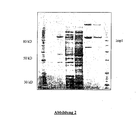
- the Imp1 fusion protein has a calculated mass of 78 kD (Example 1 and Figure 2).
- the plasmid p830 was then used for the recombinant expression of Imp1 in E. coli cells (Example 1).
- the present one is Invention not only on the sequence according to SEQ ID NO: 2 or SEQ ID NO: 4 limited.
- the results that are within the scope of the present invention shown for the first time also apply to other polypeptides phytopathogenic fungi with the biological activity of an IMPDH. So can also obtained homologous IMPDHs from other such species as outlined above and can be used in processes according to the invention. Plant pathogen polypeptides Mushrooms with the biological activity of an IMPDH are therefore considered included in the subject matter of the present invention.
- the homologous polypeptides mentioned are particularly preferably those which have a similarity to the Ustilago maydis IMPDH of at least 60%, at least 65%, at least 70%, at least 75%, at least 80%, at least 85%, at least 90%, have at least 95% and in particular at least 98% over a length of at least 20, preferably at least 25, particularly at least 30 and very particularly preferably at least 100 consecutive amino acids and particularly preferably over the entire length.
- Polypeptides homologous to the IMPDH from Ustilago maydis , in particular to the polypeptide according to SEQ ID NO: 2 or SEQ ID NO: 4, which can be used to identify fungicidal active ingredients, do not have to be complete fungal IMPDHs, but can only be fragments thereof as long as they have at least the biological activity of the complete IMPDH.
- Polypeptides which have the same biological activity as an IMPDH with an amino acid sequence according to SEQ ID NO: 2 or SEQ ID NO: 4 are still considered to be according to the invention.
- Those polypeptides which correspond to IMPDHs, for example the following phytopathogenic fungi, or fragments thereof which still have their biological activity are considered to be according to the invention:
- Pythium species such as, for example, Pythium ultimum, Phytophthora species, such as, for example, Phytophthora infestans , Pseudoperonospora species, such as, for example, Pseudoperonospora humuli or Pseudoperonospora cubensis , Plasmopara species, such as, for example, Plasmopara viticola , Bremia species, such as, for example, Bremia lactucae , Peronospor Species such as Peronospora pisi or P.
- Erysiphe species such as Erysiphe graminis
- Sphaerotheca species such as Sphaerotheca fuliginea
- Podosphaera species such as Podosphaera leucotricha
- Venturia species such as Venturia inaequalis
- Pyrenophora species such as, for example, Pyrenophora teres or P.
- graminea (conidial form: Drechslera, Syn: Helminthosporium), Cochliobolus species, such as, for example, Cochliobolus sativus ( Conidial form : Drechslera, Syn: Helminthosporium), Uromyces species, such as, for example, Uromyces appinia species, Pu such as Puccinia recondita , Sclerot inia species, such as, for example, Sclerotinia sclerotiorum , Tilletia species, such as, for example, Tilletia caries ; Ustilago species, such as, for example, Ustilago nuda or Ustilago avenae , Pellicularia species, such as, for example, Pellicularia sasakii , Pyricularia species, such as, for example, Pyricularia oryzae , Fusarium species, such as, for example, Fusarium culmorum
- polypeptides refers to both short amino acid chains, commonly called peptides, oligopeptides, or oligomers are referred to, as well as to longer amino acid chains, usually called Proteins are called. It includes amino acid chains that are either natural Processes, such as post-translational processing, or by chemical processes, which are state of the art, can be modified. Such modifications can occur in different locations and multiple times in a polypeptide, such as for example on the peptide backbone, on the amino acid side chain, on the amino and / or at the carboxy terminus.
- acetylations include, for example, acetylations, acylations, ADP ribosylations, amidations, covalent linkages with Flavins, heme fractions, nucleotides or nucleotide derivatives, lipids or lipid derivatives or phosphatidylinositol, cyclizations, disulfide bridging, demethylations, Cystine formation, formylation, gamma carboxylation, glycosylation, Hydroxylations, iodinations, methylations, myristoylations, Oxidations, proteolytic processing, phosphorylation, selenoylation and tRNA-mediated additions of amino acids.
- polypeptides according to the invention can be in the form of "mature” proteins or as Parts of larger proteins, e.g. as fusion proteins. Furthermore, they can Secreting or "leader” sequences, pro sequences, sequences that are simple Allow purification, such as multiple histidine residues, or additional stabilizing ones Have amino acids.
- the proteins of the invention can also are present as they are naturally present in their organism of origin which they can be won directly, for example.
- a possible cleaning procedure of the IMPDH is based on preparative electrophoresis, FPLC, HPLC (e.g. using gel filtration, reverse phases or slightly hydrophobic columns), gel filtration, differential precipitation, ion exchange chromatography or affinity chromatography.
- a rapid method for isolating the polypeptides of the invention begins with the expression of a fusion protein, whereby the fusion partner can be easily affinity-cleaned.
- the fusion partner can be a 6xHis tag, for example.
- the fusion protein can then turn on a nickel-NTA affinity column.
- the fusion partner can by partial proteolytic cleavage, for example on linkers between the fusion partner and the polypeptide of the invention to be purified.
- the linker can be designed to target amino acids such as arginine and Includes lysine residues that define sites for trypsin cleavage. Around Generating such linkers can be done using standard cloning techniques of oligonucleotides can be used.
- polypeptides according to the invention can also be used without a fusion partner using Antibodies that bind to the polypeptides are affinity purified.
- the cells obtained in this way contain the polypeptide according to the invention or the like Purified polypeptide obtained are useful in methods of identifying Modulators or inhibitors of the IMPDH to be used.
- polypeptides from plant pathogenic Basidiomycetes particularly from the Ustilago genus, in particular from Ustilago maydis
- the polypeptide according to SEQ ID NO: 2 or SEQ ID NO: 4 being particularly preferred here in methods for identifying inhibitors of a polypeptide from phytopathogenic fungi with the activity of an IMPDH, it being possible for the IMPDH inhibitors to be used as fungicides.
- Fungicidal active ingredients found using one of the IMPDHs according to the invention can also be used with IMPDHs from other phytopathogenic fungal species interact, interacting with the different ones found in these mushrooms IMPDHs do not always have to be equally strong. This explains, among other things the observed selectivity of active substances.
- the use of the invention enables Finding nucleic acids or polypeptides in a suitable method Compounds that bind to the polypeptides according to the invention and / or the compound inhibit. These can then be used as fungicides in plants.
- the present invention therefore also relates to a method for Identification of fungicidal active ingredients which is suitable for the inventive Binding polypeptides and / or modulating their biological activity, i.e. activate or inhibit.
- Methods which are suitable for identifying modulators, ie activators or inhibitors or agonists or antagonists of the polypeptides according to the invention are generally based on determining the activity or the biological functionality of the polypeptide.
- both whole-cell-based methods in vivo methods
- methods based on the use of the polypeptide isolated from the cells which can be present in purified or partially purified form or as a crude extract, are also possible.
- These cell-free in vitro methods can be used just like in vivo methods on a laboratory scale, but preferably also in HTS or UHTS methods.
- test systems that aim to test compounds and natural extracts are preferably geared towards high throughput numbers in order to maximize the number of substances tested in a given period of time.
- Test systems that are based on cell-free work require purified or semi-purified protein. They are suitable for a "first" test, which primarily aims to detect a possible influence of a substance on the target protein. Once such a first test has been carried out and one or more compounds, extracts etc. have been found, the effect of such compounds can be examined in a more targeted manner in the laboratory.
- the inhibition or activation of the polypeptide according to the invention can be checked again in vitro in order to then test the effectiveness of the compound on the target organism, here one or more phytopathogenic fungi.
- the compound can then optionally be used as a starting point for the further search and development of fungicidal compounds which are based on the original structure, but which are optimized, for example, in terms of effectiveness, toxicity or selectivity.
- a synthetic reaction mix e.g. products of in vitro transcription
- a cellular component such as a membrane, a compartment or any other preparation which contains the polypeptides according to the invention
- an optionally labeled substrate or ligand of the polypeptides incubated.
- the ability of the candidate molecule to increase or to inhibit the activity of the polypeptides according to the invention is evident, for example, from an increased or decreased binding of the optionally labeled ligand or from an increased or decreased conversion of the optionally labeled substrate.
- Molecules which lead to an increased activity of the polypeptides according to the invention are agonists.
- Molecules that inhibit the biological activity of the polypeptides according to the invention are good antagonists.
- the biological activity of the polypeptides according to the invention can be detected can be improved by a so-called reporter system.
- Reporter systems in this Aspects include, but are not limited to, colorimetric or fluorimetric detectable substrates that are converted into a product or a Reporter gene which is based on changes in the activity or expression of the invention Responses to polypeptides or other known binding assays.
- Another example of a method with which modulators of the invention Polypeptides can be found is a displacement test in which the polypeptides according to the invention and a potential modulator with a molecule known to be according to the invention Polypeptides bind like a natural substrate or ligand or a substrate or ligand mimetic.
- the invention Polypeptides themselves can be labeled, e.g. fluorimetric or colorimetric, so you can see the number of polypeptides bound to a ligand are or who have participated in an implementation, can determine exactly.
- binding can be carried out using the optionally labeled substrate, ligand or substrate analogs are tracked. In this way, the effectiveness of an agonist or antagonist.
- Test systems check both inhibitory or suppressive effects of the substances as well as stimulatory effects.
- the effectiveness of a substance can be checked using concentration-dependent test series. Control approaches without test substances or without enzyme can be used to evaluate the effects.
- Host cells containing IMPDH encoding nucleic acids will be the development of test systems based on cells for the identification of substances enables the activity of the polypeptides according to the invention modulate.
- SPA sintillation proximity assay
- the modulators to be identified are preferably small organic chemical compounds.
- the compound which has the activity is particularly preferably determined of the polypeptide of the invention specifically inhibited.
- activity like it is used here refers to the biological activity of the invention Polypeptide.
- the activity or the increase or decrease in the activity of the polypeptide according to the invention is preferably determined by means of the conversion of the substrate NAD + to NADH.
- the lower or inhibited activity of the polypeptide according to the invention is tracked on the basis of the photospectrometric determination of the decrease in NAD + or the increase in NADH.
- the reduced nicotinamide coenzyme NADH has an absorption maximum at 340 nm.
- the oxidized form NAD + shows no absorption between 300 and 400 nm.
- the enzymatic reaction according to the invention which leads to a reduction in the NAD + , can therefore be followed on the basis of the increase in absorption, for example at 340 nm.
- the influence of an inhibitor on the reaction can also be determined.
- a further possibility for determining the activity or the increase or decrease in activity by means of the conversion of the substrate NAD + to NADH consists in the detection of the resulting NADH in a coupled luciferase assay.
- the reaction is coupled with the NADH-FMN oxidoreductase according to the following scheme: FMNH 2 + RCHO + O 2 -> FMN + RCOOH + H 2 O + hv .
- R alkyl (Baldwin et al. (1975): Bacterial Luciferase. Binding of Oxidized Flavin Mononucleotide. J. Biol. Chem., 250, 2763).
- the NADH is the primary electron donor.
- the electrons are then transferred to the luciferase via the FMN, which leads to the emission of light.
- the NADH produced in the reaction according to the invention can be detected well in a range from 1 to 25 ⁇ m.
- the light output of the luciferase is clearly pH-dependent, a range from pH 7 to pH 8.5 being particularly suitable.
- the activity or the increase or decrease in the activity can also preferably be determined by converting the substrate NAD + to NADH, the lower or inhibited activity of the polypeptide according to the invention being determined on the basis of a smaller increase in fluorescence, that of the less emerging NADH (see also Fig. 1). NADH fluoresces more than NAD + .
- the polypeptide according to the invention is mixed with NAD + in a suitable concentration, which is preferably between 0.1 and 20 ng / ⁇ l, preferably between 0.13 and 10 ng / ⁇ l, in a concentration of 5 to 400 ⁇ M, preferably 10 to 100 ⁇ M, and IMP in a concentration of 5 to 400 ⁇ M, preferably 50 to 300 ⁇ M, incubated at a suitable temperature.
- the concentration of the IMP is preferably twice as high as that of the substrate NAD + . It should be noted that substrate inhibition can be observed for both substrates, NAD + and IMP, and the concentrations of the two substrates used should therefore be checked.
- the temperature can range from 8 to 37 ° C.
- test buffer which is preferably, for example, 20 to 200 mM KCl, 1 to 5 mM DTE or DTT, 0.01 to 1% BSA, 0.01 to 0.1% Tween 20 and 2 contain up to 10% glycerol and can be adjusted to a pH of 8 with 25 to 100mM Tris buffer (see example 2).
- test buffer preferably, for example, 20 to 200 mM KCl, 1 to 5 mM DTE or DTT, 0.01 to 1% BSA, 0.01 to 0.1% Tween 20 and 2 contain up to 10% glycerol and can be adjusted to a pH of 8 with 25 to 100mM Tris buffer (see example 2).
- test buffer which is preferably, for example, 20 to 200 mM KCl, 1 to 5 mM DTE or DTT, 0.01 to 1% BSA, 0.01 to 0.1% Tween 20 and 2 contain up to 10% glycerol and can be adjusted to a pH of 8 with 25 to 100mM Tris buffer (see example 2).
- the formation of NADH in the course of the reaction is then based on the fluorescence at an excitation wavelength of 360 nm and an emission wavelength of 465 nm tracked.
- the increase in fluorescence in the presence of a chemical compound can then with the increase in fluorescence in the absence of a chemical Connection to be compared.
- the comparison shows whether a chemical compounds the increase in fluorescence less or where appropriate is higher than in the absence of the chemical compound, i.e. if she said compound has an activatory or inhibitory effect on the tested Has polypeptide.
- the time period in which the increase in fluorescence is measured can be varied. There may be a slow increase in fluorescence in the The course of several hours can be observed until finally after 5 to 10 hours a plateau is reached (see also Fig. 3).
- the buffer in which the enzyme is stored or the reaction is carried out choose that the polypeptide according to the invention is stabilized as well as possible.
- the pH is preferably adjusted to pH 8. 10-200 mM KCl, 10-200 mM Tris, 0.02-0.2% BSA and 0.1-5 are preferred mM DTE or DTT as well as 12-25% glycerin used.
- the measurement can also be carried out in formats customary for HTS or UHTS assays, for example in microtiter plates in which, for example, a total volume of 5 to 50 ⁇ l per batch or per well is placed and the individual components are present in one of the final concentrations given above.
- the compound to be tested potentially inhibiting or activating the activity of the enzyme (candidate molecule) is initially introduced, for example, in a suitable concentration in the above-mentioned test buffer containing IMP.
- the polypeptide according to the invention in the above-mentioned test buffer containing the second substrate NAD + is added and the reaction is started with it.
- the mixture is then incubated, for example, for up to 2 or 3 hours at a suitable temperature and the increase in fluorescence is measured at an excitation wavelength of 360 nm and an emission wavelength of 460 nm.
- a further measurement is carried out in a corresponding approach, but without addition of a candidate molecule and without adding a polypeptide according to the invention (Negative control).
- Another measurement takes place in the absence of one Candidate molecule, but in the presence of the polypeptide according to the invention (Positive control).
- Negative and positive control result in the comparison values approaches in the presence of a candidate molecule.
- the pI50 value given there is the negative decimal logarithm of the so mentioned IC50 value, which indicates the molar concentration of a substance that is used for 50% inhibition of the enzyme results.
- a pI50 value of 8 corresponds, for example, to a half-maximum inhibition of the enzyme at a concentration of 10 nM.
- inhibitors of an inventive IMPDH are suitable for damaging or causing phytopathogenic fungi kill.
- the was Medium is added to each cavity.
- the medium was previously with a suitable concentration of spores or mycelium of the fungus to be tested.
- the resulting concentrations of the active ingredient are e.g. 0.1, 1, 10 and 100 ppm.
- the plates were then placed on a shaker at a temperature of 22 ° C incubated until sufficient growth is detectable in the untreated control was.
- the evaluation was carried out photometrically at a wavelength of 620 nm.
- the dose of active substance which leads to a 50% inhibition of fungal growth compared to the untreated control (ED 50 ) was calculated from the measurement data of the different concentrations.
- the present invention therefore also relates to modulators of the polypeptides according to the invention, in particular the compounds or extracts suitable for modulating the IMPDH from U. maydis according to SEQ ID NO: 2 or SEQ ID NO: 4, using the methods described in the present application to identify modulators of the IMPDH can be found.
- the present invention further includes methods for locating chemical compounds, the expression of the polypeptides according to the invention change.
- expression modulators can also be new fungicides Represent active substances.
- Expression modulators can be small organic chemical Molecules, peptides or antibodies that are attached to the regulatory regions of the bind the nucleic acids encoding the polypeptides according to the invention.
- Farther can expression modulators small organic chemical molecules, peptides or Antibodies that bind to a molecule, which in turn binds to regulatory Regions of the nucleic acids coding for the polypeptides according to the invention binds, and thereby affects their expression.
- Expression modulators can also be antisense molecules.
- the present invention also relates to the use of modulators of the polypeptides according to the invention or their expression as fungicides (see. Example 3).
- the present invention also relates to expression modulators Inosine monophosphate dehydrogenases with the help of those described above Methods for finding expression modulators can be found.
- the invention furthermore relates to antibodies which are specific to those of the invention Bind polypeptides or fragments thereof.
- the production of such Antibodies are made in the usual way.
- such antibodies are produced by the injection of a substantially immunocompetent host with an effective amount for antibody production of an inventive Polypeptide or a fragment thereof and by subsequent extraction of this Antibody.
- an immortalized one can be used in a manner known per se Obtained cell line that produces monoclonal antibodies.
- the antibodies can if necessary, be marked with a detection reagent.
- Preferred examples of such a detection reagent are enzymes, radio-labeled elements, fluorescent Chemicals or biotin. Instead of the full antibody, you can fragments are also used which have the desired specific binding properties demonstrate.
- the ORF from mRNA from U. maydis was amplified via gene-specific primers according to SEQ ID NO: 5 and 6.
- the corresponding cDNA an amplicon of 1675 bp in length, was intercloned into the vector pCRTOP2.1 from Invitrogen and then cloned into the vector pET32a (Novagen) cut with Eco RV and Not I via the interfaces introduced by the primers Eco RV and Not I ,
- the resulting plasmid p830 contains the complete coding sequence of impl in an N-terminal fusion with the thioredoxin tag, which is part of the vector.
- the Imp1 fusion protein has a calculated mass of 78 kD.
- plasmid p830 was transformed into BL21 :: DE3 in such a way that the transformation mixture served directly as a preculture in 50 ml selection medium. These cells were incubated overnight at 37 ° C. and then diluted 1: 100 in selection medium (LB medium with 100 ⁇ g / ml ampicillin). In order to repress the basal activity of the T7 promoter, 0.2% glucose was added to the medium. At an OD 600nm of 0.8-1.0 the temperature of the cells was reduced to 16 ° C and after 10 min. induced with 1mM IPTG (final concentration). The cells were harvested after 1.5 hours. The cell pellets could be stored at -80 ° C for several months without loss of activity.
- the digestion was carried out by sonification in lysis buffer (200 mM KCl, 10 mM imidazole, 50 mM Tris-HCl, pH 8, 15% glycerol). The cleaning was carried out according to the manufacturer's standard protocol for Ni-NTA columns (see also Fig. 2). The purified protein was then buffered in storage buffer (200 mM KCl, 50 mM Tris-HCl, pH 8, 0.1% BSA, 1mM DTE, 17% glycerol). About 4 mg of soluble protein could be isolated from one liter of culture medium, which could be used in methods for identifying IMPDH modulators.
- the negative control was pipetted into the first column. This was composed of 5 ⁇ l test buffer (100 mM KCl, 50 mM Tris / HCl, pH 8, 2 mM DTE, 0.1% BSA, 0.05% Tween 20, 5% glycerol) with 5% DMSO, 20 ⁇ l test buffer with 200 ⁇ M IMP and 25 ⁇ l test buffer with 100 ⁇ M NAD + .
- the positive control was pipetted into the second column. This consisted of 5 ⁇ l test buffer with 5% DMSO, 20 ⁇ l test buffer with 200 ⁇ M IMP as well as 2 ng / ⁇ l IMPDH and 25 ⁇ l test buffer with 100 ⁇ M NAD + .
- test buffer containing 200 ⁇ M IMP was used to dilute the substance to a volume of 5 ⁇ l.
- 25 ⁇ l of test buffer containing 100 mM NAD + were added to start the reaction. This was followed by incubation at room temperature for 2 hours.
- the NADH formed during the reaction was measured by determination absolute fluorescence in a Tecan Ultra suitable for MTP Fluorescence spectrometer.
- a methanolic solution of the was placed in the wells of microtiter plates of an active ingredient identified according to the invention, mixed with an Emulsifier, pipetted. After the solvent had evaporated, each 200 ⁇ l of potato dextrose medium added. The medium was previously with suitable concentrations of spores or mycelia of the fungus to be tested (see Table III).
- the resulting concentrations of the active ingredient were 0.1, 1, 10 and 100 ppm.
- the resulting concentration of the emulsifier was 300 ppm.
Landscapes
- Chemical & Material Sciences (AREA)
- Life Sciences & Earth Sciences (AREA)
- Health & Medical Sciences (AREA)
- Organic Chemistry (AREA)
- Zoology (AREA)
- Wood Science & Technology (AREA)
- Engineering & Computer Science (AREA)
- Genetics & Genomics (AREA)
- Bioinformatics & Cheminformatics (AREA)
- Biochemistry (AREA)
- Biotechnology (AREA)
- Molecular Biology (AREA)
- General Health & Medical Sciences (AREA)
- General Engineering & Computer Science (AREA)
- Microbiology (AREA)
- Proteomics, Peptides & Aminoacids (AREA)
- Physics & Mathematics (AREA)
- Immunology (AREA)
- Analytical Chemistry (AREA)
- Biophysics (AREA)
- Medicinal Chemistry (AREA)
- Biomedical Technology (AREA)
- Measuring Or Testing Involving Enzymes Or Micro-Organisms (AREA)
- Enzymes And Modification Thereof (AREA)
- Agricultural Chemicals And Associated Chemicals (AREA)
- Organic Low-Molecular-Weight Compounds And Preparation Thereof (AREA)
- Micro-Organisms Or Cultivation Processes Thereof (AREA)
- Peptides Or Proteins (AREA)
Abstract
Description
- Abbildung 1:
- Die von der IMPDH katalysierte Reaktion ist die Umsetzung von Inosin-5'-monophosphat (IMP) zu Xanthosin-5'-monophosphat (XMP), wobei aus NAD+ das NADH entsteht. Diese von der IMPDH katalysierte Reaktion beschreibt ihre biologische bzw. enzymatische Aktivität.
- Abbildung 2:
- Die Reinigung der IMPDH aus U. maydis kann mit Hilfe einer Auftrennung auf einem Gel verfolgt werden. Spur 1: 10 kD-Leiter; Spur 2: Proteinextrakt einer nicht induzierten Kultur; Spur 3: Proteinextrakt einer induzierten Kultur nach 1,5 h Inkubation; Spur 4: löslicher Überstand des E. coli Proteinextrakts; Spur 5: Säulendurchfluss der Ni-NTA Säulen; Spur 6: Eluat 1 der Ni-NTA- Säule; Spur 7: Eluat 2 der Ni-NTA-Säule; Spur 8: 10 kD-Leiter.
- Abbildung 3:
- Kinetik der Umsetzung von NAD+ durch die IMPDH. In einem Assayvolumen von 50 µl wurden 25 µM NAD+ und 50 µM IMP eingesetzt. Die verwendeten Proteinkonzentrationen sind der Abbildung zu entnehmen. Die Umsetzung wurde anhand der Fluoreszenz des entstehenden NADH verfolgt. In der Abbildung ist die relative Fluoreszenz angegeben.
- Abbildung 4:
- KM-Wert Bestimmung für NAD+ mit Vo/max = Anfangs- bzw. maximale Reaktionsgeschwindigkeit in µM/(mg-1min-1)und S = Substratkonzentration in µM.
- Abbildung 5:
- Sequenzvergleich auf Aminosäureebene zwischen der IMP Dehydrogenase aus U. maydis, den aus S. cerevisiae bekannten Sequenzen, und der IMP Dehydrogenase aus Homo sapiens und A. thaliana. Die für IMP Dehydrogenasen typische Konsensussequenz im katalytischen Zentrum des Enzyms ist fett dargestellt.
- SEQ ID NO:1:
- Genomische DNA kodierend für IMP Dehydrogenase aus Ustilago maydis. Die genomische DNA enthält ein Intron.
- SEQ ID NO:2:
- Polypeptidsequenz, kodiert von der DNA gemäß SEQ ID NO: 1.
- SEQ ID NO:3:
- cDNA kodierend für IMP Dehydrogenase aus Ustilago maydis.
- SEQ ID NO:4:
- Polypeptidsequenz, kodiert von der DNA gemäß SEQ ID NO:3.
- SEQ ID NO:5:
- Artifizielle Sequenz (Primer), geeignet zur Gewinnung und/oder Amplifizierung der DNA gemäß SEQ ID NO: 1 und 3 sowie dazu homologer Sequenzen.
- SEQ ID NO:6:
- Artifizielle Sequenz (Primer), geeignet zur Gewinnung und/oder Amplifizierung der DNA gemäß SEQ ID NO: 1 und 3 sowie dazu homologer Sequenzen.
| Organismus | Homologie in % |
| P. carinii | 59 |
| C. neoformans | 55 |
| C. albicans | 59 |
| S. cerevisiae (imh1) | 60 |
| S. cerevisiae (imh2) | 63 |
| S. cerevisiae (imh3) | 64 |
| H sapiens | 59 |
| A. thaliana | 43 |
| Ursprünglicher Rest | Substitution |
| Ala | Gly, Ser |
| Arg | Lys |
| Asn | Gln, His |
| Asp | Glu |
| Cys | Ser |
| Gln | Asn |
| Glu | Asp |
| Gly | Ala, Pro |
| His | Asn, Gln |
| Ile | Leu, Val |
| Leu | Ile, Val |
| Lys | Arg, Gln, Glu |
| Met | Leu, Tyr, Ile |
| Phe | Met, Leu, Tyr |
| Ser | Thr |
| Thr | Ser |
| Trp | Tyr |
| Tyr | Trp, Phe |
| Val | Ile, Leu |
wobei ein Bereich von pH 7 bis pH 8,5 besonders geeignet ist.

| Organismus | ED50 [ppm] |
| Bortytis cinerea | 27,7 |
| Giberella zeae | 60,3 |
| Phytophtora cryptogea | 55,1 |
| Septoria tritici | 43,4 |
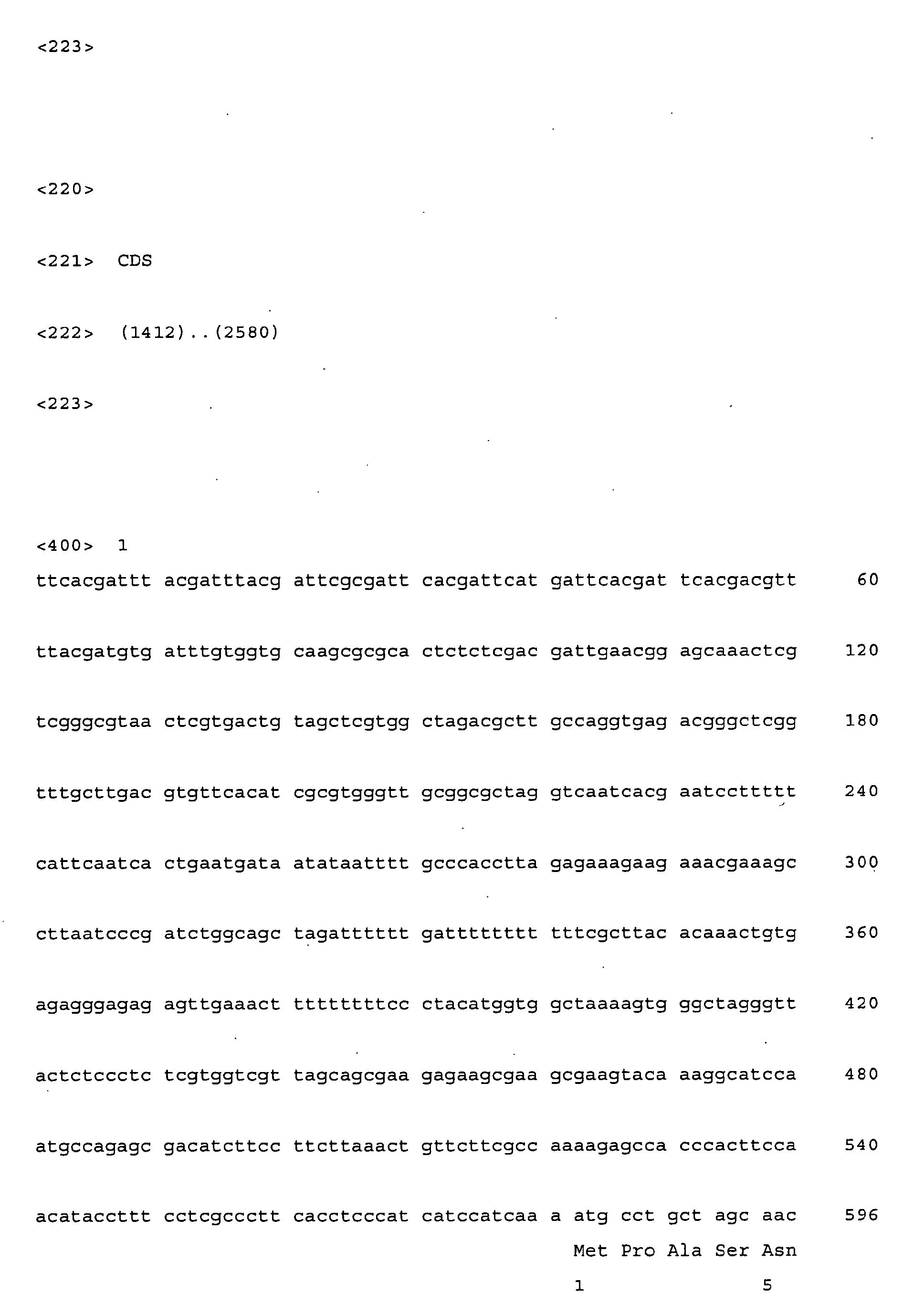
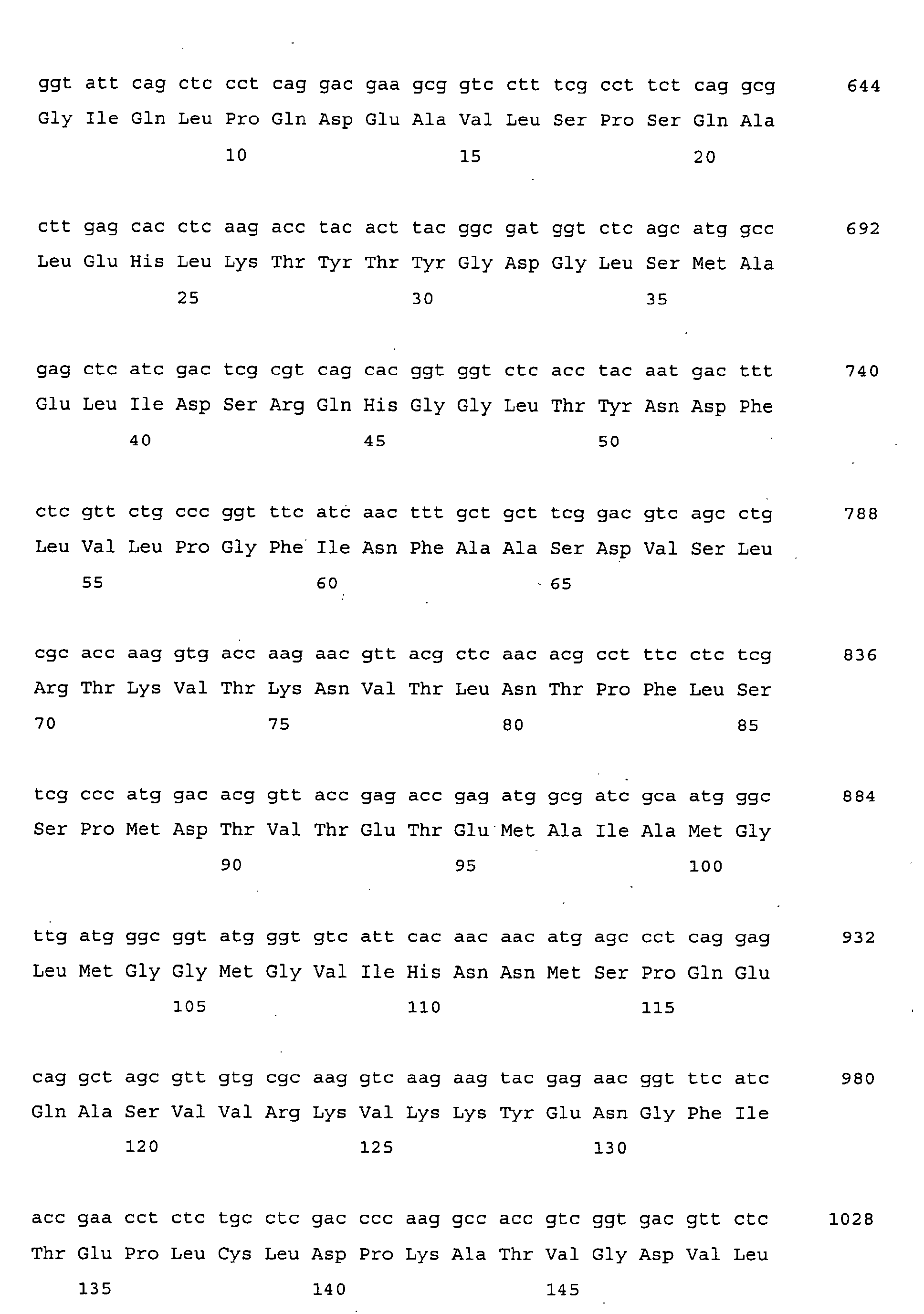
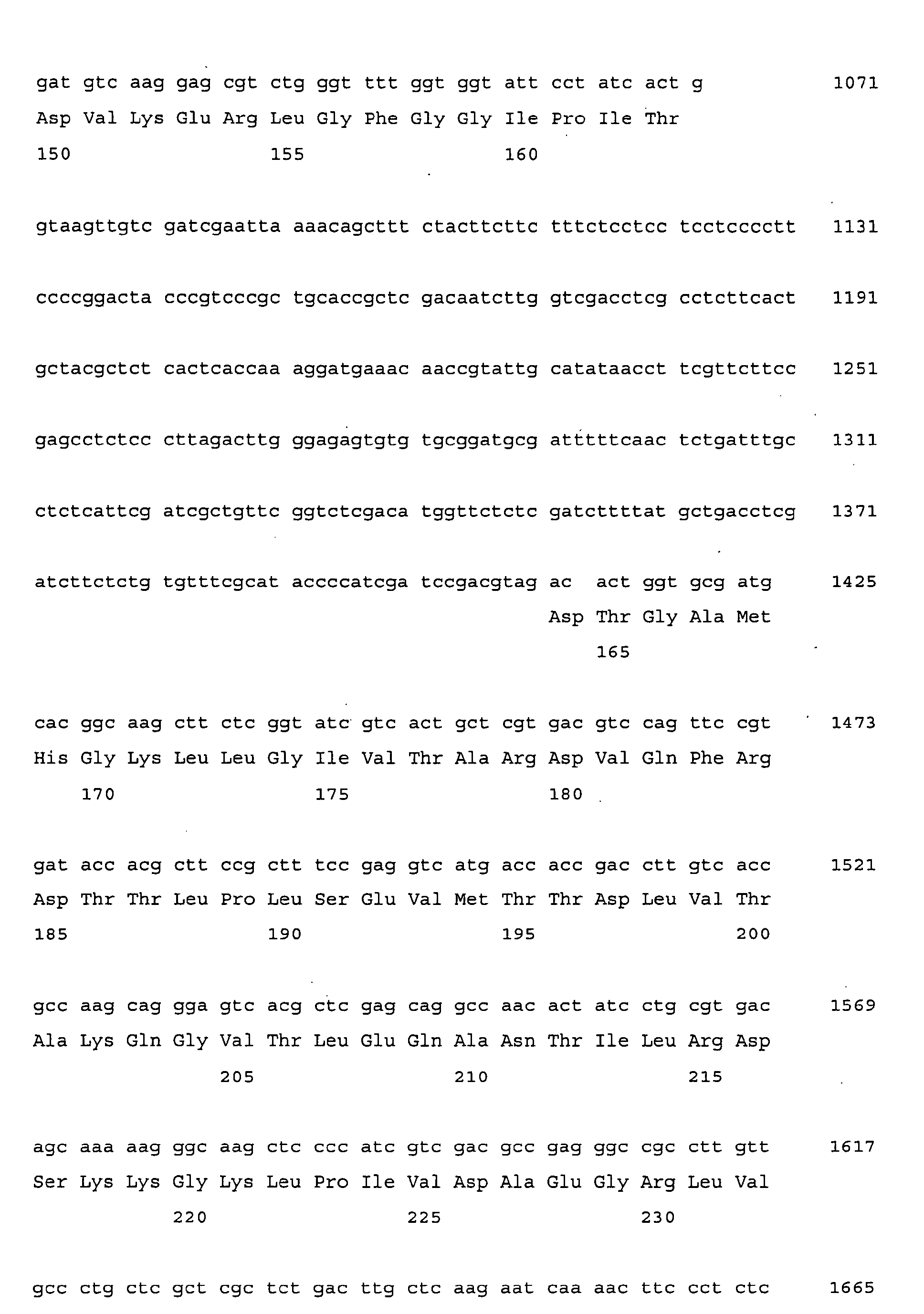


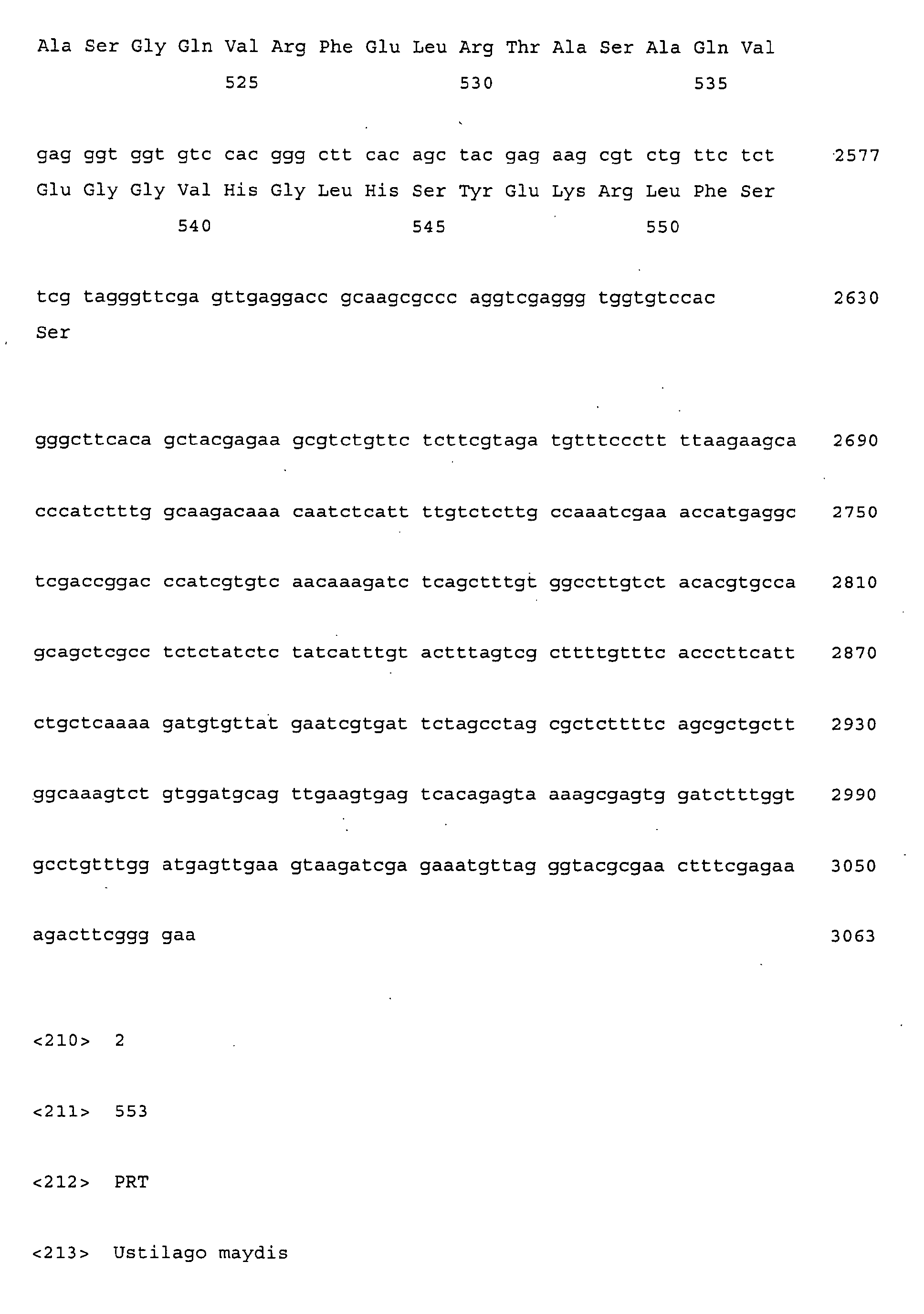
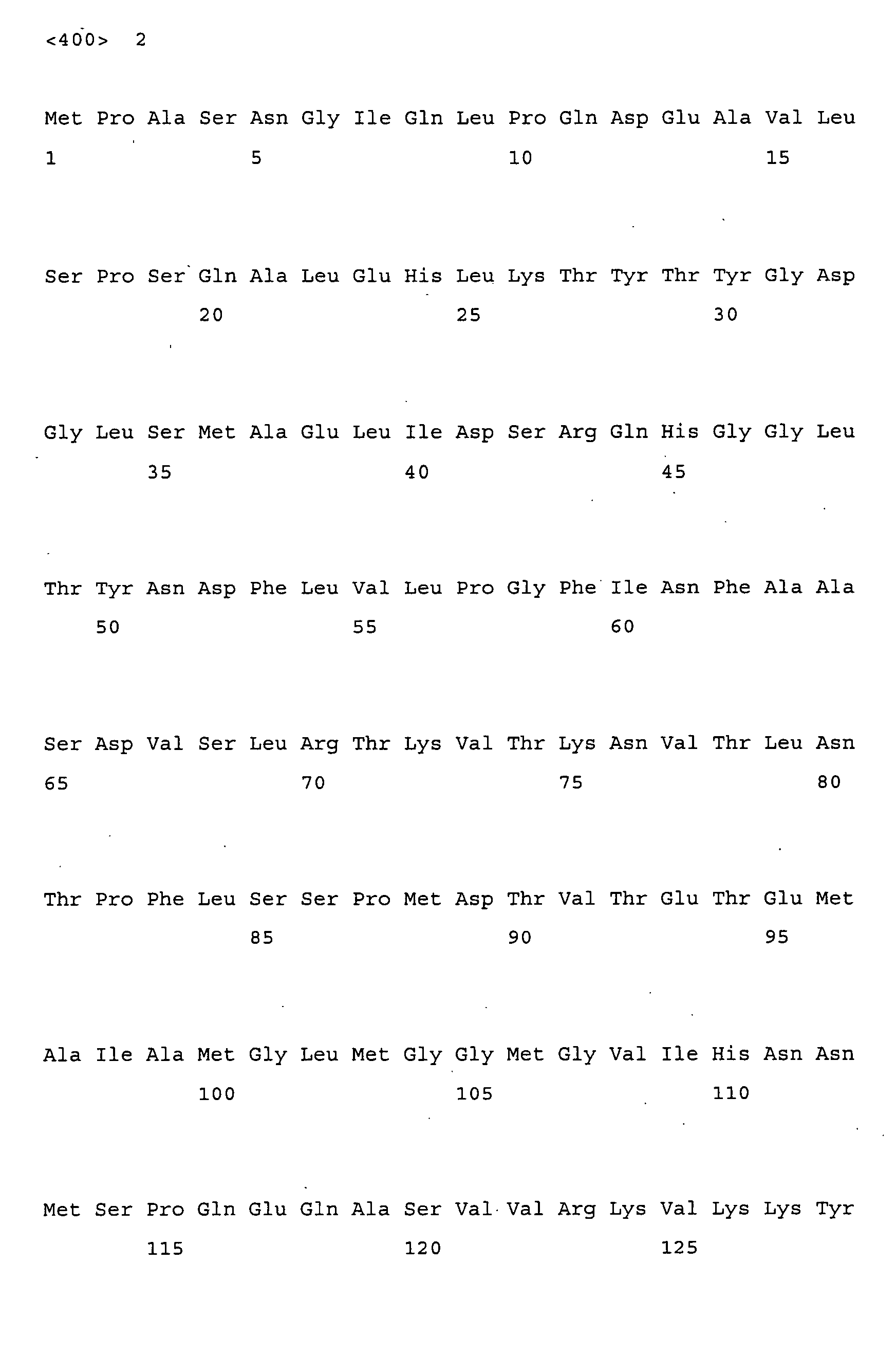
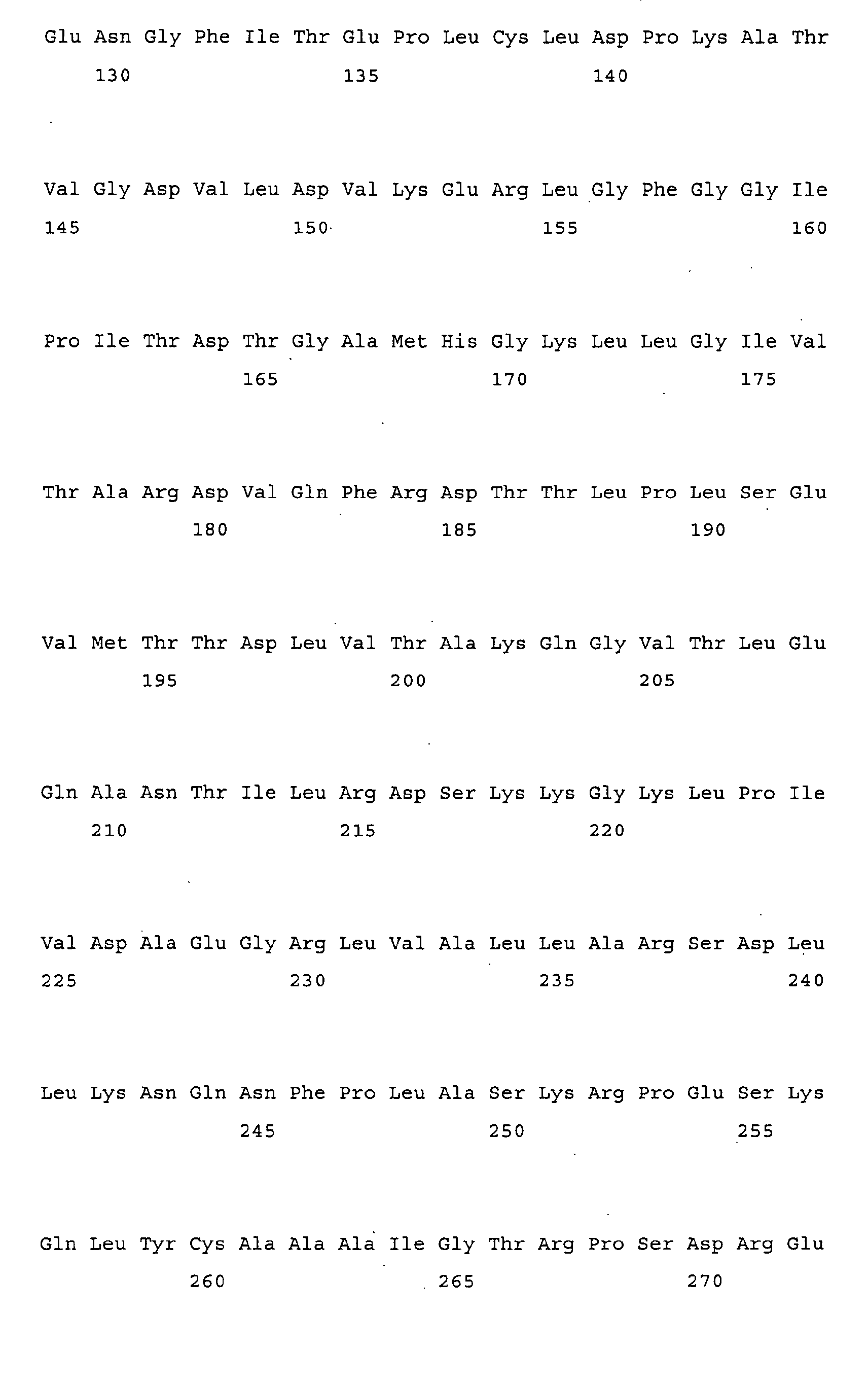


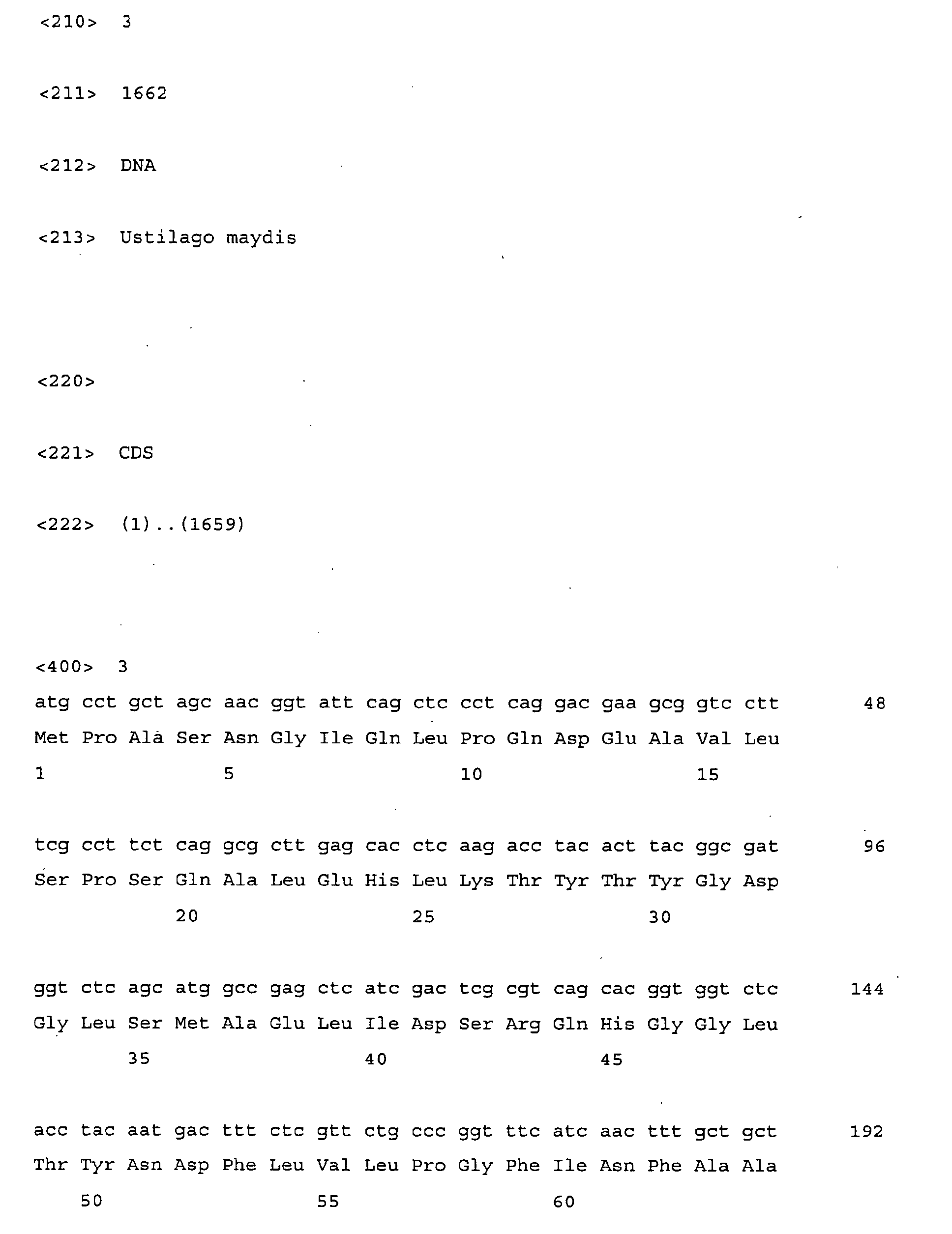

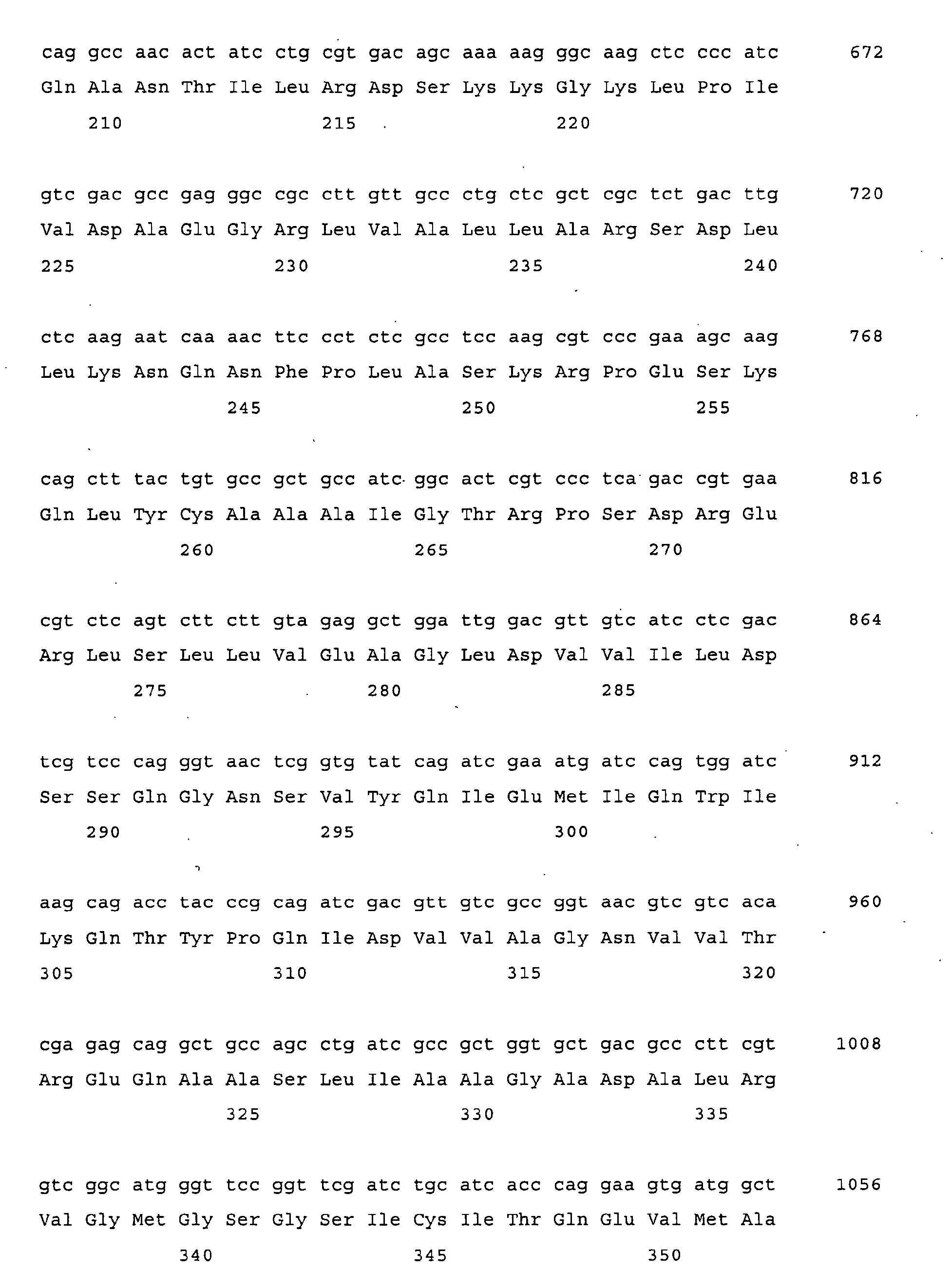
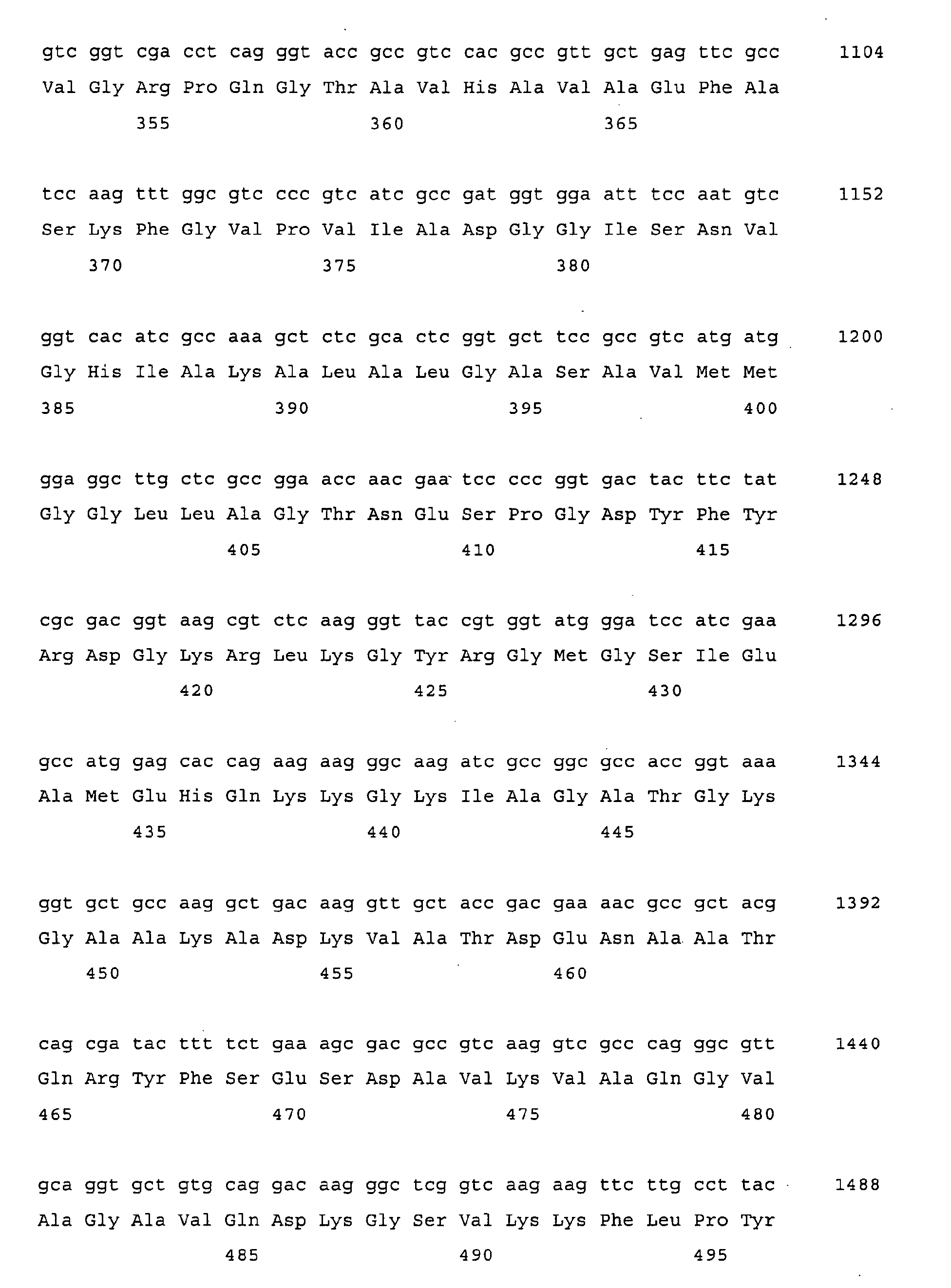
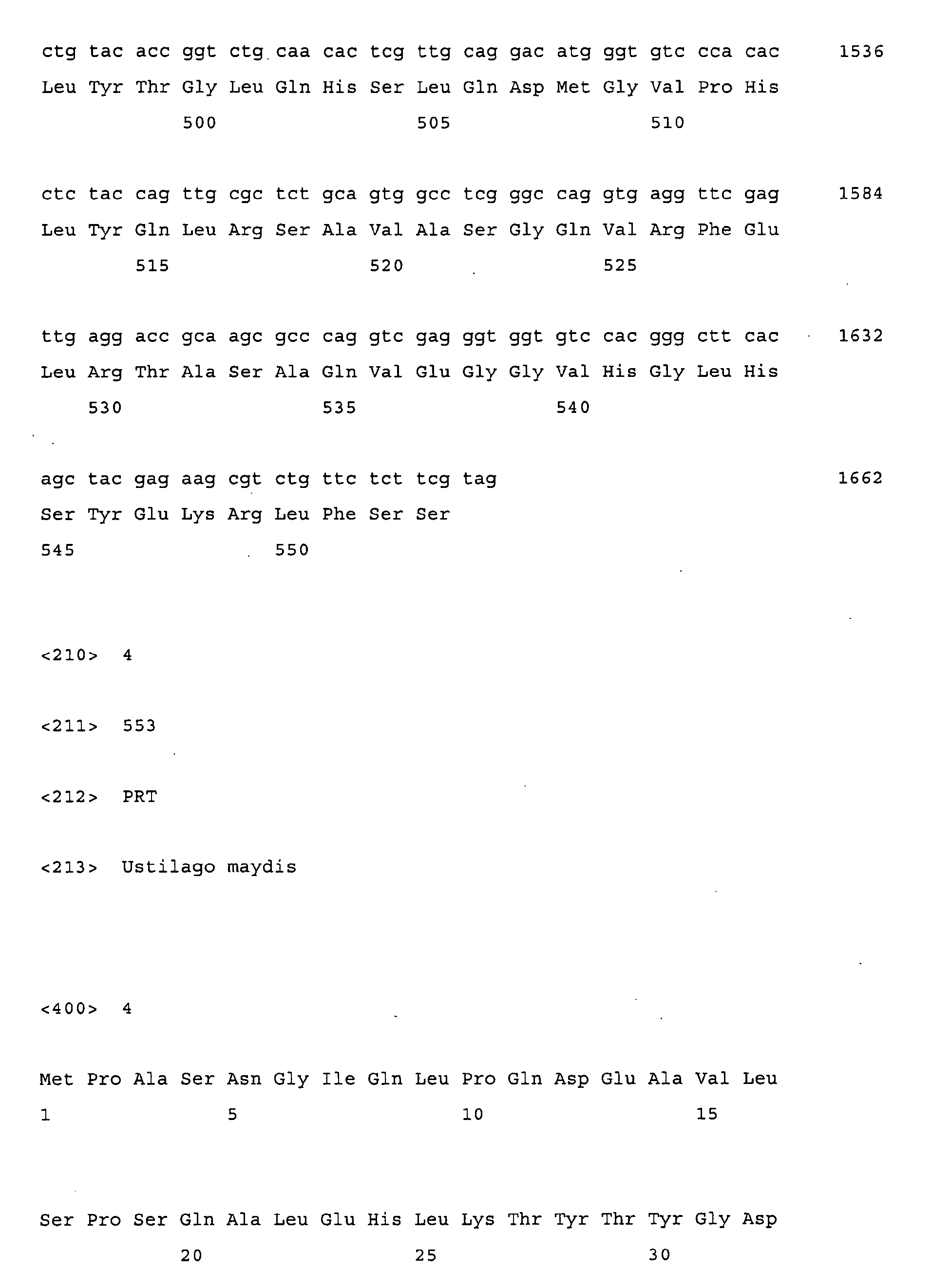
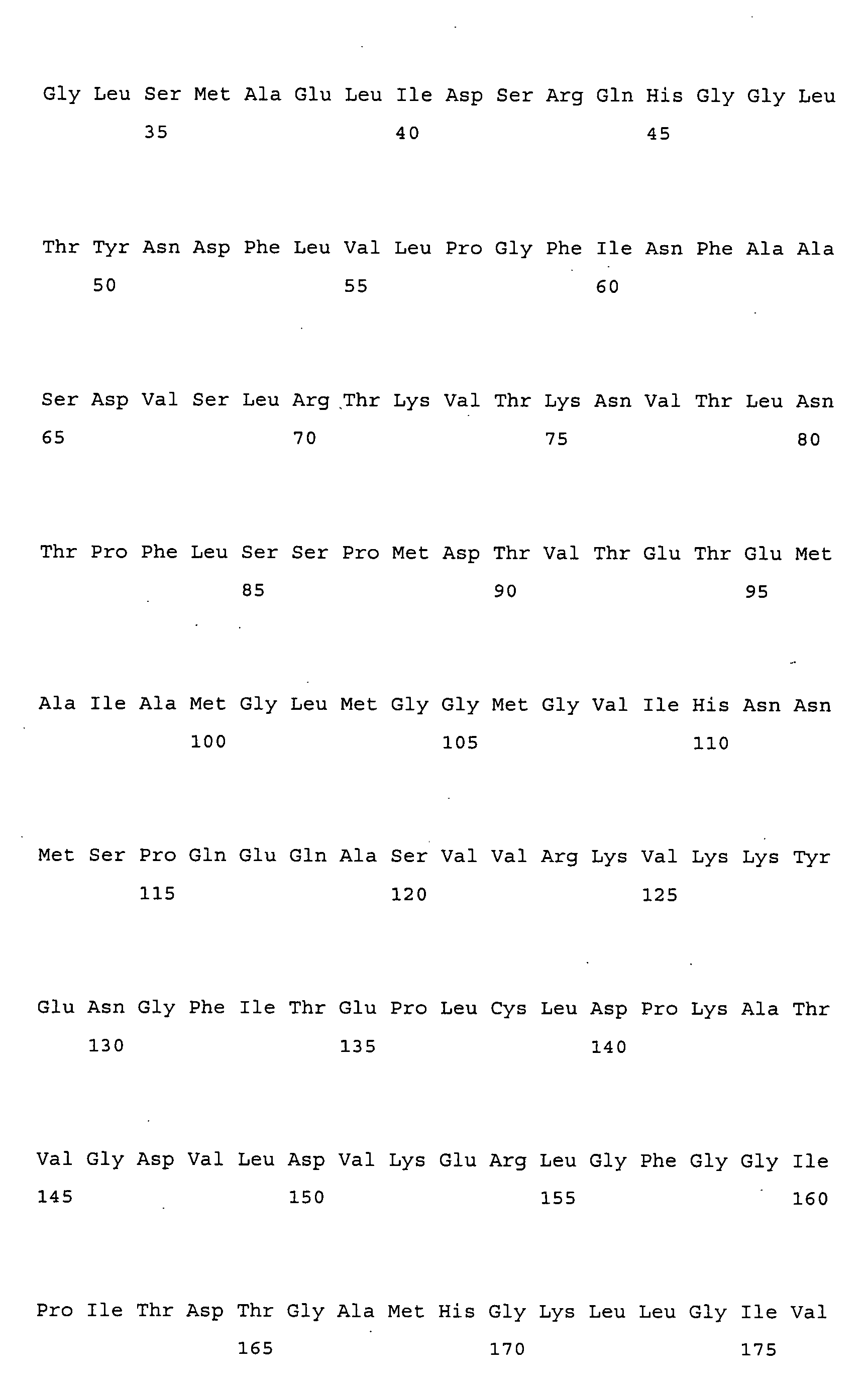
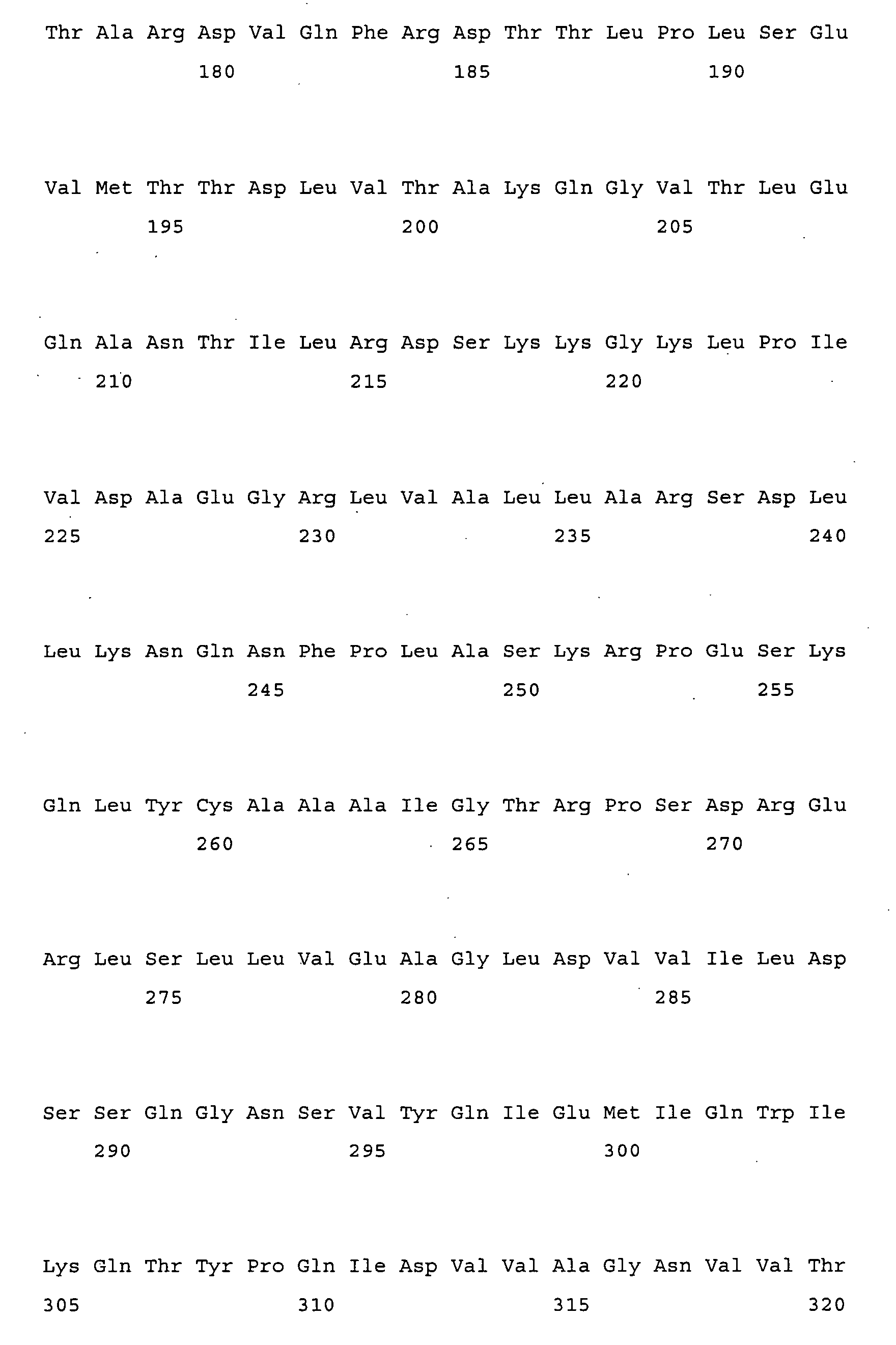


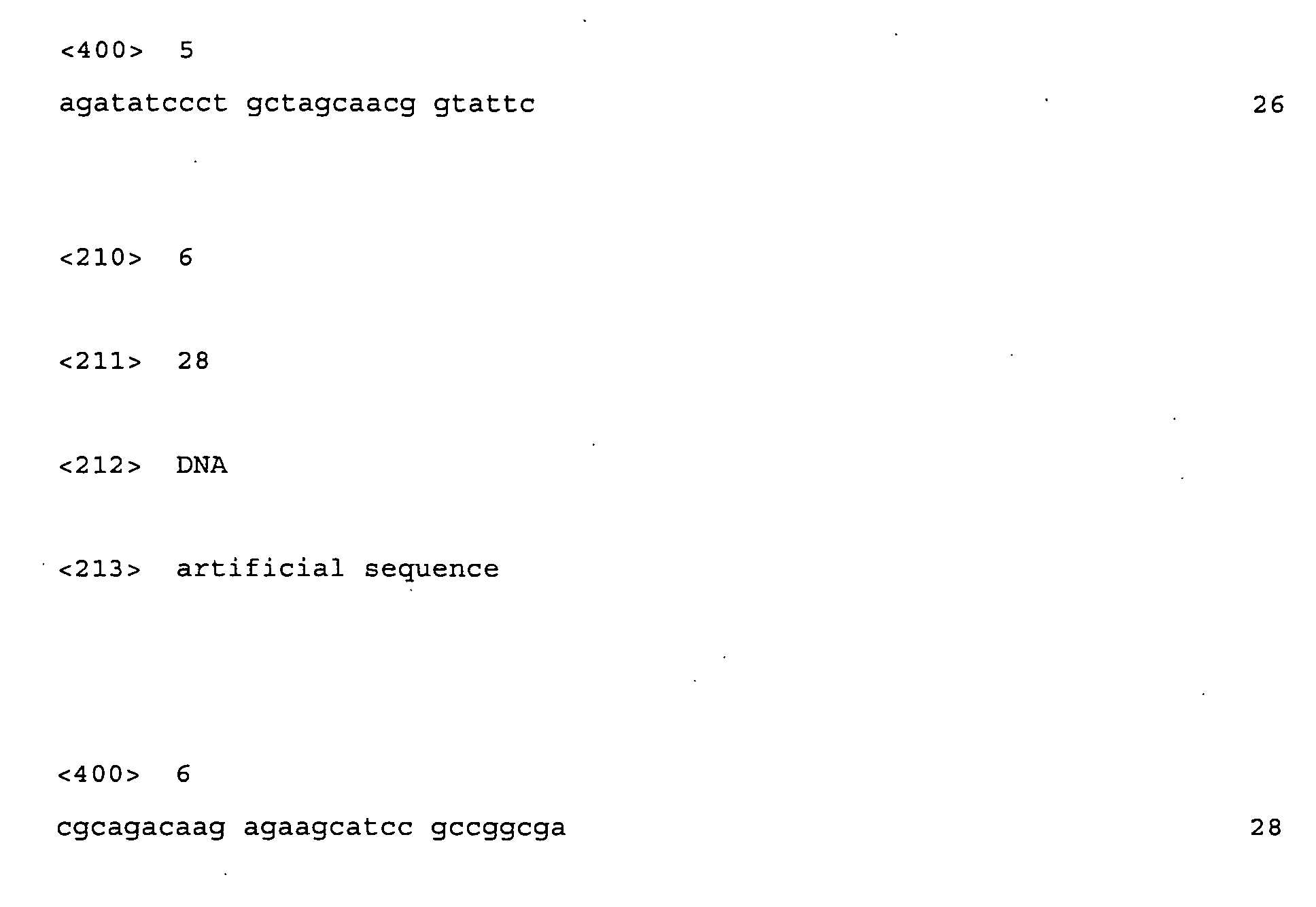
Claims (24)
dadurch gekennzeichnet, dass man
Applications Claiming Priority (2)
| Application Number | Priority Date | Filing Date | Title |
|---|---|---|---|
| DE10160660A DE10160660A1 (de) | 2001-12-11 | 2001-12-11 | Polypeptide zum Identifizieren von fungizid wirksamen Verbindungen |
| DE10160660 | 2001-12-11 |
Publications (2)
| Publication Number | Publication Date |
|---|---|
| EP1319715A1 true EP1319715A1 (de) | 2003-06-18 |
| EP1319715B1 EP1319715B1 (de) | 2005-08-17 |
Family
ID=7708702
Family Applications (1)
| Application Number | Title | Priority Date | Filing Date |
|---|---|---|---|
| EP02026487A Revoked EP1319715B1 (de) | 2001-12-11 | 2002-11-28 | IMP Dehydrogenase und deren Verwendung zum Identifizieren von fungizid wirksamen Verbindungen |
Country Status (9)
| Country | Link |
|---|---|
| US (1) | US7270977B2 (de) |
| EP (1) | EP1319715B1 (de) |
| JP (1) | JP2005512575A (de) |
| AT (1) | ATE302285T1 (de) |
| AU (1) | AU2002358559A1 (de) |
| DE (2) | DE10160660A1 (de) |
| DK (1) | DK1319715T3 (de) |
| ES (1) | ES2248476T3 (de) |
| WO (1) | WO2003054221A1 (de) |
Cited By (1)
| Publication number | Priority date | Publication date | Assignee | Title |
|---|---|---|---|---|
| CN103276057A (zh) * | 2013-04-03 | 2013-09-04 | 南京农业大学 | 一种基于lamp技术快速检测灰葡萄孢的方法 |
Families Citing this family (1)
| Publication number | Priority date | Publication date | Assignee | Title |
|---|---|---|---|---|
| EP2468882A1 (de) | 2010-12-27 | 2012-06-27 | Bayer CropScience AG | Aurorakinaseaktivatorpolypeptide zum Identifizieren von fungizid wirksamen Verbindungen |
Citations (1)
| Publication number | Priority date | Publication date | Assignee | Title |
|---|---|---|---|---|
| WO1999033996A1 (en) * | 1997-12-24 | 1999-07-08 | The University Of Chicago | Method to identify specific inhibitors of imp dehydrogenase |
Family Cites Families (8)
| Publication number | Priority date | Publication date | Assignee | Title |
|---|---|---|---|---|
| US5976848A (en) | 1990-08-03 | 1999-11-02 | Dow Agrosciences Llc | Method of identifying potential fungicides using dihydroorotate dehydrogenase inhibition assay |
| CA2172824A1 (en) | 1993-10-25 | 1995-05-04 | Charles M. Moehle | Methods for screening for antimycotics |
| GB9610872D0 (en) | 1996-05-23 | 1996-07-31 | Ciba Geigy Ag | Protein kinase assay as a method for identification of fungicides |
| AU749606C (en) | 1997-01-23 | 2007-05-17 | Johns Hopkins University School Of Medicine, The | Characterization of the yeast transcriptome |
| GB9703739D0 (en) | 1997-02-22 | 1997-04-09 | Agrevo Uk Ltd | Fungicide test method |
| AU9567398A (en) | 1997-09-10 | 1999-03-29 | E.I. Du Pont De Nemours And Company | Fungal pathogenicity genes |
| EP0927761A3 (de) | 1997-12-23 | 2001-09-05 | Basf Aktiengesellschaft | Gene der Purinbiosyntese aus Ashbya gossypii und deren Verwendung in der mikrobiellen Riboflavinsynthese |
| GB9818319D0 (en) | 1998-08-21 | 1998-10-14 | Agrevo Uk Ltd | Fungicidal test method |
-
2001
- 2001-12-11 DE DE10160660A patent/DE10160660A1/de not_active Withdrawn
-
2002
- 2002-11-28 DE DE50203944T patent/DE50203944D1/de not_active Expired - Lifetime
- 2002-11-28 WO PCT/EP2002/013433 patent/WO2003054221A1/de not_active Ceased
- 2002-11-28 DK DK02026487T patent/DK1319715T3/da active
- 2002-11-28 EP EP02026487A patent/EP1319715B1/de not_active Revoked
- 2002-11-28 ES ES02026487T patent/ES2248476T3/es not_active Expired - Lifetime
- 2002-11-28 JP JP2003554921A patent/JP2005512575A/ja not_active Withdrawn
- 2002-11-28 AT AT02026487T patent/ATE302285T1/de not_active IP Right Cessation
- 2002-11-28 AU AU2002358559A patent/AU2002358559A1/en not_active Abandoned
- 2002-12-06 US US10/313,371 patent/US7270977B2/en not_active Expired - Fee Related
Patent Citations (1)
| Publication number | Priority date | Publication date | Assignee | Title |
|---|---|---|---|---|
| WO1999033996A1 (en) * | 1997-12-24 | 1999-07-08 | The University Of Chicago | Method to identify specific inhibitors of imp dehydrogenase |
Non-Patent Citations (4)
| Title |
|---|
| ANDERSON W K ET AL: "Synthesis and modeling studies with monocyclic analogues of mycophenolic acid.", JOURNAL OF MEDICINAL CHEMISTRY. UNITED STATES 5 JAN 1996, vol. 39, no. 1, 5 January 1996 (1996-01-05), pages 46 - 55, XP002234559, ISSN: 0022-2623 * |
| FARAZI T ET AL: "Isolation and characterization of mycophenolic acid-resistant mutants of inosine-5'-monophosphate dehydrogenase.", THE JOURNAL OF BIOLOGICAL CHEMISTRY. UNITED STATES 10 JAN 1997, vol. 272, no. 2, 10 January 1997 (1997-01-10), pages 961 - 965, XP002234558, ISSN: 0021-9258 * |
| KÖHLER G A ET AL: "Overexpression of a cloned IMP dehydrogenase gene of Candida albicans confers resistance to the specific inhibitor mycophenolic acid.", JOURNAL OF BACTERIOLOGY. UNITED STATES APR 1997, vol. 179, no. 7, April 1997 (1997-04-01), pages 2331 - 2338, XP002234556, ISSN: 0021-9193 * |
| O'GARA M J ET AL: "IMP dehydrogenase from Pneumocystis carinii as a potential drug target.", ANTIMICROBIAL AGENTS AND CHEMOTHERAPY. UNITED STATES JAN 1997, vol. 41, no. 1, January 1997 (1997-01-01), pages 40 - 48, XP002234557, ISSN: 0066-4804 * |
Cited By (2)
| Publication number | Priority date | Publication date | Assignee | Title |
|---|---|---|---|---|
| CN103276057A (zh) * | 2013-04-03 | 2013-09-04 | 南京农业大学 | 一种基于lamp技术快速检测灰葡萄孢的方法 |
| CN103276057B (zh) * | 2013-04-03 | 2014-10-15 | 南京农业大学 | 一种基于lamp技术快速检测灰葡萄孢的方法 |
Also Published As
| Publication number | Publication date |
|---|---|
| WO2003054221A1 (de) | 2003-07-03 |
| JP2005512575A (ja) | 2005-05-12 |
| DK1319715T3 (da) | 2005-12-27 |
| ES2248476T3 (es) | 2006-03-16 |
| EP1319715B1 (de) | 2005-08-17 |
| DE10160660A1 (de) | 2003-06-18 |
| US20030228649A1 (en) | 2003-12-11 |
| AU2002358559A1 (en) | 2003-07-09 |
| US7270977B2 (en) | 2007-09-18 |
| DE50203944D1 (de) | 2005-09-22 |
| ATE302285T1 (de) | 2005-09-15 |
Similar Documents
| Publication | Publication Date | Title |
|---|---|---|
| EP1319715B1 (de) | IMP Dehydrogenase und deren Verwendung zum Identifizieren von fungizid wirksamen Verbindungen | |
| DE19717656A1 (de) | DNA-Sequenzen kodierend für die Untereinheit CHLD pflanzlicher Magnesium-Chelatasen, sowie Verfahren zur Aktivitätsbestimmung pflanzlicher Magnesium-Chelatasen | |
| DE10242940A1 (de) | Verfahren zum Identifizieren von fungizid wirksamen Verbindungen | |
| EP1612276A1 (de) | Verfahren zum Identifizieren von fungizid wirksamen Verbindungen basierend auf Thymidylat-Kinasen | |
| EP1394265A2 (de) | Verfahren zur Identifikation von Fungiziden unter Verwendung einer Ribose-5-Phosphat Isomerase | |
| WO2003105591A1 (de) | Verfahren zum identifizieren von fungizid wirksamen verbindungen | |
| DE10142328A1 (de) | Verwendung von Fructose-1,6-Bisphosphate Aldolase zum Identifizieren von neuen fungizid wirksamen Substanzen | |
| DE10330234A1 (de) | Verfahren zum Identifizieren von fungizid wirksamen Verbindungen basierend auf Mevalonat Kinasen aus Pilzen | |
| DE102004016252A1 (de) | Verfahren zum Indentifizieren von fungizid wirksamen Verbindungen basierend auf Thioredoxin Reduktasen | |
| DE10330233A1 (de) | Verfahren zum Identifizieren von funigzid wirksamen Verbindungen basierend auf Guanylat Kinasen | |
| DE10356218A1 (de) | Verfahren zum Identifizieren von fungizid wirksamen Verbindungen basierend auf Pyruvatkinasen aus Pilzen | |
| DE10356433A1 (de) | Verfahren zum Identifizieren von fungizid wirksamen Verbindungen basierend auf UMP/CMP-Kinasen aus Pilzen | |
| WO2003023028A9 (de) | Glyoxaloxidasen aus pilzen | |
| DE102005025191A1 (de) | Verfahren zum Identifizieren von fungizid wirksamen Verbindungen basierend auf Isopentenylpyrophosphat-Isomerasen | |
| WO2003048349A2 (de) | Acetoacetyl-coa thiolase und deren verwendung zum identifizieren von neuen fungizid wirksamen substanzen | |
| DE10150677A1 (de) | Neue Targets für Fungizide | |
| EP2468882A1 (de) | Aurorakinaseaktivatorpolypeptide zum Identifizieren von fungizid wirksamen Verbindungen | |
| DE10221725A1 (de) | Glyoxaloxidasen aus Pilzen | |
| EP1402013A2 (de) | Homoaconitase als target für fungizide | |
| DE10232773A1 (de) | Proteine des Ubiquitin Proteasom Stoffwechsels als Targets für Fungizide |
Legal Events
| Date | Code | Title | Description |
|---|---|---|---|
| PUAI | Public reference made under article 153(3) epc to a published international application that has entered the european phase |
Free format text: ORIGINAL CODE: 0009012 |
|
| AK | Designated contracting states |
Designated state(s): AT BE BG CH CY CZ DE DK EE ES FI FR GB GR IE IT LI LU MC NL PT SE SK TR |
|
| AX | Request for extension of the european patent |
Extension state: AL LT LV MK RO SI |
|
| 17P | Request for examination filed |
Effective date: 20031218 |
|
| 17Q | First examination report despatched |
Effective date: 20040127 |
|
| AKX | Designation fees paid |
Designated state(s): AT BE BG CH CY CZ DE DK EE ES FI FR GB GR IE IT LI LU MC NL PT SE SK TR |
|
| GRAP | Despatch of communication of intention to grant a patent |
Free format text: ORIGINAL CODE: EPIDOSNIGR1 |
|
| GRAS | Grant fee paid |
Free format text: ORIGINAL CODE: EPIDOSNIGR3 |
|
| GRAA | (expected) grant |
Free format text: ORIGINAL CODE: 0009210 |
|
| AK | Designated contracting states |
Kind code of ref document: B1 Designated state(s): AT BE BG CH CY CZ DE DK EE ES FI FR GB GR IE IT LI LU MC NL PT SE SK TR |
|
| PG25 | Lapsed in a contracting state [announced via postgrant information from national office to epo] |
Ref country code: CZ Free format text: LAPSE BECAUSE OF FAILURE TO SUBMIT A TRANSLATION OF THE DESCRIPTION OR TO PAY THE FEE WITHIN THE PRESCRIBED TIME-LIMIT Effective date: 20050817 Ref country code: EE Free format text: LAPSE BECAUSE OF FAILURE TO SUBMIT A TRANSLATION OF THE DESCRIPTION OR TO PAY THE FEE WITHIN THE PRESCRIBED TIME-LIMIT Effective date: 20050817 Ref country code: SK Free format text: LAPSE BECAUSE OF FAILURE TO SUBMIT A TRANSLATION OF THE DESCRIPTION OR TO PAY THE FEE WITHIN THE PRESCRIBED TIME-LIMIT Effective date: 20050817 Ref country code: FI Free format text: LAPSE BECAUSE OF FAILURE TO SUBMIT A TRANSLATION OF THE DESCRIPTION OR TO PAY THE FEE WITHIN THE PRESCRIBED TIME-LIMIT Effective date: 20050817 |
|
| REG | Reference to a national code |
Ref country code: GB Ref legal event code: FG4D Free format text: NOT ENGLISH |
|
| REG | Reference to a national code |
Ref country code: CH Ref legal event code: EP |
|
| REG | Reference to a national code |
Ref country code: IE Ref legal event code: FG4D Free format text: LANGUAGE OF EP DOCUMENT: GERMAN |
|
| REF | Corresponds to: |
Ref document number: 50203944 Country of ref document: DE Date of ref document: 20050922 Kind code of ref document: P |
|
| REG | Reference to a national code |
Ref country code: CH Ref legal event code: NV Representative=s name: E. BLUM & CO. PATENTANWAELTE |
|
| PGFP | Annual fee paid to national office [announced via postgrant information from national office to epo] |
Ref country code: IE Payment date: 20051017 Year of fee payment: 4 |
|
| PGFP | Annual fee paid to national office [announced via postgrant information from national office to epo] |
Ref country code: PT Payment date: 20051103 Year of fee payment: 4 |
|
| PGFP | Annual fee paid to national office [announced via postgrant information from national office to epo] |
Ref country code: TR Payment date: 20051109 Year of fee payment: 5 |
|
| PGFP | Annual fee paid to national office [announced via postgrant information from national office to epo] |
Ref country code: DK Payment date: 20051116 Year of fee payment: 4 |
|
| PG25 | Lapsed in a contracting state [announced via postgrant information from national office to epo] |
Ref country code: BG Free format text: LAPSE BECAUSE OF FAILURE TO SUBMIT A TRANSLATION OF THE DESCRIPTION OR TO PAY THE FEE WITHIN THE PRESCRIBED TIME-LIMIT Effective date: 20051117 Ref country code: SE Free format text: LAPSE BECAUSE OF FAILURE TO SUBMIT A TRANSLATION OF THE DESCRIPTION OR TO PAY THE FEE WITHIN THE PRESCRIBED TIME-LIMIT Effective date: 20051117 Ref country code: GR Free format text: LAPSE BECAUSE OF FAILURE TO SUBMIT A TRANSLATION OF THE DESCRIPTION OR TO PAY THE FEE WITHIN THE PRESCRIBED TIME-LIMIT Effective date: 20051117 |
|
| PG25 | Lapsed in a contracting state [announced via postgrant information from national office to epo] |
Ref country code: CY Free format text: LAPSE BECAUSE OF FAILURE TO SUBMIT A TRANSLATION OF THE DESCRIPTION OR TO PAY THE FEE WITHIN THE PRESCRIBED TIME-LIMIT Effective date: 20051128 Ref country code: AT Free format text: LAPSE BECAUSE OF NON-PAYMENT OF DUE FEES Effective date: 20051128 |
|
| PG25 | Lapsed in a contracting state [announced via postgrant information from national office to epo] |
Ref country code: LU Free format text: LAPSE BECAUSE OF NON-PAYMENT OF DUE FEES Effective date: 20051130 Ref country code: MC Free format text: LAPSE BECAUSE OF NON-PAYMENT OF DUE FEES Effective date: 20051130 |
|
| REG | Reference to a national code |
Ref country code: DK Ref legal event code: T3 |
|
| GBT | Gb: translation of ep patent filed (gb section 77(6)(a)/1977) |
Effective date: 20051205 |
|
| REG | Reference to a national code |
Ref country code: ES Ref legal event code: FG2A Ref document number: 2248476 Country of ref document: ES Kind code of ref document: T3 |
|
| ET | Fr: translation filed | ||
| PLBI | Opposition filed |
Free format text: ORIGINAL CODE: 0009260 |
|
| 26 | Opposition filed |
Opponent name: BASF AKTIENGESELLSCHAFT GLOBAL INTELLECTUAL PROPER Effective date: 20060503 |
|
| PLAX | Notice of opposition and request to file observation + time limit sent |
Free format text: ORIGINAL CODE: EPIDOSNOBS2 |
|
| NLR1 | Nl: opposition has been filed with the epo |
Opponent name: BASF AKTIENGESELLSCHAFT GLOBAL INTELLECTUAL PROPER |
|
| PLAF | Information modified related to communication of a notice of opposition and request to file observations + time limit |
Free format text: ORIGINAL CODE: EPIDOSCOBS2 |
|
| PG25 | Lapsed in a contracting state [announced via postgrant information from national office to epo] |
Ref country code: IE Free format text: LAPSE BECAUSE OF NON-PAYMENT OF DUE FEES Effective date: 20061128 |
|
| PG25 | Lapsed in a contracting state [announced via postgrant information from national office to epo] |
Ref country code: DK Free format text: LAPSE BECAUSE OF NON-PAYMENT OF DUE FEES Effective date: 20061130 |
|
| PLBB | Reply of patent proprietor to notice(s) of opposition received |
Free format text: ORIGINAL CODE: EPIDOSNOBS3 |
|
| PLAB | Opposition data, opponent's data or that of the opponent's representative modified |
Free format text: ORIGINAL CODE: 0009299OPPO |
|
| R26 | Opposition filed (corrected) |
Opponent name: BASF AKTIENGESELLSCHAFT GLOBAL INTELLECTUAL PROPER Effective date: 20060503 |
|
| PG25 | Lapsed in a contracting state [announced via postgrant information from national office to epo] |
Ref country code: PT Free format text: LAPSE BECAUSE OF NON-PAYMENT OF DUE FEES Effective date: 20070528 |
|
| REG | Reference to a national code |
Ref country code: PT Ref legal event code: MM4A Free format text: LAPSE DUE TO NON-PAYMENT OF FEES Effective date: 20070528 |
|
| NLR1 | Nl: opposition has been filed with the epo |
Opponent name: BASF AKTIENGESELLSCHAFT GLOBAL INTELLECTUAL PROPER |
|
| REG | Reference to a national code |
Ref country code: DK Ref legal event code: EBP |
|
| REG | Reference to a national code |
Ref country code: IE Ref legal event code: MM4A |
|
| REG | Reference to a national code |
Ref country code: CH Ref legal event code: PFA Owner name: BAYER CROPSCIENCE AG Free format text: BAYER CROPSCIENCE AG#ALFRED-NOBEL-STRASSE 50#40789 MONHEIM (DE) -TRANSFER TO- BAYER CROPSCIENCE AG#ALFRED-NOBEL-STRASSE 50#40789 MONHEIM (DE) |
|
| APBP | Date of receipt of notice of appeal recorded |
Free format text: ORIGINAL CODE: EPIDOSNNOA2O |
|
| APAH | Appeal reference modified |
Free format text: ORIGINAL CODE: EPIDOSCREFNO |
|
| APBP | Date of receipt of notice of appeal recorded |
Free format text: ORIGINAL CODE: EPIDOSNNOA2O |
|
| APBQ | Date of receipt of statement of grounds of appeal recorded |
Free format text: ORIGINAL CODE: EPIDOSNNOA3O |
|
| APBQ | Date of receipt of statement of grounds of appeal recorded |
Free format text: ORIGINAL CODE: EPIDOSNNOA3O |
|
| PLAB | Opposition data, opponent's data or that of the opponent's representative modified |
Free format text: ORIGINAL CODE: 0009299OPPO |
|
| R26 | Opposition filed (corrected) |
Opponent name: BASF SE Effective date: 20060503 |
|
| NLR1 | Nl: opposition has been filed with the epo |
Opponent name: BASF SE |
|
| PG25 | Lapsed in a contracting state [announced via postgrant information from national office to epo] |
Ref country code: TR Free format text: LAPSE BECAUSE OF FAILURE TO SUBMIT A TRANSLATION OF THE DESCRIPTION OR TO PAY THE FEE WITHIN THE PRESCRIBED TIME-LIMIT Effective date: 20050817 |
|
| APAH | Appeal reference modified |
Free format text: ORIGINAL CODE: EPIDOSCREFNO |
|
| PGFP | Annual fee paid to national office [announced via postgrant information from national office to epo] |
Ref country code: CH Payment date: 20091113 Year of fee payment: 8 Ref country code: ES Payment date: 20091201 Year of fee payment: 8 |
|
| PGFP | Annual fee paid to national office [announced via postgrant information from national office to epo] |
Ref country code: NL Payment date: 20091104 Year of fee payment: 8 |
|
| PGFP | Annual fee paid to national office [announced via postgrant information from national office to epo] |
Ref country code: FR Payment date: 20091123 Year of fee payment: 8 Ref country code: GB Payment date: 20091125 Year of fee payment: 8 Ref country code: IT Payment date: 20091119 Year of fee payment: 8 |
|
| PGFP | Annual fee paid to national office [announced via postgrant information from national office to epo] |
Ref country code: BE Payment date: 20091130 Year of fee payment: 8 |
|
| BERE | Be: lapsed |
Owner name: *BAYER CROPSCIENCE A.G. Effective date: 20101130 |
|
| REG | Reference to a national code |
Ref country code: NL Ref legal event code: V1 Effective date: 20110601 |
|
| REG | Reference to a national code |
Ref country code: CH Ref legal event code: PL |
|
| GBPC | Gb: european patent ceased through non-payment of renewal fee |
Effective date: 20101128 |
|
| PG25 | Lapsed in a contracting state [announced via postgrant information from national office to epo] |
Ref country code: CH Free format text: LAPSE BECAUSE OF NON-PAYMENT OF DUE FEES Effective date: 20101130 Ref country code: LI Free format text: LAPSE BECAUSE OF NON-PAYMENT OF DUE FEES Effective date: 20101130 |
|
| REG | Reference to a national code |
Ref country code: FR Ref legal event code: ST Effective date: 20110801 |
|
| PG25 | Lapsed in a contracting state [announced via postgrant information from national office to epo] |
Ref country code: BE Free format text: LAPSE BECAUSE OF NON-PAYMENT OF DUE FEES Effective date: 20101130 Ref country code: NL Free format text: LAPSE BECAUSE OF NON-PAYMENT OF DUE FEES Effective date: 20110601 |
|
| PG25 | Lapsed in a contracting state [announced via postgrant information from national office to epo] |
Ref country code: FR Free format text: LAPSE BECAUSE OF NON-PAYMENT OF DUE FEES Effective date: 20101130 |
|
| PG25 | Lapsed in a contracting state [announced via postgrant information from national office to epo] |
Ref country code: GB Free format text: LAPSE BECAUSE OF NON-PAYMENT OF DUE FEES Effective date: 20101128 |
|
| PG25 | Lapsed in a contracting state [announced via postgrant information from national office to epo] |
Ref country code: IT Free format text: LAPSE BECAUSE OF NON-PAYMENT OF DUE FEES Effective date: 20101128 |
|
| REG | Reference to a national code |
Ref country code: ES Ref legal event code: FD2A Effective date: 20120411 |
|
| PG25 | Lapsed in a contracting state [announced via postgrant information from national office to epo] |
Ref country code: ES Free format text: LAPSE BECAUSE OF NON-PAYMENT OF DUE FEES Effective date: 20101129 |
|
| REG | Reference to a national code |
Ref country code: DE Ref legal event code: R103 Ref document number: 50203944 Country of ref document: DE Ref country code: DE Ref legal event code: R064 Ref document number: 50203944 Country of ref document: DE |
|
| APBU | Appeal procedure closed |
Free format text: ORIGINAL CODE: EPIDOSNNOA9O |
|
| RDAF | Communication despatched that patent is revoked |
Free format text: ORIGINAL CODE: EPIDOSNREV1 |
|
| RDAG | Patent revoked |
Free format text: ORIGINAL CODE: 0009271 |
|
| STAA | Information on the status of an ep patent application or granted ep patent |
Free format text: STATUS: PATENT REVOKED |
|
| 27W | Patent revoked |
Effective date: 20120614 |
|
| PGFP | Annual fee paid to national office [announced via postgrant information from national office to epo] |
Ref country code: DE Payment date: 20121121 Year of fee payment: 11 |
|
| REG | Reference to a national code |
Ref country code: DE Ref legal event code: R107 Ref document number: 50203944 Country of ref document: DE Effective date: 20130228 |
|
| REG | Reference to a national code |
Ref country code: AT Ref legal event code: MA03 Ref document number: 302285 Country of ref document: AT Kind code of ref document: T Effective date: 20120614 |