EP1319602B1 - Verschlussstreifen - Google Patents
Verschlussstreifen Download PDFInfo
- Publication number
- EP1319602B1 EP1319602B1 EP02102709A EP02102709A EP1319602B1 EP 1319602 B1 EP1319602 B1 EP 1319602B1 EP 02102709 A EP02102709 A EP 02102709A EP 02102709 A EP02102709 A EP 02102709A EP 1319602 B1 EP1319602 B1 EP 1319602B1
- Authority
- EP
- European Patent Office
- Prior art keywords
- layer
- sealing element
- packing
- film layer
- closure element
- Prior art date
- Legal status (The legal status is an assumption and is not a legal conclusion. Google has not performed a legal analysis and makes no representation as to the accuracy of the status listed.)
- Expired - Lifetime
Links
- 239000010410 layer Substances 0.000 claims abstract description 72
- 229920001684 low density polyethylene Polymers 0.000 claims abstract description 21
- 239000004702 low-density polyethylene Substances 0.000 claims abstract description 21
- 238000007789 sealing Methods 0.000 claims abstract description 14
- 239000012790 adhesive layer Substances 0.000 claims abstract description 12
- 239000000463 material Substances 0.000 claims abstract description 3
- 229910052623 talc Inorganic materials 0.000 claims abstract description 3
- 239000000454 talc Substances 0.000 claims abstract description 3
- 239000004922 lacquer Substances 0.000 claims abstract 2
- XAGFODPZIPBFFR-UHFFFAOYSA-N aluminium Chemical compound [Al] XAGFODPZIPBFFR-UHFFFAOYSA-N 0.000 claims description 9
- 229910052782 aluminium Inorganic materials 0.000 claims description 9
- 229920006267 polyester film Polymers 0.000 claims description 6
- 239000000123 paper Substances 0.000 claims description 3
- 238000004026 adhesive bonding Methods 0.000 claims description 2
- 238000012856 packing Methods 0.000 claims 9
- 239000002365 multiple layer Substances 0.000 claims 6
- 239000007788 liquid Substances 0.000 claims 1
- 235000012222 talc Nutrition 0.000 claims 1
- 238000004806 packaging method and process Methods 0.000 abstract description 23
- 239000000945 filler Substances 0.000 abstract description 3
- 235000021056 liquid food Nutrition 0.000 abstract 1
- 230000001737 promoting effect Effects 0.000 abstract 1
- VGGSQFUCUMXWEO-UHFFFAOYSA-N Ethene Chemical compound C=C VGGSQFUCUMXWEO-UHFFFAOYSA-N 0.000 description 13
- 239000011888 foil Substances 0.000 description 8
- 239000004920 heat-sealing lacquer Substances 0.000 description 7
- 238000010276 construction Methods 0.000 description 6
- 238000004519 manufacturing process Methods 0.000 description 4
- 239000000853 adhesive Substances 0.000 description 3
- 230000001070 adhesive effect Effects 0.000 description 2
- 239000003292 glue Substances 0.000 description 2
- 239000012939 laminating adhesive Substances 0.000 description 2
- 238000000034 method Methods 0.000 description 2
- 230000035699 permeability Effects 0.000 description 2
- 229920003023 plastic Polymers 0.000 description 2
- 239000004033 plastic Substances 0.000 description 2
- 239000004820 Pressure-sensitive adhesive Substances 0.000 description 1
- QVGXLLKOCUKJST-UHFFFAOYSA-N atomic oxygen Chemical compound [O] QVGXLLKOCUKJST-UHFFFAOYSA-N 0.000 description 1
- 230000004888 barrier function Effects 0.000 description 1
- 238000005452 bending Methods 0.000 description 1
- 239000011248 coating agent Substances 0.000 description 1
- 238000000576 coating method Methods 0.000 description 1
- 238000001125 extrusion Methods 0.000 description 1
- 238000007765 extrusion coating Methods 0.000 description 1
- 230000001771 impaired effect Effects 0.000 description 1
- 238000003475 lamination Methods 0.000 description 1
- 239000008267 milk Substances 0.000 description 1
- 210000004080 milk Anatomy 0.000 description 1
- 235000013336 milk Nutrition 0.000 description 1
- 235000015205 orange juice Nutrition 0.000 description 1
- 229910052760 oxygen Inorganic materials 0.000 description 1
- 239000001301 oxygen Substances 0.000 description 1
- 239000005022 packaging material Substances 0.000 description 1
- 238000003825 pressing Methods 0.000 description 1
- 238000011084 recovery Methods 0.000 description 1
- 238000003860 storage Methods 0.000 description 1
- XLYOFNOQVPJJNP-UHFFFAOYSA-N water Chemical compound O XLYOFNOQVPJJNP-UHFFFAOYSA-N 0.000 description 1
- 230000037303 wrinkles Effects 0.000 description 1
Images


Classifications
-
- B—PERFORMING OPERATIONS; TRANSPORTING
- B32—LAYERED PRODUCTS
- B32B—LAYERED PRODUCTS, i.e. PRODUCTS BUILT-UP OF STRATA OF FLAT OR NON-FLAT, e.g. CELLULAR OR HONEYCOMB, FORM
- B32B27/00—Layered products comprising a layer of synthetic resin
- B32B27/36—Layered products comprising a layer of synthetic resin comprising polyesters
-
- B—PERFORMING OPERATIONS; TRANSPORTING
- B32—LAYERED PRODUCTS
- B32B—LAYERED PRODUCTS, i.e. PRODUCTS BUILT-UP OF STRATA OF FLAT OR NON-FLAT, e.g. CELLULAR OR HONEYCOMB, FORM
- B32B15/00—Layered products comprising a layer of metal
- B32B15/04—Layered products comprising a layer of metal comprising metal as the main or only constituent of a layer, which is next to another layer of the same or of a different material
- B32B15/08—Layered products comprising a layer of metal comprising metal as the main or only constituent of a layer, which is next to another layer of the same or of a different material of synthetic resin
-
- B—PERFORMING OPERATIONS; TRANSPORTING
- B32—LAYERED PRODUCTS
- B32B—LAYERED PRODUCTS, i.e. PRODUCTS BUILT-UP OF STRATA OF FLAT OR NON-FLAT, e.g. CELLULAR OR HONEYCOMB, FORM
- B32B27/00—Layered products comprising a layer of synthetic resin
- B32B27/32—Layered products comprising a layer of synthetic resin comprising polyolefins
-
- B—PERFORMING OPERATIONS; TRANSPORTING
- B65—CONVEYING; PACKING; STORING; HANDLING THIN OR FILAMENTARY MATERIAL
- B65D—CONTAINERS FOR STORAGE OR TRANSPORT OF ARTICLES OR MATERIALS, e.g. BAGS, BARRELS, BOTTLES, BOXES, CANS, CARTONS, CRATES, DRUMS, JARS, TANKS, HOPPERS, FORWARDING CONTAINERS; ACCESSORIES, CLOSURES, OR FITTINGS THEREFOR; PACKAGING ELEMENTS; PACKAGES
- B65D5/00—Rigid or semi-rigid containers of polygonal cross-section, e.g. boxes, cartons or trays, formed by folding or erecting one or more blanks made of paper
- B65D5/42—Details of containers or of foldable or erectable container blanks
- B65D5/56—Linings or internal coatings, e.g. pre-formed trays provided with a blow- or thermoformed layer
- B65D5/563—Laminated linings; Coatings
-
- B—PERFORMING OPERATIONS; TRANSPORTING
- B65—CONVEYING; PACKING; STORING; HANDLING THIN OR FILAMENTARY MATERIAL
- B65D—CONTAINERS FOR STORAGE OR TRANSPORT OF ARTICLES OR MATERIALS, e.g. BAGS, BARRELS, BOTTLES, BOXES, CANS, CARTONS, CRATES, DRUMS, JARS, TANKS, HOPPERS, FORWARDING CONTAINERS; ACCESSORIES, CLOSURES, OR FITTINGS THEREFOR; PACKAGING ELEMENTS; PACKAGES
- B65D5/00—Rigid or semi-rigid containers of polygonal cross-section, e.g. boxes, cartons or trays, formed by folding or erecting one or more blanks made of paper
- B65D5/42—Details of containers or of foldable or erectable container blanks
- B65D5/70—Break-in flaps, or members adapted to be torn-off, to provide pouring openings
- B65D5/708—Separate tearable flexible elements covering a discharge opening of a container, e.g. adhesive tape
Definitions
- the present invention relates to a packaging according to the preamble of claim 1.
- Such packaging can be found, for example as Milk cartons, orange juice packs and the like Use.
- Disposable closure elements are factory-made glued over the pouring spout and are in front of the user Remove pouring. After removing the Closure elements thrown away as a further closure lack of adhesive ability of the closure elements not possible is. Nevertheless, the pouring opening is not open Condition are known, such packaging with an additional hard plastic closure provided (re-cap systems), which surrounds the pouring opening, and over one Cover part has, which is on and zuklappbar.
- closure elements which are multilayered and resealable.
- US 5,452,849 A is one such Closing element known.
- closure element are in need of improvement.
- a package together Provide closure element which has a low weight has and is inexpensive to manufacture, and a compared to known packaging an improved opening and Reclosability allows and better tightness guaranteed.
- the arranged on the inside of the packaging LDPE film is provided with a filling material, whereby a there is slight tearability or brittleness of the film, what the first time the pouring opening after filling facilitated.
- a cover layer with a Adhesive layer, a self-adhesive layer and a Heat sealing lacquer layer, is the reclosability of the Ensures closure element.
- the primer layer causes the adhesion of the self-adhesive layer to the cover layer during the opening process, so no glue on the Packaging remains. Due to the self-adhesive layer is a repeated bonding of the multilayer closure element and detach from the packaging possible.
- the Heat sealing lacquer layer serves for the first (just after the Filling) gluing the closure element on the packaging over the pouring opening and the Production of tightness after filling.
- the cover layer may according to the characterizing features of claim 2 provided with a polyester film layer be. This gives the multilayer closure element the Required rigidity and ensures that even after opening and closing several times the shape of the Closure element is maintained.
- the Aluminum foil layer according to the characterizing feature of Claim 2 serves as a barrier layer for the contents.
- the characterizing feature of claim 6 describes a preferred thickness of the LDPE layer.
- the characterizing feature of claim 7 describes an alternative structure of the invention Closure element for higher tightness requirements.
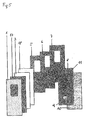
- Fig.1 shows very clearly the layered structure of A closure element 12 according to the invention with a print 1 printed polyester film layer 2 and a Aluminum foil layer 4 thereby form a cover layer.
- the cover layer may also be formed from a paper layer 15 arranged between an aluminum foil layer 14, preferably printed with a pressure 1, and a polyester film layer 16, wherein preferably paper having a specific weight of 30 g / m 2 to 90 g / m 2 is used.
- cover layer exists from a preferably printed with a pressure 1 Aluminum layer 17, which on an unfilled LDPE ((Low Density polyethylene) layer 18 is applied.
- LDPE Low Density polyethylene
- each topcoat is respectively connected by means of laminating adhesive 3.
- the polyester film layer 2 gives the closure element the required rigidity and ensures that after opening and closing several times the shape of the Closure element is maintained. Wrinkle or Grooves that negatively affect the resealing behavior influence are avoided.
- the laminating adhesive, preferably dry adhesive 3 causes a permanent, not readily detachable connection of the individual Topcoat layers.
- the aluminum foil layer 4 protects the contents of the package 13 from the environment and reduced the oxygen permeability as well as the Water vapor permeability of the invention Closing element 12.
- the entire cover layer further serves as Carrier medium for a primer layer 5, a Self-adhesive layer 6 and a heat sealing lacquer layer 7.
- a package 13 is for example a cardboard fabricated cuboid 8 with a pouring opening 11.
- the Inside the package 13 is with an LDPE film layer 10, with filler, such as talc or chalk is added, coated.
- the coating pulls also as a thin layer from the inside over the pouring opening 11th
- an inventive Closure element 12 After filling the contents in the package 13 is the pouring opening 11 with an inventive Closure element 12, not in the present example is necessarily formed strip-shaped, under Heat from the outside closed.
- the am Closing element 12 located heat sealing lacquer layer 7 is used as a sealing medium and serves to stick the Closure element 12 on the packaging box 13.
- a Sealing takes place both with the packaging material as well as with the LDPE film layer 10 on the inside of the Packaging, however, only at the pouring opening 11 of inside covering portion 10 a (see Figure 3).
- Another one Closure element as in known such packaging the case is not required.
- the closure element 12th subtracted from. By connecting the Heat sealing lacquer layer 7 with the portion 10a of the LDPE foil layer 10, this is when removing the Closing element 12 in the region of the pouring 11th torn. The area 10a thus remains on the Closure element 12 adhere and is folded up with this, whereby the pouring opening 11 is released (see FIG. 3b).
- the self-adhesive layer 6 of the closure element 12 causes after pouring the pouring opening 11 again can be closed, wherein the closure element 12 by Pressing the same to the pouring opening 11 surrounding Area of the package 13 adheres to this.
- the Adhesive layer 5 causes the Self-adhesive layer 6 almost completely on the closure element Sticks 12 and not at the pouring opening 11th surrounding area of the package 13, so served Contents do not come into contact with the self-adhesive.
- closure element 12 can prevent this at its handle portion 12a via a glue point 14 with the packaging 13 are releasably connected.
Landscapes
- Mechanical Engineering (AREA)
- Engineering & Computer Science (AREA)
- Cartons (AREA)
- Laminated Bodies (AREA)
- Absorbent Articles And Supports Therefor (AREA)
- Infusion, Injection, And Reservoir Apparatuses (AREA)
- Orthopedics, Nursing, And Contraception (AREA)
- Iron Core Of Rotating Electric Machines (AREA)
- Cable Accessories (AREA)
- Making Paper Articles (AREA)
- Seal Device For Vehicle (AREA)
- Diaphragms For Electromechanical Transducers (AREA)
- Glass Compositions (AREA)
- Closures For Containers (AREA)
Description
- Fig.1
- eine schematische Ansicht des schichtweisen Aufbaus eines erfindungsgemäßen Verschlusselementes samt den die Ausgießöffnung aufweisenden Bereich einer erfindungsgemäßen Verpackung
- Fig.2
- eine Ansicht einer erfindungsgemäßen Verpackung samt streifenförmigem Verschlusselement
- Fig.3
- eine schematische Schnittansicht des die Ausgießöffnung umfassenden Bereichs vor und nach dem Öffnen
- Fig.4
- eine schematische Ansicht eines alternativen Aufbaus eines erfindungsgemäßen Verschlusselements
- Fig.5
- eine schematische Ansicht eines weiteren alternativen Aufbaus eines erfindungsgemäßen Verschlusselements
Claims (7)
- Wiederverschließbare Verpackung (13) für schüttfähige, vorzugsweise flüssige Lebensmittel mit einer Ausgießöffnung (11), welche durch ein mehrschichtiges Verschlusselement (12) verschlossen ist, wobei die Verpackung (13) vorzugsweise aus Karton gefertigt ist und an der Innenseite mit einer LDPE (Low Density Polyäthylen)-Folienschicht (10) beschichtet ist, dadurch gekennzeichnet, dass das mehrschichtige Verschlusselement (12) folgende Schichten umfasst:und der LDPE-Folienschicht (10) ein Füllstoff, vorzugsweise Talkum oder Kreide zugesetzt ist.eine Deckschicht (1,2,3,4,14,15,16,17,18)eine Haftvermittlerschicht (5)eine Selbstkleberschicht (6)eine Heißsiegellackschicht (7)
- Wiederverschließbare Verpackung (13) nach Anspruch 1, dadurch gekennzeichnet, dass die Deckschicht (1,2,3,4,14,15,16,17,18) des mehrschichtigen Verschlusselements (12) eine vorzugsweise bedruckte Polyesterfolienschicht (2) sowie eine Aluminiumfolienschicht (4) umfasst.
- Wiederverschließbare Verpackung (13) nach Anspruch 1 und 2, dadurch gekennzeichnet, dass die Deckschicht (1,2,3,4,14,15,16,17,18) des mehrschichtigen Verschlusselements (12) eine Papierschicht (15), vorzugsweise mit einem spezifischen Gewicht von 30g/m2 bis 90 g/m2, welche zwischen einer vorzugsweise bedruckten Aluminiumfolienschicht (14) und einer Polyesterfolienschicht (16) angeordnet ist, umfasst.
- Wiederverschließbare Verpackung (13) nach Anspruch 1, dadurch gekennzeichnet, dass die Deckschicht (1,2,3,4,14,15,16,17,18) des mehrschichtigen Verschlusselements (12) eine Aluminiumfolienschicht (17) und eine LDPE-Folienschicht umfasst (18).
- Wiederverschließbare Verpackung (13) nach einem der Ansprüche 1 bis 4, wobei die Verpackung im wesentlichen quaderförmig und das Verschlusselement (12) streifenförmig ausgebildet ist dadurch gekennzeichnet, dass das Verschlusselement (12) einen Griffbereich (12a) aufweist, in welchem es über einen Klebepunkt (14) lösbar mit der Verpackung (13) verbunden ist.
- Wiederverschließbare Verpackung (13) nach einem der Ansprüche 1 bis 5, dadurch gekennzeichnet, dass die Dicke der LDPE-Folienschicht (10) zwischen 25 µm und 85 µm liegt.
- Mehrschichtiges Verschlusselement (12) nach einem der Ansprüche 1 bis 6, dadurch gekennzeichnet, dass der die Ausgießöffnung (11) überdeckende Bereich (12b) des Verschlusselementes (12) lediglich aus der Deckschicht besteht.
Priority Applications (1)
| Application Number | Priority Date | Filing Date | Title |
|---|---|---|---|
| AT02102709T ATE287831T1 (de) | 2001-12-10 | 2002-12-10 | Verschlussstreifen |
Applications Claiming Priority (2)
| Application Number | Priority Date | Filing Date | Title |
|---|---|---|---|
| AT0192901A AT413525B (de) | 2001-12-10 | 2001-12-10 | Verschlussstreifen |
| AT19292001 | 2001-12-10 |
Publications (2)
| Publication Number | Publication Date |
|---|---|
| EP1319602A1 EP1319602A1 (de) | 2003-06-18 |
| EP1319602B1 true EP1319602B1 (de) | 2005-01-26 |
Family
ID=3689347
Family Applications (1)
| Application Number | Title | Priority Date | Filing Date |
|---|---|---|---|
| EP02102709A Expired - Lifetime EP1319602B1 (de) | 2001-12-10 | 2002-12-10 | Verschlussstreifen |
Country Status (5)
| Country | Link |
|---|---|
| EP (1) | EP1319602B1 (de) |
| AT (2) | AT413525B (de) |
| DE (1) | DE50202102D1 (de) |
| DK (1) | DK1319602T3 (de) |
| ES (1) | ES2234982T3 (de) |
Families Citing this family (3)
| Publication number | Priority date | Publication date | Assignee | Title |
|---|---|---|---|---|
| EP1488921A1 (de) * | 2003-06-17 | 2004-12-22 | Alcan Technology & Management Ltd. | Kaltverformbares Laminat |
| AU2006267552B2 (en) * | 2005-07-14 | 2011-05-12 | Tetra Laval Holdings & Finance S.A. | Packaging container, process for production of inner tape, and inner tape for containers |
| DE102023114635A1 (de) * | 2023-01-19 | 2024-07-25 | Refresco Deutschland Gmbh | Laschenförmige Öffnungshilfe für Verpackung |
Family Cites Families (8)
| Publication number | Priority date | Publication date | Assignee | Title |
|---|---|---|---|---|
| SE325822B (de) * | 1968-10-29 | 1970-07-06 | Ceka Packaging Ltd | |
| JPH06551B2 (ja) * | 1983-10-26 | 1994-01-05 | 大日本印刷株式会社 | 剥離テ−プ付き容器 |
| JPS61139422A (ja) * | 1984-12-12 | 1986-06-26 | Dainippon Printing Co Ltd | プルタブテ−プの貼着方法 |
| US5452849A (en) * | 1988-05-19 | 1995-09-26 | Morgan Adhesives Co. | Easy open tab sealer for packages |
| DE3839180C1 (en) * | 1988-11-19 | 1990-01-18 | Kloeckner Pentapack Zweigniederlassung Der Kloeckner Pentaplast Gmbh, 6479 Ranstadt, De | Folding box made of cardboard for receiving paper towels (toilet paper) stacked one above the other |
| EP0540923A1 (de) * | 1991-10-17 | 1993-05-12 | Sankyo Company Limited | Behälter mit wiederverschliessbarer Verschlussfolie |
| JPH10338244A (ja) * | 1997-06-03 | 1998-12-22 | Houseki Planning:Kk | テープ張り密封袋及びその製法 |
| DE60043721D1 (de) * | 1999-01-27 | 2010-03-11 | Tetra Laval Holdings & Finance | Mehrschichtiges verpackungsmaterial für papierbehälter |
-
2001
- 2001-12-10 AT AT0192901A patent/AT413525B/de not_active IP Right Cessation
-
2002
- 2002-12-10 DE DE50202102T patent/DE50202102D1/de not_active Expired - Fee Related
- 2002-12-10 ES ES02102709T patent/ES2234982T3/es not_active Expired - Lifetime
- 2002-12-10 AT AT02102709T patent/ATE287831T1/de not_active IP Right Cessation
- 2002-12-10 EP EP02102709A patent/EP1319602B1/de not_active Expired - Lifetime
- 2002-12-10 DK DK02102709T patent/DK1319602T3/da active
Also Published As
| Publication number | Publication date |
|---|---|
| ES2234982T3 (es) | 2005-07-01 |
| DK1319602T3 (da) | 2005-06-06 |
| AT413525B (de) | 2006-03-15 |
| ATE287831T1 (de) | 2005-02-15 |
| EP1319602A1 (de) | 2003-06-18 |
| DE50202102D1 (de) | 2005-03-03 |
| ATA19292001A (de) | 2005-08-15 |
Similar Documents
| Publication | Publication Date | Title |
|---|---|---|
| DE60317291T2 (de) | Verpackung insbesondere für Nahrungsmittel | |
| EP1737753B1 (de) | Deckel mit entnahmeöffnung zum verschliessen von behältern | |
| DE60002814T2 (de) | Rohrförmiger Behälter und einem mit inneren und äusseren Siegelwulst versehenen heissgesiegelten Deckel | |
| DE60012016T2 (de) | Kunststoffbehälter mit mehrschichtiger abdichtfolie | |
| DE60003028T2 (de) | Aufrechtstehender beutel | |
| EP1449789B1 (de) | Verpackungsbehälter mit einer Verpackungsfolie mit integriertem Offnungs-und Wiederverschliesssystem | |
| EP1961670B1 (de) | Zweilagiger Deckel | |
| EP2024244A1 (de) | Verpackungsbeutel | |
| EP0042832A1 (de) | Packung | |
| EP1278630A1 (de) | Heisssiegelbare mehrschichtfolie für wiederverschliessbare packungen | |
| WO1987002011A1 (fr) | Emballage pour envelopper un materiau en morceaux | |
| WO2012045424A1 (de) | Beutelverpackung | |
| JP6136132B2 (ja) | 液体用紙容器 | |
| EP2347972B1 (de) | Wiederverschliessbare Verpackung | |
| US5988494A (en) | Carton blank and method for forming the carton blank | |
| EP1010638B1 (de) | Wiederverschliessbare, feuchtigkeitsdichte Schlauchbeutelpackung | |
| EP0226834A2 (de) | Tütenförmige Verpackung | |
| DE20113173U1 (de) | Wiederverschließbare Packung für festes Packungsgut, insbesondere für Schokolade | |
| WO2010010130A2 (de) | Wiederverschliessbare verpackung mit peelmembran | |
| DE69207897T2 (de) | Aseptische Flüssigkeitsverpackung, versehen mit einem wiederverschliessbaren Öffnungselement | |
| EP1629967B1 (de) | Siegelbare Verbundfolie und deren Verwendung zur Herstellung eines Schlauchbeutels | |
| AT413525B (de) | Verschlussstreifen | |
| DE3878286T2 (de) | Verpackung mit giebelfoermigem oberteil. | |
| DE69110791T2 (de) | Verpackungsbehälter mit einer streifenförmigen Öffnungsvorrichtung. | |
| EP2401211A1 (de) | Standbeutel |
Legal Events
| Date | Code | Title | Description |
|---|---|---|---|
| PUAI | Public reference made under article 153(3) epc to a published international application that has entered the european phase |
Free format text: ORIGINAL CODE: 0009012 |
|
| AK | Designated contracting states |
Designated state(s): AT BE BG CH CY CZ DE DK EE ES FI FR GB GR IE IT LI LU MC NL PT SE SI SK TR |
|
| AX | Request for extension of the european patent |
Extension state: AL LT LV MK RO |
|
| 17P | Request for examination filed |
Effective date: 20030606 |
|
| AKX | Designation fees paid |
Designated state(s): AT BE BG CH CY CZ DE DK EE ES FI FR GB GR IE IT LI LU MC NL PT SE SI SK TR |
|
| GRAP | Despatch of communication of intention to grant a patent |
Free format text: ORIGINAL CODE: EPIDOSNIGR1 |
|
| GRAS | Grant fee paid |
Free format text: ORIGINAL CODE: EPIDOSNIGR3 |
|
| GRAA | (expected) grant |
Free format text: ORIGINAL CODE: 0009210 |
|
| AK | Designated contracting states |
Kind code of ref document: B1 Designated state(s): AT BE BG CH CY CZ DE DK EE ES FI FR GB GR IE IT LI LU MC NL PT SE SI SK TR |
|
| PG25 | Lapsed in a contracting state [announced via postgrant information from national office to epo] |
Ref country code: IE Free format text: LAPSE BECAUSE OF FAILURE TO SUBMIT A TRANSLATION OF THE DESCRIPTION OR TO PAY THE FEE WITHIN THE PRESCRIBED TIME-LIMIT Effective date: 20050126 Ref country code: FI Free format text: LAPSE BECAUSE OF FAILURE TO SUBMIT A TRANSLATION OF THE DESCRIPTION OR TO PAY THE FEE WITHIN THE PRESCRIBED TIME-LIMIT Effective date: 20050126 Ref country code: BG Free format text: LAPSE BECAUSE OF FAILURE TO SUBMIT A TRANSLATION OF THE DESCRIPTION OR TO PAY THE FEE WITHIN THE PRESCRIBED TIME-LIMIT Effective date: 20050126 Ref country code: SK Free format text: LAPSE BECAUSE OF FAILURE TO SUBMIT A TRANSLATION OF THE DESCRIPTION OR TO PAY THE FEE WITHIN THE PRESCRIBED TIME-LIMIT Effective date: 20050126 Ref country code: SI Free format text: LAPSE BECAUSE OF FAILURE TO SUBMIT A TRANSLATION OF THE DESCRIPTION OR TO PAY THE FEE WITHIN THE PRESCRIBED TIME-LIMIT Effective date: 20050126 Ref country code: EE Free format text: LAPSE BECAUSE OF FAILURE TO SUBMIT A TRANSLATION OF THE DESCRIPTION OR TO PAY THE FEE WITHIN THE PRESCRIBED TIME-LIMIT Effective date: 20050126 Ref country code: TR Free format text: LAPSE BECAUSE OF FAILURE TO SUBMIT A TRANSLATION OF THE DESCRIPTION OR TO PAY THE FEE WITHIN THE PRESCRIBED TIME-LIMIT Effective date: 20050126 Ref country code: CZ Free format text: LAPSE BECAUSE OF FAILURE TO SUBMIT A TRANSLATION OF THE DESCRIPTION OR TO PAY THE FEE WITHIN THE PRESCRIBED TIME-LIMIT Effective date: 20050126 |
|
| REG | Reference to a national code |
Ref country code: GB Ref legal event code: FG4D Free format text: NOT ENGLISH |
|
| REG | Reference to a national code |
Ref country code: CH Ref legal event code: EP |
|
| REG | Reference to a national code |
Ref country code: IE Ref legal event code: FG4D Free format text: GERMAN |
|
| REG | Reference to a national code |
Ref country code: SE Ref legal event code: TRGR |
|
| REF | Corresponds to: |
Ref document number: 50202102 Country of ref document: DE Date of ref document: 20050303 Kind code of ref document: P |
|
| PG25 | Lapsed in a contracting state [announced via postgrant information from national office to epo] |
Ref country code: GR Free format text: LAPSE BECAUSE OF FAILURE TO SUBMIT A TRANSLATION OF THE DESCRIPTION OR TO PAY THE FEE WITHIN THE PRESCRIBED TIME-LIMIT Effective date: 20050426 |
|
| REG | Reference to a national code |
Ref country code: DK Ref legal event code: T3 |
|
| GBT | Gb: translation of ep patent filed (gb section 77(6)(a)/1977) |
Effective date: 20050520 |
|
| REG | Reference to a national code |
Ref country code: ES Ref legal event code: FG2A Ref document number: 2234982 Country of ref document: ES Kind code of ref document: T3 |
|
| REG | Reference to a national code |
Ref country code: IE Ref legal event code: FD4D |
|
| PLBE | No opposition filed within time limit |
Free format text: ORIGINAL CODE: 0009261 |
|
| STAA | Information on the status of an ep patent application or granted ep patent |
Free format text: STATUS: NO OPPOSITION FILED WITHIN TIME LIMIT |
|
| ET | Fr: translation filed | ||
| PG25 | Lapsed in a contracting state [announced via postgrant information from national office to epo] |
Ref country code: CY Free format text: LAPSE BECAUSE OF FAILURE TO SUBMIT A TRANSLATION OF THE DESCRIPTION OR TO PAY THE FEE WITHIN THE PRESCRIBED TIME-LIMIT Effective date: 20051210 |
|
| PG25 | Lapsed in a contracting state [announced via postgrant information from national office to epo] |
Ref country code: LU Free format text: LAPSE BECAUSE OF NON-PAYMENT OF DUE FEES Effective date: 20051231 Ref country code: BE Free format text: LAPSE BECAUSE OF NON-PAYMENT OF DUE FEES Effective date: 20051231 Ref country code: MC Free format text: LAPSE BECAUSE OF NON-PAYMENT OF DUE FEES Effective date: 20051231 |
|
| 26N | No opposition filed |
Effective date: 20051027 |
|
| PG25 | Lapsed in a contracting state [announced via postgrant information from national office to epo] |
Ref country code: LI Free format text: LAPSE BECAUSE OF NON-PAYMENT OF DUE FEES Effective date: 20061231 Ref country code: CH Free format text: LAPSE BECAUSE OF NON-PAYMENT OF DUE FEES Effective date: 20061231 |
|
| REG | Reference to a national code |
Ref country code: CH Ref legal event code: PL |
|
| BERE | Be: lapsed |
Owner name: TEICH AG Effective date: 20051231 |
|
| PG25 | Lapsed in a contracting state [announced via postgrant information from national office to epo] |
Ref country code: PT Free format text: LAPSE BECAUSE OF NON-PAYMENT OF DUE FEES Effective date: 20050626 |
|
| PGFP | Annual fee paid to national office [announced via postgrant information from national office to epo] |
Ref country code: DK Payment date: 20071214 Year of fee payment: 6 Ref country code: ES Payment date: 20071127 Year of fee payment: 6 Ref country code: NL Payment date: 20071227 Year of fee payment: 6 |
|
| PGFP | Annual fee paid to national office [announced via postgrant information from national office to epo] |
Ref country code: AT Payment date: 20071219 Year of fee payment: 6 Ref country code: IT Payment date: 20071210 Year of fee payment: 6 |
|
| PGFP | Annual fee paid to national office [announced via postgrant information from national office to epo] |
Ref country code: SE Payment date: 20071123 Year of fee payment: 6 |
|
| PGFP | Annual fee paid to national office [announced via postgrant information from national office to epo] |
Ref country code: FR Payment date: 20071213 Year of fee payment: 6 Ref country code: GB Payment date: 20071227 Year of fee payment: 6 |
|
| PGFP | Annual fee paid to national office [announced via postgrant information from national office to epo] |
Ref country code: DE Payment date: 20080130 Year of fee payment: 6 |
|
| REG | Reference to a national code |
Ref country code: DK Ref legal event code: EBP |
|
| EUG | Se: european patent has lapsed | ||
| GBPC | Gb: european patent ceased through non-payment of renewal fee |
Effective date: 20081210 |
|
| PG25 | Lapsed in a contracting state [announced via postgrant information from national office to epo] |
Ref country code: AT Free format text: LAPSE BECAUSE OF NON-PAYMENT OF DUE FEES Effective date: 20081210 |
|
| NLV4 | Nl: lapsed or anulled due to non-payment of the annual fee |
Effective date: 20090701 |
|
| REG | Reference to a national code |
Ref country code: FR Ref legal event code: ST Effective date: 20090831 |
|
| PG25 | Lapsed in a contracting state [announced via postgrant information from national office to epo] |
Ref country code: DE Free format text: LAPSE BECAUSE OF NON-PAYMENT OF DUE FEES Effective date: 20090701 |
|
| PG25 | Lapsed in a contracting state [announced via postgrant information from national office to epo] |
Ref country code: NL Free format text: LAPSE BECAUSE OF NON-PAYMENT OF DUE FEES Effective date: 20090701 Ref country code: GB Free format text: LAPSE BECAUSE OF NON-PAYMENT OF DUE FEES Effective date: 20081210 |
|
| PG25 | Lapsed in a contracting state [announced via postgrant information from national office to epo] |
Ref country code: DK Free format text: LAPSE BECAUSE OF NON-PAYMENT OF DUE FEES Effective date: 20090105 |
|
| REG | Reference to a national code |
Ref country code: ES Ref legal event code: FD2A Effective date: 20081211 |
|
| PG25 | Lapsed in a contracting state [announced via postgrant information from national office to epo] |
Ref country code: FR Free format text: LAPSE BECAUSE OF NON-PAYMENT OF DUE FEES Effective date: 20081231 Ref country code: ES Free format text: LAPSE BECAUSE OF NON-PAYMENT OF DUE FEES Effective date: 20081211 |
|
| PG25 | Lapsed in a contracting state [announced via postgrant information from national office to epo] |
Ref country code: SE Free format text: LAPSE BECAUSE OF NON-PAYMENT OF DUE FEES Effective date: 20081211 |
|
| PG25 | Lapsed in a contracting state [announced via postgrant information from national office to epo] |
Ref country code: IT Free format text: LAPSE BECAUSE OF NON-PAYMENT OF DUE FEES Effective date: 20081210 |