EP1318160A1 - Katalysatoren und Verfahren zur Herstellung von Isocyanuratgruppen enthaltenden Polyisocyanaten und deren Verwendung - Google Patents
Katalysatoren und Verfahren zur Herstellung von Isocyanuratgruppen enthaltenden Polyisocyanaten und deren Verwendung Download PDFInfo
- Publication number
- EP1318160A1 EP1318160A1 EP02022727A EP02022727A EP1318160A1 EP 1318160 A1 EP1318160 A1 EP 1318160A1 EP 02022727 A EP02022727 A EP 02022727A EP 02022727 A EP02022727 A EP 02022727A EP 1318160 A1 EP1318160 A1 EP 1318160A1
- Authority
- EP
- European Patent Office
- Prior art keywords
- diisocyanates
- compounds
- bis
- linked
- isocyanate
- Prior art date
- Legal status (The legal status is an assumption and is not a legal conclusion. Google has not performed a legal analysis and makes no representation as to the accuracy of the status listed.)
- Granted
Links
- 239000003054 catalyst Substances 0.000 title claims abstract description 60
- 239000005056 polyisocyanate Substances 0.000 title claims abstract description 52
- 229920001228 polyisocyanate Polymers 0.000 title claims abstract description 52
- ZFSLODLOARCGLH-UHFFFAOYSA-N isocyanuric acid Chemical group OC1=NC(O)=NC(O)=N1 ZFSLODLOARCGLH-UHFFFAOYSA-N 0.000 title claims abstract description 19
- 238000002360 preparation method Methods 0.000 title claims abstract description 9
- 238000000034 method Methods 0.000 title claims description 25
- -1 tetraalkylammonium hexafluorosilicate Chemical class 0.000 claims abstract description 52
- 238000005829 trimerization reaction Methods 0.000 claims abstract description 27
- 125000001931 aliphatic group Chemical group 0.000 claims abstract description 21
- 125000005207 tetraalkylammonium group Chemical group 0.000 claims abstract description 17
- 125000003118 aryl group Chemical group 0.000 claims abstract description 14
- 229910052757 nitrogen Inorganic materials 0.000 claims abstract description 11
- 229910052717 sulfur Inorganic materials 0.000 claims abstract description 11
- 239000007795 chemical reaction product Substances 0.000 claims abstract description 10
- KRHYYFGTRYWZRS-UHFFFAOYSA-M Fluoride anion Chemical compound [F-] KRHYYFGTRYWZRS-UHFFFAOYSA-M 0.000 claims abstract description 9
- 229910052760 oxygen Inorganic materials 0.000 claims abstract description 9
- 125000003710 aryl alkyl group Chemical group 0.000 claims abstract description 8
- 229920006395 saturated elastomer Polymers 0.000 claims abstract description 8
- 239000003444 phase transfer catalyst Substances 0.000 claims abstract description 5
- 239000003513 alkali Substances 0.000 claims abstract description 4
- 150000001875 compounds Chemical class 0.000 claims description 33
- 238000006243 chemical reaction Methods 0.000 claims description 29
- 239000012948 isocyanate Substances 0.000 claims description 27
- 239000000203 mixture Substances 0.000 claims description 26
- 150000002513 isocyanates Chemical class 0.000 claims description 23
- 125000004432 carbon atom Chemical group C* 0.000 claims description 17
- NIMLQBUJDJZYEJ-UHFFFAOYSA-N isophorone diisocyanate Chemical compound CC1(C)CC(N=C=O)CC(C)(CN=C=O)C1 NIMLQBUJDJZYEJ-UHFFFAOYSA-N 0.000 claims description 14
- 238000004519 manufacturing process Methods 0.000 claims description 13
- XJHCXCQVJFPJIK-UHFFFAOYSA-M caesium fluoride Chemical compound [F-].[Cs+] XJHCXCQVJFPJIK-UHFFFAOYSA-M 0.000 claims description 12
- 150000003254 radicals Chemical class 0.000 claims description 12
- ZSMNRKGGHXLZEC-UHFFFAOYSA-N n,n-bis(trimethylsilyl)methanamine Chemical compound C[Si](C)(C)N(C)[Si](C)(C)C ZSMNRKGGHXLZEC-UHFFFAOYSA-N 0.000 claims description 11
- 239000005058 Isophorone diisocyanate Substances 0.000 claims description 10
- 150000002222 fluorine compounds Chemical class 0.000 claims description 10
- 125000005842 heteroatom Chemical group 0.000 claims description 8
- 229910001515 alkali metal fluoride Inorganic materials 0.000 claims description 7
- 229910001618 alkaline earth metal fluoride Inorganic materials 0.000 claims description 7
- WJIOHMVWGVGWJW-UHFFFAOYSA-N 3-methyl-n-[4-[(3-methylpyrazole-1-carbonyl)amino]butyl]pyrazole-1-carboxamide Chemical compound N1=C(C)C=CN1C(=O)NCCCCNC(=O)N1N=C(C)C=C1 WJIOHMVWGVGWJW-UHFFFAOYSA-N 0.000 claims description 6
- DIOQZVSQGTUSAI-UHFFFAOYSA-N decane Chemical compound CCCCCCCCCC DIOQZVSQGTUSAI-UHFFFAOYSA-N 0.000 claims description 6
- 239000011527 polyurethane coating Substances 0.000 claims description 6
- NROKBHXJSPEDAR-UHFFFAOYSA-M potassium fluoride Chemical compound [F-].[K+] NROKBHXJSPEDAR-UHFFFAOYSA-M 0.000 claims description 6
- RSJKGSCJYJTIGS-UHFFFAOYSA-N undecane Chemical compound CCCCCCCCCCC RSJKGSCJYJTIGS-UHFFFAOYSA-N 0.000 claims description 6
- KYIMHWNKQXQBDG-UHFFFAOYSA-N N=C=O.N=C=O.CCCCCC Chemical compound N=C=O.N=C=O.CCCCCC KYIMHWNKQXQBDG-UHFFFAOYSA-N 0.000 claims description 5
- 239000004814 polyurethane Substances 0.000 claims description 5
- 229920002635 polyurethane Polymers 0.000 claims description 5
- DZLFLBLQUQXARW-UHFFFAOYSA-N tetrabutylammonium Chemical compound CCCC[N+](CCCC)(CCCC)CCCC DZLFLBLQUQXARW-UHFFFAOYSA-N 0.000 claims description 5
- ATJFFYVFTNAWJD-UHFFFAOYSA-N Tin Chemical compound [Sn] ATJFFYVFTNAWJD-UHFFFAOYSA-N 0.000 claims description 4
- 239000008139 complexing agent Substances 0.000 claims description 4
- CSJLBAMHHLJAAS-UHFFFAOYSA-N diethylaminosulfur trifluoride Chemical compound CCN(CC)S(F)(F)F CSJLBAMHHLJAAS-UHFFFAOYSA-N 0.000 claims description 4
- FFUAGWLWBBFQJT-UHFFFAOYSA-N hexamethyldisilazane Chemical compound C[Si](C)(C)N[Si](C)(C)C FFUAGWLWBBFQJT-UHFFFAOYSA-N 0.000 claims description 4
- MTZUIIAIAKMWLI-UHFFFAOYSA-N 1,2-diisocyanatobenzene Chemical class O=C=NC1=CC=CC=C1N=C=O MTZUIIAIAKMWLI-UHFFFAOYSA-N 0.000 claims description 3
- XSCLFFBWRKTMTE-UHFFFAOYSA-N 1,3-bis(isocyanatomethyl)cyclohexane Chemical compound O=C=NCC1CCCC(CN=C=O)C1 XSCLFFBWRKTMTE-UHFFFAOYSA-N 0.000 claims description 3
- ATOUXIOKEJWULN-UHFFFAOYSA-N 1,6-diisocyanato-2,2,4-trimethylhexane Chemical compound O=C=NCCC(C)CC(C)(C)CN=C=O ATOUXIOKEJWULN-UHFFFAOYSA-N 0.000 claims description 3
- QGLRLXLDMZCFBP-UHFFFAOYSA-N 1,6-diisocyanato-2,4,4-trimethylhexane Chemical compound O=C=NCC(C)CC(C)(C)CCN=C=O QGLRLXLDMZCFBP-UHFFFAOYSA-N 0.000 claims description 3
- OKKTUPGXXKXHTJ-UHFFFAOYSA-N 1-(isocyanatomethyl)-1-[[1-(isocyanatomethyl)cyclohexyl]methyl]cyclohexane Chemical compound C1CCCCC1(CN=C=O)CC1(CN=C=O)CCCCC1 OKKTUPGXXKXHTJ-UHFFFAOYSA-N 0.000 claims description 3
- QADNIOOUIIQJRS-UHFFFAOYSA-N 1-isocyanato-2-(isocyanatomethyl)-1-methylcyclohexane Chemical class O=C=NC1(C)CCCCC1CN=C=O QADNIOOUIIQJRS-UHFFFAOYSA-N 0.000 claims description 3
- JIABEENURMZTTI-UHFFFAOYSA-N 1-isocyanato-2-[(2-isocyanatophenyl)methyl]benzene Chemical compound O=C=NC1=CC=CC=C1CC1=CC=CC=C1N=C=O JIABEENURMZTTI-UHFFFAOYSA-N 0.000 claims description 3
- IQOIAHPAAZJVOX-UHFFFAOYSA-N 1-isocyanato-3-methoxypropane Chemical compound COCCCN=C=O IQOIAHPAAZJVOX-UHFFFAOYSA-N 0.000 claims description 3
- DYQFCTCUULUMTQ-UHFFFAOYSA-N 1-isocyanatooctane Chemical class CCCCCCCCN=C=O DYQFCTCUULUMTQ-UHFFFAOYSA-N 0.000 claims description 3
- KEZMBAQUUXDDDQ-UHFFFAOYSA-N CCC.N=C=O.N=C=O Chemical class CCC.N=C=O.N=C=O KEZMBAQUUXDDDQ-UHFFFAOYSA-N 0.000 claims description 3
- OMRDSWJXRLDPBB-UHFFFAOYSA-N N=C=O.N=C=O.C1CCCCC1 Chemical class N=C=O.N=C=O.C1CCCCC1 OMRDSWJXRLDPBB-UHFFFAOYSA-N 0.000 claims description 3
- HDONYZHVZVCMLR-UHFFFAOYSA-N N=C=O.N=C=O.CC1CCCCC1 Chemical class N=C=O.N=C=O.CC1CCCCC1 HDONYZHVZVCMLR-UHFFFAOYSA-N 0.000 claims description 3
- CLWKGFMSGOQXNJ-UHFFFAOYSA-N N=C=O.N=C=O.CCC1(CC)CCCCC1C Chemical class N=C=O.N=C=O.CCC1(CC)CCCCC1C CLWKGFMSGOQXNJ-UHFFFAOYSA-N 0.000 claims description 3
- QCJBVWNJRIOSDN-UHFFFAOYSA-N N=C=O.N=C=O.CCC1CCCCC1 Chemical class N=C=O.N=C=O.CCC1CCCCC1 QCJBVWNJRIOSDN-UHFFFAOYSA-N 0.000 claims description 3
- GNFBHJRVKAKFNZ-UHFFFAOYSA-N N=C=O.N=C=O.CCCC1CCCCC1 Chemical class N=C=O.N=C=O.CCCC1CCCCC1 GNFBHJRVKAKFNZ-UHFFFAOYSA-N 0.000 claims description 3
- OEMVAFGEQGKIOR-UHFFFAOYSA-N N=C=O.N=C=O.CCCCCCCC Chemical class N=C=O.N=C=O.CCCCCCCC OEMVAFGEQGKIOR-UHFFFAOYSA-N 0.000 claims description 3
- FUCRTFHCJZBKBB-UHFFFAOYSA-N N=C=O.N=C=O.CCCCCCCCC Chemical class N=C=O.N=C=O.CCCCCCCCC FUCRTFHCJZBKBB-UHFFFAOYSA-N 0.000 claims description 3
- 239000000853 adhesive Substances 0.000 claims description 3
- 230000001070 adhesive effect Effects 0.000 claims description 3
- 238000000576 coating method Methods 0.000 claims description 3
- KQWGXHWJMSMDJJ-UHFFFAOYSA-N cyclohexyl isocyanate Chemical compound O=C=NC1CCCCC1 KQWGXHWJMSMDJJ-UHFFFAOYSA-N 0.000 claims description 3
- WUDNUHPRLBTKOJ-UHFFFAOYSA-N ethyl isocyanate Chemical compound CCN=C=O WUDNUHPRLBTKOJ-UHFFFAOYSA-N 0.000 claims description 3
- STBLQDMGPBQTMI-UHFFFAOYSA-N heptane;isocyanic acid Chemical class N=C=O.N=C=O.CCCCCCC STBLQDMGPBQTMI-UHFFFAOYSA-N 0.000 claims description 3
- ANJPRQPHZGHVQB-UHFFFAOYSA-N hexyl isocyanate Chemical class CCCCCCN=C=O ANJPRQPHZGHVQB-UHFFFAOYSA-N 0.000 claims description 3
- 239000000543 intermediate Substances 0.000 claims description 3
- YDNLNVZZTACNJX-UHFFFAOYSA-N isocyanatomethylbenzene Chemical compound O=C=NCC1=CC=CC=C1 YDNLNVZZTACNJX-UHFFFAOYSA-N 0.000 claims description 3
- DGTNSSLYPYDJGL-UHFFFAOYSA-N phenyl isocyanate Chemical compound O=C=NC1=CC=CC=C1 DGTNSSLYPYDJGL-UHFFFAOYSA-N 0.000 claims description 3
- 229920003009 polyurethane dispersion Polymers 0.000 claims description 3
- 235000003270 potassium fluoride Nutrition 0.000 claims description 3
- 239000011698 potassium fluoride Substances 0.000 claims description 3
- FZHAPNGMFPVSLP-UHFFFAOYSA-N silanamine Chemical class [SiH3]N FZHAPNGMFPVSLP-UHFFFAOYSA-N 0.000 claims description 3
- 238000007614 solvation Methods 0.000 claims description 3
- WHNCQKDFVNMVCE-UHFFFAOYSA-N 1,1,3-trimethyl-3-trimethylsilylurea Chemical compound CN(C)C(=O)N(C)[Si](C)(C)C WHNCQKDFVNMVCE-UHFFFAOYSA-N 0.000 claims description 2
- VQVLINZAHIXUIO-UHFFFAOYSA-N 1,3-dibutyl-1,3-bis(trimethylsilyl)urea Chemical compound CCCCN([Si](C)(C)C)C(=O)N([Si](C)(C)C)CCCC VQVLINZAHIXUIO-UHFFFAOYSA-N 0.000 claims description 2
- RYYACEQMZMUAGS-UHFFFAOYSA-N 1-ethyl-3,3-dimethyl-1-trimethylsilylurea Chemical compound CCN([Si](C)(C)C)C(=O)N(C)C RYYACEQMZMUAGS-UHFFFAOYSA-N 0.000 claims description 2
- OQURWGJAWSLGQG-UHFFFAOYSA-N 1-isocyanatopropane Chemical class CCCN=C=O OQURWGJAWSLGQG-UHFFFAOYSA-N 0.000 claims description 2
- APOYTRAZFJURPB-UHFFFAOYSA-N 2-methoxy-n-(2-methoxyethyl)-n-(trifluoro-$l^{4}-sulfanyl)ethanamine Chemical compound COCCN(S(F)(F)F)CCOC APOYTRAZFJURPB-UHFFFAOYSA-N 0.000 claims description 2
- JJOWIQMPCCUIGA-UHFFFAOYSA-N 4-(Trimethylsilyl)morpholine Chemical compound C[Si](C)(C)N1CCOCC1 JJOWIQMPCCUIGA-UHFFFAOYSA-N 0.000 claims description 2
- MHRNQQUEUYMEEH-UHFFFAOYSA-N [[[ethyl(dimethyl)silyl]amino]-dimethylsilyl]ethane Chemical compound CC[Si](C)(C)N[Si](C)(C)CC MHRNQQUEUYMEEH-UHFFFAOYSA-N 0.000 claims description 2
- FVNOGGFRSYKBMI-UHFFFAOYSA-M [bis(2-methoxyethyl)amino]-tri(piperidin-1-yl)phosphanium;fluoride Chemical compound [F-].C1CCCCN1[P+](N1CCCCC1)(N(CCOC)CCOC)N1CCCCC1 FVNOGGFRSYKBMI-UHFFFAOYSA-M 0.000 claims description 2
- SKWZBTWSYOCXCK-UHFFFAOYSA-M [bis(2-methoxyethyl)amino]-tripyrrolidin-1-ylphosphanium;fluoride Chemical compound [F-].C1CCCN1[P+](N1CCCC1)(N(CCOC)CCOC)N1CCCC1 SKWZBTWSYOCXCK-UHFFFAOYSA-M 0.000 claims description 2
- ZKCYSPDDOOVLGY-UHFFFAOYSA-M [bis(2-methoxyethyl)amino]-tris(dimethylamino)phosphanium;fluoride Chemical compound [F-].COCCN([P+](N(C)C)(N(C)C)N(C)C)CCOC ZKCYSPDDOOVLGY-UHFFFAOYSA-M 0.000 claims description 2
- UBHZUDXTHNMNLD-UHFFFAOYSA-N dimethylsilane Chemical compound C[SiH2]C UBHZUDXTHNMNLD-UHFFFAOYSA-N 0.000 claims description 2
- XIFOKLGEKUNZTI-UHFFFAOYSA-N n-[diethylamino(dimethyl)silyl]-n-ethylethanamine Chemical compound CCN(CC)[Si](C)(C)N(CC)CC XIFOKLGEKUNZTI-UHFFFAOYSA-N 0.000 claims description 2
- IOTFVZVUTVVOER-UHFFFAOYSA-N n-[dimethyl(phenyl)silyl]-n-ethylethanamine Chemical compound CCN(CC)[Si](C)(C)C1=CC=CC=C1 IOTFVZVUTVVOER-UHFFFAOYSA-N 0.000 claims description 2
- HBJBDCQZMCBJEB-UHFFFAOYSA-N n-butyl-n-trimethylsilylbutan-1-amine Chemical compound CCCCN([Si](C)(C)C)CCCC HBJBDCQZMCBJEB-UHFFFAOYSA-N 0.000 claims description 2
- KAHVZNKZQFSBFW-UHFFFAOYSA-N n-methyl-n-trimethylsilylmethanamine Chemical compound CN(C)[Si](C)(C)C KAHVZNKZQFSBFW-UHFFFAOYSA-N 0.000 claims description 2
- DUZKCWBZZYODQJ-UHFFFAOYSA-N n-trimethylsilylmethanamine Chemical compound CN[Si](C)(C)C DUZKCWBZZYODQJ-UHFFFAOYSA-N 0.000 claims description 2
- 239000004753 textile Substances 0.000 claims description 2
- WLADIVUISABQHN-UHFFFAOYSA-N trimethyl(piperidin-1-yl)silane Chemical compound C[Si](C)(C)N1CCCCC1 WLADIVUISABQHN-UHFFFAOYSA-N 0.000 claims description 2
- NQLVIKZJXFGUET-UHFFFAOYSA-N trimethyl(pyrrolidin-1-yl)silane Chemical compound C[Si](C)(C)N1CCCC1 NQLVIKZJXFGUET-UHFFFAOYSA-N 0.000 claims description 2
- XLJFOFNRPJJGPW-UHFFFAOYSA-M tris(diethylamino)-morpholin-4-ylphosphanium;fluoride Chemical compound [F-].CCN(CC)[P+](N(CC)CC)(N(CC)CC)N1CCOCC1 XLJFOFNRPJJGPW-UHFFFAOYSA-M 0.000 claims description 2
- IRKKKQOVDCZGGC-UHFFFAOYSA-M tris(dimethylamino)-[[tris(dimethylamino)-$l^{5}-phosphanylidene]amino]phosphanium;fluoride Chemical compound [F-].CN(C)[P+](N(C)C)(N(C)C)N=P(N(C)C)(N(C)C)N(C)C IRKKKQOVDCZGGC-UHFFFAOYSA-M 0.000 claims description 2
- SNRUBQQJIBEYMU-UHFFFAOYSA-N dodecane Chemical compound CCCCCCCCCCCC SNRUBQQJIBEYMU-UHFFFAOYSA-N 0.000 claims 4
- 239000007858 starting material Substances 0.000 claims 3
- VKLNMSFSTCXMSB-UHFFFAOYSA-N 1,1-diisocyanatopentane Chemical compound CCCCC(N=C=O)N=C=O VKLNMSFSTCXMSB-UHFFFAOYSA-N 0.000 claims 2
- ROHUXHMNZLHBSF-UHFFFAOYSA-N 1,4-bis(isocyanatomethyl)cyclohexane Chemical compound O=C=NCC1CCC(CN=C=O)CC1 ROHUXHMNZLHBSF-UHFFFAOYSA-N 0.000 claims 2
- XFPRKNQSYRZNRI-UHFFFAOYSA-N 4-(isocyanatomethyl)bicyclo[2.2.1]heptane Chemical compound C1CC2CCC1(CN=C=O)C2 XFPRKNQSYRZNRI-UHFFFAOYSA-N 0.000 claims 2
- ZHESOIPTRUDICE-UHFFFAOYSA-N CCCCCCCCC.N=C=O.N=C=O.N=C=O Chemical class CCCCCCCCC.N=C=O.N=C=O.N=C=O ZHESOIPTRUDICE-UHFFFAOYSA-N 0.000 claims 2
- LAGMANKZFBMQGW-UHFFFAOYSA-N N=C=O.N=C=O.CCCC Chemical class N=C=O.N=C=O.CCCC LAGMANKZFBMQGW-UHFFFAOYSA-N 0.000 claims 2
- 125000004915 dibutylamino group Chemical group C(CCC)N(CCCC)* 0.000 claims 1
- 239000010985 leather Substances 0.000 claims 1
- 125000001181 organosilyl group Chemical group [SiH3]* 0.000 abstract description 6
- VNHIRYOCKAQNGF-UHFFFAOYSA-N aminophosphanium fluoride Chemical class [F-].N[PH3+] VNHIRYOCKAQNGF-UHFFFAOYSA-N 0.000 abstract description 3
- 239000003795 chemical substances by application Substances 0.000 abstract description 2
- 125000002877 alkyl aryl group Chemical group 0.000 abstract 3
- FIRQYUPQXNPTKO-UHFFFAOYSA-N ctk0i2755 Chemical class N[SiH2]N FIRQYUPQXNPTKO-UHFFFAOYSA-N 0.000 abstract 2
- 229940071182 stannate Drugs 0.000 abstract 2
- 125000005402 stannate group Chemical group 0.000 abstract 2
- 125000000217 alkyl group Chemical group 0.000 abstract 1
- 125000003368 amide group Chemical group 0.000 abstract 1
- 239000013522 chelant Substances 0.000 abstract 1
- 229920001577 copolymer Chemical group 0.000 abstract 1
- 125000004433 nitrogen atom Chemical group N* 0.000 abstract 1
- 239000005057 Hexamethylene diisocyanate Substances 0.000 description 20
- OKKJLVBELUTLKV-UHFFFAOYSA-N Methanol Chemical compound OC OKKJLVBELUTLKV-UHFFFAOYSA-N 0.000 description 12
- 238000001704 evaporation Methods 0.000 description 11
- 230000008020 evaporation Effects 0.000 description 11
- 239000011541 reaction mixture Substances 0.000 description 10
- 239000000178 monomer Substances 0.000 description 8
- 239000000243 solution Substances 0.000 description 8
- VEXZGXHMUGYJMC-UHFFFAOYSA-N Hydrochloric acid Chemical compound Cl VEXZGXHMUGYJMC-UHFFFAOYSA-N 0.000 description 7
- IXCSERBJSXMMFS-UHFFFAOYSA-N hydrogen chloride Substances Cl.Cl IXCSERBJSXMMFS-UHFFFAOYSA-N 0.000 description 7
- 229910000041 hydrogen chloride Inorganic materials 0.000 description 7
- 239000000047 product Substances 0.000 description 7
- 239000002253 acid Substances 0.000 description 5
- 230000009849 deactivation Effects 0.000 description 4
- PCHXZXKMYCGVFA-UHFFFAOYSA-N 1,3-diazetidine-2,4-dione Chemical group O=C1NC(=O)N1 PCHXZXKMYCGVFA-UHFFFAOYSA-N 0.000 description 3
- XTHFKEDIFFGKHM-UHFFFAOYSA-N Dimethoxyethane Chemical compound COCCOC XTHFKEDIFFGKHM-UHFFFAOYSA-N 0.000 description 3
- YXFVVABEGXRONW-UHFFFAOYSA-N Toluene Chemical compound CC1=CC=CC=C1 YXFVVABEGXRONW-UHFFFAOYSA-N 0.000 description 3
- 230000000052 comparative effect Effects 0.000 description 3
- 125000005442 diisocyanate group Chemical group 0.000 description 3
- 125000002147 dimethylamino group Chemical group [H]C([H])([H])N(*)C([H])([H])[H] 0.000 description 3
- 238000011065 in-situ storage Methods 0.000 description 3
- 239000011159 matrix material Substances 0.000 description 3
- 238000006384 oligomerization reaction Methods 0.000 description 3
- 230000007306 turnover Effects 0.000 description 3
- RTZKZFJDLAIYFH-UHFFFAOYSA-N Diethyl ether Chemical compound CCOCC RTZKZFJDLAIYFH-UHFFFAOYSA-N 0.000 description 2
- YGYAWVDWMABLBF-UHFFFAOYSA-N Phosgene Chemical compound ClC(Cl)=O YGYAWVDWMABLBF-UHFFFAOYSA-N 0.000 description 2
- NBIIXXVUZAFLBC-UHFFFAOYSA-N Phosphoric acid Chemical compound OP(O)(O)=O NBIIXXVUZAFLBC-UHFFFAOYSA-N 0.000 description 2
- YRKCREAYFQTBPV-UHFFFAOYSA-N acetylacetone Chemical compound CC(=O)CC(C)=O YRKCREAYFQTBPV-UHFFFAOYSA-N 0.000 description 2
- 150000007513 acids Chemical class 0.000 description 2
- 150000001298 alcohols Chemical class 0.000 description 2
- 239000002981 blocking agent Substances 0.000 description 2
- 150000007942 carboxylates Chemical class 0.000 description 2
- 239000003060 catalysis inhibitor Substances 0.000 description 2
- 230000003197 catalytic effect Effects 0.000 description 2
- 150000001805 chlorine compounds Chemical class 0.000 description 2
- 238000003776 cleavage reaction Methods 0.000 description 2
- 238000010790 dilution Methods 0.000 description 2
- 239000012895 dilution Substances 0.000 description 2
- 230000000694 effects Effects 0.000 description 2
- JBKVHLHDHHXQEQ-UHFFFAOYSA-N epsilon-caprolactam Chemical compound O=C1CCCCCN1 JBKVHLHDHHXQEQ-UHFFFAOYSA-N 0.000 description 2
- 150000002148 esters Chemical class 0.000 description 2
- 239000012025 fluorinating agent Substances 0.000 description 2
- 230000000269 nucleophilic effect Effects 0.000 description 2
- 239000003973 paint Substances 0.000 description 2
- 125000001453 quaternary ammonium group Chemical group 0.000 description 2
- 230000007017 scission Effects 0.000 description 2
- 239000002904 solvent Substances 0.000 description 2
- 239000010409 thin film Substances 0.000 description 2
- JOXIMZWYDAKGHI-UHFFFAOYSA-N toluene-4-sulfonic acid Chemical compound CC1=CC=C(S(O)(=O)=O)C=C1 JOXIMZWYDAKGHI-UHFFFAOYSA-N 0.000 description 2
- 239000013638 trimer Substances 0.000 description 2
- WHIVNJATOVLWBW-PLNGDYQASA-N (nz)-n-butan-2-ylidenehydroxylamine Chemical compound CC\C(C)=N/O WHIVNJATOVLWBW-PLNGDYQASA-N 0.000 description 1
- 229940008841 1,6-hexamethylene diisocyanate Drugs 0.000 description 1
- XBHIDEXFAORHCC-UHFFFAOYSA-N 1-butyl-1,3-dimethyl-3-trimethylsilylurea Chemical compound CCCCN(C)C(=O)N(C)[Si](C)(C)C XBHIDEXFAORHCC-UHFFFAOYSA-N 0.000 description 1
- ZQXCQTAELHSNAT-UHFFFAOYSA-N 1-chloro-3-nitro-5-(trifluoromethyl)benzene Chemical compound [O-][N+](=O)C1=CC(Cl)=CC(C(F)(F)F)=C1 ZQXCQTAELHSNAT-UHFFFAOYSA-N 0.000 description 1
- ZDKYYMRLZONTFK-UHFFFAOYSA-N 3,4-bis(isocyanatomethyl)bicyclo[2.2.1]heptane Chemical compound C1CC2(CN=C=O)C(CN=C=O)CC1C2 ZDKYYMRLZONTFK-UHFFFAOYSA-N 0.000 description 1
- HDLXPNDSLDLJHF-UHFFFAOYSA-N 4,7,13,16,21-pentaoxa-1,10-diazabicyclo[8.8.5]tricosane Chemical compound C1COCCOCCN2CCOCCOCCN1CCOCC2 HDLXPNDSLDLJHF-UHFFFAOYSA-N 0.000 description 1
- NSPMIYGKQJPBQR-UHFFFAOYSA-N 4H-1,2,4-triazole Chemical compound C=1N=CNN=1 NSPMIYGKQJPBQR-UHFFFAOYSA-N 0.000 description 1
- RREANTFLPGEWEN-MBLPBCRHSA-N 7-[4-[[(3z)-3-[4-amino-5-[(3,4,5-trimethoxyphenyl)methyl]pyrimidin-2-yl]imino-5-fluoro-2-oxoindol-1-yl]methyl]piperazin-1-yl]-1-cyclopropyl-6-fluoro-4-oxoquinoline-3-carboxylic acid Chemical compound COC1=C(OC)C(OC)=CC(CC=2C(=NC(\N=C/3C4=CC(F)=CC=C4N(CN4CCN(CC4)C=4C(=CC=5C(=O)C(C(O)=O)=CN(C=5C=4)C4CC4)F)C\3=O)=NC=2)N)=C1 RREANTFLPGEWEN-MBLPBCRHSA-N 0.000 description 1
- QGZKDVFQNNGYKY-UHFFFAOYSA-O Ammonium Chemical compound [NH4+] QGZKDVFQNNGYKY-UHFFFAOYSA-O 0.000 description 1
- XPKGKHXSIYYVHZ-UHFFFAOYSA-N CCCCC.CCCC(C)C.N=C=O.N=C=O Chemical compound CCCCC.CCCC(C)C.N=C=O.N=C=O XPKGKHXSIYYVHZ-UHFFFAOYSA-N 0.000 description 1
- ZAMOUSCENKQFHK-UHFFFAOYSA-N Chlorine atom Chemical compound [Cl] ZAMOUSCENKQFHK-UHFFFAOYSA-N 0.000 description 1
- LFQSCWFLJHTTHZ-UHFFFAOYSA-N Ethanol Chemical compound CCO LFQSCWFLJHTTHZ-UHFFFAOYSA-N 0.000 description 1
- CTQNGGLPUBDAKN-UHFFFAOYSA-N O-Xylene Chemical compound CC1=CC=CC=C1C CTQNGGLPUBDAKN-UHFFFAOYSA-N 0.000 description 1
- 229920003171 Poly (ethylene oxide) Polymers 0.000 description 1
- 239000002202 Polyethylene glycol Substances 0.000 description 1
- OFOBLEOULBTSOW-UHFFFAOYSA-N Propanedioic acid Natural products OC(=O)CC(O)=O OFOBLEOULBTSOW-UHFFFAOYSA-N 0.000 description 1
- 229910007991 Si-N Inorganic materials 0.000 description 1
- 229910006294 Si—N Inorganic materials 0.000 description 1
- XSQUKJJJFZCRTK-UHFFFAOYSA-N Urea Chemical compound NC(N)=O XSQUKJJJFZCRTK-UHFFFAOYSA-N 0.000 description 1
- HCHKCACWOHOZIP-UHFFFAOYSA-N Zinc Chemical class [Zn] HCHKCACWOHOZIP-UHFFFAOYSA-N 0.000 description 1
- HIMXYMYMHUAZLW-UHFFFAOYSA-N [[[dimethyl(phenyl)silyl]amino]-dimethylsilyl]benzene Chemical compound C=1C=CC=CC=1[Si](C)(C)N[Si](C)(C)C1=CC=CC=C1 HIMXYMYMHUAZLW-UHFFFAOYSA-N 0.000 description 1
- APDDLLVYBXGBRF-UHFFFAOYSA-N [diethyl-(triethylsilylamino)silyl]ethane Chemical compound CC[Si](CC)(CC)N[Si](CC)(CC)CC APDDLLVYBXGBRF-UHFFFAOYSA-N 0.000 description 1
- 125000003158 alcohol group Chemical group 0.000 description 1
- 150000001299 aldehydes Chemical class 0.000 description 1
- 229910052783 alkali metal Inorganic materials 0.000 description 1
- 150000001340 alkali metals Chemical class 0.000 description 1
- 239000002168 alkylating agent Substances 0.000 description 1
- 229940100198 alkylating agent Drugs 0.000 description 1
- 229910000147 aluminium phosphate Inorganic materials 0.000 description 1
- 150000001412 amines Chemical class 0.000 description 1
- 239000001099 ammonium carbonate Substances 0.000 description 1
- 235000011162 ammonium carbonates Nutrition 0.000 description 1
- 235000011114 ammonium hydroxide Nutrition 0.000 description 1
- 239000004202 carbamide Substances 0.000 description 1
- 239000013000 chemical inhibitor Substances 0.000 description 1
- 239000003153 chemical reaction reagent Substances 0.000 description 1
- 239000000460 chlorine Substances 0.000 description 1
- 229910052801 chlorine Inorganic materials 0.000 description 1
- OEYIOHPDSNJKLS-UHFFFAOYSA-N choline Chemical compound C[N+](C)(C)CCO OEYIOHPDSNJKLS-UHFFFAOYSA-N 0.000 description 1
- 229960001231 choline Drugs 0.000 description 1
- 239000003426 co-catalyst Substances 0.000 description 1
- 239000011248 coating agent Substances 0.000 description 1
- 150000003983 crown ethers Chemical class 0.000 description 1
- 239000002739 cryptand Substances 0.000 description 1
- 230000006378 damage Effects 0.000 description 1
- 230000001419 dependent effect Effects 0.000 description 1
- SEGLCEQVOFDUPX-UHFFFAOYSA-N di-(2-ethylhexyl)phosphoric acid Chemical compound CCCCC(CC)COP(O)(=O)OCC(CC)CCCC SEGLCEQVOFDUPX-UHFFFAOYSA-N 0.000 description 1
- YSSSPARMOAYJTE-UHFFFAOYSA-N dibenzo-18-crown-6 Chemical compound O1CCOCCOC2=CC=CC=C2OCCOCCOC2=CC=CC=C21 YSSSPARMOAYJTE-UHFFFAOYSA-N 0.000 description 1
- 238000004821 distillation Methods 0.000 description 1
- XYIBRDXRRQCHLP-UHFFFAOYSA-N ethyl acetoacetate Chemical compound CCOC(=O)CC(C)=O XYIBRDXRRQCHLP-UHFFFAOYSA-N 0.000 description 1
- 238000000605 extraction Methods 0.000 description 1
- 150000004820 halides Chemical class 0.000 description 1
- 150000004761 hexafluorosilicates Chemical class 0.000 description 1
- RRAMGCGOFNQTLD-UHFFFAOYSA-N hexamethylene diisocyanate Chemical compound O=C=NCCCCCCN=C=O RRAMGCGOFNQTLD-UHFFFAOYSA-N 0.000 description 1
- 150000004679 hydroxides Chemical class 0.000 description 1
- 230000002401 inhibitory effect Effects 0.000 description 1
- 230000000977 initiatory effect Effects 0.000 description 1
- 150000002500 ions Chemical class 0.000 description 1
- IQPQWNKOIGAROB-UHFFFAOYSA-N isocyanate group Chemical group [N-]=C=O IQPQWNKOIGAROB-UHFFFAOYSA-N 0.000 description 1
- 150000002576 ketones Chemical class 0.000 description 1
- 150000003951 lactams Chemical class 0.000 description 1
- 150000002690 malonic acid derivatives Chemical class 0.000 description 1
- 238000010327 methods by industry Methods 0.000 description 1
- BDSUYTOTVCEJPO-UHFFFAOYSA-N n-(dimethylamino-methyl-phenylsilyl)-n-methylmethanamine Chemical compound CN(C)[Si](C)(N(C)C)C1=CC=CC=C1 BDSUYTOTVCEJPO-UHFFFAOYSA-N 0.000 description 1
- WHIVNJATOVLWBW-UHFFFAOYSA-N n-butan-2-ylidenehydroxylamine Chemical compound CCC(C)=NO WHIVNJATOVLWBW-UHFFFAOYSA-N 0.000 description 1
- SWPKJPABFYFDNT-UHFFFAOYSA-N n-butyl-n-[(dibutylamino)-dimethylsilyl]butan-1-amine Chemical compound CCCCN(CCCC)[Si](C)(C)N(CCCC)CCCC SWPKJPABFYFDNT-UHFFFAOYSA-N 0.000 description 1
- YCWSUKQGVSGXJO-NTUHNPAUSA-N nifuroxazide Chemical group C1=CC(O)=CC=C1C(=O)N\N=C\C1=CC=C([N+]([O-])=O)O1 YCWSUKQGVSGXJO-NTUHNPAUSA-N 0.000 description 1
- 239000012299 nitrogen atmosphere Substances 0.000 description 1
- 150000002894 organic compounds Chemical class 0.000 description 1
- 150000002923 oximes Chemical class 0.000 description 1
- 150000004707 phenolate Chemical class 0.000 description 1
- 150000003003 phosphines Chemical class 0.000 description 1
- 150000004714 phosphonium salts Chemical class 0.000 description 1
- 229920000768 polyamine Polymers 0.000 description 1
- 229920001223 polyethylene glycol Polymers 0.000 description 1
- 238000006116 polymerization reaction Methods 0.000 description 1
- 238000004886 process control Methods 0.000 description 1
- 230000000750 progressive effect Effects 0.000 description 1
- 238000009419 refurbishment Methods 0.000 description 1
- 239000011347 resin Substances 0.000 description 1
- 229920005989 resin Polymers 0.000 description 1
- 150000003839 salts Chemical class 0.000 description 1
- 150000003335 secondary amines Chemical class 0.000 description 1
- 238000000926 separation method Methods 0.000 description 1
- 238000003756 stirring Methods 0.000 description 1
- 238000003860 storage Methods 0.000 description 1
- 239000000126 substance Substances 0.000 description 1
- 150000003459 sulfonic acid esters Chemical class 0.000 description 1
- 150000003460 sulfonic acids Chemical class 0.000 description 1
- ISIJQEHRDSCQIU-UHFFFAOYSA-N tert-butyl 2,7-diazaspiro[4.5]decane-7-carboxylate Chemical compound C1N(C(=O)OC(C)(C)C)CCCC11CNCC1 ISIJQEHRDSCQIU-UHFFFAOYSA-N 0.000 description 1
- 150000003852 triazoles Chemical class 0.000 description 1
- XLYOFNOQVPJJNP-UHFFFAOYSA-N water Substances O XLYOFNOQVPJJNP-UHFFFAOYSA-N 0.000 description 1
- 238000010626 work up procedure Methods 0.000 description 1
- 239000008096 xylene Substances 0.000 description 1
- 239000011701 zinc Chemical class 0.000 description 1
- 229910052725 zinc Inorganic materials 0.000 description 1
Classifications
-
- C—CHEMISTRY; METALLURGY
- C07—ORGANIC CHEMISTRY
- C07D—HETEROCYCLIC COMPOUNDS
- C07D251/00—Heterocyclic compounds containing 1,3,5-triazine rings
- C07D251/02—Heterocyclic compounds containing 1,3,5-triazine rings not condensed with other rings
- C07D251/12—Heterocyclic compounds containing 1,3,5-triazine rings not condensed with other rings having three double bonds between ring members or between ring members and non-ring members
- C07D251/26—Heterocyclic compounds containing 1,3,5-triazine rings not condensed with other rings having three double bonds between ring members or between ring members and non-ring members with only hetero atoms directly attached to ring carbon atoms
- C07D251/30—Only oxygen atoms
- C07D251/34—Cyanuric or isocyanuric esters
-
- C—CHEMISTRY; METALLURGY
- C08—ORGANIC MACROMOLECULAR COMPOUNDS; THEIR PREPARATION OR CHEMICAL WORKING-UP; COMPOSITIONS BASED THEREON
- C08G—MACROMOLECULAR COMPOUNDS OBTAINED OTHERWISE THAN BY REACTIONS ONLY INVOLVING UNSATURATED CARBON-TO-CARBON BONDS
- C08G18/00—Polymeric products of isocyanates or isothiocyanates
- C08G18/02—Polymeric products of isocyanates or isothiocyanates of isocyanates or isothiocyanates only
- C08G18/022—Polymeric products of isocyanates or isothiocyanates of isocyanates or isothiocyanates only the polymeric products containing isocyanurate groups
-
- C—CHEMISTRY; METALLURGY
- C08—ORGANIC MACROMOLECULAR COMPOUNDS; THEIR PREPARATION OR CHEMICAL WORKING-UP; COMPOSITIONS BASED THEREON
- C08G—MACROMOLECULAR COMPOUNDS OBTAINED OTHERWISE THAN BY REACTIONS ONLY INVOLVING UNSATURATED CARBON-TO-CARBON BONDS
- C08G18/00—Polymeric products of isocyanates or isothiocyanates
- C08G18/06—Polymeric products of isocyanates or isothiocyanates with compounds having active hydrogen
- C08G18/08—Processes
- C08G18/16—Catalysts
- C08G18/161—Catalysts containing two or more components to be covered by at least two of the groups C08G18/166, C08G18/18 or C08G18/22
Definitions
- the present invention relates to catalysts and a method for producing Polyisocyanates containing isocyanurate groups, polyisocyanates prepared therewith and their use.
- polyisocyanate mixtures containing isocyanurate and uretdione groups in particular are used as the isocyanate component.
- the oligo- or polymerization of isocyanates to such polyisocyanates has long been known.
- a number of production processes have been developed which differ from one another with regard to the choice of catalyst, with regard to the organic isocyanates to be used or also with regard to process engineering parameters (cf. e.g. GB-PS 1391066, EP 82 987, DE 39 02 078, EP 339 396, EP 224 165; see also HJ Laas et al. In J. Prakt. Chem. 336 ( 1994 ), 185ff.).
- Isocyanates suitable for trimerization e.g. B. aromatic, cycloaliphatic and aliphatic Di- and higher-value polyisocyanates can be prepared by various methods (Annalen der Chemie 562 (1949), pages 75ff). Technically proven in particular production by phosgenation of organic polyamines corresponding polycarbamic acid chlorides and their thermal cleavage into organic Polyisocyanates and hydrogen chloride. Alternatively, organic polyisocyanates can also be used without the use of phosgene, d. H. can be produced by phosgene-free processes.
- EP-B-0 126 299, EP 126 300 and EP 355 443 (Cyclo) aliphatic diisocyanates - such as 1,6-hexamethylene diisocyanate (HDI) and / or isomers aliphatic diisocyanates with 6 carbon atoms in the alkylene radical and 1-isocyanato-3-isocyanato-methyl-3,5,5-trimethyl-cyclohexane (Isophorone diisocyanate or IPDI) - manufactured are by reacting the underlying (cyclo) aliphatic diamines with urea and alcohols to (cyclo) aliphatic biscarbamic acid esters and their thermal Cleavage into the corresponding diisocyanates and alcohols.
- HDI 1,6-hexamethylene diisocyanate
- IPDI 1-isocyanato-3-isocyanato-methyl-3,5,5-trimethyl-cyclohexane
- the (cyclo) aliphatic diisocyanates are left in the presence of the Catalyst, optionally using solvents and / or auxiliaries, up to react to achieve the desired sales.
- the reaction by deactivating the catalyst canceled and the excess monomeric diisocyanate usually separated in the Usually by short path or thin film distillation. The deactivation takes place thermally or by adding a catalyst inhibitor.
- Acids such as p-toluenesulfonic acid are suitable or bis (2-ethylhexyl) phosphate, alkylating agent or Acylating reagents.
- catalysts for the trimerization of isocyanates to the desired isocyanurate and polyisocyanates optionally containing uretdione groups can be tertiary, for example Amines, phosphines, alkali phenolates, aminosilanes, quaternary ammonium hydroxides or quaternary ammonium carbonates are used.
- Well suited Oligomerization catalysts are also hydroxides, halides or carboxylates of Hydroxyalkylammonium ions (see e.g. EP 351 873, EP 798 299, US 5 290 902), Alkali metal salts as well as tin, zinc or lead salts of alkyl carboxylic acids.
- Dependent on from contact is also the use of various co-catalysts such.
- polyisocyanates are also obtained different proportions of isocyanurate or uretdione groups.
- the products are mostly clear, but depending on the catalyst type, the diisocyanate quality, the Reaction temperature and the reaction procedure more or less yellow colored Products.
- the diisocyanate quality is more or less yellow colored Products.
- a suitable catalyst can be selected according to different criteria.
- the benchmark is, for example, the use of quaternary hydroxyalkylammonium carboxylates as oligomerization catalysts. These choline type contacts are thermally labile. It is unnecessary, the trimerization when the desired turnover is achieved by adding to stop potentially quality-reducing catalyst inhibitors. Instead, the targeted thermal deactivation an optimal process control.
- Thermolability also from the point of view of process security. An uncontrolled “Runaway" of the reaction is excluded, provided that the amount of catalyst added usual size does not exceed many times.
- the class of aminosilyl catalysts has the disadvantage of being a minor one Catalytic activity, so that economic space-time yields only when used relatively large amounts of catalyst can be realized. However, this is with further disadvantages. Firstly, it represents a serious cost factor because the contact is irreversibly destroyed by deactivation and cannot useful in the process. Inevitably get to the other Larger amounts of the deactivated catalyst in the product with possibly negative Consequences for its property profile.
- the present invention was therefore based on the object of new Si-based Catalysts for the production of polyisocyanates containing isocyanurate groups for To make available, on the one hand, by a significantly increased activity distinguish, on the other hand, however, reliable reaction control and process reliability allow.
- the invention also relates to a method for producing the inventive Compounds and catalysts.
- At least one suitable organosilicon is used Compound with at least one Si-N bond (compounds A) and at least one suitable nucleophilic fluorinating agent (compounds B), if appropriate in the presence a solvation and / or complexing agent and / or phase transfer catalyst a temperature of -20 ° C to 200 ° C reacted with each other.
- Compounds A) are aminosilanes, silylureas or silazanes or else mixtures the same, for example methylaminotrimethylsilane, dimethylaminotrimethylsilane, Dibutylaminotrimethylsilane, diethylaminodimethylphenylsilane, bis (dimethyamino) dimethylsilane, Bis (diethylamino) dimethylsilane, bis (dibutylamino) dimethylsilane, bis (dimethylamino) methylphenylsilane, N-methyl-N-trimethylsilyl-N'-methyl-N'-butylurea, N-trimethylsilyl-N-methyl-N ', N'-dimethylurea, N-trimethylsilyl-N-ethyl-N ', N'-dimethylurea, N-trimethylsilyl-N-butyl-
- Compounds B) suitable for the preparation of the compounds and catalysts according to the invention are alkali metal and alkaline earth metal fluorides, for example potassium fluoride, cesium fluoride, phosphazenium fluorides such as, for example, 1,1,1,3,3,3-hexakis (dimethylamino) diphosphazenium fluoride (lit .: R. Schwesinger et al., Angew. Chem.
- aminophosphonium fluorides of the general formula (III) where R 1 , R 2 , R 3 , R 4 , R 5 , R 6 , R 7 and R 8 are branched or unbranched aliphatic, optionally alkoxy-substituted alkyl radicals having 1 to 8 carbon atoms and the pairs R 1 and R 2 and R 3 and R 4 and R 5 and R 6 and R 7 and R 8 can be linked to one another via an alkylene bridge, which may also contain the heteroatoms O, S or N, such as bis (2-methoxyethyl) amino-tris (pyrrolidino) phosphonium fluoride, bis (2-methoxyethyl) amino-tris (piperidino) phosphonium fluoride, bis (2-methoxyethyl) amino-tris (dimethylamino) phosphonium fluoride or morpholino-tris (diethylamino) phosphon
- the compounds and catalysts of the invention can be prepared “in situ” take place, i.e. the catalyst is generated in the di- or polyisocyanate matrix, the Trimerization should be done. To do this, they are used to form the catalyst necessary components A and B independently of one another the corresponding di- or Polyisocyanate added. Alternatively, the catalyst components can initially be outside the isocyanate matrix is reacted with one another in bulk or in a solvent and the contact can be prefabricated in this way. The production can basically in Presence of one or more solvation and / or complexing agents and / or Phase transfer catalyst (s) take place.
- Suitable complexing agents are Polyethylene oxides, for example ethylene glycol dimethyl ether or Polyethylene glycol dimethyl ether, crown ethers such as, for example, dibenzo-18-crown-6 or N, N'-dibenzyl-4,13-diaza-18-crown-6 or also cryptands such as, for example, 1,10-diaza-4,7,13,16,21-pentaoxabicyclo [8.8.5] tricosan.
- Suitable phase transfer catalysts are organic ammonium and phosphonium salts that are soluble in the polyisocyanate matrix.
- the invention also relates to the use of the compounds according to the invention and catalysts for the trimerization of mono-, di- or polyisocyanates.
- the invention further relates to a process for the preparation of isocyanurate groups containing polyisocyanates by catalytically induced trimerization of organic mono-, Di- or polyisocyanates, whereby as trimerization catalysts according to the invention Catalysts are used.
- the invention further relates to the method of the invention Polyisocyanates and their use.
- All known aliphatic, cycloaliphatic, araliphatic and aromatic mono-, di- and polyisocyanates with an NCO content of less than 70% by weight can be used in pure form or as any mixtures with one another to produce the polyisocyanates according to the invention.
- Examples include: cyclohexane diisocyanates, methylcyclohexane diisocyanates, ethylcyclohexane diisocyanates, propylcyclohexane diisocyanates, methyl diethylcyclohexane diisocyanates, phenylene diisocyanates, tolylene diisocyanates, bis (isocyanatophenyl) methane, propane diisocyanates, butane diisocyanate (hexane) diisocyanate, hexane diisocyanate, pentane diisocyanate -2-methylpentane (MPDI)), heptane diisocyanates, octane diisocyanates, nonane diisocyanates (e.g.
- Nonantriisocyanates e.g. 4-isocyanatomethyl-1,8-octane diisocyanate (TIN)
- decane and triisocyanates undecane and triisocyanates, dodecanedi and triisocyanates
- isophorone diisocyanate IPDI
- bis (isocyanatomethylcyclohexyl) methane H 12 MDI
- isocyanatomethyl-methylcyclohexyl isocyanate 2.5 (2.6) bis (isocyanatomethyl) bicyclo [2.2.1] heptane (NBDI), 1,3-bis (isocyanatomethyl) cyclohexane (1,3-H 6 -XDI ) and 1,4-bis (isocyanatomethyl) c
- HDI, IPDI, MPDI, TMDI, 1,3- and 1,4-H 6 -XDI, NBDI and mixtures of HDI and IPDI are preferably used.
- Monoisocyanates can also in the presence of the catalysts of the invention Isocyanurates are converted, for example ethyl isocyanate, cyclohexyl isocyanate, Phenyl isocyanate, tolyl isocyanate, benzyl isocyanate and all regio and stereoisomers of Compounds named below: propyl isocyanates, hexyl isocyanates, octyl isocyanates and methoxypropyl isocyanate.
- nucleophilic fluorinating agents including, for example, potassium fluoride and cesium fluoride
- potassium fluoride and cesium fluoride can induce the trimerization of isocyanates (see EP 0315 692; Y.Nambu, T. Endo, J. Org. Chem. 1993 , 58 , 1932-1934)
- the catalysts of the invention resulting from a combination of these two species have a higher trimerization activity. They can be deactivated chemically or in part thermally.
- the production of the isocyanurate group-containing polyisocyanates by partial Trimerization can be carried out continuously (tubular reactor or boiler cascade) or else be carried out in batches.
- the catalysts of the invention are reduced Concentration between 0.01 and 5.0 wt .-%, used. The exact amount depends the individual catalyst, the sales target and the procedure.
- Trimers can be isothermal in a temperature range between 0 ° C and 100 ° C, preferably 20 ° C and 80 ° C are carried out.
- the reaction can be quantitative Implementation of the isocyanate groups involved in the output (s) (poly) isocyanate (es) / mixture take place or be interrupted at any degree of implementation. A is preferred Target sales of 10 - 50%. If the desired turnover is reached, the Trimerization by dosing (under) stoichiometric amounts of one Deactivating agent stopped.
- Example acids or acid derivatives such as HCl, organic sulfonic acids or acid esters phosphorous acid and phosphoric acid.
- the reaction can also be designed exothermic.
- those necessary to form the catalyst of the invention can be used Components or the catalyst in pre-prepared form are also metered in after the Starting (poly) isocyanate or the starting (poly) isocyanate (mixture) used to initiate the exothermic reaction has reached the necessary temperature.
- the exact temperature at which the Exothermic reaction is initiated among other things, a function of the isocyanate, the individual catalyst and the catalyst concentration and can easily be experimental be determined.
- the catalyst according to the invention becomes exothermic in the course of the ongoing trimerization, at which temperatures of up to 220 ° C are reached completely destroyed thermally.
- complete Deactivating the catalyst a chemical inhibitor can be added. The necessary The amount can easily be determined experimentally.
- the method according to the invention can be both solvent-free and with dilution of the mono-, di- or polyisocyanates or the mixtures provided for trimerization of which are carried out.
- all are suitable for dilution compared to NCO groups inert organic compounds such as B. toluene, xylene (s), higher aromatics, ether and esters.
- the solvent-free variant is preferred.
- the inventive Catalysts of the formula (I) preferably in amounts of 0.01-5% by weight, preferably 0.02 - 3 wt .-%, based on the weight of the starting (poly) isocyanate or the starting (poly) isocyanate (mixture) (s).
- the exact amount can be easily determined experimentally and depends on the catalytic activity of the individual contact, the sales target and the procedure. Trimerization can Isothermal or exothermic, carried out continuously or batchwise.
- the invention also relates to the use of the monomers polyisocyanates containing isocyanurate groups, as intermediates for polyurethane coatings, for polyurethane dispersions, adhesives and as a polyisocyanate component in 1 and 2 component polyurethane systems.
- the monomer-free isocyanurate groups containing the present invention Isocyanurates are useful intermediates for polyurethane coatings, e.g. B. Lederund Textile coatings, and for polyurethane dispersions and adhesives, and are particularly valuable as a polyisocyanate component in 1 and 2 components Polyurethane systems for weather and light-resistant polyurethane paints.
- the Process products according to the invention both as such and in with blocking agents blocked form are used.
- Suitable blocking agents are included for example lactams such as ⁇ -caprolactam, oximes such as methyl ethyl ketoxime or Butanone oxime, triazoles such as 1H-1,2,4-triazole, easily enolizable compounds such as Acetoacetic ester or acetylacetone or also malonic acid derivatives such as malonic acid diester with 1-10 C atoms in the alcohol residues.
- lactams such as ⁇ -caprolactam
- oximes such as methyl ethyl ketoxime or Butanone oxime
- triazoles such as 1H-1,2,4-triazole
- easily enolizable compounds such as Acetoacetic ester or acetylacetone or also malonic acid derivatives such as malonic acid diester with 1-10 C atoms in the alcohol residues.
- Example 3 (comparative example , not according to the invention)
- Example 4 (comparative example , not according to the invention)
- Example 5 (comparative example , not according to the invention)
Landscapes
- Chemical & Material Sciences (AREA)
- Organic Chemistry (AREA)
- Health & Medical Sciences (AREA)
- Chemical Kinetics & Catalysis (AREA)
- Medicinal Chemistry (AREA)
- Polymers & Plastics (AREA)
- Polyurethanes Or Polyureas (AREA)
- Low-Molecular Organic Synthesis Reactions Using Catalysts (AREA)
- Adhesives Or Adhesive Processes (AREA)
- Paints Or Removers (AREA)
Abstract
Description
R gleichzeitig oder unabhängig von einander für einen gesättigten oder ungesättigten, linearen oder verzweigten aliphatischen oder cycloaliphatischen Rest oder Aryl-, Aralkyloder Alkylarylrest mit 1 bis 16 C-Atomen steht und zwei Reste R über eine Alkylenbrücke miteinander verknüpft sein können,
R1 für R, SiR3 oder einen Amidrest der Formel (II)
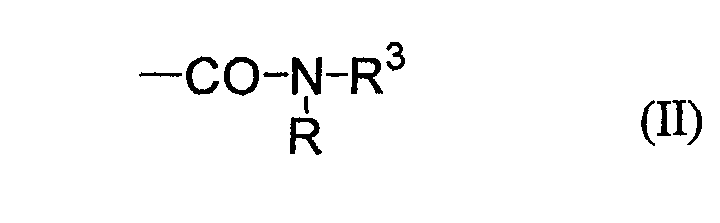
R2 gleich R oder H ist, wobei - sofern R1 kein Amidrest ist - R2 mit R1 über eine Alkylenbrücke miteinander verknüpft sein kann, und
R3 gleich R oder SiR3 ist,
und

im Verhältnis 1/100 > A/B > 100/1.
R gleichzeitig oder unabhängig von einander für einen gesättigten oder ungesättigten, linearen oder verzweigten aliphatischen oder cycloaliphatischen Rest oder Aryl-, Aralkyloder Alkylarylrest mit 1 bis 16 C-Atomen steht und zwei Reste R über eine Alkylenbrücke miteinander verknüpft sein können,
R1 für R, SiR3 oder einen Amidrest der Formel (II)
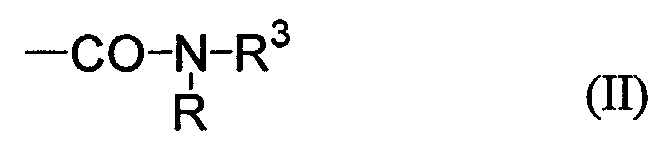
R2 gleich R oder H ist, wobei - sofern R1 kein Amidrest Ist - R2 mit R1 über eine Alkylenbrücke miteinander verknüpft sein kann, und
R3 gleich R oder SiR3 ist,
und

im Verhältnis 1/100 > A/B > 100/1.
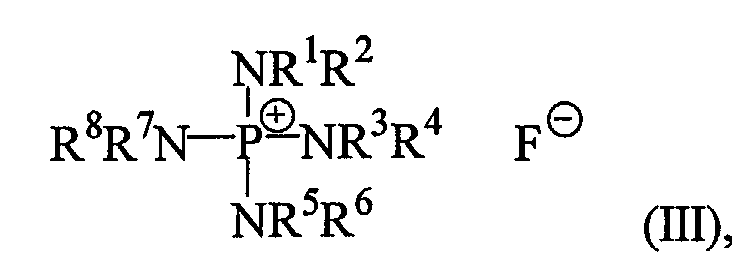
Claims (26)
- Katalysator für die Trimerisierung von Isocyanaten, bestehend aus dem Reaktionsprodukt vonwobei R1, R2, R3, R4, R5, R6, R7 und R8 für verzweigte oder unverzweigte aliphatische, gegebenenfalls alkoxysubstituierte Alkylreste mit 1 bis 8 C-Atomen stehen und jeweils die Paare R1 und R2 sowie R3 und R4 sowie R5 und R6 sowie R7 und R8 über eine Alkylenbrücke, die gegebenenfalls auch die Heteroatome O, S oder N enthalten kann, miteinander verknüpft sein können,A) Verbindungen der allgemeinen Formel I
R gleichzeitig oder unabhängig von einander für einen gesättigten oder ungesättigten, linearen oder verzweigten aliphatischen oder cycloaliphatischen Rest oder Aryl-, Aralkyl- oder Alkylarylrest mit 1 bis 16 C-Atomen steht und zwei Reste R über eine Alkylenbrücke miteinander verknüpft sein können,
R1 für R, SiR3 oder einen Amidrest der Formel (II)steht,
R2 gleich R oder H ist, wobei - sofern R1 kein Amidrest ist - R2 mit R1 über eine Alkylenbrücke miteinander verknüpft sein kann, und
R3 gleich R oder SiR3 ist,
undB) Verbindungen ausgewählt aus Alkalifluoriden, Erdalkalifluoriden, Phosphazeniumfluoriden, Alkylarylaminoschwefeltrifluoriden, Dialkylaminoschwefeltrifluoriden, Diarylaminoschwefeltrifluoriden, Tetraalkylammonium-triphenyldifluorsilikate, Tetraalkylammonium-triphenyldifluorstannaten und Tetraalkylammoniumhexafluorosilikaten, Aminophosphoniumfluoriden
der allgemeinen Formel (III)
im Verhältnis 1/100 > A/B > 100/1. - Katalysator für die Trimerisierung von Isocyanaten, erhalten durch Umsetzung vonwobei R1, R2, R3, R4, R5, R6, R7 und R8 für verzweigte oder auch unverzweigte aliphatische, gegebenenfalls alkoxysubstituierte Alkylreste mit 1 bis 8 C-Atomen stehen und jeweils die Paare R1 und R2 sowie R3 und R4 sowie R5 und R6 sowie R7 und R8 über eine Alkylenbrücke, die gegebenenfalls auch die Heteroatome O, S oder N enthalten kann, miteinander verknüpft sein können,A) Verbindungen der allgemeinen Formel I
R gleichzeitig oder unabhängig von einander für einen gesättigten oder ungesättigten, linearen oder verzweigten aliphatischen oder cycloaliphatischen Rest oder Aryl-, Aralkyl- oder Alkylarylrest mit 1 bis 16 C-Atomen steht und zwei Reste R über eine Alkylenbrücke miteinander verknüpft sein können,
R1 für R, SiR3 oder einen Amidrest der Formel (II)steht,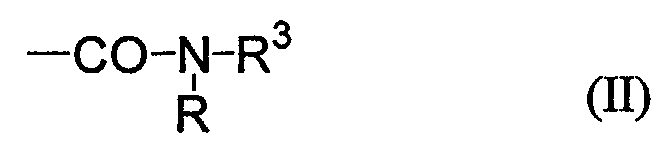
R2 gleich R oder H ist, wobei - sofern R1 kein Amidrest ist - R2 mit R1 über eine Alkylenbrücke miteinander verknüpft sein kann, und
R3 gleich R oder SiR3 ist,
undB) Verbindungen ausgewählt aus Alkalifluoriden, Erdalkalifluoriden, Phosphazeniumfluoriden, Alkylarylaminoschwefeltrifluoriden, Dialkylaminoschwefeltrifluoriden, Diarylaminoschwefeltrifluoriden, Tetraalkylammonium-triphenyldifluorsilikate, Tetraalkylammonium-triphenyldifluorstannaten und Tetraalkylammoniumhexafluorosilikaten, Aminophosphoniumfluoriden
der allgemeinen Formel (III)
im Verhältnis 1/100 > A/B > 100/1. - Katalysator nach Anspruch 1 oder 2
dadurch gekennzeichnet, dass Aminosilane, Silylharnstoffe und/oder Silazane als Ausgangskomponenten A) enthalten sind. - Katalysator nach mindestens einem der Ansprüche 1 bis 3,
dadurch gekennzeichnet, dass als Ausgangskomponenten A) Methylaminotrimethylsilan, Diemthylaminotrimethylsilan, Dibutylaminotrimethylsilan, Diethylaminodimethylphenylsilan, Bis(dimethyamino) dimethylsilan, Bis(diethylamino)dimethylsilan, Bis(dibutylamino)dimethylsilan, Bis(dimethylamino)methylphenylsilan, N-Methyl-N-trimethylsilyl-N'-methyl-N'-butylharnstoff, N-Trimethylsilyl-N-methyl-N',N'-dimethylharnstoff, N-Trimethylsilyl-N-ethyl-N',N'-dimethylharnstoff, N-Trimethylsilyl-N-butyl-N'-butyl-N'-trimethylsilylharnstoff, Trimethylsilylpyrrolidin, Trimethlsilylmorpholin, Trimethylsilylpiperidin, Trimethylsilylpiparazin, Hexamethyldisilazan, Heptamethyldisilazan, 1,3-Diethyl-1,1,3,3-tetramethyldisilazan, Hexaethyldisilazan und oder 1,3-Diphenyl-1,1,3,3-tetramethyldisilazan enthalten sind. - Katalysator nach mindestens einem der Ansprüche 1 bis 4,
dadurch gekennzeichnet, dass Kaliumfluorid, Caesiumfluorid, 1,1,1,3,3,3-Hexakis(dimethylamino)-diphosphazeniumfluorid als Ausgangskomponenten B) enthalten sind. - Katalysator nach mindestens einem der Ansprüche 1 bis 4,
dadurch gekennzeichnet, dass als Ausgangsverbindungen B) Bis(2-methoxyethyl)amino-tris(pyrrolidino) phosphoniumfluorid, Bis(2-methoxyethyl)amino-tris(piperidino)phosphoniumfluorid, Bis(2-methoxyethyl)amino-tris(dimethylamino)phosphoniumfluorid, Morpholino-tris (diethylamino)phosphoniumfluorid, Bis(2-methoxyethyl)aminoschwefeltrifluorid, Diethylaminoschwefeltrifluorid, Tetrabutylammoniumtriphenyldifluorsilikat, Tetrabutylammoniumtriphenyldifluorstannat, Tetrabutylammoniumhexafluorsilikat enthalten sind. - Verbindungen bestehend aus dem Reaktionsprodukt vonwobei R1, R2, R3, R4, R5, R6, R7 und R8 für verzweigte oder auch unverzweigte aliphatische, gegebenenfalls alkoxysubstituierte Alkylreste mit 1 bis 8 C-Atomen stehen und jeweils die Paare R1 und R2 sowie R3 und R4 sowie R5 und R6 sowie R7 und R8 über eine Alkylenbrücke, die gegebenenfalls auch die Heteroatome O,S oder N enthalten kann, miteinander verknüpft sein können,A) Verbindungen der allgemeinen Formel I
R gleichzeitig oder unabhängig von einander für einen gesättigten oder ungesättigten, linearen oder verzweigten aliphatischen oder cycloaliphatischen Rest oder Aryl-, Aralkyl- oder Alkylarylrest mit 1 bis 16 C-Atomen steht und zwei Reste R über eine Alkylenbrücke miteinander verknüpft sein können,
R1 für R, SiR3 oder einen Amidrest der Formel (II)steht,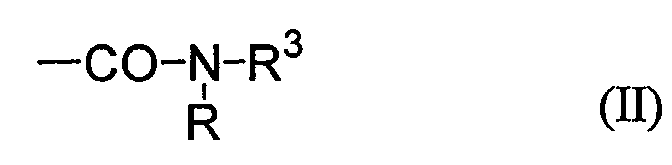
R2 gleich R oder H ist, wobei - sofern R1 kein Amidrest ist - R2 mit R1 über eine Alkylenbrücke miteinander verknüpft sein kann, und
R3 gleich R oder SiR3 ist,
undC) Verbindungen ausgewählt aus Alkalifluoriden, Erdalkalifluoriden, Phosphazeniumfluoriden, Alkylarylaminoschwefeltrifluoriden, Dialkylaminoschwefeltrifluoriden, Diarylaminoschwefeltrifluoriden, Tetraalkylammonium-triphenyldifluorsilikate, Tetraalkylammonium-triphenyldifluorstannaten und Tetraalkylammoniumhexafluorosilikaten, Aminophosphoniumfluoriden
der allgemeinen Formel (III)
im Verhältnis 1/100 > A/B > 100/1. - Verbindungen nach Anspruch 7, enthaltend als Ausgangsverbindungen mindestens eine Verbindung nach einem der Ansprüche 3 oder 4 und mindestens eine Verbindung nach einem der Ansprüche 5 oder 6.
- Verfahren zur Herstellung einer Verbindung, bestehend aus dem Reaktionsprodukt vonwobei R1, R2, R3, R4, R5, R6, R7 und R8 für verzweigte oder auch unverzweigte aliphatische, gegebenenfalls alkoxysubstituierte Alkylreste mit 1 bis 8 C-Atomen stehen und jeweils die Paare R1 und R2 sowie R3 und R4 sowie R5 und R6 sowie R7 und R8 über eine Alkylenbrücke, die gegebenenfalls auch die Heteroatome O,S oder N enthalten kann, miteinander verknüpft sein können,A) Verbindungen der allgemeinen Formel I
R1 für R, SiR3 oder einen Amidrest der Formel (II)steht,
R2 gleich R oder H ist, wobei - sofern R1 kein Amidrest ist - R2 mit R1 über eine Alkylenbrücke miteinander verknüpft sein kann, und
R3 gleich R oder SiR3 ist, undB) Verbindungen ausgewählt aus Alkalifluoriden, Erdalkalifluoriden, Phosphazeniumfluoriden, Alkylarylaminoschwefeltrifluoriden, Dialkylaminoschwefeltrifluoriden, Diarylaminoschwefeltrifluoriden, Tetraalkylammonium-triphenyldifluorsilikate, Tetraalkylammonium-triphenyldifluorstannaten und Tetraalkylammoniumhexafluorosilikaten, Aminophosphoniumfluoriden der allgemeinen Formel (III)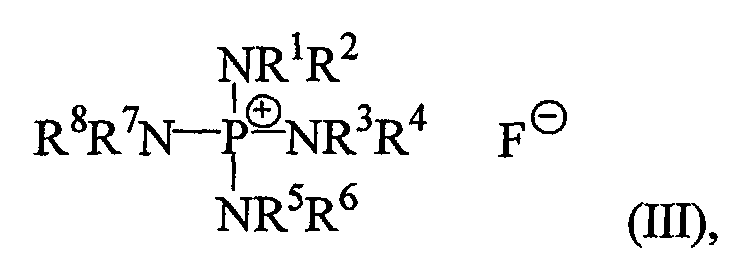
im Verhältnis 1/100 > A/B > 100/1, gegebenenfalls in Gegenwart eines Solvatations- und/oder Komplexierungsmittels und/oder Phasentransferkatalysators, bei einer Temperatur von- 20 °C bis 200 °C. - Verfahren nach Anspruch 9,
dadurch gekennzeichnet, dass Ausgangsverbindungen gemäß den Ansprüchen 3 oder 4 und 5 oder 6 eingesetzt werden. - Verwendung der Verbindungen nach einem der Ansprüche 1 bis 8 zur Trimerisierung von Mono-, Di- oder Polyisocyanaten.
- Verwendung nach Anspruch 11,
dadurch gekennzeichnet, dass als Isocynatverbindungen aliphatische, cycloaliphatische, araliphatische und/oder aromatische Mono-, Di- oder Polyisocyanate eingesetzt werden. - Verwendung nach Anspruch 12,
dadurch gekennzeichnet, dass Cyclohexandiisocyanate, Methylcyclohexandiisocyanate, Ethylcyclohexandiisocyanate, Propylcyclohexandiisocyanate, Methyl-diethyl-cyclohexandiisocyanate, Phenylendiisocyanate, Toluylendiisocyanate, Bis(isocyanatophenyl)methan, Propandiisocyanate, Butandiisocyanate, Pentandiisocyanate, Hexandiisocyanate, wie Hexamethylendiisocyanat (HDI) oder 1,5-Diisocyanato-2-methylpentan (MPDI), Heptandiisocyanate, Octandiisocyanate, Nonandiisocyanate, wie 1,6-Diisocyanato-2,4,4-trimethylhexan und 1,6-Diisocyanato-2,2,4-trimethylhexan (TMDI), Nonantriisocyanate, wie 4-Isocyanatomethyl-1,8-octandiisocyanat (TIN), Dekandi- und triisocyanate, Undekandiund -triisocyanate, Dodecandi- und -triisocyanate, Isophorondiisocyanat (IPDI), Bis(isocyanatomethylcyclohexyl)methan (H12MDI), Isocyanatomethyl-methylcyclohexylisocyanate, 2,5(2,6)-Bis(isocyanatomethyl)bicyclo[2.2.1]heptan (NBDI), 1,3-Bis(isocyanatomethyl)cyclohexan (1,3-H6-XDI) oder 1,4-Bis(isocyanatomethyl) cyclohexan (1,4-H6-XDI) eingesetzt werden. - Verwendung nach Anspruch 12,
dadurch gekennzeichnet, dass HDI, IPDI, MPDI, TMDI, 1,3- und 1,4- H6-XDI, NBDI oder Mischungen aus HDI und IPDI eingesetzt werden. - Verwendung nach Anspruch 12,
dadurch gekennzeichnet, dass als Monoisocyanate Ethylisocyanat, Cyclohexylisocyanat, Phenylisocyanat, Tolylisocyanat, Benzylisocyanat sowie alle Regio- und Stereoisomeren der Verbindungen: Propylisocyanate, Hexylisocyanate, Octylisocyanate und Methoxypropylisocyanat eingesetzt werden. - Verfahren zur Herstellung von Isocyanuratgruppen enthaltenden Polyisocyanaten durch katalytisch induzierte Trimerisierung organischer Mono-, Di- oder Polyisocyanate,
dadurch gekennzeichnet, dass Trimerisierungskatalysatoren, bestehend aus dem Reaktionsprodukt vonwobei R1, R2, R3, R4, R5, R6, R7 und R8 für verzweigte oder auch unverzweigte aliphatische, gegebenenfalls alkoxysubstituierte Alkylreste mit 1 bis 8 C-Atomen stehen und jeweils die Paare R1 und R2 sowie R3 und R4 sowie R5 und R6 sowie R7 und R8 über eine Alkylenbrücke, die gegebenenfalls auch die Heteroatome O,S oder N enthalten kann, miteinander verknüpft sein können,A) Verbindungen der allgemeinen Formel I
R gleichzeitig oder unabhängig von einander für einen gesättigten oder ungesättigten, linearen oder verzweigten aliphatischen oder cycloaliphatischen Rest oder Aryl-, Aralkyl- oder Alkylarylrest mit 1 bis 16 C-Atomen steht und zwei Reste R über eine Alkylenbrücke miteinander verknüpft sein können,
R1 für R, SiR3 oder einen Amidrest der Formel (II)steht,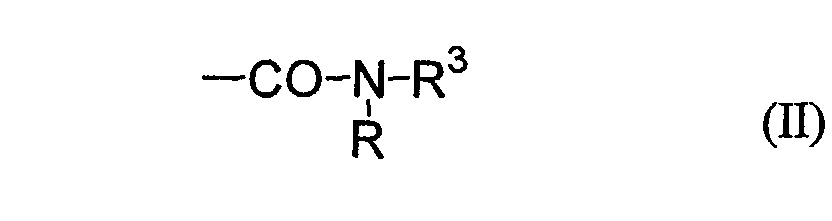
R2 gleich R oder H ist, wobei - sofern R1 kein Amidrest ist - R2 mit R1 über eine Alkylenbrücke miteinander verknüpft sein kann, und
R3 gleich R oder SiR3 ist, undB) Verbindungen ausgewählt aus Alkalifluoriden, Erdalkalifluoriden, Phosphazeniumfluoriden, Alkylarylaminoschwefeltrifluoriden, Dialkylaminoschwefeltrifluoriden, Diarylaminoschwefeltrifluoriden, Tetraalkylammonium-triphenyldifluorsilikate, Tetraalkylammonium-triphenyldifluorstannaten und Tetraalkylammonium-hexafluorosilikaten, Aminophosphoniumfluoriden der allgemeinen Formel (III)
im Verhältnis 1/100 > A/B > 100/1 eingesetzt werden. - Verfahren nach Anspruch 16,
dadurch gekennzeichnet, dass aliphatische, cycloaliphatische, araliphatische, oder aromatische Mono-, Di oder Polyisocyanate eingesetzt werden. - Verfahren nach Anspruch 17,
dadurch gekennzeichnet, dass Cyclohexandiisocyanate, Methylcyclohexandiisocyanate, Ethylcyclohexandiisocyanate, Propylcyclohexandiisocyanate, Methyl-diethyl-cyclohexandiisocyanate, Phenylendiisocyanate, Toluylendiisocyanate, Bis(isocyanatophenyl)methan, Propandiisocyanate, Butandiisocyanate, Pentandiisocyanate, Hexandiisocyanate, wie Hexamethylendiisocyanat (HDI) oder 1,5-Diisocyanato-2-methylpentan (MPDI), Heptandiisocyanate, Octandiisocyanate, Nonandiisocyanate, wie 1,6-Diisocyanato-2,4,4-trimethylhexan und 1,6-Diisocyanato-2,2,4-trimethylhexan (TMDI), Nonantriisocyanate, wie 4-Isocyanatomethyl-1,8-octandiisocyanat (TIN), Dekandi- und triisocyanate, Undekandiund -triisocyanate, Dodecandi- und -triisocyanate, Isophorondiisocyanat (IPDI), Bis(isocyanatomethylcyclohexyl)methan (H12MDI), Isocyanatomethyl-methylcyclohexylisocyanate, 2,5(2,6)-Bis(isocyanatomethyl)bicyclo[2.2.1]heptan (NBDI), 1,3-Bis(isocyanatomethyl)cyclohexan (1,3-H6-XDI) oder 1,4-Bis(isocyanatomethyl)cyclohexan (1,4-H6-XDI) eingesetzt werden. - Verfahren nach Anspruch 17,
dadurch gekennzeichnet, dass HDI, IPDI, MPDI, TMDI, 1,3- und 1,4- H6-XDI, NBDI sowie Mischungen aus HDI und IPDI eingesetzt werden. - Verfahren nach Anspruch 17,
dadurch gekennzeichnet, dass Monoisocyanate ausgewählt aus Ethylisocyanat, Cyclohexylisocyanat, Phenylisocyanat, Tolylisocyanat, Benzylisocyanat sowie alle Regio- und Stereoisomeren der Verbindungen Propylisocyanate, Hexylisocyanate, Octylisocyanate und Methoxypropylisocyanat eingesetzt werden. - Verfahren nach mindestens einem der Ansprüche 16 bis 20,
dadurch gekennzeichnet, dass die Herstellung der Isocyanuratgruppen enthaltenden Polyisocyanate kontinuierlich oder batchweise durchgeführt wird - Verfahren nach mindestens einem der Ansprüche 16 bis 21
dadurch gekennzeichnet, dass die Katalysatoren in Konzentration zwischen 0.01 und 5.0 Gew.-%, eingesetzt werden. - Verfahren nach mindestens einem der Ansprüche 16 bis 22,
dadurch gekennzeichnet, dass die Herstellung isotherm in einem Temperaturbereich zwischen 0 °C und 100 °C, bevorzugt 20 °C und 80 °C, durchgeführt wird. - Isocyanuratgruppen enthaltenden Polyisocyanate hergestellt nach mindestens einem der Ansprüche 16 bis 23.
- Verwendung der monomerbefreiten isocyanuratgruppenhaltigen Polyisocyanate, hergestellt nach mindestens einem der Ansprüche 16 bis 23, als Zwischenprodukte für Polyurethanbeschichtungen, Polyurethandispersionen, Klebstoffe und als Polyisocyanat-Komponente in 1- und 2-Komponenten Polyurethansystemen.
- Verwendung nach Anspruch 25 für Leder- und Textilbeschichtungen oder Polyurethanlacke.
Applications Claiming Priority (2)
| Application Number | Priority Date | Filing Date | Title |
|---|---|---|---|
| DE10159803A DE10159803A1 (de) | 2001-12-05 | 2001-12-05 | Katalysatoren und Verfahren zur Herstellung von Isocyanuratgruppen enthaltenden Polyisocyanaten und deren Verwendung |
| DE10159803 | 2001-12-05 |
Publications (2)
| Publication Number | Publication Date |
|---|---|
| EP1318160A1 true EP1318160A1 (de) | 2003-06-11 |
| EP1318160B1 EP1318160B1 (de) | 2007-09-26 |
Family
ID=7708169
Family Applications (1)
| Application Number | Title | Priority Date | Filing Date |
|---|---|---|---|
| EP02022727A Expired - Lifetime EP1318160B1 (de) | 2001-12-05 | 2002-10-11 | Katalysatoren und Verfahren zur Herstellung von Isocyanuratgruppen enthaltenden Polyisocyanaten und deren Verwendung |
Country Status (6)
| Country | Link |
|---|---|
| US (1) | US20030135007A1 (de) |
| EP (1) | EP1318160B1 (de) |
| JP (1) | JP2003206328A (de) |
| AT (1) | ATE374221T1 (de) |
| CA (1) | CA2413399A1 (de) |
| DE (2) | DE10159803A1 (de) |
Cited By (1)
| Publication number | Priority date | Publication date | Assignee | Title |
|---|---|---|---|---|
| FR2864537A1 (fr) * | 2003-12-24 | 2005-07-01 | Rhodia Chimie Sa | Synthese de biurets et d'isocyanates a fonctions alcoxysilanes, formulations en contenant et leurs applications |
Families Citing this family (12)
| Publication number | Priority date | Publication date | Assignee | Title |
|---|---|---|---|---|
| WO2004078820A1 (en) * | 2003-02-28 | 2004-09-16 | Dow Global Technologies Inc. | Preparation of isocyanurate group containing polyisocyanate mixtures |
| KR20050079235A (ko) * | 2004-02-04 | 2005-08-09 | 삼성전자주식회사 | 아동성장발육 관리시스템 및 방법 |
| TWI423995B (zh) * | 2005-06-22 | 2014-01-21 | Nippon Polyurethane Kogyo Kk | A reaction catalyst for forming a isocyanurate link, and a method for producing the modified polyisocyanate mixture containing the isocyanurate link thereof |
| FR2929612B1 (fr) * | 2008-04-03 | 2011-02-04 | Rhodia Operations | Procede d'oligomerisation des isocyanates en continu |
| EP2346916B1 (de) * | 2008-11-10 | 2016-01-06 | Dow Global Technologies LLC | Isocyanattrimerisationskatalysatorsystem, vorläuferformulierung, verfahren zur trimerisierung von isocyanaten, polyisocyanurat/polyurethan-hartschaumstoffe daraus und verfahren zur herstellung derartiger schaumstoffe |
| KR101909756B1 (ko) * | 2009-12-31 | 2018-10-18 | 가부시키가이샤 브리지스톤 | 아미노실란 개시제 및 이로부터 제조된 관능화된 중합체 |
| WO2012091753A1 (en) * | 2010-12-30 | 2012-07-05 | Bridgestone Corporation | Aminosilane initiators and functionalized polymers prepared therefrom |
| JP6561073B2 (ja) * | 2014-02-18 | 2019-08-14 | コベストロ、ドイチュラント、アクチエンゲゼルシャフトCovestro Deutschland Ag | Npn配列を有する触媒を使用したイソシアネートの変性方法 |
| CN107868226B (zh) * | 2017-12-07 | 2020-08-28 | 万华化学集团股份有限公司 | 一种窄分布二异氰酸酯三聚体的制备方法 |
| CN109280164A (zh) * | 2018-07-28 | 2019-01-29 | 南京艾利克斯电子科技有限公司 | 一种具有超疏水性能的涂层材料及其制备方法 |
| CN112619204B (zh) * | 2020-12-31 | 2022-04-08 | 浙江锦华新材料股份有限公司 | 一种深度脱水干燥剂及其在合成甲基三丁酮肟基硅烷的应用 |
| EP4098678A1 (de) * | 2021-06-02 | 2022-12-07 | Basf Se | Verfahren zur modifizierung von isocyanaten unter verwendung von difluorosilikatsalzen als katalysator |
Citations (3)
| Publication number | Priority date | Publication date | Assignee | Title |
|---|---|---|---|---|
| EP0089297A1 (de) * | 1982-03-04 | 1983-09-21 | Rhone-Poulenc Specialites Chimiques | Verfahren zur Herstellung von Polyisocyanurat-Polyisocyanaten durch katalytische Cyclotrimerisierung von Polyisocyanaten |
| EP0447074A2 (de) * | 1990-03-12 | 1991-09-18 | Asahi Denka Kogyo Kabushiki Kaisha | Katalytische Trimerisation von Isocyanaten und Urethanbildung |
| EP0671426A1 (de) * | 1994-02-17 | 1995-09-13 | Basf Aktiengesellschaft | Modifizierte (cyclo)aliphatische Polyisocyanatmischungen, Verfahren zu ihrer Herstellung und ihre Verwendung |
Family Cites Families (14)
| Publication number | Priority date | Publication date | Assignee | Title |
|---|---|---|---|---|
| YU43254B (en) * | 1981-02-03 | 1989-06-30 | Rhone Poulenc Spec Chim | Process for obtaining polyizocianburate by catalytic cyclotrimerisation of izocianate |
| FR2572402B1 (fr) * | 1984-10-30 | 1988-03-11 | Rhone Poulenc Spec Chim | Procede de preparation de polyisocyanates polyisocyanurates par cyclotrimerisation catalytique de polyisocyanates |
| FR2579205B1 (fr) * | 1985-03-25 | 1987-05-15 | Rhone Poulenc Spec Chim | Procede de preparation de polyisocyanates polyisocyanurates par cyclotrimerisation catalytique de polyisocyanates |
| US4771117A (en) * | 1987-04-30 | 1988-09-13 | E. I. Du Pont De Nemours And Company | Polymerization of acrylic esters |
| DE3814167A1 (de) * | 1988-04-27 | 1989-11-09 | Bayer Ag | Verfahren zur herstellung von isocyanuratgruppen aufweisenden polyisocyanaten und ihre verwendung |
| DE3902078A1 (de) * | 1989-01-25 | 1990-07-26 | Bayer Ag | Verfahren zur herstellung von modifizierten, isocyanuratgruppen aufweisenden polyisocyanaten und ihre verwendung |
| DE4217716A1 (de) * | 1992-05-29 | 1993-12-02 | Bayer Ag | Vernetzer für Textildruck-Bindemittel |
| US5290902A (en) * | 1993-06-22 | 1994-03-01 | Miles Inc. | Polyisocyanates containing allophanate and isocyanurate groups, a process for their production from cyclic diisocyanates and their use in two-component coating compositions |
| DE19526920A1 (de) * | 1995-07-24 | 1997-01-30 | Bayer Ag | Verfahren zur Herstellung von Isocyanuratgruppen enthaltenden Polyisocyanaten aus aliphatischen und aromatischen Isocyanatverbindungen |
| DE19611849A1 (de) * | 1996-03-26 | 1997-10-02 | Bayer Ag | Neue Isocyanattrimerisate und Isocyanattrimerisatmischungen, deren Herstellung und Verwendung |
| ES2187097T3 (es) * | 1998-06-02 | 2003-05-16 | Bayer Ag | Procedimiento para la preparacion de poliisocianatos que contienen grupos iminooxadiazindiona. |
| DE19944373A1 (de) * | 1999-09-16 | 2001-03-22 | Degussa | Katalysator und Verfahren zur Herstellung von farbreduzierten isocyanuratgruppenhaltigen Polyisocyananten |
| DE10033099A1 (de) * | 2000-07-07 | 2002-01-17 | Degussa | Verfahren zur Herstellung von geruchsarmen und lagerstabilen monomerhaltigen Polyisocyanuraten aus Isophorondiisocyanat |
| DE10131525A1 (de) * | 2001-07-02 | 2003-01-16 | Degussa | Verfahren zur Herstellung von geruchsarmen und lagerstabilen monomerhaltigen Polyisocyanuraten aus Isophorondiisocyanat |
-
2001
- 2001-12-05 DE DE10159803A patent/DE10159803A1/de not_active Withdrawn
-
2002
- 2002-10-11 EP EP02022727A patent/EP1318160B1/de not_active Expired - Lifetime
- 2002-10-11 AT AT02022727T patent/ATE374221T1/de not_active IP Right Cessation
- 2002-10-11 DE DE50210971T patent/DE50210971D1/de not_active Expired - Lifetime
- 2002-12-03 JP JP2002351409A patent/JP2003206328A/ja active Pending
- 2002-12-03 US US10/307,923 patent/US20030135007A1/en not_active Abandoned
- 2002-12-03 CA CA002413399A patent/CA2413399A1/en not_active Abandoned
Patent Citations (4)
| Publication number | Priority date | Publication date | Assignee | Title |
|---|---|---|---|---|
| EP0089297A1 (de) * | 1982-03-04 | 1983-09-21 | Rhone-Poulenc Specialites Chimiques | Verfahren zur Herstellung von Polyisocyanurat-Polyisocyanaten durch katalytische Cyclotrimerisierung von Polyisocyanaten |
| US4537961A (en) * | 1982-03-04 | 1985-08-27 | Rhone-Poulenc Specialites Chimiques | Catalytic cyclotrimerization of polyisocyanates |
| EP0447074A2 (de) * | 1990-03-12 | 1991-09-18 | Asahi Denka Kogyo Kabushiki Kaisha | Katalytische Trimerisation von Isocyanaten und Urethanbildung |
| EP0671426A1 (de) * | 1994-02-17 | 1995-09-13 | Basf Aktiengesellschaft | Modifizierte (cyclo)aliphatische Polyisocyanatmischungen, Verfahren zu ihrer Herstellung und ihre Verwendung |
Cited By (4)
| Publication number | Priority date | Publication date | Assignee | Title |
|---|---|---|---|---|
| FR2864537A1 (fr) * | 2003-12-24 | 2005-07-01 | Rhodia Chimie Sa | Synthese de biurets et d'isocyanates a fonctions alcoxysilanes, formulations en contenant et leurs applications |
| WO2005070942A3 (fr) * | 2003-12-24 | 2005-11-17 | Rhodia Chimie Sa | Synthese de biurets et d'isocyanates a fonctions alcoxysilanes, formulations en contenant et leurs applications |
| US7875693B2 (en) | 2003-12-24 | 2011-01-25 | Perstorp France | Synthesis of biurets and isocyanates with alkoxysilane functions, formulations containing same and use thereof |
| US8173742B2 (en) | 2003-12-24 | 2012-05-08 | Perstorp France | Synthesis of biurets and isocyanates with alkoxysilane functions, formulations containing same and use thereof |
Also Published As
| Publication number | Publication date |
|---|---|
| JP2003206328A (ja) | 2003-07-22 |
| US20030135007A1 (en) | 2003-07-17 |
| DE10159803A1 (de) | 2003-07-03 |
| EP1318160B1 (de) | 2007-09-26 |
| CA2413399A1 (en) | 2003-06-05 |
| ATE374221T1 (de) | 2007-10-15 |
| DE50210971D1 (de) | 2007-11-08 |
Similar Documents
| Publication | Publication Date | Title |
|---|---|---|
| EP0962454B1 (de) | Verfahren zur Herstellung Iminooxadiazindiongruppen enhaltender Polyisocyanate | |
| EP0102482B1 (de) | Verfahren zur Herstellung von Isocyanuratgruppen aufweisenden Polyisocyanaten und ihre Verwendung als Isocyanatkomponente zur Herstellung von Polyurethanen | |
| EP1229016B1 (de) | Katalysator und Verfahren zur Herstellung von niedrigviskosen und farbreduzierten isocyanatgruppenhaltigen Polyisocyanaten | |
| EP1521789B1 (de) | Uretdiongruppen aufweisende isocyanate | |
| EP0379914B1 (de) | Verfahren zur Herstellung von modifizierten, Isocyanuratgruppen ausweisenden Polyisocyanaten und ihre Verwendung | |
| EP0798299B1 (de) | Isocyanattrimerisate und Isocyanattrimerisatmischungen, deren Herstellung und Verwendung | |
| EP0339396B1 (de) | Verfahren zur Herstellung von Isocyanuratgruppen aufweisenden Polyisocyanaten | |
| EP0896009B1 (de) | Verfahren zur Herstellung von Polyisocyanaten | |
| EP1318160B1 (de) | Katalysatoren und Verfahren zur Herstellung von Isocyanuratgruppen enthaltenden Polyisocyanaten und deren Verwendung | |
| EP1396485B1 (de) | Verfahren zur Herstellung von geruchsarmen und lagerstabilen monomerhaltigen Polyisocyanuraten aus Isophorondiisocyanat | |
| EP1645577B1 (de) | Verfahren zur Herstellung von Iminooxadiazindiongruppen aufweisenden Polyisocyanaten | |
| DE102010038845A1 (de) | Verfahren zur Herstellung von Polyisocyanaten und deren Verwendung | |
| EP0355479B1 (de) | Verfahren zur Herstellung von Katalysatoren und ihre Verwendung zur Herstellung von Isocyanuratgruppen aufweisenden Polyisocyanaten | |
| EP1273603B1 (de) | Verfahren zur Herstellung von geruchsarmen und lagerstabilen monomerhaltigen Polyisocyanuraten auf Basis von Isophorondiisocyanat | |
| DE102007058487A1 (de) | Herstellung von Uretdion-Polyisocyanaten | |
| DE10123417A1 (de) | Verfahren zur Dimerisierung von Isophorondiisocyanat | |
| EP3569624A1 (de) | Verfahren zur herstellung von isocyanuratgruppen aufweisenden polyisocyanaten und ihre verwendung | |
| EP0226109A1 (de) | Verfahren zur Herstellung von Isocyanuratgruppen aufweisenden Polyisocyanaten und ihre Verwendung als Isocyanatkomponente zur Herstellung von Polyurethanen | |
| EP1318152B1 (de) | Katalysatoren und Verfahren zur Herstellung von Isocyanuratgruppen enthaltenden Polyisocyanaten | |
| EP1454933A1 (de) | Verfahren zur Herstellung von geruchsarmen und lagerstabilen monomerhaltigen Polyisocyanuraten auf Basis von Isophorondiisocyanat | |
| DE2856864A1 (de) | Neue polyisocyanate, ein verfahren zu ihrer herstellung und ihre verwendung | |
| DE10243030A1 (de) | Uretdiongruppen aufweisende Isocyanate |
Legal Events
| Date | Code | Title | Description |
|---|---|---|---|
| PUAI | Public reference made under article 153(3) epc to a published international application that has entered the european phase |
Free format text: ORIGINAL CODE: 0009012 |
|
| 17P | Request for examination filed |
Effective date: 20021011 |
|
| AK | Designated contracting states |
Designated state(s): AT BE BG CH CY CZ DE DK EE ES FI FR GB GR IE IT LI LU MC NL PT SE SK TR |
|
| AX | Request for extension of the european patent |
Extension state: AL LT LV MK RO SI |
|
| AKX | Designation fees paid |
Designated state(s): AT BE BG CH CY CZ DE DK EE ES FI FR GB GR IE IT LI LU MC NL PT SE SK TR |
|
| 17Q | First examination report despatched |
Effective date: 20051115 |
|
| RAP1 | Party data changed (applicant data changed or rights of an application transferred) |
Owner name: DEGUSSA GMBH |
|
| GRAP | Despatch of communication of intention to grant a patent |
Free format text: ORIGINAL CODE: EPIDOSNIGR1 |
|
| GRAS | Grant fee paid |
Free format text: ORIGINAL CODE: EPIDOSNIGR3 |
|
| GRAA | (expected) grant |
Free format text: ORIGINAL CODE: 0009210 |
|
| AK | Designated contracting states |
Kind code of ref document: B1 Designated state(s): AT BE BG CH CY CZ DE DK EE ES FI FR GB GR IE IT LI LU MC NL PT SE SK TR |
|
| REG | Reference to a national code |
Ref country code: GB Ref legal event code: FG4D Free format text: NOT ENGLISH |
|
| REG | Reference to a national code |
Ref country code: CH Ref legal event code: EP |
|
| RAP2 | Party data changed (patent owner data changed or rights of a patent transferred) |
Owner name: EVONIK DEGUSSA GMBH |
|
| REF | Corresponds to: |
Ref document number: 50210971 Country of ref document: DE Date of ref document: 20071108 Kind code of ref document: P |
|
| REG | Reference to a national code |
Ref country code: IE Ref legal event code: FG4D Free format text: LANGUAGE OF EP DOCUMENT: GERMAN |
|
| NLT2 | Nl: modifications (of names), taken from the european patent patent bulletin |
Owner name: EVONIK DEGUSSA GMBH Effective date: 20071107 |
|
| PG25 | Lapsed in a contracting state [announced via postgrant information from national office to epo] |
Ref country code: FI Free format text: LAPSE BECAUSE OF FAILURE TO SUBMIT A TRANSLATION OF THE DESCRIPTION OR TO PAY THE FEE WITHIN THE PRESCRIBED TIME-LIMIT Effective date: 20070926 |
|
| NLV1 | Nl: lapsed or annulled due to failure to fulfill the requirements of art. 29p and 29m of the patents act | ||
| ET | Fr: translation filed | ||
| GBV | Gb: ep patent (uk) treated as always having been void in accordance with gb section 77(7)/1977 [no translation filed] | ||
| BERE | Be: lapsed |
Owner name: DEGUSSA G.M.B.H. Effective date: 20071031 |
|
| PG25 | Lapsed in a contracting state [announced via postgrant information from national office to epo] |
Ref country code: NL Free format text: LAPSE BECAUSE OF FAILURE TO SUBMIT A TRANSLATION OF THE DESCRIPTION OR TO PAY THE FEE WITHIN THE PRESCRIBED TIME-LIMIT Effective date: 20070926 Ref country code: ES Free format text: LAPSE BECAUSE OF FAILURE TO SUBMIT A TRANSLATION OF THE DESCRIPTION OR TO PAY THE FEE WITHIN THE PRESCRIBED TIME-LIMIT Effective date: 20080106 Ref country code: GR Free format text: LAPSE BECAUSE OF FAILURE TO SUBMIT A TRANSLATION OF THE DESCRIPTION OR TO PAY THE FEE WITHIN THE PRESCRIBED TIME-LIMIT Effective date: 20071227 |
|
| REG | Reference to a national code |
Ref country code: IE Ref legal event code: FD4D |
|
| PG25 | Lapsed in a contracting state [announced via postgrant information from national office to epo] |
Ref country code: MC Free format text: LAPSE BECAUSE OF NON-PAYMENT OF DUE FEES Effective date: 20071031 Ref country code: CZ Free format text: LAPSE BECAUSE OF FAILURE TO SUBMIT A TRANSLATION OF THE DESCRIPTION OR TO PAY THE FEE WITHIN THE PRESCRIBED TIME-LIMIT Effective date: 20070926 Ref country code: SK Free format text: LAPSE BECAUSE OF FAILURE TO SUBMIT A TRANSLATION OF THE DESCRIPTION OR TO PAY THE FEE WITHIN THE PRESCRIBED TIME-LIMIT Effective date: 20070926 Ref country code: PT Free format text: LAPSE BECAUSE OF FAILURE TO SUBMIT A TRANSLATION OF THE DESCRIPTION OR TO PAY THE FEE WITHIN THE PRESCRIBED TIME-LIMIT Effective date: 20080226 |
|
| REG | Reference to a national code |
Ref country code: CH Ref legal event code: PL |
|
| PG25 | Lapsed in a contracting state [announced via postgrant information from national office to epo] |
Ref country code: SE Free format text: LAPSE BECAUSE OF FAILURE TO SUBMIT A TRANSLATION OF THE DESCRIPTION OR TO PAY THE FEE WITHIN THE PRESCRIBED TIME-LIMIT Effective date: 20071226 |
|
| PG25 | Lapsed in a contracting state [announced via postgrant information from national office to epo] |
Ref country code: CH Free format text: LAPSE BECAUSE OF NON-PAYMENT OF DUE FEES Effective date: 20071031 Ref country code: LI Free format text: LAPSE BECAUSE OF NON-PAYMENT OF DUE FEES Effective date: 20071031 Ref country code: DK Free format text: LAPSE BECAUSE OF FAILURE TO SUBMIT A TRANSLATION OF THE DESCRIPTION OR TO PAY THE FEE WITHIN THE PRESCRIBED TIME-LIMIT Effective date: 20070926 |
|
| PLBE | No opposition filed within time limit |
Free format text: ORIGINAL CODE: 0009261 |
|
| STAA | Information on the status of an ep patent application or granted ep patent |
Free format text: STATUS: NO OPPOSITION FILED WITHIN TIME LIMIT |
|
| RAP2 | Party data changed (patent owner data changed or rights of a patent transferred) |
Owner name: EVONIK DEGUSSA GMBH |
|
| 26N | No opposition filed |
Effective date: 20080627 |
|
| PG25 | Lapsed in a contracting state [announced via postgrant information from national office to epo] |
Ref country code: BE Free format text: LAPSE BECAUSE OF NON-PAYMENT OF DUE FEES Effective date: 20071031 |
|
| PG25 | Lapsed in a contracting state [announced via postgrant information from national office to epo] |
Ref country code: IE Free format text: LAPSE BECAUSE OF FAILURE TO SUBMIT A TRANSLATION OF THE DESCRIPTION OR TO PAY THE FEE WITHIN THE PRESCRIBED TIME-LIMIT Effective date: 20070926 |
|
| PG25 | Lapsed in a contracting state [announced via postgrant information from national office to epo] |
Ref country code: GB Free format text: LAPSE BECAUSE OF FAILURE TO SUBMIT A TRANSLATION OF THE DESCRIPTION OR TO PAY THE FEE WITHIN THE PRESCRIBED TIME-LIMIT Effective date: 20070926 |
|
| PG25 | Lapsed in a contracting state [announced via postgrant information from national office to epo] |
Ref country code: EE Free format text: LAPSE BECAUSE OF FAILURE TO SUBMIT A TRANSLATION OF THE DESCRIPTION OR TO PAY THE FEE WITHIN THE PRESCRIBED TIME-LIMIT Effective date: 20070926 |
|
| PG25 | Lapsed in a contracting state [announced via postgrant information from national office to epo] |
Ref country code: AT Free format text: LAPSE BECAUSE OF NON-PAYMENT OF DUE FEES Effective date: 20071011 |
|
| PG25 | Lapsed in a contracting state [announced via postgrant information from national office to epo] |
Ref country code: CY Free format text: LAPSE BECAUSE OF FAILURE TO SUBMIT A TRANSLATION OF THE DESCRIPTION OR TO PAY THE FEE WITHIN THE PRESCRIBED TIME-LIMIT Effective date: 20070926 |
|
| PG25 | Lapsed in a contracting state [announced via postgrant information from national office to epo] |
Ref country code: BG Free format text: LAPSE BECAUSE OF FAILURE TO SUBMIT A TRANSLATION OF THE DESCRIPTION OR TO PAY THE FEE WITHIN THE PRESCRIBED TIME-LIMIT Effective date: 20071226 Ref country code: LU Free format text: LAPSE BECAUSE OF NON-PAYMENT OF DUE FEES Effective date: 20071011 |
|
| PG25 | Lapsed in a contracting state [announced via postgrant information from national office to epo] |
Ref country code: TR Free format text: LAPSE BECAUSE OF FAILURE TO SUBMIT A TRANSLATION OF THE DESCRIPTION OR TO PAY THE FEE WITHIN THE PRESCRIBED TIME-LIMIT Effective date: 20070926 |
|
| REG | Reference to a national code |
Ref country code: FR Ref legal event code: CA |
|
| PG25 | Lapsed in a contracting state [announced via postgrant information from national office to epo] |
Ref country code: IT Free format text: LAPSE BECAUSE OF NON-PAYMENT OF DUE FEES Effective date: 20071031 |
|
| PGFP | Annual fee paid to national office [announced via postgrant information from national office to epo] |
Ref country code: FR Payment date: 20121031 Year of fee payment: 11 Ref country code: DE Payment date: 20121023 Year of fee payment: 11 |
|
| REG | Reference to a national code |
Ref country code: DE Ref legal event code: R119 Ref document number: 50210971 Country of ref document: DE Effective date: 20140501 |
|
| REG | Reference to a national code |
Ref country code: FR Ref legal event code: ST Effective date: 20140630 |
|
| PG25 | Lapsed in a contracting state [announced via postgrant information from national office to epo] |
Ref country code: DE Free format text: LAPSE BECAUSE OF NON-PAYMENT OF DUE FEES Effective date: 20140501 Ref country code: FR Free format text: LAPSE BECAUSE OF NON-PAYMENT OF DUE FEES Effective date: 20131031 |