EP1313777B1 - Process for the production of improved processability butyl rubber - Google Patents
Process for the production of improved processability butyl rubber Download PDFInfo
- Publication number
- EP1313777B1 EP1313777B1 EP01966863A EP01966863A EP1313777B1 EP 1313777 B1 EP1313777 B1 EP 1313777B1 EP 01966863 A EP01966863 A EP 01966863A EP 01966863 A EP01966863 A EP 01966863A EP 1313777 B1 EP1313777 B1 EP 1313777B1
- Authority
- EP
- European Patent Office
- Prior art keywords
- monomer
- process defined
- multiolefin
- amount
- mixture
- Prior art date
- Legal status (The legal status is an assumption and is not a legal conclusion. Google has not performed a legal analysis and makes no representation as to the accuracy of the status listed.)
- Expired - Lifetime
Links
Images





Classifications
-
- C—CHEMISTRY; METALLURGY
- C08—ORGANIC MACROMOLECULAR COMPOUNDS; THEIR PREPARATION OR CHEMICAL WORKING-UP; COMPOSITIONS BASED THEREON
- C08F—MACROMOLECULAR COMPOUNDS OBTAINED BY REACTIONS ONLY INVOLVING CARBON-TO-CARBON UNSATURATED BONDS
- C08F210/00—Copolymers of unsaturated aliphatic hydrocarbons having only one carbon-to-carbon double bond
- C08F210/04—Monomers containing three or four carbon atoms
- C08F210/08—Butenes
- C08F210/10—Isobutene
- C08F210/12—Isobutene with conjugated diolefins, e.g. butyl rubber
Definitions
- the present invention relates to a process for the production of butyl polymer having improved processability.
- Butyl polymer or rubber is well known in the art, particularly in its application in the production of tires.
- butyl polymer and butyl rubber are well known, interchangeably used terms of art and, as will be described in more detail hereinbelow, relate to a copolymer of an isoolefin and a conjugated diene.
- commercial butyl polymer is prepared in a low temperature cationic polymerization process using Lewis acid-type catalysts, of which a typical example is aluminum trichloride.
- Lewis acid-type catalysts of which a typical example is aluminum trichloride.
- the process used most extensively employs methyl chloride as the diluent for the reaction mixture and the polymerization is conducted at temperatures on the order of less than -90°C, resulting in production of a polymer in a slurry of the diluent.
- the polymer in a diluent which acts as a solvent for the polymer (e.g., hydrocarbons such as pentane, hexane, heptane).
- a diluent e.g., hydrocarbons such as pentane, hexane, heptane.
- the product polymer may be recovered using conventional techniques in the recovery of rubbery polymers.
- Elastomers go through a multitude of operations in the process of making a rubbery article. They are exposed to different shear rates and stresses during operations such as storage, mixing, milling, calendering, extrusion, injection molding and forming.
- the rheological behavior of the elastomers in the raw or compounded form is critical from the viewpoint of processability. These rheological properties are ultimately determined by the structural characteristics of the elastomer.
- processability issues and their relationship to rheological behavior, as well as structural characteristics of the polymer see, for example, J. L. White and N. Tokita: J. Applied Polymer Science, vol. 11, pp. 321-334 (1967 ) or J. White: Rubber Chem. Technol, vol. 50, pp. 163 - 185 (1976 ).
- the polymer have certain strength in order to resist cold flow during storage or transportation. Higher elasticity or green strength can also be beneficial in forming operations to prevent excessive flow of the compound as it is shaped or formed. In this respect a high viscosity material is preferred, showing a high degree of elastic memory. It is generally believed that resistance to cold flow can be improved by increasing the molecular weight of the polymer or by increasing long chain branching. In contrast, during extrusion or injection molding it is often desirable to have a polymer with low viscosity and reduced elasticity in order to ensure high extrusion rates and dimensional stability.
- Rapid relaxation of stresses during these operations is also desirable so that the extruded article does not change its shape during the post-extrusion handling of the material.
- Increasing molecular weight or long chain branching can have a negative impact on these operations because of the increased elasticity.
- Very high elastic memory can also result in poor filler incorporation in a mixer or on a mill.
- the molecular weight distribution (MWD) of the elastomer is equally important. For example, narrow molecular weight distribution is believed to result in crumbling of the elastomer on a mill or in a mixer. Broadening of MWD can help to eliminate this problem. However, as MWD is increased, elasticity of the polymer will increase, resulting in an increase of die swell or compound shrinkage.
- Dynamic testing is often used to assess rheological and processability characteristics of polymers.
- the key values derived from dynamic testing are the Storage Modulus (G'), Loss Modulus (G") and Tangent Delta (tan ⁇ ).
- the Storage Modulus is a measure of stored energy or elasticity.
- the Loss Modulus is a measure of lost energy or viscous property.
- the prior art contains numerous examples oriented toward the improvement of the processability of elastomers.
- increasing long chain branching can reduce cold flow.
- One method of increasing long chain branching is the introduction of a multifunctional monomer, such as divinyl benzene (DVB), into the polymerization mixture.
- DVB divinyl benzene
- DVB divinyl benzene
- Using very low concentration of DVB will produce mostly linear chains containing only a few pendant vinyl aromatic groups. However, some of the growing chains will react with these pendant groups and the chain will grow through, resulting in an X-shaped molecule.
- tensile strength and elongation of the cured rubber decreased.
- the partially crosslinked rubber would not be able to homogeneously mix with the curatives and filler.
- the presence of gel, especially in high amounts, in an interpolymer such as butyl polymer is not desirable because it makes the even dispersion of fillers and curatives normally used during vulcanization difficult. This increases the likelihood of under- and over-cured areas within the rubbery article, rendering its physical properties inferior and unpredictable.
- Powers particularly prefers, as the functional reagent, such cationically active agents which do not contain active branching (crosslinking) functionality - i.e., the growing butyl chain can not propagate further if attached to the reactive site of the additive - column 15, lines 14-21.
- crosslinking active branching
- Powers does not teach or suggest the use of a crosslinking agent during production of the butyl polymer and gives preference in the Examples to polymeric modifiers which tend to terminate the chain after attachment.
- butyl rubber which has an improved balance of (lower) cold flow, (higher) green strength, (faster) filler incorporation, (higher degree) of filler dispersion, (higher) stress relaxation rate and (lower) melt viscosity at high shear rates.
- the present invention provides a process for preparing a butyl polymer having improved processability, the process comprising the steps of contacting a reaction mixture comprising :
- butyl rubber polymers relates to butyl rubber polymers.
- the terms "butyl rubber”, “butyl polymer” and “butyl rubber polymer” are used throughout this specification interchangeably and each is intended to denote - polymers prepared by reacting a monomer mixture comprising a C 4 to C 7 monoolefin monomer and a C 4 to C 14 multiolefin monomer or ⁇ -pinene.
- the butyl polymer may be halogenated or non-halogenated.
- the monomer mixture may contain small amounts of one or more polymerizable co-monomers.
- a butyl rubber having an improved balance of green strength, filler incorporation and stress relaxation rate can be obtained by adding to the monomer mixture a multiolefin cross-linking agent and a chain transfer agent.
- the resulting butyl polymer has overall improved processability. More specifically, such butyl polymers have a highly desirable combination of rheological properties.
- the viscosity and elasticity of the butyl polymer at very low shear rates is higher than that of a comparable copolymer of an isoolefin and a conjugated diene, rendering the present butyl polymer more resistant to cold flow.
- the viscosity and elasticity of the butyl polymer at high shear rates is lower than that of a comparable copolymer of an isoolefin and a conjugated diene, resulting in improved mixing properties, higher extrusion rate and reduced die swell for the present butyl polymer.
- These improved properties are believed to result from the combination of the monomer mixture, the multiolefin cross-linking agent and the chain transfer agent.
- the present invention provides a means to purposefully alter the rheological properties of polymers. It has been discovered that this may be achieved by the amount of crosslinking agent added to the process, and by the control of the intensity of the chain transfer reaction. The latter can be achieved by the addition of chain transfer agent in the desired concentration, or by changing the polymerization temperature. It is known that chain transfer in cationic polymerization processes is strongly influenced by temperature.
- the first two points imply that logarithm tangent delta - logarithm frequency curves of a linear polymer and of a polymer with branched chains has to have a crossover point.
- Butyl polymers having widely different tangent delta - frequency relationships can be produced.
- the crossover point between the tangent delta curve of the linear polymer and the near-gel point polymer can be shifted.
- gel free polymers with frequency-independent tangent delta can be made and the tangent delta value can be changed by the control of the polymerization reaction.
- the polymers obtained can be processed, compounded and cured by conventional methods and they display a significantly improved processability.
- the present butyl polymer is derived from, and the present process relates to, the use of a monomer mixture comprising a C 4 to C 7 monoolefin monomer and a C 4 to C 14 multiolefin monomer or ⁇ -pinene.
- the monomer mixture comprises from about 80% to about 99% by weight of a C 4 to C 7 monoolefin monomer and from about 1.0 % to about 20% by weight of a C 4 to C 14 multiolefin monomer or ⁇ -pinene. More preferably, the monomer mixture comprises from about 85% to about 99% by weight of a C 4 to C 7 monoolefin monomer and from about 1.0% to about 10% by weight of a C 4 to C 14 multiolefin monomer or ⁇ -pinene.
- the monomer mixture comprises from about 95% to about 99% by weight of a C 4 to C 7 monoolefin monomer and from about 1.0% to about 5.0% by weight of a C 4 to C 14 multiolefin monomer or ⁇ -pinene.
- the preferred C 4 to C 7 monoolefin monomer may be selected from the group comprising isobutylene, 2-methyl-1-butene, 3-methyl-1-butene, 2-methyl-2-butene, 4-methyl-1-pentene and mixtures thereof.
- the most preferred C 4 to C 7 monoolefin monomer comprises isobutylene.
- the preferred C 4 to C 14 multiolefin monomer may be selected from the group comprising isoprene, butadiene, 2-methylbutadiene, 2,4-dimethylbutadiene, piperyline, 3-methyl-1,3-pentadiene, 2,4-hexadiene, 2-neopentylbutadiene, 2-methly-1,5-hexadiene, 2,5-dimethly-2,4-hexadiene, 2-methyl-1,4-pentadiene, 2-methyl-1,6-heptadiene, cyclopenta-diene, methylcyclopentadiene, cyclohexadiene, 1-vinyl-cyclohexadiene and mixtures thereof.
- the most preferred C 4 to C 14 multiolefin monomer comprises isoprene.
- the monomer mixture may contain minor amounts of one or more additional polymerizable co-monomers.
- the monomer mixture may contain a small amount of a styrenic monomer.
- the preferred styrenic monomer may be selected from the group comprising p-methylstyrene, styrene, ⁇ -methylstyrene, p-chlorostyrene, p-methoxystyrene, indene (including indene derivatives) and mixtures thereof.
- the most preferred styrenic monomer may be selected from the group comprising styrene, p-methylstyrene and mixtures thereof.
- the styrenic monomer in an amount of up to about 5.0% by weight of the monomer mixture.
- the butyl polymer may be halogenated.
- the halogenated butyl polymer is brominated or chlorinated.
- the amount of halogen is in the range of from about 0.1 to about 8%, more preferably from about 0.5% to about 4%, most preferably from about 1.0 % to about 3.0%, by weight of the polymer.
- the halogenated butyl polymer may also be produced by halogenating a previously-produced butyl polymer derived from the monomer mixture described hereinabove.
- the reaction mixture used to produce the present butyl polymer further comprises a multiolefin cross-linking agent.
- the choice of the cross-linking agent is not particularly restricted.
- the cross-linking comprises a multiolefinic hydrocarbon compound. Examples of these are norbornadiene, 2-isopropenylnorbornene, 2-vinyl-norbornene, 1,3,5-hexatriene, 2-phenyl-1,3-butadiene, divinylbenzene, diisopropenylbenzene, divinyltoluene, divinylxylene and C 1 to C 20 alkyl-substituted derivatives thereof.
- the multiolefin crosslinking agent is selected from the group comprising divinyl-benzene, diisopropenylbenzene, divinyltoluene, divinyl-xylene and C 1 to C 20 alkyl substituted derivatives thereof. Most preferably the multiolefin crosslinking agent comprises divinylbenzene and diisopropenylbenzene.
- the amount of crosslinking agent used in the reaction mixture depends upon the type of multifunctional crosslinking agent employed.
- the amount of DVB can range from 0.01 to 3 weight% (where weight percent is defined as DVB/(IB+IP+DVB)*100).
- the preferred range is 0.05 to 1 weight%, the most preferred is 0.1 to 0.4 weight%.
- the reaction mixture used to produce the present butyl polymer further comprises a chain transfer agent.
- the chain transfer agent should preferably be a strong chain transfer agent - i.e., it should be capable of reacting with the growing polymer chain, terminate its further growth and subsequently initiate a new polymer chain.
- the type and amount of chain transfer agent is dependent upon the amount of crosslinking agent. At low concentrations of crosslinking agent low amounts of chain transfer agent and/or a weak chain transfer agent can be employed. As the concentration of the crosslinking agent is increased, however, the chain transfer agent concentration should be increased and/or a stronger chain transfer agent should be selected.
- the strength of the chain transfer agent may be determined conventionally - see, for example, J. Macromol. Sci.-Chem., Al(6) pp. 995-1004 (1967) [Kennedy et al .].
- a number called the transfer constant expresses its strength. According to the values published in this paper, the transfer constant of 1-butene (used in Exxon's DVB patents) is 0.
- the chain transfer agent is selected from the group consisting of piperylene, 1-methylcycloheptene, 1-methyl-cyclopentene, 2-ethyl-1-hexene, 2,4,4-trimethyl-1-pentene, indene and mixtures thereof.
- the most preferred chain transfer agent is 2,4,4-trimethyl-1-pentene.
- the amount of chain transfer agent employed depends upon the amount and type of the multifunctional crosslinking agent used. In the case of DVB and 2,4,4-trimethyl-1-pentene (TMP-1) the preferred range is 0.01 to 1.4 weight %, based on the amount of isobutylene used (TMP-1/IB*100). More preferred is 0.05 to 0.5 weight %.
- the present process comprises contacting the reaction mixture described above with a catalyst system.
- the process for producing the butyl polymer is conducted at a temperature conventional in the production of butyl polymers - e.g., in the range of from about -100°C to about +50°C.
- the butyl polymer may be produced by polymerization in solution or by a slurry polymerization method. Polymerization is preferably conducted in suspension (the slurry method) - see, for example, Ullmann's Encyclopedia of Industrial Chemistry (Fifth, Completely Revised Edition, Volume A23; Editors Elvers et al.).
- the process is conducted in the presence of an aliphatic hydrocarbon diluent (such as n-hexane) and a catalyst mixture comprising a major amount (from about 80 to about 99 mole percent ) of a dialkylaluminum halide (for example diethylaluminum chloride), a minor amount (from about 1 to about 20 mole percent ) of a monoalkylaluminum dihalide (for example isobutylaluminum dichloride), and a minor amount (from about 0.01 to about 10 ppm ) of at least one of a member selected from the group comprising water, aluminoxane (for example methylaluminoxane ) and mixtures thereof.
- a dialkylaluminum halide for example diethylaluminum chloride
- a minor amount from about 1 to about 20 mole percent
- a monoalkylaluminum dihalide for example isobutylaluminum dichloride
- minor amount from about
- the butyl polymer prepared according to the above process may be halogenated in a conventional manner. See, for example, United States patent 5,886,106 .
- the halogenated butyl rubber may be produced either by treating finely divided butyl rubber with a halogenating agent such as chlorine or bromine, or by producing brominated butyl rubber by the intensive mixing, in a mixing apparatus, of brominating agents such as N-bromosuccinimide with a previously made butyl rubber.
- the halogenated butyl rubber may be produced by treating a solution or a dispersion in a suitable organic solvent of a previously made butyl rubber with corresponding brominating agents.
- the butyl rubbers may be used for the production of vulcanized rubber products.
- useful vulcanizates may be produced by mixing the butyl rubber with carbon black, silica and/or other known ingredients (e.g., other fillers or other additives) and crosslinking the mixture with a conventional curing agent in a conventional manner.
- Vulcanizates of halogenated butyl rubber may be similarly prepared.
- TMP-1 chain transfer agent
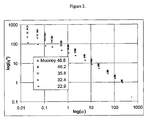
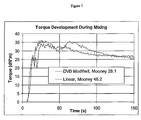
- Mooney and Mooney relaxation were measured at 125°C. Relaxation time was set at eight minutes. Mooney values, as well as the area under the curve registered during relaxation, are listed in Table 1. The results clearly show that TMP-1 is an effective chain transfer agent. Mooney decreased from about 49 to about 23 as the amount of TMP-1 was increased from 0 to 0.21 g in the charge. Results also show that the chain transfer agent had no effect on the conversion or catalyst efficiency.
- This Example illustrates how the solubility of a DVB cross-linked polymer can be increased by the addition of strong chain transfer agents to the polymerization mixture and still obtain polymers with sufficiently high viscosity.
- composition of the mixture was measured to be 57 wt% meta-divinylbenzene (m-DVB), 24 wt% para-divinylbenzene (p-DVB), 9.9 wt% meta-ethylvinylbenzene and 9.1 wt % para-ethylvinylbenzene.
- TMP-1 diisobutylene (2,4,4-trimethyl-1-pentene)
- the resulting polymer was dissolved in hexane, stabilized by the addition 0.2 phr Irganox-1010 TM and coagulated in hot water. Residual moisture and monomer were removed by drying the samples on a hot mill at 140°C.
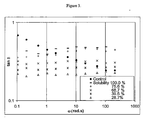
- the Mooney viscosity of the polymer samples obtained in this Example decreased from about 44 to about 18 with increasing solubility. However, even at the highest chain transfer agent concentration an elastic material was obtained which was suitable for compounding and curing.
- the frequency independent tangent delta is achieved by producing an elastomer which is close to its gel point.
- a polymer at its gel point is in a transition state between liquid and solid.
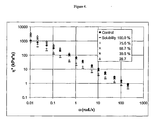
- the complex viscosity obtained from dynamic testing can be used to predict the apparent viscosity of sample in capillary flow according to the Cox-Merz rule ( W. P. Cox and E. H. Merz: J. Polymer Sci, Vol 28, p 619 (1958 )).
- the Cox-Merz rule states that the complex viscosity at a given angular frequency is equal to the apparent viscosity measured under steady shear rate in a capillary viscometer. This has been confirmed very recently by measuring the viscosity of different elastomers using RPA and MPT (Monsanto Processability Tester) ( J. S. Dick: Comparison of shear thinning behavior of different elastomers using capillary and rotorless shear rheometry, Paper No. 50, ACS Rubber Division Meeting Dallas, Texas, April 4-6, 2000 .)
- Mooney stress relaxation measurements were also conducted using these samples to determine the ability of the samples to resist cold flow by an independent method.
- the selected relaxation time was eight minutes.
- the area under the torque - time curve was used to compare the samples. Table 2 shows the results. All DVB modified samples except the very low Mooney one (Mooney 17.6) has a higher area under curve value than the linear control sample of this example or any linear samples produced in Example 1. Even the 17.6 Mooney sample has very similar area under curve value to that of the linear control.
- the higher are under curve indicates a higher ability of the sample to resist flow under low shear rates, i.e., to resist cold flow.
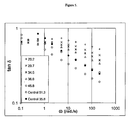
- This example shows the effect of different degrees of branching on dynamic properties.
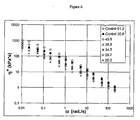
- Figure 5 show the results of dynamic testing. Tangent delta of the DVB modified samples was measured to be lower at low frequencies (1 rad/s or below) than that of the linear samples. This confirms the results of the Mooney relaxation measurements, i.e., they are able to resist cold flow more than the linear samples.
- All DVB modified samples showed a cross over point with the tangent delta - frequency curve of the two control samples. At frequencies higher than about 1 rad/s, all DVB modified samples displayed a higher tangent delta. This indicates that at higher shear rates these samples will have less elasticity. Lower elasticity at higher shear rates is preferred in order to obtain a material which is less nervy or swells less as it exits the die of an extruder.
- samples prepared at this low concentration of DVB are still able to resist cold flow better than comparable or even higher Mooney linear samples.
- the 28.1 Mooney sample of this example (Experiment No. 21) has an area under curve value of 609.
- the 32.4, 35.8 and even the 46.2 Mooney linear samples of Example 1 have a lower are under curve value (see Table 1.).
- the ability of the compounded samples to relax under stress was determined using the stress relaxation program of the RPA 2000 (Rubber Process Analyzer) instrument. During this measurement a constant strain is applied to the sample by the rapid movement of the lower die and the stress is measured at the upper die as a function of time. This measurement is similar to the Mooney relaxation measurement in principle. Therefore, stresses detected at longer times can be used to characterize the ability of a sample to resist cold flow. A higher remaining stress is an indication of higher resistance to cold flow. The remaining stress at two minutes was selected for the characterization of the cold flow resistance of the samples.
- RPA 2000 Rubber Process Analyzer
- the initial rate of stress decay enables one to determine the sample ability to relax when it is exposed to a large strain for a very short period of time.
- An example of this is the extrusion of rubber or its compound through a short and narrow die at a high shear rate. As the rubber enters the die, it is exposed to a high strain for a short period of time.
- the initial stress detected shortly after the application of strain can be used to characterize the die swell behavior of the sample. A lower initial stress value implies that the sample will swell less after exiting the die.
- the initial slope of the log (stress) - log (time) curve in the 0.01 - 1 s interval and the stress detected at 1 s were selected.
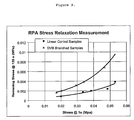
- Figure 9 shows the remaining stress at two minutes as a function of the initial slope.
- Figure 9 shows the remaining stress at two minutes as a function of stress detected at 1 s.
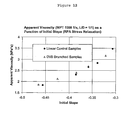
- the Figures clearly demonstrate the difference between branched and linear samples and the superior properties of branched samples. For example, at the same remaining stress at 2 minutes their initial relaxation is faster and their initial stress is lower. On the other hand at the same initial slope or initial stress their remaining stress at longer time is higher. This implies that cold-flow and extrusion properties can be improved at the same time.
- the die swell of the compounded samples listed in Tables 5 and 6 were determined using a capillary viscometer (Monsanto Processability Tester (MPT)). Measurements were carried out at 125 °C using 1000 1/s shear rate and a die with an L/D ratio of 1/1. Results are listed in Table 5 and 6. They clearly indicate that the branched samples have a lower running or relaxed die swell at the same raw polymer Mooney. For example, the compound made using the 48.8 Mooney linear sample had a running die swell of 104.5% and a relaxed die swell of 122.3 %. In contrast the compound of the 51.9 Mooney branched sample had only 80.8 % running die swell and 92.2 % relaxed die swell.
- Figures 10 - 13 are provided to illustrate the ability of the values determined by stress relaxation measurement to describe the processability characteristics of the samples.
- Figure 10 shows that there is a strong correlation between the running die swell and the initial stress and this correlation is independent of the structure of the polymer.
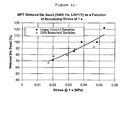
- Figure 11 shows that there is a strong correlation between the relaxed die swell and the initial stress and this correlation is independent of the structure of the polymer.
- Figure 12 shows that there is a strong correlation between the apparent viscosity and the initial slope of the stress relaxation curve and this correlation is independent of the structure of the polymer.
- Figure 13 shows that there is a strong correlation between the area under the curve determined by Mooney relaxation measurements conducted on the raw polymers and the remaining stress determined by stress relaxation measurement. This correlation is also independent of the structure of the polymer.
- Cold flow properties of the compounded samples were determined using the so-called deformational (DEFO) measurements.
- the measurement is conducted using a 30 mm diameter and 13 mm high compression molded disk. On this disk a load (8 N) is applied and the height of the disk is measured as a function of time. Samples with higher resistance to cold flow will retain more of their original height. Table 5 and 6 lists the remaining height of the samples. According to the results, the remaining height of branched samples is higher than that of a similar Mooney linear sample. For example, the 36.9 Mooney branched sample remaining height was 11.3 mm. In contrast, the 35.8 Mooney linear sample remaining height was 10.9 mm. Only the significantly higher Mooney linear sample (Mooney 46.2) could resist to cold flow as much as the 36.9 Mooney branched sample.
- This example shows that combination of improved properties can also be achieved in continuous polymerization.
- the Mooney of the samples is listed in Table 8, along with the measured area under the Mooney relaxation curve.
- test results of a linear control sample of identical Mooney viscosity is included in Table 8. This sample was also made in continuous polymerization. However, the monomer feed contained no DVB or TMP-1. The increased cold flow resistance is clearly shown by the higher area under the relaxation curve of the samples made in the presence of DVB and TMP-1.
- Example 5 The two samples of Example 5 along with the linear control sample were compounded with 60 phr N660 black.
- MPT and cold flow DEFO measurements confirmed that the samples made in the presence of DVB and TMP-1 has an improved combination of processing properties. Their increased resistance to cold flow is indicated by the higher remaining height values. According to the MPT measurements, this increased resistance to cold flow did not result in increased die swell. In fact, the running and relaxed die swell of the DVB modified samples was measured to be lower.
Landscapes
- Chemical & Material Sciences (AREA)
- Health & Medical Sciences (AREA)
- Chemical Kinetics & Catalysis (AREA)
- Medicinal Chemistry (AREA)
- Polymers & Plastics (AREA)
- Organic Chemistry (AREA)
- Addition Polymer Or Copolymer, Post-Treatments, Or Chemical Modifications (AREA)
Applications Claiming Priority (3)
| Application Number | Priority Date | Filing Date | Title |
|---|---|---|---|
| CA2316741 | 2000-08-24 | ||
| CA002316741A CA2316741A1 (en) | 2000-08-24 | 2000-08-24 | Improved processability butyl rubber and process for production thereof |
| PCT/CA2001/001188 WO2002016452A1 (en) | 2000-08-24 | 2001-08-21 | Improved processability butyl rubber and process for production thereof |
Publications (2)
| Publication Number | Publication Date |
|---|---|
| EP1313777A1 EP1313777A1 (en) | 2003-05-28 |
| EP1313777B1 true EP1313777B1 (en) | 2008-12-24 |
Family
ID=4166965
Family Applications (1)
| Application Number | Title | Priority Date | Filing Date |
|---|---|---|---|
| EP01966863A Expired - Lifetime EP1313777B1 (en) | 2000-08-24 | 2001-08-21 | Process for the production of improved processability butyl rubber |
Country Status (10)
| Country | Link |
|---|---|
| US (1) | US6841642B2 (OSRAM) |
| EP (1) | EP1313777B1 (OSRAM) |
| JP (1) | JP2004506088A (OSRAM) |
| KR (1) | KR20030031990A (OSRAM) |
| CN (1) | CN1247632C (OSRAM) |
| AU (1) | AU2001287408A1 (OSRAM) |
| CA (1) | CA2316741A1 (OSRAM) |
| DE (1) | DE60137136D1 (OSRAM) |
| RU (1) | RU2277544C2 (OSRAM) |
| WO (1) | WO2002016452A1 (OSRAM) |
Families Citing this family (44)
| Publication number | Priority date | Publication date | Assignee | Title |
|---|---|---|---|---|
| EP1483303B1 (de) * | 2002-03-04 | 2006-05-31 | Basf Aktiengesellschaft | Verfahren zur herstellung von isobutenpolymeren |
| CA2383474A1 (en) * | 2002-04-26 | 2003-10-26 | Bayer Inc. | Rubber composition for tire treads |
| CA2386646C (en) * | 2002-05-16 | 2010-07-20 | Bayer Inc. | Rubber compound for a vibration dampening device |
| CA2386628C (en) | 2002-05-16 | 2010-07-06 | Bayer Inc. | Hologen- and sulfur-free shaped articles comprising peroxide curable compounds of butyl rubber |
| CA2390046A1 (en) * | 2002-06-28 | 2003-12-28 | Bayer Inc. | Method for improving the processability of butyl polymers |
| CA2406432C (en) * | 2002-10-03 | 2011-11-29 | Bayer Inc. | Adhesive compounds of butyl-type rubber |
| CA2406775C (en) * | 2002-10-03 | 2011-11-29 | Bayer Inc. | Peroxide curable compounds based on butyl-like polymer without conjugated aliphatic dienes in its composition |
| CA2418884C (en) * | 2003-02-14 | 2010-07-20 | Bayer Inc. | Process for production of high-isoprene butyl rubber |
| CA2438024C (en) * | 2003-08-14 | 2013-05-28 | Bayer Inc. | Peroxide curable butyl formulations |
| CA2448337A1 (en) * | 2003-11-03 | 2005-05-03 | Bayer Inc. | Butyl-type rubber with high viscosity |
| CA2458741A1 (en) * | 2004-02-23 | 2005-08-23 | Rui Resendes | Peroxide curable butyl formulations containing high-isoprene butyl rubber |
| CA2465407C (en) | 2004-04-28 | 2012-11-13 | Rui Resendes | Peroxide curable butyl formulations |
| JP5017102B2 (ja) * | 2004-06-15 | 2012-09-05 | エクソンモービル・ケミカル・パテンツ・インク | エラストマー組成物、空気バリア、及びこれらの製造方法 |
| CA2487906A1 (en) * | 2004-11-18 | 2006-05-18 | Lanxess Inc. | Rubber composition comprising modified filler |
| US7642330B2 (en) * | 2005-03-31 | 2010-01-05 | Exxonmobil Chemical Patents Inc. | Method of selecting polyolefins based on rheological properties |
| JP5264485B2 (ja) * | 2005-08-26 | 2013-08-14 | ランクセス・インコーポレーテッド | 高マルチオレフィンハロブチルアイオノマーを含む過酸化物硬化性ゴムコンパウンド |
| US7312286B2 (en) * | 2005-12-02 | 2007-12-25 | Stockhausen, Inc. | Flexible superabsorbent binder polymer composition |
| US7563179B2 (en) * | 2006-01-04 | 2009-07-21 | Bridgestone Sports Co., Ltd. | Golf ball |
| US7294067B2 (en) * | 2006-01-04 | 2007-11-13 | Bridgestone Sports Co., Ltd. | Golf ball |
| US7566280B2 (en) * | 2006-01-04 | 2009-07-28 | Bridgestone Sports Co., Ltd. | Golf ball |
| US7637824B2 (en) * | 2006-01-04 | 2009-12-29 | Bridgestone Sports Co., Ltd. | Golf ball |
| US7976410B2 (en) | 2006-01-04 | 2011-07-12 | Bridgestone Sports Co., Ltd. | Golf ball |
| US7976409B2 (en) * | 2006-01-04 | 2011-07-12 | Bridgestone Sports Co., Ltd. | Golf ball |
| US7559855B2 (en) * | 2006-01-04 | 2009-07-14 | Bridgestone Sports Co., Ltd. | Golf ball |
| US7563181B2 (en) * | 2006-01-04 | 2009-07-21 | Bridgestone Sports Co., Ltd. | Golf ball |
| US7563182B2 (en) * | 2006-01-04 | 2009-07-21 | Bridgestone Sports Co., Ltd. | Polymer composition and golf ball made using the same |
| US7407449B2 (en) * | 2006-01-04 | 2008-08-05 | Bridgestone Sports Co., Ltd. | Golf ball |
| US7559856B2 (en) * | 2006-01-04 | 2009-07-14 | Bridgestone Sports Co., Ltd. | Golf ball |
| US7767743B2 (en) * | 2006-03-10 | 2010-08-03 | Exxonmobil Chemical Patents Inc. | Processable branched isoolefin-alkylstyrene elastomers |
| US8144115B2 (en) | 2006-03-17 | 2012-03-27 | Konicek Jeffrey C | Flat panel display screen operable for touch position determination system and methods |
| CN100497414C (zh) * | 2006-03-24 | 2009-06-10 | 中山大学 | β-蒎烯/极性乙烯基单体共聚物及其制备方法与应用 |
| US7859526B2 (en) * | 2006-05-01 | 2010-12-28 | Konicek Jeffrey C | Active matrix emissive display and optical scanner system, methods and applications |
| US7498381B1 (en) | 2006-08-02 | 2009-03-03 | Exxonmobil Chemical Patents Inc. | Low permeability elastomeric-metal phosphate nanocomposites |
| CN101130585B (zh) * | 2006-08-25 | 2010-11-10 | 北京化工大学 | 一种丁基橡胶的制备方法 |
| US7557170B2 (en) * | 2007-08-31 | 2009-07-07 | Exxonmobil Chemical Patents Inc. | Method for reducing depositions in polymerization vessels |
| US9079980B2 (en) | 2010-08-31 | 2015-07-14 | The Goodyear Tire & Rubber Company | Copolymers of conjugated triene monomers for improved filler interaction |
| MX360891B (es) | 2011-06-08 | 2018-11-20 | Tpc Group Llc | Producción de oligómeros de poliisobutileno de bajo peso molecular altamente reactivos. |
| US9963521B2 (en) | 2012-02-17 | 2018-05-08 | Basf Se | Process for preparing higher molecular weight polyisobutylene |
| MY168940A (en) * | 2012-02-17 | 2019-01-10 | Basf Se | Process for preparing higher molecular weight polyisobutylene |
| CA2816776A1 (en) * | 2012-05-29 | 2013-11-29 | Tpc Group Llc | Adducts of low molecular weight pib with low polydispersity and high vinylidene content |
| EP3301133A1 (en) * | 2016-09-29 | 2018-04-04 | ARLANXEO Canada Inc. | Multi-modal polyisoolefin compositions and processes for their production |
| CN109401092A (zh) * | 2018-11-26 | 2019-03-01 | 盛州医药包装材料科技(中国)有限公司 | 一种用于药品封装橡胶塞的配方及其制备方法 |
| EP4077410A4 (en) * | 2019-12-20 | 2023-12-06 | Public Joint Stock Company "Sibur Holding" (PJSC "Sibur Holding") | BRANCHED POLYDIENES AND RUBBER COMPOSITIONS BASED THEREON |
| CN116217773A (zh) * | 2023-03-29 | 2023-06-06 | 山东京博中聚新材料有限公司 | 一种宽分子量分布的丁基橡胶及其合成方法 |
Family Cites Families (12)
| Publication number | Priority date | Publication date | Assignee | Title |
|---|---|---|---|---|
| US3214358A (en) * | 1965-10-26 | Isobutylene-diene copglymerization by low temperature irradiatiun | ||
| US2781334A (en) | 1952-05-01 | 1957-02-12 | Exxon Research Engineering Co | Divinyl aromatic modified isoolefinmultiolefin copolymers |
| US2729626A (en) | 1952-05-01 | 1956-01-03 | Exxon Research Engineering Co | Isoolefin-multiolefin copolymers |
| US2671774A (en) | 1952-07-28 | 1954-03-09 | Standard Oil Dev Co | High extrusion modified isoolefinmultiolefin copolymers |
| US2830973A (en) * | 1955-12-09 | 1958-04-15 | Exxon Research Engineering Co | Preparation of olefin-aromatic copolymers with cross-linking agents |
| US3511821A (en) * | 1963-10-23 | 1970-05-12 | Exxon Research Engineering Co | Terpolymers of isobutylene-methylcyclopentadiene and a crosslinking agent |
| GB1143690A (OSRAM) | 1966-12-16 | |||
| US4139695A (en) * | 1975-11-13 | 1979-02-13 | Exxon Research & Engineering Co. | High molecular weight high unsaturation C4-C10 isoolefin conjugated diolefin copolymers and multipolymers containing methylcyclopentadiene |
| US5071913A (en) * | 1987-12-11 | 1991-12-10 | Exxon Chemical Patents Inc. | Rubbery isoolefin polymers exhibiting improved processability |
| DE4426756A1 (de) * | 1994-07-28 | 1996-02-01 | Bayer Ag | Verfahren zur Herstellung von C¶4¶-C¶1¶¶6¶-Alkylkautschuken nach dem Slurry-Verfahren |
| US5677405A (en) * | 1995-05-24 | 1997-10-14 | The B.F. Goodrich Company | Homopolymers and copolymers of cationically polymerizable monomers and method of their preparation |
| RU2158272C1 (ru) * | 1999-05-27 | 2000-10-27 | Открытое акционерное общество "Нижнекамскнефтехим" | Способ получения бутилкаучука |
-
2000
- 2000-08-24 CA CA002316741A patent/CA2316741A1/en not_active Abandoned
-
2001
- 2001-08-21 AU AU2001287408A patent/AU2001287408A1/en not_active Abandoned
- 2001-08-21 EP EP01966863A patent/EP1313777B1/en not_active Expired - Lifetime
- 2001-08-21 JP JP2002521546A patent/JP2004506088A/ja active Pending
- 2001-08-21 WO PCT/CA2001/001188 patent/WO2002016452A1/en not_active Ceased
- 2001-08-21 RU RU2003107923/04A patent/RU2277544C2/ru not_active IP Right Cessation
- 2001-08-21 US US10/362,202 patent/US6841642B2/en not_active Expired - Fee Related
- 2001-08-21 KR KR10-2003-7002611A patent/KR20030031990A/ko not_active Withdrawn
- 2001-08-21 CN CNB018177085A patent/CN1247632C/zh not_active Expired - Fee Related
- 2001-08-21 DE DE60137136T patent/DE60137136D1/de not_active Expired - Lifetime
Also Published As
| Publication number | Publication date |
|---|---|
| US6841642B2 (en) | 2005-01-11 |
| RU2277544C2 (ru) | 2006-06-10 |
| KR20030031990A (ko) | 2003-04-23 |
| CN1247632C (zh) | 2006-03-29 |
| DE60137136D1 (de) | 2009-02-05 |
| EP1313777A1 (en) | 2003-05-28 |
| JP2004506088A (ja) | 2004-02-26 |
| CA2316741A1 (en) | 2002-02-24 |
| US20030187173A1 (en) | 2003-10-02 |
| CN1469886A (zh) | 2004-01-21 |
| HK1062179A1 (en) | 2004-10-21 |
| WO2002016452A1 (en) | 2002-02-28 |
| AU2001287408A1 (en) | 2002-03-04 |
Similar Documents
| Publication | Publication Date | Title |
|---|---|---|
| EP1313777B1 (en) | Process for the production of improved processability butyl rubber | |
| CA2418884C (en) | Process for production of high-isoprene butyl rubber | |
| US4139695A (en) | High molecular weight high unsaturation C4-C10 isoolefin conjugated diolefin copolymers and multipolymers containing methylcyclopentadiene | |
| KR100893444B1 (ko) | 높은 이중 결합 함량을 가진 할로겐화된, 고 분자량,비-겔 상태 이소부텐 공중합체 | |
| CA2458741A1 (en) | Peroxide curable butyl formulations containing high-isoprene butyl rubber | |
| CA2420244C (en) | Improved processability butyl rubber and process for production thereof | |
| JP7209156B2 (ja) | 多峰性ポリイソオレフィン組成物及びその製造方法 | |
| US9982075B2 (en) | Highly unsaturated multi-modal polyisoolefin composition and process for preparation thereof | |
| RU2326894C2 (ru) | Способ улучшения перерабатываемости полимеров бутилкаучуков | |
| US4229325A (en) | High unsaturation butyl rubbers with additives | |
| HK1062179B (en) | Improved processability butyl rubber and process for production thereof | |
| CA2438931A1 (en) | Method of improving reversion resistance |
Legal Events
| Date | Code | Title | Description |
|---|---|---|---|
| PUAI | Public reference made under article 153(3) epc to a published international application that has entered the european phase |
Free format text: ORIGINAL CODE: 0009012 |
|
| 17P | Request for examination filed |
Effective date: 20030324 |
|
| AK | Designated contracting states |
Designated state(s): AT BE CH CY DE DK ES FI FR GB GR IE IT LI LU MC NL PT SE TR |
|
| AX | Request for extension of the european patent |
Extension state: AL LT LV MK RO SI |
|
| RBV | Designated contracting states (corrected) |
Designated state(s): DE FR GB IT |
|
| 17Q | First examination report despatched |
Effective date: 20040928 |
|
| RAP1 | Party data changed (applicant data changed or rights of an application transferred) |
Owner name: LANXESS INC. |
|
| 17Q | First examination report despatched |
Effective date: 20040928 |
|
| RTI1 | Title (correction) |
Free format text: PROCESS FOR THE PRODUCTION OF IMPROVED PROCESSABILITY BUTYL RUBBER |
|
| GRAP | Despatch of communication of intention to grant a patent |
Free format text: ORIGINAL CODE: EPIDOSNIGR1 |
|
| GRAS | Grant fee paid |
Free format text: ORIGINAL CODE: EPIDOSNIGR3 |
|
| GRAA | (expected) grant |
Free format text: ORIGINAL CODE: 0009210 |
|
| AK | Designated contracting states |
Kind code of ref document: B1 Designated state(s): DE FR GB IT |
|
| REG | Reference to a national code |
Ref country code: GB Ref legal event code: FG4D |
|
| REF | Corresponds to: |
Ref document number: 60137136 Country of ref document: DE Date of ref document: 20090205 Kind code of ref document: P |
|
| PLBE | No opposition filed within time limit |
Free format text: ORIGINAL CODE: 0009261 |
|
| STAA | Information on the status of an ep patent application or granted ep patent |
Free format text: STATUS: NO OPPOSITION FILED WITHIN TIME LIMIT |
|
| 26N | No opposition filed |
Effective date: 20090925 |
|
| PGFP | Annual fee paid to national office [announced via postgrant information from national office to epo] |
Ref country code: DE Payment date: 20130814 Year of fee payment: 13 |
|
| PGFP | Annual fee paid to national office [announced via postgrant information from national office to epo] |
Ref country code: GB Payment date: 20130821 Year of fee payment: 13 Ref country code: FR Payment date: 20130808 Year of fee payment: 13 |
|
| PGFP | Annual fee paid to national office [announced via postgrant information from national office to epo] |
Ref country code: IT Payment date: 20130809 Year of fee payment: 13 |
|
| REG | Reference to a national code |
Ref country code: DE Ref legal event code: R119 Ref document number: 60137136 Country of ref document: DE |
|
| GBPC | Gb: european patent ceased through non-payment of renewal fee |
Effective date: 20140821 |
|
| PG25 | Lapsed in a contracting state [announced via postgrant information from national office to epo] |
Ref country code: IT Free format text: LAPSE BECAUSE OF NON-PAYMENT OF DUE FEES Effective date: 20140821 |
|
| REG | Reference to a national code |
Ref country code: FR Ref legal event code: ST Effective date: 20150430 |
|
| REG | Reference to a national code |
Ref country code: DE Ref legal event code: R119 Ref document number: 60137136 Country of ref document: DE Effective date: 20150303 |
|
| PG25 | Lapsed in a contracting state [announced via postgrant information from national office to epo] |
Ref country code: GB Free format text: LAPSE BECAUSE OF NON-PAYMENT OF DUE FEES Effective date: 20140821 Ref country code: DE Free format text: LAPSE BECAUSE OF NON-PAYMENT OF DUE FEES Effective date: 20150303 |
|
| PG25 | Lapsed in a contracting state [announced via postgrant information from national office to epo] |
Ref country code: FR Free format text: LAPSE BECAUSE OF NON-PAYMENT OF DUE FEES Effective date: 20140901 |