EP1298891A2 - Mobilfunkgerät - Google Patents
Mobilfunkgerät Download PDFInfo
- Publication number
- EP1298891A2 EP1298891A2 EP02022041A EP02022041A EP1298891A2 EP 1298891 A2 EP1298891 A2 EP 1298891A2 EP 02022041 A EP02022041 A EP 02022041A EP 02022041 A EP02022041 A EP 02022041A EP 1298891 A2 EP1298891 A2 EP 1298891A2
- Authority
- EP
- European Patent Office
- Prior art keywords
- incoming call
- terminal
- mobile radio
- unit
- data
- Prior art date
- Legal status (The legal status is an assumption and is not a legal conclusion. Google has not performed a legal analysis and makes no representation as to the accuracy of the status listed.)
- Withdrawn
Links
- 238000004891 communication Methods 0.000 claims abstract description 21
- 238000000034 method Methods 0.000 description 21
- 230000005540 biological transmission Effects 0.000 description 6
- 238000001514 detection method Methods 0.000 description 3
- 238000009792 diffusion process Methods 0.000 description 3
- 238000010295 mobile communication Methods 0.000 description 3
- 230000001413 cellular effect Effects 0.000 description 2
- 238000010586 diagram Methods 0.000 description 2
- 238000005401 electroluminescence Methods 0.000 description 2
- 238000005316 response function Methods 0.000 description 2
- 230000003321 amplification Effects 0.000 description 1
- 238000006243 chemical reaction Methods 0.000 description 1
- 239000004973 liquid crystal related substance Substances 0.000 description 1
- 238000003199 nucleic acid amplification method Methods 0.000 description 1
- 230000002265 prevention Effects 0.000 description 1
- 239000004065 semiconductor Substances 0.000 description 1
Images



Classifications
-
- H—ELECTRICITY
- H04—ELECTRIC COMMUNICATION TECHNIQUE
- H04M—TELEPHONIC COMMUNICATION
- H04M1/00—Substation equipment, e.g. for use by subscribers
- H04M1/66—Substation equipment, e.g. for use by subscribers with means for preventing unauthorised or fraudulent calling
- H04M1/663—Preventing unauthorised calls to a telephone set
-
- H—ELECTRICITY
- H04—ELECTRIC COMMUNICATION TECHNIQUE
- H04M—TELEPHONIC COMMUNICATION
- H04M1/00—Substation equipment, e.g. for use by subscribers
- H04M1/02—Constructional features of telephone sets
- H04M1/0202—Portable telephone sets, e.g. cordless phones, mobile phones or bar type handsets
- H04M1/0206—Portable telephones comprising a plurality of mechanically joined movable body parts, e.g. hinged housings
- H04M1/0208—Portable telephones comprising a plurality of mechanically joined movable body parts, e.g. hinged housings characterized by the relative motions of the body parts
- H04M1/0214—Foldable telephones, i.e. with body parts pivoting to an open position around an axis parallel to the plane they define in closed position
-
- H—ELECTRICITY
- H04—ELECTRIC COMMUNICATION TECHNIQUE
- H04M—TELEPHONIC COMMUNICATION
- H04M1/00—Substation equipment, e.g. for use by subscribers
- H04M1/02—Constructional features of telephone sets
- H04M1/0202—Portable telephone sets, e.g. cordless phones, mobile phones or bar type handsets
- H04M1/0206—Portable telephones comprising a plurality of mechanically joined movable body parts, e.g. hinged housings
- H04M1/0241—Portable telephones comprising a plurality of mechanically joined movable body parts, e.g. hinged housings using relative motion of the body parts to change the operational status of the telephone set, e.g. switching on/off, answering incoming call
- H04M1/0245—Portable telephones comprising a plurality of mechanically joined movable body parts, e.g. hinged housings using relative motion of the body parts to change the operational status of the telephone set, e.g. switching on/off, answering incoming call using open/close detection
-
- H—ELECTRICITY
- H04—ELECTRIC COMMUNICATION TECHNIQUE
- H04M—TELEPHONIC COMMUNICATION
- H04M1/00—Substation equipment, e.g. for use by subscribers
- H04M1/72—Mobile telephones; Cordless telephones, i.e. devices for establishing wireless links to base stations without route selection
- H04M1/724—User interfaces specially adapted for cordless or mobile telephones
-
- H—ELECTRICITY
- H04—ELECTRIC COMMUNICATION TECHNIQUE
- H04M—TELEPHONIC COMMUNICATION
- H04M1/00—Substation equipment, e.g. for use by subscribers
- H04M1/26—Devices for calling a subscriber
- H04M1/27—Devices whereby a plurality of signals may be stored simultaneously
- H04M1/274—Devices whereby a plurality of signals may be stored simultaneously with provision for storing more than one subscriber number at a time, e.g. using toothed disc
- H04M1/2745—Devices whereby a plurality of signals may be stored simultaneously with provision for storing more than one subscriber number at a time, e.g. using toothed disc using static electronic memories, e.g. chips
- H04M1/27453—Directories allowing storage of additional subscriber data, e.g. metadata
-
- H—ELECTRICITY
- H04—ELECTRIC COMMUNICATION TECHNIQUE
- H04M—TELEPHONIC COMMUNICATION
- H04M1/00—Substation equipment, e.g. for use by subscribers
- H04M1/57—Arrangements for indicating or recording the number of the calling subscriber at the called subscriber's set
Definitions
- the conventional mobile radio terminals have a problem of being low in operability.
- the mobile radio terminal on occurrence of an incoming call, can make response to the incoming call to initiate communication with the originating terminal by being changed from the folded state to the unfolded state.
- FIG. 1 is a block diagram of a mobile radio terminal embodying the present invention, which is adapted to make CDMA (Code Division Multiple Access)-based radio communication with a base station BS.
- CDMA Code Division Multiple Access
- a radio-frequency signal transmitted from the base station BS is input through the receiving filter 102a to a receiving unit (RX) 103.
- This received radio-frequency signal will never be input to a transmitting unit 105 to be described later owing to the transmitting filter 102b.
- the radio frequency signal is converted into an intermediate-frequency signal by being mixed with a receiving local oscillator signal from a frequency synthesizer (SYN) 104.
- SYN frequency synthesizer
- the intermediate-frequency signal obtained by the receiving unit 103 is subjected to quadrature demodulation, and despread in a CDMA signal processing unit 106.
- the resulting signal is converted into receive data in a predetermined format corresponding to the data rate.
- receive data data indicating the data rate or electronic mail data are output to the control-unit 200, while voice data is output to a voice code processing unit 107.
- the CDMA signal processing unit 106 detects from the received data the occurrence of an incoming call to the corresponding mobile radio terminal and the phone number of the originating terminal presented from the base station BS and then notifies the control unit 200 of these information.
- the voice code processing unit 107 performs expansion processing on the received data obtained in the CDMA signal processing unit 106 according to the rate of the received data presented from the control unit 200 and then outputs the result to a PCM code processing unit 108.
- the voice of a talker is input to a microphone (M) 111 for conversion into an analog send speech signal, which is amplified up to an appropriate level in an amplifier 112, then PCM coded in the PCM code processing unit 108 and output to the voice code processing unit 107 as transmit data.
- M microphone
- the voice code processing unit 107 detects the amount of energy of the input voice from the transmit data output from the PCM code processing unit 108, then determines a data rate based on the result and presents it to the control unit 200.
- the transmit data is compressed into a burst signal in a format corresponding to that data rate and then output to the CDMA signal processing unit 106.
- the CDMA signal processing unit 106 performs diffusion processing on the burst signal compressed in the voice code processing unit 107 or transmit electronic mail data input from the control unit 200 using PN codes corresponding to a transmission channel.
- the CDMA signal processing unit then performs quadrature modulation processing on the result of the diffusion processing to produce a quadrature modulated signal, which is output to the transmitting unit (TX) 105.
- the transmitting unit 105 combines the quadrature modulated signal with a transmission local oscillator signal to produce a radio-frequency signal.
- the transmitting unit 105 amplifies only an effective portion of the radio-frequency signal based on the transmit data rate presented from the control unit 200 and outputs it to the antenna sharer 102.
- the transmission local oscillator signal which is produced by the frequency synthesizer 104, has a frequency corresponding to a control signal from the control unit 200.
- An incoming call indicator 120 is adapted to, on the occurrence of an incoming call to the corresponding terminal, inform the user of the incoming call under control of the control unit 200 and comprises a sounder 121 which generates audible sound to inform the user of the incoming call, a light emitter 122 which generates light, and a vibrator 123, such as an eccentric motor, which generates vibration.
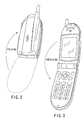
- a folding detecting unit 130 is adapted to detect whether the corresponding terminal is folded (the state shown in FIG. 2) or unfolded (the state shown in FIG. 3) and presents the result to the control unit 200.
- a storage unit 140 uses a semiconductor memory, such as a ROM or RAM, as a storage medium.
- the storage medium is stored with user-created data including telephone directory data in which, for example, as shown in FIG. 4, names are mapped into phone numbers and electronic mail addresses, moving image data (moving images and associated sound), received electronic mail, transmitted electronic mail, etc. These information is written and read through the control unit 200.
- the driver 160 is responsive input image data from the image processing unit 150 to drive a display 171 in a user interface unit 170, thereby displaying a still image or moving images.
- the sound data output from the image processing unit 150 is converted into analog sound data in the PCM code processing unit 108, then amplified in the amplifier 113 and sounded by the loudspeaker 114.
- the amplification level of the amplifier 113 is controlled by the control unit 200.
- the user interface unit 170 comprises the display 171, a sub-display 172, and a key entry unit 173.
- the display 171 which is comprised of, for example, a liquid crystal display (LCD) or an electro luminescence (EL) display, visually indicates to the user the conditions of the corresponding terminal (outgoing call/incoming call, battery condition, field strength), dial data read from the storage unit 140, and various images including moving images.
- LCD liquid crystal display
- EL electro luminescence
- the sub-display 172 is comprised of a small-sized LCD and mounted on the back of the corresponding terminal and adapted to inform the user of the conditions of the terminal and the occurrence of an incoming call when the terminal is folded.
- the key entry unit 173 includes keys for performing a normal talking function associated with sending and receiving operations, such as ten keys for dial number entry, and keys for various setting operations, such as switching incoming call indicating ways (audible sound generation, light emission, vibration, and no indication), and various functions.
- the control unit 200 is comprised of a CPU, a ROM, and a RAM.
- the CPU controls each component of the terminal in accordance with control programs and control data stored in the ROM.
- the control unit 200 has a communication control function of controlling the receiving unit 103, the frequency synthesizer 104, the transmitting unit 105, and the CDMA signal processing unit 106 to establish a CDMA-based communication link with the base station BS for voice communication and data communication, such as electronic mail, over a mobile communication network in which the base station BS is accommodated.
- control unit 200 has a control function of, when a request for playback of moving images is made by the user through the key entry unit 173, controlling the image processing unit 150 to allow the moving images to be played back.
- control unit 200 has a function of accepting a request for response to an incoming call from the user on the basis of the result of detection by the folding detecting unit 130, the phone number of the originating terminal presented from the base station BS at the occurrence of the incoming call, and the telephone directory data stored in the storage unit 140.
- a power supply circuit 181 produces a predetermined supply voltage Vcc from the output of a battery 180 and applies it to each circuit.
- step 5a the control unit 200 controls the image processing unit 150 to display an input acceptance screen for telephone directory data on the display 171.
- the control unit 200 accepts entry of a name, phone number and electronic mail address through the key entry unit 173 and then goes to step 5b.
- step 5c the control unit 200 controls the image processing unit 150 to display 171 the contents received from the user in steps 5a and 5b, asking the user to confirm that he or she wants to enter the contents. The procedure then goes to step 5d.
- step 5d the control unit 200 accepts through the key entry unit 173 a command of whether to enter the contents displayed in step 5c into the telephone directory data or not.
- a command is given to enter the displayed contents, the procedure goes to step 5e; otherwise, the procedure goes to step 5a.
- step 5e the control unit 200 records the contents received from the user in steps 5a and 5b into the storage unit 140 as telephone directory data. Then, the procedure is complete.
- FIG. 6 is a flowchart for the processing associated with response control at the occurrence of an incoming call. This processing is performed by the control unit 200 and initiated on occurrence of the incoming call.
- step 6a on the basis of the phone number of the originating terminal presented from the base station BS at the occurrence of an incoming call the control unit 200 searches the telephone directory data stored in the storage unit 140 for data coincident with that phone number. The procedure then goes to step 6b.
- step 6b the control unit 200 makes a decision of whether or not automatic response has been set up on the telephone directory data detected in step 6a, i.e., whether or not the corresponding automatic response data is 1.
- step 6c the control unit 200 drives at least one of the sounder 121, the light emitter 122, and the vibrator 123 to initiate the indication of the occurrence of an incoming call. Also, the control unit 200 displays the name entered into the telephone directory and detected in step 6a on the display 171 and then goes to step 6d.
- step 6e the control unit 200 makes a decision of whether or not the incoming call has terminated.
- step 6f If the incoming call has terminated, then the procedure goes to step 6f; otherwise, the procedure goes to step 6d.
- step 6g the control unit 200 terminates the incoming call indication initiated in step 6c and then goes to step 6h.
- step 6i on the basis of the result of detection by the folding detecting unit 130 the control unit 200 makes a decision of whether or not the corresponding mobile radio terminal has been unfolded.
- step 6c If the terminal has been unfolded, the procedure goes to step 6c. If, on the other hand, the terminal has not been unfolded (i.e., folded), the procedure goes to step 6j.
- step 6j the control unit 200 drives at least one of the sounder 121, the light emitter 122, and the vibrator 123 to initiate the indication of the occurrence of an incoming call. Also, the control unit 200 displays the name entered into the telephone directory and detected in step 6a on the display 171 and then goes to step 6k.
- step 6k the control unit 200 makes a decision of whether or not the terminal has been changed from the folded state to the unfolded state on the basis of the result of detection by the folding detecting unit 130.
- step 6g If the state of the terminal has changed to unfolded, the procedure goes to step 6g; otherwise, the procedure goes to step 61.
- step 61 the control unit 200 makes a decision of whether or not the incoming call has terminated.
- step 6m If the incoming call has terminated, then the procedure goes to step 6m; otherwise, the procedure goes to step 6k.
- step 6m the control unit 200 terminates the incoming call indication initiated in step 6j. Then, the procedure is complete.
- the mobile radio terminal is very convenient in that the incoming call received in the folded state (closed state) can be responded to easily. It is merely a matter of unfolding the mobile radio terminal.
- Whether to enable the function or to disable it can be determined for each of the callers. If the caller is a person the receiver does not want to answer, the function is disabled. In this case, the call from the caller is not responded to even if the terminal is unfolded.
- whether to make automatic response or not is set for each originating terminal's phone number. It is also possible to divide telephone directory data into groups and set whether to make automatic response or not for each group.
- the storage unit 140 is recorded with telephone directory data in which group number data is added to each phone number as shown in FIG. 7 and group setting data indicating whether to make automatic response or not for each group as shown in FIG. 8.
- step 6a reference is made to the telephone directory data to detect the group number from the phone number of an originating terminal and, in step 6b, reference is made to the group setting data to make a decision of whether or not automatic response has been set up on the group number detected in step 6a.
- an incoming call indicating melody is played back which corresponds to the melody type number set in the group setting data.
- melody type indicating data as shown in FIG. 8 is set for each originating terminal data.
- the corresponding melody to that originating terminal is played back.
Landscapes
- Engineering & Computer Science (AREA)
- Signal Processing (AREA)
- Computer Security & Cryptography (AREA)
- Human Computer Interaction (AREA)
- Computer Networks & Wireless Communication (AREA)
- Mobile Radio Communication Systems (AREA)
- Telephone Function (AREA)
- Transceivers (AREA)
- Telephone Set Structure (AREA)
Applications Claiming Priority (2)
| Application Number | Priority Date | Filing Date | Title |
|---|---|---|---|
| JP2001305769A JP3790143B2 (ja) | 2001-10-01 | 2001-10-01 | 移動無線端末装置 |
| JP2001305769 | 2001-10-01 |
Publications (2)
| Publication Number | Publication Date |
|---|---|
| EP1298891A2 true EP1298891A2 (de) | 2003-04-02 |
| EP1298891A3 EP1298891A3 (de) | 2003-12-03 |
Family
ID=19125508
Family Applications (1)
| Application Number | Title | Priority Date | Filing Date |
|---|---|---|---|
| EP02022041A Withdrawn EP1298891A3 (de) | 2001-10-01 | 2002-10-01 | Mobilfunkgerät |
Country Status (4)
| Country | Link |
|---|---|
| US (1) | US6895239B2 (de) |
| EP (1) | EP1298891A3 (de) |
| JP (1) | JP3790143B2 (de) |
| CN (1) | CN1411309A (de) |
Cited By (1)
| Publication number | Priority date | Publication date | Assignee | Title |
|---|---|---|---|---|
| WO2008025471A1 (en) * | 2006-08-31 | 2008-03-06 | Nokia Corporation | Method for operating a mobile communication device and mobile communication device |
Families Citing this family (5)
| Publication number | Priority date | Publication date | Assignee | Title |
|---|---|---|---|---|
| JP3561709B2 (ja) * | 2002-03-01 | 2004-09-02 | 三洋電機株式会社 | 携帯電話機 |
| US7039443B2 (en) * | 2002-10-11 | 2006-05-02 | Motorola, Inc. | Method and apparatus for automatically initiating a communication from a wireless communication device |
| US7265655B2 (en) * | 2004-06-02 | 2007-09-04 | Research In Motion Ltd. | Handheld computing device with power-saving notification |
| USD566092S1 (en) * | 2006-10-04 | 2008-04-08 | Sanyo Electric Co., Ltd. | Mobile phone |
| USD568284S1 (en) * | 2007-01-15 | 2008-05-06 | Samsung Electronics Co., Ltd. | Mobile phone |
Family Cites Families (6)
| Publication number | Priority date | Publication date | Assignee | Title |
|---|---|---|---|---|
| US6366771B1 (en) * | 1995-06-21 | 2002-04-02 | Arron S. Angle | Wireless communication network having voice and data communication capability |
| US6094565A (en) * | 1997-06-30 | 2000-07-25 | Motorola, Inc. | Closeable communication device and method of operating the same |
| FI114769B (fi) * | 1997-09-04 | 2004-12-15 | Nokia Corp | Menetelmä puhelinnumeroiden käsittelemiseksi matkaviestimessä ja matkaviestin |
| US6018668A (en) * | 1997-11-04 | 2000-01-25 | Ericsson Inc. | Method for auto answering a call based on caller ID |
| JP3132494B2 (ja) * | 1998-12-25 | 2001-02-05 | 日本電気株式会社 | 着信音生成情報端末器 |
| US6215993B1 (en) * | 1999-02-24 | 2001-04-10 | Ericsson Inc. | Caller ID preview for mobile telephones |
-
2001
- 2001-10-01 JP JP2001305769A patent/JP3790143B2/ja not_active Expired - Fee Related
-
2002
- 2002-09-30 CN CN02143994A patent/CN1411309A/zh active Pending
- 2002-10-01 US US10/260,284 patent/US6895239B2/en not_active Expired - Fee Related
- 2002-10-01 EP EP02022041A patent/EP1298891A3/de not_active Withdrawn
Cited By (1)
| Publication number | Priority date | Publication date | Assignee | Title |
|---|---|---|---|---|
| WO2008025471A1 (en) * | 2006-08-31 | 2008-03-06 | Nokia Corporation | Method for operating a mobile communication device and mobile communication device |
Also Published As
| Publication number | Publication date |
|---|---|
| US6895239B2 (en) | 2005-05-17 |
| JP3790143B2 (ja) | 2006-06-28 |
| EP1298891A3 (de) | 2003-12-03 |
| US20030083022A1 (en) | 2003-05-01 |
| CN1411309A (zh) | 2003-04-16 |
| JP2003110678A (ja) | 2003-04-11 |
Similar Documents
| Publication | Publication Date | Title |
|---|---|---|
| US5493604A (en) | Portable telephone set with automatic dialing feature | |
| EP2114059B1 (de) | Zellulare Mobiltelefonvorrichtung | |
| US5966671A (en) | Radiotelephone having an auxiliary actuator and method for operating said radiotelephone | |
| US6281925B1 (en) | Video telephone device having automatic sound level setting along with operation mode switching | |
| JP2833964B2 (ja) | 折畳型携帯電話機 | |
| JP3530475B2 (ja) | 折畳式通信端末装置および情報表示方法 | |
| KR100528715B1 (ko) | 폴더식 통신단말장치 및 자동발신방법 | |
| JP2003022066A (ja) | 通信端末装置およびスペース文字表示方法 | |
| EP1298896A2 (de) | Elektronische Vorrichtung und Funkgerät | |
| US6895239B2 (en) | Mobile radio terminal | |
| JP2003110666A (ja) | 電子機器 | |
| JP2850794B2 (ja) | 着信音自動調整機能付携帯電話機 | |
| US20040192356A1 (en) | Method for transmitting a character message from mobile communication terminal | |
| GB2340338A (en) | A telephone arranged to generate a waiting message | |
| JPH06252837A (ja) | 無線電話装置 | |
| JPH04368027A (ja) | 携帯電話機 | |
| JP4980512B2 (ja) | 移動通信端末 | |
| JP3524858B2 (ja) | 通信端末装置および設定値表示方法 | |
| JPH11341567A (ja) | 携帯電話端末 | |
| JP2968785B1 (ja) | 折り畳み式携帯電話機並びにその留守番電話サービス及びドライブモードの設定方法 | |
| JP2002359681A (ja) | 移動無線端末 | |
| KR100660119B1 (ko) | 발신자 정보의 음성출력 선택 기능이 구비된 전화기 및시스템 | |
| JP3379423B2 (ja) | 携帯端末装置 | |
| JPH09153946A (ja) | 電話装置 | |
| KR200254224Y1 (ko) | 발신자 번호 표시 유무선 전화기의 발신자 번호 음성안내 장치 |
Legal Events
| Date | Code | Title | Description |
|---|---|---|---|
| PUAI | Public reference made under article 153(3) epc to a published international application that has entered the european phase |
Free format text: ORIGINAL CODE: 0009012 |
|
| 17P | Request for examination filed |
Effective date: 20021001 |
|
| AK | Designated contracting states |
Kind code of ref document: A2 Designated state(s): AT BE BG CH CY CZ DE DK EE ES FI FR GB GR IE IT LI LU MC NL PT SE SK TR Designated state(s): AT BE BG CH CY CZ DE DK EE ES FI FR GB GR IE IT LI LU MC NL PT SE SK TR |
|
| AX | Request for extension of the european patent |
Extension state: AL LT LV MK RO SI |
|
| PUAL | Search report despatched |
Free format text: ORIGINAL CODE: 0009013 |
|
| AK | Designated contracting states |
Kind code of ref document: A3 Designated state(s): AT BE BG CH CY CZ DE DK EE ES FI FR GB GR IE IT LI LU MC NL PT SE SK TR |
|
| AX | Request for extension of the european patent |
Extension state: AL LT LV MK RO SI |
|
| RIC1 | Information provided on ipc code assigned before grant |
Ipc: 7H 04M 1/247 B Ipc: 7H 04M 1/57 B Ipc: 7H 04M 1/725 B Ipc: 7H 04M 1/02 A |
|
| AKX | Designation fees paid |
Designated state(s): DE FR GB |
|
| 17Q | First examination report despatched |
Effective date: 20050420 |
|
| STAA | Information on the status of an ep patent application or granted ep patent |
Free format text: STATUS: THE APPLICATION IS DEEMED TO BE WITHDRAWN |
|
| 18D | Application deemed to be withdrawn |
Effective date: 20060321 |