EP1297944B1 - Verfahren zum Laserdurchstrahlschweissen von Kunststoffteilen - Google Patents
Verfahren zum Laserdurchstrahlschweissen von Kunststoffteilen Download PDFInfo
- Publication number
- EP1297944B1 EP1297944B1 EP20010123507 EP01123507A EP1297944B1 EP 1297944 B1 EP1297944 B1 EP 1297944B1 EP 20010123507 EP20010123507 EP 20010123507 EP 01123507 A EP01123507 A EP 01123507A EP 1297944 B1 EP1297944 B1 EP 1297944B1
- Authority
- EP
- European Patent Office
- Prior art keywords
- plastic parts
- energy
- laser
- plastic
- boundary layer
- Prior art date
- Legal status (The legal status is an assumption and is not a legal conclusion. Google has not performed a legal analysis and makes no representation as to the accuracy of the status listed.)
- Expired - Lifetime
Links
Images
Classifications
-
- B—PERFORMING OPERATIONS; TRANSPORTING
- B29—WORKING OF PLASTICS; WORKING OF SUBSTANCES IN A PLASTIC STATE IN GENERAL
- B29C—SHAPING OR JOINING OF PLASTICS; SHAPING OF MATERIAL IN A PLASTIC STATE, NOT OTHERWISE PROVIDED FOR; AFTER-TREATMENT OF THE SHAPED PRODUCTS, e.g. REPAIRING
- B29C65/00—Joining or sealing of preformed parts, e.g. welding of plastics materials; Apparatus therefor
- B29C65/02—Joining or sealing of preformed parts, e.g. welding of plastics materials; Apparatus therefor by heating, with or without pressure
- B29C65/14—Joining or sealing of preformed parts, e.g. welding of plastics materials; Apparatus therefor by heating, with or without pressure using wave energy, i.e. electromagnetic radiation, or particle radiation
- B29C65/16—Laser beams
- B29C65/1629—Laser beams characterised by the way of heating the interface
- B29C65/1635—Laser beams characterised by the way of heating the interface at least passing through one of the parts to be joined, i.e. laser transmission welding
-
- B—PERFORMING OPERATIONS; TRANSPORTING
- B23—MACHINE TOOLS; METAL-WORKING NOT OTHERWISE PROVIDED FOR
- B23K—SOLDERING OR UNSOLDERING; WELDING; CLADDING OR PLATING BY SOLDERING OR WELDING; CUTTING BY APPLYING HEAT LOCALLY, e.g. FLAME CUTTING; WORKING BY LASER BEAM
- B23K26/00—Working by laser beam, e.g. welding, cutting or boring
- B23K26/18—Working by laser beam, e.g. welding, cutting or boring using absorbing layers on the workpiece, e.g. for marking or protecting purposes
-
- B—PERFORMING OPERATIONS; TRANSPORTING
- B23—MACHINE TOOLS; METAL-WORKING NOT OTHERWISE PROVIDED FOR
- B23K—SOLDERING OR UNSOLDERING; WELDING; CLADDING OR PLATING BY SOLDERING OR WELDING; CUTTING BY APPLYING HEAT LOCALLY, e.g. FLAME CUTTING; WORKING BY LASER BEAM
- B23K26/00—Working by laser beam, e.g. welding, cutting or boring
- B23K26/20—Bonding
- B23K26/21—Bonding by welding
- B23K26/24—Seam welding
- B23K26/244—Overlap seam welding
-
- B—PERFORMING OPERATIONS; TRANSPORTING
- B29—WORKING OF PLASTICS; WORKING OF SUBSTANCES IN A PLASTIC STATE IN GENERAL
- B29C—SHAPING OR JOINING OF PLASTICS; SHAPING OF MATERIAL IN A PLASTIC STATE, NOT OTHERWISE PROVIDED FOR; AFTER-TREATMENT OF THE SHAPED PRODUCTS, e.g. REPAIRING
- B29C65/00—Joining or sealing of preformed parts, e.g. welding of plastics materials; Apparatus therefor
- B29C65/02—Joining or sealing of preformed parts, e.g. welding of plastics materials; Apparatus therefor by heating, with or without pressure
- B29C65/14—Joining or sealing of preformed parts, e.g. welding of plastics materials; Apparatus therefor by heating, with or without pressure using wave energy, i.e. electromagnetic radiation, or particle radiation
- B29C65/16—Laser beams
- B29C65/1603—Laser beams characterised by the type of electromagnetic radiation
-
- B—PERFORMING OPERATIONS; TRANSPORTING
- B29—WORKING OF PLASTICS; WORKING OF SUBSTANCES IN A PLASTIC STATE IN GENERAL
- B29C—SHAPING OR JOINING OF PLASTICS; SHAPING OF MATERIAL IN A PLASTIC STATE, NOT OTHERWISE PROVIDED FOR; AFTER-TREATMENT OF THE SHAPED PRODUCTS, e.g. REPAIRING
- B29C65/00—Joining or sealing of preformed parts, e.g. welding of plastics materials; Apparatus therefor
- B29C65/02—Joining or sealing of preformed parts, e.g. welding of plastics materials; Apparatus therefor by heating, with or without pressure
- B29C65/14—Joining or sealing of preformed parts, e.g. welding of plastics materials; Apparatus therefor by heating, with or without pressure using wave energy, i.e. electromagnetic radiation, or particle radiation
- B29C65/16—Laser beams
- B29C65/1603—Laser beams characterised by the type of electromagnetic radiation
- B29C65/1606—Ultraviolet [UV] radiation, e.g. by ultraviolet excimer lasers
-
- B—PERFORMING OPERATIONS; TRANSPORTING
- B29—WORKING OF PLASTICS; WORKING OF SUBSTANCES IN A PLASTIC STATE IN GENERAL
- B29C—SHAPING OR JOINING OF PLASTICS; SHAPING OF MATERIAL IN A PLASTIC STATE, NOT OTHERWISE PROVIDED FOR; AFTER-TREATMENT OF THE SHAPED PRODUCTS, e.g. REPAIRING
- B29C65/00—Joining or sealing of preformed parts, e.g. welding of plastics materials; Apparatus therefor
- B29C65/02—Joining or sealing of preformed parts, e.g. welding of plastics materials; Apparatus therefor by heating, with or without pressure
- B29C65/14—Joining or sealing of preformed parts, e.g. welding of plastics materials; Apparatus therefor by heating, with or without pressure using wave energy, i.e. electromagnetic radiation, or particle radiation
- B29C65/16—Laser beams
- B29C65/1629—Laser beams characterised by the way of heating the interface
- B29C65/1664—Laser beams characterised by the way of heating the interface making use of several radiators
-
- B—PERFORMING OPERATIONS; TRANSPORTING
- B29—WORKING OF PLASTICS; WORKING OF SUBSTANCES IN A PLASTIC STATE IN GENERAL
- B29C—SHAPING OR JOINING OF PLASTICS; SHAPING OF MATERIAL IN A PLASTIC STATE, NOT OTHERWISE PROVIDED FOR; AFTER-TREATMENT OF THE SHAPED PRODUCTS, e.g. REPAIRING
- B29C65/00—Joining or sealing of preformed parts, e.g. welding of plastics materials; Apparatus therefor
- B29C65/02—Joining or sealing of preformed parts, e.g. welding of plastics materials; Apparatus therefor by heating, with or without pressure
- B29C65/14—Joining or sealing of preformed parts, e.g. welding of plastics materials; Apparatus therefor by heating, with or without pressure using wave energy, i.e. electromagnetic radiation, or particle radiation
- B29C65/16—Laser beams
- B29C65/1677—Laser beams making use of an absorber or impact modifier
- B29C65/168—Laser beams making use of an absorber or impact modifier placed at the interface
-
- B—PERFORMING OPERATIONS; TRANSPORTING
- B29—WORKING OF PLASTICS; WORKING OF SUBSTANCES IN A PLASTIC STATE IN GENERAL
- B29C—SHAPING OR JOINING OF PLASTICS; SHAPING OF MATERIAL IN A PLASTIC STATE, NOT OTHERWISE PROVIDED FOR; AFTER-TREATMENT OF THE SHAPED PRODUCTS, e.g. REPAIRING
- B29C65/00—Joining or sealing of preformed parts, e.g. welding of plastics materials; Apparatus therefor
- B29C65/02—Joining or sealing of preformed parts, e.g. welding of plastics materials; Apparatus therefor by heating, with or without pressure
- B29C65/14—Joining or sealing of preformed parts, e.g. welding of plastics materials; Apparatus therefor by heating, with or without pressure using wave energy, i.e. electromagnetic radiation, or particle radiation
- B29C65/16—Laser beams
- B29C65/1677—Laser beams making use of an absorber or impact modifier
- B29C65/1683—Laser beams making use of an absorber or impact modifier coated on the article
-
- B—PERFORMING OPERATIONS; TRANSPORTING
- B29—WORKING OF PLASTICS; WORKING OF SUBSTANCES IN A PLASTIC STATE IN GENERAL
- B29C—SHAPING OR JOINING OF PLASTICS; SHAPING OF MATERIAL IN A PLASTIC STATE, NOT OTHERWISE PROVIDED FOR; AFTER-TREATMENT OF THE SHAPED PRODUCTS, e.g. REPAIRING
- B29C65/00—Joining or sealing of preformed parts, e.g. welding of plastics materials; Apparatus therefor
- B29C65/48—Joining or sealing of preformed parts, e.g. welding of plastics materials; Apparatus therefor using adhesives, i.e. using supplementary joining material; solvent bonding
- B29C65/4805—Joining or sealing of preformed parts, e.g. welding of plastics materials; Apparatus therefor using adhesives, i.e. using supplementary joining material; solvent bonding characterised by the type of adhesives
- B29C65/481—Non-reactive adhesives, e.g. physically hardening adhesives
- B29C65/4815—Hot melt adhesives, e.g. thermoplastic adhesives
-
- B—PERFORMING OPERATIONS; TRANSPORTING
- B29—WORKING OF PLASTICS; WORKING OF SUBSTANCES IN A PLASTIC STATE IN GENERAL
- B29C—SHAPING OR JOINING OF PLASTICS; SHAPING OF MATERIAL IN A PLASTIC STATE, NOT OTHERWISE PROVIDED FOR; AFTER-TREATMENT OF THE SHAPED PRODUCTS, e.g. REPAIRING
- B29C65/00—Joining or sealing of preformed parts, e.g. welding of plastics materials; Apparatus therefor
- B29C65/48—Joining or sealing of preformed parts, e.g. welding of plastics materials; Apparatus therefor using adhesives, i.e. using supplementary joining material; solvent bonding
- B29C65/50—Joining or sealing of preformed parts, e.g. welding of plastics materials; Apparatus therefor using adhesives, i.e. using supplementary joining material; solvent bonding using adhesive tape, e.g. thermoplastic tape; using threads or the like
- B29C65/5057—Joining or sealing of preformed parts, e.g. welding of plastics materials; Apparatus therefor using adhesives, i.e. using supplementary joining material; solvent bonding using adhesive tape, e.g. thermoplastic tape; using threads or the like positioned between the surfaces to be joined
-
- B—PERFORMING OPERATIONS; TRANSPORTING
- B29—WORKING OF PLASTICS; WORKING OF SUBSTANCES IN A PLASTIC STATE IN GENERAL
- B29C—SHAPING OR JOINING OF PLASTICS; SHAPING OF MATERIAL IN A PLASTIC STATE, NOT OTHERWISE PROVIDED FOR; AFTER-TREATMENT OF THE SHAPED PRODUCTS, e.g. REPAIRING
- B29C66/00—General aspects of processes or apparatus for joining preformed parts
- B29C66/70—General aspects of processes or apparatus for joining preformed parts characterised by the composition, physical properties or the structure of the material of the parts to be joined; Joining with non-plastics material
- B29C66/73—General aspects of processes or apparatus for joining preformed parts characterised by the composition, physical properties or the structure of the material of the parts to be joined; Joining with non-plastics material characterised by the intensive physical properties of the material of the parts to be joined, by the optical properties of the material of the parts to be joined, by the extensive physical properties of the parts to be joined, by the state of the material of the parts to be joined or by the material of the parts to be joined being a thermoplastic or a thermoset
- B29C66/731—General aspects of processes or apparatus for joining preformed parts characterised by the composition, physical properties or the structure of the material of the parts to be joined; Joining with non-plastics material characterised by the intensive physical properties of the material of the parts to be joined, by the optical properties of the material of the parts to be joined, by the extensive physical properties of the parts to be joined, by the state of the material of the parts to be joined or by the material of the parts to be joined being a thermoplastic or a thermoset characterised by the intensive physical properties of the material of the parts to be joined
- B29C66/7311—Thermal properties
- B29C66/73115—Melting point
-
- B—PERFORMING OPERATIONS; TRANSPORTING
- B29—WORKING OF PLASTICS; WORKING OF SUBSTANCES IN A PLASTIC STATE IN GENERAL
- B29C—SHAPING OR JOINING OF PLASTICS; SHAPING OF MATERIAL IN A PLASTIC STATE, NOT OTHERWISE PROVIDED FOR; AFTER-TREATMENT OF THE SHAPED PRODUCTS, e.g. REPAIRING
- B29C66/00—General aspects of processes or apparatus for joining preformed parts
- B29C66/70—General aspects of processes or apparatus for joining preformed parts characterised by the composition, physical properties or the structure of the material of the parts to be joined; Joining with non-plastics material
- B29C66/73—General aspects of processes or apparatus for joining preformed parts characterised by the composition, physical properties or the structure of the material of the parts to be joined; Joining with non-plastics material characterised by the intensive physical properties of the material of the parts to be joined, by the optical properties of the material of the parts to be joined, by the extensive physical properties of the parts to be joined, by the state of the material of the parts to be joined or by the material of the parts to be joined being a thermoplastic or a thermoset
- B29C66/731—General aspects of processes or apparatus for joining preformed parts characterised by the composition, physical properties or the structure of the material of the parts to be joined; Joining with non-plastics material characterised by the intensive physical properties of the material of the parts to be joined, by the optical properties of the material of the parts to be joined, by the extensive physical properties of the parts to be joined, by the state of the material of the parts to be joined or by the material of the parts to be joined being a thermoplastic or a thermoset characterised by the intensive physical properties of the material of the parts to be joined
- B29C66/7311—Thermal properties
- B29C66/73115—Melting point
- B29C66/73116—Melting point of different melting point, i.e. the melting point of one of the parts to be joined being different from the melting point of the other part
-
- B—PERFORMING OPERATIONS; TRANSPORTING
- B29—WORKING OF PLASTICS; WORKING OF SUBSTANCES IN A PLASTIC STATE IN GENERAL
- B29C—SHAPING OR JOINING OF PLASTICS; SHAPING OF MATERIAL IN A PLASTIC STATE, NOT OTHERWISE PROVIDED FOR; AFTER-TREATMENT OF THE SHAPED PRODUCTS, e.g. REPAIRING
- B29C66/00—General aspects of processes or apparatus for joining preformed parts
- B29C66/90—Measuring or controlling the joining process
- B29C66/95—Measuring or controlling the joining process by measuring or controlling specific variables not covered by groups B29C66/91 - B29C66/94
- B29C66/951—Measuring or controlling the joining process by measuring or controlling specific variables not covered by groups B29C66/91 - B29C66/94 by measuring or controlling the vibration frequency and/or the vibration amplitude of vibrating joining tools, e.g. of ultrasonic welding tools
- B29C66/9512—Measuring or controlling the joining process by measuring or controlling specific variables not covered by groups B29C66/91 - B29C66/94 by measuring or controlling the vibration frequency and/or the vibration amplitude of vibrating joining tools, e.g. of ultrasonic welding tools by controlling their vibration frequency
-
- B—PERFORMING OPERATIONS; TRANSPORTING
- B29—WORKING OF PLASTICS; WORKING OF SUBSTANCES IN A PLASTIC STATE IN GENERAL
- B29C—SHAPING OR JOINING OF PLASTICS; SHAPING OF MATERIAL IN A PLASTIC STATE, NOT OTHERWISE PROVIDED FOR; AFTER-TREATMENT OF THE SHAPED PRODUCTS, e.g. REPAIRING
- B29C66/00—General aspects of processes or apparatus for joining preformed parts
- B29C66/90—Measuring or controlling the joining process
- B29C66/95—Measuring or controlling the joining process by measuring or controlling specific variables not covered by groups B29C66/91 - B29C66/94
- B29C66/951—Measuring or controlling the joining process by measuring or controlling specific variables not covered by groups B29C66/91 - B29C66/94 by measuring or controlling the vibration frequency and/or the vibration amplitude of vibrating joining tools, e.g. of ultrasonic welding tools
- B29C66/9513—Measuring or controlling the joining process by measuring or controlling specific variables not covered by groups B29C66/91 - B29C66/94 by measuring or controlling the vibration frequency and/or the vibration amplitude of vibrating joining tools, e.g. of ultrasonic welding tools characterised by specific vibration frequency values or ranges
-
- B—PERFORMING OPERATIONS; TRANSPORTING
- B29—WORKING OF PLASTICS; WORKING OF SUBSTANCES IN A PLASTIC STATE IN GENERAL
- B29C—SHAPING OR JOINING OF PLASTICS; SHAPING OF MATERIAL IN A PLASTIC STATE, NOT OTHERWISE PROVIDED FOR; AFTER-TREATMENT OF THE SHAPED PRODUCTS, e.g. REPAIRING
- B29C35/00—Heating, cooling or curing, e.g. crosslinking or vulcanising; Apparatus therefor
- B29C35/02—Heating or curing, e.g. crosslinking or vulcanizing during moulding, e.g. in a mould
- B29C35/08—Heating or curing, e.g. crosslinking or vulcanizing during moulding, e.g. in a mould by wave energy or particle radiation
- B29C35/0805—Heating or curing, e.g. crosslinking or vulcanizing during moulding, e.g. in a mould by wave energy or particle radiation using electromagnetic radiation
- B29C2035/0822—Heating or curing, e.g. crosslinking or vulcanizing during moulding, e.g. in a mould by wave energy or particle radiation using electromagnetic radiation using IR radiation
-
- B—PERFORMING OPERATIONS; TRANSPORTING
- B29—WORKING OF PLASTICS; WORKING OF SUBSTANCES IN A PLASTIC STATE IN GENERAL
- B29C—SHAPING OR JOINING OF PLASTICS; SHAPING OF MATERIAL IN A PLASTIC STATE, NOT OTHERWISE PROVIDED FOR; AFTER-TREATMENT OF THE SHAPED PRODUCTS, e.g. REPAIRING
- B29C35/00—Heating, cooling or curing, e.g. crosslinking or vulcanising; Apparatus therefor
- B29C35/02—Heating or curing, e.g. crosslinking or vulcanizing during moulding, e.g. in a mould
- B29C35/08—Heating or curing, e.g. crosslinking or vulcanizing during moulding, e.g. in a mould by wave energy or particle radiation
- B29C35/0805—Heating or curing, e.g. crosslinking or vulcanizing during moulding, e.g. in a mould by wave energy or particle radiation using electromagnetic radiation
- B29C2035/0827—Heating or curing, e.g. crosslinking or vulcanizing during moulding, e.g. in a mould by wave energy or particle radiation using electromagnetic radiation using UV radiation
-
- B—PERFORMING OPERATIONS; TRANSPORTING
- B29—WORKING OF PLASTICS; WORKING OF SUBSTANCES IN A PLASTIC STATE IN GENERAL
- B29C—SHAPING OR JOINING OF PLASTICS; SHAPING OF MATERIAL IN A PLASTIC STATE, NOT OTHERWISE PROVIDED FOR; AFTER-TREATMENT OF THE SHAPED PRODUCTS, e.g. REPAIRING
- B29C35/00—Heating, cooling or curing, e.g. crosslinking or vulcanising; Apparatus therefor
- B29C35/02—Heating or curing, e.g. crosslinking or vulcanizing during moulding, e.g. in a mould
- B29C35/08—Heating or curing, e.g. crosslinking or vulcanizing during moulding, e.g. in a mould by wave energy or particle radiation
- B29C35/0805—Heating or curing, e.g. crosslinking or vulcanizing during moulding, e.g. in a mould by wave energy or particle radiation using electromagnetic radiation
-
- B—PERFORMING OPERATIONS; TRANSPORTING
- B29—WORKING OF PLASTICS; WORKING OF SUBSTANCES IN A PLASTIC STATE IN GENERAL
- B29C—SHAPING OR JOINING OF PLASTICS; SHAPING OF MATERIAL IN A PLASTIC STATE, NOT OTHERWISE PROVIDED FOR; AFTER-TREATMENT OF THE SHAPED PRODUCTS, e.g. REPAIRING
- B29C65/00—Joining or sealing of preformed parts, e.g. welding of plastics materials; Apparatus therefor
- B29C65/02—Joining or sealing of preformed parts, e.g. welding of plastics materials; Apparatus therefor by heating, with or without pressure
- B29C65/14—Joining or sealing of preformed parts, e.g. welding of plastics materials; Apparatus therefor by heating, with or without pressure using wave energy, i.e. electromagnetic radiation, or particle radiation
- B29C65/16—Laser beams
- B29C65/1603—Laser beams characterised by the type of electromagnetic radiation
- B29C65/1609—Visible light radiation, e.g. by visible light lasers
-
- B—PERFORMING OPERATIONS; TRANSPORTING
- B29—WORKING OF PLASTICS; WORKING OF SUBSTANCES IN A PLASTIC STATE IN GENERAL
- B29C—SHAPING OR JOINING OF PLASTICS; SHAPING OF MATERIAL IN A PLASTIC STATE, NOT OTHERWISE PROVIDED FOR; AFTER-TREATMENT OF THE SHAPED PRODUCTS, e.g. REPAIRING
- B29C65/00—Joining or sealing of preformed parts, e.g. welding of plastics materials; Apparatus therefor
- B29C65/02—Joining or sealing of preformed parts, e.g. welding of plastics materials; Apparatus therefor by heating, with or without pressure
- B29C65/14—Joining or sealing of preformed parts, e.g. welding of plastics materials; Apparatus therefor by heating, with or without pressure using wave energy, i.e. electromagnetic radiation, or particle radiation
- B29C65/16—Laser beams
- B29C65/1603—Laser beams characterised by the type of electromagnetic radiation
- B29C65/1612—Infrared [IR] radiation, e.g. by infrared lasers
- B29C65/1616—Near infrared radiation [NIR], e.g. by YAG lasers
-
- B—PERFORMING OPERATIONS; TRANSPORTING
- B29—WORKING OF PLASTICS; WORKING OF SUBSTANCES IN A PLASTIC STATE IN GENERAL
- B29C—SHAPING OR JOINING OF PLASTICS; SHAPING OF MATERIAL IN A PLASTIC STATE, NOT OTHERWISE PROVIDED FOR; AFTER-TREATMENT OF THE SHAPED PRODUCTS, e.g. REPAIRING
- B29C65/00—Joining or sealing of preformed parts, e.g. welding of plastics materials; Apparatus therefor
- B29C65/02—Joining or sealing of preformed parts, e.g. welding of plastics materials; Apparatus therefor by heating, with or without pressure
- B29C65/14—Joining or sealing of preformed parts, e.g. welding of plastics materials; Apparatus therefor by heating, with or without pressure using wave energy, i.e. electromagnetic radiation, or particle radiation
- B29C65/16—Laser beams
- B29C65/1629—Laser beams characterised by the way of heating the interface
- B29C65/1674—Laser beams characterised by the way of heating the interface making use of laser diodes
-
- B—PERFORMING OPERATIONS; TRANSPORTING
- B29—WORKING OF PLASTICS; WORKING OF SUBSTANCES IN A PLASTIC STATE IN GENERAL
- B29C—SHAPING OR JOINING OF PLASTICS; SHAPING OF MATERIAL IN A PLASTIC STATE, NOT OTHERWISE PROVIDED FOR; AFTER-TREATMENT OF THE SHAPED PRODUCTS, e.g. REPAIRING
- B29C65/00—Joining or sealing of preformed parts, e.g. welding of plastics materials; Apparatus therefor
- B29C65/48—Joining or sealing of preformed parts, e.g. welding of plastics materials; Apparatus therefor using adhesives, i.e. using supplementary joining material; solvent bonding
- B29C65/4805—Joining or sealing of preformed parts, e.g. welding of plastics materials; Apparatus therefor using adhesives, i.e. using supplementary joining material; solvent bonding characterised by the type of adhesives
- B29C65/483—Reactive adhesives, e.g. chemically curing adhesives
- B29C65/4845—Radiation curing adhesives, e.g. UV light curing adhesives
-
- B—PERFORMING OPERATIONS; TRANSPORTING
- B29—WORKING OF PLASTICS; WORKING OF SUBSTANCES IN A PLASTIC STATE IN GENERAL
- B29C—SHAPING OR JOINING OF PLASTICS; SHAPING OF MATERIAL IN A PLASTIC STATE, NOT OTHERWISE PROVIDED FOR; AFTER-TREATMENT OF THE SHAPED PRODUCTS, e.g. REPAIRING
- B29C65/00—Joining or sealing of preformed parts, e.g. welding of plastics materials; Apparatus therefor
- B29C65/48—Joining or sealing of preformed parts, e.g. welding of plastics materials; Apparatus therefor using adhesives, i.e. using supplementary joining material; solvent bonding
- B29C65/4865—Joining or sealing of preformed parts, e.g. welding of plastics materials; Apparatus therefor using adhesives, i.e. using supplementary joining material; solvent bonding containing additives
-
- B—PERFORMING OPERATIONS; TRANSPORTING
- B29—WORKING OF PLASTICS; WORKING OF SUBSTANCES IN A PLASTIC STATE IN GENERAL
- B29C—SHAPING OR JOINING OF PLASTICS; SHAPING OF MATERIAL IN A PLASTIC STATE, NOT OTHERWISE PROVIDED FOR; AFTER-TREATMENT OF THE SHAPED PRODUCTS, e.g. REPAIRING
- B29C65/00—Joining or sealing of preformed parts, e.g. welding of plastics materials; Apparatus therefor
- B29C65/82—Testing the joint
- B29C65/8253—Testing the joint by the use of waves or particle radiation, e.g. visual examination, scanning electron microscopy, or X-rays
-
- B—PERFORMING OPERATIONS; TRANSPORTING
- B29—WORKING OF PLASTICS; WORKING OF SUBSTANCES IN A PLASTIC STATE IN GENERAL
- B29C—SHAPING OR JOINING OF PLASTICS; SHAPING OF MATERIAL IN A PLASTIC STATE, NOT OTHERWISE PROVIDED FOR; AFTER-TREATMENT OF THE SHAPED PRODUCTS, e.g. REPAIRING
- B29C66/00—General aspects of processes or apparatus for joining preformed parts
- B29C66/01—General aspects dealing with the joint area or with the area to be joined
- B29C66/05—Particular design of joint configurations
- B29C66/20—Particular design of joint configurations particular design of the joint lines, e.g. of the weld lines
- B29C66/23—Particular design of joint configurations particular design of the joint lines, e.g. of the weld lines said joint lines being multiple and parallel or being in the form of tessellations
- B29C66/232—Particular design of joint configurations particular design of the joint lines, e.g. of the weld lines said joint lines being multiple and parallel or being in the form of tessellations said joint lines being multiple and parallel, i.e. the joint being formed by several parallel joint lines
-
- B—PERFORMING OPERATIONS; TRANSPORTING
- B29—WORKING OF PLASTICS; WORKING OF SUBSTANCES IN A PLASTIC STATE IN GENERAL
- B29C—SHAPING OR JOINING OF PLASTICS; SHAPING OF MATERIAL IN A PLASTIC STATE, NOT OTHERWISE PROVIDED FOR; AFTER-TREATMENT OF THE SHAPED PRODUCTS, e.g. REPAIRING
- B29C66/00—General aspects of processes or apparatus for joining preformed parts
- B29C66/40—General aspects of joining substantially flat articles, e.g. plates, sheets or web-like materials; Making flat seams in tubular or hollow articles; Joining single elements to substantially flat surfaces
- B29C66/41—Joining substantially flat articles ; Making flat seams in tubular or hollow articles
- B29C66/45—Joining of substantially the whole surface of the articles
-
- B—PERFORMING OPERATIONS; TRANSPORTING
- B29—WORKING OF PLASTICS; WORKING OF SUBSTANCES IN A PLASTIC STATE IN GENERAL
- B29C—SHAPING OR JOINING OF PLASTICS; SHAPING OF MATERIAL IN A PLASTIC STATE, NOT OTHERWISE PROVIDED FOR; AFTER-TREATMENT OF THE SHAPED PRODUCTS, e.g. REPAIRING
- B29C66/00—General aspects of processes or apparatus for joining preformed parts
- B29C66/80—General aspects of machine operations or constructions and parts thereof
- B29C66/83—General aspects of machine operations or constructions and parts thereof characterised by the movement of the joining or pressing tools
- B29C66/832—Reciprocating joining or pressing tools
- B29C66/8322—Joining or pressing tools reciprocating along one axis
-
- B—PERFORMING OPERATIONS; TRANSPORTING
- B29—WORKING OF PLASTICS; WORKING OF SUBSTANCES IN A PLASTIC STATE IN GENERAL
- B29C—SHAPING OR JOINING OF PLASTICS; SHAPING OF MATERIAL IN A PLASTIC STATE, NOT OTHERWISE PROVIDED FOR; AFTER-TREATMENT OF THE SHAPED PRODUCTS, e.g. REPAIRING
- B29C66/00—General aspects of processes or apparatus for joining preformed parts
- B29C66/90—Measuring or controlling the joining process
- B29C66/91—Measuring or controlling the joining process by measuring or controlling the temperature, the heat or the thermal flux
-
- B—PERFORMING OPERATIONS; TRANSPORTING
- B29—WORKING OF PLASTICS; WORKING OF SUBSTANCES IN A PLASTIC STATE IN GENERAL
- B29C—SHAPING OR JOINING OF PLASTICS; SHAPING OF MATERIAL IN A PLASTIC STATE, NOT OTHERWISE PROVIDED FOR; AFTER-TREATMENT OF THE SHAPED PRODUCTS, e.g. REPAIRING
- B29C66/00—General aspects of processes or apparatus for joining preformed parts
- B29C66/90—Measuring or controlling the joining process
- B29C66/95—Measuring or controlling the joining process by measuring or controlling specific variables not covered by groups B29C66/91 - B29C66/94
- B29C66/959—Measuring or controlling the joining process by measuring or controlling specific variables not covered by groups B29C66/91 - B29C66/94 characterised by specific values or ranges of said specific variables
- B29C66/9592—Measuring or controlling the joining process by measuring or controlling specific variables not covered by groups B29C66/91 - B29C66/94 characterised by specific values or ranges of said specific variables in explicit relation to another variable, e.g. X-Y diagrams
-
- B—PERFORMING OPERATIONS; TRANSPORTING
- B29—WORKING OF PLASTICS; WORKING OF SUBSTANCES IN A PLASTIC STATE IN GENERAL
- B29K—INDEXING SCHEME ASSOCIATED WITH SUBCLASSES B29B, B29C OR B29D, RELATING TO MOULDING MATERIALS OR TO MATERIALS FOR MOULDS, REINFORCEMENTS, FILLERS OR PREFORMED PARTS, e.g. INSERTS
- B29K2307/00—Use of elements other than metals as reinforcement
-
- B—PERFORMING OPERATIONS; TRANSPORTING
- B29—WORKING OF PLASTICS; WORKING OF SUBSTANCES IN A PLASTIC STATE IN GENERAL
- B29K—INDEXING SCHEME ASSOCIATED WITH SUBCLASSES B29B, B29C OR B29D, RELATING TO MOULDING MATERIALS OR TO MATERIALS FOR MOULDS, REINFORCEMENTS, FILLERS OR PREFORMED PARTS, e.g. INSERTS
- B29K2995/00—Properties of moulding materials, reinforcements, fillers, preformed parts or moulds
- B29K2995/0018—Properties of moulding materials, reinforcements, fillers, preformed parts or moulds having particular optical properties, e.g. fluorescent or phosphorescent
- B29K2995/0026—Transparent
- B29K2995/0027—Transparent for light outside the visible spectrum
-
- B—PERFORMING OPERATIONS; TRANSPORTING
- B29—WORKING OF PLASTICS; WORKING OF SUBSTANCES IN A PLASTIC STATE IN GENERAL
- B29L—INDEXING SCHEME ASSOCIATED WITH SUBCLASS B29C, RELATING TO PARTICULAR ARTICLES
- B29L2009/00—Layered products
Definitions
- the invention relates to a method for laser transmission welding of more than two plastic parts.
- a method of laser transmission welding of plastic parts in which the light energy of a laser beam is absorbed by an energy conversion means and converted into heat energy.
- the first plastic part is permeable to a laser beam with a specific wavelength and can be irradiated.
- the energy conversion means is introduced into a boundary layer between a first plastic part and a plastic part pressed thereon.
- the plastic parts are partially melted in the surface area at the boundary layer. With cooling, a weld is formed as an intimate connection between the plastic parts.
- the location of the light absorption and consequently the location of the heating and melting is in this case placed in the interface, so that there is a symmetrical formation of the connection point.
- a method according to the preamble of claim 1 is known from Laser Welding of Fabrics Using Infrared Absorbing Dyes "by PA Hilton, IA Jones and RA Sollaranti, Proceedings From Joining Advanced and Specialty Materials, 9-11 October 2000, St. Louis, Mo, ASM International known.
- the object is achieved in a method for laser transmission welding of more than two plastic parts with the features of claim 1.
- absorbing here are those energy conversion means referred to having an absorbance of greater than or equal to 10% of the incident light energy.
- the plastic layers are transparent to laser light. Only the nature of the underlying layer is without influence on the effects of the method according to the invention.
- an energy conversion agent can be partially or completely introduced.
- a laser with a specific wavelength and an energy-conversion medium absorbing in this wavelength range are selected for each boundary layer.
- the wavelengths are chosen so that an energy conversion takes place in each case only in one boundary layer and the laser beam when passing through the other (n) boundary layer (s) can pass through them unhindered. It is thus possible, in particular, to connect plastic fabrics or plastic films in a single operation with differently running seams in each boundary layer.
- each boundary layer to be welded has at least one laser beam with a specific wavelength and a specific energy conversion means associated with it.
- the translucency of the plastic parts is selected so that each laser beam passes unimpeded through one or more layers of plastic parts until it encounters the boundary layer into which an energy conversion agent is incorporated which absorbs the light of its specific wavelength. It is particularly advantageous that the welds can run independently of each other and do not have to be congruent.
- the plastic parts can be designed and manufactured independently of the course of the subsequent weld.
- the introduction of the energy conversion agent in the boundary layer can be done with all known techniques such as knife coating, printing, flocking, sprinkling or spraying later. In this case, it is possible, in particular, to introduce the energy conversion agent into a boundary layer only where the desired course of the weld lies. A full-surface addition of the energy conversion agent in the region of a boundary layer is possible, but not necessary.
- the heat to be introduced into the region of the weld can be influenced in a targeted manner.
- a quantity of heat be produced which is sufficient for melting and intimate connection of the joining partners, but which does not lead to a material damaging heating of the plastics or even their local destruction.
- the energy conversion agent is selected according to the absorption coefficient and layer thickness so that the energy of a single laser beam is not yet sufficient to achieve melting of the joining partners in the region of the boundary layer. Melting takes place only when an additional laser beam is directed to this energy conversion means.
- a total of four plastic parts can be welded in this way by the use of two lasers with different wavelengths, namely a first boundary layer with the first laser, a second boundary layer with the second laser and a third boundary layer by common use of both lasers.
- the energy conversion means in the form of a light energy absorbing welding film is placed between the plastic parts. This can be dispensed with a printing process or the like.
- the welding foil is supplied at the moment and at the place of welding. It is also possible to connect non-compatible plastic parts on the weld film as a primer.
- the welding film consists of a plastic which, in contrast to the joining partners, has a lower melting temperature and in which, in addition to the energy converting agent, further additives are incorporated.
- ultraviolet light activated crosslinking agent be introduced so that by subsequent irradiation of the weld with ultraviolet light, an additional solidification of the weld is achieved.
- additives may be provided which reflect ultraviolet light, so that the course and quality of a weld in the so-called black light are visible.
- the energy conversion agent is applied to the surface of the translucent plastic part and the second plastic part pressed thereon.
- interfacial reflections are largely avoided and the incident laser energy passes with almost no losses in the energy conversion agent.
- carbon is a suitable energy conversion agent because it absorbs all the wavelengths of light, thus allowing the use of low cost lasers.
- it can be introduced into the bottom layer, that is to say last penetrated, in order to absorb all the laser beams penetrating from above.
- carbon in the form of carbon black is a cheap, widely used filler in the plastics industry.
- Carbon black is also suitable for incorporation in solventborne paints or polymer solutions and then applied to one of the joining partners by the above-mentioned methods such as printing, etc.
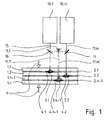
- Fig. 1 shows the welding of a total of four plastic parts 1.1., ..., 1.n with two lasers 10.1, 10.m.
- a first laser beam 10.1 first passes past a folding mirror 15 and strikes in a first boundary layer 2.1 on a first energy conversion means 4.1, from which it is absorbed. The result is a first weld 3.1, which connects the plastic parts 1.1 and 1.2 together.
- Another laser beam 11.m passes by a folding mirror 14, passes through the first plastic part 10.1, the first boundary layer 2.1 and the second plastic part 10.2 unhindered and is absorbed in the second boundary layer 2.2 by an energy conversion means 4.1. The result is a further weld point 3.2, which connects the parts 10.2 and 10.3 together.
- the folding mirrors 14, 16 are directed into the laser beams 11.1, 11.m.
- the beams are passed through the first three plastic parts 1.1, 1.2 and 1.3 with the intermediate boundary layers 2.1, 2.2 and hit in the boundary layer 2.n-1 to another energy conversion means 4.n-1, which absorbs both rays 11.1, 11.m.
- the absorbed energy of both beams 11.1, 11.m is sufficient to provide a third weld 3.n-1; If only one of the rays 11.1 or 11.m alone strikes the boundary layer 2.n-1, then a heating takes place, but no melting takes place.
- the thickness of an overhead, to be irradiated plastic part 1.1 is almost arbitrary with appropriate light transmission for a laser beam 11.1, which is emitted by a laser 10.1, as long as the light attenuation or absorption in the plastic part 1.1 is not so strong that a melting of the boundary layer 2.1 is no longer available.
- the thickness of the non-irradiated, lower plastic part 1.2 is arbitrary in any case.
- the laser beam 11.1 passes through the plastic part 1.1, strikes in the boundary layer 2.1 on the introduced there energy conversion means 4.1, wherein the light energy is converted into heat energy.
- the amount of heat can be calculated per time, which must be introduced into the boundary layer to cause melting of the plastic parts 1.1, 1.2 in the boundary layer 2.1, but without complete melting, softening or even destroy the plastic parts 1.1 1.2 to effect.
- a targeted focusing or defocusing of the laser beam 11.1 can be made.
- a lenticular weld seam 3.1 is formed which initially melts and, after the end of the irradiation, cools and solidifies.
- the symmetry plane of the weld point 3.1 or its center of gravity is approximately in the boundary layer 2.1.
- the heat transfer from the energy conversion means into the adjoining plastic parts and thus the dissipation of the heat absorbed in boundary layer 2.1 into the plastic parts can be influenced by the contact pressure of the joining partners and the intermediate energy conversion means.
- the contact pressure is represented by the arrows designated P.
- P the contact pressure
- the weld seam 3.1 penetrates further into the plastic parts 1.1 and 1.2, so that the weld seam 3.1 has an ellipsoidal cross-section with high height, but small extent.
- a comparatively lower contact pressure P leads to the formation of a weld seam 3.1 with an ellipsoidal cross-section of lesser height but greater width.
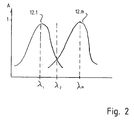
- the absorption factor A of the energy conversion means over the wavelength ⁇ is plotted schematically.
- the curve 12.1 shows the absorption of the light of a first energy conversion means 4.1, the curve 12.m that of a second energy conversion means 4.1.
- the lasers 11.1, 11.m are chosen such that their wavelengths lie in the respective region of the strongest absorption ⁇ 1 or ⁇ m .
- each energy conversion means absorbs a portion of the energy. Together, this is sufficient to effect a local melting and welding, but not by a light beam having the wavelength ⁇ 1 or ⁇ m alone.
- both energy conversion means are present to each other, so that a laser beam with the wavelength ⁇ 2 can only cause a weld there, while otherwise he can strike the entire surface over the tissue, without melting it. By simply connecting the nodes, the tissue remains flexible.
- the use of a low-cost semiconductor laser for generating the laser beam and of carbon, in particular in the form of carbon black, as an energy conversion agent in the boundary layer is suitable. It can even be a simple order of the energy conversion agent by black pigmented paint crayons are made.
Landscapes
- Physics & Mathematics (AREA)
- Engineering & Computer Science (AREA)
- Mechanical Engineering (AREA)
- Optics & Photonics (AREA)
- Health & Medical Sciences (AREA)
- Toxicology (AREA)
- Electromagnetism (AREA)
- Plasma & Fusion (AREA)
- Thermal Sciences (AREA)
- Lining Or Joining Of Plastics Or The Like (AREA)
- Laser Beam Processing (AREA)
Description
- Die Erfindung betrifft ein Verfahren zum Laserdurchstrahlschweißen von mehr als zwei Kunststoffteilen.
- Aus der
US 6,207,925 B1 ist es bekannt, Kunststoffteile durch die von einem Laser ausgesandte Lichtenergie miteinander zu verschweißen. Hierbei wird ein erstes Kunststoffteil gewählt, das für das Licht des Lasers mit einer bestimmten Wellenlänge durchlässig ist. Außerdem wird ein zweites Teil aus einem solchen Kunststoff hinzugefügt, der die Lichtenergie des Laserstrahls überwiegend absorbiert und so zu einer lokalen Erwärmung und schließlich zum partiellen Aufschmelzen des absorbierenden Kunststoffs führt. Die Schmelze verbindet sich mit den Oberflächenschichten des ersten, lichtdurchlässigen Kunststoffteils und führt so zu einer stoffschlüssigen Verbindung der Kunststoffteile. Es hat sich allerdings gezeigt, dass die Aufschmelzung überwiegend in einer Randzone des lichtenergieabsorbierenden Kunststoffteiles stattfindet und ein Aufschmelzen des lichtdurchlässigen Fügepartners nur sehr partiell an der Oberfläche erfolgt, so dass keine innige, symmetrische Verbindung der Fügepartner erfolgt. In einem Schnitt durch die Schweißnaht gesehen, bildet sich die Naht linsenförmig aus, wobei der weitaus größerer Teil dieser Linse im Querschnitt des absorbierenden Kunststoffteils eingebettet liegt. - Aus der
WO 00/20157 - Ein Verfahren nach dem Oberbegriff von Anspruch 1 ist aus "Laser Welding of Fabrics Using Infrared Absorbing Dyes" von P.A. Hilton, I.A. Jones und R.A. Sollaranti, Proceedings From Joining of Advanced and Specialty Materials, 9-11 October 2000, St. Louis, Mo, ASM International bekannt.
- Es stellt sich daher die Aufgabe, ein Verfahren zum Laserdurchstrahlschweißen von Kunststoffteilen anzugeben, durch das bei mehr als zwei Kunststoffteilen einen Verbindung durch Laserstrahlschweißen ermöglicht wird, wobei wiederum die Symmetrieebene der hergestellten Schweißnähte im wesentlichen in der Grenzschicht zwischen den jeweiligen aneinander liegenden Fügepartnern verläuft.
- Die Aufgabe wird bei einem Verfahren zum Laserdurchstrahlschweißen von mehr als zwei Kunststoffteilen mit den Merkmalen des Anspruchs 1 gelöst.
- Mit absorbierend sind hier solche Energiekonvertierungsmittel bezeichnet, die einen Absorptionsgrad von größer oder gleich 10% der eingestrahlten Lichtenergie aufweisen.
- Als lichtdurchlässig sind hier solche Energiekonvertierungsmittel bezeichnet, die einen Absorptionsgrad von kleiner als 10% der eingestrahlten Lichtenergie aufweisen.
- Erfindungsgemäß ist vorgesehen, dass die Kunststofflagen für Laserlicht durchlässig sind. Lediglich die Beschaffenheit der zu unterst liegenden Lage ist ohne Einfluss auf die Wirkungen des erfindungsgemäßen Verfahrens. In jede der so entstandenen Grenzflächen zwischen jeweils zwei Fügepartnern kann partiell oder vollflächig ein Energiekonvertierungsmittel eingebracht werden. Hierbei wird jeweils für jede Grenzschicht ein Laser mit bestimmter Wellenlänge und ein in diesem Wellenlängenbereich absorbierendes Energiekonvertierungsmittel gewählt. Die Wellenlängen werden so gewählt, dass eine Energiekonvertierung jeweils nur in einer Grenzschicht erfolgt und der Laserstrahl beim Durchtritt durch die andere(n) Grenzschicht(en) diese ungehindert passieren kann. Es ist somit insbesondere möglich, Kunststoffgewebe oder Kunststofffolien in einem einzelnen Arbeitsgang mit verschieden verlaufenden Nähten in jeder Grenzschicht zu verbinden.
- Der besondere Vorteil des erfindungsgemäßen Verfahrens liegt darin, dass mehr als zwei Kunststoffteile in einem einzigen Schweißvorgang miteinander verbunden werden können; es muss also nicht mehr ein lagenweises Schweißen erfolgen. Grundgedanke ist, dass jeder zu verschweißenden Grenzschicht mindestens ein Laserstrahl mit einer bestimmten Wellenlänge und ein spezifisches Energiekonvertierungsmittel zugeordnet sind. Die Lichtdurchlässigkeit der Kunststoffteile ist so gewählt, dass jeder Laserstrahl ungehindert durch ein oder mehrere Lagen von Kunststoffteilen tritt, bis er auf diejenige Grenzschicht trifft, in die ein Energiekonvertierungsmittel eingebracht ist, das das Licht seiner spezifischen Wellenlänge absorbiert. Besonders vorteilhaft ist, dass die Schweißnähte so unabhängig voneinander verlaufen können und nicht deckungsgleich sein müssen.
- Wesentlich ist, dass der Ort der Lichtabsorption und demzufolge der Ort der Erwärmung und Aufschmelzung in die Grenzfläche hinein gelegt wird.
- Die Vorteile liegen weiterhin darin, die Kunststoffteile unabhängig vom Verlauf der späteren Schweißnaht gestaltet und hergestellt werden zu können. Das Einbringen des Energiekonvertierungsmittels in die Grenzschicht kann mit allen bekannten Techniken, wie Aufrakeln, Aufdrucken, Beflocken, Bestreuen oder Besprühen nachträglich erfolgen. Hierbei ist es insbesondere möglich, das Energiekonvertierungsmittel nur dort in eine Grenzschicht einzubringen, wo der gewünschte Verlauf der Schweißnaht liegt. Eine vollflächige Beigabe von dem Energiekonvertierungsmittel im Bereich einer Grenzschicht ist möglich, aber nicht notwendig.
- Weiterhin ist es vorteilhaft, dass über den Energieabsorptionskoeffizienten und die Schichtdicke des Energiekonvertierungsmittels und über die Wellenlänge des verwendeten Lasers die in den Bereich der Schweißnaht einzubringende Wärme gezielt beeinflusst werden kann. Somit kann eine Wärmemenge erzeugt werden, die für ein Aufschmelzen und inniges Verbinden der Fügepartner ausreichend ist, die aber nicht zu einer materialschädigenden Erhitzung der Kunststoffe oder gar deren lokaler Zerstörung führt.
- Außerdem ist es gemäß einer weiteren Ausführungsform möglich, eine weitere Grenzschicht vorzusehen, in der ein Verschweißen nur dann erfolgt, wenn wenigstens zwei Laserstrahlen gleichzeitig auf ein Energiekonvertierungsmittel treffen, das das Licht beider Laserstrahlen absorbiert. Hierbei wird das Energiekonvertierungsmittel nach Absorptionskoeffizient und Schichtdicke so gewählt, dass die Energie eines einzelnen Laserstrahls noch nicht ausreichend ist, um ein Aufschmelzen der Fügepartner im Bereich der Grenzschicht zu erreichen. Ein Aufschmelzen erfolgt erst dann, wenn noch ein zusätzlicher Laserstrahl auf dieses Energiekonvertierungsmittel gerichtet ist.
- Beispielsweise können auf diese Weise insgesamt vier Kunststoffteile durch den Einsatz von zwei Lasern mit unterschiedlicher Wellenlänge verschweißt werden, nämlich eine erste Grenzschicht mit dem ersten Laser, eine zweite Grenzschicht mit dem zweiten Laser und eine dritte Grenzschicht durch gemeinsamen Einsatz beider Laser.
- Mit den erfindungsgemäßen Verfahren ist es außerdem möglich, eine Siegelnaht herzustellen. Hierbei werden solche Energiekonvertierungsmittel gewählt, die nur in einem sehr engen Band absorbierend für Lichtenergie mit einer bestimmten Wellenlänge wirken. Somit ist es nur bei Kenntnis der speziellen Wellenlänge und den weiteren auf die jeweilige Grenzschicht angepassten Parametern des Lasers möglich, ein Behältnis zu verschweißen und die Schweißnaht zerstörungsfrei wieder zu öffnen. Diese Funktion nach Art eines Schlüssels kann dadurch verstärkt werden, dass Laser mehrerer Wellenlängen gleichzeitig auf das Energiekonvertierungsmittel wirken müssen, um eine lokale Aufschmelzung zu erreichen. Bei einer solchen gezielten Öffnung nur der Siegelnaht bleiben die verschweißten Kunststoffteile in ihrer Struktur erhalten, wohingegen ein unberechtigter Öffnungsversuch durch unkontrollierte Wärmezufuhr von außen in einer vollständigen Erweichung und entsprechend sichtbaren Beschädigung der Kunststoffteile mündet.
- Vorgesehen sein kann auch, dass das Energiekonvertierungsmittel in Form einer lichtenergieabsorbierenden Schweißfolie zwischen die Kunststoffteile gelegt wird. Hierdurch kann auf einen Bedruckungsvorgang oder dgl. verzichtet werden. Die Schweißfolie wird im Moment und am Ort der Schweißung zugeführt. Außerdem ist es möglich, nicht miteinander kompatible Kunststoffteile über die Schweißfolie als Haftvermittler zu verbinden.
- In einer weiteren vorteilhaften Variante der erfindungsgemäßen Verfahren besteht die Schweißfolie aus einem Kunststoff, der im Gegensatz zu den Fügepartnern eine niedrigere Schmelztemperatur hat und in den neben dem Energiekonvertierungsmittel noch weitere Zusatzstoffe eingebunden sind. Hierdurch wird erreicht, dass beim Bestrahlen mit Laserenergie ein vollständiges Aufschmelzen der Schweißfolie erfolgt und in dem Schmelzebad die Zusatzstoffe enthalten sind. Beim Übergang der Wärme auf die Fügepartner und deren Aufschmelzen im Oberflächenbereich verteilt sich das Schweißbad mit den Zusatzstoffen im gesamten Bereich der Schweißnahtstelle, so dass auf diesem Wege ein gezieltes Einbringen der Zusatzstoffe in die Schweißnaht möglich ist.
- Es können z. B. durch ultraviolettes Licht aktivierte Vernetzungsmittel eingebracht werden, so dass durch anschließendes Bestrahlen der Schweißnaht mit ultraviolettem Licht eine zusätzliche Verfestigung der Schweißnaht erreicht wird. Außerdem können Zusatzstoffe vorgesehen sein, die ultraviolettes Licht reflektieren, so dass der Verlauf und die Qualität einer Schweißnaht im sogenannten Schwarzlicht sichtbar werden.
- Bevorzugt wird das Energiekonvertierungsmittel auf die Oberfläche des lichtdurchlässigen Kunststoffteils aufgebracht und das zweite Kunststoffteil daran angepresst. Durch den Auftrag auf die Rückseite des durchstrahlten ersten Kunststoffteils werden Grenzflächenreflektionen weitgehend vermieden und die eingestrahlte Laserenergie gelangt nahezu ohne Verluste in das Energiekonvertierungsmittel.
- In der überwiegenden Anzahl von Anwendungsfällen ist Kohlenstoff ein geeignetes Energiekonvertierungsmittel, da es alle Wellenlängen des Lichtes absorbiert und somit den Einsatz kostengünstiger Laser ermöglicht. Beim mehrlagigen Schweißen kann es in die zu unterst liegende, also zuletzt durchstrahlte Grenzschicht eingebracht werden, um dort alle von oben durchdringenden Laserstrahlen zu absorbieren. Zudem ist Kohlenstoff in Form von Ruß ein kostengünstiges, weit verbreitetes Füllmittel der Kunststoffindustrie. Ruß ist auch geeignet, in lösemittelhaltigen Lacken oder Polymerlösungen eingebunden zu und dann mit den oben genannten Verfahren wie Drucken etc. auf einen der Fügepartner aufgebracht zu werden.
- Die Erfindung wird nachfolgend mit Bezug auf die Zeichnung näher erläutert. Es zeigen:
- Fig. 1
- das Verschweißen von vier Kunststoffteile in schematischer Darstellung;
- Fig. 2
- die Lichtabsorption zweier Energiekonvertierungsmittel in einem Diagramm über die Wellenlänge, und
- Fig. 3
- die Lichtabsorption bei einer Siegelnaht in einem Diagramm über die Wellenlänge.
- Fig. 1 zeigt die Verschweißung von insgesamt vier Kunststoffteilen 1.1.,...,1.n mit zwei Lasern 10.1, 10.m. Ein erster Laserstrahl 10.1 läuft zunächst an einem Klappspiegel 15 vorbei und trifft in einer ersten Grenzschicht 2.1 auf ein erstes Energiekonvertierungsmittel 4.1, von dem er absorbiert wird. Es entsteht eine erste Schweißnahtstelle 3.1, die die Kunststoffteile 1.1 und 1.2 miteinander verbindet.
- Ein weiterer Laserstrahl 11.m läuft an einem Klappspiegel 14 vorbei, durchläuft das erste Kunststoffteil 10.1, die erste Grenzschicht 2.1 und das zweite Kunststoffteil 10.2 ungehindert und wird in der zweiten Grenzschicht 2.2 von einem Energiekonvertierungsmittel 4.1 absorbiert. Es entsteht eine weitere Schweißnahtstelle 3.2, die die Teile 10.2 und 10.3 miteinander verbindet.
- Dann werden die Klappspiegel 14, 16 in die Laserstrahlen 11.1, 11.m gelenkt. Es erfolgt eine Bündelung beider Strahlen 11.1, 11.m über eine optische Einrichtung 15. Die Strahlen durchlaufen die ersten drei Kunststoffteile 1.1, 1.2 und 1.3 mit den zwischenliegenden Grenzschichten 2.1, 2.2 und treffen in der Grenzschicht 2.n-1 auf ein weiteres Energiekonvertierungsmittel 4.n-1, das beide Strahlen 11.1, 11.m absorbiert. Die absorbierte Energie beider Strahlen 11.1, 11.m reicht gemeinsam aus, um eine dritte Schweißnahtstelle 3.n-1 zu schaffen; trifft nur einer der Strahlen 11.1 oder 11.m alleine auf die Grenzschicht 2.n-1, so erfolgt eine Erwärmung, jedoch keine Aufschmelzung.
- Die Dicke eines oben liegenden, zu durchstrahlenden Kunststoffteils 1.1 ist bei entsprechender Lichtdurchlässigkeit für einen Laserstrahl 11.1, der von einem Laser 10.1 ausgesandt wird, nahezu beliebig, solange die Lichtdämpfung bzw. Absorption in dem Kunststoffteil 1.1 nicht so stark wird, dass eine Aufschmelzung der Grenzschicht 2.1 nicht mehr erreichbar ist. Die Dicke des nicht durchstrahlten, unteren Kunststoffteils 1.2 ist in jedem Fall beliebig.
- Der Laserstrahl 11.1 durchläuft das Kunststoffteil 1.1, trifft in der Grenzschicht 2.1 auf das dort eingebrachte Energiekonvertierungsmittel 4.1, wobei die Lichtenergie in Wärmeenergie umgewandelt wird. Nach den Gesetzmäßigkeiten der Thermodynamik und unter Berücksichtigung von Umwelteinflüssen, z. B. durch Abkühlung, kann die Wärmemenge pro Zeit berechnet werden, die in die Grenzschicht eingebracht werden muss, um ein Anschmelzen der Kunststoffteile 1.1, 1.2 im Bereich der Grenzschicht 2.1 zu bewirken, ohne jedoch ein vollständiges Aufschmelzen, Erweichen oder gar Zerstören der Kunststoffteile 1.1, 1.2 zu bewirken.
- Neben der Beeinflussung der einzubringenden Wärmemenge durch Wahl des Absorptionskoeffizienten und der Schichtdicke des jeweiligen Energiekonvertierungsmittels 4.1, ist es auch möglich, die vom Laser 10.1 ausgesandte Energie zu steuern, beispielsweise durch Steuerung der Pulslänge und -frequenz.
- Ebenso kann eine gezielte Fokussierung bzw. Defokussierung des Laserstrahls 11.1 vorgenommen werden.
- Durch den Schweißvorgang bildet sich eine linsenförmige Schweißnahtstelle 3.1, die zunächst schmelzeförmig vorliegt und nach dem Ende der Bestrahlung abkühlt und erstarrt. Die Symmetrieebene der Schweißnahtstelle 3.1 bzw. deren Schwerpunkt liegt etwa in der Grenzschicht 2.1.
- Weiterhin kann über den Anpressdruck der Fügepartner und des dazwischenliegenden Energiekonvertierungsmittels der Wärmeübergang aus dem Energiekonvertierungsmittel in die anliegenden Kunststoffteile und damit die Dissipation der in Grenzschicht 2.1 absorbierten Wärme in die Kunststoffteile beeinflusst werden. In den Fig. 1 und 2 ist der Anpressdruck durch die mit P bezeichneten Pfeile dargestellt. Durch hohen Anpressdruck P dringt die Schweißnahtstelle 3.1 weiter in die Kunststoffteile 1.1 und 1.2 ein, so dass die Schweißnahtstelle 3.1 einen ellipsoiden Querschnitt mit großer Höhe, aber geringer Ausdehnung hat. Demgegenüber führt ein vergleichsweise niedrigerer Anpressdruck P zur Ausbildung einer Schweißnahtstelle 3.1 mit einem ellipsoiden Querschnitt von geringerer Höhe, aber größerer Breite.
- In Fig. 2 ist der Absorptionsfaktor A der Energiekonvertierungsmittel über die Wellenlänge λ schematisch aufgetragen. Die Kurve 12.1 zeigt die Absorption des Lichtes eines ersten Energiekonvertierungsmittels 4.1, die Kurve 12.m die eines zweiten Energiekonvertierungsmittels 4.1. Die Laser 11.1, 11.m werden so gewählt, dass ihre Wellenlängen im jeweiligen Bereich der stärksten Absorption λ1 bzw. λm liegen.
- Für den Bereich der Überschneidung der Kurven 12.1, 12.m ergibt sich folgende Möglichkeit: Es kann ein weiterer Laser mit einer Wellenlänge λ2 vorgesehen werden. Die Energiekonvertierungsmittel gemäß 12.1 und 12.m, die bei λ2 noch etwa die Hälfte ihre maximalen Absorption haben, werden gemischt. Bei Bestrahlung mit einem Laserstrahl mit Licht der Wellenlänge λ2 absorbiert jedes Energiekonvertierungsmittel einen Teil der Energie. Zusammen reicht dies zur Bewirkung einer lokalen Aufschmelzung und Verschweißung, jedoch nicht durch einen Lichtstrahl mit der Wellenlänge λ1 oder λm allein. Somit ist es möglich, bei einem Gewebe nur die Kreuzungspunkte zu verschweißen, wenn die Schussfäden mit dem ersten Energiekonvertierungsmittel und die Kettfäden mit dem zweiten beschichtet sind. Im Überlappungsbereich am Knotenpunkt liegen beide Energiekonvertierungsmittel aneinander vor, so dass ein Laserstrahl mit der Wellenlänge λ2 nur dort eine Verschweißung bewirken kann, während er ansonsten vollflächig über das Gewebe streichen kann, ohne dieses aufzuschmelzen. Durch die bloße Verbindung der Knotenpunkte bleibt das Gewebe flexibel.
- Ist nur eine Schweißnahtstelle zu erzeugen, bietet sich die Verwendung eines kostengünstigen Halbleiterlasers zur Erzeugung des Laserstrahl an und von Kohlenstoff, insbesondere in Form von Russ, als Energiekonvertierungsmittel in der Grenzschicht. Es kann sogar ein einfacher Auftrag des Energiekonvertierungsmittel durch schwarz pigmentierte Lack-Farbstifte vorgenommen werden.
- Beim mehrlagigen Laserdurchstrahlschweißen müssen die einzelnen Laser 10.1,...,10.n so gewählt sein, dass sie in Frequenzbändern Licht emittieren, die hinsichtlich der Absorption des Energiekonvertierungsmittels ausreichend weit auseinander liegen. Beispielsweise können Excimer-Gas-Laser mit einem der folgenden Lasermedien ausgewählt werden:
- F2 mit einer Wellenlänge von 157 nm,
- ArF mit einer Wellenlänge von 193 nm,
- KrCl mit einer Wellenlänge von 222 nm,
- KrF mit einer Wellenlänge von 248 nm,
- XeCl mit einer Wellenlänge von 308 nm,
- N2 mit einer Wellenlänge von 337 nm, oder
- XeF mit einer Wellenlänge von 351 nm.
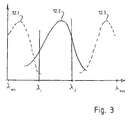
- Die Herstellung einer Siegelnaht mit Garantiefunktion wird anhand von Fig. 3 erläutert. Es werden zwei Laser ausgewählt, die Licht der Wellenlängen λ1 und λ2 emittieren. Für den dazwischenliegenden Bereich sind keine Laserstrahlquellen mit eng begrenztem Spektrum bekannt. Bei λ1 liegt ein Absorptionsgrad des Energiekonvertierungsmittel gemäß Kurve 12.2 von etwa 0,25 und bei λ2 von etwa 0,75 vor. Bei gleichzeitiger Bestrahlung mit Lasern der Wellenlängen λ1 und λ2 erfolgt eine Aufschmelzung des Siegelbereichs. Die Bestrahlung mit nur einem der Laser reicht indes noch nicht, um die Siegelnaht zu schließen oder zu öffnen. Durch Einbettung von Energiekonvertierungsmitteln in die zu fügenden Kunststoffteile mit einer Absorption in benachbarten Spektralbereichen gemäß Kurve 12.1 bzw. 12.3 wird erreicht, dass eine vollständige Aufschmelzung und damit Zerstörung der Kunststoffteile erfolgt, wenn versucht wird, die Siegelschicht unberechtigt mit einer unspezifischen Strahlungsquelle mit breitem Spektrum von λmin bis λmax zu öffnen. Das Schließen und Öffnen der Siegelnaht setzt daher die genaue Kenntnis von der Absorption und der Schichtdicke des Energiekonvertierungsmittel und die Wellenlängen geeigneter Laser voraus.
Claims (6)
- Verfahren zum Laserdurchstrahlschweißen von mehr als zwei Kunststoffteilen (1.1,...,1.n), mit folgenden Verfahrensschritten:- Bereitstellen von m Laserstrahlen (11.1,...,11.m) mit unterschiedlichen Wellenlängen λ1,...,λm in einem Spektrum zwischen einer unteren Wellenlänge λmin und einer oberen Wellenlänge λmax,- Aneinanderpressen von n Kunststoffteilen (1.1,..., 1.n) unter jeweiliger Ausbildung einer Grenzschicht (2.1,...,2.n-1) zwischen je zwei aneinanderliegenden Kunststoffteilen,
wobei wenigstens n-1 aneinanderliegende Kunststoffteile (1.1,..., 1.n-1) lichtdurchlässig für wenigstens eine Wellenlänge eines Laserstrahls in dem Spektrum von λmin bis λmax sind, und
wobei ein außenliegendes Kunststoffteil (1.n) eine beliebige Lichtdurchlässigkeit aufweist,- Einbringen wenigstens eines Energiekonvertierungsmittels (4.1,...,4.n-1), welches die Lichtenergie wenigstens einer der Laserstrahlen (11.1,...,11.m) im Spektrum von λm0 bis λm1 absorbiert, in jede Grenzschicht (2.1,...,2.n-1);- gleichzeitiges oder aufeinanderfolgendes Bestrahlen der Grenzschichten (2.1,...,2.n-1) mit den Laserstrahlen (11.1,..., 11.m) unter Durchstrahlung der über der jeweiligen Grenzschicht liegenden Kunststoffteile;- partielles Aufschmelzenlassen der jeweiligen Kunststoffteile im Bereich jeder Grenzschicht und Abkühlenlassen unter Ausbildung einer Schweißnahtstelle (3.1,...3.n-1) als innige Verbindung zwischen den Kunststoffteilen (1.1,...,1.n).dadurch gekennzeichnet, dass in wenigstens eine der Grenzschichten (2.n-1) ein Energiekonvertierungsmittel (4.n-1) eingebracht wird, das unterschiedliche Wellenlängen λ1, λm absorbiert, und dass die an der Grenzschicht (2.n-1) anliegenden Kunststoffteile (1.n-1, 1.n) durch Bestrahlen der Grenzschicht (2.n-1) mit wenigstens zwei Laserstrahlen (11.1,11.m) mit den Wellenlängen λ1, λm aufgeschmolzen werden, wobei die Schichtdicke und/oder der Absorptionskoeffizient des Energiekonvertierungsmittels (4.n-1) und/oder die Stärke und/oder Wirkdauer der Energie der Laserstrahlen (11.1,11.m) so gewählt sind, dass erst durch gleichzeitiges Bestrahlen mit den wenigstens zwei Laserstrahlen (11.1,11.m) eine Erwärmung der Kunststoffteile (1.n-1, 1.n) bis zur Aufschmelzung und Ausbildung einer Schweißnahtstelle (3.n) erfolgt. - Verfahren nach Anspruch 1, dadurch gekennzeichnet, dass das Energiekonvertierungsmittel in Form einer lichtenergieabsorbierenden Schweißfolie zwischen die Kunststoffteile gelegt wird.
- Verfahren nach Anspruch 1 oder 2, dass die Schweißfolie Zusatzstoffe wie im ultravioletten Licht vernetzende oder im ultravioletten Licht sichtbare Mittel enthält.
- Verfahren nach einem der Ansprüche, dadurch gekennzeichnet, dass das Energiekonvertierungsmittel (4.1,...,4.n-1) jeweils auf die Rückseite eines durchstrahlten Kunststoffteils (1.1,...,1.n-1) aufgebracht wird.
- verfahren nach einem der vorhergehenden Ansprüche, dadurch gekennzeichnet, dass als Energiekonvertierungsmittel (4.1,...,4.n-1) Kohlenstoff gewählt wird.
- Verfahren nach einem der vorhergehenden Ansprüche, dadurch gekennzeichnet, dass die Eindringtiefe der Schweißnahtstelle (3.1,...,3.n-1) in die Kunststoffteile (1.1, 1.n) über einen Anpressdruck P variiert wird.
Priority Applications (8)
| Application Number | Priority Date | Filing Date | Title |
|---|---|---|---|
| AT01123507T ATE383937T1 (de) | 2001-09-29 | 2001-09-29 | Verfahren zum laserdurchstrahlschweissen von kunststoffteilen |
| EP20010123507 EP1297944B1 (de) | 2001-09-29 | 2001-09-29 | Verfahren zum Laserdurchstrahlschweissen von Kunststoffteilen |
| DE50113511T DE50113511D1 (de) | 2001-09-29 | 2001-09-29 | Verfahren zum Laserdurchstrahlschweissen von Kunststoffteilen |
| PCT/EP2002/010922 WO2003028983A2 (de) | 2001-09-29 | 2002-09-28 | Verfahren zum laserdurchstrahlschweissen von kunststoffteilen |
| PCT/EP2002/010923 WO2003029109A2 (de) | 2001-09-29 | 2002-09-28 | Verfahren zum herstellen eines flexiblen schüttgutbehälters und danach hergestellte schüttgutbehälter |
| AU2002338831A AU2002338831A1 (en) | 2001-09-29 | 2002-09-28 | Method for the production of a flexible bulk-material container and bulk-material container produced according to said method |
| US10/491,062 US20050041893A1 (en) | 2001-09-29 | 2002-09-28 | Method for the production of a flexible bulk-material container and bulk-material container produced according to said method |
| US10/491,063 US20050000641A1 (en) | 2001-09-29 | 2002-09-28 | Method for laser welding plastic parts |
Applications Claiming Priority (1)
| Application Number | Priority Date | Filing Date | Title |
|---|---|---|---|
| EP20010123507 EP1297944B1 (de) | 2001-09-29 | 2001-09-29 | Verfahren zum Laserdurchstrahlschweissen von Kunststoffteilen |
Publications (2)
| Publication Number | Publication Date |
|---|---|
| EP1297944A1 EP1297944A1 (de) | 2003-04-02 |
| EP1297944B1 true EP1297944B1 (de) | 2008-01-16 |
Family
ID=8178808
Family Applications (1)
| Application Number | Title | Priority Date | Filing Date |
|---|---|---|---|
| EP20010123507 Expired - Lifetime EP1297944B1 (de) | 2001-09-29 | 2001-09-29 | Verfahren zum Laserdurchstrahlschweissen von Kunststoffteilen |
Country Status (5)
| Country | Link |
|---|---|
| US (1) | US20050000641A1 (de) |
| EP (1) | EP1297944B1 (de) |
| AT (1) | ATE383937T1 (de) |
| DE (1) | DE50113511D1 (de) |
| WO (1) | WO2003028983A2 (de) |
Cited By (1)
| Publication number | Priority date | Publication date | Assignee | Title |
|---|---|---|---|---|
| EP2923821B1 (de) | 2014-03-28 | 2019-08-07 | Sogefi Engine Systems USA, Inc. | Verfahren für direktes infrarotlaserschweissen |
Families Citing this family (37)
| Publication number | Priority date | Publication date | Assignee | Title |
|---|---|---|---|---|
| DE10243005A1 (de) * | 2002-09-17 | 2004-03-25 | Robert Bosch Gmbh | Verfahren und Vorrichtung zum Schweißen und Markieren eines Werkstücks mittels Laserstrahlen |
| DE10301353A1 (de) * | 2003-01-16 | 2004-07-29 | Mann + Hummel Gmbh | Filtervorrichtung zur Filterung eines Fluids |
| FR2857616B1 (fr) * | 2003-07-18 | 2007-04-06 | Solvay | Procede pour l'assemblage des elements d'une structure comprenant une ame en nid d'abeille |
| DE10335446A1 (de) * | 2003-07-31 | 2005-02-17 | Volkswagen Ag | Verfahren zum Durchstrahlschweißen, insbesondere zum Laserdurchstrahlschweißen, sowie Vorrichtung zur Durchführung des Verfahrens |
| DE10338732A1 (de) * | 2003-08-22 | 2005-03-24 | Giesecke & Devrient Gmbh | Kartenförmiger Mehrschichtverbund |
| CN1853418A (zh) * | 2003-09-18 | 2006-10-25 | 皇家飞利浦电子股份有限公司 | 定位框架的方法 |
| US7823366B2 (en) * | 2003-10-07 | 2010-11-02 | Douglas Machine, Inc. | Apparatus and method for selective processing of materials with radiant energy |
| WO2005080066A1 (en) * | 2004-02-18 | 2005-09-01 | Invista Technologies S.A.R.L. | Fabric seam formation by radiation welding process |
| ATE417727T1 (de) * | 2004-04-13 | 2009-01-15 | Coloplast As | Verfahren zur bereitstellung eines lasergeschweissten produkts und lasergeschweisstes produkt |
| US7820937B2 (en) * | 2004-10-27 | 2010-10-26 | Boston Scientific Scimed, Inc. | Method of applying one or more electromagnetic beams to form a fusion bond on a workpiece such as a medical device |
| US10857722B2 (en) | 2004-12-03 | 2020-12-08 | Pressco Ip Llc | Method and system for laser-based, wavelength specific infrared irradiation treatment |
| US7425296B2 (en) | 2004-12-03 | 2008-09-16 | Pressco Technology Inc. | Method and system for wavelength specific thermal irradiation and treatment |
| US20060245951A1 (en) * | 2005-04-13 | 2006-11-02 | Par Technologies, Llc | Multilayer valve structures, methods of making, and pumps using same |
| US20060245949A1 (en) * | 2005-04-13 | 2006-11-02 | Par Technologies, Llc | Electromagnetically bonded pumps and pump subassemblies and methods of fabrication |
| US20060283543A1 (en) * | 2005-06-20 | 2006-12-21 | Masanori Kubota | Pseudo-transmission method of forming and joining articles |
| DE102005056286A1 (de) * | 2005-11-24 | 2007-05-31 | Degussa Gmbh | Schweißverfahren mittels elektromagnetischer Strahlung |
| US8778120B2 (en) * | 2006-04-06 | 2014-07-15 | Fresenius Medical Care Deutschland Gmbh | Transmission laser welding method for connecting shaped plastic bodies |
| EP2121285B1 (de) * | 2006-12-08 | 2013-07-10 | MAHLE International GmbH | Laserschweissverfahren |
| WO2008154503A2 (en) * | 2007-06-08 | 2008-12-18 | Pressco Technology Inc. | A method and system for wavelength specific thermal irradiation and treatment |
| DE102007036838A1 (de) * | 2007-08-02 | 2009-02-05 | Bundesdruckerei Gmbh | Verfahren zum Verbinden von Dokumentmaterialien unterschiedlichen Typs in einem Mehrschichtsicherheitsdokumentkörper |
| US20090294047A1 (en) * | 2008-02-05 | 2009-12-03 | Yasuo Kurosaki | Method and device for welding thermoplastic resin articles |
| JP4942207B2 (ja) * | 2008-02-07 | 2012-05-30 | キヤノン株式会社 | 気密容器の製造方法 |
| US20090258233A1 (en) * | 2008-04-11 | 2009-10-15 | The Boeing Company | Method of making a transparency |
| DE102008052489B4 (de) * | 2008-10-21 | 2012-04-05 | Ibs Filtran Kunststoff-/ Metallerzeugnisse Gmbh | Vorrichtung zum Verschweißen zweier Schweißartikel und Verfahren zum Betreiben der Vorrichtung |
| DE102010031212A1 (de) * | 2010-07-12 | 2012-01-12 | Robert Bosch Gmbh | Verfahren zur Herstellung eines Mehrlagensystems sowie entsprechendes Mehrlagensystem |
| PL2655043T3 (pl) * | 2010-12-21 | 2018-02-28 | Bielomatik Leuze Gmbh + Co. Kg | Sposób zapewniania jakości zespawanych elementów konstrukcyjnych z tworzywa sztucznego |
| WO2013166499A2 (en) * | 2012-05-04 | 2013-11-07 | Magna International Inc. | Method of curing and adhesive between two or more panels |
| JP6073643B2 (ja) * | 2012-10-25 | 2017-02-01 | 株式会社小糸製作所 | 車両用ランプとその製造方法 |
| CN105736536B (zh) * | 2014-12-30 | 2019-11-08 | 全耐塑料公司 | 通过直接加热胶合剂胶合机动车辆零件的方法 |
| US11058995B2 (en) | 2016-09-30 | 2021-07-13 | Saint-Gobain Performance Plastics Corporation | Process for making a porous filter element, porous filter elements made thereby, and filter devices including them |
| JP6861043B2 (ja) * | 2017-02-03 | 2021-04-21 | ポリプラスチックス株式会社 | 樹脂成型品の接合方法 |
| WO2018212947A1 (en) * | 2017-05-17 | 2018-11-22 | Branson Ultrasonics Corporation | Simultaneous laser welding using two-micron laser light |
| DE112018002722T5 (de) * | 2017-05-26 | 2020-02-13 | Branson Ultrasonics Corporation | Optische in situ rückkopplung |
| WO2018217930A1 (en) * | 2017-05-26 | 2018-11-29 | Branson Ultrasonics Corporation | Infrared through transmissive laser welding using complementary optical part |
| EP3450392A1 (de) * | 2017-09-01 | 2019-03-06 | Thomson Licensing | Klebstofffreie verbindung von schichten von dielektrischen materialien mithilfe von nanojet-mikrostrukturen |
| JP7028690B2 (ja) * | 2018-03-29 | 2022-03-02 | 三菱重工業株式会社 | 熱溶融積層造形方法、熱溶融積層造形物の製造方法、および熱溶融積層造形物を一部に備えた構造 |
| CN116330673A (zh) * | 2022-09-22 | 2023-06-27 | 威克锐光电科技(苏州)有限公司 | 一种激光塑性焊接工艺 |
Family Cites Families (14)
| Publication number | Priority date | Publication date | Assignee | Title |
|---|---|---|---|---|
| US3560291A (en) * | 1964-03-27 | 1971-02-02 | Mobil Oil Corp | Bonding thermoplastic resin films by means of radiation from a laser source |
| DE1629225A1 (de) * | 1966-07-07 | 1971-01-07 | Windmoeller & Hoelscher | Verfahren zum Verschweissen von Materiallagen |
| US4041476A (en) * | 1971-07-23 | 1977-08-09 | Wyn Kelly Swainson | Method, medium and apparatus for producing three-dimensional figure product |
| JPH04157082A (ja) * | 1990-10-16 | 1992-05-29 | Mitsubishi Heavy Ind Ltd | レーザー溶接方法 |
| GB2276584B (en) * | 1993-04-01 | 1997-09-17 | British Gas Plc | Joining bodies of thermoplastic material |
| WO1995026869A1 (de) * | 1994-03-31 | 1995-10-12 | Marquardt Gmbh | Werkstück aus kunststoff und herstellverfahren für ein derartiges werkstück |
| DE59700414D1 (de) * | 1996-02-21 | 1999-10-14 | Coronet Werke Gmbh | Verfahren zur herstellung von borstenwaren, insbesondere bürsten |
| GB2333059B (en) * | 1996-10-11 | 2000-05-31 | Brian Andrew Kendall | Apparatus for cutting and/or welding flexible packaging |
| GB9821375D0 (en) * | 1998-10-01 | 1998-11-25 | Welding Inst | Welding method |
| DE19925203B4 (de) * | 1999-06-01 | 2004-04-08 | Fraunhofer-Gesellschaft zur Förderung der angewandten Forschung e.V. | Verfahren zum Verschweißen von Kunststoffen, und Verwendung des Kunststoffs |
| US6220673B1 (en) * | 1999-07-12 | 2001-04-24 | Colgate-Palmolive Company | Laser joining toothbrush heads to handles |
| AU2001234982A1 (en) * | 2000-02-11 | 2001-08-20 | Orient Chemical Industries Ltd | Thermoplastic resin compositions for laser welding and articles formed therefrom |
| US7244482B2 (en) * | 2000-06-28 | 2007-07-17 | Coloplast A/S | Method for welding components of a multi-layer construction |
| EP1341668A2 (de) * | 2000-11-10 | 2003-09-10 | Gentex Corporation | Durchsichtige farbstoffe zum laser-durchstrahlschweissen |
-
2001
- 2001-09-29 DE DE50113511T patent/DE50113511D1/de not_active Expired - Lifetime
- 2001-09-29 AT AT01123507T patent/ATE383937T1/de active
- 2001-09-29 EP EP20010123507 patent/EP1297944B1/de not_active Expired - Lifetime
-
2002
- 2002-09-28 WO PCT/EP2002/010922 patent/WO2003028983A2/de not_active Ceased
- 2002-09-28 US US10/491,063 patent/US20050000641A1/en not_active Abandoned
Cited By (1)
| Publication number | Priority date | Publication date | Assignee | Title |
|---|---|---|---|---|
| EP2923821B1 (de) | 2014-03-28 | 2019-08-07 | Sogefi Engine Systems USA, Inc. | Verfahren für direktes infrarotlaserschweissen |
Also Published As
| Publication number | Publication date |
|---|---|
| US20050000641A1 (en) | 2005-01-06 |
| ATE383937T1 (de) | 2008-02-15 |
| WO2003028983A2 (de) | 2003-04-10 |
| WO2003028983A3 (de) | 2003-09-12 |
| DE50113511D1 (de) | 2008-03-06 |
| EP1297944A1 (de) | 2003-04-02 |
Similar Documents
| Publication | Publication Date | Title |
|---|---|---|
| EP1297944B1 (de) | Verfahren zum Laserdurchstrahlschweissen von Kunststoffteilen | |
| EP0751865B2 (de) | Werkstück aus kunststoff und herstellungsverfahren für ein derartiges werkstück | |
| DE60124395T2 (de) | Verfahren zum Verschweißen von Bestandteilen eines Mehrschichtaufbaus | |
| EP2321115B1 (de) | Verfahren zur herstellung eines verbundteils durch durchstrahllaserschweissen | |
| DE69904844T2 (de) | Verfahren zum schweissen | |
| EP1254022B1 (de) | Verpackung aus biaxial orientierter polyolefinfolie | |
| EP2001655B1 (de) | Durchstrahllaserschweissverfahren für die verbindung von kunststoffformkörpern | |
| DE10109594A1 (de) | Fahrzeuglampeneinheit und Verfahren zum Herstellen derselben | |
| DE10297423T5 (de) | Schweißverfahren für thermoplastische Harzgüsse | |
| DE2653353A1 (de) | Verfahren und vorrichtung zum thermoverschweissen zweier folien | |
| EP1069984B1 (de) | Verfahren zum verschweissen von laminatförmigen verpackungsmaterialien | |
| DE69322474T2 (de) | Verfahren zum Sterilisieren der Innenschicht in einem Verpackungsmaterial | |
| DE3813570C2 (de) | ||
| EP0911141A2 (de) | Verfahren und Vorrichtung zum Verschweissen von Kunststoffolien, vorzugsweise von Polyolefin-Folien | |
| EP0031129A2 (de) | Verfahren zum Verschweissen der Innenlagen von mehrlagigen Papiersäcken | |
| EP3849782B1 (de) | Druckkopf für eine druckvorrichtung zum dreidimensionalen aufbringen eines materials, druckvorrichtung sowie verfahren | |
| EP0428575A1 (de) | Verfahren zum beschriften von verbundbauteilen mit laserstrahlung und mit diesem verfahren hergestelltes verbundbauteil | |
| DE10004538A1 (de) | Verfahren zum Laser-Durchstrahlschweißen von Kunststoffen und Laser-Durchstrahlschweißvorrichtung | |
| DE102008020943A1 (de) | Verfahren zum Fügen von wenigstens zwei transparenten Fügepartnern mittels Laserdurchstrahlschweißen | |
| DE68910822T2 (de) | Verfahren und anordnung zum verbinden thermoplastischer materialien. | |
| EP1254760A1 (de) | Verfahren zum Laser-Durchstrahlschweissen von Kunststoffen und Laser-Durchstrahlschweissvorrichtung | |
| DE10335446A1 (de) | Verfahren zum Durchstrahlschweißen, insbesondere zum Laserdurchstrahlschweißen, sowie Vorrichtung zur Durchführung des Verfahrens | |
| AT525838B1 (de) | Mehrschichtige folie für aufreissverpackungen | |
| EP1090746B1 (de) | Mehrschichtige Kunstofffolie | |
| EP3299312A1 (de) | Kunststoffgewebeverbund, verpackungsbeutel aus einem kunststoffgewebeverbund sowie verfahren zur herstellung eines kunststoffgewebeverbundes |
Legal Events
| Date | Code | Title | Description |
|---|---|---|---|
| PUAI | Public reference made under article 153(3) epc to a published international application that has entered the european phase |
Free format text: ORIGINAL CODE: 0009012 |
|
| AK | Designated contracting states |
Kind code of ref document: A1 Designated state(s): AT BE CH CY DE DK ES FI FR GB GR IE IT LI LU MC NL PT SE TR |
|
| AX | Request for extension of the european patent |
Extension state: AL LT LV MK RO SI |
|
| 17P | Request for examination filed |
Effective date: 20030821 |
|
| AKX | Designation fees paid |
Designated state(s): AT BE CH CY DE DK ES FI FR GB GR IE IT LI LU MC NL PT SE TR |
|
| 17Q | First examination report despatched |
Effective date: 20040715 |
|
| TPAC | Observations filed by third parties |
Free format text: ORIGINAL CODE: EPIDOSNTIPA |
|
| GRAP | Despatch of communication of intention to grant a patent |
Free format text: ORIGINAL CODE: EPIDOSNIGR1 |
|
| GRAS | Grant fee paid |
Free format text: ORIGINAL CODE: EPIDOSNIGR3 |
|
| GRAA | (expected) grant |
Free format text: ORIGINAL CODE: 0009210 |
|
| AK | Designated contracting states |
Kind code of ref document: B1 Designated state(s): AT BE CH CY DE DK ES FI FR GB GR IE IT LI LU MC NL PT SE TR |
|
| REG | Reference to a national code |
Ref country code: GB Ref legal event code: FG4D Free format text: NOT ENGLISH |
|
| REG | Reference to a national code |
Ref country code: CH Ref legal event code: EP |
|
| REG | Reference to a national code |
Ref country code: IE Ref legal event code: FG4D Free format text: LANGUAGE OF EP DOCUMENT: GERMAN |
|
| REF | Corresponds to: |
Ref document number: 50113511 Country of ref document: DE Date of ref document: 20080306 Kind code of ref document: P |
|
| REG | Reference to a national code |
Ref country code: CH Ref legal event code: NV Representative=s name: ABATRON-PATENTBUERO AG |
|
| PG25 | Lapsed in a contracting state [announced via postgrant information from national office to epo] |
Ref country code: NL Free format text: LAPSE BECAUSE OF FAILURE TO SUBMIT A TRANSLATION OF THE DESCRIPTION OR TO PAY THE FEE WITHIN THE PRESCRIBED TIME-LIMIT Effective date: 20080116 |
|
| NLV1 | Nl: lapsed or annulled due to failure to fulfill the requirements of art. 29p and 29m of the patents act | ||
| PG25 | Lapsed in a contracting state [announced via postgrant information from national office to epo] |
Ref country code: FI Free format text: LAPSE BECAUSE OF FAILURE TO SUBMIT A TRANSLATION OF THE DESCRIPTION OR TO PAY THE FEE WITHIN THE PRESCRIBED TIME-LIMIT Effective date: 20080116 Ref country code: ES Free format text: LAPSE BECAUSE OF FAILURE TO SUBMIT A TRANSLATION OF THE DESCRIPTION OR TO PAY THE FEE WITHIN THE PRESCRIBED TIME-LIMIT Effective date: 20080427 |
|
| GBV | Gb: ep patent (uk) treated as always having been void in accordance with gb section 77(7)/1977 [no translation filed] | ||
| PG25 | Lapsed in a contracting state [announced via postgrant information from national office to epo] |
Ref country code: PT Free format text: LAPSE BECAUSE OF FAILURE TO SUBMIT A TRANSLATION OF THE DESCRIPTION OR TO PAY THE FEE WITHIN THE PRESCRIBED TIME-LIMIT Effective date: 20080616 |
|
| REG | Reference to a national code |
Ref country code: IE Ref legal event code: FD4D |
|
| PG25 | Lapsed in a contracting state [announced via postgrant information from national office to epo] |
Ref country code: IE Free format text: LAPSE BECAUSE OF FAILURE TO SUBMIT A TRANSLATION OF THE DESCRIPTION OR TO PAY THE FEE WITHIN THE PRESCRIBED TIME-LIMIT Effective date: 20080116 Ref country code: DK Free format text: LAPSE BECAUSE OF FAILURE TO SUBMIT A TRANSLATION OF THE DESCRIPTION OR TO PAY THE FEE WITHIN THE PRESCRIBED TIME-LIMIT Effective date: 20080116 Ref country code: SE Free format text: LAPSE BECAUSE OF FAILURE TO SUBMIT A TRANSLATION OF THE DESCRIPTION OR TO PAY THE FEE WITHIN THE PRESCRIBED TIME-LIMIT Effective date: 20080416 |
|
| EN | Fr: translation not filed | ||
| PLBE | No opposition filed within time limit |
Free format text: ORIGINAL CODE: 0009261 |
|
| STAA | Information on the status of an ep patent application or granted ep patent |
Free format text: STATUS: NO OPPOSITION FILED WITHIN TIME LIMIT |
|
| 26N | No opposition filed |
Effective date: 20081017 |
|
| PG25 | Lapsed in a contracting state [announced via postgrant information from national office to epo] |
Ref country code: GB Free format text: LAPSE BECAUSE OF FAILURE TO SUBMIT A TRANSLATION OF THE DESCRIPTION OR TO PAY THE FEE WITHIN THE PRESCRIBED TIME-LIMIT Effective date: 20080116 |
|
| BERE | Be: lapsed |
Owner name: EUREA VERPACKUNGS G.M.B.H. & CO. KG. Effective date: 20080930 Owner name: INSTITUT FUR ANGEWANDTE BIOTECHNIK UND SYSTEMANAL Effective date: 20080930 |
|
| PG25 | Lapsed in a contracting state [announced via postgrant information from national office to epo] |
Ref country code: FR Free format text: LAPSE BECAUSE OF FAILURE TO SUBMIT A TRANSLATION OF THE DESCRIPTION OR TO PAY THE FEE WITHIN THE PRESCRIBED TIME-LIMIT Effective date: 20081107 Ref country code: MC Free format text: LAPSE BECAUSE OF NON-PAYMENT OF DUE FEES Effective date: 20080930 |
|
| PG25 | Lapsed in a contracting state [announced via postgrant information from national office to epo] |
Ref country code: BE Free format text: LAPSE BECAUSE OF NON-PAYMENT OF DUE FEES Effective date: 20080930 Ref country code: CY Free format text: LAPSE BECAUSE OF FAILURE TO SUBMIT A TRANSLATION OF THE DESCRIPTION OR TO PAY THE FEE WITHIN THE PRESCRIBED TIME-LIMIT Effective date: 20080116 |
|
| PG25 | Lapsed in a contracting state [announced via postgrant information from national office to epo] |
Ref country code: IT Free format text: LAPSE BECAUSE OF FAILURE TO SUBMIT A TRANSLATION OF THE DESCRIPTION OR TO PAY THE FEE WITHIN THE PRESCRIBED TIME-LIMIT Effective date: 20080116 |
|
| PG25 | Lapsed in a contracting state [announced via postgrant information from national office to epo] |
Ref country code: LU Free format text: LAPSE BECAUSE OF NON-PAYMENT OF DUE FEES Effective date: 20080929 |
|
| PG25 | Lapsed in a contracting state [announced via postgrant information from national office to epo] |
Ref country code: TR Free format text: LAPSE BECAUSE OF FAILURE TO SUBMIT A TRANSLATION OF THE DESCRIPTION OR TO PAY THE FEE WITHIN THE PRESCRIBED TIME-LIMIT Effective date: 20080116 |
|
| PG25 | Lapsed in a contracting state [announced via postgrant information from national office to epo] |
Ref country code: GR Free format text: LAPSE BECAUSE OF FAILURE TO SUBMIT A TRANSLATION OF THE DESCRIPTION OR TO PAY THE FEE WITHIN THE PRESCRIBED TIME-LIMIT Effective date: 20080417 |
|
| PGFP | Annual fee paid to national office [announced via postgrant information from national office to epo] |
Ref country code: AT Payment date: 20140930 Year of fee payment: 14 |
|
| PGFP | Annual fee paid to national office [announced via postgrant information from national office to epo] |
Ref country code: CH Payment date: 20141021 Year of fee payment: 14 |
|
| REG | Reference to a national code |
Ref country code: DE Ref legal event code: R082 Ref document number: 50113511 Country of ref document: DE Representative=s name: TARVENKORN & WICKORD PATENTANWAELTE PARTG MBB, DE |
|
| PGFP | Annual fee paid to national office [announced via postgrant information from national office to epo] |
Ref country code: DE Payment date: 20150929 Year of fee payment: 15 |
|
| REG | Reference to a national code |
Ref country code: CH Ref legal event code: PL |
|
| REG | Reference to a national code |
Ref country code: AT Ref legal event code: MM01 Ref document number: 383937 Country of ref document: AT Kind code of ref document: T Effective date: 20150929 |
|
| PG25 | Lapsed in a contracting state [announced via postgrant information from national office to epo] |
Ref country code: CH Free format text: LAPSE BECAUSE OF NON-PAYMENT OF DUE FEES Effective date: 20150930 Ref country code: LI Free format text: LAPSE BECAUSE OF NON-PAYMENT OF DUE FEES Effective date: 20150930 |
|
| PG25 | Lapsed in a contracting state [announced via postgrant information from national office to epo] |
Ref country code: AT Free format text: LAPSE BECAUSE OF NON-PAYMENT OF DUE FEES Effective date: 20150929 |
|
| REG | Reference to a national code |
Ref country code: DE Ref legal event code: R119 Ref document number: 50113511 Country of ref document: DE |
|
| PG25 | Lapsed in a contracting state [announced via postgrant information from national office to epo] |
Ref country code: DE Free format text: LAPSE BECAUSE OF NON-PAYMENT OF DUE FEES Effective date: 20170401 |