EP1297936B1 - Kunststoffmischung bestehend aus Thermoplasten und Elastomeren - Google Patents
Kunststoffmischung bestehend aus Thermoplasten und Elastomeren Download PDFInfo
- Publication number
- EP1297936B1 EP1297936B1 EP02021059A EP02021059A EP1297936B1 EP 1297936 B1 EP1297936 B1 EP 1297936B1 EP 02021059 A EP02021059 A EP 02021059A EP 02021059 A EP02021059 A EP 02021059A EP 1297936 B1 EP1297936 B1 EP 1297936B1
- Authority
- EP
- European Patent Office
- Prior art keywords
- thermoplastic resin
- component
- sea
- resin composition
- elastomer
- Prior art date
- Legal status (The legal status is an assumption and is not a legal conclusion. Google has not performed a legal analysis and makes no representation as to the accuracy of the status listed.)
- Expired - Lifetime
Links
- 239000011342 resin composition Substances 0.000 title claims description 52
- 229920001169 thermoplastic Polymers 0.000 title description 2
- 239000004416 thermosoftening plastic Substances 0.000 title description 2
- 229920005992 thermoplastic resin Polymers 0.000 claims description 135
- 229920001971 elastomer Polymers 0.000 claims description 77
- 238000000465 moulding Methods 0.000 claims description 67
- 239000000806 elastomer Substances 0.000 claims description 55
- 229920005989 resin Polymers 0.000 claims description 53
- 239000011347 resin Substances 0.000 claims description 53
- 239000004743 Polypropylene Substances 0.000 claims description 48
- 229920001155 polypropylene Polymers 0.000 claims description 48
- -1 polypropylene Polymers 0.000 claims description 37
- 239000011159 matrix material Substances 0.000 claims description 21
- 239000000654 additive Substances 0.000 claims description 19
- 230000000996 additive effect Effects 0.000 claims description 18
- 239000000203 mixture Substances 0.000 claims description 9
- OKTJSMMVPCPJKN-UHFFFAOYSA-N Carbon Chemical compound [C] OKTJSMMVPCPJKN-UHFFFAOYSA-N 0.000 claims description 8
- 229910052799 carbon Inorganic materials 0.000 claims description 8
- 239000002244 precipitate Substances 0.000 claims description 8
- 238000010438 heat treatment Methods 0.000 claims description 7
- 238000000034 method Methods 0.000 claims description 7
- 230000008569 process Effects 0.000 claims description 7
- PPBRXRYQALVLMV-UHFFFAOYSA-N Styrene Chemical compound C=CC1=CC=CC=C1 PPBRXRYQALVLMV-UHFFFAOYSA-N 0.000 claims description 6
- 238000004519 manufacturing process Methods 0.000 claims description 6
- 230000005540 biological transmission Effects 0.000 claims description 5
- 238000002844 melting Methods 0.000 claims description 4
- 230000008018 melting Effects 0.000 claims description 4
- 229920005990 polystyrene resin Polymers 0.000 claims description 3
- 229910001927 ruthenium tetroxide Inorganic materials 0.000 claims description 3
- 230000003595 spectral effect Effects 0.000 claims 1
- 238000004611 spectroscopical analysis Methods 0.000 claims 1
- 238000007669 thermal treatment Methods 0.000 description 32
- 230000000052 comparative effect Effects 0.000 description 14
- 238000004458 analytical method Methods 0.000 description 7
- 238000001228 spectrum Methods 0.000 description 7
- 230000000694 effects Effects 0.000 description 6
- 229920001577 copolymer Polymers 0.000 description 5
- 239000000463 material Substances 0.000 description 5
- 238000010521 absorption reaction Methods 0.000 description 4
- 230000008859 change Effects 0.000 description 4
- 238000006243 chemical reaction Methods 0.000 description 4
- 230000007423 decrease Effects 0.000 description 4
- 239000004793 Polystyrene Substances 0.000 description 3
- 230000015572 biosynthetic process Effects 0.000 description 3
- 238000007334 copolymerization reaction Methods 0.000 description 3
- 230000006872 improvement Effects 0.000 description 3
- 230000009467 reduction Effects 0.000 description 3
- VGGSQFUCUMXWEO-UHFFFAOYSA-N Ethene Chemical compound C=C VGGSQFUCUMXWEO-UHFFFAOYSA-N 0.000 description 2
- 239000005977 Ethylene Substances 0.000 description 2
- 238000013329 compounding Methods 0.000 description 2
- 238000000354 decomposition reaction Methods 0.000 description 2
- 238000004043 dyeing Methods 0.000 description 2
- 238000005430 electron energy loss spectroscopy Methods 0.000 description 2
- 239000000945 filler Substances 0.000 description 2
- 230000003647 oxidation Effects 0.000 description 2
- 238000007254 oxidation reaction Methods 0.000 description 2
- 229920000642 polymer Polymers 0.000 description 2
- 229920002223 polystyrene Polymers 0.000 description 2
- 230000001376 precipitating effect Effects 0.000 description 2
- 239000000047 product Substances 0.000 description 2
- 238000000926 separation method Methods 0.000 description 2
- 239000000454 talc Substances 0.000 description 2
- 229910052623 talc Inorganic materials 0.000 description 2
- 239000004594 Masterbatch (MB) Substances 0.000 description 1
- 230000001133 acceleration Effects 0.000 description 1
- 230000008602 contraction Effects 0.000 description 1
- 238000004132 cross linking Methods 0.000 description 1
- 229910003460 diamond Inorganic materials 0.000 description 1
- 239000010432 diamond Substances 0.000 description 1
- 239000006185 dispersion Substances 0.000 description 1
- 239000011521 glass Substances 0.000 description 1
- 238000011068 loading method Methods 0.000 description 1
- 239000008188 pellet Substances 0.000 description 1
- 230000002093 peripheral effect Effects 0.000 description 1
- 238000011417 postcuring Methods 0.000 description 1
- 238000001556 precipitation Methods 0.000 description 1
- YARNEMCKJLFQHG-UHFFFAOYSA-N prop-1-ene;styrene Chemical compound CC=C.C=CC1=CC=CC=C1 YARNEMCKJLFQHG-UHFFFAOYSA-N 0.000 description 1
- QQONPFPTGQHPMA-UHFFFAOYSA-N propylene Natural products CC=C QQONPFPTGQHPMA-UHFFFAOYSA-N 0.000 description 1
- 125000004805 propylene group Chemical group [H]C([H])([H])C([H])([*:1])C([H])([H])[*:2] 0.000 description 1
- 238000011160 research Methods 0.000 description 1
- 238000012827 research and development Methods 0.000 description 1
- 230000004044 response Effects 0.000 description 1
- 239000007787 solid Substances 0.000 description 1
- 239000000126 substance Substances 0.000 description 1
- 229920002397 thermoplastic olefin Polymers 0.000 description 1
- 229920006346 thermoplastic polyester elastomer Polymers 0.000 description 1
- 229920002803 thermoplastic polyurethane Polymers 0.000 description 1
- 229920001187 thermosetting polymer Polymers 0.000 description 1
- 238000011282 treatment Methods 0.000 description 1
Images



Classifications
-
- C—CHEMISTRY; METALLURGY
- C08—ORGANIC MACROMOLECULAR COMPOUNDS; THEIR PREPARATION OR CHEMICAL WORKING-UP; COMPOSITIONS BASED THEREON
- C08L—COMPOSITIONS OF MACROMOLECULAR COMPOUNDS
- C08L23/00—Compositions of homopolymers or copolymers of unsaturated aliphatic hydrocarbons having only one carbon-to-carbon double bond; Compositions of derivatives of such polymers
- C08L23/02—Compositions of homopolymers or copolymers of unsaturated aliphatic hydrocarbons having only one carbon-to-carbon double bond; Compositions of derivatives of such polymers not modified by chemical after-treatment
- C08L23/10—Homopolymers or copolymers of propene
-
- B—PERFORMING OPERATIONS; TRANSPORTING
- B29—WORKING OF PLASTICS; WORKING OF SUBSTANCES IN A PLASTIC STATE IN GENERAL
- B29C—SHAPING OR JOINING OF PLASTICS; SHAPING OF MATERIAL IN A PLASTIC STATE, NOT OTHERWISE PROVIDED FOR; AFTER-TREATMENT OF THE SHAPED PRODUCTS, e.g. REPAIRING
- B29C71/00—After-treatment of articles without altering their shape; Apparatus therefor
- B29C71/02—Thermal after-treatment
-
- C—CHEMISTRY; METALLURGY
- C08—ORGANIC MACROMOLECULAR COMPOUNDS; THEIR PREPARATION OR CHEMICAL WORKING-UP; COMPOSITIONS BASED THEREON
- C08L—COMPOSITIONS OF MACROMOLECULAR COMPOUNDS
- C08L101/00—Compositions of unspecified macromolecular compounds
-
- B—PERFORMING OPERATIONS; TRANSPORTING
- B29—WORKING OF PLASTICS; WORKING OF SUBSTANCES IN A PLASTIC STATE IN GENERAL
- B29K—INDEXING SCHEME ASSOCIATED WITH SUBCLASSES B29B, B29C OR B29D, RELATING TO MOULDING MATERIALS OR TO MATERIALS FOR MOULDS, REINFORCEMENTS, FILLERS OR PREFORMED PARTS, e.g. INSERTS
- B29K2021/00—Use of unspecified rubbers as moulding material
-
- B—PERFORMING OPERATIONS; TRANSPORTING
- B29—WORKING OF PLASTICS; WORKING OF SUBSTANCES IN A PLASTIC STATE IN GENERAL
- B29K—INDEXING SCHEME ASSOCIATED WITH SUBCLASSES B29B, B29C OR B29D, RELATING TO MOULDING MATERIALS OR TO MATERIALS FOR MOULDS, REINFORCEMENTS, FILLERS OR PREFORMED PARTS, e.g. INSERTS
- B29K2023/00—Use of polyalkenes or derivatives thereof as moulding material
- B29K2023/10—Polymers of propylene
- B29K2023/12—PP, i.e. polypropylene
-
- B—PERFORMING OPERATIONS; TRANSPORTING
- B29—WORKING OF PLASTICS; WORKING OF SUBSTANCES IN A PLASTIC STATE IN GENERAL
- B29K—INDEXING SCHEME ASSOCIATED WITH SUBCLASSES B29B, B29C OR B29D, RELATING TO MOULDING MATERIALS OR TO MATERIALS FOR MOULDS, REINFORCEMENTS, FILLERS OR PREFORMED PARTS, e.g. INSERTS
- B29K2025/00—Use of polymers of vinyl-aromatic compounds or derivatives thereof as moulding material
-
- B—PERFORMING OPERATIONS; TRANSPORTING
- B29—WORKING OF PLASTICS; WORKING OF SUBSTANCES IN A PLASTIC STATE IN GENERAL
- B29K—INDEXING SCHEME ASSOCIATED WITH SUBCLASSES B29B, B29C OR B29D, RELATING TO MOULDING MATERIALS OR TO MATERIALS FOR MOULDS, REINFORCEMENTS, FILLERS OR PREFORMED PARTS, e.g. INSERTS
- B29K2995/00—Properties of moulding materials, reinforcements, fillers, preformed parts or moulds
- B29K2995/0037—Other properties
- B29K2995/0089—Impact strength or toughness
-
- C—CHEMISTRY; METALLURGY
- C08—ORGANIC MACROMOLECULAR COMPOUNDS; THEIR PREPARATION OR CHEMICAL WORKING-UP; COMPOSITIONS BASED THEREON
- C08L—COMPOSITIONS OF MACROMOLECULAR COMPOUNDS
- C08L25/00—Compositions of, homopolymers or copolymers of compounds having one or more unsaturated aliphatic radicals, each having only one carbon-to-carbon double bond, and at least one being terminated by an aromatic carbocyclic ring; Compositions of derivatives of such polymers
- C08L25/02—Homopolymers or copolymers of hydrocarbons
- C08L25/04—Homopolymers or copolymers of styrene
Definitions
- the present invention relates to a thermoplastic resin composition, a molding made of the thermoplastic resin composition and a process of making the molding.
- thermoplastic resin molding In order to enhance the impact absorption of such a thermoplastic resin molding, various kind of things have been done to meliorate thermoplastic resin compositions for an increase in the property of elongation thereof. For example, it has been attempted to disperse an elastomer component such as a rubber component in a resin matrix such as a polypropylene resin so that the elastomer component causes deformation due to an impact load.
- a thermoplastic resin molding made of the thermoplastic resin composition provides an improvement in the property of elongation, in particular the property of high speed elongation at a loading speed of higher than 2m/sec., of the thermoplastic resin molding.
- thermoplastic polyester-elastomer a thermoplastic polyester-elastomer and a rubber-elastic polymer is known. This composition is thermally treated at a temperature between 100°C and 300°C over five minutes to 100 hours before molding is performed.
- EP 249 251 A1 shows a further resin composition and a reactor.
- thermoplastic resin molding demonstrates a tendency to toward a decline in the coefficient of elasticity, in particular a decline in the flexural coefficient of elasticity, in the case of trying to increase the elastomer content of the thermoplastic resin composition in order to realize a more enhanced property of elongation of the thermoplastic resin molding.
- thermoplastic resin molding could conceivably include a change in the type of elastomer of the thermoplastic resin composition, however, when the elastomer is of an unusual type, the elastomer itself is too expensive to be employed for the thermoplastic resin composition and turns out to be little practical.
- thermoplastic resin material In the way of ensuring an enhancement of the property of elongation of a thermoplastic resin molding by melioration of the thermoplastic resin composition, in the event where, even though a trial molding works out satisfactorily, there occurs the necessity of changing the composition of the thermoplastic resin material for the molding for some reasons in subsequent events, the thermoplastic resin material generally changes its solid state properties such as a coefficient of contraction resulting from the change in composition. This causes the necessity of modifying the molding die or fabricating an alternative molding die which drives up a molding cost.
- thermoplastic resin composition of a desired flexural coefficient of elasticity for a molding that is meliorated in the property of elongation and manufactured at a low cost.
- thermoplastic resin composition according to claim 1.
- thermoplastic resin composition yields the micro structures
- the thermoplastic resin component precipitating in the elastomer component receives a stress above a certain stress intensity
- the thermoplastic resin component shows a decline in strength due to an appearance of a number of fine clacks.
- the elastomer component brings its deformation ability into full play owing to the stress. This provides a greater melioration in the property of elongation of the thermoplastic resin composition.
- thermoplastic resin composition shows a "sea-island-lake” micro-structure which comprises a "sea” region consisting of a matrix resin, an "island” region appearing in the "sea” region and a “lake” region appearing in the "island” region and in which the "sea" region and the "lake” region are desirably substantially identical in contrast.
- the "sea" region and the "lake” region emit spectra representing bonded states of carbon, respectively, that are desirably substantially identical in configuration.
- thermoplastic resin composition is telescopically examined as yielding the "sea-island-lake” micro-structure that contains the thermoplastic resin component as the “sea” region precipitating in the "island” region consisting of the elastomer component demonstrate greater melioration in the property of elongation of the thermoplastic resin composition.
- thermoplastic resin molding in particular a polypropylene resin molding that has high versatility, demonstrates more greater melioration in the property of elongation.
- the foregoing objects of the present invention are accomplished by a process of manufacturing a molding from the thermoplastic resin composition according to claim 6.
- the heating temperature exceeds the lower limit of 120°C, it is hard for the thermal treatment to cause the thermoplastic resin component to separate and precipitate in the elastomer component.
- the heating temperature exceeds the upper limit, i.e. a melting temperature of each of the respective components, it is hard for the thermal treatment to cause the separation and precipitation of the thermoplastic resin component in the elastomer component without causing the respective components to melt.
- the heating time is less than one hour, it is hard for the thermal treatment to exert sufficient effect on the thermoplastic resin molding.
- the thermal treatment is more desirably performed at a heating temperature higher than 140°C for more than two hours but less than 8 hours in view of preventing oxidation and/or decomposition of the thermoplastic resin composition.
- the thermoplastic resin composition may further comprise an additive component incompatible with the thermoplastic resin component and compatible with the elastomer component.
- the thermoplastic resin composition containing such an additive component is effective in yielding large representation of the "sea-island-lake" micro-structures. In consequence, the thermoplastic resin molding demonstrates more greater melioration in the property of elongation. In this instance, the thermoplastic resin molding does not alter in its own composition, the additive component has basically no effect on the thermal treatment and, of course, on the coefficient of elasticity of the thermoplastic resin molding.
- the elastomer component and the additive component desirably comprise a styrene elastomer and a polystyrene resin, respectively each of which is widely available commercially and inexpensively.
- the thermoplastic resin molding made of a matrix of a polypropylene resin that has high versatility yields more reliable melioration in the property of elongation.
- micro-structure as used herein shall mean and refer to a micro-structure which comprises a "sea” region consisting of a matrix resin component, an "island” region consisting of an elastomer component in which the matrix resin component precipitates and a "lake” region consisting of an additive component encompassed with the elastomer component.
- thermoplastic resin compositions that a micro-structure excellent in the property of energy absorption, in other words the property of elongation, can be yielded in the thermoplastic resin composition by admixing a certain type of additive component such as a polystyrene resin in a thermoplastic resin matrix comprising a polypropylene (PP) resin with an elastomer component dispersed therein. That is, a thermoplastic resin can be uplifted in the property of elongation by forming such the "sea-island-lake" micro-structure in which the matrix resin component precipitates in an elastomer component so as to encompass an additive component with the elastomer component.
- additive component such as a polystyrene resin
- PP polypropylene
- Figure 1A schematically shows a "sea-island-lake” micro-structure of a thermoplastic resin composition.
- "sea”, “island” and “lake” regions are indicated by reference characters S1, R1 and Q1, respectively.
- thermoplastic resin was capable of being uplifted more in the property of elongation through an increase in the number of "sea-island-lake" micro-structures in the thermoplastic resin by means of employing a polypropylene resin of high rubber copolymerization ratio as a base material. Microscopic examination brought out that the uplifted more in the property of elongation resulted from the additional formation of "sea-island-lake" micro-structures with copolymer at their centers.
- Figure 1B schematically shows a "sea-island-lake” micro-structure of a polypropylene resin of high rubber copolymerization ratio as a base material.
- "sea”, “island” and “lake” regions are indicated by reference characters S2, R2 and Q2, respectively.
- Another "lake” region that consists of copolymer rubber is indicated by a reference character Q2'.
- thermoplastic resins made of base polypropylene resins containing additional formation of "sea-island-lake" micro-structures with copolymer rubber at their centers found that moldings made of such the thermoplastic resin was meliorated in the property of elongation and, in consequence, in the property of impact absorption.
- thermoplastic resin molding in the case of employing a polypropylene resin as a resin matrix that had a high rubber copolimerization ratio and was at least compatible with a rubber component, it was found that the rubber component existed in such a state that the polypropylene component blended in with the rubber component during dispersion and that this blend of these components inhibited deformation of the rubber component resulting from a stress acting thereon, so as thereby to put a restraint on the property of elongation of the thermoplastic resin molding: In addition, it was also found that a thermal treatment of the thermoplastic resin molding under a specific condition brought about enhanced melioration in the property of elongation resulting from separation of the polypropylene resin component from the rubber component.
- Figure 1C schematically shows a "sea-island-lake” micro-structure of a polypropylene resin as a resin matrix which contains polypropylene resin component separating into the rubber component.
- "sea”, “island” and “lake” regions are indicated by reference characters S3, R3 and Q3, respectively.
- Another "lake” region that consists of copolymer rubber of the matrix polypropylene resin is indicated by a reference character Q3' and has the matrix polypropylene resin component separated into the rubber component.
- thermosetting resin such as an RMI urethane resin
- thermoplastic olefin rubber so as to facilitate a dynamic crosslinking reaction.
- thermal treatments are practiced for facilitation of reaction and, therefore, different radically in terms of the technical concept, the motive for and effect of application and the type of treatment from thermal treatments that are applied to resin products after the completion of reaction and molding.
- the inventors of this application have found that a trace of the thermal treatment applied to a thermoplastic resin molding can be easily born out from a particular result that is obtained by analyzing the thermoplastic resin molding with a specific analytical method.
- thermoplastic resin compositions includes a two-component thermoplastic resin principally consisting of two components, namely a thermoplastic resin matrix (A) comprising a polypropylene resin and an elastomer component (B) and a three-component thermoplastic resin principally consisting of three components, namely a thermoplastic resin matrix (A) such as a polypropylene resin, an elastomer component (B) and an additive component (C).
- the table I shows details of the examination of the respective thermoplastic resin compositions ⁇ composition, compounding ratio, condition on the thermal treatment and result of the thermal treatment ⁇ .
- TABLE I PP resin Elastomer Filler Additive Thermal treatment Coefficient of elongation High speed elongation Note type w% type w% w% w% °C H Gpa HSP(%) CRI I 50 I 20 w/ 20 w/ 10 0.86 303 CRII I 50 I 20 w/ 20 w/ 10 120 0.5 0.86 303 SRI I 50 I 20 w/ 20 w/ 10 120 1.0 0.86 310 SRII I 50 I 20 w/ 20 w/ 10 120 2.0 0.86 310 SRIII I 50 I 20 w/ 20 w/ 10 120 3.0 0.86 313 SRIV I 50 I 20 w/ 20 w/ 10 140 0.5 0.86 312 SRV I 50 I 20 w/ 20 w/ 10 140 1.0 0.86 330 SRVI I 50 I 20 w
- Table II shows particulars of the respective polypropylene resins, elastomers and additives.
- Manufacturer Grade Note PP resin I Chisso Co., Ltd.: Newcon NCK0005 w/ elastomer PP resin II GRAND POLYMER Co., Ltd.: J106 w/o elastomer PP resin III Chisso Co,.
- the PP resins I and III were practically different in actual elastomer content from the others because their resin matrices contained elastomer components, respectively.
- the elastomers that were used in the respective sample and comparative thermoplastic resins included one that is of the styrene ⁇ ethylene ⁇ propylene styrene (SEPS) family (elastomer I) and an ethylene ⁇ propylene ⁇ rubber (EPR) (elastomer II).
- SEPS ethylene ⁇ propylene styrene
- EPR ethylene ⁇ propylene ⁇ rubber
- the additive that were used in the respective sample and comparative thermoplastic resins was a polystyrene (PS) resin that was incompatible with polypropylene but compatible with the elastomer components.
- sample thermoplastic resins I - XI and the comparative thermoplastic resins I and II were principally of the three component type including an additive, and the sample thermoplastic resins XII and XIII and the comparative thermoplastic resins III and V were principally of the two component type not including any additive.
- thermoplastic resins are the same in compounding ratio, they are the same in the flexural coefficient of elasticity in spite of application of thermal treatment and are however improved in the property of high speed elongation due to thermal treatment. It is apparent that the property of high speed elongation is more enhanced with a raise in the temperature of thermal treatment. It is conceivably concluded that this results from that, as a result of the thermal treatment applied to a thermoplastic resin molding made of the thermoplastic resin containing a matrix polypropylene resin and an elastomer component that partly blends in with each other, the matrix polypropylene resin separates and precipitates in the elastomer component.
- the thermal treatment is necessary to continue for more than one hour.
- less than 30 minutes of the thermal treatment at low temperature below approximately 120°C is too short for the polypropylene resin to bring out an upward improvement in the property of high speed elongation.
- the temperature of thermal treatment was controlled under the melting temperature, more specifically under approximately 160°C.
- the thermal treatment is preferable to continue for more than two hours by reason of providing a stable upward improvement in the property of high speed elongation in a temperature region between 120°C and 160°C and, however, for less than eight hours by reason of preventing oxidation and/or decomposition of the thermoplastic resins.
- thermoplastic resin moldings after the thermal treatment it was ascertained in an analysis using electron energy loss spectroscopy (EELS) or in an examination with a transmission electron microscope (TEM) that the thermoplastic resin molding yielded a "sea-island-lake” micro-structure with a polypropylene resin component forming a "sea” region and it was undoubtedly easy to distinguish that the thermoplastic resin molding having such the "sea-island-lake” micro-structure gained the property of high speed elongation enhanced through the thermal treatment.
- EELS electron energy loss spectroscopy
- TEM transmission electron microscope
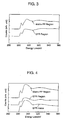
- Figure 3 shows spectra representing bonded states of carbon of a molding made of the comparative thermoplastic resin III (which was not heat-treated) in PP and EPR regions based on from an electron energy loss spectroscopic (EELS) analysis.
- Figure 4 shows spectra representing bonded states of carbon of a molding made of the sample thermoplastic resin XII (which is equivalent to the comparative thermoplastic resin III after a thermal treatment at 140°C for two hours) at respective "sea-island-lake" micro-structures based on an electron energy loss spectroscopic (EELS) analysis.
- EELS electron energy loss spectroscopic
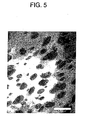
- Figure 5 shows the "sea-island-lake” micro-structure of a molding made of the comparative thermoplastic resins III in TEM photograph at X30000 magnification
- Figure 6 shows the "sea-island-lake” micro-structure of a molding made of the sample thermoplastic resins XII in TEM photograph at X100000 magnification.
- a fragmental specimen was cut off from the molding so that a region to be observed was located at a peripheral edge of the fragmental specimen. Thereafter, the fragmental specimen was trimmed by a cutter and then finished by deburring the periphery by a glass knife. Finally, the fragmental specimen was planed by a diamond knife and then dyed with a ruthenium tetroxide solution in steam dyeing or block dyeing. The TEM observation was made under an acceleration voltage of 300kV.
- thermoplastic resin molding made of a thermoplastic resin composition in which a thermoplastic polypropylene resin component and an elastomer component have partly blended in with each other, the polypropylene resin component is caused to separate in phase and precipitate in the elastomer component, so that the thermoplastic resin molding yields a greatly enhanced property of high speed elongation.
- thermoplastic resin composition and the molding made of the thermoplastic resin composition according to the present invention yields a greatly enhanced property of high speed elongation.
- the melioration of in the property of elongation can be realized in the case where the thermoplastic resin composition comprises a polypropylene resin that has a high versatility. That is, the thermoplastic resin molding yields a greatly enhanced property of elongation with neither encountering a decline in the coefficient of elasticity nor driving up manufacturing cost.
- thermoplastic resin molding is meliorated in the property of elongation by thermal treatment, even if it is necessary to change the property of elongation of the thermoplastic resin molding and/or the thennoplastic resin composition for the thermoplastic resin molding after trial manufacture of the thermoplastic resin product, there is no necessity of modifying an molding die or fabricating an alternative molding die. This dispenses with an additional burden of molding costs and, in consequence, is very contributory to reduction in manufacturing costs of the thermoplastic resin moldings.
Landscapes
- Chemical & Material Sciences (AREA)
- Health & Medical Sciences (AREA)
- Chemical Kinetics & Catalysis (AREA)
- Medicinal Chemistry (AREA)
- Polymers & Plastics (AREA)
- Organic Chemistry (AREA)
- Physics & Mathematics (AREA)
- Thermal Sciences (AREA)
- Compositions Of Macromolecular Compounds (AREA)
- Processes Of Treating Macromolecular Substances (AREA)
- Heating, Cooling, Or Curing Plastics Or The Like In General (AREA)
Claims (8)
- Eine thermoplastische Harzzusammensetzung mit einer Meer-Insel-See-Struktur, die eine Matrix aus einer thermoplastischen Harzkomponente einschließt, die Polypropylenharz als ein Meer (S1, S2, S3) und eine Elastomerkomponente, insbesondere eine nicht vernetzte Elastomerkomponente, die Inseln (R1, R2, R3) als Domänen in dem Meer bildet, einschließt, wobei die thermoplastische Harzkomponente unter Bildung von Seen als Domänen in den Inseln (Q'2, Q3') ausfällt.
- Eine thermoplastische Harzzusammensetzung nach Anspruch 1, dadurch gekennzeichnet, dass, wenn eine Photomikrographie der mit einer Rutheniumtetroxidlösung gefärbten thermoplastischen Harzzusammensetzung unter Verwendung eines Transmissionselektronenmikroskops bereitgestellt wird, die Photomikrographie im Wesentlichen einen gleichen Kontrast zwischen dem "Meer" (S2, S3) und dem "See" (Q2; Q3) zeigt.
- Eine thermoplastische Harzzusammensetzung nach Anspruch 1, dadurch gekennzeichnet, dass bei Analyse der thermoplastischen Harzzusammensetzung in der spektroskopischen Elektronenverlustanalyse das "Meer" (S2, S3) und der "See" (Q2; Q3) im spektralen Verteilungsmuster, das gebundene Zustände von Kohlenstoff darstellt, im Wesentlichen gleich sind.
- Eine thermoplastische Harzzusammensetzung nach Anspruch 1, dadurch gekennzeichnet, dass die thermoplastischen Harzzusammensetzung weiterhin eine Additivkomponente einschließt, die mit der thermoplastischen Harzkomponente inkompatibel und mit der Elastomerkomponente kompatibel ist, wobei die Additivkomponte Inseln als Domänen in den Seen bildet.
- Ein aus einer thermoplastischen Harzzusammensetzung nach einem der vorhergehenden Ansprüche 1 bis 4 hergestelltes Formteil.
- Ein Verfahren zur Herstellung eines Formteils aus einer thermoplastischen Harzzusammensetzung, die ein Polypropylenharz und eine Elastomerkomponente, insbesondere eine nicht vernetze Elastomerkomponente, einschließt, die teilweise miteinander vermischt wurden, dadurch gekennzeichnet, dass:das thermoplastische Harzformteil bei einer Heiztemperatur oberhalb von etwa 120°C jedoch unterhalb eines Schmelzpunkts von jeweils der thermoplastischen Harzkomponente und der Elastomerkomponente mindestens eine Stunde erwärmt wird, so dass dadurch die thermoplastische Harzzusammensetzung dazu gebracht wird, sich von der Elastomerzusammensetzung (Q2', Q3') abzutrennen und darin auszufallen,derart dass das thermoplastische Harzformteile eine Meer-Insel-See-Struktur aufweist, die eine Matrix aus der thermoplastischen Harzkomponente, die Polypropylenharz einschließt, als ein Meer einschließt, in dem Meer die Inseln bildende Elastomerkomponente als Domänen einschließt, und die thermoplastische Harzkomponente ausfällt, um Seen als Domänen in den Inseln (Q2', Q3') zu bilden.
- Ein Verfahren nach Anspruch 6, dadurch gekennzeichnet, dass die thermoplastische Harzzusammensetzung weiterhin eine Additivkomponente einschließt, die mit der thermoplastischen Harzkomponente inkompatibel und mit der Elastomerkomponente kompatibel ist und Seen als Domänen in den Inseln bildet, und die Heiztemperatur oberhalb von etwa 120°C, jedoch unterhalb eines Schmelzpunkts von jeweils der thermoplastischen Harzkomponente, der Elastomerkomponente und der Additivkomponente liegt.
- Ein Verfahren nach Anspruch 7, dadurch gekennzeichnet, dass die thermoplastische Harzkomponente, die Elastomerkomponente und die Additivkomponente ein Polyethylenharz, ein Styrolelastomer bzw. ein Polystyrolharz einschließt.
Applications Claiming Priority (2)
| Application Number | Priority Date | Filing Date | Title |
|---|---|---|---|
| JP2001302996A JP4696432B2 (ja) | 2001-09-28 | 2001-09-28 | 熱可塑性樹脂組成物及び該組成物から成形された熱可塑性樹脂成形品並びに該成形品の製造方法 |
| JP2001302996 | 2001-09-28 |
Publications (2)
| Publication Number | Publication Date |
|---|---|
| EP1297936A1 EP1297936A1 (de) | 2003-04-02 |
| EP1297936B1 true EP1297936B1 (de) | 2009-06-17 |
Family
ID=19123149
Family Applications (1)
| Application Number | Title | Priority Date | Filing Date |
|---|---|---|---|
| EP02021059A Expired - Lifetime EP1297936B1 (de) | 2001-09-28 | 2002-09-20 | Kunststoffmischung bestehend aus Thermoplasten und Elastomeren |
Country Status (4)
| Country | Link |
|---|---|
| US (1) | US6906139B2 (de) |
| EP (1) | EP1297936B1 (de) |
| JP (1) | JP4696432B2 (de) |
| DE (1) | DE60232630D1 (de) |
Families Citing this family (3)
| Publication number | Priority date | Publication date | Assignee | Title |
|---|---|---|---|---|
| JPWO2008149505A1 (ja) * | 2007-05-31 | 2010-08-19 | 有限会社サンサーラコーポレーション | ポリマー組成物 |
| RU2582521C2 (ru) * | 2012-02-14 | 2016-04-27 | Бриджстоун Корпорейшн | Шина |
| MX2014014515A (es) * | 2012-06-06 | 2015-04-08 | Saint Gobain Performance Plast | Tuberia de elastomero termoplastico y metodo para fabricar y usar la misma. |
Family Cites Families (11)
| Publication number | Priority date | Publication date | Assignee | Title |
|---|---|---|---|---|
| IL62554A (en) * | 1980-04-14 | 1985-03-31 | Wedco | Heat treating of polymer material in finely divided form |
| US4508870A (en) * | 1984-01-27 | 1985-04-02 | Monsanto Company | Polyblends of thermoplastic copolyetheresters and acrylonitrile-butadiene-styrene polymers |
| US4628073A (en) * | 1984-10-03 | 1986-12-09 | Monsanto Company | Soft, rubbery, multiphase matrix material and methods for its production |
| JPS63289046A (ja) * | 1987-05-21 | 1988-11-25 | Chisso Corp | 熱可塑性樹脂組成物 |
| KR900004932B1 (ko) * | 1987-05-26 | 1990-07-12 | 주식회사 럭키 | 올레핀계 열가소성 수지 조성물의 제조 방법 |
| DE3918982A1 (de) * | 1989-06-10 | 1990-12-13 | Basf Ag | Thermoplastische polypropylen-polyamid-formmassen hoher zaehigkeit, steifigkeit und waermeformbestaendigkeit, verfahren zu ihrer herstellung und ihre verwendung |
| JPH03229740A (ja) * | 1990-02-06 | 1991-10-11 | Idemitsu Petrochem Co Ltd | ポリプロピレン系樹脂組成物及びその製造方法 |
| JP3007139B2 (ja) * | 1990-11-29 | 2000-02-07 | 三菱化学株式会社 | 耐衝撃性に優れたオレフィン重合体組成物 |
| DE4104405A1 (de) * | 1991-02-14 | 1992-08-20 | Basf Ag | Thermoplastische formmassen |
| JP3601569B2 (ja) * | 1997-03-26 | 2004-12-15 | 株式会社ブリヂストン | 樹脂強化エラストマー、その製造方法、及びそれを用いた空気入りタイヤ |
| JP2000336239A (ja) | 1998-12-18 | 2000-12-05 | Sumitomo Bakelite Co Ltd | 熱可塑性エラストマー組成物 |
-
2001
- 2001-09-28 JP JP2001302996A patent/JP4696432B2/ja not_active Expired - Fee Related
-
2002
- 2002-09-20 DE DE60232630T patent/DE60232630D1/de not_active Expired - Lifetime
- 2002-09-20 EP EP02021059A patent/EP1297936B1/de not_active Expired - Lifetime
- 2002-09-26 US US10/255,094 patent/US6906139B2/en not_active Expired - Lifetime
Also Published As
| Publication number | Publication date |
|---|---|
| US6906139B2 (en) | 2005-06-14 |
| US20040162393A1 (en) | 2004-08-19 |
| JP4696432B2 (ja) | 2011-06-08 |
| DE60232630D1 (de) | 2009-07-30 |
| JP2003105212A (ja) | 2003-04-09 |
| EP1297936A1 (de) | 2003-04-02 |
Similar Documents
| Publication | Publication Date | Title |
|---|---|---|
| EP0747322B1 (de) | Verbundtonmaterial und Verfahren zu seiner Herstellung, Mischungsmaterial und Verbundtonkautschuk, die es anwenden, und Verfahren zu ihrer Herstellung | |
| DE10082051B3 (de) | Formartikel aus thermoplastischer Polyesterharzzusammensetzung | |
| DE69510820T2 (de) | Thermoplastische polymerzusammensetzung und verfahren zum spritzgiessen von teilen mit verringerter schrumpfung | |
| DE60105278T2 (de) | Thermoplastische silicon-polyamide elastomere | |
| CN1112403C (zh) | 新热塑性弹性体组合物和用于气袋装置的覆盖物 | |
| DE112008001887T5 (de) | Thermoplastische Elastomerzusammensetzung und Verbund-Formkörper | |
| DE69933381T2 (de) | Mischungen aus teilkristallinen polymeren | |
| DE102015225456A1 (de) | Thermoplastische Polyurethan-Zusammensetzung zum Spritzgießen und Verfahren zum Herstellen derselben | |
| US11242429B2 (en) | Composition for automobile interior skin, manufacturing method thereof, and automobile interior skin manufactured using the same | |
| DE102012017353B4 (de) | Verfahren zur Herstellung einer thermoplastische Elastomerzusammensetzung | |
| EP0673969B1 (de) | Farbstoffzusammensetzung | |
| EP0254153B1 (de) | Verwendung einer Silicon-Mischung zur Herstellung weicher elastomerer Spritzguss-Formkörper | |
| US6176510B1 (en) | Air bag cover containing a block copolymer polypropylene resin blend | |
| JPH09188766A (ja) | 複合樹脂組成物とその製造方法 | |
| US6906139B2 (en) | Thermoplastic resin composition, molding made of the thermoplastic resin composition and process of manufacturing the molding | |
| DE19902318C2 (de) | Airbaggehäuse | |
| DE69323408T2 (de) | Aufnahmegehäuse für einen Luftsack | |
| EP0442435B1 (de) | Verfahren zur Wiederverwertung von Abfällen oder Altartikeln aus vernetztem Kunststoff, insbesondere aus Polyurethan oder Polyharnstoff | |
| EP2542619B1 (de) | Thermoplastische reaktor-polyolefinelastomerzusammensetzung | |
| DE102009018779B4 (de) | Thermoplastische Elastomermasse, Verfahren zur Herstellung eines Formteils unter Verwendung der thermoplastischen Elastomermasse und Formteil, das über ein solches Verfahren hergestellt wird | |
| DE102022206842A1 (de) | Thermoplastische harzzusammensetzung mit hoher steifigkeit und niedrigem linearen wärmeausdehnungskoeffizienten und formteil, enthaltend diese | |
| DE19902123A1 (de) | Airbaggehäuse | |
| DE19939352A1 (de) | Formteil und Verfahren zu seiner Herstellung | |
| KR20190088389A (ko) | 자동차 내장재용 표피재 및 이의 제조방법 | |
| Yeetsorn et al. | Thermoplastic vulcanizates/recycled polypropylene blend for automotive OEM |
Legal Events
| Date | Code | Title | Description |
|---|---|---|---|
| PUAI | Public reference made under article 153(3) epc to a published international application that has entered the european phase |
Free format text: ORIGINAL CODE: 0009012 |
|
| AK | Designated contracting states |
Kind code of ref document: A1 Designated state(s): AT BE BG CH CY CZ DE DK EE ES FI FR GB GR IE IT LI LU MC NL PT SE SK TR |
|
| AX | Request for extension of the european patent |
Extension state: AL LT LV MK RO SI |
|
| 17P | Request for examination filed |
Effective date: 20030711 |
|
| AKX | Designation fees paid |
Designated state(s): DE ES FR GB IT |
|
| 17Q | First examination report despatched |
Effective date: 20050517 |
|
| 17Q | First examination report despatched |
Effective date: 20050517 |
|
| GRAP | Despatch of communication of intention to grant a patent |
Free format text: ORIGINAL CODE: EPIDOSNIGR1 |
|
| GRAS | Grant fee paid |
Free format text: ORIGINAL CODE: EPIDOSNIGR3 |
|
| GRAA | (expected) grant |
Free format text: ORIGINAL CODE: 0009210 |
|
| AK | Designated contracting states |
Kind code of ref document: B1 Designated state(s): DE ES FR GB IT |
|
| REG | Reference to a national code |
Ref country code: GB Ref legal event code: FG4D |
|
| REF | Corresponds to: |
Ref document number: 60232630 Country of ref document: DE Date of ref document: 20090730 Kind code of ref document: P |
|
| PG25 | Lapsed in a contracting state [announced via postgrant information from national office to epo] |
Ref country code: ES Free format text: LAPSE BECAUSE OF FAILURE TO SUBMIT A TRANSLATION OF THE DESCRIPTION OR TO PAY THE FEE WITHIN THE PRESCRIBED TIME-LIMIT Effective date: 20090928 |
|
| PLBE | No opposition filed within time limit |
Free format text: ORIGINAL CODE: 0009261 |
|
| STAA | Information on the status of an ep patent application or granted ep patent |
Free format text: STATUS: NO OPPOSITION FILED WITHIN TIME LIMIT |
|
| 26N | No opposition filed |
Effective date: 20100318 |
|
| GBPC | Gb: european patent ceased through non-payment of renewal fee |
Effective date: 20090920 |
|
| REG | Reference to a national code |
Ref country code: FR Ref legal event code: ST Effective date: 20100531 |
|
| PG25 | Lapsed in a contracting state [announced via postgrant information from national office to epo] |
Ref country code: FR Free format text: LAPSE BECAUSE OF NON-PAYMENT OF DUE FEES Effective date: 20090930 |
|
| PG25 | Lapsed in a contracting state [announced via postgrant information from national office to epo] |
Ref country code: GB Free format text: LAPSE BECAUSE OF NON-PAYMENT OF DUE FEES Effective date: 20090920 |
|
| PG25 | Lapsed in a contracting state [announced via postgrant information from national office to epo] |
Ref country code: IT Free format text: LAPSE BECAUSE OF FAILURE TO SUBMIT A TRANSLATION OF THE DESCRIPTION OR TO PAY THE FEE WITHIN THE PRESCRIBED TIME-LIMIT Effective date: 20090617 |
|
| PGFP | Annual fee paid to national office [announced via postgrant information from national office to epo] |
Ref country code: DE Payment date: 20170912 Year of fee payment: 16 |
|
| REG | Reference to a national code |
Ref country code: DE Ref legal event code: R119 Ref document number: 60232630 Country of ref document: DE |
|
| PG25 | Lapsed in a contracting state [announced via postgrant information from national office to epo] |
Ref country code: DE Free format text: LAPSE BECAUSE OF NON-PAYMENT OF DUE FEES Effective date: 20190402 |