EP1295590B1 - Zweikomponenten-Mittel mit zeitlichem pH-Gradienten und Verfahren zur Behandlung von Haaren - Google Patents
Zweikomponenten-Mittel mit zeitlichem pH-Gradienten und Verfahren zur Behandlung von Haaren Download PDFInfo
- Publication number
- EP1295590B1 EP1295590B1 EP02015153A EP02015153A EP1295590B1 EP 1295590 B1 EP1295590 B1 EP 1295590B1 EP 02015153 A EP02015153 A EP 02015153A EP 02015153 A EP02015153 A EP 02015153A EP 1295590 B1 EP1295590 B1 EP 1295590B1
- Authority
- EP
- European Patent Office
- Prior art keywords
- acid
- process according
- hair
- agent
- component
- Prior art date
- Legal status (The legal status is an assumption and is not a legal conclusion. Google has not performed a legal analysis and makes no representation as to the accuracy of the status listed.)
- Revoked
Links
- 210000004209 hair Anatomy 0.000 title claims abstract description 49
- 238000000034 method Methods 0.000 title claims abstract description 36
- 230000008569 process Effects 0.000 title claims description 24
- 239000002253 acid Substances 0.000 claims abstract description 36
- XLYOFNOQVPJJNP-UHFFFAOYSA-N water Substances O XLYOFNOQVPJJNP-UHFFFAOYSA-N 0.000 claims abstract description 23
- 238000002156 mixing Methods 0.000 claims abstract description 15
- 239000000203 mixture Substances 0.000 claims abstract description 14
- 239000003795 chemical substances by application Substances 0.000 claims description 51
- 230000008859 change Effects 0.000 claims description 13
- 238000007493 shaping process Methods 0.000 claims description 12
- 125000004432 carbon atom Chemical group C* 0.000 claims description 10
- QGZKDVFQNNGYKY-UHFFFAOYSA-N Ammonia Chemical compound N QGZKDVFQNNGYKY-UHFFFAOYSA-N 0.000 claims description 9
- 230000002209 hydrophobic effect Effects 0.000 claims description 8
- KWYUFKZDYYNOTN-UHFFFAOYSA-M Potassium hydroxide Chemical compound [OH-].[K+] KWYUFKZDYYNOTN-UHFFFAOYSA-M 0.000 claims description 6
- HEMHJVSKTPXQMS-UHFFFAOYSA-M Sodium hydroxide Chemical compound [OH-].[Na+] HEMHJVSKTPXQMS-UHFFFAOYSA-M 0.000 claims description 6
- 150000007530 organic bases Chemical class 0.000 claims description 6
- CXMXRPHRNRROMY-UHFFFAOYSA-N sebacic acid Chemical compound OC(=O)CCCCCCCCC(O)=O CXMXRPHRNRROMY-UHFFFAOYSA-N 0.000 claims description 6
- 229910021529 ammonia Inorganic materials 0.000 claims description 5
- 150000002191 fatty alcohols Chemical class 0.000 claims description 5
- 230000002123 temporal effect Effects 0.000 claims description 5
- OAKJQQAXSVQMHS-UHFFFAOYSA-N Hydrazine Chemical compound NN OAKJQQAXSVQMHS-UHFFFAOYSA-N 0.000 claims description 4
- WMFOQBRAJBCJND-UHFFFAOYSA-M Lithium hydroxide Chemical compound [Li+].[OH-] WMFOQBRAJBCJND-UHFFFAOYSA-M 0.000 claims description 4
- TVIDDXQYHWJXFK-UHFFFAOYSA-N dodecanedioic acid Chemical compound OC(=O)CCCCCCCCCCC(O)=O TVIDDXQYHWJXFK-UHFFFAOYSA-N 0.000 claims description 4
- 150000007529 inorganic bases Chemical class 0.000 claims description 4
- 150000002634 lipophilic molecules Chemical class 0.000 claims description 4
- 239000012188 paraffin wax Substances 0.000 claims description 4
- HQHCYKULIHKCEB-UHFFFAOYSA-N tetradecanedioic acid Chemical compound OC(=O)CCCCCCCCCCCCC(O)=O HQHCYKULIHKCEB-UHFFFAOYSA-N 0.000 claims description 4
- 239000005662 Paraffin oil Substances 0.000 claims description 3
- UFTFJSFQGQCHQW-UHFFFAOYSA-N triformin Chemical compound O=COCC(OC=O)COC=O UFTFJSFQGQCHQW-UHFFFAOYSA-N 0.000 claims description 3
- 150000003973 alkyl amines Chemical class 0.000 claims description 2
- 239000007793 ph indicator Substances 0.000 claims description 2
- OFOBLEOULBTSOW-UHFFFAOYSA-N Malonic acid Chemical compound OC(=O)CC(O)=O OFOBLEOULBTSOW-UHFFFAOYSA-N 0.000 claims 2
- 239000004480 active ingredient Substances 0.000 claims 1
- AXCZMVOFGPJBDE-UHFFFAOYSA-L calcium dihydroxide Chemical compound [OH-].[OH-].[Ca+2] AXCZMVOFGPJBDE-UHFFFAOYSA-L 0.000 claims 1
- 229910001861 calcium hydroxide Inorganic materials 0.000 claims 1
- 239000000920 calcium hydroxide Substances 0.000 claims 1
- 238000011282 treatment Methods 0.000 abstract description 12
- 239000003638 chemical reducing agent Substances 0.000 abstract description 4
- 230000001590 oxidative effect Effects 0.000 abstract description 3
- 238000001035 drying Methods 0.000 abstract 1
- 239000002585 base Substances 0.000 description 16
- 239000000126 substance Substances 0.000 description 15
- -1 aliphatic monocarboxylic acids Chemical class 0.000 description 9
- 230000002378 acidificating effect Effects 0.000 description 6
- PEDCQBHIVMGVHV-UHFFFAOYSA-N Glycerine Chemical compound OCC(O)CO PEDCQBHIVMGVHV-UHFFFAOYSA-N 0.000 description 5
- 230000007423 decrease Effects 0.000 description 5
- 239000003921 oil Substances 0.000 description 5
- 239000000047 product Substances 0.000 description 5
- 150000003839 salts Chemical class 0.000 description 5
- LFQSCWFLJHTTHZ-UHFFFAOYSA-N Ethanol Chemical compound CCO LFQSCWFLJHTTHZ-UHFFFAOYSA-N 0.000 description 4
- MHAJPDPJQMAIIY-UHFFFAOYSA-N Hydrogen peroxide Chemical compound OO MHAJPDPJQMAIIY-UHFFFAOYSA-N 0.000 description 4
- XSQUKJJJFZCRTK-UHFFFAOYSA-N Urea Chemical compound NC(N)=O XSQUKJJJFZCRTK-UHFFFAOYSA-N 0.000 description 4
- 150000007513 acids Chemical class 0.000 description 4
- 239000000872 buffer Substances 0.000 description 4
- 150000001991 dicarboxylic acids Chemical class 0.000 description 4
- 239000000975 dye Substances 0.000 description 4
- 230000000694 effects Effects 0.000 description 4
- 230000007062 hydrolysis Effects 0.000 description 4
- 238000006460 hydrolysis reaction Methods 0.000 description 4
- 238000004806 packaging method and process Methods 0.000 description 4
- 239000000243 solution Substances 0.000 description 4
- TYFQFVWCELRYAO-UHFFFAOYSA-N suberic acid Chemical compound OC(=O)CCCCCCC(O)=O TYFQFVWCELRYAO-UHFFFAOYSA-N 0.000 description 4
- CWERGRDVMFNCDR-UHFFFAOYSA-N thioglycolic acid Chemical compound OC(=O)CS CWERGRDVMFNCDR-UHFFFAOYSA-N 0.000 description 4
- 108090000790 Enzymes Proteins 0.000 description 3
- 102000004190 Enzymes Human genes 0.000 description 3
- XEKOWRVHYACXOJ-UHFFFAOYSA-N Ethyl acetate Chemical compound CCOC(C)=O XEKOWRVHYACXOJ-UHFFFAOYSA-N 0.000 description 3
- LYCAIKOWRPUZTN-UHFFFAOYSA-N Ethylene glycol Chemical compound OCCO LYCAIKOWRPUZTN-UHFFFAOYSA-N 0.000 description 3
- 150000001298 alcohols Chemical class 0.000 description 3
- 230000015572 biosynthetic process Effects 0.000 description 3
- 238000003776 cleavage reaction Methods 0.000 description 3
- 150000001875 compounds Chemical class 0.000 description 3
- 239000002537 cosmetic Substances 0.000 description 3
- 239000006071 cream Substances 0.000 description 3
- 235000014113 dietary fatty acids Nutrition 0.000 description 3
- 229940088598 enzyme Drugs 0.000 description 3
- 150000002148 esters Chemical class 0.000 description 3
- 239000000194 fatty acid Substances 0.000 description 3
- 229930195729 fatty acid Natural products 0.000 description 3
- 239000000499 gel Substances 0.000 description 3
- 230000037308 hair color Effects 0.000 description 3
- 239000004615 ingredient Substances 0.000 description 3
- 239000007788 liquid Substances 0.000 description 3
- 239000007800 oxidant agent Substances 0.000 description 3
- 230000020477 pH reduction Effects 0.000 description 3
- 239000002304 perfume Substances 0.000 description 3
- 239000002994 raw material Substances 0.000 description 3
- 230000007017 scission Effects 0.000 description 3
- 239000002904 solvent Substances 0.000 description 3
- 239000003381 stabilizer Substances 0.000 description 3
- 238000003860 storage Methods 0.000 description 3
- 239000000725 suspension Substances 0.000 description 3
- 239000000080 wetting agent Substances 0.000 description 3
- GHOKWGTUZJEAQD-ZETCQYMHSA-N (D)-(+)-Pantothenic acid Chemical compound OCC(C)(C)[C@@H](O)C(=O)NCCC(O)=O GHOKWGTUZJEAQD-ZETCQYMHSA-N 0.000 description 2
- PMNLUUOXGOOLSP-UHFFFAOYSA-N 2-mercaptopropanoic acid Chemical compound CC(S)C(O)=O PMNLUUOXGOOLSP-UHFFFAOYSA-N 0.000 description 2
- PLIKAWJENQZMHA-UHFFFAOYSA-N 4-aminophenol Chemical compound NC1=CC=C(O)C=C1 PLIKAWJENQZMHA-UHFFFAOYSA-N 0.000 description 2
- KFZMGEQAYNKOFK-UHFFFAOYSA-N Isopropanol Chemical compound CC(C)O KFZMGEQAYNKOFK-UHFFFAOYSA-N 0.000 description 2
- 230000001133 acceleration Effects 0.000 description 2
- 239000000654 additive Substances 0.000 description 2
- 125000000217 alkyl group Chemical group 0.000 description 2
- WERYXYBDKMZEQL-UHFFFAOYSA-N butane-1,4-diol Chemical compound OCCCCO WERYXYBDKMZEQL-UHFFFAOYSA-N 0.000 description 2
- 239000004202 carbamide Substances 0.000 description 2
- 238000006555 catalytic reaction Methods 0.000 description 2
- 125000002091 cationic group Chemical group 0.000 description 2
- 229920006317 cationic polymer Polymers 0.000 description 2
- HVYWMOMLDIMFJA-DPAQBDIFSA-N cholesterol Chemical compound C1C=C2C[C@@H](O)CC[C@]2(C)[C@@H]2[C@@H]1[C@@H]1CC[C@H]([C@H](C)CCCC(C)C)[C@@]1(C)CC2 HVYWMOMLDIMFJA-DPAQBDIFSA-N 0.000 description 2
- 230000003750 conditioning effect Effects 0.000 description 2
- 235000018417 cysteine Nutrition 0.000 description 2
- 230000003111 delayed effect Effects 0.000 description 2
- 230000001419 dependent effect Effects 0.000 description 2
- 238000009792 diffusion process Methods 0.000 description 2
- DGXRZJSPDXZJFG-UHFFFAOYSA-N docosanedioic acid Chemical compound OC(=O)CCCCCCCCCCCCCCCCCCCCC(O)=O DGXRZJSPDXZJFG-UHFFFAOYSA-N 0.000 description 2
- 239000003995 emulsifying agent Substances 0.000 description 2
- 150000004665 fatty acids Chemical class 0.000 description 2
- 235000011187 glycerol Nutrition 0.000 description 2
- 230000003806 hair structure Effects 0.000 description 2
- 150000002596 lactones Chemical class 0.000 description 2
- 238000002844 melting Methods 0.000 description 2
- 230000008018 melting Effects 0.000 description 2
- 238000006386 neutralization reaction Methods 0.000 description 2
- 239000003605 opacifier Substances 0.000 description 2
- GHMLBKRAJCXXBS-UHFFFAOYSA-N resorcinol Chemical compound OC1=CC=CC(O)=C1 GHMLBKRAJCXXBS-UHFFFAOYSA-N 0.000 description 2
- 239000002562 thickening agent Substances 0.000 description 2
- 230000036962 time dependent Effects 0.000 description 2
- URAYPUMNDPQOKB-UHFFFAOYSA-N triacetin Chemical compound CC(=O)OCC(OC(C)=O)COC(C)=O URAYPUMNDPQOKB-UHFFFAOYSA-N 0.000 description 2
- DNIAPMSPPWPWGF-VKHMYHEASA-N (+)-propylene glycol Chemical compound C[C@H](O)CO DNIAPMSPPWPWGF-VKHMYHEASA-N 0.000 description 1
- YPFDHNVEDLHUCE-UHFFFAOYSA-N 1,3-propanediol Substances OCCCO YPFDHNVEDLHUCE-UHFFFAOYSA-N 0.000 description 1
- VLZVIIYRNMWPSN-UHFFFAOYSA-N 2-Amino-4-nitrophenol Chemical compound NC1=CC([N+]([O-])=O)=CC=C1O VLZVIIYRNMWPSN-UHFFFAOYSA-N 0.000 description 1
- OBCSAIDCZQSFQH-UHFFFAOYSA-N 2-methyl-1,4-phenylenediamine Chemical compound CC1=CC(N)=CC=C1N OBCSAIDCZQSFQH-UHFFFAOYSA-N 0.000 description 1
- HVHNMNGARPCGGD-UHFFFAOYSA-N 2-nitro-p-phenylenediamine Chemical compound NC1=CC=C(N)C([N+]([O-])=O)=C1 HVHNMNGARPCGGD-UHFFFAOYSA-N 0.000 description 1
- QCAHUFWKIQLBNB-UHFFFAOYSA-N 3-(3-methoxypropoxy)propan-1-ol Chemical compound COCCCOCCCO QCAHUFWKIQLBNB-UHFFFAOYSA-N 0.000 description 1
- DKIDEFUBRARXTE-UHFFFAOYSA-N 3-mercaptopropanoic acid Chemical compound OC(=O)CCS DKIDEFUBRARXTE-UHFFFAOYSA-N 0.000 description 1
- ZPLCXHWYPWVJDL-UHFFFAOYSA-N 4-[(4-hydroxyphenyl)methyl]-1,3-oxazolidin-2-one Chemical compound C1=CC(O)=CC=C1CC1NC(=O)OC1 ZPLCXHWYPWVJDL-UHFFFAOYSA-N 0.000 description 1
- KWIUHFFTVRNATP-UHFFFAOYSA-N Betaine Natural products C[N+](C)(C)CC([O-])=O KWIUHFFTVRNATP-UHFFFAOYSA-N 0.000 description 1
- GHOKWGTUZJEAQD-UHFFFAOYSA-N Chick antidermatitis factor Natural products OCC(C)(C)C(O)C(=O)NCCC(O)=O GHOKWGTUZJEAQD-UHFFFAOYSA-N 0.000 description 1
- RYGMFSIKBFXOCR-UHFFFAOYSA-N Copper Chemical compound [Cu] RYGMFSIKBFXOCR-UHFFFAOYSA-N 0.000 description 1
- WQZGKKKJIJFFOK-GASJEMHNSA-N Glucose Natural products OC[C@H]1OC(O)[C@H](O)[C@@H](O)[C@@H]1O WQZGKKKJIJFFOK-GASJEMHNSA-N 0.000 description 1
- DGAQECJNVWCQMB-PUAWFVPOSA-M Ilexoside XXIX Chemical compound C[C@@H]1CC[C@@]2(CC[C@@]3(C(=CC[C@H]4[C@]3(CC[C@@H]5[C@@]4(CC[C@@H](C5(C)C)OS(=O)(=O)[O-])C)C)[C@@H]2[C@]1(C)O)C)C(=O)O[C@H]6[C@@H]([C@H]([C@@H]([C@H](O6)CO)O)O)O.[Na+] DGAQECJNVWCQMB-PUAWFVPOSA-M 0.000 description 1
- 102000011782 Keratins Human genes 0.000 description 1
- 108010076876 Keratins Proteins 0.000 description 1
- XUJNEKJLAYXESH-REOHCLBHSA-N L-Cysteine Chemical compound SC[C@H](N)C(O)=O XUJNEKJLAYXESH-REOHCLBHSA-N 0.000 description 1
- FFFHZYDWPBMWHY-VKHMYHEASA-N L-homocysteine Chemical compound OC(=O)[C@@H](N)CCS FFFHZYDWPBMWHY-VKHMYHEASA-N 0.000 description 1
- 239000004166 Lanolin Substances 0.000 description 1
- 239000004367 Lipase Substances 0.000 description 1
- 102000004882 Lipase Human genes 0.000 description 1
- 108090001060 Lipase Proteins 0.000 description 1
- KWIUHFFTVRNATP-UHFFFAOYSA-O N,N,N-trimethylglycinium Chemical compound C[N+](C)(C)CC(O)=O KWIUHFFTVRNATP-UHFFFAOYSA-O 0.000 description 1
- 108010019160 Pancreatin Proteins 0.000 description 1
- ALQSHHUCVQOPAS-UHFFFAOYSA-N Pentane-1,5-diol Chemical compound OCCCCCO ALQSHHUCVQOPAS-UHFFFAOYSA-N 0.000 description 1
- 239000004264 Petrolatum Substances 0.000 description 1
- 239000002202 Polyethylene glycol Substances 0.000 description 1
- ZLMJMSJWJFRBEC-UHFFFAOYSA-N Potassium Chemical compound [K] ZLMJMSJWJFRBEC-UHFFFAOYSA-N 0.000 description 1
- 229920002125 Sokalan® Polymers 0.000 description 1
- 229920002472 Starch Polymers 0.000 description 1
- PLZVEHJLHYMBBY-UHFFFAOYSA-N Tetradecylamine Chemical compound CCCCCCCCCCCCCCN PLZVEHJLHYMBBY-UHFFFAOYSA-N 0.000 description 1
- 108010046334 Urease Proteins 0.000 description 1
- 230000002159 abnormal effect Effects 0.000 description 1
- 239000013543 active substance Substances 0.000 description 1
- 239000000443 aerosol Substances 0.000 description 1
- 229920000615 alginic acid Polymers 0.000 description 1
- 235000010443 alginic acid Nutrition 0.000 description 1
- 239000003513 alkali Substances 0.000 description 1
- 229940045714 alkyl sulfonate alkylating agent Drugs 0.000 description 1
- 150000008052 alkyl sulfonates Chemical class 0.000 description 1
- 230000000172 allergic effect Effects 0.000 description 1
- 150000001412 amines Chemical class 0.000 description 1
- ZZTCCAPMZLDHFM-UHFFFAOYSA-N ammonium thioglycolate Chemical compound [NH4+].[O-]C(=O)CS ZZTCCAPMZLDHFM-UHFFFAOYSA-N 0.000 description 1
- 229940075861 ammonium thioglycolate Drugs 0.000 description 1
- 239000002280 amphoteric surfactant Substances 0.000 description 1
- 125000000129 anionic group Chemical group 0.000 description 1
- 238000013459 approach Methods 0.000 description 1
- 239000007864 aqueous solution Substances 0.000 description 1
- 208000010668 atopic eczema Diseases 0.000 description 1
- 239000000440 bentonite Substances 0.000 description 1
- 229910000278 bentonite Inorganic materials 0.000 description 1
- 235000012216 bentonite Nutrition 0.000 description 1
- SVPXDRXYRYOSEX-UHFFFAOYSA-N bentoquatam Chemical compound O.O=[Si]=O.O=[Al]O[Al]=O SVPXDRXYRYOSEX-UHFFFAOYSA-N 0.000 description 1
- 229960003237 betaine Drugs 0.000 description 1
- 239000007844 bleaching agent Substances 0.000 description 1
- 150000001732 carboxylic acid derivatives Chemical class 0.000 description 1
- 239000003093 cationic surfactant Substances 0.000 description 1
- 239000001913 cellulose Substances 0.000 description 1
- 229920002678 cellulose Polymers 0.000 description 1
- RLGQACBPNDBWTB-UHFFFAOYSA-N cetyltrimethylammonium ion Chemical compound CCCCCCCCCCCCCCCC[N+](C)(C)C RLGQACBPNDBWTB-UHFFFAOYSA-N 0.000 description 1
- 238000006243 chemical reaction Methods 0.000 description 1
- 239000007795 chemical reaction product Substances 0.000 description 1
- 235000012000 cholesterol Nutrition 0.000 description 1
- 229940107161 cholesterol Drugs 0.000 description 1
- 238000004140 cleaning Methods 0.000 description 1
- 239000007957 coemulsifier Substances 0.000 description 1
- 238000004040 coloring Methods 0.000 description 1
- 230000000536 complexating effect Effects 0.000 description 1
- 229910052802 copper Inorganic materials 0.000 description 1
- 239000010949 copper Substances 0.000 description 1
- UFULAYFCSOUIOV-UHFFFAOYSA-N cysteamine Chemical compound NCCS UFULAYFCSOUIOV-UHFFFAOYSA-N 0.000 description 1
- XUJNEKJLAYXESH-UHFFFAOYSA-N cysteine Natural products SCC(N)C(O)=O XUJNEKJLAYXESH-UHFFFAOYSA-N 0.000 description 1
- 230000003247 decreasing effect Effects 0.000 description 1
- 239000006185 dispersion Substances 0.000 description 1
- 238000010494 dissociation reaction Methods 0.000 description 1
- 230000005593 dissociations Effects 0.000 description 1
- LQZZUXJYWNFBMV-UHFFFAOYSA-N dodecan-1-ol Chemical class CCCCCCCCCCCCO LQZZUXJYWNFBMV-UHFFFAOYSA-N 0.000 description 1
- 239000000839 emulsion Substances 0.000 description 1
- 238000005516 engineering process Methods 0.000 description 1
- 230000002255 enzymatic effect Effects 0.000 description 1
- 238000011067 equilibration Methods 0.000 description 1
- 125000004185 ester group Chemical group 0.000 description 1
- RTZKZFJDLAIYFH-UHFFFAOYSA-N ether Substances CCOCC RTZKZFJDLAIYFH-UHFFFAOYSA-N 0.000 description 1
- 239000000834 fixative Substances 0.000 description 1
- 239000006260 foam Substances 0.000 description 1
- 238000009472 formulation Methods 0.000 description 1
- 239000001087 glyceryl triacetate Substances 0.000 description 1
- 235000013773 glyceryl triacetate Nutrition 0.000 description 1
- 150000002334 glycols Chemical class 0.000 description 1
- 239000003676 hair preparation Substances 0.000 description 1
- 125000005843 halogen group Chemical group 0.000 description 1
- UBHWBODXJBSFLH-UHFFFAOYSA-N hexadecan-1-ol;octadecan-1-ol Chemical compound CCCCCCCCCCCCCCCCO.CCCCCCCCCCCCCCCCCCO UBHWBODXJBSFLH-UHFFFAOYSA-N 0.000 description 1
- YAMHXTCMCPHKLN-UHFFFAOYSA-N imidazolidin-2-one Chemical compound O=C1NCCN1 YAMHXTCMCPHKLN-UHFFFAOYSA-N 0.000 description 1
- 229940039717 lanolin Drugs 0.000 description 1
- 235000019388 lanolin Nutrition 0.000 description 1
- 235000019421 lipase Nutrition 0.000 description 1
- 238000012423 maintenance Methods 0.000 description 1
- 238000004519 manufacturing process Methods 0.000 description 1
- 229960003151 mercaptamine Drugs 0.000 description 1
- 239000004530 micro-emulsion Substances 0.000 description 1
- 150000007522 mineralic acids Chemical class 0.000 description 1
- PJUIMOJAAPLTRJ-UHFFFAOYSA-N monothioglycerol Chemical compound OCC(O)CS PJUIMOJAAPLTRJ-UHFFFAOYSA-N 0.000 description 1
- 125000001421 myristyl group Chemical group [H]C([*])([H])C([H])([H])C([H])([H])C([H])([H])C([H])([H])C([H])([H])C([H])([H])C([H])([H])C([H])([H])C([H])([H])C([H])([H])C([H])([H])C([H])([H])C([H])([H])[H] 0.000 description 1
- 230000007935 neutral effect Effects 0.000 description 1
- 239000002736 nonionic surfactant Substances 0.000 description 1
- 230000009965 odorless effect Effects 0.000 description 1
- 150000007524 organic acids Chemical class 0.000 description 1
- 150000002894 organic compounds Chemical class 0.000 description 1
- 230000003647 oxidation Effects 0.000 description 1
- 238000007254 oxidation reaction Methods 0.000 description 1
- 238000001139 pH measurement Methods 0.000 description 1
- 229940055695 pancreatin Drugs 0.000 description 1
- 229940055726 pantothenic acid Drugs 0.000 description 1
- 235000019161 pantothenic acid Nutrition 0.000 description 1
- 239000011713 pantothenic acid Substances 0.000 description 1
- 230000036961 partial effect Effects 0.000 description 1
- 239000006072 paste Substances 0.000 description 1
- 230000035515 penetration Effects 0.000 description 1
- 150000002978 peroxides Chemical class 0.000 description 1
- 235000019271 petrolatum Nutrition 0.000 description 1
- 229940066842 petrolatum Drugs 0.000 description 1
- 239000012071 phase Substances 0.000 description 1
- 239000004584 polyacrylic acid Substances 0.000 description 1
- 229920001223 polyethylene glycol Polymers 0.000 description 1
- 229920005862 polyol Polymers 0.000 description 1
- 150000003077 polyols Chemical class 0.000 description 1
- 229920000166 polytrimethylene carbonate Polymers 0.000 description 1
- 229910052700 potassium Inorganic materials 0.000 description 1
- 239000011591 potassium Substances 0.000 description 1
- BDERNNFJNOPAEC-UHFFFAOYSA-N propan-1-ol Chemical compound CCCO BDERNNFJNOPAEC-UHFFFAOYSA-N 0.000 description 1
- HNJBEVLQSNELDL-UHFFFAOYSA-N pyrrolidin-2-one Chemical compound O=C1CCCN1 HNJBEVLQSNELDL-UHFFFAOYSA-N 0.000 description 1
- 150000003242 quaternary ammonium salts Chemical class 0.000 description 1
- 230000009467 reduction Effects 0.000 description 1
- 230000004044 response Effects 0.000 description 1
- 238000007789 sealing Methods 0.000 description 1
- 230000001235 sensitizing effect Effects 0.000 description 1
- 239000002453 shampoo Substances 0.000 description 1
- 229910052708 sodium Inorganic materials 0.000 description 1
- 239000011734 sodium Substances 0.000 description 1
- XUXNAKZDHHEHPC-UHFFFAOYSA-M sodium bromate Chemical compound [Na+].[O-]Br(=O)=O XUXNAKZDHHEHPC-UHFFFAOYSA-M 0.000 description 1
- 229960001922 sodium perborate Drugs 0.000 description 1
- YKLJGMBLPUQQOI-UHFFFAOYSA-M sodium;oxidooxy(oxo)borane Chemical compound [Na+].[O-]OB=O YKLJGMBLPUQQOI-UHFFFAOYSA-M 0.000 description 1
- 239000007787 solid Substances 0.000 description 1
- 230000002269 spontaneous effect Effects 0.000 description 1
- 239000008107 starch Substances 0.000 description 1
- 235000019698 starch Nutrition 0.000 description 1
- 150000003460 sulfonic acids Chemical class 0.000 description 1
- OULAJFUGPPVRBK-UHFFFAOYSA-N tetratriacontan-1-ol Chemical compound CCCCCCCCCCCCCCCCCCCCCCCCCCCCCCCCCCO OULAJFUGPPVRBK-UHFFFAOYSA-N 0.000 description 1
- REZOIPSCCRVWNN-UHFFFAOYSA-N tetratriacontan-17-ol Chemical compound CCCCCCCCCCCCCCCCCC(O)CCCCCCCCCCCCCCCC REZOIPSCCRVWNN-UHFFFAOYSA-N 0.000 description 1
- 229940035024 thioglycerol Drugs 0.000 description 1
- 239000000606 toothpaste Substances 0.000 description 1
- 229940034610 toothpaste Drugs 0.000 description 1
- 230000009466 transformation Effects 0.000 description 1
- 229960002622 triacetin Drugs 0.000 description 1
- 150000003626 triacylglycerols Chemical class 0.000 description 1
- 239000007762 w/o emulsion Substances 0.000 description 1
Images
Classifications
-
- C—CHEMISTRY; METALLURGY
- C07—ORGANIC CHEMISTRY
- C07C—ACYCLIC OR CARBOCYCLIC COMPOUNDS
- C07C51/00—Preparation of carboxylic acids or their salts, halides or anhydrides
- C07C51/41—Preparation of salts of carboxylic acids
- C07C51/412—Preparation of salts of carboxylic acids by conversion of the acids, their salts, esters or anhydrides with the same carboxylic acid part
-
- A—HUMAN NECESSITIES
- A61—MEDICAL OR VETERINARY SCIENCE; HYGIENE
- A61K—PREPARATIONS FOR MEDICAL, DENTAL OR TOILETRY PURPOSES
- A61K8/00—Cosmetics or similar toiletry preparations
- A61K8/18—Cosmetics or similar toiletry preparations characterised by the composition
- A61K8/19—Cosmetics or similar toiletry preparations characterised by the composition containing inorganic ingredients
-
- A—HUMAN NECESSITIES
- A61—MEDICAL OR VETERINARY SCIENCE; HYGIENE
- A61K—PREPARATIONS FOR MEDICAL, DENTAL OR TOILETRY PURPOSES
- A61K8/00—Cosmetics or similar toiletry preparations
- A61K8/18—Cosmetics or similar toiletry preparations characterised by the composition
- A61K8/30—Cosmetics or similar toiletry preparations characterised by the composition containing organic compounds
- A61K8/33—Cosmetics or similar toiletry preparations characterised by the composition containing organic compounds containing oxygen
- A61K8/36—Carboxylic acids; Salts or anhydrides thereof
- A61K8/362—Polycarboxylic acids
-
- A—HUMAN NECESSITIES
- A61—MEDICAL OR VETERINARY SCIENCE; HYGIENE
- A61K—PREPARATIONS FOR MEDICAL, DENTAL OR TOILETRY PURPOSES
- A61K8/00—Cosmetics or similar toiletry preparations
- A61K8/18—Cosmetics or similar toiletry preparations characterised by the composition
- A61K8/30—Cosmetics or similar toiletry preparations characterised by the composition containing organic compounds
- A61K8/40—Cosmetics or similar toiletry preparations characterised by the composition containing organic compounds containing nitrogen
- A61K8/41—Amines
-
- A—HUMAN NECESSITIES
- A61—MEDICAL OR VETERINARY SCIENCE; HYGIENE
- A61Q—SPECIFIC USE OF COSMETICS OR SIMILAR TOILETRY PREPARATIONS
- A61Q5/00—Preparations for care of the hair
- A61Q5/04—Preparations for permanent waving or straightening the hair
-
- A—HUMAN NECESSITIES
- A61—MEDICAL OR VETERINARY SCIENCE; HYGIENE
- A61Q—SPECIFIC USE OF COSMETICS OR SIMILAR TOILETRY PREPARATIONS
- A61Q5/00—Preparations for care of the hair
- A61Q5/10—Preparations for permanently dyeing the hair
-
- A—HUMAN NECESSITIES
- A61—MEDICAL OR VETERINARY SCIENCE; HYGIENE
- A61K—PREPARATIONS FOR MEDICAL, DENTAL OR TOILETRY PURPOSES
- A61K2800/00—Properties of cosmetic compositions or active ingredients thereof or formulation aids used therein and process related aspects
- A61K2800/40—Chemical, physico-chemical or functional or structural properties of particular ingredients
- A61K2800/42—Colour properties
- A61K2800/45—Colour indicators, e.g. pH- or Redox indicators
-
- A—HUMAN NECESSITIES
- A61—MEDICAL OR VETERINARY SCIENCE; HYGIENE
- A61K—PREPARATIONS FOR MEDICAL, DENTAL OR TOILETRY PURPOSES
- A61K2800/00—Properties of cosmetic compositions or active ingredients thereof or formulation aids used therein and process related aspects
- A61K2800/80—Process related aspects concerning the preparation of the cosmetic composition or the storage or application thereof
- A61K2800/88—Two- or multipart kits
Definitions
- a method for the treatment of hair, in particular for the care or permanent deformation of hair using a two-component agent having a delayed after mixing of the components, within 1 to 60 minutes automatically changing pH value, contained in a component (A ) at least one acid and in another component (B) at least one base, wherein the acid and / or the base have a low water solubility.
- DE 2349050 A discloses a means and a method in which the wave activity is continuously reduced by lowering the initial pH.
- such alkali-cleavable organic compounds having ester or halogen groups in the molecule which are capable of forming acid upon cleavage are added to the shaping agent.
- Suitable esters are u. a. Called ethyl acetate and triacetin.
- an acceleration of the cleavage can be achieved by additional addition of the lipase pancreatin.
- an acid is contacted with a base.
- the acid and / or the base suitable for the solution of the problem is - in contrast to its salt - only slightly soluble in water.
- Preferably, only the acid is slightly water-soluble.
- the salt formation (for example the binding of the base initially excess in the mixture) then takes place mainly with the small proportion of the acid in solution corresponding to the equilibrium constant. Due to the low water solubility of the acid salt formation (and thus the neutralization of the base) is delayed in the context of equilibration.
- no suspension is used, but preferably a co-emulsifier of a lipophilic compound (which is preferably selected from fatty alcohol, triglyceride, paraffin oil or wax) and the relevant acid.
- one component (A) contains as acid a hydrophobic acid soluble in less than 3 g of 100 ml of water at 20 degrees Celsius and the other component (B) contains at least one inorganic base or organic base with 1 to 40 carbon atoms.
- the aliphatic monocarboxylic acids are insufficiently acidic at those chain lengths which are acceptable in the odor, whereas corresponding sulfonic acids are too readily soluble in water, even at long chain lengths.
- hydrophobic dicarboxylic acids having 6 to 22 carbon atoms wherein the dicarboxylic acids having 8 to 16 carbon atoms proved to be ideal. These are therefore particularly preferred.
- Hydrophobic dicarboxylic acids having 6 to 22 carbon atoms are on the one hand odorless, on the other hand quite acidic and available in a wide range of different chain lengths (hydrophobicity).
- the dicarboxylic acids are C 8 (suberic acid) to C 22 (docosanedioic acid). Upon contact with different bases under different conditions, they produce a time-delayed pH drop to the desired extent.
- Particularly preferred acids are sebacic acid, dodecanedioic acid and tetradecanedioic acid.
- Suitable bases are, in particular, inorganic bases, in particular LiOH, NaOH, KOH, Ca (OH) 2 , ammonia and hydrazine, while suitable organic bases are those having 1 to 30 C atoms.
- suitable organic bases are primary, secondary and tertiary alkylamines, alkyldiamines and alkylolamines having 2 to 20 C atoms per alkyl radical.
- Both the acid and the base may each be present in a concentration of 0.01 to 10% by weight, based on the mixture of components (A) and (B).
- a preferred embodiment of the two-component agent is characterized in that adjusts a temporal pH gradient after mixing of the components, wherein, starting from the initial pH of the mixture, the final pH is reached within a time period between 2 and 100 minutes.
- Particularly preferred is an agent in which the final pH is reached within a period of between 4 and 30 minutes, wherein it is particularly preferred that the pH changes from the higher initial pH to a lower final pH.
- the pH curve can be visualized by adding one or more indicator dyes which have their color change in the range of the pH change to one of the components (A) or (B). Depending on the pH curve and type of indicator, such a color impression can arise, disappear or change.
- a likewise sparingly soluble in water base such as myristylamine is incorporated into the alkaline component (B). This may optionally be adjusted by partial neutralization with a suitable organic or inorganic acid to the desired initial pH.
- Another embodiment of the invention consists of the combination of partially neutralized by means of hydrophobic dicarboxylic fatty amine in the fatty phase of the basic component (B).
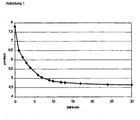
- a typical pH curve when mixing equal parts by volume of both components is shown in Figure 1.
- the duration, intensity, range and direction of the pH curve can be determined by selection and combination of the respective acid and base, their respective use concentration and their concentration ratios to each other and adjusted in a wide range.
- the method described here for establishing a temporal pH gradient by retarded salt formation can be used for products based on dispersions of all kinds, such as O / W and W / O emulsions, microemulsions, suspensions, liquid crystalline phases, gels, foams, aerosols, for the purpose of cleaning, care, sealing, coloring or other treatment of surfaces.
- the two-component agent is particularly suitable for packaging as a cosmetic agent, preferably for the skin, tooth and hair cosmetics.
- the two-component agent used is a hair cosmetic product, for. Hair conditioner, shampoo, styling gel, hair fixative, permanent waving agent, fixation, hair bleach, hair color or hair color. It then preferably contains 1 to 20 wt.% Of a lipophilic compound, which is preferably selected from fatty alcohol, triglyceride, paraffin oil or wax.
- the invention has the further object to provide a method and a means for permanent deformation of hair, in which the pH decreases in the course of the exposure time, so that the reducing power of the corrugating agent weakened during the exposure time and thereby the hair structure is protected Of course, nevertheless, a sufficient deformation of the hair should be achieved.
- the invention therefore also provides a process for the permanent deformation of hair according to claim 18.
- the initial pH of the alkaline duration former is from 8 to 9.5 and is lowered by 0.8 to 2.0 units within 10 to 30 minutes. More preferably, the initial pH of the permanent shaping agent is reduced by at least one unit to a pH between 6.5 to 7.3 within 7 to 20 minutes.
- the application temperature is preferably 20 to 45 ° C, particularly preferably 30 to 40 ° C.
- the degree of dissociation of the reducing agent and thus the waviness during the exposure time can be controlled to the desired extent by decreasing the alkalinity.
- the initial pH is reduced within 7 to 20 minutes by at least one unit to a pH between 6.5 to 7.3. It is particularly advantageous if two-component permanent shaping agent is a permanent wave agent, the initial pH value is 8 to 9.5 and is lowered by 0.8 to 2.0 units within 10 to 30 minutes.
- the two-component permanent shaping agent is a Haarentk syndromeselungsstoff whose pH is initially 11 to 13 and is lowered within 10 to 30 minutes by 2 to 4 units.
- the exposure time of the hair styling agent can be accelerated by the usually used in Haarverformungs reflex attain reaching heat.
- thioglycolic acid thioglycolic acid amides, thioglycerol
- keratin-reducing active substance in the two-component permanent shaping agent.
- the keratin-reducing agent is contained in the ready-to-use permanent hair-styling agent in an amount of 1 to 25% by weight, preferably 5 to 15% by weight.
- the ready-to-use permanent deformation agent can be any of the usual and known additives for such agents, e.g. B. thickeners, such as, bentonite, fatty acids, starch, polyacrylic acid and derivatives thereof, cellulose derivatives, alginates, petrolatum, paraffin oils, wetting agents or emulsifiers from the classes of anionic, cationic, amphoteric or nonionic surfactants, for example fatty alcohol sulfates, fatty alcohol ether sulfates, alkyl sulfonates, Alkylbenzenesulfates, quaternary ammonium salts, alkyl betaines, ethoxylated alkylphenols, fatty acid alkanolamides or ethoxylated fatty acid esters, further opacifiers, such as.
- B. thickeners such as, bentonite, fatty acids, starch, polyacrylic acid and derivatives thereof, cellulose derivatives, alginates, petrol
- alcohols such as.
- Alcohols such as ethanol, propanol, isopropanol
- polyols such as ethylene glycol, 1,2- or 1,3-propanediol, 1,2-, 1,3- or 1,4-butanediol, 1,2-, 1 , 3-, 1,4- or 1,5-pentanediol and glycerol
- Sugar such as As D-glucose, solubilizers, stabilizers, buffer substances, perfume oils, dyes and hair conditioning and hair care ingredients such.
- cationic polymers lanolin derivatives, cholesterol, pantothenic acid and betaine.
- the mentioned ingredients are used in the ready-to-use permanent deformation agent in the amounts customary for such purposes, e.g.
- the wetting agents and emulsifiers in concentrations of altogether 0.2 to 30 wt .-%, the alcohols in a total amount of 0.1 to 20 wt .-%, the opacifiers, perfume oils and dyes in an amount of 0, 01 to 1 wt .-%, the buffer substances in a total amount of 0.1 to 10 wt .-%, sugar, solubilizers, stabilizers, as well as hair conditioning and hair care ingredients in an amount of 0.1 to 5 wt. %, while the thickening agents and solubilizers in a total amount of 0.5 to 20 wt .-% may be contained in this agent.
- source and penetration substances such as. Example, dipropylene glycol monomethyl ether, 2-pyrrolidone or imidazolidin-2-one, be contained in an amount of 1 to 30 wt .-%.
- the ready-for-use hair-styling agent is obtained by mixing the components (A) and (B). It is best if the ready-to-use agent is prepared immediately (2 seconds to 3 minutes) before use by mixing the two components, component (B) preferably containing the keratin reducing agent and the base and component (A) containing the acid , One of the two components may be in solid form when the other is in liquid form; Preferably, both components are liquid or thickened.
- the agent is advantageously packaged as a 2-component packaging.
- the hair is treated as follows:
- the acid-containing component (A) is added to component (B) before use, which contains the mercapto compound and the base in solution.
- the wound hairs are now wetted in a known manner with the ready-to-use shaping agent.
- the original pH of the mixture of 7.5 to 10 decreases during the exposure time to 6.0 to 7.5.
- the exposure time depends on the strength of the desired curl and on the treatment temperature.
- the hair rinsed with water and then treated by oxidation (“fixed").
- the aftertreatment agent is used, depending on the amount of hair, preferably in an amount of 80 to 100 grams.
- any aftertreatment agent suitable for such a treatment can be used.
- oxidizing agents usable in such after-treatment agents are potassium and sodium bromate, sodium perborate, urea and hydrogen peroxide.
- the concentration of the oxidizing agent varies depending on the application time (usually 5 to 15 minutes) and the application temperature. Normally, the oxidizing agent is present in the ready-to-use aqueous post-treatment agent in a concentration of 0.5 to 10% by weight.
- the agent for the oxidative aftertreatment can of course other substances such.
- care agents such as cationic polymers, weak acids, buffer substances or peroxide stabilizers, and in the form of an aqueous solution, an emulsion and in thickened form on an aqueous basis, in particular as a cream, gel or paste.
- these conventional additives may be contained in the after-treatment agent in an amount of 0.1 to 10% by weight.
- the winder is removed. If necessary, the unwound hair can now be re-treated oxidatively. Then the hair is rinsed with water, optionally placed to the water wave and finally dried.
- the agent or the method causes an elastic, permanent and uniform transformation from the hairline to the hair tip, without causing allergic or sensitizing reactions while largely sparing the hair structure from damage.
- the agent is a two-component conditioner, preferably two cationic hair care treatments are prepared, which are intimately mixed with each other immediately before use:
- An acidic ( Cure S ) which additionally contains a carboxylic acid in the fatty alcohol phase (it is based on the usual acidification dispensed with and the pH is already in the cure S 3 to 4) and a basic set cure ( cure B ).
- Cure S which additionally contains a carboxylic acid in the fatty alcohol phase (it is based on the usual acidification dispensed with and the pH is already in the cure S 3 to 4)
- the glycerine or oil bath must be at about 120 ° C be melted.
- the temporal pH curve can either be monitored by pH measurement and / or visualized by means of suitable indicator dyes.
- a typical pH curve for mixtures of equal volumes of Kur S and Kur B is shown in Figure 1.
- a basic component B (Course) (Cure B) sebacic 2.0 g 0.7 g myristyl - 2.0 g Bromothymol blue (pH indicator) - 0.2 g Cetylstearyl alcohol (Lanette ® O) 4.0 g 4.0 g cetyltrimethylammonium 1.0 g 1.0 g water ad 100.0 g ad 100.0 g PH value 3.0 9.5
- Cure S (Component A): The fatty alcohol is melted together with the hydrophobic acid at 90 ° C in a water bath with stirring until a clear phase results.
- the water phase consisting of cetyltrimethylammonium chloride and water, is heated to 85 ° C. This is emulsified into the liquid fatty phase at 85 ° C with stirring. In a cold water bath, the resulting emulsion is also cooled with stirring to room temperature.
- Cure B (component B): The fatty alcohol is together with the hydrophobic acid, the fatty amine and the indicator dye at 90 ° C in a water bath under Stirring until a clear phase results.
- the water phase consisting of cetyltrimethylammonium chloride and water, is heated to 85 ° C. This is emulsified into the liquid fatty phase at 85 ° C with stirring. In a cold water bath, the resulting emulsion is also cooled with stirring to room temperature.
- the initial pH of the mixture is 7.8.
- the present two-component treatment is designed so that when applying equal volumes of the two components after about 10 minutes at all points the color final value has been reached. Deviations from this mixing ratio in favor of the acid component A or in favor of the basic component B, in contrast, lead to an acceleration or deceleration of the color change.
- the cure has a bright blue color immediately after mixing, which changes more and more to a pale shade of yellow within 8 to 12 minutes.
- raw materials acidic component A basic component B sebacic 1.0 g - hexadecylamine - 1.0 g Cetylstearylalkohol 2.0 g 2.0 g (Lanette O) ethoxylated cetylsteary 0.5 g 0.5 g alcohol (25 EO) thioglycolic 10.5 g 10.5 g Ammonia 25% 5.7 g 10.6 g water ad 100.0 g ad 100.0 g PH value: 3.5 9.1
- both components A and B are mixed in a ratio of 1: 1 and then the ready-to-use permanent waving agent is applied to the hair.
- a pH of 8.5 is obtained for the mixture which decreases over the 15 minute exposure time to a final pH of 7.0.
- both components A and B are mixed and then apply the ready-to-use cream on the hair.
- a pH of 9.5 is obtained for the mixture, which gradually decreases in the course of the exposure time of 12 minutes to the neutral pH range.
Landscapes
- Health & Medical Sciences (AREA)
- Life Sciences & Earth Sciences (AREA)
- Chemical & Material Sciences (AREA)
- Animal Behavior & Ethology (AREA)
- General Health & Medical Sciences (AREA)
- Public Health (AREA)
- Veterinary Medicine (AREA)
- Birds (AREA)
- Epidemiology (AREA)
- Organic Chemistry (AREA)
- Emergency Medicine (AREA)
- Inorganic Chemistry (AREA)
- Engineering & Computer Science (AREA)
- Oil, Petroleum & Natural Gas (AREA)
- Cosmetics (AREA)
Description
- Verfahren zur Behandlung von Haaren, insbesondere zur Pflege oder zur dauerhaften Verformung von Haaren, unter Verwendung eines Zweikomponenten-Mittels mit einem sich nach dem Vermischen der Komponenten verzögerten, innerhalb von 1 bis 60 Minuten selbsttätig verändernden pH-Wert, enthaltend in einer Komponente (A) mindestens eine Säure und in einer anderen Komponente (B) mindestens eine Base, wobei die Säure und/oder die Base eine geringe Wasserlöslichkeit aufweisen.
- Wenngleich die meisten chemischen, technischen, lebensmitteltechnologischen und kosmetischen Produkte von Beginn bis Ende der Anwendung den gleichen pH-Wert haben (sollen), gab es für spezielle Anwendungen immer wieder Versuche, Systeme zu schaffen, die nach der Applikation ihren pH selbstständig ändern.
- Für diese Anforderung können verschiedene Gründe vorliegen, beispielsweise:
- Eine Substanz ist bei dem pH, bei dem sie ihre Wirkung am besten entfalten kann, nur begrenzt lagerstabil;
- eine pH-abhängige Wirkung soll in ihrer Intensität zeitabhängig gesteuert werden;
- zwei pH-abhängige Wirkungen mit unterschiedlichem pH-Optimum sollen, trotz nur einmaliger Auftragung, nacheinander ablaufen;
- eine Reaktionsverzögerung soll erreicht werden, um eine vorherige Diffusion zu ermöglichen;
- Ein Farbumschlag soll das Ende einer Einwirkzeit anzeigen.
- Aus der eigenen DE 1089124 A1 ist ein Verfahren zur Dauerverformung bekannt, bei dem man mit Hilfe von Urease aus Harnstoff allmählich Ammoniak freisetzt und so für einen Anstieg des pH während der Einwirkungszeit sorgt.
- Aus der eigenen DE 2349050 A ist ein Mittel und ein Verfahren bekannt, bei dem die Wellaktivität über das Absenken des Anfangs-pH-Wertes kontinuierlich verringert wird. Dem Verformungsmittel werden kurz vor dem Gebrauch solche alkalisch spaltbaren organischen Verbindungen mit Ester- oder Halogengruppen im Molekül zugesetzt, die imstande sind, bei der Spaltung Säure entstehen zu lassen. Dadurch soll die Konzentration an Alkali während der Einwirkungszeit allmählich und in dem gewünschten Umfang abnehmen. Als geeignete Ester sind u. a. Essigsäureethylester und Triacetin genannt. Bei den Estergruppen enthaltenden Verbindungen kann eine Beschleunigung der Spaltung durch zusätzliche Beigabe der Lipase Pankreatin erreicht werden.
- Aus der eigenen DE-PS 19860239 C2 ist ein System bekannt, bei dem durch enzymatische Spaltung von Estern, insbesondere z. B. Triglyceriden, und gleichzeitigem Gegenpuffern der pH-Verlauf einer Dauerwelllösung zeitabhängig absinkt, um die anfänglich hohe Wellaktivität erst nach einiger Zeit abzusenken und zudem ein Unterschreiten von pH 7,0 zu verhindern.
- Aus der eigenen DE 19902246 A1 ist ein System bekannt, bei dem durch nichtenzymatische Hydrolyse eines hinreichend instabilen Lactons eine pH-Absenkung erfolgt, deren Geschwindigkeit und End-pH bei gegebenen Rahmenbedingungen (Temperatur, Anfangs-pH etc.) von Art und Konzentration des betreffenden Eduktes abhängt.
- Jedes dieser Systeme hat jedoch gravierende Nachteile: Wird der pH-Gradient durch enzymkatalysierte Reaktionen erzeugt, so ist die Einstellung (und vor allem die Aufrechterhaltung) eines definierten Verlaufes äußerst schwierig. Unter Lagerbedingungen verändert sich üblicherweise die Enzymaktivität und somit die Kinetik der pH-Änderung. Zudem wird in der Regel eine Drei-Komponenten-Verpackung notwendig sein: Eine für das Hauptprodukt, eine für das (streng wasserfreie) Hydrolyse-Objekt sowie eine für das Enzym. Zusätzlich entsteht bei der Applikation ein Mehraufwand bezüglich des (homogenen, vollständigen!) Mischens der drei Komponenten; auch ist es nicht unproblematisch, die darauf folgende Anwendung hinreireichend schnell durchzuführen.
- Die in der DE 19902246 A1 genutzte Spontanhydrolyse eines Lactons umgeht zwar die Problematik der Enzymkatalyse; allerdings existiert nur eine recht begrenzte Zahl geeigneter Verbindungen. Das Hydrolyseverhalten des jeweiligen Stoffes ist dabei starr in der Natur der Substanz verankert und formulierungstechnisch kaum beeinflussbar, so dass keine nennenswerte Möglichkeit besteht, ein derartiges System an verschiedene Aufgaben oder Gegebenheiten anzupassen.
- Allen hier geschilderten Lösungsansätzen ist zudem gemein, dass kurz vor der Applikation die "normale" Produktmasse mit "unnormalen" Komponenten (wasserfreien Suspensionen, kristallinen oder pulverförmigen Substanzen) versetzt werden müssen (der Ausdruck "normal" bezieht sich hier sowohl auch die chemische Zusammensetzung als auch auf die Anmutung: Farbe, Geruch, Fließverhalten, Viskosität, Haptik).
- Es bestand daher die Aufgabe, ein Verfahren unter Verwendung eines Systems zu entwickeln, das einen zeitlichen pH-Gradienten aufbaut mit folgenden Eigenschaften:
- es enthält nur Komponenten mit "normaler" Anmutung;
- es enthält keine hydrolytisch freizusetzenden Substanzen;
- es enthält keine enzymatisch freizusetzenden Substanzen;
- es weist eine hohe Lagerstabilität aller Komponenten auf;
- es benötigt maximal zwei getrennte Komponenten;
- es ist einstellbar bezüglich der Lage der durchlaufenen pH-Bereiche;
- es ist einstellbar bezüglich der Größe der durchlaufenen pH-Bereiche;
- es ist einstellbar bezüglich Richtung der pH-Änderung;
- es ist einstellbar bezüglich Geschwindigkeit der pH-Änderung;
- Die Aufgabe wird gelöst durch den Gegenstand nach Anspruch 1.
- Bei dem erfindungsgemäßen Verfahren zur Haarbehandlung wird eine Säure mit einer Base in Kontakt gebracht. Die zur Lösung der Aufgabe geeignete Säure und/oder die Base ist - im Gegensatz zu ihrem Salz - nur wenig wasserlöslich. Bevorzugt ist nur die Säure wenig wasserlöslich. Die Salzbildung (z. B. die Bindung der anfangs im Gemisch überschüssigen Base) erfolgt dann hauptsächlich mit jeweils dem kleinen Anteil der Säure, der sich entsprechend der Gleichgewichtskonstanten in Lösung befindet. Aufgrund der geringen Wasserlöslichkeit der Säure erfolgt die Salzbildung (und somit die Neutralisation der Base) verzögert im Rahmen der Gleichgewichtseinstellung. Dabei wird keine Suspension eingesetzt, sondern vorzugsweise ein Co-Emulgat aus einer lipophilen Verbindung (wobei diese bevorzugt ausgewählt ist aus Fettalkohol, Triglycerid, Paraffinöl oder Wachs) und der betreffenden Säure.

- Die für die Erfindung prinzipiell geeigneten Säuren sollten vorzugsweise folgende Eigenschaften aufweisen:
- Geringe Wasserlöslichkeit (vorzugsweise unter 2 %);
- Relativ hohe Acidität;
- Niedriger Schmelzpunkt (vorzugsweise unter 150 °C);
- Kein nennenswerter Eigengeruch;
- Keine nennenswerte Beeinflussung der Standardrezeptur.
- Bevorzugt ist eine Säure und/oder Base, welche bei 20 Grad Celsius in 100 ml Wasser in einer Menge von 0,01 bis 1,0g löslich ist. Besonders bevorzugt ist eine Säure und/oder Base, welche bei 20 Grad Celsius in 100 ml Wasser in einer Menge von 0,05 bis 0,5g löslich ist.
- In einer bevorzugten Ausführungsform des Zweikomponenten-Mittels enthält die eine Komponente (A) als Säure eine hydrophobe, in 100 ml Wasser bei 20 Grad Celsius zu weniger als 3g lösliche Säure und die andere Komponente (B) enthält mindestens eine anorganische Base oder eine organische Base mit 1 bis 40 C-Atomen.
- Die aliphatischen Monocarbonsäuren sind bei denjenigen Kettenlängen, die geruchlich akzeptabel sind, zu wenig acide, wogegen entsprechende Sulfonsäuren auch bei großen Kettenlängen zu leicht wasserlöslich sind. Überraschend besonders geeignet sind hydrophobe Dicarbonsäuren mit 6 bis 22 C-Atomen, wobei die Dicarbonsäuren mit 8 bis 16 C-Atomen sich als ideal erwiesen. Diese sind daher besonders bevorzugt. Hydrophobe Dicarbonsäuren mit 6 bis 22 C-Atomen sind einerseits geruchlos, andererseits recht acide und in einem weiten Bereich verschiedener Kettenlängen (Hydrophobizitäten) verfügbar. In diesem Bereich liegen die Dicarbonsäuren mit C8 (Korksäure) bis C22 (Docosandisäure). Sie erzeugen bei Kontakt mit unterschiedlichen Basen unter verschiedenen Bedingungen einen zeitverzögerten pH-Abfall im gewünschten Umfang. Als besonders bevorzugte Säuren sind Sebacinsäure, Dodecandisäure und Tetradecandisäure zu nennen.
- Als Basen kommen vor allem anorganische Basen, insbesondere LiOH, NaOH, KOH, Ca(OH)2, Ammoniak und Hydrazin in Betracht, während geeignete organische Basen solche mit 1 bis 30 C-Atomen sind. Beispiele für geeignete organische Basen sind primäre, sekundäre und tertiäre Alkylaminen, Alkyldiamine und Alkylolamine mit 2 bis 20 C-Atomen je Alkylrest.
- Sowohl die Säure als auch die Base können jeweils in einer Konzentration von 0,01 bis 10 Gew.% bezogen auf das Gemisch der Komponenten (A) und (B) vorliegen.
- Eine bevorzugte Ausführungsform des Zweikomponenten-Mittels ist dadurch gekennzeichnet, dass sich nach dem Mischen der Komponenten ein zeitlicher pH-Gradient einstellt, wobei, ausgehend vom Anfangs-pH der Mischung, der End-pH innerhalb einer Zeitspanne zwischen 2 und 100 Minuten erreicht wird.
Besonders bevorzugt ist ein Mittel, bei dem der End-pH innerhalb einer Zeitspanne zwischen 4 und 30 Minuten erreicht wird, wobei besonders bevorzugt ist, dass sich der pH vom höheren Anfangs-pH zu einem niedrigeren End-pH hin verändert. - In einer bevorzugten Ausführungsform der Erfindung kann der pH-Verlauf durch Zugabe eines oder mehrerer Indikatorfarbstoffe, die ihren Farbumschlag im Bereich der pH-Änderung haben, zu einer der Komponenten (A) oder (B) sichtbar gemacht werden. Je nach pH-Verlauf und Art des Indikators kann so ein Farbeindruck entstehen, verschwinden oder sich ändern.
- Eine Erhöhung der Verzögerungszeit unter gleichzeitiger Erniedrigung des erreichbaren End-pH konnte überraschenderweise dadurch erreicht werden, dass in einer weiteren Ausführungsform eine ebenfalls wenig in Wasser lösliche Base wie z. B. Myristylamin in die alkalische Komponente (B) eingearbeitet wird. Diese kann ggf. durch Teilneutralisation mit einer geeigneten organischen oder anorganischen Säure auf den gewünschten Anfangs-pH eingestellt werden.
- Eine weitere Ausführungsform der Erfindung besteht aus der Kombination von mittels hydrophober Dicarbonsäure teilneutralisiertem Fettamin in der Fettphase der basischen Komponente (B). Einen typischen pH-Verlauf bei Mischung gleicher Volumenteile beider Komponenten zeigt Abbildung 1.
- Die Zeitdauer, Intensität, Bereichswahl und Richtung des pH-Verlaufes kann durch Auswahl und Kombination der jeweiligen Säure und Base, deren jeweiliger Einsatzkonzentration sowie deren Konzentrationsverhältnisse zueinander bestimmt und in weiten Bereichen eingestellt werden.
- Die hier geschilderte Methode zum Aufbau eines zeitlichen pH-Gradienten durch retardierte Salzbildung kann genutzt werden für Produkte auf Basis von Dispersionen aller Art wie O/W- und W/O-Emulsionen, Mikroemulsionen, Suspensionen, flüssigkristallinen Phasen, Gelen, Schäumen, Aerosolen, zum Zwecke der Reinigung, Pflege, Versiegelung, Färbung oder sonstiger Behandlung von Oberflächen.
- Das Zweikomponenten-Mittel ist insbesondere geeignet zur Konfektionierung als kosmetisches Mittel, vorzugsweise für die Haut-, Zahn- und Haarkosmetik. Besonders bevorzugt ist das verwendete Zweikomponenten-Mittel ein haarkosmetisches Produkt, z. B. Haarkur, Shampoo, Stylinggel, Haarfestiger, Dauerwellmittel, Fixierung, Haarbleichmittel, Haarfarbe oder Haartönung. Es enthält dann bevorzugt 1 bis 20 Gew.% einer lipophilen Verbindung, wobei diese bevorzugt ausgewählt ist aus Fettalkohol, Triglycerid, Paraffinöl oder Wachs.
- Der Erfindung liegt die weitere Aufgabe zugrunde, ein Verfahren und ein Mittel zur dauerhaften Verformung von Haaren zur Verfügung zu stellen, bei dem der pH-Wert im Verlauf der Einwirkungszeit sinkt, damit die Reduktionskraft des Wellmittels während der Einwirkungszeit geschwächt und dadurch die Haarstruktur geschont wird, wobei selbstverständlich dennoch eine ausreichende Umformung der Haare erreicht werden soll.
- Es wurde nunmehr überraschend gefunden, dass sich die vorstehend genannten Nachteile der Verfahren des Standes der Technik durch ein Verfahren nach Anspruch 18 vermeiden lassen.
- Gegenstand der Erfindung ist daher auch ein Verfahren zur dauerhaften Verformung von Haaren nach Anspruch 18.
- Bevorzugt liegt der anfängliche pH-Wert des alkalischen Dauerverformungsmittels bei 8 bis 9,5 und wird innerhalb von 10 bis 30 Minuten um 0,8 bis 2,0 Einheiten abgesenkt. Besonders bevorzugt wird der anfängliche pH-Wert des Dauerverformungsmittels innerhalb von 7 bis 20 Minuten um mindestens eine Einheit auf einen pH-Wert zwischen 6,5 bis 7,3 herabgesetzt. Die Anwendungstemperatur beträgt vorzugsweise 20 bis 45 °C, besonders bevorzugt 30 bis 40 °C.
- Durch geeignete Auswahl der Säure und der Base sowie deren Konzentration lässt sich so über die Abnahme der Alkalität der Dissoziationsgrad des Reduktionsmittels und damit die Wellwirksamkeit während der Einwirkungszeit in gewünschtem Maße steuern.
- Bevorzugt ist es, wenn der anfängliche pH-Wert innerhalb von 7 bis 20 Minuten um mindestens eine Einheit auf einen pH-Wert zwischen 6,5 bis 7,3 herabgesetzt wird. Besonders vorteilhaft ist es, wenn Zweikomponenten-Dauerverformungsmittel ein Dauerwellmittel ist, der pH-Wert anfänglich 8 bis 9,5 beträgt und innerhalb von 10 bis 30 Minuten um 0,8 bis 2,0 Einheiten abgesenkt wird.
- In einer ebenfalls bevorzugten Ausführungsform der Erfindung ist das Zweikomponenten-Dauerverformungsmittel ein Haarentkräuselungsmittel, dessen pH-Wert anfänglich 11 bis 13 beträgt und innerhalb von 10 bis 30 Minuten um 2 bis 4 Einheiten abgesenkt wird.
- Die Einwirkungszeit des Haarverformungsmittels lässt sich durch die üblicherweise bei Haarverformungsbehandlungen zum Einsatz gelangende Wärmezufuhr beschleunigen.
- Als keratinreduzierender Wirkstoff kann in dem Zweikomponenten-Dauerverformungsmittel insbesondere Thioglykolsäure, Thioglykolsäureamide, Thioglycerin, Thiomilchsäure, 3-Mercaptopropionsäure, Cystein, Cysteamin, Homocystein, Alkyl- oder Acylcysteine oder die Salze dieser Verbindungen, insbesondere Ammoniumthioglykolat, verwendet werden. Der keratinreduzierende Wirkstoff ist in dem gebrauchsfertigen Mittel zur dauerhaften Haarverformung in einer Menge von 1 bis 25 Gew.-%, vorzugsweise 5 bis 15 Gew.-%, enthalten.
- Selbstverständlich kann das gebrauchsfertige Mittel zur dauerhaften Verformung alle für derartige Mittel üblichen und bekannten Zusatzstoffe, z. B. Verdickungsmittel, wie beispielsweise, Bentonit, Fettsäuren, Stärke, Polyacrylsäure und deren Derivate, Cellulosederivate, Alginate, Vaseline, Paraffinöle, Netzmittel oder Emulgatoren aus den Klassen der anionischen, kationischen, amphoteren oder nichtionogenen oberflächenaktiven Substanzen, beispielsweise Fettalkoholsulfate,Fettalkoholethersulfate, Alkylsulfonate, Alkylbenzolsulfate, quaternäre Ammoniumsalze, Alkylbetaine, oxethylierte Alkylphenole, Fettsäurealkanolamide oder oxethylierte Fettsäureester, ferner Trübungsmittel, wie z. B. Polyethylenglykolester, Alkohole, wie z. B. ; Alkohole, wie zum Beispiel Ethanol, Propanol, Isopropanol, Polyole wie zum Beispiel Ethylenglykol, 1,2- oder 1,3-Propandiol, 1,2-, 1,3- oder 1,4-Butandiol, 1,2-, 1,3-, 1,4-oder 1,5-Pentandiol und Glycerin; Zucker wie z. B. D-Glucose, Lösungsvermittler, Stabilisatoren, Puffersubstanzen, Parfümöle, Farbstoffe sowie haarkonditionierende und haarpflegende Bestandteile, wie z. B. kationische Polymere, Lanolinderivate, Cholesterin, Pantothensäure und Betain, enthalten.
- Die erwähnten Bestandteile werden in dem gebrauchsfertigen Mittel zur dauerhaften Verformung in den für solche Zwecke üblichen Mengen verwendet, z. B. die Netzmittel und Emulgatoren in Konzentrationen von insgesamt 0,2 bis 30 Gew.-%, die Alkohole in einer Menge von insgesamt 0,1 bis 20 Gew.-%, die Trübungsmittel, Parfümöle und Farbstoffe in einer Menge von jeweils 0,01 bis 1 Gew.-%, die Puffer-substanzen in einer Menge von insgesamt 0,1 bis 10 Gew.-%, Zucker, Lösungsvermittler, Stabilisatoren, sowie haarkonditionierende und haarpflegende Bestandteile in einer Menge von jeweils 0,1 bis 5 Gew.-%, während die Verdickungsmittel und Lösungsvermittler in einer Menge von insgesamt 0,5 bis 20 Gew.-% in diesem Mittel enthalten sein können.
- Weiterhin können in diesem Mittel zur Wirkungssteigerung sogenannte Quell- und Penetrationsstoffe, wie z. B. Dipropylenglykolmonomethylether, 2-Pyrrolidon oder Imidazolidin-2-on, in einer Menge von 1 bis 30 Gew.-% enthalten sein.
- Das gebrauchsfertige Mittel zur dauerhaften Verformung von Haaren wird erhalten durch Vermischen der Komponenten (A) und (B). Am günstigsten ist es, wenn das gebrauchsfertige Mittel unmittelbar (2 Sekunden bis 3 Minuten) vor der Anwendung durch Vermischen der zwei Komponenten hergestellt wird, wobei die Komponente (B) vorzugsweise den keratinreduzierenden Wirkstoff und die Base enthält und die Komponente (A) die Säure. Eine der beiden Komponenten kann in fester Form vorliegen, wenn die andere in flüssiger Form vorliegt; bevorzugt sind beide Komponenten flüssig oder verdickt. Das Mittel ist dabei vorteilhaft als 2-Komponentenverpackung konfektioniert.
- In einer bevorzugten Ausführungsform der erfindungsgemäßen Verfahrens zur dauerhaften Haarverformung werden die Haare wie folgt behandelt: Man gibt die eine Säure enthaltende Komponente (A) vor der Anwendung zur Komponente (B), welche die Mercaptoverbindung und die Base in Lösung enthält. Die gewickelten Haare werden nun in bekannter Weise mit dem gebrauchsfertigen Verformungsmittel benetzt. Der ursprüngliche pH-Wert der Mischung von 7,5 bis 10 sinkt während der Einwirkungszeit bis auf 6,0 bis 7,5 ab. Die Einwirkungszeit ist abhängig von der Stärke der gewünschten Krause und von der Behandlungstemperatur.
- Nach einer für die dauerhafte Verformung des Haares ausreichenden Einwirkungszeit, welche je nach Haarbeschaffenheit, der Verformungswirksamkeit des Verformungsmittels sowie in Abhängigkeit von der Anwendungstemperatur 5 bis 30 Minuten (10 bis 30 Minuten ohne Wärmeeinwirkung oder 5 bis 20 Minuten mit Wärmeeinwirkung) beträgt, wird das Haar mit Wasser gespült und dann oxidativ nachbehandelt ("fixiert"). Das Nachbehandlungsmittel wird, je nach Haarfülle, vorzugsweise in einer Menge von 80 bis 100 Gramm, verwendet.
- Für die oxidative Nachbehandlung im aufgewickelten oder abgewickelten Zustand kann jedes beliebige, für eine derartige Behandlung geeignete Nachbehandlungsmittel verwendet werden. Beispiele für in solchen Nachbehandlungsmitteln verwendbare Oxidationsmittel sind Kalium- und Natriumbromat, Natriumperborat, Harnstoff- und Wasserstoffperoxid. Die Konzentration des Oxidationsmittels ist in Abhängigkeit von der Anwendungszeit (in der Regel 5 bis 15 Minuten) und der Anwendungstemperatur unterschiedlich. Normalerweise liegt das Oxidationsmittel in dem gebrauchsfertigen wässrigen Nachbehandlungsmittel in einer Konzentration von 0,5 bis 10 Gew.-% vor. Das Mittel für die oxidative Nachbehandlung kann selbstverständlich weitere Stoffe, wie z. B. Netzmittel, Pflegestoffe wie kationaktive Polymere, schwache Säuren, Puffersubstanzen oder Peroxidstabilisatoren, enthalten und in Form einer wässrigen Lösung, einer Emulsion sowie in verdickter Form auf wässriger Basis, insbesondere als Creme, Gel oder Paste, vorliegen. Diese üblichen Zusätze können insbesondere in einer Menge von 0,1 bis 10 Gew.-% in dem Nachbehandlungsmittel enthalten sein.
- Anschließend werden die Wickler entfernt. Falls erforderlich, kann das abgewickelte Haar nun nochmals oxidativ nachbehandelt werden. Dann wird das Haar mit Wasser gespült, gegebenenfalls zur Wasserwelle gelegt und schließlich getrocknet.
- Das Mittel bzw. das Verfahren bewirkt eine elastische, dauerhafte und gleichmäßige Umformung vom Haaransatz bis zur Haarspitze, ohne allergische oder sensibilisierende Reaktionen hervorzurufen unter weitgehender Schonung der Haarstruktur vor Schädigung.
- Ist das Mittel eine Zweikomponenten-Haarkur, so werden vorzugsweise zwei kationische Haarpflegekuren hergestellt, die unmittelbar vor der Anwendung miteinander innig vermischt werden: Eine saure Kur (Kur S), die in der Fettalkoholphase zusätzlich eine Carbonsäure enthält (dabei wird auf die sonst übliche Ansäuerung verzichtet und der pH liegt bei der Kur S bereits zwischen 3 und 4) und eine basisch eingestellte Kur (Kur B). Bei Säuren mit höherem Schmelzpunkt, wie Sebacin- oder Korksäure, muss im Glycerin- oder Ölbad bei ca. 120 °C aufgeschmolzen werden. Der zeitliche pH-Verlauf kann entweder über pH-Messung überwacht werden und/oder mittels geeigneter Indikatorfarbstoffe sichtbar gemacht werden. Einen typischen pH-Verlauf bei mischungen gleicher Volumina von Kur S und Kur B zeigt Abbildung 1.
-
Rohstoffe saure Komponente A basische Komponente B (Kur S) (Kur B) Sebacinsäure 2,0 g 0,7 g Myristylamin - 2,0 g Bromthymolblau (pH-Indikator) - 0,2 g Cetylstearylalkohol (Lanette® O) 4,0 g 4,0 g Cetyltrimethylammoniumchlorid 1,0 g 1,0 g Wasser ad 100,0 g ad 100,0 g pH-Wert 3,0 9,5 - Kur S (Komponente A): Der Fettalkohol wird gemeinsam mit der hydrophoben Säure bei 90 °C im Wasserbad unter Rühren geschmolzen, bis sich eine klare Phase ergibt. Die Wasserphase, bestehend aus Cetyltrimethylammoniumchlorid und Wasser, wird auf 85 °C erhitzt. Diese wird in die flüssige Fettphase bei 85 °C unter Rühren einemulgiert. In einem kalten Wasserbad wird die entstandene Emulsion ebenfalls unter Rühren auf Raumtemperatur abgekühlt.
- Kur B (Komponente B): Der Fettalkohol wird gemeinsam mit der hydrophoben Säure, dem Fettamin und dem Indikatorfarbstoff bei 90 °C im Wasserbad unter Rühren geschmolzen, bis sich eine klare Phase ergibt. Die Wasserphase, bestehend aus Cetyltrimethylammoniumchlorid und Wasser, wird auf 85 °C erhitzt. Diese wird in die flüssige Fettphase bei 85 °C unter Rühren einemulgiert. In einem kalten Wasserbad wird die entstandene Emulsion ebenfalls unter Rühren auf Raumtemperatur abgekühlt.
- Anwendung: Unmittelbar vor dem Gebrauch werden gleiche Volumina von Kur S und Kur B innig miteinander vermischt. Im Endprodukt sollte, bei Verwendung einer Zweikomponentenverpackung, zumindest eine Vormischung (z. B. wie bei einer Streifen-Zahncreme) erfolgen. Beim Einarbeiten ins Haar wird dann die endgültige Durchmischung vollzogen.
- Der Anfangs-pH der Mischung liegt bei 7,8. Die vorliegende Zweikomponenten-Kur ist darauf eingerichtet, dass bei Applikation gleicher Volumina der beiden Komponenten nach ca. 10 Minuten an allen Stellen der Farbendwert erreicht worden ist. Abweichungen von diesem Mischungsverhältnis zugunsten der sauren Komponente A oder zugunsten der basischen Komponente B führen demgegenüber zu einer Beschleunigung bzw. Verzögerung des Farbumschlages.
- Die Kur hat unmittelbar nach dem Vermischen eine kräftig blaue Farbe, die sich im Laufe von 8 bis 12 Minuten immer mehr zu einem blassen Gelbton verändert.
-
Rohstoffe saure Komponente A basische Komponente B Sebacinsäure 1,0 g - Hexadecylamin - 1,0 g Cetylstearylalkohol 2,0 g 2,0 g (Lanette O) ethoxylierter Cetylsteary- 0,5 g 0,5 g lalkohol (25 EO) Thioglykolsäure 10,5 g 10,5 g Ammoniak 25%ig 5,7 g 10,6 g Wasser ad 100,0 g ad 100,0 g pH-Wert: 3,5 9,1 - Unmittelbar vor der Anwendung werden beide Komponenten A und B im Verhältnis 1 : 1 vermischt und anschließend das gebrauchsfertige Dauerwellmittel auf das Haar aufgebracht. Man erhält für das Gemisch einen pH-Wert von 8,5 der sich im Verlauf der Einwirkungszeit von 15 Minuten bis auf einen End-pH-Wert von 7,0 verringert.
-
Rohstoff saure Komponente A basische Komponente B Tetradecandisäure 2,00 g - Ammoniak - - 2,00 g ethoxylierter Laurylalkohol, (3 , EO) 4,00 g 4,00 g C16-18-Fettalkohol 8,00 g 8,00 g Komplexbildner - 0,20 g Natriumsulfit - 1,00 g Parfümöl 0,50 g 0,50 g p-Aminophenol - 0,10 g p-Toluylendiamin : 0,20 g o-Nitro-p-phenylendiamin - 0,10 g p-Nitro-o-aminophenol - 0,05 g Resorcin - 0,05 g Wasserstoffperoxid 6,00 g - Wasser ad 100,00 g ad 100,00 g pH Wert: ca. 3,0 ca. 10,0 - Unmittelbar vor der Anwendung werden beide Komponenten A und B vermischt und anschließend die gebrauchsfertige Cremehaarfarbe auf das Haar aufgebracht. Man erhält für das Gemisch einen pH-Wert von 9,5 der im Lauf der Einwirkungszeit von 12 Minuten allmählich in den neutralen pH-Bereich absinkt.
Claims (21)
- Verfahren zur Behandlung von Haaren, bei dem man unmittelbar vor der Anwendung eine Komponente (A) eines Zweikomponenten-Mittels, die mindestens eine Säure enthält mit einer Komponente (B) des Zweikomponenten-Mittels, die mindestens eine Base enthält, vermischt, wobei sich nach dem Vermischen der Komponenten der pH-Wert allmählich innerhalb von 1 bis 60 Minuten selbsttätig verändert, das Haar mit dem gebrauchsfertigen Mittel behandelt und nach der Einwirkungszeit aus dem Haar ausspült, dadurch gekennzeichnet, dass die Säure und/oder die Base in 100 ml Wasser bei 20 Grad Celsius zu weniger als 3g löslich ist.
- Verfahren nach Anspruch 1, dadurch gekennzeichnet, dass die Säure und/oder die Base bei 20 Grad Celsius in 100 ml Wasser in einer Menge von 0,01 bis 0,5g löslich ist.
- Verfahren nach Anspruch einem der Ansprüche 1 oder 2, dadurch gekennzeichnet, dass die Komponente (A) als Säure eine hydrophobe, in 100 ml Wasser bei 20 Grad Celsius zu weniger als 3g lösliche Säure enthält und die Komponente (B) mindestens eine anorganische Base oder eine organische Base mit 1 bis 40 C-Atomen enthält.
- Verfahren nach einem der Ansprüche 1 bis 3, dadurch gekennzeichnet, dass die hydrophobe Säure eine Dicarbonsäure mit 6 bis 22 C-Atomen ist.
- Verfahren nach Anspruch 4, dadurch gekennzeichnet, dass die hydrophobe Säure eine Dicarbonsäure mit 8 bis 16 C-Atomen ist.
- Verfahren nach einem der Ansprüche 1 bis 5, dadurch gekennzeichnet, dass die hydrophobe Säure ausgewählt ist aus Sebacinsäure, Dodecandisäure und Tetradecandisäure.
- Verfahren nach einem der Ansprüche 1 bis 6, dadurch gekennzeichnet, dass die Base eine anorganische Base ist und ausgewählt ist aus LiOH, NaOH, KOH, Ca(OH)2, Ammoniak und Hydrazin.
- Verfahren nach einem der Ansprüche 1 bis 6, dadurch gekennzeichnet, dass die Base eine organische Base mit 1 bis 20 C-Atomen ist.
- Verfahren nach Anspruch 8, dadurch gekennzeichnet, dass die organische Base ausgewählt ist aus Alkylaminen und Alkylolaminen.
- Verfahren nach einem der Ansprüche 1 bis 9, dadurch gekennzeichnet, dass die Säure und die Base jeweils in einer Konzentration von 0,01 bis 10 Gew.% bezogen auf das Gemisch der Komponenten (A) und (B) vorliegen.
- Verfahren gemäß einem der Ansprüche 1 bis 10, dadurch gekennzeichnet, dass sich nach dem Mischen der Komponenten ein zeitlicher pH-Gradient einstellt, wobei, ausgehend vom Anfangs-pH der Mischung, der End-pH innerhalb einer Zeitspanne zwischen 2 und 100 Minuten erreicht wird.
- Verfahren nach Anspruch 11, dadurch gekennzeichnet, dass, der End-pH innerhalb einer Zeitspanne zwischen 4 und 30 Minuten erreicht wird.
- Verfahren nach Anspruch 12, dadurch gekennzeichnet, dass sich der pH vom höheren Anfangs-pH zu einem niedrigeren End-pH hin verändert.
- Verfahren nach einem der Ansprüche 1 bis 13, dadurch gekennzeichnet, dass mindestens eine der Komponeneten (A) oder (B) einen pH-Indikator enthält, der seinen Farbumschag im Bereich der pH-Änderung hat.
- Verfahren nach Anspruch 1, dadurch gekennzeichnet, dass das verwendete Mittel ein Haarpflegemittel oder Haardauerverformungsmittel ist.
- Verfahren nach einem der Ansprüche 1 bis 15, dadurch gekennzeichnet, dass das verwendete Mittel 1 bis 20 Gew.% einer lipophilen Verbindung enthält.
- Verfahren nach Anspruch 16, dadurch gekennzeichnet, dass die lipophilen Verbindung ausgewählt ist aus Fettalkohol, Triglycerid, Paraffinöl oder Wachs.
- Verfahren zur dauerhaften Verformung von Haaren, bei dem man unmittelbar vor der Anwendung die Komponente (B) eines Zweikomponenten-Dauerverformungsmittels mit einem Gehalt an einem keratinreduzierenden Wirkstoff und einer Base mit einem anfänglichen pH-Wert von 7,5 bis 10 mit der zweiten Komponente (A), enthaltend eine Säure, zum gebrauchsfertigen Dauerverformungsmittel vermischt, wobei sich nach dem Vermischen der Komponenten der pH-Wert allmählich innerhalb von 1 bis 60 Minuten selbsttätig verändert, das Haar bevor und/oder nachdem man es in der gewünschten Form festhält, mit dem gebrauchsfertigen Mittel behandelt, nach der Einwirkungszeit das Haar mit Wasser spült, oxidativ nachbehandelt, erneut mit Wasser spült, gegebenenfalls zur Wasserwelle legt, und sodann trocknet, dadurch gekennzeichnet, dass die Säure und/oder die Base in 100 ml Wasser bei 20 Grad Celsius zu weniger als 3g löslich ist.
- Verfahren nach einem der Ansprüche 1 oder 18, dadurch gekennzeichnet, dass der anfängliche pH-Wert des gebrauchsfertigen Zweikomponenten-Mittels innerhalb von 7 bis 20 Minuten um mindestens eine Einheit auf einen pH-Wert zwischen 6,5 bis 7,3 herabgesetzt wird.
- Verfahren nach Anspruch 18, dadurch gekennzeichnet, dass das Zweikomponenten-Dauerverformungsmittel ein Dauerwellmittel ist, der pH-Wert anfänglich 8 bis 9,5 beträgt und innerhalb von 10 bis 30 Minuten um 0,8 bis 2,0 Einheiten abgesenkt wird.
- Verfahren nach Anspruch 18, dadurch gekennzeichnet, dass das Zweikomponenten-Dauerverformungsmittel ein Haarentkräuselungsmittel ist, der pH-Wert anfänglich 11 bis 13 beträgt und innerhalb von 10 bis 30 Minuten um 2 bis 4 Einheiten abgesenkt wird.
Applications Claiming Priority (2)
| Application Number | Priority Date | Filing Date | Title |
|---|---|---|---|
| DE10146350A DE10146350A1 (de) | 2001-09-20 | 2001-09-20 | Zweikomponenten-Mittel mit zeitlichem pH-Gradienten und Verfahren zur Behandlung von Haaren |
| DE10146350 | 2001-09-20 |
Publications (3)
| Publication Number | Publication Date |
|---|---|
| EP1295590A2 EP1295590A2 (de) | 2003-03-26 |
| EP1295590A3 EP1295590A3 (de) | 2004-01-02 |
| EP1295590B1 true EP1295590B1 (de) | 2007-01-03 |
Family
ID=7699665
Family Applications (1)
| Application Number | Title | Priority Date | Filing Date |
|---|---|---|---|
| EP02015153A Revoked EP1295590B1 (de) | 2001-09-20 | 2002-07-06 | Zweikomponenten-Mittel mit zeitlichem pH-Gradienten und Verfahren zur Behandlung von Haaren |
Country Status (5)
| Country | Link |
|---|---|
| US (1) | US7078025B2 (de) |
| EP (1) | EP1295590B1 (de) |
| AT (1) | ATE349999T1 (de) |
| DE (2) | DE10146350A1 (de) |
| ES (1) | ES2278838T3 (de) |
Families Citing this family (22)
| Publication number | Priority date | Publication date | Assignee | Title |
|---|---|---|---|---|
| WO2003099238A1 (en) * | 2002-05-29 | 2003-12-04 | Unilever Plc | Odor control in amine salt containing cosmetic compositions |
| JP2006510681A (ja) * | 2002-12-13 | 2006-03-30 | ユニリーバー・ナームローゼ・ベンノートシヤープ | ヘアトリートメント組成物 |
| US20040185074A1 (en) * | 2003-03-17 | 2004-09-23 | Unilever Home & Personal Care Usa, Division Of Conopco, Inc. | Odor control in amine salt containing cosmetic compositions |
| US20050129645A1 (en) * | 2003-11-18 | 2005-06-16 | L'oreal | Hair shaping composition comprising at least one non-hydroxide imine |
| US20050136018A1 (en) * | 2003-11-18 | 2005-06-23 | Gerard Malle | Hair relaxing composition comprising at least one secondary or tertiary amine |
| US20050186232A1 (en) * | 2003-11-18 | 2005-08-25 | Gerard Malle | Hair-relaxing composition comprising tetramethylguanidine |
| US20060134042A1 (en) * | 2003-11-18 | 2006-06-22 | Gerard Malle | Hair shaping composition comprising at least one tetramethylguanidine |
| US20050136019A1 (en) * | 2003-11-18 | 2005-06-23 | Gerard Malle | Hair shaping composition comprising at least one amine chosen from secondary and tertiary amines |
| US20050136017A1 (en) * | 2003-11-18 | 2005-06-23 | Gerard Malle | Hair relaxing composition comprising at least one non-hydroxide imine |
| US20050125914A1 (en) * | 2003-11-18 | 2005-06-16 | Gerard Malle | Hair shaping composition comprising at least one- non-hydroxide base |
| US7390478B2 (en) * | 2004-02-23 | 2008-06-24 | Sebastian International, Inc. | Hair thickening composition and method |
| PL1737420T3 (pl) * | 2004-04-07 | 2010-11-30 | Unilever Nv | Kompozycje do traktowania włosów |
| ZA200804201B (en) | 2005-12-07 | 2009-10-28 | Unilever Plc | Hair straightening composition comprising a disaccharide |
| US8166412B2 (en) * | 2006-01-13 | 2012-04-24 | Adobe Systems Incorporated | Visual cue discernment on scattered data |
| DE102006020620A1 (de) * | 2006-05-02 | 2007-11-08 | Henkel Kgaa | Mittel zur Behandlung keratinischer Fasern mit Farbindikation der optimalen Behandlungszeit |
| TW200744662A (en) * | 2007-06-28 | 2007-12-16 | jin-long Guo | Process for adjusting pH to complete denaturation of perming (dying), and the utilized pH protein denaturnation |
| EP2340010B1 (de) * | 2008-10-29 | 2017-08-16 | L'Oréal | Verfahren zur entspannung oder streckung von haaren mit schwachen dicarbonsäuren mit wärme |
| WO2010065297A1 (en) * | 2008-12-03 | 2010-06-10 | Avon Products, Inc. | Compositions having a plurality of discrete emulsions |
| EP2857003A1 (de) | 2013-10-02 | 2015-04-08 | The Procter and Gamble Company | Haarpflegezusammensetzung mit Ammoniumthioglycolat und/oder Ammonium-Thiolactat |
| JP6376766B2 (ja) * | 2014-02-10 | 2018-08-22 | ホーユー株式会社 | 酸化染毛剤組成物及び染毛方法 |
| DE102018222134A1 (de) * | 2018-12-18 | 2020-06-18 | Henkel Ag & Co. Kgaa | Zweikomponenten-Haarpflegemittel, Verfahren zur Herstellung eines kosmetischen Mittels und Verwendung des Zweikomponenten-Haarpflegemittels |
| DE102018222132A1 (de) * | 2018-12-18 | 2020-06-18 | Henkel Ag & Co. Kgaa | Zweikomponenten-Haarpflegemittel mit Farbindikator zur Kenntlichmachung des optimalen pH-Werts, Verfahren zum Anwenden desselben und Verwendung desselben |
Family Cites Families (7)
| Publication number | Priority date | Publication date | Assignee | Title |
|---|---|---|---|---|
| DE1089124B (de) | 1959-03-28 | 1960-09-15 | Wella Ag | Verfahren zur Dauerverformung von Haaren |
| DE2349050C2 (de) | 1973-09-29 | 1985-06-05 | Wella Ag, 6100 Darmstadt | Verfahren und Mittel zur Herabsetzung der Wirkstoffkonzentration in kosmetischen Präparaten |
| NL8601762A (nl) * | 1986-07-07 | 1988-02-01 | Bouke Jan Lange | Werkwijze voor de reiniging en conditionering en eventuele medicinale behandeling van het haar en de hoofdhuid, een voor dit doel bruikbare tweefasen shampoo, alsmede een verpakking daarvoor. |
| US5827542A (en) * | 1996-02-12 | 1998-10-27 | Healthpoint, Ltd. | Quick acting chemical sterilant |
| US5935589A (en) * | 1997-10-17 | 1999-08-10 | Chesebrough-Pond's Usa Co. | Stable cosmetic compositions with different pH emulsions |
| DE19860239C2 (de) * | 1998-12-24 | 2000-11-30 | Wella Ag | Mittel und Verfahren zur schonenden dauerhaften Haarverformung mit Autostoppfunktion |
| DE19902246C5 (de) * | 1999-01-21 | 2004-11-04 | Wella Ag | Verfahren und Mittel zur dauerhaften Haarverformung mit zeitabhängiger Reduzierung der Wellwirksamkeit |
-
2001
- 2001-09-20 DE DE10146350A patent/DE10146350A1/de not_active Withdrawn
-
2002
- 2002-07-06 DE DE50209139T patent/DE50209139D1/de not_active Revoked
- 2002-07-06 ES ES02015153T patent/ES2278838T3/es not_active Expired - Lifetime
- 2002-07-06 EP EP02015153A patent/EP1295590B1/de not_active Revoked
- 2002-07-06 AT AT02015153T patent/ATE349999T1/de not_active IP Right Cessation
- 2002-08-20 US US10/224,187 patent/US7078025B2/en not_active Expired - Lifetime
Also Published As
| Publication number | Publication date |
|---|---|
| ES2278838T3 (es) | 2007-08-16 |
| US20030075197A1 (en) | 2003-04-24 |
| EP1295590A2 (de) | 2003-03-26 |
| EP1295590A3 (de) | 2004-01-02 |
| DE10146350A1 (de) | 2003-04-17 |
| ATE349999T1 (de) | 2007-01-15 |
| US7078025B2 (en) | 2006-07-18 |
| DE50209139D1 (de) | 2007-02-15 |
Similar Documents
| Publication | Publication Date | Title |
|---|---|---|
| EP1295590A2 (de) | Zweikomponenten-Mittel mit zeitlichem pH-Gradienten und Verfahren zur Behandlung von Haaren | |
| EP0261387B1 (de) | Mittel und Verfahren zur dauerhaften Haarverformung | |
| DE19852611C1 (de) | Verwendung von Dehydroascorbinsäure in Fixiermitteln sowie Mittel und Verfahren zur dauerhaften Haarverformung | |
| EP0969792B1 (de) | Mittel und verfahren zur dauerhaften haarverformung auf basis von n,n-disubstituierten mercaptoacetamiden sowie verfahren zur herstellung dieser mercaptoacetamide | |
| DE69614110T2 (de) | Stabilisierte pseudoemulsionen und verfahren zu ihrer herstellung | |
| DE4300320A1 (de) | Mittel und Verfahren zum Zwecke der Herstellung gebrauchsfertiger Dauerwellenpräparate für jede Haarqualität durch mischen von 2 Lösungen, wodurch ein sukzessiver Thio-Gruppen-Verminderungseffekt durch Addition und eine teilweise Neutralisation eintritt | |
| DE19860239C2 (de) | Mittel und Verfahren zur schonenden dauerhaften Haarverformung mit Autostoppfunktion | |
| DE3707415C2 (de) | ||
| DE29915590U1 (de) | Mittel zur dauerhaften Haarverformung mit zeitabhängiger Reduzierung der Wellwirksamkeit | |
| DE3138142C2 (de) | ||
| WO1988008297A1 (fr) | Agent de permanentage ou de depilation | |
| DE3726230C2 (de) | ||
| EP0625350A1 (de) | Mittel und Verfahren zur dauerhaften Haarverformung | |
| EP0868900A1 (de) | Mittel und Verfahren zur daurerhaften Haarverformung | |
| EP0726251B1 (de) | Mittel zur dauerhaften Haarverformung sowie neue haarkeratinreduzierende Cysteinester | |
| EP0628301B1 (de) | Mittel und Verfahren zur dauerhaften Haarverformung | |
| EP0880916A1 (de) | Haardauerverformungsverfahren mit zunächst höherem und später niedrigerem pH-Wert in der Reduktionsstufe | |
| DE19500680C1 (de) | Mittel und Verfahren zur dauerhaften Haarverformung | |
| DE4003234A1 (de) | Mittel und verfahren zur dauerhaften haarverformung | |
| EP0862406B1 (de) | Mittel und verfahren zum dauerhaften verformen von menschlichen haaren | |
| EP0841894B1 (de) | Mittel und verfahren zur dauerhaften haarverformung | |
| DE19502142A1 (de) | Mittel und Verfahren zur dauerhaften Haarverformung | |
| AT267072B (de) | Haarwellmittel | |
| DE19504091A1 (de) | Mittel und Verfahren zur dauerhaften Haarverformung | |
| DE19503131A1 (de) | Mittel und Verfahren zur dauerhaften Haarverformung |
Legal Events
| Date | Code | Title | Description |
|---|---|---|---|
| PUAI | Public reference made under article 153(3) epc to a published international application that has entered the european phase |
Free format text: ORIGINAL CODE: 0009012 |
|
| AK | Designated contracting states |
Designated state(s): AT BE BG CH CY CZ DE DK EE ES FI FR GB GR IE IT LI LU MC NL PT SE SK TR Kind code of ref document: A2 Designated state(s): AT BE BG CH CY CZ DE DK EE ES FI FR GB GR IE IT LI LU MC NL PT SE SK TR |
|
| AX | Request for extension of the european patent |
Extension state: AL LT LV MK RO SI |
|
| PUAL | Search report despatched |
Free format text: ORIGINAL CODE: 0009013 |
|
| AK | Designated contracting states |
Kind code of ref document: A3 Designated state(s): AT BE BG CH CY CZ DE DK EE ES FI FR GB GR IE IT LI LU MC NL PT SE SK TR |
|
| AX | Request for extension of the european patent |
Extension state: AL LT LV MK RO SI |
|
| RIC1 | Information provided on ipc code assigned before grant |
Ipc: 7A 61K 7/06 A Ipc: 7C 07C 51/41 B Ipc: 7C 07C 211/02 B Ipc: 7A 61K 7/09 B Ipc: 7C 07C 55/00 B |
|
| 17P | Request for examination filed |
Effective date: 20040515 |
|
| AKX | Designation fees paid |
Designated state(s): AT BE BG CH CY CZ DE DK EE ES FI FR GB GR IE IT LI LU MC NL PT SE SK TR |
|
| GRAP | Despatch of communication of intention to grant a patent |
Free format text: ORIGINAL CODE: EPIDOSNIGR1 |
|
| RIC1 | Information provided on ipc code assigned before grant |
Ipc: A61Q 5/04 20060101ALI20060718BHEP Ipc: A61K 8/362 20060101AFI20060718BHEP Ipc: A61K 8/41 20060101ALI20060718BHEP Ipc: A61Q 5/10 20060101ALI20060718BHEP Ipc: C07C 51/41 20060101ALI20060718BHEP |
|
| GRAS | Grant fee paid |
Free format text: ORIGINAL CODE: EPIDOSNIGR3 |
|
| GRAA | (expected) grant |
Free format text: ORIGINAL CODE: 0009210 |
|
| AK | Designated contracting states |
Kind code of ref document: B1 Designated state(s): AT BE BG CH CY CZ DE DK EE ES FI FR GB GR IE IT LI LU MC NL PT SE SK TR |
|
| PG25 | Lapsed in a contracting state [announced via postgrant information from national office to epo] |
Ref country code: NL Free format text: LAPSE BECAUSE OF FAILURE TO SUBMIT A TRANSLATION OF THE DESCRIPTION OR TO PAY THE FEE WITHIN THE PRESCRIBED TIME-LIMIT Effective date: 20070103 Ref country code: FI Free format text: LAPSE BECAUSE OF FAILURE TO SUBMIT A TRANSLATION OF THE DESCRIPTION OR TO PAY THE FEE WITHIN THE PRESCRIBED TIME-LIMIT Effective date: 20070103 Ref country code: DK Free format text: LAPSE BECAUSE OF FAILURE TO SUBMIT A TRANSLATION OF THE DESCRIPTION OR TO PAY THE FEE WITHIN THE PRESCRIBED TIME-LIMIT Effective date: 20070103 Ref country code: IE Free format text: LAPSE BECAUSE OF FAILURE TO SUBMIT A TRANSLATION OF THE DESCRIPTION OR TO PAY THE FEE WITHIN THE PRESCRIBED TIME-LIMIT Effective date: 20070103 |
|
| REG | Reference to a national code |
Ref country code: GB Ref legal event code: FG4D Free format text: NOT ENGLISH |
|
| REF | Corresponds to: |
Ref document number: 50209139 Country of ref document: DE Date of ref document: 20070215 Kind code of ref document: P |
|
| REG | Reference to a national code |
Ref country code: IE Ref legal event code: FG4D Free format text: LANGUAGE OF EP DOCUMENT: GERMAN |
|
| GBT | Gb: translation of ep patent filed (gb section 77(6)(a)/1977) |
Effective date: 20070307 |
|
| PG25 | Lapsed in a contracting state [announced via postgrant information from national office to epo] |
Ref country code: BG Free format text: LAPSE BECAUSE OF THE APPLICANT RENOUNCES Effective date: 20070404 |
|
| REG | Reference to a national code |
Ref country code: SE Ref legal event code: TRGR |
|
| PG25 | Lapsed in a contracting state [announced via postgrant information from national office to epo] |
Ref country code: PT Free format text: LAPSE BECAUSE OF FAILURE TO SUBMIT A TRANSLATION OF THE DESCRIPTION OR TO PAY THE FEE WITHIN THE PRESCRIBED TIME-LIMIT Effective date: 20070604 |
|
| ET | Fr: translation filed | ||
| NLV1 | Nl: lapsed or annulled due to failure to fulfill the requirements of art. 29p and 29m of the patents act | ||
| REG | Reference to a national code |
Ref country code: ES Ref legal event code: FG2A Ref document number: 2278838 Country of ref document: ES Kind code of ref document: T3 |
|
| REG | Reference to a national code |
Ref country code: IE Ref legal event code: FD4D |
|
| PLBI | Opposition filed |
Free format text: ORIGINAL CODE: 0009260 |
|
| PLAX | Notice of opposition and request to file observation + time limit sent |
Free format text: ORIGINAL CODE: EPIDOSNOBS2 |
|
| 26 | Opposition filed |
Opponent name: HENKEL KGAA Effective date: 20071001 |
|
| PG25 | Lapsed in a contracting state [announced via postgrant information from national office to epo] |
Ref country code: SK Free format text: LAPSE BECAUSE OF FAILURE TO SUBMIT A TRANSLATION OF THE DESCRIPTION OR TO PAY THE FEE WITHIN THE PRESCRIBED TIME-LIMIT Effective date: 20070103 |
|
| PG25 | Lapsed in a contracting state [announced via postgrant information from national office to epo] |
Ref country code: CZ Free format text: LAPSE BECAUSE OF FAILURE TO SUBMIT A TRANSLATION OF THE DESCRIPTION OR TO PAY THE FEE WITHIN THE PRESCRIBED TIME-LIMIT Effective date: 20070103 |
|
| BERE | Be: lapsed |
Owner name: WELLA A.G. Effective date: 20070731 |
|
| REG | Reference to a national code |
Ref country code: CH Ref legal event code: PL |
|
| PLBB | Reply of patent proprietor to notice(s) of opposition received |
Free format text: ORIGINAL CODE: EPIDOSNOBS3 |
|
| PG25 | Lapsed in a contracting state [announced via postgrant information from national office to epo] |
Ref country code: GR Free format text: LAPSE BECAUSE OF FAILURE TO SUBMIT A TRANSLATION OF THE DESCRIPTION OR TO PAY THE FEE WITHIN THE PRESCRIBED TIME-LIMIT Effective date: 20070404 Ref country code: MC Free format text: LAPSE BECAUSE OF NON-PAYMENT OF DUE FEES Effective date: 20070731 Ref country code: LI Free format text: LAPSE BECAUSE OF NON-PAYMENT OF DUE FEES Effective date: 20070731 Ref country code: CH Free format text: LAPSE BECAUSE OF NON-PAYMENT OF DUE FEES Effective date: 20070731 |
|
| PG25 | Lapsed in a contracting state [announced via postgrant information from national office to epo] |
Ref country code: BE Free format text: LAPSE BECAUSE OF NON-PAYMENT OF DUE FEES Effective date: 20070731 |
|
| PG25 | Lapsed in a contracting state [announced via postgrant information from national office to epo] |
Ref country code: AT Free format text: LAPSE BECAUSE OF NON-PAYMENT OF DUE FEES Effective date: 20070706 |
|
| PG25 | Lapsed in a contracting state [announced via postgrant information from national office to epo] |
Ref country code: EE Free format text: LAPSE BECAUSE OF FAILURE TO SUBMIT A TRANSLATION OF THE DESCRIPTION OR TO PAY THE FEE WITHIN THE PRESCRIBED TIME-LIMIT Effective date: 20070103 |
|
| PLAB | Opposition data, opponent's data or that of the opponent's representative modified |
Free format text: ORIGINAL CODE: 0009299OPPO |
|
| R26 | Opposition filed (corrected) |
Opponent name: HENKEL AG & CO. KGAA Effective date: 20071001 |
|
| PG25 | Lapsed in a contracting state [announced via postgrant information from national office to epo] |
Ref country code: CY Free format text: LAPSE BECAUSE OF FAILURE TO SUBMIT A TRANSLATION OF THE DESCRIPTION OR TO PAY THE FEE WITHIN THE PRESCRIBED TIME-LIMIT Effective date: 20070103 |
|
| PG25 | Lapsed in a contracting state [announced via postgrant information from national office to epo] |
Ref country code: LU Free format text: LAPSE BECAUSE OF NON-PAYMENT OF DUE FEES Effective date: 20070706 |
|
| PG25 | Lapsed in a contracting state [announced via postgrant information from national office to epo] |
Ref country code: TR Free format text: LAPSE BECAUSE OF FAILURE TO SUBMIT A TRANSLATION OF THE DESCRIPTION OR TO PAY THE FEE WITHIN THE PRESCRIBED TIME-LIMIT Effective date: 20070103 |
|
| RDAF | Communication despatched that patent is revoked |
Free format text: ORIGINAL CODE: EPIDOSNREV1 |
|
| PGFP | Annual fee paid to national office [announced via postgrant information from national office to epo] |
Ref country code: ES Payment date: 20090709 Year of fee payment: 8 Ref country code: FR Payment date: 20090708 Year of fee payment: 8 |
|
| PGFP | Annual fee paid to national office [announced via postgrant information from national office to epo] |
Ref country code: DE Payment date: 20090730 Year of fee payment: 8 Ref country code: GB Payment date: 20090612 Year of fee payment: 8 Ref country code: SE Payment date: 20090708 Year of fee payment: 8 |
|
| RDAG | Patent revoked |
Free format text: ORIGINAL CODE: 0009271 |
|
| STAA | Information on the status of an ep patent application or granted ep patent |
Free format text: STATUS: PATENT REVOKED |
|
| 27W | Patent revoked |
Effective date: 20091108 |
|
| GBPR | Gb: patent revoked under art. 102 of the ep convention designating the uk as contracting state |
Effective date: 20091108 |
|
| PGFP | Annual fee paid to national office [announced via postgrant information from national office to epo] |
Ref country code: IT Payment date: 20090725 Year of fee payment: 8 |
|
| REG | Reference to a national code |
Ref country code: SE Ref legal event code: ECNC |