EP1291885B1 - Laminiertes elektrisches Doppelschichtkondensatormodul - Google Patents
Laminiertes elektrisches Doppelschichtkondensatormodul Download PDFInfo
- Publication number
- EP1291885B1 EP1291885B1 EP02016362A EP02016362A EP1291885B1 EP 1291885 B1 EP1291885 B1 EP 1291885B1 EP 02016362 A EP02016362 A EP 02016362A EP 02016362 A EP02016362 A EP 02016362A EP 1291885 B1 EP1291885 B1 EP 1291885B1
- Authority
- EP
- European Patent Office
- Prior art keywords
- current collector
- laminated
- collector plate
- metal current
- electrode
- Prior art date
- Legal status (The legal status is an assumption and is not a legal conclusion. Google has not performed a legal analysis and makes no representation as to the accuracy of the status listed.)
- Expired - Lifetime
Links
Images




Classifications
-
- H—ELECTRICITY
- H01—ELECTRIC ELEMENTS
- H01G—CAPACITORS; CAPACITORS, RECTIFIERS, DETECTORS, SWITCHING DEVICES, LIGHT-SENSITIVE OR TEMPERATURE-SENSITIVE DEVICES OF THE ELECTROLYTIC TYPE
- H01G11/00—Hybrid capacitors, i.e. capacitors having different positive and negative electrodes; Electric double-layer [EDL] capacitors; Processes for the manufacture thereof or of parts thereof
- H01G11/10—Multiple hybrid or EDL capacitors, e.g. arrays or modules
- H01G11/12—Stacked hybrid or EDL capacitors
-
- H—ELECTRICITY
- H01—ELECTRIC ELEMENTS
- H01G—CAPACITORS; CAPACITORS, RECTIFIERS, DETECTORS, SWITCHING DEVICES, LIGHT-SENSITIVE OR TEMPERATURE-SENSITIVE DEVICES OF THE ELECTROLYTIC TYPE
- H01G11/00—Hybrid capacitors, i.e. capacitors having different positive and negative electrodes; Electric double-layer [EDL] capacitors; Processes for the manufacture thereof or of parts thereof
- H01G11/66—Current collectors
- H01G11/70—Current collectors characterised by their structure
-
- H—ELECTRICITY
- H01—ELECTRIC ELEMENTS
- H01G—CAPACITORS; CAPACITORS, RECTIFIERS, DETECTORS, SWITCHING DEVICES, LIGHT-SENSITIVE OR TEMPERATURE-SENSITIVE DEVICES OF THE ELECTROLYTIC TYPE
- H01G11/00—Hybrid capacitors, i.e. capacitors having different positive and negative electrodes; Electric double-layer [EDL] capacitors; Processes for the manufacture thereof or of parts thereof
- H01G11/74—Terminals, e.g. extensions of current collectors
- H01G11/76—Terminals, e.g. extensions of current collectors specially adapted for integration in multiple or stacked hybrid or EDL capacitors
-
- H—ELECTRICITY
- H01—ELECTRIC ELEMENTS
- H01G—CAPACITORS; CAPACITORS, RECTIFIERS, DETECTORS, SWITCHING DEVICES, LIGHT-SENSITIVE OR TEMPERATURE-SENSITIVE DEVICES OF THE ELECTROLYTIC TYPE
- H01G11/00—Hybrid capacitors, i.e. capacitors having different positive and negative electrodes; Electric double-layer [EDL] capacitors; Processes for the manufacture thereof or of parts thereof
- H01G11/78—Cases; Housings; Encapsulations; Mountings
- H01G11/82—Fixing or assembling a capacitive element in a housing, e.g. mounting electrodes, current collectors or terminals in containers or encapsulations
-
- H—ELECTRICITY
- H01—ELECTRIC ELEMENTS
- H01G—CAPACITORS; CAPACITORS, RECTIFIERS, DETECTORS, SWITCHING DEVICES, LIGHT-SENSITIVE OR TEMPERATURE-SENSITIVE DEVICES OF THE ELECTROLYTIC TYPE
- H01G11/00—Hybrid capacitors, i.e. capacitors having different positive and negative electrodes; Electric double-layer [EDL] capacitors; Processes for the manufacture thereof or of parts thereof
- H01G11/54—Electrolytes
- H01G11/58—Liquid electrolytes
- H01G11/62—Liquid electrolytes characterised by the solute, e.g. salts, anions or cations therein
-
- H—ELECTRICITY
- H01—ELECTRIC ELEMENTS
- H01G—CAPACITORS; CAPACITORS, RECTIFIERS, DETECTORS, SWITCHING DEVICES, LIGHT-SENSITIVE OR TEMPERATURE-SENSITIVE DEVICES OF THE ELECTROLYTIC TYPE
- H01G11/00—Hybrid capacitors, i.e. capacitors having different positive and negative electrodes; Electric double-layer [EDL] capacitors; Processes for the manufacture thereof or of parts thereof
- H01G11/66—Current collectors
- H01G11/72—Current collectors specially adapted for integration in multiple or stacked hybrid or EDL capacitors
-
- Y—GENERAL TAGGING OF NEW TECHNOLOGICAL DEVELOPMENTS; GENERAL TAGGING OF CROSS-SECTIONAL TECHNOLOGIES SPANNING OVER SEVERAL SECTIONS OF THE IPC; TECHNICAL SUBJECTS COVERED BY FORMER USPC CROSS-REFERENCE ART COLLECTIONS [XRACs] AND DIGESTS
- Y02—TECHNOLOGIES OR APPLICATIONS FOR MITIGATION OR ADAPTATION AGAINST CLIMATE CHANGE
- Y02E—REDUCTION OF GREENHOUSE GAS [GHG] EMISSIONS, RELATED TO ENERGY GENERATION, TRANSMISSION OR DISTRIBUTION
- Y02E60/00—Enabling technologies; Technologies with a potential or indirect contribution to GHG emissions mitigation
- Y02E60/13—Energy storage using capacitors
-
- Y—GENERAL TAGGING OF NEW TECHNOLOGICAL DEVELOPMENTS; GENERAL TAGGING OF CROSS-SECTIONAL TECHNOLOGIES SPANNING OVER SEVERAL SECTIONS OF THE IPC; TECHNICAL SUBJECTS COVERED BY FORMER USPC CROSS-REFERENCE ART COLLECTIONS [XRACs] AND DIGESTS
- Y02—TECHNOLOGIES OR APPLICATIONS FOR MITIGATION OR ADAPTATION AGAINST CLIMATE CHANGE
- Y02T—CLIMATE CHANGE MITIGATION TECHNOLOGIES RELATED TO TRANSPORTATION
- Y02T10/00—Road transport of goods or passengers
- Y02T10/60—Other road transportation technologies with climate change mitigation effect
- Y02T10/70—Energy storage systems for electromobility, e.g. batteries
Definitions
- the present invention relates to a laminated electric double layer capacitor module, particularly to a laminated electric double layer capacitor module having a high output density and a high energy density per volume or per weight.
- Electric double layer capacitor assemblies are described in documents US-A-5 850 331 and EP-A-1 061 539.
- An electric double layer capacitor is excellent in the output density or the long-term reliability for charge/discharge cycles, and it is being employed as a power source for a hybrid electric car or as an emergency electric power source. In such a power source application, a high voltage at a level of a few hundreds V is required.
- the operating voltage of a unit cell of an electric double layer capacitor is from 0.6 to 0.8 V in a case where the electrolyte is an aqueous solution type, or from 2.0 to 3.3 V in a case where the electrolyte is a non-aqueous solution type. Accordingly, such unit cells are used in the form of a high voltage power source module in which from a few tens to a few hundreds of such unit cells are connected in series.
- a prismatic cell is as shown in Fig. 8 i.e. a plurality of flat plate positive and negative electrodes 7A and 7B are alternately stacked with a separator 2 interposed in-between to form multilayer element assembly, and the assembly is accommodated in a prismatic case 11.
- flat plate leads 8A and 8B extend upwardly and bundled, respectively, at lead joint portions 9A and 9B as divided into positive electrodes and negative electrodes.
- the lead joint portions 9A and 9B are connected and secured to positive and negative terminals 10A and 10B, respectively, which are secured as passed through the prismatic case 11.
- a cylindrical cell is as shown in Fig. 9 i.e. a pair of long strip-shaped positive and negative electrodes 1A and 1B and a separator 13 interposed therebetween, are wound up to form a winding element, and this winding element is accommodated in a cylindrical case 15 to form a cylindrical cell.
- Leads 5A and 5B are connected to the upper ends of the positive and negative electrodes 1A and 1B, respectively. These leads 5A and 5B are connected to the positive and negative electrode terminals 4A and 4B, respectively, which are secured as passed through a sealing insulating plate 3.
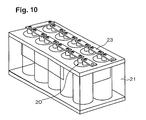
- a plurality of unit cells 20 thus constructed are connected in series to constitute a high voltage power source module.
- the weight increase and the volume increase required to form the module are substantial, and as the high voltage power source module as a whole, the output density and the energy density deteriorate substantially. Namely, there has been a problem that the high output density as a merit of an electrical double layer capacitor is lost, and the low energy density becomes distinct.
- the present invention has been made in view of such problems of the prior art, and it is an object of the present invention to provide a laminated electric double layer capacitor module having a high output density and a high energy density per volume or per weight.
- the present invention provides a laminated electric double layer capacitor module comprising:
- the module of the present invention does not require to employ strongly-built module structural members to integrally secure the plurality of cells or many electrical connecting members for cells, which used to be required to construct a high voltage power source module by connecting unit cells in series. According to the present invention, it is possible to increase the energy density per volume or per weight, as a module power source. Especially when a resin case lighter than a metal, is used as the module case, the energy density can further be increased. Further, the process until a final laminated module power source is prepared, can be simplified, and the number of components required, is small, whereby the productivity is excellent, and the production cost can be reduced.
- the module case comprises a module case main body provided with said element compartments, and a module case cover to close the module case main body.
- the module case is constituted by the module case main body and the module case cover, whereby the production is easy, and the repair services, etc., are easy.
- a connecting means is provided which is connected to the current collector plate for positive electrodes and/or the current collector plate for negative electrodes through a partition wall partitioning the adjacent element compartments of the module case main body or through both side walls of the module case main body.
- the adjacent unit cells can be connected in the minimum distance without requiring bus bars or the like, whereby the resistance as a module power source can be made lower than before.
- an electrode assembly 31 Among various members constituting the laminated electric double layer capacitor module according to an embodiment of the present invention, the detailed construction of an electrode assembly 31 will be described first. An enlarged perspective view of an electrode assembly 31 is shown in Fig. 1.
- the electrode assembly 31 which will be a positive electrode or a negative electrode, comprises a band-shaped or strip-shaped metal current collector foil 33 and electrode layers 35A and 35B made of a high surface area material, formed on both sides of the foil except for an end strip portion 33a along one side end of the foil.
- the metal current collector foil 33 to be used here is not particularly limited, so long as it is excellent in the electrochemical corrosion resistance on the positive electrode side.
- a foil material of aluminum, an aluminum alloy or stainless steel is preferred.
- Its thickness is set to be thin so far as the strength permits, and it is usually preferably within a range of from 20 to 100 ⁇ m. Further, for the purpose of improving the adhesion strength with the electrode layers 35A and 35B or reducing the electric resistance, chemical, electrochemical or mechanical surface etching treatment may be applied in many cases.
- the end strip portion 33a on which no electrode layer such as 35A or 35B is formed is designed for electrical connection to the exterior. Accordingly, to increase the cell capacity, it is preferably as narrow as possible and is preferably at a level of from 2 to 6 mm.
- the electrode layers 35A and 35B are formed on both sides of the metal current collector foil 33 and made of a high specific surface area material to form an electric double layer at the interface with the electrolyte for storage, and they may be coated ones or preformed thin electrode sheets which are bonded to the metal current collector foil 33.
- a binder is usually required, and various organic binders, particularly binders such as polytetrafluoroethylene and polyvinylidene fluoride, are preferably employed.
- a conduction-assisting agent may be added in a certain amount.
- the above-mentioned high specific surface area material is made mainly of a carbonaceous material having a specific surface area of from 100 to 3,000 m 2 /g.
- activated carbon of a resin type such as phenol, a coconut shell type, a coke type or a pitch type as well as carbon nanotubes, carbon aerogel or polyacene may, for example, be preferably employed.
- a resin type such as phenol, a coconut shell type, a coke type or a pitch type as well as carbon nanotubes, carbon aerogel or polyacene
- carbon black, carbon short fibers or metal fibers may preferably be employed.
- the electrolyte to be used for forming an electric double layer is preferably a non-aqueous electrolyte, since its withstand voltage is high.
- the solute contained in the non-aqueous electrolyte is preferably a quaternary onium salt from the viewpoint of the electrical conductivity, the solubility in a solvent and the electrochemical stability.
- R 1 R 2 R 3 R 4 N + or R 1 R 2 R 3 R 4 P + (wherein each of R 1 , R 2 , R 3 and R 4 which are independent of one another, is a C 1-6 alky group or a C 6-10 aryl group).
- R 1 , R 2 , R 3 and R 4 which are independent of one another, is a C 1-6 alky group or a C 6-10 aryl group.
- it is preferably a salt of the above-mentioned cation with an anion such as BF 4 - , PF 6 - , CF 3 SO 3 - , AsF 6 - , N(SO 2 CF 3 ) 2 - or ClO 4 - .
- the concentration of the above onium salt in the electrolyte is preferably at least 0.5 mol/l, particularly preferably at least 1.0 mol/l, for the purpose of securing the amount of ions required for forming the electric double layer and obtaining adequate electrical conductivity.
- the organic solvent to be used for the non-aqueous electrolyte is preferably at least one solvent selected from the group consisting of cyclic carbonates such as ethylene carbonate, propylene carbonate and butylene carbonate, straight chain carbonates such as dimethyl carbonate, ethylmethyl carbonate and diethyl carbonate, sulfolane, sulfolane derivatives, and nitriles such as acetonitrile and glutaronitrile.
- cyclic carbonates such as ethylene carbonate, propylene carbonate and butylene carbonate
- straight chain carbonates such as dimethyl carbonate, ethylmethyl carbonate and diethyl carbonate
- sulfolane, sulfolane derivatives such as acetonitrile and glutaronitrile.
- an amidine type ionic liquid i.e. a molten salt at room temperature
- a solvent i.e. a molten salt at room temperature
- the separator 2 is a member having ion permeability, interposed between the positive and negative electrode assemblies 31.
- the material for the separator 2 is not particularly limited, but it is preferably made of a porous material excellent in the electrical insulating property, chemical stability against the electrolyte and liquid absorbing and maintaining properties for the electrolyte.
- inorganic fibers such as glass fibers, silica fibers, alumina fibers, asbestos or whiskers thereof, natural fibers such as manila hemp, or organic fibers such as synthetic polymer fibers of e.g. a polyolefin or a polyester.
- organic fibers such as synthetic polymer fibers of e.g. a polyolefin or a polyester.
- a sheet made thereof, or a micro porous film having fine perforations formed by stretching may also be preferably employed.
- FIG. 2 A perspective view of the laminated structure of electrode assemblies 31 and separators 2, is shown in Fig. 2.
- band-shaped or strip-shaped separators 2 and band-shaped or strip-shaped electrode assemblies 31 for positive and negative electrodes of the same construction, are disposed alternately.
- the respective end strip portions 33a of the electrode assemblies 31 are disposed so that ones adjacent to each other in the width direction of the separators 2, are projected from the separators 2 on opposite sides. And by such electrode assemblies 31 and separators 2, a laminated element 30 is constituted. In this state, at both right and left end surfaces of the laminated element 30, the end strip portions 33a of positive and negative electrodes are, respectively, exposed.
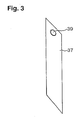
- FIG. 3 A perspective view of the metal current collector plate 37 is shown in Fig. 3.
- a through-hole 39 is provided at an upper portion of the metal current collector plate 37 made of a metal.
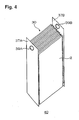
- FIG. 4 A perspective view of the laminated element assembly 40 is shown in Fig. 4.
- the laminated element assembly 40 is constructed in such a manner that the metal current collector plates 37A and 37B are bonded to the end strip portions 33a of the respective metal current collector foils 33 for positive and negative electrodes of the laminated element 30, to establish electrical contact with the exterior, respectively.
- the method for bonding the metal current collector plates 37A and 37B to the end strip portions 33a may be mechanical pressing or electroconductive adhesion by means of an electroconductive adhesive or the like. However, bonding by welding is preferred which is highly reliable mechanically and electrically.
- ultrasonic welding welding by a laser such as YAG or electron beam welding is preferably employed.
- the material for the metal current collector plate 37 is not particularly limited so long as it has high electrical conductivity and electrochemical corrosion resistance. However, aluminum or an aluminum alloy is, for example, preferred.
- the shape of the metal current collector plate 37 is not particularly limited. However, in order not to impair impregnation of the electrolyte at the end surface of the laminated element 30, it is preferred to provide notches at the flat portion of the metal current collector plate 37 to be abutted against the end surface of the laminated element 30. Otherwise, perforations or irregularities at a part of the flat portion, which bring about similar effects, may be provided.
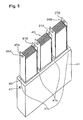
- FIG. 5 A perspective view of the module case main body 41 in the present invention, is shown in Fig. 5, and a perspective view of the module case cover 43 in the present invention, is shown in Fig. 6.
- a plurality of element compartments 45 are formed which are partitioned independently one another.
- the laminated element assemblies 40 are sufficiently impregnated with the electrolyte. And, the impregnated laminated element assemblies 40 are, respectively, accommodated in the element compartments 45, so that the positive electrode metal current collector plate 37A of one of the adjacent laminated element assemblies 40 faces the negative metal current collector plate 37B of the other element assembly via a partition wall 41b.
- through-holes 47 are, respectively, formed at facing positions. These through-holes 47 are designed so that when the laminated element assemblies 40 are accommodated in the element compartments 45, the positions of the through-holes will agree with the through-holes 39 of the metal current collector plates 37. Through the through-hole 47 and the through-hole 39a of the laminated element assembly 40 disposed at the left end in Fig. 5, an external terminal bolt 49 is inserted and fixed.
- an internal terminal bolt (not shown) is inserted and fixed. Sealing is secured by an O-ring between the internal terminal bolt and the through-hole 39A or 39B.
- the material for the O-ring is not particularly limited, so long as it is a material which is not eroded by the non-aqueous electrolyte used.
- fluorine rubber, EPDM, butyl rubber or silicon rubber may suitably be used.
- the material for the internal terminal bolt is not particularly limited so long as it has high electrical conductivity and high electrochemical corrosion resistance, but aluminum or an aluminum alloy is, for example, preferred.
- the laminated element assemblies 40 are thus electrically connected in series.
- a laminate electric double layer capacitor module as shown in Fig. 7, will be obtained.
- the number of element compartments 45 formed in the module case main body 41 and the module case cover 43 is not particularly limited and may be optionally determined depending upon the particular purpose and the required module voltage. However, usually, it is preferably from 2 to 10.
- the material for the module case main body 23 and the module case cover 25 is suitably selected taking into consideration the electrical insulating property, the mechanical strength, the moisture shielding property and the resistance against the non-aqueous electrolyte to be used.
- a polyolefin PP, PE
- a polyethylene terephthalate PET
- a polyparaphenylene sulfide PPS
- a polyimide or a polyamideimide is, for example, suitable.
- a polymer alloy containing such a polymer may also be used.
- a filler such as inorganic fibers, may be mixed, or in order to prevent permeation of moisture, surface treatment may be applied.
- the internal terminal bolts and the external terminal bolts 49 may also be attached by molding to be integral with the inner partition walls of the closed container, whereby a good sealing state can be secured.
- the method for sealing the cover made of a resin and the module case made of a resin may, for example, be fusion by heat melting, ultrasonic wave fusion, adhesion by means of various sealing agents, hot melt or adhesives, or press sealing by a packing material.
- the present invention it is possible to increase the energy density per volume or per weight, as a module power source. Further, the process until the final laminated module power source is prepared, can be simplified, and the number of components required is small, whereby the productivity is excellent, and the cost can be reduced. Further, adjacent unit cells can be connected in the minimum distance without requiring bus bars or the like, whereby the resistance as a module power source can be made low.
Landscapes
- Engineering & Computer Science (AREA)
- Power Engineering (AREA)
- Microelectronics & Electronic Packaging (AREA)
- Electric Double-Layer Capacitors Or The Like (AREA)
- Connection Of Batteries Or Terminals (AREA)
Claims (7)
- Laminiertes elektrisches Doppelschichtkondensatormodul, umfassend:Elektrodenanordnungen (31) für positive und negative Elektroden, jeweils gegenüber angeordnet, welche jeweils eine Metall-Stromsammlerfolie (33) und eine Elektrodenschicht (35A), (35B) aus einem Material mit einer großen Oberfläche, gebildet auf mindestens einer Oberfläche der Folie, außer einem Endstreifenabschnitt (33a), entlang einem Seitenende der Folie, umfassen;einen Ionen-durchlässigen Separator (2), angeordnet zwischen den angrenzenden Elektrodenanordnungen, um die jeweiligen Elektrodenschichten voneinander zu trennen;eine Metall-Stromsammlerplatte (37A) für positive Elektroden und eine Metall-Stromsammlerplatte (37B) für negative Elektroden, elektrisch mit dem Endstreifenabschnitt jeder Elektrodenanordnung für die positive Elektrode bzw. dem Endstreifenabschnitt jeder Elektrodenanordnung für die negative Elektrode verbunden;einen Elektrolyten undein Modulgehäuse;wobei:a) die Elektrodenanordnungen (31) für positive und negative Elektroden alternierend in Vielzahl derart laminiert sind, daß die jeweiligen Endstreifenabschnitte (33a) von den Separatoren (2) auf gegenüberliegenden Seiten hervorspringen, um ein laminiertes Element zu bilden;b) die Metall-Stromsammlerplatte (37A) für positive Elektroden an dem Ende des laminierten Elements auf der Seite angeordnet ist, an welcher die Endstreifenabschnitte (33a) der Metall-Stromsammlerfolien (33) für positive Elektroden von den Separatoren hervorspringen;c) die Metall-Stromsammlerplatte (37B) für negative Elektroden an dem Ende des laminierten Elements auf der Seite angeordnet ist, an der die Endstreifenabschnitte (33a) der Metall-Stromsammlerfolien für negative Elektroden von den Separatoren hervorspringen;d) die Elektrodenanordnungen (31), die Separatoren (2), die Stromsammlerplatte (37A) für positive Elektroden und die Stromsammlerplatte (37B) für negative Elektroden integriert sind, um eine laminierte Elementeinheit aufzubauen;e) eine Vielzahl solcher laminierter Elementeinheiten (40) vorgesehen sind, und diese jeweils eingerichtet und geschützt sind in einem von Elementkompartimenten (45), gebildet in einer Vielzahl in dem Modulgehäuse; undf) die Vielzahl der laminierten Element-Einheiten (40), eingerichtet in der Vielzahl der Elementkompartimente (45), elektrisch in Reihe verbunden sind.
- Laminiertes elektrisches Doppelschichtkondensatormodul gemäß Anspruch 1, wobei das Modulgehäuse ein Modulgehäuse-Hauptkörper (41), angeordnet mit den Elementkompartimenten (45), und eine Modulgehäuse-Abdeckung, um den Modulgehäuse-Hauptkörper zu schließen, umfasst.
- Laminiertes elektrisches Doppelschichtkondensatormodul gemäß Anspruch 2, welches mit einem Verbindungsmittel, verbunden mit der Stromsammlerplatte für positive Elektroden und/oder der Stromsammlerplatte für negative Elektroden durch eine Trennwand (41 b), welche die angrenzenden Elementkompartimente (45) des Modulgehäuse-Hauptkörpers aufteilt, oder durch beide Seitenwände (41 c) des Modulgehäuse-Hauptkörpers (41), versehen ist.
- Laminiertes elektrisches Doppelschichtkondensatormodul gemäß einem der Ansprüche 1 bis 3, wobei an jeder der positiven Elektroden und der negativen Elektroden der Endstreifenabschnitt (33a) der Metall-Stromsammlerfolie (33) und die Metall-Stromsammlerplatte (37A, 37B) durch Schweißen gebunden sind.
- Laminiertes elektrisches Doppelschichtkondensatormodul gemäß einem der Ansprüche 1 bis 4, wobei die angrenzenden zwei laminierten Elementanordnungen (40), eingerichtet in den Elementkompartimenten (45), derart angeordnet sind, daß die Metall-Stromsammlerplatte (37A) für positive Elektroden von einer laminierten Elementeinheit der Metall-Stromsammlerplatte (37B) für negative Elektroden der anderen laminierten Elementeinheit über eine Trennwand (41 b) gegenüberliegt.
- Laminiertes elektrisches Doppelschichtkondensatormodul gemäß einem der Ansprüche 1 bis 5, wobei das Modulgehäuse aus einem Polyolefin, einem Polyethylenterephthalat, einem Polyparaphenylensulfid, einem Polyimid, einem Polyamid oder einer Polymerlegierung, enthaltend solche Polymere, ist.
- Laminiertes elektrisches Doppelschichtkondensatormodul gemäß Anspruch 6, wobei der Elektrolyt ein nicht-wäßriger Elektrolyt ist.
Applications Claiming Priority (2)
| Application Number | Priority Date | Filing Date | Title |
|---|---|---|---|
| JP2001230235 | 2001-07-30 | ||
| JP2001230235A JP2003045760A (ja) | 2001-07-30 | 2001-07-30 | 積層型電気二重層キャパシタモジュール |
Publications (2)
| Publication Number | Publication Date |
|---|---|
| EP1291885A1 EP1291885A1 (de) | 2003-03-12 |
| EP1291885B1 true EP1291885B1 (de) | 2006-06-07 |
Family
ID=19062474
Family Applications (1)
| Application Number | Title | Priority Date | Filing Date |
|---|---|---|---|
| EP02016362A Expired - Lifetime EP1291885B1 (de) | 2001-07-30 | 2002-07-25 | Laminiertes elektrisches Doppelschichtkondensatormodul |
Country Status (4)
| Country | Link |
|---|---|
| US (1) | US6650531B2 (de) |
| EP (1) | EP1291885B1 (de) |
| JP (1) | JP2003045760A (de) |
| DE (1) | DE60212019T2 (de) |
Families Citing this family (30)
| Publication number | Priority date | Publication date | Assignee | Title |
|---|---|---|---|---|
| DE10339156B3 (de) * | 2003-08-26 | 2005-03-17 | Epcos Ag | Schaltungsanordnung mit mehreren Kapazitäten |
| US20080259525A1 (en) * | 2005-11-09 | 2008-10-23 | Maxwell Technologies, Inc. | Energy storage apparatus and article of manufacture |
| US20070146965A1 (en) * | 2005-11-22 | 2007-06-28 | Porter Mitchell | Ultracapacitor pressure control system |
| US8264137B2 (en) | 2006-01-03 | 2012-09-11 | Samsung Electronics Co., Ltd. | Curing binder material for carbon nanotube electron emission cathodes |
| US20080014504A1 (en) * | 2006-07-14 | 2008-01-17 | Adrian Schneuwly | Method of making and article of manufacture for an energy storage electrode apparatus |
| US7580243B2 (en) * | 2006-07-14 | 2009-08-25 | Maxwell Technologies, Inc. | Method of making and article of manufacture for an ultracapacitor electrode apparatus |
| WO2008049037A2 (en) * | 2006-10-17 | 2008-04-24 | Maxwell Technologies, Inc. | Electrode for energy storage device |
| JP4899898B2 (ja) * | 2007-02-02 | 2012-03-21 | 株式会社明電舎 | 電気二重層キャパシタ |
| FR2915626B1 (fr) | 2007-04-24 | 2010-10-29 | Batscap Sa | Module pour ensemble de stockage d'energie electrique |
| FR2916306B1 (fr) | 2007-05-15 | 2009-07-17 | Batscap Sa | Module pour ensembles de stockage d'energie electrique permettant la detection du vieillissement desdits ensembles. |
| US20100008020A1 (en) * | 2008-07-09 | 2010-01-14 | Adrian Schneuwly | Electrode device |
| JP2011014859A (ja) * | 2009-01-27 | 2011-01-20 | Panasonic Corp | 電気二重層キャパシタ |
| US8705225B2 (en) * | 2009-03-31 | 2014-04-22 | Tdk Corporation | Electric double layer capacitor with non-equal areas of the active material layers of the positive electrode and the negative electrode |
| US20100258111A1 (en) * | 2009-04-07 | 2010-10-14 | Lockheed Martin Corporation | Solar receiver utilizing carbon nanotube infused coatings |
| US9111658B2 (en) | 2009-04-24 | 2015-08-18 | Applied Nanostructured Solutions, Llc | CNS-shielded wires |
| AU2010259173B2 (en) | 2009-04-24 | 2015-03-19 | Applied Nanostructured Solutions Llc | CNT-based signature control material |
| BRPI1014711A2 (pt) | 2009-04-27 | 2016-04-12 | Applied Nanostrctured Solutions Llc | aquecimento de resistência com base em cnt para descongelar estruturas de compósito |
| US20110089958A1 (en) * | 2009-10-19 | 2011-04-21 | Applied Nanostructured Solutions, Llc | Damage-sensing composite structures |
| US9167736B2 (en) | 2010-01-15 | 2015-10-20 | Applied Nanostructured Solutions, Llc | CNT-infused fiber as a self shielding wire for enhanced power transmission line |
| CA2790205A1 (en) | 2010-03-02 | 2011-09-09 | Applied Nanostructured Solutions, Llc | Spiral wound electrical devices containing carbon nanotube-infused electrode materials and methods and apparatuses for production thereof |
| KR101818640B1 (ko) | 2010-03-02 | 2018-01-15 | 어플라이드 나노스트럭처드 솔루션스, 엘엘씨. | 카본 나노튜브 주입된 섬유를 포함하는 전기 장치 및 그의 제조 방법 |
| US8780526B2 (en) * | 2010-06-15 | 2014-07-15 | Applied Nanostructured Solutions, Llc | Electrical devices containing carbon nanotube-infused fibers and methods for production thereof |
| EP2629595A2 (de) | 2010-09-23 | 2013-08-21 | Applied NanoStructured Solutions, LLC | CNT-infundierte Faser als selbstabschirmendes Kabel für eine Übertragungsleitung mit erhöhter Leistung |
| JP5905731B2 (ja) * | 2011-02-15 | 2016-04-20 | セイコーインスツル株式会社 | 電気化学素子及びその製造方法 |
| KR20130012469A (ko) * | 2011-07-25 | 2013-02-04 | 삼성전기주식회사 | 에너지 저장 모듈 |
| US9085464B2 (en) | 2012-03-07 | 2015-07-21 | Applied Nanostructured Solutions, Llc | Resistance measurement system and method of using the same |
| KR101973407B1 (ko) * | 2012-12-27 | 2019-04-29 | 삼성전기주식회사 | 전기 에너지 저장장치 및 이의 제조방법 |
| JP6308217B2 (ja) * | 2013-06-26 | 2018-04-11 | ダイキン工業株式会社 | 電解液、及び、電気化学デバイス |
| CA3085190C (en) * | 2020-06-30 | 2025-05-06 | Atlas Power Technologies Inc. | DISTRIBUTION OF ACTIVATED CARBON PORE SIZE AND RELATED APPLICATIONS |
| CN116525307A (zh) * | 2023-05-05 | 2023-08-01 | 深圳江浩电子有限公司 | 一种高压电容器模组 |
Family Cites Families (7)
| Publication number | Priority date | Publication date | Assignee | Title |
|---|---|---|---|---|
| US5850331A (en) * | 1996-08-30 | 1998-12-15 | Honda Giken Kogyo Kabushiki Kaisha | Electric double-layer capacitor and capacitor device |
| US6182546B1 (en) * | 1997-03-04 | 2001-02-06 | Tessera, Inc. | Apparatus and methods for separating microelectronic packages from a common substrate |
| EP0933791B1 (de) | 1998-01-30 | 2006-08-09 | Asahi Glass Company Ltd. | Elektrode für einen Doppelschichtkondensator und Verfahren zur Herstellung |
| JP2000223376A (ja) * | 1998-11-25 | 2000-08-11 | Ngk Insulators Ltd | 電気化学キャパシタの製造方法 |
| DE10006839A1 (de) * | 1999-02-17 | 2000-08-24 | Hitachi Maxell | Elektrode für einen Kondensator, Verfahren zur deren Herstellung und ein Kondensator |
| JP2001035450A (ja) | 1999-07-19 | 2001-02-09 | Toyota Motor Corp | 角型電池 |
| TW523767B (en) * | 2000-09-11 | 2003-03-11 | Nec Tokin Corp | Electrical double layer capacitor |
-
2001
- 2001-07-30 JP JP2001230235A patent/JP2003045760A/ja active Pending
-
2002
- 2002-07-25 DE DE60212019T patent/DE60212019T2/de not_active Expired - Fee Related
- 2002-07-25 EP EP02016362A patent/EP1291885B1/de not_active Expired - Lifetime
- 2002-07-29 US US10/206,221 patent/US6650531B2/en not_active Expired - Fee Related
Also Published As
| Publication number | Publication date |
|---|---|
| JP2003045760A (ja) | 2003-02-14 |
| US20030035262A1 (en) | 2003-02-20 |
| DE60212019T2 (de) | 2006-12-21 |
| US6650531B2 (en) | 2003-11-18 |
| DE60212019D1 (de) | 2006-07-20 |
| EP1291885A1 (de) | 2003-03-12 |
Similar Documents
| Publication | Publication Date | Title |
|---|---|---|
| EP1291885B1 (de) | Laminiertes elektrisches Doppelschichtkondensatormodul | |
| US8472164B2 (en) | Stacking type electrochemical cell having quasi-bipolar structure | |
| US8329328B2 (en) | Electrical energy storage cell and electrical energy storage module including the same | |
| KR101372780B1 (ko) | 전지 | |
| US8263247B2 (en) | Electrochemical cell having quasi-bipolar structure | |
| US8790811B2 (en) | Flat-wound electricity storage device cell and flat-wound electricity storage device module | |
| KR20070099430A (ko) | 안전성과 용량이 증가된 리튬 이차전지 | |
| US8470471B2 (en) | Electrochemical cell having quasi-bipolar structure | |
| JP2012516009A (ja) | 電気化学的エネルギー貯蔵セル | |
| KR101085885B1 (ko) | 전기이중층축전지 | |
| KR20080090769A (ko) | 개선된 구조의 상단 실링부를 포함하고 있는 이차전지 | |
| KR100964491B1 (ko) | 전기화학셀 | |
| US20130016450A1 (en) | Supercapacitor Cell and Supercapacitive Module Incorporating a Plurality of these Cells | |
| JP2002353078A (ja) | 積層型電気二重層キャパシタモジュール | |
| KR20090010444A (ko) | 직렬 연결 구조의 고출력 이차전지 | |
| CN112585799B (zh) | 蓄电模块及蓄电模块的制造方法 | |
| JP4956777B2 (ja) | バイポーラ電池、組電池及びそれらの電池を搭載した車両 | |
| JP5098859B2 (ja) | 電気二重層キャパシタ | |
| JP2012060052A (ja) | 蓄電装置 | |
| JP4657997B2 (ja) | 電気二重層キャパシタ | |
| JP2010034120A (ja) | 電気二重層キャパシタ | |
| JP6926509B2 (ja) | 蓄電装置 | |
| KR20140038982A (ko) | 용융염 전지 | |
| JP2009289938A (ja) | 電気二重層キャパシタ | |
| JP2007019211A (ja) | 電気二重層キャパシタおよびその製造方法 |
Legal Events
| Date | Code | Title | Description |
|---|---|---|---|
| PUAI | Public reference made under article 153(3) epc to a published international application that has entered the european phase |
Free format text: ORIGINAL CODE: 0009012 |
|
| AK | Designated contracting states |
Kind code of ref document: A1 Designated state(s): AT BE BG CH CY CZ DE DK EE ES FI FR GB GR IE IT LI LU MC NL PT SE SK TR |
|
| AX | Request for extension of the european patent |
Extension state: AL LT LV MK RO SI |
|
| 17P | Request for examination filed |
Effective date: 20030612 |
|
| AKX | Designation fees paid |
Designated state(s): DE FR GB IT |
|
| GRAP | Despatch of communication of intention to grant a patent |
Free format text: ORIGINAL CODE: EPIDOSNIGR1 |
|
| GRAS | Grant fee paid |
Free format text: ORIGINAL CODE: EPIDOSNIGR3 |
|
| GRAA | (expected) grant |
Free format text: ORIGINAL CODE: 0009210 |
|
| AK | Designated contracting states |
Kind code of ref document: B1 Designated state(s): DE FR GB IT |
|
| PG25 | Lapsed in a contracting state [announced via postgrant information from national office to epo] |
Ref country code: IT Free format text: LAPSE BECAUSE OF FAILURE TO SUBMIT A TRANSLATION OF THE DESCRIPTION OR TO PAY THE FEE WITHIN THE PRESCRIBED TIME-LIMIT;WARNING: LAPSES OF ITALIAN PATENTS WITH EFFECTIVE DATE BEFORE 2007 MAY HAVE OCCURRED AT ANY TIME BEFORE 2007. THE CORRECT EFFECTIVE DATE MAY BE DIFFERENT FROM THE ONE RECORDED. Effective date: 20060607 |
|
| REG | Reference to a national code |
Ref country code: GB Ref legal event code: FG4D |
|
| REF | Corresponds to: |
Ref document number: 60212019 Country of ref document: DE Date of ref document: 20060720 Kind code of ref document: P |
|
| ET | Fr: translation filed | ||
| PLBE | No opposition filed within time limit |
Free format text: ORIGINAL CODE: 0009261 |
|
| STAA | Information on the status of an ep patent application or granted ep patent |
Free format text: STATUS: NO OPPOSITION FILED WITHIN TIME LIMIT |
|
| 26N | No opposition filed |
Effective date: 20070308 |
|
| PGFP | Annual fee paid to national office [announced via postgrant information from national office to epo] |
Ref country code: DE Payment date: 20080807 Year of fee payment: 7 |
|
| PGFP | Annual fee paid to national office [announced via postgrant information from national office to epo] |
Ref country code: FR Payment date: 20080718 Year of fee payment: 7 |
|
| PGFP | Annual fee paid to national office [announced via postgrant information from national office to epo] |
Ref country code: GB Payment date: 20080806 Year of fee payment: 7 |
|
| GBPC | Gb: european patent ceased through non-payment of renewal fee |
Effective date: 20090725 |
|
| REG | Reference to a national code |
Ref country code: FR Ref legal event code: ST Effective date: 20100331 |
|
| PG25 | Lapsed in a contracting state [announced via postgrant information from national office to epo] |
Ref country code: FR Free format text: LAPSE BECAUSE OF NON-PAYMENT OF DUE FEES Effective date: 20090731 |
|
| PG25 | Lapsed in a contracting state [announced via postgrant information from national office to epo] |
Ref country code: GB Free format text: LAPSE BECAUSE OF NON-PAYMENT OF DUE FEES Effective date: 20090725 |
|
| PG25 | Lapsed in a contracting state [announced via postgrant information from national office to epo] |
Ref country code: DE Free format text: LAPSE BECAUSE OF NON-PAYMENT OF DUE FEES Effective date: 20100202 |