EP1288185A2 - Stabilisation de l'acroleine - Google Patents
Stabilisation de l'acroleine Download PDFInfo
- Publication number
- EP1288185A2 EP1288185A2 EP02016690A EP02016690A EP1288185A2 EP 1288185 A2 EP1288185 A2 EP 1288185A2 EP 02016690 A EP02016690 A EP 02016690A EP 02016690 A EP02016690 A EP 02016690A EP 1288185 A2 EP1288185 A2 EP 1288185A2
- Authority
- EP
- European Patent Office
- Prior art keywords
- acrolein
- nitroxide
- use according
- tempo
- derivative
- Prior art date
- Legal status (The legal status is an assumption and is not a legal conclusion. Google has not performed a legal analysis and makes no representation as to the accuracy of the status listed.)
- Withdrawn
Links
Classifications
-
- C—CHEMISTRY; METALLURGY
- C07—ORGANIC CHEMISTRY
- C07C—ACYCLIC OR CARBOCYCLIC COMPOUNDS
- C07C45/00—Preparation of compounds having >C = O groups bound only to carbon or hydrogen atoms; Preparation of chelates of such compounds
- C07C45/78—Separation; Purification; Stabilisation; Use of additives
- C07C45/86—Use of additives, e.g. for stabilisation
Definitions
- the invention relates to the field of acrylic monomers and more particularly for object the stabilization of acrolein to avoid its autopolymerization during its purification, storage or transport.
- the most commonly used acrolein production process includes a reaction section in which a catalytic oxidation is carried out gas phase of propylene by air oxygen, and a purification section to remove the reaction byproducts which are mainly the oxides of carbon, acrylic acid, acetic acid and acetaldehyde.
- section essentially organic For certain applications of acrolein, it is often necessary to perfect the purification in a second purification section called “section essentially organic ", including a fourth column to eliminate at the top of light compounds (especially acetaldehyde) and a final removal column heavy compounds.
- acrolein purification comes from the fact that it monomer, as well as the acrylic acid contained in the crude solutions from of the reaction section, easily undergoes an initiated self-polymerization reaction by radical reactions favored by temperature. It follows that the flows present in the purification stages which are carried out at high temperature (especially in the distillation columns) are the most sensitive to this phenomenon.
- a second factor favoring the polymerization of acrolein is the formation peroxides, easily generated by the action of oxygen on the monomer and known to quickly initiate polymerization. To alleviate this problem, we generally seeks to reduce the presence of oxygen in the medium, but this can adversely affect the effectiveness of certain polymerization inhibitors added in the process.
- the polymers generated have the particularity of being insoluble in the monomer, in the raw media containing the monomer to be purified and in the mixtures of the monomer with the solvents used in the purification process, in particular in aqueous media.
- the generation of these insoluble polymers in equipment industrial distillers leads to bottlenecks which impose stoppages of frequent, difficult and costly installation and cleaning.
- one or more stabilizing molecules such as phenolic compounds (for example, hydroquinone, hydroquinone methyl ether, 2,6-di (t.butyl) -1-hydroxytoluene, ...), amino derivatives (for example, hydroxylamines, hydroxydiphenylamine, piperidine, etc.), substituted p-phenylenediamines or also transition metal salts such as, for example, copper (II) acetate, manganese (II) acetate or copper dibutyldithiocarbamate.
- phenolic compounds for example, hydroquinone, hydroquinone methyl ether, 2,6-di (t.butyl) -1-hydroxytoluene, ...), amino derivatives (for example, hydroxylamines, hydroxydiphenylamine, piperidine, etc.), substituted p-phenylenediamines or also transition metal salts such as, for example, copper (II) acetate, manganese (I
- Hydroquinone is often mentioned as an inhibitor in processes acrolein purification; however, it does not effectively reduce the formation of polymers during the stages of purification of acrolein.
- the effectiveness mediocre of this inhibitor and phenolic inhibitors in general is explained by the its mechanism of action requires the presence of oxygen which, as indicated above, is an initiator of the formation of peroxides detrimental to stability of the monomer.
- inhibitors are more effective than hydroquinone, but their effectiveness is still insufficient to allow trouble-free operation of reliability of an industrial acrolein purification unit.
- the present invention aims to significantly increase the stability of flow rich in acrolein, especially during the stages of the so-called essentially section organic process of acrolein purification. This is achieved without additional introduction of oxygen or of a gaseous flow containing oxygen, by adding at least one nitroxide derivative to the acrolein flow.
- the subject of the invention is therefore the use of at least one nitroxide derivative for stabilize pure acrolein or its highly concentrated solutions (acrolein content ⁇ 90% by weight), in contact with an essentially anaerobic atmosphere, i.e. a gas atmosphere containing less than 1% oxygen by volume.
- an essentially anaerobic atmosphere i.e. a gas atmosphere containing less than 1% oxygen by volume.
- This use relates more particularly to the stages of the section essentially organic purification of acrolein, but also its storage or transport under an inert atmosphere.
- the invention also relates to a process for stabilizing acrolein or a stream rich in acrolein, characterized in that at least one derivative is added thereto nitroxide.
- the amount of nitroxide derivative to be added can vary within wide limits, but it is generally between 10 and 10,000 ppm relative to the weight acrolein or flux to be stabilized, preferably between 50 and 5000 ppm.
- TEMPO 2,2,6,6-tetramethyl-1-oxyl-piperidine
- its substituted derivatives position 4 such as 4-hydroxy-TEMPO, 4-oxo-TEMPO and 4-amino-TEMPO, as well as N-tert.butyl-1-phenyl-2-methylpropyl nitroxide and N-tert.butyl-1-diethylphosphono-2,2-dimethylpropyl nitroxide (hereafter SG1) whose structural formula and the preparation are described in publication WO 96/24620.
- nitroxide derivatives according to the invention in aqueous or solid form, are mixed with acrolein or the flux to be stabilized and the solutions obtained are then injected into the process, preferably in the feed stream and / or at the top of the column to be distilled.
- these solutions are introduced at the top of the column, the introduction is made at one or more of the points constituted by the highest plateau of the column or by a plateau situated slightly lower than the latter or via the vapor condenser inlet at the top of the column.
- acrolein In a glass tube, crude acrolein is placed (mixture of approximately 97% acrolein and 3% water) previously destabilized by distillation, then stabilized with 10 ppm of the stabilizer to be studied.
- This tube is topped with a refrigerant itself closed by a plug having a hole to let pass a stainless steel cane.
- This stainless steel rod is used to continuously purge the acrolein sample with nitrogen. After 20 minutes of purging at room temperature, the tube is immersed in a bath thermostatically controlled at 80 ° C. and the start of polymerization is detected visually. We then define for each stabilizer tested a period of stabilization of acrolein under the conditions of the test.
- the feed mixture consists of acrolein (93%), acetaldehyde (4%) and water (3%), to which 0.1% of polymerization inhibitor is also added to test.
- This mixture is introduced at a flow rate of 185 g / h between the two sections of the column.
- the same flow rate at the bottom of the column is eliminated continuously from the boiler, so as to maintain a constant level of liquid in the boiler.
- the residence time of the column bottom stream in the boiler is one hour.
- the heating power applied to the boiler is adapted so as to obtain sufficient liquid reflux at the condenser at the head of column.
- the tests are carried out at atmospheric pressure.
- the temperatures measured are 53 ° C at the boiler, 50 ° C at the feed, and 19 ° C at the top of the column.
- the polymer formation is evaluated in a way comparative, by observation of deposits in the assembly.
- the polymerization inhibitor tested is 4-hydroxy-TEMPO, dissolved at a 0.1% by weight concentration in the feed mixture.
- the foot flow of column extracted from the boiler is clear and limpid. After 3 hours of operation, does not observe any trace of solid deposit in the assembly.
- the polymerization inhibitor tested is hydroquinone, dissolved in the feed mixture at a concentration of 0.1% by weight.
- the liquid flow extracted at the bottom of the column is cloudy, indicating the presence of insoluble polymers in fine suspension in the medium.
- a deposit of white solid in a thin layer is observed lining the internal wall of the boiler on about half of the surface, and a deposit of solid white grains in the lower part of the boiler.
- the inhibitor is 4-OH-TEMPO, dissolved in the feed mixture at 0.1%. After 24 hours of operation, the column is completely free of solid deposit and no significant deposit is observed on the internal wall of the boiler.
- Example 5 The test of Example 5 is repeated but replacing the 4-OH-TEMPO with hydroquinone added at 0.1% in the feed stream. After 4 p.m. operation, the test must be stopped as a result of the line being blocked Power.
- the column bottom stream contains polymers in suspension.
- the inner wall of the boiler is covered with a thin layer of white solid on about 2/3 of its surface and a thick deposit of viscous polymer can be observed at the bottom of the boiler, as well as some grain-shaped solids which line it the bottom part.
Landscapes
- Chemical & Material Sciences (AREA)
- Organic Chemistry (AREA)
- Organic Low-Molecular-Weight Compounds And Preparation Thereof (AREA)
Abstract
Description
- le refroidissement du flux réactionnel aqueux (quench) ;
- l'absorption à l'eau, dans une première colonne, des acides organiques (acide acrylique et acide acétique) ;
- l'absorption à l'eau froide de l'acroléine dans une deuxième colonne avec élimination en tête des gaz incondensés (propylène non converti, azote, oxygène, oxydes de carbone) et récupération en pied de colonne d'une solution aqueuse diluée d'acroléine ;
- l'élimination de l'eau en pied d'une troisième colonne, en tête de laquelle l'acroléine est récupérée.

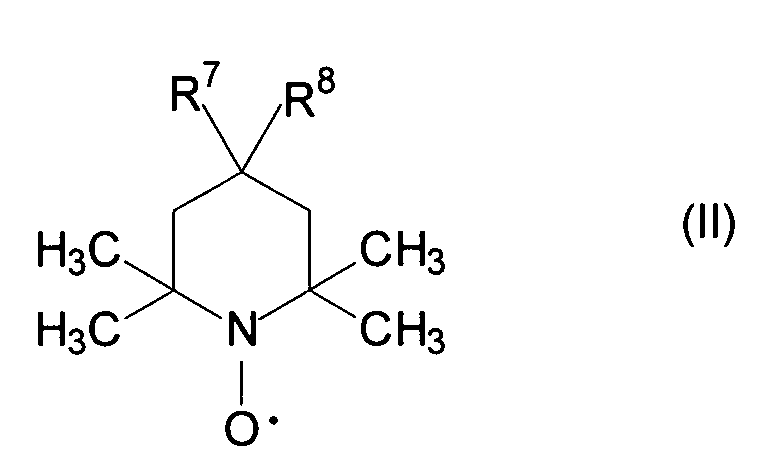
- les nitroxydes cycliques de formule générale:
dans laquelle R7 représente un atome d'hydrogène ou un groupe hydroxy, acyloxy ou amino, et R8 représente un atome d'hydrogène ou, avec R7, forme un groupe oxo; et
- les nitroxydes acycliques de formule générale:
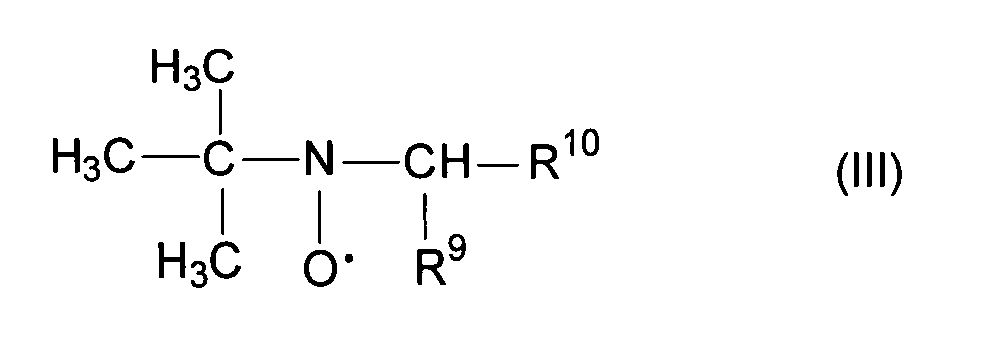
dans laquelle R9 représente un radical alkyle ramifié et R10 un radical phényle ou un groupe dialcoxyphosphoryle.
| Stabilisant | Durée de stabilisation |
| 4-OH-TEMPO | > 4 h |
| SG1 | >4h |
| hydroquinone | 1 min |
| CB | 5 min |
| phénothiazine | 10 min |
- d'une colonne en verre de diamètre intérieur 36 mm, comprenant 2 sections de 14 cm de hauteur équipées chacune d'un élément de garnissage en inox de type multiknit,
- d'un bouilleur à thermosiphon en pied de colonne, chauffé par résistance électrique, et
- d'un condenseur circulé par de l'eau à 12°C en tête.
Claims (9)
- Utilisation d'au moins un dérivé nitroxyde pour stabiliser l'acroléine dans les flux d'acroléine contenant au moins 90 % en poids de ce monomère, durant sa purification, son stockage ou son transport.
- Utilisation selon la revendication 1, caractérisée en ce que le flux riche en acroléine est mis en contact avec une atmosphère gazeuse contenant en volume moins de 1 % d'oxygène.
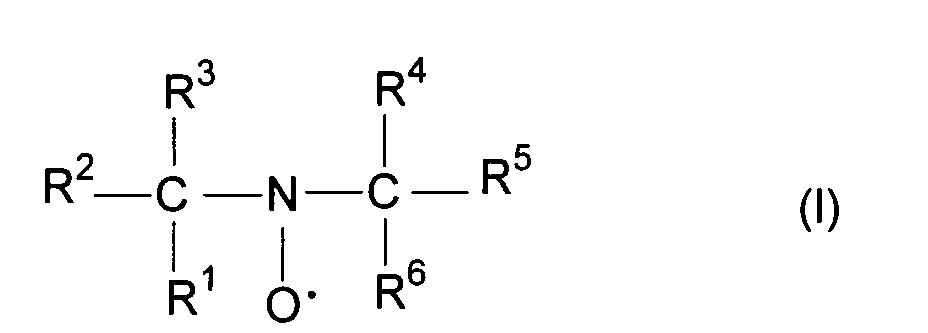
- Utilisation selon la revendication 1 ou 2, caractérisée en ce que le dérivé nitroxyde répond à la formule générale:dans laquelle les symboles R1, R2, R3 et R4, identiques ou différents, représentent des radicaux alkyle, linéaires ou ramifiés, éventuellement substitués, les symboles R3 et R4 pouvant aussi être reliés entre eux; R5 est un atome d'hydrogène ou un radical alkyle, linéaire ou ramifié, éventuellement substitué; et R6 représente un radical alkyle, linéaire ou ramifié, éventuellement substitué, aryle ou dialcoxyphosphoryle.
- Utilisation selon la revendication 1 ou 2, caractérisée en ce que le dérivé nitroxyde est un nitroxyde cyclique de formule générale:dans laquelle R7 représente un atome d'hydrogène ou un groupe hydroxy, acyloxy ou amino, et R8 représente un atome d'hydrogène ou, avec R7, forme un groupe oxo.
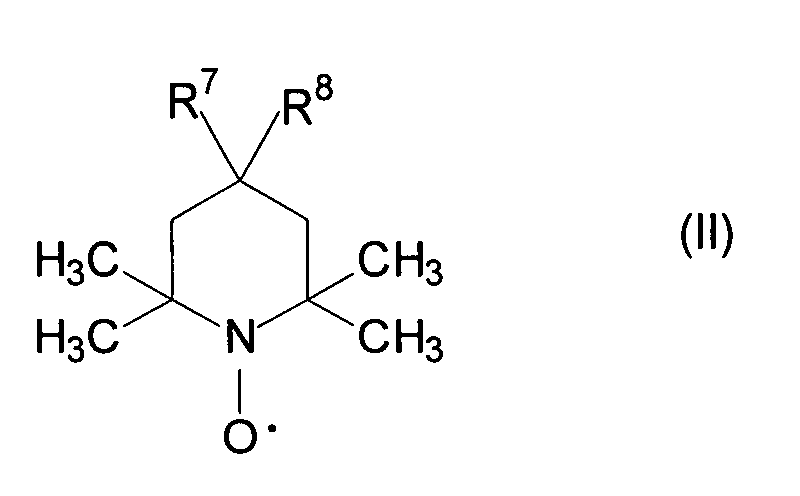
- Utilisation selon la revendication 4 dans laquelle le dérivé nitroxyde est la 2,2,6,6-tétraméthyl-1-oxyl-pipéridine (TEMPO), le 4-hydroxy-TEMPO, le 4-oxo-TEMPO ou le 4-amino-TEMPO.
- Utilisation selon la revendication 1 ou 2, caractérisée en ce que le dérivé nitroxyde est un nitroxyde acyclique de formule générale:dans laquelle R9 représente un radical alkyle ramifié et R10 un radical phényle ou un groupe dialcoxyphosphoryle.

- Utilisation selon la revendication 6 dans laquelle le dérivé nitroxyde est le N-tertiobutyl-1-diéthylphosphono-2,2-diméthylpropyl nitroxyde ou le N-tertiobutyl-1-phényl-2-méthylpropyl nitroxyde.
- Utilisation selon l'une des revendications 1 à 7, caractérisé en ce que la concentration totale en dérivé nitroxyde dans le flux liquide d'acroléine est comprise entre 10 ppm et 10000 ppm, de préférence entre 50 et 5000 ppm, par rapport à l'acroléine.
- Utilisation selon l'une des revendications 1 à 8, caractérisé en ce que le dérivé nitroxyde est utilisé pour stabiliser la section essentiellement organique d'un procédé de purification de l'acroléine.
Applications Claiming Priority (2)
| Application Number | Priority Date | Filing Date | Title |
|---|---|---|---|
| FR0111241A FR2829130A1 (fr) | 2001-08-30 | 2001-08-30 | Stabilisation de l'acroleine |
| FR0111241 | 2001-08-30 |
Publications (2)
| Publication Number | Publication Date |
|---|---|
| EP1288185A2 true EP1288185A2 (fr) | 2003-03-05 |
| EP1288185A3 EP1288185A3 (fr) | 2003-07-02 |
Family
ID=8866823
Family Applications (1)
| Application Number | Title | Priority Date | Filing Date |
|---|---|---|---|
| EP02016690A Withdrawn EP1288185A3 (fr) | 2001-08-30 | 2002-07-26 | Stabilisation de l'acroleine |
Country Status (7)
| Country | Link |
|---|---|
| US (1) | US20030065110A1 (fr) |
| EP (1) | EP1288185A3 (fr) |
| JP (1) | JP2003081909A (fr) |
| KR (1) | KR20030019202A (fr) |
| CN (1) | CN1403432A (fr) |
| BR (1) | BR0203423A (fr) |
| FR (1) | FR2829130A1 (fr) |
Families Citing this family (2)
| Publication number | Priority date | Publication date | Assignee | Title |
|---|---|---|---|---|
| DE602005005692T2 (de) * | 2004-09-03 | 2008-11-27 | Ciba Holding Inc. | In-can stabilisatoren |
| US12486211B2 (en) | 2022-12-29 | 2025-12-02 | Baker Hughes Oilfield Operations Llc | Stabilizing acrolein in carbonate sol vents |
Family Cites Families (2)
| Publication number | Priority date | Publication date | Assignee | Title |
|---|---|---|---|---|
| KR100417098B1 (ko) * | 1998-07-27 | 2004-02-05 | 니폰 쇼쿠바이 컴파니 리미티드 | 비닐 화합물의 중합 억제 방법 |
| DE19856565A1 (de) * | 1998-12-08 | 2000-06-15 | Basf Ag | Verfahren zur Stabilisierung von wenigstens eine ethylenisch ungesättigte Bindung aufweisenden chemischen Verbindungen gegen unerwünschte radikalische Polymerisation |
-
2001
- 2001-08-30 FR FR0111241A patent/FR2829130A1/fr not_active Withdrawn
-
2002
- 2002-07-26 EP EP02016690A patent/EP1288185A3/fr not_active Withdrawn
- 2002-08-28 BR BR0203423-9A patent/BR0203423A/pt not_active Application Discontinuation
- 2002-08-29 KR KR1020020051462A patent/KR20030019202A/ko not_active Ceased
- 2002-08-30 US US10/231,231 patent/US20030065110A1/en not_active Abandoned
- 2002-08-30 CN CN02132106A patent/CN1403432A/zh active Pending
- 2002-08-30 JP JP2002253693A patent/JP2003081909A/ja active Pending
Also Published As
| Publication number | Publication date |
|---|---|
| EP1288185A3 (fr) | 2003-07-02 |
| CN1403432A (zh) | 2003-03-19 |
| FR2829130A1 (fr) | 2003-03-07 |
| BR0203423A (pt) | 2003-05-27 |
| KR20030019202A (ko) | 2003-03-06 |
| JP2003081909A (ja) | 2003-03-19 |
| US20030065110A1 (en) | 2003-04-03 |
Similar Documents
| Publication | Publication Date | Title |
|---|---|---|
| US5728872A (en) | Stabilized acrylic acid compositions | |
| RU2181715C2 (ru) | Способ уменьшения и/или удаления перманганатвосстанавливающих соединений и с2-12 алкилиодидных соединений | |
| CN110049962B (zh) | 防止在纯化(甲基)丙烯酸的方法中聚合物沉积的方法 | |
| FR2478627A1 (fr) | Procede de production et de recuperation d'acide terephtalique | |
| FR3062652A1 (fr) | Procede de purification de la vanilline naturelle | |
| EP1232138B1 (fr) | Procede de purification des monomeres (meth) acryliques par distillation | |
| EP0946486B1 (fr) | Purification de l'acide acrylique obtenu par oxydation catalytique du propylene | |
| JP6705120B2 (ja) | アクリル酸及びそのエステルの重合防止方法 | |
| KR950003113B1 (ko) | 비닐화합물의 중합방지제 및 중합 방지법 | |
| KR100417098B1 (ko) | 비닐 화합물의 중합 억제 방법 | |
| WO2020136337A1 (fr) | Purification d'hydroperoxyde d'alkyle par distillation extractive | |
| WO2000059858A1 (fr) | Procede d'oxydation d'hydrocarbures, d'alcools et/ou de cetones | |
| BE524422A (fr) | ||
| FR2829130A1 (fr) | Stabilisation de l'acroleine | |
| EP0477112B1 (fr) | Procédé de préparation de l'acide adipique par hydrocarboxylation d'acides penteniques | |
| FR2814741A1 (fr) | Procede de stabilisation de monomeres acryliques | |
| FR2876374A1 (fr) | Utilisation d'esters phosphoriques comme agents anti-depots lors de la synthese, la purification ou la regeneration de monomeres (meth) acryliques | |
| JPS6150937A (ja) | カルボン酸アンモン水溶液からカルボン酸の製造法 | |
| BE558027A (fr) | ||
| FR3137091A1 (fr) | Procede de valorisation continu de sous-produits lourds issus de la fabrication d’acide acrylique | |
| FR3096050A1 (fr) | Procede de purification d’eugenol et nouvelles compositions comprenant de l’eugenol | |
| BE580592A (fr) | ||
| FR3091283A1 (fr) | Purification d’hydroperoxyde d’alkyle par distillation en presence de methanol et d’eau | |
| JP2002155021A (ja) | ビニル単量体用重合防止剤組成物及び高純度(メタ)アクリル酸の製造方法 | |
| JPS60246332A (ja) | シクロヘキセンの酸化防止方法 |
Legal Events
| Date | Code | Title | Description |
|---|---|---|---|
| PUAI | Public reference made under article 153(3) epc to a published international application that has entered the european phase |
Free format text: ORIGINAL CODE: 0009012 |
|
| 17P | Request for examination filed |
Effective date: 20020726 |
|
| AK | Designated contracting states |
Kind code of ref document: A2 Designated state(s): AT BE BG CH CY CZ DE DK EE ES FI FR GB GR IE IT LI LU MC NL PT SE SK TR Designated state(s): AT BE BG CH CY CZ DE DK EE ES FI FR GB GR IE IT LI LU MC NL PT SE SK TR |
|
| AX | Request for extension of the european patent |
Extension state: AL LT LV MK RO SI |
|
| PUAL | Search report despatched |
Free format text: ORIGINAL CODE: 0009013 |
|
| AK | Designated contracting states |
Designated state(s): AT BE BG CH CY CZ DE DK EE ES FI FR GB GR IE IT LI LU MC NL PT SE SK TR |
|
| AX | Request for extension of the european patent |
Extension state: AL LT LV MK RO SI |
|
| AKX | Designation fees paid |
Designated state(s): AT BE BG CH CY CZ DE DK EE ES FI FR GB GR IE IT LI LU MC NL PT SE SK TR |
|
| 17Q | First examination report despatched |
Effective date: 20041005 |
|
| RAP1 | Party data changed (applicant data changed or rights of an application transferred) |
Owner name: ARKEMA |
|
| STAA | Information on the status of an ep patent application or granted ep patent |
Free format text: STATUS: THE APPLICATION IS DEEMED TO BE WITHDRAWN |
|
| 18D | Application deemed to be withdrawn |
Effective date: 20050216 |