EP1286445B1 - Steuerungssystem und -verfahren für einen Generator eines Fahrkraftzeuges - Google Patents
Steuerungssystem und -verfahren für einen Generator eines Fahrkraftzeuges Download PDFInfo
- Publication number
- EP1286445B1 EP1286445B1 EP02254862A EP02254862A EP1286445B1 EP 1286445 B1 EP1286445 B1 EP 1286445B1 EP 02254862 A EP02254862 A EP 02254862A EP 02254862 A EP02254862 A EP 02254862A EP 1286445 B1 EP1286445 B1 EP 1286445B1
- Authority
- EP
- European Patent Office
- Prior art keywords
- voltage
- generator
- system equipment
- command value
- generation
- Prior art date
- Legal status (The legal status is an assumption and is not a legal conclusion. Google has not performed a legal analysis and makes no representation as to the accuracy of the status listed.)
- Expired - Lifetime
Links
Images

Classifications
-
- H—ELECTRICITY
- H02—GENERATION; CONVERSION OR DISTRIBUTION OF ELECTRIC POWER
- H02J—ELECTRIC POWER NETWORKS; CIRCUIT ARRANGEMENTS OR SYSTEMS FOR SUPPLYING OR DISTRIBUTING ELECTRIC POWER; SYSTEMS FOR STORING ELECTRIC ENERGY
- H02J7/00—Circuit arrangements for charging or discharging batteries or for supplying loads from batteries
- H02J7/14—Circuit arrangements for charging or discharging batteries or for supplying loads from batteries for charging batteries from dynamo-electric generators driven at varying speed, e.g. on vehicle
- H02J7/1446—Circuit arrangements for charging or discharging batteries or for supplying loads from batteries for charging batteries from dynamo-electric generators driven at varying speed, e.g. on vehicle in response to parameters of a vehicle
-
- H—ELECTRICITY
- H02—GENERATION; CONVERSION OR DISTRIBUTION OF ELECTRIC POWER
- H02J—ELECTRIC POWER NETWORKS; CIRCUIT ARRANGEMENTS OR SYSTEMS FOR SUPPLYING OR DISTRIBUTING ELECTRIC POWER; SYSTEMS FOR STORING ELECTRIC ENERGY
- H02J7/00—Circuit arrangements for charging or discharging batteries or for supplying loads from batteries
- H02J7/14—Circuit arrangements for charging or discharging batteries or for supplying loads from batteries for charging batteries from dynamo-electric generators driven at varying speed, e.g. on vehicle
- H02J7/16—Regulation of the charging current or voltage by variation of field
- H02J7/24—Regulation of the charging current or voltage by variation of field using discharge tubes or semiconductor devices
- H02J7/2434—Regulation of the charging current or voltage by variation of field using discharge tubes or semiconductor devices with pulse modulation
-
- Y—GENERAL TAGGING OF NEW TECHNOLOGICAL DEVELOPMENTS; GENERAL TAGGING OF CROSS-SECTIONAL TECHNOLOGIES SPANNING OVER SEVERAL SECTIONS OF THE IPC; TECHNICAL SUBJECTS COVERED BY FORMER USPC CROSS-REFERENCE ART COLLECTIONS [XRACs] AND DIGESTS
- Y02—TECHNOLOGIES OR APPLICATIONS FOR MITIGATION OR ADAPTATION AGAINST CLIMATE CHANGE
- Y02T—CLIMATE CHANGE MITIGATION TECHNOLOGIES RELATED TO TRANSPORTATION
- Y02T10/00—Road transport of goods or passengers
- Y02T10/80—Technologies aiming to reduce greenhouse gasses emissions common to all road transportation technologies
- Y02T10/92—Energy efficient charging or discharging systems for batteries, ultracapacitors, supercapacitors or double-layer capacitors specially adapted for vehicles
Definitions
- the present invention relates to a control system and method for a vehicle generator, particularly of the kind capable of attaining improved vehicle acceleration ability, improved fuel consumption, and suitable power supply in accordance with a loaded condition of the generator.
- a vehicle generator is connected to a rotational shaft of an engine and is therefore caused to vary in rotational speed over a wide range. For this reason, the vehicle generator is provided with a regulator (control system) for regulating generated voltage within a suitable range.
- the regulator of this kind controls the generated voltage by intermittently operating the generator through ON/OFF control of the field current of the generator. When the load on the generator becomes larger, the generation time is controlled so as to become longer for maintaining the generated voltage constant.
- the conditions under which the vehicle electrical equipement is used vary largely depending upon whether it is used in the daytime or night, or the season in which it is used. If the power generation time is shortened for the purpose of improving the acceleration ability and fuel consumption, there will be caused a problem of overdischarge of the battery and flickering of lamps when the working power is large. On the contrary, if the power generation time is made longer upon deceleration of the vehicle, there will be caused a problem of overcharge of the battery and burning out of lamps.
- the above described regulator is constructed so as to execute a control for reducing the generated power for the purpose of improving the acceleration ability and fuel consumption of the vehicle, while at the same time inhibiting the above described control when certain electrical equipment is turned on or when the value of current detected by a current detector becomes equal to or higher than a predetermined value for the purpose of preventing a variation of performance of electrical equipment due to a variation of generated voltage, for example, flickering of lamps.
- JP 59-05099A discloses a control system and a control method in accordance with the preambles of claims 1 and 13 respectively.
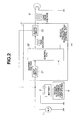
- generator 1 is connected to an output shaft of an engine (no numeral) so as to be driven by the engine.
- Engine control unit 2 executes various controls of the engine.
- engine control unit 2 is supplied with various information such as engine speed from engine speed sensor 4, vehicle speed from vehicle speed sensor 5, and battery voltage from voltmeter 7 for battery 9.
- Engine control unit 2 determines a vehicle running condition, i.e., whether the vehicle is in an idling condition, accelerating condition, constant speed running condition, or decelerating condition, based on the information supplied thereto from engine speed sensor 4, vehicle speed sensor 5, voltmeter 7, etc.
- Engine control unit 2 thus cooperates with engine speed sensor 4, vehicle speed sensor 5, voltmeter 7, etc. to constitute a first detector that detects a running condition of the vehicle and produces a signal representative thereof.
- vehicle electrical equipment load control unit 3 determines the operating conditions of lamp system equipment 8, i.e., whether lamp system equipment 8 is in operation (i.e., ON) or out of operation (i.e., OFF) and the operating conditions of actuator system equipment 10, i.e., whether actuator system equipment 10 is in operation (i.e., ON) or out of operation (i.e., OFF).
- Vehicle electrical equipment load control unit 3 cooperates with vehicle electrical equipment load switches 6 and battery voltmeter 7 to constitute a second detector that detects the operating conditions of lamp system equipment 8 (i.e., whether lamp system equipment 8 are ON or OFF) and the operating conditions of actuator system equipments 10 (i.e., whether actuator system equipment 10 is ON or OFF) and produces signals representative thereof.
- engine control unit 2 Based on the information (i.e., the signal from the second detector) and in addition information on the vehicle running condition (i.e., the signal from the first detector), a process that will be described hereinafter is executed to control field current by controlling a generation command value given to generator 1.
- This section of engine control unit 2 corresponds to a controller responsive to the signal from the first detector and the second detector for controlling field current of generator 1 thereby controlling an output voltage of generator 1.
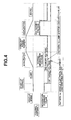
- FIG. 4 is a time chart for illustrating a control that is executed when it is determined that any of vehicle electrical equipment load switches 6 is OFF as a result of the detection of the operating conditions of vehicle electrical equipment load switches 6 by vehicle electrical equipment load control unit 3.
- a generation command value inputted to generator 1 is set at a second target voltage higher than a normal generation voltage, irrespective of whether vehicle electrical equipment 8 and 10 is ON or OFF. It is desirable for the generation command value to be set higher in the above-described manner in case the vehicle is in a decelerating condition since the torque load of generator 1 becomes larger to contribute to engine braking and power can be supplied to vehicle electrical equipment 8 and 10 efficiently.
- the generation command value of generator 1 is set at a first target voltage lower than the normal generation voltage.
- the torque load of generator 1 becomes smaller and therefore the torque load on the engine becomes smaller, thus making it possible to improve the acceleration ability and fuel consumption of the vehicle.
- the first target voltage is lower than the normal generation voltage, there is no influence on the vehicle electrical equipment since the OFF condition of vehicle electrical equipment load switches 6 is detected by vehicle electrical equipment load control unit 3.
- the generation command value when the vehicle is in one of the idling condition, accelerating condition and constant speed running condition is set at, in place of the first target voltage, a third target voltage that is higher than the first target voltage and lower than the normal generation voltage.
- the generation command value is unchanged and held at the second target voltage. This is because the second target voltage makes it assured to obtain a voltage necessary for the lamp system load sufficiently and contributes to the engine braking.
- the normal generation voltage is a voltage most suited to generator 1, and the target voltages and the normal generation voltage have such a relation that the first target voltage ⁇ the third target voltage ⁇ the normal generation voltage ⁇ the second target voltage.
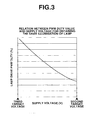
- a PWM control with the duty ratio of 100% is performed. If the inputted battery voltage is higher than the reference voltage of lamp system equipment 8, a PWM control with a smaller duty ratio is performed. Namely, it is desirable that when the battery voltage is higher than the reference voltage of lamp system equipment 8, the supply voltage to lamp system equipment 8 is reduced to the reference voltage by the PWM control.
- lamp system equipment 8 can be uniform in the intensity of illumination and can be free from a problem of flickering when the vehicle is in the decelerating condition, i.e., the generation command value is set high.
- input circuit 31 constitutes a battery voltage detector for detecting charged voltage of battery 9
- control CPU 32 and output circuit 33 constitute a lamp system equipment controller for PWM controlling a voltage applied to lamp system equipment 8.
- the control pattern shown in FIG. 4 is a basic control of the present invention. Then, other applications of the control will be described.
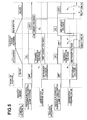
- FIG. 5 is a time chart of a control that is executed when lamp system load switch 6 is turned ON or OFF in the middle of the basic control of FIG. 4.
- the generation command value is maintained at the second target voltage even if lamp system load switch 6 is turned ON.
- the second target voltage makes it assured for the lamp system vehicle load to be supplied with necessary voltage and can contribute to engine braking.
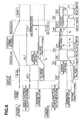
- FIG. 6 is a time chart of a control that is executed when actuator system load switch 6 is turned ON or OFF in the middle of the basic control.
- actuator system load switch 6 is turned ON when the vehicle is in the decelerating condition, the generation command value is changed from the second target voltage so far toward the normal generation voltage linearly at a voltage changing speed - ⁇ (V/sec) (refer to range R2 in FIG. 6). This makes it assured to obtain the voltage applied to the actuator system load and prevents bad influence on the acceleration ability and fuel consumption since the generated voltage changes linearly.
- actuator system load switch 6 is turned OFF when the generation command value is the normal generation voltage
- the generation command value is changed from the normal generation voltage so far to the voltage for the basic control shown in FIG. 4 after a lapse of the delay time Dt.
- the delay time Dt is changed from the normal generation voltage so far to the second target voltage after a lapse of the delay time Dt (refer to P3 in FIG. 6).
- actuator system load switch 6 is turned OFF in the middle of linear changing of the generation command value
- the control is returned to the basic control after a lapse of a predetermined delay time Dt after the generation command value reached the normal generation voltage.
- a predetermined delay time Dt for example, as shown in the lower part of FIG. 6, if actuator system load switch 6 is turned ON when the vehicle is in the accelerating condition, thus causing the generation command value to be changed from the first target voltage toward the normal generation voltage linearly at a voltage changing speed + ⁇ , and then actuator system load switch 6 is turned OFF in the middle of linear changing of the generation command value, the generation command value is returned to the normal generation voltage after a lapse of the delay time Dt after the generation command value reached the normal generation voltage (refer to P4 in FIG. 6).
- actuator system load switch 6 is turned ON when the vehicle is in the decelerating condition, thus causing the generation command value to be changed from the second target voltage toward the normal generation voltage linearly at a voltage changing speed - ⁇ , and then actuator system load switch 6 is turned OFF in the middle of linear changing of the generation command value, the generation command value is returned to the first target voltage after a lapse of the delay time Dt after the generation command value reached the normal generation voltage (refer to P5 in FIG. 6).
- the generation command value is the normal generation voltage and actuator system load switch 6 is turned ON again during a wait for a lapse of delay time Dt, the normal generation voltage is maintained.
- the delay time Dt is measured again from the point of time when actuator system load switch 6 is turned OFF and the control is returned to the basic control after a lapse of the delay time Dt.
- actuator system load switch 6 is turned ON and then OFF when the vehicle is in the accelerating condition and is turned ON again during a wait for a first lapse of the delay time Dt as shown by the dotted line in FIG. 6, the generation command value that is the normal generation voltage is held as it is (refer to R2 in FIG. 6).
- the generation command value is changed to the first target voltage (refer to point P6 in FIG. 6).
- actuator system load switch 6 is turned ON and then OFF when the vehicle is in the decelerating condition and is turned ON again during a wait for a first lapse of the delay time Dt as indicated by the dotted line, the generation command value is held at the normal generation voltage as it is (refer to range R3 in FIG. 6). After a lapse of the delay time Dt after actuator system load switch 6 was turned OFF, the generation command value is changed to the first target generation voltage (refer to point P7 in FIG. 6).
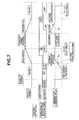
- FIG. 7 is a time chart of a control that is executed when both of lamp system load switch 6 and actuator system load switch 6 are turned ON or OFF during the basic control of FIG. 4.
- actuator system load switch 6 when either of lamp system load switch 6 and actuator system load switch 6 are ON, the control of actuator system load switch 6 is given priority and executed according to control patterns 3a and 3b shown in FIG. 6. If actuator system load switch 6 is turned ON in the middle of the basic control, the generation command value is changed from the command value for the basic control so far toward the normal generation voltage linearly at a voltage changing speed ⁇ ⁇ .
- the generation command value is changed from the first target voltage so far toward the normal generation voltage linearly at a voltage changing speed + ⁇ (refer to range R1 in FIG. 6).
- ON/OFF of lamp system load switch 6 does not cause any influence on the control. This makes it assured to obtain the voltage applied to the actuator system load and prevents bad influence on the acceleration ability and fuel consumption since the generated voltage changes linearly. Further, even if lamp system load switch 6 is turned ON or OFF in the middle of the control, the voltage applied to the lamp system load can be obtained assuredly.
- the generation command value is changed from the second target voltage so far toward the normal generation voltage linearly at a voltage changing speed - ⁇ (refer to range R2 in FIG. 7).
- ON/OFF of the lamp system load switch does not cause any influence on the control. This makes it assured to obtain the voltage applied to the actuator system load and prevents bad influence on the acceleration ability and fuel consumption since the generated voltage changes linearly. Further, even if the lamp system load switch is turned ON or OFF in the middle of the control, the voltage applied to the lamp system load can be obtained assuredly.
- actuator system load switch 6 is turned OFF and lamp system load switch 6 is turned ON after a lapse of the delay time Dt after the generation command value reached the normal generation voltage, the control is executed according to control patterns 2a and 2b shown in FIG. 5. Further, if, under this condition, lamp system load switch 6 is turned OFF, the control is executed according to the basic control pattern shown in FIG. 4.
Landscapes
- Engineering & Computer Science (AREA)
- Power Engineering (AREA)
- Control Of Eletrric Generators (AREA)
- Lighting Device Outwards From Vehicle And Optical Signal (AREA)
- Control Of Charge By Means Of Generators (AREA)
Claims (18)
- Regelungssystem für einen Fahrzeuggenerator (1), umfassend:einen ersten Detektor (2, 4, 5, 7) für die Erkennung eines Betriebszustandes eines Fahrzeuges und die Erzeugung eines Signals, das für denselben repräsentativ ist;einen zweiten Detektor (3, 6, 7) für die Erkennung, ob die Fahrzeugelektroausstattung (8, 10) sich im Schalterzustand EIN oder AUS befindet, und die Erzeugung eines Signals, das für denselben repräsentativ ist; undeinen Controller (2), der auf die Signale von dem ersten Detektor und dem zweiten Detektor reagiert, um einen Feldstrom des Generators (1) zu regeln, wodurch eine Ausgangsspannung des Generators geregelt wird;dadurch gekennzeichnet, dass der Controller (2) programmiert ist:an den Generator, wenn erkannt wurde, dass die Leuchtenanlagenausstattung (8) und die Aktorenanlagenausstattung (10) der Fahrzeugelektroausstattung sich beide im Schalterzustand AUS befinden und sich das Fahrzeug in einem anderen Betriebszustand als dem Verzögerungszustand befindet, einen Erzeugungsführungsgrößenwert zu senden, der gleich einer ersten Vorgabespannung ist, die niedriger als eine normale Erzeugungsspannung ist;an den Generator, wenn erkannt wurde, dass die Leuchtenanlagenausstattung (8) und die Aktorenanlagenausstattung (10) sich beide im Schalterzustand AUS befinden und das Fahrzeug sich in einem Verzögerungszustand befindet, einen Erzeugungsführungsgrößenwert zu senden, der gleich einer zweiten Vorgabespannung ist, die höher als die normale Erzeugungsspannung ist;an den Generator, wenn erkannt wurde, dass die Leuchtenanlagenausstattung (8) sich im Schalterzustand EIN befindet, die Aktorenanlagenausstattung (10) sich im Schalterzustand AUS befindet und das Fahrzeug sich in einem anderen Betriebszustand als dem Verzögerungszustand befindet, einen Erzeugungsführungsgrößenwert zu senden, der gleich einer dritten Vorgabespannung ist, die niedriger als die normale Erzeugungsspannung und höher als die erste Vorgabespannung ist; undan den Generator, wenn erkannt wurde, dass die Aktorenanlagenausstattung (10) sich im Schalterzustand EIN befindet, einen Erzeugungsführungsgrößenwert zu senden, der gleich der normalen Erzeugungsspannung ist und der einem Regelungsverlauf für die Aktorenanlagenausstattung (10) den Vorrang gibt, unabhängig davon, ob sich die Leuchtenanlagenausstattung (8) im Schalterzustand EIN oder AUS befindet.
- Regelungssystem nach Anspruch 1, bei dem der Controller (2) programmiert ist, an den Generator (1), wenn erkannt wurde, dass die Leuchtenanlagenausstattung (8) sich im Schalterzustand EIN befindet, die Aktorenanlagenausstattung (10) sich im Schalterzustand AUS befindet und das Fahrzeug sich in einem Verzögerungszustand befindet, einen Erzeugungsführungsgrößenwert zu senden, der gleich der zweiten Vorgabespannung ist.
- Regelungssystem nach Anspruch 1, bei dem der Controller programmiert ist, an den Generator (1), wenn die Leuchtenanlagenausstattung (8) durch Einschalten den Schalterzustand EIN annimmt, während der Erzeugungsführungsgrößenwert gleich der ersten Vorgabespannung ist, einen Erzeugungsführungsgrößenwert zu senden, der sich von der ersten Vorgabespannung sofort auf die dritte Vorgabespannung ändert.
- Regelungssystem nach einem der Ansprüche 1 oder 3, bei dem der Controller (2) programmiert ist, an den Generator (1), wenn die Leuchtenanlagenausstattung (8) durch Ausschalten den Schalterzustand AUS annimmt, während der Erzeugungsführungsgrößenwert gleich der dritten Vorgabespannung ist, einen Erzeugungsführungsgrößenwert zu senden, der eine vorgegebene Zeit lang auf der dritten Vorgabespannung gehalten und danach durch Setzen auf die erste Vorgabespannung geändert wird.
- Regelungssystem nach Anspruch 1, bei dem der Controller (2) programmiert ist, an den Generator (1), wenn die Aktorenanlagenausstattung (10) durch Einschalten den Schalterzustand EIN annimmt, während der Erzeugungsführungsgrößenwert gleich der ersten oder der dritten Vorgabespannung ist, einen Erzeugungsführungsgrößenwert zu senden, der sich von der ersten oder der dritten Vorgabespannung aus mit einer vorgegebenen Spannungsänderungsgeschwindigkeit linear bis auf den Wert der normalen Erzeugungsspannung ändert.
- Regelungssystem nach Anspruch 1 oder 5, bei dem der Controller (2) programmiert ist, an den Generator (1), wenn die Aktorenanlagenausstattung (10) durch Ausschalten den Schalterzustand AUS annimmt, während der Erzeugungsführungsgrößenwert gleich der normalen Erzeugungsspannung ist, einen Erzeugungsführungsgrößenwert zu senden, der eine vorgegebene Zeit lang auf der normalen Erzeugungsspannung gehalten und danach durch Setzen auf eine andere Vorgabespannung geändert wird.
- Regelungssystem nach Anspruch 5, bei dem der Controller (2) programmiert ist, an den Generator (1), wenn die Aktorenanlagenausstattung (10) durch Ausschalten den Schalterzustand AUS annimmt, und zwar mitten in der Ausführung einer Regelung, um die erste oder die zweite Vorgabespannung mit einer vorgegebenen Spannungsänderungsgeschwindigkeit linear bis auf den Wert der normalen Erzeugungsspannung zu ändern, einen Erzeugungsführungsgrößenwert zu senden, der, nachdem der Erzeugungsführungsgrößenwert die normale Erzeugungsspannung erreicht hat, eine vorgegebene Zeit lang auf der normalen Erzeugungsspannung gehalten wird und danach durch Setzen auf eine andere Vorgabespannung geändert wird.
- Regelungssystem nach Anspruch 7, bei dem der Controller (2) programmiert ist, an den Generator (1), wenn die Aktorenanlagenausstattung (10) durch Einschalten den Schalterzustand EIN annimmt, und zwar mitten in der Ausführung einer Regelung, um die normale Erzeugungsspannung eine vorgegebene Zeit lang aufrechtzuerhalten, einen Erzeugungsführungsgrößenwert zu senden, der so lange auf der normalen Erzeugungsspannung gehalten wird, bis die Aktorenanlagenausstattung (10) das nächste Mal durch Ausschalten den Schalterzustand AUS annimmt und durch Setzen auf eine andere Vorgabespannung geändert wird, nachdem sie noch eine vorgegebene Zeit lang auf der normalen Erzeugungsspannung gehalten wurde.
- Regelungssystem nach Anspruch 1, das außerdem einen Leuchtenanlagenausstattungs-Controller (32, 33) für die PWM [Pulsweitenmodulation], der eine an die Leuchtenanlagenausstattung (8) angelegte Spannung regelt, und einen Batteriespannungsdetektor (31) zum Erkennen der geladenen Spannung einer Batterie (9) umfasst, wobei der Leuchtenanlagenausstattungs-Controller (32, 33) betreibbar ist, um die an die Leuchtenanlagenausstattung (8) angelegte Spannung auf eine Referenzspannung durch eine PWM-Regelung zu reduzieren, wenn die geladene Spannung der Batterie (9) höher als die Referenzspannung der Leuchtenanlagenausstattung (8) ist.
- Regelungsverfahren für einen Fahrzeuggenerator (1), umfassend:Erkennen eines Betriebszustandes eines Fahrzeuges und Erzeugen eines ersten Signals, das für denselben repräsentativ ist;Erkennen, ob die Fahrzeugelektroausstattung (8, 10) sich im Schalterzustand EIN oder AUS befindet und Erzeugen eines zweiten Signals, das für denselben repräsentativ ist; undRegeln, als Reaktion auf das erste und das zweite Signal, eines Feldstromes des Generators (1), wodurch eine Ausgangsspannung des Generators (1) geregelt wird;dadurch gekennzeichnet, dass das Regeln des Feldstromes des Generators (1) Folgendes umfasst:Senden eines Erzeugungsführungsgrößenwertes, der gleich einer ersten Vorgabespannung ist, die niedriger als eine normale Erzeugungsspannung ist, an den Generator, wenn erkannt wurde, dass die Leuchtenanlagenausstattung (8) und die Aktorenanlagenausstattung (10) der Fahrzeugelektroausstattung sich beide im Schalterzustand AUS befinden und das Fahrzeug sich in einem anderen Betriebszustand als dem Verzögerungszustand befindet;Senden eines Erzeugungsführungsgrößenwertes, der gleich einer zweiten Vorgabespannung ist, die höher als die normale Erzeugungsspannung ist, an den Generator, wenn erkannt wurde, dass die Leuchtenanlagenausstattung (8) und die Aktorenanlagenausstattung (10) sich beide im Schalterzustand AUS befinden und das Fahrzeug sich in einem Verzögerungszustand befindet;Senden eines Erzeugungsführungsgrößenwertes, der gleich einer dritten Vorgabespannung ist, die niedriger als die normale Erzeugungsspannung und höher als die erste Vorgabespannung ist, an den Generator, wenn erkannt wurde, dass die Leuchtenanlagenausstattung (8) sich im Schalterzustand EIN befindet, die Aktorenanlagenausstattung (10) sich im Schalterzustand AUS befindet und das Fahrzeug sich in einem anderen Betriebszustand als dem Verzögerungszustand befindet; undSenden eines Erzeugungsführungsgrößenwertes, der gleich der normalen Erzeugungsspannung ist und der einem Regelungsverlauf für die Aktorenanlagenausstattung (10) den Vorrang gibt, unabhängig davon, ob sich die Leuchtenanlagenausstattung (8) im Schalterzustand EIN oder AUS befindet, an den Generator, wenn erkannt wurde, dass die Aktorenanlagenausstattung (10) sich im Schalterzustand EIN befindet.
- Regelungsverfahren nach Anspruch 10, bei dem das Regeln des Feldstromes des Generators (1) das Senden eines Erzeugungsführungsgrößenwertes, der gleich der zweiten Vorgabespannung ist, an den Generator (1) umfasst, wenn erkannt wurde, dass die Leuchtenanlagenausstattung (8) sich im Schalterzustand EIN befindet, die Aktorenanlagenausstattung (10) sich im Schalterzustand AUS befindet und das Fahrzeug sich in einem Verzögerungszustand befindet.
- Regelungsverfahren nach Anspruch 10, bei dem das Regeln des Feldstromes des Generators (1) das Senden eines Erzeugungsführungsgrößenwertes, der sich von der ersten Vorgabespannung aus sofort auf die dritte Vorgabespannung ändert, an den Generator (1) umfasst, wenn die Leuchtenanlagenausstattung (8) durch Einschalten den Schalterzustand EIN annimmt, während der Erzeugungsführungsgrößenwert gleich der ersten Vorgabespannung ist.
- Regelungsverfahren nach einem der Ansprüche 10 oder 12, wobei das Regeln des Feldstromes des Generators (1) das Senden eines Erzeugungsführungsgrößenwertes, der eine vorgegebene Zeit lang auf der dritten Vorgabespannung gehalten wird und danach durch Setzen auf die erste Vorgabespannung geändert wird, an den Generator (1) umfasst, wenn die Leuchtenanlagenausstattung (8) durch Ausschalten den Schalterzustand AUS annimmt, während der Erzeugungsführungsgrößenwert gleich der dritten Vorgabespannung ist.
- Regelungsverfahren nach Anspruch 10, bei dem das Regeln des Feldstromes des Generators (1) das Senden eines Erzeugungsführungsgrößenwertes, der sich von der ersten oder der dritten Vorgabespannung aus mit einer vorgegebenen Spannungsänderungsgeschwindigkeit linear bis auf den Wert der normalen Erzeugungsspannung ändert, an den Generator (1) umfasst, wenn die Aktorenanlagenausstattung (10) durch Einschalten den Schalterzustand EIN annimmt, während der Erzeugungsführungsgrößenwert gleich der ersten oder der dritten Vorgabespannung ist.
- Regelungsverfahren nach Anspruch 14, bei dem das Regeln des Feldstromes des Generators (1) das Senden eines Erzeugungsführungsgrößenwertes, der eine vorgegebene Zeit lang auf der normalen Erzeugungsspannung gehalten und danach durch Setzen auf eine andere Vorgabespannung geändert wird, an den Generator (1) umfasst, wenn die Aktorenanlagenausstattung (10) durch Ausschalten den Schalterzustand AUS annimmt, während der Erzeugungsführungsgrößenwert gleich der normalen Erzeugungsspannung ist.
- Regelungsverfahren nach Anspruch 14, bei dem das Regeln des Feldstromes des Generators (1) das Senden eines Erzeugungsführungsgrößenwertes, der, nachdem der Erzeugungsführungsgrößenwert die normale Erzeugungsspannung erreicht hat, eine vorgegebene Zeit lang auf der normalen Erzeugungsspannung gehalten wird und danach durch Setzen auf eine andere Vorgabespannung geändert wird, an den Generator (1) umfasst, wenn die Aktorenanlagenausstattung (10) durch Ausschalten den Schalterzustand AUS annimmt, und zwar mitten in der Ausführung der Regelung, um die erste oder die zweite Vorgabespannung mit einer vorgegebenen Spannungsänderungsgeschwindigkeit linear bis auf den Wert der normalen Erzeugungsspannung zu ändern.
- Regelungsverfahren nach Anspruch 16, bei dem das Regeln des Feldstromes des Generators (1) das Senden eines Erzeugungsführungsgrößenwertes, der so lange auf der normalen Erzeugungsspannung gehalten wird, bis die Aktorenanlagenausstattung (10) das nächste Mal durch Ausschalten den Schalterzustand AUS annimmt und durch Setzen auf eine andere Vorgabespannung geändert wird, nachdem sie noch eine vorgegebene Zeit lang auf der normalen Erzeugungsspannung gehalten wurde, an den Generator (1) umfasst, wenn die Aktorenanlagenausstattung (10) durch Einschalten den Schalterzustand EIN annimmt, und zwar mitten in der Ausführung einer Regelung, um die normale Erzeugungsspannung eine vorgegebene Zeit lang aufrechtzuerhalten.
- Regelungsverfahren nach Anspruch 10, das außerdem das PWM- [Pulsweitenmodulation] Regeln einer der Leuchtenanlagenausstattung (8) zugeführten Spannung und das Erkennen der geladenen Spannung einer Batterie (9) umfasst, wobei das PWM-Regeln das Reduzieren der Spannung, die der Leuchtenanlagenausstattung (8) zugeführt wird, auf die Referenzspannung durch eine PWM-Regelung umfasst, wenn die geladene Spannung der Batterie (9) höher als die Referenzspannung der Leuchtenanlagenausstattung (8) ist.
Applications Claiming Priority (2)
| Application Number | Priority Date | Filing Date | Title |
|---|---|---|---|
| JP2001248627A JP2003061400A (ja) | 2001-08-20 | 2001-08-20 | 車両用発電機の制御装置 |
| JP2001248627 | 2001-08-20 |
Publications (3)
| Publication Number | Publication Date |
|---|---|
| EP1286445A2 EP1286445A2 (de) | 2003-02-26 |
| EP1286445A3 EP1286445A3 (de) | 2004-09-08 |
| EP1286445B1 true EP1286445B1 (de) | 2006-11-02 |
Family
ID=19077761
Family Applications (1)
| Application Number | Title | Priority Date | Filing Date |
|---|---|---|---|
| EP02254862A Expired - Lifetime EP1286445B1 (de) | 2001-08-20 | 2002-07-11 | Steuerungssystem und -verfahren für einen Generator eines Fahrkraftzeuges |
Country Status (4)
| Country | Link |
|---|---|
| US (1) | US6625528B2 (de) |
| EP (1) | EP1286445B1 (de) |
| JP (1) | JP2003061400A (de) |
| DE (1) | DE60215731T2 (de) |
Families Citing this family (19)
| Publication number | Priority date | Publication date | Assignee | Title |
|---|---|---|---|---|
| FR2876514B1 (fr) * | 2004-10-08 | 2007-04-13 | Peugeot Citroen Automobiles Sa | Dispositif de pilotage d'un alternateur de vehicule automobile en fonction de la situation de vie de ce vehicule, et methode associee |
| EP1777116A1 (de) * | 2005-10-19 | 2007-04-25 | C.R.F. Società Consortile per Azioni | Ein System zur Verwaltung der Versorgung elektrischer Energie in einem Kraftfahrzeug |
| JP4848780B2 (ja) * | 2006-01-27 | 2011-12-28 | トヨタ自動車株式会社 | 冷却ファンの制御装置 |
| US7696719B2 (en) | 2006-03-07 | 2010-04-13 | Fujitsu Ten Limited | Power control apparatus, power control method |
| FR2900516B1 (fr) * | 2006-04-27 | 2008-08-08 | Peugeot Citroen Automobiles Sa | Procede d'optimisation de la generation electrique dans un vehicule |
| DE102006028925A1 (de) * | 2006-06-23 | 2007-12-27 | Robert Bosch Gmbh | Verfahren und Vorrichtung zur Steuerung und/oder Regelung eines Generators in einem Fahrzeug |
| DE102007002272A1 (de) * | 2007-01-16 | 2008-07-17 | Robert Bosch Gmbh | Verfahren zum Betreiben eines Kfz-Generators mit variabler Spannung |
| JP4306746B2 (ja) * | 2007-03-09 | 2009-08-05 | 株式会社デンソー | 車両用電源装置 |
| JP4424413B2 (ja) | 2007-11-28 | 2010-03-03 | 株式会社デンソー | 調整電圧設定装置 |
| FR2925793B1 (fr) * | 2007-12-21 | 2010-01-15 | Peugeot Citroen Automobiles Sa | Procede de pilotage d'un alternateur de vehicule automobile et systeme de pilotage associe |
| JP5217430B2 (ja) | 2007-12-28 | 2013-06-19 | トヨタ自動車株式会社 | オルタネータ制御装置およびオルタネータ制御方法 |
| JP5353079B2 (ja) * | 2008-06-12 | 2013-11-27 | 日産自動車株式会社 | 車両用電源装置 |
| JP5645156B2 (ja) * | 2010-03-09 | 2014-12-24 | 株式会社 Jeol Resonance | Esr装置用空胴共振器 |
| DE102011004542A1 (de) * | 2011-02-22 | 2012-08-23 | Bayerische Motoren Werke Aktiengesellschaft | Einstellen der Leistungsaufnahme eines elektrischen Verbrauchers in einem elektrischen Bordnetz eines Kraftfahrzeugs bei Erhöhung einer Batterieladespannung |
| KR101283254B1 (ko) | 2011-09-01 | 2013-07-11 | 기아자동차주식회사 | 연료저감을 위한 차량용 발전제어시스템 및 이의 제어방법 |
| JP2013101843A (ja) * | 2011-11-09 | 2013-05-23 | Denso Corp | リレー駆動装置 |
| JP5580867B2 (ja) * | 2011-12-28 | 2014-08-27 | 本田技研工業株式会社 | 車両の発電制御装置 |
| KR101369589B1 (ko) | 2012-11-29 | 2014-03-04 | 쌍용자동차 주식회사 | Isg 차량의 절전장치 및 그 방법 |
| JP5661166B1 (ja) * | 2013-10-30 | 2015-01-28 | 三菱電機株式会社 | 車両用充電システム |
Family Cites Families (8)
| Publication number | Priority date | Publication date | Assignee | Title |
|---|---|---|---|---|
| JPS5959099A (ja) * | 1982-09-28 | 1984-04-04 | Nippon Denso Co Ltd | 車両用発電機の制御装置 |
| JPS59106900A (ja) * | 1982-12-09 | 1984-06-20 | Nippon Denso Co Ltd | 車両充電発電用制御装置 |
| EP0201243A3 (de) * | 1985-04-24 | 1988-01-27 | Honda Giken Kogyo Kabushiki Kaisha | Regelsystem für einen maschinengetriebenen Wechselstromgenerator |
| JPH0463639A (ja) | 1990-07-03 | 1992-02-28 | Matsushita Electric Ind Co Ltd | 自動ビス挿入機 |
| JP2983375B2 (ja) * | 1992-04-10 | 1999-11-29 | 三菱電機株式会社 | 車両用電子制御装置 |
| JPH0732941A (ja) * | 1993-07-15 | 1995-02-03 | Alps Electric Co Ltd | 自動車用照明装置の保護回路 |
| JP3274019B2 (ja) * | 1994-04-20 | 2002-04-15 | 三菱電機株式会社 | 車両用交流発電機制御装置 |
| JP3932632B2 (ja) * | 1997-11-28 | 2007-06-20 | 株式会社デンソー | 車両用電源装置 |
-
2001
- 2001-08-20 JP JP2001248627A patent/JP2003061400A/ja active Pending
-
2002
- 2002-07-11 DE DE60215731T patent/DE60215731T2/de not_active Expired - Fee Related
- 2002-07-11 EP EP02254862A patent/EP1286445B1/de not_active Expired - Lifetime
- 2002-07-25 US US10/201,995 patent/US6625528B2/en not_active Expired - Fee Related
Also Published As
| Publication number | Publication date |
|---|---|
| US20030036833A1 (en) | 2003-02-20 |
| DE60215731D1 (de) | 2006-12-14 |
| EP1286445A2 (de) | 2003-02-26 |
| JP2003061400A (ja) | 2003-02-28 |
| EP1286445A3 (de) | 2004-09-08 |
| US6625528B2 (en) | 2003-09-23 |
| DE60215731T2 (de) | 2007-09-13 |
Similar Documents
| Publication | Publication Date | Title |
|---|---|---|
| EP1286445B1 (de) | Steuerungssystem und -verfahren für einen Generator eines Fahrkraftzeuges | |
| JP3203162B2 (ja) | 自動車用負荷駆動装置 | |
| EP0647541B1 (de) | Steuer-verfahren für elektrische Geräte in Hybridfahrzeugen | |
| US5428274A (en) | Drive control apparatus of series hybrid vehicle | |
| US20110043171A1 (en) | Power generation control device, vehicle equipped with power generation control device, and power generation control method | |
| JP3992017B2 (ja) | 車両用発電システム | |
| EP0114748A2 (de) | Geschwindigkeitsregeler für Fahrzeug und Motor | |
| KR20070028255A (ko) | 발전기의 출력 전류 및 출력 전압을 선택적으로 제어하기위한 제어 장치 | |
| KR20000023172A (ko) | 전기 시동 모터의 전원 공급을 제어하는 장치 및 그러한장치를 포함하는 시동 모터 | |
| JP4638588B2 (ja) | 電力分配方法 | |
| KR100256748B1 (ko) | 하이브리드 자동차의 제어 시스템 | |
| JP3869227B2 (ja) | 車両用発電制御装置 | |
| JP2006335179A (ja) | 負荷制御システム | |
| JPH0139306B2 (de) | ||
| US20040201355A1 (en) | Light fixture control system | |
| JP2000125483A (ja) | 車両用発電機の制御装置 | |
| JP3384349B2 (ja) | 車両用制御装置 | |
| KR100440140B1 (ko) | 차량의 전원 제어 시스템 | |
| KR100215659B1 (ko) | 차량의 에어콘 구동 방법 및 장치 | |
| JP3266383B2 (ja) | 自動車用発電機の制御装置 | |
| JP2001197796A (ja) | 自動車用電力制御装置 | |
| JPH0156617B2 (de) | ||
| WO2010082112A1 (en) | Electric power generation control apparatus | |
| JP2762439B2 (ja) | 車両の充電制御装置 | |
| KR20040058646A (ko) | 부하 변동에 따른 엔진 제어장치 및 방법 |
Legal Events
| Date | Code | Title | Description |
|---|---|---|---|
| PUAI | Public reference made under article 153(3) epc to a published international application that has entered the european phase |
Free format text: ORIGINAL CODE: 0009012 |
|
| 17P | Request for examination filed |
Effective date: 20020722 |
|
| AK | Designated contracting states |
Kind code of ref document: A2 Designated state(s): AT BE BG CH CY CZ DE DK EE ES FI FR GB GR IE IT LI LU MC NL PT SE SK TR Designated state(s): AT BE BG CH CY CZ DE DK EE ES FI FR GB GR IE IT LI LU MC NL PT SE SK TR |
|
| AX | Request for extension of the european patent |
Extension state: AL LT LV MK RO SI |
|
| PUAL | Search report despatched |
Free format text: ORIGINAL CODE: 0009013 |
|
| AK | Designated contracting states |
Kind code of ref document: A3 Designated state(s): AT BE BG CH CY CZ DE DK EE ES FI FR GB GR IE IT LI LU MC NL PT SE SK TR |
|
| AX | Request for extension of the european patent |
Extension state: AL LT LV MK RO SI |
|
| RIC1 | Information provided on ipc code assigned before grant |
Ipc: 7H 02J 7/24 B Ipc: 7H 02P 9/30 B Ipc: 7H 02P 9/14 B Ipc: 7H 02J 7/14 A |
|
| 17Q | First examination report despatched |
Effective date: 20050324 |
|
| AKX | Designation fees paid |
Designated state(s): DE FR GB |
|
| GRAP | Despatch of communication of intention to grant a patent |
Free format text: ORIGINAL CODE: EPIDOSNIGR1 |
|
| GRAS | Grant fee paid |
Free format text: ORIGINAL CODE: EPIDOSNIGR3 |
|
| GRAA | (expected) grant |
Free format text: ORIGINAL CODE: 0009210 |
|
| AK | Designated contracting states |
Kind code of ref document: B1 Designated state(s): DE FR GB |
|
| REG | Reference to a national code |
Ref country code: GB Ref legal event code: FG4D |
|
| REF | Corresponds to: |
Ref document number: 60215731 Country of ref document: DE Date of ref document: 20061214 Kind code of ref document: P |
|
| ET | Fr: translation filed | ||
| PGFP | Annual fee paid to national office [announced via postgrant information from national office to epo] |
Ref country code: DE Payment date: 20070705 Year of fee payment: 6 |
|
| PLBE | No opposition filed within time limit |
Free format text: ORIGINAL CODE: 0009261 |
|
| STAA | Information on the status of an ep patent application or granted ep patent |
Free format text: STATUS: NO OPPOSITION FILED WITHIN TIME LIMIT |
|
| 26N | No opposition filed |
Effective date: 20070803 |
|
| PGFP | Annual fee paid to national office [announced via postgrant information from national office to epo] |
Ref country code: GB Payment date: 20070711 Year of fee payment: 6 |
|
| PGFP | Annual fee paid to national office [announced via postgrant information from national office to epo] |
Ref country code: FR Payment date: 20070710 Year of fee payment: 6 |
|
| GBPC | Gb: european patent ceased through non-payment of renewal fee |
Effective date: 20080711 |
|
| PG25 | Lapsed in a contracting state [announced via postgrant information from national office to epo] |
Ref country code: DE Free format text: LAPSE BECAUSE OF NON-PAYMENT OF DUE FEES Effective date: 20090203 |
|
| REG | Reference to a national code |
Ref country code: FR Ref legal event code: ST Effective date: 20090331 |
|
| PG25 | Lapsed in a contracting state [announced via postgrant information from national office to epo] |
Ref country code: GB Free format text: LAPSE BECAUSE OF NON-PAYMENT OF DUE FEES Effective date: 20080711 |
|
| PG25 | Lapsed in a contracting state [announced via postgrant information from national office to epo] |
Ref country code: FR Free format text: LAPSE BECAUSE OF NON-PAYMENT OF DUE FEES Effective date: 20080731 |