EP1285582A2 - Anlage und Verfahren zur Abnahme und Gewinning von Tierblut - Google Patents
Anlage und Verfahren zur Abnahme und Gewinning von Tierblut Download PDFInfo
- Publication number
- EP1285582A2 EP1285582A2 EP02291991A EP02291991A EP1285582A2 EP 1285582 A2 EP1285582 A2 EP 1285582A2 EP 02291991 A EP02291991 A EP 02291991A EP 02291991 A EP02291991 A EP 02291991A EP 1285582 A2 EP1285582 A2 EP 1285582A2
- Authority
- EP
- European Patent Office
- Prior art keywords
- station
- animal
- blood
- animals
- Prior art date
- Legal status (The legal status is an assumption and is not a legal conclusion. Google has not performed a legal analysis and makes no representation as to the accuracy of the status listed.)
- Granted
Links
- 241001465754 Metazoa Species 0.000 title claims abstract description 102
- 239000008280 blood Substances 0.000 title claims abstract description 53
- 210000004369 blood Anatomy 0.000 title claims abstract description 53
- 238000009434 installation Methods 0.000 title claims abstract description 30
- 238000000034 method Methods 0.000 title claims description 13
- 238000003860 storage Methods 0.000 claims abstract description 26
- 230000000740 bleeding effect Effects 0.000 claims description 16
- 238000010200 validation analysis Methods 0.000 claims description 8
- 238000005070 sampling Methods 0.000 claims description 7
- 238000004659 sterilization and disinfection Methods 0.000 claims description 6
- 230000001954 sterilising effect Effects 0.000 claims description 5
- 241000282887 Suidae Species 0.000 claims description 4
- 238000002360 preparation method Methods 0.000 claims description 4
- 238000005406 washing Methods 0.000 claims description 4
- 238000012550 audit Methods 0.000 claims description 3
- 238000004140 cleaning Methods 0.000 claims description 3
- 230000001681 protective effect Effects 0.000 claims description 2
- 238000011144 upstream manufacturing Methods 0.000 claims description 2
- 230000001105 regulatory effect Effects 0.000 abstract 1
- 238000003307 slaughter Methods 0.000 description 13
- 230000032258 transport Effects 0.000 description 6
- 239000003146 anticoagulant agent Substances 0.000 description 4
- 229940127219 anticoagulant drug Drugs 0.000 description 3
- 239000000463 material Substances 0.000 description 3
- 238000011282 treatment Methods 0.000 description 3
- 206010053567 Coagulopathies Diseases 0.000 description 2
- 210000002376 aorta thoracic Anatomy 0.000 description 2
- 230000035602 clotting Effects 0.000 description 2
- 230000006378 damage Effects 0.000 description 2
- 239000000047 product Substances 0.000 description 2
- 238000004064 recycling Methods 0.000 description 2
- 210000001835 viscera Anatomy 0.000 description 2
- FHVDTGUDJYJELY-UHFFFAOYSA-N 6-{[2-carboxy-4,5-dihydroxy-6-(phosphanyloxy)oxan-3-yl]oxy}-4,5-dihydroxy-3-phosphanyloxane-2-carboxylic acid Chemical compound O1C(C(O)=O)C(P)C(O)C(O)C1OC1C(C(O)=O)OC(OP)C(O)C1O FHVDTGUDJYJELY-UHFFFAOYSA-N 0.000 description 1
- OYPRJOBELJOOCE-UHFFFAOYSA-N Calcium Chemical compound [Ca] OYPRJOBELJOOCE-UHFFFAOYSA-N 0.000 description 1
- BHPQYMZQTOCNFJ-UHFFFAOYSA-N Calcium cation Chemical compound [Ca+2] BHPQYMZQTOCNFJ-UHFFFAOYSA-N 0.000 description 1
- KRKNYBCHXYNGOX-UHFFFAOYSA-K Citrate Chemical compound [O-]C(=O)CC(O)(CC([O-])=O)C([O-])=O KRKNYBCHXYNGOX-UHFFFAOYSA-K 0.000 description 1
- KCXVZYZYPLLWCC-UHFFFAOYSA-N EDTA Chemical compound OC(=O)CN(CC(O)=O)CCN(CC(O)=O)CC(O)=O KCXVZYZYPLLWCC-UHFFFAOYSA-N 0.000 description 1
- 241001644893 Entandrophragma utile Species 0.000 description 1
- KRHYYFGTRYWZRS-UHFFFAOYSA-M Fluoride anion Chemical compound [F-] KRHYYFGTRYWZRS-UHFFFAOYSA-M 0.000 description 1
- JVTAAEKCZFNVCJ-UHFFFAOYSA-M Lactate Chemical compound CC(O)C([O-])=O JVTAAEKCZFNVCJ-UHFFFAOYSA-M 0.000 description 1
- MUBZPKHOEPUJKR-UHFFFAOYSA-N Oxalic acid Chemical compound OC(=O)C(O)=O MUBZPKHOEPUJKR-UHFFFAOYSA-N 0.000 description 1
- 229910019142 PO4 Inorganic materials 0.000 description 1
- 208000010513 Stupor Diseases 0.000 description 1
- 229940072056 alginate Drugs 0.000 description 1
- 235000010443 alginic acid Nutrition 0.000 description 1
- 229920000615 alginic acid Polymers 0.000 description 1
- 229940127090 anticoagulant agent Drugs 0.000 description 1
- 230000015572 biosynthetic process Effects 0.000 description 1
- 230000017531 blood circulation Effects 0.000 description 1
- 230000023555 blood coagulation Effects 0.000 description 1
- 239000006227 byproduct Substances 0.000 description 1
- 229910052791 calcium Inorganic materials 0.000 description 1
- 239000011575 calcium Substances 0.000 description 1
- 239000003715 calcium chelating agent Substances 0.000 description 1
- 229910001424 calcium ion Inorganic materials 0.000 description 1
- 239000008139 complexing agent Substances 0.000 description 1
- 230000007547 defect Effects 0.000 description 1
- 230000035617 depilation Effects 0.000 description 1
- 235000013305 food Nutrition 0.000 description 1
- XKUKSGPZAADMRA-UHFFFAOYSA-N glycyl-glycyl-glycine Natural products NCC(=O)NCC(=O)NCC(O)=O XKUKSGPZAADMRA-UHFFFAOYSA-N 0.000 description 1
- 108010067216 glycyl-glycyl-glycine Proteins 0.000 description 1
- 230000005484 gravity Effects 0.000 description 1
- 230000008676 import Effects 0.000 description 1
- 238000002347 injection Methods 0.000 description 1
- 239000007924 injection Substances 0.000 description 1
- 238000004519 manufacturing process Methods 0.000 description 1
- 235000013372 meat Nutrition 0.000 description 1
- MGFYIUFZLHCRTH-UHFFFAOYSA-N nitrilotriacetic acid Chemical compound OC(=O)CN(CC(O)=O)CC(O)=O MGFYIUFZLHCRTH-UHFFFAOYSA-N 0.000 description 1
- NBIIXXVUZAFLBC-UHFFFAOYSA-K phosphate Chemical compound [O-]P([O-])([O-])=O NBIIXXVUZAFLBC-UHFFFAOYSA-K 0.000 description 1
- 239000010452 phosphate Substances 0.000 description 1
- 239000003352 sequestering agent Substances 0.000 description 1
- 230000000007 visual effect Effects 0.000 description 1
Images



Classifications
-
- A—HUMAN NECESSITIES
- A22—BUTCHERING; MEAT TREATMENT; PROCESSING POULTRY OR FISH
- A22B—SLAUGHTERING
- A22B5/00—Accessories for use during or after slaughtering
- A22B5/04—Blood-collecting apparatus; Blood-stirring devices
Definitions
- the invention relates to a device and method for collecting and collecting the blood of slaughter animals, especially pigs. She finds application especially in slaughter facilities that must obey conditions strict hygienic.
- pigs are first anesthetized with CO 2 or by electro-narcosis and then suspended by their hind legs from a bleeding carousel.
- a knife with a hollow handle or trocar is inserted into the aortic arch of the animal.
- This trocar is connected to a container by means of a flexible hose, a container generally being connected to several trocars.
- An example of a trocar commonly used for bleeding slaughter animals is schematically shown in FIG. 1.
- This device 100 comprises a double-edged blade 110 welded to a hollow handle 130.
- the base of the hollow handle is capable of being connected by a flexible pipe (not shown) to a container.
- the handle is provided at its upper part with a tube 120 for the arrival of an anti-coagulant product which prevents the blood from clotting inside the handle and the flexible hose.
- the blood taken by means of the trocar is recovered by gravity flow in a container.
- the container In order to speed up the bleeding, the container is kept in vacuum by means of a suction pump.
- the container is designed to have a sufficient capacity to be able to recover blood successively or simultaneously ten animals. After a certain delay, the containers are emptied into a storage tank.
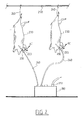
- FIG. 2 A bleeding station using this known method is illustrated in FIG. 2.
- the post includes a conveyor 250 to which the animals are suspended using slings 260.
- the trocars 200 are shown pressed into the bodies 270 of animals slaughtered. These trocars are connected to a container 280 by flexible pipes 240.
- the inlet pipes 220 are connected to a reservoir of anti-coagulant product (not represented).
- the container 280 is connected by means of a socket 251 to a pump suction (not shown).
- the animals are washed, scalded and dehaired, then skinned and eviscerated.
- Carcasses and viscera are checked by a checkpoint veterinary.
- veterinary control concludes that an animal is sick or unfit for consumption, the carcass is seized.
- the veterinary control post notifies the bloodletting station so that the blood of the sick animal is also seized.
- the blood collected remains stored in the containers for the time of transit in the slaughter line, so that the container having collected the blood of the sick animal is still available at the time the seizure order arrives. Its contents cannot then be emptied into the storage tank and must be destroyed. Thus, the blood of healthy animals collected in the container having collected the blood of the animal seized is lost.
- the problem underlying the invention is to propose a slaughterhouse installation allowing to overcome the aforementioned drawbacks and in particular to limit the strict minimum the quantity of blood to destroy.
- the installation according to the invention is defined by an installation slaughterhouse to collect and collect the blood of animals, in particular pigs, comprising routing means for routing said animals to a plurality of workstations, the installation comprising a storage enclosure refrigerated and a first conveyor adapted to convey bags of blood taken from animals, from a first work station, called return station, to said enclosure, said conveyor then extending into said enclosure to a switching station the switch of a pocket being determined according to the result of a first veterinary control relating to the animal from which the blood was taken.
- the conveying time of said pockets between the return station and the station advantage is chosen to be greater than the time after which said first veterinary check is completed.
- the switching station is adapted to automatically switch said pockets, the routing of a pocket being determined according to a information or lack of information relating to the veterinary control audit.
- the referral station leaves a pocket continue conveying by said first conveyor if the first control veterinarian has given her hygienic validation information and directs her to a storage rack in the opposite case.
- the switching station leaves a pocket continue conveying by said first conveyor if it has not received a hygienic risk information and directs it to a storage rack in the case reverse.
- the installation may further comprise a drainage device comprising a drain tank, guide means for guiding the bags during their conveying, by the first conveyor, above the drain tank to a saw circular, said circular saw being arranged so as to pierce said pockets above from the drain tank.
- the drain tank is advantageously topped a protective cover having a slot in the conveying direction of so as to let said pockets pass.
- the installation comprises a second conveyor adapted to convey sampling means each comprising a trocar and a pouch removal, from a trocar preparation station where said pockets are attached to the trocars, up to a second workstation, called a bloodletting station where the trocars are embedded in the bodies of animals.
- sampling means each comprising a trocar and a pouch removal
- the installation may include a third conveyor adapted to convey the trocars from said return station to a cleaning and sterilization of said trocars then to said trocar preparation station.
- the installation may also include a fourth conveyor adapted to convey identification or marking devices for bags and animals, at a third work station, called the marking station, located upstream from the return, in the direction of movement of the animals.
- Means of identification preferably include a transponder and a tattoo stroke.
- the conveying means are preferably suitable for transporting animals in the supine position.
- the invention is also defined by a method for collecting and collecting the blood of animals in a slaughterhouse, whereby the blood of each animal is taken by means of a trocar to which is attached a sampling pocket, a pocket corresponding to one and only one animal.
- the pockets containing the blood samples are detached from the trocars, conveyed in a storage enclosure refrigerated, then referred by a referral station, the referral of a pocket being determined based on the result of an initial veterinary check on the animal the blood was taken from.
- hygienic validation information is sent to the station switch, a pocket for which said information is received being conveyed to an emptying station where the contents of the bag are collected in a emptying and then sent to a storage tank and a pocket for which said information was not received being placed on hold until a second check vet is performed.
- a second operating mode if the first veterinary check is positive or an animal is missing, hygienic risk information is transmitted to the referral station, a pocket for which said information has not been received being conveyed to an emptying station where the contents of the bag are collected in a drain tank and then sent to a storage tank and a pocket for which said information was received being placed on hold until a second veterinary check is carried out.
- the trocars are removed from the animals, conveyed to a washing and sterilization station then recycled for new use.
- each animal is identified by an identification code animal and each pocket is identified by a pocket identification code, each pocket identification code being associated with an identification code animal and only one.
- a first general idea underlying the invention is to carry out a sample of animal blood per animal in individual bags, as described in patent application FR 01 02365 filed on 20.2.01 on behalf of the applicants and incorporated here by reference.
- a second general idea underlying the invention is to provide an installation for selective bag emptying of blood collected, so that only the blood of a healthy animal can reach the tank of storage.
- the installation of the invention aims to treat bags of blood taken from industrial way.
- a schematic representation of the installation is given in Figs. 3a and 3b.
- the animals After being anesthetized, the animals join by an access ramp 300, conveying means 310 constituted, for example, by a mechanical belt or a succession of crazy mounted rollers.
- the animals arrive at the bleeding station 331 in the supine position.
- An operator seizes from the conveyor 320 a trocar-pocket assembly and pushes the trocar into the aortic arch of the animal.
- a pocket identification code is affixed to the pocket with ink pad and animal identification code is affixed on the animal by means of a tattoo.
- the pocket can be identified by means of a barcode label, a transponder and so general by means of identification carrying a pocket identification code.
- the animal can be identified by means of identification bearing a animal identification code, for example a transponder injected into the carcass.
- the latter may be the subject of a specific identification, for example an additional tattoo.
- the identification of an animal and the corresponding pocket is carried out by identification devices sent to the marking station by a conveyor.
- the identification devices can include a strikes a tattoo and a transponder. The operator responsible for marking then tattoos the animal by typing.
- a sensor located at the marking station, reads the code from the transponder and transmits it to a printer that prints a code directly on the pocket or on a label which will be affixed to the pocket.
- the same code can advantageously be used for pocket and animal.
- the animal After the marking station, the animal arrives at a return station 313 from pockets and trocars. At this position, an operator first detaches the pockets in unlocking the quick fastening means and placing them on a pocket conveyor 350. After removing them from the animals' bodies, the operator also places the trocars on a trocar conveyor 340.
- the animals After being routed in the supine position in front of the aforementioned stations the conveying means 310, the animals are then hoisted by slings to be conveyed to washing, scalding, depilation stations, etc. classic.
- the viscera and the carcasses are subjected to a visual check and then a first veterinary check.
- This first check can either directly conclude that the animal is healthy, or declare that the animal has hygienic risks, in which case the carcass is sent to a checkpoint more veterinarian, said observation post.
- the animal At the end of this second check, the animal can either be finally declared healthy (possibly at the cost of a seizure partial) or seized by the veterinary services.
- validation information is forwarded to a referral station 351 (described later) if the first or, if if necessary, the second check is negative.
- the information transmitted to this post validates the blood hygiene of the animal.
- risk information hygienic is transmitted to the referral station if the animal is observed or if it is missing in the slaughter line. If, ultimately, the animal is declared healthy, validation information is then transmitted to the referral station.
- a plurality of conveyors 320, 330, 340, 350 bring and, if necessary, bring back the material means necessary for the various work along the means of transport.
- the conveyor 320 transports from a handling station 314 to the bleeding the sampling means, these each comprising a trocar and a associated pocket and returns empty to the handling station.
- a operator fixes by means of the quick fastening system a pocket on each trocar then hooks the assembly to the conveyor 320.
- a dose of anticoagulant is injected beforehand, through the hollow handle of the trocar, into the pocket.
- an automatic dosing device composed of two identical valves mounted in series on a pipeline and actuated by reverse controls can be used. The volume of the pipeline, delimited by the two valves, defines the dose to inject.
- the conveyor 330 transports the identification devices in a closed loop.
- the length of the conveyor is provided long enough to allow a duration of acceptable autonomy.
- Identification devices may include, such as as we have seen, tattoo strokes, ink pads, transponders, barcode labels etc.
- the conveyor 340 transports the trocars from the return station 313 to the manipulation 314 and returns empty to the return station. At this station, an operator removes the animal's trocar and hooks it to the conveyor 340. The trocars are then conveyed through a prewash, washing and sterilization device 341 and arrive sterilized at handling station 314 to be reused.
- the conveyor 350 transports the bags of blood drawn from the return station 313 to a refrigerated storage enclosure 360, extends inside this enclosure, advantageously in the form of meanders to a switching station 351.
- the length of the conveyor between the return station and the switch station is determined so that the conveying time from the pocket to the switching station is greater than the transit time of the animal in the slaughter line up to and included the first veterinary check. So when a pocket reaches the level of the referral point, the first veterinary check has already been carried out. We must then distinguish according to the operating mode used.
- the referral station receives the code in time identification of the healthy animal and deduces the identification code from the bag corresponding.
- a pocket presents itself at the switch point, that is its code is recognized, in which case she can continue her journey on the conveyor, or it is not recognized and in this case the pocket will be referred, so automatic or manual to a temporary storage rack 353.
- a pocket of which the code is not recognized may correspond to an animal placed under observation for the second veterinary check or even missing in the slaughter line.
- validation information is sent to the referral station (animal finally declared healthy or found and declared healthy), the pocket waiting in the rack will be returned to the normal circuit.
- the identification code animal at hygienic risk is transmitted in time at the referral station and the pocket identification code is deducted.
- the pocket is presented at the referral station, or its identification code is not recognized, in which case it can continue its journey on the conveyor, or it is recognized and in this case the pocket will be routed, automatically or manually to a temporary storage rack 353. If later, information from validation is sent to the referral station (animal finally declared healthy or found and declared healthy), the pocket waiting in the rack will be returned to the normal circuit, i.e. conveyor 350.
- the pockets remaining in the storage rack are seized at the end of the batch slaughter by the competent services.
- the pockets relating to healthy animals are conveyed by the conveyor 350 to a drainage device 352 described later.
- the bags are parts of the conveyor for recycling the plastic material of which they are formed. Alternatively, if reusable bags are used, they will be washed and disinfected for reuse. The conveyor then returns empty to the back 313.
- the referral station may include a barcode reading device and more generally any reading device for reading the pocket identification code. Blood bags hanging from the 350 conveyor pass one by one in front of the reading device. We must then distinguish the two operating modes.
- the bag continues on to the emptying station. Otherwise, it is automatically routed to the temporary storage rack.
- the identification code of the pocket corresponds to the code of an animal being observed or missing, it is directed to the temporary storage rack. Otherwise, it continues its journey towards the emptying station.
- the wall inside the pockets can be coated with a calcium complexing agent such as, for example, ethylenediaminetetraacetic acid, a citrate, an oxalate, a fluoride, a phosphate, a lactate, a triglycine, an alginate.
- a calcium complexing agent such as, for example, ethylenediaminetetraacetic acid, a citrate, an oxalate, a fluoride, a phosphate, a lactate, a triglycine, an alginate.
- a calcium chelating or sequestering agent As the reaction of blood clotting requires the presence of calcium ions, this precaution allows slow the formation of the clot.
- a anti-coagulant agent inside the bag before sampling. In this case, this injection is carried out at station 314, as seen previously.
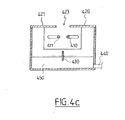
- Figs 4a, 4b, 4c show an example of a device for draining pockets respectively in top view, according to section BB and according to section CC.
- the drain device comprises a drain tank 450 surmounted by a cover protection consisting of two wings 420 and 421 folded down towards the center of the tank their upper parts and the edges of which delimit a central slot 423 intended to pass the pockets 460 transported by the conveyor 350.
- the pockets are guided by rails 410 and 411 to a circular saw 430 which splits them to their passage.
- the blood in the pocket then pours into the drain tank 450.
- the drain tank is provided at its base with a drain hose 440 allowing to transfer the blood to a storage tank (not shown). Pockets as well slits can only give rise to recycling of the plastic.
- sampling bags can be fitted with valves or gripping means allowing their reversal.
- the device can still siphon or aspirate blood from pockets.
- the bags can be recycled after appropriate cleaning and disinfection.
- the installation described allows blood to be collected and collected from excellent hygienic conditions while minimizing the amount of blood seized.
- the identification of pockets and animals guarantees perfect traceability of the blood collected.
Landscapes
- General Health & Medical Sciences (AREA)
- Hematology (AREA)
- Life Sciences & Earth Sciences (AREA)
- Engineering & Computer Science (AREA)
- Food Science & Technology (AREA)
- Health & Medical Sciences (AREA)
- Sampling And Sample Adjustment (AREA)
- Measurement Of The Respiration, Hearing Ability, Form, And Blood Characteristics Of Living Organisms (AREA)
- Warehouses Or Storage Devices (AREA)
- Housing For Livestock And Birds (AREA)
- Medical Preparation Storing Or Oral Administration Devices (AREA)
- Accommodation For Nursing Or Treatment Tables (AREA)
- Surgical Instruments (AREA)
- Investigating Or Analysing Biological Materials (AREA)
- Medicines Containing Plant Substances (AREA)
Applications Claiming Priority (2)
| Application Number | Priority Date | Filing Date | Title |
|---|---|---|---|
| FR0110837A FR2828377B1 (fr) | 2001-08-13 | 2001-08-13 | Installation et procede pour prelever et collecter le sang d'animaux |
| FR0110837 | 2001-08-13 |
Publications (3)
| Publication Number | Publication Date |
|---|---|
| EP1285582A2 true EP1285582A2 (de) | 2003-02-26 |
| EP1285582A3 EP1285582A3 (de) | 2003-03-12 |
| EP1285582B1 EP1285582B1 (de) | 2004-02-18 |
Family
ID=8866550
Family Applications (1)
| Application Number | Title | Priority Date | Filing Date |
|---|---|---|---|
| EP02291991A Expired - Lifetime EP1285582B1 (de) | 2001-08-13 | 2002-08-07 | Anlage und Verfahren zur Abnahme und Gewinning von Tierblut |
Country Status (6)
| Country | Link |
|---|---|
| EP (1) | EP1285582B1 (de) |
| AT (1) | ATE259599T1 (de) |
| DE (1) | DE60200218T2 (de) |
| DK (1) | DK1285582T3 (de) |
| ES (1) | ES2215977T3 (de) |
| FR (1) | FR2828377B1 (de) |
Cited By (1)
| Publication number | Priority date | Publication date | Assignee | Title |
|---|---|---|---|---|
| CN104509573A (zh) * | 2015-01-21 | 2015-04-15 | 朱学成 | 鸡血收集机 |
Families Citing this family (1)
| Publication number | Priority date | Publication date | Assignee | Title |
|---|---|---|---|---|
| RU2764799C1 (ru) * | 2020-10-08 | 2022-01-21 | Общество с ограниченной ответственностью "Алинкино" | Универсальная передвижная установка по сбору и первичной переработке крови убойных животных |
Citations (1)
| Publication number | Priority date | Publication date | Assignee | Title |
|---|---|---|---|---|
| FR2820951A1 (fr) | 2001-02-20 | 2002-08-23 | Bernard Sa | Dispositif et procede pour prelever et collecter le sang d'un animal |
Family Cites Families (3)
| Publication number | Priority date | Publication date | Assignee | Title |
|---|---|---|---|---|
| SE502783C2 (sv) * | 1990-05-25 | 1996-01-15 | Sjoeberg John Anitec Ab | Anläggning för automatisk uppsamling, mellanlagring och tömning av blod från slaktdjur |
| BR9405317A (pt) * | 1994-12-14 | 1996-12-03 | Walter Dimenstein | Conjunto (kit) esteril para sangria animal individualizada em circuito fechado |
| IES80814B2 (en) * | 1998-10-15 | 1999-03-10 | North Cork Ferrous R & D Limit | A blood treatment and recovery apparatus |
-
2001
- 2001-08-13 FR FR0110837A patent/FR2828377B1/fr not_active Expired - Fee Related
-
2002
- 2002-08-07 DE DE60200218T patent/DE60200218T2/de not_active Expired - Fee Related
- 2002-08-07 EP EP02291991A patent/EP1285582B1/de not_active Expired - Lifetime
- 2002-08-07 DK DK02291991T patent/DK1285582T3/da active
- 2002-08-07 ES ES02291991T patent/ES2215977T3/es not_active Expired - Lifetime
- 2002-08-07 AT AT02291991T patent/ATE259599T1/de not_active IP Right Cessation
Patent Citations (1)
| Publication number | Priority date | Publication date | Assignee | Title |
|---|---|---|---|---|
| FR2820951A1 (fr) | 2001-02-20 | 2002-08-23 | Bernard Sa | Dispositif et procede pour prelever et collecter le sang d'un animal |
Cited By (1)
| Publication number | Priority date | Publication date | Assignee | Title |
|---|---|---|---|---|
| CN104509573A (zh) * | 2015-01-21 | 2015-04-15 | 朱学成 | 鸡血收集机 |
Also Published As
| Publication number | Publication date |
|---|---|
| FR2828377B1 (fr) | 2003-10-31 |
| DE60200218D1 (de) | 2004-03-25 |
| FR2828377A1 (fr) | 2003-02-14 |
| DK1285582T3 (da) | 2004-06-01 |
| ES2215977T3 (es) | 2004-10-16 |
| EP1285582A3 (de) | 2003-03-12 |
| DE60200218T2 (de) | 2004-12-02 |
| ATE259599T1 (de) | 2004-03-15 |
| EP1285582B1 (de) | 2004-02-18 |
Similar Documents
| Publication | Publication Date | Title |
|---|---|---|
| NL2001993C (en) | Method and apparatus for processing poultry or a part thereof. | |
| ES2985045T3 (es) | Sistema y método para procesar animales sacrificados y/o piezas de los mismos | |
| DK1786269T3 (en) | Method and apparatus for processing animals | |
| US20130019993A1 (en) | Device for emptying a blood product bag | |
| NL1017100C2 (nl) | Werkwijze en inrichting voor het verwerken van een ingewandenpakket van een slachtdier. | |
| DK2869703T3 (en) | METHOD AND APPARATUS FOR OPENING A CARPET OF A SLAUGHTERED ANIMAL | |
| US5114380A (en) | Method for eviscerating animal carcasses, preferably pig carcasses, a plug and plant therefor | |
| CN107404884A (zh) | 用于清洁和处理被屠宰的猪的直肠和骨盆的设备及所述设备的操作方法 | |
| US6685550B2 (en) | System and method for cleaning intestines | |
| EP1285582B1 (de) | Anlage und Verfahren zur Abnahme und Gewinning von Tierblut | |
| CN108713578A (zh) | 一种猪肉屠宰加工工艺流程 | |
| EP1232691B1 (de) | Vorrichtung zur Abnahme und Gewinning von Tierblut | |
| NL1005157C2 (nl) | Werkwijze en inrichting voor het nemen van een bloedmonster van een slachtdier. | |
| NL8400611A (nl) | Werkwijze voor het chemisch afnemen en opzamelen van dierlijk bloed en inrichting voor het toepassen van deze werkwijze. | |
| EP0077580B1 (de) | Einrichtung zur Gewinnung von für Nahrungszwecke geeignetem Blut in einem Schlachthaus | |
| CN209234805U (zh) | 一种肉牛加工系统 | |
| DK180017B1 (en) | SYSTEM AND METHOD FOR AUTOMATIC REMOVAL OF CAUL FAT FROM ANIMAL STOMACHS | |
| NL2028349B1 (en) | Intestinal tract part processing device and method | |
| JPH08112057A (ja) | 魚体の除臓方法及び除臓装置及び除臓工具並びに魚体の開口方法及び開口装置 | |
| AU2002336361A1 (en) | System and method for cleaning animal intestines | |
| JPH04222546A (ja) | 家禽用の摘出装置 | |
| HU192030B (en) | Device for collecting blood | |
| NZ561259A (en) | Carcass rectum closure clamp to prevent faecal contamination |
Legal Events
| Date | Code | Title | Description |
|---|---|---|---|
| PUAI | Public reference made under article 153(3) epc to a published international application that has entered the european phase |
Free format text: ORIGINAL CODE: 0009012 |
|
| PUAL | Search report despatched |
Free format text: ORIGINAL CODE: 0009013 |
|
| AK | Designated contracting states |
Kind code of ref document: A2 Designated state(s): AT BE BG CH CY CZ DE DK EE ES FI FR GB GR IE IT LI LU MC NL PT SE SK TR |
|
| AX | Request for extension of the european patent |
Extension state: AL LT LV MK RO SI |
|
| AK | Designated contracting states |
Kind code of ref document: A3 Designated state(s): AT BE BG CH CY CZ DE DK EE ES FI FR GB GR IE IT LI LU MC NL PT SE SK TR |
|
| AX | Request for extension of the european patent |
Extension state: AL LT LV MK RO SI |
|
| 17P | Request for examination filed |
Effective date: 20030517 |
|
| GRAP | Despatch of communication of intention to grant a patent |
Free format text: ORIGINAL CODE: EPIDOSNIGR1 |
|
| AKX | Designation fees paid |
Designated state(s): AT BE BG CH CY CZ DE DK EE ES FI FR GB GR IE IT LI LU MC NL PT SE SK TR |
|
| GRAS | Grant fee paid |
Free format text: ORIGINAL CODE: EPIDOSNIGR3 |
|
| GRAA | (expected) grant |
Free format text: ORIGINAL CODE: 0009210 |
|
| AK | Designated contracting states |
Kind code of ref document: B1 Designated state(s): AT BE BG CH CY CZ DE DK EE ES FI FR GB GR IE IT LI LU MC NL PT SE SK TR |
|
| PG25 | Lapsed in a contracting state [announced via postgrant information from national office to epo] |
Ref country code: CZ Free format text: LAPSE BECAUSE OF FAILURE TO SUBMIT A TRANSLATION OF THE DESCRIPTION OR TO PAY THE FEE WITHIN THE PRESCRIBED TIME-LIMIT Effective date: 20040218 Ref country code: CY Free format text: LAPSE BECAUSE OF FAILURE TO SUBMIT A TRANSLATION OF THE DESCRIPTION OR TO PAY THE FEE WITHIN THE PRESCRIBED TIME-LIMIT Effective date: 20040218 Ref country code: BG Free format text: LAPSE BECAUSE OF FAILURE TO SUBMIT A TRANSLATION OF THE DESCRIPTION OR TO PAY THE FEE WITHIN THE PRESCRIBED TIME-LIMIT Effective date: 20040218 Ref country code: FI Free format text: LAPSE BECAUSE OF FAILURE TO SUBMIT A TRANSLATION OF THE DESCRIPTION OR TO PAY THE FEE WITHIN THE PRESCRIBED TIME-LIMIT Effective date: 20040218 Ref country code: EE Free format text: LAPSE BECAUSE OF FAILURE TO SUBMIT A TRANSLATION OF THE DESCRIPTION OR TO PAY THE FEE WITHIN THE PRESCRIBED TIME-LIMIT Effective date: 20040218 Ref country code: GB Free format text: LAPSE BECAUSE OF FAILURE TO SUBMIT A TRANSLATION OF THE DESCRIPTION OR TO PAY THE FEE WITHIN THE PRESCRIBED TIME-LIMIT Effective date: 20040218 Ref country code: AT Free format text: LAPSE BECAUSE OF FAILURE TO SUBMIT A TRANSLATION OF THE DESCRIPTION OR TO PAY THE FEE WITHIN THE PRESCRIBED TIME-LIMIT Effective date: 20040218 Ref country code: SK Free format text: LAPSE BECAUSE OF FAILURE TO SUBMIT A TRANSLATION OF THE DESCRIPTION OR TO PAY THE FEE WITHIN THE PRESCRIBED TIME-LIMIT Effective date: 20040218 Ref country code: TR Free format text: LAPSE BECAUSE OF FAILURE TO SUBMIT A TRANSLATION OF THE DESCRIPTION OR TO PAY THE FEE WITHIN THE PRESCRIBED TIME-LIMIT Effective date: 20040218 |
|
| REG | Reference to a national code |
Ref country code: GB Ref legal event code: FG4D Free format text: NOT ENGLISH |
|
| REG | Reference to a national code |
Ref country code: CH Ref legal event code: EP |
|
| REG | Reference to a national code |
Ref country code: IE Ref legal event code: FG4D Free format text: FRENCH |
|
| REF | Corresponds to: |
Ref document number: 60200218 Country of ref document: DE Date of ref document: 20040325 Kind code of ref document: P |
|
| REG | Reference to a national code |
Ref country code: SE Ref legal event code: TRGR |
|
| PG25 | Lapsed in a contracting state [announced via postgrant information from national office to epo] |
Ref country code: GR Free format text: LAPSE BECAUSE OF FAILURE TO SUBMIT A TRANSLATION OF THE DESCRIPTION OR TO PAY THE FEE WITHIN THE PRESCRIBED TIME-LIMIT Effective date: 20040518 |
|
| REG | Reference to a national code |
Ref country code: DK Ref legal event code: T3 |
|
| PG25 | Lapsed in a contracting state [announced via postgrant information from national office to epo] |
Ref country code: LU Free format text: LAPSE BECAUSE OF NON-PAYMENT OF DUE FEES Effective date: 20040807 |
|
| GBV | Gb: ep patent (uk) treated as always having been void in accordance with gb section 77(7)/1977 [no translation filed] |
Effective date: 20040218 |
|
| PG25 | Lapsed in a contracting state [announced via postgrant information from national office to epo] |
Ref country code: MC Free format text: LAPSE BECAUSE OF NON-PAYMENT OF DUE FEES Effective date: 20040831 |
|
| REG | Reference to a national code |
Ref country code: ES Ref legal event code: FG2A Ref document number: 2215977 Country of ref document: ES Kind code of ref document: T3 |
|
| PLBE | No opposition filed within time limit |
Free format text: ORIGINAL CODE: 0009261 |
|
| STAA | Information on the status of an ep patent application or granted ep patent |
Free format text: STATUS: NO OPPOSITION FILED WITHIN TIME LIMIT |
|
| 26N | No opposition filed |
Effective date: 20041119 |
|
| PG25 | Lapsed in a contracting state [announced via postgrant information from national office to epo] |
Ref country code: FR Free format text: LAPSE BECAUSE OF NON-PAYMENT OF DUE FEES Effective date: 20050429 |
|
| REG | Reference to a national code |
Ref country code: FR Ref legal event code: ST |
|
| PGFP | Annual fee paid to national office [announced via postgrant information from national office to epo] |
Ref country code: NL Payment date: 20060814 Year of fee payment: 5 |
|
| PGFP | Annual fee paid to national office [announced via postgrant information from national office to epo] |
Ref country code: DK Payment date: 20060815 Year of fee payment: 5 |
|
| PGFP | Annual fee paid to national office [announced via postgrant information from national office to epo] |
Ref country code: DE Payment date: 20060816 Year of fee payment: 5 |
|
| PGFP | Annual fee paid to national office [announced via postgrant information from national office to epo] |
Ref country code: IE Payment date: 20060825 Year of fee payment: 5 |
|
| PGFP | Annual fee paid to national office [announced via postgrant information from national office to epo] |
Ref country code: ES Payment date: 20060830 Year of fee payment: 5 |
|
| PG25 | Lapsed in a contracting state [announced via postgrant information from national office to epo] |
Ref country code: CH Free format text: LAPSE BECAUSE OF NON-PAYMENT OF DUE FEES Effective date: 20060831 Ref country code: LI Free format text: LAPSE BECAUSE OF NON-PAYMENT OF DUE FEES Effective date: 20060831 |
|
| PGFP | Annual fee paid to national office [announced via postgrant information from national office to epo] |
Ref country code: IT Payment date: 20060831 Year of fee payment: 5 |
|
| PGFP | Annual fee paid to national office [announced via postgrant information from national office to epo] |
Ref country code: BE Payment date: 20060914 Year of fee payment: 5 |
|
| REG | Reference to a national code |
Ref country code: CH Ref legal event code: PL |
|
| PG25 | Lapsed in a contracting state [announced via postgrant information from national office to epo] |
Ref country code: PT Free format text: LAPSE BECAUSE OF NON-PAYMENT OF DUE FEES Effective date: 20040718 |
|
| PGFP | Annual fee paid to national office [announced via postgrant information from national office to epo] |
Ref country code: SE Payment date: 20060814 Year of fee payment: 5 |
|
| BERE | Be: lapsed |
Owner name: S.A. *BERNARD Effective date: 20070831 Owner name: *DELAUNOY JEAN-PIERRE Effective date: 20070831 |
|
| EUG | Se: european patent has lapsed | ||
| REG | Reference to a national code |
Ref country code: DK Ref legal event code: EBP |
|
| PG25 | Lapsed in a contracting state [announced via postgrant information from national office to epo] |
Ref country code: NL Free format text: LAPSE BECAUSE OF NON-PAYMENT OF DUE FEES Effective date: 20080301 Ref country code: SE Free format text: LAPSE BECAUSE OF NON-PAYMENT OF DUE FEES Effective date: 20070808 |
|
| NLV4 | Nl: lapsed or anulled due to non-payment of the annual fee |
Effective date: 20080301 |
|
| REG | Reference to a national code |
Ref country code: IE Ref legal event code: MM4A |
|
| PG25 | Lapsed in a contracting state [announced via postgrant information from national office to epo] |
Ref country code: DK Free format text: LAPSE BECAUSE OF NON-PAYMENT OF DUE FEES Effective date: 20070831 Ref country code: DE Free format text: LAPSE BECAUSE OF NON-PAYMENT OF DUE FEES Effective date: 20080301 |
|
| PG25 | Lapsed in a contracting state [announced via postgrant information from national office to epo] |
Ref country code: BE Free format text: LAPSE BECAUSE OF NON-PAYMENT OF DUE FEES Effective date: 20070831 |
|
| PG25 | Lapsed in a contracting state [announced via postgrant information from national office to epo] |
Ref country code: IE Free format text: LAPSE BECAUSE OF NON-PAYMENT OF DUE FEES Effective date: 20070807 |
|
| REG | Reference to a national code |
Ref country code: ES Ref legal event code: FD2A Effective date: 20070808 |
|
| PG25 | Lapsed in a contracting state [announced via postgrant information from national office to epo] |
Ref country code: ES Free format text: LAPSE BECAUSE OF NON-PAYMENT OF DUE FEES Effective date: 20070808 |
|
| PG25 | Lapsed in a contracting state [announced via postgrant information from national office to epo] |
Ref country code: IT Free format text: LAPSE BECAUSE OF NON-PAYMENT OF DUE FEES Effective date: 20070807 |