EP1280811B1 - Verfahren zur hydroformylierung, verbrückte verbindungen des phosphors, arsens und des antimons und katalysator, umfassend einen komplex dieser verbrückten verbindungen - Google Patents
Verfahren zur hydroformylierung, verbrückte verbindungen des phosphors, arsens und des antimons und katalysator, umfassend einen komplex dieser verbrückten verbindungen Download PDFInfo
- Publication number
- EP1280811B1 EP1280811B1 EP01931693A EP01931693A EP1280811B1 EP 1280811 B1 EP1280811 B1 EP 1280811B1 EP 01931693 A EP01931693 A EP 01931693A EP 01931693 A EP01931693 A EP 01931693A EP 1280811 B1 EP1280811 B1 EP 1280811B1
- Authority
- EP
- European Patent Office
- Prior art keywords
- aryl
- alkyl
- cycloalkyl
- independently
- nitro
- Prior art date
- Legal status (The legal status is an assumption and is not a legal conclusion. Google has not performed a legal analysis and makes no representation as to the accuracy of the status listed.)
- Expired - Lifetime
Links
- JSUFYADPANWGDQ-UHFFFAOYSA-N C/C(/N)=[O](/C)\CC1CC1 Chemical compound C/C(/N)=[O](/C)\CC1CC1 JSUFYADPANWGDQ-UHFFFAOYSA-N 0.000 description 1
Classifications
-
- B—PERFORMING OPERATIONS; TRANSPORTING
- B01—PHYSICAL OR CHEMICAL PROCESSES OR APPARATUS IN GENERAL
- B01J—CHEMICAL OR PHYSICAL PROCESSES, e.g. CATALYSIS OR COLLOID CHEMISTRY; THEIR RELEVANT APPARATUS
- B01J31/00—Catalysts comprising hydrides, coordination complexes or organic compounds
- B01J31/16—Catalysts comprising hydrides, coordination complexes or organic compounds containing coordination complexes
- B01J31/18—Catalysts comprising hydrides, coordination complexes or organic compounds containing coordination complexes containing nitrogen, phosphorus, arsenic or antimony as complexing atoms, e.g. in pyridine ligands, or in resonance therewith, e.g. in isocyanide ligands C=N-R or as complexed central atoms
- B01J31/1845—Catalysts comprising hydrides, coordination complexes or organic compounds containing coordination complexes containing nitrogen, phosphorus, arsenic or antimony as complexing atoms, e.g. in pyridine ligands, or in resonance therewith, e.g. in isocyanide ligands C=N-R or as complexed central atoms the ligands containing phosphorus
-
- B—PERFORMING OPERATIONS; TRANSPORTING
- B01—PHYSICAL OR CHEMICAL PROCESSES OR APPARATUS IN GENERAL
- B01J—CHEMICAL OR PHYSICAL PROCESSES, e.g. CATALYSIS OR COLLOID CHEMISTRY; THEIR RELEVANT APPARATUS
- B01J31/00—Catalysts comprising hydrides, coordination complexes or organic compounds
- B01J31/16—Catalysts comprising hydrides, coordination complexes or organic compounds containing coordination complexes
- B01J31/18—Catalysts comprising hydrides, coordination complexes or organic compounds containing coordination complexes containing nitrogen, phosphorus, arsenic or antimony as complexing atoms, e.g. in pyridine ligands, or in resonance therewith, e.g. in isocyanide ligands C=N-R or as complexed central atoms
- B01J31/1845—Catalysts comprising hydrides, coordination complexes or organic compounds containing coordination complexes containing nitrogen, phosphorus, arsenic or antimony as complexing atoms, e.g. in pyridine ligands, or in resonance therewith, e.g. in isocyanide ligands C=N-R or as complexed central atoms the ligands containing phosphorus
- B01J31/1865—Phosphonites (RP(OR)2), their isomeric phosphinates (R2(RO)P=O) and RO-substitution derivatives thereof
-
- B—PERFORMING OPERATIONS; TRANSPORTING
- B01—PHYSICAL OR CHEMICAL PROCESSES OR APPARATUS IN GENERAL
- B01J—CHEMICAL OR PHYSICAL PROCESSES, e.g. CATALYSIS OR COLLOID CHEMISTRY; THEIR RELEVANT APPARATUS
- B01J31/00—Catalysts comprising hydrides, coordination complexes or organic compounds
- B01J31/16—Catalysts comprising hydrides, coordination complexes or organic compounds containing coordination complexes
- B01J31/24—Phosphines, i.e. phosphorus bonded to only carbon atoms, or to both carbon and hydrogen atoms, including e.g. sp2-hybridised phosphorus compounds such as phosphabenzene, phosphole or anionic phospholide ligands
-
- B—PERFORMING OPERATIONS; TRANSPORTING
- B01—PHYSICAL OR CHEMICAL PROCESSES OR APPARATUS IN GENERAL
- B01J—CHEMICAL OR PHYSICAL PROCESSES, e.g. CATALYSIS OR COLLOID CHEMISTRY; THEIR RELEVANT APPARATUS
- B01J31/00—Catalysts comprising hydrides, coordination complexes or organic compounds
- B01J31/16—Catalysts comprising hydrides, coordination complexes or organic compounds containing coordination complexes
- B01J31/24—Phosphines, i.e. phosphorus bonded to only carbon atoms, or to both carbon and hydrogen atoms, including e.g. sp2-hybridised phosphorus compounds such as phosphabenzene, phosphole or anionic phospholide ligands
- B01J31/2404—Cyclic ligands, including e.g. non-condensed polycyclic ligands, the phosphine-P atom being a ring member or a substituent on the ring
- B01J31/2409—Cyclic ligands, including e.g. non-condensed polycyclic ligands, the phosphine-P atom being a ring member or a substituent on the ring with more than one complexing phosphine-P atom
- B01J31/2414—Cyclic ligands, including e.g. non-condensed polycyclic ligands, the phosphine-P atom being a ring member or a substituent on the ring with more than one complexing phosphine-P atom comprising aliphatic or saturated rings
-
- B—PERFORMING OPERATIONS; TRANSPORTING
- B01—PHYSICAL OR CHEMICAL PROCESSES OR APPARATUS IN GENERAL
- B01J—CHEMICAL OR PHYSICAL PROCESSES, e.g. CATALYSIS OR COLLOID CHEMISTRY; THEIR RELEVANT APPARATUS
- B01J31/00—Catalysts comprising hydrides, coordination complexes or organic compounds
- B01J31/16—Catalysts comprising hydrides, coordination complexes or organic compounds containing coordination complexes
- B01J31/24—Phosphines, i.e. phosphorus bonded to only carbon atoms, or to both carbon and hydrogen atoms, including e.g. sp2-hybridised phosphorus compounds such as phosphabenzene, phosphole or anionic phospholide ligands
- B01J31/2404—Cyclic ligands, including e.g. non-condensed polycyclic ligands, the phosphine-P atom being a ring member or a substituent on the ring
- B01J31/2442—Cyclic ligands, including e.g. non-condensed polycyclic ligands, the phosphine-P atom being a ring member or a substituent on the ring comprising condensed ring systems
- B01J31/2447—Cyclic ligands, including e.g. non-condensed polycyclic ligands, the phosphine-P atom being a ring member or a substituent on the ring comprising condensed ring systems and phosphine-P atoms as substituents on a ring of the condensed system or on a further attached ring
- B01J31/2452—Cyclic ligands, including e.g. non-condensed polycyclic ligands, the phosphine-P atom being a ring member or a substituent on the ring comprising condensed ring systems and phosphine-P atoms as substituents on a ring of the condensed system or on a further attached ring with more than one complexing phosphine-P atom
- B01J31/2457—Cyclic ligands, including e.g. non-condensed polycyclic ligands, the phosphine-P atom being a ring member or a substituent on the ring comprising condensed ring systems and phosphine-P atoms as substituents on a ring of the condensed system or on a further attached ring with more than one complexing phosphine-P atom comprising aliphatic or saturated rings, e.g. Xantphos
-
- C—CHEMISTRY; METALLURGY
- C07—ORGANIC CHEMISTRY
- C07C—ACYCLIC OR CARBOCYCLIC COMPOUNDS
- C07C17/00—Preparation of halogenated hydrocarbons
- C07C17/26—Preparation of halogenated hydrocarbons by reactions involving an increase in the number of carbon atoms in the skeleton
- C07C17/263—Preparation of halogenated hydrocarbons by reactions involving an increase in the number of carbon atoms in the skeleton by condensation reactions
-
- C—CHEMISTRY; METALLURGY
- C07—ORGANIC CHEMISTRY
- C07C—ACYCLIC OR CARBOCYCLIC COMPOUNDS
- C07C17/00—Preparation of halogenated hydrocarbons
- C07C17/26—Preparation of halogenated hydrocarbons by reactions involving an increase in the number of carbon atoms in the skeleton
- C07C17/263—Preparation of halogenated hydrocarbons by reactions involving an increase in the number of carbon atoms in the skeleton by condensation reactions
- C07C17/2632—Preparation of halogenated hydrocarbons by reactions involving an increase in the number of carbon atoms in the skeleton by condensation reactions involving an organo-magnesium compound, e.g. Grignard synthesis
-
- C—CHEMISTRY; METALLURGY
- C07—ORGANIC CHEMISTRY
- C07C—ACYCLIC OR CARBOCYCLIC COMPOUNDS
- C07C17/00—Preparation of halogenated hydrocarbons
- C07C17/35—Preparation of halogenated hydrocarbons by reactions not affecting the number of carbon or of halogen atoms in the reaction
-
- C—CHEMISTRY; METALLURGY
- C07—ORGANIC CHEMISTRY
- C07C—ACYCLIC OR CARBOCYCLIC COMPOUNDS
- C07C45/00—Preparation of compounds having >C = O groups bound only to carbon or hydrogen atoms; Preparation of chelates of such compounds
- C07C45/27—Preparation of compounds having >C = O groups bound only to carbon or hydrogen atoms; Preparation of chelates of such compounds by oxidation
- C07C45/30—Preparation of compounds having >C = O groups bound only to carbon or hydrogen atoms; Preparation of chelates of such compounds by oxidation with halogen containing compounds, e.g. hypohalogenation
-
- C—CHEMISTRY; METALLURGY
- C07—ORGANIC CHEMISTRY
- C07C—ACYCLIC OR CARBOCYCLIC COMPOUNDS
- C07C45/00—Preparation of compounds having >C = O groups bound only to carbon or hydrogen atoms; Preparation of chelates of such compounds
- C07C45/49—Preparation of compounds having >C = O groups bound only to carbon or hydrogen atoms; Preparation of chelates of such compounds by reaction with carbon monoxide
- C07C45/50—Preparation of compounds having >C = O groups bound only to carbon or hydrogen atoms; Preparation of chelates of such compounds by reaction with carbon monoxide by oxo-reactions
-
- C—CHEMISTRY; METALLURGY
- C07—ORGANIC CHEMISTRY
- C07C—ACYCLIC OR CARBOCYCLIC COMPOUNDS
- C07C45/00—Preparation of compounds having >C = O groups bound only to carbon or hydrogen atoms; Preparation of chelates of such compounds
- C07C45/61—Preparation of compounds having >C = O groups bound only to carbon or hydrogen atoms; Preparation of chelates of such compounds by reactions not involving the formation of >C = O groups
- C07C45/67—Preparation of compounds having >C = O groups bound only to carbon or hydrogen atoms; Preparation of chelates of such compounds by reactions not involving the formation of >C = O groups by isomerisation; by change of size of the carbon skeleton
- C07C45/673—Preparation of compounds having >C = O groups bound only to carbon or hydrogen atoms; Preparation of chelates of such compounds by reactions not involving the formation of >C = O groups by isomerisation; by change of size of the carbon skeleton by change of size of the carbon skeleton
- C07C45/676—Preparation of compounds having >C = O groups bound only to carbon or hydrogen atoms; Preparation of chelates of such compounds by reactions not involving the formation of >C = O groups by isomerisation; by change of size of the carbon skeleton by change of size of the carbon skeleton by elimination of carboxyl groups
-
- C—CHEMISTRY; METALLURGY
- C07—ORGANIC CHEMISTRY
- C07C—ACYCLIC OR CARBOCYCLIC COMPOUNDS
- C07C49/00—Ketones; Ketenes; Dimeric ketenes; Ketonic chelates
- C07C49/587—Unsaturated compounds containing a keto groups being part of a ring
- C07C49/687—Unsaturated compounds containing a keto groups being part of a ring containing halogen
- C07C49/697—Unsaturated compounds containing a keto groups being part of a ring containing halogen containing six-membered aromatic rings
-
- C—CHEMISTRY; METALLURGY
- C07—ORGANIC CHEMISTRY
- C07F—ACYCLIC, CARBOCYCLIC OR HETEROCYCLIC COMPOUNDS CONTAINING ELEMENTS OTHER THAN CARBON, HYDROGEN, HALOGEN, OXYGEN, NITROGEN, SULFUR, SELENIUM OR TELLURIUM
- C07F15/00—Compounds containing elements of Groups 8, 9, 10 or 18 of the Periodic Table
- C07F15/0006—Compounds containing elements of Groups 8, 9, 10 or 18 of the Periodic Table compounds of the platinum group
- C07F15/0033—Iridium compounds
- C07F15/004—Iridium compounds without a metal-carbon linkage
-
- C—CHEMISTRY; METALLURGY
- C07—ORGANIC CHEMISTRY
- C07F—ACYCLIC, CARBOCYCLIC OR HETEROCYCLIC COMPOUNDS CONTAINING ELEMENTS OTHER THAN CARBON, HYDROGEN, HALOGEN, OXYGEN, NITROGEN, SULFUR, SELENIUM OR TELLURIUM
- C07F15/00—Compounds containing elements of Groups 8, 9, 10 or 18 of the Periodic Table
- C07F15/0006—Compounds containing elements of Groups 8, 9, 10 or 18 of the Periodic Table compounds of the platinum group
- C07F15/0046—Ruthenium compounds
- C07F15/0053—Ruthenium compounds without a metal-carbon linkage
-
- C—CHEMISTRY; METALLURGY
- C07—ORGANIC CHEMISTRY
- C07F—ACYCLIC, CARBOCYCLIC OR HETEROCYCLIC COMPOUNDS CONTAINING ELEMENTS OTHER THAN CARBON, HYDROGEN, HALOGEN, OXYGEN, NITROGEN, SULFUR, SELENIUM OR TELLURIUM
- C07F15/00—Compounds containing elements of Groups 8, 9, 10 or 18 of the Periodic Table
- C07F15/0006—Compounds containing elements of Groups 8, 9, 10 or 18 of the Periodic Table compounds of the platinum group
- C07F15/006—Palladium compounds
- C07F15/0066—Palladium compounds without a metal-carbon linkage
-
- C—CHEMISTRY; METALLURGY
- C07—ORGANIC CHEMISTRY
- C07F—ACYCLIC, CARBOCYCLIC OR HETEROCYCLIC COMPOUNDS CONTAINING ELEMENTS OTHER THAN CARBON, HYDROGEN, HALOGEN, OXYGEN, NITROGEN, SULFUR, SELENIUM OR TELLURIUM
- C07F15/00—Compounds containing elements of Groups 8, 9, 10 or 18 of the Periodic Table
- C07F15/0006—Compounds containing elements of Groups 8, 9, 10 or 18 of the Periodic Table compounds of the platinum group
- C07F15/0073—Rhodium compounds
- C07F15/008—Rhodium compounds without a metal-carbon linkage
-
- C—CHEMISTRY; METALLURGY
- C07—ORGANIC CHEMISTRY
- C07F—ACYCLIC, CARBOCYCLIC OR HETEROCYCLIC COMPOUNDS CONTAINING ELEMENTS OTHER THAN CARBON, HYDROGEN, HALOGEN, OXYGEN, NITROGEN, SULFUR, SELENIUM OR TELLURIUM
- C07F15/00—Compounds containing elements of Groups 8, 9, 10 or 18 of the Periodic Table
- C07F15/0006—Compounds containing elements of Groups 8, 9, 10 or 18 of the Periodic Table compounds of the platinum group
- C07F15/0086—Platinum compounds
- C07F15/0093—Platinum compounds without a metal-carbon linkage
-
- C—CHEMISTRY; METALLURGY
- C07—ORGANIC CHEMISTRY
- C07F—ACYCLIC, CARBOCYCLIC OR HETEROCYCLIC COMPOUNDS CONTAINING ELEMENTS OTHER THAN CARBON, HYDROGEN, HALOGEN, OXYGEN, NITROGEN, SULFUR, SELENIUM OR TELLURIUM
- C07F15/00—Compounds containing elements of Groups 8, 9, 10 or 18 of the Periodic Table
- C07F15/06—Cobalt compounds
- C07F15/065—Cobalt compounds without a metal-carbon linkage
-
- B—PERFORMING OPERATIONS; TRANSPORTING
- B01—PHYSICAL OR CHEMICAL PROCESSES OR APPARATUS IN GENERAL
- B01J—CHEMICAL OR PHYSICAL PROCESSES, e.g. CATALYSIS OR COLLOID CHEMISTRY; THEIR RELEVANT APPARATUS
- B01J2531/00—Additional information regarding catalytic systems classified in B01J31/00
- B01J2531/80—Complexes comprising metals of Group VIII as the central metal
- B01J2531/82—Metals of the platinum group
- B01J2531/821—Ruthenium
-
- B—PERFORMING OPERATIONS; TRANSPORTING
- B01—PHYSICAL OR CHEMICAL PROCESSES OR APPARATUS IN GENERAL
- B01J—CHEMICAL OR PHYSICAL PROCESSES, e.g. CATALYSIS OR COLLOID CHEMISTRY; THEIR RELEVANT APPARATUS
- B01J2531/00—Additional information regarding catalytic systems classified in B01J31/00
- B01J2531/80—Complexes comprising metals of Group VIII as the central metal
- B01J2531/82—Metals of the platinum group
- B01J2531/822—Rhodium
-
- B—PERFORMING OPERATIONS; TRANSPORTING
- B01—PHYSICAL OR CHEMICAL PROCESSES OR APPARATUS IN GENERAL
- B01J—CHEMICAL OR PHYSICAL PROCESSES, e.g. CATALYSIS OR COLLOID CHEMISTRY; THEIR RELEVANT APPARATUS
- B01J2531/00—Additional information regarding catalytic systems classified in B01J31/00
- B01J2531/80—Complexes comprising metals of Group VIII as the central metal
- B01J2531/84—Metals of the iron group
- B01J2531/845—Cobalt
Definitions
- the present invention relates to a process for hydroformylation ethylenically unsaturated compounds, using as hydroformylation catalyst at least one complex of a metal VIII subgroup with at least one ligand, of the two triaryl groups, each of the triaryl groups a residue containing phosphorus, arsenic or antimony atoms and in each case an aryl radical of the two triaryl groups via a single bond to a non-aromatic 3- to 8-membered carbocyclic or heterocyclic bridging group bound is.
- the invention further relates to new bridged connections of this type and catalysts that have at least one Complex of a metal of subgroup VIII with at least one such compound as ligands.
- Hydroformylation or oxo synthesis is an important large-scale one Process and is used for the production of aldehydes Olefins, carbon monoxide and hydrogen. These aldehydes can optionally with hydrogen in the same operation corresponding oxo alcohols are hydrogenated.
- the reaction itself is highly exothermic and generally runs under increased pressure and at elevated temperatures in the presence of catalysts.
- Co, Rh, Ir, Ru, Pd or Pt compounds are used as catalysts or complexes used for activity and / or Selectivity influence modified with N- or P-containing ligands could be. It happens in the hydroformylation reaction due to the possible addition of CO to each of the two carbon atoms a double bond to form mixtures of isomeric aldehydes.
- Suitable phosphorus-containing ligands are z.
- the currently on The most common ligands are triarylphosphines, such as. B. Triphenylphosphine and sulfonated triphenylphosphine as these have sufficient stability under the reaction conditions.
- a disadvantage of these ligands is that in general only very high excess ligand yields satisfactory especially deliver on linear aldehydes.
- DE-A-196 523 50 describes catalysts based on 4.5-Diphosphinoacridin ligands. These are suitable for catalysis the carbon monoxide conversion via the water gas balance.
- the disadvantage of these ligands is that they are complex and multi-stage Synthetic pathway and that which is unfavorable for rhodium chelation
- Van Leeuwen et al. describe in Organometallics 1995, 14, page 3081 ff.
- a disadvantage of this Ligands is the complex synthesis of the xanthene body as well the need to use sensitive organometallic Compounds in synthesis. Hydroformylation process under Catalysts based on these ligands are therefore used economically disadvantaged.
- WO-A-87/07600 describes the use of chelating ligands in catalysts for low-pressure hydroformylation.
- chelating ligands z.
- B. Compounds are used in which two diarylphosphine groups are each bonded via a C 1 alkylene group to a 1,1'-bisaryl group as a bridging group.
- a disadvantage of this process is the high basicity of the ligands used, whose catalytic activity is in need of improvement.
- WO-A-95/30680 describes bidentate phosphine ligands, at where the phosphorus atoms are bound directly to a bridging group which comprises two aryl groups which are part of an ortho-fused one Ring systems are.
- Van der Veen et al. describe in Angewandte Chemie 1999, 111, P. 349 ff. Rhodium catalysts for the hydroformylation of internal Olefins to linear aldehydes, with bisphosphines as ligands on a xanthene basis.
- a disadvantage of this Catalysts are the complex synthesis of the xanthene base and the need to use organometallic compounds in the synthesis.
- JP-A-3261791 also describes the synthesis of cyclopentylene bridges Bis (triphenylphosphines) and their use as Ligands in transition metal catalysts for the hydrogenation of ketones and ⁇ -acylaminoacrylic acids.
- JP-A-3017039 describes a process for the preparation of aldehydes by hydroformylation of olefins in the presence of a Rhodium catalyst with a cyclic siloxane as ligand Diphenylphosphine residues bound to it via phenylene bridges.
- US 5,817,883 describes a process for the production of substituted or unsubstituted hydroxy aldehydes, e.g. B. 6-Hydroxyhexanalen, in which alkadienes a hydrocarbonylation and undergoes hydroformylation, both reactions in the presence of a metal complex catalyst with organophosphorus ligands can be done.
- the present invention has for its object an improved Process for the hydroformylation of compounds which contain at least one ethylenically unsaturated double bond, to provide. It is said to be in hydroformylation ⁇ -olefins preferably the highest possible proportion of ⁇ -aldehydes, or alcohols can be achieved.
- the method should preferably also for the hydroformylation of internal linear olefins if possible high regioselectivity in favor of terminal product aldehydes be suitable.
- the catalyst service lives should also be considered be as high as possible.
- the invention also lies based on the task of new compounds and new catalysts, the at least one complex of a metal of subgroup VIII with such a compound as a ligand to deliver. These catalysts should preferably be used in their Use in hydroformylation a high ⁇ selectivity and / or Regioselectivity and / or under the reaction conditions have a high stability.
- Hydroformylation catalyst at least one complex of a metal VIII subgroup with at least one ligand, of the two triaryl groups, each of the triaryl groups a residue containing phosphorus, arsenic or antimony atoms has, in each case an aryl radical of the two triaryl groups via a single bond to a non-aromatic 3- to 8-membered carbocyclic or heterocyclic bridging group bound is.
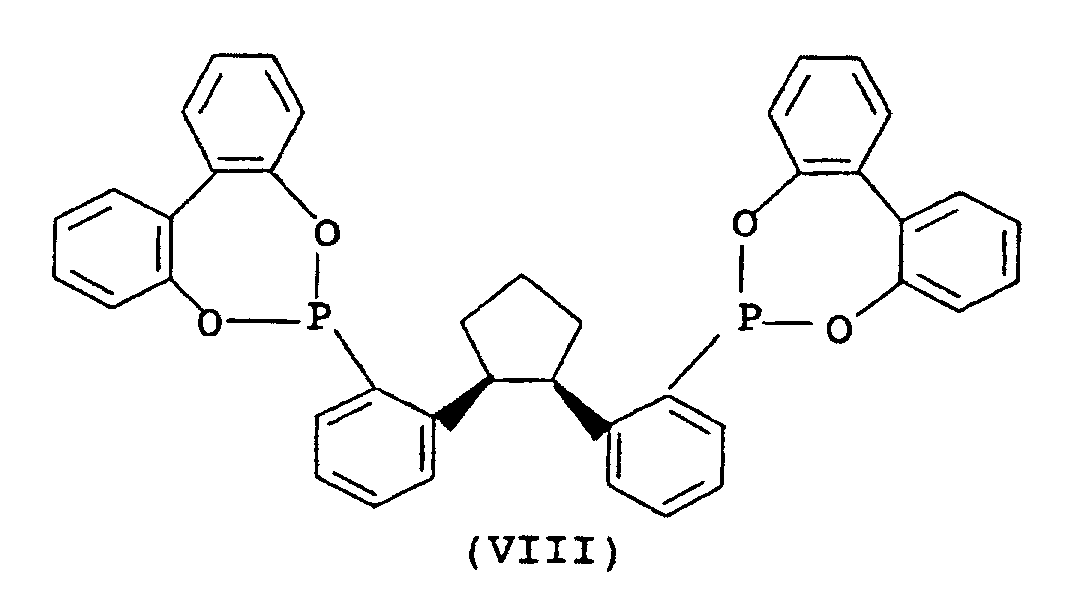
- At least one complex with a compound of the formula I is used as the ligand as the hydroformylation catalyst, where Z 1 and Z 2 are phosphonite groups. According to a further preferred embodiment, Z 1 and Z 2 represent phosphine groups.
- alkyl encompasses straight-chain and branched alkyl groups. These are preferably straight-chain or branched C 1 -C 8 alkyl, more preferably C 1 -C 6 alkyl and particularly preferably C 1 -C 4 alkyl groups.
- alkyl groups are in particular methyl, ethyl, propyl, isopropyl, n-butyl, 2-butyl, sec-butyl, tert-butyl, n-pentyl, 2-pentyl, 2-methylbutyl, 3-methylbutyl, 1,2 -Dimethylpropyl, 1,1-dimethylpropyl, 2,2-dimethylpropyl, 1-ethylpropyl, n-hexyl, 2-hexyl, 2-methylpentyl, 3-methylpentyl, 4-methylpentyl, 1,2-dimethylbutyl, 1,3-dimethylbutyl , 2,3-dimethylbutyl, 1,1-dimethylbutyl, 2,2-dimethylbutyl, 3,3-dimethylbutyl, 1,1,2-trimethylpropyl, 1,2,2-trimethylpropyl, 1-ethylbutyl, 2-ethylbutyl, 1 -Ethyl
- the cycloalkyl group is preferably a C 4 to C 8 cycloalkyl group and in particular a C 5 -C 7 cycloalkyl group, such as cyclopentyl, cyclohexyl or cycloheptyl.
- the cycloalkyl group When the cycloalkyl group is substituted, it preferably has 1, 2, 3, 4 or 5, in particular 1, 2 or 3 substituents, selected from alkyl, alkoxy or halogen.
- Aryl preferably represents phenyl, tolyl, xylyl, mesityl, naphthyl, Anthracenyl, phenanthrenyl, naphthacenyl and in particular for phenyl or naphthyl.
- Substituted aryl radicals preferably have 1, 2, 3, 4 or 5, in particular 1, 2 or 3, substituents selected from alkyl, alkoxy, carboxyl, carboxylate, trifluoromethyl, -SO 3 H, sulfonate, NE 1 E 2 , alkylene-NE 1 E 2 , nitro, cyano or halogen.
- Hetaryl preferably represents pyrrolyl, pyrazolyl, imidazolyl, Indolyl, carbazolyl, pyridyl, quinolinyl, acridinyl, pyridazinyl, Pyrimidinyl or pyrazinyl.
- Substituted hetaryl radicals preferably have 1, 2 or 3 substituents selected from alkyl, alkoxy, -SO 3 H, sulfonate, NE 1 E 2 , alkylene-NE 1 E 2 , trifluoromethyl or halogen.
- alkyl, cycloalkyl and aryl radicals apply accordingly to alkoxy, cycloalkyloxy and aryloxy radicals.
- the residues NE 1 E 2 and NE 3 E 4 preferably represent N, N-dimethyl, N, N-diethyl, N, N-dipropyl, N, N-diisopropyl, N, N-di-n-butyl, N, N-di-t-butyl, N, N-dicyclohexyl or N, N-diphenyl.
- Halogen stands for fluorine, chlorine, bromine and iodine, preferably for Fluorine, chlorine and bromine.
- carboxylate and sulfonate preferably represent a derivative of a carboxylic acid function or a sulfonic acid function, in particular a metal carboxylate or sulfonate, a carboxylic acid or sulfonic acid ester function or a carboxylic acid or sulfonic acid amide function, particularly preferably an ester function.
- these include e.g. B. the esters with C 1 -C 4 alkanols, such as methanol, ethanol, n-propanol, isopropanol, n-butanol, sec-butanol and tert-butanol.
- M + preferably represents a cation, such as Li + , Na + , K + or NH 4 + ,
- X - preferably represents an anion, such as F - , Cl - or Br - .
- Y is preferably an integer from 2 to 100.
- one of the radicals Z 1 or Z 2 or both radicals Z 1 and Z 2 are selected from those radicals of the formulas PR 1 R 2 , OPR 1 R 2 , P (OR 1 ) R 2 , P (OR 1 ) (OR 2 ), OP (OR 1 ) R 2 and OP (OR 1 ) (OR 2 ), wherein R 1 and R 2 together with the phosphorus atom and optionally the oxygen atom (s) to which they are bonded, represent a 5- to 8-membered heterocycle which is optionally additionally fused one, two or three times with cycloalkyl, heterocycloalkyl, aryl and / or hetaryl, where the heterocycle and / or the fused groups independently of one another, two, three or four substituents which can be selected from alkyl, alkoxy, halogen, nitro, cyano, carboxyl, SO 3 H, sulfonate, NE 3 E 4 , alkylene-NE
- the radical M preferably represents a C 2 -C 6 -alkylene bridge which is fused 1 or 2 times with aryl and / or which has a substituent which is selected from alkyl, optionally substituted cycloalkyl and optionally substituted aryl can and / or which can be interrupted by an optionally substituted heteroatom.
- the fused aryls of the radicals M are preferably benzene or naphthalene.
- Fused benzene rings are preferably unsubstituted or have 1, 2 or 3, in particular 1 or 2, substituents which are selected from alkyl, alkoxy, halogen, SO 3 H, sulfonate, NE 3 E 4 , alkylene-NE 3 E 4 , trifluoromethyl, Nitro, carboxyl, alkoxycarbonyl, acyl and cyano.
- Fused naphthalenes are preferably unsubstituted or have 1, 2 or 3, in particular 1 or 2, of the substituents mentioned above for the fused benzene rings in the non-fused ring and / or in the fused ring.
- alkyl preferably represents C 1 -C 4 -alkyl and in particular methyl, isopropyl and tert-butyl.
- Alkoxy is preferably C 1 -C 4 -alkoxy and in particular methoxy.
- Alkoxycarbonyl is preferably C 1 to C 4 alkoxycarbonyl.
- Halogen is especially fluorine and chlorine.
- C 2 -C 6 -alkylene bridge of the radical M is interrupted by 1, 2 or 3, optionally substituted heteroatoms, these are preferably selected from O, S or NR h , where R h is alkyl, cycloalkyl or aryl.
- the C 2 to C 6 alkylene bridge of the radical M is preferably interrupted by an optionally substituted heteroatom.
- the C 2 -C 6 -alkylene bridge of the radical M is substituted, it preferably has 1, 2 or 3, in particular 1, substituent which is / are selected from alkyl, cycloalkyl and aryl, the aryl substituent 1, Can carry 2 or 3 of the substituents mentioned for aryl.
- the alkylene bridge D preferably has a substituent which is selected from methyl, ethyl, isopropyl, phenyl, p- (C 1 - to C 4 -alkyl) phenyl, preferably p-methylphenyl, p- (C 1 - to C 4 - Alkoxy) phenyl, preferably p-methoxyphenyl, p-halophenyl, preferably p-chlorophenyl and p-trifluoromethylphenyl.
- the radical M preferably represents a C 3 -C 6 -alkylene bridge which is fused and / or substituted as described above and / or interrupted by optionally substituted heteroatoms.
- the radical M represents a C 3 -C 6 -alkylene bridge which is fused once or twice with phenyl and / or naphthyl, the phenyl or naphthyl groups 1, 2 or 3, in particular 1 or 2, of the aforementioned substituents can wear.
- one / both of the radicals Z 1 or Z 2 is / are selected in formula I from such radicals of the formulas PR 1 R 2 , OPR 1 R 2 , P (OR 1 ) R 2 , P (OR 1 ) (OR 2 ), OP (OR 1 ) R 2 and OP (OR 1 ) (OR 2 ), in which the radicals R 1 and R 2 are not bridged to one another.
- R 1 and R 2 are preferably independently of one another alkyl, cycloalkyl, aryl or hetaryl, the aryl and hetaryl groups each having one, two or three substituents which are selected from alkyl, cycloalkyl, aryl, alkoxy, cycloalkoxy, aryloxy, acyl, Halogen, trifluoromethyl, nitro, cyano, carboxyl, alkoxycarbonyl or NE 3 E 4 , can carry, where E 3 and E 4 can be the same or different and stand for alkyl, cycloalkyl or aryl.
- radicals R 1 and R 2 and / or R 3 and R 4 can optionally be bridged to one another.
- the radicals R 1 and R 2 or R 3 and R 4 are preferably not bridged to one another.
- Bridged radicals R 1 and R 2 or R 3 and R 4 preferably together with the part of the phosphine group to which they are attached represent a 5- to 8-membered heterocycle, which may also be mono-, di- or triple with cycloalkyl ,
- Aryl and / or hetaryl can be fused, the fused groups each having one, two or three substituents selected from alkyl, alkoxy, halogen, nitro, cyano or carboxyl.
- the radicals R 1 and R 2 or R 3 and R 4 are then together z.
- Alkyl is preferably C 1 -C 4 alkyl.
- Alkoxy is preferably C 1 -C 4 alkoxy and in particular methoxy.
- Halogen is especially fluorine, chlorine or bromine.
- the radicals R 1 , R 2 , R 3 and R 4 are preferably, independently of one another, optionally substituted alkyl or aryl, in particular optionally substituted phenyl, 1-naphthyl or 2-naphthyl.
- R 1 , R 2 , R 3 and R 4 are preferably phenyl radicals which may optionally carry 1 or 2 substituents which are selected from alkyl, alkoxy, halogen, trifluoromethyl, nitro, cyano, alkoxycarbonyl or carboxyl.
- the group X stands for a non-aromatic, 3- to 8-membered, preferably 5- to 7-membered bridging group, as previously defined, which is part of a condensed Ring system with 1, 2 or 3 further rings, particularly preferred 1 or 2 further rings and in particular another ring can be.
- Group X fused rings are preferably aryl, especially benzene or naphthalene.
- Fused benzene rings are preferably unsubstituted or have 1, 2 or 3, in particular 1 or 2, substituents which are selected from alkyl, alkoxy, halogen, trifluoromethyl, nitro, carboxyl, alkoxycarbonyl and cyano.
- Fused naphthalenes are preferably unsubstituted or have 1, 2 or 3, in particular 1 or 2, of the substituents previously mentioned for the fused-on benzene rings in the X not directly fused on ring and / or in the directly fused ring.
- Fused naphthalenes which are substituted in the directly fused ring preferably have a substituent.
- This is then preferably alkyl, alkoxy or alkoxycarbonyl.
- alkyl preferably represents C 1 -C 4 -alkyl and in particular methyl, isopropyl and tert-butyl.
- Alkoxy is preferably C 1 -C 4 -alkoxy and in particular methoxy.
- Alkoxycarbonyl is preferably C 1 to C 4 alkoxycarbonyl.
- Halogen is especially fluorine and chlorine.
- the bridging Group X is not part of a condensed ring system.
- radicals D 1 and / or D 2 can have at least one fused-on ring, provided that their number of carbon atoms permits this.
- R b stands for a polymeric carrier, optionally bound via a spacer group.
- the carrier is preferably selected from styrene homopolymers and copolymers, in particular styrene-divinylbenzene copolymers (Merrifield resins), polyamides, aminomethylated polystyrene resins, etc.
- Suitable spacers include alkylene chains which may be replaced by one or more non-adjacent heteroatoms, such as O, S , NR x , where R x is hydrogen, alkyl, cycloalkyl or aryl, may be interrupted.
- the alkylene chains can also have functional groups, such as ester and / or amino groups.
- X is selected from groups of the formulas II.a to II.h, in which R b is hydrogen, oxo or a ketal, in particular the neopentyl ketal, and Y is O, S, CH 2 , C 2 H 4 or C. 2 H 2 stands.
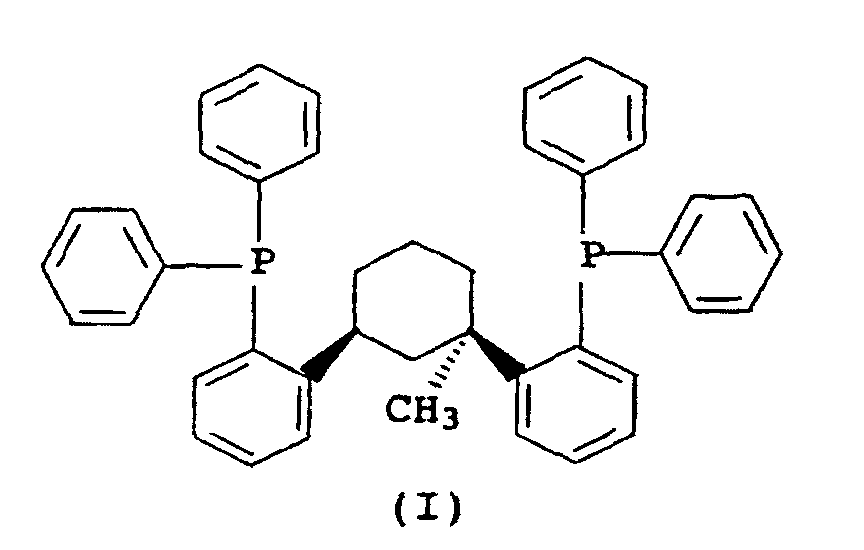
- the triaryl residues e.g. B. the triarylphosphine residues to saturated Carbon atoms of group X are bound, so they can in the form of the pure cis or trans isomers or in the form of a Isomer mixture are present.
- the cis isomers are preferred. Especially the cis isomers are preferred when X is a 5- or 6-membered bridging group stands. Good results with the However, hydroformylation is usually also done with trans isomers achieved.
- the phosphine ligand of the general formula I ' is preferably a compound of the formula I.1, in which R 10 , R 11 , R 14 and R 15 independently of one another are hydrogen or C 1 - to C 4 -alkyl, preferably methyl, ethyl, isopropyl or tert-butyl and R 12 , R 13 , R 16 and R 17 independently of one another are hydrogen, C 1 - to C 4 -alkyl, preferably methyl, ethyl, isopropyl or tert-butyl, C 1 to C 4 - Alkoxy, preferably methoxy, fluorine, chlorine, nitro or trifluoromethyl.
- the radical R b is preferably hydrogen, oxo or a ketal, in particular the neopentyl ketal thereof.
- the group Y is preferably O, S, CH 2 , C 2 H 4 or C 2 H 2 .
- a hydroformylation catalyst is used, the phosphine ligand of the general formula I 'being selected from ligands of the formulas Ia to Ie where in the formulas Ia to Ie the substituents R 10 , R 11 , R 12 , R 13 , R 14 , R 15 , R 16 and R 17 have the following meanings: R 10 R 11 R 12 R 13 R 14 R 15 R 16 R 17 H H H H H H H H H CH 3 CH 3 H H H H H H CH 3 CH 3 H H H CH 3 CH 3 H H CH 3 CH 3 CH 3 CH 3 CH 3 H H H CH 3 CH 3 CH 3 CH 3 CH 3 H H H CH 3 CH 3 CH 3 CH 3 CH 3 CH 3 CH 3 H H CH 3 CH 3 CH 3 CH 3 CH 3 CH 3 CH 3 CH 3 CH 3 CH 3 CH 3 CH 3 CH 3 CH 3 CH 3 CH 3 CH 3 CH 3 CH 3 CH 3 CH 3 CH 3 CH 3 CH 3 CH 3 CH 3 CH 3 CH 3 CH 3 CH 3 CH 3 CH 3 CH 3 CH 3 CH 3 CH 3 CH
- Another object of the invention is a catalyst comprising at least one complex of a metal of subgroup VIII with at least one ligand according to the invention, as previously defined.
- the catalysts of the invention can one or more of the Have ligands of the general formulas I and I '. additionally to the ligands of the general formulas I and I 'you can also selected at least one other ligand is among halides, amines, carboxylates, acetylacetonate, Aryl or alkyl sulfonates, hydride, CO, olefins, dienes, Cycloolefins, nitriles, N-containing heterocycles, aromatics and
- These further ligands can be 1-, 2- or multidentate and coordinate to the metal of subgroup VIII.
- Suitable further phosphorus-containing ligands are e.g. B. the phosphine ligands previously described as prior art.
- the metal of subgroup VIII is preferably Cobalt, ruthenium, rhodium, nickel, palladium, platinum, osmium or iridium and especially cobalt, rhodium, ruthenium and Iridium.
- reaction with sodium leads to 2-carbalkoxy-cis / trans-3,4-bis (halophenyl) cyclopentanones, which, if necessary after separation into the isomers, by saponification and subsequent decarboxylation into the corresponding cyclopentanones (VI ) can be transferred.
- cyclopentanones can be reduced to the corresponding cyclopentanes in a conventional manner.
- Huang-Minlon reduction the reaction with zinc -Amalgam and concentrated hydrochloric acid
- the corresponding cyclopentane isomers are usually obtained predominantly. Only in the reduction of cis-cyclopentanones according to the Huang-Minlon variant is the trans isomer also obtained in significant amounts (Scheme 2).
- the pure cis isomer can be prepared, for example, by converting the cyclopentanone into the corresponding tosylhydrazone and then reducing it with catecholborane.
- a further derivatization can also be carried out done as the reduction to the corresponding Alcohols or acetalization, e.g. B. with neopentyl glycol.
- a further derivatization can also be carried out done as the reduction to the corresponding Alcohols or acetalization, e.g. B. with neopentyl glycol.
- Ring extension to build bridging groups with 6- to 8-membered rings are made.
- Such ring expansion reactions are known to those skilled in the art and are e.g. B. in Carey, Sundberg, Advanced Organic Chemistry, 2nd ed., Part B, pp. 455-458 described. On it, and on the references cited there is referred to here.
- catalytically active species of the general formula H x M y (CO) z L q are formed from the catalysts or catalyst precursors used in each case, in which M represents a metal from subgroup VIII, L represents a phosphorus-containing compound according to the invention and q, x , y, z are integers, depending on the valency and type of the metal and the binding nature of the ligand L.
- z and q are independently at least 1, such as. B. 1, 2 or 3.
- the sum of z and q is preferably from 2 to 5.
- the complexes can, if desired, additionally have at least one of the other ligands described above.
- the hydroformylation catalysts in situ, in the for the hydroformylation reaction reactor used. If you can however, the catalysts of the invention are also prepared separately and be isolated by conventional methods.
- the catalysts of the invention can be used, for. B. at least one compound of general formula I, one compound or a complex of a metal of subgroup VIII, if appropriate at least one additional ligand and optionally an activating agent in an inert solvent implement under the hydroformylation conditions.
- Suitable rhodium compounds or complexes are e.g. B. Rhodium (II) - and rhodium (III) salts, such as rhodium (III) chloride, rhodium (III) nitrate, Rhodium (III) sulfate, potassium rhodium sulfate, rhodium (II) - or rhodium (III) carboxylate, rhodium (II) and rhodium (III) acetate, Rhodium (III) oxide, salts of rhodium (III) acid, Trisammonium hexachlororhodate (III) etc.
- Rhodium (II) - and rhodium (III) salts such as rhodium (III) chloride, rhodium (III) nitrate, Rhodium (III) sulfate, potassium rhodium sulfate, rhodium
- rhodium complexes such as rhodium biscarbonylacetylacetonate, acetylacetonatobisethylene rhodium (I) etc.
- rhodium biscarbonylacetylacetonate or rhodium acetate used.
- Ruthenium salts or compounds are also suitable. Suitable ruthenium salts are, for example, ruthenium (III) chloride, ruthenium (IV), ruthenium (VI) or ruthenium (VIII) oxide, alkali metal salts of ruthenium oxygen acids such as K 2 RuO 4 or KRuO 4 or complex compounds, such as, for. B. RuHCl (CO) (PPh 3 ) 3 .
- the metal carbonyls of ruthenium such as trisruthenium dodecacarbonyl or hexaruthenium octadecacarbonyl, or mixed forms in which CO is partly replaced by ligands of the formula PR 3 , such as Ru (CO) 3 (PPh 3 ) 2 , can also be used in the process according to the invention.
- Suitable cobalt compounds are, for example, cobalt (II) chloride, Cobalt (II) sulfate, cobalt (II) carbonate, cobalt (II) nitrate, their Amine or hydrate complexes, cobalt carboxylates, such as cobalt acetate, Cobalt ethyl hexanoate, cobalt naphthanoate, and the cobalt-caprolactamate complex.
- the carbonyl complexes of Cobalt such as dicobalt octacarbonyl, tetracobalt dodecacarbonyl and Hexacobalthexadecacarbonyl can be used.
- Suitable activating agents are e.g. B. Brönsted acids, Lewis acids, such as. B. BF 3 , AlCl 3 , ZnCl 2 , and Lewis bases.
- the aldehydes are preferably used as solvents, which result from the hydroformylation of the respective olefins, as well as their higher-boiling secondary reaction products, e.g. B. the products aldol condensation.
- suitable solvents are aromatics, such as toluene and xylenes, hydrocarbons or mixtures of hydrocarbons, also for diluting the above Aldehydes and the derivatives of aldehydes.
- Other solvents are esters of aliphatic carboxylic acids with alkanols, for example ethyl acetate or Texanol TM, ethers such as tert-butyl methyl ether and tetrahydrofuran.
- hydrophilized Ligands can also alcohols, such as methanol, ethanol, n-propanol, Isopropanol, n-butanol, isobutanol, ketones such as acetone and methyl ethyl ketone etc., can be used. Can also be used as a solvent so-called “ionic liquids" can also be used.
- liquid salts for example N, N'-dialkylimidzolium salts such as the N-butyl-N'-methylimidazolium salts, tetraalkylammonium salts such as the tetra-n-butylammonium salts, N-alkylpyridinium salts such as the n-butylpyridinium salts, tetraalkylphosphonium salts like the trishexyl (tetradecyl) phosphonium salts, z.
- N, N'-dialkylimidzolium salts such as the N-butyl-N'-methylimidazolium salts
- tetraalkylammonium salts such as the tetra-n-butylammonium salts
- N-alkylpyridinium salts such as the n-butylpyridinium salts
- tetraalkylphosphonium salts like the trishexyl
- aqueous solvent systems which, in addition to water, contain a water-miscible solvent, for example an alcohol such as methanol, ethanol, n-propanol, isopropanol, n-butanol, isobutanol, a ketone such as acetone and methyl ethyl ketone contain another solvent.
- the reactions then take the form of two-phase catalysis, the catalyst being in the aqueous phase and feedstocks and products forming the organic phase.
- the implementation in the "Ionic Liquids" can also be designed as a two-phase catalysis.
- the molar ratio of phosphorus ligand to metal VIII. Subgroup is generally in the range of about 1: 1 to 1000: 1.
- connections come into consideration, which one or contain several ethylenically unsaturated double bonds.
- These include e.g. B. olefins, such as ⁇ -olefins, internal straight-chain and internal branched olefins.
- Suitable ⁇ -olefins are e.g. B. Ethylene, propene, 1-butene, 1-pentene, 1-hexene, 1-heptene, 1-octene, 1-non, 1-decene, 1-undecene, 1-dodecene etc.
- Suitable straight-chain internal olefins are preferably C 4 to C 20 olefins, such as 2-butene, 2-pentene, 2-hexene, 3-hexene, 2-heptene, 3-heptene, 2-octene, 3-octene, 4- Octene etc.
- Suitable branched, internal olefins are preferably C 4 -C 20 -olefins, such as 2-methyl-2-butene, 2-methyl-2-pentene, 3-methyl-2-pentene, branched, internal heptene mixtures, branched, internal octene mixtures, branched, internal non-mixtures, branched, internal decene mixtures, branched, internal undecene mixtures, branched, internal dodecene mixtures etc.
- Suitable olefins to be hydroformylated are furthermore C 5 - to C 8 -cycloalkenes, such as cyclopentene, cyclohexene, cycloheptene, cyclooctene and their derivatives, such as, for. B. whose C 1 - to C 20 alkyl derivatives with 1 to 5 alkyl substituents.
- Suitable olefins to be hydroformylated are furthermore vinyl aromatics, such as styrene, ⁇ -methylstyrene, 4-isobutylstyrene etc.
- Suitable olefins to be hydroformylated are furthermore ⁇ , ⁇ -ethylenically unsaturated mono- and / or dicarboxylic acids, their esters, half-esters and amides, such as acrylic acid, methacrylic acid acid, maleic acid, fumaric acid, crotonic acid, itaconic acid, methyl 3-pentenoate, methyl 4-pentenoate, methyl oleate, methyl acrylate, methyl methacrylate, unsaturated nitriles such as 3-pentenenitrile, 4-pentenenitrile, acrylonitrile, vinyl ethers such as vinyl methyl ether, vinyl ethyl ether, vinyl propyl, etc., C 1 to C 20 -alkenols, -alkenediols and -alkadienols, such as 2,7-octadienol-1.
- Suitable substrates are further di- or polyenes with isolated or conjugated double bonds. These include e.g. B. 1,3-butadiene, 1,4-pentadiene, 1,5-hexadiene, 1,6-heptadiene, 1,7-octadiene, vinylcyclohexene, dicyclopentadiene, 1,5,9-cyclooctatriene and butadiene homo- and copolymers.
- a method is preferred which is characterized in that the hydroformylation catalyst is prepared in situ, wherein one at least one compound of formula I, a compound or a complex of a metal of subgroup VIII and optionally an activating agent in an inert solvent the hydroformylation conditions to react.
- the hydroformylation reaction can be continuous, semi-continuous or be carried out discontinuously.
- Suitable reactors for the continuous reaction are Known in the art and z. B. in Ullmann's encyclopedia of technical chemistry, vol. 1, 3rd ed., 1951, p. 743 ff.
- Suitable pressure-resistant reactors are also known to the person skilled in the art and z. B. in Ullmann's Encyclopedia of Technical Chemistry, vol. 1, 3rd edition, 1951, pp. 769 ff. In general becomes an autoclave for the inventive method used, if desired with a stirring device and Inner lining can be provided.
- Synthesis gas from carbon monoxide and hydrogen can be used in a wide range Ranges vary.
- the molar ratio of carbon monoxide and hydrogen is typically about 5:95 to 70:30, preferred about 40:60 to 60:40.
- a molar is particularly preferred Ratio of carbon monoxide and hydrogen in the range of used about 1: 1.
- the temperature in the hydroformylation reaction is generally in a range from about 20 to 180 ° C, preferably about 50 up to 150 ° C.
- the reaction is usually at the partial pressure of the reaction gas at the chosen reaction temperature. Generally, the pressure is in the range of about 1 up to 700 bar, preferably 1 to 600 bar, in particular 1 to 300 bar.
- the reaction pressure can vary depending on the activity of the used hydroformylation catalyst used varies become. In general, the catalysts of the invention allow implementation based on phosphorus-containing compounds in a range of low pressures, such as in the range from 1 to 100 bar.
- the hydroformylation catalysts according to the invention can be by conventional methods known to those skilled in the art of discharging the Separate hydroformylation reaction and can in general be used again for the hydroformylation.
- the chiral compounds of general formula I include, are suitable for enantioselective hydroformylation.
- the catalysts described above can also be used in a more suitable manner Way, e.g. B. by connection via suitable as anchor groups functional groups, adsorption, grafting, etc. to a suitable Carrier, e.g. B. made of glass, silica gel, synthetic resins etc., immobilized become. They are then also suitable for use as solid phase catalysts.
- ligands of the formula I are generally higher than the isomerization activity related to the formation more central Double bonds.
- inventive and the catalysts used according to the invention high selectivity in the hydroformylation of ⁇ -olefins in favor of the ⁇ -aldehydes or alcohols.
- these catalysts generally have high stability under the hydroformylation conditions on, so that with you usually longer catalyst life can be achieved than with known from the prior art Catalysts based on conventional chelating ligands.
- the inventive and inventive show advantageously catalysts continue to have high activity, so that usually the corresponding aldehydes or alcohols can be obtained in good yields.
- In the hydroformylation of Show ⁇ -olefins and internal linear olefins also a very low selectivity to the hydrogenation product of the used Olefin.
- the solvent is partially removed with gentle heating under high vacuum, 10 ml of H 2 O and 20 ml of ether are added to the remaining brown residue, and the aqueous phase is extracted again with 20 ml of ether.
- the combined ether extracts are shaken out with 1N HCl solution and water. After drying over MgSO 4 and removal of the solvent on a rotary evaporator, the residue is recrystallized from ether.
- the yield of colorless crystals is 744 mg (2.55 mmol, 83.5% of theory).
- reaction mixture is transferred to the second chamber separated by a frit to separate excess lithium and lithium chloride formed by slightly tilting the reaction vessel and applying a weak vacuum.
- the reaction chamber of the lithiation is rinsed with 5 ml of absolute THF.
- the addition of 1642 mg (7.43 mmol) of diphenylchlorophosphane is carried out rapidly using a gas-tight syringe, since the diphenylchlorophosphane freezes out at this temperature.
- the reaction solution is slowly warmed to -50 ° C, then to -30 ° C, before it reaches room temperature overnight and a light yellow, clear solution is formed, which is transferred to a Schlenk tube.
- the yield of colorless powder is 770 mg (1.31 mmol, 38% d. Th.).
- the production takes place in the first stage analogously to the production of ligand II, but after the first reaction stage to continue working with the cis isomer.
- the reaction chamber of the lithiation is filled with 10 ml rinsed with absolute THF. 1526 mg (6.91 mmol) diphenylchlorophosphine are quickly added using a gas-tight syringe.
- the reaction solution is slowly warmed to -50 ° C, then to -30 ° C, before it reaches room temperature overnight and a light yellow, clear solution is created, which is transferred into a Schlenk tube becomes. After removing the solvent and drying in a high vacuum a light yellow solid remains, which comes three times 50 ml of soda solution (3 g in 250 ml of degassed water, pH 10) becomes. After cannulation of the solution, a flaky, colorless precipitate, again with degassed water washed and then dried in a high vacuum.
- reaction solution is left to stir at room temperature overnight, then extracted with ether and washed with saturated NH 4 Cl solution, water and saturated NaCl solution. Drying takes place over MgSO 4 . After removing the solvent in vacuo, a pale yellow compound is obtained which is purified by means of silica gel flash chromatography with petroleum ether as the eluent (H: 45 cm, ⁇ : 3 cm).
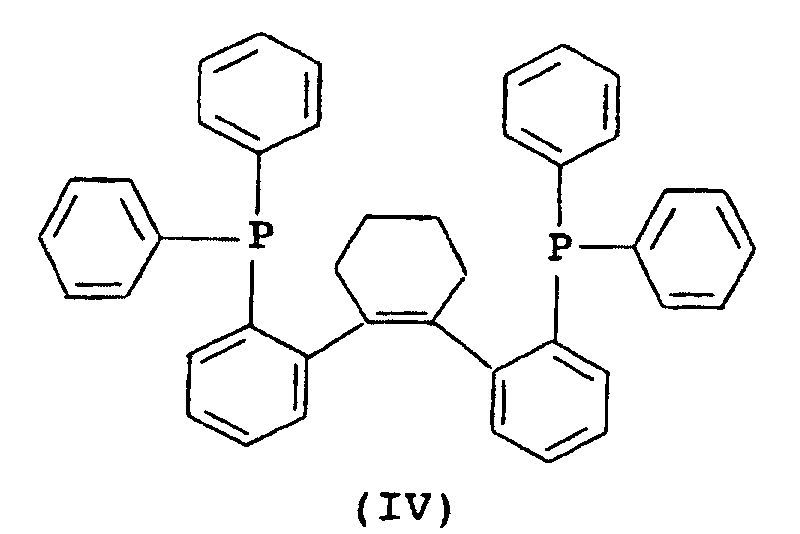
- the glove box contains 125 mg (15.8 mmol, 10 eq.) Lithium powder weighed out in 10 ml absolute Suspended THF and cooled to -78 ° C. Dripping over a syringe a solution of 800 mg (1.58 mmol) 2,3-bis (o-chlorophenyl) cyclohexene in 5 ml of absolute THF and rinsed twice with 2 ml of absolute THF after.
- the suspension is filtered under argon at -78 ° C, the filter cake is rinsed twice with 5 ml of absolute THF, at -78 ° C 1.273 g (5.28 mmol, 2.2 eq.) Diphenylchlorophosphan added and the mixture overnight at room temperature heated. The solvent is drawn into a cold trap. The remaining mass is three times with 20 ml degassed 2M soda solution, washed three times 20 ml of degassed water and three times 10 ml of pentane. The mass changes into a yellowish solid. This is recrystallized twice from acetone. You get that Product as a colorless, microcrystalline solid.
- the suspension is filtered under argon at -78 ° C, the filter cake twice rinsed with 5 ml absolute THF, at -78 ° C 1.143 g (5.41 mmol, 2.1 eq.) Bis (diethylamino) chlorophosphane added and the batch then warmed to room temperature overnight.
- the solvent is drawn into a cold trap and the remaining mass extracted three times with 10 ml of pentane.
- the extraction solution will reduced to approx. 2 ml and also cooled to -80 ° C. It crystallizes the product as a white solid (1.086 g, 1.9 mmol, 70.8% d. Th.) Out.
Landscapes
- Chemical & Material Sciences (AREA)
- Organic Chemistry (AREA)
- Chemical Kinetics & Catalysis (AREA)
- Inorganic Chemistry (AREA)
- Engineering & Computer Science (AREA)
- Materials Engineering (AREA)
- Organic Low-Molecular-Weight Compounds And Preparation Thereof (AREA)
- Catalysts (AREA)
Abstract
Description

- Z1und Z2
- unabhängig voneinander für mindestens ein Phosphor-, Arsen- oder Antimonatom aufweisende Reste stehen, und
- X
- für eine zweiwertige, nichtaromatische, 3- bis 8-gliedrige,
carbocyclische oder heterocyclische, verbrückende Gruppe
steht, die eine, zwei oder drei Doppelbindungen, und/oder einen,
zwei, drei oder vier Substituenten, die ausgewählt sind
unter Alkyl, Cycloalkyl, Aryl, Hetaryl, Alkoxy, Acyl, Carboxyl,
Alkoxycarbonyl, Hydroxy, Nitro, Cyano, Trifluormethyl,
Oxo und den Ketalen davon, oder NE1E2, tragen können, wobei E1
und E2 gleich oder verschieden sein können und für Alkyl, Cycloalkyl
oder Aryl stehen, und/oder wobei die verbrückende
Gruppe X Teil eines kondensierten Ringsystems mit 1, 2 oder 3
weiteren Ringen sein kann, wobei die ankondensierten Ringe je
einen, zwei oder drei Substituenten, die unter den zuvor als
Substituenten der Gruppe X genannten ausgewählt sind, tragen
können, und/oder wobei die verbrückende Gruppe X ihrerseits
durch -O-, -S-, -N(Ra)- oder eine davon verschiedene zweiwertige
verbrückende Gruppe überbrückt sein kann, wobei Ra für
Wasserstoff, Alkyl, Cycloalkyl oder Aryl steht, und wobei X
ausgewählt ist unter Gruppen der Formeln II.1 bis II.3
worin

- A1 und A2
- unabhängig voneinander für B, N, P oder CR5 stehen, wobei R5 für Wasserstoff, Alkyl, Cycloalkyl, Aryl oder Hetaryl steht,
- D1
- für eine Einfachbindung oder eine C1- bis C3-Alkylenbrücke steht, die eine Doppelbindung und/oder einen oder zwei Substituenten, die ausgewählt sind unter Alkyl, Cycloalkyl, Aryl, Alkoxy, Acyl, Carboxyl, Alkoxycarbonyl, Hydroxy, Nitro, Cyano, Trifluormethyl, Oxo und den Ketalen davon, oder NE1E2, tragen können, wobei E1 und E2 gleich oder verschieden sein können und für Alkyl, Cycloalkyl oder Aryl stehen,
- D2
- für eine C3- bis C6-Alkylenbrücke steht, die eine zwei oder drei Doppelbindungen und/oder einen, zwei, drei oder vier der für D1 genannten Substituenten aufweisen kann und/oder die Alkylenbrücke D2 in den Formeln II.1 und II.3 durch eine Gruppe -Y- überbrückt sein kann, und
- Y
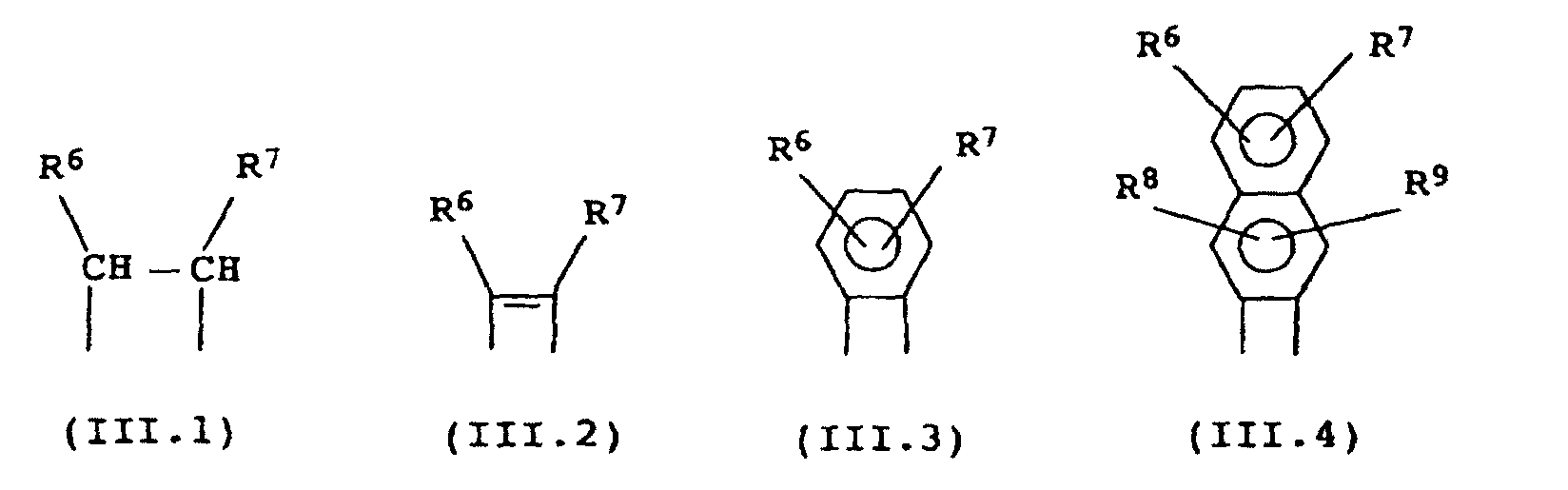
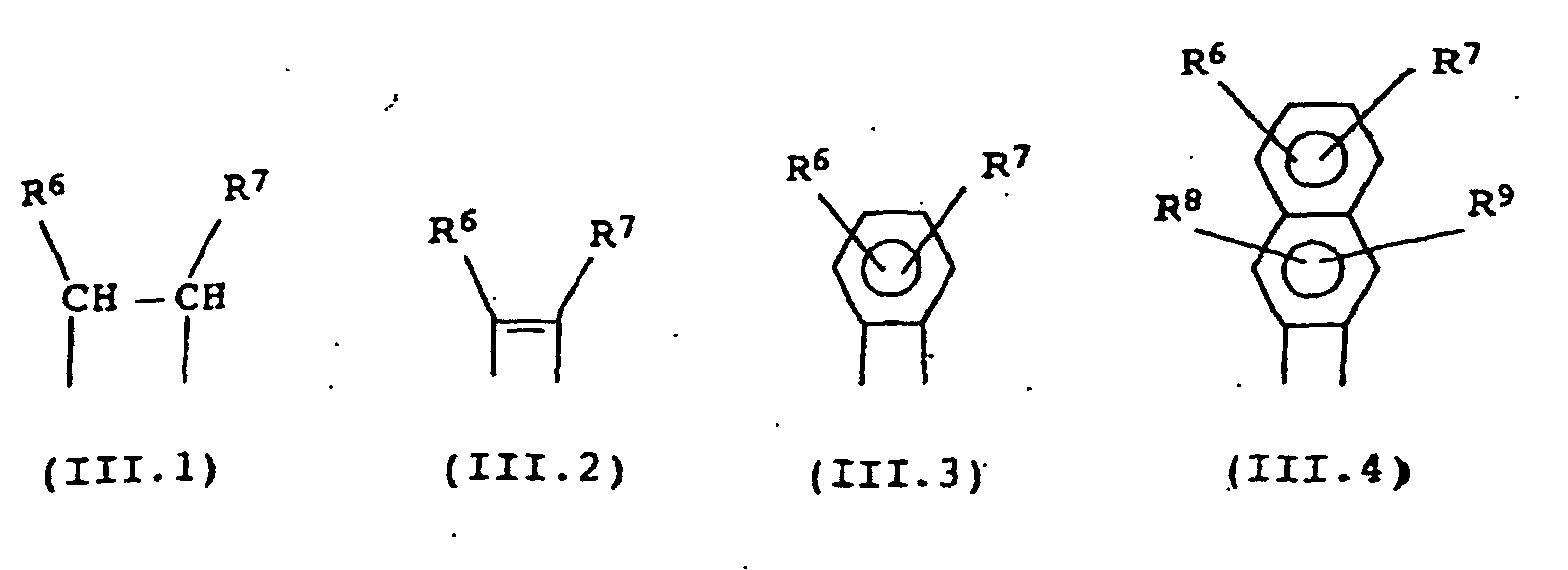
- für O, S, CRxRy oder einen Rest der Formeln III.1 bis III.4
steht, worin

- Rx und Ry
- ausgewählt sind unter Wasserstoff, Alkyl, Cycloalkyl, Aryl oder Hetaryl,
- R6, R7, R8 und R9
- unabhängig voneinander für Wasserstoff, Alkyl, Cycloalkyl, Aryl, Alkoxy, Halogen, SO3H, Sulfonat, NE1E2, Alkylen-NE1E2, Trifluormethyl, Nitro, Alkoxycarbonyl, Carboxyl oder Cyano stehen, wobei E1 und E2 unabhängig voneinander für Alkyl, Cycloalkyl oder Aryl stehen.
- R1 und R2
- unabhängig voneinander für Alkyl, Cycloalkyl, Heterocycloalkyl,
Aryl oder Hetaryl stehen, welche gegebenenfalls einen,
zwei oder drei Substituenten, ausgewählt unter Alkyl,
Cycloalkyl, Heterocycloalkyl, Aryl, Hetaryl, COORf, COO-M+,
SO3Rf, SO- 3M+, NE3E4, Alkylen-NE3E4, NE3E4E5+X-, Alkylen-NE3E4E5+X-,
ORf, SRf, (CHRgCH2O)yRf, (CH2N(E3))yRf,
(CH2CH2N(E3))yRf, Halogen, Trifluormethyl, Nitro, Acyl oder
Cyano aufweisen können, worin
- Rf, E3, E4 und E5
- jeweils gleiche oder verschiedene Reste, ausgewählt unter Wasserstoff, Alkyl, Cycloalkyl oder Aryl bedeuten,
- Rg
- für Wasserstoff, Methyl oder Ethyl steht,
- M+
- für ein Kation steht,
- X-
- für ein Anion steht, und
- y
- für eine ganze Zahl von 1 bis 120 steht, oder
- R1 und R2
- zusammen mit dem Phosphoratom und gegebenenfalls dem/den Sauerstoffatom(en), an die sie gebunden sind für einen 5- bis 8-gliedrigen Heterocyclus stehen, der gegebenenfalls zusätzlich ein-, zwei- oder dreifach mit Cycloalkyl, Heterocycloalkyl, Aryl oder Hetaryl anelliert ist, wobei der Heterocyclus und, falls vorhanden, die anellierten Gruppen unabhängig voneinander je einen, zwei, drei oder vier Substituenten tragen können, die ausgewählt sind unter Alkyl, Cycloalkyl, Heterocycloalkyl, Aryl, Hetaryl, COORf, COO-M+, SO3Rf, SO- 3M+, NE3E4, Alkylen-NE3E4, NE3E4E5+X-, Alkylen-NE3E4E5+X-, ORf, SRf, (CHRgCH2O)yRf, (CH2N(E1))yRf, (CH2CH2N(E4))yRf, Halogen, Trifluormethyl, Nitro, Acyl oder Cyano, wobei Rf, Rg, E3, E4, E5, M+, X- und y die zuvor angegebenen Bedeutungen besitzen.

- R1, R2, R3 und R4
- unabhängig voneinander für Alkyl, Cycloalkyl, Aryl oder Hetaryl stehen, wobei die Cycloalkyl-, Aryl- und Hetarylgruppen je einen, zwei oder drei Substituenten, die ausgewählt sind unter Alkyl, Cycloalkyl,Aryl, Alkoxy, Cycloalkoxy, Aryloxy, Acyl, Halogen, Trifluormethyl, Nitro, Cyano, Carboxyl, Alkoxycarbonyl oder NE3E4,tragen können, wobei E3 und E4 gleich oder verschieden sein können und für Alkyl, Cycloalkyl oder Aryl stehen, und
- X
- für eine zweiwertige, nichtaromatische, 3- bis 8-gliedrige,
carbocyclische oder heterocyclische, verbrückende Gruppe
steht, die eine, zwei oder drei Doppelbindungen, und/oder einen,
zwei, drei oder vier Substituenten, die ausgewählt sind
unter Alkyl, Cycloalkyl, Aryl, Alkoxy, Acyl, Carboxyl, Alkoxycarbonyl,
Hydroxy, Nitro, Cyano, Trifluormethyl, Oxo und
den Ketalen davon, oder NE1E2, tragen können, wobei E1 und E2
gleich oder verschieden sein können und für Alkyl, Cycloalkyl
oder Aryl stehen, und/oder wobei die verbrückende Gruppe X
Teil eines kondensierten Ringsystems mit 1, 2 oder 3 weiteren
Ringen sein kann, wobei die ankondensierten Ringe je einen,
zwei oder drei Substituenten, die unter den zuvor als Substituenten
der Gruppe X genannten ausgewählt sind, tragen können,
und/oder wobei die verbrückende Gruppe X ihrerseits
durch -O-, -S-, -N(Ra)- oder eine davon verschiedene zweiwertige
verbrückende Gruppe überbrückt sein kann, wobei Ra für
Wasserstoff, Alkyl, Cycloalkyl oder Aryl steht, und wobei X
ausgewählt ist unter Gruppen der Formeln II.1 bis II.3
worin

- A1 und A2
- unabhängig voneinander für B, N, P oder CR5 stehen, wobei R5 für Wasserstoff, Alkyl, Cycloalkyl, Aryl oder Hetaryl steht,
- D1
- für eine Einfachbindung oder eine C1- bis C3-Alkylenbrücke steht, die eine Doppelbindung und/oder einen oder zwei Substituenten, die ausgewählt sind unter Alkyl, Cycloalkyl, Aryl, Alkoxy, Acyl, Carboxyl, Alkoxycarbonyl, Hydroxy, Nitro, Cyano, Trifluormethyl, Oxo und den Ketalen davon, oder NE1E2, tragen können, wobei E1 und E2 gleich oder verschieden sein können und für Alkyl, Cycloalkyl oder Aryl stehen,
- D2
- für eine C3- bis C6-Alkylenbrücke steht, die eine zwei oder drei Doppelbindungen und/oder einen, zwei, drei oder vier der für D1 genannten Substituenten aufweisen kann und/oder die Alkylenbrücke D2 in den Formeln II.1 und II.3 durch eine Gruppe -Y- überbrückt sein kann, und
- Y
- für O, S, CRxRy oder einen Rest der Formeln III.1 bis III.4
steht, worin
- Rx und Ry
- ausgewählt sind unter Wasserstoff, Alkyl, Cycloalkyl, Aryl oder Hetaryl,
- R6, R7, R8 und R9
- unabhängig voneinander für Wasserstoff, Alkyl, Cycloalkyl, Aryl, Alkoxy, Halogen, SO3H, Sulfonat, NE1E2, Alkylen-NE1E2, Trifluormethyl, Nitro, Alkoxycarbonyl, Carboxyl oder Cyano stehen, wobei E1 und E2 unabhängig voneinander für Alkyl, Cycloalkyl oder Aryl stehen.

- s, t und u
- unabhängig voneinander für 0 oder 1 stehen,
- M
- zusammen mit dem Phosphoratom und dem/den Sauerstoffatom(en), an die es gebunden ist, für einen 5- bis 8-gliedrigen Heterocyclus steht, der gegebenenfalls ein-, zwei- oder dreifach mit Cycloalkyl, Heterocycloalkyl, Aryl und/oder Hetaryl anelliert ist, wobei die anellierten Gruppen unabhängig voneinander je einen, zwei, drei oder vier Substituenten, ausgewählt unter Alkyl, Alkoxy, Halogen, SO3H, Sulfonat, NE3E4, AlkylenNE3E4, Nitro, Cyano, Carboxyl und Carboxylat, tragen können und/oder M einen, zwei oder drei Substituenten, die ausgewählt sind unter Alkyl, Alkoxy, gegebenenfalls substituiertem Cycloalkyl und gegebenenfalls substituiertem Aryl, aufweisen kann und/oder M durch 1, 2 oder 3 gegebenenfalls substituierte Heteroatome unterbrochen sein kann.


- Z
- für O, S oder NRi steht, wobei Ri für Alkyl, Cycloalkyl oder Aryl steht,
- oder Z
- für eine C1- bis C3-Alkylenbrücke steht, die eine Doppelbindung und/oder einen Alkyl-, Cycloalkyl- oder Arylsubstituenten aufweisen kann, wobei der Arylsubstituent einen, zwei oder drei der für Aryl genannten Substituenten tragen kann,
- oder Z
- für eine C2- bis C3-Alkylenbrücke steht, die durch O, S oder NRi unterbrochen ist,
- R10, R11, R12, R13, R14, R15, R16 und R17
- unabhängig voneinander ausgewählt sind unter Wasserstoff, Alkyl, Cycloalkyl, Aryl, Alkoxy, Cycloalkoxy, Aryloxy, Acyl, Halogen, SO3H, Sulfonat, NE3E4, Alkylen-NE3E4, Trifluormethyl, Nitro, Alkoxycarbonyl, Carboxyl und Cyano,
- wobei E3 und E4
- gleich oder verschieden sein können und für Alkyl, Cycloalkyl oder Aryl stehen.
- R1 und R3
- unabhängig voneinander für Alkyl, Cycloalkyl, Aryl oder Hetaryl stehen, welche je einen, zwei oder drei Substituenten, die ausgewählt sind unter Alkyl, Cycloalkyl und Aryl, tragen können,
- R2 und R4
- unabhängig voneinander für Alkyl, Cycloalkyl, Aryl oder Hetaryl stehen, wobei die Aryl- und Hetarylgruppen je einen, zwei oder drei Substituenten, die ausgewählt sind unter Alkyl, Cycloalkyl, Aryl, Alkoxy, Cycloalkoxy, Aryloxy, Acyl, Halogen, Trifluormethyl, Nitro, Cyano, Carboxyl, Alkoxycarbonyl oder NE3E4, tragen können, wobei E3 und E4 gleich oder verschieden sein können und für Alkyl, Cycloalkyl oder Aryl stehen.


- Rb
- ausgewählt ist unter Alkyl, Cycloalkyl, Aryl, Alkoxy, Acyl, Carboxyl, Alkoxycarbonyl, Hydroxy, Nitro, Cyano, Trifluormethyl, Oxo und den Ketalen davon, oder NE1E2, wobei E1 und E2 gleich oder verschieden sein können und für Alkyl, Cycloalkyl oder Aryl stehen, und
- Y
- für O, S, CH2 oder einen Rest der Formeln III.1 bis III.4, wie zuvor definiert, steht.



- R10, R11, R12, R13, R14, R15, R16 und R17
- unabhängig voneinander ausgewählt sind unter Wasserstoff, Alkyl, Cycloalkyl, Aryl, Alkoxy, Cycloalkoxy, Aryloxy, Acyl, Halogen, Trifluormethyl, Nitro, Cyano, Carboxyl, Alkoxycarbonyl oder NE3E4, wobei E3 und E4 gleich oder verschieden sein können und für Alkyl, Cycloalkyl oder Aryl stehen,
- l, m, n, p, q und r
- unabhängig voneinander für 0 oder 1 stehen,
- Rb
- in den Formeln IA und IB ausgewählt ist unter Wasserstoff, Alkyl, Oxo und den Ketalen davon und in den Formeln IC, ID, IE und IF ausgewählt ist unter Wasserstoff und Alkyl,
- G
- für eine Einfachbindung, eine Doppelbindung oder ein Sauerstoffatom steht,
- Y
- für O, S, CH2 oder einen Rest der Formel III.1 bis III.4
steht, worin

- R6, R7, R8 und R9
- unabhängig voneinander für Wasserstoff, Alkyl, Cycloalkyl, Aryl, Alkoxy, Halogen, SO3H, Sulfonat, NE1E2, Alkylen-NE1E2, Trifluormethyl, Nitro, Alkoxycarbonyl, Carboxyl oder Cyano stehen, wobei E1 und E2 unabhängig voneinander für Alkyl, Cycloalkyl oder Aryl stehen.
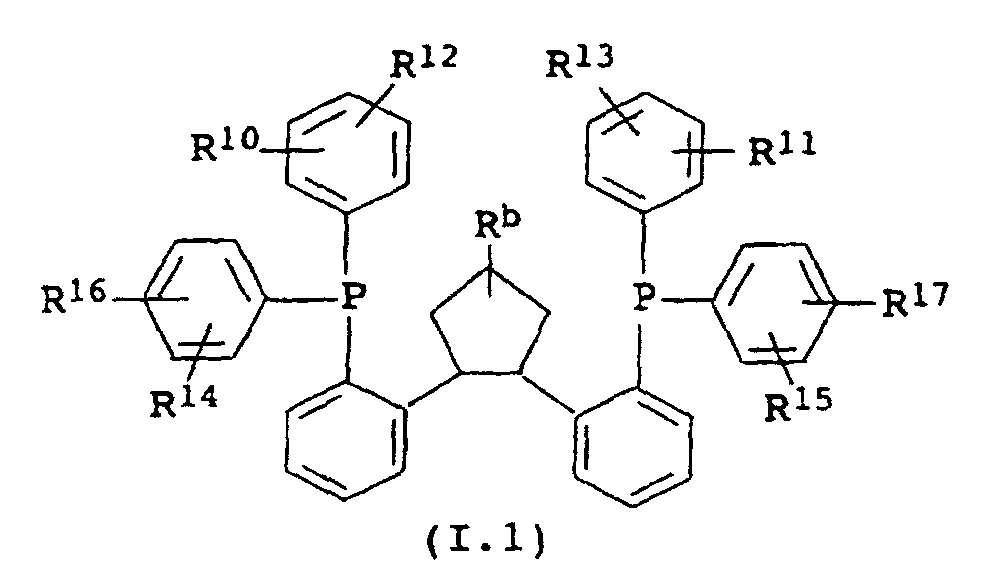
- R10, R11, R12, R13, R14, R15, R16 und R17
- unabhängig voneinander ausgewählt sind unter Alkyl, Cycloalkyl, Aryl, Alkoxy, Cycloalkoxy, Aryloxy, Acyl, Halogen, Trifluormethyl, Nitro, Cyano, Carboxyl, Alkoxycarbonyl oder NE3E4, wobei E3 und E4 gleich oder verschieden sein können und für Alkyl, Cycloalkyl oder Aryl stehen,
- Rb
- wie zuvor definiert ist.

- R10, R11, R12, R13, R14, R15, R16, R17 und Rb
- die zuvor bei der Formel I.1 angegebenen Bedeutungen besitzt.
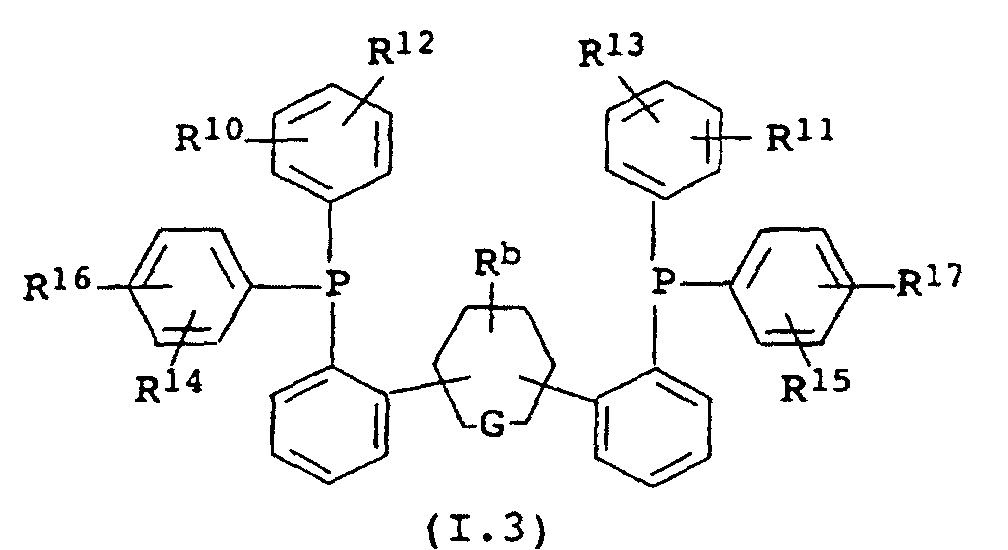
- G
- für Sauerstoff, eine Einfach- oder eine Doppelbindung steht, und
- R10, R11, R12, R13, R14, R15, R16, R17 und Rb
- die zuvor bei der Formel I.1 angegebenen Bedeutungen besitzen.

- G
- für Sauerstoff, eine Einfach- oder eine Doppelbindung steht,
- Y
- für einen Rest der Formeln III.1 bis III.4, wie zuvor definiert, steht,
- R10, R11, R12, R13, R14, R15, R16, R17 und Rb
- die zuvor bei der Formel I.1 angegebenen Bedeutungen besitzen.


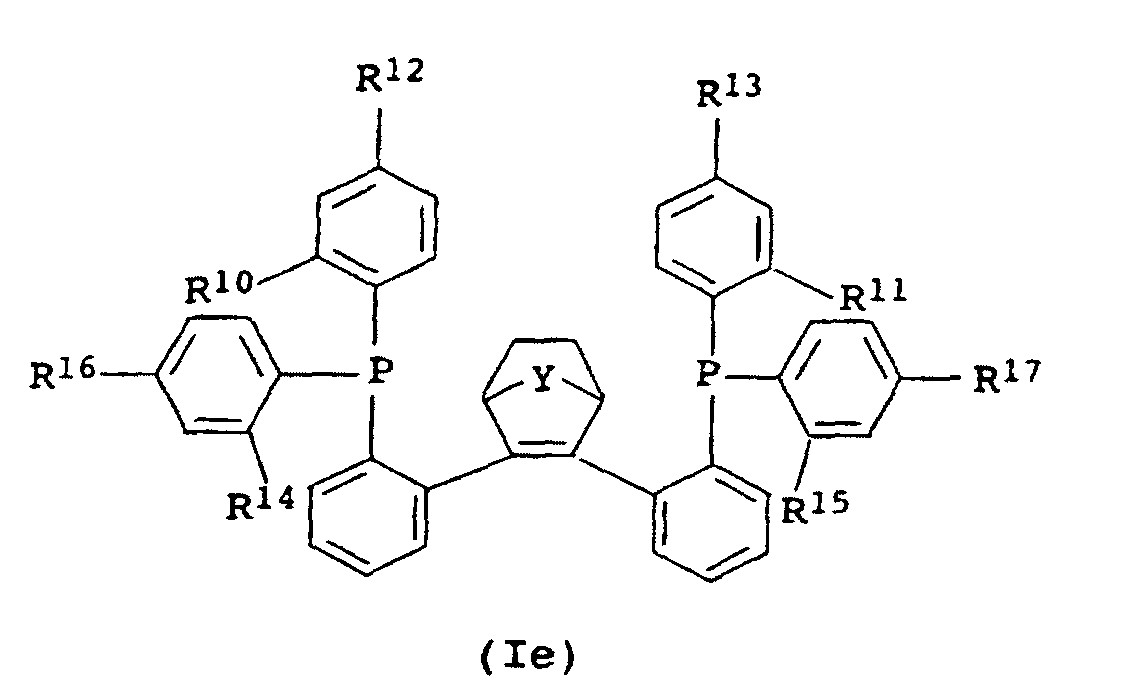
| R10 | R11 | R12 | R13 | R14 | R15 | R16 | R17 |
| H | H | H | H | H | H | H | H |
| CH3 | CH3 | H | H | H | H | H | H |
| CH3 | CH3 | H | H | CH3 | CH3 | H | H |
| CH3 | CH3 | CH3 | CH3 | H | H | H | H |
| CH3 | CH3 | CH3 | CH3 | CH3 | CH3 | H | H |
| CH3 | CH3 | CH3 | CH3 | CH3 | CH3 | CH3 | CH3 |
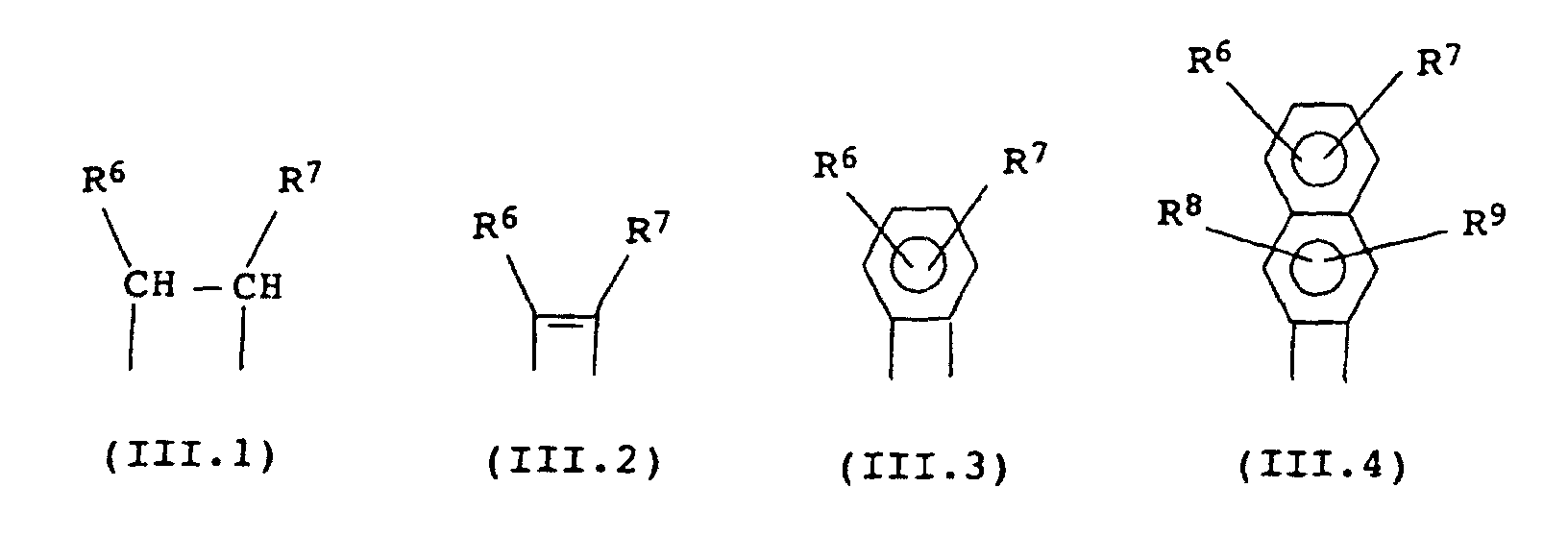
R6, R7, R8 und R9 unabhängig voneinander für Wasserstoff, Alkyl, Cycloalkyl, Aryl, Alkoxy, Halogen, SO3H, Sulfonat, NE1E2, Alkylen-NE1E2, Trifluormethyl, Nitro, Alkoxycarbonyl, Carboxyl oder Cyano stehen, wobei E1 und E2 unabhängig voneinander für Alkyl, Cycloalkyl oder Aryl stehen.

- Z1 und Z2
- unabhängig voneinander für mindestens ein Phosphor-, Arsen- oder Antimonatom aufweisende Reste stehen, wobei an das Phosphor-, Arsen- oder Antimonatom jeweils mindestens zwei gegebenenfalls substituierte Heteroatome, die ausgewählt sind unter O, S und NRc, direkt gebunden sind, wobei Rc für Wasserstoff, Alkyl, Cycloalkyl oder Aryl steht,und

- R1, R2, R3 und R4
- unabhängig voneinander für Alkyl, Cycloalkyl, Aryl oder Hetaryl stehen, wobei die Aryl- und Hetarylgruppen je einen, zwei oder drei Substituenten, die ausgewählt sind unter Alkyl, Cycloalkyl, Aryl, Alkoxy, Cycloalkoxy, Aryloxy, Acyl, Halogen, Trifluormethyl, Nitro, Cyano, Carboxyl, Alkoxycarbonyl oder NE1E2, tragen können, wobei E1 und E2 gleich oder verschieden sein können und für Alkyl, Cycloalkyl oder Aryl stehen,
- X
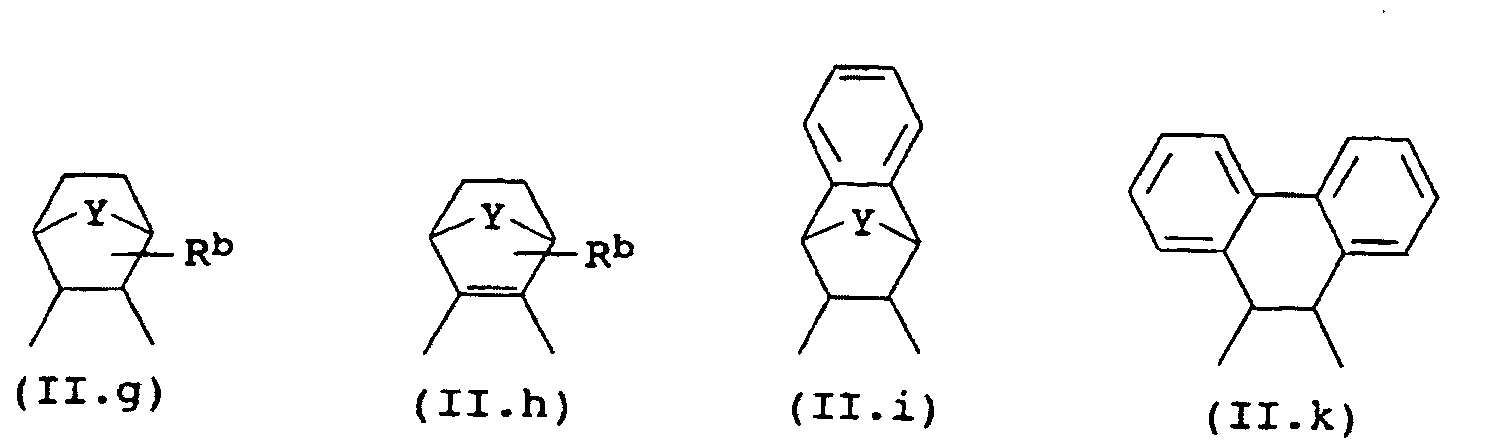
- ausgewählt ist unter Gruppen der Formeln II.a bis II.k

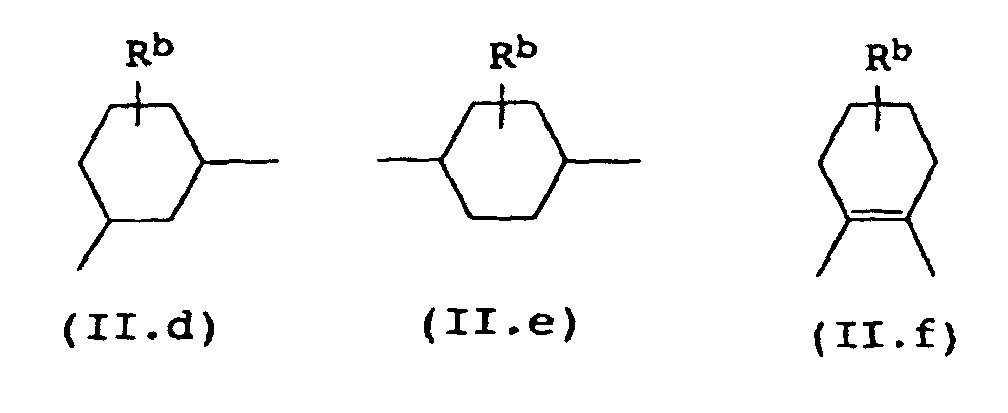
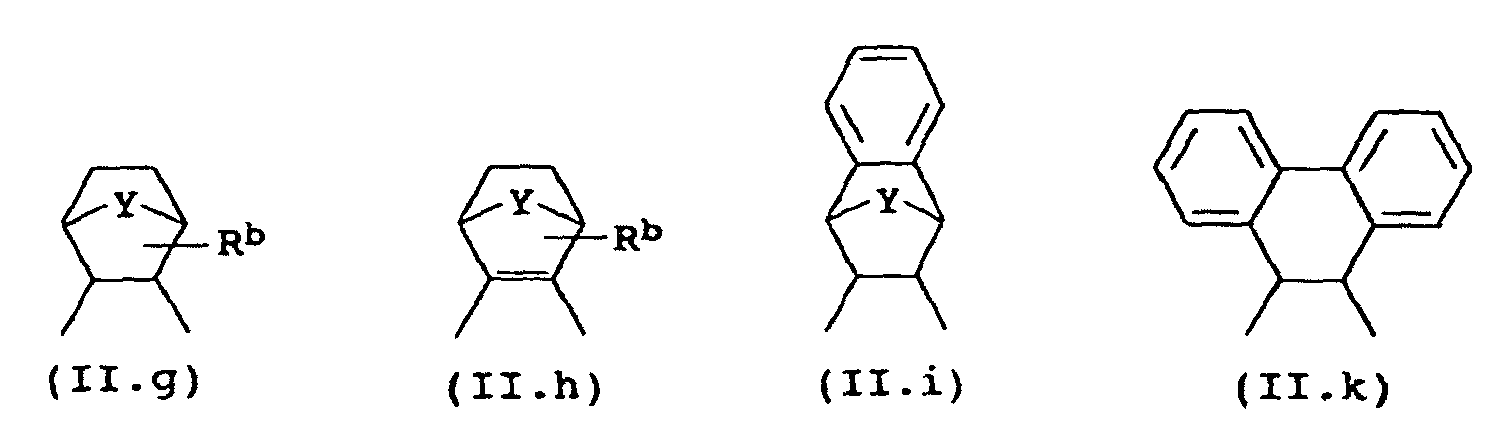
- Rb
- ausgewählt ist unter Alkyl, Cycloalkyl, Aryl, Alkoxy, Acyl, Carboxyl, Alkoxycarbonyl, Hydroxy, Nitro, Cyano, Trifluormethyl, Oxo und den Ketalen davon, oder NE1E2, wobei E1 und E2 gleich oder verschieden sein können und für Alkyl, Cycloalkyl oder Aryl stehen, und
- Y
- wie in Anspruch 1 definiert ist.

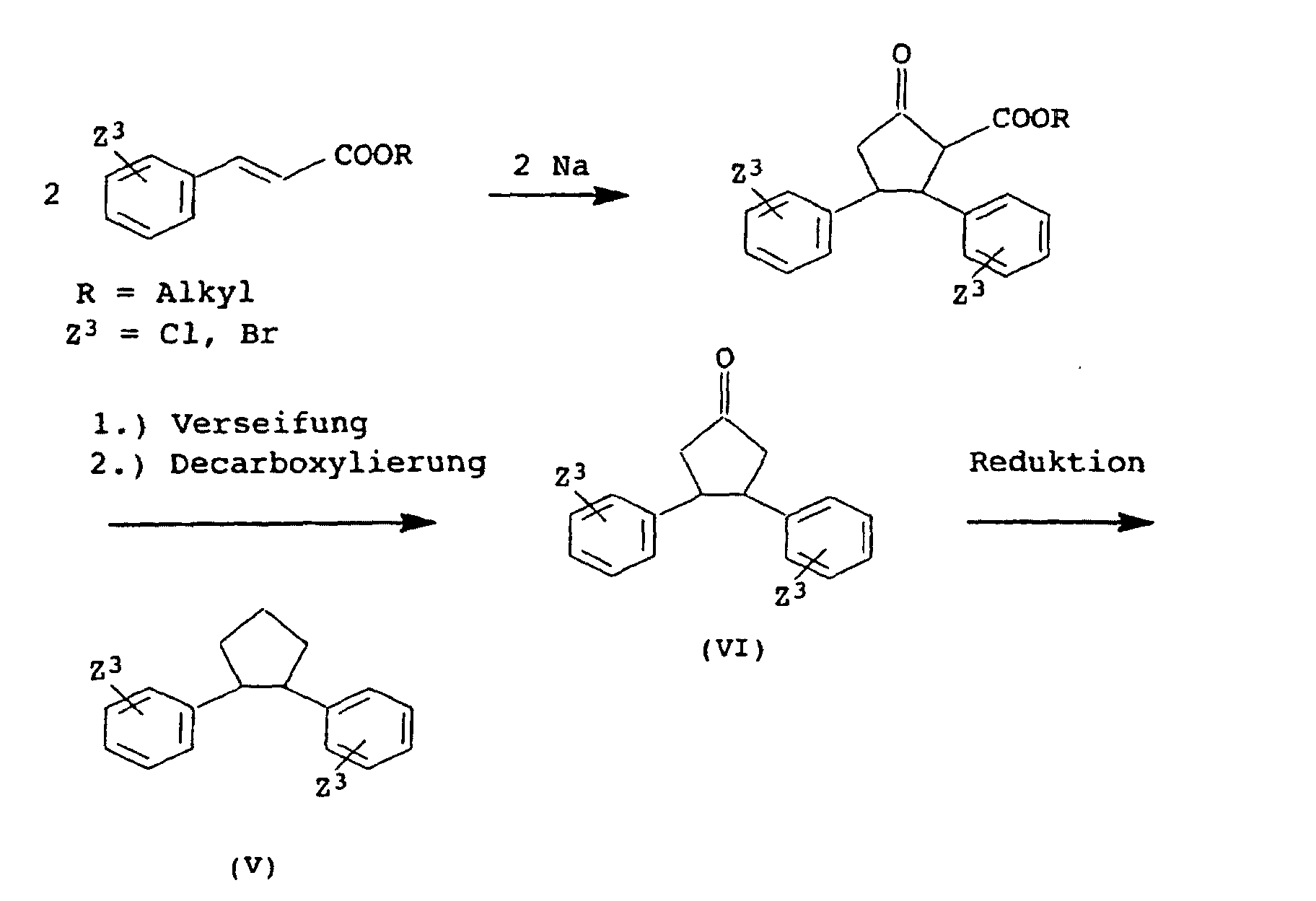
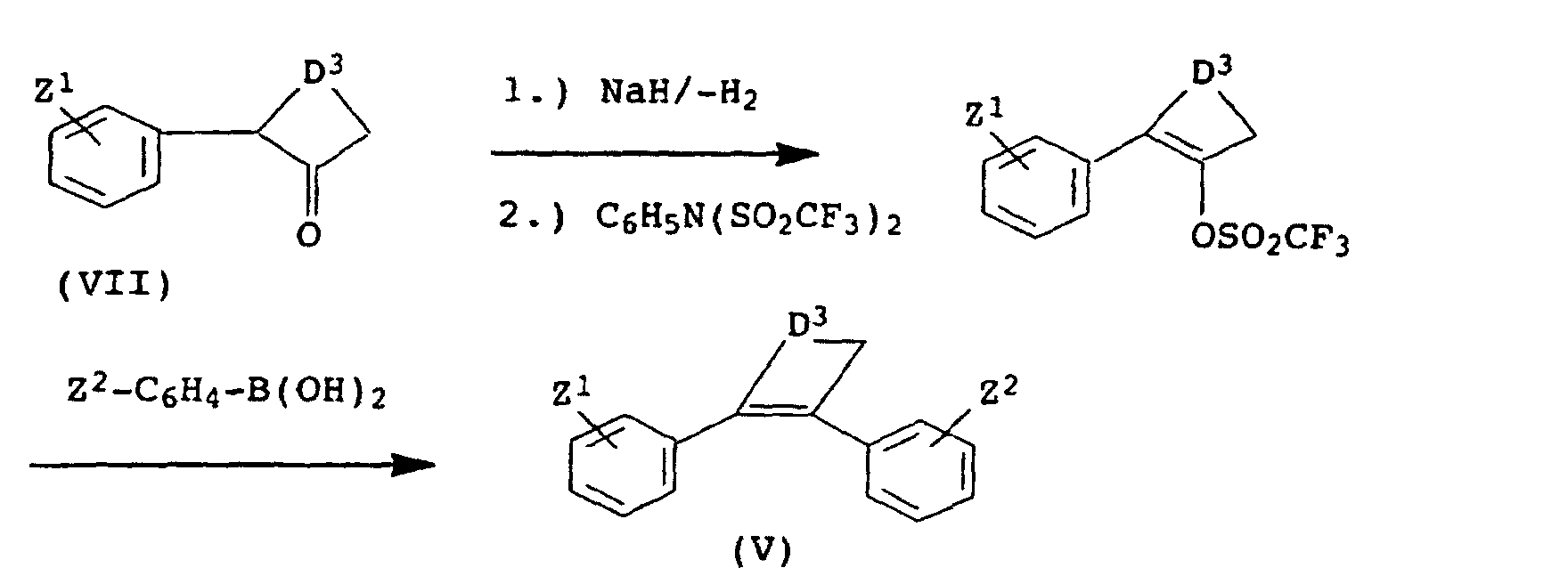
- Z1, Z2 =
- F, Cl, Br
- D3
- ist eine C2- bis C6-Alkylenbrücke, die eine zwei oder drei Doppelbindungen und/oder einen, zwei, drei oder vier der zuvor genannten Substituenten aufweisen kann und/oder die durch eine Gruppe -Y- überbrückt sein kann, wobei Y für O, S, CRxRy (mit Rx und Ry = H, Alkyl, Cycloalkyl, Aryl oder Hetaryl) oder einen Rest der Formeln III.1 bis III.4, wie zuvor definiert, steht.




| Schmelzpunkt (cis-Isomer) | 135-137 °C |
| Schmelzpunkt (trans-Isomer) | 168-169 °C |
Claims (10)
- Verfahren zur Hydroformylierung von Verbindungen, die wenigstens eine ethylenisch ungesättigte Doppelbindung enthalten, durch Umsetzung mit Kohlenmonoxid und Wasserstoff in Gegenwart eines Hydroformylierungskatalysators, dadurch gekennzeichnet, dass man als Hydroformylierungskatalysator wenigstens einen Komplex eines Metalls der VIII. Nebengruppe mit mindestens einem Liganden der allgemeinen Formel Ieinsetzt, worin

- Z1 und Z2
- unabhängig voneinander für mindestens ein Phosphor-, Arsen- oder Antimonatom aufweisende Reste stehen, und
- X
- für eine zweiwertige, nichtaromatische, 3- bis 8-gliedrige,
carbocyclische oder heterocyclische, verbrückende Gruppe
steht, die eine, zwei oder drei Doppelbindungen, und/oder
einen, zwei, drei oder vier Substituenten, die ausgewählt
sind unter Alkyl, Cycloalkyl, Aryl, Hetaryl, Alkoxy,
Acyl, Carboxyl, Alkoxycarbonyl, Hydroxy, Nitro, Cyano,
Trifluormethyl, Oxo und den Ketalen davon, oder NE1E2,
tragen können, wobei E1 und E2 gleich oder verschieden
sein können und für Alkyl, Cycloalkyl oder Aryl stehen,
und/oder wobei die verbrückende Gruppe X Teil eines kondensierten
Ringsystems mit 1, 2 oder 3 weiteren Ringen
sein kann, wobei die ankondensierten Ringe je einen, zwei
oder drei Substituenten, die unter den zuvor als Substituenten
der Gruppe X genannten ausgewählt sind, tragen
können, und/oder wobei die verbrückende Gruppe X ihrerseits
durch -O-, -S-, -N(Ra)- oder eine davon verschiedene
zweiwertige verbrückende Gruppe überbrückt sein
kann, wobei Ra für Wasserstoff, Alkyl, Cycloalkyl oder
Aryl steht, und wobei X ausgewählt ist unter Gruppen der
Formeln II.1 bis II.3
worin
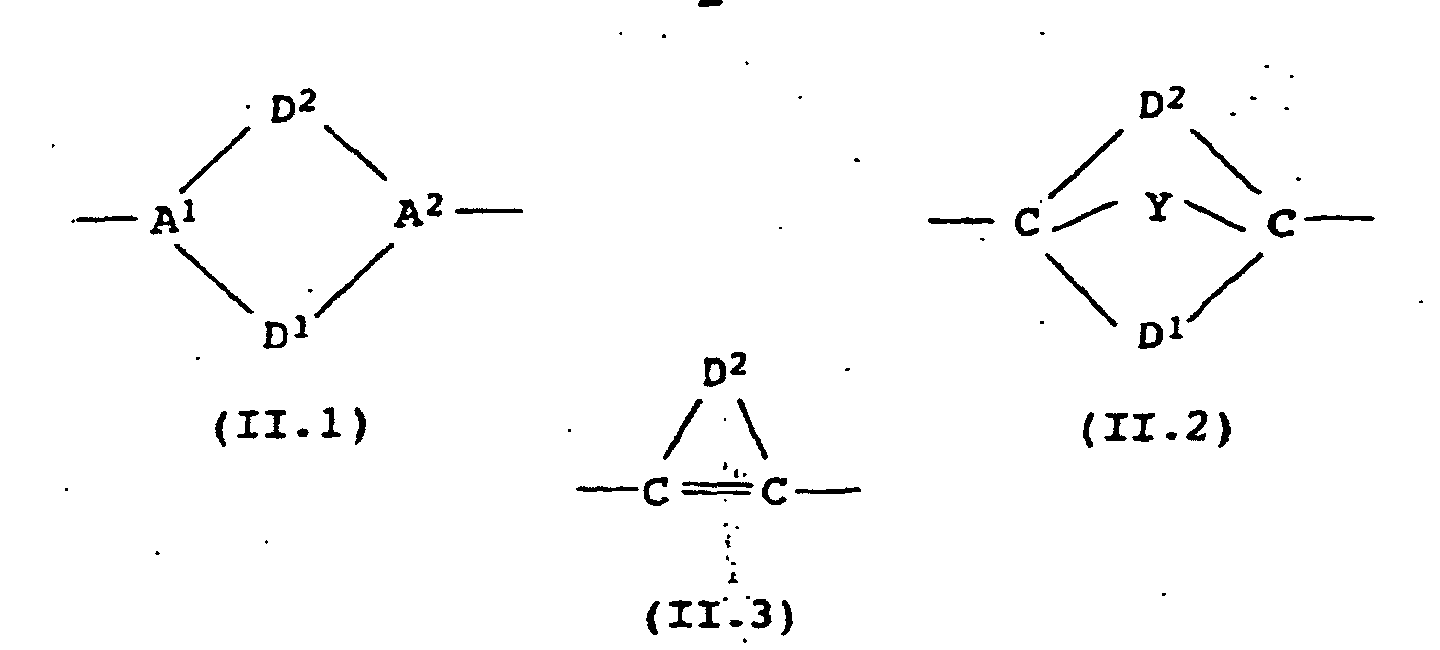
- A1 und A2
- unabhängig voneinander für B, N, P oder CR5 stehen, wobei R5 für Wasserstoff, Alkyl, Cycloalkyl, Aryl oder Hetaryl steht,
- D1
- für eine Einfachbindung oder eine C1- bis C3-Alkylenbrücke steht, die eine Doppelbindung und/oder einen oder zwei Substituenten, die ausgewählt sind unter Alkyl, Cycloalkyl, Aryl, Alkoxy, Acyl, Carboxyl, Alkoxycarbonyl, Hydroxy, Nitro, Cyano, Trifluormethyl, Oxo und den Ketalen davon, oder NE1E2, tragen können, wobei E1 und E2 gleich oder verschieden sein können und für Alkyl, Cycloalkyl oder Aryl stehen,
- D2
- für eine C3- bis C6-Alkylenbrücke steht, die eine zwei oder drei Doppelbindungen und/oder einen, zwei, drei oder vier der für D1 genannten Substituenten aufweisen kann und/oder die Alkylenbrücke D2 in den Formeln II.1 und II.3 durch eine Gruppe -Y- überbrückt sein kann, und
- Y
- für O, S, CRxRy oder einen Rest der Formeln III.1 bis
III.4
steht, worin
- Rx und Ry
- ausgewählt sind unter Wasserstoff, Alkyl, Cycloalkyl, Aryl oder Hetaryl,
- R6, R7, R8 und R9
- unabhängig voneinander für Wasserstoff, Alkyl, Cycloalkyl, Aryl, Alkoxy, Halogen, SO3H, Sulfonat, NE1E2, Alkylen-NE1E2, Trifluormethyl, Nitro, Alkoxycarbonyl, Carboxyl oder Cyano stehen, wobei E1 und E2 unabhängig voneinander für Alkyl, Cycloalkyl oder Aryl stehen.
- Verfahren nach Anspruch 1, wobei in der Formel I Z1 und Z2 unabhängig voneinander für je einen Rest der Formeln PR1R2, OPR1R2, P(OR1)R2, P(OR1)(OR2), OP(OR1)R2 oder OP(OR1)(OR2) stehen, worin
- R1 und R2
- unabhängig voneinander für Alkyl, Cycloalkyl, Heterocycloalkyl,
Aryl oder Hetaryl stehen, welche gegebenenfalls
einen, zwei oder drei Substituenten, ausgewählt unter
Alkyl, Cycloalkyl, Heterocycloalkyl, Aryl, Hetaryl,
COORf, COO-M+, SO3Rf, SO- 3M+, NE3E4, Alkylell-NE3E4,
NE3E4E5+X-, Alkylen-NE3E4E5+X-, ORf, SRf, (CHRgCH2O)yRf,
(CH2N(E3))yRf, (CH2CH2N(E3))yRf, Halogen, Trifluormethyl,
Nitro, Acyl oder Cyano aufweisen können, worin
- Rf, E3, E4 und E5
- jeweils gleiche oder verschiedene Reste, ausgewählt unter Wasserstoff, Alkyl, Cycloalkyl oder Aryl bedeuten,
- Rg
- für Wasserstoff, Methyl oder Ethyl steht,
- M+
- für ein Kation steht,
- X-
- für ein Anion steht, und
- y
- für eine ganze Zahl von 1 bis 120 steht, oder
- R1 und R2
- zusammen mit dem Phosphoratom und gegebenenfalls dem/den Sauerstoffatom(en), an die sie gebunden sind für einen 5- bis 8-gliedrigen Heterocyclus stehen, der gegebenenfalls zusätzlich ein-, zwei- oder dreifach mit Cycloalkyl, Heterocycloalkyl, Aryl oder Hetaryl anelliert ist, wobei der Heterocyclus und, falls vorhanden, die anellierten Gruppen unabhängig voneinander je einen, zwei, drei oder vier Substituenten tragen können, die ausgewählt sind unter Alkyl, Cycloalkyl, Heterocycloalkyl, Aryl, Hetaryl, COORf, COO-M+, SO3Rf, SO- 3M+, NE3E4, Alkylen-NE3E4, NE3E4E5+X-, Alkylen-NE3E4E5+X-, ORf, SRf, (CHRgCH2O)yRf, (CH2N(E1))yRf, (CH2CH2N(E4))yRf, Halogen, Trifluormethyl, Nitro, Acyl oder Cyano, wobei Rf, Rg, E3, E4, E5, M+, X- und y die zuvor angegebenen Bedeutungen besitzen.
- Verfahren nach Anspruch 1, dadurch gekennzeichnet, dass man als Hydroformylierungskatalysator wenigstens einen Komplex eines Metalls der VIII. Nebengruppe mit mindestens einem Phosphinliganden der allgemeinen Formel I'einsetzt, worin

- R1, R2, R3 und R4
- unabhängig voneinander für Alkyl, Cycloalkyl, Aryl oder Betaryl stehen, wobei die Cycloalkyl-, Aryl- und Hetarylgruppen je einen, zwei oder drei Substituenten, die ausgewählt sind unter Alkyl, Cycloalkyl,Aryl, Alkoxy, Cycloalkoxy, Aryloxy, Acyl, Halogen, Trifluormethyl, Nitro, Cyano, Carboxyl, Alkoxycarbonyl oder NE3E4,tragen können, wobei E3 und E4 gleich oder verschieden sein können und für Alkyl, Cycloalkyl oder Aryl stehen, und
- X
- für eine zweiwertige, nichtaromatische, 3- bis 8-gliedrige,
carbocyclische oder heterocyclische, verbrückende Gruppe
steht, die eine, zwei oder drei Doppelbindungen, und/oder
einen, zwei, drei oder vier Substituenten, die ausgewählt
sind unter Alkyl, Cycloalkyl, Aryl, Alkoxy, Acyl, Carboxyl,
Alkoxycarbonyl, Hydroxy, Nitro, Cyano, Trifluormethyl,
Oxo und den Ketalen davon, oder NE1E2, tragen können,
wobei E1 und E2 gleich oder verschieden sein können
und für Alkyl, Cycloalkyl oder Aryl stehen, und/oder wobei
die verbrückende Gruppe X Teil eines kondensierten
Ringsystems mit 1, 2 oder 3 weiteren Ringen sein kann,
wobei die ankondensierten Ringe je einen, zwei oder drei
Substituenten, die unter den zuvor als Substituenten der
Gruppe X genannten ausgewählt sind, tragen können, und/oder
wobei die verbrückende Gruppe X ihrerseits durch
-O-, -S-, -N(Ra)- oder eine davon verschiedene zweiwertige
verbrückende Gruppe überbrückt sein kann, wobei Ra
für Wasserstoff, Alkyl, Cycloalkyl oder Aryl steht, und
wobei X ausgewählt ist unter Gruppen der Formeln II.1 bis
II.3
worin

- A1
- und A2 unabhängig voneinander für B, N, P oder CR5 stehen, wobei R5 für Wasserstoff, Alkyl, Cycloalkyl, Aryl oder Hetaryl steht,
- D1
- für eine Einfachbindung oder eine C1- bis C3-Alkylenbrücke steht, die eine Doppelbindung und/oder einen oder zwei Substituenten, die ausgewählt sind unter Alkyl, Cycloalkyl, Aryl, Alkoxy, Acyl, Carboxyl, Alkoxycarbonyl, Bydroxy, Nitro, Cyano, Trifluormethyl, Oxo und den Ketalen davon, oder NE1E2, tragen können, wobei E1 und E2 gleich oder verschieden sein können und für Alkyl, Cycloalkyl oder Aryl stehen,
- D2
- für eine C3- bis C6-Alkylenbrücke steht, die eine zwei oder drei Doppelbindungen und/oder einen, zwei, drei oder vier der für D1 genannten Substituenten aufweisen kann und/oder die Alkylenbrücke D2 in den Formeln II.1 und II.3 durch eine Gruppe -Y- überbrückt sein kann, und
- Y
- für O, S, CRxRy oder einen Rest der Formeln III.1 bis
III.4
steht, worin

- Rx und Ry
- ausgewählt sind unter Wasserstoff, Alkyl, Cycloalkyl, Aryl oder Hetaryl,
- R6, R7, R8 und R9
- unabhängig voneinander für Wasserstoff, Alkyl, Cycloalkyl, Aryl, Alkoxy, Halogen, SO3H, Sulfonat, NE1E2, Alkylen-NE1E2, Trifluormethyl, Nitro, Alkoxycarbonyl, Carboxyl oder Cyano stehen, wobei E1 und E2 unabhängig voneinander für Alkyl, Cycloalkyl oder Aryl stehen.
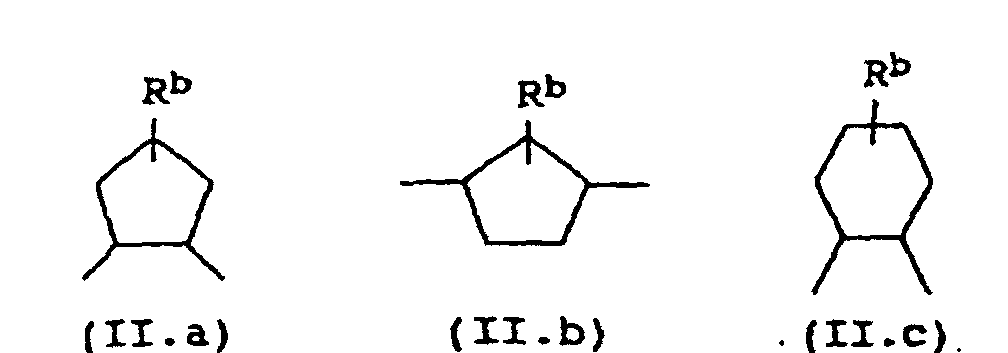
- Verfahren nach einem der vorhergehenden Ansprüche, wobei x ausgewählt ist unter Gruppen der Formeln II.a bis II.k

 worin
worin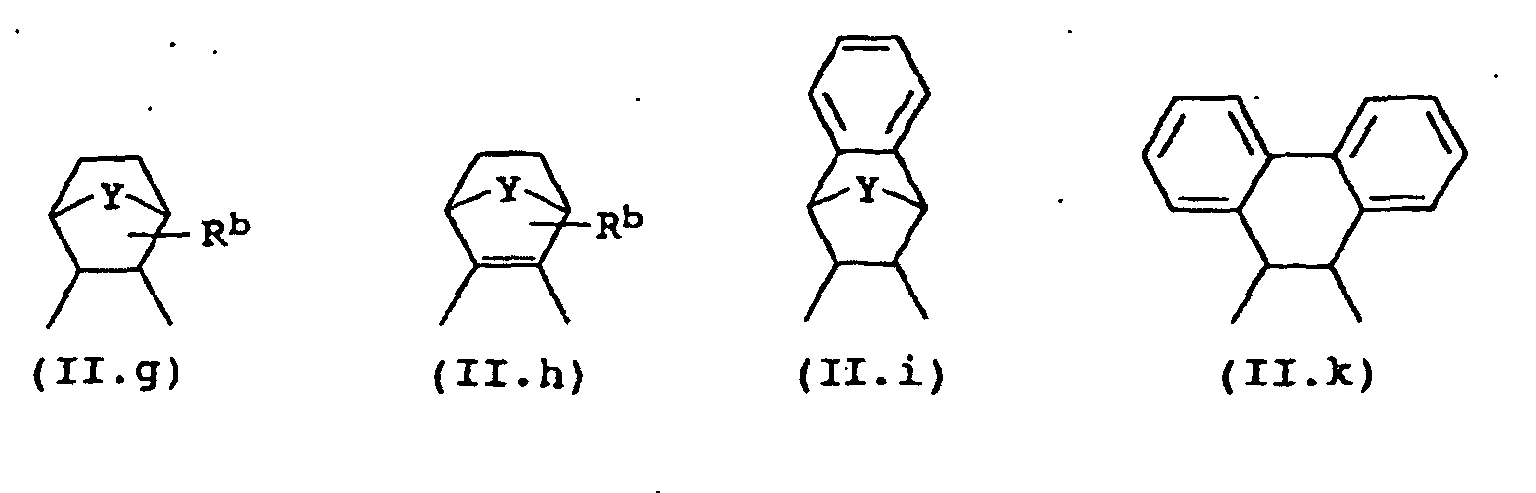
- Rb
- ausgewählt ist unter Alkyl, Cycloalkyl, Aryl, Alkoxy, Acyl, Carboxyl, Alkoxycarbonyl, Hydroxy, Nitro, Cyano, Trifluormethyl, Oxo und den Ketalen davon, oder NE1E2, wobei E1 und E2 gleich oder verschieden sein können und für Alkyl, Cycloalkyl oder Aryl stehen, und
- Y
- wie in Anspruch 1 definiert ist.
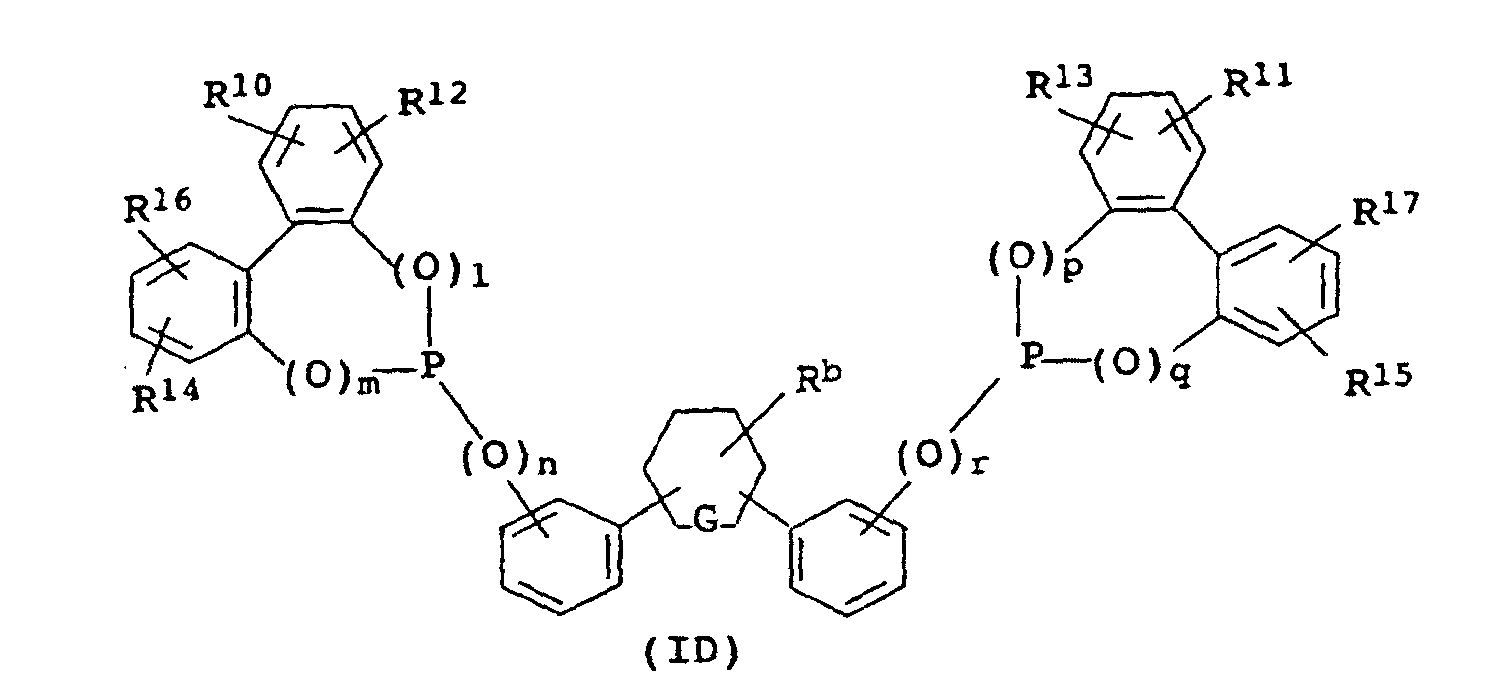
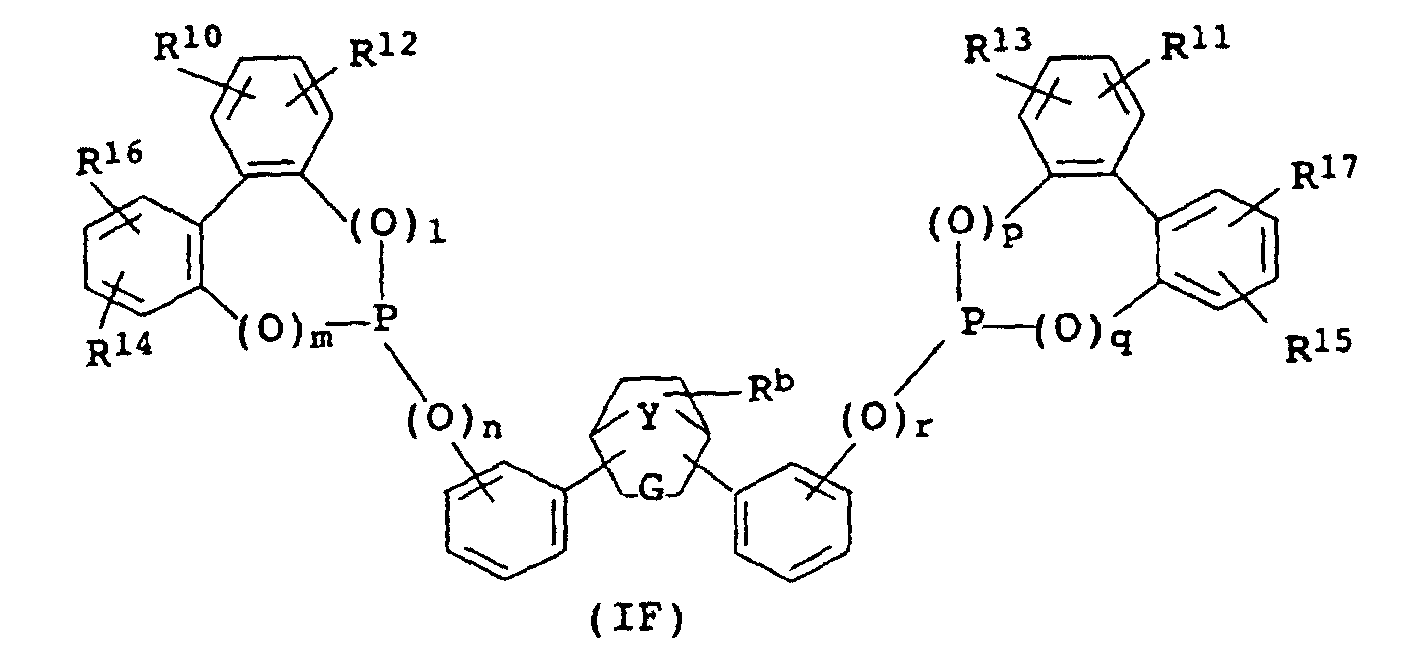
- Verfahren nach einem der vorhergehenden Ansprüche, wobei der Ligand der Formel I ausgewählt ist unter Liganden der Formeln IA bis IF
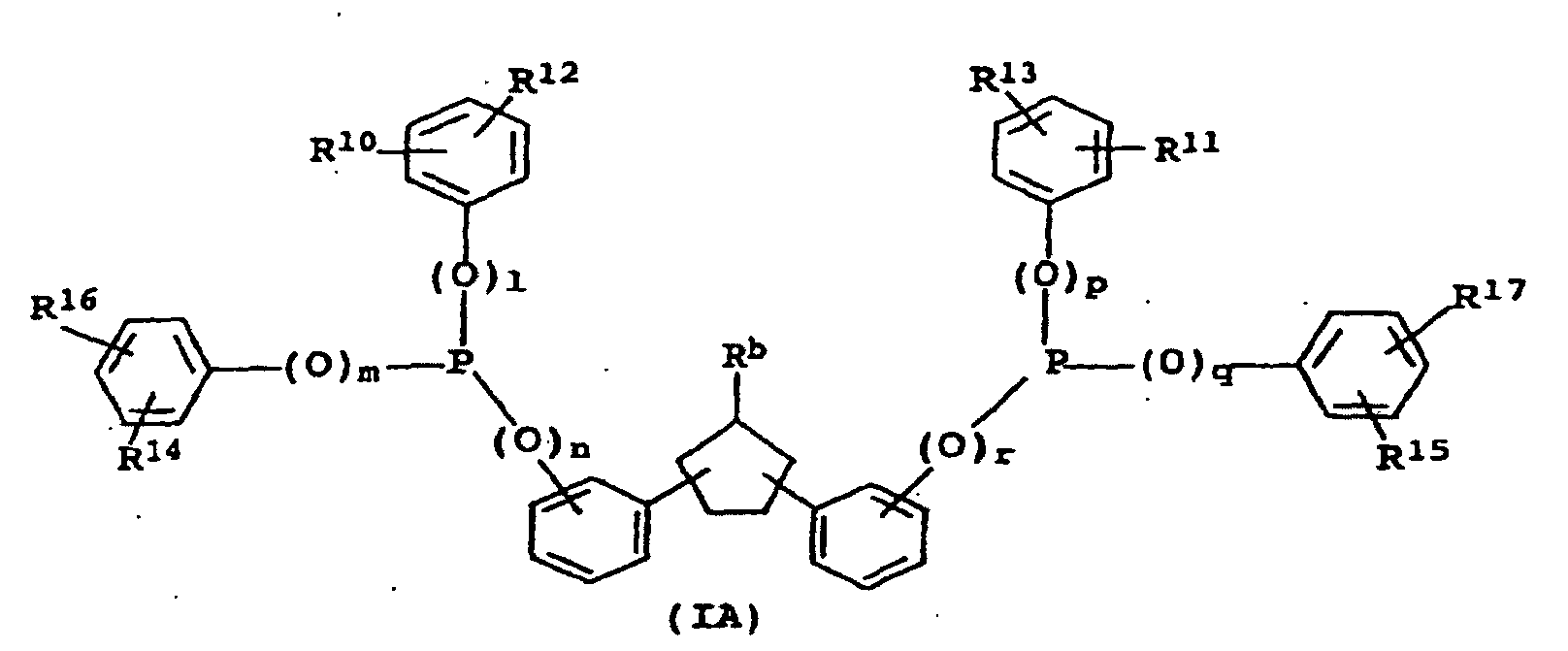
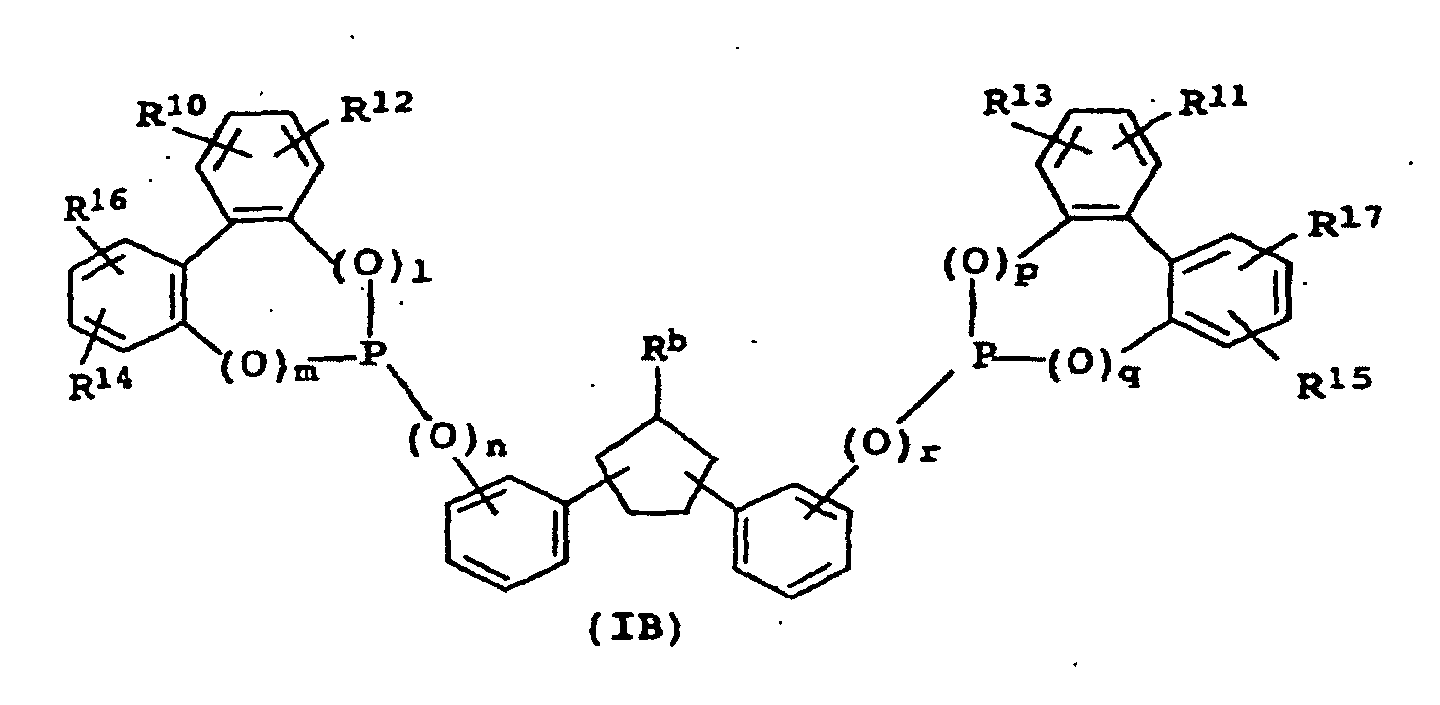


 worin
worin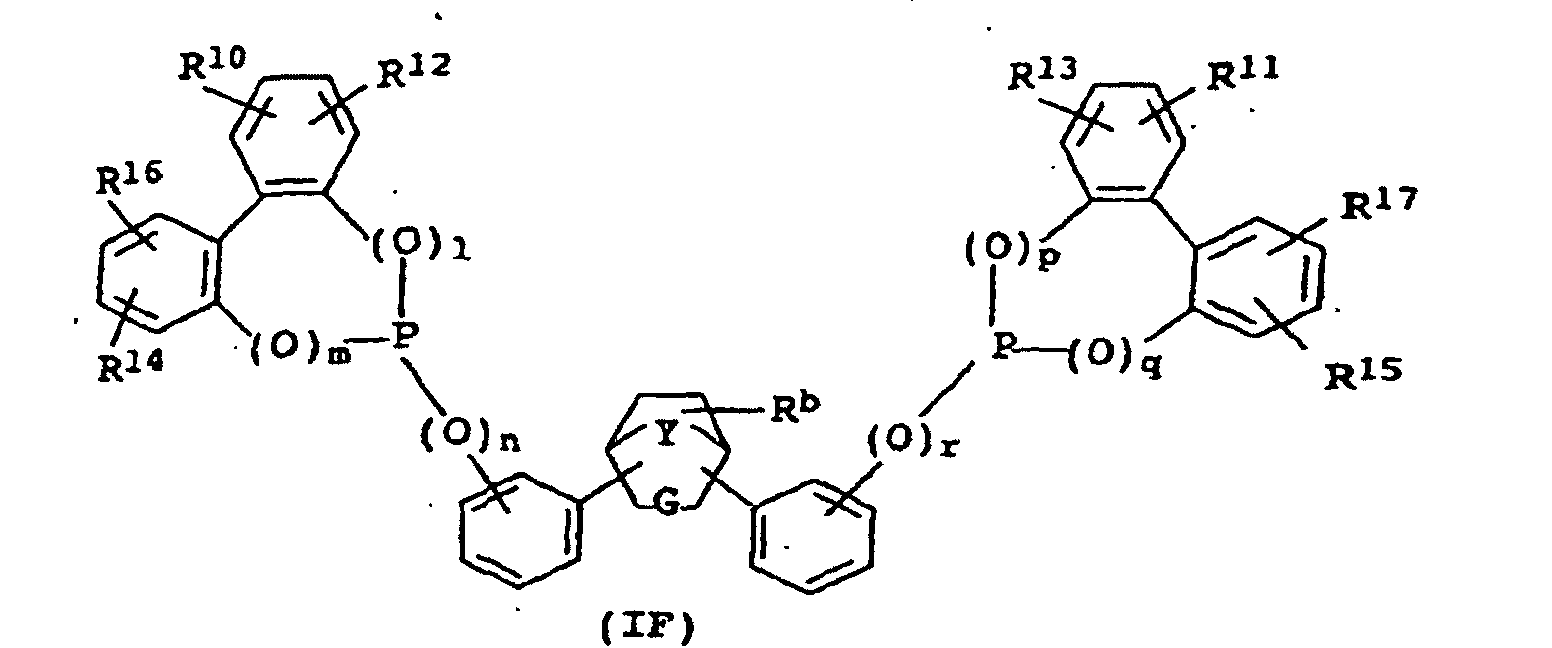
- R10, R11, R12, R13, R14, R15, R16 und R17
- unabhängig voneinander ausgewählt sind unter Wasserstoff, Alkyl, Cycloalkyl, Aryl, Alkoxy, Cycloalkoxy, Aryloxy, Acyl, Halogen, Trifluormethyl, Nitro, Cyano, Carboxyl, Alkoxycarbonyl oder NE3E4, wobei E3 und E4 gleich oder verschieden sein können und für Alkyl, Cycloalkyl oder Aryl stehen,
- l, m, n, p, q und r
- unabhängig voneinander für 0 oder 1 stehen,
- Rb
- in den Formeln IA und IB ausgewählt ist unter Wasserstoff, Alkyl, Oxo und den Ketalen davon und in den Formeln IC, ID, IE und IF ausgewählt ist unter Wasserstoff und Alkyl,
- G
- für eine Einfachbindung, eine Doppelbindung oder ein Sauerstoffatom steht,
- Y
- für O, S, CH2 oder einen Rest der Formel III.1 bis III.4
steht, worin

- R6, R7, R8 und R9
- unabhängig voneinander für Wasserstoff, Alkyl, Cycloalkyl, Aryl, Alkoxy, Halogen, SO3H, Sulfonat, NE1E2, Alkylen-NE1E2, Trifluormethyl, Nitro, Alkoxycarbonyl, Carboxyl oder cyano stehen, wobei E1 und E2 unabhängig voneinander für Alkyl, Cycloalkyl oder Aryl stehen.
- Verfahren nach einem der vorhergehenden Ansprüche, wobei der Ligand der Formel I ausgewählt ist unter Phosphinliganden der Formeln Ia-Ie


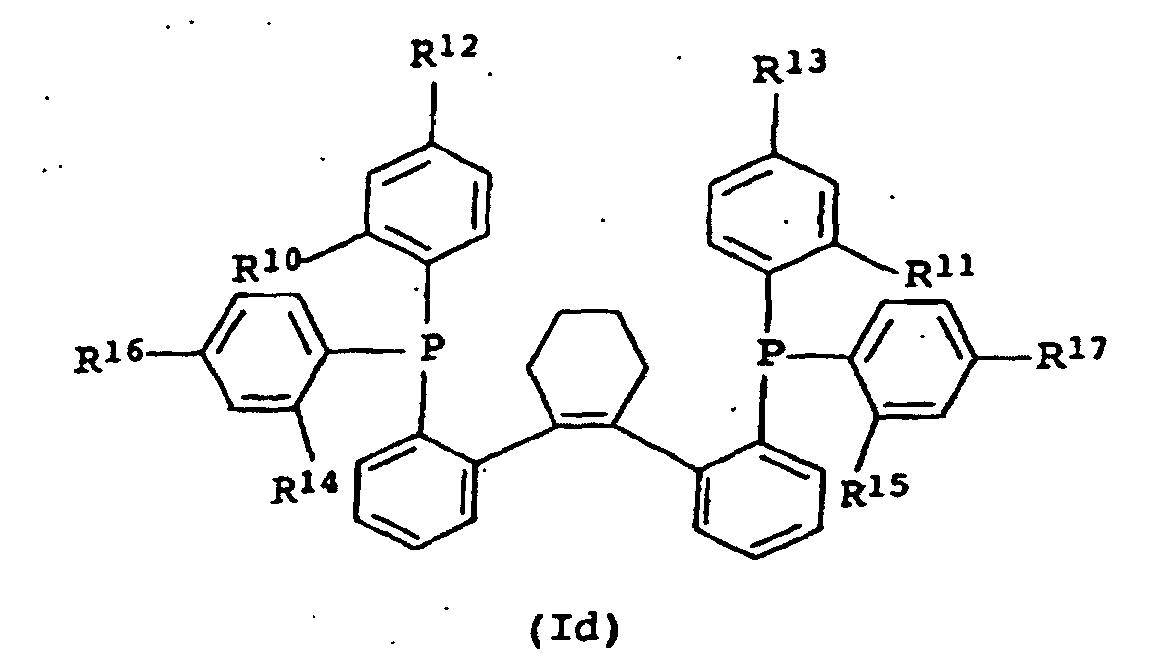 wobei in den Formeln Ia bis Ie die Substituenten R10, R11,
R12, R13, R14, R15, R16 und R17 die folgenden Bedeutungen besitzen:R10 R11 R12 R13 R14 R15 R16 R17 H H H H H H H H CH3 CH3 H H H H H H CH3 CH3 H H CH3 CH3 H H CH3 CH3 CH3 CH3 H H H H CH3 CH3 CH3 CH3 CH3 CH3 H H CH3 CH3 CH3 CH3 CH3 CH3 CH3 CH3 steht, worin
R6, R7, R8 und R9 unabhängig voneinander für Wasserstoff, Alkyl, Cycloalkyl, Aryl, Alkoxy, Halogen, SO3H, Sulfonat, NE1E2, Alkylen-NE1E2, Trifluormethyl, Nitro, Alkoxycarbonyl, Carboxyl oder Cyano stehen, wobei E1 und E2 unabhängig voneinander für Alkyl, Cycloalkyl oder Aryl stehen. - Verbindungen der allgemeinen Formel Iworin

- Z1 und Z2
- unabhängig voneinander für mindestens ein Phosphor-, Arsen- oder Antimonatom aufweisende Reste stehen, wobei an das Phosphor-, Arsen- oder Antimonatom jeweils mindestens zwei gegebenenfalls substituierte Heteroatome, die ausgewählt sind unter O, S und NRc, direkt gebunden sind, wobei Rc für Wasserstoff, Alkyl, Cycloalkyl oder Aryl steht,
Verbindungen der allgemeinen Formel I'worin
- R1, R2, R3 und R4
- unabhängig voneinander für Alkyl, Cycloalkyl, Aryl oder Hetaryl stehen, wobei die Aryl- und Hetarylgruppen je einen, zwei oder drei Substituenten, die ausgewählt sind unter Alkyl, Cycloalkyl, Aryl, Alkoxy, Cycloalkoxy, Aryloxy, Acyl, Halogen, Trifluormethyl, Nitro, Cyano, Carboxyl, Alkoxycarbonyl oder NE1E2, tragen können, wobei E1 und E2 gleich oder verschieden sein können und für Alkyl, Cycloalkyl oder Aryl stehen.
- X
- ausgewählt ist unter Gruppen der Formeln II.a bis II.k
 worin
worin
- Rb
- ausgewählt ist unter Alkyl, Cycloalkyl, Aryl, Alkoxy, Acyl, Carboxyl, Alkoxycarbonyl, Hydroxy, Nitro, Cyano, Trifluormethyl, Oxo und den Ketalen davon, oder NE1E2, wobei E1 und E2 gleich oder verschieden sein können und für Alkyl, Cycloalkyl oder Aryl stehen, und
- Y
- wie in Anspruch 1 definiert ist,
- Katalysator, umfassend wenigstens einen Komplex eines Metalls der VIII. Nebengruppe mit mindestens einem Liganden, der ausgewählt ist unter Verbindungen der allgemeinen Formeln I und I', wie in Anspruch 7 definiert.
- Katalysator nach Anspruch 8, dadurch gekennzeichnet, dass das Metall der VIII. Nebengruppe ausgewählt ist unter Cobalt, Ruthenium, Iridium, Rhodium, Nickel, Palladium und Platin.
- Katalysator nach einem der Ansprüche 8 oder 9, der zusätzlich wenigstens einen weiteren Liganden, ausgewählt unter Halogeniden, Aminen, Carboxylaten, Acetylacetonat, Aryl- oder Alkylsulfonaten, Hydrid, CO, Olefinen, Dienen, Cycloolefinen, Nitrilen, N-haltigen Heterocyclen, Aromaten und Heteroaromaten, Ethern, PF3, Phospholen, Phosphabenzolen sowie ein-, zwei- und mehrzähnigen Phosphin-, Phosphinit-, Phosphonit-, Phosphoramidit und Phosphitliganden aufweist.
Applications Claiming Priority (5)
| Application Number | Priority Date | Filing Date | Title |
|---|---|---|---|
| DE10023471A DE10023471A1 (de) | 2000-05-12 | 2000-05-12 | Verfahren zur Hydroformylierung, verbrückte Phosphine und Katalysator, umfassend einen Komplex dieser verbrückten Phosphine |
| DE10023471 | 2000-05-12 | ||
| DE10101939A DE10101939A1 (de) | 2000-05-12 | 2001-01-17 | Verfahren zur Hydroformylierung, verbrückte Verbindungen des Phosphors, Arsens und des Antimons und Katalysator, umfassend einen Komplex dieser verbrückten Verbindungen |
| DE10101939 | 2001-01-17 | ||
| PCT/EP2001/005407 WO2001085739A1 (de) | 2000-05-12 | 2001-05-11 | Verfahren zur hydroformylierung, verbrückte verbindungen des phosphors, arsens und des antimons und katalysator, umfassend einen komplex dieser verbrückten verbindung |
Publications (2)
| Publication Number | Publication Date |
|---|---|
| EP1280811A1 EP1280811A1 (de) | 2003-02-05 |
| EP1280811B1 true EP1280811B1 (de) | 2004-10-13 |
Family
ID=26005668
Family Applications (1)
| Application Number | Title | Priority Date | Filing Date |
|---|---|---|---|
| EP01931693A Expired - Lifetime EP1280811B1 (de) | 2000-05-12 | 2001-05-11 | Verfahren zur hydroformylierung, verbrückte verbindungen des phosphors, arsens und des antimons und katalysator, umfassend einen komplex dieser verbrückten verbindungen |
Country Status (4)
| Country | Link |
|---|---|
| EP (1) | EP1280811B1 (de) |
| AU (1) | AU2001258397A1 (de) |
| DE (3) | DE10023471A1 (de) |
| WO (1) | WO2001085739A1 (de) |
Families Citing this family (5)
| Publication number | Priority date | Publication date | Assignee | Title |
|---|---|---|---|---|
| DE60304034T2 (de) | 2002-03-11 | 2006-10-12 | Union Carbide Chemicals & Plastics Technology Corp., Danbury | Bisphosphit-ligande für carbonylierungsverfahren |
| DE10242636A1 (de) | 2002-09-13 | 2004-03-18 | Basf Ag | Verfahren zur Herstellung von Dialdehyden und/oder ethylenisch ungesättigten Monoaldehyden durch Hydroformylierung ethylenisch ungesättigter Verbindungen |
| WO2004035595A1 (en) | 2002-10-15 | 2004-04-29 | Union Carbide Chemicals & Plastics Technology Corporation | Bis-chelating ligand and use thereof in carbonylation processes |
| DE10352757A1 (de) * | 2003-11-12 | 2005-06-16 | Studiengesellschaft Kohle Mbh | Chirale Di- und Triphosphite |
| EP2099731A1 (de) | 2006-11-30 | 2009-09-16 | Basf Se | Verfahren zur hydroformylierung von olefinen |
Family Cites Families (2)
| Publication number | Priority date | Publication date | Assignee | Title |
|---|---|---|---|---|
| JP2775855B2 (ja) * | 1989-06-13 | 1998-07-16 | 三菱化学株式会社 | アルデヒドの製造法 |
| US5817883A (en) * | 1996-04-24 | 1998-10-06 | Union Carbide Chemicals & Plastics Technology Corporation | Processes for producing hydroxyaldehydes |
-
2000
- 2000-05-12 DE DE10023471A patent/DE10023471A1/de not_active Withdrawn
-
2001
- 2001-01-17 DE DE10101939A patent/DE10101939A1/de not_active Withdrawn
- 2001-05-11 EP EP01931693A patent/EP1280811B1/de not_active Expired - Lifetime
- 2001-05-11 WO PCT/EP2001/005407 patent/WO2001085739A1/de not_active Ceased
- 2001-05-11 AU AU2001258397A patent/AU2001258397A1/en not_active Abandoned
- 2001-05-11 DE DE2001504116 patent/DE50104116D1/de not_active Expired - Lifetime
Also Published As
| Publication number | Publication date |
|---|---|
| EP1280811A1 (de) | 2003-02-05 |
| WO2001085739A1 (de) | 2001-11-15 |
| AU2001258397A1 (en) | 2001-11-20 |
| DE50104116D1 (de) | 2004-11-18 |
| DE10023471A1 (de) | 2001-11-15 |
| DE10101939A1 (de) | 2002-07-18 |
Similar Documents
| Publication | Publication Date | Title |
|---|---|---|
| EP1064093B1 (de) | Katalysator, umfassend einen rhodium-komplex auf der basis eines phosphonitliganden und verfahren zur hydroformylierung | |
| EP1383777B1 (de) | Liganden für pnicogenchelatkomplexe mit einem metall der viii. nebengruppe und verwendung der komplexe als katalysatoren für hydroformylierung, carbonylierung, hydrocyanierung oder hydrierung | |
| EP1257361B1 (de) | Verbindungen des phosphors, arsens und des antimons basierend auf diarylanellierten bicyclo[2.2.n]-grundkörpern und diese enthaltende katalysatoren | |
| EP1486481A2 (de) | Verfahren zur Hydroformylierung | |
| EP2091958A1 (de) | Bisphosphitliganden für die übergangsmetallkatalysierte hydroformylierung | |
| EP1318868B1 (de) | Verfahren zur hydroformylierung mit katalysatoren von xanthen-verbruckten liganden | |
| DE10140086A1 (de) | Neue Phosphitverbindungen und neue Phosphitmetallkomplexe | |
| EP1163051B1 (de) | Katalysator, umfassend einen rhodium-komplex auf der basis eines phosphinamiditliganden; seine verwendung zur hydroformylierung | |
| DE10205702A1 (de) | Verfahren zur Hydroformylierung, Liganden mit von Bisphenol A abgeleiteter Struktur und Katalysator, umfassend einen Komplex dieser Liganden | |
| DE69419567T2 (de) | Hydroformylierungs-Verfahren unter Benutzung eines neuen Phosphin-Rhodium Katalysator-Systems | |
| DE10333519A1 (de) | Zweistufiges Hydroformylierungsverfahren | |
| DE102004052040A1 (de) | Liganden zur asymmetrischen Hydroformylierung | |
| DE10206697A1 (de) | Hydroformylierungsverfahren | |
| EP1689760B1 (de) | Verfahren zur asymmetrischen synthese | |
| EP1280811A1 (de) | Verfahren zur hydroformylierung, verbrückte verbindungen des phosphors, arsens und des antimons und katalysator, umfassend einen komplex dieser verbrückten verbindungen | |
| DE19827232A1 (de) | Katalysator, umfassend einen Komplex eines Metalls der VIII. Nebengruppe auf Basis eines Phosphinitliganden und Verfahren zur Hydroformylierung und Hydrocyanierung | |
| DE102007052640A1 (de) | Verfahren zur Hydroformylierung | |
| DE10205361A1 (de) | Phosphorchelatverbindungen | |
| DE10342760A1 (de) | Pnicogenverbindungen | |
| DE102005061642A1 (de) | Phosphorchelatverbindungen | |
| DE10246035A1 (de) | 1-Pnicogena-2-oxanorbornan-Verbindungen | |
| DE10033982A1 (de) | Verfahren zur Herstellung von Additionsprodukten ethylenisch ungesättigter Verbindungen | |
| DE10108473A1 (de) | Neue Diphosphine und Verfahren zu ihrer Herstellung | |
| DE10260797A1 (de) | Monopnicogenverbindungen | |
| DE10320139A1 (de) | Katalysatoren umfassend einen Komplex mit einem Heterobicyclo (2.2.2)octan-Liganden |
Legal Events
| Date | Code | Title | Description |
|---|---|---|---|
| PUAI | Public reference made under article 153(3) epc to a published international application that has entered the european phase |
Free format text: ORIGINAL CODE: 0009012 |
|
| 17P | Request for examination filed |
Effective date: 20021111 |
|
| AK | Designated contracting states |
Designated state(s): AT BE CH CY DE DK ES FI FR GB GR IE IT LI LU MC NL PT SE TR |
|
| AX | Request for extension of the european patent |
Extension state: AL LT LV MK RO SI |
|
| 17Q | First examination report despatched |
Effective date: 20030221 |
|
| GRAP | Despatch of communication of intention to grant a patent |
Free format text: ORIGINAL CODE: EPIDOSNIGR1 |
|
| GRAS | Grant fee paid |
Free format text: ORIGINAL CODE: EPIDOSNIGR3 |
|
| GRAA | (expected) grant |
Free format text: ORIGINAL CODE: 0009210 |
|
| AK | Designated contracting states |
Kind code of ref document: B1 Designated state(s): DE |
|
| REG | Reference to a national code |
Ref country code: IE Ref legal event code: FG4D Free format text: GERMAN |
|
| REF | Corresponds to: |
Ref document number: 50104116 Country of ref document: DE Date of ref document: 20041118 Kind code of ref document: P |
|
| LTIE | Lt: invalidation of european patent or patent extension |
Effective date: 20041013 |
|
| REG | Reference to a national code |
Ref country code: IE Ref legal event code: FD4D |
|
| PLBE | No opposition filed within time limit |
Free format text: ORIGINAL CODE: 0009261 |
|
| STAA | Information on the status of an ep patent application or granted ep patent |
Free format text: STATUS: NO OPPOSITION FILED WITHIN TIME LIMIT |
|
| 26N | No opposition filed |
Effective date: 20050714 |
|
| PGFP | Annual fee paid to national office [announced via postgrant information from national office to epo] |
Ref country code: DE Payment date: 20100730 Year of fee payment: 10 |
|
| REG | Reference to a national code |
Ref country code: DE Ref legal event code: R119 Ref document number: 50104116 Country of ref document: DE Effective date: 20111201 |
|
| PG25 | Lapsed in a contracting state [announced via postgrant information from national office to epo] |
Ref country code: DE Free format text: LAPSE BECAUSE OF NON-PAYMENT OF DUE FEES Effective date: 20111201 |