EP1278506B1 - Zahnreinigungsmittel - Google Patents
Zahnreinigungsmittel Download PDFInfo
- Publication number
- EP1278506B1 EP1278506B1 EP01923456A EP01923456A EP1278506B1 EP 1278506 B1 EP1278506 B1 EP 1278506B1 EP 01923456 A EP01923456 A EP 01923456A EP 01923456 A EP01923456 A EP 01923456A EP 1278506 B1 EP1278506 B1 EP 1278506B1
- Authority
- EP
- European Patent Office
- Prior art keywords
- cleaning means
- means according
- glass
- teeth cleaning
- toothpaste
- Prior art date
- Legal status (The legal status is an assumption and is not a legal conclusion. Google has not performed a legal analysis and makes no representation as to the accuracy of the status listed.)
- Expired - Lifetime
Links
- 239000012459 cleaning agent Substances 0.000 title abstract description 6
- 239000000606 toothpaste Substances 0.000 claims abstract description 23
- 239000011521 glass Substances 0.000 claims abstract description 22
- 239000002245 particle Substances 0.000 claims abstract description 20
- 229940034610 toothpaste Drugs 0.000 claims abstract description 13
- 239000006072 paste Substances 0.000 claims abstract description 7
- 239000002562 thickening agent Substances 0.000 claims abstract description 6
- 239000003082 abrasive agent Substances 0.000 claims abstract description 5
- 239000003995 emulsifying agent Substances 0.000 claims abstract description 5
- 150000002222 fluorine compounds Chemical class 0.000 claims abstract description 5
- 239000000654 additive Substances 0.000 claims abstract description 4
- 239000005337 ground glass Substances 0.000 claims abstract 2
- 238000004140 cleaning Methods 0.000 claims description 14
- 239000005388 borosilicate glass Substances 0.000 claims description 12
- 239000000203 mixture Substances 0.000 claims description 12
- VYPSYNLAJGMNEJ-UHFFFAOYSA-N Silicium dioxide Chemical compound O=[Si]=O VYPSYNLAJGMNEJ-UHFFFAOYSA-N 0.000 claims description 9
- 238000004519 manufacturing process Methods 0.000 claims description 8
- 239000000126 substance Substances 0.000 claims description 5
- JKWMSGQKBLHBQQ-UHFFFAOYSA-N diboron trioxide Chemical compound O=BOB=O JKWMSGQKBLHBQQ-UHFFFAOYSA-N 0.000 claims description 4
- 239000000796 flavoring agent Substances 0.000 claims description 4
- 235000019634 flavors Nutrition 0.000 claims description 4
- 235000003599 food sweetener Nutrition 0.000 claims description 4
- 239000003765 sweetening agent Substances 0.000 claims description 4
- 208000002925 dental caries Diseases 0.000 claims description 3
- 239000000377 silicon dioxide Substances 0.000 claims description 3
- PNEYBMLMFCGWSK-UHFFFAOYSA-N aluminium oxide Inorganic materials [O-2].[O-2].[O-2].[Al+3].[Al+3] PNEYBMLMFCGWSK-UHFFFAOYSA-N 0.000 claims description 2
- 230000003442 weekly effect Effects 0.000 claims description 2
- KKCBUQHMOMHUOY-UHFFFAOYSA-N Na2O Inorganic materials [O-2].[Na+].[Na+] KKCBUQHMOMHUOY-UHFFFAOYSA-N 0.000 claims 1
- 229910052681 coesite Inorganic materials 0.000 claims 1
- 229910052906 cristobalite Inorganic materials 0.000 claims 1
- 239000004571 lime Substances 0.000 claims 1
- 230000002265 prevention Effects 0.000 claims 1
- 229910052682 stishovite Inorganic materials 0.000 claims 1
- 229910052905 tridymite Inorganic materials 0.000 claims 1
- 238000011321 prophylaxis Methods 0.000 abstract description 2
- 230000003449 preventive effect Effects 0.000 abstract 1
- 239000000551 dentifrice Substances 0.000 description 21
- 239000010451 perlite Substances 0.000 description 12
- 235000019362 perlite Nutrition 0.000 description 12
- 238000009472 formulation Methods 0.000 description 6
- 239000003906 humectant Substances 0.000 description 4
- 239000000047 product Substances 0.000 description 4
- 210000003298 dental enamel Anatomy 0.000 description 3
- 210000003739 neck Anatomy 0.000 description 3
- 230000000069 prophylactic effect Effects 0.000 description 3
- 238000005299 abrasion Methods 0.000 description 2
- 239000004480 active ingredient Substances 0.000 description 2
- 230000006399 behavior Effects 0.000 description 2
- 238000005260 corrosion Methods 0.000 description 2
- 210000004268 dentin Anatomy 0.000 description 2
- 238000002845 discoloration Methods 0.000 description 2
- 238000009826 distribution Methods 0.000 description 2
- 238000005187 foaming Methods 0.000 description 2
- 238000002360 preparation method Methods 0.000 description 2
- 238000012216 screening Methods 0.000 description 2
- RZVAJINKPMORJF-UHFFFAOYSA-N Acetaminophen Chemical compound CC(=O)NC1=CC=C(O)C=C1 RZVAJINKPMORJF-UHFFFAOYSA-N 0.000 description 1
- 229910018072 Al 2 O 3 Inorganic materials 0.000 description 1
- KRHYYFGTRYWZRS-UHFFFAOYSA-M Fluoride anion Chemical compound [F-] KRHYYFGTRYWZRS-UHFFFAOYSA-M 0.000 description 1
- PXGOKWXKJXAPGV-UHFFFAOYSA-N Fluorine Chemical compound FF PXGOKWXKJXAPGV-UHFFFAOYSA-N 0.000 description 1
- 229910004298 SiO 2 Inorganic materials 0.000 description 1
- 241001122767 Theaceae Species 0.000 description 1
- 229910052783 alkali metal Inorganic materials 0.000 description 1
- 150000001340 alkali metals Chemical class 0.000 description 1
- 229910052782 aluminium Inorganic materials 0.000 description 1
- -1 aluminum silicates Chemical class 0.000 description 1
- 229910052796 boron Inorganic materials 0.000 description 1
- 229910052810 boron oxide Inorganic materials 0.000 description 1
- 230000001680 brushing effect Effects 0.000 description 1
- WUKWITHWXAAZEY-UHFFFAOYSA-L calcium difluoride Chemical compound [F-].[F-].[Ca+2] WUKWITHWXAAZEY-UHFFFAOYSA-L 0.000 description 1
- 239000011248 coating agent Substances 0.000 description 1
- 238000000576 coating method Methods 0.000 description 1
- 230000000295 complement effect Effects 0.000 description 1
- 238000011109 contamination Methods 0.000 description 1
- 230000007797 corrosion Effects 0.000 description 1
- 230000000694 effects Effects 0.000 description 1
- 238000004334 fluoridation Methods 0.000 description 1
- 239000011737 fluorine Substances 0.000 description 1
- 229910052731 fluorine Inorganic materials 0.000 description 1
- 208000007565 gingivitis Diseases 0.000 description 1
- 229910001385 heavy metal Inorganic materials 0.000 description 1
- 238000010348 incorporation Methods 0.000 description 1
- 239000004615 ingredient Substances 0.000 description 1
- 229910052500 inorganic mineral Inorganic materials 0.000 description 1
- 229910052751 metal Inorganic materials 0.000 description 1
- 239000002184 metal Substances 0.000 description 1
- 238000000034 method Methods 0.000 description 1
- 239000011707 mineral Substances 0.000 description 1
- 238000005065 mining Methods 0.000 description 1
- 229910001562 pearlite Inorganic materials 0.000 description 1
- 230000002085 persistent effect Effects 0.000 description 1
- 230000007505 plaque formation Effects 0.000 description 1
- 239000008262 pumice Substances 0.000 description 1
- 239000005297 pyrex Substances 0.000 description 1
- 239000010453 quartz Substances 0.000 description 1
- 238000007788 roughening Methods 0.000 description 1
- 238000006748 scratching Methods 0.000 description 1
- 230000002393 scratching effect Effects 0.000 description 1
- 150000004760 silicates Chemical class 0.000 description 1
- 229910052814 silicon oxide Inorganic materials 0.000 description 1
- 230000000391 smoking effect Effects 0.000 description 1
- 238000013112 stability test Methods 0.000 description 1
- 238000003860 storage Methods 0.000 description 1
- 239000013589 supplement Substances 0.000 description 1
- XLYOFNOQVPJJNP-UHFFFAOYSA-N water Substances O XLYOFNOQVPJJNP-UHFFFAOYSA-N 0.000 description 1
- 239000000080 wetting agent Substances 0.000 description 1
Images
Classifications
-
- A—HUMAN NECESSITIES
- A61—MEDICAL OR VETERINARY SCIENCE; HYGIENE
- A61Q—SPECIFIC USE OF COSMETICS OR SIMILAR TOILETRY PREPARATIONS
- A61Q11/00—Preparations for care of the teeth, of the oral cavity or of dentures; Dentifrices, e.g. toothpastes; Mouth rinses
-
- A—HUMAN NECESSITIES
- A61—MEDICAL OR VETERINARY SCIENCE; HYGIENE
- A61K—PREPARATIONS FOR MEDICAL, DENTAL OR TOILETRY PURPOSES
- A61K8/00—Cosmetics or similar toiletry preparations
- A61K8/18—Cosmetics or similar toiletry preparations characterised by the composition
- A61K8/19—Cosmetics or similar toiletry preparations characterised by the composition containing inorganic ingredients
- A61K8/25—Silicon; Compounds thereof
-
- A—HUMAN NECESSITIES
- A61—MEDICAL OR VETERINARY SCIENCE; HYGIENE
- A61K—PREPARATIONS FOR MEDICAL, DENTAL OR TOILETRY PURPOSES
- A61K2800/00—Properties of cosmetic compositions or active ingredients thereof or formulation aids used therein and process related aspects
- A61K2800/40—Chemical, physico-chemical or functional or structural properties of particular ingredients
- A61K2800/41—Particular ingredients further characterized by their size
- A61K2800/412—Microsized, i.e. having sizes between 0.1 and 100 microns
Definitions
- the present invention relates to a dentifrice, such as a toothpaste for daily use, a toothpaste for monthly use, a dentifrice as prophylactic paste, and a method for cleaning the teeth.
- a dentifrice such as a toothpaste for daily use, a toothpaste for monthly use, a dentifrice as prophylactic paste, and a method for cleaning the teeth.
- Toothpastes according to group 2 are complementary to the use of conventional toothpastes and are used in particular for the removal of persistent dental contamination and plaque or plaque. These dentifrices are used at intervals of about a few weeks or for example monthly and are an important supplement to daily brushing to prevent tooth decay, plaque formation and from gingivits. Such dentifrices are also used by dental hygienists in the example of semi-annual dental check at the dentist for cleaning the teeth.
- Tooth cleaning agents are known per se and include u.a. Silicates, pumice components, aluminum trioxide, aluminum silicates, synthetically produced precipitated silica and perlite, and other components, such as humectants, wetting agents, thickeners, active ingredients normally used in toothpastes, such as fluorine and optionally gingivite-preventing components.
- dentifrice has a good cleaning effect, but without abrading the enamel and without scratching the enamel. Also, when using the dentifrice in the neck of the neck, the gum should not be injured or attacked.
- Perlite is a mineral of volcanic origin. Mineralogy is understood to mean perlite liparite and quartz porphyritic glasses, which have a spherical structure. However, foaming is determined by the heat and pressure in the volcanic environment. Depending on the mining area, the chemical composition and the degree of purity changes.
- the spherical structures are ground to give the desired platelet shape which is suitable to use perlite in the proposed dentifrice formulations.
- Another property is that the particle size of the pearlite is variable and sometimes has sizes up to 500 microns with a mean particle diameter of about 60 to 70 microns.
- Perlite must therefore be screened before use in a dentifrice. The screening of large particles larger than 200 microns makes the product more expensive, and it has also been found that the products commonly used in commerce based on perlite leave a sandy impression after rinsing the mouth.
- the object is achieved by means of a dentifrice according to the wording of claim 1. It is suggested that the dentifrice has a viscous composition containing ground borosilicate glass. Borosilicate glass or C glass is used to refer to special glass which, in addition to up to about 75% silicon oxide, contains boron trioxide in the order of about 2-10% by weight.
- C-glass or alkali metal glass with an increased boron oxide content is proposed, which in itself is produced synthetically and has been developed in particular for anti-corrosion formulations.
- the production and foaming of this borosilicate glass takes place under certain controlled conditions, the chemical composition being constant in each case.
- Comminution for the production of the desired particle size takes place, for example, in hammer mills, and the particle size is standardized and is preferably below 100 .mu.m with an average particle diameter of about 10 to 20 .mu.m, preferably about 15 .mu.m , These are also known as Micro Glass ® Glass flakes glass particles are used in particular in coating systems for the production of a high quality corrosion protection of metal and concrete surfaces.
- the borosilicate glass described according to the invention is also suitable for incorporation into the mentioned dentifrices without pretreatment. These are plates with geometric shapes.
- perlite is much more variable and is up to 500 microns and more at the same mean particle diameter of about 60 - 70 microns.
- Perlite would first have to be screened before use with a dentifrice, and by screening out the larger particles of over 200 microns, the product would immediately become much more expensive.
- large particles in the enamel or dentin leave a deep roughness, which is of course undesirable.
- the chemical composition of borosilicate glass or C-glass has the following value ranges: SiO 2 65 - 75% Al 2 O 3 2 - 7% CaO 4 - 9% MgO 0 - 5% B 2 O 3 2 - 10% Na 2 O + K 2 O 9 - 13% ZnO 1 - 6%
- Durosil, Pyrex, Solidex or the so-called FLAKEGLAS which is already present in ground form and is commercially available in the desired particle size distribution or average particle size, are known as borosilicate glasses.
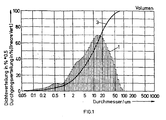
- a typical diameter distribution of Borosilikatglasses erfindungygemäss used or of micro glass Glass Flakes ® is shown in the accompanying Fig. 1,.
- the bars, denoted by the reference numeral 1 the quantitative proportion of the respective particle diameter, while the line 3 represents the integral of the amount. From Fig. 1 it can be clearly seen that no particles with a diameter> 100 microns are included.
- Example 1 formulation for a toothpaste:
- abrasives ⁇ 55% thickener ⁇ 2% Humectants ⁇ 60% emulsifiers ⁇ 2% fluorides 0.05 - 0.15% (maximum 1500 ppm) Flavors / Sweeteners ⁇ 2.5% other additives ⁇ 1%
- Example 2 formulation for a prophylactic paste:
- a preferred recipe for the preparation of both a toothpaste (ZP) and a prophylactic paste (PP) is as follows: ZP in% PP in% abrasives about 10 - 20 about 55 thickener about 0.5 about 2 Humectants approx. 50 about 30 emulsifiers 1 approx. approx. 1 fluorides about 0.1 about 0.1 Flavors / Sweeteners approx. 1.2 approx. 1.2 and in the case of toothpastes still about 0.1% additives. Both formulas are supplemented with water up to 100%.
- the borosilicate glass behaves or behave the Microglas ® glass flakes inert to all ingredients.
- a two-year storage stability test at room temperature shows no changes in and on the paste. The fluoride and pH remain stable.
- a toothpaste or more generally a dentifrice with Microglas ® Glass Flakes is particularly suitable for people with exposed dentin in the area of the tooth necks and discoloration on the tooth surfaces due to smoking or frequent consumption of coffee, tea etc.
- the selection of suitable toothpastes is rather small, with which the tooth-cleaning agent proposed according to the invention closes a considerable gap in the offer.
- toothpastes or general dentifrices according to the formulation proposed according to the invention can also be used without problems with electric toothbrushes.
Landscapes
- Health & Medical Sciences (AREA)
- Life Sciences & Earth Sciences (AREA)
- Veterinary Medicine (AREA)
- Animal Behavior & Ethology (AREA)
- General Health & Medical Sciences (AREA)
- Public Health (AREA)
- Inorganic Chemistry (AREA)
- Chemical & Material Sciences (AREA)
- Oral & Maxillofacial Surgery (AREA)
- Birds (AREA)
- Epidemiology (AREA)
- Cosmetics (AREA)
- Glass Compositions (AREA)
- Acyclic And Carbocyclic Compounds In Medicinal Compositions (AREA)
- Optical Head (AREA)
- Brushes (AREA)
Description
- Die vorliegende Erfindung betrifft ein Zahnreinigungsmittel, wie insbesondere eine Zahnpasta für den täglichen Gebrauch, eine Zahnpasta für den monatlichen Gebrauch, ein Zahnreinigungsmittel als Prophylaxepaste sowie ein Verfahren zum Reinigen der Zähne.
- Zahnreinigungsmittel, wie beispielsweise Zahnpasten, sollen Nahrungsmittelreste, Plaque, unverkalkte Zahnbeläge und Verfärbungen entfernen und gleichzeitig dem Konsumenten ein erfrischtes Mundgefühl geben. Dabei sollen die Zähne nicht nur gereinigt, sondern auch poliert (strahlendes Lachen) werden. Zusätzlich soll eine Zahnpasta Wirkstoffe enthalten, die Karies und Gingivits verhüten. Grundsätzlich können Zahnreinigungsmittel in drei Gruppen unterteilt werden:
- 1. Zahnpasten für den täglichen Gebrauch
- 2. Zahnpasten für den wöchentlichen oder monatlichen Gebrauch in Ergänzung zu Zahnpasten unter 1, da stärker wirksam, und
- 3. Prophylaxepasten für den halbjährlichen Gebrauch.
- Zahnpasten gemäss Gruppe 2 stellen eine Ergänzung zu der Verwendung von herkömmlichen Zahnpasten dar und werden insbesondere zur Beseitigung von hartnäckigen Zahnverunreinigungen und von Zahnbelag bzw. von Plaque verwendet. Diese Zahnreinigungsmittel werden in Abständen von ca. einigen Wochen bzw. beispielsweise monatlich verwendet und sind eine wichtige Ergänzung zum täglichen Zähneputzen zur Verhinderung von Karies, Plaquebildung und von Gingivits. Derartige Zahnreinigungsmittel werden aber auch von Dentalhygienikern bei der beispielsweise halbjährlichen Zahnkontrolle beim Zahnarzt zum Reinigen der Zähne verwendet.
- Zahnreinigungsmittel sind an sich bekannt und enthalten u.a. Silikate, Bimssteinkomponenten, Aluminiumtrioxid, Aluminiumsilikate, synthetisch hergestellte Fällungskieselsäure sowie Perlit, nebst weiteren Komponenten, wie Feuchthaltemittel, Benetzungsmittel, Verdicker, normalerweise in Zahnpasten verwendete Wirkstoffe wie Fluor sowie gegebenenfalls gingivitsverhütende Komponenten.
- Wesentlich ist, dass das Zahnreinigungsmittel eine gute Reinigungswirkung aufweist, ohne jedoch den Zahnschmelz abzuradieren und ohne den Schmelz zu verkratzen. Auch soll bei der Anwendung des Zahnreinigungsmittels beim Zahnhalsansatz das Zahnfleisch nicht verletzt bzw. angegriffen werden. Aus der
EP 0 268 763 , derEP 0 528 756 sowie demUS-Patent 5 124 143 sind Zahnpflegemittel bekannt auf Basis synthetisch hergestellter Fällungskieselsäure sowie Perlit. Perlit ist ein Mineral vulkanischen Ursprungs. In der Mineralogie versteht man unter Perlit Liparit- und Quarz-Porphyrgläser, die eine kugelige Struktur aufweisen. Das Aufschäumen wird jedoch durch die Hitze und den Druck in der vulkanischen Umgebung bestimmt. Je nach Abbaugebiet ändert die chemische Zusammensetzung und der Reinheitsgrad. Teilweise sind in Perlit gar Schwermetalle nachweisbar. Die kugelförmigen Strukturen werden gemahlen, um die gewünschte Plättchenform zu erhalten, welche geeignet ist, Perlit in den vorgeschlagenen Zahnpflegemittelformulierungen zu verwenden. Eine weitere Eigenschaft liegt darin, dass die Partikelgrösse des Perlits variabel ist und teilweise Grössen bis zu 500 µm aufweist bei einem mittleren Teilchendurchmesser von ca. 60 bis 70 µm. Perlit muss also vor dem Einsatz in einem Zahnpflegemittel gesiebt werden. Die Aussiebung grosser Teilchen von über 200 µm verteuert das Produkt, und zudem hat es sich gezeigt, dass die üblicherweise im Handel verwendeten Produkte auf Basis von Perlit nach dem Ausspülen des Mundes einen sandigen Eindruck hinterlassen. - Es ist daher eine Aufgabe der vorliegenden Erfindung, ein Zahnreinigungsmittel der eingangs erwähnten Art zu schaffen, welches nicht auf der Basis von Perlit aufgebaut ist und welches trotzdem auf optimale Art und Weise den oben angeführten Anforderungen an ein derartiges Zahnreinigungsmittel gerecht wird.
- Die gestellte Aufgabe wird mittels eines Zahnreinigungsmittels gemäss dem Wortlaut nach Anspruch 1 gelöst. Vorgeschlagen wird, dass das Zahnreinigungsmittel eine viskose Zusammensetzung aufweist, enthaltend gemahlenes Borosilikatglas. Mit Borosilikatglas oder auch C-Glas genannt werden Spezialgläser bezeichnet, welche nebst bis zu ca. 75 % Siliziumoxid Bortrioxid in der Grössenordnung von ca. 2 - 10 Gew% enthalten.
- Gemäss einer bevorzugten Ausführungsvariante der Erfindung wird die Verwendung von C-Glas bzw. Alkalikalkglas mit erhöhtem Boroxidgehalt vorgeschlagen, welches an sich synthetisch hergestellt wird und insbesondere für Korrosionschutz-Rezepturen entwickelt worden ist. Das Herstellen und Aufschäumen dieses Borosilikatglases erfolgt unter bestimmten gesteuerten Bedingungen, wobei die chemische Zusammensetzung jeweils gleichbleibend ist. Die Zerkleinerung zur Herstellung der gewünschten Teilchengrösse, geeignet für die Verwendung im erfindungsgemäss definierten Zahnreinigungsmittel, erfolgt beispielsweise in Hammermühlen, und die Teilchengrösse ist standardisiert und liegt vorzugsweise unter 100 µm bei einem mittleren Teilchendurchmesser von ca. 10 - 20 µm, vorzugsweise ca. 15 µm. Diese auch als Microglas® Glass Flakes bekannten Glaspartikel werden insbesondere auch in Beschichtungssystemen verwendet für die Herstellung eines hochqualitativen Korrosionsschutzes von Metall- und Betonuntergründen. In den beschriebenen Teilchengrössen ist das erfindungsgemäss beschriebene Borosilikatglass auch geeignet, ohne Vorbehandlung in die erwähnten Zahnreinigungsmittel eingearbeitet zu werden. Es handelt sich um Plättchen mit geometrischen Formen.
- Demgegenüber ist die Partikelgrösse von Perlit viel variabler und beträgt bis zu 500 µm und mehr bei gleichzeitigem mittlerem Partikeldurchmesser von ca. 60 - 70 µm. Perlit müsste vor dem Einsatz ein einem Zahnreinigungsmittel zuerst gesiebt werden, und durch die Aussiebung der grösseren Teilchen von über 200 µm würde das Produkt sofort stark verteuert werden. Zusätzlich ist zu bemerken, dass grosse Partikel im Zahnschmelz oder Dentin eine tiefe Anrauhung hinterlassen, was selbstverständlich unerwünscht ist.
- Die chemische Zusammensetzung von Borosilikatglas bzw. C-Glass weist je nach Qualität die nachfolgenden Wertebereiche auf:
SiO2 65 - 75 % Al2O3 2 - 7 % CaO 4 - 9 % MgO 0 - 5 % B2O3 2 - 10 % Na2O+K2O 9 - 13 % ZnO 1 - 6 % - Als Borosilikatgläser bekannt sind u.a. Duran, Pyrex, Solidex oder das sogenannte FLAKEGLAS, welches bereits in gemahlener Form vorliegt und in der gewünschten Korngrössenverteilung bzw. mittleren Korngrösse kommerziell erhältlich ist. Eine typische Durchmesserverteilung des erfindungygemäss verwendeten Borosilikatglasses bzw. von Microglas® Glass Flakes ist in der beigefügten Fig. 1 dargestellt. Dabei zeigen die Balken, bezeichnet mit dem Bezugszeichen 1, den mengenmässigen Anteil des jeweiligen Teilchendurchmesser, währenddem Linie 3 das Integral der Menge darstellt. Aus Fig. 1 deutlich erkennbar ist, dass keine Teilchen mit einem Durchmesser > 100 µm enthalten sind.
- Nachfolgend werden anhand zweier Beispiele mögliche Rezepturen aufgelistet für die Herstellung eines Zahnreinigungsmittels unter Verwendung des erfindungsgemäss vorgeschlagenen Abrasivstoffes, des Borsilikatglasses bzw. der Microglas® Glass Flakes.
-
Abrasivstoffe ≤ 55 % Verdickungsmittel ≤ 2 % Feuchthaltemittel ≤ 60 % Emulgatoren ≤ 2 % Fluoride 0,05 - 0,15 % (maximal 1500 ppm) Aromen/Süssstoffe ≤ 2,5 % weitere Zusatzstoffe ≤ 1 % -
Abrasivstoffe ≤ 65 % Verdickungsmittel ≤ 6 % Feuchthaltemittel ≤ 60 % Emulgatoren ≤ 5 % Fluoride ≤ 0,3 % Aromen/Süssstoffe ≤ 2,5 % - Eine bevorzugte Rezeptur für die Herstellung sowohl einer Zahnpaste (ZP) wie auch einer Prophylaxepaste (PP) lautet wie folgt:
ZP in % PP in % Abrasivstoffe ca. 10 - 20 ca. 55 Verdickungsmittel ca. 0,5 ca. 2 Feuchthaltemittel ca. 50 ca. 30 Emulgatoren 1 ca. ca. 1 Fluoride ca. 0,1 ca. 0,1 Aromen/Süssstoffe ca. 1,2 ca. 1,2 - In den angeführten Rezepturen verhält sich das Borosilikatglas bzw. verhalten sich die Microglas® Glass Flakes gegenüber allen Inhaltsstoffen inert. Eine zweijährige Lagerstabilitätsprüfung bei Raumtemperatur zeigt keine Veränderungen in und an der Paste. Der Fluorid- und pH-Wert bleiben stabil.
- Der Konsument wünscht sich von einer Zahnpasta gut gereinigte, weisse Zähne, einen erfrischenden Geschmack und die Fluoridierung seiner Zähne. Den Preis, den der Kunde für die Erfüllung seines Wunsches bezahlt, ist der Verlust von Zahnhartsubstanz durch Abrasion und Anrauhung. Wohl weisen sowohl das aus dem Stand der Technik bekannte Perlit wie das erfindungsgemäss vorgeschlagene Borosilikatglass bzw. die Microglas® Glass Flakes ein vergleichbares Verhalten auf bezüglich des Reinigungspotentials sowie des Abrasionsverhaltens, jedoch ergeben sich durch die Verwendung von Microglas® Glass Flakes weniger Verkratzungen. Insbesondere aber die Herstellung einer Zahnpasta mit Microglas® Glass Flakes ist einfacher, billiger und standardisierter als mit Perlit. Diese Vorteile spielen aber auch für den Hersteller eines Zahnreinigungsmittels, wie insbesondere einer Zahnpasta, eine grosse Rolle, auch im Hinblick auf die Produktehaftpflicht. Eine Zahnpasta bzw. genereller ein Zahnreinigungsmittel mit Microglas® Glass Flakes ist für Personen mit freiliegendem Dentin im Bereich der Zahnhälse und mit Verfärbungen an den Zahnoberflächen infolge Rauchens bzw. häufigen Genusses von Kaffee, Tee usw. speziell gut geeignet. Für diese Konsumentengruppe ist die Auswahl an geeigneten Zahnpasten eher klein, womit das erfindungsgemäss vorgeschlagene Zahnreinigungsmittel eine gewichtige Lücke im Angebot schliesst. Ferner können Zahnpasten oder genereller Zahnreinigungsmittel entsprechend der erfindungsgemäss vorgeschlagenen Formulierung auch mit elektrischen Zahnbürsten problemlos angewendet werden.
Claims (9)
- Zahnreinigungsmittel, gekennzeichnet durch eine viskose Zusammensetzung, enthaltend Plättchen mit geometrischen Formen mit einer Teilchengrösse < 200 µm und mittleren Durchmesser < 50 µm, bestehend aus Borosilikatglass der nachfolgenden Zusammensetzung:
SiO2 65 - 75 % AI2O3 2 - 7 % CaO 4 - 9 % MgO 0 - 5 % B2O3 2 - 10 % Na2O+K2O 9 - 13 % ZnO 1 - 6 % - Zahnreinigungsmittel nach einem der Anspruch 1, dadurch gekennzeichnet, dass die Teilchengrösse des gemahlenen Glasses < 100 µm und der mittlere Durchmesser < 30 µm ist, vorzugsweise < 20 µm ist.
- Zahnreinigungsmittel nach einem der Ansprüche 1 oder 2, dadurch gekennzeichnet, dass der Anteil Borosilikat ≤ 65 %, vorzugsweise 4 - 20 %, bezogen auf die gesamte Rezeptur, beträgt.
- Zahnreinigungsmittel nach einem der Ansprüche 1 bis 3, dadurch gekennzeichnet, dass das Borosilikatglass oder auch genannt Alkalikalkglass bzw. C-Glass einen Bortrioxid-Gehalt aufweist in der Grössenordnung von 2 - 10 % und bevorzugt 2 - 7 %.
- Zahnreinigungsmittel nach einem der Ansprüche 1 bis 4, dadurch gekennzeichnet, dass mindestens folgende Substanzen in der Rezeptur enthalten sind:
Abrasivstoffe (Borosilikatglass) ≤ 65 % Verdickungsmittel ≤ 7 % Feuchthaltemittel ≤ 61 % Emulgatoren ≤ 4 % Fluoride % 0,05 - 0,15 (max. 1500 ppm) Aromen/Süssstoffe 0,5 - 2 % weitere Zusatzstoffe 0 - 2 % - Verwendung des Zahnreinigungsmittels nach einem der Ansprüche 1 bis 5 zur Herstellung einer Zahnpasta des täglichen Gebrauchs.
- Verwendung des Zahnreinigungsmittels nach einem der Ansprüche 1 bis 5 zur Herstellung einer Zahnpasta für den wöchentlichen oder monatlichen Gebrauch.
- Verwendung des Zahnreinigungsmittels nach einem der Ansprüche 1 bis 5 zur Herstellung einer Prophylaxepaste.
- Verwendung des Zahnreinigungsmittels nach einem der Ansprüche 1 bis 5 zur Herstellung einer Zahnpasta, vorgesehen zum Reinigen von Zähnen bzw. zum Entfernen von Plaque und/oder zur Verhinderung von Karies.
Applications Claiming Priority (3)
| Application Number | Priority Date | Filing Date | Title |
|---|---|---|---|
| CH866002000 | 2000-05-03 | ||
| CH00866/00A CH700348B1 (de) | 2000-05-03 | 2000-05-03 | Zahnreinigungsmittel. |
| PCT/CH2001/000267 WO2001082883A1 (de) | 2000-05-03 | 2001-04-27 | Zahnreinigungsmittel |
Publications (2)
| Publication Number | Publication Date |
|---|---|
| EP1278506A1 EP1278506A1 (de) | 2003-01-29 |
| EP1278506B1 true EP1278506B1 (de) | 2007-12-19 |
Family
ID=4543674
Family Applications (1)
| Application Number | Title | Priority Date | Filing Date |
|---|---|---|---|
| EP01923456A Expired - Lifetime EP1278506B1 (de) | 2000-05-03 | 2001-04-27 | Zahnreinigungsmittel |
Country Status (6)
| Country | Link |
|---|---|
| EP (1) | EP1278506B1 (de) |
| AT (1) | ATE381310T1 (de) |
| AU (1) | AU2001250229A1 (de) |
| CH (1) | CH700348B1 (de) |
| DE (1) | DE50113401D1 (de) |
| WO (1) | WO2001082883A1 (de) |
Cited By (1)
| Publication number | Priority date | Publication date | Assignee | Title |
|---|---|---|---|---|
| DE102013004088A1 (de) | 2013-03-11 | 2014-09-11 | Voco Gmbh | Besonders lagerstabile und thixotrop standfeste Prophylaxepaste für den professionellen zahnärztlichen Gebrauch |
Family Cites Families (5)
| Publication number | Priority date | Publication date | Assignee | Title |
|---|---|---|---|---|
| US3151027A (en) * | 1961-06-07 | 1964-09-29 | Procter & Gamble | Abrasive for dentifrice composition |
| JP2596684B2 (ja) * | 1992-01-30 | 1997-04-02 | 興亜硝子株式会社 | 抗菌性及び抗齲蝕性複合ガラス |
| US5735942A (en) * | 1996-02-07 | 1998-04-07 | Usbiomaterials Corporation | Compositions containing bioactive glass and their use in treating tooth hypersensitivity |
| JPH1067627A (ja) * | 1996-05-14 | 1998-03-10 | Sunstar Inc | 生体活性ガラス含有口腔用組成物 |
| JPH10120540A (ja) * | 1996-10-23 | 1998-05-12 | Sunstar Inc | 生体活性ガラス含有口腔用組成物 |
-
2000
- 2000-05-03 CH CH00866/00A patent/CH700348B1/de not_active IP Right Cessation
-
2001
- 2001-04-27 AT AT01923456T patent/ATE381310T1/de not_active IP Right Cessation
- 2001-04-27 WO PCT/CH2001/000267 patent/WO2001082883A1/de not_active Ceased
- 2001-04-27 DE DE50113401T patent/DE50113401D1/de not_active Expired - Lifetime
- 2001-04-27 EP EP01923456A patent/EP1278506B1/de not_active Expired - Lifetime
- 2001-04-27 AU AU2001250229A patent/AU2001250229A1/en not_active Abandoned
Cited By (3)
| Publication number | Priority date | Publication date | Assignee | Title |
|---|---|---|---|---|
| DE102013004088A1 (de) | 2013-03-11 | 2014-09-11 | Voco Gmbh | Besonders lagerstabile und thixotrop standfeste Prophylaxepaste für den professionellen zahnärztlichen Gebrauch |
| EP2801346A2 (de) | 2013-03-11 | 2014-11-12 | VOCO GmbH | Besonders lagerstabile und thixotrop standfeste Prophylaxepaste für den professionellen zahnärztlichen Gebrauch |
| US10299997B2 (en) | 2013-03-11 | 2019-05-28 | Voco Gmbh | Particularly storage-stable and thixotropically stable prophylaxis paste for professional dental use |
Also Published As
| Publication number | Publication date |
|---|---|
| WO2001082883A1 (de) | 2001-11-08 |
| DE50113401D1 (de) | 2008-01-31 |
| WO2001082883B1 (de) | 2002-03-07 |
| CH700348B1 (de) | 2010-08-13 |
| AU2001250229A1 (en) | 2001-11-12 |
| ATE381310T1 (de) | 2008-01-15 |
| EP1278506A1 (de) | 2003-01-29 |
Similar Documents
| Publication | Publication Date | Title |
|---|---|---|
| DE69524747T2 (de) | Linderung von dentinüberempfindlichkeit mit submikron-partikeln | |
| DE1467958C3 (de) | Zahnreinigungs- und Zahnpoliermittel | |
| DE3921133C2 (de) | Wasserstoffperoxid freisetzende Zahnpasta | |
| DE69306805T2 (de) | Mundhygienemittel | |
| EP0666730B1 (de) | Remineralisierendes zahnpflegemittel | |
| DE69512647T2 (de) | Durchsichtiges flüssiges zahnputzmittel | |
| DE3619867A1 (de) | Zahnpasta mit hydrogenkarbonat | |
| EP0630227B1 (de) | Zahnpasta | |
| DE68902629T2 (de) | Orale zusammensetzung. | |
| DE69516406T2 (de) | Mundspülungsmittel | |
| DE69202621T2 (de) | Flüssige Zahnpasta. | |
| EP1009370B1 (de) | Zahnreinigungsmittel mit einer poliermittelkombination aus kieselsäurepoliermitteln und aluminiumoxid | |
| DE1282854B (de) | Zahnpasta | |
| CN107714495A (zh) | 含硅酸钙的洁齿剂组合物 | |
| DE2206285C3 (de) | Transparentes Zahnpflege- und Zahnreinigungsmittel | |
| EP0999820B1 (de) | Mund- und zahnpflegemittel für empfindliche zähne | |
| DE2417070A1 (de) | Zahnpflegemittel | |
| EP2801346B1 (de) | Besonders lagerstabile und thixotrop standfeste Prophylaxepaste für den professionellen zahnärztlichen Gebrauch | |
| DE2523363B2 (de) | Mund- und Zahnpflegemittel | |
| CH700348B1 (de) | Zahnreinigungsmittel. | |
| EP1117364B1 (de) | Flüssige zahnreinigungsmittel | |
| EP2700395A2 (de) | Lactoperoxidase-aktivierendes Mund- und Zahnpflege- und Reinigungsmittel | |
| EP2727627B1 (de) | Mund- und Zahnpflege - und -reinigungsmittel mit Tocopherylacetat | |
| EP3609583B1 (de) | Zahnpflegemittel mit nativer cellulose | |
| DE2417069A1 (de) | Zahnpflegemittel |
Legal Events
| Date | Code | Title | Description |
|---|---|---|---|
| PUAI | Public reference made under article 153(3) epc to a published international application that has entered the european phase |
Free format text: ORIGINAL CODE: 0009012 |
|
| 17P | Request for examination filed |
Effective date: 20021022 |
|
| AK | Designated contracting states |
Designated state(s): AT BE CH CY DE DK ES FI FR GB GR IE IT LI LU MC NL PT SE TR |
|
| AX | Request for extension of the european patent |
Extension state: AL LT LV MK RO SI |
|
| 17Q | First examination report despatched |
Effective date: 20051209 |
|
| GRAP | Despatch of communication of intention to grant a patent |
Free format text: ORIGINAL CODE: EPIDOSNIGR1 |
|
| RIC1 | Information provided on ipc code assigned before grant |
Ipc: A61K 8/19 20060101AFI20070725BHEP |
|
| GRAS | Grant fee paid |
Free format text: ORIGINAL CODE: EPIDOSNIGR3 |
|
| GRAA | (expected) grant |
Free format text: ORIGINAL CODE: 0009210 |
|
| AK | Designated contracting states |
Kind code of ref document: B1 Designated state(s): AT BE CH CY DE DK ES FI FR GB GR IE IT LI LU MC NL PT SE TR |
|
| REG | Reference to a national code |
Ref country code: GB Ref legal event code: FG4D Free format text: NOT ENGLISH |
|
| REG | Reference to a national code |
Ref country code: IE Ref legal event code: FG4D Free format text: LANGUAGE OF EP DOCUMENT: GERMAN |
|
| REG | Reference to a national code |
Ref country code: CH Ref legal event code: EP |
|
| REF | Corresponds to: |
Ref document number: 50113401 Country of ref document: DE Date of ref document: 20080131 Kind code of ref document: P |
|
| GBT | Gb: translation of ep patent filed (gb section 77(6)(a)/1977) |
Effective date: 20080305 |
|
| REG | Reference to a national code |
Ref country code: CH Ref legal event code: NV Representative=s name: TROESCH SCHEIDEGGER WERNER AG |
|
| PG25 | Lapsed in a contracting state [announced via postgrant information from national office to epo] |
Ref country code: SE Free format text: LAPSE BECAUSE OF FAILURE TO SUBMIT A TRANSLATION OF THE DESCRIPTION OR TO PAY THE FEE WITHIN THE PRESCRIBED TIME-LIMIT Effective date: 20080319 |
|
| PG25 | Lapsed in a contracting state [announced via postgrant information from national office to epo] |
Ref country code: NL Free format text: LAPSE BECAUSE OF FAILURE TO SUBMIT A TRANSLATION OF THE DESCRIPTION OR TO PAY THE FEE WITHIN THE PRESCRIBED TIME-LIMIT Effective date: 20071219 Ref country code: FI Free format text: LAPSE BECAUSE OF FAILURE TO SUBMIT A TRANSLATION OF THE DESCRIPTION OR TO PAY THE FEE WITHIN THE PRESCRIBED TIME-LIMIT Effective date: 20071219 |
|
| NLV1 | Nl: lapsed or annulled due to failure to fulfill the requirements of art. 29p and 29m of the patents act | ||
| PG25 | Lapsed in a contracting state [announced via postgrant information from national office to epo] |
Ref country code: ES Free format text: LAPSE BECAUSE OF FAILURE TO SUBMIT A TRANSLATION OF THE DESCRIPTION OR TO PAY THE FEE WITHIN THE PRESCRIBED TIME-LIMIT Effective date: 20080330 |
|
| PG25 | Lapsed in a contracting state [announced via postgrant information from national office to epo] |
Ref country code: PT Free format text: LAPSE BECAUSE OF FAILURE TO SUBMIT A TRANSLATION OF THE DESCRIPTION OR TO PAY THE FEE WITHIN THE PRESCRIBED TIME-LIMIT Effective date: 20080519 |
|
| REG | Reference to a national code |
Ref country code: IE Ref legal event code: FD4D |
|
| EN | Fr: translation not filed | ||
| PLBE | No opposition filed within time limit |
Free format text: ORIGINAL CODE: 0009261 |
|
| STAA | Information on the status of an ep patent application or granted ep patent |
Free format text: STATUS: NO OPPOSITION FILED WITHIN TIME LIMIT |
|
| BERE | Be: lapsed |
Owner name: WIGET WIGET & PARTNER GMBH Effective date: 20080430 |
|
| PG25 | Lapsed in a contracting state [announced via postgrant information from national office to epo] |
Ref country code: DK Free format text: LAPSE BECAUSE OF FAILURE TO SUBMIT A TRANSLATION OF THE DESCRIPTION OR TO PAY THE FEE WITHIN THE PRESCRIBED TIME-LIMIT Effective date: 20071219 Ref country code: IE Free format text: LAPSE BECAUSE OF FAILURE TO SUBMIT A TRANSLATION OF THE DESCRIPTION OR TO PAY THE FEE WITHIN THE PRESCRIBED TIME-LIMIT Effective date: 20071219 |
|
| 26N | No opposition filed |
Effective date: 20080922 |
|
| PG25 | Lapsed in a contracting state [announced via postgrant information from national office to epo] |
Ref country code: MC Free format text: LAPSE BECAUSE OF NON-PAYMENT OF DUE FEES Effective date: 20080430 |
|
| PG25 | Lapsed in a contracting state [announced via postgrant information from national office to epo] |
Ref country code: GR Free format text: LAPSE BECAUSE OF FAILURE TO SUBMIT A TRANSLATION OF THE DESCRIPTION OR TO PAY THE FEE WITHIN THE PRESCRIBED TIME-LIMIT Effective date: 20080320 |
|
| PG25 | Lapsed in a contracting state [announced via postgrant information from national office to epo] |
Ref country code: BE Free format text: LAPSE BECAUSE OF NON-PAYMENT OF DUE FEES Effective date: 20080430 |
|
| PG25 | Lapsed in a contracting state [announced via postgrant information from national office to epo] |
Ref country code: FR Free format text: LAPSE BECAUSE OF FAILURE TO SUBMIT A TRANSLATION OF THE DESCRIPTION OR TO PAY THE FEE WITHIN THE PRESCRIBED TIME-LIMIT Effective date: 20081010 |
|
| PG25 | Lapsed in a contracting state [announced via postgrant information from national office to epo] |
Ref country code: CY Free format text: LAPSE BECAUSE OF FAILURE TO SUBMIT A TRANSLATION OF THE DESCRIPTION OR TO PAY THE FEE WITHIN THE PRESCRIBED TIME-LIMIT Effective date: 20071219 |
|
| PG25 | Lapsed in a contracting state [announced via postgrant information from national office to epo] |
Ref country code: AT Free format text: LAPSE BECAUSE OF NON-PAYMENT OF DUE FEES Effective date: 20080427 |
|
| PG25 | Lapsed in a contracting state [announced via postgrant information from national office to epo] |
Ref country code: LU Free format text: LAPSE BECAUSE OF NON-PAYMENT OF DUE FEES Effective date: 20080427 |
|
| PG25 | Lapsed in a contracting state [announced via postgrant information from national office to epo] |
Ref country code: TR Free format text: LAPSE BECAUSE OF FAILURE TO SUBMIT A TRANSLATION OF THE DESCRIPTION OR TO PAY THE FEE WITHIN THE PRESCRIBED TIME-LIMIT Effective date: 20071219 |
|
| PGFP | Annual fee paid to national office [announced via postgrant information from national office to epo] |
Ref country code: GB Payment date: 20150422 Year of fee payment: 15 Ref country code: CH Payment date: 20150429 Year of fee payment: 15 Ref country code: DE Payment date: 20150422 Year of fee payment: 15 |
|
| PGFP | Annual fee paid to national office [announced via postgrant information from national office to epo] |
Ref country code: IT Payment date: 20150416 Year of fee payment: 15 |
|
| REG | Reference to a national code |
Ref country code: DE Ref legal event code: R119 Ref document number: 50113401 Country of ref document: DE |
|
| REG | Reference to a national code |
Ref country code: CH Ref legal event code: PL |
|
| GBPC | Gb: european patent ceased through non-payment of renewal fee |
Effective date: 20160427 |
|
| PG25 | Lapsed in a contracting state [announced via postgrant information from national office to epo] |
Ref country code: GB Free format text: LAPSE BECAUSE OF NON-PAYMENT OF DUE FEES Effective date: 20160427 Ref country code: LI Free format text: LAPSE BECAUSE OF NON-PAYMENT OF DUE FEES Effective date: 20160430 Ref country code: CH Free format text: LAPSE BECAUSE OF NON-PAYMENT OF DUE FEES Effective date: 20160430 Ref country code: DE Free format text: LAPSE BECAUSE OF NON-PAYMENT OF DUE FEES Effective date: 20161101 |
|
| PG25 | Lapsed in a contracting state [announced via postgrant information from national office to epo] |
Ref country code: IT Free format text: LAPSE BECAUSE OF NON-PAYMENT OF DUE FEES Effective date: 20160427 |