EP1277816A1 - Antifouling coating material, antifouling coating film, submerged structure, and antifouling method - Google Patents
Antifouling coating material, antifouling coating film, submerged structure, and antifouling method Download PDFInfo
- Publication number
- EP1277816A1 EP1277816A1 EP01923976A EP01923976A EP1277816A1 EP 1277816 A1 EP1277816 A1 EP 1277816A1 EP 01923976 A EP01923976 A EP 01923976A EP 01923976 A EP01923976 A EP 01923976A EP 1277816 A1 EP1277816 A1 EP 1277816A1
- Authority
- EP
- European Patent Office
- Prior art keywords
- group
- antifouling paint
- water
- meth
- acrylate
- Prior art date
- Legal status (The legal status is an assumption and is not a legal conclusion. Google has not performed a legal analysis and makes no representation as to the accuracy of the status listed.)
- Granted
Links
Classifications
-
- C—CHEMISTRY; METALLURGY
- C09—DYES; PAINTS; POLISHES; NATURAL RESINS; ADHESIVES; COMPOSITIONS NOT OTHERWISE PROVIDED FOR; APPLICATIONS OF MATERIALS NOT OTHERWISE PROVIDED FOR
- C09D—COATING COMPOSITIONS, e.g. PAINTS, VARNISHES OR LACQUERS; FILLING PASTES; CHEMICAL PAINT OR INK REMOVERS; INKS; CORRECTING FLUIDS; WOODSTAINS; PASTES OR SOLIDS FOR COLOURING OR PRINTING; USE OF MATERIALS THEREFOR
- C09D5/00—Coating compositions, e.g. paints, varnishes or lacquers, characterised by their physical nature or the effects produced; Filling pastes
- C09D5/16—Antifouling paints; Underwater paints
- C09D5/1656—Antifouling paints; Underwater paints characterised by the film-forming substance
- C09D5/1662—Synthetic film-forming substance
- C09D5/1675—Polyorganosiloxane-containing compositions
-
- C—CHEMISTRY; METALLURGY
- C09—DYES; PAINTS; POLISHES; NATURAL RESINS; ADHESIVES; COMPOSITIONS NOT OTHERWISE PROVIDED FOR; APPLICATIONS OF MATERIALS NOT OTHERWISE PROVIDED FOR
- C09D—COATING COMPOSITIONS, e.g. PAINTS, VARNISHES OR LACQUERS; FILLING PASTES; CHEMICAL PAINT OR INK REMOVERS; INKS; CORRECTING FLUIDS; WOODSTAINS; PASTES OR SOLIDS FOR COLOURING OR PRINTING; USE OF MATERIALS THEREFOR
- C09D201/00—Coating compositions based on unspecified macromolecular compounds
- C09D201/02—Coating compositions based on unspecified macromolecular compounds characterised by the presence of specified groups, e.g. terminal or pendant functional groups
- C09D201/06—Coating compositions based on unspecified macromolecular compounds characterised by the presence of specified groups, e.g. terminal or pendant functional groups containing oxygen atoms
- C09D201/08—Carboxyl groups
-
- C—CHEMISTRY; METALLURGY
- C09—DYES; PAINTS; POLISHES; NATURAL RESINS; ADHESIVES; COMPOSITIONS NOT OTHERWISE PROVIDED FOR; APPLICATIONS OF MATERIALS NOT OTHERWISE PROVIDED FOR
- C09D—COATING COMPOSITIONS, e.g. PAINTS, VARNISHES OR LACQUERS; FILLING PASTES; CHEMICAL PAINT OR INK REMOVERS; INKS; CORRECTING FLUIDS; WOODSTAINS; PASTES OR SOLIDS FOR COLOURING OR PRINTING; USE OF MATERIALS THEREFOR
- C09D5/00—Coating compositions, e.g. paints, varnishes or lacquers, characterised by their physical nature or the effects produced; Filling pastes
- C09D5/16—Antifouling paints; Underwater paints
- C09D5/1606—Antifouling paints; Underwater paints characterised by the anti-fouling agent
- C09D5/1637—Macromolecular compounds
- C09D5/165—Macromolecular compounds containing hydrolysable groups
Definitions
- This invention relates to antifouling paint, an antifouling paint film, a submerged structure(s) with antifouling paint film and a method for preventing a surface of the submerged structure(s) from fouling.
- this invention relates to an antifouling paint film which can prevent the attachment of fouling matters such as marine organisms to the surface(s) of a structure submerged in or in contact with water such as sea-water and the like, antifouling paint with which such an antifouling paint film can be formed, a submerged structure having the antifouling paint film(s) formed by using the antifouling paint on its surface(s) and used in or in contact with water and a method for preventing the attachment of fouling matters such as marine organisms to the surface(s) immersed in or in contact with water such as sea-water and the like.
- Such organotin polymer-based paint is often called hydrolysable polymer-typed paint, because when used as a coating film in sea-water, hydrolysis of the organotin groups chemically bonded to each of the chains of the polymers occurs over the surface of the film in the sea-water. This hydrolysis results in chemically controlled release of biocidal organotin compounds and erosion of the surface of the paint film in or in contact with sea-water, which preserves effective fresh surface of the film for long and as a result the antifouling activity of the surface of these paint films can be maintained over a long period of time in sea-water. Therefore, these types of organotin polymer-based paint have widely used in this field so far.
- the organosilyl ester is easily hydrolysed by reacting with water, which causes such a problem as follows: for example, if varnish containing the copolymer(s) thus obtained is preserved for long time, then the water resistance of the paint films prepared from such varnish becomes poor and the erosion rate of the paint films becomes too high.
- An object of this invention is to provide antifouling paint which can stably be preserved for long and can provide excellent antifouling paint films having outstanding basic paint-film properties and high water-resistance and exhibiting such a preferable film-erosion property and superior antifouling activity that can steadily be maintained for a very long period of time even from the beginning when used in sea-water.
- Another object of this invention is to provide an antifouling paint film which can prevent the attachment of fouling matters such as organisms to the surface(s) of a submerged structure(s) in or in contact with water such as sea-water.
- Further object of this invention is to provide antifouling paint by using of which such antifouling paint films which can prevent the attachment of fouling matters such as marine organisms to the surface(s) of a structure(s) are submerged in or in contact with water such as sea-water can be formed.
- Still further object of this invention is to provide a submerged structure(s) used in or in contact with water such as sea-water, having an antifouling paint film(s) formed by using the antifouling paint of this invention on its surface(s)
- Yet still further object of this invention is to provide a method for preventing the attachment of fouling matters such as marine organisms to the surface(s) submerged in or in contact with water such as sea-water.
- This invention involves:
- the organosilyl-ester-group-containing polymer is at least one kind of a polymer selected from the group consisting of (meth)acrylate-copolymers, maleate-copolymer and fumarate-copolymers, where these copolymers having one or more kinds of the triorganosilyl ester groups described above; and in another preferred embodiment of the antifouling paint of this invention, the metal-carboxylate-group-containing polymer is at least one kind of a polymer selected from the group consisting of metal (meth)acrylate-copolymers, metal maleate-copolymers and metal fumarate-copolymers, where these copolymers having one or more kinds of the metal carboxylate group described above; also this invention involves:
- the antifouling paint involved in this invention comprises a specific organosilyl-ester-group-containing polymer and a specific metal-caboxylate-group-containing polymer.
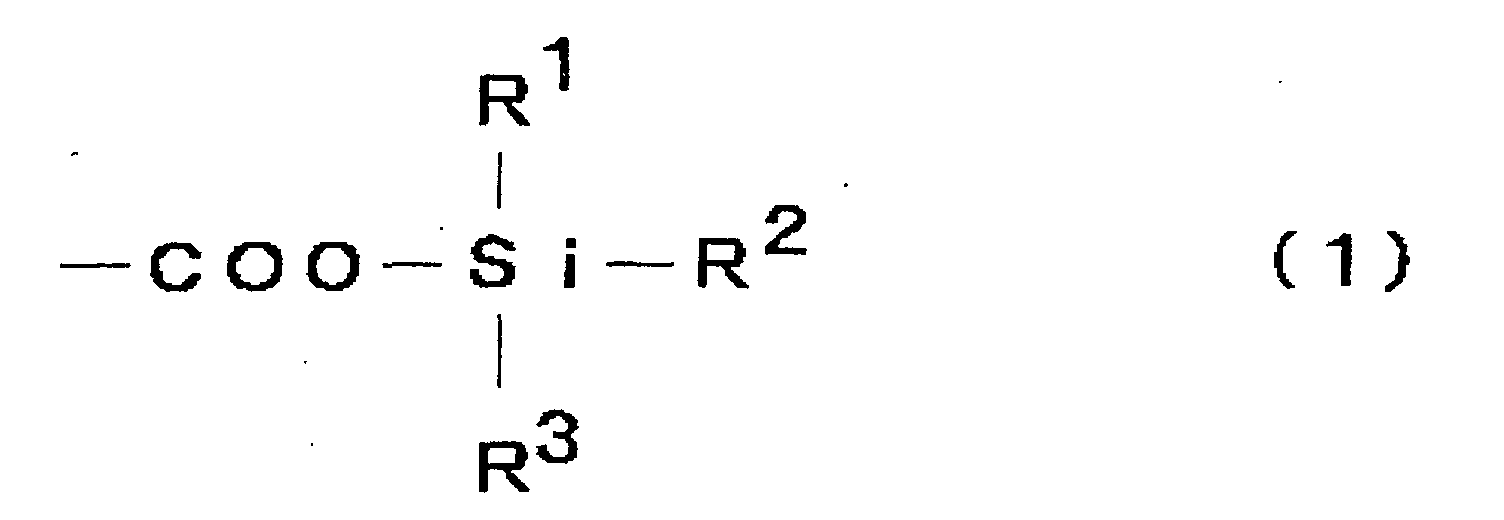
- That specific organosilyl-ester-group-containing polymer comprises: (A) an organosilyl-ester-group-containing polymer having at least one kind of an triorganosilyl ester group in each of the polymer molecules, where the triorganosilyl ester group is represented by the general formula (1): wherein in the formula (1), R 1 , R 2 and R 3 are groups each independently selected from the group consisting of the alkyl groups, cycloalkyl groups, aryl groups and aralkyl groups having a carbon number of 1 - 18 and are the same or different from each other with the proviso that the carbon number of at least one of the three groups R 1 , R 2 and R 3 is not less than 3.
- the antifouling paint involved in this invention can each comprise a single kind of the organosilyl-ester-group-containing polymer or two or more kinds of the organosilyl-ester-group-containing polymers.
- the triorganosilyl-ester-group-containing polymer to be used in this invention can be a polymer (hereinafter, denoted as Polymer A) of one or more kinds of organosilane monomer(s) (hereinafter, denoted as Monomer A) having an triorganosilyl ester group which is represented by the formula (1) and a copolymer (hereinafter, denoted as Copolymer AB) of one or more kinds of the above described Monomer A and one or more kinds of vinyl-typed monomer(s) (hereinafter, denoted as Monomer B) which can be copolymerized with the Monomer A.
- Polymer A polymer of one or more kinds of organosilane monomer(s) having an triorganosilyl ester group which is represented by the formula (1)
- a copolymer hereinafter, denoted as Copolymer AB
- Monomer B vinyl-typed monomer(s)
- the triorganosilyl-ester-group-containing polymer can comprise Polymer A and Copolymer AB at need.
- the alkyl group represented by R 1 , R 2 or R 3 in the formula (1) can be a linear, branched or cyclic alkyl group having a carbon number of 1 - 18.
- Some of typical examples of the alkyl group are methyl, ethyl, n-propyl, i-propyl, n-butyl, i-butyl, t-butyl, cyclohexyl, 2-ethylhexyl, lauryl and stearyl and the like.
- the aryl group represented by R 1 , R 2 or R 3 in the formula (1) can be an unsubstituted aryl group or any of the aryl groups substituted by one or more kinds of group(s), such as alkyl, alkoxy, halogen atom, etc. and some of typical examples of these aryl groups are phenyl, tolyl, xylyl, ethylphenyl, isopropylphenyl, methoxyphenyl, phenoxyphenyl, chlorophenyl and naphtyl and the like.
- the aralkyl group represented by R 1 , R 2 or R 3 in the formula (1) can be an unsubstituted aralkyl group or any of the aralkyl groups substituted by one or more kinds of group(s), such as alkyl, alkoxy, halogen atom, etc. and some of typical examples of the aralkyl groups are benzyl, 2-phenylethyl, 1-phenylethyl, methylbenzyl, phenoxybenzyl, chlorobenzyl and the like.
- the carbon number of at least one of the three groups R 1 , R 2 and R 3 is preferably not less than 3, more preferably 3-18.
- Examples of the Monomer A which are to be used in this invention can be (meth)acrylates, maleates, itaconates and fumarates and the like, where these unsaturated esters each having a triorganosilyl ester group represented by the formula (1).
- Each molecule of these (meth)acrylates, maleates, itaconates and fumarates may have one or two of the triorganosilyl ester group(s) represented by the formula (1).
- the other carboxyl group if any, has been esterified to form an ester group and in this case the alcohol residue in the latter ester group, if any, can be any of such alkyl groups, cycloalkyl groups, aryl groups aralkyl groups and the like, where each of these groups having a carbon number of 1 - 18, which are described as the examples of R 1 , R 2 or R 3 .
- the Monomer A can be (meth)acrylates, including tri-n-propylsilyl (meth)acrylate, tri-i-propylsilyl (meth)acrylate, tri-n-butylsilyl (meth)acrylate, tri-i-butylsilyl (meth)acrylate, tri-sec-butylsilyl (meth)acrylate, triphenylsilyl (meth)acrylate, tricyclohexylsilyl (meth)acrylate, tribenzylsilyl (meth)acrylate, tri-2-ethylhexylsilyl (meth)acrylate, di-i-propyl-n-butylsilyl (meth)acrylate, di-i-propyl-n-laurylsilyl (meth)acrylate, n-butyl-diphenylsilyl (meth)acrylate, t-butyl-diphenylsilyl (meth)acrylate,
- Monomer B to be copolymerized with Monomer A is any of monomers which do not belong to Monomer A and can be copolymerized with the Monomer A; and some of typical examples of the Monomer B are (meth)acrylates, including methyl (meth)acrylate, ethyl (meth)acrylate, n-butyl (meth)acrylate, i-butyl (meth)acrylate, t-butyl (meth)acrylate, 2-ethylhexyl (meth)acrylate, lauryl (meth)acrylate, stearyl (meth)acrylate, phenyl (meth)acrylate, benzyl (meth)acrylate, cyclohexyl (meth)acrylate, 2-hydroxyethyl (meth)acrylate, 4-hydroxybutyl (meth)acrylate, 2-methoxymethyl (meth)acrylate, 2-ethoxymethyl (meth)acrylate, 4-methoxybutyl (meth)acryl
- the organosilyl-ester-group-containing polymers to be used in this invention can each be obtained by polymerizing at least one kind of the above described Monomer A or by copolymerizing at least one kind of the above described Monomer A and at least one kind of the above described Monomer B.
- polymerization initiators For these polymerizations, conventionally known polymerization initiators can be used.
- the metal-caboxylate-group-containing polymer to be used in this invention has a metal carboxylate group which is represented by the general formula (2): -COO-M-X wherein in the formula, M is a metal selected from the group consisting of Cu, Zn, Ca and Mg, and X is an organic acid residue or a hydroxy group.
- Preferred metal in the metal carboxylate group represented by the formula (2) is Cu or Zn.
- the organic acid residue in the metal carboxylate group means a residue group formed by removing a hydrogen atom from an organic acid.
- Some of typical examples of the organic acid residues are aliphatic carboxyl acid residues, aromatic carboxyl acid residues, alicyclic carboxyl acid residues and the like and among them aliphatic carboxyl acid residues are preferred.
- the metal-carboxylate-group-containing polymer to be used in this invention can be a polymer (hereinafter, denoted as Polymer C) of one or more kinds of metal-carboxylate-group-containing monomer(s) (hereinafter, denoted as Monomer C) having a metal carboxylate group which is represented by the formula (2) or a copolymer (hereinafter, denoted as Copolymer CD) of one or more kinds of the above described Monomer C and one or more kinds of a vinyl-typed monomer (hereinafter, denoted as Monomer D) which can be copolymerized with Monomer C; or the like.
- Polymer C polymer of one or more kinds of metal-carboxylate-group-containing monomer(s) having a metal carboxylate group which is represented by the formula (2) or a copolymer (hereinafter, denoted as Copolymer CD) of one or more kinds of the above described Monomer C and one or more kinds of a vinyl-typed
- the metal-caboxylate-group-containing polymer in this invention may comprise Polymer C and Copolymer CD at need.
- Examples of the Monomer C which are to be used in this invention can be (meth)acrylates, maleates, itaconates and fumarates and the like, where these unsaturated esters each having a metal carboxylate group which is represented by the formula (2).
- Each molecule of these (meth)acrylates, maleates, itaconates and fumarates may have one or two of the metal carboxylate group represented by the formula (2).
- Some of typical examples of the Monomer C are zinc n-propionate (meth)acrylates, zinc octanoate (meth)acrylate, zinc versatate (meth)acrylate, zinc palmitate (meth)acrylate, zinc stearate (meth)acrylate, zinc oleate (meth)acrylate, zinc naphthenate (meth)acrylate, zinc benzoate (meth)acrylate, copper n-propionate (meth)acrylates, copper octanoate (meth)acrylate, copper versatate (meth)acrylate, copper palmitate (meth)acrylate, copper stearate (meth)acrylate, copper oleate (meth)acrylate, copper naphthenate (meth)acrylate, copper benzoate (meth)acrylate, calcium n-propionate (meth)acrylates, calcium octanoate (meth)acrylate, calcium naphthenate (meth)acrylate, magnesium octan
- Monomer D to be copolymerized with Monomer C is any of monomers which do not belong to Monomer C and can be copolymerized with Monomer C; and typical examples of Monomer D can be the same ones described as those of Monomer B.
- the metal-caboxylate-group-containing polymers to be used in this invention can each be obtained by polymerizing at least one kind of the above described Monomer C or by polymerizing at least one kind of the above described Monomer C and at least one kind of the above described Monomer D or by mixing Polymer C and Polymer CD.
- polymerization initiators For these polymerizations, conventionally known polymerization initiators can be used. A variety of polymerization techniques, such as bulk polymerization, solution polymerization, emulsion polymerization, etc. can be applied.
- the antifouling paint involved in this invention essentially comprises the above described organosilyl-ester-group-containing polymer(s) and the above described metal-carboxylate-group-containing polymer(s) and they can further contain conventionally known component(s) and/or reagent(s) which have been use in conventional paint.
- the totaled content of the organosilyl-ester-group-containing polymer(s) and the metal-carboxylate-group-containing polymer(s) in the antifouling paint can be usually in the range of 1- 80 weight %, preferably in the range of 5 - 30 weight % on the base of the whole amount of the paint itself.
- a variety kinds of conventional antifouling can be added to be contained in the antifouling paint of this invention as a known additive component(s) an/or reagent(s) at need. Since the antifouling paint of this invention contains the organosilyl-ester-group-containing polymer(s) and metal-caboxylate-group-containing polymer(s), when used as paint films in water, the attachments of organisms that inhabit in that water to the surface of the paint films can be prevented with the antifouling effect based on these polymers; however, it may be required, in some cases, that a further improvement in their antifouling activity by adding an antifolding or antifouling agent(s) to be contained in the antifouling paint of this invention.
- the antifolding or antifouling agents which can be used for such an improvement include a wide variety of conventionally known antifouling agents and they are roughly classified into inorganic compounds, metal-containing organic compounds and nonmetal organic compounds.
- the inorganic compounds which can be used as an antifolding or antifouling agent(s) are, for example, copper compounds, including cuprous oxide, copper powder, cuprous thiocyanate, copper carbonate, copper sulfate and the like; zinc sulfate, zinc oxide, nickel sulfate and nickel-copper alloys and the like.
- the metal-containing organic compounds which can be used as an antifouling agent(s) are, for example, copper-containing organic compounds, nickel-containing organic compounds, zinc-containing organic compounds and the like; and maneb, manseb, propineb.
- Some of typical examples of the copper-containing organic compounds are copper oxine complex salts, copper nonylphenolsulphonate, copper bis(ethylenediamine)-bis(dodecylbenzenesulfonate), copper acetate, copper naphthate, copper bis(pentachlorophenolate), copper pyrithione and the like.
- Some of typical examples of the nickel-containing organic compounds are nickel acetate, nickel dimethyldithiocarbamate and the like.
- Some of typical examples of the zinc-containing organic compounds are zinc acetate, zinc carbamate, zinc dimethyldithiocarbamate, zinc pyrithione, zinc ethylenebisthiocarbamate and the like.
- the nonmetal organic compounds which can be used as an antifoulding agent(s) are, for example, N-trihalomethylthiophthalimides, dithiocarbamic acids, N-arylmaleimides, 3-(substituted-amino)-1,3-thiazolidine-2,4-diones, dithiocyano compounds, triazines and so on.
- N-trihalomethylthiophthalimides are N-trichloromethylthiophthalimide, N-florodichrolomethylthiophthalimide and the like.
- dithiocarbamic acids are bis(dimethylthiocarbamoyl) disulfide, ammonium N-methyldithiocarbamate, ammonium ethylenebisdithiocarbamate, milneb and the like.
- N-arylmaleimides are N-(2,4,6-trichlorophenyl)maleimide, N-4-tolylmaleimide, N-3-chlorophenylmaleimide, N-(4-n-butylphenyl)maleimide, N-(anilinophenol)maleimide, N-(2,3-xylyl)maleimide and the like.
- 3-(substituted amino)-1,3-thiazolidine-2,4-diones are 3-benzylideneamino-1,3-thiazolidine-2,4-dione, 3-(4-methylbenzylideneamino)-1,3-thiazolidine-2,4-dione, 3-(2-hydroxybenzylideneamino)-1,3-thiazolidine-2,4-dione, 3-(4-dimethylbenzylideneamino)-1,3-thiazolidine-2,4-dione and the like.
- dithiocyano compounds are dithiocyanomethane, dithiocyanoethane and 2,5-dithiocyanothiophene and the like.
- triazines are 4-dimethylthio-4-t-butylamino-6-cyclopropylamino-s-triazine and the like.
- nonmetal organic compounds are 2,4,5,6-tetrachloroisophthalonitrile, N,N-dimethyl-N'-dichlorophenylurea, 4,5-dichloro-2-n-octyl-isothiazoline-3-one, N,N-dimethyl-N'-phenyl-(N-fluorodichloromethylthio)sulfamide, tetramethylthiuram sulfide, 3-iodo-2-propynylbutyl carbamate, 2-(methoxycarbonylamino)benzimidazole, 2,3,5,6-tetrachloro-4-(methylsulfonyl) pyridine, diiodomethylparatolyl sulfone, phenyl(bispyridine)bismuth dichloride, 2-(4-thiazolyl)benzimidazole, triphenylboronpyridine and the like.
- additives are for example, pigments, including red iron oxide, talc, titanium dioxide and the like; colorants, such as dyes, etc.; dehumidifiers; antisagging agent which have commonly been used in conventional paint; and plasticizers, including chlorinated paraffins, dioctylphthalates and tricresyl phosphates and the like; UV absorbers including benzophenones, benzotriazols and the like; antisettling agents, antiflooding agents, antiforming or antifoaming agents and a variety of other additives, including silanols, polysiloxanes, alkoxysilanes and the like; rosins or resins, including tall rosin, gum rosin, wood rosin and the like; rosin-derivatives, including hydrated rosins, maleic rosin
- the antifouling paint of this invention can be prepared by mixing the above described organosilyl-ester-group-containing polymer(s), the above described metal-carboxylate-group-containing polymer(s) and suitable components or agents which are added to be contained in the paint at need, according to known methods or processes by using known machines or machineries, instruments, appratuses and other measures.
- the antifouling paint films involved in this invention can be formed by applying the antifouling paint involved in this invention to the surfaces of immersion-typed structure(s) submerged in or into water or sea-water by using known procedures or techniques, followed by drying.
- the above described immersion-typed structures can be a wide variety of structures whose surfaces are partially or totally to be submerged in or in contact with water when used as such, including the hull plate(s) of a variety kinds of ships (including warships and the like), buoys and frames for excavations of natural resources, such as petroleum, natural gas, etc. and so on.
- the surfaces to which the antifouling paint of this invention is to be applied or on which the antifouling paint film(s) of this invention is to be formed are those which are to be submerged in or in contact with water.
- the structures of this invention which are to be used in or in contact with water include those prepared by forming to yield the antifouling paint film(s) of this invention on such surfaces of the hull plates of ships or immersion-typed structures that are to be submerged in or in contact with sea-water in use.
- the thickness of these antifouling paint films is not particularly restricted.
- the another feature of this invention involve methods for preventing a surface(s) of a submerged structure(s) from fouling characterized by applying the antifouling paint of this invention to the surface of an immersion-typed structure, the surface of which is to be submerged or immersed in or in contact with sea-water.
- a primer and the like Prior to the application of the antifouling paint of this invention to the surface, a primer and the like can be applied to that surface.
- a mixed solution containing 1.5g of t-butyl peroctanate and 15g of xylene was added by dropping over a period of time of 2h and then, after agitating the content in the flask for 2h, by adding 30g of xylene a solution of an organosilyl ester group/metal carboxylate group-containing copolymer (Varnish C-1) was obtained.
- the varnish thus obtained was a solution having a viscosity at 25 °C of 380cps, 50.1% of nonvolatile matter.
- a rotatable drum having a diameter of 318 mm a height of 440mm was mounted to a water bath and this drum rotated with a motor at need.
- a heating device and a cooling device were equipped so as to keep the temperature of sea-water in the bath constant and a pH controller was also equipped in order to maintain the pH of the sea-water at a constant value.
- test-plates having the respective paint films were fixed on the rotatable drum in such a way that the paint films could be in contact with the sea-water and this test-plate-fixed drum was rotated in the sea water at a rate of about 20 knots over long periods of time.
- the temperature of the sea-water was maintained at 25 °C and its pH value was kept at 8.0-8.2; and the used sea-water was replaced by fresh sea-water every one week.
- the thickness of the paint films on the respective test-plates was measured by using a microscope, the reductions in thichness of each paint film by its erosion were calculated by the difference between the film-thichness measured at the initial stage and at each time.
- the film-thichness were measured at three different points of each paint film for each time and the averaged value of the erosion amount of each paint film was calculated. The results are listed in Table 3, where the erosion amount of the paint films are expressed as the film-thichness reductions per month(unit: ⁇ /month).
- test-plates having the respective paint films were immersed in the sea-water, 1 m below the surface of the sea, off the coast of Owase city in Mie prefecture in Japan and the fouling of the surface of the paint film on each test-plate by the attachment of marine organisms were examined over the period of 36 months.
- the results are shown in Table 4. It was found that there were no attachments of seaweeds, barnacles, seruplas and so on to the surfaces of the test-plates coated with the each paint obtained in Examples 1-9, but the attachments of those sea organisms were observed for the test-plates prepared with the each paint obtained in Comparative Examples 1-4.
- Example 1 0 0 0 0 0 0 0
- Example 2 0 0 0 0 0
- Example 3 0 0 0 0 0 0 0
- Example 4 0 0 0 0 0 0 0
- Example 5 0 0 0 0 0 0
- Example 6 0 0 0 0 0 0
- Example 7 0 0 0 0 0 0 0
- Example 8 0 0 0 0 0 0 0
Landscapes
- Chemical & Material Sciences (AREA)
- Life Sciences & Earth Sciences (AREA)
- Engineering & Computer Science (AREA)
- Materials Engineering (AREA)
- Wood Science & Technology (AREA)
- Organic Chemistry (AREA)
- Paints Or Removers (AREA)
- Application Of Or Painting With Fluid Materials (AREA)
- Agricultural Chemicals And Associated Chemicals (AREA)
Abstract
Description
- (B) one or more kinds of metal-carboxylate-group-containing polymers having at least
one kind of a metal carboxylate group in each of the polymer molecules, wherein the
metal carboxylate group is represented by the general formula (2):
in another preferred embodiment of the antifouling paint of this invention, the metal-carboxylate-group-containing polymer is at least one kind of a polymer selected from the group consisting of metal (meth)acrylate-copolymers, metal maleate-copolymers and metal fumarate-copolymers, where these copolymers having one or more kinds of the metal carboxylate group described above;
also this invention involves:
(A) an organosilyl-ester-group-containing polymer having at least one kind of an triorganosilyl ester group in each of the polymer molecules, where the triorganosilyl ester group is represented by the general formula (1):

| Component | Example | Comparative Example | |||||||||||||
| 1 | 2 | 3 | 4 | 5 | 6 | 7 | 8 | 9 | 1 | 2 | 3 | 4 | 5 | ||
| Polymer Solution | A-1 | 25 | 20 | 15 | 40 | 35 | |||||||||
| A-2 | 25 | 20 | 15 | 10 | 35 | ||||||||||
| A-3 | 20 | 10 | 35 | ||||||||||||
| B-1 | 10 | 15 | 20 | 5 | 35 | ||||||||||
| B-2 | 10 | 15 | 15 | 15 | |||||||||||
| C-1 | 35 | ||||||||||||||
| Pigment | (a) | 40 | 40 | 40 | 35 | 35 | 35 | 35 | 35 | 35 | 35 | 35 | 40 | 40 | |
| (b) | 5 | 5 | 5 | 5 | 5 | 5 | 5 | ||||||||
| (c) | 2 | 2 | 2 | 2 | 2 | 2 | 2 | 2 | 5 | 2 | 2 | 2 | 2 | 2 | |
| (d) | 2 | 2 | 2 | 2 | 2 | 2 | 2 | 2 | 2 | 2 | 2 | 2 | 2 | ||
| (e) | 3 | 3 | 3 | 3 | 3 | 3 | 3 | 3 | 5 | 3 | 3 | 3 | 3 | 3 |
| Component | Example | Comparative Example | |||||||||||||
| 1 | 2 | 3 | 4 | 5 | 6 | 7 | 8 | 9 | 1 | 2 | 3 | 4 | 5 | ||
| Other Resins | (f) | 2 | |||||||||||||
| (g) | 2 | ||||||||||||||
| (h) | 2 | ||||||||||||||
| Plasticizers | (i) | 1 | 1 | 1 | 1 | 1 | 1 | ||||||||
| (j) | 1 | 1 | 1 | ||||||||||||
| (k) | 1 | 1 | 1 | 1 | |||||||||||
| Organic Reagents | (l) | 3 | 3 | 3 | |||||||||||
| (m) | 3 | 3 | 3 | ||||||||||||
| (n) | 3 | 3 | 3 | 3 | |||||||||||
| (o) | 3 | 3 | 3 | ||||||||||||
| (p) | 15 | ||||||||||||||
| Dispersant | (q) | 1 | 1 | 1 | 1 | 1 | 1 | 1 | 1 | 1 | 1 | 1 | 1 | 1 | 1 |
| Solvents | (r) | 13 | 13 | 13 | 13 | 13 | 10 | 10 | 10 | 24 | 13 | 13 | 5 | 5 | 5 |
| (s) | 6 | 6 | 6 | 8 | 8 | 8 |
| Amount of erosion of paint flm(µ/month) | note | ||||||
| After a month | After 3 months | After 6 months | After 12 months | After 18 months | After 24 months | ||
| Example 1 | 3.5 | 3.8 | 4 | 4.5 | 4.8 | 4.8 | |
| Example 2 | 5.1 | 5 | 5.3 | 4.9 | 4.7 | 4.5 | |
| Example 3 | 5.8 | 5.8 | 4.9 | 4.3 | 3.9 | 3.7 | |
| Example 4 | 6 | 5.5 | 5.3 | 4.4 | 3.8 | 3.2 | |
| Example 5 | 4.5 | 4.6 | 4.8 | 4.4 | 4.3 | 4.5 | |
| Example 6 | 8.2 | 8.5 | 7.5 | 6.8 | 6.2 | 6 | |
| Example 7 | 7.6 | 7.3 | 7.4 | 7.1 | 6.5 | 6.3 | |
| Example 8 | 5.7 | 6.2 | 6 | 5.5 | 5.8 | 5.4 | |
| Example 9 | 6.6 | 6.3 | 6.4 | 6.4 | 6.6 | 6.6 | |
| Comparative Example 1 | 1.1 | 1 | 1.3 | 1.9 | 2.2 | 2.5 | |
| Comparative Example 2 | 0.2 | 0.3 | 0.3 | 0.5 | 0.8 | 1 | |
| Comparative Example 3 | 25.3 | 14.5 | 10.1 | 2.1 | 1.1 | 0.9 | |
| Comparative Example 4 | 17.1 | 12.3 | 7.4 | 6.4 | 5.8 | 5.1 | Crack occurres in a paint film after 12 months |
| Comparative Example 5 | ― | ― | ― | ― | ― | ― |
| Antifouling Effect | ||||||
| After 3 months | After 6 months | After 9 months | After 12 months | After 18 months | After 24 months | |
| Example 1 | 0 | 0 | 0 | 0 | 0 | 0 |
| Example 2 | 0 | 0 | 0 | 0 | 0 | 0 |
| Example 3 | 0 | 0 | 0 | 0 | 0 | 0 |
| Example 4 | 0 | 0 | 0 | 0 | 0 | 0 |
| Example 5 | 0 | 0 | 0 | 0 | 0 | 0 |
| Example 6 | 0 | 0 | 0 | 0 | 0 | 0 |
| Example 7 | 0 | 0 | 0 | 0 | 0 | 0 |
| Example 8 | 0 | 0 | 0 | 0 | 0 | 0 |
| Example 9 | 0 | 0 | 0 | 0 | 0 | 0 |
| Comparative Example 1 | 0 | 10 | 50 | 100 | 100 | 100 |
| Comparative Example 2 | 0 | 30 | 70 | 100 | 100 | 100 |
| Comparative Example 3 | 0 | 0 | 0 | 10 | 30 | 50 |
| Comparative Example 4 | 0 | 0 | 0 | 10 | 30 | 70 |
| Comparative Example 5 | ― | ― | ― | ― | ― | ― |
Claims (6)
- Antifouling paint which comprises:and(A) one or more kinds of organosilyl-ester-group-containing polymers having at least one kind of an organosilyl ester group in each of the polymer molecules, where the triorganosilyl ester group is represented by the general formula (1):wherein in the formula (1) R1, R2 and R3 are groups each independently selected from the group consisting of the alkyl groups, cycloalkyl groups, aryl groups and aralkyl groups having a carbon number of 1- 18, and are the same or different from each other with the proviso that the carbon number of at least one of the three groups R1, R2 and R3 is not less than 3,
 (B) one or more kinds of metal-caboxylate-group-containing polymers having at least one kind of an metal carboxylate group in each of the polymer molecules, where the metal carboxylate group is represented by the general formula (2):
 - Antifouling paint as claimed in Claim 1, wherein the organosilyl-ester-group-containing polymer is at least one kind of a polymer selected from the group consisting of (meth)acrylate-copolymers, maleate-copolymers and fumarate-copolymers, where these copolymers having one or more kinds of the triorganosilyl ester groups.
- Antifouling paint as claimed in Claim 1, wherein the metal-carboxylate-group-containing polymer is at least one kind of a polymer selected from the group consisting of metal (meth)acrylate-copolymers, metal maleate-copolymers and metal fumarate-copolymers, where these copolymers having one or more kinds of the metal carboxylate groups.
- An antifouling paint film characterized in that the antifouling paint film is prepared by using the antifouling paint as claimed in Claim 1, Claim 2 or Claim 3.
- A submerged structure in or in contact with water, characterized in that the surface of the hull of a ship, where the surface is to be submerged in or in contact with sea-water in use or the surface of a structure, where the surface is to be submerged in or in contact with water, is the antifouling paint film as claimed in Claim 4.
- A method for preventing from fouling, characterized in that the method comprises the step of applying the antifouling paint as claimed in Claim 1, Claim 2 or Claim 3 to the surface of the hull of a ship, which is to be submerged in or in contact with sea-water when used as such or to the surface of a structure(s), to form an antifouling paint film on their surface.
Applications Claiming Priority (3)
| Application Number | Priority Date | Filing Date | Title |
|---|---|---|---|
| JP2000123277 | 2000-04-24 | ||
| JP2000123277 | 2000-04-24 | ||
| PCT/JP2001/003516 WO2001081489A1 (en) | 2000-04-24 | 2001-04-24 | Antifouling coating material, antifouling coating film, submerged structure, and antifouling method |
Publications (3)
| Publication Number | Publication Date |
|---|---|
| EP1277816A1 true EP1277816A1 (en) | 2003-01-22 |
| EP1277816A4 EP1277816A4 (en) | 2004-06-09 |
| EP1277816B1 EP1277816B1 (en) | 2006-11-08 |
Family
ID=18633606
Family Applications (1)
| Application Number | Title | Priority Date | Filing Date |
|---|---|---|---|
| EP01923976A Expired - Lifetime EP1277816B1 (en) | 2000-04-24 | 2001-04-24 | Antifouling coating material, antifouling coating film, submerged structure, and antifouling method |
Country Status (13)
| Country | Link |
|---|---|
| US (1) | US20030158292A1 (en) |
| EP (1) | EP1277816B1 (en) |
| JP (1) | JP3914437B2 (en) |
| KR (1) | KR20030025916A (en) |
| CN (1) | CN1205292C (en) |
| AT (1) | ATE344829T1 (en) |
| CY (1) | CY1105959T1 (en) |
| DE (1) | DE60124386T2 (en) |
| DK (1) | DK1277816T3 (en) |
| HK (1) | HK1054243B (en) |
| NO (1) | NO326909B1 (en) |
| TW (1) | TWI298345B (en) |
| WO (1) | WO2001081489A1 (en) |
Cited By (4)
| Publication number | Priority date | Publication date | Assignee | Title |
|---|---|---|---|---|
| EP1760497A3 (en) * | 2005-09-02 | 2009-08-26 | Hitachi, Ltd. | Optical part and projection type display apparatus using same |
| EP1978065A4 (en) * | 2005-12-28 | 2010-08-04 | Chugoku Marine Paints | HIGH-COLOR ANTITHEAT COATING COMPOSITION, COATING FILM, BASE COMPRISING COATING FILM, ANTI-STATE BASE, METHOD OF FORMING COATING FILM ON BASE SURFACE, METHOD OF PREVENTING STAINS ON A BASE, AND ASSEMBLY MULTITOCK COATING COMPOSITIONS |
| EP2348077A1 (en) | 2010-01-26 | 2011-07-27 | Jotun A/S | Antifouling composition |
| US11279835B2 (en) | 2016-11-11 | 2022-03-22 | Hempel A/S | Antifouling coating composition comprising novel carbon-based hydrolysable polymers |
Families Citing this family (19)
| Publication number | Priority date | Publication date | Assignee | Title |
|---|---|---|---|---|
| JP4846093B2 (en) * | 2000-12-25 | 2011-12-28 | 三菱レイヨン株式会社 | Method for producing metal-containing copolymer |
| JP4064100B2 (en) * | 2001-12-13 | 2008-03-19 | 日東化成株式会社 | Anti-fouling composition for fishing nets, fishing nets coated with the anti-fouling composition for fishing nets, and anti-fouling method for fishing nets using the anti-fouling composition for fishing nets |
| NO328137B1 (en) * | 2001-12-26 | 2009-12-14 | Nippon Paint Co Ltd | Acrylic resin and anti-fouling coatings |
| JP3673233B2 (en) * | 2002-03-14 | 2005-07-20 | Basfコーティングスジャパン株式会社 | Top coating for automobile skin, coating method, and coating film |
| JP2004002819A (en) * | 2002-04-19 | 2004-01-08 | Nippon Paint Co Ltd | Antifouling paint |
| DK1695956T3 (en) * | 2003-11-27 | 2012-08-27 | Chugoku Marine Paints | Cyclic carboxylic acid compound and its use. |
| US20060000495A1 (en) * | 2004-07-01 | 2006-01-05 | Geoffrey Brown | Novel methods and compositions for remediating submerged deposits |
| JP2011026357A (en) * | 2007-11-21 | 2011-02-10 | Nitto Kasei Co Ltd | Contamination-proof coating composition, manufacturing method for the composition, contamination-proof coating film formed using the composition, coated article having the coating film on surface, and contamination-proofing treatment method for forming the coating film |
| JP5434913B2 (en) * | 2008-05-16 | 2014-03-05 | 旭硝子株式会社 | Polymerizable compound, photocurable composition, optical element and optical head device |
| CN107513300A (en) * | 2010-04-06 | 2017-12-26 | 三菱化学株式会社 | Antifouling coating composition, method for producing antifouling coating film, and antifouling coating film |
| JP4769331B1 (en) * | 2010-08-25 | 2011-09-07 | 日東化成株式会社 | Antifouling paint composition, copolymer for antifouling paint composition, and coated article having antifouling coating film formed on the surface using the composition |
| WO2017164283A1 (en) * | 2016-03-25 | 2017-09-28 | 中国塗料株式会社 | Antifouling coating composition, antifouling coating film, antifouling substrate and method for producing same |
| SG11202009384RA (en) * | 2018-04-12 | 2020-10-29 | Nitto Kasei Co Ltd | Antifouling coating composition |
| SG11202009375XA (en) * | 2018-04-12 | 2020-10-29 | Nitto Kasei Co Ltd | Antifouling coating composition |
| JP6624665B1 (en) * | 2018-04-18 | 2019-12-25 | 日東化成株式会社 | Copolymer for antifouling paint composition, antifouling paint composition containing the copolymer |
| EP3783074B1 (en) * | 2018-04-20 | 2022-08-10 | Nitto Kasei Co., Ltd. | Copolymer for antifouling coating composition and antifouling coating composition containing said copolymer |
| CN111169606A (en) * | 2020-01-02 | 2020-05-19 | 杭州友凯船艇有限公司 | Fiber cloth cover for solving marine adhesion and preparation scheme thereof |
| JP7686419B2 (en) * | 2020-03-26 | 2025-06-02 | 中国塗料株式会社 | Antifouling paint composition |
| CN119452053A (en) * | 2022-06-28 | 2025-02-14 | 日本油漆船舶涂料公司 | Coating composition and coating film |
Family Cites Families (22)
| Publication number | Priority date | Publication date | Assignee | Title |
|---|---|---|---|---|
| MX159906A (en) * | 1983-01-17 | 1989-09-29 | M & T Chemicals Inc | ACRYLIC COMPOSITION TO PROTECT MARINE SURFACES |
| US4593055A (en) * | 1983-01-17 | 1986-06-03 | M&T Chemicals Inc. | Erodible ship-bottom paints for control of marine fouling |
| JPS63215780A (en) * | 1987-03-04 | 1988-09-08 | Dainippon Ink & Chem Inc | Antifouling paint resin |
| GB8824003D0 (en) * | 1988-10-13 | 1988-11-23 | Int Paint Plc | Coating compositions |
| JP2790021B2 (en) * | 1993-09-30 | 1998-08-27 | 日本油脂株式会社 | Paint composition |
| TW319791B (en) * | 1994-11-21 | 1997-11-11 | Nippon Oil Co Ltd | |
| JP3396349B2 (en) * | 1994-11-21 | 2003-04-14 | 日本油脂ビーエーエスエフコーティングス株式会社 | Biofouling prevention coating composition |
| JP3701706B2 (en) * | 1995-02-08 | 2005-10-05 | 関西ペイント株式会社 | Antifouling resin composition and method for producing the same |
| MY115462A (en) * | 1995-06-01 | 2003-06-30 | Chugoku Marine Paints | Antifouling coating composition, coating film formed from said antifouling coating composition, antifouling method using said antifouling coating composition and hull or underwater structure coated with said coating film |
| JPH09286933A (en) * | 1996-02-21 | 1997-11-04 | Kansai Paint Co Ltd | Antifouling coating composition |
| JP3874486B2 (en) * | 1996-04-17 | 2007-01-31 | Basfコーティングスジャパン株式会社 | Paint composition |
| SG60054A1 (en) * | 1996-04-17 | 1999-02-22 | Nof Corp | Coating composition |
| JPH10219148A (en) * | 1997-02-12 | 1998-08-18 | Kansai Paint Co Ltd | Antifouling resin composition and its production |
| DK2009069T3 (en) * | 1997-05-20 | 2013-04-22 | Mitsubishi Rayon Co | Anti-fouling paint composition |
| PL200670B1 (en) * | 1998-12-28 | 2009-01-30 | Chugoku Marine Paints | Silylmethacrylate copolymers, methods of obtaining them, antifoulding painting compositions containing such copolymers, antifoulding films formed of such painting compositions, methods of preventing surface fouling using such painting compositions and und |
| JP2000248228A (en) * | 1998-12-28 | 2000-09-12 | Chugoku Marine Paints Ltd | Antifouling paint composition, antifouling coating film formed from this antifouling coating composition, antifouling method using the antifouling coating composition, and hull or underwater structure coated with the coating film |
| JP5072137B2 (en) * | 1998-12-28 | 2012-11-14 | 中国塗料株式会社 | Silyl (meth) acrylate copolymer and method for producing the same |
| JP5281218B2 (en) * | 1999-01-11 | 2013-09-04 | 中国塗料株式会社 | Antifouling coating composition, antifouling coating film formed from this antifouling coating composition, antifouling method using the antifouling coating composition, and hull or underwater structure coated with the coating |
| JP4722248B2 (en) * | 1999-05-13 | 2011-07-13 | 中国塗料株式会社 | Silyl (meth) acrylate copolymer and method for producing the same |
| JP4493771B2 (en) * | 1999-05-13 | 2010-06-30 | 中国塗料株式会社 | Antifouling coating composition, antifouling coating film formed from this antifouling coating composition, antifouling method using the antifouling coating composition, and hull or underwater structure coated with the coating |
| JP2001081147A (en) * | 1999-09-10 | 2001-03-27 | Chugoku Marine Paints Ltd | Silyl (meth) acrylate copolymer, antifouling coating composition containing the copolymer, antifouling coating film formed from the antifouling coating composition, and antifouling method using the antifouling coating composition And a hull or marine structure coated with the coating film |
| EP1167398B1 (en) * | 2000-06-28 | 2005-11-09 | Mitsubishi Rayon Co., Ltd. | Metal-containing monomer dissolved mixture, metal-containing resin and antifouling paint composition |
-
2001
- 2001-04-24 KR KR1020027014241A patent/KR20030025916A/en not_active Ceased
- 2001-04-24 CN CNB018082610A patent/CN1205292C/en not_active Expired - Lifetime
- 2001-04-24 WO PCT/JP2001/003516 patent/WO2001081489A1/en not_active Ceased
- 2001-04-24 EP EP01923976A patent/EP1277816B1/en not_active Expired - Lifetime
- 2001-04-24 US US10/258,448 patent/US20030158292A1/en not_active Abandoned
- 2001-04-24 TW TW090109753A patent/TWI298345B/zh not_active IP Right Cessation
- 2001-04-24 AT AT01923976T patent/ATE344829T1/en not_active IP Right Cessation
- 2001-04-24 HK HK03106450.7A patent/HK1054243B/en unknown
- 2001-04-24 DK DK01923976T patent/DK1277816T3/en active
- 2001-04-24 JP JP2001578566A patent/JP3914437B2/en not_active Expired - Lifetime
- 2001-04-24 DE DE60124386T patent/DE60124386T2/en not_active Expired - Lifetime
-
2002
- 2002-10-22 NO NO20025066A patent/NO326909B1/en not_active IP Right Cessation
-
2007
- 2007-01-29 CY CY20071100109T patent/CY1105959T1/en unknown
Cited By (6)
| Publication number | Priority date | Publication date | Assignee | Title |
|---|---|---|---|---|
| EP1760497A3 (en) * | 2005-09-02 | 2009-08-26 | Hitachi, Ltd. | Optical part and projection type display apparatus using same |
| US7616380B2 (en) | 2005-09-02 | 2009-11-10 | Hitachi, Ltd. | Optical part and projection type display apparatus using same |
| EP1978065A4 (en) * | 2005-12-28 | 2010-08-04 | Chugoku Marine Paints | HIGH-COLOR ANTITHEAT COATING COMPOSITION, COATING FILM, BASE COMPRISING COATING FILM, ANTI-STATE BASE, METHOD OF FORMING COATING FILM ON BASE SURFACE, METHOD OF PREVENTING STAINS ON A BASE, AND ASSEMBLY MULTITOCK COATING COMPOSITIONS |
| EP2348077A1 (en) | 2010-01-26 | 2011-07-27 | Jotun A/S | Antifouling composition |
| WO2011092143A1 (en) | 2010-01-26 | 2011-08-04 | Jotun A/S | Antifouling composition |
| US11279835B2 (en) | 2016-11-11 | 2022-03-22 | Hempel A/S | Antifouling coating composition comprising novel carbon-based hydrolysable polymers |
Also Published As
| Publication number | Publication date |
|---|---|
| CN1425050A (en) | 2003-06-18 |
| CN1205292C (en) | 2005-06-08 |
| US20030158292A1 (en) | 2003-08-21 |
| DE60124386D1 (en) | 2006-12-21 |
| NO20025066L (en) | 2002-12-16 |
| HK1054243A1 (en) | 2003-11-21 |
| NO20025066D0 (en) | 2002-10-22 |
| ATE344829T1 (en) | 2006-11-15 |
| HK1054243B (en) | 2005-09-23 |
| DE60124386T2 (en) | 2007-10-04 |
| CY1105959T1 (en) | 2011-04-06 |
| WO2001081489A1 (en) | 2001-11-01 |
| NO326909B1 (en) | 2009-03-16 |
| KR20030025916A (en) | 2003-03-29 |
| TWI298345B (en) | 2008-07-01 |
| DK1277816T3 (en) | 2007-02-19 |
| EP1277816B1 (en) | 2006-11-08 |
| EP1277816A4 (en) | 2004-06-09 |
| JP3914437B2 (en) | 2007-05-16 |
Similar Documents
| Publication | Publication Date | Title |
|---|---|---|
| EP1277816B1 (en) | Antifouling coating material, antifouling coating film, submerged structure, and antifouling method | |
| KR100709047B1 (en) | A process for preparing coating composition | |
| EP0646630B1 (en) | Antifouling coating composition | |
| KR100592438B1 (en) | Antifouling coating composition, antifouling coating film, antifouling method for coating surface of ship, underwater structure, fishing gear, fishing net using said antifouling coating composition | |
| JP4866741B2 (en) | Antifouling composition comprising a polymer having a salt group | |
| JPWO2001081489A1 (en) | Antifouling paint, antifouling coating film, water-submerged structure, and antifouling method | |
| KR101003602B1 (en) | Antifouling paint composition | |
| HK1000323B (en) | Antifouling coating composition | |
| JP6638958B2 (en) | Antifouling coating composition, antifouling coating film, substrate with antifouling coating film, method for producing the same, and antifouling method | |
| JP4786053B2 (en) | Antifouling paint composition, antifouling coating, substrate coated with the coating, antifouling method | |
| EP0608132B1 (en) | Coating varnish composition and antifouling coating composition | |
| JP2003119420A (en) | Antifouling paint composition and painted object | |
| JP2001226440A (en) | Copolymer and coating composition | |
| EP1127902A1 (en) | Metal-free binders for self-polishing anti-fouling paints | |
| JPH11116857A (en) | Coating materiel composition | |
| JPH11116858A (en) | Coating material composition | |
| JP4154344B2 (en) | Coating composition and copolymer | |
| JP3396349B2 (en) | Biofouling prevention coating composition | |
| EP1675919A1 (en) | Self-polishing anti-fouling compositions | |
| EP1127925A1 (en) | Marine paint compositions | |
| JP2956263B2 (en) | Paint composition | |
| US6710117B2 (en) | Marine paint compositions | |
| JP2956262B2 (en) | Paint composition | |
| JPH1129725A (en) | Paint composition | |
| CN119654383B (en) | Antifouling coating composition |
Legal Events
| Date | Code | Title | Description |
|---|---|---|---|
| PUAI | Public reference made under article 153(3) epc to a published international application that has entered the european phase |
Free format text: ORIGINAL CODE: 0009012 |
|
| 17P | Request for examination filed |
Effective date: 20021024 |
|
| AK | Designated contracting states |
Kind code of ref document: A1 Designated state(s): AT BE CH CY DE DK ES FI FR GB GR IE IT LI LU MC NL PT SE TR |
|
| A4 | Supplementary search report drawn up and despatched |
Effective date: 20040423 |
|
| 17Q | First examination report despatched |
Effective date: 20050121 |
|
| RAP1 | Party data changed (applicant data changed or rights of an application transferred) |
Owner name: BASF COATINGS JAPAN LTD. Owner name: NITTO KASEI CO., LTD. |
|
| GRAP | Despatch of communication of intention to grant a patent |
Free format text: ORIGINAL CODE: EPIDOSNIGR1 |
|
| GRAS | Grant fee paid |
Free format text: ORIGINAL CODE: EPIDOSNIGR3 |
|
| GRAA | (expected) grant |
Free format text: ORIGINAL CODE: 0009210 |
|
| AK | Designated contracting states |
Kind code of ref document: B1 Designated state(s): AT BE CH CY DE DK ES FI FR GB GR IE IT LI LU MC NL PT SE TR |
|
| PG25 | Lapsed in a contracting state [announced via postgrant information from national office to epo] |
Ref country code: AT Free format text: LAPSE BECAUSE OF FAILURE TO SUBMIT A TRANSLATION OF THE DESCRIPTION OR TO PAY THE FEE WITHIN THE PRESCRIBED TIME-LIMIT Effective date: 20061108 Ref country code: LI Free format text: LAPSE BECAUSE OF FAILURE TO SUBMIT A TRANSLATION OF THE DESCRIPTION OR TO PAY THE FEE WITHIN THE PRESCRIBED TIME-LIMIT Effective date: 20061108 Ref country code: CH Free format text: LAPSE BECAUSE OF FAILURE TO SUBMIT A TRANSLATION OF THE DESCRIPTION OR TO PAY THE FEE WITHIN THE PRESCRIBED TIME-LIMIT Effective date: 20061108 |
|
| REG | Reference to a national code |
Ref country code: GB Ref legal event code: FG4D |
|
| REG | Reference to a national code |
Ref country code: CH Ref legal event code: EP |
|
| REG | Reference to a national code |
Ref country code: IE Ref legal event code: FG4D |
|
| REF | Corresponds to: |
Ref document number: 60124386 Country of ref document: DE Date of ref document: 20061221 Kind code of ref document: P |
|
| PG25 | Lapsed in a contracting state [announced via postgrant information from national office to epo] |
Ref country code: ES Free format text: LAPSE BECAUSE OF FAILURE TO SUBMIT A TRANSLATION OF THE DESCRIPTION OR TO PAY THE FEE WITHIN THE PRESCRIBED TIME-LIMIT Effective date: 20070219 |
|
| REG | Reference to a national code |
Ref country code: SE Ref legal event code: TRGR |
|
| REG | Reference to a national code |
Ref country code: GR Ref legal event code: EP Ref document number: 20070400410 Country of ref document: GR |
|
| PG25 | Lapsed in a contracting state [announced via postgrant information from national office to epo] |
Ref country code: PT Free format text: LAPSE BECAUSE OF FAILURE TO SUBMIT A TRANSLATION OF THE DESCRIPTION OR TO PAY THE FEE WITHIN THE PRESCRIBED TIME-LIMIT Effective date: 20070409 |
|
| REG | Reference to a national code |
Ref country code: CH Ref legal event code: PL |
|
| EN | Fr: translation not filed | ||
| PLBE | No opposition filed within time limit |
Free format text: ORIGINAL CODE: 0009261 |
|
| STAA | Information on the status of an ep patent application or granted ep patent |
Free format text: STATUS: NO OPPOSITION FILED WITHIN TIME LIMIT |
|
| 26N | No opposition filed |
Effective date: 20070809 |
|
| PG25 | Lapsed in a contracting state [announced via postgrant information from national office to epo] |
Ref country code: FR Free format text: LAPSE BECAUSE OF FAILURE TO SUBMIT A TRANSLATION OF THE DESCRIPTION OR TO PAY THE FEE WITHIN THE PRESCRIBED TIME-LIMIT Effective date: 20070622 |
|
| PG25 | Lapsed in a contracting state [announced via postgrant information from national office to epo] |
Ref country code: IE Free format text: LAPSE BECAUSE OF NON-PAYMENT OF DUE FEES Effective date: 20070424 |
|
| PG25 | Lapsed in a contracting state [announced via postgrant information from national office to epo] |
Ref country code: FR Free format text: LAPSE BECAUSE OF FAILURE TO SUBMIT A TRANSLATION OF THE DESCRIPTION OR TO PAY THE FEE WITHIN THE PRESCRIBED TIME-LIMIT Effective date: 20061108 |
|
| PG25 | Lapsed in a contracting state [announced via postgrant information from national office to epo] |
Ref country code: MC Free format text: LAPSE BECAUSE OF NON-PAYMENT OF DUE FEES Effective date: 20070430 |
|
| PG25 | Lapsed in a contracting state [announced via postgrant information from national office to epo] |
Ref country code: LU Free format text: LAPSE BECAUSE OF NON-PAYMENT OF DUE FEES Effective date: 20070424 |
|
| PG25 | Lapsed in a contracting state [announced via postgrant information from national office to epo] |
Ref country code: TR Free format text: LAPSE BECAUSE OF FAILURE TO SUBMIT A TRANSLATION OF THE DESCRIPTION OR TO PAY THE FEE WITHIN THE PRESCRIBED TIME-LIMIT Effective date: 20061108 |
|
| REG | Reference to a national code |
Ref country code: NL Ref legal event code: SD Effective date: 20110628 |
|
| REG | Reference to a national code |
Ref country code: DE Ref legal event code: R082 Ref document number: 60124386 Country of ref document: DE Representative=s name: , Effective date: 20110616 Ref country code: DE Ref legal event code: R081 Ref document number: 60124386 Country of ref document: DE Owner name: NKM COATINGS CO., LTD., JP Free format text: FORMER OWNER: NITTO KASEI CO. LTD., BASF COATINGS JAPAN LTD., , JP Effective date: 20110616 Ref country code: DE Ref legal event code: R081 Ref document number: 60124386 Country of ref document: DE Owner name: NITTO KASEI CO. LTD., JP Free format text: FORMER OWNER: NITTO KASEI CO. LTD., BASF COATINGS JAPAN LTD., , JP Effective date: 20110616 Ref country code: DE Ref legal event code: R081 Ref document number: 60124386 Country of ref document: DE Owner name: KANSAI PAINT MARINE CO.,LTD, JP Free format text: FORMER OWNERS: NITTO KASEI CO. LTD., OSAKA, JP; BASF COATINGS JAPAN LTD., YOKOHAMA, KANAGAWA, JP Effective date: 20110616 Ref country code: DE Ref legal event code: R082 Ref document number: 60124386 Country of ref document: DE Representative=s name: LEONHARD & PARTNER PATENTANWAELTE, DE Effective date: 20110616 Ref country code: DE Ref legal event code: R081 Ref document number: 60124386 Country of ref document: DE Owner name: NKM COATINGS CO., LTD., JP Free format text: FORMER OWNERS: NITTO KASEI CO. LTD., OSAKA, JP; BASF COATINGS JAPAN LTD., YOKOHAMA, KANAGAWA, JP Effective date: 20110616 Ref country code: DE Ref legal event code: R081 Ref document number: 60124386 Country of ref document: DE Owner name: NITTO KASEI CO. LTD., JP Free format text: FORMER OWNERS: NITTO KASEI CO. LTD., OSAKA, JP; BASF COATINGS JAPAN LTD., YOKOHAMA, KANAGAWA, JP Effective date: 20110616 |
|
| REG | Reference to a national code |
Ref country code: GB Ref legal event code: 732E Free format text: REGISTERED BETWEEN 20110922 AND 20110928 |
|
| REG | Reference to a national code |
Ref country code: DE Ref legal event code: R082 Ref document number: 60124386 Country of ref document: DE Representative=s name: , Ref country code: DE Ref legal event code: R082 Ref document number: 60124386 Country of ref document: DE Representative=s name: LEONHARD & PARTNER PATENTANWAELTE, DE |
|
| REG | Reference to a national code |
Ref country code: DE Ref legal event code: R082 Ref document number: 60124386 Country of ref document: DE Representative=s name: LEONHARD & PARTNER PATENTANWAELTE, DE Ref country code: DE Ref legal event code: R081 Ref document number: 60124386 Country of ref document: DE Owner name: KANSAI PAINT MARINE CO.,LTD, JP Free format text: FORMER OWNERS: NITTO KASEI CO. LTD., OSAKA, JP; NKM COATINGS CO., LTD., TOKYO, JP Ref country code: DE Ref legal event code: R081 Ref document number: 60124386 Country of ref document: DE Owner name: NITTO KASEI CO. LTD., JP Free format text: FORMER OWNERS: NITTO KASEI CO. LTD., OSAKA, JP; NKM COATINGS CO., LTD., TOKYO, JP |
|
| REG | Reference to a national code |
Ref country code: NL Ref legal event code: HC Owner name: KANSAI PAINT MARINE CO., LTD.; JP Free format text: DETAILS ASSIGNMENT: CHANGE OF OWNER(S), CHANGE OF OWNER(S) NAME; FORMER OWNER NAME: NKM COATINGS CO., LTD. Effective date: 20170629 |
|
| PGFP | Annual fee paid to national office [announced via postgrant information from national office to epo] |
Ref country code: CY Payment date: 20200424 Year of fee payment: 20 Ref country code: GR Payment date: 20200414 Year of fee payment: 20 Ref country code: FI Payment date: 20200421 Year of fee payment: 20 Ref country code: DK Payment date: 20200422 Year of fee payment: 20 Ref country code: NL Payment date: 20200427 Year of fee payment: 20 Ref country code: DE Payment date: 20200420 Year of fee payment: 20 |
|
| PGFP | Annual fee paid to national office [announced via postgrant information from national office to epo] |
Ref country code: SE Payment date: 20200427 Year of fee payment: 20 Ref country code: GB Payment date: 20200427 Year of fee payment: 20 Ref country code: IT Payment date: 20200428 Year of fee payment: 20 Ref country code: BE Payment date: 20200427 Year of fee payment: 20 |
|
| REG | Reference to a national code |
Ref country code: DE Ref legal event code: R071 Ref document number: 60124386 Country of ref document: DE |
|
| REG | Reference to a national code |
Ref country code: DK Ref legal event code: EUP Expiry date: 20210424 |
|
| REG | Reference to a national code |
Ref country code: NL Ref legal event code: MK Effective date: 20210423 |
|
| REG | Reference to a national code |
Ref country code: GB Ref legal event code: PE20 Expiry date: 20210423 |
|
| REG | Reference to a national code |
Ref country code: BE Ref legal event code: MK Effective date: 20210424 Ref country code: FI Ref legal event code: MAE |
|
| REG | Reference to a national code |
Ref country code: SE Ref legal event code: EUG |
|
| PG25 | Lapsed in a contracting state [announced via postgrant information from national office to epo] |
Ref country code: GB Free format text: LAPSE BECAUSE OF EXPIRATION OF PROTECTION Effective date: 20210423 |