Technical Field
The present invention relates to sanitary ware such as washhand basins, wash
bowls, urinals, stools, toilet tanks, toilet strainers, and the like.
Background Art
Such sanitary ware as washhand basins, wash bowls, urinals, stools, toilet
tanks, toilet strainers, and the like are daily necessities, and are required to have such
a sufficient mechanical strength that even a very heavy person can use, while resting
the person's weight, some of these articles without anxiety. In addition, a good
quality of design is also required.
Furthermore, the above mentioned commodities are used in the portions of a
house where water is used, and hence these commodities are required to have
chemical stability.
Accordingly, from old times, glazed ceramic wares have been used as sanitary
ware, and particularly, glazed ironstone bodies and glazed vitrifiable bodies have
been generally used for sanitary ware which bodies can be fired at such temperatures
1100 to 1300°C that easily allow to acquire in a single firing the degree of freedom
in design based on the coloring and patterns brought forth by the glaze layer, and
which bodies can also display sufficient mechanical strengths.
As for the ironstone bodies and vitrifiable bodies, however, when these bodies
are fired to shrink to such an extent that a satisfactory mechanical strength is
displayed, the shrinkage when fired becomes large and the deformation when fired
also becomes great.
Accordingly, it is difficult to design accurately the dimension and shape of a
product after being subjected to firing, and hence there are restrictions on the degree
of freedom in giving design qualities and functionalities relying on shape.
In addition, depending on the shape of a product, the shrinkage and
deformation cause generation of cracks, unevenness in shape, and degradation in
dimensional accuracy, and hence sometimes become a source for lowering the
process yield.
Furthermore, molded bodies being large in volume, thereby the setting
efficiency gets worse, and the productivity cannot be said to be sufficiently
satisfactory.
Accordingly, the object of the present invention is to provide the sanitary
ware for which it is possible to accurately design the shape and dimension of a
product after being subjected to firing while maintaining the mechanical strength
required to sanitary ware, degradation of the process yield caused by shrinkage and
deformation scarcely occurs, and the setting efficiency and productivity are improved
as compared to the prior art.
Disclosure of the Invention
The present invention provides, for the purpose of solving the above
described problems, the sanitary ware, which is formed of a ceramic body with a
glaze layer formed on the desired portions of the body, characterized in that the body
is the one containing a crystal phase mainly composed of mullite and quartz, a glass
phase mainly composed of SiO2 and Al2O3, and a crystal phase comprising those
minerals selected according to need from cristobalite, andalusite, sillimanite, kyanite,
and corundum; the main components of the body are 50 to 65 wt% SiO2, 30 to 45
wt% Al2O3, 0.1 to 2 wt% alkali oxides, and 0.1 to 10 wt% divalent metal oxides, the
divalent metal oxide component containing at least the CaO component; and the CaO
component segregation portions where the CaO component is segregated are
dispersed in the body.
Since the CaO component segregation portions where the CaO component is
segregated are dispersed, it becomes possible to provide the sanitary ware for which
the firing shrinkage is sufficiently small while maintaining the mechanical strength
required to sanitary ware, so that it is possible to accurately design the shape and
dimension of a product after being subjected to firing; and the degradation of the
process yield caused by shrinkage and deformation scarcely occurs, and the setting
efficiency and productivity are satisfactory.
The reason for the above description can be interpreted as follows. Since the
CaO component segregation portions where the CaO component is segregated are
dispersed, the shrinkage caused by sintering of the liquid phase is suppressed in the
segregation portions, and hence the firing shrinkage is suppressed. Furthermore,
owing to the presence of the CaO component segregation portions which portions are
different in such mechanical properties as Young's modulus and the like, the crack
deflection effect takes place, and consequently the mechanical strength can take a
sufficient value.
In the preferred embodiments of the present invention, the above described
crystal phase is dispersed in the above described glass phase, and the composition
ratio of the glass phase to the body is smaller than 60 wt%.
By suppressing the glass phase ratio to be smaller than 60 wt%, the large
shrinkage following the liquid phase sintering is suppressed, and accordingly the
firing shrinkage can be suppressed to be 6% or below.
In the preferred embodiments of the present invention, the relationships
between the abundance ratios of Ca to Na, K, and Mg (in weight ratios) in the CaO
component segregation portion are made to satisfy all the relations, Ca>Na, Ca>K,
and Ca>Mg.
Accordingly, the components in the CaO component segregation portion are
largely different from the components in the glass phase, so that the effect due to the
dispersion of the CaO component segregation portions is accentuated.
In the preferred embodiments of the present invention, the content of the CaO
component in the body is made to be 1 wt% or above.
By making the content of the CaO component to be 1 wt% or above, an
excellent ratio of the bulk specific gravity to the strength can be obtained. This is
interpreted to be ascribable to the observation that when the CaO component is
abundant, the shrinkage in the glass phase following the liquid phase sintering is
suppressed to be small.
In the preferred embodiments of the present invention, the relationships
between the CaO component and the other divalent metal oxide components in the
above described body are made to satisfy the condition that in relation to 100 parts
by weight of CaO, the other divalent metal oxides are 50 parts by weight or below.
Consequently, an excellent ratio of the bulk specific gravity to the strength
can be obtained. This is interpreted to be ascribable to the observation that when
the CaO component is abundant, the shrinkage in the glass phase following the liquid
phase sintering is suppressed to be small.
In the preferred embodiments of the present invention, the content of quartz in
the body is made to be 20 wt% or below.
Consequently, it becomes possible to suppress the excessive increase in the
thermal expansion coefficient of the body, and hence the cracks are scarcely caused
to occur in such products large in size and complex in structure as sanitary ware
during the temperature decrease process in firing.
In the preferred embodiments of the present invention, when corundum is
contained in the body, the content of corundum is made to be 20 wt% or below.
Since corundum has a high Young's modulus, by uniformly dispersing
corundum, a large effect of improving the strength can be obtained.
When corundum is contained in the body, it is preferable to make the
corundum content be 20 wt% or below. The specific gravity of corundum is larger
than the other minerals and glass phase, and hence when the body contains more than
20 wt% of corundum, the specific gravity of the body becomes heavy, resulting in an
increase in cost when processing the bodies.
The present invention provides the sanitary ware which can be produced by
the method comprising the process for molding the body raw material, the process
for applying glaze, according to need, onto the desired portions, and the process for
firing at the temperatures 1100 to 1300°C, and which are characterized in that the
body raw material contains a clay mineral, quartz, a raw material containing alkali
metals, and a raw material containing divalent metals; the clay mineral is a mineral
which contains at least one mineral selected from kaolinite, dickite, halloysite,
sericite, and pyrophyllite; the raw material containing divalent metals contains at
least one mineral of wallastonite, limestone, and anorthite; the content of quartz is 30
wt% or below in relation to the body raw material; the content of the clay mineral
material is 30 to 90 wt% in relation to the body raw material; and the body raw
material is controlled in size so that the average grain size based on a laser diffraction
grain size analyzer is 3 to 10 µm.
The use of at least one of wallastonite, limestone, and anorthite as a body raw
material for use in introducing CaO, makes the CaO component segregation portions
tend to be easily formed in a fired body, since in these materials the CaO component
does not form solid solutions or compounds with such components as MgO, Na2O,
K2O, and the like.
Accordingly, it becomes possible to provide the sanitary ware for which it is
possible to accurately design the shape and dimension of a product after being
subjected to firing while maintaining the mechanical strength required to sanitary
ware with firing shrinkage sufficiently small, degradation of the process yield caused
by shrinkage and deformation scarcely occurs, and the setting efficiency and
productivity are improved as compared to the prior art.
The present invention provides the sanitary ware which can be produced by
the method comprising the process for molding the body raw material, the process
for applying glaze, according to need, onto the desired portions, and the process for
firing at the temperatures 1100 to 1300°C, and which are characterized in that the
body raw material contains a clay mineral, quartz, a raw material containing alkali
metal oxides, a raw material containing divalent metal oxides, and a raw material
small in ignition loss; the clay mineral is a mineral which contains at least one
mineral selected from kaolinite, dickite, halloysite, sericite, and pyrophyllite; the
content of quartz is 30 wt% or below in relation to the body raw material; the content
of the clay mineral is 30 to 90 wt% in relation to the body raw material; the content
of the raw material small in ignition loss is 5 to 50 wt% in relation to the body raw
material; and the body raw material is controlled in size so that the average grain size
based on a laser diffraction grain size analyzer is 3 to 10 µm.
The inclusion of the raw material small in ignition loss serves to reduce the
firing shrinkage based on the ignition loss.
In the preferred embodiments of the present invention, the raw material
containing divalent metals is made to contain at least one mineral of wallastonite,
limestone, and anorthite.
The firing shrinkage is further reduced to yield an excellent strength through
the multiplier effect between the effect of the use of a raw material small in ignition
loss and the effect of the use of at least one mineral of wallastonite, limestone, and
anorthite as a body raw material for use in introducing CaO.
In the preferred embodiments of the present invention, the raw material small
in ignition loss is chamotte, and the main components of chamotte are each at least
one mineral selected from mullite, cristobalite, quartz, and corundum, and the
content of CaO in chamotte is set to be 1 wt% or above.
Through using a crystalline chamotte having the content of CaO of 1 wt% or
above, the mechanical strength is improved by the crack deflection action, and the
firing shrinkage rate becomes able to be reduced owing to the reduction in the
content ratio of the glass phase.
In the preferred embodiments of the present invention, the raw material small
in ignition loss is a hollow glass in which SiO2 and Al2O3 are the main components.
Accordingly, the pores in a hollow glass remain as closed pores in a body, and
hence a body can be obtained which has a small bulk density for its strength.
In the preferred embodiments of the present invention, the raw material small
in ignition loss is the one selected from shirasu-balloon, expanded perlite, and
expanded shale.
Accordingly, the pores in the hollow glass remain as enclosed pores in a body,
and hence a body can be obtained which is small in bulk density for its strength.
In the preferred embodiments of the present invention, the bulk density (Db)
of the above described body is 1.6 to 2.1 g/cm3, and the relationship between the
bulk density and the bending strength (Sb) of the body is made to be such that Sb >
60 × Db- 60 (MPa).
Consequently, the balance between the weight reduction and the mechanical
strength can be maintained in a practical level for sanitary ware.
The present invention provides the sanitary ware which is made of a ceramic
body and a glaze layer formed on the desired portions thereof, and can be produced
by the method comprising the process for molding the body raw material, the process
for applying glaze, according to need, onto the desired portions, and the process for
firing at the temperatures 1100 to 1300°C, and which is characterized in that the
firing shrinkage rate along the lengthwise direction in the firing process is 6% or
below; the softening deformation of the body in the firing process is 10 mm or
below; the bulk density (Db) of the body is 1.6 to 2.1 g/cm3; and the relationship
between the bulk density and the bending strength (Sb) of the body is such that Sb >
60 × Db - 60 (MPa).
Consequently, the balance between the weight reduction and the mechanical
strength and a degree of freedom in design can be maintained in a practical level for
sanitary ware.
In the preferred embodiments of the present invention, the glaze layer is
formed with such a glaze that gives a glaze layer smaller by 0 to 30 × 10-7/°C in
thermal expansion coefficient than the body.
By forming a glaze layer on the surface of a body, which layer is smaller by 0
to 30 × 10-7/°C in thermal expansion coefficient than the body, the minute cracks due
to aging on the surface of the glaze layer get to scarcely occur.
In the preferred embodiments of the present invention, the glaze layer of a
transparent glaze is formed on the surface of the ceramic body.
Accordingly, the surface design quality is improved and adhesion of dirt onto
the surface of the glaze layer is impeded, improving the resistance to dirt adhesion.
In the preferred embodiments of the present invention, a glaze layer of a
coloring glaze is formed on the surface of the ceramic body, and furthermore, a
surface glaze layer of a transparent glaze is formed thereon.
Consequently, the quality of surface design is improved, and adhesion of dirt
onto the surface of the glaze layer is impeded, improving the resistance to dirt
adhesion. In addition, the minute cracks due to aging on the surface of the glaze
layer get to scarcely occur.
In the preferred embodiments of the present invention, engobe is formed on
the surface of the ceramic body, and a glaze layer of the coloring glaze is formed
thereon.
Consequently, the minute cracks due to aging on the surface of the glaze layer
become to scarcely occur.
In the preferred embodiments of the present invention, engobe is formed on
the surface of the ceramic body, and a glaze layer of the transparent glaze is formed
thereon.
Consequently, the surface design quality is improved, and adhesion of dirt
onto the surface of the glaze layer is impeded, improving the resistance to dirt
adhesion. In addition, the minute cracks on the surface of the glaze layer due to
aging get to scarcely occur.
In the preferred embodiments of the present invention, engobe is formed on
the surface of the ceramic body, and a glaze layer of the coloring glaze is formed
thereon, and furthermore, a glaze layer of the transparent glaze is formed thereon.
Consequently, the surface design quality is improved, adhesion of dirt onto
the surface of the glaze layer is impeded, improving the resistance to dirt adhesion.
In addition, the minute cracks on the surface of the glaze layer due to aging get to
scarcely occur.
In the preferred embodiments of the present invention, the surface roughness
Ra of the surface of the transparent glaze layer is made to be 100 nm or below, and
preferably 70 nm or below, and more preferably 40 nm or below, as measured with a
stylus-type surface roughness analyzer (JIS-B0651).
Consequently, adhesion of dirt onto the surface of the glaze layer is impeded,
improving the resistance to dirt adhesion. In addition, the minute cracks on the
surface of the glaze layer due to aging get to scarcely occur.
In the preferred embodiments of the present invention, the engobe formed
between the body surface and the coloring glaze layer is made to be a fine layer
smaller in porosity than the body.
Accordingly, the engobe gets to acquire the blocking function to prevent the
gas generated in the body from passing through the glaze layer to grow as pinholes,
and hence the poor exterior appearance such as speckles gets to be scarcely invited,
and simultaneously the flatness and smoothness of the glaze layer surface is
prevented from being deteriorated by the effect of the gas. In addition, the minute
cracks due to aging on the glaze layer surface get to scarcely occur.
In the preferred embodiments of the present invention, a powder raw material
having a 50% grain size (D50) of 6 µm or below is used as the raw material for
forming the engobe.
Accordingly, the engobe gets to easily form a fine layer smaller in porosity
than the body layer, and to easily acquire the function to block the gas generated
from the body.
In the preferred embodiments of the present invention, the raw material for
use in forming the engobe has the composition of 30 to 50 wt% pottery stone, 30 to
50 wt% clay, and 10 to 30 wt % flux.
Consequently, the engobe tends to easily have a properly vitrified state and a
properly sintered state, and gets to acquire stably the function to block the gas from
the body.
In the preferred embodiments of the present invention, the thermal expansion
coefficient of the body is 50 to 90 × 10-7 (/°C) (50 to 600°C).
By making the thermal expansion coefficient to be 90 × 10-7 (/°C) or below,
cracking gets to scarcely occur in such products large in size and complex in
structure as sanitary ware during the temperature decrease process in firing.
In addition, by making the thermal expansion coefficient to be 50 × 10-7 (/°C)
or above, it becomes possible to acquire a degree of freedom in designing glaze layer
under the condition that cracking and the like scarcely occur.
In the preferred embodiments of the present invention, the molding method
adopted is the slip casting method.
Accordingly, large-sized and complex sanitary ware can be easily produced at
a low cost.
Brief Description of the Drawings
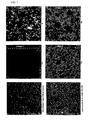
Figure 1 shows the SEM images of the section of the body No. 1-4 (a
comparative example) and the distribution states of Ca, Mg, Na, and K in the section
observed by EPMA;
Figure 2 shows the SEM images of the section of the body No. 1-5 (one
embodiment of the present invention) and the distribution states of Ca, Mg, Na, and
K in the section observed by EPMA;
Figure 3 shows the X-ray diffraction chart of the body No. 1-5 (one
embodiment of the present invention);
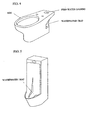
Figure 4 shows a schematic view of a stool produced as a prototype in one
embodiment of the present invention;
Figure 5 shows a schematic view of a stall urinal produced as a prototype in
one embodiment of the present invention;
Figure 6 shows a schematic view of a counter-integrated wash bowl produced
as a prototype in one embodiment of the present invention; and
Figure 7 shows a schematic view of a wash bowl produced as a prototype in
one embodiment of the present invention.
Best Mode for Carrying out the Invention
At the beginning, description will be made below on the main technical terms
used in the present invention.
Crystal phase:
In the present invention, the crystal phase means a portion which is a
particular mineral and has a regular diffraction pattern in X-ray analysis. The
content of a crystal phase is determined with the internal standard method from the
calibration curves obtained for the individual crystal phases on the basis of the
respective standard substances, and is given in weight ratios.
Glass phase:
In the present invention, the glass phase means the portion other than the
crystal portion which does not show any regular pattern in X-ray analysis.
Ratio of the glass phase in a body:
In the present invention, the ratio of the glass in a body is defined as the
weight ratio of the glass phase to the whole body, and specifically, refers to the
amount left by subtracting the crystal phase weight determined with X-ray analysis
from the weight of the whole body.
Body components:
Ceramic components include oxides and solid solutions of a plurality of
metallic species such as composite oxide crystals as represented by mullite and glass
phases, and these components are given in the weight ratios as determined on the
basis of the weights reduced to the individual single component metal oxides
determined by the fluorescent X-ray analysis method.
CaO component segregation portion:
On the basis of the results obtained by the element analysis with EPMA, a
portion which is higher in the concentration of Ca than the surrounding portions is
defined as a CaO component segregation portion. When each CaO segregation
portions is, for the concentrations of Mg, Na, and K, not largely different from or
rather lower than the surrounding portions on the basis of the element analysis with
EPMA, the states of the CaO segregation portions are preferable for decreasing the
firing shrinkage.
Dispersion of the CaO component segregation portions:
The term "dispersion" means a state where the regions concerned are not
concentrated in a particular location, but are present in a lot of locations. Through
being in such a state, the crack deflection effect becomes to be effectively displayed.
Bulk density of a body:
The bulk density of a body is measured by Archimedes' method. A test
piece (a piece of fired body) of 25 mm in width, 5 mm in thickness, and 20 mm in
length is dried at 105°C for 24 hours, and subsequently cooled to room temperature
in such a environment that the test piece does not take up moisture, and then the mass
W1 is measured. Then, the test piece is allowed to stand in a vacuum for 1 hour to
release the air bubbles. Furthermore, in the same environment the test piece is kept
in water for 1 hour and then made to get back to room temperature. Then, the mass
of the test piece is measured while being hung freely in the water with a thin thread
to give the mass W2. Subsequently, the test piece is taken out of the water, and
immediately after the waterdrops on the surface thereof are wiped off quickly with a
piece of wet and wrung cloth, the mass thereof is measured to give the mass W3.
The bulk density is obtained from the density of water, W1, W2, and W3, on the
basis of the following equation:
Bulk density = (density of water) × W1/(W3 - W2)
Bending strength of a body:
The bending strength of a body is measured on a fired test piece of 13 × 130
mm, under the conditions that the span is 100 mm and the cross head speed is 2.5
mm/min, by use of the three-point bending method.
Firing shrinkage rate of a body:
A mark of 150 mm in length is inscribed on a green test piece of 30 mm in
width, 15 mm in thickness, and 260 mm in length. Then, the length variation in the
inscribed mark found after firing is divided by 150 mm to give the firing shrinkage
rate in percents.
Softening deformation of a body:
A green test piece of 30 mm in width, 15 mm in thickness, and 260 mm in
length is fired in a state of being supported with a span of 200 mm, and subsequently
the bending in the central portion of the test piece and the thickness of the test piece
are measured. Since the bending thus obtained is inversely proportional to the
square of the test piece thickness, the bending reduced to the thickness of 10 mm, on
the basis of the following equation, is defined as the softening deformation of the
body:
Softening deformation of body = measured bending value × (test piece
thickness after firing)2/102
Thermal expansion coefficient of a body:
For the measurement of the thermal expansion of a body, a fired test piece of
5 mm in diameter and 20 mm in length is used. The thermal expansion coefficient
is shown as the linear thermal expansion coefficient measured using a differential
expansion monitor on the basis of the compressive load method over the temperature
range 50 to 600°C.
The impact strength of a body:
The impact strength of a body is measured using a Charpy tester with a
sintered 13 × 130 mm test piece.
Thermal shock resistance of a body:
The thermal shock resistance of a body is represented as the maximum
temperature difference for which no cracks are formed when a test piece of width 25
× thickness 10 × length 110 mm is maintained at a prescribed temperature for 1 hour
and more then thrown into water to be cooled abruptly and examined as to whether
cracks are formed.
Now, description will be made below on an example of the production
method of sanitary ware of the present invention.
Body raw material:
For the starting raw material, the clay minerals and a raw material containing
Ca are indispensable components, and in addition, quartz, raw materials containing
alkali metals, and a raw material small in ignition loss may be added to the starting
material.
The above described raw materials are mixed together, and according to need,
pulverized using a ball mill or the like to obtain a body raw material.
The average grain size of the body raw material measured with a laser
diffraction grain size analyzer is preferably adjusted to be 3 to 10 µm.
When the casting method is used in a later process, the body raw material is
dispersed in water and used as a suspension. Dispersants, antiseptic agents,
adhesive pastes, antibacterial agents may be added to the suspension.
As the clay minerals, kaolinite, dickite, halloysite, sericite, and pyrophyllite
can be suitably used.
As the raw materials containing alkali metals, sericite, feldspar, and nepheline
can be suitably used.
As the raw materials containing Ca, limestone and wollastonite can be
suitably used.
As for contents of the individual raw materials, the clay mineral is used
preferably in 30 to 90 parts by weight, and the raw material containing Ca is used
preferably in 1 to 15 parts by weight. The raw material containing alkali metals can
be used within the range where the total amount of alkali metal oxides does not
exceed 2 wt% in relation to the whole body. In addition, when a quartz raw
material is used, the content thereof is preferably 30 parts by weight or below.
When a raw material small in ignition loss is used, it is preferably used within the
range from 5 to 50 parts by weight.
Production method:
The body raw material is molded by the casting method, demolded, dried, and
subsequently a glaze is applied onto the desired portions, and then fired.
Plaster molds, resin molds, and the like can be used as casting molds, and
pressurization, vacuum suction, mold suction, head pressure are all can be used as
the methods for application of pressure.
Drying can be performed, for example, at room temperature to a temperature
of the order of 110°C.
For application of glaze, there can be used such methods as wet spray, dry
spray, "other exemplified methods," and the like can be used.
For glaze, there can be used natural raw materials such as feldspar, quartz,
limestone, and the like, and amorphous raw materials and the like such as frit glaze
and the like to which materials pigments and emulsifiers are added. The glaze is
preferably smaller in thermal expansion coefficient than the body by 0 to 30 ×
10-7/°C.
The transparent glaze raw material means mixtures of natural grains of silica
sand, feldspar, limestone, and the like, and/or amorphous glazes such as frit glaze,
and the like, and the coloring glaze raw material means a raw material which is
prepared by adding emulsifiers and/or pigments to a transparent glaze raw material.
In one embodiment of glaze application, engobe is formed on the ceramic
body, the coloring glaze layer is formed thereover, and furthermore, a transparent
glaze layer is formed thereover.
As engobe, there can be suitably used such mixtures as composed of natural
interval grains of pottery stone, clay, feldspar, and the like.
In the coloring glaze layer, the main component is composed of amorphous
components, and in addition such crystalline components as emulsifier, pigments,
and the like are contained in small amounts. The amorphous components comprises
the tetravalent metal oxide components such as SiO2 and the like, the trivalent metal
oxide components such as Al2O3 and the like, the divalent metal oxides such as CaO,
MgO, ZnO, and the like, and the monovalent metal oxide components such as Na2O,
K2O, Li2O, and the like, and among these components, the MgO component is
contained in 2.5 to 4.4 wt% and the Al2O3 component is contained in 9.3 to 15.1 wt%.
The preferable contents of the other components are 55 to 80 wt% for SiO2, 8 to 17
wt% for CaO, 3 to 10 wt% for ZnO, 1 to 4 wt% for K2O, and 0.5 to 2.5 wt% for
Na2O.
In the transparent glaze layer, the main component is composed of amorphous
components, and in addition such crystalline components as emulsifier, pigments,
and the like are contained in small amounts. The amorphous components comprises
the tetravalent metal oxide components such as SiO2 and the like, the trivalent metal
oxide components such as Al2O3 and the like, the divalent metal oxides components
such as CaO, MgO, ZnO, and the like, and the monovalent metal oxide components
such as Na2O, K2O, Li2O, and the like, and among these components, the MgO
component is contained in 0 to 4.4 wt%. The preferable contents of the other
components are 55 to 80 wt% for SiO2, 7 to 17 wt% for CaO, 3 to 15 wt% for ZnO, 1
to 4 wt% for K2O, and 0.5 to 2.5 wt% for Na2O.
Incidentally, any of the following materials is preferably used as the raw
material for the transparent glaze, since the surface roughness thereby obtained easily
tends to be 100 nm or below.
The firing can be performed at the temperatures of 1100 to 1300°C. For the
purpose of firing, either of a continuous firing furnace and a batch furnace can be
used.
Embodiments
Description will be made below on the embodiments of the present invention
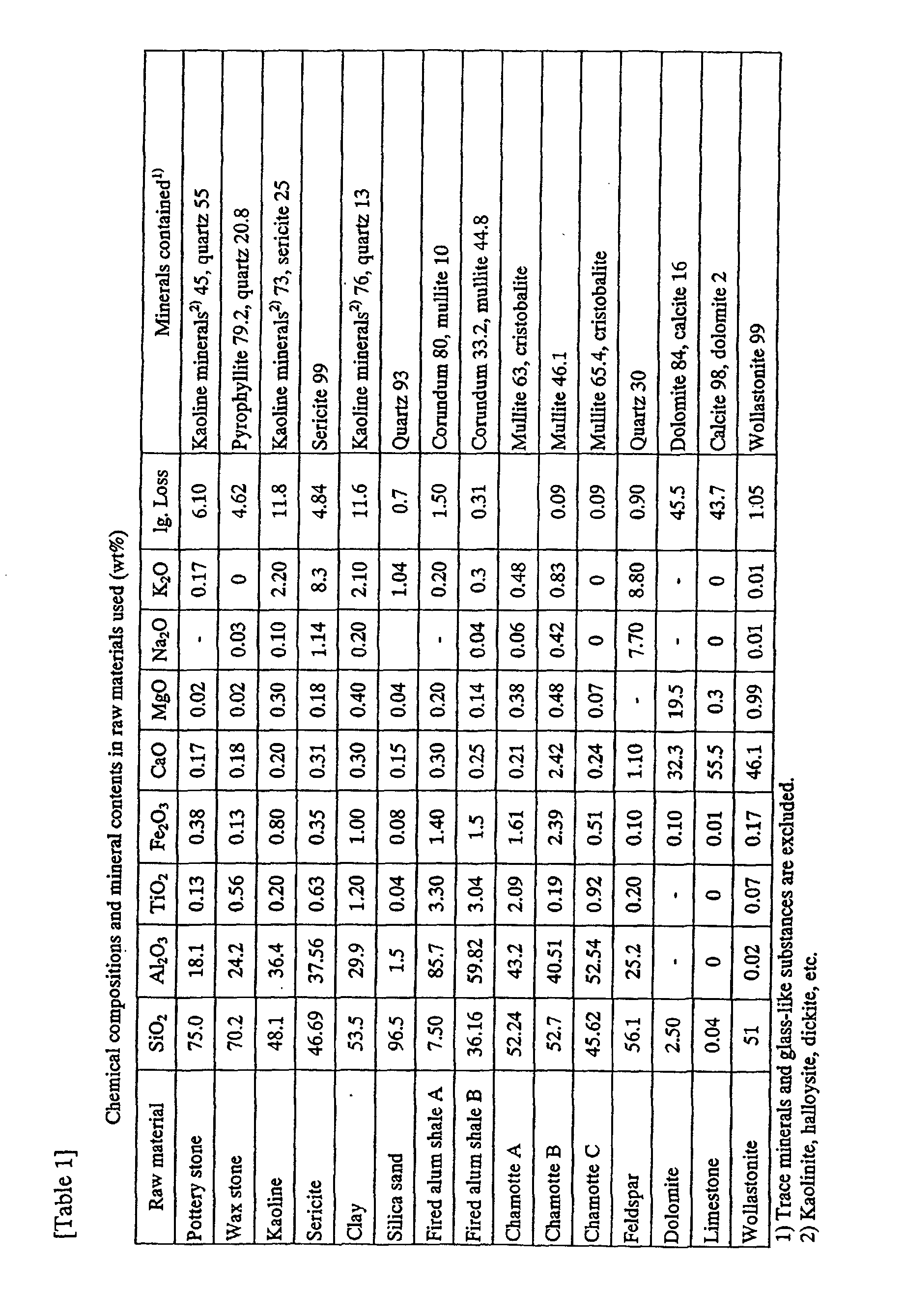
on the basis of the attached drawings. Table 1 shows the raw materials used in the
embodiments, and the chemical compositions and main minerals thereof. Tables 2
to 7 show the raw materials for the bodies associated with the comparative examples
and the present invention, the contents of the minerals contained in the raw materials,
the compositions and physical properties of the bodies, and the like.
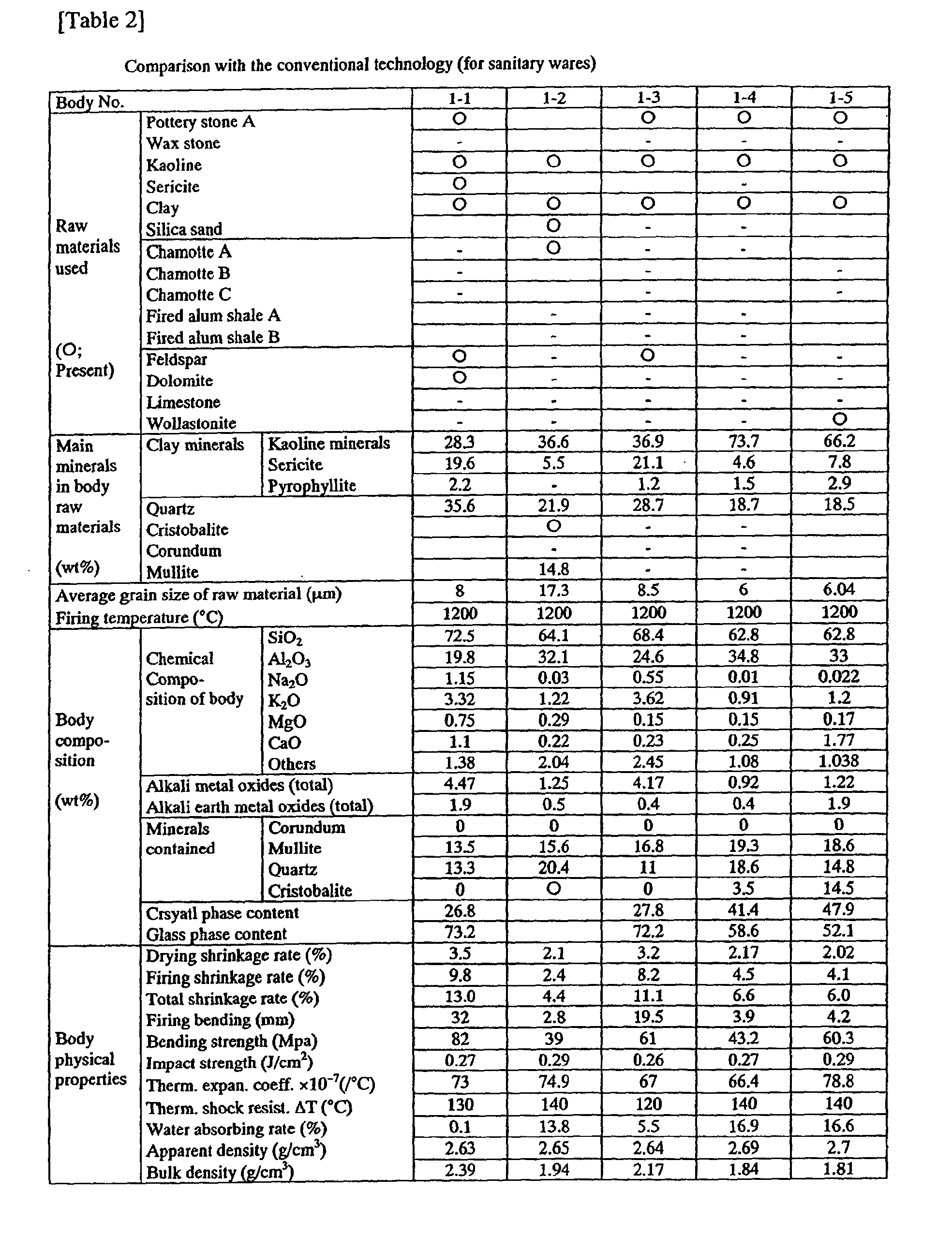
In the compositions of the bodies, the total content of the monovalent metal
oxides is the total sum of the contents of the monovalent metal oxides , Na2O, K2O, and
the like, and the total content of the alkali earth oxides is the total sum of the contents of
the alkali earth oxides, MgO, CaO, and the like, both in the chemical composition of the
body. As for cristobalite among the minerals contained, the symbol O indicates the
case where the content of cristobalite is not determined, but it is present.
Table 2 shows a comparison between the conventional technology and the
technology of the present invention. The body No. 1-1 is referred to as vitrifiable
body, the body No. 1-2 as engobe body, and the body No. 1-3 as ironstone body, and
these bodies have been conventionally used for sanitary ware. The body No. 1-4 is a
body used in the prior art, in which pottery stone, kaoline, and clay are the main raw
materials, and the firing flux components such as alkali oxides and the like are adjusted
to be small in content so that the firing shrinkage and softening deformation may be
small.
On the other hand, the body No. 1-5 is a body of the present invention in which
wollastonite is used as a body raw material, the uneven CaO distribution portions are
dispersed, and about 1.8 wt% of CaO is contained.
The firing shrinkage rate, bulk density, and bending strength are respectively
4.5%, 1.84 g/cm3, and 43.2 MPa for the body No. 1-4, whereas they are respectively
4.1%, 1.81 g/cm3, and 60.3 MPa for the body No. 1-5. In this manner, the body of the
present invention has the firing shrinkage rate and bulk density both of the same order
as those of the body of the prior art, but nevertheless the strength is largely improved.
The body of the present invention has the following composition characteristics.
In the body, there are those uneven CaO distribution portions which are higher in the
CaO concentration than the other portions. Furthermore, in those uneven CaO
distribution portions, the concentrations of the divalent metal oxides other than CaO and
the concentrations of alkali oxides tend to be lower as compared with those in the other
portions. The observed results associated with the above description are shown below.
Figure 1 shows the SEM images of the cross section of the body No. 1-4 and the
distribution states of Ca, Mg, Na, and K in the cross section observed by EPMA, and
Figure 2 shows the SEM images of the cross section of the body No. 1-5 and the
distribution states of Ca, Mg, Na, and K in the cross section observed by EPMA. In
the body No. 1-5, the contents of CaO, MgO, K2O, and Na2O are respectively 1.77,
0.17, 1.2, and 0.02 wt%, and the uneven CaO distribution portions come from the
wollastonite grains dispersed in the raw material; the CaO content ratio in wollastonite
is about 46 wt%, and hence the CaO concentration in the uneven CaO distribution
portions is at least several wt% or above, and the total content sum of MgO, K2O, and
Na2O is 1.5 wt% or below.
It can be interpreted that in the uneven CaO distribution portions, the contents of
the divalent metal oxides other than CaO and the alkali oxides are small, and hence the
uneven CaO distribution portions are not converted to liquid phase, but are crystallized
to form a mineral containing Ca.
The X-ray diffraction chart of the body No. 1-5 is shown in Figure 3, where the
formation of a mineral containing Ca, anorthite (CaAl2Si2O8), can be confirmed. The
glass phase contents of the body No. 1-1 and the body No. 1-2 are respectively 59 and
52 wt%. In other words, the CaO component segregation portions in which the CaO
component is segregated are dispersed, and thereby the shrinkage associated with the
liquid phase sintering is suppressed in these portions, consequently the firing shrinkage
being suppressed. Furthermore, since the CaO component segregation portions are
present which portions are different in such mechanical properties as Young's modulus
and the like from the liquid phase, the crack deflection effect takes place and the
mechanical strength can take a satisfactory value.
As described above, in the body of the present invention, the characteristics are
remarkably improved owing to the presence of the CaO component segregation
portions.
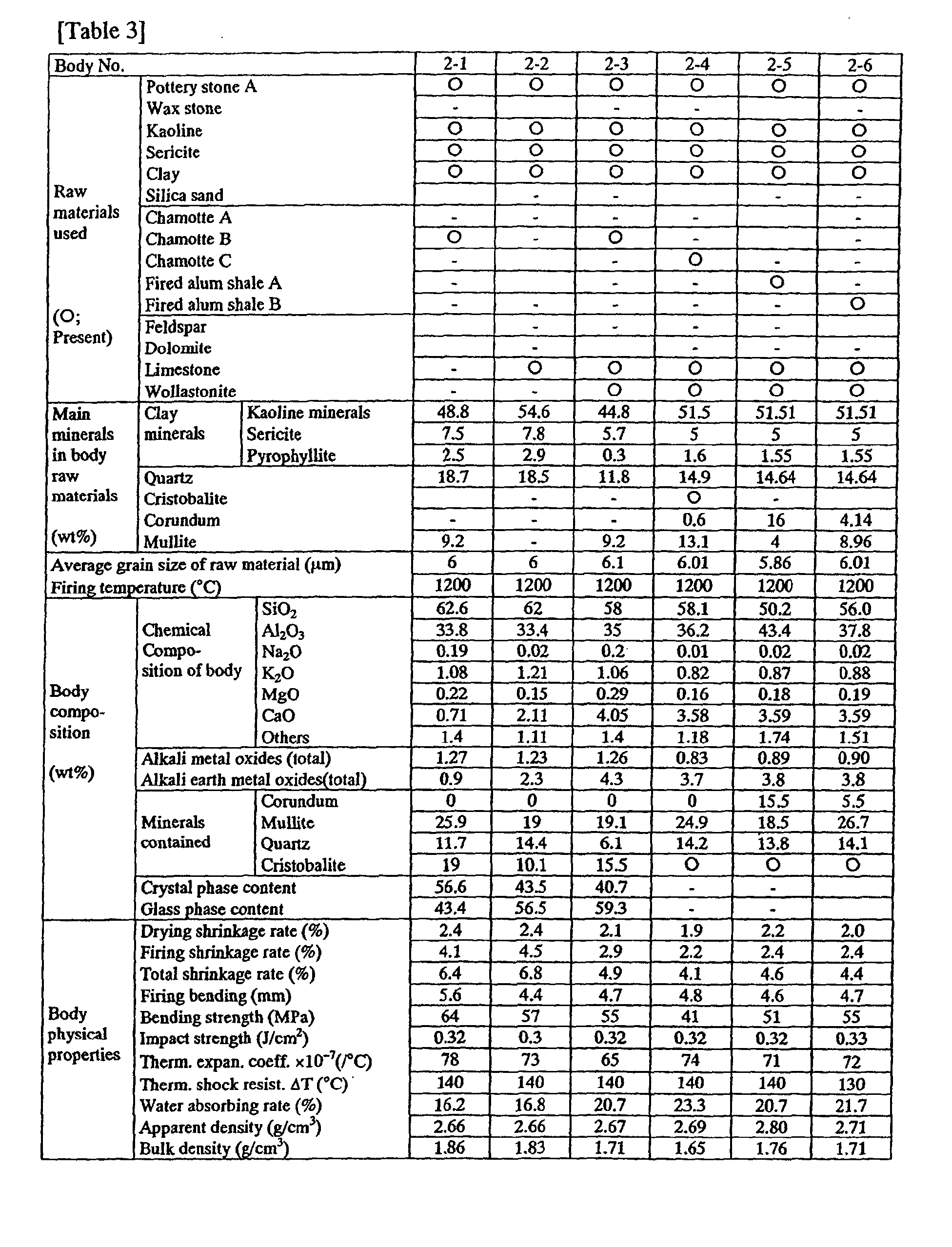
Tables 3 and 4 list the bodies No. 2-1 to No. 2-10 which have the characteristic
features of the present invention. Tables 5 to 8 show the test results which constitute
the bases of the present invention. Table 5 lists the bodies No. 3-1 to No. 3-3, Table 6
lists the bodies No. 4-1 to No. 4-5, and Table 7 lists the bodies No. 5-1 to No. 5-4.
Table 8 shows the chemical composition of the glaze used in the present invention.
The glaze is the one which is referred to as bristol glaze and generally used for sanitary
ware.
| | SiO2 | Al2O3 | TiO2 | Fe2O3 | CaO | MgO | Na2O | K2O | ZnO |
| Chemical composition (wt%) | 66.3 | 10.1 | 0.70 | 0.20 | 12.5 | 1.30 | 0.60 | 3.80 | 5.00 |
Figures 4 to 7 are the schematic views of the sanitary wares produced in the
embodiments as prototypes. Figure 4 shows a stool, Figure 5 a stall urinal, Figure 6 a
counter-integrated wash bowl, and Figure 7 a wash bowl.
The sanitary wares shown in Figures 4 to 7 were produced as prototypes by
molding with the slip casting method using the plaster molds, subjecting to the
processes of finish processing, drying, and glaze applying, and finally firing. As the
glaze, the one shown in Table 8 was used. The thermal expansion coefficient of the
glaze is 5.1 × 10⁻⁷/°C. In these sanitary wares produced as prototypes, all the portions
to be in contact with water or wastewater were prevented from the water absorbability
of body by applying glaze. The glazed portions include the interior of the rim working
as a water channel and the interior surface of the wastewater trap in Figure 4, the
interior of the wastewater trap in Figure 5, and the interior of the overflow in each of
Figures 6 and 7.
Description will be made below on the individual items in Tables 4 to 7.
In Table 4, kiln crack means the fissure formed in a product by heat shock during
the temperature falling process involved in a firing process, and the symbol ○ indicates
no occurrence of the kiln crack, while the symbol x the occurrence thereof.
In Table 4, the abrupt heating test means a test in which the bowl in Figure 7 is
subjected to a temperature difference of 80°C, and is examined as to whether fissures
are formed due to heat shock. The temperature difference of 80°C was provided by
the following way; a volume of cold water of 10°C was poured into the bowl of the
wash bowl to allow the wash bowl to be maintained at 10°C, and subsequently the cold
water was removed, and immediately a volume of water at 90° was poured into the
bowl. In the table, the symbol ○ indicates no occurrence of fissure, while the symbol
× the occurrence thereof.
The bodies No. 2-1 to 2-10 is the bodies of the present invention. The body
No. 2-1 is the one which uses chamotte B containing 2.4 wt % of CaO, while the body
No. 2-2 is the one in which the CaO content is adjusted to be about 2.1 wt% by adding
limestone. Both bodies are small in firing shrinkage rate and softening deformation
during firing, and shows excellent strengths for the bulk density. The bodies No. 2-3
is the one in which chamotte B is used and the CaO content is adjusted to be about 4.1
wt% by adding limestone and wollastonite, the firing shrinkage and bulk density can be
suppressed each to a low level, and moreover, the strength is excellent. The body No.
2-4 is the one in which chamotte C containing 0.24 wt% of CaO, and the CaO content
is adjusted to be about 3.6 wt% by adding limestone and wollastonite. The body No.
2-5 is the one in which is used the fired alum shale A containing about 80 wt% of a
corundum which contains 0.3 wt% of CaO, and the CaO content is adjusted to be about
3.6 wt% by adding limestone and wollastonite. The body No. 2-6 is the one in which
is used the fired alum shale B containing about 33 wt% of a corundum which contains
0.25 wt% of CaO, and the CaO content is adjusted to be about 3.6 wt% by adding
limestone and wollastonite. Any of the bodies No. 2-4 to No. 2-6 is small in firing
shrinkage and softening deformation during firing, and excellent in strength for the bulk
density. As described above, an excellent strength can be obtained for the body bulk
density, by forming the uneven CaO distribution portions in the body, even when there
is used a chamotte low in CaO content, or a raw material other than chamotte which is
small in ignition loss.
The bodies No. 2-7 to No. 2-10 are the ones in each of which chamotte B is
used, the CaO content is adjusted to be about 3.9 wt%, and the body properties such as
the thermal expansion coefficient, firing shrinkage, and the like are controlled by
varying the alkali and quartz contents. Any of these bodies is small in firing shrinkage
and softening deformation during firing, and is high in strength for the bulk density.
Particularly, the bodies No. 2-9 and No. 2-10 are comparable in strength with the
vitrifiable body (No. 1-1) shown in Table 2 which is used for sanitary wares, and for
each thereof the firing shrinkage and softening deformation during firing are
respectively 1/3 and 1/6 of those of the vitirfiable body.
As for the bodies No. 2-7 to No. 2-10, four kinds of sanitary wares were
produced as prototypes, and the relevant results are presented. In general, the fissure
referred to as kiln crack becomes to easily occur during firing with increasing
complexity in structure, whereas the kiln crack becomes to scarcely occur as the thermal
expansion coefficient of the body becomes small, and hence it is necessary to consider
about setting the thermal expansion coefficient according to the shapes of the articles
produced.
As for stall urinals, counter-integrated wash bowls, wash bowls, and the like,
these sanitary wares can be produced without occurrence of the kiln crack, when the
thermal expansion coefficient is set to be 90 × 10-7/°C or below.
As for stools which are more complex in structure, it is possible to produce such
sanitary wares without occurrence of the kiln crack when the thermal expansion
coefficient is set to be 70 × 10-7/°C or below.
As will be described later, for the purpose of decreasing the thermal expansion
coefficient, there are available a method of decreasing the quartz content in the body
and a method of increasing the firing shrinkage. Of these two methods, the method of
decreasing the quartz content in the body is particularly preferable for the present
invention.
As for stall urinals, counter-integrated wash bowls, wash bowls, and the like, the
quartz content is preferably 20 wt% or below, while as for stools more complex in
shape, the quartz content is preferably 10 wt% or below.
Table 5 shows the body characteristics of the bodies in which chamotte B is used
and the grain size of the body raw material is varied. The relation of the strength
relative versus the bulk density is improved by adjusting the grain size of the raw
material to be finer. In addition, simultaneously, the reducing effect of the softening
deformation during firing is also obtained. In order to obtain sanitary ware of good
quality, the average grain size of a body raw material is preferably adjusted to be 10µm
or below.
Table 6 shows the relationship between the quartz content in a body raw material
and the quartz content in a body, and in addition, the relationship between the quartz
content and the thermal expansion coefficient of a body. A part of the quartz
component in a body raw material is vitrified by firing, and hence the quartz content in
a body is decreased nearly relatively. As shown for the bodies No. 4-1 to No. 4-4,
there is a clear correlation between the quartz content and the thermal expansion
coefficient of the body, the thermal expansion coefficient increasing with increasing
quartz content. The thermal expansion coefficient, however, is not merely defined by
the quartz content in the body; there is such a case where as can be seen from
comparison of the bodies No. 4-2 to No. 4-5, the quartz contents in the body raw
materials are similar to each other, but the quartz contents in the bodies are different
from each other, and the thermal expansion coefficient are largely different from each
other.
From the results of the above described real object tests (the bodies No. 2-7 to
No. 2-10), as for stall urinals, counter-integrated wash bowls, wash bowls, and the like,
the quartz content is preferably 20 wt% or below, and as for stools which are more
complex in shape, the quartz content is preferably 10 wt% or below.
Table 7 shows the examples where the raw material (chamotte B) large in the
content of the Ca component and small in ignition loss was added to the body raw
materials, and among them the bodies No. 5-2 to No. 5-4 are the examples for
comparing the body characteristics in the cases where limestone, dolomite, and
wollastonite were respectively used as the raw materials for introducing CaO.
As can be seen from the bodies No. No. 5-1 to No. 5-4, it is possible to produce
the sanitary ware in which the firing shrinkage and firing deformation are sufficiently
small, and moreover, the strength versus the bulk density is excellent.
In the body No. 5-2 where limestone was used, the strength is not found to be
improved, but the firing shrinkage, firing deformation, and bulk density are decreased
and the strength versus the bulk density is improved.
In the body No. 5-3 where dolomite was used, a large improvement in strength
can be seen. When dolomite is used, however, the firing shrinkage rate and the
softening deformation during firing become large, and hence it is preferable to suppress
the firing shrinkage rate and deformation, as in the present embodiment, by
simultaneously using a raw material which contains a large amount of the Ca
component and is small in ignition loss (for example, chamotte B).
In the body No. 5-4 where wollastonite was used, the firing shrinkage rate is
decreased and the firing deformation is not changed appreciably, but nevertheless the
strength is improved largely.
As described above, the body characteristics become different depending on the
kind of the raw material for use in introducing CaO; nevertheless, as can be seen, the
strength versus the bulk density tends to be improved in the present embodiment.
Accordingly, when there is used a raw material which contains a large amount of
the Ca component and is small in ignition loss (for example, chamotte B), a variety of
raw materials other than wollastonite, limestone, and dolomite can be used as a raw
material for use in introducing CaO.
The firing shrinkage and softening deformation during firing became relatively
large when dolomite was used, contrary to the cases where limestone and wollastonite
were used, and this is ascribable to the fact that MgO was introduced into the body by
use of dolomite and the MgO promoted the conversion of the body to the liquid phase.
Accordingly, for the purpose of forming the uneven CaO distribution portions in
the body and expecting the effects thereof to be operative to the fullest extent, it is more
preferable to also suppress the contents of such divalent metal oxides other than CaO
that possibly promote the conversion to liquid phase, in addition to the suppression of
the contents of the alkali oxides in the body.
Industrial Applicability
According to the present invention, it becomes possible to provide the sanitary
ware for which it is possible to accurately design the shapes and dimensions of the
products after being subjected to firing while maintaining the mechanical strength
required to sanitary ware, degradation of the process yield caused by shrinkage and
deformation scarcely occurs, and the setting efficiency and productivity are improved as
compared to the prior art.