EP1275619A2 - Vorrichtung zum Schmelzen und Läutern hochreiner optischer Gläser - Google Patents
Vorrichtung zum Schmelzen und Läutern hochreiner optischer Gläser Download PDFInfo
- Publication number
- EP1275619A2 EP1275619A2 EP02014498A EP02014498A EP1275619A2 EP 1275619 A2 EP1275619 A2 EP 1275619A2 EP 02014498 A EP02014498 A EP 02014498A EP 02014498 A EP02014498 A EP 02014498A EP 1275619 A2 EP1275619 A2 EP 1275619A2
- Authority
- EP
- European Patent Office
- Prior art keywords
- glass
- metal
- melting
- skull
- crucible
- Prior art date
- Legal status (The legal status is an assumption and is not a legal conclusion. Google has not performed a legal analysis and makes no representation as to the accuracy of the status listed.)
- Withdrawn
Links
Images

Classifications
-
- C—CHEMISTRY; METALLURGY
- C03—GLASS; MINERAL OR SLAG WOOL
- C03C—CHEMICAL COMPOSITION OF GLASSES, GLAZES OR VITREOUS ENAMELS; SURFACE TREATMENT OF GLASS; SURFACE TREATMENT OF FIBRES OR FILAMENTS MADE FROM GLASS, MINERALS OR SLAGS; JOINING GLASS TO GLASS OR OTHER MATERIALS
- C03C3/00—Glass compositions
- C03C3/12—Silica-free oxide glass compositions
- C03C3/14—Silica-free oxide glass compositions containing boron
- C03C3/15—Silica-free oxide glass compositions containing boron containing rare earths
- C03C3/155—Silica-free oxide glass compositions containing boron containing rare earths containing zirconium, titanium, tantalum or niobium
-
- C—CHEMISTRY; METALLURGY
- C03—GLASS; MINERAL OR SLAG WOOL
- C03B—MANUFACTURE, SHAPING, OR SUPPLEMENTARY PROCESSES
- C03B5/00—Melting in furnaces; Furnaces so far as specially adapted for glass manufacture
- C03B5/02—Melting in furnaces; Furnaces so far as specially adapted for glass manufacture in electric furnaces, e.g. by dielectric heating
- C03B5/021—Melting in furnaces; Furnaces so far as specially adapted for glass manufacture in electric furnaces, e.g. by dielectric heating by induction heating
-
- C—CHEMISTRY; METALLURGY
- C03—GLASS; MINERAL OR SLAG WOOL
- C03B—MANUFACTURE, SHAPING, OR SUPPLEMENTARY PROCESSES
- C03B5/00—Melting in furnaces; Furnaces so far as specially adapted for glass manufacture
- C03B5/16—Special features of the melting process; Auxiliary means specially adapted for glass-melting furnaces
- C03B5/225—Refining
-
- C—CHEMISTRY; METALLURGY
- C03—GLASS; MINERAL OR SLAG WOOL
- C03C—CHEMICAL COMPOSITION OF GLASSES, GLAZES OR VITREOUS ENAMELS; SURFACE TREATMENT OF GLASS; SURFACE TREATMENT OF FIBRES OR FILAMENTS MADE FROM GLASS, MINERALS OR SLAGS; JOINING GLASS TO GLASS OR OTHER MATERIALS
- C03C3/00—Glass compositions
- C03C3/04—Glass compositions containing silica
- C03C3/076—Glass compositions containing silica with 40% to 90% silica, by weight
- C03C3/078—Glass compositions containing silica with 40% to 90% silica, by weight containing an oxide of a divalent metal, e.g. an oxide of zinc
-
- C—CHEMISTRY; METALLURGY
- C03—GLASS; MINERAL OR SLAG WOOL
- C03B—MANUFACTURE, SHAPING, OR SUPPLEMENTARY PROCESSES
- C03B2211/00—Heating processes for glass melting in glass melting furnaces
- C03B2211/70—Skull melting, i.e. melting or refining in cooled wall crucibles or within solidified glass crust, e.g. in continuous walled vessels
-
- C—CHEMISTRY; METALLURGY
- C03—GLASS; MINERAL OR SLAG WOOL
- C03B—MANUFACTURE, SHAPING, OR SUPPLEMENTARY PROCESSES
- C03B2211/00—Heating processes for glass melting in glass melting furnaces
- C03B2211/70—Skull melting, i.e. melting or refining in cooled wall crucibles or within solidified glass crust, e.g. in continuous walled vessels
- C03B2211/71—Skull melting, i.e. melting or refining in cooled wall crucibles or within solidified glass crust, e.g. in continuous walled vessels within segmented wall vessels where the molten glass solidifies between and seals the gaps between wall segments
Definitions
- the invention relates to the glass manufacturing process, in particular the manufacturing and Treating glass melts.
- the glass manufacturing process begins with the melting of so-called Batch or broken glass.
- a refining process follows the melting process which serves to physically or chemically bond gases from the melt expel.
- Optical glasses are usually melted in platinum crucibles. With correspondingly aggressive glasses, Pt or PtO x is often removed. The PtO x leads to discoloration, especially in the UV and in the blue spectral range. The dissolution of the Pt or the reduction of PtO x to Pt leads to disruptive Pt particles in the glass, which are particularly unacceptable for glasses for laser applications.
- the melting process is preferred in a melting pan made of ceramic refractory material.
- To the ceramic Melting basin usually includes a Pt refining chamber and Homogenization system made of Pt.
- a ceramic refractory material for the The melting tank is preferably made of silica glass.
- Ceramic refractories such as Al 2 O 3 , which would better resist glass attack, are generally relatively heavily contaminated with transition elements such as Fe, so that they are not suitable for applications in which high transmission is important, such as glass optical fibers for lighting technology are suitable.
- Another device for melting glasses is skull melting.
- the principle is described, for example, in US Pat. No. 4,049,384.
- a crucible is used here, the surrounding wall of which is formed from coolable metal tubes.
- a crust is formed in the region of this wall from the material of its own so that the metal tubes on the side in contact with the melt are covered by it.
- Skull melting technology is preferably used for melting high-melting glasses or crystals for the production of refractory materials or for growing crystals such as ZrO 2 .
- the high-melting starting material (batch) forms a crust of sintered, species-specific material in the area of the wall.
- the advantage of the Skull melting technique is that streak formation is prevented because the glass is melted in its own material.
- the principle of the skull crucible is used both in the melting process and in the Purification process applied with success.
- the skull crucible was made in a variety of ways further developed. See for example DE 199 39 772 A1. There is a so-called Mushroom skull crucible described. This causes corrosion of the cooled metal pipes avoided above the melt.
- the liquid-cooled metal pipes are bent outwards in the form of a mushroom in the upper area.
- On the chilled A ceramic ring is placed on the metal pipes in the colder area. That way the metal pipes on the side facing the melt completely Melted glass covered.
- the invention has for its object to provide a device with which high-purity optical glasses can be melted and / or refined.
- no metal particles, no coloring ions or foreign streaks should be introduced into the glass melt.
- the glass quality should not be impaired by metallic particles, coloring ions or streaks.
- the amount of coloring ions must be so small that it can only be quantified by means of attenuation spectra on very long ( 3 10 m) glass optical fibers.
- the device according to the invention should also be suitable for melting glass of a highly aggressive character.
- the inventors have recognized that in low melting glasses, for Example with most optical glasses, with skull melting, no thick ones Skull layer made of sintered native material, but only a thin one Glass layer forms, which lies directly on the cooled metal pipes. Surprisingly, it was found that through this thin layer of glass an ion exchange between the surface of the metal pipes and the hot one Glass melting takes place. This is all the more surprising as the metal pipes for Example can be cooled with water.
- the invention is based on the material of the coolable tubes or at least whose surface layer is to be designed in such a way that either no ion exchange between the coolable tubes and the melt, or that the ions, which diffuse through the thin layer of glass into the glass melt, the Do not interfere with glass composition. It was known that certain metals e.g. B. platinum, iridium or rhodium have the property Color the glass melt. The surprising thing is, however, that Knowledge of the ion exchange through the thin glass layer.
- An ion exchange between the surface of the tubes and the glass melt can be prevented if the surface of the pipes is in metallic form, that is, if the surface of the pipes is not oxidized. In metallic form the elements cannot participate in the ion exchange.
- Ir, Pd and Rh tubes are relatively resistant to oxidation, but diffusion is less However, quantities in the glass melt cannot be excluded. Because the ions of this Elements that color the glass are tubes made of these metals for the highest demands not suitable. If somewhat lower requirements are placed on the transmission, then these metals can also be used.
- W, Mo and Nb are also resistant to oxidation at low temperatures.
- This Metals have the disadvantage that they are difficult to process and their ions Color the glass.
- An ion exchange between the metal tube and the glass melt can be permitted if it is in the ion that from the tube into the Glass melt migrates to a non-coloring ion that enters the glass grid is installed.
- Al tubes When using Al tubes, ion diffusion of Al 3+ into the glass melt cannot be ruled out, since the surface of aluminum metal is always covered with a thin oxide layer.
- the Al 3+ is a network former that is completely colorless.
- Experiments with a skull crucible made of aluminum tubes show no coloring of the glass melt or the molten glass. Streaking cannot take place either, since the amount of Al 3+ that diffuses from the tube into the glass melt is far too small to form a streak.
- other metal tubes without glass-coloring components can also be used, such as magnesium or zinc tubes. These metals can also diffuse into the glass melt as ions without reducing the transmission of the glass.
- Metal pipes such as copper or stainless steel pipes can also be used with these Metals such as Al, Zn, Sn and Mg are coated because only the surface of the tubes comes into contact with the glass layer and via the glass layer with the melt. A disruptive diffusion within the metal pipe was found in coated pipes not found.
- suitable metal oxide compounds for coating the metal tubes are Al 2 O 3 , MgO, ZrO 2 , Y 2 O 3 and, if appropriate, their nitrides and carbides.
- the melt was cast in shapes of different geometries (disks, Rods, bars) and cooled from 650 ° C to room temperature.
- the improvement can be seen from the fact that the pure transmission in the blue Decide spectral range has increased. Cause absorption in the blue a yellowish color cast, so that in observation applications such as Photography, microscopy and telescopes have the lowest possible absorption is desired.
- the deviations in refractive index and Abbe number are due to something higher evaporation rates of the new technology and can be Correct the fine adjustments to the batch slightly.
- This wavelength corresponds to an important one Emission line from mercury vapor lamps, which is used for many applications.
- the Luminous efficacy at this wavelength can be achieved using the new technology can be increased by 0.111 or 15%, which is a clear product advantage equivalent. You can also recognize the lower refractive index Evaluate the possibilities of the corrective measures mentioned above.
- the mushroom skull crucible A shown in Figure 1 consists of a ring of water-cooled Aluminum tubes that are bent 90 degrees outwards in the upper part. On the outward bent pipe is a ring made of refractory material, on which the upper furnace cover lies D.
- the skull crucible is attached to the coil E High frequency heated.
- the surface can also be used with a burner F be heated.
- the batch poured in via a filling funnel is placed in a mushroom skull crucible A melted with water-cooled platinum tubes, as the strongest attack on the Tub material takes place during melting. After melting, the glass can refined in a platinum channel B, homogenized in a platinum stirrer C and in the Platinum D feeders can be conditioned without being essential Contamination from the inductively heated platinum is to be feared.
- the system shown in FIG. 3 has a mushroom skull crucible A and a mushroom skull crucible B with water-cooled, platinum-coated copper pipes, further a device C for homogenizing and conditioning.
- FIG. 4 shows a mushroom skull crucible A for melting glass, and another immediately following, underneath another mushroom skull crucible B for purification. Both skull crucibles have water-cooled, platinum-coated stainless steel tubes.
- the skull crucible according to FIG. 5 is of classic construction. He points water-cooled copper pipes.
Landscapes
- Chemical & Material Sciences (AREA)
- Engineering & Computer Science (AREA)
- Materials Engineering (AREA)
- Organic Chemistry (AREA)
- Life Sciences & Earth Sciences (AREA)
- Chemical Kinetics & Catalysis (AREA)
- General Chemical & Material Sciences (AREA)
- Geochemistry & Mineralogy (AREA)
- Glass Compositions (AREA)
- Glass Melting And Manufacturing (AREA)
Abstract
Description
| Ti(300nm; 25mm) = 0,0010 | (0,0011) |
| Ti(330nm; 25mm) = 0,6263 | (0,5565) |
| Ti(350nm; 25mm) = 0,9680 | (0,8959) |
| Ti(370nm; 25mm) = 0,9951 | (0,9600) |
| Ti(400nm; 25mm) = 0,9995 | (0,9839) |
| Ti(420nm; 25mm) = 0,9972 | (0,9890) |
| Ti(450nm; 25mm) = 0,9985 | (0,9924) |
| Glaszusammensetzung für die Beispiele 1 und 2 | ||
| Oxid | Beispiel 1 | Beispiel 2 |
| B2O3 | 40 | - |
| CaO | 6 | - |
| La2O3 | 42 | - |
| SiO2 | 2 | 45 |
| ZnO | 6 | 38 |
| ZrO2 | 4 | - |
| Sb2O3 | 0,05 | - |
| Na2O | - | 8 |
| K2O | - | 9 |
| As2O3 | - | 0,3 |
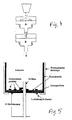
- Figur 1
- zeigt einen pilzförmigen Skull-Tiegel in einer Aufrißansicht.
- Figur 2
- zeigt eine Anlage zum Schmelzen, Läutern und Homogenisieren in schematischer Darstellung.
- Figur 3
- zeigt eine weitere Anlage zum Schmelzen, Läutern und Homogenisieren in einer schematischen Darstellung.
- Figur 4
- zeigt eine Anlage zum Schmelzen und Läutern.
- Figur 5
- zeigt einen Skull-Tiegel herkömmlicher Bauart.
Claims (8)
- Vorrichtung zum Schmelzen hochreiner optischer Gläser, die frei von metallischen Teilchen, färbenden Oxiden und Fremdschlieren sind, mit Hilfe der Skull-Schmelztechnik, dadurch gekennzeichnet, dass die Metallrohre oder die Beschichtungen der Metallrohre des Skull-Tiegels aus einem nicht oxidierenden Material oder aus einem Material, das keine die Glasschmelze färbende Ionen enthält, besteht.
- Vorrichtung nach Anspruch 1, dadurch gekennzeichnet, daß die Metallrohre des Skull-Tiegels aus einem nicht oder nur sehr gering oxidierendem Material wie zum Beispiel Platin oder einer Platinlegierung besteht.
- Vorrichtung nach Anspruch 1, dadurch gekennzeichnet, daß die Metallrohre des Skull-Tiegels zum Beispiel aus Kupfer oder Stahl bestehen und deren Beschichtung aus einem nicht oder nur sehr gering oxidierendem Material besteht wie zum Beispiel Platin, Gold, Silber oder deren Legierungen.
- Vorrichtung nach Anspruch 1, dadurch gekennzeichnet, daß die Metallrohre des Skull-Tiegels aus einem Material bestehen, das keine die Glasschmelze färbende Ionen enthält wie zum Beispiel Aluminium, Magnesium oder Zink.
- Vorrichtung nach Anspruch 1, dadurch gekennzeichnet, daß die Metallrohre des Skull-Tiegels zum Beispiel aus Kupfer oder Stahl bestehen und deren Beschichtung aus einem Material besteht, das keine die Schmelze färbende Ionen enthält, wie zum Beispiel einer Metallbeschichtung aus Aluminium, Magnesium, Zinn, Zink oder deren Legierungen
- Vorrichtung nach Anspruch 1, dadurch gekennzeichnet, daß die Metallrohre des Skull-Tiegels zum Beispiel aus Kupfer oder Stahl sind und deren Beschichtung aus einem Metalloxid wie zum Beispiel Al2O3, MgO, ZrO2, Y2O3, oder deren Kombination; oder aus einem Metallnitrid; oder aus einem Metallcarbid wie zum Beispiel Woframcarbid; oder aus einem Metallsilicid wie zum Beispiel Molybdänsilicid oder deren Kombinationen besteht.
- Vorrichtung nach Anspruch 1 bis 6, dadurch gekennzeichnet, daß der Skull-Tiegel in zylindrischer Form aufgebaut-ist.
- Vorrichtung nach Anspruch 1 bis 7, dadurch gekennzeichnet, daß der Skull-Tiegel in Form eines Pilz-Tiegels aufgebaut ist.
Applications Claiming Priority (2)
| Application Number | Priority Date | Filing Date | Title |
|---|---|---|---|
| DE10133469 | 2001-07-10 | ||
| DE10133469A DE10133469B4 (de) | 2001-07-10 | 2001-07-10 | Vorrichtung zum Schmelzen hochreiner optischer Gläser |
Publications (2)
| Publication Number | Publication Date |
|---|---|
| EP1275619A2 true EP1275619A2 (de) | 2003-01-15 |
| EP1275619A3 EP1275619A3 (de) | 2004-03-17 |
Family
ID=7691267
Family Applications (1)
| Application Number | Title | Priority Date | Filing Date |
|---|---|---|---|
| EP02014498A Withdrawn EP1275619A3 (de) | 2001-07-10 | 2002-06-29 | Vorrichtung zum Schmelzen und Läutern hochreiner optischer Gläser |
Country Status (4)
| Country | Link |
|---|---|
| US (1) | US20030051510A1 (de) |
| EP (1) | EP1275619A3 (de) |
| JP (1) | JP4699674B2 (de) |
| DE (1) | DE10133469B4 (de) |
Cited By (3)
| Publication number | Priority date | Publication date | Assignee | Title |
|---|---|---|---|---|
| WO2004052797A1 (de) * | 2002-12-06 | 2004-06-24 | Schott Ag | Verfahren zur herstellung von borosilicatgläsern, boratgläsern und kristallisierenden borhaltigen werkstoffen |
| WO2010105844A1 (de) * | 2009-03-20 | 2010-09-23 | Schott Ag | Mutterform oder vorform für optische bauteile |
| DE102009033502A1 (de) * | 2009-07-15 | 2011-01-27 | Schott Ag | Verfahren und Vorrichtung zur Herstellung von Glasprodukten aus einer Glasschmelze |
Families Citing this family (6)
| Publication number | Priority date | Publication date | Assignee | Title |
|---|---|---|---|---|
| DE10342904B3 (de) * | 2003-09-17 | 2005-03-24 | Schott Ag | Verfahren zur Herstellung eines bleifreien optischen Glases guter Transmission, bleifreies optisches Glas und dessen Verwendung |
| DE102005054319B4 (de) * | 2005-11-11 | 2013-04-25 | Schott Ag | Modularer Skulltiegel, Begrenzungs- und Erweiterungselemente und Verfahren zum Schmelzen und/oder Läutern einer anorganischen Substanz, insbesondere von Glas |
| DE102006004637B4 (de) * | 2006-01-31 | 2010-01-07 | Schott Ag | Induktiv beheizbarer Skulltiegel, Schmelzanlage und Verfahren zum kontinuierlichen Herstellen einer Glasschmelze |
| DE102007008299B4 (de) * | 2006-08-12 | 2012-06-14 | Schott Ag | Verfahren zur Herstellung von Gläsern, wobei die chemische Reduktion von Bestandteilen vermieden wird |
| US20140087321A1 (en) * | 2012-09-27 | 2014-03-27 | Theodore A. Waniuk | Active cooling regulation of induction melt process |
| CN115403392B (zh) * | 2022-08-24 | 2023-06-20 | 广东省科学院资源利用与稀土开发研究所 | 用于熔炼钛基储氢合金的坩埚基体及其制备方法和应用 |
Family Cites Families (15)
| Publication number | Priority date | Publication date | Assignee | Title |
|---|---|---|---|---|
| FR1306851A (fr) * | 1961-11-22 | 1962-10-19 | Glaverbel | Appareil pour la fusion de produits tels que le verre et procédé pour son exploitation |
| FR1492063A (fr) * | 1966-04-05 | 1967-08-18 | Commissariat Energie Atomique | Perfectionnement aux fours électriques haute fréquence pour la fabrication en continu de réfractaires électrofondus |
| GB1221909A (en) * | 1969-10-01 | 1971-02-10 | Standard Telephones Cables Ltd | Improvements in or relating to apparatus for the heat treatment of electrically conductive materials |
| GB1404313A (en) * | 1971-08-13 | 1975-08-28 | Secr Defence | Manufacture of high purity glass |
| GB1488376A (en) * | 1974-08-06 | 1977-10-12 | Standard Telephones Cables Ltd | Glass |
| US4049384A (en) * | 1975-04-14 | 1977-09-20 | Arthur D. Little, Inc. | Cold crucible system |
| FR2456926A1 (fr) * | 1979-05-17 | 1980-12-12 | Proizv Ob Te | Four a bassin en particulier pour la fusion de verre |
| NL8204438A (nl) * | 1982-11-16 | 1984-06-18 | Philips Nv | Werkwijze en inrichting voor de continue vervaardiging van langgerekte lichamen uitgaande van een ongesmolten uitgangsmateriaal. |
| DE3316546C1 (de) * | 1983-05-06 | 1984-04-26 | Philips Patentverwaltung Gmbh, 2000 Hamburg | Kalter Tiegel fuer das Erschmelzen und die Kristallisation nichtmetallischer anorganischer Verbindungen |
| FR2566890B1 (fr) * | 1984-06-29 | 1986-11-14 | Commissariat Energie Atomique | Cage froide pour creuset a fusion par induction electromagnetique a frequence elevee |
| US5385595A (en) * | 1993-12-23 | 1995-01-31 | Owens-Corning Fiberglas Technology Inc. | Titanium nitride diffusion barrier for platinum-coated fiberglass spinner bores |
| US6591636B1 (en) * | 1998-05-05 | 2003-07-15 | Corning Incorporated | Material and method for coating glass forming equipment |
| DE19939772C1 (de) * | 1999-08-21 | 2001-05-03 | Schott Glas | Skulltiegel für das Erschmelzen oder das Läutern von Gläsern |
| DE10002019C1 (de) * | 2000-01-19 | 2001-11-15 | Schott Glas | Vorrichtung zum Erschmelzen oder Läutern von anorganischen Substanzen insbesondere Gläsern oder Glaskeramiken |
| DE10331103B4 (de) * | 2002-07-04 | 2008-06-26 | Schott Ag | Doppeltiegel für Glas-Ziehverfahren und Verfahren zum Herstellen von Glasfasern oder zugehörigen Vorformen mit dem Doppeltiegel |
-
2001
- 2001-07-10 DE DE10133469A patent/DE10133469B4/de not_active Expired - Lifetime
-
2002
- 2002-06-29 EP EP02014498A patent/EP1275619A3/de not_active Withdrawn
- 2002-07-09 JP JP2002200586A patent/JP4699674B2/ja not_active Expired - Fee Related
- 2002-07-10 US US10/192,774 patent/US20030051510A1/en not_active Abandoned
Cited By (5)
| Publication number | Priority date | Publication date | Assignee | Title |
|---|---|---|---|---|
| WO2004052797A1 (de) * | 2002-12-06 | 2004-06-24 | Schott Ag | Verfahren zur herstellung von borosilicatgläsern, boratgläsern und kristallisierenden borhaltigen werkstoffen |
| WO2010105844A1 (de) * | 2009-03-20 | 2010-09-23 | Schott Ag | Mutterform oder vorform für optische bauteile |
| DE102009033502A1 (de) * | 2009-07-15 | 2011-01-27 | Schott Ag | Verfahren und Vorrichtung zur Herstellung von Glasprodukten aus einer Glasschmelze |
| US8530804B2 (en) | 2009-07-15 | 2013-09-10 | Schott Ag | Method and device for producing glass products from a glass melt |
| DE102009033502B4 (de) * | 2009-07-15 | 2016-03-03 | Schott Ag | Verfahren und Vorrichtung zur Herstellung von Glasprodukten aus einer Glasschmelze |
Also Published As
| Publication number | Publication date |
|---|---|
| EP1275619A3 (de) | 2004-03-17 |
| JP2003073128A (ja) | 2003-03-12 |
| JP4699674B2 (ja) | 2011-06-15 |
| DE10133469A1 (de) | 2003-02-06 |
| US20030051510A1 (en) | 2003-03-20 |
| DE10133469B4 (de) | 2004-10-14 |
Similar Documents
| Publication | Publication Date | Title |
|---|---|---|
| DE102007008299B4 (de) | Verfahren zur Herstellung von Gläsern, wobei die chemische Reduktion von Bestandteilen vermieden wird | |
| DE102012100233B4 (de) | Hochtransmittive Gläser mit hoher Solarisationsbeständigkeit, ihre Verwendung und Verfahren zu ihrer Herstellung | |
| EP1078889B1 (de) | Verfahren zur Läuterung von Glasschmelzen | |
| DE102006003521B4 (de) | Vorrichtung und Verfahren zum kontinuierlichen Läutern von Gläsern mit hohen Reinheitsanforderungen | |
| EP1618074B1 (de) | Schmelzen und läutern in wannen mit gekühlten wänden | |
| EP3569577A1 (de) | Flachglas, verfahren zu dessen herstellung sowie dessen verwendung | |
| EP1337686A2 (de) | Beschichtetes metallteil in der glasherstellung | |
| DE10362074B4 (de) | Hochschmelzendes Glas oder Glaskeramik sowie der Verwendung | |
| WO2015046428A1 (ja) | 光学ガラスおよびその製造方法 | |
| DE10257049B4 (de) | Verfahren zur Herstellung von Borosilicatgläsern, Boratgläsern und kristallisierenden borhaltigen Werkstoffen | |
| DE10133469B4 (de) | Vorrichtung zum Schmelzen hochreiner optischer Gläser | |
| EP4061778B1 (de) | Glas, verfahren zur herstellung eines glases und glasschmelzanlage | |
| DE102006003531A1 (de) | Verfahren und Vorrichtung zum blasenfreien Transportieren, Homogenisieren und Konditionieren von geschmolzenem Glas | |
| EP0884397B1 (de) | Verwendung einer Molybdän und/oder Wolfram Legierung für Bauteilen, die mit Glas- und/oder Keramikschmelzen in Berührung kommen | |
| DE102012202696B4 (de) | Verfahren zur Herstellung von Gläsern und Glaskeramiken, Glas und Glaskeramik und deren Verwendung | |
| DE102010037437B4 (de) | Glasschmelzanlage sowie Verfahren zum Betreiben einer solchen Glasschmelzanlage | |
| DE102012025656B3 (de) | Hochtransmittive Gläser mit hoher Solarisationsbeständigkeit | |
| DE10138108B4 (de) | Verfahren zur Verminderung der Blasenbildung beim Herstellen von Gläsern | |
| DE102004001729B4 (de) | Verfahren zur Herstellung eines rot gefärbten Borosilicatglases | |
| WO2007065874A1 (de) | Verfahren zur herstellung von flachglas nach dem floatverfahren sowie giesslippe (spout lip) für das floatverfahren | |
| DE2435455B2 (de) | Verfahren zum herstellen von telluritglas | |
| DE102006051049B4 (de) | Oxidationsgeschützte Behältnisse aus Iridium zum Transportieren und/oder Konditionieren einer Glasschmelze, insbesondere für den kontinuierlichen Betrieb, sowie Verfahren | |
| DE102024128460A1 (de) | Fluorfreies Natron-Kalk-Silikat-Opalglas | |
| DE102009033500A1 (de) | Barriere für Vorrichtungen zur kontinuierlichen Herstellung von Produkten aus einer Schmelze | |
| DE102006050141A1 (de) | Verfahren und Vorrichtung zum Herstellen eines Glasproduktes |
Legal Events
| Date | Code | Title | Description |
|---|---|---|---|
| PUAI | Public reference made under article 153(3) epc to a published international application that has entered the european phase |
Free format text: ORIGINAL CODE: 0009012 |
|
| 17P | Request for examination filed |
Effective date: 20020629 |
|
| AK | Designated contracting states |
Kind code of ref document: A2 Designated state(s): AT BE CH CY DE DK ES FI FR GB GR IE IT LI LU MC NL PT SE TR |
|
| AX | Request for extension of the european patent |
Free format text: AL;LT;LV;MK;RO;SI |
|
| PUAL | Search report despatched |
Free format text: ORIGINAL CODE: 0009013 |
|
| AK | Designated contracting states |
Kind code of ref document: A3 Designated state(s): AT BE CH CY DE DK ES FI FR GB GR IE IT LI LU MC NL PT SE TR |
|
| AX | Request for extension of the european patent |
Extension state: AL LT LV MK RO SI |
|
| 17Q | First examination report despatched |
Effective date: 20040707 |
|
| RAP1 | Party data changed (applicant data changed or rights of an application transferred) |
Owner name: SCHOTT AG |
|
| AKX | Designation fees paid |
Designated state(s): AT BE CH CY DE DK ES FI FR GB GR IE IT LI LU MC NL PT SE TR |
|
| STAA | Information on the status of an ep patent application or granted ep patent |
Free format text: STATUS: THE APPLICATION HAS BEEN WITHDRAWN |
|
| 18W | Application withdrawn |
Effective date: 20050309 |