EP1269947A2 - Klebeverband mit verbessertem Komfort und verbesserter Adhäsion - Google Patents
Klebeverband mit verbessertem Komfort und verbesserter Adhäsion Download PDFInfo
- Publication number
- EP1269947A2 EP1269947A2 EP02254560A EP02254560A EP1269947A2 EP 1269947 A2 EP1269947 A2 EP 1269947A2 EP 02254560 A EP02254560 A EP 02254560A EP 02254560 A EP02254560 A EP 02254560A EP 1269947 A2 EP1269947 A2 EP 1269947A2
- Authority
- EP
- European Patent Office
- Prior art keywords
- bandage
- point
- arcuate segments
- adhesive
- lower edge
- Prior art date
- Legal status (The legal status is an assumption and is not a legal conclusion. Google has not performed a legal analysis and makes no representation as to the accuracy of the status listed.)
- Withdrawn
Links
Images



Classifications
-
- A—HUMAN NECESSITIES
- A61—MEDICAL OR VETERINARY SCIENCE; HYGIENE
- A61F—FILTERS IMPLANTABLE INTO BLOOD VESSELS; PROSTHESES; DEVICES PROVIDING PATENCY TO, OR PREVENTING COLLAPSING OF, TUBULAR STRUCTURES OF THE BODY, e.g. STENTS; ORTHOPAEDIC, NURSING OR CONTRACEPTIVE DEVICES; FOMENTATION; TREATMENT OR PROTECTION OF EYES OR EARS; BANDAGES, DRESSINGS OR ABSORBENT PADS; FIRST-AID KITS
- A61F13/00—Bandages or dressings; Absorbent pads
- A61F13/02—Adhesive bandages or dressings
- A61F13/0203—Adhesive bandages or dressings with fluid retention members
-
- A—HUMAN NECESSITIES
- A61—MEDICAL OR VETERINARY SCIENCE; HYGIENE
- A61F—FILTERS IMPLANTABLE INTO BLOOD VESSELS; PROSTHESES; DEVICES PROVIDING PATENCY TO, OR PREVENTING COLLAPSING OF, TUBULAR STRUCTURES OF THE BODY, e.g. STENTS; ORTHOPAEDIC, NURSING OR CONTRACEPTIVE DEVICES; FOMENTATION; TREATMENT OR PROTECTION OF EYES OR EARS; BANDAGES, DRESSINGS OR ABSORBENT PADS; FIRST-AID KITS
- A61F13/00—Bandages or dressings; Absorbent pads
- A61F2013/00089—Wound bandages
- A61F2013/00348—Wound bandages lint-free, i.e. non-linting or frying
Definitions
- This invention relates to an adhesive bandage which provides improved comfort and resistance to release from the skin during use by the consumer.
- the adhesive bandage comprises a backing material, an adhesive, and a wound-contacting pad.
- Adhesive bandages according to the invention are designed to be more comfortable and have good adhesion especially when used to protect wounds in areas that bend, e.g., finger joints.
- the bandage of the invention is tapered on both sides of the absorbent pad to provide the improved comfort and resistance to displacement and unraveling from the skin of the wearer during use.
- Adhesives bandages are widely used to cover and protect wounds on various parts of the human body.
- a variety of adhesive bandage designs and shapes are commercially available to attend to different patient needs, which needs are based on, e.g., the location and severity of the wound to be protected.
- the bandages frequently applied to wounds on fingers have a rectangular shape or a modified rectangular shape, in which rounded edges are created by the removal of some material from the comers of the rectangle.
- Adhesive bandages having a modified rectangular configuration are typically made by removing material, and preferably a substantially equal amount of material, from each of the corners of an otherwise rectangular starting bandage. Typically, 3% or less of the total area of the starting rectangular bandage is removed from the corners to provide a modified rectangular bandage.
- an adhesive bandage comprises:
- the straight line segments comprising the upper and lower edges of the bandage are coincident with the upper and lower edge of the rectangle in which said bandage may be inscribed and the first and second side edges of said rectangle in which said bandage may be inscribed pass, respectively, through said first end point and said second end point.
- the bandage of the present invention comprises a generally flexible backing material.
- Any conventional backing material known for use in adhesive bandages may be utilized.
- Suitable backing materials include, but are not limited to, polyolefin films, such as polyethylene and polypropylene; polyvinylchloride films; ethylene-vinyl acetate films; woven, nonwoven or knitted fabrics; and the like.
- a woven backing material which may be used comprises a polyester yarn such as a polyethylene terephthalate or a polybutylene terephthalate yarn in the warp direction and a polyamide yarn (such as nylon 6 or nylon 6,6) in the fill direction.
- Another useful woven backing material comprises a polyethylene terephthalate yarn in the warp direction and a polybutylene terephthalate yarn in the fill direction.
- One major surface of the backing material has an adhesive applied thereto.
- a portion of the adhesive serves to secure a wound-contacting pad to the backing while the remaining portion of the adhesive serves to secure the bandage to the skin during use.
- Any conventional adhesives known for use in adhesive bandages may be utilized.
- the adhesives may be hot melt adhesives. Examples of suitable adhesives include, but are not limited to, those based on blends of styrenic block copolymers and tackifying resins.
- Useful adhesives are HL-1491 available from HB-Fuller Co. (St. Paul MN); H-2543 available from ATO-Findley (Wawatausa, WI); and 34-5534 available from National Starch & Chemical (Bridgewater, NJ).
- Ethylene copolymers including ethylene-vinyl acetate copolymers, may also be used.
- Suitable adhesives also include acrylic based, dextrin based, and urethane based adhesives as well as natural and synthetic elastomers.
- the adhesives may also include amorphous polyolefins, including amorphous polypropylene, such as HL-1308 available from HB Fuller or Rextac RT 2373 available from Huntsman (Odesssa, TX).
- the adhesive may be compounded with Kraton® brand synthetic rubber and the like, or natural rubber with a tackifier and antioxidant and other processing aids.
- Hot melt adhesives can be applied in the molten state, e.g., by spraying, coating, or other known methods.
- the amount of adhesive typically applied to the backing is well-known to those skilled in the art.
- the adhesive coating weight may vary from about 20 grams per square meter ("gsm") to about 100 gsm.
- a wound-contacting pad is secured to the central portion of the backing to cushion the wound and protect the wound from contamination by dirt.
- the wound contacting pad comprises at least one layer of a body-fluid absorbent material.
- said at least one layer of body-fluid absorbent material is covered with a porous covering layer.
- the porous covering layer is preferably an open-mesh polymeric netting, e.g., a polypropylene netting.
- the wound-contacting layer is centered on the backing material from end to end of the bandage. If desired, the wound contacting pad may be offset from center so as to be closer to one end of the bandage than the other.
- the absorbent layer may be made from various body fluid absorbent materials including rayon; natural fibers, such as, but not limited to, cotton and wood pulp; synthetic fibers, such as, but not limited to, polyester, polyamide, and polyolefin fibers. Polyesteramide, polyetheramide and the like fibers may also be used. Blends of two or more fibers may be used as well.
- the fibers may be bicomponent fibers. For example, the fibers may have a core of one polymer, and a sheath of a different polymer. Alternatively, the two polymers comprising the bicomponent fiber may be in a "side-by-side" configuration.
- the fibers comprising the absorbent layer of the wound-contacting pad may, if desired, be bonded so as to increase structural integrity.
- the pad may be bonded by the application of heat.
- the absorbent layer is made of fibers which are not heat-sealable or are not easily heat-sealable
- the pad may be bonded by the application thereto of a polymeric adhesive, either solvent based or aqueous based, followed by drying.
- the fibers comprising the absorbent layer of the wound-contacting pad typically have deniers ranging from about 1-10, but other deniers may be used if desired.
- the fibers may, if desired, be hollow fibers.
- the basis weight for the absorbent layer is not critical, but typically may range from 0.003 g/cm 2 to 0.015 g/cm 2 .
- the size of the wound-contacting pad may vary depending on the wound to be protected or treated.
- the bandage of the present invention has a length (l) in its longitudinal direction, and a width (w) in its transverse direction.
- the width of the bandage at its widest part typically ranges from about 10 mm to about 30 mm.
- the ratio of the maximum length to the maximum width of the bandage of this invention is from about 2.5 to about 5.
- the maximum width of the bandage occurs in a generally central region thereof, inwardly of its opposed ends.
- the bandage is tapered from its central region toward each of its ends.
- the length of the wound contacting pad is typically from about 20 percent to about 70 percent, preferably from about 25 percent to about 50 percent, of the overall length of the backing material.
- the width of the wound-contacting pad may be substantially equal to or less than the width of the backing material.
- the bandage of the present invention may be inscribed in a rectangle whose length corresponds to the length, l, of the bandage and whose width, w., corresponds to the maximum width of the bandage.
- the maximum width of the bandage occurs in a generally central region between its tapered ends.
- the bandage of the present invention occupies an area of from about 65 percent to about 95 percent of the area of the rectangle in which the bandage may be inscribed. This is accomplished by the removal of a portion of the backing material from each of its corners to form tapered portions of the bandage.
- the bandage of the present invention occupies an area of from about 70 percent to about 93 percent of the area of the rectangle in which the bandage may be inscribed. More preferably, the bandage of the present invention occupies from about 75 percent to about 91 percent of the area of the rectangle in which the bandage may be inscribed.
- Bandages in accordance with the present invention are able to more uniformly distribute the stresses applied to them during use, thus providing improved comfort and skin adhesion.
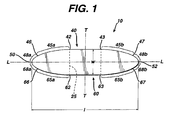
- Figure 1 is a top plan view of a bandage of the present invention.
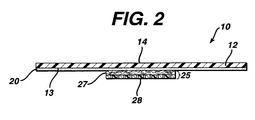
- Figure 2 is a longitudinal section taken along longitudinal axis, L-L, of Figure 1 and showing a wound contacting pad 25 comprising an absorbent layer 27 and a porous covering layer 28.
- Figure 3 shows one embodiment of the adhesive bandage of the present invention inscribed within a rectangle, R, the length of said bandage being substantially equivalent to the length of said rectangle and the maximum width of said bandage being substantially equal to the width of said rectangle.
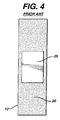
- Figure 4 is a top plan view of a substantially rectangular adhesive bandage known in the prior art.
- Figure 5 is a top plan view of a typical modified rectangular adhesive bandage known in the prior art.
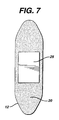
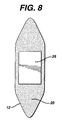
- Figures 6-8 are plan views of bandages in accordance with the teachings of the present invention, each of said bandages occupying an area which is less than the area of the rectangle in which it may be inscribed.
- bandage 10 comprises a backing material 12, an adhesive 20, and a wound-contacting pad 25.
- the bandage has a longitudinal axis, L-L, and a transverse axis, T-T, the longitudinal axis and the transverse axis intersecting each other at an angle of substantially 90°.
- the bandage has an upper edge 40 on one side of the longitudinal axis and a lower edge 60 on the other side of the longitudinal axis.
- the backing material has a first major surface 13 and a second major surface 14.
- the adhesive 20 is applied to the first major surface 13 of the backing material 12.
- the wound-contacting pad 25 is secured to the backing material 12 by a portion of the adhesive 20.
- the upper edge 40 of the bandage has a first straight line segment which extends from a first point 42 in the upper edge to a second point 43 in the upper edge.
- the upper edge 40 further includes a first pair of substantially identical arcuate segments 45 a and 45 b, each having a first radius of curvature.
- One of the arcuate segments, 45 a extends laterally from first point 42 to a first point of inflection 46 in the upper edge 40 and the other of the arcuate segments, 45 b extends from second point 43 to a second point of inflection 47 in the upper edge 40.
- the upper edge 40 further includes a second pair of substantially identical arcuate segments, 48 a and 48 b.
- Each of the second arcuate segments has a second radius of curvature.
- One of the second arcuate segments, 48 a extends from the first point of inflection (46) to a first end point 50 and the other of the second arcuate segments, 48 b, extends from the second point of inflection 47 to a second end point 52.
- the lower edge 60 of the bandage has a first straight line segment which extends from a first point 62 in the lower edge to a second point 63 in the lower edge.
- the lower edge 60 further includes a first pair of substantially identical arcuate segments 65 a and 65 b, each having a first radius of curvature.
- One of the arcuate segments, 65 a extends laterally from first point 62 in the lower edge to a first point of inflection (66) in the lower edge 60.
- the other arcuate segment, 65 b extends from second point 63 in the lower edge 60 to a second point of inflection 67 in the lower edge 60.
- the lower edge 60 further includes a second pair of substantially identical arcuate segments 68 a and 68 b, each of the second arcuate segments having a second radius of curvature.
- One of the second arcuate segments, 68 a extends from the first point of inflection 66 in the lower edge 60 to the first end point 50.
- the other of the second arcuate segments, 68 b extends from second point of inflection 67 in the lower edge 60 to the second end point 52.
- the upper edge 40 and the lower edge 60 when joined respectively at the first and second end points 50 and 52, define the periphery of the bandage.
- the area of the inventive bandage lying within said periphery ranges from about 65% to about 95% of the area of a rectangle in which the bandage may be inscribed.
- the length of the aforementioned straight line segments constitutes less than about 50% of the length, I, of the bandage, while the total length of the two adjacent tapered sections constitutes more than 50%.
- the length of the straight line segments constitutes less than 40% of the length, l, of the bandage.
- adhesive bandages in accordance with the invention be symmetrical when folded around their longitudinal axis, L-L, and when folded around their transverse axis, T-T.
- Finite elemental analysis was performed on various bandage embodiments to determine regions of the bandage that undergo stress, due to flexion of body parts, during use. These stressed regions result in discomfort and poor skin adhesion during use.
- the study simulates the stress to which an adhesive bandage is exposed when it is applied to a joint, such as a knuckle, a knee, or an elbow, and flexed during use.
- the bandage is applied on a substratum with elastic characteristics similar to those of human skin. The substratum is then elongated in the longitudinal and transverse direction exposing the product to stress.
- Bandage designs which were subjected to finite elemental analysis are shown in Figures 4, 5, 6, 7 and 8.
- the bandage of Figure 4 was a substantially rectangular bandage measuring 19mm wide and 76mm long.
- the bandage contains a wound-contacting pad which is 14 mm wide and 25 mm long and which is centered from end-to-end and from side-to-side of the bandage.
- the adhesive bandages of FIGS. 5-8 have the same overall length, the same overall width, the same adhesive and coating weight, and the same wound-contacting pad dimensions and location as the adhesive bandage shown in FIG. 4.
- the backings of the adhesive bandages of FIGS. 5-8 occupy only a percentage of the area of the rectangle in which they may be inscribed. Further, as is preferred, the backings of the bandages of FIGS. 5-8 are symmetrical when folded around their longitudinal and transverse axes.
- the adhesive bandage shown in FIG. 5 occupied an area which was about 97% of the area of the rectangle in which it could be inscribed.
- This adhesive bandage is representative of the modified rectangular bandage known in the prior art.
- the adhesive bandage shown in FIG. 6 occupied an area which was about 91% of the area of the rectangle in which it could be inscribed.
- the adhesive bandage shown in FIG. 7 occupied an area which is about 80% of the area of the rectangle in which it could be inscribed.
- the adhesive bandage shown in FIG. 8 occupied an area which is about 70% of the area of the rectangle in which it could be inscribed.
- the substantially rectangular adhesive bandage of Figure 4 was predicted to be uncomfortable in use and to have little resistance to unraveling or displacement from the skin in regions where it would be subjected to flexing and bending of a body part, e.g., a knuckle. Such results are consistent with actual experience with substantially rectangular adhesive bandages of the prior art.
Landscapes
- Health & Medical Sciences (AREA)
- Engineering & Computer Science (AREA)
- Biomedical Technology (AREA)
- Heart & Thoracic Surgery (AREA)
- Vascular Medicine (AREA)
- Life Sciences & Earth Sciences (AREA)
- Animal Behavior & Ethology (AREA)
- General Health & Medical Sciences (AREA)
- Public Health (AREA)
- Veterinary Medicine (AREA)
- Materials For Medical Uses (AREA)
- Adhesive Tapes (AREA)
Applications Claiming Priority (2)
| Application Number | Priority Date | Filing Date | Title |
|---|---|---|---|
| US09/895,962 US20030004450A1 (en) | 2001-06-29 | 2001-06-29 | Adhesive bandage with improved comfort and adhesion during use |
| US895962 | 2001-06-29 |
Publications (2)
| Publication Number | Publication Date |
|---|---|
| EP1269947A2 true EP1269947A2 (de) | 2003-01-02 |
| EP1269947A3 EP1269947A3 (de) | 2004-02-11 |
Family
ID=25405367
Family Applications (1)
| Application Number | Title | Priority Date | Filing Date |
|---|---|---|---|
| EP02254560A Withdrawn EP1269947A3 (de) | 2001-06-29 | 2002-06-28 | Klebeverband mit verbessertem Komfort und verbesserter Adhäsion |
Country Status (9)
| Country | Link |
|---|---|
| US (2) | US20030004450A1 (de) |
| EP (1) | EP1269947A3 (de) |
| JP (1) | JP2003052741A (de) |
| CN (1) | CN1397620A (de) |
| AU (1) | AU5063802A (de) |
| BR (1) | BR0202436A (de) |
| CA (1) | CA2391705A1 (de) |
| MX (1) | MXPA02006602A (de) |
| ZA (1) | ZA200205163B (de) |
Cited By (1)
| Publication number | Priority date | Publication date | Assignee | Title |
|---|---|---|---|---|
| ES2201864A1 (es) * | 2001-06-13 | 2004-03-16 | Jose Manuel Magdalena Portas | Tira adhesiva, protectora de heridas que evita rozamiento. |
Families Citing this family (38)
| Publication number | Priority date | Publication date | Assignee | Title |
|---|---|---|---|---|
| USD495419S1 (en) | 2003-08-15 | 2004-08-31 | 3M Innovative Properties Company | Bandage |
| US20050182443A1 (en) | 2004-02-18 | 2005-08-18 | Closure Medical Corporation | Adhesive-containing wound closure device and method |
| US20060009099A1 (en) | 2004-07-12 | 2006-01-12 | Closure Medical Corporation | Adhesive-containing wound closure device and method |
| USD578651S1 (en) | 2006-06-12 | 2008-10-14 | 3M Innovative Properties Company | Bandage |
| USD573260S1 (en) | 2006-06-12 | 2008-07-15 | 3M Innovative Properties Company | Bandage |
| USD604423S1 (en) | 2006-06-12 | 2009-11-17 | 3M Innovative Properties Company | Bandage |
| USD646789S1 (en) * | 2009-02-20 | 2011-10-11 | Steffen Barth | Adhesive bandage |
| USD712046S1 (en) * | 2013-11-07 | 2014-08-26 | Coloplast A/S | Wound dressing |
| USD831833S1 (en) | 2013-11-07 | 2018-10-23 | Bardy Diagnostics, Inc. | Extended wear electrode patch |
| USD712047S1 (en) * | 2013-11-07 | 2014-08-26 | Coloplast A/S | Wound dressing |
| USD717955S1 (en) | 2013-11-07 | 2014-11-18 | Bardy Diagnostics, Inc. | Electrocardiography monitor |
| USD712552S1 (en) * | 2013-11-07 | 2014-09-02 | Coloplast A/S | Wound dressing |
| USD712548S1 (en) * | 2013-11-07 | 2014-09-02 | Coloplast A/S | Wound dressing |
| USD712554S1 (en) * | 2013-11-07 | 2014-09-02 | Coloplast A/S | Wound dressing |
| USD892340S1 (en) | 2013-11-07 | 2020-08-04 | Bardy Diagnostics, Inc. | Extended wear electrode patch |
| USD712549S1 (en) * | 2013-11-07 | 2014-09-02 | Coloplast A/S | Wound dressing |
| USD712553S1 (en) * | 2013-11-07 | 2014-09-02 | Coloplast A/S | Wound dressing |
| USD712546S1 (en) * | 2013-11-07 | 2014-09-02 | Coloplast A/S | Wound dressing |
| USD824525S1 (en) | 2014-09-25 | 2018-07-31 | Ethicon Llc | Release paper for wound treament devices |
| US10792024B2 (en) | 2016-09-28 | 2020-10-06 | Ethicon, Inc. | Scaffolds with channels for joining layers of tissue at discrete points |
| US10470934B2 (en) | 2016-09-29 | 2019-11-12 | Ethicon, Inc. | Methods and devices for skin closure |
| USD848624S1 (en) | 2016-09-29 | 2019-05-14 | Ethicon, Inc. | Release paper for wound treatment devices |
| US10687986B2 (en) | 2016-09-29 | 2020-06-23 | Ethicon, Inc. | Methods and devices for skin closure |
| JP6815195B2 (ja) * | 2016-12-27 | 2021-01-20 | 日本光電工業株式会社 | 装着テープ及びパルスフォトメトリ用プローブ |
| US20180271505A1 (en) | 2017-03-23 | 2018-09-27 | Ethicon, Inc. | Scaffolds for Joining Layers of Tissue at Discrete Points |
| US10470935B2 (en) | 2017-03-23 | 2019-11-12 | Ethicon, Inc. | Skin closure systems and devices of improved flexibility and stretchability for bendable joints |
| US11504446B2 (en) | 2017-04-25 | 2022-11-22 | Ethicon, Inc. | Skin closure devices with self-forming exudate drainage channels |
| US11202721B2 (en) | 2017-09-29 | 2021-12-21 | Johnson & Johnson Consumer Inc. | Extensible dressings |
| US10993708B2 (en) | 2018-07-31 | 2021-05-04 | Ethicon, Inc. | Skin closure devices with interrupted closure |
| USD923801S1 (en) * | 2019-03-22 | 2021-06-29 | Welly Health PBC | Bandage |
| JP2022106461A (ja) * | 2021-01-07 | 2022-07-20 | 花王株式会社 | 身体貼付用シート |
| USD952163S1 (en) | 2021-02-09 | 2022-05-17 | Coloplast A/S | Wound dressing |
| USD962449S1 (en) | 2021-02-09 | 2022-08-30 | Coloplast A/S | Wound dressing |
| USD1080883S1 (en) | 2021-12-15 | 2025-06-24 | Kenvue Brands Llc | Adhesive bandage |
| USD1036679S1 (en) | 2021-12-15 | 2024-07-23 | Johnson & Johnson Consumer Inc. | Adhesive bandage |
| USD1122453S1 (en) | 2023-06-23 | 2026-04-14 | Kenvue Brands Llc | Adhesive bandage with colored pad |
| USD1122452S1 (en) | 2023-06-23 | 2026-04-14 | Kenvue Brands Llc | Adhesive bandage with colored pad |
| USD1123168S1 (en) | 2023-06-23 | 2026-04-21 | Kenvue Brands Llc | Adhesive bandage with colored pad |
Family Cites Families (7)
| Publication number | Priority date | Publication date | Assignee | Title |
|---|---|---|---|---|
| JP2001245917A (ja) * | 1998-12-11 | 2001-09-11 | Johnson & Johnson Kk | パッド、その製造方法及び該パッドを使用した救急絆創膏 |
| BR9901888A (pt) * | 1999-05-12 | 2001-01-16 | Johnson & Jonhson Ind E Com Lt | Porção de fita adesiva para pele |
| JP4509268B2 (ja) * | 1999-11-22 | 2010-07-21 | ジョンソン・エンド・ジョンソン株式会社 | 絆創膏 |
| JP4578601B2 (ja) * | 1999-11-22 | 2010-11-10 | ジョンソン・エンド・ジョンソン株式会社 | 絆創膏 |
| US20010037077A1 (en) * | 2000-05-05 | 2001-11-01 | Wiemken Brian James | Super care bandages |
| US6894204B2 (en) * | 2001-05-02 | 2005-05-17 | 3M Innovative Properties Company | Tapered stretch removable adhesive articles and methods |
| USD470592S1 (en) * | 2001-05-02 | 2003-02-18 | 3M Innovative Properties Company | Medical article |
-
2001
- 2001-06-29 US US09/895,962 patent/US20030004450A1/en not_active Abandoned
-
2002
- 2002-06-25 CA CA002391705A patent/CA2391705A1/en not_active Abandoned
- 2002-06-26 AU AU50638/02A patent/AU5063802A/en not_active Abandoned
- 2002-06-27 ZA ZA200205163A patent/ZA200205163B/xx unknown
- 2002-06-28 BR BR0202436-5A patent/BR0202436A/pt not_active IP Right Cessation
- 2002-06-28 CN CN02141238.3A patent/CN1397620A/zh active Pending
- 2002-06-28 EP EP02254560A patent/EP1269947A3/de not_active Withdrawn
- 2002-07-01 JP JP2002192530A patent/JP2003052741A/ja active Pending
- 2002-07-01 MX MXPA02006602A patent/MXPA02006602A/es unknown
- 2002-12-20 US US10/326,043 patent/US20030093024A1/en not_active Abandoned
Cited By (2)
| Publication number | Priority date | Publication date | Assignee | Title |
|---|---|---|---|---|
| ES2201864A1 (es) * | 2001-06-13 | 2004-03-16 | Jose Manuel Magdalena Portas | Tira adhesiva, protectora de heridas que evita rozamiento. |
| ES2201864B1 (es) * | 2001-06-13 | 2005-03-01 | Jose Manuel Magdalena Portas | Tira adhesiva, protectora de heridas que evita rozamiento. |
Also Published As
| Publication number | Publication date |
|---|---|
| AU5063802A (en) | 2003-01-02 |
| JP2003052741A (ja) | 2003-02-25 |
| BR0202436A (pt) | 2003-04-29 |
| EP1269947A3 (de) | 2004-02-11 |
| CA2391705A1 (en) | 2002-12-29 |
| CN1397620A (zh) | 2003-02-19 |
| US20030093024A1 (en) | 2003-05-15 |
| US20030004450A1 (en) | 2003-01-02 |
| MXPA02006602A (es) | 2004-08-19 |
| ZA200205163B (en) | 2004-02-03 |
Similar Documents
| Publication | Publication Date | Title |
|---|---|---|
| EP1269947A2 (de) | Klebeverband mit verbessertem Komfort und verbesserter Adhäsion | |
| AU2002301029B2 (en) | Adhesive Bandage With Improved Comfort And Fit | |
| CN112804975B (zh) | 具有粘合边缘的湿的伤口敷料 | |
| AU755726B2 (en) | Sanitary napkin | |
| EP0902676B1 (de) | Absorbierender artikel mit bei kontakt mit flüssigkeit schrumpfenden elementen | |
| TWI520717B (zh) | Absorbent items | |
| US6020535A (en) | Extensible absorbent article including a release agent | |
| KR20170131423A (ko) | 흡수성 물품의 신축 구조, 및 팬티 타입 일회용 기저귀 | |
| TW200423886A (en) | Disposable wearing article | |
| JP2006518259A (ja) | なじみやすい創傷被覆材 | |
| EP2047762A1 (de) | Stilleinlage | |
| JP5767783B2 (ja) | パンツタイプ使い捨ておむつ | |
| JPH0262B2 (de) | ||
| JP2011177285A5 (de) | ||
| KR20210016345A (ko) | 일회용 착용 물품 | |
| WO2006130594A2 (en) | Bandages with break lines | |
| US8182454B2 (en) | Breast milk absorbent pad | |
| JP2010200831A (ja) | 吸収性物品 | |
| JP5224920B2 (ja) | 吸収構造体 | |
| JP5779414B2 (ja) | 吸収性物品 | |
| EP1185224B1 (de) | Auf der haut haftendes klebeband | |
| JPH03139350A (ja) | 使い捨て着用物品 | |
| CN104271097A (zh) | 一次性尿布 | |
| JP3806128B2 (ja) | 使い捨ておむつ | |
| TWI761411B (zh) | 吸收性物品 |
Legal Events
| Date | Code | Title | Description |
|---|---|---|---|
| PUAI | Public reference made under article 153(3) epc to a published international application that has entered the european phase |
Free format text: ORIGINAL CODE: 0009012 |
|
| AK | Designated contracting states |
Kind code of ref document: A2 Designated state(s): AT BE CH CY DE DK ES FI FR GB GR IE IT LI LU MC NL PT SE TR |
|
| AX | Request for extension of the european patent |
Free format text: AL;LT;LV;MK;RO;SI |
|
| PUAL | Search report despatched |
Free format text: ORIGINAL CODE: 0009013 |
|
| AK | Designated contracting states |
Kind code of ref document: A3 Designated state(s): AT BE CH CY DE DK ES FI FR GB GR IE IT LI LU MC NL PT SE TR |
|
| AX | Request for extension of the european patent |
Extension state: AL LT LV MK RO SI |
|
| 17P | Request for examination filed |
Effective date: 20040723 |
|
| AKX | Designation fees paid |
Designated state(s): DE FR GB IE IT |
|
| STAA | Information on the status of an ep patent application or granted ep patent |
Free format text: STATUS: THE APPLICATION IS DEEMED TO BE WITHDRAWN |
|
| 18D | Application deemed to be withdrawn |
Effective date: 20070102 |