EP1264642A2 - Trocknungsverfahren für auf Bauteile applizierte Lackmaterialien und Vorrichtung zur Durchführung des Trocknungsverfahrens - Google Patents
Trocknungsverfahren für auf Bauteile applizierte Lackmaterialien und Vorrichtung zur Durchführung des Trocknungsverfahrens Download PDFInfo
- Publication number
- EP1264642A2 EP1264642A2 EP02011996A EP02011996A EP1264642A2 EP 1264642 A2 EP1264642 A2 EP 1264642A2 EP 02011996 A EP02011996 A EP 02011996A EP 02011996 A EP02011996 A EP 02011996A EP 1264642 A2 EP1264642 A2 EP 1264642A2
- Authority
- EP
- European Patent Office
- Prior art keywords
- drying
- nir
- infrared
- circulating air
- air drying
- Prior art date
- Legal status (The legal status is an assumption and is not a legal conclusion. Google has not performed a legal analysis and makes no representation as to the accuracy of the status listed.)
- Granted
Links
Images

Classifications
-
- B—PERFORMING OPERATIONS; TRANSPORTING
- B05—SPRAYING OR ATOMISING IN GENERAL; APPLYING FLUENT MATERIALS TO SURFACES, IN GENERAL
- B05D—PROCESSES FOR APPLYING FLUENT MATERIALS TO SURFACES, IN GENERAL
- B05D3/00—Pretreatment of surfaces to which liquids or other fluent materials are to be applied; After-treatment of applied coatings, e.g. intermediate treating of an applied coating preparatory to subsequent applications of liquids or other fluent materials
- B05D3/02—Pretreatment of surfaces to which liquids or other fluent materials are to be applied; After-treatment of applied coatings, e.g. intermediate treating of an applied coating preparatory to subsequent applications of liquids or other fluent materials by baking
- B05D3/0209—Multistage baking
-
- F—MECHANICAL ENGINEERING; LIGHTING; HEATING; WEAPONS; BLASTING
- F26—DRYING
- F26B—DRYING SOLID MATERIALS OR OBJECTS BY REMOVING LIQUID THEREFROM
- F26B3/00—Drying solid materials or objects by processes involving the application of heat
- F26B3/28—Drying solid materials or objects by processes involving the application of heat by radiation, e.g. from the sun
- F26B3/283—Drying solid materials or objects by processes involving the application of heat by radiation, e.g. from the sun in combination with convection
-
- B—PERFORMING OPERATIONS; TRANSPORTING
- B05—SPRAYING OR ATOMISING IN GENERAL; APPLYING FLUENT MATERIALS TO SURFACES, IN GENERAL
- B05D—PROCESSES FOR APPLYING FLUENT MATERIALS TO SURFACES, IN GENERAL
- B05D3/00—Pretreatment of surfaces to which liquids or other fluent materials are to be applied; After-treatment of applied coatings, e.g. intermediate treating of an applied coating preparatory to subsequent applications of liquids or other fluent materials
- B05D3/02—Pretreatment of surfaces to which liquids or other fluent materials are to be applied; After-treatment of applied coatings, e.g. intermediate treating of an applied coating preparatory to subsequent applications of liquids or other fluent materials by baking
- B05D3/0254—After-treatment
- B05D3/0263—After-treatment with IR heaters
-
- B—PERFORMING OPERATIONS; TRANSPORTING
- B05—SPRAYING OR ATOMISING IN GENERAL; APPLYING FLUENT MATERIALS TO SURFACES, IN GENERAL
- B05D—PROCESSES FOR APPLYING FLUENT MATERIALS TO SURFACES, IN GENERAL
- B05D3/00—Pretreatment of surfaces to which liquids or other fluent materials are to be applied; After-treatment of applied coatings, e.g. intermediate treating of an applied coating preparatory to subsequent applications of liquids or other fluent materials
- B05D3/04—Pretreatment of surfaces to which liquids or other fluent materials are to be applied; After-treatment of applied coatings, e.g. intermediate treating of an applied coating preparatory to subsequent applications of liquids or other fluent materials by exposure to gases
- B05D3/0406—Pretreatment of surfaces to which liquids or other fluent materials are to be applied; After-treatment of applied coatings, e.g. intermediate treating of an applied coating preparatory to subsequent applications of liquids or other fluent materials by exposure to gases the gas being air
- B05D3/0413—Heating with air
-
- F—MECHANICAL ENGINEERING; LIGHTING; HEATING; WEAPONS; BLASTING
- F26—DRYING
- F26B—DRYING SOLID MATERIALS OR OBJECTS BY REMOVING LIQUID THEREFROM
- F26B2210/00—Drying processes and machines for solid objects characterised by the specific requirements of the drying goods
- F26B2210/12—Vehicle bodies, e.g. after being painted
Definitions
- the invention relates in particular to a drying process for components paint materials applied to vehicle bodies or their parts the preamble of claim 1 and a device for performing the drying method according to the preamble of claim 8.
- a two-stage drying process is also known (DE 195 03 775 C1), in which infrared emitters are used in the first drying stage contoured in their arrangement to the shape of the object to be dried or by means of adjusting devices up to a short distance can be brought up.
- the heating and Drying only carried out to a certain degree of drying and then the object to be dried is turned lengthwise into a second one Dryer cabin promoted for the second drying stage, where then the further Drying at a given object temperature with predominantly stationary Infrared emitters are carried out until the paint has completely dried.
- Circulating air drying curing is not intended, only before the first Drying level is an intermediate evaporation, if necessary using warm air provided at an elevated temperature as well as a blow ring between the first dryer cabin and the second dryer cabin to lower the temperature to prevent when passing through the intermediate area.
- a drying process for coating materials is also known (DE 38 14 871 A1), in which only infrared drying is used.
- the first step is by means of infrared drying with a radiation frequency Near-infrared (NIR) cleaning water dried from the workpiece.
- NIR Near-infrared
- the spray painted workpiece is turned into one Kiln transferred on both sides of several rows of NIR emitters are arranged.
- the wavelength ranges here are in the near infrared at 1.0 to 4.0 ⁇ m.
- a change from low temperature and high temperature areas A problem with such pure NIR drying consists of hidden areas that are exposed to the NIR radiation does not hit directly, is only slightly warmed and cured, so this method only works for objects with no hidden areas, in particular cannot be used for heavily structured vehicle bodies.
- a generic two-stage drying process is also used infrared drying and circulating air drying are known (DE 43 36 856 A1). It is important for the paint drying that in a heating-up time only infrared emitters are used and no forced-air drying takes place. Only in the holding time that follows after the heating-up time can a Drying by circulating air alone or in combination with infrared heaters or pure infrared heating takes place. For example, here in the heating time a drying temperature of 150 ° can be reached in a maximum of 6 minutes, corresponding to a heating of approx. 20 ° / min. Such an extremely short one Heating time can lead to blistering and thus an unsatisfactory Lead painting result. At most, these are short, extreme heating times can only be mastered in connection with the specified paint materials, so this known method is limited and not at all painting processes can be used universally. Information about the used Wavelengths for infrared heating are not made here.
- the object of the invention is to propose a drying process with that relatively short drying times can be achieved and that is universal optimally smooth lacquer surfaces can be used. Another job
- the invention is an apparatus for performing such To provide drying process.
- the task is regarding the drying process with the characteristics of claim 1 solved.
- the first step in the process is forced air drying up to a predetermined degree of curing of the coating material carried out.
- infrared drying is subsequently carried out performed as near-infrared drying (NIR drying) with a radiation frequency in the near infrared (NIR) by means of at least one near infrared radiator (NIR emitter) for a further increase in the degree of curing in the radiation-accessible areas of the component after circulating air drying.
- NIR drying near-infrared drying
- NIR emitter near infrared radiator
- step according to claim 2 is a subsequent one Hardening at room temperature for a complete hardening of hidden Execute areas in the second step of the NIR radiation have not been reached.
- the drying method according to the invention is universal according to claim 7 after each painting step, especially after KTL, filler, basecoat and clearcoat usable.
- Particularly suitable coating systems are based on polyurethane manufactured.
- the NIR drying then follows in the second process step Temperatures on the substrate surface are said to occur in one area from minus 10 ° to plus 40 ° based on the ambient air temperature of 140 °.
- the NIR drying is therefore carried out at temperatures from 130 ° to 180 ° Loading time from approx. 0.3 to 4.0 min.
- the circulating air drying takes place in a first drying cabin according to the first step.
- a second drying cabin in which the NIR drying takes place.
- the components to be dried, in particular vehicle bodies, are transported through the drying booths by suitable means of funding. ever depending on the circumstances there is a continuous or discontinuous Transport possible.
- Particularly good results with effective use of energy are achieved with the features of claim 9 by the NIR emitter for the second process step on controllable adjusting devices are attached in such a way that they conform to the contours to be dried Components, in particular on vehicle bodies, within a short distance can be brought up.
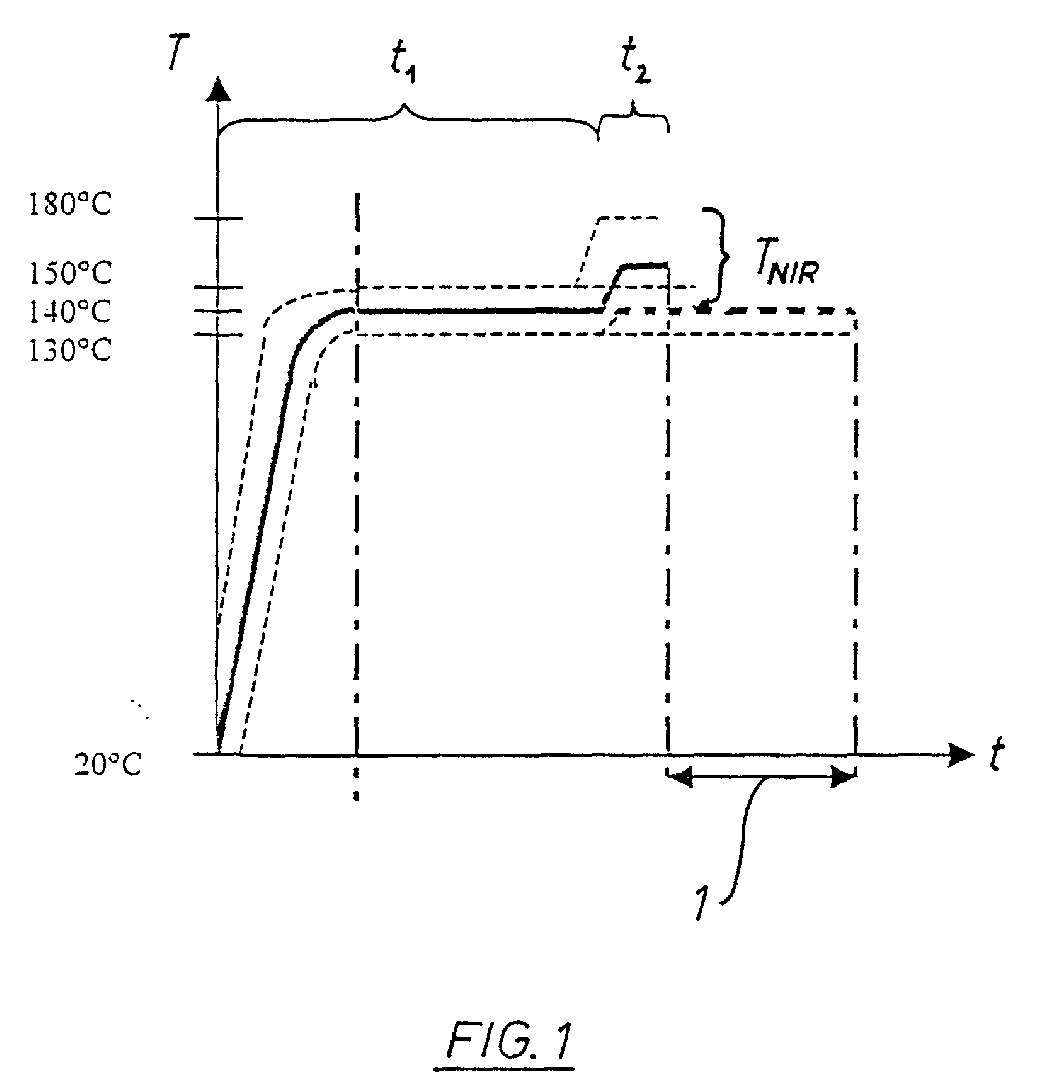
- FIG. 1 schematically shows a temperature-time diagram of an inventive one Drying method for an applicable to a vehicle body 140 ° clear coat shown.
- circulating air drying is carried out up to a predetermined degree of curing of the clear lacquer with an object temperature of 140 ° C., as shown in the diagram with the solid black line is shown.
- NIR drying is then carried out for a time t 2 of, for example, 0.3 to 4 min, at which temperatures occur in the region of approximately 160 ° C., as shown in FIG 1 can also be seen again from the solid thick line.
- the forced-air drying can as a first step in the process with an object temperature of +/- 10 ° C on the object temperature of 140 ° C.
- the NIR drying in a range from - 10 ° C to + 40 ° C based on the ambient air temperature of 140 ° C are carried out.
- NIR drying uses e.g. Wavelength ranges from 0.76 ⁇ m up to 1.2 ⁇ m used.
- FIG. 2 schematically shows a structure of a device according to the invention 2 to carry out the drying process shown a first drying cabin as a circulating air drying cabin 3 and a second drying cabin has as an NIR drying cabin 4.
- the vehicle to be painted 5 can e.g. with a conveyor not shown here be promoted by the two drying cabins 3, 4.
- NIR emitters 6 are arranged, which are controllable and actuating devices not shown in detail here are applied that except for one, they are contour-adjusted to the vehicle bodies to be dried can be moved up close.
Landscapes
- Engineering & Computer Science (AREA)
- Life Sciences & Earth Sciences (AREA)
- Microbiology (AREA)
- Mechanical Engineering (AREA)
- General Engineering & Computer Science (AREA)
- Drying Of Solid Materials (AREA)
- Coating Apparatus (AREA)
- Application Of Or Painting With Fluid Materials (AREA)
Abstract
Description
- Fig. 1
- ein schematisches Temperatur-Zeitdiagramm eines erfindungsgemäßen Trocknungsverfahrens,
- Fig. 2
- eine schematische Prinzipdarstellung einer Trocknungsvorrichtung,
- Fig. 3
- eine schematische Frontansicht einer NIR-Trocknungskabine, und
- Fig. 4
- eine schematische Seitenansicht der NIR-Trocknungskabine der Fig. 3.
Claims (9)
- Trocknungsverfahren für auf Bauteile, insbesondere auf Fahrzeugkarosserien oder deren Teile applizierte Lackmaterialien, wobei nach einer Applikation des Lackmaterials und einem Ablüften das Trocknungsverfahren zweistufig unter Einsatz einer Infrarot-Trocknung und einer Umluft-Trocknung durchgeführt wird, gekennzeichnet durch folgende Verfahrensschritte:a) eine Umluft-Trocknung bis zu einem vorbestimmten Aushärtungsgrad des Lackmaterials,b) eine nachfolgende Infrarot-Trocknung als Nahe-Infrarot-Trocknung (NIR-Trocknung) mit einer Strahlungsfrequenz im nahen Infrarot (NIR) mittels wenigstens eines Nahen-Infrarot-Strahlers (NIR-Strahlers) für eine weitere Erhöhung des Aushärtungsgrades in den strahlenzugänglichen Bereichen des Bauteils nach der Umluft-Trocknung.
- Trocknungsverfahren nach Anspruch 1, gekennzeichnet durch einen weiteren Verfahrensschritt:c) eine nachträgliche Härtung bei Raumtemperatur, insbesondere als Feuchtigkeitshärtung für eine vollkommene Aushärtung von verdeckten Bereichen, die im Verfahrensschritt (b) von der NIR-Strahlung nicht erreicht worden sind.
- Trocknungsverfahren nach Anspruch 1 oder 2, dadurch gekennzeichnet, dass im Verfahrensschritt (a) eine Umluft-Trocknung mit einer minimalen Belastungszeit (t1) von einem Drittel der Zeit erfolgt, welche bei einer herkömmlichen alleinigen Umluft-Trocknung ohne Verfahrensschritt (b) erforderlich wäre.
- Trocknungsverfahren nach einem der Ansprüche 1 bis 3, dadurch gekennzeichnet, dass im Verfahrensschritt (b) eine NIR-Trocknung mit einer Belastungszeit (t2) von 0,3 bis 4 min erfolgt.
- Trocknungsverfahren nach einem der Ansprüche 1 bis 4, dadurch gekennzeichnet, dass im Verfahrensschritt (a) bei der Umluft-Trocknung eine Umluft-Trocknungstemperatur gefahren wird, die analog bei einer herkömmlichen alleinigen Umluft-Trocknung verwendet wird, und
dass im Verfahrensschritt (b) bei der NIR-Trocknung die Oberflächentemperatur in einem Bereich von minus 10° bis plus 40° bezogen auf die Umluft-Trocknungstemperatur gehalten wird. - Trocknungsverfahren nach einem der Ansprüche 1 bis 5, dadurch gekennzeichnet, dass bei der NIR-Trocknung Wellenlängen im Bereich von 0,76 µm bis 1,2 µm verwendet werden.
- Trocknungsverfahren nach einem der Ansprüche 1 bis 6, dadurch gekennzeichnet, dass das Trocknungsverfahren nach jedem Lackierschritt angewendet wird und geeignete Lacksysteme insbesondere auf Polyurethan-Basis verwendet werden.
- Vorrichtung nach einem der Ansprüche 1 bis 7,
mit wenigstens zwei Trocknungskabinen(3, 4), dadurch gekennzeichnet, dass in einer ersten Trocknungskabine (3) die Umluft-Trocknung gemäß Verfahrensschritt (a) erfolgt und in einer an der ersten Trocknungskabine (3) anschließenden zweiten Trocknungskabine (4) die NIR-Trocknung erfolgt, und
dass die zu trocknenden Bauteile, insbesondere Fahrzeugkarosserien (5) durch Fördermittel selbständig durch die Trocknungskabinen (3, 4) transportierbar sind. - Vorrichtung nach Anspruch 8, dadurch gekennzeichnet, dass NIR-Strahler (6) für den Verfahrensschritt (b) auf steuerbaren Stellvorrichtungen dergestalt angebracht sind, dass sie konturenangepaßt an die zu trocknenden Bauteile, insbesondere an Fahrzeugkarosserien (5) bis auf einen geringen Abstand heranbringbar sind.
Applications Claiming Priority (2)
| Application Number | Priority Date | Filing Date | Title |
|---|---|---|---|
| DE10127962 | 2001-06-08 | ||
| DE2001127962 DE10127962B4 (de) | 2001-06-08 | 2001-06-08 | Trocknungsverfahren für auf Bauteile, insbesondere auf Fahrzeugkarosserien oder deren Teile applizierte Lackmaterialien und Vorrichtung zur Durchführung des Trocknungsverfahrens |
Publications (3)
| Publication Number | Publication Date |
|---|---|
| EP1264642A2 true EP1264642A2 (de) | 2002-12-11 |
| EP1264642A3 EP1264642A3 (de) | 2003-12-17 |
| EP1264642B1 EP1264642B1 (de) | 2006-08-23 |
Family
ID=7687701
Family Applications (1)
| Application Number | Title | Priority Date | Filing Date |
|---|---|---|---|
| EP20020011996 Expired - Lifetime EP1264642B1 (de) | 2001-06-08 | 2002-05-31 | Trocknungsverfahren für auf Bauteile applizierte Lackmaterialien und Vorrichtung zur Durchführung des Trocknungsverfahrens |
Country Status (3)
| Country | Link |
|---|---|
| EP (1) | EP1264642B1 (de) |
| DE (2) | DE10127962B4 (de) |
| ES (1) | ES2266348T3 (de) |
Cited By (6)
| Publication number | Priority date | Publication date | Assignee | Title |
|---|---|---|---|---|
| WO2005015102A3 (de) * | 2003-07-24 | 2005-03-31 | Eisenmann Kg Maschbau | Vorrichtung zur aushärtung einer aus einem material, das unter elektromagnetischer strahlung aushärtet, insbesondere aus einem uv-lack oder aus einem thermisch aushärtenden lack, bestehenden beschichtung eines gegenstandes |
| WO2005011878A3 (de) * | 2003-07-24 | 2005-04-21 | Eisenmann Kg Maschbau | Vorrichtung zur aushärtung einer aus einem material, das unter elektromagnetischer strahlung aushärtet, insbesondere aus einem uv-lack oder aus einem thermisch aushärtenden lack, bestehenden beschichtung eines gegenstandes |
| CN100460791C (zh) * | 2003-07-24 | 2009-02-11 | 艾森曼机械制造有限及两合公司 | 使物体的涂层硬化的装置 |
| CN100460790C (zh) * | 2003-07-24 | 2009-02-11 | 艾森曼机械制造有限及两合公司 | 用来使物体的由在电磁辐射作用下硬化的材料,特别是由uv油漆或热硬化油漆组成的涂层硬化的装置 |
| CN103008204A (zh) * | 2013-01-11 | 2013-04-03 | 福州伟通机械设备有限公司 | 一种前大灯冷胶干燥炉 |
| US11619399B1 (en) * | 2021-09-22 | 2023-04-04 | William H. White | Systems and methods for direct use of solar energy |
Families Citing this family (2)
| Publication number | Priority date | Publication date | Assignee | Title |
|---|---|---|---|---|
| US7473444B2 (en) | 2002-01-21 | 2009-01-06 | Kansai Paint Co., Ltd. | Method of forming coating film |
| DE10326191B3 (de) * | 2003-06-06 | 2005-02-03 | Daimlerchrysler Ag | Trocknung von lackierten Oberflächen |
Family Cites Families (7)
| Publication number | Priority date | Publication date | Assignee | Title |
|---|---|---|---|---|
| US4943447A (en) * | 1986-09-08 | 1990-07-24 | Bgk Finishing Systems, Inc. | Automotive coating treating process |
| US5323485A (en) * | 1991-08-29 | 1994-06-21 | Abb Flakt, Inc. | Paint baking oven having a bring-up zone utilizing short and medium wave infrared lamps |
| DE4336856A1 (de) * | 1993-10-28 | 1995-05-04 | Bayerische Motoren Werke Ag | Verfahren zum Trocknen von Automobillacken |
| DE19503775C1 (de) * | 1995-02-04 | 1996-03-14 | Burkamp En Und Anlagentechnik | Verfahren zur Trocknung von Lacken mittels Infrarotstrahlern |
| DE19628831A1 (de) * | 1996-07-17 | 1998-01-22 | Basf Lacke & Farben | Labortrockner |
| DE19913442C2 (de) * | 1999-03-25 | 2002-10-31 | Herberts Gmbh & Co Kg | Verfahren zur Lackierung von Fahrzeugkarossen oder deren Teilen |
| US6231932B1 (en) * | 1999-05-26 | 2001-05-15 | Ppg Industries Ohio, Inc. | Processes for drying topcoats and multicomponent composite coatings on metal and polymeric substrates |
-
2001
- 2001-06-08 DE DE2001127962 patent/DE10127962B4/de not_active Expired - Lifetime
-
2002
- 2002-05-31 EP EP20020011996 patent/EP1264642B1/de not_active Expired - Lifetime
- 2002-05-31 DE DE50207900T patent/DE50207900D1/de not_active Expired - Lifetime
- 2002-05-31 ES ES02011996T patent/ES2266348T3/es not_active Expired - Lifetime
Cited By (6)
| Publication number | Priority date | Publication date | Assignee | Title |
|---|---|---|---|---|
| WO2005015102A3 (de) * | 2003-07-24 | 2005-03-31 | Eisenmann Kg Maschbau | Vorrichtung zur aushärtung einer aus einem material, das unter elektromagnetischer strahlung aushärtet, insbesondere aus einem uv-lack oder aus einem thermisch aushärtenden lack, bestehenden beschichtung eines gegenstandes |
| WO2005011878A3 (de) * | 2003-07-24 | 2005-04-21 | Eisenmann Kg Maschbau | Vorrichtung zur aushärtung einer aus einem material, das unter elektromagnetischer strahlung aushärtet, insbesondere aus einem uv-lack oder aus einem thermisch aushärtenden lack, bestehenden beschichtung eines gegenstandes |
| CN100460791C (zh) * | 2003-07-24 | 2009-02-11 | 艾森曼机械制造有限及两合公司 | 使物体的涂层硬化的装置 |
| CN100460790C (zh) * | 2003-07-24 | 2009-02-11 | 艾森曼机械制造有限及两合公司 | 用来使物体的由在电磁辐射作用下硬化的材料,特别是由uv油漆或热硬化油漆组成的涂层硬化的装置 |
| CN103008204A (zh) * | 2013-01-11 | 2013-04-03 | 福州伟通机械设备有限公司 | 一种前大灯冷胶干燥炉 |
| US11619399B1 (en) * | 2021-09-22 | 2023-04-04 | William H. White | Systems and methods for direct use of solar energy |
Also Published As
| Publication number | Publication date |
|---|---|
| DE50207900D1 (de) | 2006-10-05 |
| EP1264642B1 (de) | 2006-08-23 |
| EP1264642A3 (de) | 2003-12-17 |
| DE10127962A1 (de) | 2002-12-19 |
| ES2266348T3 (es) | 2007-03-01 |
| DE10127962B4 (de) | 2006-01-26 |
Similar Documents
| Publication | Publication Date | Title |
|---|---|---|
| EP2495292B1 (de) | Fügeflächenvorbehandlungsvorrichtung und Fügeflächenvorbehandlungsverfahren | |
| DE3878681T2 (de) | Verfahren und vorrichtung zur behandlung einer oberflaeche. | |
| DE69419687T2 (de) | Lackierverfahren und Lackiereinrichtung | |
| EP1264642B1 (de) | Trocknungsverfahren für auf Bauteile applizierte Lackmaterialien und Vorrichtung zur Durchführung des Trocknungsverfahrens | |
| DE69610930T2 (de) | Verfahren zur pulverbeschichtung und in diesem verfahren verwandtes pulver | |
| DE10261298B4 (de) | Verfahren zur Herstellung einer Beschichtung auf einer Fahrzeugkarosserie und Dichtungsmittel-Trocknungsvorrichtung | |
| DE112010000464T5 (de) | Verfahren und vorrichtung zum lackaushärten | |
| WO2014127893A1 (de) | Fördersystem | |
| DE19945291A1 (de) | Lackieranlage zum Lackieren von Kunststoff-Gegenständen | |
| EP0724706B1 (de) | Verfahren zum trocken von automobillacken | |
| WO2018011389A1 (de) | Vorrichtung, anlage und verfahren zum temperieren von werkstücken | |
| DE19503775C1 (de) | Verfahren zur Trocknung von Lacken mittels Infrarotstrahlern | |
| DE102005039875C5 (de) | Beschichtungsvorrichtung zur Beschichtung von Kleinteilen | |
| AT403518B (de) | Verfahren und einrichtung zum trocknen und/oder aushärten von beschichtungen | |
| EP0369478B1 (de) | Kammer für die verschiedenen Behandlungsstationen eines Gegenstandes beim elektrostatischen Pulverbeschichten | |
| DE8700427U1 (de) | Infrarottrockner | |
| EP0724705B1 (de) | Verfahren zum trocknen von automobillacken | |
| DE10312381A1 (de) | Verfahren zur Trocknung einer Lackierung auf einem Objekt | |
| DE4312892A1 (de) | Lacktrocknungsanlage | |
| DE202005021235U1 (de) | Beschichtungsvorrichtung zur Beschichtung von Kleinteilen | |
| DE102012109817A1 (de) | Beschichtungsvorrichtung für Solarmodule | |
| EP1900440B1 (de) | Verwendung eines Applikationsmittels bei der Beschichtung und Lackierung mit UV/IR-härtenden Lacken | |
| DE102004033260A1 (de) | Verfahren und Vorrichtung zum Aushärten von strahlungsinduziert härtbaren Lacken | |
| DE3623239C1 (en) | Device for receiving articles which are permanently deformable under loading and simultaneous heat action | |
| DE7815635U1 (de) | Vorrichtung zur herstellung eines verbundstranges |
Legal Events
| Date | Code | Title | Description |
|---|---|---|---|
| PUAI | Public reference made under article 153(3) epc to a published international application that has entered the european phase |
Free format text: ORIGINAL CODE: 0009012 |
|
| AK | Designated contracting states |
Kind code of ref document: A2 Designated state(s): AT BE CH CY DE DK ES FI FR GB GR IE IT LI LU MC NL PT SE TR |
|
| AX | Request for extension of the european patent |
Free format text: AL;LT;LV;MK;RO;SI |
|
| PUAL | Search report despatched |
Free format text: ORIGINAL CODE: 0009013 |
|
| AK | Designated contracting states |
Kind code of ref document: A3 Designated state(s): AT BE CH CY DE DK ES FI FR GB GR IE IT LI LU MC NL PT SE TR |
|
| AX | Request for extension of the european patent |
Extension state: AL LT LV MK RO SI |
|
| 17P | Request for examination filed |
Effective date: 20040110 |
|
| AKX | Designation fees paid |
Designated state(s): DE ES FR GB IT |
|
| 17Q | First examination report despatched |
Effective date: 20040917 |
|
| GRAP | Despatch of communication of intention to grant a patent |
Free format text: ORIGINAL CODE: EPIDOSNIGR1 |
|
| GRAS | Grant fee paid |
Free format text: ORIGINAL CODE: EPIDOSNIGR3 |
|
| GRAA | (expected) grant |
Free format text: ORIGINAL CODE: 0009210 |
|
| AK | Designated contracting states |
Kind code of ref document: B1 Designated state(s): DE ES FR GB IT |
|
| PG25 | Lapsed in a contracting state [announced via postgrant information from national office to epo] |
Ref country code: IT Free format text: LAPSE BECAUSE OF FAILURE TO SUBMIT A TRANSLATION OF THE DESCRIPTION OR TO PAY THE FEE WITHIN THE PRESCRIBED TIME-LIMIT;WARNING: LAPSES OF ITALIAN PATENTS WITH EFFECTIVE DATE BEFORE 2007 MAY HAVE OCCURRED AT ANY TIME BEFORE 2007. THE CORRECT EFFECTIVE DATE MAY BE DIFFERENT FROM THE ONE RECORDED. Effective date: 20060823 |
|
| REG | Reference to a national code |
Ref country code: GB Ref legal event code: FG4D Free format text: NOT ENGLISH |
|
| REF | Corresponds to: |
Ref document number: 50207900 Country of ref document: DE Date of ref document: 20061005 Kind code of ref document: P |
|
| GBT | Gb: translation of ep patent filed (gb section 77(6)(a)/1977) |
Effective date: 20061018 |
|
| ET | Fr: translation filed | ||
| REG | Reference to a national code |
Ref country code: ES Ref legal event code: FG2A Ref document number: 2266348 Country of ref document: ES Kind code of ref document: T3 |
|
| PLBE | No opposition filed within time limit |
Free format text: ORIGINAL CODE: 0009261 |
|
| STAA | Information on the status of an ep patent application or granted ep patent |
Free format text: STATUS: NO OPPOSITION FILED WITHIN TIME LIMIT |
|
| 26N | No opposition filed |
Effective date: 20070524 |
|
| PGFP | Annual fee paid to national office [announced via postgrant information from national office to epo] |
Ref country code: DE Payment date: 20150531 Year of fee payment: 14 |
|
| REG | Reference to a national code |
Ref country code: FR Ref legal event code: PLFP Year of fee payment: 15 |
|
| PGFP | Annual fee paid to national office [announced via postgrant information from national office to epo] |
Ref country code: GB Payment date: 20160512 Year of fee payment: 15 Ref country code: ES Payment date: 20160520 Year of fee payment: 15 |
|
| PGFP | Annual fee paid to national office [announced via postgrant information from national office to epo] |
Ref country code: IT Payment date: 20160531 Year of fee payment: 15 Ref country code: FR Payment date: 20160512 Year of fee payment: 15 |
|
| REG | Reference to a national code |
Ref country code: DE Ref legal event code: R119 Ref document number: 50207900 Country of ref document: DE |
|
| PG25 | Lapsed in a contracting state [announced via postgrant information from national office to epo] |
Ref country code: DE Free format text: LAPSE BECAUSE OF NON-PAYMENT OF DUE FEES Effective date: 20161201 |
|
| GBPC | Gb: european patent ceased through non-payment of renewal fee |
Effective date: 20170531 |
|
| REG | Reference to a national code |
Ref country code: FR Ref legal event code: ST Effective date: 20180131 |
|
| PG25 | Lapsed in a contracting state [announced via postgrant information from national office to epo] |
Ref country code: GB Free format text: LAPSE BECAUSE OF NON-PAYMENT OF DUE FEES Effective date: 20170531 |
|
| PG25 | Lapsed in a contracting state [announced via postgrant information from national office to epo] |
Ref country code: IT Free format text: LAPSE BECAUSE OF NON-PAYMENT OF DUE FEES Effective date: 20170531 Ref country code: FR Free format text: LAPSE BECAUSE OF NON-PAYMENT OF DUE FEES Effective date: 20170531 |
|
| REG | Reference to a national code |
Ref country code: ES Ref legal event code: FD2A Effective date: 20180627 |
|
| PG25 | Lapsed in a contracting state [announced via postgrant information from national office to epo] |
Ref country code: ES Free format text: LAPSE BECAUSE OF NON-PAYMENT OF DUE FEES Effective date: 20170601 |